
Showing 64 items matching "cornish miners"
-
![Photograph - North Sunshine Cornish miners building Wesleyan Church 19402, [circa 1940s]](/media/collectors/5164c1772162ef0c64d700f2/items/69dc57946a5a9c1cb356d97d/item-media/69dc58fb6a5a9c1cb356ee0f/item-fit-380x285.jpg?cb=6) Sunshine and District Historical Society Incorporated
Sunshine and District Historical Society IncorporatedPhotograph - North Sunshine Cornish miners building Wesleyan Church 19402, [circa 1940s]
... North Sunshine Cornish miners building Wesleyan Church 19402...North Sunshine Cornish miners building Wesleyan Church 1940s...Photo of an old building in North Sunshine built by Cornish miners It was used for many years as Wesleyan Church until the early 20th Century The building is now demolished...Sunshine North Albion Wesleyan Church Church Photo of an old building in North Sunshine built by Cornish miners It was used for many years as Wesleyan Church until the early 20th Century The building is now demolished North Sunshine Cornish miners building Wesleyan Church 1940s Photograph North Sunshine Cornish miners building Wesleyan Church 19402 ...Photo of an old building in North Sunshine built by Cornish miners It was used for many years as Wesleyan Church until the early 20th Century The building is now demolishedsunshine north, albion wesleyan church, church -
 Bendigo Historical Society Inc.
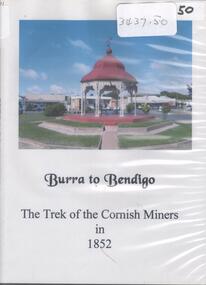
Film - BURRA TO BENDIGO, 1852
... Cornish Miners...The Trek of the Cornish Miners in 1852....Cornish Miners Burra to Bendigo DVD. Burra to Bendigo. ...DVD. Burra to Bendigo. The Trek of the Cornish Miners in 1852.cornish miners, burra to bendigo -
 Bendigo Historical Society Inc.
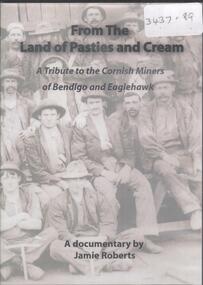
Film - FROM THE LAND OF PASTIES AND CREAM, 2010
... Cornish Miners...A Tribute to the Cornish Miners of Bendigo and Eaglehawk. A Documentary by Jamie Roberts....Cornish Miners Jamie Roberts DVD. From the Land of Pasties and Cream. ...DVD. From the Land of Pasties and Cream. A Tribute to the Cornish Miners of Bendigo and Eaglehawk. A Documentary by Jamie Roberts.cornish miners, jamie roberts -
 Bendigo Historical Society Inc.
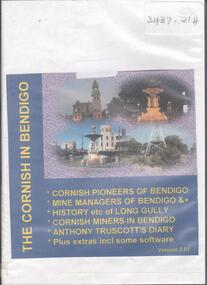
Book - THE CORNISH IN BENDIGO
... ...Cornish miners...Cornish pioneers Cornish miners DVD. The Cornish in Bendigo. Book THE CORNISH IN BENDIGO ...DVD. The Cornish in Bendigo.cornish pioneers, cornish miners -
 Bendigo Historical Society Inc.
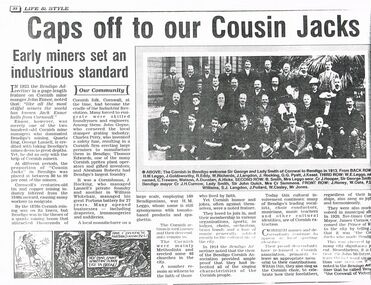
Document - CORNISH COLLECTION: COPY OF BENDIGO ADVERTISER ARTICLE TITLED ''CAPS OFF TO OUR COUSIN JACKS''
... ...John Ennor. Cornish Miners. J. Hocking. Charles Perry. Abraham Roberts. ...BENDIGO Mining early history. miners John Ennor. Cornish Miners. J. Hocking. Charles Perry. Abraham Roberts. ...Document. Copy of Bendigo Advertiser article (undated) titled ''Caps off to our Cousin Jacks'': Provides brief history of Cornish influence on mining in Bendigo, church affiliation and musical tradition; mention of John Groyne, Charles Perry, Thomas Edwards, Abraham Roberts, J Hocking, William Whitehair, James Curnow with B&W reproduction of photo (1913) showing group of approx. 35 people (named) welcoming Sir George and Lady Smith to Bendigo.bendigo, mining, early history. miners, john ennor. cornish miners. j. hocking. charles perry. abraham roberts. h. m. leggo. bendigo cornish association. -
 Clunes Museum
Book, JIM FAULL, THE CORNISH IN AUSTRALIA, 1983
... CORNISH MINERS...CORNISH MINERS MIGRATION HISTORICAL INFORMATION RELATED TO CORNISH MIGRATION TO AUSTRALIA MANY INVOLVED IN MINING 115 PAGE BOOK WITH MAPS, DRAWINGS, PHOTOGRAPHS AND HISTORICAL INFORMATION RELATED TO CORNISH MIGRATION TO AUSTRALIA MANY INVOLVED IN MINING. ...HISTORICAL INFORMATION RELATED TO CORNISH MIGRATION TO AUSTRALIA MANY INVOLVED IN MINING115 PAGE BOOK WITH MAPS, DRAWINGS, PHOTOGRAPHS AND HISTORICAL INFORMATION RELATED TO CORNISH MIGRATION TO AUSTRALIA MANY INVOLVED IN MINING. ORANGE COVER WITH PHOTOGRAPH ON THE FRONT. MUSTARD COLOUR SPINE.non-fictionHISTORICAL INFORMATION RELATED TO CORNISH MIGRATION TO AUSTRALIA MANY INVOLVED IN MININGcornish miners, migration -
 Bendigo Historical Society Inc.
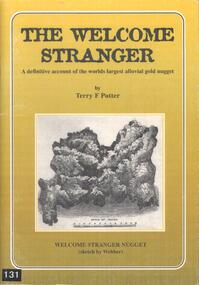
Book - BOOK: THE WELCOME STRANGER - A DEFINITIVE ACCOUNT OF THE WORLDS LARGEST ALLUVIAL GOLD NUGGET, 1999
... This alluvial gold nugget was discovered in 1869 at Moliagul, by Cornish miners, John Deason and Richard Oates. It's gross weight was 109.51 kg and net weight of gold was 72.02 kg. ...This alluvial gold nugget was discovered in 1869 at Moliagul, by Cornish miners, John Deason and Richard Oates. It's gross weight was 109.51 kg and net weight of gold was 72.02 kg. ...This alluvial gold nugget was discovered in 1869 at Moliagul, by Cornish miners, John Deason and Richard Oates. It's gross weight was 109.51 kg and net weight of gold was 72.02 kg. It was melted down and the ingots sent to the Bank of England.Softcover book with gold coloured cover with a sketch of the Welcome Stranger nugget on the front and a blurb on the back. Contains 50 pages covering the history, myths, geology, details of the discoverers and the discovery of the nuggett. Contains black and white photographs and sketches.Terry F Pottergold -
 Bendigo Historical Society Inc.
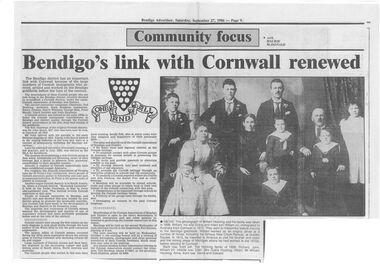
Article - Article about Cornish Society in Bendigo
... The article was published in the Bendigo Advertiser on 27/9/1986 and outlines the contributions made to Bendigo by Cornish miners and their descendants including Sir John Quick. ...The article was published in the Bendigo Advertiser on 27/9/1986 and outlines the contributions made to Bendigo by Cornish miners and their descendants including Sir John Quick. ...A news article titled 'Bendigo's link with Cornwall renewed' by Maurie McDonald on the history of Cornish settlers in the Bendigo District. The article was published in the Bendigo Advertiser on 27/9/1986 and outlines the contributions made to Bendigo by Cornish miners and their descendants including Sir John Quick. The article is accompanied by a photograph of the Hocking Family taken in 1898. bendigo and district cornish association, sir john quick, william hocking, ted hocking, maurie mcdonald -
 Bendigo Historical Society Inc.
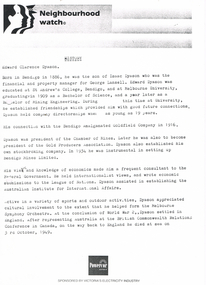
Document - LONG GULLY HISTORY GROUP COLLECTION: NEIGHBOURHOOD WATCH
... The third, dated 30/5/97, also mentions Eaglehawk Heritage Society, Cornish Miners, Cornish Association, Long Gully School, Department of Main Roads, St laurence Court, Charles Fay, La Trobe History Department. ...The third, dated 30/5/97, also mentions Eaglehawk Heritage Society, Cornish Miners, Cornish Association, Long Gully School, Department of Main Roads, St laurence Court, Charles Fay, La Trobe History Department. ...BHS CollectionThree pages, the first titled Neighbourhood Watch. The second, dated 2/6/97, mentions a phone call to the City of Greater Bendigo about speaking to Marco in the Planning Department. The third, dated 30/5/97, also mentions Eaglehawk Heritage Society, Cornish Miners, Cornish Association, Long Gully School, Department of Main Roads, St laurence Court, Charles Fay, La Trobe History Department. It has Cheryl Wallis signature at the bottom of page.bendigo, history, long gully history group, the long gully history group - neighbourhood watch, edward clarence dyason, isaac dyason, george lansell, st andrew's college, melbourne university, bendigo amalgamated goldfield company, chamber of mines, gold producers association, bendigo mines limited, league of nations, australian institute for international affairs, melbourne syphony orchestra, world war ii, british commonwealth relations conference, powercor australia, city of greater bendigo, eaglehawk heritage society, cornish association, long gully school, department of main roads, st laurence court, charles fay, la trobe history department, cheryl wallis -
 Bendigo Historical Society Inc.
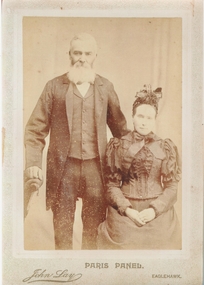
Photograph - Thomas and Eliza Harvey, McKenzie Family Collection, August 2024
... This was a small cluster of Cornish miners homes in Eaglehawk....This was a small cluster of Cornish miners homes in Eaglehawk. history period clothing Photographer's stamp John Lay Eaglehawk, Paris Panel Copy of posed studio photograph of Thomas and Eliza Harvey. ...Thomas Harvey (16/8/1842-30/6/1912) was born in Cornwall. He married Eliza Williams (23/3/1841-12/7/1923) on 6/12/1865. The lived in Clarke Street, Harveyville. This was a small cluster of Cornish miners homes in Eaglehawk.Copy of posed studio photograph of Thomas and Eliza Harvey. Photographer's stamp John Lay Eaglehawk, Paris Panelhistory, period clothing -
 Bendigo Historical Society Inc.
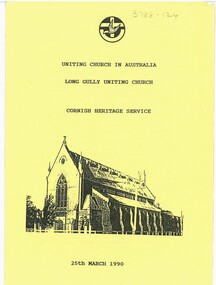
Document - Long Gully Uniting Church - Cornish Heritage Order of Service 25 March 1990, 23/02/1986
... A large part of the congregation was Cornish miners of whom there were large numbers in Long Gully and California Gully....A large part of the congregation was Cornish miners of whom there were large numbers in Long Gully and California Gully. ...The initial Methodist Church at Long Gully was a slab hut and in 1855 the first brick building was erected. This was replaced in 1865 by a brick church designed by architects Vahland and Getzschmann. In 1877 the present church, designed by the same architects was built, with the 1865 building becoming the Sunday school. A large part of the congregation was Cornish miners of whom there were large numbers in Long Gully and California Gully.A4 Sheet printed both sides of page, sketch of Long Gully Uniting Church on the front cover.religion, lydia chancellor collection, history, church -
 Bendigo Historical Society Inc.
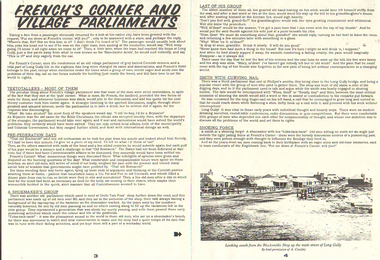
Document - LONG GULLY HISTORY GROUP COLLECTION: FRENCH'S CORNER AND VILLAGE PARLIAMENTS
... French's Corner was once the meeting place of the old Cornish miners where they used to discuss local and international affairs. ...French's Corner was once the meeting place of the old Cornish miners where they used to discuss local and international affairs. ...Titled French's Corner and Village Parliaments. French's Corner was once the meeting place of the old Cornish miners where they used to discuss local and international affairs. Headings of the paragraphs are - Teetotallers - Most of Them, Pre-Federation Days, A Shoemaker's Group, Last of his Group, Smith with Curving Nail and Shoeing Force. At the end of the article is a photo - Looking south from the Blacksmiths Shop up the main street of Long Gully.bendigo, history, long gully history group, the long gully history group - french's corner and village parliaments, manchester arms hotel, french's hotel, mr french, uncle tom foss' shop, phillpot's smithy, a crossley -
 Bendigo Historical Society Inc.
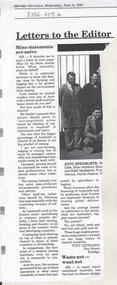
Newspaper - Kangaroo Flat Gold Mine Collection: letters to Bendigo Advertiser Editor
... The statue of the Cornish miner came about as a project of the Bendigo Cornish Association. ...The statue of the Cornish miner came about as a project of the Bendigo Cornish Association. ...Three photocopies and one original 'Bendigo Advertiser' articles, 'Letters to the Editor': 1. 'Mine statements are naive', June 6, 2001, from Tony Lethlean, Don Street, Bendigo. Letter discusses the damage done to the environment by farming and logging compared to mining. 2. "Mining letter is misleading' 4th July, 2001, from Geoff Turner, AIG Victorian Branch, Strathfieldsaye. Letter discusses 'misleading information circulating in the wider Strathfieldsaye area' regarding the mining operations proposed by Perseverance Exploration Pty. Ltd. 3. 'A Balance to Open Cut Mining', 16th July 2001, by '. Letter refers to Geoff Turner's letter and writes to bring 'balance to this subject' 4. Bendigo Advertiser original copy of article: 'Cornish statue feature pleasing' 22nd January, 2001, by Ruth Hopkins, Peel Street, Bendigo. Ruth's letter discusses the history of the Cornish miner in Bendigo; the largest ethnic group on the field. The statue of the Cornish miner came about as a project of the Bendigo Cornish Association. gold mining, bendigo, perserverance exploration pty ltd., open cut mining, bendigo advertiser, tony lethlean, geoff turner, ruth hopkins, cornish association, fosterville gold mine, luch and graeme reed, objectors, cornish statue -
 Bendigo Historical Society Inc.
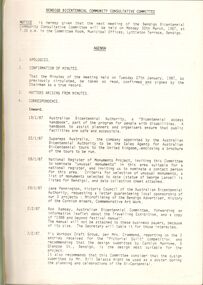
Document - NOTES RELATING TO: A MEETING OF THE BENDIGO BICENTENNIAL COMMUNITY CONSULTATIVE COMMITTEE (1987), 27/01/1987
... Statue of George Lansell, Bendigo); application for grants for i. microfilming Bendigo Advertiser ; ii history of the Cornish miners; iii commemorative art work; entries for design of pictorial Quilt competition (three entries described); correspondence re the Bicentennial Commemorative Art Work (Gateway Sculpture - Anthony Pryor)...Statue of George Lansell, Bendigo); application for grants for i. microfilming Bendigo Advertiser ; ii history of the Cornish miners; iii commemorative art work; entries for design of pictorial Quilt competition (three entries described); correspondence re the Bicentennial Commemorative Art Work (Gateway Sculpture - Anthony Pryor) Document NOTES RELATING TO: A MEETING OF THE BENDIGO BICENTENNIAL COMMUNITY CONSULTATIVE COMMITTEE (1987) ...Bound) Notes relating to a meeting of the Bendigo Bicentennial Community Consultative Committee (30th March 1987). Agenda plus correspondence. Reference to 1. National Register of Unusual Monuments Project (incl. Statue of George Lansell, Bendigo); application for grants for i. microfilming Bendigo Advertiser ; ii history of the Cornish miners; iii commemorative art work; entries for design of pictorial Quilt competition (three entries described); correspondence re the Bicentennial Commemorative Art Work (Gateway Sculpture - Anthony Pryor)Bendigo Bicentennial Committeebendigo, history, centenary, bendigo bicentennial community consultative committee. national register of monuments project. first fleet re-enactment company, bendigo art gallery -
 Bendigo Historical Society Inc.
Document - Naming of Bendigo, 1970
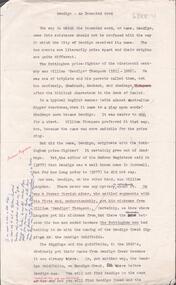
... The document details the naming of Bendigo from the 'nickname' Bendigo, of the former Cornish miner, William Langdon. Langdon 'settled arguments with his fists and understandably got his nickname from William 'Bendigo' Thompson. ...The document details the naming of Bendigo from the 'nickname' Bendigo, of the former Cornish miner, William Langdon. Langdon 'settled arguments with his fists and understandably got his nickname from William 'Bendigo' Thompson. ...William Abednego Thompson (11 October 1811 – 23 August 1880), also known as Bendigo Thompson, was an English bare-knuckle boxer who won the heavyweight championship of England from James Burke on 12 February 1839.[3] He was inducted into The Ring magazine Hall of Fame in 1955, the International Boxing Hall of Fame in 1991[3] and the Bare Knuckle Boxing Hall of Fame in 2011. His nickname of "Bendigo" lives on in the name of a city and creek in Australia. (Wikipedia)One page typed document, headed 'Bendigo - an Invented Word'. Document is typed on the back of a letter sent to Mr. Harold Curnow, Public Accountant, View Point Bendigo, 24th February 1970, from G.P. McGowan and Associates Pty Ltd. Albury. The document details the naming of Bendigo from the 'nickname' Bendigo, of the former Cornish miner, William Langdon. Langdon 'settled arguments with his fists and understandably got his nickname from William 'Bendigo' Thompson. Annotations in blue and red biro. On left hand side margin: ' If we want to delve a little deeper we only have to look at William Sanders/Sandbach ? ....? not reported in first one after Annals of Bendigo to see that Thomas Myers gave the name of Bendigo to the local man of punches ? and the nickname stuck. Thomas Myers came out to Australia on the same ship as Bendigo'. Annotation on bottom of page ' around the time gold was discovered', in red pen. 'Madron Register' on margin, left hand side. abednego thompson, william thompson, bendigo, boxer, naming of bendigo, thomas myers, harold curnow -
 Wodonga & District Historical Society Inc
Photograph - Old Barnawartha Homestead
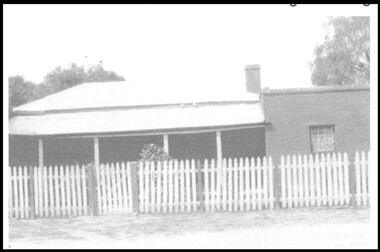
... The homestead exhibited no particular style, it looked like a Cornish Miner’s cottage, and appeared as if pieces were added on as the need arose. ...The homestead exhibited no particular style, it looked like a Cornish Miner’s cottage, and appeared as if pieces were added on as the need arose. ...Henry Richardson came from England in 1852 and this was his home from 1871 to 1888. His son Henry, better known as Harry, managed the property from 1888 until his death in 1926. The property was sold in 1932 and has been known as Old Barnawartha for over 140 years. The homestead exhibited no particular style, it looked like a Cornish Miner’s cottage, and appeared as if pieces were added on as the need arose. The property is well known for topping both sheep and cattle sales at Newmarket.This item is significant because it depicts the home of an early Wodonga District pioneerA black and white image of an old homestead. There is a white picket fence across the front of the building.old barnawartha, early settlement, wodonga and district -
 Federation University Historical Collection
Photograph, Geoff Biddington, Former Cyril Retallick House (Now Australian Catholic University), Ballarat, c1967
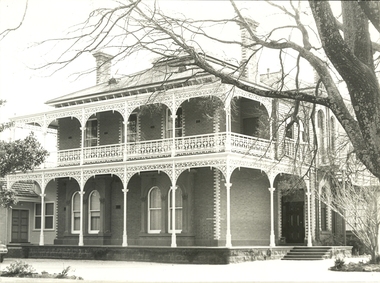
... Retallack was a successful Cornish miner and engineer. He built a two storey brick mansion between 1882 and 1883, naming the property ‘Carn Brae’ after the castle in Cornwall. ...Retallack was a successful Cornish miner and engineer. He built a two storey brick mansion between 1882 and 1883, naming the property ‘Carn Brae’ after the castle in Cornwall. ...In 1881 Cyrus Bath Retallack purchased land now known as 1200 Mair Street Ballarat. Retallack was a successful Cornish miner and engineer. He built a two storey brick mansion between 1882 and 1883, naming the property ‘Carn Brae’ after the castle in Cornwall. Substantial grounds were established with with range of exotic trees planted, a tennis court was laid out and a stables building was erected. In 1918 the site become a campus of Queen’s GIrls’ Grammar School, then Aquinas College which was merged into the Australian Catholic University from 1973. Photograph of a double storey brick building on bluestone foundations, with cast iron balcony. ballarat, geoff biddington, cast iron, bluestone, cyril retallick, australian catholic university, ballarat, aquinas college -
 Federation University Historical Collection
Photograph, Ballarat photographs by Geoff Biddington, 1967, 1967
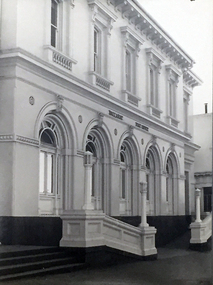
... .6) Australian Catholic University Ballarat Campus (Aquinas) is set in the historic gardens of Carn Brea, formerly the property of Cornish miner Cyrus Retallack. The property includes a two-storey mansion, which he built as his family home in 1881. ....6) Australian Catholic University Ballarat Campus (Aquinas) is set in the historic gardens of Carn Brea, formerly the property of Cornish miner Cyrus Retallack. The property includes a two-storey mansion, which he built as his family home in 1881. ....6) Australian Catholic University Ballarat Campus (Aquinas) is set in the historic gardens of Carn Brea, formerly the property of Cornish miner Cyrus Retallack. The property includes a two-storey mansion, which he built as his family home in 1881. Carn Brea, a castle in Cornwall, was built in the 1500s. After the Queen's Church of England Girls' Grammar School acquired the property in 1919, the mansion was renamed Manifold House. Manifold House now accommodates administrative facilities of the campus and staff offices. (http://www.acu.edu.au/about_acu/campuses/ballarat/history_of_ballarat_campus, accesses 21 August 2014)Nine black and white images by Geoff Biddington. .1) Burke and Wills Monument, corner Sturt Street and Lydiard Street, with the MLS Building and Allan Brothers in the background. .2) Former Ballarat Post Office (later Federation University Post Office Gallery) .3) Tram in Sturt Street .4) Geelong ? shopping centre .5) Geelong Waterworks and Sewerage Trust .6) Carn Brae / Retallacks / Queen's / Australian Catholic University, 1200 Mair Street .7) Former Ballarat Post OFfice, Lydiard Street .8) Perseus Statue, Camp Street (removed for conservation in 2008) .9 McDonald Printer, 48 Lydiard Stgeoff biddington, ballarat, ballarat post office, geelong waterworks, perseus, mcdonald, acu, carn brae, australian catholic university ballarat, burk and wills monument, mlc building ballarat, allan brothers ballarat, lydiard street, sturt street -
 Bendigo Historical Society Inc.
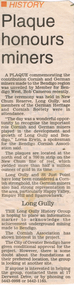
Newspaper - LONG GULLY HISTORY GROUP COLLECTION: PLAQUE HONOURS MINERS
... Newspaper cutting titled Plaque honours miners. A plaque commemorating the contribution Cornish and German miners made to the Bendigo region was unveiled by Member for Bendigo West, Bob Cameron. ...A plaque commemorating the contribution Cornish and German miners made to the Bendigo region was unveiled by Member for Bendigo West, Bob Cameron. ...Newspaper cutting titled Plaque honours miners. A plaque commemorating the contribution Cornish and German miners made to the Bendigo region was unveiled by Member for Bendigo West, Bob Cameron. The ceremony was held in New Chum Reservebendigo, history, long gully history group, the long gully history group - plaque honours miners, bob cameron, german heritage society, bendigo cornish association, lorna erwin, the long gully history group, the city of greater bendigo -
 Rutherglen Historical Society
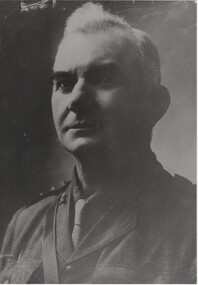
Photograph - Image, 1917-1919
... John Richards Harris was born in 1868 of Cornish miner parents in Chiltern. He attended Rutherglen State School No. 522 (Rutherglen Common School), probably starting there in it's 1st or 2nd year of opening. ...John Richards Harris was born in 1868 of Cornish miner parents in Chiltern. He attended Rutherglen State School No. 522 (Rutherglen Common School), probably starting there in it's 1st or 2nd year of opening. ...John Richards Harris was born in 1868 of Cornish miner parents in Chiltern. He attended Rutherglen State School No. 522 (Rutherglen Common School), probably starting there in it's 1st or 2nd year of opening. He practiced medicine in Rutherglen, and was the doctor who examined many of the local men for enlistment in World War 1. In 1917, he enlisted himself, and served as Medical Officer in the Australian Flying Corps in Egypt. In 1920 he was elected to the Legislative Council of Victoria, where he served for much of the period from then until 1946. He received his knighthood in 1937. After retiring from politics, he returned to Rutherglen as a medical practitioner and vigneron. As a vigneron he made the sweet fortified wines that were common in the district, but in the 1920s he experimented with a dry sherry style, made in the Spanish manner. His 'Doctor John' sherry won many show awards. He died in 1946, and is buried in Carlyle Cemetery, Rutherglen.Black and white portrait photograph of a man in military uniform.Typed on back of photo: "Sir John Harris"john richards harris, legislative council, victorian politics, wine industry, medical practitioners, doctors, common school, australian flying corps, world war i, world war 1, ww1, wwi -
 Bendigo Historical Society Inc.
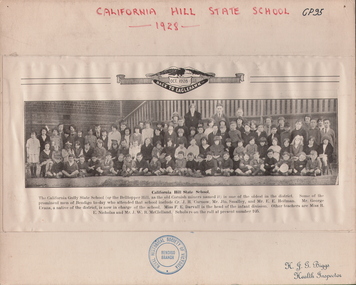
Photograph - STUDENTS OF CALIFORNIA HILL STATE SCHOOL, 1928
... 'The California Gully State School (or the Bell topper Hill, as the old Cornish miners names it) is one of the oldest in the district. ...'The California Gully State School (or the Bell topper Hill, as the old Cornish miners names it) is one of the oldest in the district. ...Black and white reproduction of photo from 'Back to Eaglehawk' back Oct. 1928. Large group of children, four adults in background. Outside. Banisters in background, brick wall at side. Approximately ninety children, youngest ones seated on ground at front, cross-legged. Inscriptions: on front - 'California Hill State School, 1928', 'JH Biggs, Health Inspector'. RHSV stamp (under photo). California Hill State School. 'The California Gully State School (or the Bell topper Hill, as the old Cornish miners names it) is one of the oldest in the district. Some of the prominent men of Bendigo today who attended that school include Cr. JH Curnow, Mr Jtn Smalley, and Mr EE Heitman. Mr. George Evans, a native of the district, is now in charge of the school. Miss FE Darvall is the head of the infant division. Other teachers are Miss RE Nicholas and Mr WR McClelland. Scholars on the roll at present number 105.person, group, students of cal. hill state.school -
 Bendigo Historical Society Inc.
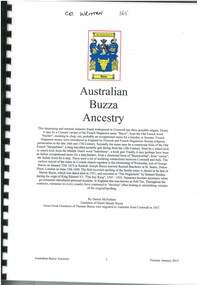
Document - AUSTRALIAN BUZZA ANCESTRY, 2013
... Thomas Buzza (1833-1904) was a Cornish born miner who came to Bendigo in 1853. He bought the BAckCreek sawmill (1861-1865). ...Thomas Buzza (1833-1904) was a Cornish born miner who came to Bendigo in 1853. He bought the BAckCreek sawmill (1861-1865). ...Thomas Buzza (1833-1904) was a Cornish born miner who came to Bendigo in 1853. He bought the BAckCreek sawmill (1861-1865). He had several other sawmilling enterprises and later operated a hay and corn produce store. He also built and operated paddle-steamers in the Murray Darling system. He left Myers Flat in 1893 and died in Goolwa, SA in 1904. He had married Emily Rainsdon (1852-1926) in 1867.Printed family history spiral bound with perspex cover. Contents page - no index. Contains family trees, summary of Thomas Buzza and his migration from Cornwall, details of descendants of Thomas Buzza, photographs, maps and images of birth, death and marriage certificates.Darren McFarlanegenealogy, family, cornish, buzza, bendigo, eaglehawk -
 Bendigo Historical Society Inc.
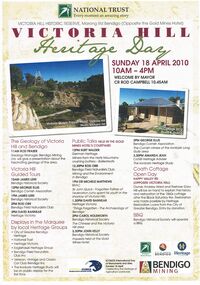
Document - VICTORIA HILL MARONG RD BENDIGO HERITAGE DAY BROCHURE 2010, 2010
... Victoria Hill Guided Tours James Lerk (Bendigo Historical Society) George Ellis (Bendigo Cornish Association) Rod Orr (Bendigo Field Naturalists Club) David Bannear (Heritage Victoria) Presentations: Rod Fraser The Geology of Victoria Hill and Bendigo, Kurt Walder German Heritage Ballerstedts-miners from the Hartz Mountains crushing battery, Rod Orr Mining and the Environment in Bendigo, Michele Matthews (BRAC) Sir John Quick the Forgotten Father of Federation spent his youth in the shadow of Victoria Hill, David Bannear ''Things Forgotten'' - the Archaelogy of Bendigo, Carol Holsworth the Chinese and Victoria Hill area, John Kelly Inquests held at the Gold Mines Hotel, George Ellis The Cornish miners of the Ironbark and Long Gully area, Amanda Jean The Ironbark Heritage Study. ...Victoria Hill Guided Tours James Lerk (Bendigo Historical Society) George Ellis (Bendigo Cornish Association) Rod Orr (Bendigo Field Naturalists Club) David Bannear (Heritage Victoria) Presentations: Rod Fraser The Geology of Victoria Hill and Bendigo, Kurt Walder German Heritage Ballerstedts-miners from the Hartz Mountains crushing battery, Rod Orr Mining and the Environment in Bendigo, Michele Matthews (BRAC) Sir John Quick the Forgotten Father of Federation spent his youth in the shadow of Victoria Hill, David Bannear ''Things Forgotten'' - the Archaelogy of Bendigo, Carol Holsworth the Chinese and Victoria Hill area, John Kelly Inquests held at the Gold Mines Hotel, George Ellis The Cornish miners of the Ironbark and Long Gully area, Amanda Jean The Ironbark Heritage Study. ...Victoria Hill Marong Rd Bendigo (Opposite the Gold Mines Hotel) Heritage Day Brochure 2010. Victoria Hill Guided Tours James Lerk (Bendigo Historical Society) George Ellis (Bendigo Cornish Association) Rod Orr (Bendigo Field Naturalists Club) David Bannear (Heritage Victoria) Presentations: Rod Fraser The Geology of Victoria Hill and Bendigo, Kurt Walder German Heritage Ballerstedts-miners from the Hartz Mountains crushing battery, Rod Orr Mining and the Environment in Bendigo, Michele Matthews (BRAC) Sir John Quick the Forgotten Father of Federation spent his youth in the shadow of Victoria Hill, David Bannear ''Things Forgotten'' - the Archaelogy of Bendigo, Carol Holsworth the Chinese and Victoria Hill area, John Kelly Inquests held at the Gold Mines Hotel, George Ellis The Cornish miners of the Ironbark and Long Gully area, Amanda Jean The Ironbark Heritage Study. Coath Cottage Open Day owner Andrew Ward and Restorer Gary Hill explain the history and restoration of the 1860s miners cottage after Black Saturday fire. Restoration Loans from the City of Greater Bendigo.bendigo, gold mining, heritage day 2010 -
Bendigo Historical Society Inc.
Document - HARRY BIGGS COLLECTION: ORIGIN OF THE NAME BENDIGO
... Cruwys in Devon, England by Harold Curnow inquiring as to any information on a Cornish miner named Bendigo. (c) A handwritten letter on blue writing paper from George Rich to Harold Curnow with information about the race horse 'Bendigo'. ...Cruwys in Devon, England by Harold Curnow inquiring as to any information on a Cornish miner named Bendigo. (c) A handwritten letter on blue writing paper from George Rich to Harold Curnow with information about the race horse 'Bendigo'. ...(a) two newspaper articles and a typed copy of each written by Harold Curnow 'Is it Bendigo - the horse' . (b) copy in red ink of a letter sent to Mrs. M.C.S. Cruwys in Devon, England by Harold Curnow inquiring as to any information on a Cornish miner named Bendigo. (c) A handwritten letter on blue writing paper from George Rich to Harold Curnow with information about the race horse 'Bendigo'. (d) pinned collection of correspondence between H. Curnow and Mr. J. Hughes Onslow relating to Bendigo the race horse. (e) Photocopied letter from H. Curnow to Lady Jackson regarding the mystery Racehorse. (f) A letter from Mr. Ryan MacMahon to H. Curnow regarding the prize fighter, Bendigo. (g) A blue air letter/aerogram to H. Curnow from Canon C. T. Wood, Bishops Court, Claremont, Cape Province, South Africa, The subject is the horse Bendigo , of which he has a print. (h) A letter and envelope in blue paper from N. Jackson, England relating details about the horse Bendigo which she saw as a child, he is buried at Fadderly Hall, Leicestershireplace, bendigo, naming of bendigo, bendigo , thompson, race horse bendigo, naming of bendigo -
 Bendigo Historical Society Inc.
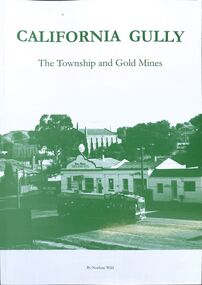
Book - "California Gully. The Township and Gold Mines", 2009
... A large influx of Cornish miners occurred in the 1870s, strengthening a Methodist tradition which had established the first school in 1857. ...A large influx of Cornish miners occurred in the 1870s, strengthening a Methodist tradition which had established the first school in 1857. ...It was presumed that California Gully was named after miners who came from California and worked in the gully searching for alluvial gold. In the 1850s both California Gully and Eaglehawk became established townships. In the 1960's much land was opened up for housing bringing a slow but steady increase of new families to the area. California Gully is a suburb of Bendigo, 4 km north-west of the city centre. It was formed around the California Gully where it intersects the Eaglehawk Road. Gold was discovered in California Gully in 1852, and it was rushed by miners from the Californian gold diggings. A large influx of Cornish miners occurred in the 1870s, strengthening a Methodist tradition which had established the first school in 1857. A township formed in Eaglehawk Road, and is identified by the White Horse Hotel and the Uniting (former Methodist) church behind the hotel. Both were built during the early 1870s. California Gully's mines had a long production period, the North Johnson group running from 1861 to 1920. It was on the Eaglehawk tram line which closed in 1973. In 1883 a large school building was erected on an elevated site west of the town, known as Bell Topper Hill. (The name apparently came about from English miners making a bonfire of their bell topper hats, found to be unsuitable for Australian conditions.) The school is on the Victorian Heritage Register, along with the former Methodist church. The school replaced a building (1862) in School Street which became a mechanics' institute. The California Gully primary school had 147 pupils in 2014. California Gully has a number of buildings and sites which retain elements of the goldmining past. There are two reserves with ovals and a shopping centre near the Woolpack Hotel. In 1968 the Anglican church opened the St Lawrence Court aged care centre in Upper California Gully Road. Three years later a large Stafford Ellinson menswear factory was opened. It lasted until 2002, employing over 300 people. Since then, St Lawrence Court has become the largest local employer."California Gully. The Township and Gold Mines" written by Noelene Wild. Soft cover. 84 PP. Sky blue front cover, spine and back cover. Title on front cover in green text. Has image of California Gully in the 1960's in green. Has index. Has black and white images throughout. Published in 2009 by Noelene and Ian Wild. ISBN 978-0-9579939-2-1.mining, miners, california gully, gold, eaglehawk -
 Flagstaff Hill Maritime Museum and Village
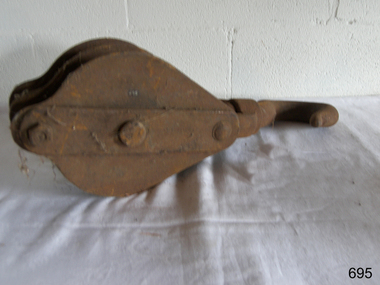
Equipment - Block, Tangyes engineering, Early 20th century
... Richard Tangye (1833–1906) and four of his brothers—James, Joseph, Edward, and George—were the sons of Joseph Tangye, a Quaker Cornish miner. In 1857, they founded the engineering firm Richard Tangye & Brothers in Birmingham, UK. ...Richard Tangye (1833–1906) and four of his brothers—James, Joseph, Edward, and George—were the sons of Joseph Tangye, a Quaker Cornish miner. In 1857, they founded the engineering firm Richard Tangye & Brothers in Birmingham, UK. ...This metal block may have been used as part of a boat or ship's rigging or winch. The becket is the loop or ring where a shackle could be attached to use as a pulley. The two-sheaved block has a mechanical advantage over a single-sheave block, using less power to lift a load. The block was made by Tangyes, established in Birmingham, UK, in 1857, and renowned for producing high-quality, reliable machines, equipment, and tools in the late 19th and early 20th centuries. Richard Tangye (1833–1906) and four of his brothers—James, Joseph, Edward, and George—were the sons of Joseph Tangye, a Quaker Cornish miner. In 1857, they founded the engineering firm Richard Tangye & Brothers in Birmingham, UK. In 1860, the firm became Tangye Brothers and moved to Cornwall Works in Birmingham. The business encouraged inventors to join the company and develop their patents there, as happened with Weston’s differential pulley block, invented by the Englishman Thomas Aldridge Weston in 1854. Tangye bought the patent in 1858, giving the firm the sole right to manufacture it. The design received a medal for “original application, practical utility and success” at the 1862 International Exhibition in London. Also in 1858, the Tangye firm was commissioned by Brunel’s shipping company to manufacture hydraulic lifting jacks, or rams, to launch the steamship SS Great Eastern. The success of this project brought favourable attention to the firm, and it became involved in other notable projects, including the erection of Cleopatra’s Needle in London in 1878 and work on the Forth Road Bridge in Scotland. The firm underwent several name changes over the years, including James Tangye and Brothers (1857), Tangye Brothers and Price (1859), Tangye Brothers (1860), Tangye Brothers & Holman (1876), Tangye Brothers (by 1878), Tangye Ltd. (1881), and then simply Tangye. Its machinery and equipment were exported worldwide. In 1884, a branch with showrooms, offices, and a warehouse was opened in Melbourne at Cornwall House, Collins Street West. The firm was well known for producing high-quality machinery for agriculture and industry. Even today, new Tangye machinery is available for a subsidiary of Allspeeds. An extensive account of the firm’s history, names, inventions, and further references is available in Grace’s Guide, which also includes references to and diagrams of the Tangye horizontal steam engine. The block is significant for its connection to the renowned and innovative Tangye machine makers, respected for their high quality and standards. The block's maker,, Tangyes, also manufactured an 1880s steam engine, sold by a Melbourne merchant, and locally significant for its use in a late-19th century cheese factory. The block also represents the many blocks used in many industries, including the marine concerns, for rigging and lifting. Flagstaff Hill has a wide variety of these simple but very important pieces of equipment.Becket block: a metal block with two sheaves, a hook, a becket attachment point, and straps. Inscription embossed. Made by Tangyes."TANGYES"warrnambool, flagstaff hill maritime museum and village, maritime museum, maritime village, great ocean road, shipwreck coast, block, metal block, two sheave block, marine technology, rigging, tangye, ship rigging, block with hook and becket, becket block, sailing block, cargo block, tangyes block, vintage, nautical pulley, rigging equipment, pulley system, functional machine, machine, lifting equipment, marine equipment, richard tangye & brothers, james tangye and brothers, tangye brothers and price, tangye brothers, tangye brothers & holman, tangyes ltd., cornwall works -
 The Beechworth Burke Museum
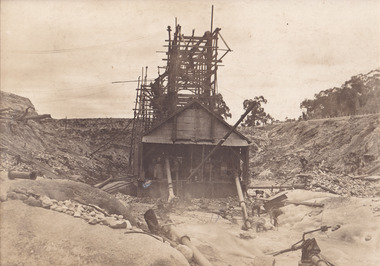
Photograph, 1910 - 1911
... John Cock was the son of a Cornish miner who arrived in El Dorado in 1858. ...John Cock was the son of a Cornish miner who arrived in El Dorado in 1858. ...This photograph depicts Cock's Pioneer G & T Sluicing site No. 4 in El Dorado. Looking eastwards, the photo captures a wooden and tin building with various mining equipment strewn in the foreground. Underneath the verandah, figures can be seen. These are believed to be a Mr. Hollister (left), Mrs. Breustedt (4th from left), children Min and Chris Breustedt, and Kate Timmons holding a girl's hand. The Cocks Pioneer Gold and Tin Mines N.L was one of El Dorado's two largest open-cut sluicing mines of the 20th Century. The other was named the Cocks El Dorado Gold Dredging Company. The Cocks Pioneer Mines operated from 1901 until 1941 and found a total of 117,378 ounces of Gold and 1,673 tones of tin concentrates over these years. The Cocks company was formed in 1898 and operated until 1941. Open cut sluicing involved the use of high-powered hoses which used the centrifugal sand pump system (known as hydraulic sluicing) which broke down the soil which was then processed for gold and other precious metals. From 1914, four years after this image was captured, the company reformed to Cocks Pioneer Gold and Tin Mines NL (previously it was known as Cocks Pioneer Sluicing Co) and undertook large-scale sluicing operations until 1929 and then 1934-1941. The Cocks Pioneer was an extremely successful mining company during the 20th century. In the Annual Report of the Secretary for Mines for the year 1915, the Cocks Pioneer was the largest producer of gold and tin collecting 5,535 ozs. of gold and £7,500 of tin. Twenty years later in 1935, Cocks Pioneer was still one of the most profitable mines in Victoria, ranking as the second-highest dividend paying mine. The company produced a total of 3,650 kg of gold. El Dorado is located on Reedy Creek and is surrounded by forested country to the north and east. It is 20 km east of Wangaratta in Victoria's regional northeast. John Cock was the son of a Cornish miner who arrived in El Dorado in 1858. Cock founded his gold and tin mining company which ran successfully for many years in the El Dorado region. It was an open-cut sluicing company because of the abandonment of underground mining after this was deemed too dangerous. In 1935 Cock's El Dorado Company commissioned the floating dredge which is still visible in El Dorado today. The dredge was built by the Thompson engineering works, Castlemaine, and weighed over 2,000 tones and today has a place on the Victorian Registers of historic buildings. Interestingly, the name El Dorado does not derive from the gold in the region, but from the Barambogie pastoral run completed by William Baker in 1840-1841. Gold was discovered in El Dorado in 1854 but the gold was too deep for individual prospectors to find, it required the use of heavy machinery.The search for gold is ingrained into the history of Victoria and therefore, images like this one which portray an open cut sluicing site can reveal important information for society and technology for the date when the photograph was taken. This image is of important historical significance for its ability to convey information about sluicing and the methods used to find gold in 1910. It also shows a location where sluicing was undertook which provides insight into the impact of sluicing on the environment at a time when it was done. This image is important for current research into the history of El Dorado, a small regional location near Wangaratta in Victoria's North East. Therefore, this image has the capacity to be beneficial for research into society and the motivations of those living and working in this region during this period and therefore, has social significance. The Beechworth Burke Museum has additional images relating to gold sluicing and El Dorado which can be analysed and studied alongside images like this one.A black and white copy of a sepia coloured rectangular photograph printed on matte photographic paper mounted on boardObverse: COCKS PIONEER G + T SL CO, N.L. / 1910 - 11 / NO 4 SITE LOOKING EAST / 4 Reverse: 1997.2508 / AUG 29 1909cocks pioneer gold and tin sluicing company, el dorado, mining, sluicing, hydraulic mining, hollister, breustedt, timmons, gold, tin, gold rush, victoria -
Bendigo Historical Society Inc.
Ephemera - Mike Butcher Collection: Bendigo Regional Photographic Library
... During the early gold rush period, about 4,000 Cornish miners went to Mount Alexander (Castlemaine), and by the late 1850s up to 17% of the mining population in Bendigo were Cornish-alone, with almost a quarter being Chinese in 1856. ...During the early gold rush period, about 4,000 Cornish miners went to Mount Alexander (Castlemaine), and by the late 1850s up to 17% of the mining population in Bendigo were Cornish-alone, with almost a quarter being Chinese in 1856. ...Gold was officially discovered in the area in October 1851, just after the other significant goldfields in neighbouring Castlemaine, from where a number of diggers migrated, bringing the total population to 40,000 in less than a year. A number of these diggers were Chinese and their descendants still live in the region. During 1852, under the direction of the Surveyor General of Victoria, Robert Hoddle, William Swan Urquhart was making a general survey of Mount Alexander and the surrounding ranges and the goldfields. He fixed the site of the township as "Sandhurst". On 13 July 1852, Hoddle passed on to Urquhart the request of Lieutenant-Governor La Trobe for a plan of the Mount Alexander gold workings, and his order that he mark out a reserve at the junction of Golden Gully with Bendigo Creek, and the camp on the west side of the creek below the junction. In late August La Trobe wanted him to report urgently on the best reserves for agriculture in the district. By 26 November he had mapped Bendigo Creek and Myers Creek and his survey of the Bendigo Valley and environs marked township reserves at Bullock Creek, Ravenswood and Happy Jack where settlement was already taking place. His plan General Survey of the Bendigo Goldfields showing the proposed reserves for townships. Drawn by W. S. Urquhart, Melbourne, November 1852 recommended sites for national schools, churches, markets and other public purposes reserved from sale. The predominant population of the Victorian goldfields throughout the gold rush era was British (being English, Irish, and Scottish), with the largest non-British population being Chinese. During the early gold rush period, about 4,000 Cornish miners went to Mount Alexander (Castlemaine), and by the late 1850s up to 17% of the mining population in Bendigo were Cornish-alone, with almost a quarter being Chinese in 1856. Such was the influence of the former that many of their mining practicises were respected and adopted. By the 1871 Victorian census, approximately 15,000 residents of the central goldfields were Cornish. In 1853, a large protest called the Red Ribbon Rebellion was held over the cost of the licence fee for prospectors, though it passed peacefully due to good diplomacy by police and miners' leaders. From being a tent city, the boomtown grew rapidly into a major urban centre with grand public buildings. The municipality became a borough in 1863, officially known as Sandhurst until 1891, but always unofficially as Bendigo. During this period, miner Henry Bain was noted in local accounts as a cultural patron who hosted informal gatherings of writers, artists and prospectors, later described as the "Golden Circle." The railway had reached Bendigo by 1862, stimulating rapid growth, with flour mills, woollen mills, tanneries, quarries, foundries, eucalyptus oil production, food production industries and timber cutting. When the alluvial gold ran out, extraction of quartz-based gold continued in deep shafts using industrial systems. During this period of growth and development, photographers were recording the growth of the town and those that lived in it. Four A4 pages. Typed document. All pages contain charts of at least nine columns with headings of: Rate Year, Rate Number, Ratepayer First Name, Rate Payer Occupation, Owner/Surname, Owner/First Name, Owner/Occupation, Address and Net Annual Value. Single sided. One A4 page. Typed document. Titled 'Payments by contractors by Godfrey Eathorne, Architect, Bendigo. Contains chart of 8 columns, with headings of: Surname, First Name, Number of Street, Street Name, Date, Title of Studio. Last column left blank.friends of the bendigo library, photography, bendigo -
 Flagstaff Hill Maritime Museum and Village
Machine - Steam Engine, Tangyes engineering, Mid-1880s
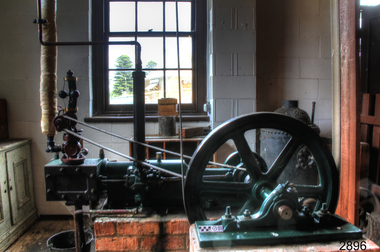
... Tangye: Richard Tangye (1833–1906) and four of his brothers—James, Joseph, Edward, and George—were the sons of Joseph Tangye, a Quaker Cornish miner. In 1857, they founded the engineering firm Richard Tangye & Brothers in Birmingham, UK. ...Tangye: Richard Tangye (1833–1906) and four of his brothers—James, Joseph, Edward, and George—were the sons of Joseph Tangye, a Quaker Cornish miner. In 1857, they founded the engineering firm Richard Tangye & Brothers in Birmingham, UK. ...This Tangye B-size, single-cylinder, horizontal steam engine was likely manufactured in England around the mid-1880s. It was distributed by Melbourne machinery merchants Cameron & Sutherland, which also operated in Bendigo and Ballarat. A local cheese maker once used the engine to drive factory equipment. It was later donated to the Warrnambool Technical School, which then donated it to Flagstaff Hill to add to its historical steam engine collection. Between its manufacture and its donation to Flagstaff Hill, the governor had been replaced by the current Pickering governor. This engine design was very popular in the late 19th and early 20th centuries. When connected and powered up, the engine could drive an overhead line shaft via a flat belt off its flywheel. The line shaft would then drive the machinery via flat belts. It could drive virtually any type of machinery, such as water and sewerage pumps, mine elevators, winches, cranes, metal forges, air blowers, and marine machinery. This engine features a mechanical governor, which controls the speed of the engine regardless of whether it is under load. It also has a water pump built into the valve rod, which is used to supply the boiler with water. Steam enters the cylinder via a slide valve and applies pressure to the piston; it is like a modern internal combustion engine, but in the case of the steam engine, the pressure is exerted in turn on either side of the piston. In other words, the connecting rod is pushed by steam via the piston and piston rod and then pulled back again by steam pushing on the opposite side of the piston. Thus, power is exerted almost continuously, except at the end of each piston stroke, when it reverses direction. In the 1880s, many local butter and cheese manufacturers installed Tangye steam engines to power their machinery. A comprehensive article in the Gippsland Mercury in September 1889 extolled the magnificence of the Farnham Butter Factory in Dennington, Warrnambool, and described how one Tangye engine was used to drive several machines in the cheese- and butter-making processes. A report in the Warragul Guardian in December 1890 notes that the newly opened Warrnambool Butter Factory used a Tangye steam engine to pump water from a 60-foot well. Tangye: Richard Tangye (1833–1906) and four of his brothers—James, Joseph, Edward, and George—were the sons of Joseph Tangye, a Quaker Cornish miner. In 1857, they founded the engineering firm Richard Tangye & Brothers in Birmingham, UK. In 1860, the firm became Tangye Brothers and moved to Cornwall Works in Birmingham. The business encouraged inventors to join the company and develop their patents there, as happened with Weston’s differential pulley block, invented by the Englishman Thomas Aldridge Weston in 1854. Tangye bought the patent in 1858, giving the firm the sole right to manufacture it. The design received a medal for “original application, practical utility and success” at the 1862 International Exhibition in London. Also in 1858, the Tangye firm was commissioned by Brunel’s shipping company to manufacture hydraulic lifting jacks, or rams, to launch the steamship SS Great Eastern. The success of this project brought favourable attention to the firm, and it became involved in other notable projects, including the erection of Cleopatra’s Needle in London in 1878 and work on the Forth Road Bridge in Scotland. The firm underwent several name changes over the years, including James Tangye and Brothers (1857), Tangye Brothers and Price (1859), Tangye Brothers (1860), Tangye Brothers & Holman (1876), Tangye Brothers (by 1878), Tangye Ltd. (1881), and then simply Tangye. Its machinery and equipment were exported worldwide. In 1884, a branch with showrooms, offices, and a warehouse was opened in Melbourne at Cornwall House, Collins Street West. The firm was well known for producing high-quality machinery for agriculture and industry. Even today, new Tangye machinery is available for a subsidiary of Allspeeds. An extensive account of the firm’s history, names, inventions, and further references is available in Grace’s Guide, which also includes references to and diagrams of the Tangye horizontal steam engine. The horizontal steam engine was made by the well-known engineering firm Tangye, known for its high quality of manufacture. It was an important development in machinery because it helped improve productivity. Engines of this type are still used in some parts of the world today. This engine is a good example of a late 19th-century steam engine used in industry and agriculture and adapted for many different purposes. It is also important locally because it was connected to a local cheese making business and part of the thriving western district dairy industry. It may have been one of the Tangyes engines used at the Farnham butter factory or the Warrnambool Butter Factory, which was reported to be one of the most important in the Colony. It is also connected to the Warrnambool Technical School, established in 1968. Steam engine: stationary Tangye Size B, single-cylinder, horizontal Mill type steam engine. It has a 4-inch diameter cylinder with an 8-inch stroke. The body is painted green, and the Pickering governor is red. It was manufactured in Birmingham, England, in accordance with Tangye's Patent 238930, and distributed by Cameron and Sunderland, Melbourne, in the mid-1880s. TANGEYS PATENT BIRMINGHAM B SIZE 238930 CAMERON & SUTHERLAND MELBOURNE THE PICKERING PORTLAND . GOVERNOR . CONN. U.S.A.flagstaff hill, warrnambool, maritime village, maritime museum, flagstaff hill maritime museum and village, shipwreck coast, great ocean road, machine, invention, engine, steam, steam engine, horizontal steam engine, tangyes horizontal steam engine, stationary steam engine, single cylinder steam engine, manufacturing, farming, pumps, lifting equipment, engines, machine tools, hydraulic rams, hydraulic pumps, steam pumps, differential pulleys, mill type steam engine, 4 inch cylinder, weston’s differential pulley, thomas aldridge weston, 1862 international exhibition in london, brunel, ss great eastern, cleopatra’s needle, forth road bridge, cornwall house, collins street melbourne, agricultural machinery, industrial machinery, allspeeds, dairy, pump, richard tangye & brothers, james tangye and brothers, tangye brothers and price, tangye brothers, tangye brothers & holman, tangyes ltd., tangye, richard tangye, james tangye, joseph tangye, edward tangye, george tangye, cornwall works, birmingham, pickering governor, pickering portland connecticut usa, 19th century, dairy plant, steam power, tangye's patent 238930, tangye b size engine, cameron & sutherland, machine merchants, 1880s, mid-1880s, cheese manufacturer, butter manufacturer, diary industry, warrnambool technical school, belt driven machinery, agriculture, mechanical governor, farnham butter factory, warrnambool butter factory -
 Bendigo Historical Society Inc.
Newspaper - Fortuna Articles - "The Lansell Saga", Oct 02 1999
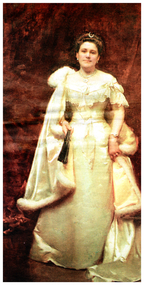
... Initially unsuccessful, Lansell later prospered by employing experienced Cornish consultants and miners. His return to Bendigo was driven more by public belief in his personal influence than by his mining expertise. ...Initially unsuccessful, Lansell later prospered by employing experienced Cornish consultants and miners. His return to Bendigo was driven more by public belief in his personal influence than by his mining expertise. ...Ruth Hopkins has extensively researched Bendigo Cornish history and has published a book on the subject. Initially unsuccessful, Lansell later prospered by employing experienced Cornish consultants and miners. His return to Bendigo was driven more by public belief in his personal influence than by his mining expertise. He was involved in wage reduction efforts and allowed his mines to flood, causing widespread unemployment among miners and resentment. The story of a coffin being placed as a symbol of miners' animosity is discussed, with the author suggesting it reflected broader discontent, not just disputes over working conditions. Lansell's marriage to Bedelia Mary Mulganney was troubled, marked by her alcoholism and early death, with her will contested by Lansell despite its modest value. Bedelia's death was lonely, with her death registered by an undertaker's assistant rather than family. Edith Lansell (née Bassford)Edith, from a respectable but financially struggling family, became Lansell's housekeeper and later his wife. Their relationship began before marriage, with Edith giving birth to their son shortly after their wedding. Lansell was significantly older than Edith, and their union was met with mixed reactions from family and the public. The document reflects on the lasting impact of Lansell and the miners on Bendigo's history, suggesting that the tragedies and triumphs of these figures are embodied in the Fortuna estate. The author expresses gratitude for the preservation of Fortuna as a symbol of Bendigo's mining era, acknowledging both its glory and its tragedies.Fortuna Article - "The Lansell Saga" - The Weekender Saturday Oct 02 2009 This item contains the following: 11217.26a Colour Photo of Edith Lansell, the housekeeper who became mistress of the house, courtesy of the Bendigo Art Gallery. 11217.26b Part of page 22 - Article "The Lansell Saga"non-fictionbendigo, fortuna, george lansell, edith lansell, edith bassford, bedelia mary mulganney
