
Showing 117 items matching "cotton manufacture"
-
 Emerald Museum & Nobelius Heritage Park
Book - School Textbook, Longmans, Green and Co. Ltd, Cotton and Other Threads, Second edition 1953
... ...Cotton manufacture...Emerald Victoria Australia Emerald Primary School schools and colleges School books Cotton manufacture Emerald Primary School "R243" on cover and on first page. ...Textbook from Emerald Primary School Library in Longman's Tropical Library "Things we Use" series, by Gwen Gross."R243" on cover and on first page. "State School No. 3381 Emerald" on first page "660.CRO.10" on back coveremerald, victoria, australia, emerald primary school, schools and colleges, school books, cotton manufacture, emerald primary school -
 Hume City Civic Collection
Uniform - Hat, CFA Leiutenant, c 1960
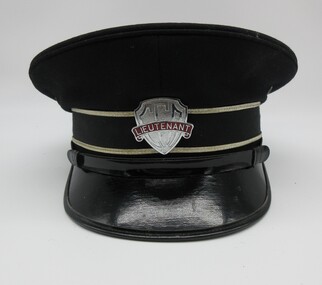
... The bowl of the hat is lined with red woven cotton and manufacturing details are stamped in gold. ...The bowl of the hat is lined with red woven cotton and manufacturing details are stamped in gold. ...This hat was worn by members of the Country Fire Authority on ceremonial occasions.A peaked black woollen gaberdine fireman's hat with a black petersham band edged with silver binding. There is a silver badge with the letters CFA- Lieutenant in the middle of the band. On each side there are two silver buttons with 'cfa' stamped on them. Attached to these two buttons is a black plastic band. There is green plastic under the peak. The bowl of the hat is lined with red woven cotton and manufacturing details are stamped in gold. There is a brown plastic band around the headband.(On the inside of the hat) Melbourne 36 1218 / EMERCO / This is your guarantee for quality./ Made in Australia./country fire authority, emerco hats - melbourne, hats, clothing, george evans collection, sunbury cfa -
 City of Moorabbin Historical Society (Operating the Box Cottage Museum)
Sewing Equipment, cotton reel 'Knox's', early 20thC
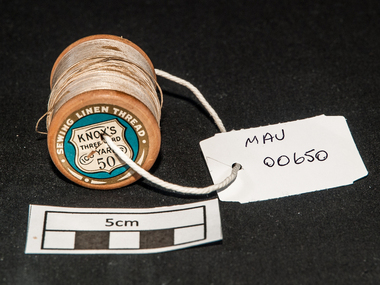
... W & J Knox Ltd were cotton millers in Kilbernie, Scotland during the time after the Industrial Revolution when Great Brittain exported manufactured cotton products globally. ...W & J Knox Ltd were cotton millers in Kilbernie, Scotland during the time after the Industrial Revolution when Great Brittain exported manufactured cotton products globally. ...W & J Knox Ltd were cotton millers in Kilbernie, Scotland during the time after the Industrial Revolution when Great Brittain exported manufactured cotton products globally. The early settlers in Moorabbin Shire had to be self reliant and made their own clothing, napery, tools and household goods. The women were skilful dressmakers and craft workers.A wooden reel of 'Knox's Three Cord' sewing cotton . 100 yardsW..J.KNOX / KILBIRNIE SCOTLAND/ 50/ 100ydsmoorabbin, brighton, early settlers, pioneers, cheltenham, knox pty. ltd. kilbirnie scotland, cotton mills, dressmaking -
 Broadmeadows Historical Society & Museum
Flag - Municipal Flag, City of Broadmeadows Flag
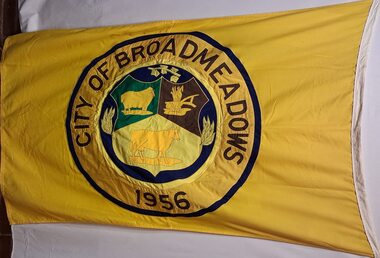
... Yellow oblong municipal flag manufactured from cotton. The flag bears the City of Broadmeadows civic logo on both faces and retains attachments along the hoist edge for display or flying. ...Yellow oblong municipal flag manufactured from cotton. The flag bears the City of Broadmeadows civic logo on both faces and retains attachments along the hoist edge for display or flying. ...This flag is associated with the former City of Broadmeadows, a municipal authority that administered a large proportion of the area now incorporated within the City of Hume. The item represents civic identity, local government administration, and municipal symbolism within Broadmeadows. The former catalogue worksheet identifies the item as a "City of Broadmeadows Flag 1956".The City of Broadmeadows Flag is historically significant as a surviving municipal emblem of the former City of Broadmeadows. It demonstrates how the municipality represented itself through official civic symbols and contributes to the interpretation of local government history within Broadmeadows and the wider Hume district. The survival of a complete municipal flag enhances its research and interpretive value and provides tangible evidence of community identity and municipal heritage.Yellow oblong municipal flag manufactured from cotton. The flag bears the City of Broadmeadows civic logo on both faces and retains attachments along the hoist edge for display or flying. The flag is complete and substantially intact.No inscriptions or markings recorded. The flag incorporates the official City of Broadmeadows municipal logo on both faces.city of broadmeadows, local government, municipal administration, municipal symbols, broadmeadows, hume region, flags, civic identity -
 Flagstaff Hill Maritime Museum and Village
Functional object - Blotting Paper Holder, Circa 1910
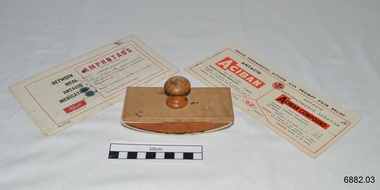
... It is often made of cotton and manufactured on special paper machines. Blotting paper is reputed to be first referred to in the English language in the 15th century but there is a tradition in Norfolk, England that it was invented by accident at Lyng Mill on the River Wensum. ...It is often made of cotton and manufactured on special paper machines. Blotting paper is reputed to be first referred to in the English language in the 15th century but there is a tradition in Norfolk, England that it was invented by accident at Lyng Mill on the River Wensum. ...Blotting paper is made from different materials of varying thickness, softness, etc. depending on the application. It is often made of cotton and manufactured on special paper machines. Blotting paper is reputed to be first referred to in the English language in the 15th century but there is a tradition in Norfolk, England that it was invented by accident at Lyng Mill on the River Wensum. It is reported that a Berkshire (England) paper mill worker in East Hagbourne failed to add sizing to a batch of paper that was being produced. The batch was discarded. Subsequently, someone tried to write on a piece of this discarded "scrap" paper and found that it rapidly absorbed any ink applied, making it unusable for writing. Its marked absorbency having been noted, however, led to its subsequently being produced and used as blotting paper, replacing sand, which was the material that had been used for absorbing superficial wet ink. In a time when most paper was produced from "rags", red/pink rags, from which it was difficult to remove all colour and had generally been discarded, were now directed to the production of blotters, hence the historically characteristic pink colour of blotters. https://en.wikipedia.org/wiki/Blotting_paper This blotting paper holder and blotting sheets were donated to Flagstaff Hill Maritime Village by the family of Doctor William Roy Angus, Surgeon and Oculist. It is part of the “W.R. Angus Collection” that includes historical medical equipment, surgical instruments and material once belonging to Dr Edward Ryan and Dr Thomas Francis Ryan, (both of Nhill, Victoria) as well as Dr Angus’ own belongings. The Collection’s history spans the medical practices of the two Doctors Ryan, from 1885-1926 plus that of Dr Angus, up until 1969. ABOUT THE “W.R.ANGUS COLLECTION” Doctor William Roy Angus M.B., B.S., Adel., 1923, F.R.C.S. Edin.,1928 (also known as Dr Roy Angus) was born in Murrumbeena, Victoria in 1901 and lived until 1970. He qualified as a doctor in 1923 at University of Adelaide, was Resident Medical Officer at the Royal Adelaide Hospital in 1924 and for a period was house surgeon to Sir (then Mr.) Henry Simpson Newland. Dr Angus was briefly an Assistant to Dr Riddell of Kapunda, then commenced private practice at Curramulka, Yorke Peninsula, SA, where he was physician, surgeon and chemist. In 1926, he was appointed as new Medical Assistant to Dr Thomas Francis Ryan (T.F. Ryan, or Tom), in Nhill, Victoria, where his experiences included radiology and pharmacy. In 1927 he was Acting House Surgeon in Dr Tom Ryan’s absence. Dr Angus had become engaged to Gladys Forsyth and they decided he further his studies overseas in the UK in 1927. He studied at London University College Hospital and at Edinburgh Royal Infirmary and in 1928, was awarded FRCS (Fellow from the Royal College of Surgeons), Edinburgh. He worked his passage back to Australia as a Ship’s Surgeon on the on the Australian Commonwealth Line’s T.S.S. Largs Bay. Dr Angus married Gladys in 1929, in Ballarat. (They went on to have one son (Graham 1932, born in SA) and two daughters (Helen (died 12/07/1996) and Berenice (Berry), both born at Mira, Nhill ) According to Berry, her mother Gladys made a lot of their clothes. She was very talented and did some lovely embroidery including lingerie for her trousseau and beautifully handmade baby clothes. Dr Angus was a ‘flying doctor’ for the A.I.M. (Australian Inland Ministry) Aerial Medical Service in 1928 . Its first station was in the remote town of Oodnadatta, where Dr Angus was stationed. He was locum tenens there on North-South Railway at 21 Mile Camp. He took up this ‘flying doctor’ position in response to a call from Dr John Flynn; the organisation was later known as the Flying Doctor Service, then the Royal Flying Doctor Service. A lot of his work during this time involved dental surgery also. Between 1928-1932 he was surgeon at the Curramulka Hospital, Yorke Peninsula, South Australia. In 1933 Dr Angus returned to Nhill and purchased a share of the Nelson Street practice and Mira hospital (a 2 bed ward at the Nelson Street Practice) from Dr Les Middleton one of the Middleton Brothers, the current owners of what previously once Dr Tom Ryan’s practice. Dr Tom and his brother had worked as surgeons included eye surgery. Dr Tom Ryan performed many of his operations in the Mira private hospital on his premises. He had been House Surgeon at the Nhill Hospital 1902-1926. Dr Tom Ryan had one of the only two pieces of radiology equipment in Victoria during his practicing years – The Royal Melbourne Hospital had the other one. Over the years Dr Tom Ryan had gradually set up what was effectively a training school for country general-practitioner-surgeons. Each patient was carefully examined, including using the X-ray machine, and any surgery was discussed and planned with Dr Ryan’s assistants several days in advance. Dr Angus gained experience in using the X-ray machine there during his time as assistant to Dr Ryan. When Dr Angus bought into the Nelson Street premises in Nhill he was also appointed as the Nhill Hospital’s Honorary House Surgeon 1933-1938. His practitioner’s plate from his Nhill surgery is now mounted on the doorway to the Port Medical Office at Flagstaff Hill Maritime Village, Warrnambool. When Dr Angus took up practice in the Dr Edward and Dr Tom Ryan’s old premises he obtained their extensive collection of historical medical equipment and materials spanning 1884-1926. A large part of this collection is now on display at the Port Medical Office at Flagstaff Hill Maritime Village in Warrnambool. In 1939 Dr Angus and his family moved to Warrnambool where he purchased “Birchwood,” the 1852 home and medical practice of Dr John Hunter Henderson, at 214 Koroit Street. (This property was sold in1965 to the State Government and is now the site of the Warrnambool Police Station. and an ALDI sore is on the land that was once their tennis court). The Angus family was able to afford gardeners, cooks and maids; their home was a popular place for visiting dignitaries to stay whilst visiting Warrnambool. Dr Angus had his own silk worm farm at home in a Mulberry tree. His young daughter used his centrifuge for spinning the silk. Dr Angus was appointed on a part-time basis as Port Medical Officer (Health Officer) in Warrnambool and held this position until the 1940’s when the government no longer required the service of a Port Medical Officer in Warrnambool; he was thus Warrnambool’s last serving Port Medical Officer. (Masters of immigrant ships arriving in port reported incidents of diseases, illness and death and the Port Medical Officer made a decision on whether the ship required Quarantine and for how long, in this way preventing contagious illness from spreading from new immigrants to the residents already in the colony.) Dr Angus was a member of the Australian Medical Association, for 35 years and surgeon at the Warrnambool Base Hospital 1939-1942, He served as a Surgeon Captain during WWII 1942-45, in Ballarat, Victoria, and in Bonegilla, N.S.W., completing his service just before the end of the war due to suffering from a heart attack. During his convalescence he carved an intricate and ‘most artistic’ chess set from the material that dentures were made from. He then studied ophthalmology at the Royal Melbourne Eye and Ear Hospital and created cosmetically superior artificial eyes by pioneering using the intrascleral cartilage. Angus received accolades from the Ophthalmological Society of Australasia for this work. He returned to Warrnambool to commence practice as an ophthalmologist, pioneering in artificial eye improvements. He was Honorary Consultant Ophthalmologist to Warrnambool Base Hospital for 31 years. He made monthly visits to Portland as a visiting surgeon, to perform eye surgery. He represented the Victorian South-West subdivision of the Australian Medical Association as its secretary between 1949 and 1956 and as chairman from 1956 to 1958. In 1968 Dr Angus was elected member of Spain’s Barraquer Institute of Barcelona after his research work in Intrasclearal cartilage grafting, becoming one of the few Australian ophthalmologists to receive this honour, and in the following year presented his final paper on Living Intrasclearal Cartilage Implants at the Inaugural Meeting of the Australian College of Ophthalmologists in Melbourne In his personal life Dr Angus was a Presbyterian and treated Sunday as a Sabbath, a day of rest. He would visit 3 or 4 country patients on a Sunday, taking his children along ‘for the ride’ and to visit with him. Sunday evenings he would play the pianola and sing Scottish songs to his family. One of Dr Angus’ patients was Margaret MacKenzie, author of a book on local shipwrecks that she’d seen as an eye witness from the late 1880’s in Peterborough, Victoria. In the early 1950’s Dr Angus, painted a picture of a shipwreck for the cover jacket of Margaret’s book, Shipwrecks and More Shipwrecks. She was blind in later life and her daughter wrote the actual book for her. Dr Angus and his wife Gladys were very involved in Warrnambool’s society with a strong interest in civic affairs. He had an interest in people and the community They were both involved in the creation of Flagstaff Hill, including the layout of the gardens. After his death (28th March 1970) his family requested his practitioner’s plate, medical instruments and some personal belongings be displayed in the Port Medical Office surgery at Flagstaff Hill Maritime Village, and be called the “W. R. Angus Collection”. The W.R. Angus Collection is significant for still being located at the site it is connected with, Doctor Angus being the last Port Medical Officer in Warrnambool. The collection of medical instruments and other equipment is culturally significant, being an historical example of medicine and administration from late 19th to mid-20th century. Dr Angus assisted Dr Tom Ryan, a pioneer in the use of X-rays and in ocular surgery. Blotting paper holder, part of the W.R. Angus Collection. Wooden rocking blotting paper holder, arc-shaped with handle and blotting paper inserted in slots (paper is used). Two books of blotting paper sheets, (1) advertising printed on cover. “ACIBAN ANTACID”, “G.P. PTY LTD / Sydney Australia” (2) Folder of blotting paper, with advertising “AMPHOTABS” and “WYETH”“ACIBAN ANTACID”, “G.P. PTY LTD / Sydney Australia” “AMPHOTABS” and “WYETH” flagstaff hill, warrnambool, shipwrecked coast, flagstaff hill maritime museum, maritime museum, shipwreck coast, flagstaff hill maritime village, great ocean road, dr w r angus, dr ryan, surgical instrument, t.s.s. largs bay, warrnambool base hospital, nhill base hospital, mira hospital, flying doctor, blotting paper holder, office stationery circa 1910, rocking blotting paper holder -
 Flagstaff Hill Maritime Museum and Village
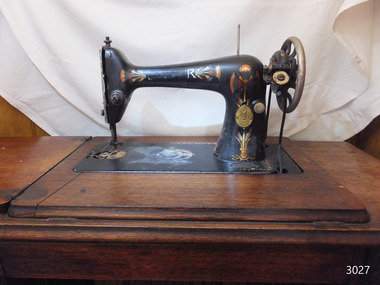
Domestic object - Sewing Machine, Singer Sewing Machine Company, 1922
... Industrial sewing machines, in combination with the cotton gin, the spinning jenny, and the steam engine, made clothing production much easier and much cheaper. flagstaff hill warrnambool shipwrecked-coast flagstaff-hill-maritime-museum maritime-museum shipwreck-coast flagstaff-hill-maritime-village sewing machine hand operated dressmaking textile machinery portable premier sewing machine premier Singer Treadle Sewing Machine "Branded Premier" 5-7-9-2-0-0-" Serial Number Y6243048 (denotes 1922 year of manufacture) Sewing machine, treadle operated, Domestic object Sewing Machine Singer Sewing Machine Company ...In 1867 the Singer Company decided that the demand for their sewing machines in the UK was sufficiently high to open a local factory. Glasgow was selected for its iron-making industries, cheap labour, and possibly because at the time the General Manager of the US Singer Sewing Machine Company was George McKenzie, who was of Scottish descent. The company obtained a lease on land near Queen Street Station and machinery and machine parts were shipped over from the US. Demand for sewing machines outstripped production at the new plant and by 1873 a new larger factory was completed near Bridgeton Cross. By now Singer employed over 2,000 people in Scotland but still, they could not produce enough machines. In 1882 George McKenzie, the soon to become President of the Singer Sewing Machine Company undertook the ground breaking ceremony on 46 acres of farmland at Kilbowie, Clydebank and the largest Singer factory in the world started to be built. Originally two main buildings were constructed. Built above the middle wing of the factory was a huge clock tower with the 'Singer' name displayed for all to see from miles around. Many miles of railway lines were laid throughout the factory to connect the different departments and to aid in the shipping of their goods. Railway lines from the factory connected Glasgow, Dumbarton, and Helensburgh stations. The factory was regarded as the most modern facility in Europe at that time. As different departments in the factory were completed, the workers moved from the old sites to the new one at Kilbowie and the factory was finally finished in 1885. With nearly a million square feet of space and almost 7,000 employees producing on average 13,000 machines a week, making it the largest sewing machine factory in the world. The Clydebank factory was so productive that in 1905 the US Singer Company set up the Singer Manufacturing Company Ltd. as a UK registered company. The invention of the sewing machine had several very significant impacts on the lives of many people. It changed the domestic life of many women as more households began to own sewing machines, women as the ones who traditionally stayed home to do chores including making and repairing clothing, found themselves with more free time. Previously several days a week would be dedicated to sewing clothing for herself and her family, a housewife could now complete her sewing in merely several hours, allowing for more free time to pursue hobbies and attain new skills. Sewing and clothing production, in general, became more industrialized activities, taking place less in the home and more in large factories. Industrial sewing machines, in combination with the cotton gin, the spinning jenny, and the steam engine, made clothing production much easier and much cheaper. Sewing machine, treadle operated, "Branded Premier" 5-7-9-2-0-0-" Serial Number Y6243048 (denotes 1922 year of manufacture) flagstaff hill, warrnambool, shipwrecked-coast, flagstaff-hill-maritime-museum, maritime-museum, shipwreck-coast, flagstaff-hill-maritime-village, sewing machine, hand operated, dressmaking, textile machinery, portable, premier sewing machine, premier, singer treadle sewing machine -
 Flagstaff Hill Maritime Museum and Village
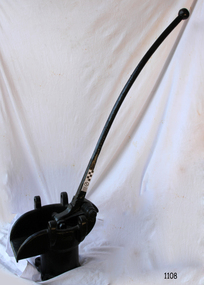
Functional object - Water Pump, Goulds Manufacturing Co, 1915-1925
... manufacturing company was founded in 1848 at Seneca Falls, New York when Seabury S. Gould purchased an interest in Downs, Mynderse & Co. and the firm became Downs & Co. Wooden pumps were produced at the time in an old cotton...manufacturing company was founded in 1848 at Seneca Falls, New York when Seabury S. Gould purchased an interest in Downs, Mynderse & Co. and the firm became Downs & Co. Wooden pumps were produced at the time in an old cotton ...Gould manufacturing company was founded in 1848 at Seneca Falls, New York when Seabury S. Gould purchased an interest in Downs, Mynderse & Co. and the firm became Downs & Co. Wooden pumps were produced at the time in an old cotton factory building. In 1869, the name of the company was changed from Downs & Company to Goulds Manufacturing Company. Seabury S. Gould was regarded as a man of unusual vision, and as the founder of Goulds Manufacturing Company he was keen to start producing cast iron pumps. An iron pump, he believed, would overcome all the disadvantages of a wooden pump. It would be strong and efficient and provide fresh flowing water for the pioneers. He ran the company until after the American Civil War and because Goulds Manufacturing had a foundry, they also produced all kinds of cast iron products such as corn shellers, bells, sad irons, sinks, tools, and a line of fire engines. From 1848 to 1964 a Gould family member had always been President of the company. However, the company ownership in 1964 was transferred from family-owned stock to public offerings and employee ownership of stock. The subject item called the "N e w Deluge" was an improved bilge pump for vessels having not more than 25 feet depth of hold. It was also used by contractors for pumping out excavations and was well adapted for irrigation use. This hand pump was designed to be used where a hand pump of large capacity was desired. Goulds made many different types of pumps to suit differing pumping situations such as. Well Pumps, Hydraulic Rams, Diaphragm Pumps, Tank Pumps, Sprayers and Small Capacity Power rumps. Goulds Triplex, Centrifugal, Rotary and Deep Well Power Pumps The subject item was first introduced to the market in the Goulds catalogue of 1915 and became a very popular pump used in Australia and the USA. It is manufactured by a company still trading today with offices in Australia and many other countries.Hand Pump cast iron with long reversable pumping lever and cylindrical casing there are 4 metal holes for fastening to floor surface. Painted black. Embossed "NEW DELUGE" "- - -" and "No 16" or "No 18".warrnambool, flagstaff-hill, flagstaff-hill-maritime-museum, maritime-museum, shipwreck-coast, flagstaff-hill-maritime-village, pump, hand pump, goulds manufacturing -
Frankston RSL Sub Branch
Uniform, Coverall
... This item of clothing is manufactured from a 'camouflague' cloth made from 100% cotton....Cotton". The rear of the label has care instructions and the note "Made in Australia". Uniform which is in the form of a 'one piece' clothing item with long sleeves and long trousers. Not unlike what is commonly referred to as 'coverall'. This item of clothing is manufactured ...Uniform which is in the form of a 'one piece' clothing item with long sleeves and long trousers. Not unlike what is commonly referred to as 'coverall'. This item of clothing is manufactured from a 'camouflague' cloth made from 100% cotton.The item is labelled with the following inscription "Stewart & Heaton Clothing", "QUALITY UNIFORMS & WORKWEAR", "100% Cotton". The rear of the label has care instructions and the note "Made in Australia". -
 Ballarat Clarendon College
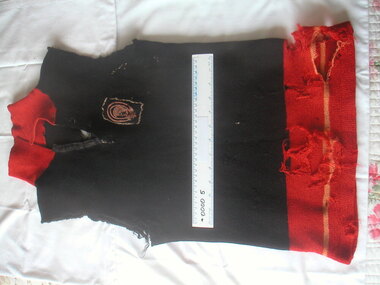
Uniform, Football jersey, 1935 (estimated)
... It is the only example of 1930's sport attire held by the school The jersey has social significance because it exemplifies uniform requirements and manufacture during the 1930's. football football jersey sport uniform 1936 r a slocombe A black sleeveless, knitted, woollen football jersey with red collar. It has an 11cm wide red band on waist and a thin gold line 4cm above the hemline. There is a cotton ...This football jersey was worm by R. A. Slocombe while a member of the 1st XVIII in 1935. Mr Slocombe was in year 11 at the time. The item was badly damaged while in storage during World War 2. It is the only example of 1930's sport attire held by the schoolThe jersey has social significance because it exemplifies uniform requirements and manufacture during the 1930's. A black sleeveless, knitted, woollen football jersey with red collar. It has an 11cm wide red band on waist and a thin gold line 4cm above the hemline. There is a cotton bound neck opening with 3 buttonholes on left side of garment (buttons missing). The College insignia has been roughly appliqued at left breast. football, football jersey, sport uniform, 1936, r a slocombe -
 Shepparton RSL Sub Branch
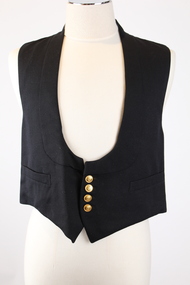
Uniform, Waist Coat, Commodore, 8th. July 1971
... cotton rear to waist coat. Adjustable strap to rear with metal Buckle. Clothing manufactures lable to left hand inside. ...Manufactures Lables. Black Material Waist Coat. Satin inner lining. Four Gold Buttons. Two small pockets to front. Black cotton ...Post WW2 Navy CommodoreBlack Material Waist Coat. Satin inner lining. Four Gold Buttons. Two small pockets to front. Black cotton rear to waist coat. Adjustable strap to rear with metal Buckle. Clothing manufactures lable to left hand inside. Coller. C.G.C.F. And Made in Australia. And R.A.N.Manufactures Lables.uniform royal australian navy -
 Flagstaff Hill Maritime Museum and Village
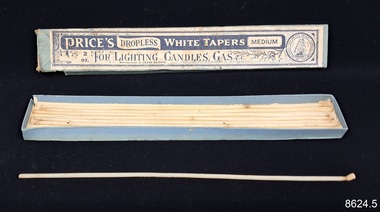
Functional object - Wax Tapers, Price's Candle Company, Early 20th Century
... Manufactured in Great Britain. This label is issued by the Australian Candle Co. 859.' Also on the Price's logo: 'Price's Patent Candle Company Limited. London & Liverpool.' Box 2: 'Olympia Wax Tapers. Made by Olympia Waxes, Melbourne, Victoria. Two dozen Olympia Wax Tapers.' Two cardboard boxes of long, white wax tapers that have cotton ...These wax tapers belonged to Dr.William Roy Angus, Surgeon and Oculist. They were donated to Flagstaff Hill Maritime Village by his daughter, Bernice McDade. They are part of the “W.R. Angus Collection” that includes historical medical equipment, surgical instruments and material once belonging to Dr Edward Ryan and Dr Thomas Francis Ryan, (both of Nhill, Victoria) as well as Dr Angus’ own belongings. The Collection’s history spans the medical practices of the two Doctors Ryan, from 1885-1926 plus that of Dr Angus, up until 1969. ABOUT THE “W.R.ANGUS COLLECTION” Doctor William Roy Angus M.B., B.S., Adel., 1923, F.R.C.S. Edin.,1928 (also known as Dr Roy Angus) was born in Murrumbeena, Victoria in 1901 and lived until 1970. He qualified as a doctor in 1923 at University of Adelaide, was Resident Medical Officer at the Royal Adelaide Hospital in 1924 and for a period was house surgeon to Sir (then Mr.) Henry Simpson Newland. Dr Angus was briefly an Assistant to Dr Riddell of Kapunda, then commenced private practice at Curramulka, Yorke Peninsula, SA, where he was physician, surgeon and chemist. In 1926, he was appointed as new Medical Assistant to Dr Thomas Francis Ryan (T.F. Ryan, or Tom), in Nhill, Victoria, where his experiences included radiology and pharmacy. In 1927 he was Acting House Surgeon in Dr Tom Ryan’s absence. Dr Angus had become engaged to Gladys Forsyth and they decided he would take time to further his studies overseas in the UK in 1927. He studied at London University College Hospital and at Edinburgh Royal Infirmary and in 1928, was awarded FRCS (Fellow from the Royal College of Surgeons), Edinburgh. He worked his passage back to Australia as a Ship’s Surgeon on the on the Australian Commonwealth Line’s T.S.S. Largs Bay. Dr Angus married Gladys in 1929, in Ballarat. (They went on to have one son (Graham 1932, born in SA) and two daughters (Helen (died 12/07/1996) and Berenice (Berry), both born at Mira, Nhill ) Dr Angus was a ‘flying doctor’ for the A.I.M. (Australian Inland Ministry) Aerial Medical Service in 1928 . The organisation began in South Australia through the Presbyterian Church in that year, with its first station being in the remote town of Oodnadatta, where Dr Angus was stationed. He was locum tenens there on North-South Railway at 21 Mile Camp. He took up this ‘flying doctor’ position in response to a call from Dr John Flynn; the organisation was later known as the Flying Doctor Service, then the Royal Flying Doctor Service. A lot of his work during this time involved dental surgery also. Between 1928-1932 he was surgeon at the Curramulka Hospital, Yorke Peninsula, South Australia. In 1933 Dr Angus returned to Nhill where he’d previously worked as Medical Assistant and purchased a share of the Nelson Street practice and Mira hospital from Dr Les Middleton one of the Middleton Brothers, the current owners of what was once Dr Tom Ryan’s practice. Dr L Middleton was House Surgeon to the Nhill Hospital 1926-1933, when he resigned. [Dr Tom Ryan’s practice had originally belonged to his older brother Dr Edward Ryan, who came to Nhill in 1885. Dr Edward saw patients at his rooms, firstly in Victoria Street and in 1886 in Nelson Street, until 1901. The Nelson Street practice also had a 2 bed ward, called Mira Private Hospital ). Dr Edward Ryan was House Surgeon at the Nhill Hospital 1884-1902 . He also had occasions where he successfully performed veterinary surgery for the local farmers too. Dr Tom Ryan then purchased the practice from his brother in 1901. Both Dr Edward and Dr Tom Ryan work as surgeons included eye surgery. Dr Tom Ryan performed many of his operations in the Mira private hospital on his premises. He too was House Surgeon at the Nhill Hospital 1902-1926. Dr Tom Ryan had one of the only two pieces of radiology equipment in Victoria during his practicing years – The Royal Melbourne Hospital had the other one. Over the years Dr Tom Ryan gradually set up what was effectively a training school for country general-practitioner-surgeons. Each patient was carefully examined, including using the X-ray machine, and any surgery was discussed and planned with Dr Ryan’s assistants several days in advance. Dr Angus gained experience in using the X-ray machine there during his time as assistant to Dr Ryan. Dr Tom Ryan moved from Nhill in 1926. He became a Fellow of the Royal Australasian College of Surgeons in 1927, soon after its formation, a rare accolade for a doctor outside any of the major cities. He remained a bachelor and died suddenly on 7th Dec 1955, aged 91, at his home in Ararat. Scholarships and prizes are still awarded to medical students in the honour of Dr T.F. Ryan and his father, Dr Michael Ryan, and brother, John Patrick Ryan. ] When Dr Angus bought into the Nelson Street premises in Nhill he was also appointed as the Nhill Hospital’s Honorary House Surgeon 1933-1938. His practitioner’s plate from his Nhill surgery states “HOURS Daily, except Tuesdays, Fridays and Saturday afternoons, 9-10am, 2-4pm, 7-8pm. Sundays by appointment”. This plate is now mounted on the doorway to the Port Medical Office at Flagstaff Hill Maritime Village, Warrnambool. Dr Edward Ryan and Dr Tom Ryan had an extensive collection of historical medical equipment and materials spanning 1884-1926 and when Dr Angus took up practice in their old premises he obtained this collection, a large part of which is now on display at the Port Medical Office at Flagstaff Hill Maritime Village in Warrnambool. During his time in Nhill Dr Angus was involved in the merging of the Mira Hospital and Nhill Public Hospital into one public hospital and the property titles passed on to Nhill Hospital in 1939. In 1939 Dr Angus and his family moved to Warrnambool where he purchased “Birchwood,” the 1852 home and medical practice of Dr John Hunter Henderson, at 214 Koroit Street. (This property was sold in1965 to the State Government and is now the site of the Warrnambool Police Station. ). The Angus family was able to afford gardeners, cooks and maids; their home was a popular place for visiting dignitaries to stay whilst visiting Warrnambool. Dr Angus had his own silk worm farm at home in a Mulberry tree. His young daughter used his centrifuge for spinning the silk. Dr Angus was appointed on a part-time basis as Port Medical Officer (Health Officer) in Warrnambool and held this position until the 1940’s when the government no longer required the service of a Port Medical Officer in Warrnambool; he was thus Warrnambool’s last serving Port Medical Officer. (The duties of a Port Medical Officer were outlined by the Colonial Secretary on 21st June, 1839 under the terms of the Quarantine Act. Masters of immigrant ships arriving in port reported incidents of diseases, illness and death and the Port Medical Officer made a decision on whether the ship required Quarantine and for how long, in this way preventing contagious illness from spreading from new immigrants to the residents already in the colony.) Dr Angus was a member of the Australian Medical Association, for 35 years and surgeon at the Warrnambool Base Hospital 1939-1942, He served as a Surgeon Captain during WWII1942-45, in Ballarat, Victoria, and in Bonegilla, N.S.W., completing his service just before the end of the war due to suffering from a heart attack. During his convalescence he carved an intricate and ‘most artistic’ chess set from the material that dentures were made from. He then studied ophthalmology at the Royal Melbourne Eye and Ear Hospital and created cosmetically superior artificial eyes by pioneering using the intrascleral cartilage. Angus received accolades from the Ophthalmological Society of Australasia for this work. He returned to Warrnambool to commence practice as an ophthalmologist, pioneering in artificial eye improvements. He was Honorary Consultant Ophthalmologist to Warrnambool Base Hospital for 31 years. He made monthly visits to Portland as a visiting surgeon, to perform eye surgery. He represented the Victorian South-West subdivision of the Australian Medical Association as its secretary between 1949 and 1956 and as chairman from 1956 to 1958. In 1968 Dr Angus was elected member of Spain’s Barraquer Institute of Barcelona after his research work in Intrasclearal cartilage grafting, becoming one of the few Australian ophthalmologists to receive this honour, and in the following year presented his final paper on Living Intrasclearal Cartilage Implants at the Inaugural Meeting of the Australian College of Ophthalmologists in Melbourne In his personal life Dr Angus was a Presbyterian and treated Sunday as a Sabbath, a day of rest. He would visit 3 or 4 country patients on a Sunday, taking his children along ‘for the ride’ and to visit with him. Sunday evenings he would play the pianola and sing Scottish songs to his family. One of Dr Angus’ patients was Margaret MacKenzie, author of a book on local shipwrecks that she’d seen as an eye witness from the late 1880’s in Peterborough, Victoria. In the early 1950’s Dr Angus, painted a picture of a shipwreck for the cover jacket of Margaret’s book, Shipwrecks and More Shipwrecks. She was blind in later life and her daughter wrote the actual book for her. Dr Angus and his wife Gladys were very involved in Warrnambool’s society with a strong interest in civic affairs. Their interests included organisations such as Red Cross, Rostrum, Warrnambool and District Historical Society (founding members), Wine and Food Society, Steering Committee for Tertiary Education in Warrnambool, Local National Trust, Good Neighbour Council, Housing Commission Advisory Board, United Services Institute, Legion of Ex-Servicemen, Olympic Pool Committee, Food for Britain Organisation, Warrnambool Hospital, Anti-Cancer Council, Boys’ Club, Charitable Council, National Fitness Council and Air Raid Precautions Group. He was also a member of the Steam Preservation Society and derived much pleasure from a steam traction engine on his farm. He had an interest in people and the community He and his wife Gladys were both involved in the creation of Flagstaff Hill, including the layout of the gardens. After his death (28th March 1970) his family requested his practitioner’s plate, medical instruments and some personal belongings be displayed in the Port Medical Office surgery at Flagstaff Hill Maritime Village, and be called the “W. R. Angus Collection”.The W.R. Angus Collection is significant for still being located at the site it is connected with, Doctor Angus being the last Port Medical Officer in Warrnambool. The collection of medical instruments and other items and equipment is culturally significant, being an historical example of medicine from late 19th to mid-20th century. Dr Angus assisted Dr Tom Ryan, a pioneer in the use of X-rays and in ocular surgery.Two cardboard boxes of long, white wax tapers that have cotton wicks. Box 1 is blue and Box 2 is red. Both boxes have labels and inscriptions. The object is part of the W.R. Angus Collection. Box 1: 'Price's Dropless White Tapers Medium. 2 oz. For Lighting Candles, Gas & C. Manufactured in Great Britain. This label is issued by the Australian Candle Co. 859.' Also on the Price's logo: 'Price's Patent Candle Company Limited. London & Liverpool.' Box 2: 'Olympia Wax Tapers. Made by Olympia Waxes, Melbourne, Victoria. Two dozen Olympia Wax Tapers.'flagstaff hill maritime museum and village, great ocean road, shipwreck coast, wax tapers, candles, lighting, price's dropless white tapers, olympia wax tapers, gas stoves, gas lamps, gas fires, w.r. angus -
 City of Moorabbin Historical Society (Operating the Box Cottage Museum)
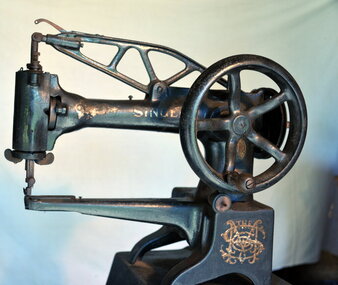
Functional object - Sewing machine, 'Singer' boot-making, c1914
... Early settlers and market gardeners in Moorabbin Shire had to be self reliant, producing their food making and maintaining their own equipment, clothing and utensils This Singer boot-makers sewing machine is an example of the skills and craftsmanship of the pioneer settlers in Moorabbin Shire. brighton moorabbin pioneers bentleigh market gardeners early settlers farm equipment sewing machine singer manufacturing company boot-makers leatherwork ' SINGER ' on body of machine / 'SINGER 29K2' on plate/ emblem plate on right shaft shows 'S entwined with a shuttle/ bobbin over a reel of cotton' ./ ‘Singer Manef.c Co’ on iron support frame A black, Singer 29K2, treadle, boot-maker's sewing machine c1914 Functional object Sewing machine, 'Singer' boot-making SINGER Manufacturing Company ...Early settlers and market gardeners in Moorabbin Shire had to be self reliant, producing their food making and maintaining their own equipment, clothing and utensils This Singer boot-makers sewing machine is an example of the skills and craftsmanship of the pioneer settlers in Moorabbin Shire.A black, Singer 29K2, treadle, boot-maker's sewing machine c1914' SINGER ' on body of machine / 'SINGER 29K2' on plate/ emblem plate on right shaft shows 'S entwined with a shuttle/ bobbin over a reel of cotton' ./ ‘Singer Manef.c Co’ on iron support framebrighton, moorabbin, pioneers, bentleigh, market gardeners, early settlers, farm equipment, sewing machine, singer manufacturing company, boot-makers, leatherwork -
 City of Moorabbin Historical Society (Operating the Box Cottage Museum)
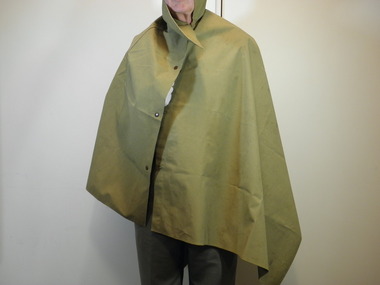
Uniform - Armed Services, Cape/groundsheet, 20th century
... cotton with various press snaps and webbing tape loops attached around the outside which allow it to be used in a variety of configuration. During WWII Australian forces fighting the Japanese in the Islands had an urgent requirement for a decent individual shelter. The rubberized canvas groundsheets and rain capes continued to be used, but these were less than effective in the tropics. Towards the end of the war in the Pacific Australia began issuing its troops a lighter weight version of the groundsheet manufactured...cotton with various press snaps and webbing tape loops attached around the outside which allow it to be used in a variety of configuration. During WWII Australian forces fighting the Japanese in the Islands had an urgent requirement for a decent individual shelter. The rubberized canvas groundsheets and rain capes continued to be used, but these were less than effective in the tropics. Towards the end of the war in the Pacific Australia began issuing its troops a lighter weight version of the groundsheet manufactured ...Rain cape, also used as a groundsheet, issued Australian servicemen. Purchased for the donor from an "Army Surplus" store and re-purposed for camps as a Scout in the late 1960s. The MK VII Groundsheet (Rain Cape / Poncho) was introduced in October 1917 during WW1. They were made from dyed cotton, proofed with a rubber compound, "well vulcanized" on one side. Weight 3lb. 8oz;. 78 inches long by 36 inches wide and made by the Victoria Rubber Co. Edinburgh. They were used again during WWII 1939-45 Today the Army uses the hootchie - a sheet of 70D nylon or PU-coated cotton with various press snaps and webbing tape loops attached around the outside which allow it to be used in a variety of configuration. During WWII Australian forces fighting the Japanese in the Islands had an urgent requirement for a decent individual shelter. The rubberized canvas groundsheets and rain capes continued to be used, but these were less than effective in the tropics. Towards the end of the war in the Pacific Australia began issuing its troops a lighter weight version of the groundsheet manufactured from polyurethane-coated cotton – During the Malayan Emergency of the 1950s, Australian troops were issued with hooded ponchos. Unlike the WWII US pattern ponchos which always had a hole in the dead centre of the poncho sheet, the Australian-issue hooded ponchos made an effective shelter – especially when two where clipped together. The problem of course is that the rubberized canvas ponchos were far too heavy for jungle use. 1960s Australian units in Borneo were issued with the first pattern lightweight hootchies. 1 Kg. 1970 the Vietnam War, a second pattern lightweight hootchie was issued made from nylon, but retaining the hardware and loops. This lightweight hootchie weighed a mere 680 grams, still heavy, but suitable for tropical use. Currently the hootchie is made from AUSCAM nylon material . Historic significance; representative of the type believed to have been issued to Australian servicemen in World War II, possibly in World War I.Waterproofed Canvas rain cape, also used as a groundsheet in the Australian Army, press studs to close as a cape, collar to cover neck.NILuniforms, australian army, world war ii, army surplus, scouts australia, bentleigh, moorabbin, world war 1, hooded ponchos, borneo, auscam nylon material, hootchies, malayan emergency, vietnam war, groundsheets -
 City of Moorabbin Historical Society (Operating the Box Cottage Museum)
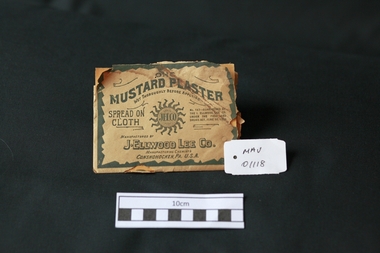
Pharmacy, mustard plaster, 20thC
... . / MANUFACTURING CHEMISTS / CONCHOHOCKEN PA. U.S.A. A paper packet that would have contained a cotton cloth impregnated with a mustard poultice used for the relief of pain in muscles. ...A mustard plaster is a poultice of mustard seed powder spread inside a protective dressing and applied to the body to stimulate healing. It can be used to warm muscle tissues and to treat chronic aches and pains. For long a part of conventional medical treatment, and available in prepared versions in pharmacies, it fell from favour in the 20th century, and is now only used as a home remedy.A paper packet that would have contained a cotton cloth impregnated with a mustard poultice used for the relief of pain in muscles.on packet ; ONE / MUSTARD PLASTER / WET THOROUGHLY BEFORE APPLYING / S[READ ON / CLOTH / TRADE / JELCO / MARK / No. 127 - GUARANTEED BY / THE J-ELWOOD LEE CO. / UNDER THE FOOD AND / DRUGS ACT, JUNE 3J-ELWOOD LEE 0TH 1906 / MANUFACTURED BY / J-ELWOOD LEE CO. / MANUFACTURING CHEMISTS / CONCHOHOCKEN PA. U.S.A.pharmacy, pharmaceutical manufacturers, moorabbin, cheltenham, medical poultices, early settlers, mustard plaster, pennsylvania usa, -
 City of Moorabbin Historical Society (Operating the Box Cottage Museum)
Manufactured Objects, adhesive surgical tape, 20thC
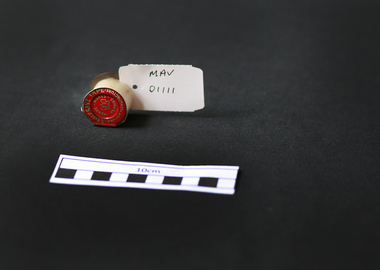
... Larger scale manufacturing of similar medical tapes began in 1874 by Robert Wood Johnson and George Seaburg in East Orange, NJ. (Johnson & Johnson Pty). 1921, Earle Dickson, who bought cotton for Johnson & Johnson, fixed a piece of gauze to some cloth backed tape and the first Band-Aid ® was invented. ...Larger scale manufacturing of similar medical tapes began in 1874 by Robert Wood Johnson and George Seaburg in East Orange, NJ. (Johnson & Johnson Pty). 1921, Earle Dickson, who bought cotton for Johnson & Johnson, fixed a piece of gauze to some cloth backed tape and the first Band-Aid ® was invented. medical dressings early settlers, moorabbin, cheltenham. bentleigh, johnson & johnson pty ltd adhesive surgical tape, around wheel: ADHESIVE TAPE MANUFACTURED / MINDS MAKES REPAIRS Symbol of a butterfly in centre A roll of white adhesive surgical tape on a metal reel width 2cm Manufactured Objects, adhesive surgical tape Unrecorded ...Surgical tape or medical tape is a type of pressure-sensitive adhesive tape used in medicine and first aid to hold a bandage or other dressing onto a wound. These tapes usually have a hypoallergenic adhesive which is designed to hold firmly onto skin, dressing materials, and underlying layers of tape, but to remove easily without damaging the skin. Surgical tape is often white because it contains zinc oxide, which is added to help prevent infections. In 1845, Dr. Horace Day made the first crude surgical tape. It was created by combining India rubber, pine gum, turpentine, litharge (a yellow lead oxide), and turpentine extract of cayenne pepper and then applying that mixture to strips of fabric. It was the first “rubber-based” adhesive tape called Leukoplast for the German company Beiersdorf AG. Larger scale manufacturing of similar medical tapes began in 1874 by Robert Wood Johnson and George Seaburg in East Orange, NJ. (Johnson & Johnson Pty). 1921, Earle Dickson, who bought cotton for Johnson & Johnson, fixed a piece of gauze to some cloth backed tape and the first Band-Aid ® was invented. A roll of white adhesive surgical tape on a metal reel width 2cmaround wheel: ADHESIVE TAPE MANUFACTURED / MINDS MAKES REPAIRS Symbol of a butterfly in centre medical dressings, early settlers, moorabbin, cheltenham. bentleigh, johnson & johnson pty ltd, adhesive surgical tape, -
 City of Moorabbin Historical Society (Operating the Box Cottage Museum)
WW11 1939-1945 Australian Army Soldiers Sewing Kit, c1939
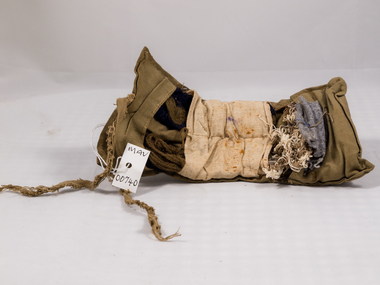
... This sewing kit hold-alls was manufactured from a khaki cotton or similar material. The metal thimble is missing....This sewing kit hold-alls was manufactured from a khaki cotton or similar material. The metal thimble is missing. ...1939 - 1945 Australian Army Sewing Kit. This kit is just one of many different brands of sewing kit - issued to Australian troops during the Second World War. Containing the standard requirements for uniform/clothing repair in the field. Items include:- assorted sewing needles,spare metal (quad hole) buttons and spare cotton/wool thread. Originally the "hold-all" (or pouch) was manufactured using leather, which was in plentiful supply in Australia and is quite durable. The major problem with leather however, especially in tropical or damp conditions - is it's susceptibility to moisture. This will then have an adverse affect upon the metal items contained within the kit, obviously resulting in corrosion to the metal sewing needles and buttons. This sewing kit hold-alls was manufactured from a khaki cotton or similar material. The metal thimble is missing.Standard issue sewing kit for Australian Soldiers serving in WW2 1939-45 in New Guinea and tropical areasA rectangular khaki cotton pouch containing wool and cotton threads, needles, metal buttons, folding stainless steel scissors that rolls up and is tied by two cotton bands.world war 11 1939-1945, cotton, khaki, soldier field kit, sewing kit, new guinea, army supply department, australian army, moorabbin, bentleigh, cheltenham, -
 City of Moorabbin Historical Society (Operating the Box Cottage Museum)
Clothing, white cotton lace blouse, c1960
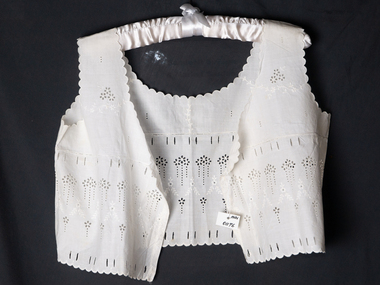
... Manufactured lace became affordable and plentiful so it was used by home dressmakers like Gladys Reed in City of Moorabbin c1960 clothing, manufactured lace, dressmaking, blouses, theatrical props, craftwork, sequins, beading, early settlers, moorabbin shire, mechanics institute cheltenham, ormond choral society, postworld war 11 settlers, housing estates moorabbin 1950, bentleigh, ormond, moorabbin, cheltenham, drama societies, musical society cheltenham, clark judy, reed gladys, reed george A white cotton lace, sleeveless blouse c 1960 with opening front fastened by hooks and eyes Clothing, white cotton lace blouse Mrs Gladys Reed ...Gladys Reed was a member of the Ormond Choral Society c 1950. who performed plays and musicals the City of Moorabbin and she was an accomplished dressmaker and made this blouse for her daughter Judy.Manufactured lace became affordable and plentiful so it was used by home dressmakers like Gladys Reed in City of Moorabbin c1960A white cotton lace, sleeveless blouse c 1960 with opening front fastened by hooks and eyes clothing, manufactured lace, dressmaking, blouses, theatrical props, craftwork, sequins, beading, early settlers, moorabbin shire, mechanics institute cheltenham, ormond choral society, postworld war 11 settlers, housing estates moorabbin 1950, bentleigh, ormond, moorabbin, cheltenham, drama societies, musical society cheltenham, clark judy, reed gladys, reed george -
 City of Moorabbin Historical Society (Operating the Box Cottage Museum)
Domestic object - 'O-CEDAR' Handimop, Kitchen Equipment
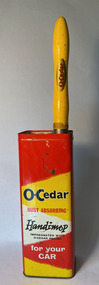
... Made in England, O'Cedar Ltd Slough, Bucks mop manufactured object o'cedar O'Cedar Dust Absorbing Handimop for your car - for your furniture A small duster mop impregnated with 'O-CEDAR' furniture polish with cotton head and wood handle Kitchen Equipment Domestic object 'O-CEDAR' Handimop ...Made in England, O'Cedar Ltd Slough, BucksA small duster mop impregnated with 'O-CEDAR' furniture polish with cotton head and wood handle O'Cedar Dust Absorbing Handimop for your car - for your furnituremop, manufactured object, o'cedar -
Glenelg Shire Council Cultural Collection
Clothing - Straw Boater Hat, Special Manufacture London & Melbourne Regd. No. 3124, n.d
... cotton mesh and silk. Maker's mark on silk. Sticker with '7' attached to leather headband. Clothing Straw Boater Hat Special Manufacture London & Melbourne Regd. ...Straw boater, natural colour, wide black grosgrain ribbon around crown of hat. Cord round crown attached to two metal clips on edge of brim. Leather headband with 'Self Conforming regd design No. 632799', in gold. Inside crown lined with cotton mesh and silk. Maker's mark on silk. Sticker with '7' attached to leather headband. -
 Orbost & District Historical Society
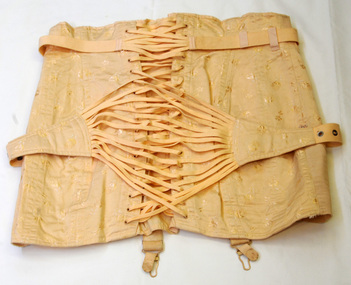
corset, c. 1900 - 1920
... cotton fabric embroidered with flowers in the same colour. It has whalebone stays, and laces through metal eyelets. This corset is similar to 822 in the collection. It is size 33 and manufactured...cotton fabric embroidered with flowers in the same colour. It has whalebone stays, and laces through metal eyelets. This corset is similar to 822 in the collection. It is size 33 and manufactured ...This item was worn by Marjorie McKeown (nee Ford)Until well into the 20th century, the corset was an essential element of fashionable dress. Corsets were worn by women (and much earlier by men) to enhance their figures and to hold their stockings in place. Although still sometimes used they were mainly used prior to the making of pantyhose approximately 1960.A corset made of apricot / pink cotton fabric embroidered with flowers in the same colour. It has whalebone stays, and laces through metal eyelets. This corset is similar to 822 in the collection. It is size 33 and manufactured by Jenyns.Size 33, Jenyns Patent Corsetry (manufacturer) womens-corsetry womens-undergarments female-underwear -
 Montmorency–Eltham RSL Sub Branch
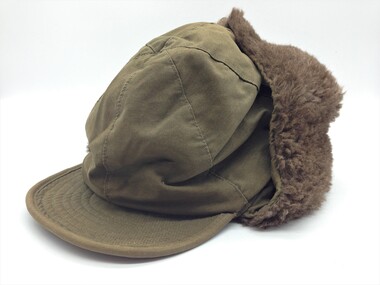
Uniform - Cap, US Army, Cold Weather, Korean War, Cap, US Army, Korean War, 1959
... cotton label sewn to liner. Cap, US Army, Korean War Uniform Cap, US Army, Cold Weather, Korean War Atlantic Highlands Manufacturing Company ...Typical US Army cold weather cap used in Korean War and post-Korea eraRepresentative US Army cap. This type of clothing was issued to Australian troops during the Korean War Olive Drab cotton and wool peaked Field Cap with imitation alpaca fold-down ear comforters, ends secured by cord. Cotton identification label sewn to liner. Wear instructions cotton label sewn to liner. CAP, FIELD, PILE, O.D., MQ-1 Size 7 ATLANTIC HIGHLANDS MFG. CO. Dated 13 Jan. 1951 Q.M. 9532-OI-10070 Pur.Desc. 1 Nov. 1950 Stock No. 73-C-16376-45 NYQMPA ALPACA 60% WOOL, 40% COTTON LINING 80% WOOL, 20% COTTON plus - wearing instructions "CAP, FIELD,PILE,OD, M-Q1" (sic) -
 Montmorency–Eltham RSL Sub Branch
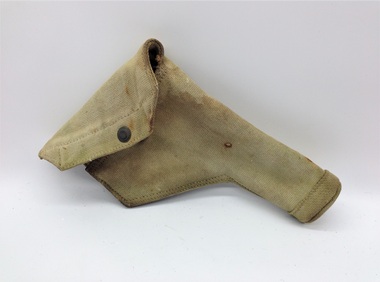
Weapon - Case, Pistol, Patt. '37 W.E, Pistol case ‘37 W.E, 1940
... Manufacturing Company Limited) in Montreal, Quebec. A great deal of webbing was sent to Australia. These pistol cases saw much use by our troops during WW2 and holstered US Smith & Wesson 'Victory' model and various British Webley .38 revolvers in addition to Enfields. Z L & T Ltd (holster) UNITED CARR CANADA (snap fastener) Khaki cotton ...This holster was copied by the Canadians from the British Pattern 1937 web equipment designed to hold the British .38 Calibre Enfield No.2 Mk 1 Revolver. Canada produced its own P37 webbing during WW2 and commenced production in 1940. Two companies produce the vast majority - Z L & T Ltd in Guelph, Ontario and M S & U Ltd (Montreal Suspender and Umbrella Manufacturing Company Limited) in Montreal, Quebec. A great deal of webbing was sent to Australia. These pistol cases saw much use by our troops during WW2 and holstered US Smith & Wesson 'Victory' model and various British Webley .38 revolvers in addition to Enfields.Khaki cotton webbing holster with press studded flap for a .38 calibre revolver. Webbing sleeve on interior for the cleaning rod and three brass hooks on the rear, two to allow attachment to a P37 web belt plus a top hook to permit attachment of a P37 web ammunition pouch. Z L & T Ltd (holster) UNITED CARR CANADA (snap fastener) -
 Montmorency–Eltham RSL Sub Branch
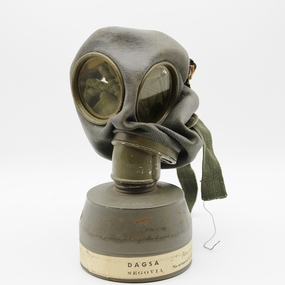
Equipment - Gas Mask
... manufacture. gas mask “DAGSA” and DAGSA logo on top surface of filter canister. On white tape around filter canister - “Dreager - Blanco” plus 20630 (ink stamp), “DAGSA. SEGOVIA” “Filtro. polivalente para mascara de guerra” (transl: Multipurpose filter for war mask) “No arrancad la tapa protectora haste el instance de su utilizacion” (transl: do not tear off the protective cap until the moment of use) German WW2-style full-face mask with single attached filter. Seven point harness. Separate lens. Olive green. Metal, vinyl, glass, leather, cotton ...This item and it’s associated canister (Cat.No. 0096.2) are of a style typical of German WW2 gas masks but the use of vinyl instead of rubber and the Spanish manufacture suggests post WW2 manufacture. German WW2-style full-face mask with single attached filter. Seven point harness. Separate lens. Olive green. Metal, vinyl, glass, leather, cotton webbing. “DAGSA” and DAGSA logo on top surface of filter canister. On white tape around filter canister - “Dreager - Blanco” plus 20630 (ink stamp), “DAGSA. SEGOVIA” “Filtro. polivalente para mascara de guerra” (transl: Multipurpose filter for war mask) “No arrancad la tapa protectora haste el instance de su utilizacion” (transl: do not tear off the protective cap until the moment of use) gas mask -
 Flagstaff Hill Maritime Museum and Village
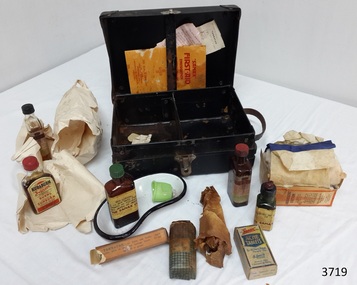
Equipment - First Aid Case, Thomas Urquhart & Son Pty Ltd (Thos. Urquhart), 1930-1939
... Manufactured by Sanax, Fitzroy, Melbourne, C. 1930-1939 Contents include "Sanax" First Aid instructions booklet, 2 leaflets, metal kidney dish enamelled in white with black trim on edge, green plastic or Bakelite eye bath, eye lotion, Tannafax tannic acid jelly, Sal Volitile, Kuraburn, Iodine, Argyrol, ACHE tablets, absorbent cotton in cardboard box, gauze bandage, and UNKNOWN wrapped bottle. ...Manufactured by Sanax, Fitzroy, Melbourne, C. 1930-1939 Contents include "Sanax" First Aid instructions booklet, 2 leaflets, metal kidney dish enamelled in white with black trim on edge, green plastic or Bakelite eye bath, eye lotion, Tannafax tannic acid jelly, Sal Volitile, Kuraburn, Iodine, Argyrol, ACHE tablets, absorbent cotton in cardboard box, gauze bandage, and UNKNOWN wrapped bottle. ...This small, portable 1930s Sanax First Aid Case has been strongly constructed, with corners reinforced with metal to take knocks and bumps, so it could be quickly transported to the site of an emergency. Having these supplies organised into a kit made them easily accessible and reduces time to take them to the site of the accident. It was possibly designed for use in factories because the booklet in the case states that the kit complies with “Part 1, Victorian Factories Regulations”. The text of the printed brand “Sanax First Aid Case” is right-way up when the case stands vertically on its hinged side. In modern times people are well aware of the importance of quick treatment when accident and injury occur. However, before the first commercial First Aid Kit was made by Johnson & Johnson in 1888, people had little knowledge about treating injuries and lacked information about suitable supplies to keep on hand for emergencies. They were often unaware of how to help in that critical time before the doctor or other assistance arrived, a particularly important time for the many people living in remote areas. A quote from Johnson’s & Johnson’s 1888 price list explains “It is a fact, which is everywhere being recognized, that many lives are lost and much suffering entailed in such accidents on account of the lack of the simple but necessary articles required to afford prompt assistance to the wounded.” One example of the value of First Aid assistance to community groups is shown in an article from the Weekly Times, 29th November 1930. It records a report from the Annuello Branch of the Younger Set (a Country Women’s Organisation), telling that on Armistice Day their president Mrs Jamieson, presented the Annuello School with the gift of a Sanax Red Cross First Aid outfit, which was accepted as being “of great practical use to the scholars.” (Annuello is a remote wheat growing area in the Mallee region of North Western Victoria, which became a soldier settlement area after World War I. There is a strain of wheat named ‘Annuello’ due to its suitability for that area. ) The Sanax Case in our Collection contains instructions, equipment and medical items suitable for use in emergency situations. The Case was one of 42 patterns available from Sanax that conformed to ‘Part 1, Victorian Factories Regulations’. It includes items made by Sanax Company and by Burroughs Wellcome & Co. (Australia) Ltd., Sydney, NSW. A quote at the back of the First Aid Emergency Instructions booklet says: “Sanax products are made in Australia by or under the supervision of qualified chemists, from the highest quality materials. They are dependable for the purposes written on labels.” BOOKLET included in First Aid Case: “SANAX” First-Aid Emergency Instructions has orange cover and white pages, joined in the centre by two staples. Booklet contains First Aid Instructions for general events listed in alphabetical order. It also contains an indexed sections headed “Poisoning, and what to do” written by S.A. Burrows, Ph.C., Vuc and N.Z. There are instructions and diagrams on how to perform Artificial Respiration. There are advertisement for Sanax products throughout the booklet that include; - Sanax Ambulance Stretcher for timber mills, mines, ships and quarries - Saw dust masks (porous rubber) for workers in dust, paint or duco sprayers Inside cover lists Sanax’s Australian made products including - tablets and powders for headaches, neuralgia, influenza, colds - snuff for Catarrh that is “quite harmless” - First Aid Cases that come in a range of 42 patterns - sunburn preventatives and treatments - healing salve for carbuncles, pock, pimples, boils, varicose ulcers etc. - snake bite outfits and kits LEAFLETS included in First Aid Case: (1) Tannafax Tannic Acid Jelly. Tannafax should be kept at hand in every home. It should be applied direct from the tube and used with neither oil nor grease. Where a large area has to be covered the clamped end may be torn or cut off to give a wider mouth to the tube. Collapsible tubes of different sizes. Made in Australia. Burroughs Wellcome & Co. (Australia) Ltd. (Incorporated in England). Sydney, NSW. Assorted Houses, London, New York, Montreal, Cape Town, Milan, Bombay, Shanghai, Buenos Aires. Copyright A. 1817, J. 9463 (2) Tabloid. The strong thing is the just - - . Tabloid marks the wor - - Burroughs Wellcome & Comp. The use of the word is to enab – the prescriber, dispenser and patient to get the right thing with one short word, instead of the firm’s long name. If another maker apply the word to his product, the act is unlawful. Tabloid is our trade mark and brand. If a vendor disregard it in dispensing or selling, the act is unlawful for the same reason. We prosecute both offenders rigorously, in the interest of prescribers, dispensers, patients and the owners of the trade mark. Please inform us of any instance of either offence. Burroughs Wellcome & Co. (Australia) Ltd. (Incorporated in England). Telephone Number - M 4184 (4 lines) All communications to G.P.O. Box No. 1185 DD. Copyright Sy. 20. & J 9894. Medicines and Equipment included in First Aid Case: - Absorbent Cotton, Sanax, for absorbing blood or drying a wound. As a swab for washing wounds; to place above a compress to keep the heat in: or as a pad to protect wounds or fractures. The Sanax Co. Manuf. Chemists, Melbourne. Regd. Office: 5 Brunswick St, Fitzroy. N.6. - ACHE tablets, Sanax, for all aches, pains, fevers etc. Dose: 2 to 3 tablets with a draught of water, every 3 hours. Children in proportion. For influenza or colds, take the bedtime dose with a hot lemon drink or toddy. Recommended for Headaches, Colds, Influenza, Fevers, Neuralgia, Rheumatism, Nerve Pains, Sleeplessness, and Seasickness. Three Sanax Ache tablets equals one Sanax Ache powder. Each tablet contains 1.75grs. each Phenacotinum and Acety acSzilcyl, and .75grs Ammon Brom. Etc.. Sanax brand specialties are prepared by highly qualified pharmaceutical chemists and may be accepted as safe and effective for the purpose indicated on the label. The Sanax Co. Melbourne - Eye lotion, Sanax, “in eye bath full strength or diluted with equal parts of water. Sanax Co. Brunswich St, Fitzroy, Melbourne. - Iodine, Sanax, POISON, with instructions for what to do if swallowed. - Kuraburn, Sanax, Applied to the burn and allowed to dry, the pain and heat instantly disappear, and blistering is prevented. If necessary, apply again in an hours. To safeguard against burning when sunbathing, apply before exposure to the sun. If already sunburnet, use Kuraburn as directions above. Safe and harmless. Sole makers, The Sanax Co. Brunswick St. - - Vic. - Sal Volatile, Sanax, - - stimulant for - - nervous aches - - or as smelling salts Dose - - - - Solution of A- - - 5%, . The Sanax Co. Brunswick St, Melbourne. - Tannafax, Burroughs Wellcome & Co. Australia Ltd. Sydney, N.S.W., 20gm. Approx., Tannic Acid Jelly, (Tannic Acid with 0.5% Phenol in a water-soluble base) for burns and scalds. A.N. 15050, p188, logo of a unicorn. Apply lightly, allow to dry, and bandage loosely. Do not apply oil or grease. - bottle wrapped in brown paper, unknown contents, paper adhered to bottle. - dish, kidney shaped, metal, white enamel with black rim - eye bath, green, plastic or Bakelite SANAX COMPANY The Sanax Company was at the address of 5 Brunswick Street, Fitzroy [Melbourne] at least as early as November 1924, as shown by its advertisement of Ache Powder in the Weekly Times, 8th November 1924. It was still at this address in September 1951, when it advertised First Aid outfits and components in the Post Master General’s section of the Commonwealth of Australia Gazette. REFERENCES: Annuello, Victoria; Wikipedia, https://en.wikipedia.org/wiki/Annuello,_Victoria Annuello Younger Set, Branch Activities and Local Reports, Country Women’s Organisations, Weekly Times, 29 November 1930, Trove http://trove.nla.gov.au/newspaper/article/224921009?searchTerm=%22sanax%22%20and%20%22melbourne%22&searchLimits=# Commonwealth of Australia Gazette, Issue 32, 24th April 1915, https://www.legislation.gov.au/file/1915GN32 [Johnson & Johnson Price List, September 1, 1888, p. 20. From our archives], Celebrating the 125th Birthday of the First Aid Kit , The Story of Johnson & Johnson, , http://www.kilmerhouse.com/2013/06/from-1888-to-2013-celebrating-the-125th-birthday-of-the-first-aid-kit/ Post Master General’s section of the Commonwealth of Australia Gazette, Issue No. 73, Thursday 27th September 1951 http://trove.nla.gov.au/newspaper/article/232185299?searchTerm=%22sanax%22%20and%20%22fitzroy%22&searchLimits= Sanax First Aid Emergency Instructions, by S.A. Burrows, publisher Sanax Ltd. Fitzroy, Victoria, 1930-1939 English, book, Illustrated edition, Trove http://trove.nla.gov.au/version/40948895 Access to emergency medical help in early settlement days of Victoria could take quite some time, especially in remote areas. From 1888 First Aid Kits and instructions became available for work sites, offices, community groups and individuals, helping to bridge the gap between the accident and the arrival of medical assistance. This portable Sanax First Aid Case is an example of portable medical equipment made in Melbourne, Australia, in the 1930’s and available to the public. It contains a range of items plus information to be used in a variety of injuries and emergencies in in factories, households, businesses and local communities, and instructions on their use. First Aid Case, portable, Sanax First Aid Case. First Aid kit in strong black cardboard carry case with metal reinforced corners, metal hinges on lid, metal catch and leather carry handle. Inside lid is a vertical strap with narrow gap behind it. Base is divided into two compartments. Manufactured by Sanax, Fitzroy, Melbourne, C. 1930-1939 Contents include "Sanax" First Aid instructions booklet, 2 leaflets, metal kidney dish enamelled in white with black trim on edge, green plastic or Bakelite eye bath, eye lotion, Tannafax tannic acid jelly, Sal Volitile, Kuraburn, Iodine, Argyrol, ACHE tablets, absorbent cotton in cardboard box, gauze bandage, and UNKNOWN wrapped bottle. Printed in gold on lid of case “SANAX” FIRST AID CASE. Most of the contents, as well as the case, show the “SANAX” brand. Some contents are inscribed Burroughs Wellcome & Co. (Australia) Ltd., flagstaff hill, warrnambool, shipwrecked coast, flagstaff hill maritime museum, maritime museum, shipwreck coast, flagstaff hill maritime village, great ocean road, first aid items, first aid kit, emergency first aid, medical emergency kit, home emergency kit, industrial emergency kit, sanax company fitzroy melbourne, burroughs wellcome & co. (australia) ltd, thos. urquhart & son pty. ltd. melbourne, sanax first aid case, sanax first-aid emergency instructions, part 1 victorian factories regulations, tabloid medical supplies -
 Orbost & District Historical Society
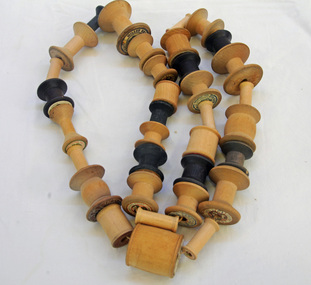
cotton reels, C 1960's
... These cotton reels are an example of an item not as commonly manufactured today. ...These cotton reels are an example of an item not as commonly manufactured today. Cotton reels are now generally made of plastic.Thirty-four wooden cotton reels strung together. They are assorted sizes and coloured ; black, natural and brown. There are various labels: COATES, ANCHOR, SYLKO (DEWHURST), BONDS,MILLER CHAIN, PEARSALL, CARLSON. -
 Bendigo Military Museum
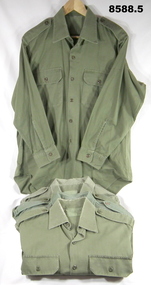
Uniform - SHIRTS, ARMY
... Manufacturers label, below collar, green colour cotton with black ink print on it. 3. 2, 4, 5. Illegible. Date of Manufacture 1953 to 1982. ...Manufacturers label, below collar, green colour cotton with black ink print on it. 3. 2, 4, 5. Illegible. Date of Manufacture 1953 to 1982. ...1. - 5. Shirt - green colour cotton fabric with long sleeves, shoulder epaulettes, two front pockets with button down flap. Front button closure, sleeve cuffs. plastic buttons, green and brown colour. Manufacturers label, below collar, green colour cotton with black ink print on it. 3. 2, 4, 5. Illegible. Date of Manufacture 1953 to 1982. Army work dress shirt commonly called "Greens". Manufacturing dates from 1953 to 1982. Green cotton label information - black ink print. 1. "A.G.C.F./ VICTORIA/ 1980/ ^/ SIZE 41/81/ 8405.66.093.2443/ SERVICE NO./ NAME ". 3. "Pelaco/ Victoria/ 1953/ D^D". 2. 4. 5. Illegible/ passchendaele barracks trust, uniform, army, workwear -
 Bendigo Military Museum
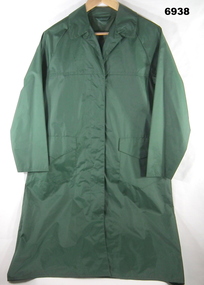
Uniform - RAINCOAT, SERVICE DRESS, ARMY, Kindred Manufacturing Pty Ltd for Australian Defence Industries, 1983
... MANUFACTURING/ PTY LTD/ QLD 1983/ D.S.N. 8410-66-030-2060/ SIZE 10/ SERVICE NO./ NAME." Raincoat - dark green colour plastic waterproof fabric. Below length coat with collar, long sleeves, two front patch pockets with flaps, front opening with concealed button placket. Five dark green colour plastic buttons. Two manufacturer's labels sewn to fabric - white cotton ...Raincoat - garment part of Women's Service Dress Uniform. Possibly issued to "BALAAM" Service No. F320519. Refer also Cat No. 6916.Raincoat - dark green colour plastic waterproof fabric. Below length coat with collar, long sleeves, two front patch pockets with flaps, front opening with concealed button placket. Five dark green colour plastic buttons. Two manufacturer's labels sewn to fabric - white cotton fabric. First label - front placket lining. Second label - inside behind left pocket.Manufacturers information - black ink print. First label - "INSTRUCTION LABEL" with details on laundering and drying garment. At bottom "NAME/ SERVICE NO". Second label - "KINDRED MANUFACTURING/ PTY LTD/ QLD 1983/ D.S.N. 8410-66-030-2060/ SIZE 10/ SERVICE NO./ NAME."uniform, raincoat, army, balaam, passchendaele barracks trust -
 Bendigo Military Museum
Uniform - GREAT COAT, ARMY, 1983
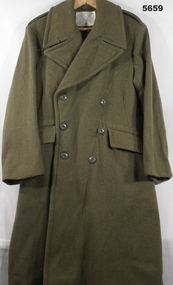
... On Maker's Label, Black ink print on cotton/polyester fabric "KINDRED MANUFACTURING/PTY LTD/QLD/D (Upwards Arrow) D/1983/???...UNIFORM AUSTRALIAN Army On Maker's Label, Black ink print on cotton/polyester fabric "KINDRED MANUFACTURING/PTY LTD/QLD/D (Upwards Arrow) D/1983/??? ...Greatcoat - Khaki colour woollen fabric with attached half belt. Inside pockets and lining to shoulders and sleeves - khaki colour with cotton fabric. Buttons Khaki plastic Double breasted. Maker's Label - Inside back below collar. On Maker's Label, Black ink print on cotton/polyester fabric "KINDRED MANUFACTURING/PTY LTD/QLD/D (Upwards Arrow) D/1983/???5-66-0? -1812/SIZE 100/TO FIT CHEST 100cm/NAME... SERVICE No....".uniform, australian army -
 Kiewa Valley Historical Society
Dress Child
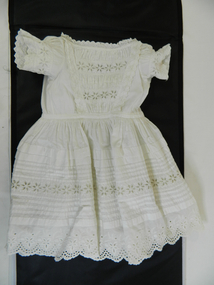
... manufacture but also of the fashion in that era. It has christian religious implications and values of the time frame of regional life in the early1900s. children clothing lace-battenberg and broderie anglaise female clothing dress cotton christening dressmaking Girl's white dress (christening event), fine cotton with lace border "broderie anglaise" with a row of lace flowers mid skirt "battenberg".This lace is also inserted in centre front panel and sleeves. ...The dress was probably worn at a christening in one of the Kiewa Valley churches (denomination unknown). The importance of the event to family and friends is shown by the quality of the garment. These style Christening dresses were often worn buy several children of the one family , both boys and girls. Other items such as hand made bonnet may have been part of this out fit. "KVHS 0123" The quality of the garment and the fashion style it represents is both historical, not only the time of its manufacture but also of the fashion in that era. It has christian religious implications and values of the time frame of regional life in the early1900s. Girl's white dress (christening event), fine cotton with lace border "broderie anglaise" with a row of lace flowers mid skirt "battenberg".This lace is also inserted in centre front panel and sleeves. Scolloped cotton is also on sleeves, neck and front. Pin tucked skirt. Opening back with drawstring fastening at neck and waist. Short sleeves and machine stitched children clothing, lace-battenberg and broderie anglaise, female clothing, dress, cotton, christening, dressmaking -
 Kiewa Valley Historical Society
Dress
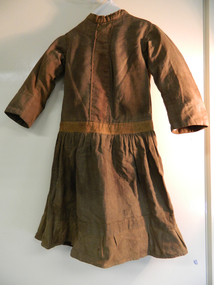
... manufacture, earthy colours and ease of mobility. Photos in the KVHS collection show girls from Tawonga Primary School in a dress that could be this dress which is dated 1910. dress clothing girl's dress home made no inscriptions or markings suggesting locally made. Dress brown cotton ...made locally circa 1910. Due to relative long distance to haberdashery stores majority of children's garments were hand made by a local talented seamstress or mother/relativeHistorical significant to the period circa 1900 to circa 1950 when fashion was dictated by long lasting durability, local manufacture, earthy colours and ease of mobility. Photos in the KVHS collection show girls from Tawonga Primary School in a dress that could be this dress which is dated 1910. Dress brown cotton with long sleeves. Dress top and sleeves lined. Back of dress is open with metal hooks for fastening. Hand stitched eyelets and decorative strip down centre front bodice and around hips. Gathered skirt is joined at hip. One pocket on left side 6cm from waist band.Decorative strip at bottom of dress with a pleated hand and machine stitched frill.no inscriptions or markings suggesting locally made.dress, clothing, girl's dress, home made
