
Showing 27 items matching "counterweight"
-
 Seaworks Maritime Museum
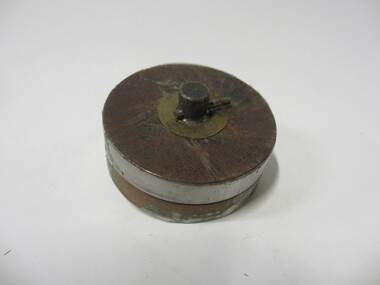
Counterweight
... Counterweight...Small round counterweight...PWO 2994.2 Small round counterweight Counterweight ...Small round counterweightPWO 2994.2 -
 Flagstaff Hill Maritime Museum and Village
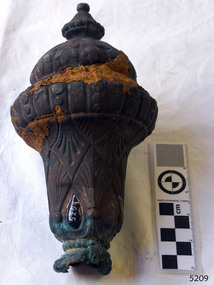
Counterweight, Before 1878
... Counterweight......counterweight...Lead and brass counterweight for kerosene lamp from the Loch Ard. ...Ref: LA3-38-258 Counterweight ...Recovered from the wreck of the Loch Ard. Artefact Reg No LA/05. HISTORY OF THE LOCH ARD The LOCH ARD belonged to the famous Loch Line which sailed many ships from England to Australia. Built in Glasgow by Barclay, Curdle and Co. in 1873, the LOCH ARD was a three-masted square rigged iron sailing ship. The ship measured 262ft 7" (79.87m) in length, 38ft (11.58m) in width, 23ft (7m) in depth and had a gross tonnage of 1693 tons. The LOCH ARD's main mast measured a massive 150ft (45.7m) in height. LOCH ARD made three trips to Australia and one trip to Calcutta before its final voyage. LOCH ARD left England on March 2, 1878, under the command of Captain Gibbs, a newly married, 29 year old. She was bound for Melbourne with a crew of 37, plus 17 passengers and a load of cargo. The general cargo reflected the affluence of Melbourne at the time. On board were straw hats, umbrella, perfumes, clay pipes, pianos, clocks, confectionary, linen and candles, as well as a heavier load of railway irons, cement, lead and copper. There were items included that intended for display in the Melbourne International Exhibition in 1880. The voyage to Port Phillip was long but uneventful. At 3am on June 1, 1878, Captain Gibbs was expecting to see land and the passengers were becoming excited as they prepared to view their new homeland in the early morning. But LOCH ARD was running into a fog which greatly reduced visibility. Captain Gibbs was becoming anxious as there was no sign of land or the Cape Otway lighthouse. At 4am the fog lifted. A man aloft announced that he could see breakers. The sheer cliffs of Victoria's west coast came into view, and Captain Gibbs realised that the ship was much closer to them than expected. He ordered as much sail to be set as time would permit and then attempted to steer the vessel out to sea. On coming head on into the wind, the ship lost momentum, the sails fell limp and LOCH ARD's bow swung back. Gibbs then ordered the anchors to be released in an attempt to hold its position. The anchors sank some 50 fathoms - but did not hold. By this time LOCH ARD was among the breakers and the tall cliffs of Mutton Bird Island rose behind the ship. Just half a mile from the coast, the ship's bow was suddenly pulled around by the anchor. The captain tried to tack out to sea, but the ship struck a reef at the base of Mutton Bird Island, near Port Campbell. Waves broke over the ship and the top deck was loosened from the hull. The masts and rigging came crashing down knocking passengers and crew overboard. When a lifeboat was finally launched, it crashed into the side of LOCH ARD and capsized. Tom Pearce, who had launched the boat, managed to cling to its overturned hull and shelter beneath it. He drifted out to sea and then on the flood tide came into what is now known as LOCH ARD Gorge. He swam to shore, bruised and dazed, and found a cave in which to shelter. Some of the crew stayed below deck to shelter from the falling rigging but drowned when the ship slipped off the reef into deeper water. Eva Carmichael had raced onto deck to find out what was happening only to be confronted by towering cliffs looming above the stricken ship. In all the chaos, Captain Gibbs grabbed Eva and said, "If you are saved Eva, let my dear wife know that I died like a sailor". That was the last Eva Carmichael saw of the captain. She was swept off the ship by a huge wave. Eva saw Tom Pearce on a small rocky beach and yelled to attract his attention. He dived in and swam to the exhausted woman and dragged her to shore. He took her to the cave and broke open case of brandy which had washed up on the beach. He opened a bottle to revive the unconscious woman. A few hours later Tom scaled a cliff in search of help. He followed hoof prints and came by chance upon two men from nearby Glenample Station three and a half miles away. In a state of exhaustion, he told the men of the tragedy. Tom returned to the gorge while the two men rode back to the station to get help. By the time they reached LOCH ARD Gorge, it was cold and dark. The two shipwreck survivors were taken to Glenample Station to recover. Eva stayed at the station for six weeks before returning to Ireland, this time by steamship. In Melbourne, Tom Pearce received a hero's welcome. He was presented with the first gold medal of the Royal Humane Society of Victoria and a £1000 cheque from the Victorian Government. Concerts were performed to honour the young man's bravery and to raise money for those who lost family in the LOCH ARD disaster. Of the 54 crew members and passengers on board, only two survived: the apprentice, Tom Pearce and the young woman passenger, Eva Carmichael, who lost all of her family in the tragedy. Ten days after the LOCH ARD tragedy, salvage rights to the wreck were sold at auction for £2,120. Cargo valued at £3,000 was salvaged and placed on the beach, but most washed back into the sea when another storm developed. The wreck of LOCH ARD still lies at the base of Mutton Bird Island. Much of the cargo has now been salvaged and some was washed up into what is now known as LOCH ARD Gorge. Cargo and artefacts have also been illegally salvaged over many years before protective legislation was introduced. One of the most unlikely pieces of cargo to have survived the shipwreck was a Minton porcelain peacock - one of only nine in the world. The peacock was destined for the Melbourne International Exhibition in 1880. It had been well packed, which gave it adequate protection during the violent storm. Today, the Minton peacock can be seen at the Flagstaff Hill Maritime Museum in Warrnambool. From Australia's most dramatic shipwreck it has now become Australia's most valuable shipwreck artefact and is one of very few 'objects' on the Victorian State Heritage Register. Flagstaff Hill’s collection of artefacts from LOCH ARD is significant for being one of the largest collections of artefacts from this shipwreck in Victoria. It is significant for its association with the shipwreck, which is on the Victorian Heritage Register (VHR S417). The collection is significant because of the relationship between the objects, as together they have a high potential to interpret the story of the LOCH ARD. The LOCH ARD collection is archaeologically significant as the remains of a large international passenger and cargo ship. The LOCH ARD collection is historically significant for representing aspects of Victoria’s shipping history and its potential to interpret sub-theme 1.5 of Victoria’s Framework of Historical Themes (living with natural processes). The collection is also historically significant for its association with the LOCH ARD, which was one of the worst and best known shipwrecks in Victoria’s history. Lead and brass counterweight for kerosene lamp from the Loch Ard. Concretion adhering to surface, blue/green corrosion on sections. Ref: LA3-38-258 flagstaff hill, warrnambool, shipwrecked coast, flagstaff hill maritime museum, maritime museum, shipwreck coast, flagstaff hill maritime village, great ocean road, loch line, loch ard, captain gibbs, eva carmichael, tom pearce, glenample station, mutton bird island, loch ard gorge, counterweight -
 Moorabbin Air Museum
Manual (item) - Flight Mechanics Course Notes - Otto Cycle, Hamilton Counterweight airscrew, Gipsy Major, P&W Wasp, Rolls Royce Merlin
... Flight Mechanics Course Notes - Otto Cycle, Hamilton Counterweight airscrew, Gipsy Major, P&W Wasp, Rolls Royce Merlin...Flight Mechanics Course Notes - Otto Cycle, Hamilton Counterweight airscrew, Gipsy Major, P&W Wasp, Rolls Royce Merlin Manual Flight Mechanics Course Notes - Otto Cycle, Hamilton Counterweight airscrew, Gipsy Major, P&W Wasp, Rolls Royce Merlin ... -
Moorabbin Air Museum
Manual (Item) - Counterweight Propellers Service Manual Hamilton Standard Propellers No.110D, Counterweight Propellers Service Manual
... Counterweight Propellers Service Manual...Counterweight Propellers Service Manual Manual Counterweight Propellers Service Manual Hamilton Standard Propellers No.110D ... -
Moorabbin Air Museum
Manual (Item) - Counterweight Propellers Parts Catalogue Hamilton Standard Propellers No.111, Counterweight Propellers Parts Catalogue
... Counterweight Propellers Parts Catalogue...Counterweight Propellers Parts Catalogue Manual Counterweight Propellers Parts Catalogue Hamilton Standard Propellers No.111 ... -
Moorabbin Air Museum
Manual (Item) - Propeller Counterweight Governors Parts Catalogue Hamilton Standard Propellers No.125
... Propeller Counterweight Governors Parts Catalogue Hamilton Standard Propellers No.125...Propeller Counterweight Governors Parts Catalogue Hamilton Standard Propellers No.125 Manual Propeller Counterweight Governors Parts Catalogue Hamilton Standard Propellers No.125 ... -
 Flagstaff Hill Maritime Museum and Village
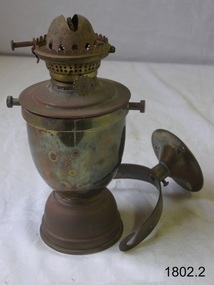
Functional object - Kerosene Lamp, Bef. 09-02-1984
... Its gimbal bracket and counterweight heavy base allow it to swing with a vessel's movement and still stay horizontal. ...The base is a solid counterweight to work with the gimbal wall attachment bracket. ...Its gimbal bracket and counterweight heavy base allow it to swing with a vessel's movement and still stay horizontal. ...The kerosene lamp was one of the most common oil lamps used and was manufactured until the 1980s. This particular lamp has the design of the early kerosene lamps. Its gimbal bracket and counterweight heavy base allow it to swing with a vessel's movement and still stay horizontal. The lamp is significant for its design which is an example of a 19th and early 20th-century kerosene lamp with a wall-mounted gimbal bracket and counterweight base. These features were important to vessels at sea, allowing the lamp to swing with the vessel's movement and stay vertical on rough seas.Kerosene lamp; round electroplated metal top and base, both shaped inward to join together. The base is a solid counterweight to work with the gimbal wall attachment bracket. There is no glass cover.shipwreck coast, flagstaff hill maritime museum, flagstaff hill maritime village, warrnambool, flagstaff hill, kerosene lamp, lighting, marine lamp, kerosene lantern, lamp, lantern, marine equipment, wall gimbal, wall mounted lamp, ship lamp -
 Federation University Historical Collection
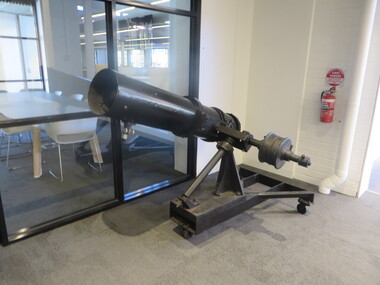
Instrument - Object, Telescope
... Black telescope with 9 inch mirror and large counterweight. ...The telescope was reconditioned by former staff member Graeme Hood. telescope observatory On the back of the mirror are the following words "G M Riley Sunshine 1922" Black telescope with 9 inch mirror and large counterweight. Telescope Instrument Object ...This telescope was used at the Ballarat School of Mines, and used to be located on the roof of the Ballarat Technical Art School (Gribble Building) at the Ballarat School of Mines. The telescope was reconditioned by former staff member Graeme Hood. Black telescope with 9 inch mirror and large counterweight. On the back of the mirror are the following words "G M Riley Sunshine 1922"telescope, observatory -
 Moorabbin Air Museum
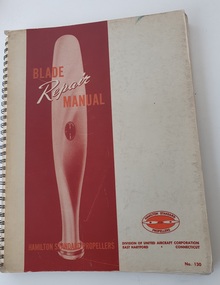
Manual (item) - Blade Repair Manual Hamilton Standard Propellors, Blade Repair Manual: Hamilton Standard Propellors
... The basic technical handbook for repairing Hamilton Standard Hydromatic and Counterweight type propellor blades...The basic technical handbook for repairing Hamilton Standard Hydromatic and Counterweight type propellor blades propellors 1947 Hamilton standard propellor Blade Repair Manual: Hamilton Standard Propellors Manual Blade Repair Manual Hamilton Standard Propellors ...The basic technical handbook for repairing Hamilton Standard Hydromatic and Counterweight type propellor bladespropellors, 1947, hamilton standard propellor -
 Whitehorse Historical Society Inc.
Equipment - Switches, 1900s
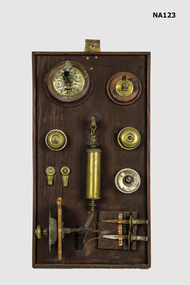
... 3 brass and ceramic light switches. 2 brass picture hooks. 1 brass and lead counterweight for lamp. 2 gas jets on wooden base. 1 door bell pull. 2 brass curtain holders. ...Railway Department house number 127 metalcraft brassware 3 brass and ceramic light switches. 2 brass picture hooks. 1 brass and lead counterweight for lamp. 2 gas jets on wooden base. 1 door bell pull. 2 brass curtain holders. ...Fittings out of the Mitcham Station Master's house, the last block of land on the east side of Station Street, now a car park. Railway Department house number 1273 brass and ceramic light switches. 2 brass picture hooks. 1 brass and lead counterweight for lamp. 2 gas jets on wooden base. 1 door bell pull. 2 brass curtain holders. All on wooden base.metalcraft, brassware -
 Port Melbourne Historical & Preservation Society
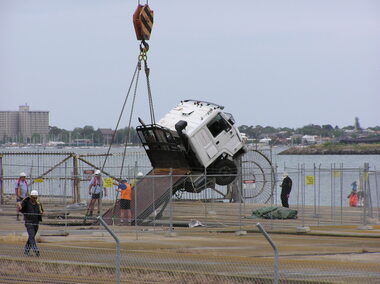
Photograph - Truck Stranded on Princes Pier, 18 Nov 2003
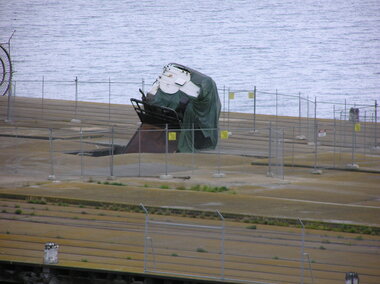
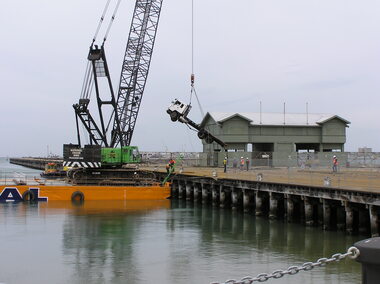
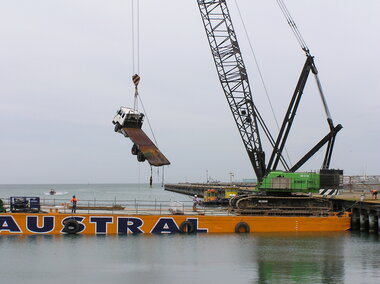
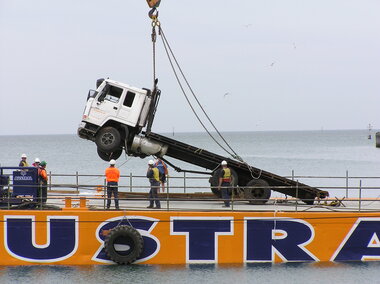
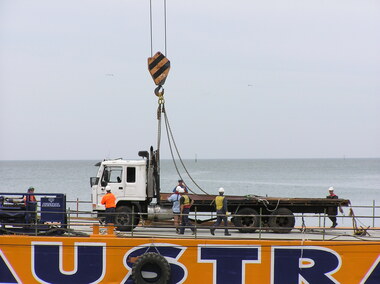
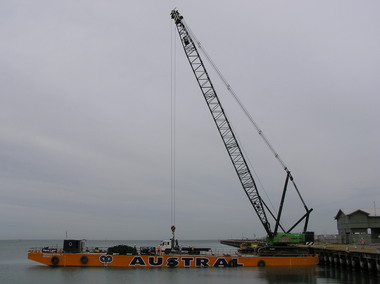
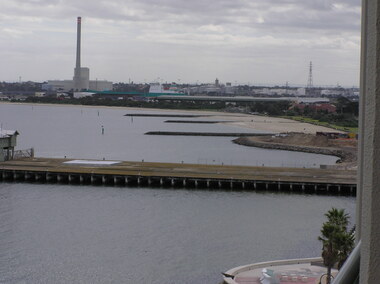
... On Friday 16 August 2002, a truck carrying the tower crane counterweights from the 4th residential tower in Beach Street, entered Princes Pier to turn around and fell through the decking. ...Piers and Wharves - Princes Pier On Friday 16 August 2002, a truck carrying the tower crane counterweights from the 4th residential tower in Beach Street, entered Princes Pier to turn around and fell through the decking. ...On Friday 16 August 2002, a truck carrying the tower crane counterweights from the 4th residential tower in Beach Street, entered Princes Pier to turn around and fell through the decking. The area was fenced off and a year later on 18 November 2003 the truck was extricated by a crane on a barge. The hole was covered by a steel box like structure until the Pier was renovated at a later date.piers and wharves - princes pier -
 Port Melbourne Historical & Preservation Society
Photograph - Truck Stranded on Princes Pier, 18 Nov 2003
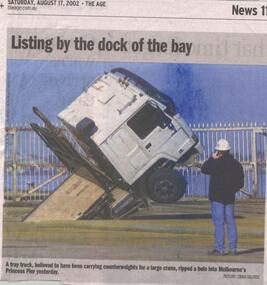
... On Friday 16 August 2002, a truck carrying the tower crane counterweights from the 4th residential tower in Beach Street, entered Princes Pier to turn around and fell through the decking. ...Piers and Wharves - Princes Pier On Friday 16 August 2002, a truck carrying the tower crane counterweights from the 4th residential tower in Beach Street, entered Princes Pier to turn around and fell through the decking. ...On Friday 16 August 2002, a truck carrying the tower crane counterweights from the 4th residential tower in Beach Street, entered Princes Pier to turn around and fell through the decking. The area was fenced off and a year later on 18 November 2003 the truck was extricated by a crane on a barge. The hole was covered by a steel box like structure until the Pier was renovated at a later date.piers and wharves - princes pier -
 Port Melbourne Historical & Preservation Society
Photograph - Truck Stranded on Princes Pier, 18 Nov 2003
... On Friday 16 August 2002, a truck carrying the tower crane counterweights from the 4th residential tower in Beach Street, entered Princes Pier to turn around and fell through the decking. ...Piers and Wharves - Princes Pier On Friday 16 August 2002, a truck carrying the tower crane counterweights from the 4th residential tower in Beach Street, entered Princes Pier to turn around and fell through the decking. ...On Friday 16 August 2002, a truck carrying the tower crane counterweights from the 4th residential tower in Beach Street, entered Princes Pier to turn around and fell through the decking. The area was fenced off and a year later on 18 November 2003 the truck was extricated by a crane on a barge. The hole was covered by a steel box like structure until the Pier was renovated at a later date.piers and wharves - princes pier -
 Port Melbourne Historical & Preservation Society
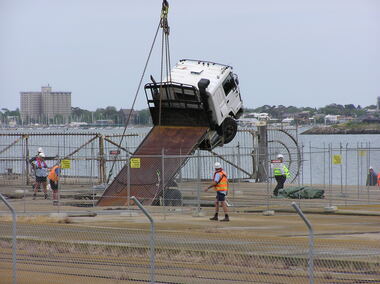
Photograph - Truck Stranded on Princes Pier, 18 Nov 2003
... On Friday 16 August 2002, a truck carrying the tower crane counterweights from the 4th residential tower in Beach Street, entered Princes Pier to turn around and fell through the decking. ...Piers and Wharves - Princes Pier On Friday 16 August 2002, a truck carrying the tower crane counterweights from the 4th residential tower in Beach Street, entered Princes Pier to turn around and fell through the decking. ...On Friday 16 August 2002, a truck carrying the tower crane counterweights from the 4th residential tower in Beach Street, entered Princes Pier to turn around and fell through the decking. The area was fenced off and a year later on 18 November 2003 the truck was extricated by a crane on a barge. The hole was covered by a steel box like structure until the Pier was renovated at a later date.piers and wharves - princes pier -
 Port Melbourne Historical & Preservation Society
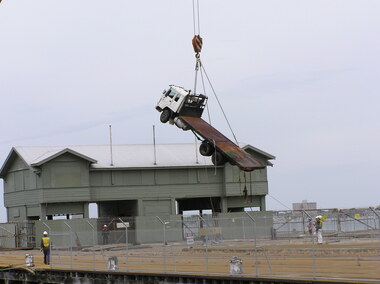
Photograph - Truck Stranded on Princes Pier, 18 Nov 2003
... On Friday 16 August 2002, a truck carrying the tower crane counterweights from the 4th residential tower in Beach Street, entered Princes Pier to turn around and fell through the decking. ...Piers and Wharves - Princes Pier On Friday 16 August 2002, a truck carrying the tower crane counterweights from the 4th residential tower in Beach Street, entered Princes Pier to turn around and fell through the decking. ...On Friday 16 August 2002, a truck carrying the tower crane counterweights from the 4th residential tower in Beach Street, entered Princes Pier to turn around and fell through the decking. The area was fenced off and a year later on 18 November 2003 the truck was extricated by a crane on a barge. The hole was covered by a steel box like structure until the Pier was renovated at a later date.piers and wharves - princes pier -
 Port Melbourne Historical & Preservation Society
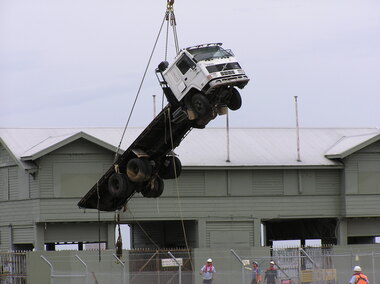
Photograph - Truck Stranded on Princes Pier, 18 Nov 2003
... On Friday 16 August 2002, a truck carrying the tower crane counterweights from the 4th residential tower in Beach Street, entered Princes Pier to turn around and fell through the decking. ...Piers and Wharves - Princes Pier On Friday 16 August 2002, a truck carrying the tower crane counterweights from the 4th residential tower in Beach Street, entered Princes Pier to turn around and fell through the decking. ...On Friday 16 August 2002, a truck carrying the tower crane counterweights from the 4th residential tower in Beach Street, entered Princes Pier to turn around and fell through the decking. The area was fenced off and a year later on 18 November 2003 the truck was extricated by a crane on a barge. The hole was covered by a steel box like structure until the Pier was renovated at a later date.piers and wharves - princes pier -
 Port Melbourne Historical & Preservation Society
Photograph - Truck Stranded on Princes Pier, 18 Nov 2003
... On Friday 16 August 2002, a truck carrying the tower crane counterweights from the 4th residential tower in Beach Street, entered Princes Pier to turn around and fell through the decking. ...Piers and Wharves - Princes Pier On Friday 16 August 2002, a truck carrying the tower crane counterweights from the 4th residential tower in Beach Street, entered Princes Pier to turn around and fell through the decking. ...On Friday 16 August 2002, a truck carrying the tower crane counterweights from the 4th residential tower in Beach Street, entered Princes Pier to turn around and fell through the decking. The area was fenced off and a year later on 18 November 2003 the truck was extricated by a crane on a barge. The hole was covered by a steel box like structure until the Pier was renovated at a later date.piers and wharves - princes pier -
 Port Melbourne Historical & Preservation Society
Photograph - Truck Stranded on Princes Pier, 18 Nov 2003
... On Friday 16 August 2002, a truck carrying the tower crane counterweights from the 4th residential tower in Beach Street, entered Princes Pier to turn around and fell through the decking. ...Piers and Wharves - Princes Pier On Friday 16 August 2002, a truck carrying the tower crane counterweights from the 4th residential tower in Beach Street, entered Princes Pier to turn around and fell through the decking. ...On Friday 16 August 2002, a truck carrying the tower crane counterweights from the 4th residential tower in Beach Street, entered Princes Pier to turn around and fell through the decking. The area was fenced off and a year later on 18 November 2003 the truck was extricated by a crane on a barge. The hole was covered by a steel box like structure until the Pier was renovated at a later date.piers and wharves - princes pier -
 Port Melbourne Historical & Preservation Society
Photograph - Truck Stranded on Princes Pier, 18 Nov 2003
... On Friday 16 August 2002, a truck carrying the tower crane counterweights from the 4th residential tower in Beach Street, entered Princes Pier to turn around and fell through the decking. ...Piers and Wharves - Princes Pier On Friday 16 August 2002, a truck carrying the tower crane counterweights from the 4th residential tower in Beach Street, entered Princes Pier to turn around and fell through the decking. ...On Friday 16 August 2002, a truck carrying the tower crane counterweights from the 4th residential tower in Beach Street, entered Princes Pier to turn around and fell through the decking. The area was fenced off and a year later on 18 November 2003 the truck was extricated by a crane on a barge. The hole was covered by a steel box like structure until the Pier was renovated at a later date.piers and wharves - princes pier -
 Port Melbourne Historical & Preservation Society
Photograph - Truck Stranded on Princes Pier, 18 Nov 2003
... On Friday 16 August 2002, a truck carrying the tower crane counterweights from the 4th residential tower in Beach Street, entered Princes Pier to turn around and fell through the decking. ...Piers and Wharves - Princes Pier On Friday 16 August 2002, a truck carrying the tower crane counterweights from the 4th residential tower in Beach Street, entered Princes Pier to turn around and fell through the decking. ...On Friday 16 August 2002, a truck carrying the tower crane counterweights from the 4th residential tower in Beach Street, entered Princes Pier to turn around and fell through the decking. The area was fenced off and a year later on 18 November 2003 the truck was extricated by a crane on a barge. The hole was covered by a steel box like structure until the Pier was renovated at a later date.piers and wharves - princes pier -
 Port Melbourne Historical & Preservation Society
Photograph - Truck Stranded on Princes Pier, 18 Nov 2003
... On Friday 16 August 2002, a truck carrying the tower crane counterweights from the 4th residential tower in Beach Street, entered Princes Pier to turn around and fell through the decking. ...Piers and Wharves - Princes Pier On Friday 16 August 2002, a truck carrying the tower crane counterweights from the 4th residential tower in Beach Street, entered Princes Pier to turn around and fell through the decking. ...On Friday 16 August 2002, a truck carrying the tower crane counterweights from the 4th residential tower in Beach Street, entered Princes Pier to turn around and fell through the decking. The area was fenced off and a year later on 18 November 2003 the truck was extricated by a crane on a barge. The hole was covered by a steel box like structure until the Pier was renovated at a later date.piers and wharves - princes pier -
 Port Melbourne Historical & Preservation Society
Photograph - Truck Stranded on Princes Pier, 18 Nov 2003
... On Friday 16 August 2002, a truck carrying the tower crane counterweights from the 4th residential tower in Beach Street, entered Princes Pier to turn around and fell through the decking. ...Piers and Wharves - Princes Pier On Friday 16 August 2002, a truck carrying the tower crane counterweights from the 4th residential tower in Beach Street, entered Princes Pier to turn around and fell through the decking. ...On Friday 16 August 2002, a truck carrying the tower crane counterweights from the 4th residential tower in Beach Street, entered Princes Pier to turn around and fell through the decking. The area was fenced off and a year later on 18 November 2003 the truck was extricated by a crane on a barge. The hole was covered by a steel box like structure until the Pier was renovated at a later date.piers and wharves - princes pier -
 Flagstaff Hill Maritime Museum and Village
Instrument - Letter Scale, Ca. early 20th century
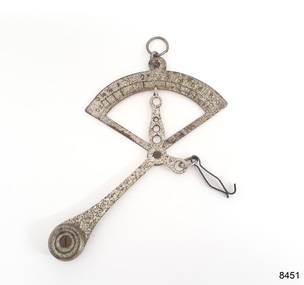
... This small weighing instrument is shaped like a quarter-circle with a metal ring, a fixed pendulum counterweight and a decorative pivoting arrow indicator. ...This small weighing instrument is shaped like a quarter-circle with a metal ring, a fixed pendulum counterweight and a decorative pivoting arrow indicator. ...This handheld portable pendulum quadrant scale was used to weigh small paper items such as letters and documents, powdered chemicals or metals like gold, and animal fleece samples. This mechanical scale can weigh up to a maximum of 10 ounces, which is about 285 grams or one-and-a-half cups of brown sugar. The operator holds the scale’s ring and connects the item to be weighed onto the wire clip. The weight of the item causes the pendulum to pivot, and the scale measures the weight of the object, indicated by the arrow. This scale belonged to Dr William Roy Angus and is now part of Flagstaff Hill’s comprehensive W.R. Angus Collection, donated by the family of Dr W R Angus, 1901-1970, surgeon and oculist. The W.R. Angus Collection: - The W.R. Angus Collection includes historical medical equipment, surgical instruments and material belonging to Dr Edward Ryan and Dr Thomas Francis Ryan, (both of Nhill, Victoria) and Dr Angus’ own belongings. The Collection’s history spans the medical practices of the two Doctors Ryan, from 1885-1926 plus that of Dr Angus, up until 1969. It includes historical medical and surgical equipment and instruments from the doctors Edward and Thomas Ryan of Nhill, Victoria. Dr Angus married Gladys in 1927 at Ballarat, the nearest big city to Nhill where he began as a Medical Assistant. He was also Acting House surgeon at the Nhill hospital where their two daughters were born. During World War II He served as a Military Doctor in the Australian Defence Force. Dr Angus and his family moved to Warrnambool in 1939, where Dr Angus operated his own medical practice. He later added the part-time Port Medical Officer responsibility and was the last person appointed to that position. Both Dr Angus and his wife were very involved in the local community, including the planning stages of the new Flagstaff Hill and the layout of the gardens there. Dr Angus passed away in March 1970.This letter scale is the only one of its type in our collection. It is an example of objects belonging to Dr. W. R. Angus, 1901-1970, surgeon and oculist. The W.R. Angus Collection is significant for still being located at the site it is connected with, Doctor Angus being the last Port Medical Officer in Warrnambool. The Collection includes historical medical objects that date back to the late 1800s.Letter scale, a handheld quadrant fixed pendulum scale made from silver-plated metal. This small weighing instrument is shaped like a quarter-circle with a metal ring, a fixed pendulum counterweight and a decorative pivoting arrow indicator. A hanger clip is attached to a short arm of the scale. Measurements are embossed on the arc of the circle, labelled in ounces (oz) and ranging from 0 to 10 at unequal distances apart. The scale is part of the W.R. Angus Collection.Scale measurements, "OZ" (ounces), "0 /14 1/2 1 2 3 4 5 6 7 8 9 10 "flagstaff hill, warrnambool, maritime village, maritime museum, shipwreck coast, great ocean road, flagstaff hill maritime museum and village, dr w r angus, mira hospital, w.r. angus collection, scale, weighing instrument, measure weight, postal scale, chemist scale, letter, weigh, post, office, quadrant scale, letter scale, handheld, portable, mechanical scale, pendulum scale, fixed balance scale -
 Geoffrey Kaye Museum of Anaesthetic History
Machine - Geoffrey Kaye's spirometer, Dr Geoffrey Kaye
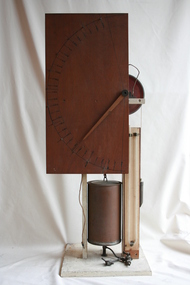
... The panel is attached to a wooden frame, which also supports a red Stenco brand pulley attached to a metal canister and a counterweight. There are two taps on the bottom of the canister. ...The panel is attached to a wooden frame, which also supports a red Stenco brand pulley attached to a metal canister and a counterweight. There are two taps on the bottom of the canister. ...This spirometer, built by Geoffrey Kaye for demonstration purposes, features a large, rectangular panel of wood with a wooden needle and a dial numbered from 000 to 3000 in increments of 100, which would have measured a patient's lung capacity as they breathed into a tube which is no longer present. The panel is attached to a wooden frame, which also supports a red Stenco brand pulley attached to a metal canister and a counterweight. There are two taps on the bottom of the canister. There is an elongated U-shaped glass tube affixed to a wooden plank to the right of the canister, beneath the pulley.spirometer, spirometry, machine, diagnostic machine, diagnostic machinery, respiration, lung capacity, tidal lung capacity, geoffrey kaye -
 Flagstaff Hill Maritime Museum and Village
Instrument - Scale, 1900-1930
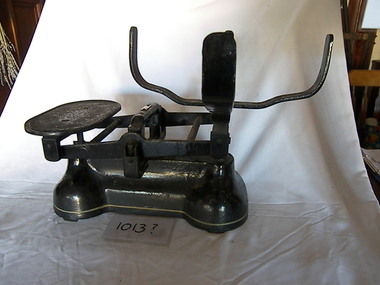
... Known as an unequal arm balance scale, this variety builds the counterweight into the device. Counter scales used in dry-goods stores and domestic kitchens often featured Japanned or (blackened) cast iron with bronze trims. ...Known as an unequal arm balance scale, this variety builds the counterweight into the device. Counter scales used in dry-goods stores and domestic kitchens often featured Japanned or (blackened) cast iron with bronze trims. ...The basic balance scale has been around for thousands of years and its accuracy has improved dramatically over the last several centuries, the principle behind this tool remains unchanged. Its parts include a fulcrum, a beam that balances on it, a pan at the end of the beam to hold the materials to be weighed, and a flat platform at the other for the counter-balancing weights. Balance scales that require equal weights on each side of the fulcrum have been used by everyone from apothecaries and assayers to jewellers and postal workers. Known as an unequal arm balance scale, this variety builds the counterweight into the device. Counter scales used in dry-goods stores and domestic kitchens often featured Japanned or (blackened) cast iron with bronze trims. Made by companies such as Howe and Fairbanks, the footed tin pans of these scales were often oblong, some encircled at one end so bulk items could be easily poured into a bag. Seamless pans were typically stamped from brass and given style names like Snuff (the smallest) and Birmingham (the largest). Some counter scales were designed for measuring spices, others for weighing slices of cake. In the 18th century, spring scales began to appear and would use the resistance of spring to calculate weights, which are read automatically on the scale’s face. The ease of use of spring scales over balance scales. These scales are significant as they identify one of the basic preparation items for the weighing of foodstuff in the family kitchen to prepare everyday meals. This item is significant as it gives a snapshot into domestic life within the average home in Australia around the turn of the twentieth century and is, therefore, an item with social relevance. Black cast iron, medium weighing scales, with a fulcrum which the beam that balances on, there is a scoop or large bowl at one end for the material to be weighted and a flat platform at the other end that holds the weights. Around the cast iron base is an embossed strip weight and bowl missing.flagstaff hill, warrnambool, shipwrecked-coast, flagstaff-hill, flagstaff-hill-maritime-museum, maritime-museum, shipwreck-coast, flagstaff-hill-maritime-village -
 Flagstaff Hill Maritime Museum and Village
Instrument - Scale, Early 20th century
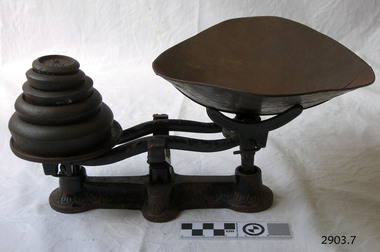
... Known as an unequal arm balance scale, this variety builds the counterweight into the device. Counter scales used in dry-goods stores and domestic kitchens often featured Japanned or (blackened) cast iron with bronze trims. ...Known as an unequal arm balance scale, this variety builds the counterweight into the device. Counter scales used in dry-goods stores and domestic kitchens often featured Japanned or (blackened) cast iron with bronze trims. ...The basic balance scale has been around for thousands of years and its accuracy has improved dramatically over the last several centuries, the principle behind this tool remains unchanged. Its parts include a fulcrum, a beam that balances on it, a pan at the end of the beam to hold the materials to be weighed, and a flat platform at the other for the counter-balancing weights. Balance scales that require equal weights on each side of the fulcrum have been used by everyone from apothecaries and assayers to jewellers and postal workers. Known as an unequal arm balance scale, this variety builds the counterweight into the device. Counter scales used in dry-goods stores and domestic kitchens often featured Japanned or (blackened) cast iron with bronze trims. Made by companies such as Howe and Fairbanks, the footed tin pans of these scales were often oblong, some encircled at one end so bulk items could be easily poured into a bag. Seamless pans were typically stamped from brass and given style names like Snuff (the smallest) and Birmingham (the largest). Some counter scales were designed for measuring spices, others for weighing slices of cake. In the 18th century, spring scales began to appear and would use the resistance of spring to calculate weights, which are read automatically on the scale’s face. The ease of use of spring scales over balance scales. One of the most common types of spring scales was the kitchen scale also known as a family or dial scale. Designed for horizontal surfaces, these vintage kitchen scales used the weight of goods in a pan at the top of the scale to force the spring down rather than the balance system. Such scales were common in early 20th century households and were sold by many companies. Many had flat weighing surfaces but some were topped by shallow pans. Companies such as Salters, Chatillon, and Fairbanks were the most popular brands used. These scales are significant as they identify one of the basic preparation items for the weighing of foodstuff in the family kitchen to prepare everyday meals. This item is significant as it gives a snapshot into domestic life within the average home in Australia around the turn of the twentieth century and is, therefore, an item with social relevance. Black cast iron, medium weighing scales, with a fulcrum which the beam that balances on, there is as scoop at one end for the material to be weighted and a flat circular disc at the other end that holds the weights. Around the cast iron base is an embossed leaf pattern. All the weights have their weight embossed within the casting.There are 5 weights, marked 2 oz, 4 oz,8 oz,1 lb,2 lb, This scale does not have any visual markings on the arms to identify a maker or true balance. It is therefore assumed that these scales were made for domestic use only.flagstaff hill, warrnambool, shipwrecked-coast, flagstaff-hill, flagstaff-hill-maritime-museum, maritime-museum, shipwreck-coast, flagstaff-hill-maritime-village, spring scale, scale -
 Ballarat Tramway Museum
Magazine, Jack Richardson, "Tram Tracks - The Electric Traction Monthly", Jan to June 1947
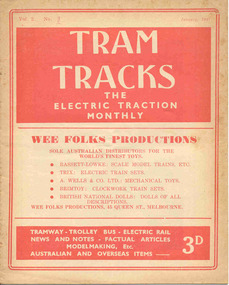
... Has articles on the tram / car debate, Dunedin Tramways, Overlapping fare sections, type of trucks under Sydney tramcars, Brisbane Electric Railway (Power station), The Balmain Counterweight and Trolley buses in Australia. ...Has articles on the tram / car debate, Dunedin Tramways, Overlapping fare sections, type of trucks under Sydney tramcars, Brisbane Electric Railway (Power station), The Balmain Counterweight and Trolley buses in Australia. News items include Brisbane, Newcastle, Sydney, Melbourne, SEC, Hobart, VR, Adelaide, Kalgoorlie, Broome, electric trains in Melbourne and Sydney, and AETA notes. ...Six issues of "Tram Tracks - The Electric Traction Monthly" of the Australian Electric Traction Association. Each issue has a standard cover, of the magazine name etc, featuring "Wee Folks Productions" models but are in different colours, all have been saddled stapled with two staples, except No. 6. The Volume and date details have been over printed. Back covers inside back covers have the same advertisements but the font varies vary. The six issues contain advertisements for the Wee Folks productions, Hartleys Sports store, Hearns Hobbies, Wattle Park, Johnson's Variety Store, Barnes Tennis Centre, The Model Dockyard, Robilt Models, Meadmore Model Engineering and Austral Bronze Pty Ltd, Hearns Hobbies, Christie Scale Model Railway and Equipment, Herbert Small (Meccano), the American Subscription Agency, Manufacturers' Mutual Insurance Ltd. 2465.1 - Vol. 2 No. 1 - 16 pages, Jan 1947, with cover printed in red. Has articles on the tram / car debate, Dunedin Tramways, Overlapping fare sections, type of trucks under Sydney tramcars, Brisbane Electric Railway (Power station), The Balmain Counterweight and Trolley buses in Australia. News items include Brisbane, Newcastle, Sydney, Melbourne, SEC, Hobart, VR, Adelaide, Kalgoorlie, Broome, electric trains in Melbourne and Sydney, and AETA notes. Photos include Sydney O, OP and P, VR PERM 63 and interior photo of a MMTB W4 class tram. 2465.2 - Vol. 2, No. 2 - 16 pages, Feb. 1947, with cover printed in dark blue. Has articles on Brisbane 400 class tramcar, Adelaide to Glenelg Brighton - Le Sands tramway, Melbourne Suburban railways, Diesel Electrics on the Southern Railway (US)and Birney Safety Car. News items include Brisbane, Sydney, Melbourne, VR, Fremantle and AETA notes. 2465.3 - Vol. 2, No. 3 - 12 pages, Mar. 1947, with cover printed in brown. Has articles on why NSW trams lose money, Duncan and Frazer, new trams in Johannesburg, Melbourne Suburban railways, and Sydney New Railway (Eastern Suburbs). News items Sydney, Melbourne, SEC, VR and Adelaide and AETA notes. 2465.4 - Vol. 2, No. 4 - 16 pages, Apr. 1947, with cover printed in green. Has articles on Duncan and Fraser (continued), In search of Ancient Warriors (old trams), Brisbane Electric Railway and some unusual fares arrangements. News items include Brisbane, Newcastle, Melbourne, Sydney, SEC, Launceston, Kalgoorlie, overseas, and AETA notes. Editorial looks at claims that the SW6 cars are the finest in the world, back numbers (notes that Tram Tracks started with a mimeographed club news sheet and now have circulation of nearly 200), costs of production etc. Has photographs of the interior of a SW6 850, a plan for Melbourne underground railway, the VR power operations room at Flinders St., Hobart trolley bus and a cartoon about Sydney traffic. 2465.5 - Vol. 2, No. 5 - 16 pages, May 1947, with cover printed in red. Has articles on Australian Light railways, Sydney's relief lines and the start of an article on NSWGT 600/1200V tramcars. Has news items on Brisbane, Sydney, MMTB, VR, Geelong, Ballarat, Launceston, Hobart and AETA notes. Editorial notes the first anniversary of the magazine and has a number of letters regarding this, content and the tram/car debate. 2465.6 - Vol. 2, No. 6 - 20 pages, June 1947, with cover printed in blue. Has articles on Cremorne bridge replacement (with photos), Neutral bay line and Tramcar transmission gears. News items include photos of MMTB track replacements, crowded trams, Brisbane, Sydney, Melbourne, and a photo of a Sydney tram passing under the new bridge work for Circular Quay station. 2465.7 - Vol. 2, No. 12 - pages 1-12, cover has an advert for Hartley Sporting Goods. Has cartoon on fares on Sydney trams by Peterson, not regarding retirement of Mr. H. Bell of MMTB, Melbourne Latrobe St and bus construction, Sydney tram cartoons from Emile Mercier, electric trains and other tramway news. (Item added 24-3-18 - from consolidation of Melbourne Tram Museum and BTM collections) trams, tramways, electric traction, aeta, models, australian tramways, duncan fraser, cartoons
