
Showing 198 items matching "country trains"
-
 Whitehorse Historical Society Inc.
Document, Trains, country and interstate, 9/05/1977 12:00:00 AM
... Trains, country and interstate...Timetable for country and interstate trains printed in May 1977....Timetable for country and interstate trains printed in May 1977. Trains, country and interstate Document Document ...Timetable for country and interstate trains printed in May 1977.Timetable for country and interstate trains printed in May 1977.Timetable for country and interstate trains printed in May 1977.trains, victorian railways, time tables, railways -
 Wodonga & District Historical Society Inc
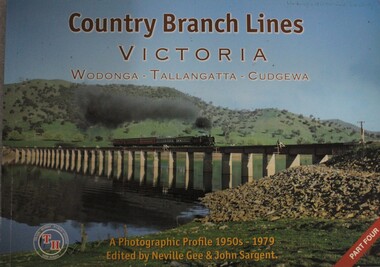
Book - Country Branch Lines Victoria: Wodonga - Tallangatta - Cudgewa: a Photographic Profile 1950s - 1979, Neville Gee and John A. Sargent, 01 Feb 2008
... train...victoria railways...high country...locomotives -- victoria -- history cudgewa train victoria railways high country trains The book covers the branch line that ran eastward from Wodonga past Lake Hume and on to Tallangatta, over the highest point on Victorian Railways at Shelley and terminated at Cudgewa. ...The book covers the branch line that ran eastward from Wodonga past Lake Hume and on to Tallangatta, over the highest point on Victorian Railways at Shelley and terminated at Cudgewa. A photographic profilenon-fictionThe book covers the branch line that ran eastward from Wodonga past Lake Hume and on to Tallangatta, over the highest point on Victorian Railways at Shelley and terminated at Cudgewa. A photographic profilelocomotives -- victoria -- history, cudgewa train, victoria railways, high country trains -
 Sunshine and District Historical Society Incorporated
Article - Argus Extracts 1846 - 1887 on Victorian Railways, Tom rigg, unknown
... ...country trains...Melbourne and suburban railways country trains fare structure notable events Argus Extracts 1846 - 1887 on Victorian Railways Ring folder containing extracts from the Argus Newspaper 1846 - 1887 Article Argus Extracts 1846 - 1887 on Victorian Railways Tom rigg ...The Argus, Melbourne's premier daily newspaper from 1846 to 1857 meticulously documented the birth, rapid expansion and technological evolution of the Victorian Railways. Because the railway was Victoria's greatest state asset and political battleground, the extracts offer an incredibility detailed historical record. Argus Extracts 1846 - 1887 on Victorian Railwaysmelbourne and suburban railways, country trains, fare structure, notable events -
 Melbourne Tram Museum
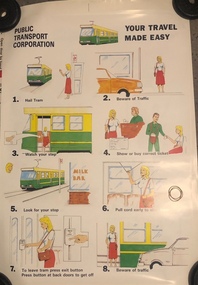
Poster, Public Transport Corporation (PTC), "Public Transport Corporation - Your travel made easy", early 1990's?
... Set of five large posters, featuring a person using public transport and how to use it titled "Public Transport Corporation - Your travel made easy" .1 - portrait format - for trams .2 - ditto for buses .3 - ditto for suburban trains .4 - landscape format for country trains - has a contact number for disability access. .5 - ditto for suburban buses...Trams tramways PTC Posters Trams Railways Disability services behaviour Set of five large posters, featuring a person using public transport and how to use it titled "Public Transport Corporation - Your travel made easy" .1 - portrait format - for trams .2 - ditto for buses .3 - ditto for suburban trains .4 - landscape format for country trains - has a contact number for disability access. .5 - ditto for suburban buses "Public Transport Corporation - Your travel made easy" Poster Public Transport Corporation (PTC) ...Set of five large posters, featuring a person using public transport and how to use it titled "Public Transport Corporation - Your travel made easy" .1 - portrait format - for trams .2 - ditto for buses .3 - ditto for suburban trains .4 - landscape format for country trains - has a contact number for disability access. .5 - ditto for suburban busestrams, tramways, ptc, posters, trams, railways, disability services, behaviour -
 Melbourne Tram Museum
Functional object - Folder - Public Transport Corporation (PTC), Public Transport Corporation (PTC), c1990
... Has the PTC log on the front and inside along with pictograms for bus, tram, suburban and country train on the lower edge....Has the PTC log on the front and inside along with pictograms for bus, tram, suburban and country train on the lower edge. Demonstrates a folder for the distribution of press releases and other documents in a loose format. ...Item used to contain papers such as a press release, or other public or internal documents for meetings. Has the PTC log on the front and inside along with pictograms for bus, tram, suburban and country train on the lower edge.Demonstrates a folder for the distribution of press releases and other documents in a loose format.Folder made from printed folder light weight card or paper with the Public Transport Corporation logo on the frohnt.public transport, transport, railways, tramways, buses, ptc -
 Melbourne Tram Museum
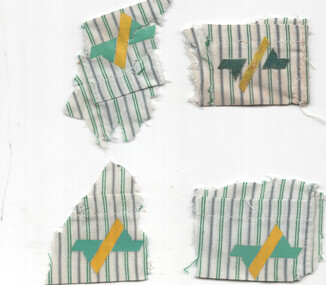
Badge - PTC Uniform Name badge on cloth, Public Transport Corporation (PTC), late 1980s
... Badge of the PTC which was formed in 1989, merging trams, suburban trains and country trains into the Public Transport Corporation, though retaining the name, The Met, for some time - see Reference. ...Badge of the PTC which was formed in 1989, merging trams, suburban trains and country trains into the Public Transport Corporation, though retaining the name, The Met, for some time - see Reference. ...Badge of the PTC which was formed in 1989, merging trams, suburban trains and country trains into the Public Transport Corporation, though retaining the name, The Met, for some time - see Reference. See item 9526 for a The Met uniform logo. Demonstrates the method of providing uniform emblems and organisation identification.Four ripped fabric scraps with vertical green and gray stripes, each featuring a yellow diagonal stripe overlaid on teal chevron shapes.tramways, badges, uniforms, clothing, the met, ptc -
Tatura Irrigation & Wartime Camps Museum
Booklet, Newsrail - May 1992, 1992
... Contains photographs of country rail trains. Includes accident of Brill Railcar (known as the "Beetle") at a level crossing on Toolamba-Echuca line 1949, at Byrneside...Contains photographs of country rail trains. Includes accident of Brill Railcar (known as the "Beetle") at a level crossing on Toolamba-Echuca line 1949, at Byrneside newsrail - may 1992 vr rail motors potts d small w Victorian railways On Front cover - Central Highlands Tourist Railways' 91RM rounds a curb as it heads towards Dayelsford after a trip to Musk. ...Contains photographs of country rail trains. Includes accident of Brill Railcar (known as the "Beetle") at a level crossing on Toolamba-Echuca line 1949, at ByrnesideOn Front cover - Central Highlands Tourist Railways' 91RM rounds a curb as it heads towards Dayelsford after a trip to Musk. Sunday 15.9.91. Ads for model trains on back cover. newsrail - may 1992, vr rail motors, potts d, small w, victorian railways -
 Melbourne Tram Museum
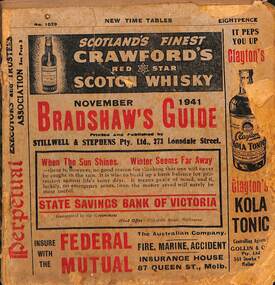
Book - Bradshaws Guide - November 1941, Stillwell & Stephens Pty Ltd
... Provides detailed information on Victorian railways country timetables, suburban trains, lists of post offices, Victorian and Commonwealth Government officials and elected representatives, and tramways - all night services, first and last cars, including Sandringham and St Kilda services. ...Provides detailed information on Victorian railways country timetables, suburban trains, lists of post offices, Victorian and Commonwealth Government officials and elected representatives, and tramways - all night services, first and last cars, including Sandringham and St Kilda services. ...Provides detailed information on Victorian railways country timetables, suburban trains, lists of post offices, Victorian and Commonwealth Government officials and elected representatives, and tramways - all night services, first and last cars, including Sandringham and St Kilda services. Provides a detailed guide to services in Victoria, including public transport.Book - 194 pages, 9 sections stapled paper titled "Bradshaws Guide - November 1941" Priced 8d, No. 1029. Has a fold out map of the VR Country and suburban lines. Includes many advertisements.victoria, tramways, melbourne, timetables, railways, guides, bradshaws guide, advertisements -
 Bendigo Historical Society Inc.
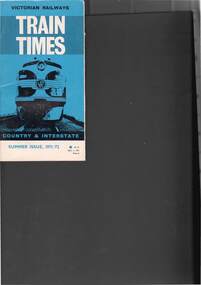
Book - RAILWAYS COLLECTION: TRAIN TIMES COUNTRY AND INTERSTATE SUMMER ISSUE 1971/72
... RAILWAYS COLLECTION: TRAIN TIMES COUNTRY AND INTERSTATE SUMMER ISSUE 1971/72...RAILWAYS COLLECTION- Victorian Railways train times country and interstate - summer issue 1971/72 as at Nov 1, 1971 price 5c, glossy cover in blue, black and white showing a Diesel train on the front, first page is loose....Book RAILWAYS COLLECTION: TRAIN TIMES COUNTRY AND INTERSTATE SUMMER ISSUE 1971/72 ...RAILWAYS COLLECTION- Victorian Railways train times country and interstate - summer issue 1971/72 as at Nov 1, 1971 price 5c, glossy cover in blue, black and white showing a Diesel train on the front, first page is loose.railways, bendigo to melbourne -
 Bendigo Historical Society Inc.
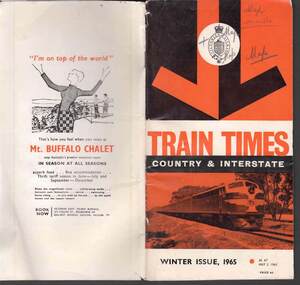
Book - RAILWAYS COLLECTION: TRAIN TIMES COUNTRY AND INTERSTATE WINTER ISSUE 1965
... RAILWAYS COLLECTION: TRAIN TIMES COUNTRY AND INTERSTATE WINTER ISSUE 1965...RAILWAYS COLLECTION - Victorian Railways train times country and interstate - winter issue 1965 - as at May 3, 1965 price 6d - glossy cover in orange, black and white showing a Diesel train on the front. ...Book RAILWAYS COLLECTION: TRAIN TIMES COUNTRY AND INTERSTATE WINTER ISSUE 1965 ...RAILWAYS COLLECTION - Victorian Railways train times country and interstate - winter issue 1965 - as at May 3, 1965 price 6d - glossy cover in orange, black and white showing a Diesel train on the front. Back page has a fold out map of rail routes.railways, bendigo to melbourne -
 Ballarat Tramway Museum
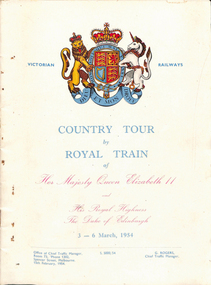
Ephemera - Timetable, Victorian Railways (VR), "Country Tour by Royal Train of Her Majesty Queen Elizabeth II", 15/02/1954 12:00:00 AM
... "Country Tour by Royal Train of Her Majesty Queen Elizabeth II"...Timetable - 28 pages, Victorian Railways titled "Country Tour by Royal Train of Her Majesty Queen Elizabeth II". ...Royal Visit Victorian Railways Ballarat Timetable - 28 pages, Victorian Railways titled "Country Tour by Royal Train of Her Majesty Queen Elizabeth II". ...Timetable - 28 pages, Victorian Railways titled "Country Tour by Royal Train of Her Majesty Queen Elizabeth II". Details the timetable and arrangements for the Royal Tour of 3 - 6 March 1954. Printed by VR Gives details of the train times and for example the time spent in Ballarat of 75mins. royal visit, victorian railways, ballarat -
 Melbourne Tram Museum
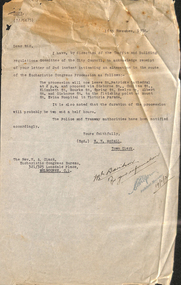
Document - Memorandum, Melbourne & Metropolitan Tramways Board (MMTB), Eucharist Congress and Procession, 1934
... Note pinned to front, handwritten in red pencil, Eucharistic Congress Mens Night - Thurs 6/12/34. 127H x 204W, 265H x 208W, good condition 5 - Set of 13 pages of memos relating to the the Eucharistic Congress and Procession, Sunday 9 December, 1934. 6 - Arrival and departure times of country trains on Sunday 9 December, 1934, replacing previous timetable. 7 - Memo from Assistant Manager to Dist Traffic Supts NS & SS. ...Note pinned to front, handwritten in red pencil, Eucharistic Congress Mens Night - Thurs 6/12/34. 127H x 204W, 265H x 208W, good condition 5 - Set of 13 pages of memos relating to the the Eucharistic Congress and Procession, Sunday 9 December, 1934. 6 - Arrival and departure times of country trains on Sunday 9 December, 1934, replacing previous timetable. 7 - Memo from Assistant Manager to Dist Traffic Supts NS & SS. ...Memorandums and table card for tram scheduling for Eucharist Congress and Procession: 1 - Newspaper clipping: "Papal Legate on Cathay - Due in Melbourne November 26, Papal Legate, Cardinal MacRory will visit for the National Catholic Congress in Melbourne December 2 to 9. 230H x 55W, poor condition 2 - Letter from WV McCall, Town Clerk, to Rev NA Clack, Eucharistic Congress Bureau, advising of receipt of letter advising of changes to Eucharist Congress Procession. Handwritten note to "Mr Davidson, for your information, 19/11/34". 335H x 210W, poor condition, torn edges and folds 3 - Set of 3 table cards for Eucharistic Congress Show Grounds "Men's Night". Thursday 6/12/34 "Down Loading at City Rd. Camberwell Glen Iris, South Melb Toorak, Elsternwick St Kilda Beach, 223H x 76W 4 - Set of 4 memos from DJ Davidson to depots regarding tram scheduling for Eucharistic Congress Show Grounds "Men's Night". Note pinned to front, handwritten in red pencil, Eucharistic Congress Mens Night - Thurs 6/12/34. 127H x 204W, 265H x 208W, good condition 5 - Set of 13 pages of memos relating to the the Eucharistic Congress and Procession, Sunday 9 December, 1934. 6 - Arrival and departure times of country trains on Sunday 9 December, 1934, replacing previous timetable. 7 - Memo from Assistant Manager to Dist Traffic Supts NS & SS. Other similar memos relating the the event. 8 - Letter from WV McCall, to Secretary, MMTB, advising of Eucharistic Procession, Sunday 9 December, 1934. Handwritten note to "Mr Davidson, for your information, 7/12/34". 263H x 206W, poor condition, torn edges and foldstrams, tramways, instructions, events, eucharistic congress, showgrounds -
 Warrnambool and District Historical Society Inc.
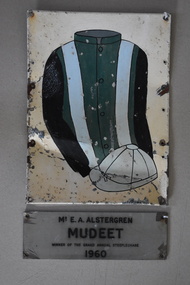
Plaque, Mudeet, C 1990
... Mudeet was trained by Alex Fullarton ,a leading cross country rider and later trainer of jumps horses. ...Mudeet was trained by Alex Fullarton ,a leading cross country rider and later trainer of jumps horses. ...This is one of a series of eighteen plaques which commemorated some of the winner of the Grand Annual Steeplechase which is held each year in Warrnambool. The first Grand Annual was held in 1872 as the Warrnambool Handicap Steeplechase. Mudeet won the race in 1960 with Warrnambool jockey E Byrne. Mudeet was trained by Alex Fullarton ,a leading cross country rider and later trainer of jumps horses. This series of plaques were painted by local artist Leslie Lamey and were originally in the members enclosure at the Warrnambool RacecourseThese items relate to a significant part of Warrnambool's sporting and social history..1 Painted white rectangular tin plaque with rolled edges with painting of jockeys silks and cap. The colours are black sleeves with light and dark green panels on the front with a light green cap. Fourteen holes are around the edge. .2 Galvanised rectangular brass plate with engraved black text .1.Mudeet and Strasbourg written in red and black texta on the reverse. .2 Mr E.A.Alstergren MUDEET. Winner of the Grand Annual Steeplchase.warrnambool, grand annual steeplechase, alex fullerton, mudeet, e byrne jockey warrnambool -
 Melton City Libraries
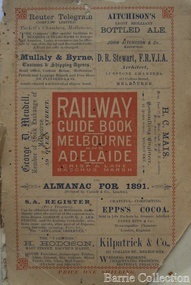
Book, 'Railway Guide Book Melbourne and Adelaide, 1891
... We usually got into the same compartment on the train, it was a typical country train with a corridor along the side and compartments with a door, roof racks and sometimes heated metal containers for the feet in the winter. ...We usually got into the same compartment on the train, it was a typical country train with a corridor along the side and compartments with a door, roof racks and sometimes heated metal containers for the feet in the winter. ...Memories of Train Travel compiled by Wendy Barrie 4/09/2013 Train travel had changed very little from the time my mothers generation to mine. The timetable meant the usual rush to Melton South by bike in her case and if she was running late the train pulled up on the crossing. I was driven to the Station from home past Keith and Mary Gillespie’s house near the Ferris Road rail crossing to Bridge road to Melton South for the 7.32 train. While attending Sunshine High School in 1961 I would meet up with three other students, two of whom I knew from Bacchus Marsh High School days. We usually got into the same compartment on the train, it was a typical country train with a corridor along the side and compartments with a door, roof racks and sometimes heated metal containers for the feet in the winter. Some of the trains came through from Horsham and Ballarat, and the Overland from Adelaide passed through in the evening, we could hear it in the distance from the Ferris Lane home. The carriages had 1st and economy class compartments showing photographs of county scenes and holiday destinations. The engine was the large A class diesel. They are still running to Bacchus Marsh 50 years later, due to the need for the greatly increased number of commuters travelling to work in the city. Sometimes the carriages were pull by a Steam engine, these were a problem in the summer time because the sparks caused fires along the train lines and then quickly spread into the dry grass, crops and stubble. The Motor Train left Spencer Street at 4.23 pm and was the best train for me to catch. Ferris Road was a designated stop and train pulled up on the road crossing. It had steps at the door and rungs to hold while alighting to the ground. The ballast along the tracks was rough and uneven and awkward to land on. The train was painted blue and yellow with the letters VR pained on the front. This saved may parents the afternoon trip to collect me from the Station. On the walk home on the gravel road I would pass Uncle Tom and Aunty May’s house before reaching home. Melva Gillespie was studying at Sunshine Technical School and we sometimes both got off the train at the same time. On other occasions the Motor Train was replaced with a diesel engine with carriages, it was also required to stop and the driver had to be notified in advance. This meant getting into the guards van a Rockbank. It was more difficult alighting from the carriage as the gap was greater and more precarious to swing out and land on the ground. A few times in my last year of study at Melbourne Teachers College in Grattan Street Carlton. I managed to catch the 2.30 pm train to Serviceton, it was express to Melton and was very quick trip. The last train, was the 5.25 pm diesel to Ballarat and I usually caught this train to Melton South Station. On one occasion after being held up on the tram in Bourke street I had to make a mad dash to the platform chasing the train as it was just moving off and yelling to the guard, fortunately I was noticed and the train ground to halt. I scrambled into the end door and took most of the journey home to recover. After the last year at High School I continued to travel on the train, 2 years to Prahran Technical School changing at North Melbourne. There were a lot school children travelling to private schools and some at the primary level and mainly from Bacchus Marsh. Rockbank children also travelled by train from the beginning of their high school years, quite a few went to Sunshine High School. Book provided a timetable and information about the stations the train travels to from Melbourne to Adelaide. transport -
 Bendigo Historical Society Inc.
Document - PETER ELLIS COLLECTION: NEWSPAPER ARTICLE, 23rd May, 2015
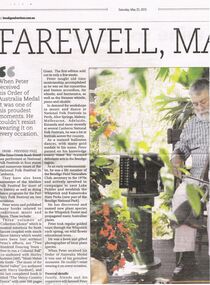
... In demand for workshops in music and dance at National Folk Festivals in Perth, Alice Springs, Maleny, Melbourne, Adelaide, Kuranda and more recently at several Canberra National Folk Festivals, he was a hit at festivals across the country. As a trained ballroom dancer, with many gold medals to his name, Peter passed on his knowledge every time he trained debutante sets in the Bendigo region. ...In demand for workshops in music and dance at National Folk Festivals in Perth, Alice Springs, Maleny, Melbourne, Adelaide, Kuranda and more recently at several Canberra National Folk Festivals, he was a hit at festivals across the country. As a trained ballroom dancer, with many gold medals to his name, Peter passed on his knowledge every time he trained debutante sets in the Bendigo region. ...Colour photocopy of article from Bendigo Advertiser. Dated Saturday, May 23, 2015. FAREWELL, MA.. When Peter received his Order of Australia Medal it was one of his proudest moments. He couldn’t resist wearing it on every occasion. FROM - PREVIOUS PAGE The Emu Creek Bush Band has performed at National Folk Festivals in four states and numerous times at the National Folk Festival in Canberra. They have also been mainstays of the Maldon Folk Festival for most of its history as well as doing dance programs for the Port Fairy Folk Festival on two occasions. Peter wrote and published many books related to traditional music and dance. These include: Three volumes of 'Collector's Choice' which is musical notations for bush dances coupled with much dance history which would have been lost without Peter's efforts, are 'Two Hundred Dancing Years- How to run a Colonial Ball' (Co-authored with Shirley Andrews (AM), 'Music Makes Me Smile- The Music of the Nariel Valley' (Co-authored with Harry Gardner), and his last completed book is titled 'The Merry Country Dance' with over 300 pages.. .. .. Grant. The first edition sold out in only a few weeks. Peter taught old time musicianship, accomplished as he was on the concertina and button accordion, tin whistle, and harmonica, as well as the Swanee whistle, piano and ukulele. In demand for workshops in music and dance at National Folk Festivals in Perth, Alice Springs, Maleny, Melbourne, Adelaide, Kuranda and more recently at several Canberra National Folk Festivals, he was a hit at festivals across the country. As a trained ballroom dancer, with many gold medals to his name, Peter passed on his knowledge every time he trained debutante sets in the Bendigo region. As an early environmentalist, he was a life member of the Bendigo Field Naturalists Club, secretary in the 1970's and actively involved in campaigns to save Lake Pedder and establish the Whipstick and Kamarooka State Parks (now part of the Bendigo National Park). He has discovered and named new plant species in the Whipstick Forest and propagated many Australian plants. Peter took regular guided tours through the Whipstick each spring, on wildflower educational tours. He was a keen and gifted photographer of local plant species. When Peter received his Order of Australia Medal it was one of his proudest moments. He couldn’t resist wearing it on every occasion. Funeral details. Family, friends and his supporters will farewell Peter.. .. .. ..person, individual, peter ellis oam -
 Melton City Libraries
Photograph, Wendy Barrie, Unknown
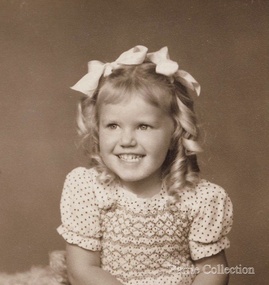
... We usually got into the same compartment on the train, it was a typical country train with a corridor along the side and compartments with a door, roof racks and sometimes heated metal containers for the feet in the winter. ...We usually got into the same compartment on the train, it was a typical country train with a corridor along the side and compartments with a door, roof racks and sometimes heated metal containers for the feet in the winter. ...Eldest daughter of Edna and Bon Barrie, born on 03 November 1943 in Melbourne, Victoria, Memoirs of Wendy Barrie, recalling the early formative years of life in Melton: In 1949 I started school at Melton State School no 430 and was driven the 2½ miles to there by my parents at first. Later we walked home in the afternoons or were picked up by car as we made our way home along the Western Highway. In 1956 I went to Bacchus Marsh High School. There were 4 students in grade 6 and 3 of us went to the High School. The students from Melton, Melton South and Toolern Vale State Schools went by bus to Bacchus Marsh High School as far a fifth form. My parents drove me to the pick up point and during the five years of travel to High School. The bus travelled via Toolern Vale and later went through Exford and through Parwan. On the return journey in the afternoon the bus went in the reverse direction. The bridge at Exford was an old narrow wooden one, and the students had to get off the bus and walk across, with the driver crossing in the empty bus for safety reasons. There was a travelling allowance paid to parents and it was estimated from the distance the crow flies, a straight line. We lived a Ferris Lane, just where the Harness Racing entrance is now situated about 2 ½ miles by road to school too close to qualify for the subsidy. While at State School Melton we would walk home in a group with the Nixon and Gillespie children, along the main road over the bridge near the Shire Offices and down a hill. I was being dinked on Joyce Gillespie’s bike while holding onto the seat, toppled off the bike striking my chin and teeth on the bitumen and cracking my jaw. I was about 9 years old and stayed a couple of days in the Quamby Hospital in Bacchus Marsh, it seemed like and eternity at the time and quite traumatic being separated from my family. I can remember contemplating how I could get out of the window and run away but realised it was too far to walk home. Often we would cut across the Common on our way home from school picking up stray golf balls and collecting them from the creek when it dried out. We were warned about not accepting lifts from strangers passing along the Melbourne/ Ballarat Road. The only danger we faced was being swooped by the magpies particularly on the open ground on the Common. We were also fairly cautious when the Gypsies camped on the Common in the area just about opposite the small reservoir. “Mum” grandma Myers loved to have us call in on our way home, and usually would cut a slice of Jongebloed’s bread and spread it with home made butter. Sometimes we waited there until we were collected by car, usually driven by our mother. Margaret Nixon and Joyce Gillespie were a few grades ahead of me and Barbara Nixon was born just two months earlier than me. Our mothers were great friends for over 6o years, born in the same month three years apart. They lived within a few days of the same age as each other at the time their deaths. Dad and George Nixon attended Melton school at the same time. Sarah nee Hornbuckle Nixon and my grandfather Frederick Myers Snr were at school together at the same in the 1880s. The Nixon family lived in Keilor Road just past the Toolern Creek near the turnoff. Tom and Ann Collins lived on the southern side of the Western highway and Keilor road intersection. Jim and Ruby Gillespie’s house was further long Keilor road on the right. They backed onto the Myers who lived on the north side of Western Highway east of Myers Gully (Ryans Creek). The Bridge over the Toolern Creek as very narrow and as truck traffic increased there were accidents. One truck took out the side railing and plunged upside down into the bank and into the shallow water. Another fatal accident happened between a car and a truck right in front of the Myers house. Grandfather Fred had been a bike rider all his life, as far as the Riverina in his younger years, wryly made the comment about the drivers the speeding along the Ballarat Road were setting out to kill themselves. The road was busy particularly after the Races at Ballarat when the crowds were hurrying home to Melbourne. Train travel had changed very little from the time my mothers generation to mine. The timetable meant the usual rush to Melton South by bike in her case and if she was running late the train pulled up on the crossing. I was driven to the Station from home past Keith and Mary Gillespie’s house near the Ferris Road rail crossing to Bridge road to Melton South for the 7.32 train. While attending Sunshine High School in 1961 I would meet up with three other students, two of whom I knew from Bacchus Marsh High School days. We usually got into the same compartment on the train, it was a typical country train with a corridor along the side and compartments with a door, roof racks and sometimes heated metal containers for the feet in the winter. Some of the trains came through from Horsham and Ballarat, and the Overland from Adelaide passed through in the evening, we could hear it in the distance from the Ferris Lane home. The carriages had 1st and economy class compartments showing photographs of county scenes and holiday destinations. The engine was the large A class diesel. They are still running to Bacchus Marsh 50 years later, due to the need for the greatly increased number of commuters travelling to work in the city. Sometimes the carriages were pull by a Steam engine, these were a problem in the summer time because the sparks caused fires along the train lines and then quickly spread into the dry grass, crops and stubble. The Motor Train left Spencer Street at 4.23 pm and was the best train for me to catch. Ferris Road was a designated stop and train pulled up on the road crossing. It had steps at the door and rungs to hold while alighting to the ground. The ballast along the tracks was rough and uneven and awkward to land on. The train was painted blue and yellow with the letters VR pained on the front. This saved may parents the afternoon trip to collect me from the Station. On the walk home on the gravel road I would pass Uncle Tom and Aunty May’s house before reaching home. Melva Gillespie was studying at Sunshine Technical School and we sometimes both got off the train at the same time. On other occasions the Motor Train was replaced with a diesel engine with carriages, it was also required to stop and the driver had to be notified in advance. This meant getting into the guards van a Rockbank. It was more difficult alighting from the carriage as the gap was greater and more precarious to swing out and land on the ground. A few times in my last year of study at Melbourne Teachers College in Grattan Street Carlton. I managed to catch the 2.30 pm train to Serviceton, it was express to Melton and was very quick trip. The last train, was the 5.25 pm diesel to Ballarat and I usually caught this train to Melton South Station. On one occasion after being held up on the tram in Bourke street I had to make a mad dash to the platform chasing the train as it was just moving off and yelling to the guard, fortunately I was noticed and the train ground to halt. I scrambled into the end door and took most of the journey home to recover. After the last year at High School I continued to travel on the train, 2 years to Prahran Technical School changing at North Melbourne. There were a lot school children travelling to private schools and some at the primary level and mainly from Bacchus Marsh. Rockbank children also travelled by train from the beginning of their high school years, quite a few went to Sunshine High School. During my third year of teacher training I travelled to Flinders Street to RMIT for ceramics classes and Grattan St Teachers College located in the grounds of Melbourne University. There were many teachers being trained at the Secondary Teachers College due to the baby bulge creating a great shortage of teachers. Sunshine High School was very well represented amongst the different courses in Primary, Secondary and Art and Crafts. I attended Melbourne University lectures, studying a Fine Art subject. Bernard Smith was the most notable of the lecturers. he replaced Professor Joseph Bourke who had taken leave for the years. In 1962 he published the art book “Australian Painting”. The secondary art and craft student teachers from the College were in the majority, taking this subject and were well regarded due to their practical art and craft methods and their teaching round experience. In December 1964 I graduated as a Trained Secondary Teacher – Art and Crafts. The graduating ceremony was held at Wilson Hall. I received my appointment to work at Maryborough High School. Uncle Max and Aunty Rosemary Myers arranged my accommodation. Uncle Max was a teacher at the Maryborough Technical School fat the time. The appointment was suddenly changed when just before the school year was about to start when I received notification that I was now required to move to Warracknabeal High School. I was subject to a bond for the three years of training and three years of teaching and was under an obligation to comply with the directive of the Education Department. My father stood as guarantor when I was accepted as student at the Melbourne Teachers’ College, thus enabling me to receive my teacher training, and a 5 pounds a week allowance for expenses. After teaching for two years at Warracknabeal High School I was fortunate enough the gain a transfer to Sunshine West High School, returning to live at home in Melton and travelling by car to work with a fellow colleague, Jock Smith who lived at Station road Melton. I completed bond obligation and resigned at the end of the year. The employment regulations at that time did not allow the option of leave of absence for, indefinite overseas travel. I returned to Australia in October 1969. Visiting Arthur Hart the Principal of Sunshine High School he arranged with the Education Department for my re-employment at Sunshine High School until the end of the year. In 1970 I was transferred, and returned to Sunshine West High School where I worked for the next three years. In January 1968 I sailed on the “Oriana” to South Hampton with two teaching friends from Warracknabeal High School on a travelling and working holiday. Doreen Kiely, a former Bacchus Marsh High student and fellow train traveller from Bacchus Marsh, was already working in London, had arranged our accommodation at the London Travellers Club Hotel, Braham Gardens, Earls Court SW5. We based our stay at this address in London and travelled around Scotland, Ireland and England. In the summer we took a four month trip around the Continent and the Mediterranean. I registered with The Royal Borough Of Kingston Upon Thames as a Supply teacher, and worked at Chessington School form autumn to spring the following year and living with Mrs Rose Gillies at Kinross Avenue, Worcester Park, Surrey. In the spring of 1969 visiting Norway, Sweden and Finland joining an organised camping group to the Artic Circle, entered Russia at Leningrad (St Petersburg) Moscow, Minsk, to Poland and Czechoslovakia. In August returning to Worcester Park for the flight to Montreal to stay with cousin Lynette and husband Jurgen. A side trip was taken to Toronto, Niagara Falls and New York. The flight home from Montreal to Melbourne took 52 hours. A ½ day break in Vancouver before boarding the Qantas boeing 707 via San Francisco, Honolulu, Fiji, Sydney to Melbourne. Around the world in 21 months. Photographs of Wendy local identities -
 City of Melbourne Libraries
Photograph, Bull, Hugh Jones, 1897-1993, Commercial Travellers' Association, Victoria, Board Room
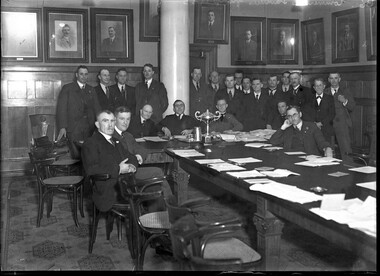
... Top rate club tariff for bed and breakfast - 6 shillings, if called for a country train leaving Melbourne before 8am - 4 shillings, suite and breakfast- 9 shillings, sixpence. ...Top rate club tariff for bed and breakfast - 6 shillings, if called for a country train leaving Melbourne before 8am - 4 shillings, suite and breakfast- 9 shillings, sixpence. ...Seven seated and fifteen standing men dressed in suits around a long table in a panelled room hung with formal portraits of men. A trophy sits on the long table amongst loose paper sheets. Research by project volunteer, Fiona Collyer: The Commercial Travellers’ Association of Victoria (CTA) was formed at a meeting of 40 commercial travellers held at the Duke of Rothesay Hotel, 24 Elizabeth Street on 1 December 1880. Their charter was to advocate for better working conditions for commercial travelling salesmen, including improved accommodation at discounted rates and travel concession fares. At first by locomotive, horse and buggy, steamers and horseback, later also by motor car and motorcycle, “The Man on the Road” went into the back-blocks of the country to extend the interests of commerce to the stores and households of Australian regional towns and isolated settlements. Affiliated organisations existed in all states and New Zealand and in 1895 they integrated to form the United Commercial Travellers’ Association of Australasia (UCTAA). By the turn of the 20th century, the Victorian branch of the CTA had 421 Association Members and 520 Club members. The CTA continued to hold meetings in leased rooms in hotels and offices until 1898 when they commissioned purpose-built premises at 190-192 Flinders Street (extant, now the Macstore, next to former Metropolitan Gas Company Buildings). Designed by leading architectural firm of brothers H.W. & F.B.Tompkins (Dimmey’s Model Store, Swan Street, London Stores, Herald and Weekly Times, Myer building, Diamond House, Centreway Arcade, Manton’s Store) in the Queen Anne Revival style at the cost of £20,000, the four storey building had a facade of red Northcote bricks and an entrance of Pyrmont stone. It was very modern for the time, featuring elevators, offices, bars, kitchen, dining, card and billiard rooms and 31 bedrooms with shared bathrooms for the footsore travellers. However, despite adding two storeys in 1901, and another storey and a basement in 1905, they soon outgrew their premises, and in 1912 the CTA commissioned a new building at 328 Flinders Street. At this time, buildings in Melbourne were constrained by the city height limit of 132 feet (40 metres)- the maximum height of firefighting ladders. The new CTA building was the tallest building in Melbourne until 1932 when regulations changed allowing the Manchester Unity Building to be built. The new CTA headquarters was the epitome of comfort and luxury with cutting edge facilities to ease the fatigued salesman and prepare him for another stint on the road. General Secretary, James Davies travelled to Britain and America to acquire the very best and latest innovations. After visiting the new premises, Punch magazine 11 June 1914 reported “furnishings, appliances, and labour-saving conveniences which were more than up to date- they were up to-morrow.” The Edwardian Baroque style building was again designed by architects H.W. & F.B. Tompkins at the cost of £100,000 and built by contractors F.E. Shillabeer and Sons (Nicholas Building, Kellow-Falkiner Pty Ltd car showroom). The nine storey plus basement building is of steel frame construction with concrete floors. The ground floor facade is of grey granite and above that it is faced with cream glazed bricks chosen to combat discolouration from the pollution emitted by Flinders Street Station trains across the road. The facade is decorated with mascarons, gum leaf trim and balconies with classical style balustrade. The club was entered through revolving doors into a two storey high, circular, domed lobby with white columns, American oak panelled walls and intricate mosaic flooring. The ceiling is festooned with plaster gum leaf and gum nut detail, a theme that is repeated throughout the building. The basement kitchen had modern, labour saving appliances that would be the envy of any Edwardian housewife, including an electric toaster, a potato peeling machine, heated dumb waiter, dishwashing machine and electric refrigeration and cooking. It serviced the commodious second floor dining room which seated 200 people and the cafe/breakfast room, 80 people. Members were permitted to entertain their lady friends there for afternoon tea between the hours of 3 and 5 pm every day, except Sunday. The members’ facilities included a barbershop, clothes pressing machine, boot cleaning chair, pipe and cigar stall with electric humidor, public telephones, lockers and safe deposit. The building was serviced with five elevators, a built in vacuum cleaning plant, hot water radiators and linen and postal chutes. The first floor was devoted to business and relaxing, containing the Board, Writing, Reading and four Business Rooms. The board room had Queensland maple panelling with huge blackwood tables topped with blue morocco and golden tortoise-shell trim and cane bottomed chairs. Large framed photographs of past presidents since 1884 lined the walls. The Reading Room ran the whole width of the building. Arthur Streeton’s painting “Between the Lights, Princes Bridge 1888” and Frederick McCubbin’s “Looking North from Mount Macedon” were hung there, as well as paintings by renowned Australian artists Hans Heysen, Walter Withers, John Mather, Jan Hendrik Scheltema. The Argus 30 May 1914 quipped “Around the walls hang evidences that the commercial traveller's soul has not been killed in his pursuit of commerce”. The blackwood panelled room was furnished with Queen Anne style tables and chairs and green leather armchairs with inviting rocker foot rests allowing weary travellers to relax after traversing the railways and dusty roads of Victoria while planning their next sales trip. “The Australasia Traveller” Volume 10, Number 2, April 1914 page 35 noted “An attendant will be constantly employed on this floor to take care of the stationary supply, to tidy up newspapers, and generally study the convenience of members.” The third floor was for amusements with billiards, a bar and four rooms for playing cards, dominoes and chess. The huge billiard room had seven Alcock billiard tables including a table in a partitioned match-room for tournaments, exhibitions and matches. The walls were lined with members’ cues and for spectators, comfortable lounges with marble topped tables and electric bell pushes for drinks service. There were 150 bedrooms over five floors, each with their own telephone and wash basin and five suites with a private sitting room attached. There were four bathrooms per bedroom floor and capacious, well-lighted shaving rooms. Top rate club tariff for bed and breakfast - 6 shillings, if called for a country train leaving Melbourne before 8am - 4 shillings, suite and breakfast- 9 shillings, sixpence. “The Australasia Traveller” Volume 10, Number 2, April 1914 page 35 reported “All “early calls” will be made from the Club Office to Bedrooms by means of the Telephone, so that instead of waking everybody else up on the corridor, only the member concerned will know that it is his unpleasant duty to get up.” The new CTA premises was widely regarded as the finest club in the Southern Hemisphere. The CTA also built the adjacent six storey Commerce House with 52 sample rooms for travellers to display their wares with the remainder rented to retail businesses and a post and telegraph office. After the CTA moved into their new, larger premises in 1914, neighbouring department store Ball & Welch expanded into the former CTA. The CTA saw themselves in a nation building role and were an influential lobby group to the Government. They advocated for inter city trunk telephone lines, standard gauge railway lines between NSW and Victoria, improved roads and highways, the Murray River water scheme and maintaining the White Australia Policy. They were very active in fund raising for the war efforts. The CTA offered its members support in other ways with benevolent funds for widows and orphans, mortuary, accident, sickness and an annuities fund for members over 65 years. There were scholarships for members’ children and home purchase scheme to assist with home ownership. A secondary membership scheme provided access to non commercial travellers (men only) to its exclusive club premises. They also organised social events and activities such as billiard tourneys, golf tournaments, dances and an annual “Smoke Social” which was a social event where men gathered for a formal dinner, community singing, lectures, speeches and of course, to smoke! Daylesford born James Davies OBE, (1865-1931) worked at the CTA for 50 years, starting as an office boy and working his way up to General Secretary and editor of the monthly trade journal for UCTAA members, “The Traveller” (1890-1905, later “The Australasian Traveller” 1905-1924 and then “The Australian Traveller” 1925-1976) and the annual colour supplement magazine “Australia To-Day” (1904-1973). “The Australasia Traveller” featured commentary on the issues of the day like wars, tariffs and trade, articles on new products and hotel recommendations and their rates and lots of advertising, especially alcohol, tobacco and accommodation in regional hotels. There were regular columns, each illustrated with a line drawing and these included “Our Immigration Record” a state by state summary of arrivals of “desirable immigrants” to Australia, while bemoaning the declining (white) birth rate. The column followed the arrival of British boys sent to Australia as agricultural apprentices to work on rural properties which were short of labour. Between 1913-1928, 1750 “Barwell Boys”, some as young as 14 years of age arrived in South Australia to work. NSW had a similar program known as the Dreadnaught Boys Scheme where 5595 boys immigrated between 1911-1939. The boys were considered of “good British stock”. There was a “Home Page For The Ladies” showcasing the latest fashions in women’s clothing, millinery and hairstyles and tips and trends in home furnishings.“Children’s Corner for Dear Little Folks” which featured puzzles, jokes and stories and members could send in photographs of their children. “Road Echoes” devoted to “The Man On The Road” and his doings. “Face Massage, Smiling is the Best Face Massage”, the humour page full of jokes and funny stories. “Railway Rumbles” news of innovations, timetables, tickets and grumbles about lavatories, food and drinking water on trains and at railway stations. And in case we forget that members had a home away from their CTA home, gardening tips with “The C.T. as Gardener”column. The annual magazine “Australia To-Day” was a vehicle to promote Australia here and overseas as a modern, prosperous country with abundant opportunities and pleasant climate. It sought to showcase its manufacturing, agriculture and tourism and encourage British immigration to Australia. The magazine featured articles about recently arrived migrants at work, quirky native flora and fauna, beach culture, recreation and the Australian way of life in the settler nation. Many of the articles were written by politicians of the day, including Robert Menzies. The UCTAA commissioned original artwork for the front covers and feature articles of “Australia To-day” from leading Australian artists. These included Norman Lindsay, Frederick McCubbin, Napier Waller, Lionel Lindsay, Hans Heysen, C Dudley Wood, Louis McCubbin, Penleigh Boyd, Louis Buvelot, Christian Waller and Ellis Rowan and her Australian wildflowers. Some of the photographs in “Australia To-Day” were provided by state and federal government departments as well as manufacturers, newspapers and mining companies. Amongst of the credited photographers was Helmut Newton who later earned world acclaim as a fashion photographer and architectural and industrial photographer Wolfgang Sievers (unfortunately their photographs remain in copyright and aren’t available online). Also featured was Richard C. Strangman, a professional photographer from Canberra, William Howieson of Melbourne, who has 22 photographs in the collection of NGV, Tasmanian wilderness photographer Frederick Smithies, Athol Shmith, portrait photographer and educator from Melbourne, Gordon de Lisle, a Melbourne commercial, industrial, aerial and society portrait photographer. (One of Gordon’s assignments was as the stills photographer for the 1959 movie “On The Beach” filmed in Melbourne). Photographs taken by acclaimed Antarctic and official war photographer Captain Frank Hurley OBE for Adelaide’s Centenary were also featured. The Australian Government was keenly aware of the influence and quality of the UCTAA publications. On 1 June 1914 The Age reported that to advertise Australia in Great Britain and elsewhere, the Department of External Affairs purchased 6500 copies of “Australia To-Day” magazine for £515 to distribute free to “places where they are most likely to come under the notice of a desirable class of immigrants.” In 1950, the office of Prime Minister Robert Menzies ordered 2550 copies of that year’s issue of “Australia To-Day” for the Department of Commerce and Information to distribute. The CTA donated their archives to University of Melbourne Archives which includes original artworks and photos used in “Australia To-Day” (Melbourne University has digitised 1114 photos) and sundry items including trophies, ashtrays, commemorative souvenirs, menus, a rare “Safechek” sovereign changer, a bust of James Davies and even a CTA embossed wash bowl and chamber pot. After the death of General Secretary James Davies in 1931, the CTA held the annual “James Davies Memorial Cup” golf tournament at various Melbourne golf courses, the winner receiving a splendid silver cup. “Table Talk” magazine photographs from 29 June 1933 depict the travellers beautifully (and I would say correctly) attired in tweedy plus fours, Fair Isle knitwear, flat caps and of course fringed brogues. I have been unable to ascertain whether the trophy in our photo is for golf or another CTA social activity. The CTA Victoria membership peaked in 1951 with 4,672 Aassociation members and 3,693 Club members. In 1959, Hollywood came to Melbourne when film stars Gregory Peck, Ava Gardner, Anthony Perkins and Fred Astaire descended to film ‘On the Beach,’ directed by Stanley Kramer. The film is based on the bestselling Neville Shute novel about the aftermath of World War Three, a nuclear war that has obliterated most of the Northern Hemisphere. Radioactive dust is heading toward Australia and everyone is preparing for death. Scenes with Anthony Perkins were filmed in the CTA billiards room as the exclusive Pastoral Club. Anthony Perkins’ character, Lieutenant Commander Peter Holmes of RAN tells Gregory Peck’s character, Commander Dwight Lionel, that The Pastoral Club is…”A mahogany and polished brass sort of place-some people claim it was the stuffiest club in the Commonwealth” before assuring him that despite shortages, the club is likely to have some Scotch left. In a scene at the Pastoral Club two, old (probably red faced) codgers discuss the challenge of drinking all of the 400 bottles of Gould Campbell vintage port in the club wine cellar before they succumb to radiation sickness in five months time. The NGV has 12 photographs in their collection of wardrobe stills of Ava Gardner modelling costumes designed by the Fontana Sisters of Rome for “On The Beach”, taken by Italian photographer G.B.Poletto. During the filming, Gregory Peck and his family stayed at “Kurneh” 206 Domain Road, South Yarra, the former home of three times Grand Slam winner Norman Brookes. Through the decades, Australian society was changing and in order to stay relevant, the CTA had to change too. In 1971, two women were elected for club membership, although they were only granted limited access to the club’s facilities and in 1972, women were invited for the first time to participate in the previously men only annual “Smoke Social”. In 1975, dwindling membership forced the closure of The Commercial Travellers’ Association building and in 1977, the building was sold, with the CTA ceasing to operate in 2014. It was the end of the road for the “Knights of the Road”. In 1992, the CTA building at 328 Flinders Street was placed on the Victorian Heritage Register in recognition of its architectural and cultural significance. The building has been meticulously restored with many of the original fittings, decorative plasterwork, mosaic flooring, stained glass windows, columns, chandeliers and the panelling made from Australian timbers retained. After renovations the building became first the Euro Asia Hotel, then the Duxton Hotel and in 2005 The Rendezvous Hotel, Melbourne. In tribute to the history of the building and the film “On The Beach”, the Rendezvous Hotel has the Ms Ava Bar, Perkins room, Mr Tompkins restaurant, Commerce Room and the Davies Room. References: COMMERCIAL TRAVELLERS' ASSOCIATION OF VICTORIA. (1899, May 27). The Australasian (Melbourne, Vic. : 1864 - 1946), p. 25. Retrieved February 21, 2025, from http://nla.gov.au/nla.news-article138615498 COMMERCIAL TRAVELLERS. (1914, May 30). The Argus (Melbourne, Vic. : 1848 - 1957), p. 8. Retrieved February 13, 2025, from http://nla.gov.au/nla.news-article7272511 NEWS OF THE DAY. (1914, June 1). The Age (Melbourne, Vic. : 1854 - 1954), p. 8. Retrieved February 19, 2025, from http://nla.gov.au/nla.news-article189414314 COMMERCIAL TRAVELLERS' "AT HOME." (1914, June 11). Punch (Melbourne, Vic. : 1900 - 1918; 1925), p. 32. Retrieved March 19, 2025, from http://nla.gov.au/nla.news-article129699692 https://archives.library.unimelb.edu.au/nodes/view/69669 https://vhd.heritagecouncil.vic.gov.au/places/757 http://www.pikitiapress.com/blog/2015/1/26/australia-today Commercial Travellers at Yarra Yarra (1933, June 29). Table Talk (Melbourne, Vic. : 1885 - 1939), p. 6. Retrieved February 28, 2025, from http://nla.gov.au/nla.news-article149547845 https://archives.library.unimelb.edu.au/nodes/view/537460 https://viewer.slv.vic.gov.au/?entity=IE7420895&file=FL19171568&mode=browse https://www.history.sa.gov.au/wp-content/uploads/2021/03/Barwell_Boys_Catalogue-compressed-compressed-compressed.pdf Australia Today," 1927 (1926, December 11). Weekly Times (Melbourne, Vic. : 1869 - 1954), p. 15. Retrieved March 17, 2025, from http://nla.gov.au/nla.news-article223844810 https://blogs.unimelb.edu.au/librarycollections/2020/12/19/an-inhabited-space-helmut-newtons-lovers/ https://www.ngv.vic.gov.au/explore/collection/artist/2075/ https://www.ngv.vic.gov.au/?s=Poletto+&type=collection https://rendezvousmelbourne.com.au/digital-history-tour/Photographer notations on slide: "Commercial Travellers Group B6".clubs, department stores, 1930-1939, commerce, manufacturing, federation/edwardian style architecture, railways, tourism, games, agriculture -
 City of Melbourne Libraries
Photograph, Bull, Hugh Jones, 1897-1993, Boy bandsmen
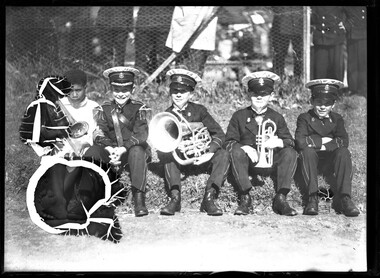
... There was, however, a major difference to the outcomes of this musical education between the two countries. Boys who were trained as musicians in English institutions readily found themselves recruited into the bands of the British Army and Navy (Sheldon, 2009). ...There was, however, a major difference to the outcomes of this musical education between the two countries. Boys who were trained as musicians in English institutions readily found themselves recruited into the bands of the British Army and Navy (Sheldon, 2009). ...Published: 7 Dec 1934 Published title: A FIJIAN TROMBONIST. Published caption: Although the young Fijian here for the Eucharistic Congress had no uniform, he did not feel out of it with the members of St. Vincent de Paul’s Band at the Sacre Coeur, East Malvern, this week. Trove article identifier: http://nla.gov.au/nla.news-article205071643 Description: A young Fijian boy sits with young members of the St Vincent de Paul’s Band, all seated on the grass in sunshine. The three young band members are jauntily dressed in braided hats, long pants and smart dark jackets, white shirts, dark bow tie, and dark long trousers and boots. One holds a French horn, one a trumpet. In contrast, the young Fijian boy is shoeless, hatless, and dressed in white – a white shirt, and possibly a white “skirt” as observed to be worn by Fijian policemen in their home country at that time. He carries a trombone, which perhaps belongs to the young band member sitting beside him. Research by project volunteer, Louise McKenzie: A photo in the Argus on the previous day shows “two Papuans, Aloysius and Bernard, … talking to Archbishop O’Shea of Wellington (N.Z.).” In a turn of phrase which would be far from acceptable today, the caption notes that the juxtaposition of the dark skinned boys and the white skinned Archbishop makes “A picturesque Contrast”. The photo is also staged in a way that has the two dark skinned boys (wearing white shirts and white “skirts”, and no hats), standing, looking down on the Archbishop in his elaborate clothing and headcovering. The Age caption advises that they are at Sacre Coeur, East Melbourne. The reason for the event – a garden party – was held as part of the National Eucharistic Congress which took place in Melbourne from Sunday 2 – Sunday 9 December 1934. An initiative of the Roman Catholic Church, it was their contribution to Melbourne’s Centenary Celebrations. At this garden party the Papal Legate, Cardinal MacRory, accompanied by dignatories including the Papal Chamberlain, met Old Girls of Sacre Coeur Convent. The Cardinal’s sister was at one time Mother Superior of this Convent. The featuring of Fijian and Papuan boys in these articles reflected the diverse nature of Catholic Church representatives worldwide who attended the Eucharistic Congress which featured as part of Melbourne’s Centenary celebrations. Notable visitors to the Congress included the Papal Legate, His Excellence Cardinal MacRory, several Monsignors from Rome, the Archbishop of Liverpool representing England, Scotland and Wales, together with representatives from New Zealand, China, South Africa, Ireland, the Islands of the Pacific, India, Malta, USA, and of course from across Australia. St Vincent de Paul “Our History” advises that the Society was founded in France in 1833 by a group of dedicated Catholics who put their faith into action to support the poor in their community. The “Vinnies” website “1854 onwards” sets out milestones of the Society’s close involvement with Melbourne from its infancy in March 1854 up to today. A well researched blog by Jeremy de Korte dated February 28, 2024 – Band Blasts from the Past – Anecdotes, Stories and Personalities, notes: Orphanage bands in Australia were a copy of practices in England where the teaching of music in boys’ institutions was commonplace (Sheldon, 2009). There was, however, a major difference to the outcomes of this musical education between the two countries. Boys who were trained as musicians in English institutions readily found themselves recruited into the bands of the British Army and Navy (Sheldon, 2009). Whereas the musicians that graduated from the Orphanage bands in Australia found themselves positions in the wider band movement. … We know that Orphanage bands in Australia have had a long and distinguished history, as well as enviable reputations. The St. Augustine’s Band from Geelong is probably the most famous of them all, and it is mentioned that by 1898 they were already putting the call out for a new set of instruments (“ST. AUGUSTINE’S ORPHANAGE BAND.,” 1898). St. Augustine’s went on to win many competitions at South Street in Ballarat and toured extensively – in one instance, in 1906 they won the A Grade Championships at South Street (Royal South Street Society, 1906). The band at St. Vincent’s de Paul in Melbourne was no less famous than their counterpart in Geelong and in 1921 they gained the services of Mr. Leslie Hoffman, a graduate of the St. Augustine’s Band, as their conductor (“St. Vincent’s Bandmaster,” 1921). This slide is quite badly damaged, reminding us of the fragility of this photographic form. The colour is washed out across most of the slide, and the left of the slide is badly degraded as if the photographic solution hasn’t quite taken. But the culprits are most likely time and mode of storage. References: A FIJIAN TROMBONIST--SUITE FOR DOLL'S HOUSE--LUNCH TIME AT THE SPORTS--A FULL SLIDE. (1934, December 7). The Age (Melbourne, Vic. : 1854 - 1954), p. 3. Retrieved April 9, 2024, from http://nla.gov.au/nla.news-article205071643 "INTERSTATE TENNIS -- EUCHARISTIC GARDEN PARTY" The Argus (Melbourne, Vic. : 1848 - 1957) 6 December 1934: 9. Web. 9 Apr 2024 Photographer notations on slide: "Boy bandsmen B61".1930-1939, bands, catholic church -
 Marysville & District Historical Society
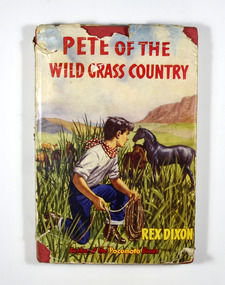
Book, Rex Dixon, Pete of the Wild Grass Country, 1954
... This he does by roaming over the Wild Grass Country catching wild horses, which he sells to his friend Murky Joe. When the wagon trains from the east begin to settle near the Wild Grass Country, Pete finds himself swept into an exciting struggle to claim and hold his land. ...Pete Cimarron, the wild boy, was raised by Indians in the Wild Grass Country of Texas. When the Indians moved on to new hunting grounds Pete was left to take care of himself. This he does by roaming over the Wild Grass Country catching wild horses, which he sells to his friend Murky Joe. When the wagon trains from the east begin to settle near the Wild Grass Country, Pete finds himself swept into an exciting struggle to claim and hold his land.Front dust cover shows a boy holding a rope lasso hiding behind tall grasses watching a black horse. There are other horses in the background. Also in the background is a grass plain which is ringed by mountains. The book itself is bound in red with the title in black writing. On the front of the book there is a logo of the Panther Library. The name of the author, the title and the publisher are written in black down the spine of the book.fictionPete Cimarron, the wild boy, was raised by Indians in the Wild Grass Country of Texas. When the Indians moved on to new hunting grounds Pete was left to take care of himself. This he does by roaming over the Wild Grass Country catching wild horses, which he sells to his friend Murky Joe. When the wagon trains from the east begin to settle near the Wild Grass Country, Pete finds himself swept into an exciting struggle to claim and hold his land.indians, texas, horses, rex dixon, panther library, fiction -
 Federation University Historical Collection
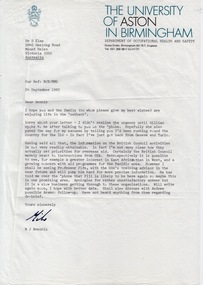
Document - Document - Correspondence, VIOSH: Correspondence between Dennis Else (BCAE) and Mike Brekin (Uni of Aston, U.K.) re Australian International Development Assistance Bureau (AIDAB)
... They relate to the assistance available to students from countries such as India, East Africa and Fiji to train / attend courses out of their country. ...They relate to the assistance available to students from countries such as India, East Africa and Fiji to train / attend courses out of their country. ...Victorian Institute of Occupational Safety and Health (VIOSH) Australia is the Asia-Pacific centre for teaching and research in occupational health and safety (OHS) and is known as one of Australia's leaders on the field. VIOSH has a global reputation for its innovative approach within the field of OHS management. VIOSH had its first intake of students in 1979. At that time the Institution was known as the Ballarat College of Advanced Education. In 1990 it became known as Ballarat University College, then in 1994 as University of Ballarat. It was 2014 that it became Federation University. VIOSH Australia students are safety managers, senior advisors and experienced OHS professionals. They come from all over Australia and industry. Students are taught active research and enquiry; rather than textbook learning and a one-size fits all approach. VIOSH accepts people into the Graduate Diploma of Occupational Hazard Management who have no undergraduate degree - on the basis of extensive work experience and knowledge. Letters written between Dennis Else and Mike Breckin. They relate to the assistance available to students from countries such as India, East Africa and Fiji to train / attend courses out of their country. Australia has the Australian International Development Bureau (AIDAB) that provides financial assistance for this purpose. See Photograph 26735 shows a group attending a three month short course at Ballarat College of Advanced Education in 1984, assisted by AIDAB. See Also Document 26686 Three A4 pages - typed. .1 on very thin aerogram paper.Letterhead for The University of Aston in Birmingham and for Ballarat College of Advanced Education. Signature for Dennis Else and Mike Breckinviosh, victorian institute of occupational safety and health, dennis else, mike breckin, australian international development assistance bureau, aidab, financial assistance, short course, university of aston birmingham, ballarat college of advanced education -
 Federation University Historical Collection
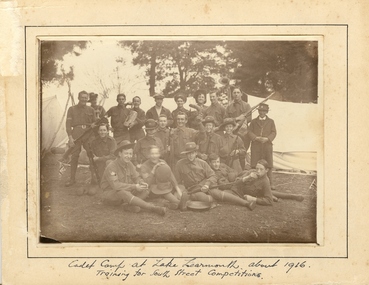
Photograph - Photograph - Sepia, Ballarat School of Mines Cadets, 1916, c1916
... trained by military officers. This early training was less military in nature than focused on physical drill and sport. It also acted to inculcate boys with the notions of loyalty to country and empire. ...trained by military officers. This early training was less military in nature than focused on physical drill and sport. It also acted to inculcate boys with the notions of loyalty to country and empire. ...Field Marshal Viscount Kitchener of Great Britain was invited by Prime Minister Deakin in 1909 to visit Australia and advise on the best way to provide Australia with a land defence. Kitchener’s report echoed the bill, introduced to Parliament in 1909 and supported by the Opposition Labor Party at its 1908 conference, to introduce compulsory military training in peace time (referred to as universal training). On 1 January 1911, the Commonwealth Defence Act 1911 (Cth) was passed as law and all males aged 12 to 26 were required to receive military training. Men were divided according to age, with junior cadets comprising boys 12-14 years of age, senior cadets comprising boys 14-18, and young men aged 18-26 assigned to the home militia defence. The support of schools was vital to the success of the scheme, since the system of cadet training began in the primary schools, with physical training prescribed by military authorities. Junior cadet training was entirely in the hands of school teachers, who had first been trained by military officers. This early training was less military in nature than focused on physical drill and sport. It also acted to inculcate boys with the notions of loyalty to country and empire. At this age, uniforms were not worn, although there were schools with pre-existing uniformed cadet units, who continued to do so. Senior Cadets were organised by Training Areas, administered by Area Officers. If a school had at least 60 senior cadets, they could form their own units. Unlike their junior counterparts, Senior Cadets were issued uniforms, a rifle, and learned the foundations necessary for service in any arm of the defence forces. Boys and men could be exempted from compulsory training if they lived more than five miles from the nearest training site, or were passed medically unfit. Those who failed to register for training were punished with fines or jail sentences, and the severity of this punishment generated some of the strongest opposition to the scheme. While institutions such as the political parties and most churches generally supported universal training, some in the broader labour movement were less enthusiastic, as evidenced in the Daily Herald newspaper’s editorials and letters. Universal military training persisted after the conclusion of World War 1, with the Junior Cadet scheme the first to go, in 1922. Senior cadets and service with the militia was suspended in November 1929. (http://guides.slsa.sa.gov.au/content.php?pid=575383&sid=4788359, accessed 29/10/2015) According to Neil Leckie, Manager of the Ballarat Ranger Military Museum: * Originally 12 – 14 year olds went to Junior Cadets attached to their school. * From age 14 – 17 they were Senior Cadets attached to the local militia unit. * After 1 July of the year a Cadet turned 18, the Cadet left the Senior Cadets and became a member of the Citizen Military Force. * In October 1918 the AIF, Militia and Cadets were renamed to give some connection to the AIF battalion raised in the area. Ballarat saw: 8th Australian Infantry Regiment comprising: * 8th Battalion AIF renamed 1st Battalion 8th Australian Infantry Regiment * 70th Infantry Militia renamed 2nd Battalion 8th Australian Infantry Regiment * 70th Infantry Cadets renamed 3rd B, 8th Australian Infantry. 39th Australian Infantry Regiment comprising: * 39th Battalion AIF renamed 1st Battalion 39th Australian Regiment * 71st Infantry Militia renamed 2nd Bn, 39th Australian Infantry Regiment * 71st Infantry Cadets renamed 3rd Bn, 39th Australian Infantry Regiment Prior to the reorganisation in 1918 the 18th Brigade was the 70th, 71st and 73rd Infantry. It is thought that the 18th Brigade Cadet units in 1920 were those that came from the old: * 69th Infantry (Geelong/Queenscliff) * 70th Infantry (Ballarat/Colac) * 71st Infantry (Ballarat West) * 72nd Infantry Warrnambool) * 73rd Infantry (NW Vic) The next name change came in 1921!Mounted sepia photograph of 21 young males. They are the Ballarat School of Mines Cadets on a training camp at Lake Learmonth. Back row left to right: Harold Wakeling; ? ; T. Wasley; H. Witter; H.V. Maddison (staff); Lieutenant S.J. Proctor, Joe ? ; ? ; B.C. Burrows. Centre left to right: Howard Beanland; ? ; F.N. Gibbs; H. Siemering; P. Riley; ? : E. Adamthwaite. Front row left to right: Albert E. Williams; Francis Davis (RAAF Dec.); A. Miller; W. Shattock; T. Rees From the Ballarat School of Mines Magazine, 1916 "Our Competition Team, 1916 At a parade, held on the 25th August competition teams were called from from the three colleges - Ballarat College, St Patrick's College, and the School of Mines. In each case, a large muster was obtained, twenty-nine volunteering fro the School of Mines. On account of the number in a team being limited to 21, some had to be weeded out. The team decided to have a camp at Learmonth in the vacation for the benefit of training for the coming competitions. The tents, within our baggage, were brought to the Junior Technical School at 10 a.m. on Monday, 11 September. Everything was carted to the station on a lorry, which was very kindly lent by Mr C. Burrow. ... Arriving at our camp, which was in the Park, we first raised the tents. This was done in record time. Three large tents, A.B.C., were pitched one behind the other. We also pitched a smaller one to act as a provisions tent. The provisions supplied by each cadet were placed in this tent. Dinner was ready by 3.30, and was prepared by the three senior non-coms., who also acted as orderlies. Things went alright Monday night, the two senior non-coms. acting as sentries for the first two hours. On Tuesday morning Reville sounded at 7. There was no need for it, however, as nearly all the cadets were up before daylight, owing to their beds being too hard. After physical exercises were gone through we had breakfast. We then had rifle exercises until Messrs A.W. Steane and F.N. King arrived. The former put the team through the table of physical exercises set down for competition work, many valuable points being obtained. The visitors remained for dinner, afterwards returning to Ballarat. Wednesday was uneventful, until the soldiers arrived at about 11 a.m., stopping at the park for lunch. As we handed over the coppers, etc., to them, our lunch was delayed. Two more visitors arrived after lunch, and after taking a few photos returned home. That night we had a "Sing-a-long" in C Tent until "Lights out" sounded at 9.30. After physical exercises ad breakfast on Thursday, we went for a six mile route march round the lake, doing skirmishing on the way. In the afternoon we practised rifle exercises and the march past. A concert was arranged for that night, the chief singers being cadets H. Siemering and W. Shattock. Supper was served at the end of the entertainment. On Friday, Reveille sounded at 6.30 instead of 7, and, as usual, we had physical exercises before breakfast, after which the team went through skirmishing at the reserve. In the afternoon, section drill and the march past were practised. Friday night, being our last night in camp, leave was granted until 10 p.m., "lights out" sounding at 11. Reveille sounded on Saturday at 4.30, the reason being that all kits, tents, etc., had to be packed away ready to catch the 8.15 train to Balalrat. At 7.30 we were all ready to leave for the station. We had a very enjoyable time in the train, each cadet having a chip in at the patriotic songs. On arriving at Ballarat, we found the lorry awaiting us. The luggage was carted to the Junior Technical School, the team following. The team were here dismissed, everyone feeling that he had had a very good time. F.G. Davis"Written in ink on front 'cadet camp at Lake Learmonth about 1916. Training for South Street Competitions. ballarat school of mines, cadets, ballarat school of mines cadets, lake learmonth, world war one, boomerang, camp, cadet camp, h.g. wakeling, harold wakeling, f.g. davis, albert w. steane, f.n. king, h. siermering, w. shattock, francis davis, harold wakeling, t. wasley, h. witter, h.v. maddison, s.j. proctor, b.c. burrows, howard beanland, f.n. gibbs, h. siemering, p. riley, e. adamthwaite, albert e. williams; francis davis, a. miller, w. shattock, t. rees, photography, foto, boxing gloves -
Marysville & District Historical Society
THE TRIANGLE NEWS-VOL 4 NO 35-2 NOVEMBER 1979
... country & western night...floral carpet...marysville swimming pool...marysville life saving & swimming club...bonney's...mountain views...wirreanda float parade...gate & car park roster...art show roster...train...marysville victoria australia wirreanda events fire brigade contact numbers footy club m.i.w.a.p.s.a. anglican news lions club chariot challenge marysville football club wanted paradise art village closing betty's comp cricket crossways restaurant dinner dance guides & brownies greetings clearance sale community care centre wanted p/t gardener marysville primary school ladies day at oaks lost nye country & western night floral carpet marysville swimming pool marysville life saving & swimming club bonney's mountain views wirreanda float parade gate & car park roster art show roster train roster craft roster historical society roster THE TRIANGLE NEWS-VOL 4 NO 35-2 NOVEMBER 1979 ...marysville, victoria, australia, wirreanda events, fire brigade contact numbers, footy club, m.i.w.a.p.s.a., anglican news, lions club chariot challenge, marysville football club, wanted, paradise art village closing, betty's comp, cricket, crossways restaurant dinner dance, guides & brownies, greetings, clearance sale, community care centre, wanted p/t gardener, marysville primary school, ladies day at oaks, lost, nye country & western night, floral carpet, marysville swimming pool, marysville life saving & swimming club, bonney's, mountain views, wirreanda float parade, gate & car park roster, art show roster, train roster, craft roster, historical society roster -
 Lara RSL Sub Branch
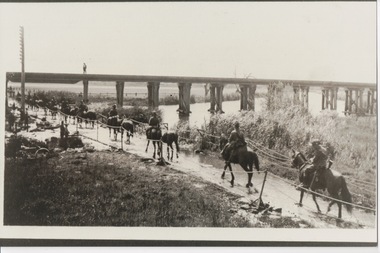
Photograph, Set 4 photographs. and others for Torquay Light Horse camp, 1940
... country. But by the end of the war, in 1945, the horse had disappeared from the Australian Army. References: Australian Light Horse Association www.lighthorse.org.au National Australia Archives Australian War Memorial Surf Coast Shire WW1 memorials www.togethertheyserved.com The Light horse- a Cavalry under Canvas Light Horse, Training Camp, Torquay, WW2 Late in 1939 it was decided to set up a Lighthorse training camp in Torquay to train both men and horses for the battles of the Second World War. ...country. But by the end of the war, in 1945, the horse had disappeared from the Australian Army. References: Australian Light Horse Association www.lighthorse.org.au National Australia Archives Australian War Memorial Surf Coast Shire WW1 memorials www.togethertheyserved.com The Light horse- a Cavalry under Canvas Light Horse, Training Camp, Torquay, WW2 Late in 1939 it was decided to set up a Lighthorse training camp in Torquay to train both men and horses for the battles of the Second World War. ...These images capture for all time Light Horsemen travelling through Geelong on their way to camp at Torquay for the last Group meeting in Australia . information following - details obtained from .........https://torquayhistory.com/light-horse-brigade/ On Australia Day, 1997, Sir John Young unveiled this plaque on Point Danger, Torquay. Torquay history, Light Horse Training Camp, WW2 Plaque at Pt. Danger Note----- (See images to view plaque) The plaque identifies a significant event in Torquay’s history and the sentiments of ‘change’ for the Light Horse Brigade – from horses to machines. In 1940 the four Light Horse Regiments (4th, 8th, 13th and 20th), some 5000 Light Horse and 2000 horses camped and trained at Torquay. Three other regiments, formerly mounted on horses, were also at Torquay ‘mounted’ on privately owned trucks and cars. Division troops included Artillery, Engineers, Signals, Field Ambulance and other branches of the Army necessary to enable a Division to function. It wasn’t just the sheer numbers of men coming to this little town that made the event significant, it was also the fact that the men of the Light Horse were dramatic, almost glamorous figures and it is easy to see their exploits as some splendid adventure. Horses have played a special role in the story of Australia. They were the only means of transport across this huge country, so it was necessary for everyone to have the ability to ride a horse. When war broke out in 1899 between Britain and the Boers of South Africa (“Boer” was Dutch for “farmer”) Australia sent troops to fight. At first Britain was wary of using untried, unprofessional colonial cavalrymen but soon saw that the slouch-hatted Australian “bushmen” were a match for the fast-moving and unconventional mounted commandos of the Boers. The Australians proved themselves to be expert rough-riding horsemen and good shots. Bush life had hardened them to go for long periods with little food and water. They also showed remarkable ability to find their way in a strange country and use its features for cover, in both attack and defence. By 1914, when Australia joined the war against Germany, there were 23 Light Horse regiments of militia volunteers. Many men from these units joined the Light Horse regiments of the Australian Imperial Force (AIF). Men were given remounts (if not using their own horses) – army horses bought by Commonwealth purchasing officers from graziers and breeders. These were called “walers” because they were a New South Wales stockhorse type – strong, great-hearted animals with the strains of the thoroughbred and semi-draught to give them speed, strength and stamina. On 1st November, 1914, Australia’s First Infantry Division and the first four Light Horse regiments sailed for England in a fleet of transport ships. The first of the Light Horse arrived at Gallipoli in May without their horses. Back with their horses after Gallipoli, they were formidable combatants across the Sinai and Palestine. Some British commanders observed that the light horseman moved with a “lazy, slouching gait, like that of a sleepy tiger” but described how the promise of battle “changes that careless gait, into a live athletic swing that takes him over the ground much quicker than other troops”. They had Light Horse, Torquay, training campdeveloped a reputation as formidable infantrymen. The Turks called them “the White Ghurkas” – a reference to their deadly skill with the bayonet. The Arabs called them “The Kings of the Feathers”. The plume had originally been a battle honour of the Queensland Mounted Infantry for their work in the shearer’s strike of 1891. During WW1 it was adopted by almost all the Light Horse Regiments. It was the proud badge of the light horseman. The most famous of their battles was the attack on Beersheba- the charge of the 4th Light Horse Brigade. Mounted infantrymen and their superb walers had carried out one of the most successful cavalry charges in history – against what seemed impossible odds. They surprised the Turks by charging cavalry-style, when they would normally have ridden close to an objective then dismounted to fight. The fall of Beersheba swung the battle tide against the Turks in Palestine; and changed the history of the Middle East. While 19 men from the Surf Coast Shire served with the 4th Light Horse over the course of WW1, only four were involved in the charge of Beersheba- John GAYLARD, Philip QUINN.(Winchelsea); Wallace FINDLAY (Anglesea); Harry TRIGG (Bambra). After the war, Light Horse units played a key role in the Australian Government’s compulsory military training programme. The Citizen Military Forces (C.M.F.) thrived on the glamour of the wartime Light Horse tradition, ignoring the possibility that motor vehicles would soon replace the horses. When training was no longer compulsory, the C.M.F. regiments declined and horses became more of a luxury during the 1930s depression years of poverty and unemployment. Some regiments were motorised. Then, in 1939, Australia joined Britain in another world war. Training was increased for the militia at both home bases and regional training camps. The camp at Torquay in 1940, commanded by Major General Rankin, was at Divisional strength. By the end of the camp some felt that the Division was ready for active service. Gradually, over the next four years, the Australian Light Horse units were mounted on wheels and tracks and the horses were retired. Six men enlisted at the Torquay camp and another 57 men and women enlisted at Torquay for service in WW2. Those who served in the Militia provided valuable Officers and NCOs and men for the armed services during the war. Each infantry division of the 2nd AIF had a Light Horse regiment attached to it. But the day of the Australian mounted soldier hadn’t quite passed. During World War II, Australia’s 6th Cavalry Regiment formed a mounted unit they called “The Kelly Gang” which did valuable scouting work. In New Guinea, a mounted Light Horse Troop did patrol duty and helped carry supplies. Some fully equipped walers were flown into Borneo for reconnaissance in rugged mountain country. But by the end of the war, in 1945, the horse had disappeared from the Australian Army. References: Australian Light Horse Association www.lighthorse.org.au National Australia Archives Australian War Memorial Surf Coast Shire WW1 memorials www.togethertheyserved.com The Light horse- a Cavalry under Canvas Light Horse, Training Camp, Torquay, WW2 Late in 1939 it was decided to set up a Lighthorse training camp in Torquay to train both men and horses for the battles of the Second World War. Horses, men and equipment came on special trains from all over Victoria and NSW, and as you would expect horseman came from areas such as Omeo and Sale, the Wimmera and the Western District. They arrived at the Geelong racecourse for watering in the Barwon River and then were ridden across the ford at the breakwater and began their 11 mile trek to Torquay. Light Horse, Training Camp, Torquay, WW2 Tent city By the end of January 1940 the camp at Torquay accommodated some 5000 men and 2500 horses of the Second Cavalry Division. The rows of horses, tents and huts near Blackgate Road were quite a sight. While the cavalrymen engaged in exercises on the land and on the beaches, many of the troops took over the Torquay School for special training of men and officers. Mr Bob Pettit local farmer and Councillor for the Barrabool Shire, wrote about the Light horse in the Surf Coast Community News in 1985 saying “They used to travel about the district riding four abreast in one long convoy. To my annoyance they went through my property and shut all the gates behind them. I had certain gates open to let stock in to the water holes and it would take me three -quarters of an hour to follow the horsemen up and put all the gates right again” he continued “the men from the Light Horse were here when the fire went through in March 1940. He recalled an incident when early one morning, as some one blew the bugle, a soldier putting a white sheet on the line frightened the horses. They panicked and ran off in all directions. Six went over the cliff near Bird Rock, five were never found, and the rest were gathered up after nearly a fortnight in the bush around Addiscott and Anglesea" Light Horse, Training Camp, Torquay, WW2, Geelong Parade Geelong parade The training camp culminated in a parade through the streets of Geelong on March 12th 1940. The salute was given at the Town Hall and the troops continued on a route to the You Yang’s for a training exercise. Note-----(see media section for photograph) The Camp was abandoned in mid 1940 as it was deemed unsuitable for training during winter and the cost of a permanent camp could not be justified if it could not be used all year. Historic.......Rare,,,Interpretive.Sepia photographs.set of four ....post card size ....Horses &LighthorsemenNo 1, Lighthorsemen Regiment Geelong 1940......No 2 Light Horse at Breakwater Geelong 1938 to 1940....No 3 Light Horse at Breakwater Geelong 1938 to 1940.....No 4 Light Horse crossing Breakwater camped at Geelong Showgrounds. These markings are on reverse of photographs.light horsemengeelong 1940., world war 2 -
Federation University Historical Collection
Report, Fast Rail Links to Regional Centres Feasibility Studies: Final Report, c2000
... Used by the local branch of the Public Transport Users Association steve bracks transport linking victoria railway fast rail ballarat corridor bendigo corridor traralgon corridor geelong corridor level crossings country rail lines rail gauge trains Ringbound Linking Victoria report of 228 pages Fast Rail Links to Regional Centres Feasibility Studies: Final Report Report ...Used by the local branch of the Public Transport Users AssociationRingbound Linking Victoria report of 228 pages steve bracks, transport, linking victoria, railway, fast rail, ballarat corridor, bendigo corridor, traralgon corridor, geelong corridor, level crossings, country rail lines, rail gauge, trains -
Federation University Historical Collection
Book, Environment Victoria, Driving the Fast Train Further: Integrated Public Transport Across All Victoria, 2001, 05/2001
... Used by the local branch of the Public Transport Users Association. transport linking victoria railway fast rail ballarat corridor bendigo corridor traralgon corridor geelong corridor warrnambool corridor level crossings country rail lines ararat rail line trains Yellow soft covered 36 page book outlining the feasibility of a Fast Train for Victoria. ...Used by the local branch of the Public Transport Users Association.Yellow soft covered 36 page book outlining the feasibility of a Fast Train for Victoria.transport, linking victoria, railway, fast rail, ballarat corridor, bendigo corridor, traralgon corridor, geelong corridor, warrnambool corridor, level crossings, country rail lines, ararat rail line, trains -
Federation University Historical Collection
Book, Public Transport Users Association Notes and Press Clippings, 1991-2010, 1991-2010
... Used by the local branch of the Public Transport Users Association. transport linking victoria railway fast rail ballarat corridor bendigo corridor traralgon corridor geelong corridor warrnambool corridor level crossings country rail lines ararat rail line trains jean baker hedley thomson coach national express review mildura review public transport corporation maryborough to ballarat passenger rail service mildura country rail john parkin john mclean steve bracks airport rail john barnes buses alstrom rail crossings dove downey curtis street bus terminal bus interchange ballarat railway stations trams creswick creswick railway station ararat wimmera mallee maryborough clunes talbot Seven plastic covered display books with press clippings, media releases and notes concerning the Public Transport users Association in the Ballarat Region. .1) Public Transport Ballarat & Region Vol 1 - National Express Review, 1999-2001 .2) Public Transport Ballarat & Region Vol 2 - Press Cuttings, 2001 - 2002 .3) Public Transport Ballarat & Region Vol 3 - Press Cuttings, 2002-2003 .4) Public Transport Ballarat & Region Vol 4 - Press Cuttings, 2004-2005 .5) Public Transport Ballarat & Region Vol 5 - Press Cuttings,2006-2012 .6) Public Transport Ballarat & Region Vol 6 - Other Ballarat Transport Issues, 2001-2008 .7) Public Transport Ballarat & Region Vol 7 - Creswick, 2000-2010 11729.8 Documents Transport Public Transport Ballarat & Region Vol 8 -Other Regional Areas Baker, Jean 2000-2010 11729.9 Documents Transport Public Transport Ballarat & Region Vol 9 - Closure of North Melbounre Station and the impact on Ballarat Commuters Baker, Jean 2014 Book Transport Driving the Fast Train Further: Integreated Public Tranpost Across All Victoria Everingham, Wendy and McPherson 1999-2001 Documents Transport Public Transport Ballarat & Region Vol 3 - Press Cuttings Baker, Jean 1999-2001 Public Transport Users Association Notes and Press Clippings, 1991-2010 Book Book Jean Baker ...Used by the local branch of the Public Transport Users Association.Seven plastic covered display books with press clippings, media releases and notes concerning the Public Transport users Association in the Ballarat Region. .1) Public Transport Ballarat & Region Vol 1 - National Express Review, 1999-2001 .2) Public Transport Ballarat & Region Vol 2 - Press Cuttings, 2001 - 2002 .3) Public Transport Ballarat & Region Vol 3 - Press Cuttings, 2002-2003 .4) Public Transport Ballarat & Region Vol 4 - Press Cuttings, 2004-2005 .5) Public Transport Ballarat & Region Vol 5 - Press Cuttings,2006-2012 .6) Public Transport Ballarat & Region Vol 6 - Other Ballarat Transport Issues, 2001-2008 .7) Public Transport Ballarat & Region Vol 7 - Creswick, 2000-2010 11729.8 Documents Transport Public Transport Ballarat & Region Vol 8 -Other Regional Areas Baker, Jean 2000-2010 11729.9 Documents Transport Public Transport Ballarat & Region Vol 9 - Closure of North Melbounre Station and the impact on Ballarat Commuters Baker, Jean 2014 Book Transport Driving the Fast Train Further: Integreated Public Tranpost Across All Victoria Everingham, Wendy and McPherson 1999-2001 Documents Transport Public Transport Ballarat & Region Vol 3 - Press Cuttings Baker, Jean 1999-2001 transport, linking victoria, railway, fast rail, ballarat corridor, bendigo corridor, traralgon corridor, geelong corridor, warrnambool corridor, level crossings, country rail lines, ararat rail line, trains, jean baker, hedley thomson, coach, national express review, mildura review, public transport corporation, maryborough to ballarat passenger rail service, mildura country rail, john parkin, john mclean, steve bracks, airport rail, john barnes, buses, alstrom, rail crossings, dove downey, curtis street bus terminal, bus interchange, ballarat railway stations, trams, creswick, creswick railway station, ararat, wimmera, mallee, maryborough, clunes, talbot -
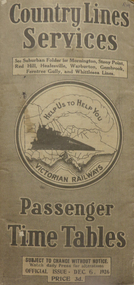 Federation University Historical Collection
Booklet - Timetable, Country Lines Services - Passenger Time Tables (Dec. 6, 1926), 12/1926
... country lines...victoria...railways...train...The timetable included fare prices. time table country lines victoria railways train timetable transport railway Grey covered slimline 80 page booklet containing the various for timetables of passenger trains on the Victorian regional railway network. ...The timetable included fare prices.Grey covered slimline 80 page booklet containing the various for timetables of passenger trains on the Victorian regional railway network. Includes indexes of stations and fares, and other information relating to traveling on the train, such as luggage transport. The cover features a picture of a train on the fronttime table, country lines, victoria, railways, train, timetable, transport, railway -
 City of Moorabbin Historical Society (Operating the Box Cottage Museum)
Book, New Century Press Pty.Ltd, Bid Time Return, 1977
... train dog boxes cheltenham state school presbyterian ladies college library. school teacher. The author tells of her life from the age of two (1889) living in Cheltenham Victoria her years at Cheltenham State School, Teachers Training College, teaching in Melbourne and the country and up till 1920 when she got married and left teaching for awhile she returned to teaching and became Victoria's first full time teacher-librarian at the Presbyterian Ladies' College she was a pioneer in teaching school library practice and visual education. ...The author tells of her life from the age of two (1889) living in Cheltenham Victoria her years at Cheltenham State School, Teachers Training College, teaching in Melbourne and the country and up till 1920 when she got married and left teaching for awhile she returned to teaching and became Victoria's first full time teacher-librarian at the Presbyterian Ladies' College she was a pioneer in teaching school library practice and visual education.168p., 8p. of plates ; A small soft cover book white with a coloured photograph of the author, the title and the authors name in red on the front cover,on the back cover is text by the author and a sepia photograph of an unknown early city.non-fictionThe author tells of her life from the age of two (1889) living in Cheltenham Victoria her years at Cheltenham State School, Teachers Training College, teaching in Melbourne and the country and up till 1920 when she got married and left teaching for awhile she returned to teaching and became Victoria's first full time teacher-librarian at the Presbyterian Ladies' College she was a pioneer in teaching school library practice and visual education. cheltenham, mentone, victoria, steam train, dog boxes, cheltenham state school, presbyterian ladies college, library. school teacher. -
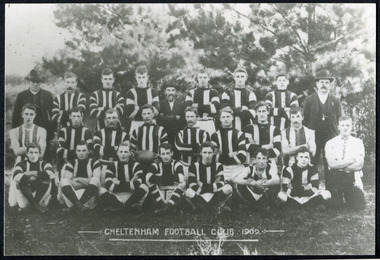 City of Moorabbin Historical Society (Operating the Box Cottage Museum)
Photographs, x 3 Black & White Cheltenham Football Club 1909,1913, 1946, 20thC
... Known as the Rosellas, the early Cheltenham Football Club sides began playing on a regular basis in 1890, and would travel long distances by steam train to play country teams, such as Ballarat where they would arrive at their destination, play the match, socialize then return to the station. ...Known as the Rosellas, the early Cheltenham Football Club sides began playing on a regular basis in 1890, and would travel long distances by steam train to play country teams, such as Ballarat where they would arrive at their destination, play the match, socialize then return to the station. ...Known as the Rosellas, the early Cheltenham Football Club sides began playing on a regular basis in 1890, and would travel long distances by steam train to play country teams, such as Ballarat where they would arrive at their destination, play the match, socialize then return to the station. Opposition players and supporters would give three hearty cheers on their departure. The Cheltenham home games were played on a paddock on the corner of Park and Charman roads in Cheltenham. In 1907 the Cheltenham progress committee made an application to the board of land works for land in Weatherall Road for recreational service to the public. That application was received and granted, then developed where Cheltenham Recreational Reserve now stands. The land in the early days was virgin bush and the response for voluntary help to clear the area was outstanding. Nearly all the market gardeners in the district along with horses, ploughs, axes, shovels completely cleared the area in three weeks. The Moorabbin council then leveled the playing area and erected a post and rail fence around the ground. Pine tree shrubs were then planted on the west side of the ground. The ground was opened in 1909 and the first Cheltenham side entered in the newly formed Federal Football Association along with seven other foundation members, Mordialloc, Mentone, Moorabbin, Frankston, Glenhuntly, Elsternwick, and Ellindale. The grand final for that year, 1909 was a hard encounter between Cheltenham and Ellindale with Cheltenham coming out victors, thus becoming the inaugural Federal Football Association premiers. Cheltenham went onto win five senior premierships in the Federal Football Association by the end of the 1920s, they won the flags in 1909, 1911, 1913, 1922 and 1925, with the late Percy Woff playing in all 5 premiership sides and was captain in 1922. 1928 saw the start of an outstanding career from our oldest living player Tom Connor. Cheltenham continued to win premierships in the 1920’s and 1930’s with juniors taking out the 1929 and 1933 flags, under the guidance of Woff, and that continued in 1934 when Cheltenham took out the 1st XVIII and 2nd XVIII premierships. Cheltenham produced its only Brownlow medallist in Peter Box who played in the late 1940s, before going to Footscray where he became a champion. The 3rd XVIII went through the season undefeated in 1974 winning the premiership, with Trevor Barker a key player before going to St Kilda the following year. The club won three senior premierships under coach Barry White in 1992, 1993 and 1995. ( from CFNC website 2019) Cheltenham Football Club was formed 1890 and succeeded in winning many Premierships as a member of the Federal Football Association, Outstanding players Peter Box Brownlow Medalist 1956 Footscay VFL, , Trevor Barker and Kevin Roberts St Kilda VFL.3x Black & White photographs of the players in the Australian Rules Cheltenham Football Club 1909, 1913 and 1946 extra photo of Peter Box Folio 10 MAV 01059a) CHELTENHAM FOOTBALL CLUB 1909 Cheltenham Football Club 1909. Back row: A Chandler, committee member; R. Robertson, back-pocket; J. Harris, half back flank; J Adams, ruck and forward-pocked; M. J. Monk, club president; L. Woff, back-pocket; W. Adams, ruck and back-pocket; P. Woff, rover and forward-pocket; A Monk, committee member. Middle row: W. Hore, back pocket and ruck; A. Towns, half-forward flank; W. Carson, full back; F. Andrews, captain-half forward flank; H. Butler, centre half back; J. Warburton, centre half-forward; A. Slater, half-back flank; F. Fisher, half-forward flank; C. Sherwood, trainer. Front Row: G Gouldthorpe, wing; H. King, full-forward; W. Johnston, ruck and forward-pocket; P Spears, rover and forward-pocket; F. Bichl, wing; A. Bichl. rover and forward-pocket; F. Butler, centre player. Courtesy, Lionel Seal. ( from CFC website 2019) b) CHELTENHAM 1913 PREMIERS c) CHELTENHAM -1946 / Back row - J. Fisher, G.Corrigan, N.Hocking, F.Virtue, R.Craven, L.Baker, M.Blundell / 2nd Row - J.Phillips, T.Connor, E.Hawkins, A.Blakely, G.Baker, A.Dark, J.Barker, D.Craven, J.Pickering, P.Cameron,/ W.Hicks, G.Hoskings, R.Beihl, A.Hubbard, R.Kier, C.Russell. / Front Row - Clark Taylor, J.Slade, N.Niel, J.Brooks, T,Butler, H.Hosking, C.Hacusler, E.Hornibrook, W.Briggs, B.Russell, L.Biehl, / W Ripponcheltenham football club, australian rules football, victorian football association, victorian football league, smith j l; smith mary ann, stanley helen, , chaff cutter, horse drawn carts, toll gates brighton, motor cars 1900, steam engines, early settlers, bentleigh, parish of moorabbin, city of moorabbin, county of bourke, moorabbin roads board, shire of moorabbin, henry dendy's special survey 1841, were j.b.; bent thomas, o'shannassy john, king richard, charman stephen, highett william, ormond francis, maynard dennis, market gardeners, vineyards, orchards, cheltenham, two acre village, holloway josiah,, woff percy, connor tom, box peter, barker trevor, white barry, browlow charles, -
 Orbost & District Historical Society
book, Exploring the Gippsland Lakes 1882, January 2010
... Country. This pocket reading republishes a story from 1882 that was aimed at promoting tourism to the Gippsland Lakes. It starts with a train...Country. This pocket reading republishes a story from 1882 that was aimed at promoting tourism to the Gippsland Lakes. It starts with a train ...The original book was published in Melbourne by M.L. Hutchinson, 1881. This edition was specially compiled for the Lakes Navigation Company by J. Blackwood Howie.A small book - Exploring the Gippsland Lakes 1882. this is a republication of a C 1882 book titled Tourists and Sportsman's Guide to the Gippsland Lakes and Surrounding Country. This pocket reading republishes a story from 1882 that was aimed at promoting tourism to the Gippsland Lakes. It starts with a train trip from Melbourne to Sale and then boards a steamer to experience the Gippsland Lakes. The book was published by Paynesville Maritime Museum in January 2010. It was compiled by J. Howie Blackwood.gippsland-lakes travel tourism-east-gippsland
