
Showing 14 items matching "court martial"
-
 National Vietnam Veterans Museum (NVVM)
Work on paper - Diary Of an Ordnance Officer
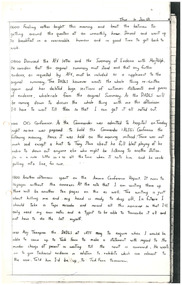
... ...Court martial...In addition to recording his day-to-day activities, he details his involvement in collecting evidence for the Court Martial of Private Knight of 2nd Advanced Ordnance Depot, Catering Corps. ...In addition to recording his day-to-day activities, he details his involvement in collecting evidence for the Court Martial of Private Knight of 2nd Advanced Ordnance Depot, Catering Corps. ...This diary was kept by Captain Richard Farrell, who served in the Royal Australian Army Ordnance Corps, 2nd Composite Ordnance Depot from 11 March 1967 until 26 Feb 1968 covers the dates 04/02/68 until his departure(which includes the time of Tet Offensive). In addition to recording his day-to-day activities, he details his involvement in collecting evidence for the Court Martial of Private Knight of 2nd Advanced Ordnance Depot, Catering Corps. Knight was charged with 'grievous wounding' for the stabbing with a bayonet of Corporal Holt during a fight in/around the canteen known as the Arnold Club on 22 October 1967. He also records the inquiry into the death of SAS Sgt Geoffrey Baines on 22 October 1967, killed while disposing of grenades down a well.Approximately 100, 2-hole punched foolscap pages of hand-written diary of Captain Richard A Farrell of Royal Australian Army Ordnance Corps. Document is a B&W copy.vietnam war, ordnance, 2nd advance ordnance depot, richard a farrell, farrell, captain farrell, stabbing, knight, private knight, corporal holt, 22 october 1967, october 1967, arnold club, court martial -
 National Vietnam Veterans Museum (NVVM)
Memorabilia, Memorabilia Royal Australian Army Provist Corps by Cpl James Archbold
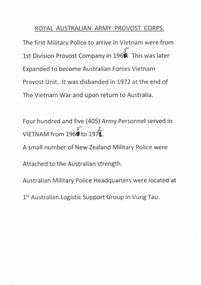
... ...Court Martial Centre...Royal Australian Army Provost Corps 1st Division Provost Company Australian Forces Vietnam Provost Unit New Zealand Military Police Australian Military Police Headquarters 1st Australian Logistic Support Group Vung Tau Military Prison Detention Barrack Court Martial Centre AFV Pro Unit American MPs Vietnamese Military and Civilian Police Nui Dat Cam Ranh Bay Special Investigation Branch (SIB) Guard Duties 1st Australian Field Hospital Viet Cong Prisoner North Vietnamese Army Prisoners VIP Security Prisoner Of War Camp Long Binh Saigon EOD Night Curfew Qantas Tan Son Nhat International Airport Cpl Ian Robert Brown 54157 Killed in Action Cpl James Stuart Archbold 3790920 Military Medal Maj Richard Karney Gorman 237669 Mention in Despatches WO1 William Anthony Eade 52772 Australian Army Training Team Vietnam (AATTV) Sgt Robert James Popperwell 52731 Memorabilia Royal Australian Army Provist Corps by Cpl James Archbold. ...Memorabilia Royal Australian Army Provist Corps by Cpl James Archbold. There is also a DVD and USB stick with photographs of the Military Police in Vietnam. royal australian army provost corps, 1st division provost company, australian forces vietnam provost unit, new zealand military police, australian military police headquarters, 1st australian logistic support group, vung tau, military prison, detention barrack, court martial centre, afv pro unit, american mps, vietnamese military and civilian police, nui dat, cam ranh bay, special investigation branch (sib), guard duties, 1st australian field hospital, viet cong prisoner, north vietnamese army prisoners, vip security, prisoner of war camp, long binh, saigon, eod, night curfew, qantas, tan son nhat international airport, cpl ian robert brown, 54157, killed in action, cpl james stuart archbold, 3790920, military medal, maj richard karney gorman, 237669, mention in despatches, wo1 william anthony eade, 52772, australian army training team vietnam (aattv), sgt robert james popperwell, 52731 -
 Ballarat Heritage Services
Photograph - Photograph - Colour, Headstone for John Egan, the Drummer Boy at Eureka, 23/09/2004
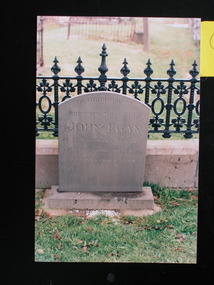
... Historian Dorothy Wickham could not find the death registration for John Egan, and after some research she discovered he did not die on the way to Ballarat, but lived to be Court martialled in New Zealand. It was eventually removed. ...Historian Dorothy Wickham could not find the death registration for John Egan, and after some research she discovered he did not die on the way to Ballarat, but lived to be Court martialled in New Zealand. It was eventually removed. john egan eureka stockade military drummer boy dorothy wickham ballarat old cemetery ballaarat old cemetery Photograph of a headstone in the Ballaarat Old Cemetery for John Egan, the Drummer Boy at Eureka. ...Historian Dorothy Wickham could not find the death registration for John Egan, and after some research she discovered he did not die on the way to Ballarat, but lived to be Court martialled in New Zealand. It was eventually removed. Photograph of a headstone in the Ballaarat Old Cemetery for John Egan, the Drummer Boy at Eureka. The headstone was erected in the Soldiers Enclosure in the late 1980s. john egan, eureka stockade, military, drummer boy, dorothy wickham, ballarat old cemetery, ballaarat old cemetery -
 Northern District School of Nursing. Managed by Bendigo Historical Society Inc.
Education kit - Edith Cavell Miniature Doll, Nursing Through the Ages
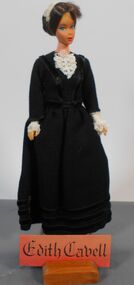
... She was sentenced to death by German Court martial she faced the firing squad with calmness and dignity. ...She was sentenced to death by German Court martial she faced the firing squad with calmness and dignity. ...Edith Cavell trained in London and became head of nursing in Brussels. When WW1 broke out she tended wounded soldiers of both sides with equal devotion but she was charged by the germans with helping allied soldiers escape to neutral territory. She was sentenced to death by German Court martial she faced the firing squad with calmness and dignity. 30cm Miniature Doll Name Tage Edith Cavellnursing history, northern district school of nursing, nursing uniforms, miniature dolls -
 Bendigo Military Museum
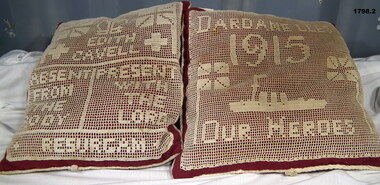
Memorabilia - CUSHIONS WW1, Post WW1
... She was arrested by the Germans and charged with Treason, found guilty by Court Martial and executed on 12.10.1915. ...She was arrested by the Germans and charged with Treason, found guilty by Court Martial and executed on 12.10.1915. military history - souvenirs manchester -furnishings handcrafts- crochetwork Cavell .1) "Edith/Cavell/Absent/From/The/Body/ Present/With/ The/ Lord/Resurgam." .2) "Dardenelles/ 1915/ our heroes .1) Commemorative cushions bearing Edith CAVELL's name .2) Crotchet commemorates the Dardanelle's campaign fallen 1915. ...Edith Louisa Cavell 1865 - 1915 was a British Nurse working in German occupied Belgium during the early years of WW1. She saved lives on both sides but she also helped some 200 Allied POW’s and Civilians escape Belgium to Britain. She was arrested by the Germans and charged with Treason, found guilty by Court Martial and executed on 12.10.1915. .1) Commemorative cushions bearing Edith CAVELL's name .2) Crotchet commemorates the Dardanelle's campaign fallen 1915. Fillet crochet panels mounted on dark red plain cushion covers with white piping on edge.1) "Edith/Cavell/Absent/From/The/Body/ Present/With/ The/ Lord/Resurgam." .2) "Dardenelles/ 1915/ our heroesmilitary history - souvenirs, manchester -furnishings, handcrafts- crochetwork, cavell -
 Bendigo Military Museum
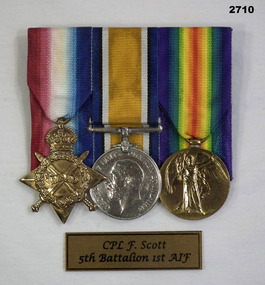
Award - MEDAL SET WW1, Post 1919
... Embarked for Eygpt 16.7.15, records are very vague with little detail from here, promoted T/Cpl at one point, court martial with loss of 59 days pay, returned to Australia on 21.7.17 with Duodenal Ulcer and discharged from the AIF on 1.7.18....Embarked for Eygpt 16.7.15, records are very vague with little detail from here, promoted T/Cpl at one point, court martial with loss of 59 days pay, returned to Australia on 21.7.17 with Duodenal Ulcer and discharged from the AIF on 1.7.18. medals military history Passchendaele Barracks Trust "2448 Cpl F. ...Frank Scott (born Melbourne, enlisted Eaglehawk) No 2446 enlisted in 7th reinforcements 5th Batt on 29.4.15 age 33 years 4 months. Embarked for Eygpt 16.7.15, records are very vague with little detail from here, promoted T/Cpl at one point, court martial with loss of 59 days pay, returned to Australia on 21.7.17 with Duodenal Ulcer and discharged from the AIF on 1.7.18.Medal set - court mounted - set (3) Re. F Scott. .1) 1914 - 15 star .2) War medal 1914 . 1918 .3) Victory Medal 1914 - 1919, replica not engraved"2448 Cpl F. Scott. 5 BN. A.I.F”medals, military, history, passchendaele barracks trust -
 Federation University Historical Collection
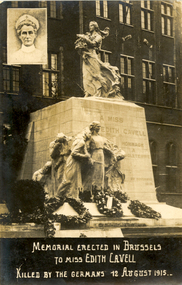
Photograph - Postcard, Edith Cavell Memorial, Brussells
... She was subsequently court-martialled, found guilty of treason and sentenced to death. ...She was subsequently court-martialled, found guilty of treason and sentenced to death. ...Edith Louisa Cavell (4 December 1865 – 12 October 1915) was a British nurse and patriot. She is celebrated for saving the lives of soldiers from all sides without distinction and in helping some 200 Allied soldiers escape from German-occupied Belgium during World War I, for which she was arrested. She was subsequently court-martialled, found guilty of treason and sentenced to death. Despite international pressure for mercy, she was shot by a German firing squad. Her execution received worldwide condemnation and extensive press coverage. (http://en.wikipedia.org/wiki/Edith_Cavell)Black and White postcard showing the memorial erected in Brussels to Edith Cavell. A portrait of Edith Cavell in nurses uniform is inset. This card was purchased by an Australian soldier, probably Henry Smerdon Holmes, during World War One. edith cavell, chatham-holmes family collection, nurse, world war one, world war, sculpture -
 Federation University Historical Collection
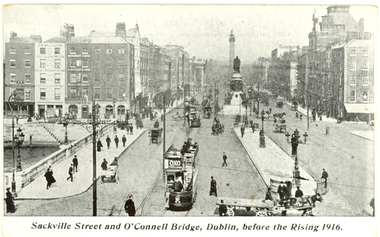
Postcard - Postcards - black and white, Coleman & Co, Dublin before and after the Rising, 1916, c1916
... Most of the leaders were executed following courts-martial, but the Rising succeeded in bringing physical force republicanism back to the forefront of Irish politics. ...Most of the leaders were executed following courts-martial, but the Rising succeeded in bringing physical force republicanism back to the forefront of Irish politics. ...The Easter Uprising took place in April 1916 in Dublin and is one of the pivotal events in modern Irish history. At the end of the Easter Uprising, 15 men identified as leaders were executed at Kilmainham Jail. To some, these men were traitors, to others they became heroes. (http://www.historylearningsite.co.uk/1916_easter_rising.htm, accessed 16 April 2014) Organised by seven members of the Military Council of the Irish Republican Brotherhood,[3] the Rising began on Easter Monday, 24 April 1916, and lasted for six days. Members of the Irish Volunteers — led by schoolmaster and Irish language activist Patrick Pearse, joined by the smaller Irish Citizen Army of James Connolly, along with 200 members of Cumann na mBan — seized key locations in Dublin and proclaimed the Irish Republic independent of the United Kingdom. There were some actions in other parts of Ireland: however, except for the attack on the Royal Irish Constabulary barracks at Ashbourne, County Meath, they were minor. With vastly superior numbers and the use of artillery, the British army quickly suppressed the Rising, and Pearse agreed to an unconditional surrender on Saturday 29 April. Most of the leaders were executed following courts-martial, but the Rising succeeded in bringing physical force republicanism back to the forefront of Irish politics. (http://en.wikipedia.org/wiki/Easter_Rising, accessed 16/04/2014) Sackville Street Dublin is now known a O'Connell Street.Seven black and white postcards showing photographic scenes before and after the Rising in Dublin.chatham family archive, chatham, holmes, ireland, dublin, uprising, sackville street, o'connell bridge, citizen army, liberty hall, henry street, nelson's pillar, post office, arnott's, abbey street, ruins, hotel metropole, the rising, easter uprising, easter rebellion, o'connell, chatham family archive, chatham, holmes, ireland, dublin, uprising, sackville street, o'connell bridge, citizen army, liberty hall, henry street, nelson's pillar, post office, arnott's, abbey street, ruins, hotel metropole, the rising, easter uprising, easter rebellion, o'connell -
 4th/19th Prince of Wales's Light Horse Regiment Unit History Room
Medal
... Demoted to private following a Court Martial on 19 November 1900, Daniel returned to Australia in December of the same year. ...Demoted to private following a Court Martial on 19 November 1900, Daniel returned to Australia in December of the same year. ...Title Peace of 1919 medalet issued to Australian schoolchildren Object type Medalet Place made Australia: Victoria, Melbourne Date made 1919 Summary Designed by C Douglas Richardson, 'The Peace of 1919' medalet was issued by the Defence Department to school children throughout Australia to commemorate the signing of the Versailles Peace Treaty in 1919. The medals were originally suspended from a narrow piece of red, white and blue striped cotton ribbon. This medalet is associated with one of the children of Lance Corporal Giles Daniel, 1st AIF. Born in Ballarat, western Victoria on 16 December 1870, Giles Felix Daniel moved to Oakleigh, Victoria aged 15. A member of the Victorian permanent forces, he served as a corporal (regimental number 8) with the First Victorian Mounted Infantry Company, part of the first Victorian Contingent to the war in South Africa in 1899. This unit was one of the first Australian formations to see action during the Boer War. It was largely drawn from serving members of the Victorian forces. Demoted to private following a Court Martial on 19 November 1900, Daniel returned to Australia in December of the same year. During the First World War, he was again one of the first to enlist, joining the AIF on 19 August 1914, and becoming Lance Corporal number 32 with the First Divisional Signals Company. He served with this unit during the Gallipoli campaign and until his return to Australia on 11 April 1916. Silver-plated brass Circular medalet with a plain edge and integral suspension loop. The obverse features a symbolic female figure of Peace, holding a sword and standing on a plinth marked 'PEACE 1919'. Behind her flies a dove, and at her left and right feet are two figures freed from their shackles. The reverse features a central panel surrounded by laurel leaves, surmounted by the King's Crown with the word 'VICTORY' over the rays of the rising sun. A sailor and a digger stand at ease on either side of the panel on which is cast 'THE / TRIUMPH / OF / LIBERTY / AND / JUSTICE'. Below the leaves is a very small panel with the words 'THE PEACE OF 1919' and the manufacturer's name.peace medal 1919 -
4th/19th Prince of Wales's Light Horse Regiment Unit History Room
Poem, The Horses Stay Behind, 1919
... No; I'd better shoot him and tell a little lie: "He floundered in a wombat hole and then lay down to die" May be I'll be court-martialled; but I'm damned if I'm inclined To go back to Australia and leave my horse behind. ...No; I'd better shoot him and tell a little lie: "He floundered in a wombat hole and then lay down to die" May be I'll be court-martialled; but I'm damned if I'm inclined To go back to Australia and leave my horse behind. ...During WW1 Australia sent 39,348 Walers overseas to the AIF. Many Light Horsemen enlisted with their horses with a government promise that they would be able to bring their horses home with them. On the outbreak of peace, costs became important and it was deemed too costly to have horses repatriated to Australia - except for one horse, "Sandy", owned by General W T Bridges who died at Gallipoli in 1915 Quarantine was offered as a reason for not permitting the walers to return to Australia. However, the horses would have had a long sea voyage, giving time for problems to emerge. Many of the fit horses were sold to the Indian ArmyFramed print of poem "The Horses Stay behind". In days to come we'll wander west and cross the range again; We'll hear the bush birds singing in the green trees after rain; We'll canter through the Mitchell grass and breast the bracing wind: But we'll have other horses. Our chargers stay behind. Around the fire at night we'll yarn about old Sinai; We'll fight our battles o'er again; and as the days go by There'll be old mates to greet us. The bush girls will be kind. Still our thoughts will often wander to the horses left. I don't think I could stand the thought of my old fancy hack Just crawling round old Cairo with a Gyppo on his back. Perhaps some English tourist out in Palestine may find My broken-hearted waler with a wooden plough behind. No; I'd better shoot him and tell a little lie: "He floundered in a wombat hole and then lay down to die" May be I'll be court-martialled; but I'm damned if I'm inclined To go back to Australia and leave my horse behind. Trooper Bluegum -
 Monbulk RSL Sub Branch
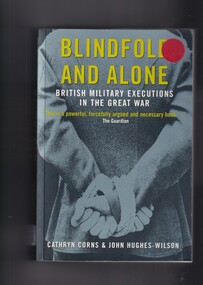
Book, Cathryn Corns et al, Blindfold and all alone: British military executions in the great war, 2001
... Using new material that only now has become available from the Public Records Office and other sources, this compelling history sets out the facts of these courts-martial and shootings--and just as important, places them in the context of the military, social, and medical context of the period. ...It was one of the most controversial and still haunting aspects of World War One: the execution of 351 British soldiers for cowardice and desertion in the face of the enemy. Using new material that only now has become available from the Public Records Office and other sources, this compelling history sets out the facts of these courts-martial and shootings--and just as important, places them in the context of the military, social, and medical context of the period.Index, notes, appendices, glossary, ill (plates b/w), p.463.non-fictionIt was one of the most controversial and still haunting aspects of World War One: the execution of 351 British soldiers for cowardice and desertion in the face of the enemy. Using new material that only now has become available from the Public Records Office and other sources, this compelling history sets out the facts of these courts-martial and shootings--and just as important, places them in the context of the military, social, and medical context of the period.world war 1914-1918 - history, world war 1914-1918 - military tribunals -
 Monbulk RSL Sub Branch
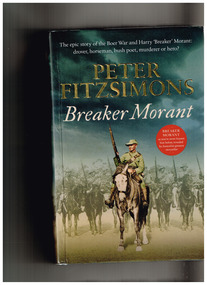
Book, Peter Fitzimons, Breaker Morant, 2020
... Morant and Handcock were court-martialled and executed in February 1902 as the Boer War was in its closing stages, but the debate over their convictions continues to this day. ...The epic story of the Boer War and Harry 'Breaker' Morant: drover, horseman, bush poet - murderer or hero? Most Australians have heard of the Boer War of 1899 to 1902 and of Harry 'Breaker' Morant, a figure who rivals Ned Kelly as an archetypal Australian folk hero. Born in England and emigrating to Queensland in 1883 in his early twenties, Morant was a charming but reckless man who established a reputation as a rider, polo player and writer. He submitted ballads to The Bulletin that were published under the name 'The Breaker' and counted Banjo Paterson as a friend. When appeals were made for horsemen to serve in the war in South Africa, Morant joined up, first with the South Australian Mounted Rifles and then with a South African irregular unit, the Bushveldt Carbineers. In September 1901 Morant and two other Australians, Lieutenants Peter Handcock and George Witton, were arrested for the murder of Boer prisoners. Morant and Handcock were court-martialled and executed in February 1902 as the Boer War was in its closing stages, but the debate over their convictions continues to this day. Does Breaker Morant deserve his iconic status? Who was Harry Morant? What events and passions led him to a conflict that was essentially an Imperial war, played out on a distant continent under a foreign flag? Was he a scapegoat for British war crimes or a criminal himself? With his trademark brilliant command of story, Peter FitzSimons unravels the many myths and fictions that surround the life of Harry Morant. The truths FitzSimons uncovers about 'The Breaker' and the part he played in the Boer War are astonishing - and, in the hands of this master storyteller, make compelling reading.Ill, bib, index, p.500.non-fictionThe epic story of the Boer War and Harry 'Breaker' Morant: drover, horseman, bush poet - murderer or hero? Most Australians have heard of the Boer War of 1899 to 1902 and of Harry 'Breaker' Morant, a figure who rivals Ned Kelly as an archetypal Australian folk hero. Born in England and emigrating to Queensland in 1883 in his early twenties, Morant was a charming but reckless man who established a reputation as a rider, polo player and writer. He submitted ballads to The Bulletin that were published under the name 'The Breaker' and counted Banjo Paterson as a friend. When appeals were made for horsemen to serve in the war in South Africa, Morant joined up, first with the South Australian Mounted Rifles and then with a South African irregular unit, the Bushveldt Carbineers. In September 1901 Morant and two other Australians, Lieutenants Peter Handcock and George Witton, were arrested for the murder of Boer prisoners. Morant and Handcock were court-martialled and executed in February 1902 as the Boer War was in its closing stages, but the debate over their convictions continues to this day. Does Breaker Morant deserve his iconic status? Who was Harry Morant? What events and passions led him to a conflict that was essentially an Imperial war, played out on a distant continent under a foreign flag? Was he a scapegoat for British war crimes or a criminal himself? With his trademark brilliant command of story, Peter FitzSimons unravels the many myths and fictions that surround the life of Harry Morant. The truths FitzSimons uncovers about 'The Breaker' and the part he played in the Boer War are astonishing - and, in the hands of this master storyteller, make compelling reading. boer war 1899-1901 - history, boer war 1899-1902 - biography -
 Alfred Hospital Nurses League - Nursing History Collection
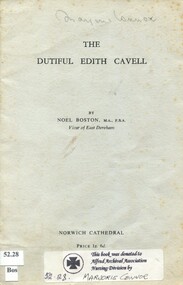
Booklet, Noel Boston 1910-1966, The dutiful Edith Cavell, 1955
... The group was brought before a court-martial on October 7, 1915. On October 9, Cavell, after making a full confession, was sentenced to death. ...Edith Cavell, birn 1865, trained at the London Hospital, in 1906 she asked to oversee a surgical and medical home in Brussles, Belgium. After the German occupation of Belgium, she became involved in an underground group formed to help British, French, and Belgian soldiers reach the Netherlands, a neutral country. The soldiers were sheltered at the Berkendael Institute, which had become a Red Cross hospital, and were provided with money and guides by Philippe Baucq, a Belgian. About 200 men had been aided when, in August 1915, Cavell and several others were arrested. The group was brought before a court-martial on October 7, 1915. On October 9, Cavell, after making a full confession, was sentenced to death. Three days later she and Baucq were shot, despite the efforts of the U.S. and Spanish ministers to secure a reprieve. The group was brought before a court-martial on October 7, 1915. On October 9, Cavell, after making a full confession, was sentenced to death. Three days later she and Baucq were shot, despite the efforts of the U.S. and Spanish ministers to secure a reprieve. Though legally justified, her execution on a charge that did not includeStapled booklet with grey cover and black print. Title, authors name, 'Norwich Cathedral' and price printed on front covernon-fictionEdith Cavell, birn 1865, trained at the London Hospital, in 1906 she asked to oversee a surgical and medical home in Brussles, Belgium. After the German occupation of Belgium, she became involved in an underground group formed to help British, French, and Belgian soldiers reach the Netherlands, a neutral country. The soldiers were sheltered at the Berkendael Institute, which had become a Red Cross hospital, and were provided with money and guides by Philippe Baucq, a Belgian. About 200 men had been aided when, in August 1915, Cavell and several others were arrested. The group was brought before a court-martial on October 7, 1915. On October 9, Cavell, after making a full confession, was sentenced to death. Three days later she and Baucq were shot, despite the efforts of the U.S. and Spanish ministers to secure a reprieve. The group was brought before a court-martial on October 7, 1915. On October 9, Cavell, after making a full confession, was sentenced to death. Three days later she and Baucq were shot, despite the efforts of the U.S. and Spanish ministers to secure a reprieve. Though legally justified, her execution on a charge that did not includeedith cavell, world war 1914-1918 -
 Returned Nurses RSL Sub-branch
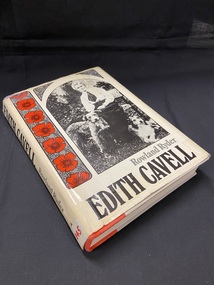
Book - Hardcover book, Rowland Ryder, Edith Cavell, 1975
... She was subsequently court-martialled, found guilty of treason and sentenced to death. ...Edith Louisa Cavell (1865-1915) was a British nurse and patriot. She is celebrated for saving the lives of soldiers from all sides without distinction and in helping some 200 Allied soldiers escape from German-occupied Belgium during World War I, for which she was arrested. She was subsequently court-martialled, found guilty of treason and sentenced to death. Despite international pressure for mercy, she was shot by a German firing squad. Her execution received worldwide condemnation and extensive press coverage. - from Trove record.Hardback book with dustjacket. The dustjacket is cream in colour. Along the spine the title is printed in large black letters, followed by the author's name, and at the bottom is a white sticker with 'B45' handwritten in red texta. The front of the dustjacket shows a black and white photograph of a well-dressed lady sitting on a bench with a dog either side of her. Down the left side of the image is a vertical panel with seven red poppies. The title and author are printed across the bottom of the cover.non-fictionEdith Louisa Cavell (1865-1915) was a British nurse and patriot. She is celebrated for saving the lives of soldiers from all sides without distinction and in helping some 200 Allied soldiers escape from German-occupied Belgium during World War I, for which she was arrested. She was subsequently court-martialled, found guilty of treason and sentenced to death. Despite international pressure for mercy, she was shot by a German firing squad. Her execution received worldwide condemnation and extensive press coverage. - from Trove record. edith cavell, history of nursing, world war one 1914-1918, ww1, wwi
