
Showing 20 items matching "crimes committed"
-
 Sunshine and District Historical Society Incorporated
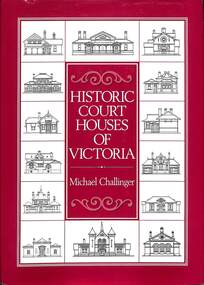
Book - Historic Court Houses of Victoria, Palisade Press, 2001
... crimes committed...crimes committed court proceedings Court Houses in Victoria history Many of Victoria's court houses are historically significant. ...Many of Victoria's court houses are historically significant. The book details every one of Victoria's remaining pre-1945 court houses.A thick 231-page hard covered book with cardboard binding and dust jacket, brown cover with printed text and photographic images.non-fictionMany of Victoria's court houses are historically significant. The book details every one of Victoria's remaining pre-1945 court houses.crimes committed, court proceedings, court houses in victoria, history -
 Wodonga & District Historical Society Inc
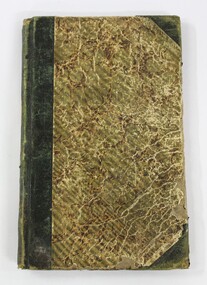
Administrative record - Wodonga Police Register of Duties 1855-1857
... The Wodonga Police register dated to 1855-1857 provides a record of the names of police officers and details of their day-to-day duties, including crimes committed and steps taken to trace and apprehend perpetrators. ...The Wodonga Police register dated to 1855-1857 provides a record of the names of police officers and details of their day-to-day duties, including crimes committed and steps taken to trace and apprehend perpetrators. ...The Wodonga Police register dated to 1855-1857 provides a record of the names of police officers and details of their day-to-day duties, including crimes committed and steps taken to trace and apprehend perpetrators. It has several references to Robert O'Hara Burke, who was a soldier, police officer in Victoria, and well-known explorer in the ill-fated Burke and Wills expedition.The Wodonga police register has local significance due to the detailed information and date in the 1850s, which was before Wodonga became a separate Shire from Yackandandah Shire. It is also significant on a state and national level as an example of early police records. The detailed information provides significant research and interpretive potential. Green leather and faded green and brown marbled paper bound register or diary, recording the day-to-day duties of the Wodonga Police in 1855-1857. Pale blue watermarked paper with faint lines in the interior. Every second page has been removed and there is staining on some of the pages.The entries are written in iron gall ink and are deteriorated/faded in places. Red-brown and green marbled paper on the interior front and back covers, with linen binding. There are three small red wax seals on the inside front cover used to secure an introductory page of writing. The paper around the seals is torn and the page has become detached. Fragmentary inscription written on paper on the green leather spine.wodonga police, robert o'hara burke, police records, police register, wodonga, police journal, police diary -
 Victoria Police Museum
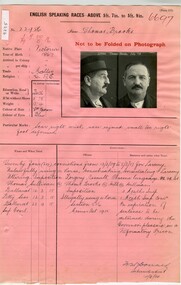
Prison record (Thomas Brooks), 14 June 1920
... Most of his crimes were committed whilst under the influence of drink....Most of his crimes were committed whilst under the influence of drink. english speaking prisoner thomas brooks horse stealing imposition housebreaking Prison record for Thomas Brooks, prisoner registered number 22986, giving details of the prisoner, his crimes and the dates and places of his trials. ...Thomas Brooks's had a long criminal career beginning in 1889 under various aliases. His crimes included forgery, imposition, horse stealing, and housebreaking (for which he received a sentence of 10 years). Most of his crimes were committed whilst under the influence of drink.Prison record for Thomas Brooks, prisoner registered number 22986, giving details of the prisoner, his crimes and the dates and places of his trials.english speaking prisoner, thomas brooks, horse stealing, imposition, housebreaking -
 Victoria Police Museum
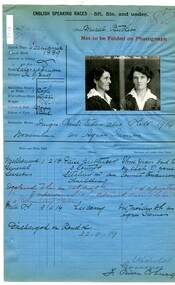
Prison record (Muriel Butler), 2 August 1919
... She had committed previous crimes of stealing and false pretences between 1914 and 1918, sometimes under the name of Agnes James....She had committed previous crimes of stealing and false pretences between 1914 and 1918, sometimes under the name of Agnes James. english speaking prisoner female prisoner muriel butler agnes james false pretences stealing larceny Prison record for Muriel Butler, prisoner registered number 7400, giving details of the prisoner, her crimes and the dates and places of her trials. ...Muriel Butler stole a black coat and a fox skin fur in Melbourne in January 1918. She was arrested when getting off the train in Ballarat. She was also wanted by the police for circulating valueless cheques. She had committed previous crimes of stealing and false pretences between 1914 and 1918, sometimes under the name of Agnes James.Prison record for Muriel Butler, prisoner registered number 7400, giving details of the prisoner, her crimes and the dates and places of her trials.english speaking prisoner, female prisoner, muriel butler, agnes james, false pretences, stealing, larceny -
 Whitehorse Historical Society Inc.
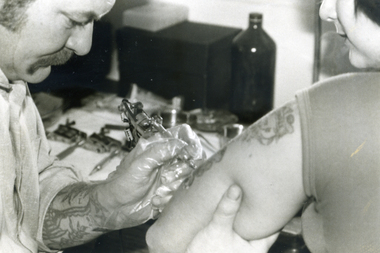
Photograph, Winlaton Youth Training Centre, 1980's
... Re-opened in 1956, female offenders were committed to Winlaton by the courts, but there were also many girls and young women in danger who had not committed a crime. Winlaton closed in 1993 and the land is now occupied by the Candlebark Estate....Re-opened in 1956, female offenders were committed to Winlaton by the courts, but there were also many girls and young women in danger who had not committed a crime. Winlaton closed in 1993 and the land is now occupied by the Candlebark Estate. winlaton youth training centre 5 black and white photographs (a-e) showing tattoos being removed at the Winlaton Youth Training Centre. ...Winlaton was established in Springvale Rd., Nunawading in 1956 as the main state-run institution for adolescent girls. Previously (1951-1953) Winlaton was a home run by the Mission of St James and St John for women with venereal diseases. Re-opened in 1956, female offenders were committed to Winlaton by the courts, but there were also many girls and young women in danger who had not committed a crime. Winlaton closed in 1993 and the land is now occupied by the Candlebark Estate.5 black and white photographs (a-e) showing tattoos being removed at the Winlaton Youth Training Centre. This activity was funded by the Australian Schools Commission Innovations Grants. See also 6229winlaton youth training centre -
 Uniting Church Archives - Synod of Victoria
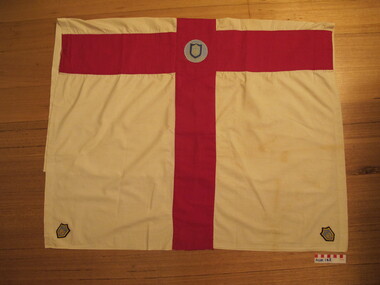
Flag, Flag of St George for Seige Perilous
... A person with a pure heart was seen as someone who had committed no crimes or done any wrong. In the tale, anyone who sat in the chair but did not have a pure heart would die instantly. ...A person with a pure heart was seen as someone who had committed no crimes or done any wrong. In the tale, anyone who sat in the chair but did not have a pure heart would die instantly. ...The flag was placed on an empty chair, the Siege Perilous, for Court Rituals. Siege Perilous - Arthurian legends Some legends also note a special chair at the Round Table, called the Siege Perilous, or 'Dangerous Chair'. Legend says that the seat could only be used by a knight who had a pure heart. A person with a pure heart was seen as someone who had committed no crimes or done any wrong. In the tale, anyone who sat in the chair but did not have a pure heart would die instantly. It was kept free by Merlin for the person who would one day find an object called the Holy Grail. This was a magical cup that was supposed to have been the one that Jesus drank out of during the Last Supper. In the story, this person was either Sir Galahad or Sir Percival, depending on what version of the story is told. https://simple.wikipedia.org/wiki/Round_Table White flag with MOK symbols in centre of red cross and at each corner.methodist order of knights -
 Eltham District Historical Society Inc
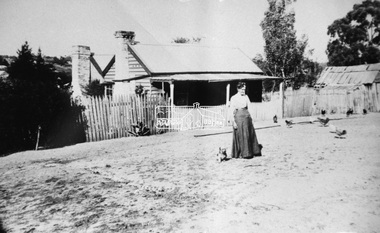
Negative - Photograph, Mary Jane Smart (nee Bailey) ouside the Smart family home in Bridge Street, Eltham, c.1915
... Smart, the lawful wife of the man who is now in the hands of the police of Western Australia on suspicion of having committed a dreadful crime. Here, about half a mile out of the picturesque village of Eltham, she was born, and has lived her whole life — about 50 years. ...Smart, the lawful wife of the man who is now in the hands of the police of Western Australia on suspicion of having committed a dreadful crime. Here, about half a mile out of the picturesque village of Eltham, she was born, and has lived her whole life — about 50 years. ...Located on the north side of Bridge Street at the intersection with Bolton Street, facing Bolton Street (now part of present day Brisbane Street and occupied by the Kitchen Design Centre). Show's an original early settler's cottage in Bridge Street. The cottage was built by Mrs Mary Jane Smart's parents, Edwin Bailey and Jane (nee Matthews). Mary Jane Smart was born in the cottage. She married an Englishman, Alexander Wilson Smart who disappeared to Western Australia in the early 1900s in search of gold. He ultimately married again in W.A., committing bigamy and then committed murder and was hung in 1911. This photo was taken c.1903 not long before both Mrs Bailey and her grand daughter both passed away. Jane Bailey died 2 Dec. 1904 and Mary Jane Smart and Ruby Jane Bertha Smart died July 1903 are all buried in Eltham Cemetery. SMART'S HOME AT ELTHAM. HIS WIFE AND SONS. In a little bush cottage surrounded by tall gum trees, through which appear glimpses of a willow fringed creek, of road ways hedged by masses of snowy flowering hawthorn, of growing crops and vividly green grazing paddocks, lives Mrs. Smart, the lawful wife of the man who is now in the hands of the police of Western Australia on suspicion of having committed a dreadful crime. Here, about half a mile out of the picturesque village of Eltham, she was born, and has lived her whole life — about 50 years. Smart himself lived here till the time when many years ago, the "lure of gold" got into his blood and he cleared out to Western Australia, to follow the digging rushes, gradually becom ing more and more estranged, till at length all communication ceased and be became lost to his wife and children. "I did not want him to go away," said Mrs. Smart, "because I had heard of so many men who had forgotten their homes in the excite ment of gold seeking, and of many others who died unknown and uncared for. But he would go, and when I saw his mind was set on it I placed no obstacles in his way. My parents built and lived in this cottage, where I was born, and they died in it. When I grew up I met my husband, a young Englishman, and married him. His name is Alexander, not Alfred, and his age is 52. We were very happy here, and although we were not well off we were comfortable, for he was a steady, sober, industrious man and had constant employment. He was just a manual worker, but could turn his hand to anything. We had five children, but one died. Four sons grew up in this little cottage. Thus three generations lived in it, somewhat unusual in an Australian bush home, I think. My eldest son is married and has a family; one is in Western Australia— not with his father— another is away working for him self, and one (indicating a young man by her side) has always stuck to his mother. He is my sole support, and he is as good to me now as his father once was. Yes, his father was a good, home-loving man in our younger days. He was fond of his children and was highly respected in these parts.' "It is fifteen years since my husband went away first. He had then been work ing for the Metropolitan Board of Works, and was engaged in the tunnel under the Yarra near Queen's-bridge when it col-lapsed. After he went to the West he sent me money regularly and wrote constantly. He came home three times — twice for a week or two at a time, the third time, eight years ago, when the Eitham railway was nearing completion. I induced him to stay till the railway opened, and he re-mained with me several months. I tried to get him to leave the West and settle down in his home, but he would not; he seemed restless and anxious to be off. One day when we were in Collingwood together he left me, saying he wanted to see what boats were going West. I implored him not to go away, and he said he would see. However, he returned to me soon after wards and said he had taken his ticket and would go by the next boat, and he went. For a year he wrote at irregular intervals, and then his letters ceased and I heard no more of him. For seven years I have not known whether he was alive or dead. Before that time my two sons in Western Australian used to see him some times, though they did not live with him; they used to tell me in their letters that he was well. It was a hard blow to be forgotten by him, but as my sons grew up I became more reconciled, and now I seem to look back at my life with him as some thing that happened a long time ago and is only a memory. Of his life and doings in Western Australia I know nothing. The last time I heard of him he was working in a foundry at Midland Junction. He was at Cue working on the railway when it opened there, and he caught the fever, but all that time he sent me money. When he returned the first time he took our eldest son with him, and the other boy followed later. They did not stay with him, how ever, and as far as I know they did not know how he lived." 'Mrs. Smart is a quiet, toil worn woman who has the respect of everyone who knows her.Roll of 35mm colour negative film, 3 strips Associated print from negative (Copy of original print)Fuji 100bridge street, cottage, smart home, houses, mary jane smart (nee bailey), smart family home, alexander wilson smart, bigamy, bush cottage, early settlers, eltham, jane bailey (nee matthews), murder, ruby jane bertha smart -
 Eltham District Historical Society Inc
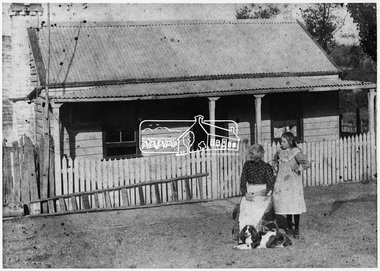
Negative - Photograph, Smart family home in Bridge Street, Eltham, c.1903
... Smart, the lawful wife of the man who is now in the hands of the police of Western Australia on suspicion of having committed a dreadful crime. Here, about half a mile out of the picturesque village of Eltham, she was born, and has lived her whole life — about 50 years. ...Smart, the lawful wife of the man who is now in the hands of the police of Western Australia on suspicion of having committed a dreadful crime. Here, about half a mile out of the picturesque village of Eltham, she was born, and has lived her whole life — about 50 years. ...Believed to be Mrs Jane Bailey (nee Matthews) (d. 1904) and her grand-daughter Ruby Jane Bertha Smart (1890-1903) in front of the Smart family cottage in Bridge Street, Eltham, c.1903 Located on the north side of Bridge Street at the intersection with Bolton Street, facing Bolton Street (now part of present day Brisbane Street and occupied by the Kitchen Design Centre). Ruby Jane Bertha Smart born abt 1890 died in 1903 in Eltham. Her brother Alfred Francis Smart was born abt 1887 and died 1966 in Mont Albert, Vic. (Accessed via Ancestry.com) Show's an original early settler's cottage in Bridge Street. The cottage was built by Mrs Mary Jane Smart's parents, Edwin Bailey and Jane (nee Matthews). Mary Jane Smart was born in the cottage. She married an Englishman, Alexander Wilson Smart who disappeared to Western Australia in the early 1900s in search of gold. He ultimately married again in W.A., committing bigamy and then committed murder and was hung in 1911. This photo was taken c.1903 not long before both Mrs Bailey and her grand daughter both passed away. Jane Bailey died 2 Dec. 1904 and Mary Jane Smart and Ruby Jane Bertha Smart died July 1903 are all buried in Eltham Cemetery. SMART'S HOME AT ELTHAM. HIS WIFE AND SONS. In a little bush cottage surrounded by tall gum trees, through which appear glimpses of a willow fringed creek, of road ways hedged by masses of snowy flowering hawthorn, of growing crops and vividly green grazing paddocks, lives Mrs. Smart, the lawful wife of the man who is now in the hands of the police of Western Australia on suspicion of having committed a dreadful crime. Here, about half a mile out of the picturesque village of Eltham, she was born, and has lived her whole life — about 50 years. Smart himself lived here till the time when many years ago, the "lure of gold" got into his blood and he cleared out to Western Australia, to follow the digging rushes, gradually becom ing more and more estranged, till at length all communication ceased and be became lost to his wife and children. "I did not want him to go away," said Mrs. Smart, "because I had heard of so many men who had forgotten their homes in the excite ment of gold seeking, and of many others who died unknown and uncared for. But he would go, and when I saw his mind was set on it I placed no obstacles in his way. My parents built and lived in this cottage, where I was born, and they died in it. When I grew up I met my husband, a young Englishman, and married him. His name is Alexander, not Alfred, and his age is 52. We were very happy here, and although we were not well off we were comfortable, for he was a steady, sober, industrious man and had constant employment. He was just a manual worker, but could turn his hand to anything. We had five children, but one died. Four sons grew up in this little cottage. Thus three generations lived in it, somewhat unusual in an Australian bush home, I think. My eldest son is married and has a family; one is in Western Australia— not with his father— another is away working for him self, and one (indicating a young man by her side) has always stuck to his mother. He is my sole support, and he is as good to me now as his father once was. Yes, his father was a good, home-loving man in our younger days. He was fond of his children and was highly respected in these parts.' "It is fifteen years since my husband went away first. He had then been work ing for the Metropolitan Board of Works, and was engaged in the tunnel under the Yarra near Queen's-bridge when it col-lapsed. After he went to the West he sent me money regularly and wrote constantly. He came home three times — twice for a week or two at a time, the third time, eight years ago, when the Eitham railway was nearing completion. I induced him to stay till the railway opened, and he re-mained with me several months. I tried to get him to leave the West and settle down in his home, but he would not; he seemed restless and anxious to be off. One day when we were in Collingwood together he left me, saying he wanted to see what boats were going West. I implored him not to go away, and he said he would see. However, he returned to me soon after wards and said he had taken his ticket and would go by the next boat, and he went. For a year he wrote at irregular intervals, and then his letters ceased and I heard no more of him. For seven years I have not known whether he was alive or dead. Before that time my two sons in Western Australian used to see him some times, though they did not live with him; they used to tell me in their letters that he was well. It was a hard blow to be forgotten by him, but as my sons grew up I became more reconciled, and now I seem to look back at my life with him as some thing that happened a long time ago and is only a memory. Of his life and doings in Western Australia I know nothing. The last time I heard of him he was working in a foundry at Midland Junction. He was at Cue working on the railway when it opened there, and he caught the fever, but all that time he sent me money. When he returned the first time he took our eldest son with him, and the other boy followed later. They did not stay with him, how ever, and as far as I know they did not know how he lived." 'Mrs. Smart is a quiet, toil worn woman who has the respect of everyone who knows her.This photo forms part of a collection of photographs gathered by the Shire of Eltham for their centenary project book,"Pioneers and Painters: 100 years of the Shire of Eltham" by Alan Marshall (1971). The collection of over 500 images is held in partnership between Eltham District Historical Society and Yarra Plenty Regional Library (Eltham Library) and is now formally known as the 'The Shire of Eltham Pioneers Photograph Collection.' It is significant in being the first community sourced collection representing the places and people of the Shire's first one hundred years.Digital image 4 x 5 inch B&W Neg Original print 10.5 x 16.5 cmFor postcard print: Inscribed on envelope: "Return to Mrs H. Butherway, 22 Bridge St, Eltham." Also "Photo Mrs Clark Hampton (nee Smart), original Smart's house - Bridge Street, 95 years ago." Also "Right - Mrs Clark's grandmother Mrs J Smart Left - Her daughter Ruby dies soon after photo taken. Brother Alf Smart died about 6 years ago." Inscribed on back of photo "247 Vincent St, Leederville" It is believed that this inscription may be somewhat mixed up.sepp, shire of eltham pioneers photograph collection, eltham, bridge street, alexander wilson smart, bigamy, bush cottage, early settlers, houses, jane bailey (nee matthews), mary jane smart (nee bailey), murder, ruby jane bertha smart, smart family home, smart home -
 Monbulk RSL Sub Branch
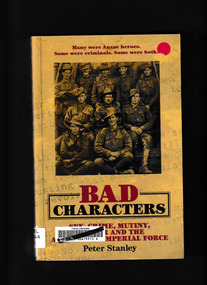
Book, Peter Stanley, Bad characters : sex, crime, mutiny, murder and the Australian Imperial Force, 2011
... This book tells the story of the Australian soldiers in the Great War who were not heroes, soldiers who committed offences and crimes, those who deserted, robbed and murdered their comrades and more. ...Australia's long-standing love affair with the Diggers has blinded us to the dark side of the Anzac legend. This book tells the story of the Australian soldiers in the Great War who were not heroes, soldiers who committed offences and crimes, those who deserted, robbed and murdered their comrades and more.Index, bibliography, notes, ill, p.287.non-fictionAustralia's long-standing love affair with the Diggers has blinded us to the dark side of the Anzac legend. This book tells the story of the Australian soldiers in the Great War who were not heroes, soldiers who committed offences and crimes, those who deserted, robbed and murdered their comrades and more.australian army - imperial force - 1914-1921 - history, australian army - military deserters - 1914-1921 -
 Victoria Police Museum
Photograph (Frederick Deeming)
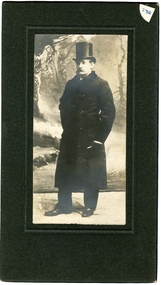
... crime scene investigation proved difficult as the suspect - whatever his real name- had cleaned up the scene very carefully. Much later it was discovered that the suspect was in fact Frederick Bayley Deeming, a former sailor born in Birkenhead, Cheshire, in 1854. In 1881, Deeming deserted his ship and lived in Sydney where he married and had a family. Deeply in debt, he later burned his business down to claim its insurance value and fled to South Africa before he could be arrested. He is believed to have committed...crime scene investigation proved difficult as the suspect - whatever his real name- had cleaned up the scene very carefully. Much later it was discovered that the suspect was in fact Frederick Bayley Deeming, a former sailor born in Birkenhead, Cheshire, in 1854. In 1881, Deeming deserted his ship and lived in Sydney where he married and had a family. Deeply in debt, he later burned his business down to claim its insurance value and fled to South Africa before he could be arrested. He is believed to have committed ...In March 1892, Melbourne Butcher John Stamford took a prospective tenant to a house he owned at 57 Andrew Street Windsor. He noticed a 'disagreeable smell' coming from the front rooms. Suspecting foul play, Stamford called the police who quickly discovered a decomposing body and partially clad body of a young woman in a shallow grave under the fireplace. 'Her skull had been shattered and her throat cut'. Two detectives, Sergeants Considine and Cawsey, began investigations. The previous tenant, a 'Mr. Druin' who had rented the house had since disappeared was the main suspect. 'Druin' had arrived in Australia from England as 'Albert Williams' in December 1891 with his 24 year old wife Emily Mather. The body was Emily's. The crime scene investigation proved difficult as the suspect - whatever his real name- had cleaned up the scene very carefully. Much later it was discovered that the suspect was in fact Frederick Bayley Deeming, a former sailor born in Birkenhead, Cheshire, in 1854. In 1881, Deeming deserted his ship and lived in Sydney where he married and had a family. Deeply in debt, he later burned his business down to claim its insurance value and fled to South Africa before he could be arrested. He is believed to have committed numerous frauds and murders in Africa. Eventually found in Uruguay, he spent time in prison in England for fraud. After being released he married Emily and returned to Australia. After leaving England, British police began investigating him over the murder of Mrs Marie Deeming and her four children. Now using another alias, 'Baron Swanston', Deeming was arrested in Western Australia before he left the country in the company of a young woman, Kate Rounsefell, whom he planned to marry. It seems Kate would have been his next murder victim. Brought back to Victoria, in May 1892, Deeming went on trail for the murder of Emily Mather. Despite a strong defense conducted by a brilliant young barrister and 3 times Australian Prime Minister Alfred Deakin, the evidence against Deeming was overwhelming and he was found guilty. Deeming was hanged at Melbourne Gaol on 23 May 1892. He was known to be responsible for at least 6 murders and may have committed others. Black and white photograph backed onto black backing board showing a man in a long coat and top hat with his hands in his pockets and a moustachefrederick deeming, emily mather, murders -
 Victoria Police Museum
Photograph (Emily Mather)
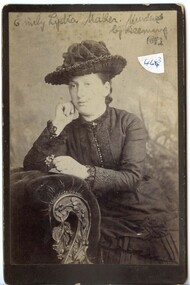
... crime scene investigation proved difficult as the suspect - whatever his real name- had cleaned up the scene very carefully. Much later it was discovered that the suspect was in fact Frederick Bayley Deeming, a former sailor born in Birkenhead, Cheshire, in 1854. In 1881, Deeming deserted his ship and lived in Sydney where he married and had a family. Deeply in debt, he later burned his business down to claim its insurance value and fled to South Africa before he could be arrested. He is believed to have committed...crime scene investigation proved difficult as the suspect - whatever his real name- had cleaned up the scene very carefully. Much later it was discovered that the suspect was in fact Frederick Bayley Deeming, a former sailor born in Birkenhead, Cheshire, in 1854. In 1881, Deeming deserted his ship and lived in Sydney where he married and had a family. Deeply in debt, he later burned his business down to claim its insurance value and fled to South Africa before he could be arrested. He is believed to have committed ...In March 1892, Melbourne Butcher John Stamford took a prospective tenant to a house he owned at 57 Andrew Street Windsor. He noticed a 'disagreeable smell' coming from the front rooms. Suspecting foul play, Stamford called the police who quickly discovered a decomposing body and partially clad body of a young woman in a shallow grave under the fireplace. 'Her skull had been shattered and her throat cut'. Two detectives, Sergeants Considine and Cawsey, began investigations. The previous tenant, a 'Mr. Druin' who had rented the house had since disappeared was the main suspect. 'Druin' had arrived in Australia from England as 'Albert Williams' in December 1891 with his 24 year old wife Emily Mather. The body was Emily's. The crime scene investigation proved difficult as the suspect - whatever his real name- had cleaned up the scene very carefully. Much later it was discovered that the suspect was in fact Frederick Bayley Deeming, a former sailor born in Birkenhead, Cheshire, in 1854. In 1881, Deeming deserted his ship and lived in Sydney where he married and had a family. Deeply in debt, he later burned his business down to claim its insurance value and fled to South Africa before he could be arrested. He is believed to have committed numerous frauds and murders in Africa. Eventually found in Uruguay, he spent time in prison in England for fraud. After being released he married Emily and returned to Australia. After leaving England, British police began investigating him over the murder of Mrs Marie Deeming and her four children. Now using another alias, 'Baron Swanston', Deeming was arrested in Western Australia before he left the country in the company of a young woman, Kate Rounsefell, whom he planned to marry. It seems Kate would have been his next murder victim. Brought back to Victoria, in May 1892, Deeming went on trail for the murder of Emily Mather. Despite a strong defense conducted by a brilliant young barrister and 3 times Australian Prime Minister Alfred Deakin, the evidence against Deeming was overwhelming and he was found guilty. Deeming was hanged at Melbourne Gaol on 23 May 1892. He was known to be responsible for at least 6 murders and may have committed others. Black and white photograph backed onto black board showing a lady in dark clothing and hat resting with her right elbow on the arm of a lounge. Woman is holding a small sprig of flowers in her left handEmily Lydia Mather. Murdered by Deeming 1892 (in black ink along top of photograph)frederick deeming, emily mather, murders -
 Victoria Police Museum
Photograph (Frederick Deeming)
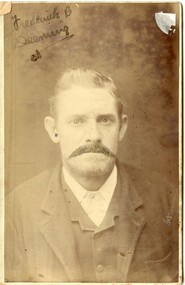
... crime scene investigation proved difficult as the suspect - whatever his real name- had cleaned up the scene very carefully. Much later it was discovered that the suspect was in fact Frederick Bayley Deeming, a former sailor born in Birkenhead, Cheshire, in 1854. In 1881, Deeming deserted his ship and lived in Sydney where he married and had a family. Deeply in debt, he later burned his business down to claim its insurance value and fled to South Africa before he could be arrested. He is believed to have committed...crime scene investigation proved difficult as the suspect - whatever his real name- had cleaned up the scene very carefully. Much later it was discovered that the suspect was in fact Frederick Bayley Deeming, a former sailor born in Birkenhead, Cheshire, in 1854. In 1881, Deeming deserted his ship and lived in Sydney where he married and had a family. Deeply in debt, he later burned his business down to claim its insurance value and fled to South Africa before he could be arrested. He is believed to have committed ...In March 1892, Melbourne Butcher John Stamford took a prospective tenant to a house he owned at 57 Andrew Street Windsor. He noticed a 'disagreeable smell' coming from the front rooms. Suspecting foul play, Stamford called the police who quickly discovered a decomposing body and partially clad body of a young woman in a shallow grave under the fireplace. 'Her skull had been shattered and her throat cut'. Two detectives, Sergeants Considine and Cawsey, began investigations. The previous tenant, a 'Mr. Druin' who had rented the house had since disappeared was the main suspect. 'Druin' had arrived in Australia from England as 'Albert Williams' in December 1891 with his 24 year old wife Emily Mather. The body was Emily's. The crime scene investigation proved difficult as the suspect - whatever his real name- had cleaned up the scene very carefully. Much later it was discovered that the suspect was in fact Frederick Bayley Deeming, a former sailor born in Birkenhead, Cheshire, in 1854. In 1881, Deeming deserted his ship and lived in Sydney where he married and had a family. Deeply in debt, he later burned his business down to claim its insurance value and fled to South Africa before he could be arrested. He is believed to have committed numerous frauds and murders in Africa. Eventually found in Uruguay, he spent time in prison in England for fraud. After being released he married Emily and returned to Australia. After leaving England, British police began investigating him over the murder of Mrs Marie Deeming and her four children. Now using another alias, 'Baron Swanston', Deeming was arrested in Western Australia before he left the country in the company of a young woman, Kate Rounsefell, whom he planned to marry. It seems Kate would have been his next murder victim. Brought back to Victoria, in May 1892, Deeming went on trail for the murder of Emily Mather. Despite a strong defense conducted by a brilliant young barrister and 3 times Australian Prime Minister Alfred Deakin, the evidence against Deeming was overwhelming and he was found guilty. Deeming was hanged at Melbourne Gaol on 23 May 1892. He was known to be responsible for at least 6 murders and may have committed others. Medium sized photograph of Frederick Deeming with a moustache drawn on the image in inkFrederick B. Deeming (on image in black ink)frederick deeming, emily lydia mather, murders -
 Victoria Police Museum
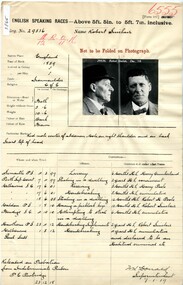
Prison record (Robert Sinclair), 23 December 1918
... committed a variety of offences including housebreaking, having a skeleton/picklock key in his possession, being an habitual criminal. He had several aliases. robert sinclair english speaking prisoner larceny housebreaking stealing Prison record for Robert Sinclair, prisoner registered number 29536, giving details of the prisoner, his crimes and the dates and places of his trials. ...Robert Sinclair, a travelling entertainer, committed a variety of offences including housebreaking, having a skeleton/picklock key in his possession, being an habitual criminal. He had several aliases. Prison record for Robert Sinclair, prisoner registered number 29536, giving details of the prisoner, his crimes and the dates and places of his trials.robert sinclair, english speaking prisoner, larceny, housebreaking, stealing -
 Victoria Police Museum
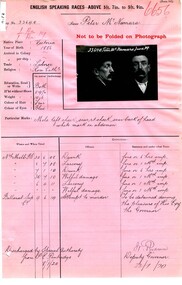
Police record (Peter McNamara), 23 January 1920
... committed numerous offences such as stealing, whilst drunk. In April 1914 he was charged with attempting to murder Sarah Bass, a housemaid at the Mount Bute steep station. He was found not guilty due to insanity caused by alcoholism english speaking prisoner peter mcnamara drunk larceny attempted murder Prison record for Peter McNamara, prisoner registered number 33640, giving details of the prisoner, his crimes and the dates and places of his trials. ...Peter McNamara had committed numerous offences such as stealing, whilst drunk. In April 1914 he was charged with attempting to murder Sarah Bass, a housemaid at the Mount Bute steep station. He was found not guilty due to insanity caused by alcoholismPrison record for Peter McNamara, prisoner registered number 33640, giving details of the prisoner, his crimes and the dates and places of his trials.english speaking prisoner, peter mcnamara, drunk, larceny, attempted murder -
 Victoria Police Museum
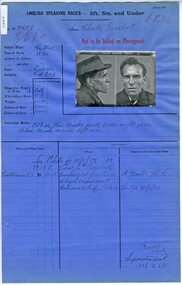
Prison record (Charles Turnbull), 25 July 1921
... He committed offences of housebreaking, stealing and receiving, and broke out of both the Appollo Bay Reformatory in November 1912 and the Castelmaine reformatory prison in October 1918. english speaking prisoner charles turnbull escaped prisoner housebreaking stealing Prison record for Charles Turnbull, prisoner registered number 33657, giving details of the prisoner, his crimes and the dates and places of his trials. ...Charles Turnbull is described as a half-caste. He committed offences of housebreaking, stealing and receiving, and broke out of both the Appollo Bay Reformatory in November 1912 and the Castelmaine reformatory prison in October 1918.Prison record for Charles Turnbull, prisoner registered number 33657, giving details of the prisoner, his crimes and the dates and places of his trials.english speaking prisoner, charles turnbull, escaped prisoner, housebreaking, stealing -
 National Vietnam Veterans Museum (NVVM)
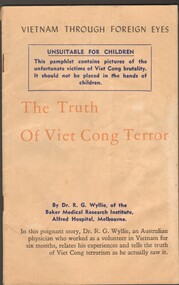
Booklet - Propaganda booklet, The Truth of Vietcong Terror
... committed by the Viet Cong during the Vietnam War. Collected by WO2 Robert Palmer Matthews (34974) of the Royal Australian Army Ordnance Corps. The truth of Vietcong Terror Dr R.G Wyllie Baker Medical Research Institute Booklet Robert Palmer Matthews 34974 Vietcong propaganda anti-war war crimes atrocities Vietnam through Foreign Eyes/ Unsuitable for Children with why/ The Truth/ Of Vietcong Terror/ By Dr R.G. ...This representation of the horrors in Vietnam was authored by Dr. R. G. Wyllie of the Baker Medical Research Institute at Alfred Hospital in Melbourne. The pamphlet is a documented account of the experiences and observations of an Australian physician volunteering in Vietnam. It highlights alleged terrorist actions committed by the Viet Cong during the Vietnam War. Collected by WO2 Robert Palmer Matthews (34974) of the Royal Australian Army Ordnance Corps.Booklet: Vietnam through foreign eyes. Contains graphic black and white images of war atrocities. 23 pages long written by Dr R.G Wyllie. (Unsuitable for Children).Vietnam through Foreign Eyes/ Unsuitable for Children with why/ The Truth/ Of Vietcong Terror/ By Dr R.G. Wyllie. On Back - The Vietnamese among who we work have no doubt the war is necessary .../ Publisher information.the truth of vietcong terror, dr r.g wyllie, baker medical research institute, booklet, robert palmer matthews, 34974, vietcong, propaganda, anti-war, war crimes, atrocities -
 Wangaratta RSL Sub Branch
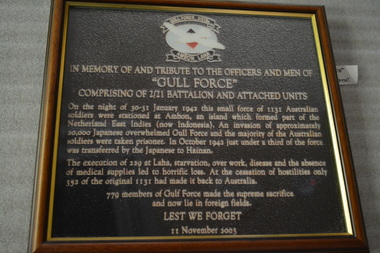
Memorabilia - Framed Tribute, Wangaratta Picture Framers, Gull Force
... Blood Oath, a 1990 Australian feature film is based on the real-life trial of Japanese soldiers for war crimes committed against Allied prisoners of war on the island of Ambon, in the Netherlands East Indies (Indonesia), such as the Laha massacre of 1942. gull force 2/21 battalion ambon ww2 Gull Force 2/21 Battalion Ambon Laha In memory of and tribute to the Officers and Men of "Gull Force" comprising of 2/21 Battalion and attached Units. ...On the night of 30-31 January 1942 this small force of 1131 Australian soldiers were stationed at Ambon, an island which formed part of the Netherland East Indies (now Indonesia). An invasion of approximately 20,000 Japanese overwhelmed Gull Force and the majority of the Australian soldiers were taken prisoner. The execution of 229 at Laha, starvation, over work, disease and the absence of medical supplies led to horrific loss. At the cessation of hostilities only 352 of the original 1131 had made it back to Australia. 779 members of Gull Force made the supreme sacrifice and now lie in foreign fields. The Battle of Ambon (30 January – 3 February 1942) occurred on the island of Ambon in the Dutch East Indies (now Indonesia), during World War II. Japan invaded and conquered the island in a few days, facing Dutch, American and Australian forces. The chaotic and sometimes bloody fighting was followed by a series of major Japanese war crimes. Allied casualties in the battle were relatively light. However, at intervals for a fortnight after the surrender, Japanese personnel chose more than 300 Australian and Dutch prisoners of war at random and summarily executed them, at or near Laha airfield. In part, this was revenge for the sinking of the Japanese minesweeper, as some surviving crew of the minesweeper took part.. Three-quarters of the Australians captured on Ambon died before the war's end. Of the 582 who remained on Ambon, 405 died. They died of overwork, malnutrition, disease and one of the most brutal regimes among camps in which bashings were routine. Blood Oath, a 1990 Australian feature film is based on the real-life trial of Japanese soldiers for war crimes committed against Allied prisoners of war on the island of Ambon, in the Netherlands East Indies (Indonesia), such as the Laha massacre of 1942.Brown timber frame with gold coloured inner edge containing badge and tribute on grey backgroundGull Force 2/21 Battalion Ambon Laha In memory of and tribute to the Officers and Men of "Gull Force" comprising of 2/21 Battalion and attached Units.gull force, 2/21 battalion, ambon, ww2 -
 Wangaratta RSL Sub Branch
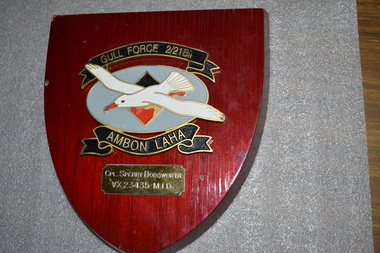
Plaque, Gull Force
... Blood Oath, a 1990 Australian feature film is based on the real-life trial of Japanese soldiers for war crimes committed against Allied prisoners of war on the island of Ambon, in the Netherlands East Indies (Indonesia), such as the Laha massacre of 1942. gull force 2/21 battalion ambon ww2 Gull Force 2/21 Battalion Ambon Laha Plaque - Cpl Sperry Bodsworth VX23435 MID Brown timber in the shape of a shield mounted with a metal a coat of arms depicting white seagull above black and orange diamond within pale blue oval shape. ...Plaque present to Corporal Sperry BODSWORTH MID who served with the 2/21st Battalion and involved with the Battle of Ambon. On the night of 30-31 January 1942 this small force of 1131 Australian soldiers were stationed at Ambon, an island which formed part of the Netherland East Indies (now Indonesia). An invasion of approximately 20,000 Japanese overwhelmed Gull Force and the majority of the Australian soldiers were taken prisoner. The execution of 229 at Laha, starvation, over work, disease and the absence of medical supplies led to horrific loss. At the cessation of hostilities only 352 of the original 1131 had made it back to Australia. 779 members of Gull Force made the supreme sacrifice and now lie in foreign fields. The Battle of Ambon (30 January – 3 February 1942) occurred on the island of Ambon in the Dutch East Indies (now Indonesia), during World War II. Japan invaded and conquered the island in a few days, facing Dutch, American and Australian forces. The chaotic and sometimes bloody fighting was followed by a series of major Japanese war crimes. Allied casualties in the battle were relatively light. However, at intervals for a fortnight after the surrender, Japanese personnel chose more than 300 Australian and Dutch prisoners of war at random and summarily executed them, at or near Laha airfield. In part, this was revenge for the sinking of the Japanese minesweeper, as some surviving crew of the minesweeper took part.. Three-quarters of the Australians captured on Ambon died before the war's end. Of the 582 who remained on Ambon, 405 died. They died of overwork, malnutrition, disease and one of the most brutal regimes among camps in which bashings were routine. Blood Oath, a 1990 Australian feature film is based on the real-life trial of Japanese soldiers for war crimes committed against Allied prisoners of war on the island of Ambon, in the Netherlands East Indies (Indonesia), such as the Laha massacre of 1942.Brown timber in the shape of a shield mounted with a metal a coat of arms depicting white seagull above black and orange diamond within pale blue oval shape.Gull Force 2/21 Battalion Ambon Laha Plaque - Cpl Sperry Bodsworth VX23435 MIDgull force, 2/21 battalion, ambon, ww2 -
 Linton Mechanics Institute and Free Library Collection
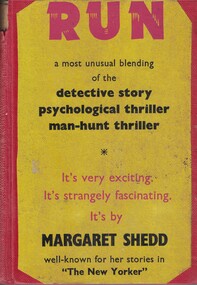
Book - Novel, Shedd, Margaret, Run, 1956
... Crime Mystery Margaret Shedd In the first sentence of the first paragraph a boy is running. We don't at once know what he is running from, or where he is running to, and not until the end of the book can we fully understand why he is running. It is a story about murder; and we want to know who committed ...In the first sentence of the first paragraph a boy is running. We don't at once know what he is running from, or where he is running to, and not until the end of the book can we fully understand why he is running. It is a story about murder; and we want to know who committed the murder; and, bit by bit, we piece together the truth - which, by a feat of ingenious construction, is revealed very, very gradually while the action keeps moving at express speed ...252p. ; red cover with original dust jacket cut and pasted onto the front cover with the text: Run: a most unusual blending of the detective story, psychological thriller, man-hunt thriller * It's very exciting. It's strangely fascinating. It's by Margaret Shedd well-known for her stories in "The New Yorker"fictionIn the first sentence of the first paragraph a boy is running. We don't at once know what he is running from, or where he is running to, and not until the end of the book can we fully understand why he is running. It is a story about murder; and we want to know who committed the murder; and, bit by bit, we piece together the truth - which, by a feat of ingenious construction, is revealed very, very gradually while the action keeps moving at express speed ...fiction, crime, mystery, margaret shedd -
 Wangaratta RSL Sub Branch
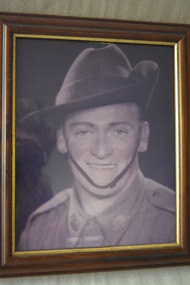
Photograph - Framed photograph, Cpl Sperry BODSWORTH
... Blood Oath, a 1990 Australian feature film is based on the real-life trial of Japanese soldiers for war crimes committed against Allied prisoners of war on the island of Ambon, in the Netherlands East Indies (Indonesia), such as the Laha massacre of 1942. ww2 gull force ambon sperry bodsworth pow VX23435 Brown timber frame containing black and white photograph of WW2 Soldier wearing slouch hat Cpl Sperry BODSWORTH Photograph Framed photograph ...Photograph of Private later Corporal Sperry Bodsworth born 27/8/1909. In 1940 aged 30 years he enlisted in the Army and assigned to the 2/21 Battalion. On 13/12/1941 the Battalion was deployed from Darwin to Ambon in the Dutch East Indies, now Indonesia, to form part of "Gull Force". The Battle of Ambon occurred between 30 January to 3 February, 1942. In April 1942 Bodsworth was listed as missing and on 1/6/1942 was reported as a Prisoner of War. Bodsworth was awarded a Mention in Despatches.The Battle of Ambon (30 January – 3 February 1942) occurred on the island of Ambon in the Dutch East Indies (now Indonesia), during World War II. Japan invaded and conquered the island in a few days, facing Dutch, American and Australian forces. The chaotic and sometimes bloody fighting was followed by a series of major Japanese war crimes. Allied casualties in the battle were relatively light. However, at intervals for a fortnight after the surrender, Japanese personnel chose more than 300 Australian and Dutch prisoners of war at random and summarily executed them, at or near Laha airfield. In part, this was revenge for the sinking of the Japanese minesweeper, as some surviving crew of the minesweeper took part.. Three-quarters of the Australians captured on Ambon died before the war's end. Of the 582 who remained on Ambon, 405 died. They died of overwork, malnutrition, disease and one of the most brutal regimes among camps in which bashings were routine. Blood Oath, a 1990 Australian feature film is based on the real-life trial of Japanese soldiers for war crimes committed against Allied prisoners of war on the island of Ambon, in the Netherlands East Indies (Indonesia), such as the Laha massacre of 1942.Brown timber frame containing black and white photograph of WW2 Soldier wearing slouch hatww2, gull force, ambon, sperry bodsworth, pow, vx23435
