
Showing 257 items matching "crocheted items"
-
 Wodonga & District Historical Society Inc
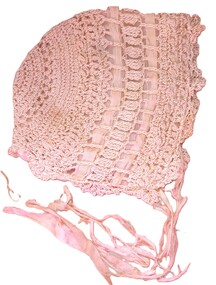
Mixed media - Crocheted Baby Bonnet
... Crocheted items...This item is significant because it is representative of crocheted handcrafts Crocheted items Dr Frank Grant handcraft A small hand crocheted baby's bonnet made of silk cotton thread and lined with silk. ...This bonnet was made to be worn by Patricia Kathleen Grant. She was born in1925, the daughter of Dr Frank John Audas Grant and Kathleen Josephine Dixon. Dr Frank Grant gave many years of service to the Wodonga community both as its doctor and on several community organisations and committees. He was born in South Yarra, Victoria in 1897 and after finishing school he began Medical Studies at Melbourne University. In 1915 he enlisted in the Australian Army and was assigned to the Hospital Transport Corps and later with the 8th Field Artillery Brigade aboard HMAT Medic. He was wounded in action with gunshot wounds to the arm and back. After time in hospital in England, Frank was returned to Melbourne where he was discharged as medically unfit on 24th October 1917. During World War II Dr Frank Grant served as an Honorary Captain in the Australian Army Medical Corps. His records show that he was accidentally “Mustard Gassed” at Bandiana. Dr Frank Grant commenced practice in Wodonga in 1923, entering into a partnership with Dr Rudolph Schlink. This marked the beginning of a long career dedicated to the Wodonga community. By 11 August 1926 he held the role of Public Vaccinator with the Commission of Public Health in Wodonga. Apart from long years of dedication to health in Wodonga, Dr Grant also took on numerous roles within Wodonga. This included being a Commissioner of the Wodonga Waterworks Trust from 6 April 1932 until 29 July 1963. He was a strong advocate for the development of the Wodonga Base Hospital which opened in 1954. Doctor Grant passed away on 14 January 1964.This item is significant because it is representative of crocheted handcraftsA small hand crocheted baby's bonnet made of silk cotton thread and lined with silk. A silk ribbon is attached.crocheted items, dr frank grant, handcraft -
 National Wool Museum
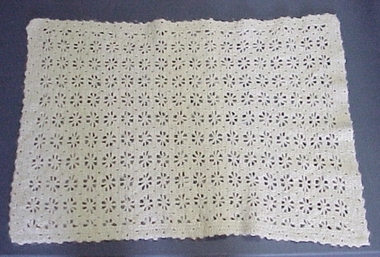
Layette
... Crocheted item by Joyce Hucker....Crochet Hucker Mrs Joyce Crocheted item by Joyce Hucker. Layette ...Crocheted example by Joyce Hucker. Hucker began working with unspun wool and making dyes from the natural sources from her garden and the farm trees around her. From knitting and croceting articles, she progressed to felting and a 'wrapping' technique, always using unspun wool. She was a successful exhibitor at many craft shows and was always willing to pass on her experience and knowledge to others, often travelling widely to help groups requiring a demonstration.Crocheted item by Joyce Hucker.crochet, hucker, mrs joyce -
 National Wool Museum
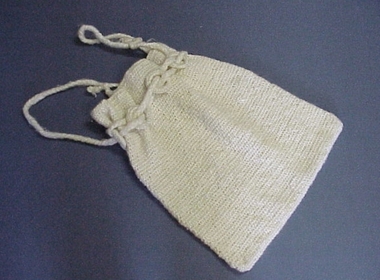
Bag, Costume
... Crocheted item by Joyce Hucker....Crochet Hucker Mrs Joyce Crocheted item by Joyce Hucker. Bag, Costume ...Crocheted example by Joyce Hucker. Hucker began working with unspun wool and making dyes from the natural sources from her garden and the farm trees around her. From knitting and croceting articles, she progressed to felting and a 'wrapping' technique, always using unspun wool. She was a successful exhibitor at many craft shows and was always willing to pass on her experience and knowledge to others, often travelling widely to help groups requiring a demonstration.Crocheted item by Joyce Hucker.crochet, hucker, mrs joyce -
 Kiewa Valley Historical Society
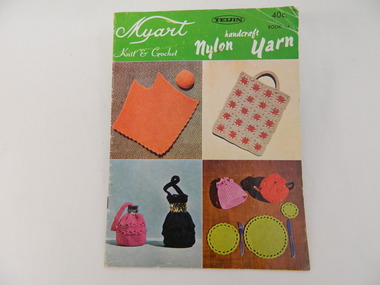
Book - Country Women's Association of Victoria, Myart Knit & Crochet
... The book has patterns with instructions for knitted & crocheted items....The book has patterns with instructions for knitted & crocheted items. Myart Knit & Crochet Book - Country Women's Association of Victoria ...This book was used by members of the Tawonga C.W.A.. The group exhibited their handicrafts and made items for charity. The Tawonga branch of the C.W.A. commenced on the 7th Feb. 1946 and often combined activities with the other branches in the Kiewa Valley. The C.W.A. aimed to improve health, welfare and education for women and children in the country.Women living in Tawonga were mostly on farms and, in 1946, when the branch commenced would have been feeling more remote with WW11 having had an effect on available workers and the well being of the women and children.Small coloured 16 page book with a cover showing 4 squares of knitted and crocheted items. At the top the book has a light green background with white writing and some black writing. The back cover is similar with 4 different items. The book is bound with 2 staples. The book has patterns with instructions for knitted & crocheted items.Cover: 'Myart / Knit & Crochet' - on left. 'Handcraft / Nylon Yarn' - on right. 'Teijin 40c / Book 14' - top right in blackcountry women's association of victoria. tawonga. handcrafts. knitting. crocheting. -
 Musculoskeletal Health Australia (now held by the Glen Eira Historical Society)
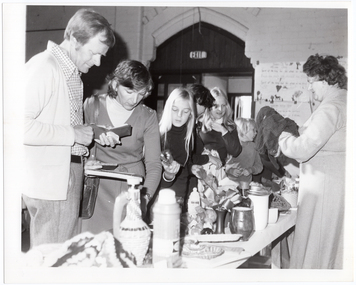
Photograph - Group photo, Ben Baxter, 27/05/1978
... In front of them is a trestle table full of various items, from vases and small dishes to a vacuum drink flask and some knitted or crocheted items....In front of them is a trestle table full of various items, from vases and small dishes to a vacuum drink flask and some knitted or crocheted items. Photograph Group photo Ben Baxter ...On Friday the 26th and Saturday the 27th of May, 1978, an art and craft exhibition was held as a fundraising event in support of the Rheumatism and Arthritis Association of Victoria (RAAV). Titled, "Living with Arthritis - Aids to Daily Living", the exhibition was held at St Andrew's Parish Hall in Brighton. A second "Living with Arthritis" exhibition was held two months later in Footscray. Henceforth, the respective events were commonly referred to as "the Brighton exhibition" and "the Footscray exhibition". A fashion parade and panel discussion were also held as part of the two-day event. In this photo, visitors browse the bric-a-brac stalls at the Aid to Daily Living art & craft exhibition.B&W photo of a several people, of all ages, browsing at a bric-a-brac stall. In front of them is a trestle table full of various items, from vases and small dishes to a vacuum drink flask and some knitted or crocheted items.[handwritten in pencil] Aid to Daily Living art & craft [in light blue ink] Page 5 [in pencil] news reviewrheumatism and arthritis association of victoria, raav, living with arthritis, aids to daily living, art and craft, exhibition, market stalls, bric-a-brac, fundraising, news review, 1978 -
 National Wool Museum
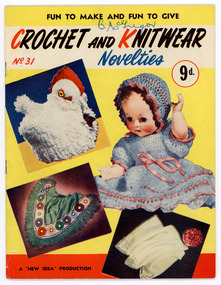
Book - Crochet and Knitwear Novelties, No 31, New Idea, c.1950s
... Front cover shows a colour image knitted items, a chicken tea cosy, knitted dolls outfit, and two crocheted textile items. ..., a chicken tea cosy, knitted dolls outfit, and two crocheted textile items. Book Crochet and Knitwear Novelties, No 31 New Idea ...Eighteen page black and white pattern book with colour front and back cover. Book contains black and white photographs and printed text. Front cover shows a colour image knitted items, a chicken tea cosy, knitted dolls outfit, and two crocheted textile items. front: [printed] FUN TO MAKE AND FUN TO GIVE / CROCHET AND KNITWEAR / Novelties / No 31 / 9 d. / A “NEW IDEA” PRODUCTIONfashion, women, knitting, crochet, home life, patterns -
 Flagstaff Hill Maritime Museum and Village
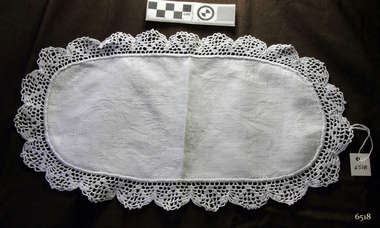
Textile - Doily, c. 1910
... CONTEXT Embroidered and Crocheted Items This doily is typical of items of household linen in popular use in the 19th and early-to-mid 20th centuries. ...CONTEXT Embroidered and Crocheted Items This doily is typical of items of household linen in popular use in the 19th and early-to-mid 20th centuries. ...CONTEXT Embroidered and Crocheted Items This doily is typical of items of household linen in popular use in the 19th and early-to-mid 20th centuries. It was a tradition for brides to have a 'glory box' containing linen and embroidered and crocheted articles to take to their new home. In the Words of donor, Betty Stone, … “These crocheted and embroidered articles cover a period of three generations- ie. Sarah (nee Chamberlain) Lees, Ann (nee Lees) Dale, and Daisy Elvena (nee Dale) Welsh. All three were accomplished needlewomen; also, both Sarah Lees (born 1844) and her daughter, Ann (b 1865) crocheted a wide variety of articles for use in their homes. A few examples of these items have survived the years.” (NOTE: For additional information please refer to my book Pioneer and Places- A History of Three Warrnambool Pioneering Families ie. Chamberlain, Dale and Lees families)This item is associated with the Warrnambool pioneer families of Chamberlain, Dale and Lees. These families are listed in the Pioneers' Register for Warrnambool Township and Shire, 1835-1900, published by A.I.G.S. Warrnambool Branch. The item is a fine example of early 20th-century needlework.Doily, oblong white floral pattern weave fabric with crocheted edging. From the Chamberlain Dale Lees Collection.flagstaff hill, warrnambool, flagstaff hill maritime museum and village, great ocean road, chamberlain family, dale family, lees family, betty stone, warrnambool pioneer, warrnambool genealogy, wangoom, chamberlain dale lees collection, glory box, doily, needlework, crochet, handmade, craft, manchester, linen, haberdashery -
 Phillip Island and District Historical Society Inc.
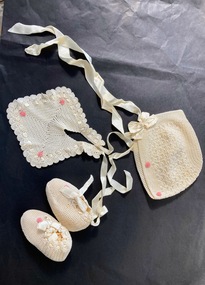
Clothing, Baby's layette
... Items were crocheted about 1950 by Minnie Grachan of Back Beach, Ventnor for Mrs Dot Coutts nee Jones. ...Items were crocheted about 1950 by Minnie Grachan of Back Beach, Ventnor for Mrs Dot Coutts nee Jones. ...Items were crocheted about 1950 by Minnie Grachan of Back Beach, Ventnor for Mrs Dot Coutts nee Jones. She had 3 daughters so the items were never used.HistoricalCream coloured, finely crocheted layette set of bonnet, bib and booties with cream satin ribbon and pink flowersN/Alayette, crochet, baby clothes, clothing, grachen family, jones family -
![COL photo of four women inside a shop. They are sorting through clothing and other items. In the foreground, one woman is holding a small toddler's dress on a coathanger. She is looking down at the dress. There are racks of hanging clothes in front of and behind her. In the backgound, two women are holding up a crocheted blanket and a small item of clothing, respectively. They are standing behind a row of large square display bins. Another woman is standing further back in the same aisle. She is turning away from the camera. On the wall behind the three women, there is a large orange, black, and white sign just below the ceiling. The text on the sign says, "ARTHRITIS", "Something can be done!" [the word 'can' is underlined], "ARTHRITIS FOUNDATION OF VICTORIA PHONE 862 2555".](/media/collectors/6406aa055b62820f1ee406c8/items/68884b64aa506c2d1b98a2ba/item-media/68884d23aa506c2d1b98a827/item-fit-380x285.jpg?cb=6) Musculoskeletal Health Australia (now held by the Glen Eira Historical Society)
Musculoskeletal Health Australia (now held by the Glen Eira Historical Society)Photograph - Group photo, 1999
... Volunteer Arthritis Foundation of Victoria members sort through clothing, a crocheted blanket, and other items at Arthritis Foundation of Victoria's Malvern Opportunity Shop. ...items. In the foreground, one woman is holding a small toddler's dress on a coathanger. She is looking down at the dress. There are racks of hanging clothes in front of and behind her. In the backgound, two women are holding up a crocheted...Volunteer Arthritis Foundation of Victoria members sort through clothing, a crocheted blanket, and other items at Arthritis Foundation of Victoria's Malvern Opportunity Shop. ...Volunteer Arthritis Foundation of Victoria members sort through clothing, a crocheted blanket, and other items at Arthritis Foundation of Victoria's Malvern Opportunity Shop. The op shop was located at 1428 High Street, Malvern. A cropped black and white version of this photo appears on page 20 of the 1999 Annual Report. The photo accompanies a brief report titled "Opportunity Shops".COL photo of four women inside a shop. They are sorting through clothing and other items. In the foreground, one woman is holding a small toddler's dress on a coathanger. She is looking down at the dress. There are racks of hanging clothes in front of and behind her. In the backgound, two women are holding up a crocheted blanket and a small item of clothing, respectively. They are standing behind a row of large square display bins. Another woman is standing further back in the same aisle. She is turning away from the camera. On the wall behind the three women, there is a large orange, black, and white sign just below the ceiling. The text on the sign says, "ARTHRITIS", "Something can be done!" [the word 'can' is underlined], "ARTHRITIS FOUNDATION OF VICTORIA PHONE 862 2555".[In the top left corner, handwritten in blue ink] 18 [On a white label, handwritten in blue ink] Malvern Opportunity Shop & volunteer staff 6 [the number '6' is circled]arthritis foundation of victoria, afv, opportunity shop, op shop, charity shop, thrift store, fundraising, clothing, apparel, glassware, crockery, bric-a-brac, framed prints, framed pictures, volunteers, members, malvern, annual report, 1999 -
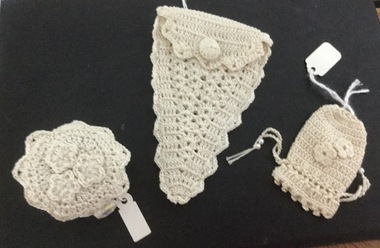 Mont De Lancey
Sewing kit
... Set of 3 antique white, crocheted sewing equipment items: Scissors bag, tape measure holder and a thimble bag, each with a different crocheting pattern. ...Set of 3 antique white, crocheted sewing equipment items: Scissors bag, tape measure holder and a thimble bag, each with a different crocheting pattern. ...Worked by Edna Parker (nee Rouget)Set of 3 antique white, crocheted sewing equipment items: Scissors bag, tape measure holder and a thimble bag, each with a different crocheting pattern. The scissors bag has a crocheted button closer, the tape measure holder has 3 crocheted flowers and 3 small crystal beads on the lid and a toggle-shaped crystal closer and the thimble bag has a cotton drawstring closer with 2 pearl beads on either side and 2 crocheted flowers on front side of bag.sewing equipment, personal effects. -
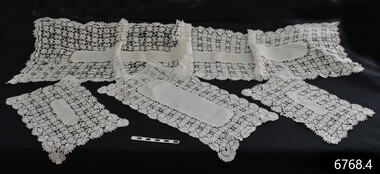 Flagstaff Hill Maritime Museum and Village
Textile - Dollies & table runner set, Vera and Aurelia Giles, Late 19th to Early 20th century
... These hand crafted, crocheted table linen items are part of the many 19th century items of furniture, linen and crockery donated to Flagstaff Hill Maritime Village by, Vera and Aurelin Giles. ...These hand crafted, crocheted table linen items are part of the many 19th century items of furniture, linen and crockery donated to Flagstaff Hill Maritime Village by, Vera and Aurelin Giles. ...These hand crafted, crocheted table linen items are part of the many 19th century items of furniture, linen and crockery donated to Flagstaff Hill Maritime Village by, Vera and Aurelin Giles. The items are associated with Warrnambool and the Giles Family history. Items donated by the family have come to be known as the “Giles Collection”. Many items in the Lighthouse Keeper’s Cottage were donated by Vera and Aurelin Giles and mostly came from the home of Vera’s parents-in-law, Henry Giles and his wife Mary Jane (nee Freckleton) who married in 1880 and whose photos are on display in the parlour. Henry was born at Tower Hill in 1858, and was a labourer on the construction of the Warrnambool Breakwater before leaving in 1895 for around seven years to build bridges in NSW. Mary Jane was born in 1860 at Cooramook and she attended Mailor’s Flat State School and where she eventually was to become a student teacher. After which she became a governess at “Injemiara” where her grandfather, Francis Freckleton, had once owned land. Henry and Mary’s family consisted of six, some of the children were born at Mailor’s Flat and later some children at Wangoom. They lived with their parents at Wangoom and Purnim west, and this is where Henry died in 1933 and Mary Jane in 1940.The Giles family collection is of social significance at a local level, because it not only illustrates the level of material support the Warrnambool community gave to Flagstaff Hill during it’s establishment. But the Giles collection also gives us today a snapshot into what domestic life was like in early colonial times prior to Federation.Set of three lace doilies & a table runner white, rectangular pieces, hand crocheted wide borders with white linen hand stitched into the centre. (Part of the Giles Collection)Nonewarrnambool, shipwrecked-coast, flagstaff-hill, flagstaff-hill-maritime-museum, shipwreck-coast, flagstaff-hill-maritime-village, giles collection, henry giles, tower hill, warrnambool breakwater, mailor’s flat, wangoom, textiles, victorian household items -
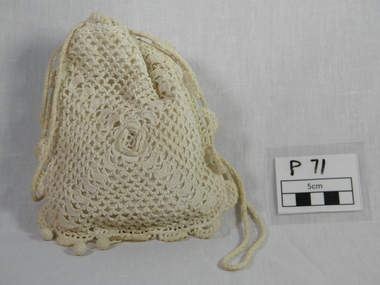 Bright & District Historical Society operating the Bright Museum
Handbag, 20th century
... items were an important feature of home and social life in rural districts in the 19th and 20th centuries. Of some local social significance. home made handcraft handbag evening bag bridal wear crotchet work hand work decorative work None White cotton hand crocheted teardrop shape evening bag, mesh pattern with scallops radiating from rose motif in centre (front and back), scalloped edge, 3 small decorative baubles, lined with fine cotton,with drawcord. ...While the exact history of this item is not recorded, handworked items were an important feature of home and social life in rural districts in the 19th and 20th centuries. Of some local social significance.White cotton hand crocheted teardrop shape evening bag, mesh pattern with scallops radiating from rose motif in centre (front and back), scalloped edge, 3 small decorative baubles, lined with fine cotton,with drawcord. Condition and colour good. Age not determined but probably 20th century.Nonehome made, handcraft, handbag, evening bag, bridal wear, crotchet work, hand work, decorative work -
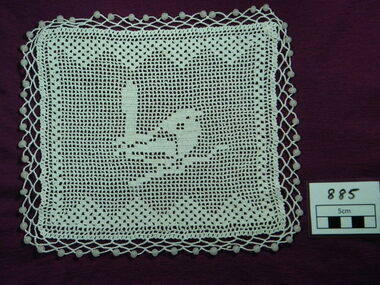 Blacksmith's Cottage and Forge
Jug cover, Early to mid 20th century
... items for the home. Part of Ellen Brown collection. Ellen Brown lived her whole life in Bacchus Marsh - she died aged 103 in 2009. She never married and excelled at home duties, eg., needlework, cooking. She won prizes at local shows for cakes, jam making, and preserves. She was a well known identity in the town. lace ellen brown milk crochet ...Covers were used to place over a jug to keep insects out of the liquid (usually milk). This sort of item was used in days before refrigeration. It also demonstrated womens ability to make items for the home.Part of Ellen Brown collection. Ellen Brown lived her whole life in Bacchus Marsh - she died aged 103 in 2009. She never married and excelled at home duties, eg., needlework, cooking. She won prizes at local shows for cakes, jam making, and preserves. She was a well known identity in the town.Square white beaded jug cover in ecru colored cotton. Crocheted central bird pattern with triangular pattern top and bottom. White beads attached on perimeter.lace, ellen brown, milk, crochet, jug cover, home duties, blue wren, beads -
 Flagstaff Hill Maritime Museum and Village
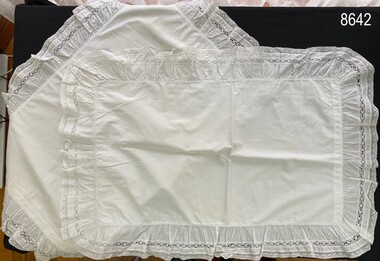
Textile - Pillowcase Pair
... item is of significance socially as an example of decorative domestic objects in the early 1900s. Flagstaff Hill Maritime Museum and Village Great Ocean Road Shipwreck Coast pillowcase decorative lace edging domestic object pair of pillowcases cotton crochet lace Warrnambool textile Pair of pillowcases made from soft white cotton and machine stitched. ...An example of a pair of pillowcases from the early 1900s. The item is of significance socially as an example of decorative domestic objects in the early 1900s.Pair of pillowcases made from soft white cotton and machine stitched. Cotton ties are sewn into the back of each pillowcase. A combination of material and hand crocheted lace forms the edging of each pillowcase.flagstaff hill maritime museum and village, great ocean road, shipwreck coast, pillowcase, decorative lace edging, domestic object, pair of pillowcases, cotton, crochet lace, warrnambool, textile -
 Flagstaff Hill Maritime Museum and Village
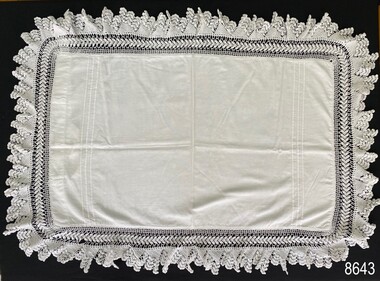
Textile - Lace Edged Pillowcase
... The item is of significance socially as an example of decorative domestic objects in the early 1900s. Flagstaff Hill Maritime Museum and Village Great Ocean Road Shipwreck Coast Warrnambool pillowcase cotton crochet lace domestic object textile decorative lace edging Single pillowcase made from soft white cotton with a crochet lace edge. ...An example of a decorative domestic object from the early 1900s.The item is of significance socially as an example of decorative domestic objects in the early 1900s.Single pillowcase made from soft white cotton with a crochet lace edge. The pillowcase is machine stitched and on the front has three fine pintucks at each end. The lace edging has been handstitched on.flagstaff hill maritime museum and village, great ocean road, shipwreck coast, warrnambool, pillowcase, cotton, crochet lace, domestic object, textile, decorative lace edging -
 Flagstaff Hill Maritime Museum and Village
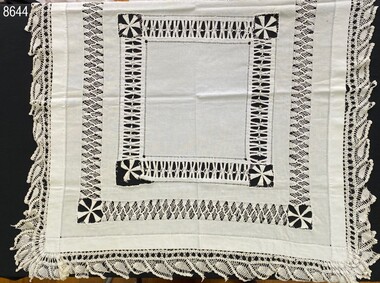
Textile - Drawn thread tablecloth
... item is of significance socially as an example of a decorative domestic object from the early 1900s. It is a fine example of drawn thread embroidery. Flagstaff Hill Maritime Museum and Village Great Ocean Road Shipwreck Coast Great Ocean Road Tablecloth linen crochet lace drawn thread work textile domestic object decorative lace edging Handmade decorative tablecloth created from soft white linen. ...Drawn thread was an embroidery technique that appeared in the 17th century. In the late 19th and early 20th century it was used on linen and cotton to create decorative functional items such as this tablecloth. The item is of significance socially as an example of a decorative domestic object from the early 1900s. It is a fine example of drawn thread embroidery.Handmade decorative tablecloth created from soft white linen. A crochet lace edge decorates the outer edge of the tablecloth and drawn thread work has been used to create two large inner borders as well as fine edging borders.flagstaff hill maritime museum and village, great ocean road, shipwreck coast, great ocean road, tablecloth, linen, crochet lace, drawn thread work, textile, domestic object, decorative lace edging -
 Flagstaff Hill Maritime Museum and Village
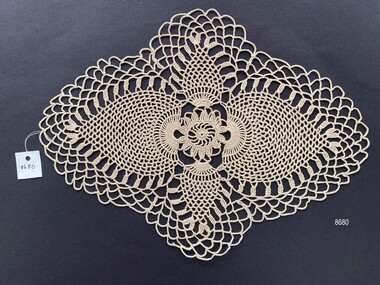
Textile - Crocheted Doily
... The doily is part of a larger collection of textile items owned by Alice Matilda Barrie who was born in 1885. According to family members Alice was a talented crocheter and it would be presumed that she crocheted this doily as it is similar to patterns available in the 1940s. ...The doily is part of a larger collection of textile items owned by Alice Matilda Barrie who was born in 1885. According to family members Alice was a talented crocheter and it would be presumed that she crocheted this doily as it is similar to patterns available in the 1940s. ...The doily is part of a larger collection of textile items owned by Alice Matilda Barrie who was born in 1885. According to family members Alice was a talented crocheter and it would be presumed that she crocheted this doily as it is similar to patterns available in the 1940s. The doily is an example of a handcrafted crocheted object used to decorate homes in the late nineteenth and early 20th century.A hand crocheted oval doily in the pineapple pattern. To the left and right are two large 'leaf' shaped motifs which are repeated to a smaller scale on the top and bottom of the pattern. The four motifs are placed around a central flower shape. The whole piece is edged using an open crochet style.flagstaff hill maritime museum and village, great ocean road, shipwreck coast, doily, crochet, crocheted doily, pineapple crochet pattern, pineapple whirl crochet pattern, late nineteenth century, early twentieth century, decorative household object -
 Flagstaff Hill Maritime Museum and Village
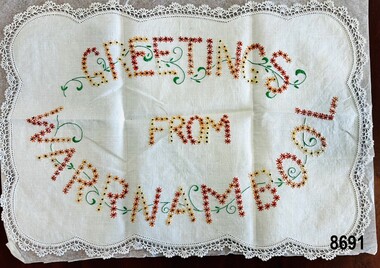
Textile - Embroidered Tray Cloth, circa 1950s to 1970's
... items often featured local land marks, flora or fauna, maps or emblems of a particular region. This example appears to be handmade using a plain tray cloth with a punctured border ready for the maker to add her own embroidered design and crocheted edge - rather than using a mass produced prestamped design....items often featured local land marks, flora or fauna, maps or emblems of a particular region. This example appears to be handmade using a plain tray cloth with a punctured border ready for the maker to add her own embroidered design and crocheted edge - rather than using a mass produced prestamped design. ...This embroidered tray cloth is a souvenir of Warrnambool and may have been made to remember a holiday or as a gift. Embroidered silk postcards sent by soldiers in WW1 to their families back home, were an early example of embroidered souvenirs. In peacetime, tourists would buy embroidered teatowels, badges, scarves or hankies etc as souvenirs of their trip or to give to friends or family. These items often featured local land marks, flora or fauna, maps or emblems of a particular region. This example appears to be handmade using a plain tray cloth with a punctured border ready for the maker to add her own embroidered design and crocheted edge - rather than using a mass produced prestamped design.This item is a significant example of an Australian handmade embroidered souvenir designed and made as a remembrance of Warrnambool. It is also a significant example of Australian Women's domestic handcraft.Rectangular cotton tray cloth with the words "Greetings from Warrnambool" embroidered in lazy daisy stitch using an orange variegated cotton. A simple stem and leaf design in green stem stitch runs through the letters and the gently curved edge is finished with a white cotton crocheted border.GREETINGS / FROM / WARRNAMBOOLflagstaff hill maritime museum and village, warrnambool, great ocean road, embroidery, embroidered tray cloth, souvenir, embroidered souvenir, tray cloth -
 Flagstaff Hill Maritime Museum and Village
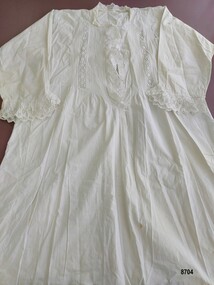
Textile - Nightgown, Circa 1900
... Although the basic design of the nightgown was fairly simple, the wearer was free to add various types of trim e.g. lace, crochet, pintucks, embroidery etc. This item is an example of the needlework skills of women in the late 19th and early 20th century - combining machine stitching with hand embroidery to personalise and embellish a practical item of clothing. ...This item is one of a collection of clothing items that belonged to the Stephenson family who lived at 22 McCracken Street, Kensington, Melbourne. Matthew Stephenson (1861 – 1943) who had grown up on the Bendigo goldfields and shifted to Melbourne in the early 1900’s was a train driver and later, a fireman with the railways. His wife Elizabeth Jane (Betsy) Wigley (1865 – 1953) also grew up on the goldfields around Majorca and Bendigo. They married in 1885 in Bendigo. They had two daughters – Ethel Evelyn Stephenson (1886 – 1956) and Lillian or Lila (1891 – 1977) who were milliners and dressmakers and who continued to live in the family home after the death of their parents. The family are recorded as living at 22 McCracken Street, Kensington, as early as 1914. It is not known who made or owned the clothing that makes up this collection but as it appears to be from the late Victorian and early Edwardian era, the different pieces were probably made and worn by any of the three ladies of the house – Betsy, Ethel and/or Lila. During W.W.2, a local Warrnambool couple (Meryl and Tony Everard) boarded with them – Tony was in the airforce training paratroopers to jump into (and survive) enemy territory and his wife Meryl worked in the Methodist baby Home. The Everards developed a close friendship with the Stephensons and were responsible for clearing out the house (and finding this clothing collection) after Lila died in 1977. This nightgown is machine sewn and has an added detailed design of pintucks and broderie anglaise lace to the front yoke and cuffs as a decorative element. The 1800's bought a shift in attitude towards modesty as the Victorian era progressed and by the mid to late 1800's it had become more acceptable ladies to wear simple, modest nightgowns. They tended to have a very loose fit and were usually made of linen, cotton or flannel, which had the advantage of providing warmth and also being easy to wash - a necessity for a garment worn next to the skin. Although the basic design of the nightgown was fairly simple, the wearer was free to add various types of trim e.g. lace, crochet, pintucks, embroidery etc.This item is an example of the needlework skills of women in the late 19th and early 20th century - combining machine stitching with hand embroidery to personalise and embellish a practical item of clothing. A full length lady's cotton nightgown with long sleeves finished with a diagonal pointed cuff of broderie anglaise. The bodice features a front opening placket with 3 buttons and buttonholes and a broderie anglaise cover. On either side of the placket, the bodice has been decorated with rows of vertical pintucks and a broderie anglaise panel insert. There is also a frill of broderie anglaise lace around the neck. The back of the nightgown is gathered onto a yoke.flagstaff hill maritime museum and village, great ocean road, shipwreck coast, warrnambool, nightgown, lady's nightgown, needlework, sewing, broderie anglaise, pintucks, stephenson family -
 Flagstaff Hill Maritime Museum and Village
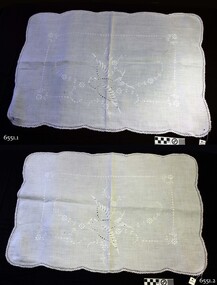
Textile - Pillow Shams, Daisy Dale, 1844-1900
... All three were accomplished needlewomen, both Sarah Lees (born 1844) and her daughter, Ann (1865) these women crocheted a wide variety of articles for use in their homes. Today we have a few surviving examples of their skill that has survived the years. This item ...The two embroidered pillow shams were made by Betty Stones's mother Daisy (nee Dale) Welsh. A number of crocheted and embroidered articles were donated to Flagstaff Hill Museum by Betty Stone who advised that they cover a period of three generations from Sarah (nee Chamberlain) Lees, Ann (nee Lees) Dale, and Daisy Elvena (nee Dale) Welsh. All three were accomplished needlewomen, both Sarah Lees (born 1844) and her daughter, Ann (1865) these women crocheted a wide variety of articles for use in their homes. Today we have a few surviving examples of their skill that has survived the years.This item and others in the collection donated by Betty Stone are significant for their association with the early Warrnambool pioneering families of Chamberlain, Dale and Lees. These families are listed in the "Pioneers' Register" for Warrnambool Township and Shire, 1835-1900, and published by A.I.G.S. Warrnambool Branch. The item is a fine example of early 20th-century needlework and handmade domestic items.A pair of white pillow shams, rectangular in shape with a shallow scalloped crochet edge. The embroidered central design includes a bird motif. Made by Daisy Walsh (nee Dale). Part of the Chamberlain Dale Lees Collection.flagstaff hill, warrnambool, flagstaff hill maritime museum and village, great ocean road, chamberlain family, dale family, lees family, betty stone, warrnambool pioneer, warrnambool genealogy, wangoom, chamberlain dale lees collection, glory box, handmade, craft, manchester, linen, haberdashery, needlework, crochet, pillow shams, bed linen, pillow covers, daisy dale, daisy welsh, betty stone's mother -
 Flagstaff Hill Maritime Museum and Village
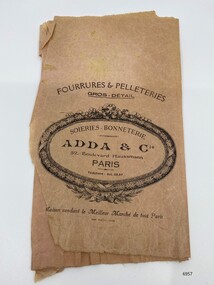
Container - Brown paper shopping bag from Adda & Co. Paris, c. early 20th century
... crocheted silks, furs and hides. History of shopping bags: Before the late 1800s, shopping bags didn’t exist. Shoppers would either carry their goods home in baskets, or have the merchant deliver them to people's homes, until 1852 when Francis Wolle, a schoolteacher in Pennsylvania, invented a machine to produce paper shopping bags. This invention would allow customers to carry items...crocheted silks, furs and hides. History of shopping bags: Before the late 1800s, shopping bags didn’t exist. Shoppers would either carry their goods home in baskets, or have the merchant deliver them to people's homes, until 1852 when Francis Wolle, a schoolteacher in Pennsylvania, invented a machine to produce paper shopping bags. This invention would allow customers to carry items ...Adda & Co operated a business at 52 Boulevard Haussmann, Paris.The store sold crocheted silks, furs and hides. History of shopping bags: Before the late 1800s, shopping bags didn’t exist. Shoppers would either carry their goods home in baskets, or have the merchant deliver them to people's homes, until 1852 when Francis Wolle, a schoolteacher in Pennsylvania, invented a machine to produce paper shopping bags. This invention would allow customers to carry items home in disposable paper bags. Soon after, owners of department stores and retailers began to realise that paper shopping bags could be used to help market their brands, and as such custom shopping bags with printed logos became common place. Carrying a shopping bag from certain shops became a type of status symbol for consumers, providing evidence that one was well-off, had good taste, or both.The paper shopping bag is a rare survival of ephemera related to a retail store called Adda &Co that operated at 52 Boulevard Haussmann, Paris. The arrival of waves of more than ten million migrants by boat is one of the major themes in Australia’s history. The paper shopping bag is representative of personal items purchased for migrant journeys as markers of domesticity, warmth and making oneself at home in a new land that speaks of the transnational lives embedded in threads of migration.A brown paper shopping bag with a printed logo and store information in black inkparis, department store, shopping, adda & co, flagstaff hill, maritime museum -
 Flagstaff Hill Maritime Museum and Village
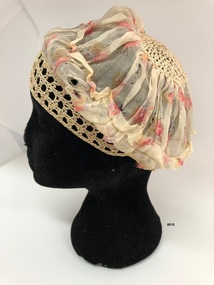
Headwear - Lady's boudoir cap, Early 1900s
... item holds significance as a possession of the donor’s Great Aunts who worked as dressmakers at the original Terang & District Co-Op established in 1908. Flagstaff Hill Warrnambool Maritime Village Maritime Museum Flagstaff Hill Maritime Museum & Village Shipwreck Coast Great Ocean Road Boudoir Cap Nightcap female headwear sleepwear Vintage women's clothing Terang & District Co-Op The boudoir cap is constructed of cream silk with a pale floral pattern. A cream crocheted ...Simple night caps had been worn by women in the 1800s for practical purposes such as to keep warm at night. In the early 1900s silk boudoir caps became popular to protect hairstyles while sleeping. It was also thought to maintain or even improve the condition of the hair. This boudoir cap was amongst the belongings of the donor's Great Aunts who were both dressmakers at the original Terang & District Co-Op which was established in 1908.Socially this item is significant as an example of women's headwear from the early 1900s. Historically this item holds significance as a possession of the donor’s Great Aunts who worked as dressmakers at the original Terang & District Co-Op established in 1908.The boudoir cap is constructed of cream silk with a pale floral pattern. A cream crocheted border and top insert are attached using hand stitching. The small ruffle is machine stitched. The silk fabric is fragile and has perished in some places.flagstaff hill, warrnambool, maritime village, maritime museum, flagstaff hill maritime museum & village, shipwreck coast, great ocean road, boudoir cap, nightcap, female headwear, sleepwear, vintage women's clothing, terang & district co-op -
 Flagstaff Hill Maritime Museum and Village
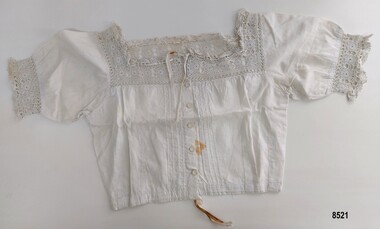
Clothing - Corset cover, Eliza Towns, Mid to late 19th century
... crocheted decorative trim. This corset cover is an excellent example of an everyday clothing item with the decorative trim favoured by women in the late Victorian era. ...This item is an example of the needlework skills of women in the late 19th century - combining machine stitching with hand embroidery and crochet to embellish an item of personal underclothing. ...This corset cover is one of several linen and clothing items that were made and belonged to Mrs. Eliza Towns and donated to Flagstaff Hill Maritime Museum and Village. Eliza was born Eliza Gould in 1857 in South Melbourne (Emerald Hill) and in 1879 married Charles Towns. In the early 1880's they moved to Nhill in western Victoria and remained there for the rest of their married life. Charles was a jeweller and later became an accountant and for many years was involved with the Shire Council, the local show committee (A & P Society), the Hospital Committee and the Board of the local newspaper (the Nhill Free Press). They had three children and lived a life that would be regarded as comfortably "middle class". Eliza probably had a treadle sewing machine and would have made many of her own clothes as well as clothes for her children - adding her own handmade embroidered or crocheted decorative trim. This corset cover is an excellent example of an everyday clothing item with the decorative trim favoured by women in the late Victorian era. Eliza Towns has added pintucks, embroidered feather stitch and a highly decorative hand crocheted lace trim to the neckline, sleeves and front of the bodice. Corset covers (sometimes called camisoles) began to appear in women's fashion around 1840 and continued through the late Victorian decades into the Edwardian era. The long chemise was considered too bulky to cover the corset and so the corset cover was developed to be short and light and was worn over the corset and under the bodice of the outer garment. A woman would dress into her chemise and drawers first, followed by her corset and finally her corset cover as a final layer under her dress. Corset covers served several purposes. They provided protection against sweat (and the need to regularly wash the corset), helped smooth the lines of the corset and increased a woman's modesty.This item is an example of the needlework skills of women in the late 19th century - combining machine stitching with hand embroidery and crochet to embellish an item of personal underclothing. It is also significant as an example of a practical solution to the difficulty of hand washing a corset in the Victorian era.A short (waist length) corset cover of fine cotton. Short sleeves fall from a square neckline and are gathered into a wide crocheted lace trim with a band of embroidered feather stitch. The same crocheted lace design and feather stitching are also on the square neckline which is finished with a drawstring ribbon. The bodice has a front opening with five buttons and is bordered on each side with four pintucks. It has a drawstring ribbon at the waist and an extra layer of fine cotton lining has been added to strengthen the corset cover under the arms. The back has two bands of three pintucks running vertically from the neckline to the waist.flagstaff hill, flagstaff hill maritime museum & village, warrnambool, great ocean road, shipwreck coast, nhill, wimmera, eliza towns, underclothing, corset cover, camisole, machine sewing, hand sewing, crocheted lace, pintucks, feather stitch, embroidery, underwear, victorian era underclothing, victorian era corset cover -
 Flagstaff Hill Maritime Museum and Village
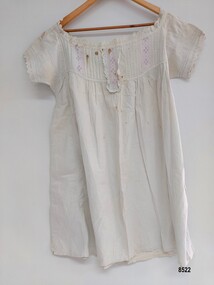
Clothing - Chemise, Eliza Towns, Late Victorian era
... crocheted decorative trim. This chemise is machine sewn by Eliza Towns and she has added pintucks and broderie anglaise lace as a decorative element. A chemise was usually a sleeveless garment made of linen or cotton (so they could be easily washed) and its shape was much like a modern day nightgown. The name comes from the French word for "shirt" or "shift". Women wore chemises next to the skin (under the corset) to keep stains and odors away from the less washable corset and gown. This item ...This chemise is one of several linen and clothing items that were made and belonged to Mrs. Eliza Towns and donated to Flagstaff Hill Maritime Museum and Village. Eliza was born Eliza Gould in 1857 in South Melbourne (Emerald Hill) and in 1879 married Charles Towns. In the early 1880's they moved to Nhill in western Victoria and remained there for the rest of their married life. Charles was a jeweller and later became an accountant and for many years was involved with the Shire Council, the local show committee (A & P Society), the Hospital Committee and the Board of the local newspaper (the Nhill Free Press). They had three children and lived a life that would be regarded as comfortably "middle class". Eliza probably had a treadle sewing machine and would have made many of her own clothes as well as clothes for her children - adding her own handmade embroidered or crocheted decorative trim. This chemise is machine sewn by Eliza Towns and she has added pintucks and broderie anglaise lace as a decorative element. A chemise was usually a sleeveless garment made of linen or cotton (so they could be easily washed) and its shape was much like a modern day nightgown. The name comes from the French word for "shirt" or "shift". Women wore chemises next to the skin (under the corset) to keep stains and odors away from the less washable corset and gown.This item is an example of the needlework skills of women in the mid to late 19th century - combining machine stitching with hand embroidery to personlise and embellish an item of clothing. It is also significant as an example of a practical solution to the difficulties of needing to regularly hand wash a bulky outer garment or gown in the Victorian era.A white cotton, short sleeved, knee length chemise. The fabric at the front is gathered on a yoke which is decorated with bands of five pintucks alternating with broderie anglaise lace and embroidered strips lined with pink ribbon. A different broderie anglaise design decorates the sleeve edges, neckline and center broderie anglaise strip. The back of the chemise is gathered on to the neckline. There are two bands of pintucks on each sleeve. The fabric around each armhole has been strengthened with another layer of cotton and a length of cotton has been added (from the left shoulder to the hem) to increase the width of chemise.flagstaff hill, flagstaff hill maritime museum and village, warrnambool, great ocean road, south west victoria, victorian era, victorian era undergarments, chemise, victorian era chemise, undergarments, pintucks, victorian chemise, eliza towns, nhill, wimmera, home sewing, machine sewn, hand made -
 Flagstaff Hill Maritime Museum and Village
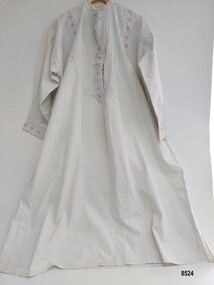
Clothing - Nightgown, Eliza Towns, circa 1890's
... Although the basic design of the nightgown was fairly simple, the wearer was free to add various types of trim e.g. lace, crochet, pintucks, embroidery etc. This item is an example of the needlework skills of women in the late 19th century - combining machine stitching with hand embroidery to personalise and embellish a practical item of clothing. ...This nightgown is one of several linen and clothing items that were made and belonged to Mrs. Eliza Towns and donated to Flagstaff Hill Maritime Museum and Village. Eliza was born Eliza Gould in 1857 in South Melbourne (Emerald Hill) and in 1879 married Charles Towns. In the early 1880's they moved to Nhill in western Victoria and remained there for the rest of their married life. Charles was a jeweller and later became an accountant and for many years was involved with the Shire Council, the local show committee (A & P Society), the Hospital Committee and the Board of the local newspaper (the Nhill Free Press). They had three children and lived a life that would be regarded as comfortably "middle class". Eliza probably had a treadle sewing machine and would have made many of her own clothes as well as clothes for her children - adding her own handmade embroidered or crocheted decorative trim. This nightgown is machine sewn by Eliza Towns and she has added a detailed design of pintucks and broderie anglaise lace to the front yoke and cuffs as a decorative element. The 1800's bought a shift in attitude towards modesty as the Victorian era progressed and by the mid to late 1800's it had become more acceptable ladies to wear simple, modest nightgowns. They tended to have a very loose fit and were usually made of linen, cotton or flannel, which had the advantage of providing warmth and also being easy to wash - a necessity for a garment worn next to the skin. Although the basic design of the nightgown was fairly simple, the wearer was free to add various types of trim e.g. lace, crochet, pintucks, embroidery etc.This item is an example of the needlework skills of women in the late 19th century - combining machine stitching with hand embroidery to personalise and embellish a practical item of clothing. It is also significant as an example of a practical solution to the difficulties that women of this era faced with regard to the washing of clothes and household linens.Lady's long, white, cotton nightgown with a V shaped bodice decorated with bands of nine pintucks alternating with strips of broderie anglaise lined with pink ribbon. The opening front placket and neckline are bordered with a simpler broderie anglaise lace. The long sleeves are gathered into cuffs with a matching V shape, pintuck and broderie anglaise design. The front placket fastens with three cream buttons although one is missing. The back of the nightgown has gathered fabric on a plain, narrow V shape yoke. A narrow gusset has been added to the both sides at the bottom of the nightgown.Noneflagstaff hill, flagstaff hill maritime museum and village, warrnambool, great ocean road, shipwreck coast, victorian era clothing, victorian era nightgown, nightgown, nightdress, eliza towns, nhill, wimmera, textiles, clothing, machine sewing, hand sewing, pintucks, broderie anglaise, sewing -
 Flagstaff Hill Maritime Museum and Village
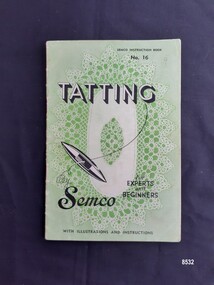
Book - Craft book, Norma Benporath, Tatting, circa 1940's
... crochet threads, they realized they had an untapped market to explore. Norma designed a collection of tatting patterns for Semco that were used to help promote their threads. Norma also worked with Semco to produce a line of threads and shuttles specifically suited to tatting. In 1997, Norma was inducted into the "Order of Australia" for "Service to the craft of tatting as a designer and through the international publication of her patterns". This item ...Tatting is a form of knotted lace making using thread and a small shuttle. Twisted threads are tied around or through small, pointed shuttles that can be made of bone, mother of pearl, tortoise shell, steel or plastic. This produces a stable, strong lace using simple knots of two half hitches to make rings and chains embellished with picots. The origins of tatting are not clear but early versions of decorative knotting were used by the Egyptians on their ceremonial dress. Tatting also has elements of fishermen's net making techniques and the decorative knotting that was practiced by aristocratic women from the 15th century. Tatting, as we know it today, emerged in the first half of the 19th century. The new availability of mercerised thread from 1835 encouraged a burgeoning of lace crafts of all sorts. It was known in Italy as "occhi" and in France as "la frivolite". Tatting looks fragile but is both strong and durable. An article in a column named "Wives and Daughters" published in the Star newspaper in May 1910 describes the durability of tatting lace - "there is edging and insertion still in existence that have outworn two sets of pillow slips." In the 19th century and well into the 20th century, tatting was used like crochet and knitted lace for decorative edgings, collars, doilies, tray cloths etc. At first, different tatting patterns were passed along by word of mouth from person to person, however in time, patterns regularly appeared in newspapers and magazines well into the 1950's. This book has photographs and detailed instructions for a wide range of tatted edgings and insertions suitable for household linens such as towels, doilies and tablecloths as well as patterns for whole mats. Stanley E. Mullen (a businessman) developed Semco Pty Ltd which began as a Melbourne based importation company in 1907. The first three letters of Semco's name were his initials. In 1915 it began manufacturing women's apparel, whitework and transfer patterns. In 1924 the company moved to Black Rock, Victoria and continued to produce an extensive range of needlework patterns and handcraft instruction booklets, threads etc. up until the late 1970's. Semco had a staff that included many young women. It was noted by E.J. Trait (editor of the local newspaper "Standard News") that the firm provided them with good working conditions and the correct rate of pay for women in a time of war - the starting rate for 15 year olds, mainly girls at Semco was 25 shillings per week. During World War 2, Manpower Regulations could be used to coerce workers to move into jobs that supported the war effort, but Trait argued that being employed at Semco could make this unlikely as the firm made some goods essential for the war effort. He even suggested that women be encouraged to produce needlework items (and play a part in the war effort) by sending them as presents, to the troops up north. He also heaped praise on the Semco workplace - noting that no Saturday work was the norm, allowing employees to shop and have "hair-do's" before enjoying a relaxing weekend! Semco also had a female cricket side in the women's Saturday association. After the war the firm stayed in production until the early 1990's when it was taken over by Coates-Paton Pty Ltd. Norma Benporath (1900 - 1998) was an expert in tatting techniques and taught and published extensively on the subject. She was born in New Zealand with impaired sight but cataract surgery restored 50% vision to one eye. She was inspired to learn tatting whilst watching her aunt tat and being told that tatting did not require as much sharp vision as embroidery. She quickly learnt to design her own patterns and published over 1000 tatted lace patterns between 1929 and 1952. She became a regular contributor to magazines (such as Home Beautiful) and newspapers across Australia. Her designs were also published in New Zealand, South Africa as well as the U.K. and U.S.A. When Semco, a thread manufacturer, noticed a rise in the sale of fine crochet threads, they realized they had an untapped market to explore. Norma designed a collection of tatting patterns for Semco that were used to help promote their threads. Norma also worked with Semco to produce a line of threads and shuttles specifically suited to tatting. In 1997, Norma was inducted into the "Order of Australia" for "Service to the craft of tatting as a designer and through the international publication of her patterns".This item is an excellent example of the needle work being enjoyed by women in the 1940's in Australia and the skills of the Australian designer, Norma Benporath. It is also an example of the trend that emerged for craft companies such as Semco to publish pattern books in order to advertise their own materials.A 32 page soft cover instruction book with green front and back covers showing two tatted doily designs. The book includes black and white photographs and written patterns by Norma Benporath.Front cover - "TATTING" "For / EXPERTS/ and / BEGINNERS" "By/Semco" "SEMCO INSTRUCTION BOOK" "No. 16" "WITH ILLUSTRATIONS AND INSTRUCTIONS" "9" Back cover - "FOR INSTRUCTIONS FOR WORKING SEE PAGE 22" "Published by Semco Pty. Ltd." "BLACK ROCK, 29, VIC"flagstaff hill maritime museum and village, warrnambool, great ocean road, tatting, tatting instruction book, tatting patterns, tatting shuttle, semco, semco pty ltd, norma benporath, needlework, handcrafts, household linen, craftwork -
 Flagstaff Hill Maritime Museum and Village
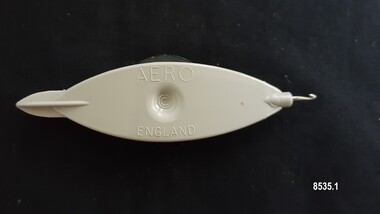
Domestic object - Tatting Shuttle, Aero Needles Group Ltd, Mid to late 20th century
... crochet hook for joining picots. The "Aero" company developed in Redditch, England - a town renowned as a centre for manufacturing needles. Firms run by Henry Milward and Abel Morrall were based in Redditch and by the 18th century Redditch was manufacturing one million sewing needles per year. Abel Morrall Ltd launched the "Aero" brand in 1936 and greatly expanded the firm's product line to include tatting shuttles and knitting needles. The classic plastic "Aero" tatting shuttle was manufactured in England from the early 1970's until the 1990's. These items ...Tatting is a form of knotted lace making using thread and a small shuttle. Twisted threads are tied around or through small, pointed shuttles that can be made of bone, mother of pearl, tortoise shell, steel or plastic. This produces a stable, strong lace using simple knots of two half hitches to make rings and chains embellished with picots.The origins of tatting are not clear but early versions of decorative knotting were used by the Egyptians on their ceremonial dress. Tatting also has elements of fishermen's net making techniques and the decorative knotting that was practiced by aristocratic women from the 15th century.Tatting, as we know it today, emerged in the first half of the 19th century. The new availability of mercerised thread from 1835 encouraged a burgeoning of lace crafts of all sorts. It was known in Italy as "occhi" and in France as "la frivolite". Tatting looks fragile but is both strong and durable. An article in a column named "Wives and Daughters" published in the Star newspaper in May 1910 describes the durability of tatting lace - "there is edging and insertion still in existence that have outworn two sets of pillow slips." In the 19th century and well into the 20th century, tatting was used like crochet and knitted lace for decorative edgings, collars, doylies, tray cloths etc. At first, different tatting patterns were passed along by word of mouth from person to person, however in time, patterns regularly appeared in newspapers and magazines well into the 1950's. A shuttle is a small tool that looks like a small boat "sailing" in and out of the thread. Tatting is called "schiffchenarbeit" in German, which means "the work of a little boat". There are two popular types of shuttles. The first has closed ends and a removable bobbin where the thread is wound around - often made from metal or plastic (as is item 8535.1). The second type has a post in the center where the thread is wound (e.g. item 8535.2). The ends of this bobbin are open but snug. Because it is constructed in two pieces, it can be made from materials like bone, ivory or mother of pearl. Shuttles hold a larger amount of thread (as compared with needles) which means fewer ends to weave in. Fishermen in the past are thought to have used large shuttles to weave cord into certain knots whilst making their fishing nets. Their methods were copied by weavers, who innovated by using threads and smaller shuttles to make lace. One type of tatting shuttle produced by "Aero" from the 1930's to the late 1960's was an anodized grey coated aluminium shuttle with a sharp pick at one end. In the 1970's it was superseded by the grey plastic "Aero" which has a removeable bobbin which you can put on the end of the shuttle to make thread winding easier and an embedded crochet hook for joining picots. The "Aero" company developed in Redditch, England - a town renowned as a centre for manufacturing needles. Firms run by Henry Milward and Abel Morrall were based in Redditch and by the 18th century Redditch was manufacturing one million sewing needles per year. Abel Morrall Ltd launched the "Aero" brand in 1936 and greatly expanded the firm's product line to include tatting shuttles and knitting needles. The classic plastic "Aero" tatting shuttle was manufactured in England from the early 1970's until the 1990's. These items are significant as examples of easily accessible handiwork tools that enabled women in the 1930s -1960s to be able to decorate and personalize their household linen and clothing.Shuttle no. 8535.1 is a beige, boat shaped plastic shuttle with enclosed ends, small round central indentations on both sides and an enclosed black removeable bobbin. The shuttle has a grooved point at one end to hold a bobbin and a small metal crochet hook at the other end. Shuttle no. 8535.2 is a beige, boat shaped metal shuttle with pointed ends that are open but snug, small round central indentations and two smaller circular markings (on both sides) and two internal posts with cream thread wound around.Shuttle no. 8535.1 - "AERO" / "ENGLAND" Shuttle no. 8535.2 - "AERO' / "ENGLAND" "39c" (written in ball point pen)flagstaff hill maritime museum and village, flagstaff hill, warrnambool, shipwreck coast, great ocean road, tatting shuttle, aero company, handwork, handwork tool, craft, handcraft, needlework, tatting -
 Flagstaff Hill Maritime Museum and Village
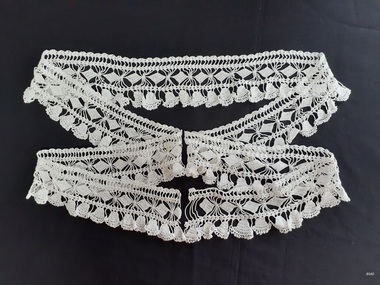
Textile - Lace Sample, Late 1800s to 1930s
... The sample of crochet lace is an example of a handmade item that would have been used to decorative purpose around the home. ...The sample of crochet lace is an example of a handmade item that would have been used to decorative purpose around the home. ...The sample of crochet lace is an example of a handmade item that would have been used to decorative purpose around the home. It may have been used to edge curtains, a table runner or a mantlepiece. The Christmas Bells pattern suggests usage as a Christmas decoration.The item is significant socially to show the use of textile crafts, such as handmade crocheted lace, to decorate regular domestic objects around the home such as curtains and mantlepieces.Length of handmade crochet lace. Mercerised white crochet thread has been used to crochet a repeat pattern consisting of three rows: a decorative top row, a middle section of diamond shapes and a bottom row of Christmas bells.flagstaff hill, warrnambool, maritime village, maritime museum, flagstaff hill maritime museum & village, shipwreck coast, great ocean road, lace, handmade lace, crocheted lace, decorative edging, decorative lace edging, domestic object, crocheted trim -
 Flagstaff Hill Maritime Museum and Village
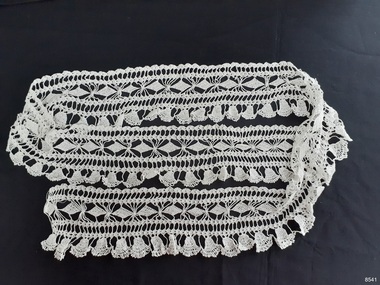
Textile - Lace Sample, Late 1800s to 1930s
... The sample of crochet lace is an example of a handmade item that would have been used to decorative purpose around the home. ...The sample of crochet lace is an example of a handmade item that would have been used to decorative purpose around the home. ...The sample of crochet lace is an example of a handmade item that would have been used to decorative purpose around the home. It may have been used to edge curtains, a table runner or a mantlepiece. The Christmas Bells pattern suggests usage as a Christmas decoration.The item is significant socially to show the use of textile crafts, such as handmade crocheted lace, to decorate regular domestic objects around the home such as curtains and mantlepieces.Length of handmade crochet lace. Mercerised white crochet thread has been used to crochet a repeat pattern consisting of four rows: a decorative top row, a second row composed of diamond shapes, a repeat of the decorative top row and finally a row of Christmas bells to complete the pattern.flagstaff hill, warrnambool, maritime village, maritime museum, flagstaff hill maritime museum & village, shipwreck coast, great ocean road, lace, handmade lace, crocheted lace, decorative edging, decorative lace edging, domestic object, crocheted trim -
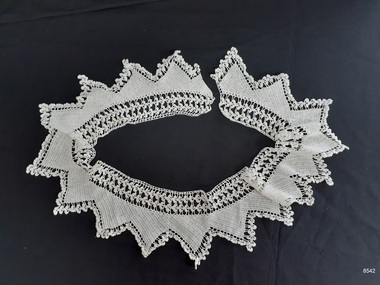 Flagstaff Hill Maritime Museum and Village
Textile - Lace Sample, Late 1800s to 1940s
... The sample of crochet lace is an example of a handmade item that would have been used to decorative purpose around the home. ...The sample of crochet lace is an example of a handmade item that would have been used to decorative purpose around the home. ...The sample of crochet lace is an example of a handmade item that would have been used to decorative purpose around the home. It may have been used to edge curtains, a table runner or a mantlepiece. Smaller pieces were used to edge towels. The shape of this piece suggests a possible use as a ladies collar however no tie or buttons have been attached at the ends.The item is significant socially to show the use of textile crafts, such as handmade crocheted lace, to decorate regular domestic objects or create pieces of clothing.A wide length of handmade crochet lace with an open pattern at the top and a pointed edged pattern underneath. For the open pattern mercerised white crochet thread has been used to crochet a double row of a repeat pattern of 'three circles and stems'. Underneath double crochet (US) / treble crochet (UK) is used to create the points which have been edged with the 'three circles and stems' pattern from above.flagstaff hill, warrnambool, maritime village, maritime museum, flagstaff hill maritime museum & village, shipwreck coast, great ocean road, lace, handmade lace, crocheted lace, decorative edging, decorative lace edging, domestic object, crocheted trim, ladies collar, crocheted collar
