
Showing 61 items matching "cultural policy"
-
 Phillip Island and District Historical Society Inc.
Book, Creative Australia : the National Cultural Policy, 2013
... Creative Australia : the National Cultural Policy...Creative Australia : the National Cultural Policy Book ... -
 Women's Art Register
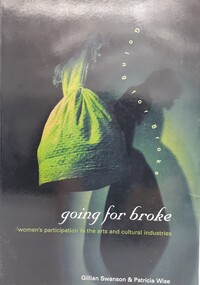
Book, Gillian Swanson & Patricia Wise, Going for Broke. Women's Participation in the Arts and Cultural Industries, N/A
... Australian Key Centre for Cultural and Media Policy, Griffith University...Book Book Gillian Swanson & Patricia Wise Australian Key Centre for Cultural and Media Policy, Griffith University ...Study commissioned by Arts Queensland and the Australia Council in 1994 to address the lack of published information on women's involvement in the arts.BookStudy commissioned by Arts Queensland and the Australia Council in 1994 to address the lack of published information on women's involvement in the arts.regionalism, cultural industraies, equity, professional recognition, indigenous women, multiculturalism -
 Surrey Hills Historical Society Collection
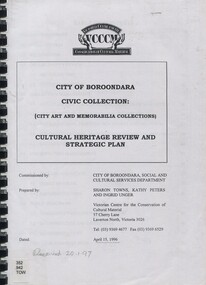
Book, City of Boroondara Civic Collection: (City Art and Memorabilia Collections) Cultural Heritage Review and Straegic Plan, 1996
... ...cultural policy...This publication explains an approach to manage the collection and develop a strategic plan for its exposure to the public through community participation and access, interpretations and exhibitions. boroondara council - art collections art ad state cultural policy boroondara history This publication explains an approach to manage the collection and develop a strategic plan for its exposure to the public through community participation and access, interpretations and exhibitions. ...This publication explains an approach to manage the collection and develop a strategic plan for its exposure to the public through community participation and access, interpretations and exhibitions.This publication explains an approach to manage the collection and develop a strategic plan for its exposure to the public through community participation and access, interpretations and exhibitions.boroondara council - art collections, art ad state, cultural policy, boroondara history -
Tatura Irrigation & Wartime Camps Museum
Book, Museums Australia Journal, 1993
... Information for museums e.g. Cultural policy and new directions....Information for museums e.g. Cultural policy and new directions. museums museums australia Decorative cover. ...Information for museums e.g. Cultural policy and new directions.Decorative cover. Beige background - dark printing. Dated 1991 - 1992. Subject of decoration - Sydney waterside workers art mural.museums, museums australia -
 Women's Art Register
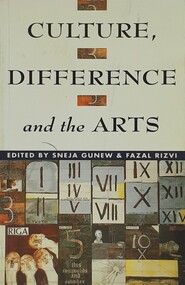
Book - Anthology, Sneja Gunew & Fazal Rizvi, Culture, Difference and the Arts, 1994
... ...cultural difference...arts policy...Written by critics, practitioners and administrators the text investigates ways to create policies to ensure all Australians contribute to our cultural future....Written by critics, practitioners and administrators the text investigates ways to create policies to ensure all Australians contribute to our cultural future. Complements other material held in the Women's Art Register multiculturalism funding access community arts cultural difference arts policy reform Aboriginality Collection of essays addressing issues of culture and difference in Australia in the late 20th century and ways to develop new thinking about the role of the arts in a multicultural society. "12.00" Culture, Difference and the Arts Book Anthology Sneja Gunew & Fazal Rizvi Allen & Unwin ...Collection of essays addressing issues of culture and difference in Australia in the late 20th century and ways to develop new thinking about the role of the arts in a multicultural society.non-fictionCollection of essays addressing issues of culture and difference in Australia in the late 20th century and ways to develop new thinking about the role of the arts in a multicultural society.multiculturalism, funding, access, community arts, cultural difference, arts policy reform, aboriginality -
 Bendigo Historical Society Inc.
Document - HUSTLERS REEF RESERVE CONSERVATION MANAGEMENT PLAN
... History of the site, a physical survey and analysis, comparative analysis, cultural significance and conservation policy are addressed in the document....History of the site, a physical survey and analysis, comparative analysis, cultural significance and conservation policy are addressed in the document. ...Conservation management plan (112 pages) prepared by Lee Andrews & Associates, Heritage Consultants, in 2011, for the Hustlers Reef Reserve. The reserve cover the site of the former Great Extended Hustlers Mine site. Leigh McKinnons amendments to the plan are included with the document. History of the site, a physical survey and analysis, comparative analysis, cultural significance and conservation policy are addressed in the document.bendigo, mining, great extended hustlers mine site -
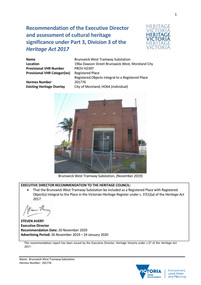 Melbourne Tram Museum
Document - Report, Heritage Victoria, "Recommendation of the Executive Director and assessment of cultural heritage significance - Brunswick West Tramway Substation", Nov. 2019
... Has a detailed statement of cultural significance, proposed permit policy. The history includes details of the electrification of the Melbourne's tramways, the mercury arc equipment, its operation, architecture. ...Has a detailed statement of cultural significance, proposed permit policy. The history includes details of the electrification of the Melbourne's tramways, the mercury arc equipment, its operation, architecture. ...Digital copy of a 50 page report - "Recommendation of the Executive Director and assessment of cultural heritage significance - Brunswick West Tramway Substation" at 196a Dawson St Brunswick West. Report prepared November 2019. Details the history and context of the location relevant to the development of the West Coburg route, the equipment contained within the building, includes all moveable objects within the building including documents. Has a detailed statement of cultural significance, proposed permit policy. The history includes details of the electrification of the Melbourne's tramways, the mercury arc equipment, its operation, architecture. Report includes photographs of the interior of the building.trams, tramways, substation, west brunswick electric tramway, mercury arc, heritage victoria, significance, dawson st, transformer, power supply, electrical engineering, rotary converters -
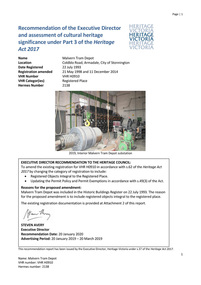 Melbourne Tram Museum
Document - Report, Heritage Victoria, "Recommendation of the Executive Director and assessment of cultural heritage significance - Malvern Tram Depot - Amendment - 20/2/2020", Jan. 2020
... Has a detailed statement of cultural significance, proposed permit policy. The history includes details of the electrification of the Melbourne's tramways, the rotary converter equipment, its operation, architecture. ...Has a detailed statement of cultural significance, proposed permit policy. The history includes details of the electrification of the Melbourne's tramways, the rotary converter equipment, its operation, architecture. ...Digital copy of a 60 page report - ""Recommendation of the Executive Director and assessment of cultural heritage significance - Malvern Tram Depot - Amendment - 20/2/2020" Details the history and context of the location relevant to the development of the PMTT and MMTB systems route, the equipment contained within the building, includes all moveable objects within the building including documents. Has a detailed statement of cultural significance, proposed permit policy. The history includes details of the electrification of the Melbourne's tramways, the rotary converter equipment, its operation, architecture. Report includes photographs of the interior of the building. The last amendment was to include the items with the former Rotary Converter sub-station.trams, tramways, substation, malvern depot, rotary converters, heritage victoria, significance, coldblo road, transformer, power supply, electrical engineering, pmtt, mmtb -
Federation University Historical Collection
Booklet - Report, Sturt Street Gardens, Ballarat, Victoria, Conservation and Landscape Management Plan, July 2007, 07/2007
... The report includes an historical overview, Physical Analysis, Statement of Cultural Significance, and Consideration and Landscape Policies....The report includes an historical overview, Physical Analysis, Statement of Cultural Significance, and Consideration and Landscape Policies. Sturt Street Gardens, Ballarat, Victoria, Conservation and Landscape Management Plan, July 2007 Booklet Report City of Ballarat McDougall and Vines Conservation and Heritage Consultants ...The Sturt Street Gardens had its origins in the 1851 survey of Ballarat West by W.S. Urquhart. A generous reserve was allocated for the main streets of Ballarat, of which Sturt Street was the first. In the 1860s Sturt Street was planted with blue gums, with dual carriageway and central median Strip. Bandstands were soon erected.70 page report on the Ballarat Sturt Street gardens. The report includes an historical overview, Physical Analysis, Statement of Cultural Significance, and Consideration and Landscape Policies.queen alexandra bandstand, titanic memorial bandstand, sturt street, sturt street gardens, blue gum, statues, eight hour day memorial, boer war memorial, peter lalor statue, bluestone, bluestone guttering, william dunstan vc, time capsule, conservation management plan, landscape management plan -
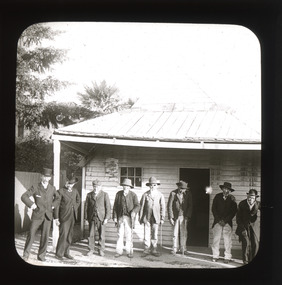 The Beechworth Burke Museum
Photograph - Lantern Slide, c1900
... cultural group in Beechworth's gold rush period. Carole Woods' history of Beechworth, 'A Titan's Field', details that there were approximately 60 Chinese people in the area in 1855, more than 1000 in 1856 and 4700 (a quarter of the population) in 1857, despite the introduction in 1855 of official policies such as additional taxes formulated by the Victorian Government to limit access by Chinese immigrants. ...cultural group in Beechworth's gold rush period. Carole Woods' history of Beechworth, 'A Titan's Field', details that there were approximately 60 Chinese people in the area in 1855, more than 1000 in 1856 and 4700 (a quarter of the population) in 1857, despite the introduction in 1855 of official policies such as additional taxes formulated by the Victorian Government to limit access by Chinese immigrants. ...This image shows six older Chinese men standing in a row with two younger non-Chinese men outside a small wooden business or official building in the Beechworth region, circa 1900. The two non-Chinese men are wearing clothes of the period that indicate relative prosperity (such as three piece suits, top hats, and a pocket handkerchief), whereas most of the Chinese men are wearing Western-style working clothes of the era. One Chinese man at the far right of the image is wearing similar garments to the non-Chinese men, including a bowler hat and longer, more tailored suit jacket. Chinese miners were a significant cultural group in Beechworth's gold rush period. Carole Woods' history of Beechworth, 'A Titan's Field', details that there were approximately 60 Chinese people in the area in 1855, more than 1000 in 1856 and 4700 (a quarter of the population) in 1857, despite the introduction in 1855 of official policies such as additional taxes formulated by the Victorian Government to limit access by Chinese immigrants. Most Chinese miners in the region came from southern China and had formerly worked as merchants, mechanics, farmers and shop-keepers. Chinese people were subjected to a 'protectorate' system, ostensibly to minimise the potential for conflict with other groups; this system required Chinese people to live in designated 'hygienic' camps with paid Chinese headmen who supervised the village and enforced the protectorate's rules. Chinese people were required to purchase an annual protection ticket to fund this system. The protectorate system was abolished in 1861, before this image was taken in approximately 1900, but it may still provide insight into social stratification or relationships between and within cultural groups in Beechworth resulting from such practices. Lantern slides, sometimes called 'magic lantern' slides, are glass plates on which an image has been secured for the purpose of projection. Glass slides were etched or hand-painted for this purpose from the Eighteenth Century but the process became more popular and accessible to the public with the development of photographic-emulsion slides used with a 'Magic Lantern' device in the mid-Nineteenth Century. Photographic lantern slides comprise a double-negative emulsion layer (forming a positive image) between thin glass plates that are bound together. A number of processes existed to form and bind the emulsion layer to the base plate, including the albumen, wet plate collodion, gelatine dry plate and Woodburytype techniques. Lantern slides and magic lantern technologies are seen as foundational precursors to the development of modern photography and film-making techniques.This glass slide is significant because it provides insight into Beechworth's cultural and social relationships in the early Twentieth Century, in particular the experiences of Chinese miners. It is also an example of an early photographic and film-making technology in use in regional Victoria in the time period.Thin translucent sheet of glass with a circular image printed on the front and framed in a black backing. It is held together by metals strips to secure the edges of the slide.burke museum, beechworth, lantern slide, slide, glass slide, plate, burke museum collection, photograph, monochrome, magic lantern, indigo shire, north-east victoria, nineteenth century, 1900s, twentieth century, emulsion slides, chinese, chinese miners, protectorate system, protection licence, immigration, racism, classism, social groups, cultural groups, taxes, hygiene camps -
Federation University Historical Collection
Booklet - Book, Burra Lotjpa Dunguludja: Victorian Aboriginal Justice Agreement Phase 4, 2018
... policy approach. The vision was to ensure Aboriginal people have access to n equitable justice system that is shaped by self-determination, and protects and upholds their human, civil, legal and cultural rights....policy approach. The vision was to ensure Aboriginal people have access to n equitable justice system that is shaped by self-determination, and protects and upholds their human, civil, legal and cultural rights. ...Burra Lotjpa Dunguludja means 'Senior Leaders Talking Strong' in Yorta Yorta language.Sixty page book aiming to continue to address Aboriginal over-representation across the justice system, and to progress self-determination as the core policy approach. The vision was to ensure Aboriginal people have access to n equitable justice system that is shaped by self-determination, and protects and upholds their human, civil, legal and cultural rights.aboriginal, martin pakula, tont lovett, marion hansen, aboriginal justice, aboriginal justice caucus, message stick, koori justice unit -
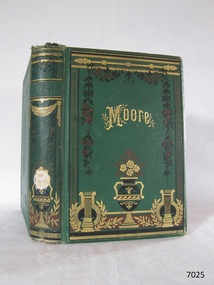 Flagstaff Hill Maritime Museum and Village
Book - Poetical Writings, Thomas Moore, The Poetical Works of Thomas Moore, 1878–1890s
... cultural heritage, political sentiment, and narratives of loss and resistance to international audiences. He enjoyed unprecedented popularity and influence in his lifetime, reaching a level of commercial fame matched by very few writers of his era. His Oriental epic poem Lalla Rookh (1817) earned him record-setting advance payments from publishers and was translated across Europe, inspiring musical compositions by Robert Schumann, Hector Berlioz, and Felix Mendelssohn. His political satire and historical prose went beyond poetry, as Moore was a formidable Whig satirist who targeted British policy ...This subject volume is a comprehensive collection of the works of Irish poet and songwriter Thomas Moore (1779–1852). The work features his famous Irish Melodies (containing classic songs like "The Last Rose of Summer" and "The Minstrel Boy"), his Oriental romance epic Lalla Rookh, satire, and light verse, along with a biographical summary ("With Life") and steel-engraved illustrations.Hard cover book. The Poetical Works of Thomas Moore Author: Thomas Moore Publisher: Gall & Inglis Date: 1878–1890s Further Information: Highly decorated green Cloth hardcover with lettering and patterning to spine in gilt. The spine has a Library label with an inscription.fictionThis subject volume is a comprehensive collection of the works of Irish poet and songwriter Thomas Moore (1779–1852). The work features his famous Irish Melodies (containing classic songs like "The Last Rose of Summer" and "The Minstrel Boy"), his Oriental romance epic Lalla Rookh, satire, and light verse, along with a biographical summary ("With Life") and steel-engraved illustrations.warrnambool, shipwrecked-coast, flagstaff-hill, flagstaff-hill-maritime-museum, maritime-museum, shipwreck-coast, flagstaff-hill-maritime-village, shipwrecked-artefact, book, the poetical works of thomas moore, thomas moore, warrnambool mechanics’ institute, pattison collection, warrnambool library, ralph eric pattison, corangamite regional library service, warrnambool city librarian, mechanics’ institute library, victorian library board, warrnambool books and records, warrnambool children’s library -
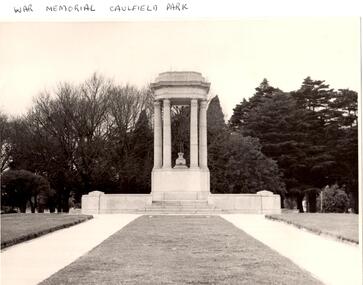 Glen Eira Historical Society
Article - Memorials in Glen Eira
... The booklet contains a conservation analysis, statement of cultural significance, statement of conservation policy, and conservation management plan for the Caulfield Park War Memorial. ...The booklet contains a conservation analysis, statement of cultural significance, statement of conservation policy, and conservation management plan for the Caulfield Park War Memorial. ...This file contains 11 items relating to War Memorials in Glen Eira: 1/Black and white photograph, undated, source unknown, of Caulfield Park War Memorial 2/Copy of photograph of Caulfield Park War Memorial, undated, source unknown 3/Colour photograph of Caulfield Park War Memorial, dated June 1982, source unknown, and slide of same 4/Print of webpage of Friends of Caulfield Park, dated 02/08/2013 with colour image of and information about the war memorial there 5/Two black and white photographs, undated and source unknown, of war memorial at Koornang Park 6/Four colour photographs and one black and white copy of photograph of war memorial and its inscription at Koornang Park. Date and source unknown 7/Article dated 30/04/2013 from GLENEIRA LEADER about funding for plaque for Lone Pine at Caulfield Park 8/Article dated 23/04/2013 from THE AGE about state funding for repair of war memorials including one at McKinnon 9/Article dated June 2013 from GLEN EIRA NEWS about state funding for repair of five WWI memorials in Glen Eira. Includes two photographs. 10/Article from GLEN EIRA NEWS dated April 2012 about restoration of Caulfield Park War Memorial. Includes colour photography 11/A booklet titled 'The Burra Charter and its Application: Essay 3: War Memorial, Caulfield Park', written in October 2000 by Eleanor Bishop. The booklet contains a conservation analysis, statement of cultural significance, statement of conservation policy, and conservation management plan for the Caulfield Park War Memorial. This includes a brief history and description of the Caulfield Park War Memorial, and 7 colour photographs of the memorial dated September 2000, 2 undated black-and-white photographs, and a copy of the original drawing of the memorial which won its design contest in 1930.monuments and memorials, war memorials, plaques, world war 1914-1918, caulfield park, friends of caulfield park, ritchie mr, world war 1939-1945, koornang park, city of caulfield, glen eira, glen eira council, mckinnon war memorial, hopetoun gardens, hyams jamie, mckinnon, lobo oscar, esakoff margaret, hyams jamie, delahunty ms, caulfield rsl, kiernan noel, bishop eleanor, caulfield park war memorial, foot henry b., parks and reserves, paddy's swamp, caulfield, royal victorian institute of architects, caulfield municipal council, architectural competitions, schefferle n. mr, architectural features, conservation management plan -
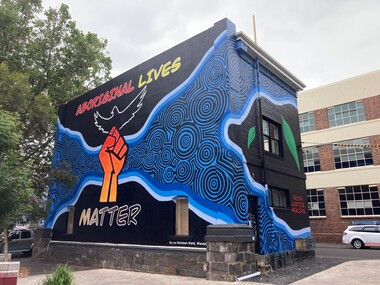 Yarra City Council
Artwork, other - Mural, Ky-ya Nicholson-Ward, Aboriginal Lives Matter, 2021
... cultural importance of the local area to the Wurundjeri Woi Wurrung people as the Traditional Owners. With a strong focus on Aboriginal identity the mural outlines the local context of the Black Lives Matter movement, which is connected to racism, policing of Aboriginal and Torres Strait Islander peoples and associated deaths in custody. The artwork acknowledges the ongoing challenges faced by Aboriginal community members and their struggle to survive white systems, policies...cultural importance of the local area to the Wurundjeri Woi Wurrung people as the Traditional Owners. With a strong focus on Aboriginal identity the mural outlines the local context of the Black Lives Matter movement, which is connected to racism, policing of Aboriginal and Torres Strait Islander peoples and associated deaths in custody. The artwork acknowledges the ongoing challenges faced by Aboriginal community members and their struggle to survive white systems, policies ..."The fist references the Black Lives Matter movement and also represents the strength of Indigenous peoples all over the world and symbolises solidarity and justice for everyone affected by systematic racism. Bunjil (wedge-tailed eagle) is flying high on the building. He is the creator spirit for Wurundjeri people who looks over us and protects us. Bunjil represents healing and power to our people. The blue circles and lines represent revival and waterways; in particular, they depict the Birrarung (Yarra River), which is very significant for the Wurundjeri people. Our people are known as the Manna Gum people. The leaves in the artwork highlight Wurundjeri people and their Country. These leaves also represent the cleansing of negative spirits. The Manna Gum leaf is also an important symbolic offering in our traditional Welcome to Country ceremony. Leaves are offered to visitors as they are granted safe passage through our land. They are made welcome to everything from the tops of the trees to the roots of the earth. We ask that they take care of the land, plants and animals and to respect the protocols and rules of the Traditional Owners whilst on our Country."In 2020 Council declared its support for the global Black Lives Matter (BLM) movement. In consultation with Yarra City Council's Yana Ngargna advisory group a motion was prepared and passed unanimously by all Councillors. A number of actions were generated from this decision; one of which was for Council to commission a large-scale mural that aligned with the movement. Emerging artist Ky-ya Nicholson-Ward, a proud Wurundjeri, Dja Dja Wurrung, Nguarai Illam-Wurrung, German and Irish woman, created the mural installed on a building in Peel Street Park, Collingwood. Selected by Council's Yana Ngargna, Black Lives Matter Working Group the artwork identifies the cultural importance of the local area to the Wurundjeri Woi Wurrung people as the Traditional Owners. With a strong focus on Aboriginal identity the mural outlines the local context of the Black Lives Matter movement, which is connected to racism, policing of Aboriginal and Torres Strait Islander peoples and associated deaths in custody. The artwork acknowledges the ongoing challenges faced by Aboriginal community members and their struggle to survive white systems, policies and institutions. Ky-ya's mural tells the story of Aboriginal resilience, strength and self-determination; and will support the process of healing. It is a celebration of the local Aboriginal and Torres Strait Islander community; the significant Aboriginal history of Fitzroy, Collingwood and surrounds; and community's continuing cultural connection to the area. Importantly, this artwork provides a platform to educate a broader audience about the local context of the Black Lives Matter movement and Aboriginal deaths in custody. The mural will activate this site, enliven the area, promote inclusion, incite conversation and contribute to the creative capital of this locale. A welcoming environment for Aboriginal and non-Aboriginal communities.Aboriginal Lives Matter Ky-ya Nicholson WardOn a black background a hand fist (strength, solidarity and justice) is placed at the centre of the building; Bunjil (wedge-tailed eagle) is depicted flying high on the building; blue circles and lines represent revival and waterways (Birrarung-Yarra River) and the leaves in the artwork highlight Wurundjeri people (cleansing of spirit and welcome to Country)The artist name 'Ky-ya Nicholson Ward' painted in white, low right of the wall facing into Peel Street Park. black lives matter (blm) movement, wurundjeri woi wurrung, bunjil, identity, birrarung, country -
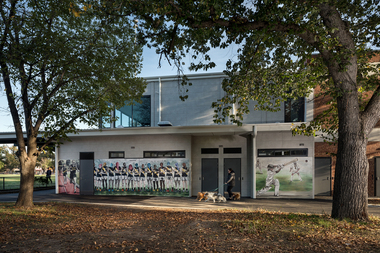 Yarra City Council
Artwork, other - Mural, Fiona McMonagle, The Park, 2022
... cultural importance and meaning to the Wurundjeri Woi Wurrung people, the Traditional Owners of the land now known as Yarra. Installed on the Jack Dyer Pavilion at Citizens Park in 2022, 'The Park' celebrates inclusivity and the contemporary sporting activities that this space represents today for the City of Yarra. This commission is a result of Council’s Public Art Policy ...'The first panel celebrates the long history of runners that use the park. Richmond Harriers Athletics Club was established in 1913 and is the oldest athletics club in Victoria. The central panel depicts young female footballers and recognises female athletes and the popularity of women and girls' teams in contemporary sports. The final panel depicts a children’s cricket match. The young players are represented through the depiction of a game that is part of our national psyche and firmly entrenched in Australian culture.'Inner-city parks like Citizens Park have many diverse uses. They provide places to play, to exercise and to relax. They are spaces for community and are often subject to competing values and interests. The re-development of the Jack Dyer Pavilion at Citizens Park allows for the growth of the local community’s diverse interests and values and enables participation and interaction. 'The Park' focuses on the recreational uses of Citizens Park and its role as a community space in an area that is changing rapidly. The mural consists of three panels that address inclusivity and access to sport. Three core sporting groups who each utilize the pavilion and park as a public recreational space are represented: children, sport teams and runners. In fostering the representation of these groups, the panels also attest to the past, present, and future of this important space.Three sporting groups are represented: athletics/runners, women footballers in line formation and young cricketers in action/play. Accompanying plaquesport, women, community, richmond, parks -
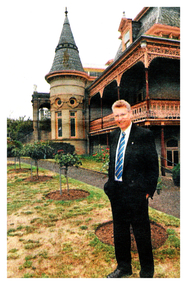 Bendigo Historical Society Inc.
Newspaper - Fortuna Articles - "Great Bravery is now required for villa", Dec 05 2008
... cultural precinct, as proposed by the Villa Fortuna Action Group. He believes the property should address local needs such as aged care, dementia, disabilities, and respite for carers. Gibbins emphasizes these are his personal views, not official council policy...cultural precinct, as proposed by the Villa Fortuna Action Group. He believes the property should address local needs such as aged care, dementia, disabilities, and respite for carers. Gibbins emphasizes these are his personal views, not official council policy ...Villa Fortuna is described as having unprecedented local historical importance and whimsical architecture, making it a cultural asset for Bendigo. Saving the villa requires a bold and visionary individual or group willing to take on the challenges of restoration, including significant financial and logistical commitments. If restored, the villa could become a major attraction, hosting events, tours, and community activities that would benefit the local economy and tourism sector. The main obstacle is not whether the villa should be saved, but what sacrifices—financial and otherwise—are necessary to achieve this goal. The Villa Fortuna Action Group has developed a plan for the site, but more stakeholders may become involved. The Department of Defence, current owner, is proceeding cautiously with no urgency to sell. The upcoming public opening is seen as a potential turning point, with the document stressing that Bendigo cannot afford to lose this historic property, regardless of the cost. Mayor Kevin Gibbins opposes transforming Fortuna Villa into an arts and cultural precinct, as proposed by the Villa Fortuna Action Group. He believes the property should address local needs such as aged care, dementia, disabilities, and respite for carers. Gibbins emphasizes these are his personal views, not official council policy. Gibbins is concerned about the council's ability to finance the maintenance of the large property, even if acquired at no cost. He questions the justification for using ratepayers' money for new arts projects when there is already a masterplan for the existing art gallery that requires significant funding and staged development. The Villa Fortuna Action Group is the only organization with a public proposal for the site, aiming to create an arts and cultural precinct similar to Melbourne's Abbotsford Convent.The group plans to present its vision to newly elected councillors. The Department of Defence is preparing Fortuna Villa in Bendigo for sale, likely early next year. A tentative timeline suggests most site assessments will be drafted by Christmas, with finalization expected in the new year. Thorough assessments are underway to understand the site's characteristics, including heritage and environmental aspects.These assessments are detailed and time-consuming to ensure accuracy and completeness. An open day for the public and media is part of the ongoing community consultation process. Additional consultation activities are planned but not yet finalized. The City of Greater Bendigo is a key stakeholder in the disposal process and will receive relevant site information.The property has not yet been valued.Fortuna Article - "Great Bravery is now required for villa" - The Bendigo Advertiser Friday Dec 05 2008 by Nino Bucci This item contains the following: 11217.24a Colour Photo of the stained glass window on the staircase 11217.24b Colour Photo of David French outside the villa 11217.24c Colour Photo of the Grand conservatory 11217.24d Part of page 14 - Article "Great Bravery is now required for villa" 11217.24e Part of page 14 - Article "Mayor defends his view for the site" 11217.24f Part of page 14 - Article "Fortuna's future is one step closer"non-fictionbendigo, fortuna, george lansell, villa fortuna action group, myor of bendigo kevin gibbins -
 Bendigo Historical Society Inc.
Newspaper - Fortuna Articles - "Respect our heritage", July 23 2009
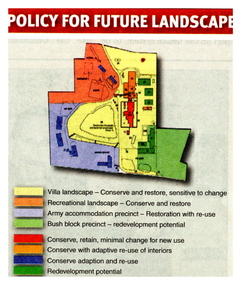
... cultural landscape and archaeological resources should be managed and documented appropriately. Most buildings on the site are in good to very good condition, with minimal structural issues.Some buildings contain asbestos and lead paint; soil samples revealed elevated arsenic and low mercury levels, indicating environmental hazards that need management. Future uses should be sustainable and compatible with the site's heritage significance.Adaptive re-use of interiors and sensitive restoration are encouraged, with minimal changes to key heritage areas.Occasional public access should be considered in future plans. The Heritage Management Plan provides policies...cultural landscape and archaeological resources should be managed and documented appropriately. Most buildings on the site are in good to very good condition, with minimal structural issues.Some buildings contain asbestos and lead paint; soil samples revealed elevated arsenic and low mercury levels, indicating environmental hazards that need management. Future uses should be sustainable and compatible with the site's heritage significance.Adaptive re-use of interiors and sensitive restoration are encouraged, with minimal changes to key heritage areas.Occasional public access should be considered in future plans. The Heritage Management Plan provides policies ...This article outlines the key findings and recommendations from a Defence Department report on Fortuna Villa, a historic site in Bendigo: Any future development must respect and complement the heritage values of Fortuna Villa. The site's cultural landscape and archaeological resources should be managed and documented appropriately. Most buildings on the site are in good to very good condition, with minimal structural issues.Some buildings contain asbestos and lead paint; soil samples revealed elevated arsenic and low mercury levels, indicating environmental hazards that need management. Future uses should be sustainable and compatible with the site's heritage significance.Adaptive re-use of interiors and sensitive restoration are encouraged, with minimal changes to key heritage areas.Occasional public access should be considered in future plans. The Heritage Management Plan provides policies and specific recommendations for conservation before and after the property's disposal by Defence.The plan aims to ensure ongoing management aligns with official heritage values.Next StepsThe report will inform decisions by the City of Greater Bendigo and the State Government regarding potential purchase and future management of the site.Fortuna Articles - "Respect our heritage" July 23 2009 The Bendigo Advertiser by Nino Bucci, pictures Julian Prowd This item contains the following: 11217.44a Colour sketch of the policy for future landscape 11217.44a Colour photo of Fortuna 11217.44c Part of Page 7 - Fortuna Articles - "Respect our heritage"non-fictionbendigo, fortuna, george lansell -
 Bendigo Historical Society Inc.
Document - WHITE HILLS BOTANIC GARDENS, BENDIGO: HERITAGE SIGNIFICANCE ASSESSMENT AND STRATEGY PROJECT
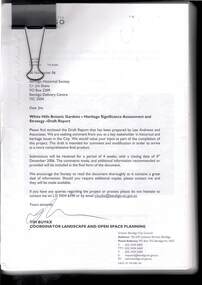
... Contains History of White Hills Botanic Gardens, Physical Survey ad Analysis, Comparative Analysis, Analysis and Assessment of Cultural Significance, Developing the Conservation Policy, Conservation Policy, Conservation Guidelines, Conservation Actions,References and Appendices. ...Contains History of White Hills Botanic Gardens, Physical Survey ad Analysis, Comparative Analysis, Analysis and Assessment of Cultural Significance, Developing the Conservation Policy, Conservation Policy, Conservation Guidelines, Conservation Actions,References and Appendices. ...Four hundred and forty three page report titled 'White Hills Botanic Gardens, Bendigo - Heritage Significance Assessment and Strategy Project by Lee Andrews & Associates Heritage Consulting, dated 31 October 2006. Contains History of White Hills Botanic Gardens, Physical Survey ad Analysis, Comparative Analysis, Analysis and Assessment of Cultural Significance, Developing the Conservation Policy, Conservation Policy, Conservation Guidelines, Conservation Actions,References and Appendices. Also contains a number of photos, copies of plans and documents, and a plan of the area with the trees marked and identified.document, white hills botanic gardens bendigo - heritage significance assessment and strategy project, bendigo historical society, jim evans, tim buykx, greater bendigo city council, lee andrews & associates heritage consulting, bendigo advertiser, the bendigonian, bendigo independent, argus, bendigo homes and property, mal gregory, mitch kemp, anthony sheean, casey ely, vicki johnson, sandra crump, friends of bendigo's botanic gardens, jane cleary, judy milner, jan orr, heritage victoria, john hawker, department of sustainability and environment historic places, norm stimson, bill dundas, janette hodgson, royal botanic gardens melbourne, roger spencer, university of melbourne burnley campus, greg moore, goldfields research centre, bendigo library, vivien newton, rita hull, state library of victoria, matheson library monash university, mueller correspondence project, sara maroske, library of the royal botanic gardens melbourne jill thurlow, helen cohn, gwen pascoe, john dwyer, larritt and russell -
Glen Eira Historical Society
Letter - Heritage Watch Caulfield
... Policy... Caulfield City Council... Campbell Mr. + Mrs.... Caulfield Heritage Watch Committee... Snowball B.... Kay W.... Spencer D.... Dustan Don... Dustan David... Campbell F.... Hill Tess... Jordan P.... Ritchie Jack... Architecture... Development... Cultural...Policy Caulfield City Council Campbell Mr. + Mrs. Caulfield Heritage Watch Committee Snowball B. Kay W. Spencer D. Dustan Don Dustan David Campbell F. Hill Tess Jordan P. Ritchie Jack Architecture Development Cultural ...This file contains 5 items: 1/Documents related to the establishment of Heritage Watch in Caulfield. This includes a typed letter to Mrs. And Mr. Campbell from Graham Walsh inviting them to attend a meeting concerning the potential establishment of Heritage Watch – dated 08/11/1989. A nomination form to elect a committee –dated 27/06/1991, and documents outlining goals, maps of proposed area designated by the council, and black-and-white photographs of Miners Cottage Elsternwick and a mansion in Ripponlea, Elsternwick. 2/Minutes of Caulfield Heritage Watch Committee meetings on 04/12/1999, 22./01/1990, 08/10/1990 and 26/11/1990. It includes aims, general business, publicity and discussion on ‘Rosecraddock’. 3/Caulfield Heritage Watch Newsletter issue number three dated June 1991. It includes a paragraph on Rosecraddock, The Grand Union Tram Junction, Caulfield Heritage Study and an invitation to the annual general meeting on 27/06/1991. 4/Financial statement for Caulfield Heritage Watch for November 1989 to May 1991. 5/A handwritten submission to save Rosecraddock from demolition, date and author unknown.caulfield train station, margaret street 28, walsh graham a., caulfield manor grove 1, shellard mr., labassa, derby road, inkerman road, kerr paul, glen huntly road, victorian houses, gladstone parade, hawthorn road, o’neill college, miners cottage regent street elsternwick, buildings, heritage, preservation, urban conservation policy, caulfield city council, campbell mr. + mrs., caulfield heritage watch committee, snowball b., kay w., spencer d., dustan don, dustan david, campbell f., hill tess, jordan p., ritchie jack, architecture, development, cultural structures and establishments, residential development, murray, wells, hopkins sherry, caulfield town hall, rodder a., caulfield contact, spiker mr., elsternwick railway, elsternwick club, committees and inquiries, meetings, rosecraddock, construction sites, property, hill l., mayoress’ room caulfield, city hall, morris e., feehan j., molony v., moore mrs., elsternwick sandham street 19, elsternwick bowling club, ward andrew, shellard mr., construction and demolition, balaclava road, tramways, tram junction, kerr paul, gardens, save rosecraddock neighbourhood group -
 Bendigo Military Museum
Administrative record - CONSERVATION MANAGEMENT PLAN SMI, 2005
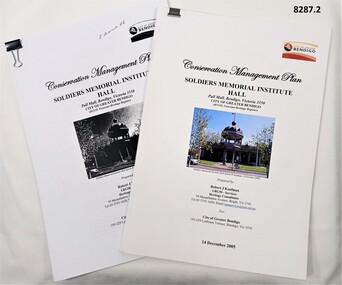
... Cultural Heritage Significance. 5. Conservation policy. 6. Conservation action. 7. ...Cultural Heritage Significance. 5. Conservation policy. 6. Conservation action. 7. ...This plan was prepared by Robert J Kaufman LRGM - Services, Heritage Consultants of Bright Victoria for the City of Greater Bendigo. The contents cover 7 main topics and 3 Appendix. 1. Introduction. 2. Summary history. 3. Physical evidence. 4. Cultural Heritage Significance. 5. Conservation policy. 6. Conservation action. 7. Sources and Bibliography. Appendix 1. Detailed description of place, photograph. 2. Surveys. 3. Existing condition survey report. There are 4 pages of maps & sketches. Four pages of photos, a mixture of Colour and B & W 26 images in total starting with the the Hustlers Royal Reserve Mine on site till current 2005. Numbers are from other buildings, around and inside the building. ( A new Conservation Management Plan was done in early 2013)Conservation Management Plan, Soldiers Memorial Institute Hall Pall Mall Heritage Register H1339, 21 pages each. .1) Colour edition held by a metal clip. .2) B & W copy of .1) All text is in black, contents are maps, sketches, .1) has photos in both colour and B & W.brsl, smirsl, conservation, 2005 -
 Sunshine and District Historical Society Incorporated
Archive - City of Sunshine / Brimbank Council Heritage Studies & Other Reports
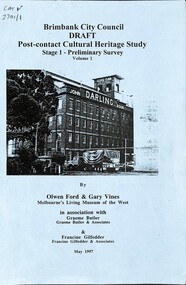
... 2791.01 - Brimbank City Council Draft Post Contact Cultural Heritage Study Stage 1 - Preliminary Survey Volume 1 2791.02 - Brimbank City Council Post Contact Cultural Heritage Study Volume 2 - Heritage Programs & Conservation Policy 2000 2791.03 - Brimbank City Council Post Contact Cultural Heritage Study Volume 2 - Heritage Programs & Conservation Policy 1999 2791.04 - Brimbank City Council Post Contact Cultural Heritage Study Volume 3 - Place Reports Heritage Areas & Individual Places 2791.05 - Brimbank City Council Post Contact Cultural Heritage Study Volume 3 Place Reports...City of Sunshine City of Brimbank 2791.01 - Brimbank City Council Draft Post Contact Cultural Heritage Study Stage 1 - Preliminary Survey Volume 1 2791.02 - Brimbank City Council Post Contact Cultural Heritage Study Volume 2 - Heritage Programs & Conservation Policy 2000 2791.03 - Brimbank City Council Post Contact Cultural Heritage Study Volume 2 - Heritage Programs & Conservation Policy 1999 2791.04 - Brimbank City Council Post Contact Cultural Heritage Study Volume 3 - Place Reports Heritage Areas & Individual Places 2791.05 - Brimbank City Council Post Contact Cultural Heritage Study Volume 3 Place Reports Collection of City of Sunshine / Brimbank Council Heritage Studies & Other Reports Archive City of Sunshine / Brimbank Council Heritage Studies & Other Reports ...2791.01 - Brimbank City Council Draft Post Contact Cultural Heritage Study Stage 1 - Preliminary Survey Volume 1 2791.02 - Brimbank City Council Post Contact Cultural Heritage Study Volume 2 - Heritage Programs & Conservation Policy 2000 2791.03 - Brimbank City Council Post Contact Cultural Heritage Study Volume 2 - Heritage Programs & Conservation Policy 1999 2791.04 - Brimbank City Council Post Contact Cultural Heritage Study Volume 3 - Place Reports Heritage Areas & Individual Places 2791.05 - Brimbank City Council Post Contact Cultural Heritage Study Volume 3 Place Reportscity of sunshine, city of brimbank -
 Victorian Aboriginal Corporation for Languages
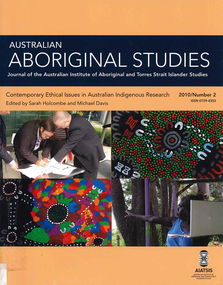
Periodical, Australian Institute of Aboriginal and Torres Strait Islander Studies, Australian Aboriginal studies : journal of the Australian Institute of Aboriginal and Torres Strait Islander Studies, 2010
... cultural extinction recycled through burgeoning heritage, Native Title, natural resource management ?industries?. Research is a central element of this network of intrusive interests and colonising practices. Government management regimes such as natural resource management draw upon the research and business sectors to form complex alliances to access funds to support their research, monitoring, policy development, management and on-ground works programs. ...cultural extinction recycled through burgeoning heritage, Native Title, natural resource management ?industries?. Research is a central element of this network of intrusive interests and colonising practices. Government management regimes such as natural resource management draw upon the research and business sectors to form complex alliances to access funds to support their research, monitoring, policy development, management and on-ground works programs. ...'Whose Ethics?':Codifying and enacting ethics in research settings Bringing ethics up to date? A review of the AIATSIS ethical guidelines Michael Davis (Independent Academic) A revision of the AIATSIS Guidelines for Ethical Research in Indigenous Studies was carried out during 2009-10. The purpose of the revision was to bring the Guidelines up to date in light of a range of critical developments that have occurred in Indigenous rights, research and knowledge management since the previous version of the Guidelines was released in 2000. In this paper I present an outline of these developments, and briefly discuss the review process. I argue that the review, and the developments that it responded to, have highlighted that ethical research needs to be thought about more as a type of behaviour and practice between engaged participants, and less as an institutionalised, document-focused and prescriptive approach. The arrogance of ethnography: Managing anthropological research knowledge Sarah Holcombe (ANU) The ethnographic method is a core feature of anthropological practice. This locally intensive research enables insight into local praxis and culturally relative practices that would otherwise not be possible. Indeed, empathetic engagement is only possible in this close and intimate encounter. However, this paper argues that this method can also provide the practitioner with a false sense of his or her own knowing and expertise and, indeed, with arrogance. And the boundaries between the anthropologist as knowledge sink - cultural translator and interpreter - and the knowledge of the local knowledge owners can become opaque. Globalisation and the knowledge ?commons?, exemplified by Google, also highlight the increasing complexities in this area of the governance and ownership of knowledge. Our stronghold of working in remote areas and/or with marginalised groups places us at the forefront of negotiating the multiple new technological knowledge spaces that are opening up in the form of Indigenous websites and knowledge centres in these areas. Anthropology is not immune from the increasing awareness of the limitations and risks of the intellectual property regime for protecting or managing Indigenous knowledge. The relevance of the Declaration on the Rights of Indigenous Peoples in opening up a ?rights-based? discourse, especially in the area of knowledge ownership, brings these issues to the fore. For anthropology to remain relevant, we have to engage locally with these global discourses. This paper begins to traverse some of this ground. Protocols: Devices for translating moralities, controlling knowledge and defining actors in Indigenous research, and critical ethical reflection Margaret Raven (Institute for Sustainability and Technology Policy (ISTP), Murdoch University) Protocols are devices that act to assist with ethical research behaviour in Indigenous research contexts. Protocols also attempt to play a mediating role in the power and control inherent in research. While the development of bureaucratically derived protocols is on the increase, critiques and review of protocols have been undertaken in an ad hoc manner and in the absence of an overarching ethical framework or standard. Additionally, actors implicated in research networks are seldom theorised. This paper sketches out a typology of research characters and the different moral positioning that each of them plays in the research game. It argues that by understanding the ways actors enact research protocols we are better able to understand what protocols are, and how they seek to build ethical research practices. Ethics and research: Dilemmas raised in managing research collections of Aboriginal and Torres Strait Islander materials Grace Koch (AIATSIS) This paper examines some of the ethical dilemmas for the proper management of research collections of Indigenous cultural materials, concentrating upon the use of such material for Native Title purposes. It refers directly to a number of points in the draft of the revised AIATSIS Guidelines for Ethical Research in Indigenous Studies and draws upon both actual and hypothetical examples of issues that may arise when requests are made for Indigenous material. Specific concerns about ethical practices in collecting data and the subsequent control of access to both the data itself and to published works based upon it are raised within the context of several types of collections, including those held by AIATSIS and by Native Title Representative Bodies. Ethics or social justice? Heritage and the politics of recognition Laurajane Smith (ANU) Nancy Fraser?s model of the politics of recognition is used to examine how ethical practices are interconnected with wider struggles for recognition and social justice. This paper focuses on the concept of 'heritage' and the way it is often uncritically linked to 'identity' to illustrate how expert knowledge can become implicated in struggles for recognition. The consequences of this for ethical practice and for rethinking the role of expertise, professional discourses and disciplinary identity are discussed. The ethics of teaching from country Michael Christie (CDU), with the assistance of Yi?iya Guyula, Kathy Gotha and Dh�?gal Gurruwiwi The 'Teaching from Country' program provided the opportunity and the funding for Yol?u (north-east Arnhem Land Aboriginal) knowledge authorities to participate actively in the academic teaching of their languages and cultures from their remote homeland centres using new digital technologies. As two knowledge systems and their practices came to work together, so too did two divergent epistemologies and metaphysics, and challenges to our understandings of our ethical behaviour. This paper uses an examination of the philosophical and pedagogical work of the Yol?u Elders and their students to reflect upon ethical teaching and research in postcolonial knowledge practices. Closing the gaps in and through Indigenous health research: Guidelines, processes and practices Pat Dudgeon (UWA), Kerrie Kelly (Australian Indigenous Psychologists Association) and Roz Walker (UWA) Research in Aboriginal contexts remains a vexed issue given the ongoing inequities and injustices in Indigenous health. It is widely accepted that good research providing a sound evidence base is critical to closing the gap in Aboriginal health and wellbeing outcomes. However, key contemporary research issues still remain regarding how that research is prioritised, carried out, disseminated and translated so that Aboriginal people are the main beneficiaries of the research in every sense. It is widely acknowledged that, historically, research on Indigenous groups by non-Indigenous researchers has benefited the careers and reputations of researchers, often with little benefit and considerably more harm for Indigenous peoples in Australia and internationally. This paper argues that genuine collaborative and equal partnerships in Indigenous health research are critical to enable Aboriginal and Torres Islander people to determine the solutions to close the gap on many contemporary health issues. It suggests that greater recognition of research methodologies, such as community participatory action research, is necessary to ensure that Aboriginal people have control of, or significant input into, determining the Indigenous health research agenda at all levels. This can occur at a national level, such as through the National Health and Medical Research Council (NHMRC) Road Map on Indigenous research priorities (RAWG 2002), and at a local level through the development of structural mechanisms and processes, including research ethics committees? research protocols to hold researchers accountable to the NHMRC ethical guidelines and values which recognise Indigenous culture in all aspects of research. Researching on Ngarrindjeri Ruwe/Ruwar: Methodologies for positive transformation Steve Hemming (Flinders University) , Daryle Rigney (Flinders University) and Shaun Berg (Berg Lawyers) Ngarrindjeri engagement with cultural and natural resource management over the past decade provides a useful case study for examining the relationship between research, colonialism and improved Indigenous wellbeing. The Ngarrindjeri nation is located in south-eastern Australia, a ?white? space framed by Aboriginalist myths of cultural extinction recycled through burgeoning heritage, Native Title, natural resource management ?industries?. Research is a central element of this network of intrusive interests and colonising practices. Government management regimes such as natural resource management draw upon the research and business sectors to form complex alliances to access funds to support their research, monitoring, policy development, management and on-ground works programs. We argue that understanding the political and ethical location of research in this contemporary management landscape is crucial to any assessment of the potential positive contribution of research to 'Bridging the Gap' or improving Indigenous wellbeing. Recognition that research conducted on Ngarrindjeri Ruwe/Ruwar (country/body/spirit) has impacts on Ngarrindjeri and that Ngarrindjeri have a right and responsibility to care for their lands and waters are important platforms for any just or ethical research. Ngarrindjeri have linked these rights and responsibilities to long-term community development focused on Ngarrindjeri capacity building and shifts in Ngarrindjeri power in programs designed to research and manage Ngarrindjeri Ruwe/Ruwar. Research agreements that protect Ngarrindjeri interests, including cultural knowledge and intellectual property, are crucial elements in these shifts in power. A preliminary review of ethics resources, with particular focus on those available online from Indigenous organisations in WA, NT and Qld Sarah Holcombe (ANU) and Natalia Gould (La Trobe University) In light of a growing interest in Indigenous knowledge, this preliminary review maps the forms and contents of some existing resources and processes currently available and under development in the Northern Territory, Queensland and Western Australia, along with those enacted through several cross-jurisdictional initiatives. A significant majority of ethics resources have been developed in response to a growing interest in the application of Indigenous knowledge in land and natural resource management. The aim of these resources is to ?manage? (i.e. protect and maintain) Indigenous knowledge by ensuring ethical engagement with the knowledge holders. Case studies are drawn on from each jurisdiction to illustrate both the diversity and commonality in the approach to managing this intercultural engagement. Such resources include protocols, guidelines, memorandums of understanding, research agreements and strategic plans. In conducting this review we encourage greater awareness of the range of approaches in practice and under development today, while emphasising that systematic, localised processes for establishing these mechanisms is of fundamental importance to ensuring equitable collaboration. Likewise, making available a range of ethics tools and resources also enables the sharing of the local and regional initiatives in this very dynamic area of Indigenous knowledge rights.b&w photographs, colour photographsngarrindjeri, ethics, ethnography, indigenous research, social justice, indigenous health -
 Victorian Aboriginal Corporation for Languages
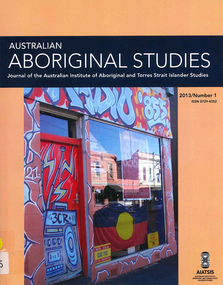
Periodical, Australian Institute of Aboriginal and Torres Strait Islander Studies, Australian Aboriginal studies : journal of the Australian Institute of Aboriginal and Torres Strait Islander Studies, 2013
... Following brief outlines of Pitjantjatjara traditional life, including burial practices, and of the establishment of Ernabella Mission in 1937 and its policy of respect for Pitjantjatjara cultural practices and language, the history of these changes which commenced in 1973 are recorded. ...Following brief outlines of Pitjantjatjara traditional life, including burial practices, and of the establishment of Ernabella Mission in 1937 and its policy of respect for Pitjantjatjara cultural practices and language, the history of these changes which commenced in 1973 are recorded. ...We don?t leave our identities at the city limits: Aboriginal and Torres Strait Islander people living in urban localities Bronwyn Fredericks Aboriginal and Torres Strait Islander people who live in cities and towns are often thought of as ?less Indigenous? than those who live ?in the bush?, as though they are ?fake? Aboriginal people ? while ?real? Aboriginal people live ?on communities? and ?real? Torres Strait Islander people live ?on islands?. Yet more than 70 percent of Australia?s Indigenous peoples live in urban locations (ABS 2007), and urban living is just as much part of a reality for Aboriginal and Torres Strait Islander people as living in remote discrete communities. This paper examines the contradictions and struggles that Aboriginal and Torres Strait Islander people experience when living in urban environments. It looks at the symbols of place and space on display in the Australian cities of Melbourne and Brisbane to demonstrate how prevailing social, political and economic values are displayed. Symbols of place and space are never neutral, and this paper argues that they can either marginalise and oppress urban Aboriginal and Torres Strait Islander people, or demonstrate that they are included and engaged. Juggling with pronouns: Racist discourse in spoken interaction on the radio Di Roy While the discourse of deficit with regard to Australian Indigenous health and wellbeing has been well documented in print media and through images on film and on television, radio talk concerning this discourse remains underresearched. This paper interrogates the power of an interactive news interview, aired on the Radio National Breakfast program on ABC Radio in 2011, to maintain and reproduce the discourse of deficit, despite the best intentions of the interview participants. Using a conversation-analytical approach, and membership categorisation analysis in particular, this paper interrogates the spoken interaction between a well-known radio interviewer and a respected medical researcher into Indigenous eye health. It demonstrates the recreation of a discourse emanating from longstanding hegemonies between mainstream and Indigenous Australians. Analysis of firstperson pronoun use shows the ongoing negotiation of social category boundaries and construction of moral identities through ascriptions to category members, upon which the intelligibility of the interview for the listening audience depended. The findings from analysis support claims in a considerable body of whiteness studies literature, the main themes of which include the pervasiveness of a racist discourse in Australian media and society, the power of invisible assumptions, and the importance of naming and exposing them. Changes in Pitjantjatjara mourning and burial practices Bill Edwards, University of South Australia This paper is based on observations over a period of more than five decades of changes in Pitjantjatjara burial practices from traditional practices to the introduction of Christian services and cemeteries. Missions have been criticised for enforcing such changes. However, in this instance, the changes were implemented by the Aboriginal people themselves. Following brief outlines of Pitjantjatjara traditional life, including burial practices, and of the establishment of Ernabella Mission in 1937 and its policy of respect for Pitjantjatjara cultural practices and language, the history of these changes which commenced in 1973 are recorded. Previously, deceased bodies were interred according to traditional rites. However, as these practices were increasingly at odds with some of the features of contemporary social, economic and political life, two men who had lost close family members initiated church funeral services and established a cemetery. These practices soon spread to most Pitjantjatjara communities in a manner which illustrates the model of change outlined by Everett Rogers (1962) in Diffusion of Innovations. Reference is made to four more recent funerals to show how these events have been elaborated and have become major social occasions. The world from Malarrak: Depictions of South-east Asian and European subjects in rock art from the Wellington Range, Australia Sally K May, Paul SC Ta�on, Alistair Paterson, Meg Travers This paper investigates contact histories in northern Australia through an analysis of recent rock paintings. Around Australia Aboriginal artists have produced a unique record of their experiences of contact since the earliest encounters with South-east Asian and, later, European visitors and settlers. This rock art archive provides irreplaceable contemporary accounts of Aboriginal attitudes towards, and engagement with, foreigners on their shores. Since 2008 our team has been working to document contact period rock art in north-western and western Arnhem Land. This paper focuses on findings from a site complex known as Malarrak. It includes the most thorough analysis of contact rock art yet undertaken in this area and questions previous interpretations of subject matter and the relationship of particular paintings to historic events. Contact period rock art from Malarrak presents us with an illustrated history of international relationships in this isolated part of the world. It not only reflects the material changes brought about by outside cultural groups but also highlights the active role Aboriginal communities took in responding to these circumstances. Addressing the Arrernte: FJ Gillen?s 1896 Engwura speech Jason Gibson, Australian National University This paper analyses a speech delivered by Francis James Gillen during the opening stages of what is now regarded as one of the most significant ethnographic recording events in Australian history. Gillen?s ?speech? at the 1896 Engwura festival provides a unique insight into the complex personal relationships that early anthropologists had with Aboriginal people. This recently unearthed text, recorded by Walter Baldwin Spencer in his field notebook, demonstrates how Gillen and Spencer sought to establish the parameters of their anthropological enquiry in ways that involved both Arrernte agency and kinship while at the same time invoking the hierarchies of colonial anthropology in Australia. By examining the content of the speech, as it was written down by Spencer, we are also able to reassesses the importance of Gillen to the ethnographic ambitions of the Spencer/Gillen collaboration. The incorporation of fundamental Arrernte concepts and the use of Arrernte words to convey the purpose of their 1896 fieldwork suggest a degree of Arrernte involvement and consent not revealed before. The paper concludes with a discussion of the outcomes of the Engwura festival and the subsequent publication of The Native Tribes of Central Australia within the context of a broader set of relationships that helped to define the emergent field of Australian anthropology at the close of the nineteenth century. One size doesn?t fit all: Experiences of family members of Indigenous gamblers Louise Holdsworth, Helen Breen, Nerilee Hing and Ashley Gordon Centre for Gambling Education and Research, Southern Cross University This study explores help-seeking and help-provision by family members of Indigenous people experiencing gambling problems, a topic that previously has been ignored. Data are analysed from face-to-face interviews with 11 family members of Indigenous Australians who gamble regularly. The results confirm that substantial barriers are faced by Indigenous Australians in accessing formal help services and programs, whether for themselves or a loved one. Informal help from family and friends appears more common. In this study, this informal help includes emotional care, practical support and various forms of ?tough love?. However, these measures are mostly in vain. Participants emphasise that ?one size doesn?t fit all? when it comes to avenues of gambling help for Indigenous peoples. Efforts are needed to identify how Indigenous families and extended families can best provide social and practical support to assist their loved ones to acknowledge and address gambling problems. Western Australia?s Aboriginal heritage regime: Critiques of culture, ethnography, procedure and political economy Nicholas Herriman, La Trobe University Western Australia?s Aboriginal Heritage Act 1972 (WA) and the de facto arrangements that have arisen from it constitute a large part of the Aboriginal ?heritage regime? in that state. Although designed ostensibly to protect Aboriginal heritage, the heritage regime has been subjected to various scholarly critiques. Indeed, there is a widespread perception of a need to reform the Act. But on what basis could this proceed? Here I offer an analysis of these critiques, grouped according to their focus on political economy, procedure, ethnography and culture. I outline problems surrounding the first three criticisms and then discuss two versions of the cultural critique. I argue that an extreme version of this criticism is weak and inconsistent with the other three critiques. I conclude that there is room for optimism by pointing to ways in which the heritage regime could provide more beneficial outcomes for Aboriginal people. Read With Me Everyday: Community engagement and English literacy outcomes at Erambie Mission (research report) Lawrence Bamblett Since 2009 Lawrie Bamblett has been working with his community at Erambie Mission on a literacy project called Read With Me. The programs - three have been carried out over the past four years - encourage parents to actively engage with their children?s learning through reading workshops, social media, and the writing and publication of their own stories. Lawrie attributes much of the project?s extraordinary success to the intrinsic character of the Erambie community, not least of which is their communal approach to living and sense of shared responsibility. The forgotten Yuendumu Men?s Museum murals: Shedding new light on the progenitors of the Western Desert Art Movement (research report) Bethune Carmichael and Apolline Kohen In the history of the Western Desert Art Movement, the Papunya School murals are widely acclaimed as the movement?s progenitors. However, in another community, Yuendumu, some 150 kilometres from Papunya, a seminal museum project took place prior to the completion of the Papunya School murals and the production of the first Papunya boards. The Warlpiri men at Yuendumu undertook a ground-breaking project between 1969 and 1971 to build a men?s museum that would not only house ceremonial and traditional artefacts but would also be adorned with murals depicting the Dreamings of each of the Warlpiri groups that had recently settled at Yuendumu. While the murals at Papunya are lost, those at Yuendumu have, against all odds, survived. Having been all but forgotten, this unprecedented cultural and artistic endeavour is only now being fully appreciated. Through the story of the genesis and construction of the Yuendumu Men?s Museum and its extensive murals, this paper demonstrates that the Yuendumu murals significantly contributed to the early development of the Western Desert Art Movement. It is time to acknowledge the role of Warlpiri artists in the history of the movement.b&w photographs, colour photographsracism, media, radio, pitjantjatjara, malarrak, wellington range, rock art, arrernte, fj gillen, engwura, indigenous gambling, ethnography, literacy, erambie mission, yuendumu mens museum, western desert art movement -
 Victorian Aboriginal Corporation for Languages
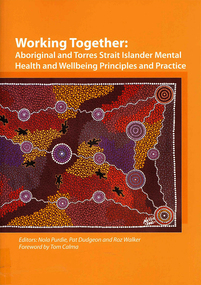
Book, Nola Purdie, Working Together: Aboriginal and Torres Strait Islander Mental Health and Wellbeing Principles and Practice, 2010
... The social, cultural and historical context of Aboriginal and Torres Strait Islander Australians 4. The policy context of Aboriginal and Torres Strait Islander mental health Pt 2 Issues of Aboriginal and Torres Strait Islander mental health and wellbeing: 5. ...The social, cultural and historical context of Aboriginal and Torres Strait Islander Australians 4. The policy context of Aboriginal and Torres Strait Islander mental health Pt 2 Issues of Aboriginal and Torres Strait Islander mental health and wellbeing: 5. ...Pt 1 History and contexts: 1. Australian Aboriginal and Torres Strait Islander mental health: an overview 2. A history of psychology in Aboriginal and Torres Strait Islander mental health 3. The social, cultural and historical context of Aboriginal and Torres Strait Islander Australians 4. The policy context of Aboriginal and Torres Strait Islander mental health Pt 2 Issues of Aboriginal and Torres Strait Islander mental health and wellbeing: 5. Mental illness in Aboriginal and Torres Strait Islander peoples 6. Social determinants of Aboriginal and Torres Strait Islander social and emotional wellbeing 7. Preventing suicide among Indigenous Australians 8. Anxiety and Aboriginal and Torres Strait Islander young people 9. Substance misuse and mental health among Aboriginal Australians 10. Trauma, transgenerational transfer and effects on community wellbeing 11. Indigenous family violence: pathways forward Pt 3 Mental health practice: 12. Working as a culturally competent mental health practitioner 13. Communication and engagement: urban diversity 14. Issues in mental health assessment with Indigenous Australians 15. Reviewing psychiatric assessment in remote Aboriginal communities 16. Promoting perinatal mental health wellness in Aboriginal and Torres Strait Islander communities Pt 4 Working with specific groups: models, programs and services: 17. Ngarlu: a cultural and spiritual strengthening model 18. Principled engagement: Gelganyem youth and community well being program 19. Dealing with loss, grief and trauma: seven phases to healing 20. The Marumali program: an Aboriginal model of healing 21. Mental health programs and services.colour photographs, tablesmental health -
 Victorian Aboriginal Corporation for Languages
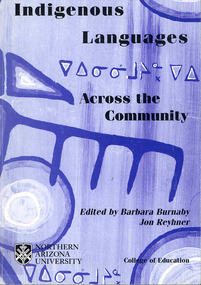
Conference proceedings, Barbara Burnaby, Indigenous languages across the community, 2002
... International language forum community based practice language research conference papers language policy language and whole community development literacy development media educational advances Canada United States New Zealand Zimbabwe Mexico Russia Caribbean Inui Yupik B&w photographs, diagrams, Language - Preservation and use. Language - Social function. [Maori: New Zealand Latin]. Language planning. [Language planning in a trans-national speech community]. [The way of the drum - when earth becomes heart] [The need for an ecological cultural ...Language - Preservation and use. Language - Social function. [Maori: New Zealand Latin]. Language planning. [Language planning in a trans-national speech community]. [The way of the drum - when earth becomes heart] [The need for an ecological cultural community] Community language management. [Methods of madness: The Tuscarora Language Committee] [Daghida: Cold Lake First Nation works towards Dene language revitalization] [The Jicarilla Apache language summer day camp] [Report on the workshop "World of Inukitut"]. Arizona. New Mexico. Oklahoma. Adult education. Women's literacy. [Teaching reading with puppets] [Assessing Lakota language teaching issues on the Cheyenne River Reservation] [Incorporating traditional Nehiyaw/Plains Cree education in the university] [Collecting texts in Crao and Portuguese for teaching] [Early vocabularies and dictionary development: A cautionary note] [The process of spelling standardization of Innu-Aimun (Montagnais)] Pidgin. Creole. [Ojibway hockey CD-ROM in the making] [The use of multimedia and the arts in language revitalization, maintenance and development: The case of the Balsas Nahuas of Guerreo, Mexico] [The languages of Indigenous Peoples in Chukotka and the media] [Meeting of the Inukitut and Yupik family of languages on May 12, 2000]B&w photographs, diagrams,international language forum, community based practice, language research, conference papers, language policy, language and whole community development, literacy development, media, educational advances, canada, united states, new zealand, zimbabwe, mexico, russia, caribbean, inui, yupik -
Victorian Aboriginal Corporation for Languages
Conference proceedings, Joan Argenter, Endangered languages and linguistic rights on the margins of nations : proceedings of the Eighth FEL Conference : Barcelona (Catalonia) Spain 1-3 October 2004, 2005
... Policy in Post Independence Kazakhstan Eden Naby From Lingua Franca to Endangered Language: The Legal Aspects of the Preservation of Aramaic in Iraq Poster presentations Akim Elnazarov Endangered languages and Education. A Case of Badakhshan Province of Tajikistan Arnfinn Muruvik Vonen & Oddvar Hjulstad Linguistic Rights Paving the Way Towards Language Endangerment? The Case of Norwegian Sign Language Eva Savelsberg Kurdish (Kurmanc�) as Minority Language in the Federal Republic of Germany Jos� Antonio Flores Farf�n Cultural...Policy in Post Independence Kazakhstan Eden Naby From Lingua Franca to Endangered Language: The Legal Aspects of the Preservation of Aramaic in Iraq Poster presentations Akim Elnazarov Endangered languages and Education. A Case of Badakhshan Province of Tajikistan Arnfinn Muruvik Vonen & Oddvar Hjulstad Linguistic Rights Paving the Way Towards Language Endangerment? The Case of Norwegian Sign Language Eva Savelsberg Kurdish (Kurmanc�) as Minority Language in the Federal Republic of Germany Jos� Antonio Flores Farf�n Cultural ...Section 1: Grass-roots Efforts and Top-down Institutions Keynote Address: Leanne Hinton The Death and Rebirth of Native American Languages Patrick Marlow Bilingual Education, Legislative Intent, and Language Maintenance in Alaska Galina Dyrkheeva New Language Policy and Small Languages in Russia: the Buryat Example Zelealem Leyew The Fate of Endangered Languages in Ethiopia Gregory Hankoni Kamwendo Language Planning from Below: Chitumbuka as a Marginalised Language in Malawi John Hobson Learning to Speak Again: Towards the Provision of Appropriate Training for the Revitalization of Australian Languages in New South Wales Shelley Tulloch Grassroots Desires for Language Planning in Nunavut Amandina C�rdenas Demay Hacia la definici�n de una pol�tica del lenguaje & Alejandra Arellano Mart�nez expl�cita en M�xico Elena Benedicto, G. McLean, Linguistic Rights in the Nicaraguan Atlantic Coast: Grupo de Ling�istas Ind�genas Mayangna Actions on the Ground within the Legislative Framework of the Estatuto de Autonom�a Bartomeu Meli� Las lenguas ind�genas en el Paraguay. Una visi�n desde el Censo 2002 Monica Ward Building from the Bottom-up: Linguistic Rights for Extremely Endangered Languages Marta Moskal Language Policy and Protection of Endangered Languages in Poland Sue Wright What is a language? Some difficulties inherent in language rights Joan Ramon Sol� Obstacles in the Way of the Recovery of Catalan Section 2: The Global vs. the Local in Linguistic Rights Keynote Address: Patxi Goenaga Fronteras que dividen y fronteras que separan. Una mirada a Europa desde el Euskara Yun-Hsuan Kuo Languages, Identity, and Linguistic Rights in Taiwan Estibaliz Amorrortu, Andoni Barre�a, What Do Linguistic Communities Think about the Esti Izagirre, Itziar Idiazabal, Bel�n Uranga Official Recognition of their Languages? Alok Kumar Das Linguistic Practices and Not Just Linguistic Rights: Endangered Languages in New Europe Section 3: Languages crossing the Borders Keynote Address: Tjeerd de Graaf The Status of Endangered Languages in the Border Areas of Japan and Russia Mariana Bara Arm�n endangered language Ver�nica Grondona Language Policy, Linguistic Rights and Language Maintenance in Argentina Grup d?Estudi de Lleng�es Amena�ades Linguistic diversity in Catalonia: towards a model of linguistic revitalization Nataliya Belitser Endangered Languages in Crimea/Ukraine: The Cases of Crimean Tatar, Karait, and Krymchak Ivelina Kazakova & Maria Miteva The Future of Bulgarian: The Road to Extinction or Paradise Regained Luke O?Callaghan War of Words: Language Policy in Post Independence Kazakhstan Eden Naby From Lingua Franca to Endangered Language: The Legal Aspects of the Preservation of Aramaic in Iraq Poster presentations Akim Elnazarov Endangered languages and Education. A Case of Badakhshan Province of Tajikistan Arnfinn Muruvik Vonen & Oddvar Hjulstad Linguistic Rights Paving the Way Towards Language Endangerment? The Case of Norwegian Sign Language Eva Savelsberg Kurdish (Kurmanc�) as Minority Language in the Federal Republic of Germany Jos� Antonio Flores Farf�n Cultural and Linguistic Revitalization, Maintenance and Development in Mexico Mary Jane Norris Assessing the Status, Use and Accessibility of Canada?s Aboriginal Languages within Communities and Cities: Some Proposed Indicators Michael Prosser van der Riet Promotion of Minority Language Scripts in Southwest China. A Relative Success or Complete Failure? Mikael Grut The Endangered Celtic Languages: A Wake-up Call Nariyo Kono Developing Partnerships Between Universities and Language Communities: Top-down and Bottom-up Integration Richard J. Hawkins Probit Modeling Language Attrition Rudy Osiel Camposeco El idioma maya Popti? y la Declaraci�n Universal de los Derechos Ling��sticos Victorio N. Sugbo The literary Response: Claiming Rights in Three Philippin Languages Ya-ling Chang Language Policies in an Aboriginal Primary School in Taiwanmaps, tables, graphsnsw, endangered languages, linguistic rights -
 Victorian Aboriginal Corporation for Languages
article, Gary Johns, Aboriginal education : remote schools and the real economy, 2006
... cultural sensitivity above the needs of the child to cope in the modern economy. More recently they have begun to concentrate on programs in literacy and numeracy, but success is limited because of the perverse incentives of other government initiatives. These initiatives have been blind to the need to deal with the absence of an economy in remote areas, and the absence of a work ethic among Aborigines who are welfare dependent. The absence of the work ethic and the absence of work have severely constrained the returns on the investment in Aboriginal education. The correct policy...policy literacy and numeracy employment outcomes Aboriginal children in remote communities have the lowest rates of success in school. The reasons for the lack of success are well known, and mainly lie outside of the schools and their programs. Education authorities have made some poor choices in the past. They have not enforced the necessary discipline on children to attend school, and they have placed cultural ...Aboriginal children in remote communities have the lowest rates of success in school. The reasons for the lack of success are well known, and mainly lie outside of the schools and their programs. Education authorities have made some poor choices in the past. They have not enforced the necessary discipline on children to attend school, and they have placed cultural sensitivity above the needs of the child to cope in the modern economy. More recently they have begun to concentrate on programs in literacy and numeracy, but success is limited because of the perverse incentives of other government initiatives. These initiatives have been blind to the need to deal with the absence of an economy in remote areas, and the absence of a work ethic among Aborigines who are welfare dependent. The absence of the work ethic and the absence of work have severely constrained the returns on the investment in Aboriginal education. The correct policy response to failure at school will be determined not simply by additional programs at school, but by how various issues of transition to the real economy - work, individual obligation, mobility - are managed. The transition will be better managed if educators and governments understand that education is essentially an instrument in economic integration, and that many remote communities are not viable, and where they are not schools should not be used as pawns to keep them afloat. Moreover, educators and governments should understand that western education cannot and should not preserve Aboriginal culture. Most importantly, parents' behaviour needs to change and where incentives to send children to school fail, compulsion must be used.school programs, education policy, literacy and numeracy, employment outcomes -
 Victorian Aboriginal Corporation for Languages
Book, Leanne Hinton, The green book of Language revitalization in practice, 2008
... Policy and Indigenous Languages in the United States /? Leanne Hinton 4. "... To Help Assure the Survival and Continuing Vitality of Native American Languages" /? Robert D. Arnold 5. Language Planning /? Leanne Hinton Introduction to the Pueblo Languages /? Leanne Hinton 6. Native Language Planning: A Pilot Process in the Acoma Pueblo Community /? Christine P. Sims 7. The Key To Cultural...Policy and Indigenous Languages in the United States /? Leanne Hinton 4. "... To Help Assure the Survival and Continuing Vitality of Native American Languages" /? Robert D. Arnold 5. Language Planning /? Leanne Hinton Introduction to the Pueblo Languages /? Leanne Hinton 6. Native Language Planning: A Pilot Process in the Acoma Pueblo Community /? Christine P. Sims 7. The Key To Cultural ...1. Language Revitalization: An Overview /? Leanne Hinton 2. Diversity in Local Language Maintenance and Restoration: A Reason For Optimism /? Anna Ash, Jessie Little Doe Fermino and Ken Hale 3. Federal Language Policy and Indigenous Languages in the United States /? Leanne Hinton 4. "... To Help Assure the Survival and Continuing Vitality of Native American Languages" /? Robert D. Arnold 5. Language Planning /? Leanne Hinton Introduction to the Pueblo Languages /? Leanne Hinton 6. Native Language Planning: A Pilot Process in the Acoma Pueblo Community /? Christine P. Sims 7. The Key To Cultural Survival: Language Planning and Revitalization in the Pueblo de Cochiti /? Regis Pecos and Rebecca Blum-Martinez The Navajo Language: I /? Ken Hale 8. Navajo Head Start Language Study /? Paul R. Platero 9. Introduction to Revitalization of National Indigenous Languages /? Leanne Hinton Introduction to the Welsh Language /? Leanne Hinton 10. Welsh: A European Case of Language Maintenance /? Gerald Morgan Introduction to the Maori Language /? Ken Hale 11. Te Kohanga Reo: Maori Language Revitalization /? Jeanette King An Introduction to the Hawaiian Language /? Leanne Hinton 12. The Movement to Revitalize Hawaiian Language and Culture /? Sam L. No'Eau Warner 13. "Mai Loko Mai O Ka 'I'ini: Proceeding from a Dream": The 'Aha Punana Leo Connection in Hawaiian Language Revitalization /? William H. Wilson and Kauanoe Kamana 14. Teaching Methods /? Leanne Hinton The Karuk Language /? Leanne Hinton 15. Teaching Well, Learning Quickly: Communication-Based Language Instruction /? Terry Supahan and Sarah E. Supahan The Navajo Language: II /? Ken Hale 16. Tsehootsooidi Olta'gi Dine Bizaad Bihoo'aah: A Navajo Immersion Program at Fort Defiance, Arizona /? Marie Arviso and Wayne Holm 17. The Master-Apprentice Language Learning Program /? Leanne Hinton 18. Linguistic Aspects of Language Teaching and Learning in Immersion Contexts /? Ken Hale 19. New Writing Systems /? Leanne Hinton An Introduction to Paiute /? Leanne Hinton and Ken Hale 20. Language Revitalization in the San Juan Paiute Community and the Role of a Paiute Constitution /? Pamela Bunte and Robert Franklin 21. Audio-Video Documentation /? Leanne Hinton Australian Languages /? Ken Hale 22. Strict Locality in Local Language Media: An Australian Example /? Ken Hale The Arapaho Language /? Ken Hale 23. Reflections on the Arapaho Language Project, or When Bambi Spoke Arapaho and Other Tales of Arapaho Language Revitalization Efforts /? Stephen Greymorning Irish /? Ken Hale 24. Continuity and Vitality: Expanding Domains through Irish-Language Radio /? Colleen Cotter The Mono Language /? Ken Hale 25. On Using Multimedia in Language Renewal: Observations from Making the CD-ROM Taitaduhaan /? Paul V. Kroskrity and Jennifer F. Reynolds 26. Can the Web Help Save My Language? /? Laura Buszard-Welcher 27. Training People to Teach Their Language /? Leanne Hinton Inuttut and Innu-aimun /? Ken Hale 28. The Role of the University in the Training of Native Language Teachers: Labrador /? Alana Johns and Irene Mazurkewich Languages of Arizona, Southern California, and Oklahoma /? Leanne Hinton 29. Indigenous Educators as Change Agents: Case Studies of Two Language Institutes /? Teresa L. McCarty, Lucille J. Watahomigie and Akira Y. Yamamoto /? [et al.] The Navajo Language: III /? Ken Hale 30. Promoting Advanced Navajo Language Scholarship /? Clay Slate 31. Sleeping Languages: Can They Be Awakened? /? Leanne Hinton 32. The Use of Linguistic Archives in Language Revitalization: The Native California Language Restoration Workshop /? Leanne Hinton The Ohlone Languages /? Leanne Hinton 33. New Life for a Lost Language /? Linda Yamane.Maps, b&w photographs, tables, word listslanguage policy, language planning, language maintenance, language revitalization, language immersion, language literacy, media and technology, language education and training, sleeping languages, navajo, arapaho -
 Victorian Aboriginal Corporation for Languages
Book, Aboriginal Community Elders Service et al, Aboriginal elders' voices : stories of the "tide of history" : Victorian Indigenous elders' life stories &? oral histories, 2003
... cultural resistance on missions, of defying assimilation laws, of forever moving around to save children from the welfare. They document the development of both fringe and urban communities and work in the Aboriginal rights movement. They clarify the ways in which these experiences have affected the individual authors along with the indigenous population in general. Also included in the book is a brief history and analysis of the legislation, policies...cultural resistance on missions, of defying assimilation laws, of forever moving around to save children from the welfare. They document the development of both fringe and urban communities and work in the Aboriginal rights movement. They clarify the ways in which these experiences have affected the individual authors along with the indigenous population in general. Also included in the book is a brief history and analysis of the legislation, policies ...This book is a collection of Victorian Indigenous Elders' life stories and oral histories. The Elders share their stories in an attempt to ensure that both sides of Australia's history are finally heard. These stories tell of cultural resistance on missions, of defying assimilation laws, of forever moving around to save children from the welfare. They document the development of both fringe and urban communities and work in the Aboriginal rights movement. They clarify the ways in which these experiences have affected the individual authors along with the indigenous population in general. Also included in the book is a brief history and analysis of the legislation, policies, attitudes and strategies that have affected the lives of the authors and their families since colonisation. This aspect provides an historical perspective, encouraging a deeper understanding of the Elders' stories. Reconciliation can only eventuate with an understanding gained from hearing and including the voices of Indigenous Australians. Contents: The writing team Indigenous elders: keepers of knowledge; custodians of land and culture Aboriginal lands Missions and reserves Growing up running from the welfare /? Aunty Olive Jackson Respecting our Elders /? Aunty Lola James If your mother didn't tell you, then your grandmother did! /? Uncles Les Stewart Don't dwell on trouble /? Aunty Audrey Critch There are my people /? Aunty Gwen Nelson We were all cousins, more or less /? Aunty Iris Lovett-Gardiner Aboriginality is about culture, not colour /? Aunty Dianne Phillips Take up the opportunities we struggled to make /? Aunty Frances Gallagher Home /? Aunty Eileen Alberts We were supposed to forget our Aboriginality /? Aunty Gwen Garoni Not enough heart to say sorry? /? Uncle Brian Kennewell-Taylor Learning from indigenous elders: Keeping the traditions, keeping the culture strong; Since time immemorial; Invasion: the tide ran red; The flood of legislation; Stolen children; Cultural resistance: holding on to children traditions and land; Organised resistance: a movement is born; The 1950s: community resistance to race laws; The price of assimilation; The Aboriginal rights movement; After the flood: self-determination; Turning the tide Bibliography Appendix. Cultural custodianship: developing an indigenous methodology.maps, colour illustrations, b&w photographswiradjuri, victorian indigenous elders, oral histories, yorta yorta, dja dja wurrung, language maps, victorian missions and reserves, lake condah, framlingham, coranderrk, ramahyuck, lake tyers, wahgunyah, cummeragunja, moonahcullah, balranald, ebenezer, maloga, acheron -
 Sunshine and District Historical Society Incorporated
Administrative record - The Western Region of Melbourne, A finding list supplement 1978-79
... Cultural Heritage Conservation: Commissioning detailed studies to identify, document, and protect sites of industrial, social, and architectural significance. - Community Engagement and Advocacy: Acting as a voice for the western suburbs in dealings with state and federal governments and promoting equitable access to services and funding. - Support for Local Councils by providing professional services, training, and policy guidance to its member councils and shires....Cultural Heritage Conservation: Commissioning detailed studies to identify, document, and protect sites of industrial, social, and architectural significance. - Community Engagement and Advocacy: Acting as a voice for the western suburbs in dealings with state and federal governments and promoting equitable access to services and funding. - Support for Local Councils by providing professional services, training, and policy guidance to its member councils and shires. ...The Western Region of Melbourne Commission incorporated the local government areas of City of Altona, City of Essendon, City of Footscray, City of Keilor, City of Sunshine, City of Williamstown, Shire of Bacchus Marsh, Shire of Melton & Shire of Werribee. The Melbourne Western Region Commission (WRC) was a collaborative body formed to address the unique planning, social, and economic challenges of the western suburbs. Its key purposes included: - Strategic Regional Planning: Coordinating infrastructure, transport, housing, and industrial development across multiple municipalities such as Footscray, Sunshine, Williamstown, and Werribee. - Cultural Heritage Conservation: Commissioning detailed studies to identify, document, and protect sites of industrial, social, and architectural significance. - Community Engagement and Advocacy: Acting as a voice for the western suburbs in dealings with state and federal governments and promoting equitable access to services and funding. - Support for Local Councils by providing professional services, training, and policy guidance to its member councils and shires.The Western Region of Melbourne A Finding List Supplement 1978-79western region of melbourne commission
