
Showing 10 items matching "customs of the commonwealth of australia"
-
 Federation University Historical Collection
Book - Sealing Register, Ballarat School of Mines and Industries, Ballarat, School of Mines and Industries Ballarat Sealing Register, 12/11/1971
... ...customs of the commonwealth of australia...It shows projects that were being undertaken at the institution at the time and gives us an historical perspective on project costs and the type of work being done sealing register school of mines and industries ballarat d.j weir pty ltd customs of the commonwealth of australia peter joseph gill mary daly w.g feary and sons john nolan and son k.j brady r shewell t.j coutts j. k. and w walsh h.w sarah Sealing Register School of Mines and Industries Ballarat written on front cover Red book with gold lettering on the front School of Mines and Industries Ballarat Sealing Register Book Sealing Register Ballarat School of Mines and Industries, Ballarat ...School of Mines is a predecessor of Federation UniversityThis book lists the sealing information of the School of Mines in the 1970's and 80's giving us an understanding of the operations of the School of Mines in that era and of the people involved with the institution at that time. It shows projects that were being undertaken at the institution at the time and gives us an historical perspective on project costs and the type of work being doneRed book with gold lettering on the front Sealing Register School of Mines and Industries Ballarat written on front cover sealing register, school of mines and industries ballarat, d.j weir pty ltd, customs of the commonwealth of australia, peter joseph gill, mary daly, w.g feary and sons, john nolan and son, k.j brady, r shewell, t.j coutts, j. k. and w walsh, h.w sarah -
 Flagstaff Hill Maritime Museum and Village
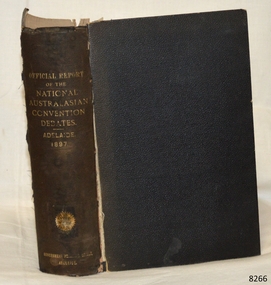
Book - Publication of Speeches, C. E. Bristow Government Printer, Official Report of The National Australasian Convention Debates Adelaide, 1897
... customs barriers, and the setup of the High Court of Australia. The publisher and printer was Charles Edward Bristow, who served as the South Australian Government Printer in Adelaide during this era. Copies were produced primarily for parliamentarians, official government repositories, delegates, and legal libraries of the period. The 1897 Adelaide Convention Debates volume holds profound historical, legal, and political significance for Australia. It is not merely a record of parliamentary speeches; it is the official birth transcript of the Australian Constitution and the blueprint for the Commonwealth ...This volume is one of the primary founding documents of the Australian Federation. Published in Adelaide in 1897 by Charles Edward Bristow (the South Australian Government Printer), this heavy octavo volume captures the verbatim transcript of the First Session of the Australasian Federal Convention, held in Adelaide from 22 March to 5 May 1897. The volume contains verbatim debates from the convention, where statesmen from across the colonies drafted the framework for the Australian Constitution.Hard cover book, National Australasian Convention. (Debate Speeches March 22nd to May 5th 1897) Author: Various Speeches by various Speakers Publisher: C. E. Bristow Government Printer, North Terrace ,Adelaide. SA. Editor: C. E. Bristow Government Printer Date: 1897 Further Information: Black embossed cloth hardcover with a brown spine and lettering in gilt. The spine has a publishers logo in gilt.non-fictionThis volume is one of the primary founding documents of the Australian Federation. Published in Adelaide in 1897 by Charles Edward Bristow (the South Australian Government Printer), this heavy octavo volume captures the verbatim transcript of the First Session of the Australasian Federal Convention, held in Adelaide from 22 March to 5 May 1897. The volume contains verbatim debates from the convention, where statesmen from across the colonies drafted the framework for the Australian Constitution.flagstaff hill, warrnambool, shipwrecked coast, flagstaff hill maritime museum, maritime museum, shipwreck coast, flagstaff hill maritime village, great ocean road, book, pattison collection, warrnambool library, warrnambool mechanics’ institute, ralph eric pattison, corangamite regional library service, warrnambool city librarian, mechanics’ institute library, victorian library board, warrnambool books and records, warrnambool children’s library, official report of the national australasian convention debates adelaide -
 City of Moorabbin Historical Society (Operating the Box Cottage Museum)
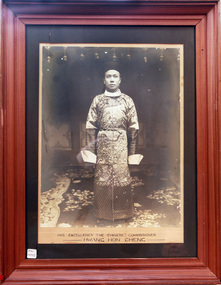
Photograph - Chinese Commissioner, Hwang Hong Cheng,1906, 1902
... Australia. In 1908 Mr Leong Lan Fun, Taotal of Swatow was appointed Consul-General for the Commonwealth with his headquarters in Melbourne. Animosity, suspicion and misunderstanding had existed between Chinese and European settlers since the Gold Rush of 1850’s. Language, customs ...His Excellency, Hwang Hon Cheng, from Peking, China, visited Australia from 1906 -1907 as Chinese Commissioner in response to an urgent petition from well respected Chinese business leaders, The 1906 Petition was sent to the Chinese Ambassador in Britain requesting the appointment of a Chinese Consular Representative in Australia to ease the escalating Discrimination and address the Immigration Restrictions in Australia. Hwang Hon Cheng visited Brisbane, Sydney, Melbourne , Adelaide and Hobart and after reviewing his recommendations Britain agreed to the appointment of the first Chinese Consul-General to Australia. In 1908 Mr Leong Lan Fun, Taotal of Swatow was appointed Consul-General for the Commonwealth with his headquarters in Melbourne. Animosity, suspicion and misunderstanding had existed between Chinese and European settlers since the Gold Rush of 1850’s. Language, customs, frugality and mostly their ability to obtain profit from crops seen as uneconomical by Europeans eg parsley, garlic and salad vegetables. Many of the Chinese workers did not purchase land instead their main aim was to obtain enough money for their family and return to China. There were a few still managing market gardens around East Bentleigh until the 1950’s, by which time they were highly regarded by the general community. A large photograph of His Excellency the Chinese Commissioner , Hwang Hong Cheng, in a wooden frame c1906His Excellency the Chinese Commissioner / Hwang Hong Cheng, moorabbin, bentleigh, ormond, brighton, gold rush, chinese immigration, chinese market gardeners, markets, cheltenham, cabinet makers, early settlers, pioneers, market gardeners, , hwang hon cheng, leong lan fun, peking china, melbourne -
 Ringwood and District Historical Society
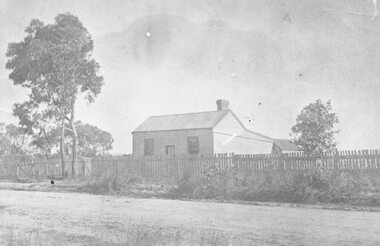
Photograph, The Lewis Findlay East Residence, Bedford Rd, Ringwood. 1901
... Lewis Findlay East was a member of an Australian Rifle Team which went to Bisley, England, in 1901, and won the Kalapore Cup. He was an officer of the Department of Customs, and later became Secretary of the Commonwealth Marine Branch, receiving the I.S.O. ...Lewis Findlay East was a member of an Australian Rifle Team which went to Bisley, England, in 1901, and won the Kalapore Cup. He was an officer of the Department of Customs, and later became Secretary of the Commonwealth Marine Branch, receiving the I.S.O. ...Black and white photograph of weatherboard house surrounded by a picket fence. (2 copies- 1 large, 1 small). Typed notes detailing history of cottage.Typed notes contain the following: "Cottage and Lot 15, Sec.C, Township of Ringwood - comprising 1 acre - were acquired from the Crown by John Price on 17th July, 1888, for £30. Subsequently, a 4-roomed weatherboard cottage was built on Lot 15. On 21st May, 1901, the two allotments and the house were transferred to Lewis Findlay East for £85, and on 13th March, 1942, were sold to R. Barr and L. Beaumont for £650 with two additional rooms and some other improvements including reticulated water supply. Lewis Findlay EAST and his family occupied the cottage until 1910. It is believed that before the cottage was purchased by East, it was occupied for a period by McCubbin the artist. Lewis Findlay East was a member of an Australian Rifle Team which went to Bisley, England, in 1901, and won the Kalapore Cup. He was an officer of the Department of Customs, and later became Secretary of the Commonwealth Marine Branch, receiving the I.S.O. His son, Lewis Ronald East, became Chairman of the State Rivers and Water Supply Commission in 1936, and received C.B.E.". -
 Bendigo Historical Society Inc.
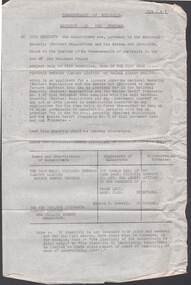
Document - COHN BROTHERS COLLECTION: 1941 DOCUMENT
... Folded typed A4 document dated 10th January 1941 relating to Cohn production of carbonic acid gas and complying with Commonwealth of Australia 'Security to the Customs' provisions....BENDIGO Industry cohn bros brewery Folded typed A4 document dated 10th January 1941 relating to Cohn production of carbonic acid gas and complying with Commonwealth of Australia 'Security to the Customs' provisions. Document COHN BROTHERS COLLECTION: 1941 DOCUMENT ...Folded typed A4 document dated 10th January 1941 relating to Cohn production of carbonic acid gas and complying with Commonwealth of Australia 'Security to the Customs' provisions.bendigo, industry, cohn bros brewery -
 Bendigo Historical Society Inc.
Document - W.D.MASON COLLECTION: DISTILLATION ACT, 20-30 Sep.1938
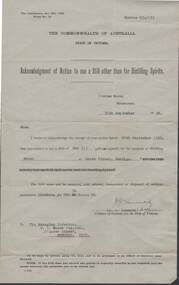
... Commonwealth of Australia, State of Victoria. The Still was intended for distilling Water at Queen Street Bendigo. The Still must not be removed, sold, altered, dismantled, or disposed of without permission (Distillation Act 1901-34, Section 10). Signed J.J.Kennedy; Collector of Customs...Customs House, Melbourne. Grey / green Document, Form 19 re the Distillation Act 1901-1925 dated 30.9.1938 W.D.Mason Collection, an Acknowledgement of Notice to use a Still other than for Distilling Spirits. The Commonwealth of Australia ...Grey / green Document, Form 19 re the Distillation Act 1901-1925 dated 30.9.1938 W.D.Mason Collection, an Acknowledgement of Notice to use a Still other than for Distilling Spirits. The Commonwealth of Australia, State of Victoria. The Still was intended for distilling Water at Queen Street Bendigo. The Still must not be removed, sold, altered, dismantled, or disposed of without permission (Distillation Act 1901-34, Section 10). Signed J.J.Kennedy; Collector of Customs for the State of Victoria.Customs House, Melbourne.business, retail, w d mason -
 National Vietnam Veterans Museum (NVVM)
Document, Customs Concession
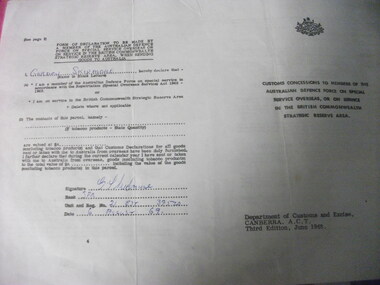
... Australia on 05/08/1969. Skidmore Gordon 39570 Sapper Concession Customs A two folded small document issued to members of the A.D.T serving overseas or on service in the British commonwealth strategic reserve area. ...This document was issued to Gordon Skidmore. Service No: 39570. Sapper. It was issued to Skidmore on his return to Australia on 05/08/1969.A two folded small document issued to members of the A.D.T serving overseas or on service in the British commonwealth strategic reserve area.skidmore, gordon, 39570, sapper, concession, customs -
Unions Ballarat
Instructions for American servicemen in Australia 1942 (Don Woodward Collection), 1942
... Australia during WWII. Includes descriptions of slang, money, places, Commonwealth, food, economy, etc. Australian culture as perceived by outsiders. BTLC Ballarat Trades Hall ballarat trades and labour council social customs Culture - Australia Military - USA war - world war ii Australia - language - vernacular Book; 54 pages. ...Dated. Cultural guide to Australia for US servicemen who were based in Australia during WWII. Includes descriptions of slang, money, places, Commonwealth, food, economy, etc.Australian culture as perceived by outsiders.Book; 54 pages. Cover: blue background; black lettering; title.btlc, ballarat trades hall, ballarat trades and labour council, social customs, culture - australia, military - usa, war - world war ii, australia - language - vernacular -
 The 5th/6th Battalion Royal Victoria Regiment Historical Collection
Uniform - Victorian Scottish Regiment Officers Scarlet Full Dress Doublet c. 1898, c1901-1911
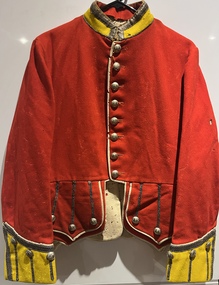
... Australian Commonwealth Military forces in 1901 and was later renamed the 5th Battalion, Victorian Scottish Regiment. In 1960 the Victorian Scottish Regiment became the Royal Victoria Regiment and the present 5th/6th Battalion, Royal Victoria Regiment is today the custodian of its Australian-Scottish customs and traditions. ...Australian Commonwealth Military forces in 1901 and was later renamed the 5th Battalion, Victorian Scottish Regiment. In 1960 the Victorian Scottish Regiment became the Royal Victoria Regiment and the present 5th/6th Battalion, Royal Victoria Regiment is today the custodian of its Australian-Scottish customs and traditions. ...The Victorian Scottish Regiment was an infantry unit of the Colony of Victoria Australia raised in 1898. It became part of the Australian Commonwealth Military forces in 1901 and was later renamed the 5th Battalion, Victorian Scottish Regiment. In 1960 the Victorian Scottish Regiment became the Royal Victoria Regiment and the present 5th/6th Battalion, Royal Victoria Regiment is today the custodian of its Australian-Scottish customs and traditions. Officer's full dress scarlet wool doublet with yellow stand collar and cuffs, and Inverness skirts. Left front of doublet, cuffs and Inverness skirts all edged with white piping. Lower edge of collar, cuffs and skirts are decorated with three rows of doubled, 1/8” silver Russian braid; each row completed with a large whitemetal coloured metal "King Edward VII Australian Commonwealth" button of the period 1901-1911. 5/8” silver lace around top of collar, and top and seam of gauntlet cuff. Silver braid shoulder straps and screw buttons MISSING. Eight large buttons at front of tunic, and two at back waist. Two large brass belt hooks at side waist of doublet. Lower front skirt flaps have welt pockets lined with linen. Body of tunic lined with a white wool mixture, lightly padded around the underarms. Lower skirt flaps lined with a medium weight cream wool twill and upper smaller flaps lined with a finer cream wool twill. Sleeves lined with cream cotton twill and written in blue ink on lotter right opening lining is '5-7 37'. Collar lined with red wool and neck fastened with two brass hook and eyes. No black patent leather tab at collar.blue ink on lotter right opening lining is '5-7 37'vsr, victorian scottish regiment, australian army, 5th battalion, 5th battalion victorian scottish regiment, royal australian infantry corps, rainf, 5/6 rvr, 5th/6th battalion, royal victoria regiment, pipes and drums, officer, full dress, doublet, scottish dress -
 The 5th/6th Battalion Royal Victoria Regiment Historical Collection
Uniform - 6th Battalion, the Royal Victoria Regiment Mess Dress Jacket
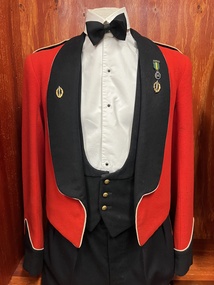
... Australian Commonwealth Military Forces buttons. This mess jacket is significant because Australian Army Infantry units would normally wear the Infantry Corps pattern of mess dress. However, this pattern was worn by the 6th Battalion, the Royal Victoria Regiment (and likely also 5/6 RVR) right up to the late 1980s due to the unique and honoured customs and traditions of the 6th Battalion. ...6th Battalion, the Royal Victoria Regiment Mess Dress Jacket. Traditional Fusiliers pattern mess dress inherited from the 6th Battalion, the Royal Melbourne Regiment (1918-1960) who were given the pattern by their allied regiment, the Royal Fusiliers (City of London Regiment) in 1936 as a token of friendship. The Royal Victoria Regiment (RVR) was a late adopter of miniature RVR badges for collar badges and the Royal Australian Infantry Corps collar badges fitted indicate use after 1960 and likely at least into the 1980s when miniature RVR badges were adopted. The staybrite St Edward's Crown rank insignia to each epaulet also indicate use between 1960-1980s. Red body with white piping to Royal blue facings (to cuffs, epaulets and lapel/collar). Royal blue lapelled waistcoat with brass Australian Commonwealth Military Forces buttons. This mess jacket is significant because Australian Army Infantry units would normally wear the Infantry Corps pattern of mess dress. However, this pattern was worn by the 6th Battalion, the Royal Victoria Regiment (and likely also 5/6 RVR) right up to the late 1980s due to the unique and honoured customs and traditions of the 6th Battalion. It is a traditional Fusiliers pattern mess dress which was inherited from the 6th Battalion, the Royal Melbourne Regiment (1918-1960) who were the forebear to the Royal Victoria Regiment. They were given the pattern by their allied regiment, the Royal Fusiliers (City of London Regiment) in 1936 as a token of friendship. The use after 1960 (when the Royal Melbourne Regiment was amalgamated) is evidenced by unit held photos and by object itself which bears the Royal Australian Infantry Corps collar badges and staybrite St Edward's Crown rank insignia to each epaulet (for rank of Major).6th Battalion, the Royal Victoria Regiment Mess Dress Jacket. Traditional Fusiliers pattern mess dress inherited from the 6th Battalion, the Royal Melbourne Regiment (1918-1960) who were given the pattern by their allied regiment, the Royal Fusiliers (City of London Regiment) in 1936 as a token of friendship. The Royal Victoria Regiment (RVR) was a late adopter of miniature RVR badges for collar badges and the Royal Australian Infantry Corps collar badges fitted indicate use after 1960 and likely at least into the 1980s when miniature RVR badges were adopted. The staybrite St Edward's Crown rank insignia to each epaulet also indicate use between 1960-1980s. Red body with white piping to Royal blue facings (to cuffs, epaulets and lapel/collar). Royal blue lapelled waistcoat with brass Australian Commonwealth Military Forces buttons. 6th battalion, royal melbourne regiment, mess dress jacket, mess dress, mess jacket, australian army, royal australian infantry corps, rainf, rmr, 5th/6th battalion, royal victoria regiment, city of melbourne regiment, rvr, 5/6 rvr
