
Showing 153 items matching "cylinder records"
-
 Federation University Historical Collection
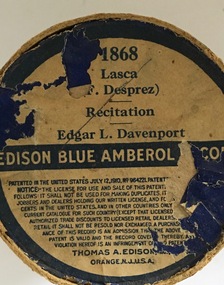
Musical Object, Edison Amberol Cylinder Records, 1900s
... Edison Amberol Cylinder Records......cylinder records...6 Record cylinders, each in a cardboard cylindrical case....Title of record with its number on the lid of the case. Title stamped on the end face of cylinder. ...Edison Amberol Cylinder Records Musical Object Thomas Edison Thomas Edison ...Each record has a number and the title of the piece. The artists' names are also mentioned and the length of time it plays. The "record should run 160 revolutions per minute - not faster or slower". .1) Blue Amberol No. 1868 - "Lasca" - F Deprez / Edgar Davenport .2) Amberol No. 999 - "Peggy Gray" - Thurland Chatterway .3) Blue Amberol No.1819 - "Just a Wee Deoch and Doris" - Harry Lauder .4) Blue Amberol No. 12206 - "Killarney" - Violet Oppenshaw. (There is no lid for this record.) .5) Amberol No. 863 - "Winter" / "March Song" - Billy Murray and Chorus .6) Amberol No. 12347 - "By the Sea" - Stanley Kirkby 6 Record cylinders, each in a cardboard cylindrical case.Title of record with its number on the lid of the case. Title stamped on the end face of cylinder. Detailed Copyright information - 1900 by the National Phonograph Co., Orange, New Jersey, U.S.A.amberol, thomas edison, cylinder records, national phonograph company, blue amberol -
 Glenelg Shire Council Cultural Collection
Audio - Edison Sterling Record, Thomas A. Edison (TM), The Pullman Porters on Parade, 1913
... Blue Amberol Records was the trademark name for cylinder records manufactured by Thomas A. Edison, Inc. in the US from 1912 to 1929. ...Blue Amberol cylinder record....Blue Amberol cylinder record. The Pullman Porters on Parade Audio Edison Sterling Record Thomas A. ...Blue Amberol Records was the trademark name for cylinder records manufactured by Thomas A. Edison, Inc. in the US from 1912 to 1929. They replaced the 4-minute black wax Amberol cylinders introduced in 1908, which had replaced the 2-minute wax cylinders that had been the standard format since the late 1880s.[citation needed] Blue Amberols can play for as long as 4 minutes and 45 seconds[citation needed] and have a surface layer of the "indestructible" plastic celluloid, which Edison tinted a trademark blue color. Edison brand phonographs designed to play Amberol cylinders were named Amberolas. Displayed at History HouseEdison Sterling Record. Blue Amberol cylinder record.Front: Thomas A Edison PAT'D. 6. 2043. The Pullman Porters on Parade. Meeker (engraved, edge)music, amberol, blue amberol, thomas a edison, edward meeker -
 Wangaratta Historical Society
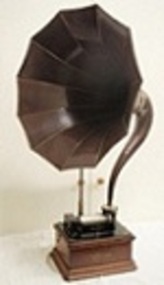
Edison Phonogram
... It was recovered and restored by Mr Gray of Chiltern and presented to the Wangaratta Historical Society by Mr Bruce Kirkwood in 1967. Edison cylinder records were obtained and these are able to be played on this machine. ...Brown table model Edison Phonogram Wooden box base with fluted metal horn Plays metal cylindrical records...Edison phonogram Brown table model Edison Phonogram Wooden box base with fluted metal horn Plays metal cylindrical records Edison Phonogram Edison Phonogram ...Two brothers - surname Wain - found this phonogram at the Chiltern tip. It was recovered and restored by Mr Gray of Chiltern and presented to the Wangaratta Historical Society by Mr Bruce Kirkwood in 1967. Edison cylinder records were obtained and these are able to be played on this machine. These Edison phonograms were highly sought after and valued as an alternate entertainment in the homes of those who had the means of affording this machine. Brown table model Edison Phonogram Wooden box base with fluted metal horn Plays metal cylindrical recordsedison phonogram -
Glenelg Shire Council Cultural Collection
Container - Record cylinder - Edison Sterling Record container: "Brooke's Triumphal March" by Roland F. Seitz, 1909
... Record cylinder - Edison Sterling Record container: "Brooke's Triumphal March" by Roland F. ...Cylinder record in cardboard case....Recording number 10137. Cylinder record in cardboard case. Container Record cylinder - Edison Sterling Record container: "Brooke's Triumphal March" by Roland F. ...Displayed at History HouseCylinder record in cardboard case.Front: See photograph. Recording number 10137. -
Glenelg Shire Council Cultural Collection
Container - Record, cylinder - Edison Gold Moulded Record: "Where Oh Where" by Billy Williams, 1906
... Record, cylinder - Edison Gold Moulded Record: "Where Oh Where" by Billy Williams...Amberol cylinder record in cardboard case....Williams (engraved, edge) Amberol cylinder record in cardboard case. Container Record, cylinder - Edison Gold Moulded Record: "Where Oh Where" by Billy Williams Thomas A. ...Displayed at History HouseAmberol cylinder record in cardboard case.Front: Thomas A Edison PAT'D. 05. 13561. The Pullman Porters on Parade. B. Williams (engraved, edge) -
Glenelg Shire Council Cultural Collection
Container - Record case cylinder - Edison Blue Amberol Record: "Uncle Josh Buys an Automobile" by Cal Stewart, 1903
... Record case cylinder - Edison Blue Amberol Record: "Uncle Josh Buys an Automobile" by Cal Stewart...Cardboard case containing broken cylinder record....Displayed at History House Cardboard case containing broken cylinder record. Container Record case cylinder - Edison Blue Amberol Record: "Uncle Josh Buys an Automobile" by Cal Stewart Thomas A. ...Displayed at History HouseCardboard case containing broken cylinder record. -
 Orbost & District Historical Society
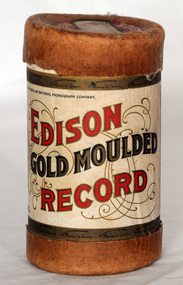
record container, From 1902 - 1911
... Phonograph cylinders are the earliest commercial medium for recording and reproducing sound. Commonly known simply as "records" , these hollow cylindrical objects have an audio recording engraved on the outside surface, which can be reproduced when they are played on a mechanical cylinder phonograph. ...A cardboard cylindrical record container. It is an Edison Gold Moulded Record container. ...Gold Moulded Records were discontinued in 1912. Edison-gold-moulded-cylinders sound-recording records Hand-written on lid - Whistler & His Dog A cardboard cylindrical record container. ...Phonograph cylinders are the earliest commercial medium for recording and reproducing sound. Commonly known simply as "records" , these hollow cylindrical objects have an audio recording engraved on the outside surface, which can be reproduced when they are played on a mechanical cylinder phonograph. The "Gold-Moulded" process was developed in 1902 and involved creating a metal mould from a wax master; a brown wax blank would be placed inside and heated . as the blank expanded, the grooves would be pressed into the blank which would then be cooled. The "gold" is derived from the traces of that metal used as a conductive agent in the initial mould. "Whistler and his Dog" was performed by the Edison Military Band.Edison Records was one of the earliest record labels which pioneered sound recording and reproduction and was important in the early recording industry. Gold Moulded records used a process that Edison had developed, that allowed a mould to be made from a master cylinder which then permitted the production of several hundred cylinders to be made from the mould. Previously cylinders were recorded live or by hooking two machine together to copy from one cylinder to another, and they used softer brown wax which wore out in as few as twenty playings. Gold Moulded Records were discontinued in 1912.A cardboard cylindrical record container. It is an Edison Gold Moulded Record container. The label has red and gold print and a photo Thomas A. Edison.Hand-written on lid - Whistler & His Dogedison-gold-moulded-cylinders sound-recording records -
 Mont De Lancey
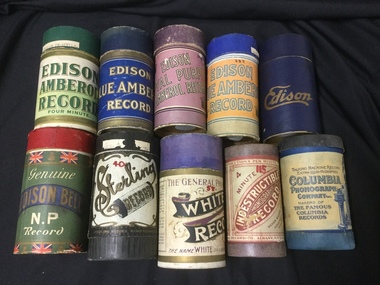
Gramophone cylinders, Thomas A. Edison, 1910
... 10 Cylinder records. 6 - Edison cylinders, 1 Stirling cylinder, 1 General Phonography Co., 1 Columbia Phono Co., 1 Indestrictible Phonographic Co....gramophone cylinders gramophones sound recordings 10 Cylinder records. 6 - Edison cylinders, 1 Stirling cylinder, 1 General Phonography Co., 1 Columbia Phono Co., 1 Indestrictible Phonographic Co. ...10 Cylinder records. 6 - Edison cylinders, 1 Stirling cylinder, 1 General Phonography Co., 1 Columbia Phono Co., 1 Indestrictible Phonographic Co.gramophone cylinders, gramophones, sound recordings -
 Greensborough Historical Society
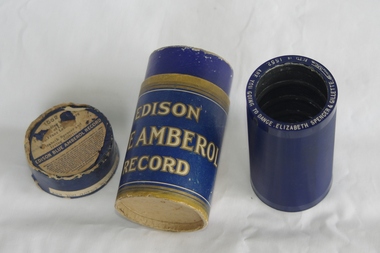
Audio - Gramophone Cylinder, Thomas A. Edison Inc, Are you going to dance, 1920s
... Musical number recorded on plastic "Edison" cylinder. 'Blue Amberol Records' was the trademark name for cylinder records manufactured by Thomas A. ...Musical number recorded on plastic "Edison" cylinder. 'Blue Amberol Records' was the trademark name for cylinder records manufactured by Thomas A. ...Musical number recorded on plastic "Edison" cylinder. 'Blue Amberol Records' was the trademark name for cylinder records manufactured by Thomas A. Edison, Inc. in the US from 1912 to 1929.Plastic gramophone cylinder in blue and gold cardboard caseElizabeth Spencer and Irving Gillette. Edison Blue Amberol Record 1552gramophone cylinder, thomas edison, blue amberol records -
 Bendigo Historical Society Inc.
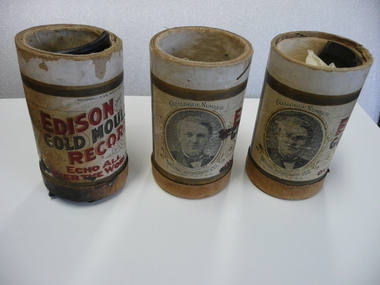
Mixed media - EDISON CYLINDERS
... Three Edison gold moulded record cylinders in cardboard cases showing portrait of Thomas Edison....RECREATIONS Amusements music Edison laboratory Orange NJ USA Flights Mitchell St Bendigo Three Edison gold moulded record cylinders in cardboard cases showing portrait of Thomas Edison. ...Three Edison gold moulded record cylinders in cardboard cases showing portrait of Thomas Edison.Edison laboratory Orange NJ USA Flights Mitchell St Bendigorecreations, amusements, music -
 Flagstaff Hill Maritime Museum and Village
Audio - Gramophone Cylinder, B & H Jack, 1907
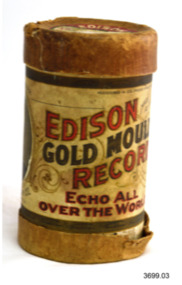
... cylinder...edison record...Edison Records was one of the early record labels that pioneered sound recording and reproduction, and was an important player in the early recording industry. The first phonograph cylinders...The Catalogue Number and Title are either printed or hand written on the cylinder’s lid. This cylinder contained Record no. 49, “B & H Jack” and was made at the Edison Laboratory USA. ...On lid “Edison Record No. 49”, written in pencil “B & H Jack” (it looks like this) On cylinder “EDISON GOLD MOULDED RECORDS ECHO ALL OVER THE WORLD” Patents listed for 1904 & 1905...The Catalogue Number and Title are either printed or hand written on the cylinder’s lid. This cylinder contained Record no. 49, “B & H Jack” and was made at the Edison Laboratory USA. ...Edison Records was one of the early record labels that pioneered sound recording and reproduction, and was an important player in the early recording industry. The first phonograph cylinders were manufactured in 1888, followed by Edison's foundation of the Edison Phonograph Company in the same year. The recorded wax cylinders, later replaced by Blue Amberol cylinders, and vertical-cut Diamond Discs, were manufactured by Edison's National Phonograph Company from 1896 on, reorganized as Thomas A. Edison, Inc. in 1911. Until 1910 the recordings did not carry the names of the artists. The company began to lag behind its rivals in the 1920s, both technically and in the popularity of its artists, and halted production of recordings in 1929. Thomas A. Edison invented the phonograph, the first device for recording and playing back sound, in 1877. After patenting the invention and benefiting from the publicity and acclaim it received, Edison and his laboratory turned their attention to the commercial development of electric lighting, playing no further role in the development of the phonograph for nearly a decade. Start of the Recording Industry: In 1887, Edison turned his attention back to improving the phonograph and the phonograph cylinder. The following year, the Edison company introduced the ”Perfected Phonograph”. Edison introduced wax cylinders approximately 4+1⁄4 inches (11 cm) long and 2+1⁄4 inches (5.7 cm) in external diameter, which became the industry standard. They had a maximum playing time of about 3 minutes at 120 RPM, but around the turn of the century the standard speed was increased to (first 144) and then 160 RPM to improve clarity and volume, reducing the maximum to about 2 minutes and 15 seconds. Several experimental wax cylinder recordings of music and speech made in 1888 still exist. The wax entertainment cylinder made its commercial debut in 1889 at first, the only customers were entrepreneurs who installed nickel-in-the-slot phonographs in amusement arcades, saloons and other public places. At that time, a phonograph cost the equivalent of several months' wages for the average worker and was driven by an electric motor powered by hazardous, high-maintenance wet cell batteries. After more affordable spring-motor-driven phonographs designed for home use were introduced in 1895, the industry of producing recorded entertainment cylinders for sale to the general public began in earnest. Blank records were an important part of the business early on. Most phonographs had or could be fitted with attachments for the users to make their own recordings. One important early use, in line with the original term for a phonograph as a "talking machine", was in business for recording dictation. Attachments were added to facilitate starting, stopping, and skipping back the recording for dictation and playback by stenographers. The business phonograph eventually evolved into a separate device from the home entertainment phonograph. Edison's brand of business phonograph was called the Ediphone. The collection of three phonograph cylinders are an example of early recorded music use for domestic entertainment. They are significant as they represent the beginnings of the modern recording industry.Cardboard tube-shaped gramophone cylinder box with lid. The printed label on the outside of the box advertises the maker and patent details. The Catalogue Number and Title are either printed or hand written on the cylinder’s lid. This cylinder contained Record no. 49, “B & H Jack” and was made at the Edison Laboratory USA. C. 1905On lid “Edison Record No. 49”, written in pencil “B & H Jack” (it looks like this) On cylinder “EDISON GOLD MOULDED RECORDS ECHO ALL OVER THE WORLD” Patents listed for 1904 & 1905warrnambool, flagstaff hill maritime museum, maritime museum, shipwreck coast, flagstaff hill maritime village, gramophone record, gramophone cylinder, edison cylinder, edison record, home entertainment, music recording, edison laboratory orange nj, usa, national phonograph company of australia ltd sydney, thomas a. edison -
 Mont De Lancey
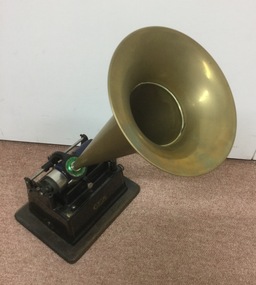
Phonograph, Thomas A. Edison, 1888-1903
... Edison Gem Cylinder phonograph, with gold horn has wooden base. Record Cylinder on Phonograph. ...gramophones cylinder players phonographs Edison Gem Cylinder phonograph, with gold horn has wooden base. Record Cylinder on Phonograph. ...Edison Gem Cylinder phonograph, with gold horn has wooden base. Record Cylinder on Phonograph. Has wooden box cover.gramophones, cylinder players, phonographs -
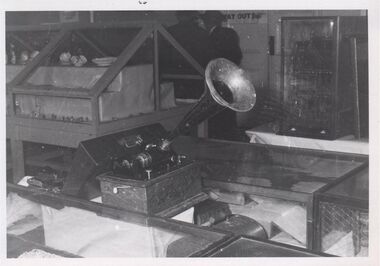 Bendigo Historical Society Inc.
Photograph - GOLDEN DAYS HISTORICAL EXHIBITION COLLECTION: EDISON 1890 GRAMOPHONE MODEL
... Large silver horn, wooden box, record cylinder visible....Large silver horn, wooden box, record cylinder visible. Photograph GOLDEN DAYS HISTORICAL EXHIBITION COLLECTION: EDISON 1890 GRAMOPHONE MODEL ...Black and white photograph: image shows Edison gramophone 1890 model. Large silver horn, wooden box, record cylinder visible.bendigo, history, golden days historical exhibition -
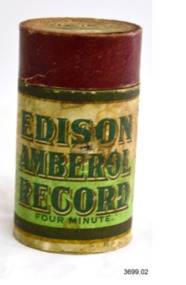 Flagstaff Hill Maritime Museum and Village
Audio - Gramophone Cylinder, National Phonograph Co, Poor old England, 1908
... cylinder...edison record...Edison Records was one of the early record labels that pioneered sound recording and reproduction, and was an important player in the early recording industry. The first phonograph cylinders...The Catalogue Number and Title are either printed or hand written on the cylinder’s lid. This cylinder contained Record no. 13619, the recording “Poor old England” published by Castling and Godfrey, sung by Billy Williams. ...The Catalogue Number and Title are either printed or hand written on the cylinder’s lid. This cylinder contained Record no. 13619, the recording “Poor old England” published by Castling and Godfrey, sung by Billy Williams. ...Edison Records was one of the early record labels that pioneered sound recording and reproduction, and was an important player in the early recording industry. The first phonograph cylinders were manufactured in 1888, followed by Edison's foundation of the Edison Phonograph Company in the same year. The recorded wax cylinders, later replaced by Blue Amberol cylinders, and vertical-cut Diamond Discs, were manufactured by Edison's National Phonograph Company from 1896 on, reorganized as Thomas A. Edison, Inc. in 1911. Until 1910 the recordings did not carry the names of the artists. The company began to lag behind its rivals in the 1920s, both technically and in the popularity of its artists, and halted production of recordings in 1929. Thomas A. Edison invented the phonograph, the first device for recording and playing back sound, in 1877. After patenting the invention and benefiting from the publicity and acclaim it received, Edison and his laboratory turned their attention to the commercial development of electric lighting, playing no further role in the development of the phonograph for nearly a decade. Start of the Recording Industry: In 1887, Edison turned his attention back to improving the phonograph and the phonograph cylinder. The following year, the Edison company introduced the ”Perfected Phonograph”. Edison introduced wax cylinders approximately 4+1⁄4 inches (11 cm) long and 2+1⁄4 inches (5.7 cm) in external diameter, which became the industry standard. They had a maximum playing time of about 3 minutes at 120 RPM, but around the turn of the century the standard speed was increased to (first 144) and then 160 RPM to improve clarity and volume, reducing the maximum to about 2 minutes and 15 seconds. Several experimental wax cylinder recordings of music and speech made in 1888 still exist. The wax entertainment cylinder made its commercial debut in 1889 at first, the only customers were entrepreneurs who installed nickel-in-the-slot phonographs in amusement arcades, saloons and other public places. At that time, a phonograph cost the equivalent of several months' wages for the average worker and was driven by an electric motor powered by hazardous, high-maintenance wet cell batteries. After more affordable spring-motor-driven phonographs designed for home use were introduced in 1895, the industry of producing recorded entertainment cylinders for sale to the general public began in earnest. Blank records were an important part of the business early on. Most phonographs had or could be fitted with attachments for the users to make their own recordings. One important early use, in line with the original term for a phonograph as a "talking machine", was in business for recording dictation. Attachments were added to facilitate starting, stopping, and skipping back the recording for dictation and playback by stenographers. The business phonograph eventually evolved into a separate device from the home entertainment phonograph. Edison's brand of business phonograph was called the Ediphone. The collection of three phonograph cylinders are an example of early recorded music use for domestic entertainment. They are significant as they represent the beginnings of the modern recording industry.Cardboard tube-shaped gramophone cylinder box with lid. The printed label on the outside of the box advertises the maker and patent details. The Catalogue Number and Title are either printed or hand written on the cylinder’s lid. This cylinder contained Record no. 13619, the recording “Poor old England” published by Castling and Godfrey, sung by Billy Williams. Made by National Phonograph Company USA. C.1907On lid “Edison Record” and “This record should turn at 160 revolutions per minute, no faster” Written on lid in blue pen “Trumpet”, “EDISON AMBEROL RECORD / FOUR MINUTE”warrnambool, flagstaff hill maritime museum, maritime museum, shipwreck coast, flagstaff hill maritime village, gramophone record, gramophone cylinder, edison cylinder, edison record, home entertainment, music recording, edison laboratory orange nj, usa, national phonograph company of australia ltd sydney, thomas a. edison -
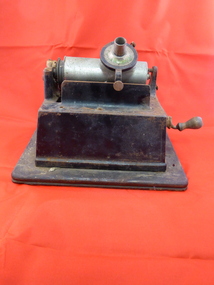 Warrnambool and District Historical Society Inc.
Musical Instrument, Edison Phonograph, 1905
... It has a cylindrical turntable for playing the Edison cylindrical records and a handle with a wooden knob. ... turntable for playing the Edison cylindrical records and a handle with a wooden knob. ...The phonograph is a mechanical device for the recording and reproduction of sound and originally used a tinfoil sheet wrapped around a rotating cylinder to produce the sound. It was invented by Thomas Edison of U.S.A. in 1877 and was the model for all phonographs or gramophones made and developed throughout the 20th century. This machine is of particular interest to the Warrnambool and District Historical Society as it is an Edison phonograph and an earlier model of this phonograph was used in Warrnambool late in the 19th century to make an important recording. In 1896 Thomas Rome, an employee in a Warrnambool boot and shoe shop, purchased an Edison phonograph that could both play and record sounds. At the Warrnambool Industrial and Art Exhibition of 1896-7 visitors to the Exhibition paid a fee to listen to music on this phonograph. But Rome also recorded some local Warrnambool people singing and speaking and these recordings survive today. They are regarded as the oldest surviving recordings made in Australia. Thomas Rome later became a shoe shop proprietor in Warrnambool and was a well-known person in the town/city for a great number of years. This is an Edison Gem Phonograph. It has a black-painted wooden base, now detached from the main mechanism. The phonograph is made of metal which is now heavily rusted. It has a cylindrical turntable for playing the Edison cylindrical records and a handle with a wooden knob. The turning mechanism and belt are now broken. The name of the manufacturer and details of the patents are on a metal plate attached to the side of the phonograph. The amplifier mechanism at the top of the machine is missing. The cover of the machine is made of wood and has a wooden handle attached with a piece of metal and two metal screws. There are also two metal screws on the side of the cover. The cover has a slot on the side to allow the turning handle to be accommodated outside of the cover. The cover is much stained and spotted. ‘Edison Gem Phonograph’ thomas edison, history of sound recordings, thomas rome (warrnambool) -
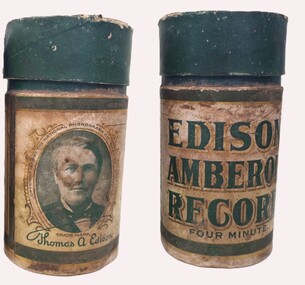 Wodonga & District Historical Society Inc
Functional object - Edison Phonograph Records
... Cylinder records continued to compete with the growing disc record market into the 1910s. ...The first cylinder is an earlier 2 minute Edison Gold Moulded Record with Issue Number 9184. ...Cylinder records continued to compete with the growing disc record market into the 1910s. ...Edison cylinders were the earliest commercial medium for recording and reproducing sound. These hollow cylindrical objects have an audio recording engraved on the outside surface which can be reproduced when they are played on a mechanical cylinder phonograph. Beginning in 1889, pre-recorded wax cylinders were marketed. These have professionally made recordings of songs, instrumental music or humorous monologues in their grooves. The earliest cylinders were made from soft wax and later hard wax was utilised. Further developments by several companies, led to the introduction of celluloid cylinders. In late 1908, Thomas Edison had introduced wax cylinders that played for about four minutes (instead of the usual two) under the Amberol brand. The Amberols were manufactured with flat rim-ends, to prevent confusion with the earlier bevel-edged two-minute version. In 1912, the Edison company eventually acquired patents to the celluloid technology, and almost immediately started production under new brand as Edison Blue Amberol Records. Cylinder records continued to compete with the growing disc record market into the 1910s. In 1912, Columbia Records, which had been selling both discs and cylinders, dropped the cylinder format, while Edison introduced his Diamond Disc format, played with a diamond stylus. From 1915, new Edison cylinders were re-recordings from Edison discs. Although his cylinders continued to be sold in steadily dwindling quantities, Edison continued to support the owners of cylinder phonographs by making new titles available in that format until the company ceased manufacturing all records and phonographs in November 1929.This item is significant because it is representative of home entertainment in the late 19th and early 20th century.Two phonograph cylinders in cardboard boxes. The first cylinder is an earlier 2 minute Edison Gold Moulded Record with Issue Number 9184. It features a recording of "Paddle your own Canoe" by Arthur F. Collins and Byron G. Harlan and was released in January 1906. The second cylinder is a 4 minute Edison Amberol Record (NO. 647) featuring the Levy-Athan Polka performed by Charles Daab on xylophone and accompanied by an orchestra. It was released in February 1911. The case is cylindrical in shape and made of cardboard. It is coloured green, white, and black on the outside, while the base is not coloured. The tube is open at the top, and sealed at the base. Inside the tube is a white fabric lining. The top section of the outside of the tube is dark green. Below this is an outer sleeve. The outer sleeve has a half white, half green background with a black stripe, with gold outline, running horizontally around the top and bottom. The words "Thomas A. Edison" are printed in green cursive along the band. In the centre of the sleeve is the text " EDISON AMBEROL RECORD FOUR MINUTE" in green ink. To the left of that text is a green-toned image of Thomas Edison in an ornate, gold border. This is surrounded by the words “Copyright 1900 by the National Phonograph Co. Orange N.J. U.S.A". To the right of the text is a rectangular text box with a black border, which contains patent information in green text. edison phonograph, home entertainment, music early 20th century -
 Wodonga & District Historical Society Inc
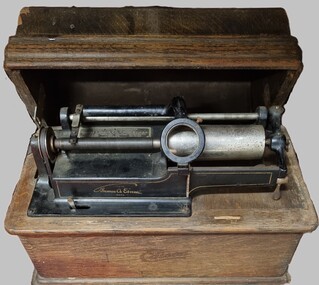
Functional object - Edison Home Phonograph
... Cylinder records continued to compete with the growing disc record market into the 1910s. ...Cylinder records continued to compete with the growing disc record market into the 1910s. ...Thomas Edison was one of the world’s most prolific inventors, holding over 2,000 different patents. One of his earliest inventions was the phonograph. The Edison Phonograph Company was formed on October 8, 1887, to market Edison's machine. The original machine went through many modifications. The Patent information on this machine indicates that it was manufactured after May 1906. Sound was recorded on wax cylinders. Edison cylinders were the earliest commercial medium for recording and reproducing sound. These hollow cylindrical objects have an audio recording engraved on the outside surface which can be reproduced when they are played on a mechanical cylinder phonograph Beginning in 1889, pre-recorded wax cylinders were marketed. They featured professionally made recordings of songs, instrumental music or humorous monologues in their grooves. The earliest cylinders were made from soft wax and later hard wax was utilised. Further developments by several companies, led to the introduction of celluloid cylinders. In late 1908, Thomas Edison had introduced wax cylinders that played for about four minutes (instead of the usual two) under the Amberol brand. The Amberols were manufactured with flat rim-ends, to prevent confusion with the earlier bevel-edged two-minute version. In 1912, the Edison company eventually acquired patents to the celluloid technology, and almost immediately started production of the new brand as Edison Blue Amberol Records. Cylinder records continued to compete with the growing disc record market into the 1910s. In 1912, Columbia Records, which had been selling both discs and cylinders, dropped the cylinder format, while Edison introduced his Diamond Disc format, played with a diamond stylus. From 1915, new Edison cylinders were re-recordings from Edison discs. Although his cylinders continued to be sold in steadily dwindling quantities, Edison continued to support the owners of cylinder phonographs by making new titles available in that format until the company ceased manufacturing all records and phonographs in November 1929.This item is significant because it is representative of early home entertainment in the late 19th and early 20th century.An Edison Home Phonograph in a wooden case. No trumpet included.On outer case' Edison On metal plate: Thomas A Edison TRADE MARK On large metal plate: Detailed inscription of Patent informationphonograph, thomas edison -
 Flagstaff Hill Maritime Museum and Village
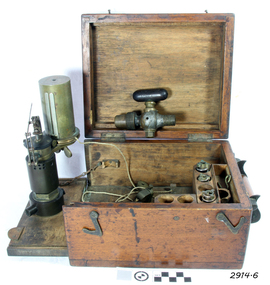
Engine Dynamometer, c.1890’s
... This force of power would be registered by a pencil, fitted to the adjustable arm, which would trace a line on paper wound around the cylinder. The recorded information could be used in conjunction with mathematical tables. ...This force of power would be registered by a pencil, fitted to the adjustable arm, which would trace a line on paper wound around the cylinder. The recorded information could be used in conjunction with mathematical tables. ...The steam engine indicator, or dynamometer, is an instrument used on a steam engine (such as that of a vessel or train) to measure and record the change in the pressures of the engine’s cylinders during their operating cycle. The engineer would use it to identify problems or defects such as bad valve settings or constricted steam pipes. It could indicate the difference in efficiency caused by adjustments made to the engine, being able to instantly measure the variation of pressure from the engine stroke at any given time. This force of power would be registered by a pencil, fitted to the adjustable arm, which would trace a line on paper wound around the cylinder. The recorded information could be used in conjunction with mathematical tables. This particular instrument was made by T.S. Mc Innes, one of the better manufacturers of engine indicators. Mc Innes engine indicators were still being used in the mid 1900’s. This specific instrument was used by Mark Forsythe of North Berwial, Scotland and late of Ararat, Victoria when he was chief engineer on the “SS Talawena” in 1892. The Port of Warrnambool, in Victoria, harboured steam ships that carried both passengers and cargo along the south west coast in the late 1800’s and into the 1900’s. The engineer of a steam ship was responsible for reaching and maintaining the optimum level of steam energy to serve the locomotion and efficiency of the steam ship. The engineer would use a steam engine indicator to measure and record information to achieve this purpose. Engine Dynamometer or Steam Engine Indicator in square, fitted oak case. This brass instrument is used to measure and record steam pressure for setting up and adjusting valves on a steam engine. It has an oscillating recording drum with vertical, silver clip attached for holding paper in place around the drum. The drum oscillates left to right. There is a pulley attached to a length of cord, which is attached to the drum. Beside the drum is a fine metal arm, vertically adjustable, small hole in the end to hold a pencil. Inscription stamped into bracket of the arm. The engine indicator is mounted on a hinged side of the case that swings out ready for use. Attached chains prevent the side from opening past vertical. There is storage for other accessories and an empty compartment in the base (where a scale or ruler may have been located). The case has a collapsible wooden handle, brass hinges and two brass, hook-shaped catches. There is a code stamped inside the lid. It contains a brass, ‘T’ shaped steam-cock (or stop cock) with two open ends made of metal pipe with different sized threads. (Turning the handle on top opens and closes the space in the pipe and would close off the flow of steam from one end to the other.) Also inside the case are three different spiral springs, each with a threaded nut on the end that has a threaded hole inside it. Used by Mr Mark Forsythe when chief engineer on the SS Talawena in 1892 “T.S. MC INNES PATENT” and “522 _ _” (last 2 digits are unreadable) pressed into the arm of the brass indicator. “[ ] X ’ stamped inside the lid of the case. The 3 springs all have a number stamped into them: (1) “32” and “12” (2) “12” and “16” [above] “12” (3) “64” and “150” Card that came with instrument “This instrument was used by Mark Forsythe of North Berwial Scotland and late of Ararat, Victoria when chief engineer on the SS Talawena in 1892" dynamometer, steam engine indicator, t.s. mcinnes, glasgow, dobbie mcinnes, port of warrnambool, warrnambool, flagstaff hill, flagstaff hill maritime museum, flagstaff hill maritime village, maritime museum, shipwreck coast, great ocean road -
 Flagstaff Hill Maritime Museum and Village
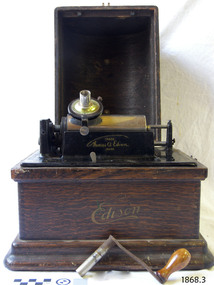
Audio - Phonograph, Thomas A. Edison, Edison Laboratory, c.1909
... This machine was produced around 1909, just after the introduction of 4-minute record cylinders in 1908.; the selection lever on the front was either 4 or 2-minute choice. ...This machine was produced around 1909, just after the introduction of 4-minute record cylinders in 1908.; the selection lever on the front was either 4 or 2-minute choice. ...The Edison Fireside Phonograph Combination Type A model phonograph was an open horn model. This machine was produced around 1909, just after the introduction of 4-minute record cylinders in 1908.; the selection lever on the front was either 4 or 2-minute choice. This Fireside model has a fluted octagonal horn that attaches to the reproducer on the machine and is suspended by on ring by a horn crane attachment. The phonograph machine is powered purely by mechanical means, winding the crank handle on the side of the machine to start the belt-driven, spring-loaded motor inside. The sound comes from a pre-recorded, vertical cut record cylinder, which slides over the Mandle, a smooth rotating drum. The reproducer, an all-in-one needle, amplifier and speaker, is lowered onto the cylinder, the needle picks up the sound and plays it on the speaker and the attached horn amplifies the sound. The phonograph machine was invented by Thomas Alva Edison in the late 19th century. Edison adopted the idea from the technology of the telegraph machine. He patented the phonograph in early 1878. It was able to record sound and play it back. This amazing invention opened up a whole new world of entertainment, where wax cylinders of pre-recorded sound could be purchased with a wide variety of music and played over and over. The first wax cylinders were white and used a combination of bees' wax and animal fax or tallow. By 1892 Edison was using 'brown wax' cylinders that ranged from cream through to dark brown. The Edison Phonograph Company was formed in 1887 to produce these machines. He sold the company in 1855 to the North American Phonograph Company but bought that company in 1890. He then started the Edison Spring Motor factory in 1895, and the National Phonograph Company in 1896. In 1910 the company became Thomas A. Edison Inc. In 1898 Edison produced the Edison Standard Phonograph, the first phonograph to carry his own trade mark. He began mass producing duplicate copies of his wax cylinders in 1901 using moulds instead of engraving the cylinders. The wax was black and harder than the brown wax. The ends of the cylinders were bevelled so that the title's label could be added. The last phonograph machine to use an external open horn was produced in 1912 due to the much more robust round records being invented. In 1913 Edison started producing the Edison Disc Phonograph. The company stopped trading in 1929.This Edison Fireside Phonograph model is significant for being one of the last models to have an external horn. It is also significant for its connection with the invention of the phonograph, which made music and sound available for domestic enjoyment. It was used for entertainment and education, even teaching languages. It signalled a new era of music that could be reproduced and played anywhere. It is also significant for its short time span of popularity, just a few decades, due to the growing use of records, which gave a much higher quality sound and were more robust.Phonograph; Edison Fireside Phonograph, Combination Type, Model A. It is in a wooden case with a domed lid, metal catches on each side and a folding wooden handle. It has a metal drum and a reproducer mechanism. The metal and wood crank handle starts the machine’s motor. A sliding lever at the front selects the speed for four- or two-minute cylinders. The inscribed plate has the maker, serial number, patents and other information. The reproducer also has an inscription. It has a curved metal open horn attachment. Made in Orange, New Jersey in c.1909. NOTE: the fluted octagonal horn is catalogued separately.Case front, in script, Edison’s early ‘banner’ decal “Edison” On the front of the machine “Thomas A Edison TRADE MARK” On the maker’s plate; "Edison Fireside Phonograph Combination Type" Serial number “14718” Around sound outlet; “C 4076” “REPRODUCER LICENCED FOR USE ONLY ON EDISON PHOTOGRAPHS SOLD BYT.A. EDISON INC.” At the front edge “4 MINUTES 2flagstaff hill, maritime museum, maritime village, warrnambool, great ocean road, shipwreck coast, gramophone, phonograph, music player, entertainment, audio equipment, edison, thomas a edison, horn, phonograph horn, amplifier, audio, sound recording, sound playback, phonograph machine, phonograph cylinder, external horn, edison phonograph company, wax cylinders, sound reproduction, edison spring motor factory, national phonograph company, thomas a. edison inc, crank-operated motor, open horn phonograph, 4 speed, 2 speed -
 Flagstaff Hill Maritime Museum and Village
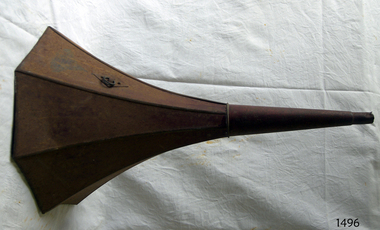
Audio - Phonograph Horn, Thomas A. Edison, Edison Laboratory, c.1909
... [NOTE: a phonograph machine plays cylinders, a gramophone plays records]...record sound and play it back sound. This amazing invention opened up a whole new world of entertainments, where wax cylinders of pre-recorded sound could be purchased with a wide variety of music and played over and over. ...This external horn is part of an Edison Fireside Phonograph made in c.1909. The horn was attached to the machine when in use. The rings on the side of the horn allowed the horn to be suspended above the machine. The narrow opening on the horn was attached to the sound outlet on the machine and the conical shape of the horn amplified the sound. The horn was suspended to allow a clear sound. This was done by attaching the ring fitted to the outside of the horn to a chain or chord, which in turn was attached to a curved wire fitted to the phonograph machine. The phonograph machine was invented by Thomas Alva Edison in the late 19th century. Edison adapted the idea used when sending messages over a telegraph machine. He patented the phonograph in early 1878. The phonograph was able to record sound and play it back sound. This amazing invention opened up a whole new world of entertainments, where wax cylinders of pre-recorded sound could be purchased with a wide variety of music and played over and over. The first wax cylinders were white and used a combination of bees' wax and animal fax or tallow. By 1892 Edison was using 'brown wax' cylinders that ranged from cream through to dark brown. The Edison Phonograph Company was formed in 1887 to produce these machines. He sold the company in 1855 to the North American Phonograph Company but bought that company in 1890. He started the Edison Spring Motor factory in 1895 and then the National Phonograph Company in 1896. In 1910 the company became Thomas A. Edison Inc. In 1898 Edison produced the Edison Standard Phonograph, the first phonograph to carry his own trade mark. He began mass producing duplicate copies of his wax cylinders in 1901 using moulds instead of engraving the cylinders. The wax was black and harder than the brown wax. The ends of the cylinders were bevelled so that the title's label could be added. The last phonograph machine to use an external horn was produced in 1912 due to the much more robust records being invented. In 1913 Edison started producing the Edison Disc Phonograph. The company stopped trading in 1929. [NOTE: a phonograph machine plays cylinders, a gramophone plays records]This Edison external phonograph horn is significant for its connection to the c.1909 Edison Fireside phonograph model. The phonograph machine brought a new era of music into the homes of everyday people but was only popular for a few decades due to the growing popularity of records, which gave a much higher quality sound and were more robust.Phonograph horn; open horn, a conical shape with the lower part flaring out. The horn's shape on the opening half is octagonal, made from eight joined sheets of metal with a scalloped finish at the opening. The narrow end is hollow and ready to fit onto a phonograph outlet. There are two rings attached together on the side of the horn, perhaps for storing on a hook. The inner surface of the horn has remnants of deep red paint. This horn is from the Edison Fireside phonograph. (There is a mark on the outside of the horn where the Edison brand would be)flagstaff hill, maritime museum, maritime village, warrnambool, great ocean road, shipwreck coast, gramophone, phonograph, music player, entertainment, audio equipment, edison, thomas a edison, horn, phonograph horn, amplifier, audio, sound recording, sound playback, phonograph machine, external horn, edison phonograph company, wax cylinders, edison spring motor factory, national phonograph company, thomas a. edison inc, phonographic cylinder, sound reproduction -
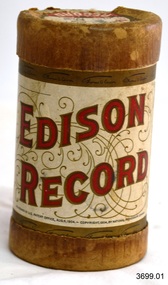 Flagstaff Hill Maritime Museum and Village
Audio - Gramophone Cylinder, Sandy McNab, 1908
... cylinder...edison record...Edison Records was one of the early record labels that pioneered sound recording and reproduction, and was an important player in the early recording industry. The first phonograph cylinders...This cylinder was made by Edison 1908 and contains Record number 53 by Sandy McNab. c. 1908...They are significant as they represent the beginnings of the modern recording industry. warrnambool flagstaff hill maritime museum maritime museum shipwreck coast flagstaff hill maritime village gramophone record gramophone cylinder edison cylinder edison record home entertainment music recording edison laboratory orange nj, usa national phonograph company of australia ltd sydney thomas a. edison On label “Edison Record No. 53, Sandy McNab" and "Form no. 1130, April 1908. ...Edison Records was one of the early record labels that pioneered sound recording and reproduction, and was an important player in the early recording industry. The first phonograph cylinders were manufactured in 1888, followed by Edison's foundation of the Edison Phonograph Company in the same year. The recorded wax cylinders, later replaced by Blue Amberol cylinders, and vertical-cut Diamond Discs, were manufactured by Edison's National Phonograph Company from 1896 on, reorganized as Thomas A. Edison, Inc. in 1911. Until 1910 the recordings did not carry the names of the artists. The company began to lag behind its rivals in the 1920s, both technically and in the popularity of its artists, and halted production of recordings in 1929. Thomas A. Edison invented the phonograph, the first device for recording and playing back sound, in 1877. After patenting the invention and benefiting from the publicity and acclaim it received, Edison and his laboratory turned their attention to the commercial development of electric lighting, playing no further role in the development of the phonograph for nearly a decade. Start of the Recording Industry: In 1887, Edison turned his attention back to improving the phonograph and the phonograph cylinder. The following year, the Edison company introduced the ”Perfected Phonograph”. Edison introduced wax cylinders approximately 4+1⁄4 inches (11 cm) long and 2+1⁄4 inches (5.7 cm) in external diameter, which became the industry standard. They had a maximum playing time of about 3 minutes at 120 RPM, but around the turn of the century the standard speed was increased to (first 144) and then 160 RPM to improve clarity and volume, reducing the maximum to about 2 minutes and 15 seconds. Several experimental wax cylinder recordings of music and speech made in 1888 still exist. The wax entertainment cylinder made its commercial debut in 1889 at first, the only customers were entrepreneurs who installed nickel-in-the-slot phonographs in amusement arcades, saloons and other public places. At that time, a phonograph cost the equivalent of several months' wages for the average worker and was driven by an electric motor powered by hazardous, high-maintenance wet cell batteries. After more affordable spring-motor-driven phonographs designed for home use were introduced in 1895, the industry of producing recorded entertainment cylinders for sale to the general public began in earnest. Blank records were an important part of the business early on. Most phonographs had or could be fitted with attachments for the users to make their own recordings. One important early use, in line with the original term for a phonograph as a "talking machine", was in business for recording dictation. Attachments were added to facilitate starting, stopping, and skipping back the recording for dictation and playback by stenographers. The business phonograph eventually evolved into a separate device from the home entertainment phonograph. Edison's brand of business phonograph was called the Ediphone. The collection of three phonograph cylinders are an example of early recorded music use for domestic entertainment. They are significant as they represent the beginnings of the modern recording industry.Cardboard tube-shaped gramophone cylinder box with lid. The printed label on the outside of the box advertises the maker and patent details. The Catalogue Number and Title are either printed or hand written on the cylinder’s lid. This cylinder was made by Edison 1908 and contains Record number 53 by Sandy McNab. c. 1908On label “Edison Record No. 53, Sandy McNab" and "Form no. 1130, April 1908. Patented December 6 1904, No. 2109, and December 6 1904 No. 2110. “This record is sold by the National Phonograph Company of Australia Ltd, at Sydney Australia.” Trade Mark Thomas A. Edison warrnambool, flagstaff hill maritime museum, maritime museum, shipwreck coast, flagstaff hill maritime village, gramophone record, gramophone cylinder, edison cylinder, edison record, home entertainment, music recording, edison laboratory orange nj, usa, national phonograph company of australia ltd sydney, thomas a. edison -
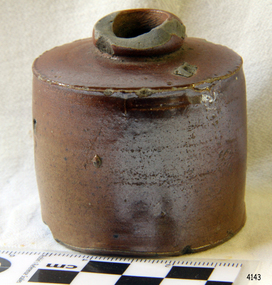 Flagstaff Hill Maritime Museum and Village
Container - Ink Bottle, 19th to early-20th century
... This ink well is historically significant as it represents methods of hand written communication that were still common up until the mid-20th century, when fountain pens and ballpoint pens took over in popularity and convenience. flagstaff hill warrnambool shipwreck coast flagstaff hill maritime museum flagstaff hill maritime village maritime museum great ocean road shipwreck artefact writing equipment writing accessory office equipment stationery domestic stoneware clay ceramic pottery ink well inkwell ink bottle penny ink well nib pen dip pen ink hand writing record keeping household business vintage blotting paper dwarf bottle Ink bottle or ink well, sometimes called a Penny Ink Well. Cylindrical ...This design of ink bottle or ink well was commonly referred to as a ‘penny ink well’ because it was very inexpensive to produce. It is also known as a dwarf bottle. Pen and ink has been in use for hand writing from about the seventh century up until the mid-20th century. Up until around the mid-19th century a quill pen made from a bird’s feather was used. In the 1850s the steel point pen was invented and could be manufactured on machines in large quantities. In the 1880s a successful portable fountain pen was designed, giving a smooth flowing ink and ease of use. Ink wells, used with steel nib dip pens, were commonly used up until the mid-20th century. The pens only held a small amount of ink so users had to frequently dip the nib of the pen into an ink well for more ink. Hand writing with pen and ink left wet writing on the paper, so blotting paper was carefully used to absorb the excess ink and prevent smudging. Ink could be purchased, ready to use, or in the powdered form, which needed to be mixed with water. After the invention of fountain pens, which had a reservoir of ink, and then ballpoint pens, which also had ink that flowed freely, the dip pen was slowly replaced. However, artisans continue to use nib pens to create beautiful calligraphy.This ink well is historically significant as it represents methods of hand written communication that were still common up until the mid-20th century, when fountain pens and ballpoint pens took over in popularity and convenience.Ink bottle or ink well, sometimes called a Penny Ink Well. Cylindrical body, salt-glazed, brown ceramic stoneware bottle, handmade. Stoneware bottle. flagstaff hill, warrnambool, shipwreck coast, flagstaff hill maritime museum, flagstaff hill maritime village, maritime museum, great ocean road, shipwreck artefact, writing equipment, writing accessory, office equipment, stationery, domestic, stoneware, clay, ceramic, pottery, ink well, inkwell, ink bottle, penny ink well, nib pen, dip pen, ink, hand writing, record keeping, household, business, vintage, blotting paper, dwarf bottle -
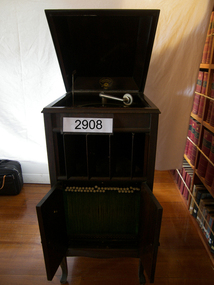 Flagstaff Hill Maritime Museum and Village
Gramophone, 1911
... Although the Gramophone does not have a large monetary value, it is of social significance as it demonstrates the progress made in audio reproduction from the first Edison cylinder machines to improvements that allowed ordinary people to be able to buy music discs and enjoy music in their own homes. flagstaff hill warrnambool shipwrecked-coast flagstaff-hill flagstaff-hill-maritime-museum maritime-museum shipwreck-coast flagstaff-hill-maritime-village record player gramophone mechanical gramophone floor model gramophone gramophone record columbia graphophone company american graphophone company columbia grafonola grafonola princess music playing music audio reproduction sound equipment domestic entertainment 1911 gramophone "Columbia Grafonola Type 2 Made in USA" Gramophone with internal horn, floor model, mechanically operated by a crank handle. ...Until late 1925, all record players reproduced sound by purely mechanical means and relied on a so-called "amplifying" horn to efficiently couple the vibrations of the stylus and diaphragm to the space occupied by the listeners. In 1906, the Victor Talking Machine Company, Columbia's arch competitor, introduced a line of models in which the horn and other hardware were concealed within a cabinet, made to look like fine furniture rather than a mechanical device. They named the new style a "Victrola". It quickly proved to be very popular and successful. Other makers, adopting the distinctive suffix, introduced their own "-ola" internal horn machines, such as Edison's Amberolas and Columbia's Grafonolas. They were soon outselling the external horn models. At first, like nearly all other early record players, all Grafonolas were driven by a spring motor that the user had to wind up with a crank before playing a record. In 1915, Columbia began to introduce electric-motor-driven models, as a majority of urban areas had been wired to electrical grids. The electrified Grafonolas supported both alternating and direct currents from 110 to 220 volts. Electrified Grafonolas never gained the popularity enjoyed by the spring motor-driven versions due to substantially higher prices and a lack of electrical service in rural areas. Grafonolas were manufactured under the 1886 United States Letters Patent No. 341,214 which Columbia Graphophone company acquired through its predecessor American Graphophone Company. Two models were available; a portable table model and bigger stationary floor model, offering limited mobility through the application of casters. The most notable table models included Grafonola Favorite introduced in 1911 and Grafonola Savoy introduced in 1915. The most notable floor models included Grafonola Symphony Grand introduced in 1907, Grafonola Regent introduced in 1909, Columbia Mignon introduced in 1910, Grafonola Princess introduced in 1911, Columbia Colonial introduced in 1913. Various period Grafonolas were introduced in 1917 to cater to an increasingly prosperous clientele. Columbia Phonograph Company began to manufacture a series of ornate, limited edition period machines. These were highly priced (some as high as US$2,100 ) special orders that provided consumers with options to choose styles which matched their interior décor. Although the Gramophone does not have a large monetary value, it is of social significance as it demonstrates the progress made in audio reproduction from the first Edison cylinder machines to improvements that allowed ordinary people to be able to buy music discs and enjoy music in their own homes. Gramophone with internal horn, floor model, mechanically operated by a crank handle. Colombian Grafonola Princess (Type F2) brand. Gramophone is in a wooden display cabinet with room for record storage underneath and is complete with handle. Manufactured in 1911 by Columbia, USA."Columbia Grafonola Type 2 Made in USA"flagstaff hill, warrnambool, shipwrecked-coast, flagstaff-hill, flagstaff-hill-maritime-museum, maritime-museum, shipwreck-coast, flagstaff-hill-maritime-village, record player, gramophone, mechanical gramophone, floor model gramophone, gramophone record, columbia graphophone company, american graphophone company, columbia, grafonola, grafonola princess, music, playing music, audio reproduction, sound equipment, domestic entertainment, 1911 gramophone -
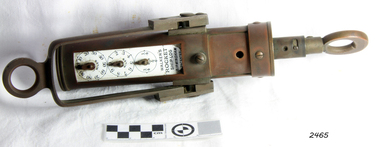 Flagstaff Hill Maritime Museum and Village
Ship Log, 1900-1920
... The log has two distinct parts; a brass register, made by Walker, showing the distance recorded and the rotator made by Reynolds, that spins in the water driving the counter. both parts are connected by a linked chain. The register has a cylindrical...The log has two distinct parts; a brass register, made by Walker, showing the distance recorded and the rotator made by Reynolds, that spins in the water driving the counter. both parts are connected by a linked chain. The register has a cylindrical ...Thomas Walker & Son was internationally renowned in the manufacturing of ships logs. Founding father Thomas Walker (1805–1871), an engineer in Birmingham, patented a mechanical log in 1878 which was a recording instrument that attached to a rail at the stern of a vessel connected by a long cord with a rotor which was towed behind the ship. The instrument dial recorded the distance travelled. Thomas Walker first went into business to manufacture stoves at 58 Oxford Street Birmingham. Walker’s self-feeding stove was widely lauded at the Paris Exhibition of 1855, winning a prize medal and kick starting the first of many notable innovations for the Walker family's manufacturing business. However, it wasn’t until working on an earlier ships log model invented by his Uncle that Thomas Walker became interested in the further development of this device, used to ascertain a ship’s speed. Walker continued to improve on the common log for the company of Massey & Sons and these improvements were deemed revolutionary. This log became a firm favourite of the West India Association (British-based organisation promoting ties and trade with the British Caribbean) and the most common log in use for two generations. It took till 1861 for Thomas Walker and his son, Thomas Ferdinand Walker (1831-1921) to patent the first Walker log of many. Together, with the introduction of the A1 Harpoon Log two years later, they established the Walker Log Business as a force to be reckoned with. By the time of his passing in 1871, Thomas Walker Snr had not only founded a family business with considerable staying power but also instilled a tradition of public service. Having sat as a representative on the Birmingham Town Council for 15 years and played an active role in public works, he was soon given the nickname of ‘Blue Brick Walker’. Much like his father, Thomas Ferdinand Walker changed the face of the maritime industry. His patent of 1897, the ‘Cherub’ log, was a notable departure from the past providing a far more accurate reading and replacing the majority of logs of the age. They were the first to produce an electric log and the Walker factory was one of the first to introduce the 48 hour work week for employees. This ship log was invented and made by a significant marine instrument maker and innovator of machinery. It demonstrates the huge leap taken to improve navigational accuracy at sea with an instrument that was in use for decades. Ship Log, three analogue dials calibrated in increments of Miles, the Rocket Log is a nautical instrument for measuring a vessel’s speed and distance traveled. The floating log was drawn behind the ship over a fixed time period in order to measure the distance traveled. The counter could measure enough miles to cover the maximum distance traveled by a ship in one day. The log has two distinct parts; a brass register, made by Walker, showing the distance recorded and the rotator made by Reynolds, that spins in the water driving the counter. both parts are connected by a linked chain. The register has a cylindrical brass body approx 4.5 cm diameter containing registering mechanism with hardened steel bearings. Distance is indicated by the three pointers on enamel plate as follows: graduated every 10 miles from 0-100; every mile from 1-10; every 1/4 mile from 1/4 -1. A brass sling and eye secured to the body enables it to be attached to the taffrail. The original rotator would have had a cylindrical tapered wooden body, approx 4.5 cm in diameter with three metal alloy fins or could be all made from brass. A towing eye is fitted to the tapered end. The two pieces of apparatus are connected by a length of linked chain, length 22.9 cm."Walkers Rocket Ship-Log Birmingham (Patented)" printed on face-plate. "Made by Thomas Walker".flagstaff hill, warrnambool, shipwrecked-coast, flagstaff-hill, flagstaff-hill-maritime-museum, maritime-museum, shipwreck-coast, flagstaff-hill-maritime-village, ship log, rocket log, mechanical ship log, measuring instrument, marine instrument, nautical instrument, speed recording instrument, ship log register, walker ship log, walkers rocket ship-log, thomas walker, thomas walker & son, thomas ferdinand walker, walker log business, reynolds ship log rotor, taffrail log, taff rail log, west india association -
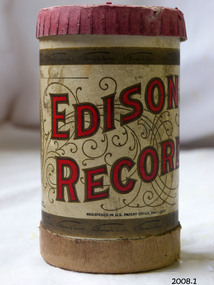 Flagstaff Hill Maritime Museum and Village
Gramophone cylinders, National Phonograph Co, The Bells of Aberdovey, April 1908
... Gramophone cylinders, black, 6 grooves on interior stored in cardboard round container with detachable lid. Edison Record...flagstaff hill warrnambool shipwrecked-coast flagstaff-hill flagstaff-hill-maritime-museum maritime-museum shipwreck-coast flagstaff-hill-maritime-village gramophone cylinders edison record the bells of aberdovey Gramophone cylinders, black, 6 grooves on interior stored in cardboard round container with detachable lid. ...Gramophone cylinders, black, 6 grooves on interior stored in cardboard round container with detachable lid. Edison Record, made and sold by National Phonograph Co. at Orange N.J. U.S.A. 13827 The Bells of Aberdovey. P. Dawson Form No. 1330 April 1908flagstaff hill, warrnambool, shipwrecked-coast, flagstaff-hill, flagstaff-hill-maritime-museum, maritime-museum, shipwreck-coast, flagstaff-hill-maritime-village, gramophone cylinders, edison record, the bells of aberdovey -
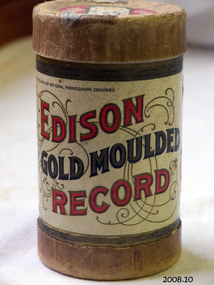 Flagstaff Hill Maritime Museum and Village
Gramophone cylinders, National Phonograph Co, Bells - Bell Solo from The Magic Flute, Dec 1907
... Gramophone cylinders, black, 6 grooves on interior stored in cardboard round container with detachable lid. Edison Record...flagstaff hill warrnambool shipwrecked-coast flagstaff-hill flagstaff-hill-maritime-museum maritime-museum shipwreck-coast flagstaff-hill-maritime-village gramophone cylinders edison record national phonograph co bells bell solo from the magic flute Gramophone cylinders, black, 6 grooves on interior stored in cardboard round container with detachable lid. ...Gramophone cylinders, black, 6 grooves on interior stored in cardboard round container with detachable lid. Edison Record, made and sold by National Phonograph Co. at Orange N.J. U.S.A. Song: 9324 Bells. Bell Solo from The Magic Flute. Form No. 1200 Dec 1907flagstaff hill, warrnambool, shipwrecked-coast, flagstaff-hill, flagstaff-hill-maritime-museum, maritime-museum, shipwreck-coast, flagstaff-hill-maritime-village, gramophone cylinders, edison record, national phonograph co, bells, bell solo from the magic flute -
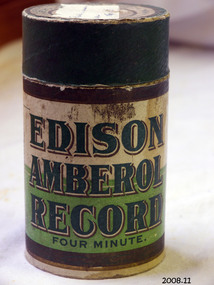 Flagstaff Hill Maritime Museum and Village
Gramophone cylinders, The Grenadier
... Gramophone cylinders, blue, 6 grooves on interior stored in cardboard round container with detachable lid. Edison Amberol Record, made and sold by National Phonograph Co. at Orange N.J. ...flagstaff hill warrnambool shipwrecked-coast flagstaff-hill flagstaff-hill-maritime-museum maritime-museum shipwreck-coast flagstaff-hill-maritime-village gramophone cylinders edison amberol record edison record national phonograph co the grenadier s kirkby, Gramophone cylinders, blue, 6 grooves on interior stored in cardboard round container with detachable lid. ...Gramophone cylinders, blue, 6 grooves on interior stored in cardboard round container with detachable lid. Edison Amberol Record, made and sold by National Phonograph Co. at Orange N.J. U.S.A. Song: 23386 The Grenadier. S Kirkby, flagstaff hill, warrnambool, shipwrecked-coast, flagstaff-hill, flagstaff-hill-maritime-museum, maritime-museum, shipwreck-coast, flagstaff-hill-maritime-village, gramophone cylinders, edison amberol record, edison record, national phonograph co, the grenadier, s kirkby, -
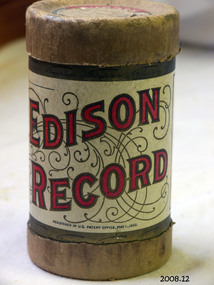 Flagstaff Hill Maritime Museum and Village
Gramophone cylinders, National Phonograph Co, Old Jim's Christmas Hymns, April 1908
... Gramophone cylinders, black, 6 grooves on interior stored in cardboard round container with detachable lid. Edison Record...flagstaff hill warrnambool shipwrecked-coast flagstaff-hill flagstaff-hill-maritime-museum maritime-museum shipwreck-coast flagstaff-hill-maritime-village gramophone cylinders edison record national phonograph co old jim's christmas hymns Gramophone cylinders, black, 6 grooves on interior stored in cardboard round container with detachable lid. ...Gramophone cylinders, black, 6 grooves on interior stored in cardboard round container with detachable lid. Edison Record, made and sold by National Phonograph Co. at Orange N.J. U.S.A. Song: 8708 Duet - Old Jim's Christmas Hymns. Form No 1330 April 1908flagstaff hill, warrnambool, shipwrecked-coast, flagstaff-hill, flagstaff-hill-maritime-museum, maritime-museum, shipwreck-coast, flagstaff-hill-maritime-village, gramophone cylinders, edison record, national phonograph co, old jim's christmas hymns -
 Flagstaff Hill Maritime Museum and Village
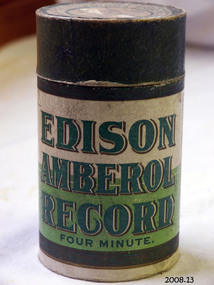
Gramophone cylinders, Scatter Seeds of Kindness
... Gramophone cylinders, black. 6 grooves on interior stored in cardboard round container with detachable lid. Edison Amberol Record, made and sold by National Phonograph Co. at Orange N.J. ...flagstaff hill warrnambool shipwrecked-coast flagstaff-hill flagstaff-hill-maritime-museum maritime-museum shipwreck-coast flagstaff-hill-maritime-village gramophone cylinders edison amberol record national phonograph co scatter seeds of kindness Gramophone cylinders, black. 6 grooves on interior stored in cardboard round container with detachable lid. ...Gramophone cylinders, black. 6 grooves on interior stored in cardboard round container with detachable lid. Edison Amberol Record, made and sold by National Phonograph Co. at Orange N.J. U.S.A. Song: 4M-231 Scatter Seeds of Kindness. Mixed Quartette flagstaff hill, warrnambool, shipwrecked-coast, flagstaff-hill, flagstaff-hill-maritime-museum, maritime-museum, shipwreck-coast, flagstaff-hill-maritime-village, gramophone cylinders, edison amberol record, national phonograph co, scatter seeds of kindness -
 Flagstaff Hill Maritime Museum and Village
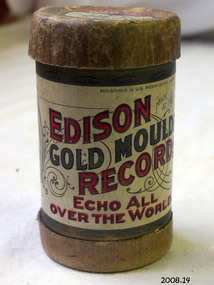
Gramophone cylinders, National Phonograph Co, Cello SoloMelody in F (Rubinstein), May 1905
... cylinder...edison record...Gramophone cylinders, black, 6 grooves on interior stored in cardboard round container with detachable lid. Edison Record...flagstaff hill warrnambool shipwrecked-coast flagstaff-hill flagstaff-hill-maritime-museum maritime-museum shipwreck-coast flagstaff-hill-maritime-village gramophone cylinder edison record national phonograph co cello solomelody in f (rubinstein) cello solomelody in f Gramophone cylinders, black, 6 grooves on interior stored in cardboard round container with detachable lid. ...Gramophone cylinders, black, 6 grooves on interior stored in cardboard round container with detachable lid. Edison Record, made and sold by National Phonograph Co. at Orange N.J. U.S.A. Song: 9080 Cello SoloMelody in F (Rubinstein) Form No. 680 May 1905flagstaff hill, warrnambool, shipwrecked-coast, flagstaff-hill, flagstaff-hill-maritime-museum, maritime-museum, shipwreck-coast, flagstaff-hill-maritime-village, gramophone cylinder, edison record, national phonograph co, cello solomelody in f (rubinstein), cello solomelody in f
