
Showing 30 items matching "darwin raids"
-
 Bendigo Military Museum
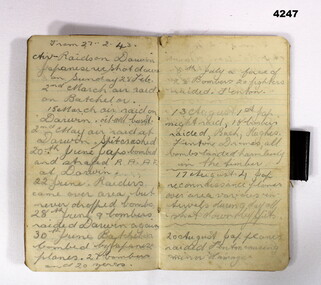
Booklet - NOTE BOOK DARWIN RAIDS, 1942 onwards
... NOTE BOOK DARWIN RAIDS......Darwin raids...The note book begins on 27.2.1942 describing Japanese raids on Darwin. The notes were written by Lawrence Vernon Andrews VX114736. ...Booklet NOTE BOOK DARWIN RAIDS ...The note book begins on 27.2.1942 describing Japanese raids on Darwin. The notes were written by Lawrence Vernon Andrews VX114736. Refer Cat No 4228 for his service details.Cream satin covered note book with a plastic loop to hold a pencil, paper pages, hand written entries.note books, darwin raids, -
 Lara RSL Sub Branch
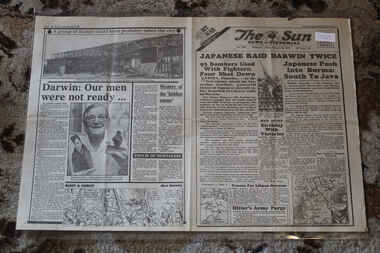
Newspaper - The Sun Newspaper dated 20/2/1942 - Special - My War Part 23 - Japanese Raid Dawin Twice, Local Newspaper Reporting on World War 2 Events - My War Part 23 - Japanese Raid Dawin Twice
... Local newspaper dated 20/2/1942 - Special - My War - Japanese Raid Darwin Twice - Bombs Rock Darwin... Japanese Raid Darwin Twice - Bombs Rock Darwin...World War 2, Local Newspaper dated 20/2/1942 World War Two - Darwin Bombed Twice, Bombs Rock Darwin local newspaper reporting on world war 2 events - my war part 23 Japanese Raid Darwin Twice - Bombs Rock Darwin Local newspaper dated 20/2/1942 - Special - My War - Japanese Raid Darwin Twice - Bombs Rock Darwin Local Newspaper Reporting on World War 2 Events - My War Part 23 - Japanese Raid Dawin Twice Newspaper The Sun Newspaper dated 20/2/1942 - Special - My War Part 23 - Japanese Raid Dawin Twice ...World War 2, Local Newspaper dated 20/2/1942World War Two - Darwin Bombed Twice, Bombs Rock Darwin Local newspaper dated 20/2/1942 - Special - My War - Japanese Raid Darwin Twice - Bombs Rock Darwin Japanese Raid Darwin Twice - Bombs Rock Darwinlocal newspaper reporting on world war 2 events - my war part 23 -
 Monbulk RSL Sub Branch
Book, Tall Stories, A war at home : a comprehensive guide to the first Japanese attacks on Darwin, 1999
... World war 1939-1945 - Air raids - Darwin...World war 1939-1945 - Air raids - Darwin World war 1939-1945 - Aerial operations - japan A comprehensive guide to the first Japanese attacks on Darwin on 19th February 1942, written by Dr Tom Lewis, OAM. ...A comprehensive guide to the first Japanese attacks on Darwin on 19th February 1942, written by Dr Tom Lewis, OAM. An essential reference work on this controversial subject that includes a full list of those killed as well as other detailed appendices. It also includes fascinating information on what wartime sites are still accessible in and around the northern capital. Originally published in 1999, until recently it has mainly been available only in Darwin itself.Index, bibliography, ill, maps, p.73.non-fictionA comprehensive guide to the first Japanese attacks on Darwin on 19th February 1942, written by Dr Tom Lewis, OAM. An essential reference work on this controversial subject that includes a full list of those killed as well as other detailed appendices. It also includes fascinating information on what wartime sites are still accessible in and around the northern capital. Originally published in 1999, until recently it has mainly been available only in Darwin itself.world war 1939-1945 - air raids - darwin, world war 1939-1945 - aerial operations - japan -
 Monbulk RSL Sub Branch
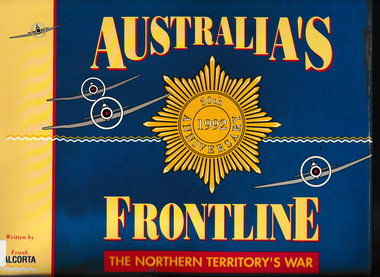
Book, Allen & Unwin, Australia's frontline : the Northern Territory's war, 1991
... ...Air raids - Darwin...World war 1939-1945 - Australia - Northern territory Air raids - Darwin Bombing of Darwin - Includes glossary of World War II Australian slang Index, bibliography, notes, ill, maps, p.109. ...Bombing of Darwin - Includes glossary of World War II Australian slangIndex, bibliography, notes, ill, maps, p.109.non-fictionBombing of Darwin - Includes glossary of World War II Australian slangworld war 1939-1945 - australia - northern territory, air raids - darwin -
 Monbulk RSL Sub Branch
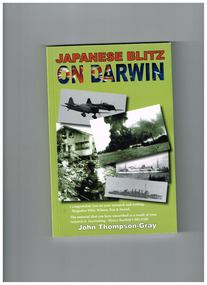
Book, John Thompson-Gray, Japanese blitz on Darwin, 2018
... World war 1939-1945 - Air raids - Darwin...Darwin - Bombimg - 1942 World war 1939-1945 - Air raids - Darwin New evidence explains Australia's most infamous day. ...New evidence explains Australia's most infamous day. The Imperial Japanese Navy bombers that attacked Pearl Harbour on December 7th 1941 blitzed Darwin on February 19th 1942. As Australia defended her mainland for the first time the only Ally standing with her was the United States of America. On that day, Americans and Australians were forged as Cousins-in-Arms. Darwin's airfield, town and harbour were repeatedly bombed leaving a trail of human tragedyBib, index, ill, p.126.non-fictionNew evidence explains Australia's most infamous day. The Imperial Japanese Navy bombers that attacked Pearl Harbour on December 7th 1941 blitzed Darwin on February 19th 1942. As Australia defended her mainland for the first time the only Ally standing with her was the United States of America. On that day, Americans and Australians were forged as Cousins-in-Arms. Darwin's airfield, town and harbour were repeatedly bombed leaving a trail of human tragedydarwin - bombimg - 1942, world war 1939-1945 - air raids - darwin -
 Bendigo Military Museum
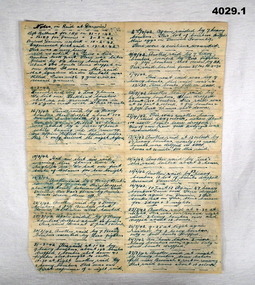
Literary work - DIARIES WW2, C. 1942
... .1) Diary, ruled paper, blue ink, both sides, dated 31-1-1942 to 24-11-42 detailing the raids on Darwin. .2) Document, typed in black re: Darwin air raids beginning 19-2-42, 4-3-42 and 16-3-42. ...Diary lierary work raaf darwin .1) Diary, ruled paper, blue ink, both sides, dated 31-1-1942 to 24-11-42 detailing the raids on Darwin. .2) Document, typed in black re: Darwin air raids beginning 19-2-42, 4-3-42 and 16-3-42. ...Diary written by LAC John Morrison No. 42562 RAAF. Enlisted 22-8-1941, Discharged 5-12-1945. Serving in 9 Transport and Movement..1) Diary, ruled paper, blue ink, both sides, dated 31-1-1942 to 24-11-42 detailing the raids on Darwin. .2) Document, typed in black re: Darwin air raids beginning 19-2-42, 4-3-42 and 16-3-42. This is .1) beginning to be typed out.diary, lierary work, raaf, darwin -
 Bendigo Military Museum
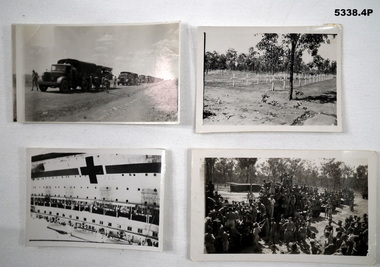
Photograph - PHOTOGRAPHS, DARWIN, c1945
... Picture of soldiers in trucks in outback - homeward bound from Darwin 8/11/45. 2. Graves of first victims of an air raid in Darwin - Berrimah Cemetery. 3. ...On back "Homeward Bound from Darwin 8 /11/45". 2. On back "Graves of first Victims of Air Raids Darwin". 3. ...On back "Homeward Bound from Darwin 8 /11/45". 2. On back "Graves of first Victims of Air Raids Darwin". 3. ...1. Picture of soldiers in trucks in outback - homeward bound from Darwin 8/11/45. 2. Graves of first victims of an air raid in Darwin - Berrimah Cemetery. 3. Ship "Oranjes" returning POW's in 1945 to Australia. 4. VP Day 15/8/45 Crowd of soldiers celebrating 4 RSV.Four photos all originals and black & white. 1. Faded photo of trucks in outback. 2. B & W photo original War graves. 3. B & W photo original POW ship. 4. B & W photo original, celebrating VP Day 1. On back "Homeward Bound from Darwin 8 /11/45". 2. On back "Graves of first Victims of Air Raids Darwin". 3. On back " POW's "Oranjes" Darwin 1945. 4. On back "VP Day 15/8/45, 4RSV & description of Celebration.vp day, darwin, pow's, war graves -
 Bendigo Military Museum
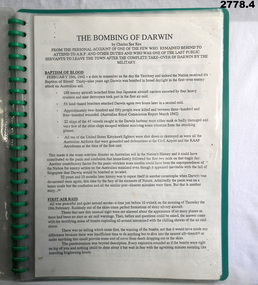
Document - DOCUMENTS, DARWIN BOMBING, post WW2
... Documents detail the first bombing raid on Darwin on 19 February 1942. Information related to subsequent raids also included....Documents detail the first bombing raid on Darwin on 19 February 1942. Information related to subsequent raids also included. documents - military history Passchendaele barracks trust Darwin .1) - .4) Collection of photocopied A4 documents related to the bombing of Darwin. 4 double sided pages in green plastic display folder. ...Documents detail the first bombing raid on Darwin on 19 February 1942. Information related to subsequent raids also included..1) - .4) Collection of photocopied A4 documents related to the bombing of Darwin. 4 double sided pages in green plastic display folder. Black & white map & photos.documents - military history, passchendaele barracks trust, darwin -
 Tatura Irrigation & Wartime Camps Museum
Book, Australia's Pearl Harbour, 1988
... Story of Japanese air raids on Darwin. Many were killed and much of the town destroyed. ...Story of Japanese air raids on Darwin. Many were killed and much of the town destroyed. ...Gold cover. Picture of Darwin bombing on front cover in blue and yellow border. Title in white writing. Other writing in black. Darwin story on back cover. Same photograph on back cover. 232 pages.darwin nt, bombing of darwin, australia's pearl harbour -
 Sunshine and District Historical Society Incorporated
Booklet - War Time
... 2333.01 - Booklet Sunshine District Patriotic Fund Contributors Book|2333.02 - Booklet Shire of Braybrook Patriotic Fund Contributors Book|2333.03 - Certificate Air Raid Precautions Certificate of Proficiency Mr S Graham of Braybrook in the ARP Quiz Championship broadcast from Station 3UZ Melbourne 1943|2333.04 - Magazine Weekly Times Part 2 The Great War Gallipoli April to December 1915|2333.05 - Newspaper Article The Sun 20 February 1942 Japanese Raid Darwin Twice|2333.06 - Newspaper Article he Age 6 June 1994 D Day 1994 Fifty years since the fighting on the beaches|2333.07 - Newspaper Article The Age 15 August 1995 Souvenir to mark the 50th anniversary of an end to hostilities in the Pacific Peace...World War 1914 - 1918 2333.01 - Booklet Sunshine District Patriotic Fund Contributors Book|2333.02 - Booklet Shire of Braybrook Patriotic Fund Contributors Book|2333.03 - Certificate Air Raid Precautions Certificate of Proficiency Mr S Graham of Braybrook in the ARP Quiz Championship broadcast from Station 3UZ Melbourne 1943|2333.04 - Magazine Weekly Times Part 2 The Great War Gallipoli April to December 1915|2333.05 - Newspaper Article The Sun 20 February 1942 Japanese Raid Darwin Twice|2333.06 - Newspaper Article he Age 6 June 1994 D Day 1994 Fifty years since the fighting on the beaches|2333.07 - Newspaper Article The Age 15 August 1995 Souvenir to mark the 50th anniversary of an end to hostilities in the Pacific Peace Collection of articles on the war Booklet War Time ...2333.01 - Booklet Sunshine District Patriotic Fund Contributors Book|2333.02 - Booklet Shire of Braybrook Patriotic Fund Contributors Book|2333.03 - Certificate Air Raid Precautions Certificate of Proficiency Mr S Graham of Braybrook in the ARP Quiz Championship broadcast from Station 3UZ Melbourne 1943|2333.04 - Magazine Weekly Times Part 2 The Great War Gallipoli April to December 1915|2333.05 - Newspaper Article The Sun 20 February 1942 Japanese Raid Darwin Twice|2333.06 - Newspaper Article he Age 6 June 1994 D Day 1994 Fifty years since the fighting on the beaches|2333.07 - Newspaper Article The Age 15 August 1995 Souvenir to mark the 50th anniversary of an end to hostilities in the Pacific Peaceworld war 1914 - 1918 -
 Kyneton RSL Sub Branch
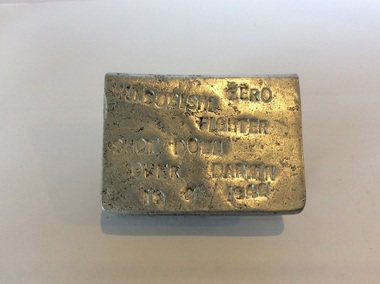
Match box holder, 1942 hand-made
... were not the precursor to an invasion but they did serve to interrupt the use of Darwin's port facilities. The raids also tied up anti aircraft defences and air force units that would have otherwise been sent to more forward areas. ... were not the precursor to an invasion but they did serve to interrupt the use of Darwin's port facilities. The raids also tied up anti aircraft defences and air force units that would have otherwise been sent to more forward areas. ...Darwin was bombed by Japanese fighter bombers from Feb 1942 until Nov 1943. On 19 February 1942 Darwin itself was bombed. Japanese fighters and bombers attacked the port and shipping in the harbour twice during the day, killing 252 Allied service personnel and civilians. On 3 March Broome, in Western Australia, was strafed. In succeeding months air attacks were made on many towns in northern Australia including Wyndham, Port Hedland and Derby in Western Australia, Darwin and Katherine in the Northern Territory, Townsville and Mossman in Queensland, and Horn Island in the Torres Strait. Despite popular fears these raids were not the precursor to an invasion but they did serve to interrupt the use of Darwin's port facilities. The raids also tied up anti aircraft defences and air force units that would have otherwise been sent to more forward areas. The Bombing of Darwin www.awm.gov.auFolded metal to cover a match box top and bottom and one side. Would leave one side of the box exposed to strike a match. Lettering on top and bottom created by letter punchFront: Zero Mitsubishi Fighter Shot down over Darwin 19/2/1942 Back: From Frank to Dad.ww2, souvenir, darwin -
 Wangaratta RSL Sub Branch
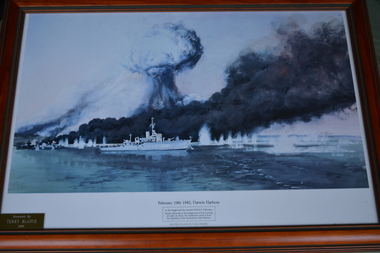
Print - Framed Print, Darwin Harbour
... Image depicting the explosion of a ship, filled with TNT and ammunition, hit during the first Japanese air raid on Australia's mainland, at Darwin on 19 February 1942. ...Image depicting the explosion of a ship, filled with TNT and ammunition, hit during the first Japanese air raid on Australia's mainland, at Darwin on 19 February 1942. ...Image depicting the explosion of a ship, filled with TNT and ammunition, hit during the first Japanese air raid on Australia's mainland, at Darwin on 19 February 1942. In the foreground is HMAS Deloraine which survived unscathed. On that day, 236 people were killed when 242 Japanese aircraft, in two separate raids, attacked the town, ships in Darwin's harbour and the town's two airfields in an attempt to prevent the Allies from using them as bases to contest the invasion of Timor and Java during World War II. MV Neptuna was a 5,952 ton cargo motor vessel. and was 1 of 11 sunk during the Japanese air raid on Darwin on 19 February 1942. In January 1942 HMAS Deloraine evaded an attack by the Japanese submarine I-124 north-west of Darwin and was jointly credited with the submarines' sinking after she inflicted the initial damage. The Bombing of Darwin, also known as the Battle of Darwin, on 19 February 1942 was the largest single attack ever mounted by a foreign power on Australia. Brown timber frame containing blue black and white print of ships being bombed.February 19th 1942, Darwin Harbour In the foreground the corvette HMAS Deloraine. Smoke billowing in the background is from burning oil tanks on shore, the mushroom cloud is from the explosionof the ammunition ship Neptuna. Watercolour by Tom Offordbombing of darwin, battle of darwin, 19 february 1942, ww2, mv neptuna, hmas deloraine -
 City of Melbourne Libraries
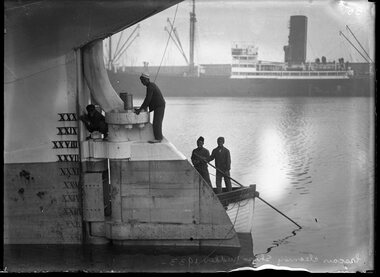
Photograph, Bull, Hugh Jones, 1897-1993, Lascars cleaning ship's rudder
... In 1942 MV Neptuna was being utilised for the war effort, and carrying depth charges and other armaments for Australia, when on 19 February it was sunk in a bombing raid on Darwin, and where part of her hull still lies. ...In 1942 MV Neptuna was being utilised for the war effort, and carrying depth charges and other armaments for Australia, when on 19 February it was sunk in a bombing raid on Darwin, and where part of her hull still lies. ...Published: unknown, however, on 26 June 1935 a similar, but not the exact photo in the McKenzie Collection, was published in The Age: Published title: Shipping Victorian Flour to the East Published Caption: Flour and wheat figure prominently in all cargoes carried by ships trading to Chinese, Japanese and Eastern ports. Victorian millers are eager to extend lids outlet for their produce, and every opportunity is grasped. The pictures show Australian labourers unloading from railway trucks some of the 2300 tons of flour which will go into the hold of the Burns, Philp motor ship Neptuna for shipment to Hong Kong, while Chinese seamen are busy cleaning and painting the rudder post of the ship. Hard by the Neptuna, other ships are taking on flour for the East. Research by Project Volunteer, Louise McKenzie: The image was described by Hugh Bull on the rear of the glass plate as – “Lascars cleaning ships rudder 1933”. Basically, a “lascar” is a seaman. Image No. 032 in the McKenzie Collection shows two lascars perched on the rudder of a ship, with two others standing in a rowboat along side. They are dressed in baggy trousers and jackets and wearing caps. Across a very calm dock area is a single funnel ship with on-deck derricks. The rudder of the ship being cleaned is white, with large black roman numbering denoting the depth at which the ship is sitting, depending on whether it is loaded or empty. Whilst the exact photo in the McKenzie Collection has yet to be located in The Age in 1933, the date when it was taken, there is a photo published in The Age on 25 June 1935 which appears to be one of a series of photos taken on the same day, featuring lascars cleaning a ship’s rudder. It bears a striking resemblance to MCK 032, but it is taken from a slightly different angle. The 1935 published photo is a close up of a ship’s rudder being cleaned, with same style of roman numerals in black on the white of the rudder. One lascar is standing on the rudder, one is standing in a small clinker style rowboat, with its characteristic wooden overlapping hull planks, holding a broom; two more lascars are sitting in the bow and stern of the rowboat. The ship being cleaned is in a dock, as a wharf and warehouses can be seen in the background, the water is very calm, and there are two other ships moored nearby – one across the other side of the dock with a black and white hull and derricks on its deck, and one adjacent, with its mooring lines clearly visible. The lascars are wearing caps, baggy trousers and jackets. Compelling similarities therefore exist between the two images. Whilst it is difficult to positively identify the cultural background of these particular lascars in either photo, the newspaper article dated June 1935 advises they are “Chinese”. This is possibly because the ship they are associated with, the Neptuna, is reported to have sailed from Melbourne on this date, bound for Hong Kong. However, the men are probably from South East Asia. Wikipedia describes the term “Southeast Asia” as covering ” … the people of Southeast Asia from prehistory to the present in two distinct sub-regions: Mainland Southeast Asia (or Indochina) and Maritime Southeast Asia (or Insular Southeast Asia). Mainland Southeast Asia comprises Cambodia, Laos, Myanmar (or Burma), Peninsular Malaysia, Thailand and Vietnam whereas Maritime Southeast Asia comprises Brunei, Cocos (Keeling) Islands, Christmas Island, East Malaysia, East Timor, Indonesia, Philippines and Singapore. Additionally, Wikipedia “Lascars” states that “Lascars were sailors from the Indian subcontinent, South East Asia, the Arab world, British Somaliland and lands east of the Cape of Good Hope, who were employed to work on colonial merchant ships. The practice ran from the 16th century to the mid 20th century”. Indian seamen were used as early as the 16th century by Portuguese explorer Vasgo da Gama in his successful voyage to India, and subsequently by Portuguese ships in the 16th and 17th centuries. “Through the Portuguese and Spanish maritime world empires, some Indian lascars found their way onto English merchant ships, and were among the sailors on the first English East India Company (EIC) ships to sail to India.” In the 17th Century “When the English adopted the term "lascar", they initially used it for all Asian sailors on English-flagged ships, but after 1661 and the Portuguese ceded Bombay to England, the term was used mainly to describe Indian sailors specifically. The term "topaze" was used to describe Indo-Portuguese personnel, especially those from Bombay, Thana, Diu, Dammam and Cochin. The term "sepoy" was used to describe Indian soldiers in European service. The number of lascars employed on EIC East Indiamen was so great that the Parliament of England restricted their employment via the Navigation Acts (in force from 1660 onwards) which required that 75% of the crew onboard English-flagged ships importing goods from Asia be English subjects. The restriction arose due to the high rates of illnesses and death among European sailors on East Indiamen, and their frequent desertions in Asia, which left such ships short of crew for the return voyage. Another reason was the frequent impressment of European sailors from EIC East Indiamen by the Royal Navy in times of war“. The term “impressment” colloquially refers to “the “press gang” …”a type of conscription of people into a military force, especially a naval force, via intimidation and physical coercion, conducted by an organized group (hence “gang”). .. The large size of the British Royal Navy in the Age of Sail meant impressment was most commonly associated with Great Britain.”. (Wikipedia – Impressment). By the 20th century these sailors served on British ships under "lascar agreements", which allowed shipowners more control than was the case in ordinary articles of agreement. The sailors could be transferred from one ship to another and retained in service for up to three years at one time. “Lascars served all over the world in the period leading up to the First World War. Lascars were barred from landing at some ports, such as in British Columbia. At the beginning of World War I, there were 51,616 lascars working on British merchant ships in and around the British Empire. In World War II thousands of lascars served in the war and died on vessels throughout the world, especially those of the British India Steam Navigation Company, P&O and other British shipping companies. The lack of Canadian naval manpower led to the employment of a total of 121 Catholic Goans and 530 Muslim British Indians on the Empress vessels of the Canadian Pacific Railway, such as the Empress of Asia and Empress of Japan. These ships served in the Indian Ocean both as ANZAC convoy ships and in actions at Aden. The ships were placed under the British Admiralty as part of Canada's contribution to the war effort and all of the Indian men were awarded medals by the Admiralty, though none of them were delivered. In the 1950s the use of the term "lascar" declined with the ending of the British Empire. The Indian “Lascar Act” of 1832 was finally repealed in 1963. However, "traditional" Indian deck and Pakistani engine crews continued to be used in Australia until 1986 when the last crew was discharged from the P&O and replaced by a general-purpose crew of Pakistanis. The term lascar has been widely used to engender an element of exoticism in literature eg “Sir Arthur Conan Doyle created a Lascar foil to Sherlock Holmes in "The Man with the Twisted Lip" in 1891. Lascars aboard the ship Patna figure prominently in the early chapters of Joseph Conrad's novel Lord Jim. Frances Hodgson Burnett's novel A Little Princess features a lascar named Ram Dass. Also, Caleb Carr portrays two lascars as bodyguards for a Spanish diplomat near the end of The Angel of Darkness. In Wuthering Heights, it is speculated that Heathcliff, the main character, may be of lascar origin." (Wikipedia – Lascar) And what has become of these “forgotten heroes of the World Wars”? The South Asian Heritage Trust, which seeks to commemorate, mark and celebrate South Asian cultures, stories, and communities, published an article in July 2025 entitled – The Lascars: Seafaring Roots of Modern Britain. It particularly honours the role of the 80,000 lascars who served Britain in WWI, and the over 100,000 who served in the British Merchant Navy in WWII, and concludes: “The hardships faced by Lascars were profound. They were often assigned the most dangerous tasks, lived in substandard conditions aboard ships and, even after their immense contributions to the war efforts, many veterans found it difficult to secure the recognition, pensions and rights afforded to other veterans. Many were employed under ‘Asiatic Articles’, which offered less protection and lower pay than their European counterparts. Yet, their legacy endures. The multicultural fabric of areas like East London owes much to these early seafarers and settlers. The East London Mosque, established in 1910, became an important spiritual and community hub. Today, efforts to bring their stories out of the shadows are growing. The Museum of London Docklands features exhibits on their history. Memorials, such as the P&O headstone in Dover for the 22 Lascar crew members of the SS Maloja sunk in 1916 and the careful restoration of the Lascar War Memorial in Kolkata, serve as important reminders of the sacrifices. The journey of the Lascars – from their homelands, along dangerous wartime shipping routes, to the docklands of Britain – is a story of personal courage and of a rich contribution to Britain’s history and identity.” The ship MV Neptuna, mentioned in the 1935 article, had that year been purchased from a German company by Australian-owned Burns Philp, with Australian Government assistance, and it was instrumental in ensuring the shipment of rice from Vietnam to Papua New Guinea. Rice is still a household staple in PNG. Despite it being introduced into PNG more than 100 years ago, the crop has not been sufficiently integrated into the country’s traditional agricultural production system, and today PNG imports still account for nearly 98% of rice. (Spotlight Magazine Sept. 2016) The 1935 newspaper article states that the Neptuna is involved in moving flour for the East. Australian wheat exports began in 1845, but were not regular until the 1870s. New land clearing methods in Australia allowed large tracts of land to be cleared more efficiently – this included the invention of the iconic ‘stump jump’ plough. With the success of the wheat harvests, flour mills began to spring up around the country. By the 1870s, many large country towns had their own mills, with around 500 mills producing flour across the country. Flour exports were an important part of the wheat industry until around the 1930s. After the Second World War, many of Australia’s export partners (which were mainly in the developing nations of Asia) began setting up their own flour industries and the Australian product was no longer in demand. In 1942 MV Neptuna was being utilised for the war effort, and carrying depth charges and other armaments for Australia, when on 19 February it was sunk in a bombing raid on Darwin, and where part of her hull still lies. References: SHIPPING VICTORIAN FLOUR TO THE EAST. (1935, June 25). The Age (Melbourne, Vic. : 1854 - 1954), p. 11. Retrieved July 23, 2025, from http://nla.gov.au/nla.news-article204357218 Age (Melbourne, Vic. : 1854 - 1954), Tuesday 25 June 1935, page 11 Wikipedia, Clinker (boat building), https://en.wikipedia.org/wiki/Clinker_(boat_building) Wikipedia, Lascar, https://en.wikipedia.org/wiki/Lascar Wikipedia, History of Southeast Asia, https://en.wikipedia.org/wiki/History_of_Southeast_Asia Wikipedia, Impressment, https://en.wikipedia.org/wiki/Impressment NEPTUNA LEAVES FOR CHINA WITH TOURISTS (1935, June 25). The Herald (Melbourne, Vic. : 1861 - 1954), p. 5. Retrieved July 23, 2025, from http://nla.gov.au/nla.news-article244841163 National Research Institute SPOTLIGHT paper Vol 9, Issue 7, https://pngnri.org/images/Publications/Spotlight_No_9_Vol_7_-_201609_-_Sofe__Odhuno_-_Rice_Import_Quota1.pdf South Asian Heritage Trust, The Lascars: Seafaring Roots of Modern Britain, July 11,2025 : Royal British Legion. https://southasianheritage.org.uk/royal-british-legion/the-lascars-seafaring-roots-of-modern-britain/ Photographer notations on slide: "Lascars cleaning ships rudder 1933".lascars, ships, 1930-1939, employment, ethnic communities -
 Mission to Seafarers Victoria
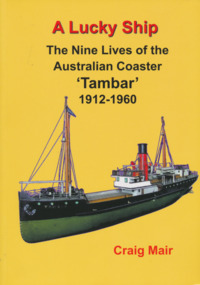
Book, Nautical Association of Australia Inc, A Lucky Ship – Nine Lives of Australian Coaster Tambar 1912-1960, 2013
... When World War II broke out, Tambar was commissioned into the RAN as an auxiliary minesweeper, but after the terrible Darwin air raid in 1942 became the first vessel of the newly formed Salvage Board, later assisting in the search for survivors of the Battle of the Coral Sea. ...This high-quality book is the extraordinary story of an ordinary little ship that had a long and eventful life. Perhaps few Australian coasters have had a more interesting and varied history. Built in Scotland in 1912 for the North Coast Steam Navigation Company, Tambar worked as a lifeline to isolated river and island communities, first in New South Wales, then for the Tasmanian Government and Holymans in Bass Strait (King Island) and as the last steamer serving the Gippsland Lakes. In between she even spent a few years in Papua New Guinea. When World War II broke out, Tambar was commissioned into the RAN as an auxiliary minesweeper, but after the terrible Darwin air raid in 1942 became the first vessel of the newly formed Salvage Board, later assisting in the search for survivors of the Battle of the Coral Sea. Returning to Bass Strait in 1944 for a few more years, she then spent the 1950s on standby as a salvage vessel in Melbourne, working on Merilyn, Terawhiti, E.J. Fairnie, and River Burnett. Craig Mair grew up in Grangemouth, Scotland where Tambar was built, and became interested after inheriting a builder's model from his father. He has consulted thousands of records, including the ship's logs, tracked down witnesses, and assembled over 100 photographs and maps to give a unique insight into Tambar's story, and coastal Australia in the middle decades of the twentieth century, before roads took over the transport task. Besides many colourful stories of shipwrecks and strandings, strange cargoes, salty characters, exotic places, wartime air raids, and salvage jobs, the book includes a definitive account of the worst Second World War 'friendly fire' incident in Australian waters in Moreton Bay in 1942.250 pages, Appendices, Bibliography and Indices, extensively illustratednon-fictionThis high-quality book is the extraordinary story of an ordinary little ship that had a long and eventful life. Perhaps few Australian coasters have had a more interesting and varied history. Built in Scotland in 1912 for the North Coast Steam Navigation Company, Tambar worked as a lifeline to isolated river and island communities, first in New South Wales, then for the Tasmanian Government and Holymans in Bass Strait (King Island) and as the last steamer serving the Gippsland Lakes. In between she even spent a few years in Papua New Guinea. When World War II broke out, Tambar was commissioned into the RAN as an auxiliary minesweeper, but after the terrible Darwin air raid in 1942 became the first vessel of the newly formed Salvage Board, later assisting in the search for survivors of the Battle of the Coral Sea. Returning to Bass Strait in 1944 for a few more years, she then spent the 1950s on standby as a salvage vessel in Melbourne, working on Merilyn, Terawhiti, E.J. Fairnie, and River Burnett. Craig Mair grew up in Grangemouth, Scotland where Tambar was built, and became interested after inheriting a builder's model from his father. He has consulted thousands of records, including the ship's logs, tracked down witnesses, and assembled over 100 photographs and maps to give a unique insight into Tambar's story, and coastal Australia in the middle decades of the twentieth century, before roads took over the transport task. Besides many colourful stories of shipwrecks and strandings, strange cargoes, salty characters, exotic places, wartime air raids, and salvage jobs, the book includes a definitive account of the worst Second World War 'friendly fire' incident in Australian waters in Moreton Bay in 1942.naa, australian national line, interest group, moreton bay, tambar, coaster, ships -
 Bendigo Military Museum
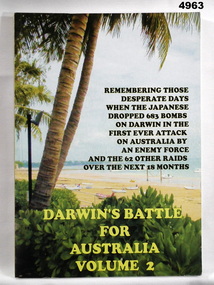
Book - BOOK, DARWIN, RUWOLDT Rex, Darwin's Battle for Australia. Vol. 2, 2005
... From the front cover " REMEMBERING THOSE/ DESPARATE DAYS/ WHEN THE JAPANESE/ DROPPED 683 BOMBS ON DARWIN IN THE/ FIRST EVER ATTACK/ ON AUSTRALIA BY/ AN ENEMY FORCE/ AND THE 62 OTHER RAIDS/ OVER THE NEXT 18 MONTHS....From the front cover " REMEMBERING THOSE/ DESPARATE DAYS/ WHEN THE JAPANESE/ DROPPED 683 BOMBS ON DARWIN IN THE/ FIRST EVER ATTACK/ ON AUSTRALIA BY/ AN ENEMY FORCE/ AND THE 62 OTHER RAIDS/ OVER THE NEXT 18 MONTHS. ...From the front cover " REMEMBERING THOSE/ DESPARATE DAYS/ WHEN THE JAPANESE/ DROPPED 683 BOMBS ON DARWIN IN THE/ FIRST EVER ATTACK/ ON AUSTRALIA BY/ AN ENEMY FORCE/ AND THE 62 OTHER RAIDS/ OVER THE NEXT 18 MONTHS.Soft cover book. Cover - cardboard, yellow and black print on front, spine and back. Illustrated front - colour photograph of a beach scene, back - small colour photograph of the author's superimposed over colour photograph of a beach scene. 368 pages, cut, plain, glossy white, illustrated black and white and colour photographs, maps and documents. DVD Plastic, adhered to back end paper.books, military history, darwin, ww2 -
 Queenscliffe Maritime Museum
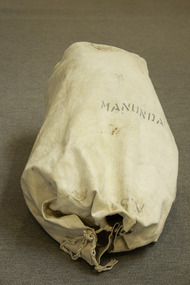
Equipment - Sea Bag [kit bag]
... On February 19, 1942 during a Japanese bombing raid whilst the ship was at anchor in Darwin harbour, a bomb hit right through the music room skylight, which exploded down on C deck tragically killing 12 and injuring 157 others. ...On February 19, 1942 during a Japanese bombing raid whilst the ship was at anchor in Darwin harbour, a bomb hit right through the music room skylight, which exploded down on C deck tragically killing 12 and injuring 157 others. ...The TSMV Manunda was requisitioned in September 1939 and she was converted into a fulltime hospital ship. HMAS Manunda was officially commissioned on May 25 1940 after which she operated four voyages to the Middle East to bring back wounded troops to Australia. On February 19, 1942 during a Japanese bombing raid whilst the ship was at anchor in Darwin harbour, a bomb hit right through the music room skylight, which exploded down on C deck tragically killing 12 and injuring 157 others. The next day she sailed for Fremantle with 266 patients. Whilst in Fremantle she was repaired and made ready for her next chapter in the war effort.This sea bag belonged to an unknown sailor who served on the hospital ship HMAS Manunda during WWIIA sailor's canvas sea or kit bag used on the TSMN Manunda in WWIIManundatsmv manunda, hmas manunda, hospital ship, wwii, kit bag, sea bag -
 Bendigo Military Museum
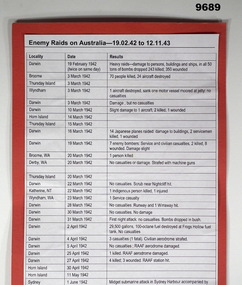
Document - ENEMY RAIDS ON AUSTRALIA, WW2, Post WW2
... Information printed on chart: "Enemy Raids on Australia 19.02.42 to 12.11.43" The document lists in chart form the Enemy raids on Australia under the headings "Locality", "Date", "Results". "Locality" includes Darwin, Broome, Thursday Island, Wyndham, Horn Island, Derby WA, Katherine NT, Horn Island, Sydney, Newcastle, Townsville, Port Hedland, Mossman (90km north of Cairns), Milingimbi, Wessell Island, Exmouth Gulf, Fenton Aerodrome, Coomallie Fenton, Onslow, Drysdale Mission....Information printed on chart: "Enemy Raids on Australia 19.02.42 to 12.11.43" The document lists in chart form the Enemy raids on Australia under the headings "Locality", "Date", "Results". "Locality" includes Darwin, Broome, Thursday Island, Wyndham, Horn Island, Derby WA, Katherine NT, Horn Island, Sydney, Newcastle, Townsville, Port Hedland, Mossman (90km north of Cairns), Milingimbi, Wessell Island, Exmouth Gulf, Fenton Aerodrome, Coomallie Fenton, Onslow, Drysdale Mission. ...Information printed on chart: "Enemy Raids on Australia 19.02.42 to 12.11.43" The document lists in chart form the Enemy raids on Australia under the headings "Locality", "Date", "Results". "Locality" includes Darwin, Broome, Thursday Island, Wyndham, Horn Island, Derby WA, Katherine NT, Horn Island, Sydney, Newcastle, Townsville, Port Hedland, Mossman (90km north of Cairns), Milingimbi, Wessell Island, Exmouth Gulf, Fenton Aerodrome, Coomallie Fenton, Onslow, Drysdale Mission.Chart - white colour paper adhered to red coloured cardboard for display purposes. Facsimile copy with black ink print. Unknown source.document, chart facsimile, ww2, australia -
 Warrnambool and District Historical Society Inc.
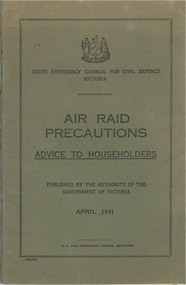
Booklet, Air Raid Precautions, 1941
... raids. It contains the relevant siren signals which denote different types of events and explains in detail various aspects of preparing for possible attack. There was discussion about issues such as evacuation of children should such an event occur with the focus primarily on the larger centres such as Geelong and Melbourne. From 1942 the number of air attacks increased mainly from Japan on the northern and western parts of Australia including over 60 on Darwin...raids. It contains the relevant siren signals which denote different types of events and explains in detail various aspects of preparing for possible attack. There was discussion about issues such as evacuation of children should such an event occur with the focus primarily on the larger centres such as Geelong and Melbourne. From 1942 the number of air attacks increased mainly from Japan on the northern and western parts of Australia including over 60 on Darwin ...This booklet was published on the recommendation of the Commonwealth government as part of a plan to offer protection to the people in the event of air strikes. Local councils and individuals were called to help to protect themselves in taking precautions,. The booklet itself sets out action to be taken in the event of an air raid happening, lighting restrictions fire prevention, refuge rooms and garden shelters and risks from air raids. It contains the relevant siren signals which denote different types of events and explains in detail various aspects of preparing for possible attack. There was discussion about issues such as evacuation of children should such an event occur with the focus primarily on the larger centres such as Geelong and Melbourne. From 1942 the number of air attacks increased mainly from Japan on the northern and western parts of Australia including over 60 on Darwin. Attacks continued into 1943 and it wasn’t until later in that year that the Prime Minister, John Curtin announced that the threat of invasion had passed.While the link to Warrnambool’s history is tenuous, it was a government publication to all persons in the state of Victoria in 1941.This item relates to a significant period in Australia’s history. All Australians were affected by the war. It has historical and scientific or research interest as it gives a number of diagrams and possible plans and the effectiveness of same. Olive green soft card cover with black text. 36 pages, with 2 extra pages depicting plans for shelters pasted inside back cover. Victorian coat of arms at top of cover.April 1941. H. E. Daw, Government printer. Forward by Sir John Harris KBE MLC Minister of Public Instruction and Public Healthhistory of warrnambool, air raid precautions 1941 -
 Monbulk RSL Sub Branch
Book, Northern Territory Government, The Territory Remembers 75 Years : Commemorating the Bombing of Darwin and Defence of Northern Australia, 2017
... World War 1939-1945 - Darwin - History Darwin - Bombimg - 1942 On 19th February 1942, Australia came under air attack for the first time when Japanese forces mounted two air raids on Darwin. ...On 19th February 1942, Australia came under air attack for the first time when Japanese forces mounted two air raids on Darwin. On that day, 242 Japanese aircraft attacked Darwin in an attempt to prevent the Allies from using it as a base. 235 people were killed in the two raids, and more than 400 were wounded, 30 aircraft were destroyed, nine ships were sunk in Darwin harbour and two outside, and many civil and military facilities in Darwin were damaged. This book provides a visual record of that time through photographs, some depicting the devastation of war brought to Northern Australia, while others capture how life was for so many during this time.Ill, p.109.On 19th February 1942, Australia came under air attack for the first time when Japanese forces mounted two air raids on Darwin. On that day, 242 Japanese aircraft attacked Darwin in an attempt to prevent the Allies from using it as a base. 235 people were killed in the two raids, and more than 400 were wounded, 30 aircraft were destroyed, nine ships were sunk in Darwin harbour and two outside, and many civil and military facilities in Darwin were damaged. This book provides a visual record of that time through photographs, some depicting the devastation of war brought to Northern Australia, while others capture how life was for so many during this time.world war 1939-1945 - darwin - history, darwin - bombimg - 1942 -
 Monbulk RSL Sub Branch
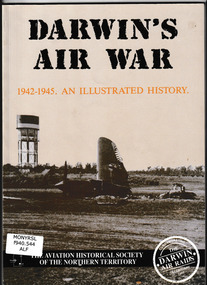
Book, Aviation Historical Society of the Northern Territory, Darwin's air war : 1942-1945, an illustrated history, 1991
... The defence build up, Darwin 1920's to 1942. 19 February 1942, the first raids. Initial defence, American and Australian Kittyhawks. ...Contents : Introduction. The defence build up, Darwin 1920's to 1942. 19 February 1942, the first raids. Initial defence, American and Australian Kittyhawks. Striking back with Hudsons & Beaufighters. Colour plates the 49 FighterGroup USAAD. The Spitfires arrive No 1 fighter wing RAAF. The heavy bombers USAAF and RAAF strikes. Staging the offensive, the war moves North. Pilot profiles. Conclusion, Darwin's present defences. Air forces. World War 2. Warfare.Bib, ill, maps, p.80.non-fictionContents : Introduction. The defence build up, Darwin 1920's to 1942. 19 February 1942, the first raids. Initial defence, American and Australian Kittyhawks. Striking back with Hudsons & Beaufighters. Colour plates the 49 FighterGroup USAAD. The Spitfires arrive No 1 fighter wing RAAF. The heavy bombers USAAF and RAAF strikes. Staging the offensive, the war moves North. Pilot profiles. Conclusion, Darwin's present defences. Air forces. World War 2. Warfare. world war 1939-1945 - aerial operations - northern territory, darwin - bombardment - 1942-1945 -
 Bendigo Historical Society Inc.
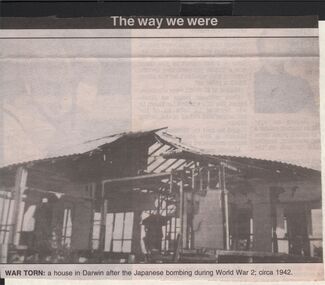
Newspaper - JENNY FOLEY COLLECTION: WAR TORN
... Darwin was bombed a total of 64 times during the war. The biggest and most deadly air-raids occurred on19/1/1943. ...Darwin was bombed a total of 64 times during the war. The biggest and most deadly air-raids occurred on19/1/1943. ...Darwin was bombed a total of 64 times during the war. The biggest and most deadly air-raids occurred on19/1/1943. Two hundred and forty two Japanese aircraft bombed the township, harbour and 2 airstrips. There were 235 deaths, 9 ships sunk in the harbour and 9 aircraft destroyed.Bendigo Advertiser ''The way we were'' from 2003. War torn: a house in Darwin after the Japanese bombing during World War 2, circa 1942. The clip is in a folder.newspaper, bendigo advertiser, the way we were -
 Bendigo Historical Society Inc.
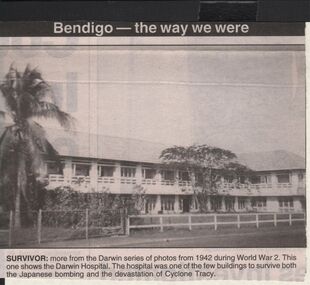
Newspaper - JENNY FOLEY COLLECTION: SURVIVOR
... Darwin was bombed a total of 64 times during the war. The biggest and most deadly air-raids occurred on19/1/1943. ...Darwin was bombed a total of 64 times during the war. The biggest and most deadly air-raids occurred on19/1/1943. ...Darwin was bombed a total of 64 times during the war. The biggest and most deadly air-raids occurred on19/1/1943. Two hundred and forty two Japanese aircraft bombed the township, harbour and 2 airstrips. There were 235 deaths, 9 ships sunk in the harbour and 9 aircraft destroyed.Bendigo Advertiser ''The way we were'' from Monday, December 30, 2002. Survivor: more from the Darwin series of photos from 1942 during World War 2. This one shows the Darwin hospital. The hospital was one of the few buildings to survive both the Japanese bombing and the devastation of cyclone Tracy. The clip is in a folder.newspaper, bendigo advertiser, the way we were -
 Bendigo Historical Society Inc.
Newspaper - JENNY FOLEY COLLECTION: DAMAGED
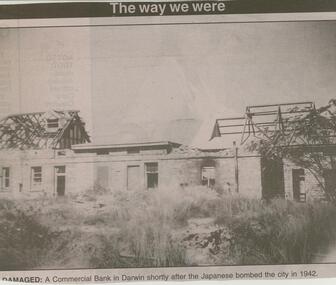
... Darwin was bombed a total of 64 times during the war. The biggest and most deadly air-raids occurred on19/1/1943. ...Darwin was bombed a total of 64 times during the war. The biggest and most deadly air-raids occurred on19/1/1943. ...Darwin was bombed a total of 64 times during the war. The biggest and most deadly air-raids occurred on19/1/1943. Two hundred and forty two Japanese aircraft bombed the township, harbour and 2 airstrips. There were 235 deaths, 9 ships sunk in the harbour and 9 aircraft destroyed.Bendigo Advertiser ''The way we were'' from 2002. Damaged: a Commercial Bank in Darwin shortly after the Japanese bombed the city in 1942. The clip is in a folder.newspaper, bendigo advertiser, the way we were -
 Wangaratta RSL Sub Branch
Essay - Framed essay, The Battle of Australia
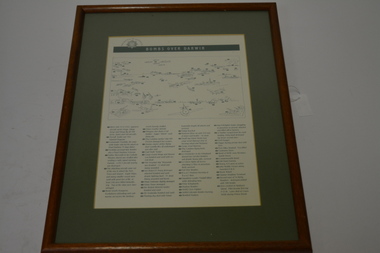
... Item detailing events of the 19th February 1942 when Darwin was bombed on two separate occasions by Japanese air raids....Item detailing events of the 19th February 1942 when Darwin was bombed on two separate occasions by Japanese air raids. On 19 February 1942 Darwin was bombed by two separate Japanese air raids becoming the largest single attack ever mounted by a foreign power on Australia. ...Item detailing events of the 19th February 1942 when Darwin was bombed on two separate occasions by Japanese air raids.On 19 February 1942 Darwin was bombed by two separate Japanese air raids becoming the largest single attack ever mounted by a foreign power on Australia. The attack left hundreds of servicemen and civilians dead, and countless others injured.Brown timber frame and green mount and cream colourd paper with green text and sketches of flying planes The Battle of Australia Bombs Over Darwindarwin, australia, bombing, ww2, japanese, 1942 -
Tatura Irrigation & Wartime Camps Museum
Book, Darwin Drama
... Describes Darwin before and after the air raids and bombings. Many photographs....Describes Darwin before and after the air raids and bombings. Many photographs. ...Red hard cover, ex library book. Describes Darwin before and after the air raids and bombings. Many photographs.Darwin Bombing Wartime Activity -
 Brighton Historical Society
Uniform, WRANS uniform, 1942-1944
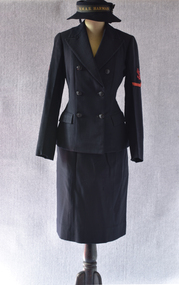
... Though the town was never subjected to the heavy bombardments of Darwin, a series of small air strikes in July 1942 had made the fear of air raids quite real. ...Though the town was never subjected to the heavy bombardments of Darwin, a series of small air strikes in July 1942 had made the fear of air raids quite real. ...This uniform belonged to Marion Elaine Caffrey, nee Bullock (1920-1993). Marion was born and lived in Begonia Road, Gardenvale and attended Star of the Sea College with her younger twin sisters, Hilary and Margaret Bullock. Their family had been living in the district since 1892 when their grandfather, James Stewart, settled first at Brighton Beach before building a new home in Gardenia Road, Gardenvale in 1910. On leaving school, Marion took a job with the T&G Insurance Company in Collins Street. However, as the threat of invasion by Japan loomed closer following the bombing of Pearl Harbour and the fall of Singapore, in 1943 she volunteered to join Australia's war effort as part of the Women's Royal Australian Naval Service (WRANS). She initially trained as a coder at HMAS Cerberus, followed by a posting to HMAS Magnetic in Townsville. By the time Marion arrived in Townsville in 1944 it was very much a garrison town, inhabited largely by Australian and American servicemen. Whereas in Melbourne the war in the Pacific may have felt somewhat distant, in Townsville it was very immediate. Though the town was never subjected to the heavy bombardments of Darwin, a series of small air strikes in July 1942 had made the fear of air raids quite real. The naval base HMAS Magnetic was responsible for communications, Port Examination Services and servicing of Allied warships. Marion worked as a coder, encoding outgoing transmissions and decoding incoming ones either manually or using a Typex cipher machine. In 1945, she completed additional training to attain the rank of Leading Coder. Her keenness for the work is evident in a note on her service record: although no WRANS women were ever sent to active warzones, Marion volunteered for overseas service. Marion later recalled her time with the WRANS as one of the happiest and most personally fulfilling times of her life. Like many Australian women, she embraced the opportunity to serve her country and take on roles traditionally reserved for men. She completed her three years' service at HMAS Harman in Canberra where she was de-mobbed in 1946. Afterwards, she secured a job with Metro Goldwyn Mayer, where she worked until her marriage to Hugh Caffrey in 1947.Second World War WRANS uniform consisting of a dark navy blue serge blazer (.1), skirt (.2) and hat (.3). The blazer features six buttons. The left arm features a black patch embroidered with a red anchor wrapped in a length of rope (a fouled anchor) with a single red chevron beneath, denoting the rank of Leading Wran (equivalent to Leading Seaman). The right arm features a black patch embroidered with red crossed flags over the letter 'C'. The pencil skirt is lined and fastens at the side with a button and snap fastenings. The navy felt hat features a round brim and a black ribbon band machine embroidered in gold with the words "H.M.A.S. HARMAN".Maker's label in collar of blazer reads "N491 / 1942 / SIZE [indistinct] / MADE IN AUSTRALIA" The label features a pen inscription, "BULLOCK". Size label in back of skirt: "2". Label inside the hat: "N18 / 1944 Size 20½ / MADE IN AUSTRALIA"1940s, marion elaine bullock, marion elaine caffrey, second world war, military uniform, wrans, women's royal australian naval service -
 Wangaratta RSL Sub Branch
Print - Framed Print, Bombs over Darwin, 1991
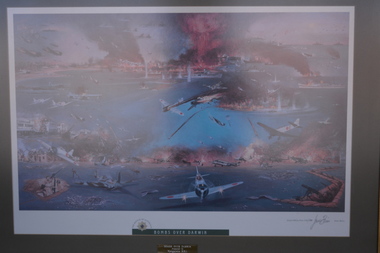
... Darwin was lightly defended, relative to the size of the attack, and the Japanese inflicted heavy losses upon Allied forces at little cost to themselves. The two Japanese air raids...The urban areas of Darwin also suffered damage from the raids and there were a number of civilian casualties. ...On the 19 February 1942, 242 Japanese aircraft, in two separate raids, attacked the town of Darwin, ships in the harbour and the town's two airfields in an attempt to prevent the Allies from using them as bases to contest the invasion of Timor and Java during World War II. Darwin was lightly defended, relative to the size of the attack, and the Japanese inflicted heavy losses upon Allied forces at little cost to themselves. The two Japanese air raids were the first, and largest, of more than 100 air raids against Australia during 1942–43.The Bombing of Darwin, also known as the Battle of Darwin, on 19 February 1942 was the largest single attack ever mounted by a foreign power on Australia. The urban areas of Darwin also suffered damage from the raids and there were a number of civilian casualties. As a result more than half of Darwin's civilian population left the area permanently, before or immediately after the attack. Timber framed containing coloured print of planes depicting the bombing of Darwin Harbour. Gold metal plaque - BOMBS OVER DARWIN Presented to Wangaratta RSL Limited Edition Print 234/1800 by James Baineswwii, bombing of darwin, battle of darwin -
Moorabbin Air Museum
Book - Stories and photos of DARWIN'S AIR WAR 1942-1945 AN ILLUSTRATED HISTORY COMMEMORATING THE DARWING AIR RAIDS, BOB ALFORD, DARWIN'S AIR WAR 1942-1945 AN ILLUSTRATED HISTORY COMMEMORATING THE DARWING AIR RAIDS, 2001
... Stories and photos of DARWIN'S AIR WAR 1942-1945 AN ILLUSTRATED HISTORY COMMEMORATING THE DARWING AIR RAIDS...Stories and photos of DARWIN'S AIR WAR 1942-1945 AN ILLUSTRATED HISTORY COMMEMORATING THE DARWING AIR RAIDS Stories and photos of DARWIN'S AIR WAR 1942-1945 AN ILLUSTRATED HISTORY COMMEMORATING THE DARWING AIR RAIDS Front cover showing colour photo of a P40 on the ground under camouflage netting, under blue sky DARWIN'S AIR WAR 1942-1945 AN ILLUSTRATED HISTORY COMMEMORATING THE DARWING AIR RAIDS Book Stories and photos of DARWIN'S AIR WAR 1942-1945 AN ILLUSTRATED HISTORY COMMEMORATING THE DARWING AIR RAIDS BOB ALFORD ...Stories and photos of DARWIN'S AIR WAR 1942-1945 AN ILLUSTRATED HISTORY COMMEMORATING THE DARWING AIR RAIDSFront cover showing colour photo of a P40 on the ground under camouflage netting, under blue sky non-fictionStories and photos of DARWIN'S AIR WAR 1942-1945 AN ILLUSTRATED HISTORY COMMEMORATING THE DARWING AIR RAIDS -
Kew Historical Society Inc
Journal, Kew Historical Society, Newsletter No.64, July, 1999
... Australia Remembered Darwin Air Raids / p3. 1999 Calendar of Meetings and Other Activities / p4. ...Heigh Ho Come to the Fair / p1-2. Our End of Year Party / p2. Australia Remembered Darwin Air Raids / p3. 1999 Calendar of Meetings and Other Activities / p4. Notice of Annual General Meeting / p4.Published quarterly since 1977, the newsletters of the Kew Historical Society contain significant research by members exploring relevant aspects of the Victorian and Australian Framework of Historical Themes. Frequently, articles on people, places and artefacts are the only source of information about an aspect of Kew, and Melbourne’s history.Heigh Ho Come to the Fair / p1-2. Our End of Year Party / p2. Australia Remembered Darwin Air Raids / p3. 1999 Calendar of Meetings and Other Activities / p4. Notice of Annual General Meeting / p4.kew historical society (vic.) -- periodicals., kew historical society (vic.) -- newsletters, kew historical society (vic.) -- journals -
 Returned Nurses RSL Sub-branch
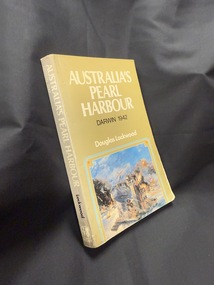
Book, Douglas Lockwood (1918-1980), Australia's Pearl Harbour : Darwin 1942, 1984
... World War Two WWII WW2 Darwin Harbour attack Darwin Northern Territory Australia 'Includes index and Bibliography (page 213). Darwin. Air raids by Japan. Kaigun & Japan. Rikugun, 1942 (ANB/PRECIS SIN 0710946). ...'Includes index and Bibliography (page 213). Darwin. Air raids by Japan. Kaigun & Japan. Rikugun, 1942 (ANB/PRECIS SIN 0710946). Later published as: Australia under attack. Previous ed.: Adelaide : Rigby, 1972.' From TrovePaperback book with olive green cover and spine, cover also has a partial image of an artworkfiction'Includes index and Bibliography (page 213). Darwin. Air raids by Japan. Kaigun & Japan. Rikugun, 1942 (ANB/PRECIS SIN 0710946). Later published as: Australia under attack. Previous ed.: Adelaide : Rigby, 1972.' From Troveworld war two, wwii, ww2, darwin harbour attack, darwin, northern territory, australia
