
Showing 6 items matching "decolonisation"
-
 Wyndham Art Gallery (Wyndham City Council)
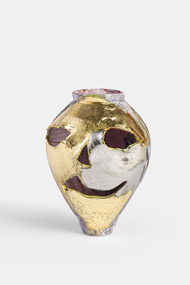
Sculpture - Vessel Mask II, Ramesh Mario Nithiyendran, 2025
... ...Decolonisation...Ceramics Ceramic sculpture Contemporary sculpture Mythology Religion Spirituality Ritual Sri Lankan-Australian art South Asian influences Contemporary mythology Postcolonialism Decolonisation Vessel Mask II Sculpture Vessel Mask II Ramesh Mario Nithiyendran ...Ramesh Mario Nithiyendran is a contemporary artist of Sri Lankan, Tamil heritage. His practice traverses global histories and languages of figuration with a particular focus on South Asian traditions. He sees the imaginative exploration of ancient pasts as a way to speculate on parallel futures and to expand ways of perceiving the present. While he works across ceramics, bronze casting, painting, drawing, and immersive installation, he is best known for his hybrid ceramic sculptures that fuse references to ancient forms with various tropes and imagery from popular culture, zoology and other discourses. Through these works he explores themes of secular and non-secular idolatry, co-existent belief systems, queer aesthetics, disciplinary and regional histories of ceramics and sculpture, monumentality, as well as self-portraiture and autobiography.ceramics, ceramic sculpture, contemporary sculpture, mythology, religion, spirituality, ritual, sri lankan-australian art, south asian influences, contemporary mythology, postcolonialism, decolonisation -
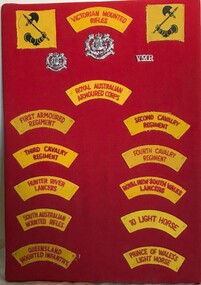 8th/13th Victorian Mounted Rifles Regimental Collection
Memorabilia - Shoulder titles
... Australia’s defence plans and priorities changed after the Second World War. Decolonisation coupled with competing ideologies created an unstable situation in the Asia-Pacific region. ...Australia’s defence plans and priorities changed after the Second World War. Decolonisation coupled with competing ideologies created an unstable situation in the Asia-Pacific region. ...Embroidered shoulder titles were worn on the upper sleeves of uniform prior to the introduction of colour patches c.1990. Regular regiments used the numerical designations First, Second, Third and Fourth. CMF regiments used their territorial designation: Victorian, Queensland, New South Wales, Hunter River, South Australian, Prince of Wales's and 10th Light Horse. Australia’s defence plans and priorities changed after the Second World War. Decolonisation coupled with competing ideologies created an unstable situation in the Asia-Pacific region. Australia recognised it needed both regular and citizen forces. Six Armoured Corps regiments were formed in 1948, all with territorial titles reflecting their Light Horse heritage. In Victoria they were 4th/19th Prince of Wales’s Light Horse and 8th/13th Victorian Mounted Rifles. The 1st Armoured Regiment, formed July 1949, was the first regular RAAC regiment, followed by 2nd, 3rd and 4th Cavalry Regiments decades later. Unique collection of regimental titles worthy of preservation and display.Display board containing the badge and shoulder title of 8/13 Victorian Mounted Rifles flanked by the formation signs of 2nd Armoured Brigade. These are followed by the shoulder titles of Royal Australian Armoured Corps and eight other RAAC regiments.military, titles, uniform, ara, cmf -
 Victorian Aboriginal Corporation for Languages
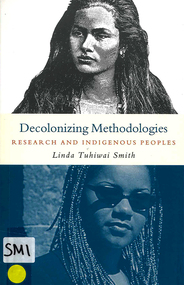
Book, Linda Tuhiwai Smith, Decolonizing methodologies : research and Indigenous peoples, 1999
... Here, an indigenous researcher issues a clarion call for the decolonisation of research methods. In the first part of the book, the author critically examines the historical and philosophical base of Western research. ...Here, an indigenous researcher issues a clarion call for the decolonisation of research methods. In the first part of the book, the author critically examines the historical and philosophical base of Western research. ...From the vantage point of the colonised, the term 'research' is inextricably linked with European colonialism; the way in which scientific research has been implicated in the worst excesses of imperialism remains a powerful remembered history for many of the world's colonised peoples. Here, an indigenous researcher issues a clarion call for the decolonisation of research methods. In the first part of the book, the author critically examines the historical and philosophical base of Western research. Extending the work of Foucault, she explores the intersections of imperialism, knowledge and research; en route she provides a history of knowledge from the Enlightenment to postcoloniality. The second part of the book meets an urgent demand: people who are carrying out their own research projects need literature which validates their frustrations in dealing with various Western paradigms. In setting an agenda for planning and implementing indigenous research, the author shows how such programmes are part of the wider project of reclaiming control over indigenous ways of knowing and being.tables, diagramscolonisation, research, imperialsim -
 Uniting Church Archives - Synod of Victoria
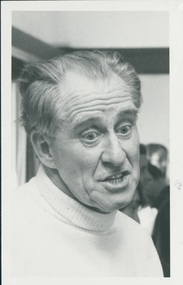
Bw photo, Undated
... In the 1970s Perkins played an important role in ''decolonising'' and devolving power in the Methodist Church missions in Aboriginal Australia and the Pacific Islands by analysing power structures and relationships through what he had learnt in Asia. ...In the 1970s Perkins played an important role in ''decolonising'' and devolving power in the Methodist Church missions in Aboriginal Australia and the Pacific Islands by analysing power structures and relationships through what he had learnt in Asia. ...Harvey Perkins was a Methodist minister and a peacemaker throughout his life of service and social activism. He knew the certainty that without justice there can be no peace, within, or between, communities and nations. He was greatly influenced by ''liberation theology'' and framed his life of thought, analysis and action on the teachings of the Bible. He was also a visionary in working closely with Asian churches on ecumenical and social justice issues in a way that anticipated by decades the closer relationships Australia now enjoys with Asia. He understood that any form of intervention altered the power relationship within a community and often challenged the dominant social interests in the post-colonial Asian countries. He knew any form of aid had to empower its recipients and be based on a partnership of equality. In the early 1960s, Perkins was an opponent of the war in Indochina and conscription in Australia and played an important role in activating congregations to protest against the war. His keen intelligence, knowledge of history and analytical skills demolished the false foundation on which the US and its allies entered the war and he organised medical and social work teams in South Vietnam and Laos to help refugees and displaced persons. In the 1970s Perkins played an important role in ''decolonising'' and devolving power in the Methodist Church missions in Aboriginal Australia and the Pacific Islands by analysing power structures and relationships through what he had learnt in Asia. Harvey Perkins and his twin sister, Jean, were born in Tasmania on January 29, 1919, children of Leslie Perkins and his wife, Doris (nee Cook). Leslie was a Methodist minister and Harvey and Jean's childhood was spent in parishes in urban and rural areas of Tasmania and Victoria. The family saw the grinding poverty and desperate human need wrought by the Depression as a ceaseless tide of people came knocking at the door of the local parsonage for help. In 1941, Perkins enlisted as an officer in the Australian Navy and served in the Pacific theatre until 1946. To his children, he explained his justification as being the real threat of invasion but it was a war that altered the direction of his life. On discharge he abandoned his completed studies at Melbourne University in law and commerce and studied for a degree in divinity. He was active in the World Student Christian Federation and in 1949, was ordained into the Methodist Church. A few years later, Perkins travelled to a World Student Christian Federation conference in Canada, on his way to study in Cambridge, and met an expatriate, Jill McCrory. They married in 1953. After Cambridge, Perkins returned to Australia and served as a minister in the Mitcham area of the growing Melbourne outer suburbs until 1956, when he was appointed General Secretary of the Australian Council of Churches and director of the Inter-Church Aid and Refugee World Service. From 1968 to 1971, Perkins worked with the East Asian Christian Conference and then took a position with the World Council of Churches in Geneva with its Commission on Churches Participation in Development. He returned to Australia in 1973 to a position with the Methodist Board of Missions and then returned to the Christian Conference of Asia in 1976 and relocated to Singapore for several years. Before retiring in 1984 he worked with the Uniting Church Board of Social Responsibility. In retirement Perkins continued to work in the Dee Why parish, enjoying preaching, leading study groups and working as a pastor in a local community. Along with his work, Perkins had a lifelong passion for AFL and his beloved team North Melbourne. Wherever he was in the world he could be found fiddling with a short-wave radio to listen to a game. In later years, Perkins developed Alzheimer's and his home became his haven until two weeks before his death. Harvey Perkins is survived by Jill, children Mary, Ro, David, Marguerite, Anna, Harvey and Kate and their partners, 13 grandchildren and two great-grandchildren. Jean died in 1981. (Obituary in the SMH by David Perkins) Head and shoulders portrait of Rev. Harvey PerkinsRev. Harvey Perkinsrev. harvey perkins; methodist minister; christian conference of asia; australian council of churches -
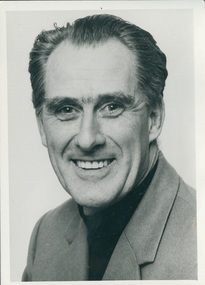 Uniting Church Archives - Synod of Victoria
BW photo, Undated
... In the 1970s Perkins played an important role in ''decolonising'' and devolving power in the Methodist Church missions in Aboriginal Australia and the Pacific Islands by analysing power structures and relationships through what he had learnt in Asia. ...In the 1970s Perkins played an important role in ''decolonising'' and devolving power in the Methodist Church missions in Aboriginal Australia and the Pacific Islands by analysing power structures and relationships through what he had learnt in Asia. ...Harvey Perkins was a Methodist minister and a peacemaker throughout his life of service and social activism. He knew the certainty that without justice there can be no peace, within, or between, communities and nations. He was greatly influenced by ''liberation theology'' and framed his life of thought, analysis and action on the teachings of the Bible. He was also a visionary in working closely with Asian churches on ecumenical and social justice issues in a way that anticipated by decades the closer relationships Australia now enjoys with Asia. He understood that any form of intervention altered the power relationship within a community and often challenged the dominant social interests in the post-colonial Asian countries. He knew any form of aid had to empower its recipients and be based on a partnership of equality. In the early 1960s, Perkins was an opponent of the war in Indochina and conscription in Australia and played an important role in activating congregations to protest against the war. His keen intelligence, knowledge of history and analytical skills demolished the false foundation on which the US and its allies entered the war and he organised medical and social work teams in South Vietnam and Laos to help refugees and displaced persons. In the 1970s Perkins played an important role in ''decolonising'' and devolving power in the Methodist Church missions in Aboriginal Australia and the Pacific Islands by analysing power structures and relationships through what he had learnt in Asia. Harvey Perkins and his twin sister, Jean, were born in Tasmania on January 29, 1919, children of Leslie Perkins and his wife, Doris (nee Cook). Leslie was a Methodist minister and Harvey and Jean's childhood was spent in parishes in urban and rural areas of Tasmania and Victoria. The family saw the grinding poverty and desperate human need wrought by the Depression as a ceaseless tide of people came knocking at the door of the local parsonage for help. In 1941, Perkins enlisted as an officer in the Australian Navy and served in the Pacific theatre until 1946. To his children, he explained his justification as being the real threat of invasion but it was a war that altered the direction of his life. On discharge he abandoned his completed studies at Melbourne University in law and commerce and studied for a degree in divinity. He was active in the World Student Christian Federation and in 1949, was ordained into the Methodist Church. A few years later, Perkins travelled to a World Student Christian Federation conference in Canada, on his way to study in Cambridge, and met an expatriate, Jill McCrory. They married in 1953. After Cambridge, Perkins returned to Australia and served as a minister in the Mitcham area of the growing Melbourne outer suburbs until 1956, when he was appointed General Secretary of the Australian Council of Churches and director of the Inter-Church Aid and Refugee World Service. From 1968 to 1971, Perkins worked with the East Asian Christian Conference and then took a position with the World Council of Churches in Geneva with its Commission on Churches Participation in Development. He returned to Australia in 1973 to a position with the Methodist Board of Missions and then returned to the Christian Conference of Asia in 1976 and relocated to Singapore for several years. Before retiring in 1984 he worked with the Uniting Church Board of Social Responsibility. In retirement Perkins continued to work in the Dee Why parish, enjoying preaching, leading study groups and working as a pastor in a local community. Along with his work, Perkins had a lifelong passion for AFL and his beloved team North Melbourne. Wherever he was in the world he could be found fiddling with a short-wave radio to listen to a game. In later years, Perkins developed Alzheimer's and his home became his haven until two weeks before his death. Harvey Perkins is survived by Jill, children Mary, Ro, David, Marguerite, Anna, Harvey and Kate and their partners, 13 grandchildren and two great-grandchildren. Jean died in 1981. (Obituary in the SMH by David Perkins) Head and shoulders portrait of the Rev. Harvey Perkins. Photo taken some years before the photo of him in F524 -9Rev. Harvey Perkinsrev. harvey perkins; methodist minister; christian conference of asia; australian council of churches -
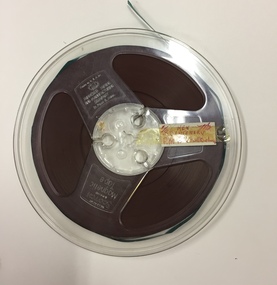 Kew Historical Society Inc
Audio - City of Kew Centenary: The Right Hon RG Menzies & Cr WHS Dickinson, William Dickinson, 1960
... He also describes the emerging democracies of Africa in the period following decolonisation, and suggests that the success of these countries is dependent on democratic institutions not being imposed from above by colonial powers. city of kew centenary of kew 1860-1960 robert gordon menzies william henry shorey dickinson bill burrell mayors of kew town clerks of kew australian prime ministers australian democracy democracy Label on original box City of Kew Centenary 1860-1960 Speeches by The Hon RG Menzies, MHR for Kew, and Cr WHS Dickinson, Mayor of Kew. ...Kew, in Melbourne, Victoria, was declared a Borough in 1859, following which the first Council was elected in 1860. Kew became a Town in 1910, and a City in 1921. It was amalgamated into a new City of Boroondara in 1994. The centenary celebrations of 1860 marked 100 since the first Kew Council was established.This reel-to-reel tape, now digitised, is both rare (ie unique) and historically significant. While the recording clearly has local significance, it is also of national and international significance due to the content of the Prime Minister's address. The focus of his speech is the nature of Australian democracy and its strengths, deriving from universal suffrage and the acceptance of democratic values by the Australian population, gained through historic participation in democracy at local, state and federal levels. RG Menzies mounts a strong case for each level of government having value in the development of Australian democracy. He also describes the emerging democracies of Africa in the period following decolonisation, and suggests that the success of these countries is dependent on democratic institutions not being imposed from above by colonial powers. City of Kew Centenary 1860-1960 Speeches by The Hon RG Menzies, MHR for Kew, and Cr WHS Dickinson, Mayor of Kew. Recorded on 13th December 1960 at the Kew City Hall 34 minutes 29 seconds From the archives of the Kew Historical Society Inc Copyright Kew Historical Society Inc Timings 00.14-17.00 The Right Hon RG Menzies MHR 17.07-32.33 Cr. WHS Dickinson 32.38-33.10 The Right Hon RG Menzies MHR 33.30-33.50 Cr. WHS Dickinson 33.51-34.25 Song - 'For He's a Jolly Good Fellow'Label on original boxcity of kew, centenary of kew 1860-1960, robert gordon menzies, william henry shorey dickinson, bill burrell, mayors of kew, town clerks of kew, australian prime ministers, australian democracy, democracy
