
Showing 6 items matching "deed of settlement"
-
 Flagstaff Hill Maritime Museum and Village
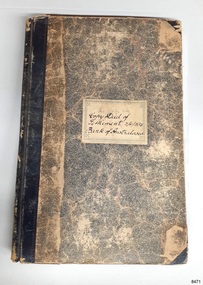
Legal record - Deed of Settlement, Copy Deed of Settlement 2/6/1834 Bank of Australasia, 02-06-1834
... Deed of Settlement...Copy Deed of Settlement 2/6/1834 Bank of Australasia......Deed of Settlement...This Copy of Deed of Settlement of the Bank of Australia originated from the Bank of Australasia. ...The book contains a copy of the Deed of Settlement of the Bank of Australasia in London....Label on spine, handwritten "AG" with covering label "272 A" Label on front cover, in pen "Copy Deed of / Settlement 2/6/1834 / Bank of Australasia" Label on front cover, printed "THOMAS and Co. ...Copy Deed of Settlement 2/6/1834 Bank of Australasia Legal record Deed of Settlement ...This Copy of Deed of Settlement of the Bank of Australia originated from the Bank of Australasia. The bank of Australasia was incorporated by Royal Charter of England in March 1834. It had its Australian beginning on 14th December 1835, opening in Sydney. The Acting Superintendent of the bank at that time was David Charters McArthur. He was Superintendent from 1867-to 1876. The Melbourne branch opened on 28th August 1838 in a two-roomed brick cottage on the north side of Little Collins Street, where two huge mastiff dogs were used at night to guard the bank. The government also provided an armed military sentinel. Due to the bank's rapid growth, a new building for the Melbourne branch was opened in 1840 at 75 Collins Street West. By 1879 the bank had been upgraded to a magnificent two-storey building on the corners of Collins and Queens Streets, with the entry on Collins Street. In 1951 the Bank of Australasia amalgamated with the Union Bank to form the Australia and New Zealand Bank, now known as the ANZ. Then in 1970, the ANZ merged with both the ES&A and the London Bank of Australia to form the ANZ Banking Group Limited. The ANZ Banking Group Ltd kindly donated a variety of historic items from the Bank of Australasia. BANK of AUSTRALASIA, WARRNAMBOOL – In 1854 Warrnambool had two banks, the Union Bank and the Bank of Australasia. Later, completely different bank businesses opened; in 1867 the National Bank of Australasia, then in 1875 the Colonial Bank of Australasia. The original Warrnambool branch of the Bank of Australasia was established in July 1854, and operated from a leased cottage on Merri Street, close to Liebig Street. The bank next bought a stone building previously erected by drapers Cramond & Dickson on the corner of Timor and Gibson Streets. Samuel Hannaford was a teller and then Manager at the Warrnambool branch from 1855 to 1856 and the Warrnambool Council chose that bank for its dealings during 1856-57. In 1859 Roberts & Co. was awarded the contract to build the new Bank of Australasia branch for the sum of £3,000; the firm built the Warrnambool Post Office in 1856 and purchased land in Timor Street in 1858. The land was on a sand hill on the northeast corner of Timor and Kepler Streets and had been bought in 1855 from investor James Cust. The new building opened on May 21, 1860. The bank continued to operate there until 1951 when it merged with the Union Bank to form the ANZ Bank, which continued operating from its Liebig Street building. Warrnambool City Council purchased the former Bank of Australasia building in 1971 and renovated it, then on 3rd December 1973 it was officially opened as the Art Gallery by Cr. Harold Stephenson and Gallery Director John Welsh. The Gallery transferred to the purpose-built building in Liebig Street in 1986 and the old bank building is now the Gallery club. Staff at the Bank of Australasia in Warrnambool included the following men but others were also involved: Samuel Hannaford, Teller then Manager from 1855-1856; Hawkins, Manager in 1856, W H Palmer, Manager from January 1857 until November 1869 when the Teller Basil Spence was promoted to Manager; H B Chomley, Manager from April 1873 and still there in 1886; A Butt, Manager in 1895-1904; J R McCleary Accountant and Acting Manager for 12 months, until 1900; A Kirk, Manager 1904; J Moore, staff until his transfer to Bendigo in December 1908; J S Bath was Manager until 1915; C C Cox, Manager until April 1923; Richard C Stanley, Manager 1923 to April 1928. The Copy of Deed of Settlement of the Bank of Australasia has significance through its association with the Bank of Australasia. The early Australian bank was established in 1834 by Royal Charter and opened in Sydney, Australia, in Sydney in 1835. The bank had many Australian offices in November 1877, particularly on the east and south coasts. Victoria had 45 per cent of all Offices. The Deed of Settlement is locally significant for its association with the Warrnambool Bank of Australasia, which was established in 1854. It was Warrnambool Council’s first bank. The bank continued to operate until the organisation's merger in 1951 when it became the ANZ Bank Group today. The Bank was an integral part of the growth of local commerce and the community. Large hard covered record book, front and back covers with dark green, red and cream pebble pattern, spine and corners reinforced with black leather, edges of pages in red, green and cream pattern. Cream pages have watermarks, numbers and feint lines. the handwritten Deed begins at at page 66. Inscriptions on labels and on front end papers, and red oval stamp on front end paper. The book was made by Thomas & Co., of London. The Deed was dated 2/6/1834. The book contains a copy of the Deed of Settlement of the Bank of Australasia in London.Label on spine, handwritten "AG" with covering label "272 A" Label on front cover, in pen "Copy Deed of / Settlement 2/6/1834 / Bank of Australasia" Label on front cover, printed "THOMAS and Co. Stationers and Account Book Manufacturers, 20, CORNELL, LONDON" In pencil on front cover label "See page 66" Red oval stamp, stamped around oval "AUSTRALIA AND NEW ZEALAND BANK LIMITED - ARCHIVES -" and inside the oval in pen "AG 34" Front end paper in pencil "32/56" and [signature] and another front end paper in pencil "L 31" and in red pen "See page 66"flagstaff hill, warrnambool, shipwrecked coast, flagstaff hill maritime museum, maritime museum, shipwreck coast, flagstaff hill maritime village, great ocean road, bank of australasia, boa, union bank, australia & new zealand bank, anz bank, david charters mcarthur, d c mcarthur, sydney, new south wales, currency, banknote, legal tender, commerce, banking, roberts & co., james cust, heraldic shield, insignia, samuel hannaford, w h palmer, basil spence, h b chomley, a butt, j r mccleary, a kirk, j moore, j s bath, c c cox, richard c stanley, deed of settlement -
 Lakes Entrance Historical Society
Painting - Flora Gregson Original Painting, Flora Gregson, 1878
... As the legal owner of this painting of the original entrance painted in 1878 as a deed to family settlement of Reginald Vernon Schulz Es. ...Painting donated to the LERHS by Susan Boekel 4/12/2012 Painted by a well known artist who recorded our early history with her paintings Art Local History watercolour As the legal owner of this painting of the original entrance painted in 1878 as a deed to family settlement of Reginald Vernon Schulz Es. ...Painting donated to the LERHS by Susan Boekel 4/12/2012Painted by a well known artist who recorded our early history with her paintingsFramed original painting by Flora Gregson of the original entrance to the Gippsland Lakes.As the legal owner of this painting of the original entrance painted in 1878 as a deed to family settlement of Reginald Vernon Schulz Es. I hereby give ownership of the painting to the Lakes Entrance Historical Society. It was his intention that the painting remain on display therefore made it a condition of the donation. Susan Boekel 4/12/2012. Witnessed by R Purdy and J Davies. It had always been my father's wish that this painting be donated to the LEHS after his passing.art, local history, watercolour -
 Orbost & District Historical Society
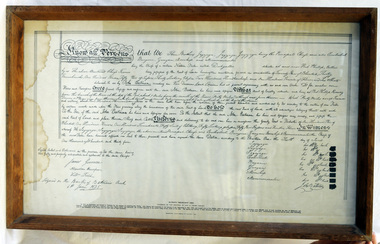
framed document, Batman's Melbourne Deed, 1966
... The original Batman Deed is of enormous significance to the history of the European settlement of Victoria. document batman-deed melbourne Framed print of the Batman Deed, dated 1835. ...The Batman Deed is sometimes called the Batman Treaty, the Dutigullar Deed, the Dutigullar Treaty or the Melbourne Deed. The deeds had been drafted by JT Gellibrand, a leading lawyer in the colony. Batman's Treaty was a document signed on 6 June 1835 by John Batman, an Australian grazier, businessman and explorer, and a group of Wurundjeri elders, for the purchase of land around Port Phillip, near the present site of the city of Melbourne. The document came to be known as Batman's Treaty and is considered significant as it was the first and only documented time when Europeans negotiated their presence and occupation of Aboriginal lands directly with the traditional owners. The so-called treaty was implicitly declared void on 26 August 1835 by the Governor of New South Wales, Richard Bourke. The original Batman Deed is of enormous significance to the history of the European settlement of Victoria. Framed print of the Batman Deed, dated 1835. This is a printed copy of the Batman Deed, made in 1966 from the 'original' by the State Library of Victoria. The frame is wood. The document consists of handwritten text in black ink with eight signatures in the lower right hand side and three signatures in the lower left hand corner. It has been signed by John Batman beneath the eight signatures.document batman-deed melbourne -
 Eltham District Historical Society Inc
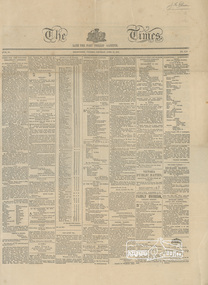
Facsimile Newspaper, The Times, Late The Port Phillip Gazette, 12 April 1851, p1
... deed, an attested copy on parchment of the Crown’s Grant with the Vendors Receipt for the purchase money on the same sheet, will be given to each purchaser without charge. A plan is now on view, and the lots can be chosen at once. Application to be made to J. M. HOLLOWAY, “Red Boot,” Swanston-street, Opposite the Shepherd’s Arms N.B.—A plan of the property will be given to each purchaser. The announcement of J.M. Holloway's Little Eltham township in April 1851 is a significant event in the foundation of European settlement ...Copy of front page of an early Port Phillip newspaper. It includes several articles including the announcement of a new township called Little Eltham. The artcile is transcribed as follows: NEW TOWNSHIP OF LITTLE ELTHAM Adjoining the Government Township of Eltham on the Yarra River. Half-acre Allotments for Sale in the above Township, at 35s. each; Title—A Grant from the Crown to the Vendor. THE advertiser feels persuaded that to recommend the above property he need only state the three following undeniable facts: First.—The Diamond Creek, which yields a never failing supply of the purest water, runs through the whole length of the township. Second.—The boundary of the Government township reserve was fixed years back, when Melbourne itself was not expected to rise beyond a mere village and when the valuable building ground at Collingwood was sold in allotments containing about twenty-seven acre each. Third.—Immediately beyond the Government township the bank of the Yarra is so steep that water could with difficulty be obtained from the river; making it certain that the town will extend itself in the direction of the creek. The distance from Melbourne is about eleven miles in a straight line, and between 13 and 14 miles by road. Attention is particularly directed to the following, being the second article in the condition of sale—: That, to secure to the purchaser uninterrupted possession without the expense of a deed, an attested copy on parchment of the Crown’s Grant with the Vendors Receipt for the purchase money on the same sheet, will be given to each purchaser without charge. A plan is now on view, and the lots can be chosen at once. Application to be made to J. M. HOLLOWAY, “Red Boot,” Swanston-street, Opposite the Shepherd’s Arms N.B.—A plan of the property will be given to each purchaser.The announcement of J.M. Holloway's Little Eltham township in April 1851 is a significant event in the foundation of European settlement for the suburb of Eltham and its wider community today.Laminated front page and p2 (facsimile?)little eltham, newspaper, j m holloway, 1851, port phillip -
 Kew Historical Society Inc
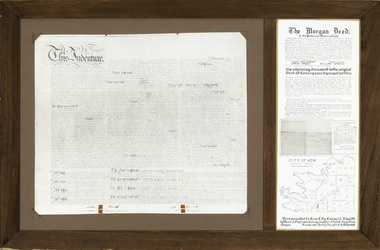
Legal record - The Indenture, Crown Portion 86, otherwise known as 'The Morgan Deed', 1852 (and later)
... settlement of Kew in the 1850s. They provide a link to Kew's most famous pioneering families. james venn morgan john quick william derrick samuel derrick kew (vic) - history kew (vic) - pioneers samuel watts kew (vic.) — municipal collection Framed 1952 Indenture recording the sale of land in Kew to pioneering Kew families. Legal record The Indenture, Crown Portion 86, otherwise known as 'The Morgan Deed ...This indenture once formed part of the City of Kew's Municipal Collection. Cr. W.D. Vaughan in his history 'Kew's Civic Century' (1960) records on page 194 that: "The original deed of conveyance of the land being all of Crown Portion 86, Kew, purchased by John Quick, James Venn Morgan, Samuel Derrick and William Derrick was presented by the Historical Society of Victoria on behalf of Mrs Fryer, a daughter of the later J.V. Morgan, to the [Kew] Council on August 5, 1941. Crown Portion 86, comprised all the land between Cotham Road and High Street to an alignment opposite the east boundary of Glenferrie Road. On it the first residential house was built by Mr. J.V. Morgan in 1852." Following the donation, the Indenture was surrounded by other original related text and explanatory notes and framed. The resulting framed documents are the largest framed objects in the collection.The Indenture and the accompanying contextual documents are some of the most historically significant manuscripts to have survived since the settlement of Kew in the 1850s. They provide a link to Kew's most famous pioneering families.Framed 1952 Indenture recording the sale of land in Kew to pioneering Kew families.james venn morgan, john quick, william derrick, samuel derrick, kew (vic) - history, kew (vic) - pioneers, samuel watts, kew (vic.) — municipal collection -
 Flagstaff Hill Maritime Museum and Village
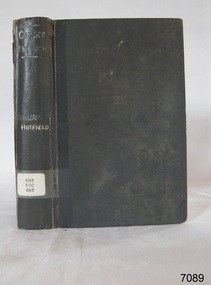
Book - A Fictional Story, William Hatfield, Ginger Murdoch, 1932
... deed poll in 1938 while in England, and was proud that Oxford University Press published his autobiography I Find Australia (1937). He served in the Australian Military Forces from 1940, as a lieutenant in the Army Education Service in 1942–43. In later years he turned to conservationist causes, lecturing as a declared Communist and writing works such as Australia Reclaimed (1944), a work on water conservation, irrigation and soil erosion. He also campaigned for breaking up northern pastoral leaseholds in favour of agricultural settlement...deed poll in 1938 while in England, and was proud that Oxford University Press published his autobiography I Find Australia (1937). He served in the Australian Military Forces from 1940, as a lieutenant in the Army Education Service in 1942–43. In later years he turned to conservationist causes, lecturing as a declared Communist and writing works such as Australia Reclaimed (1944), a work on water conservation, irrigation and soil erosion. He also campaigned for breaking up northern pastoral leaseholds in favour of agricultural settlement ...Ginger Murdoch is a novel built around a recurring bush character of Hatfield's, which had already been running as a series of short stories in The Sydney Mail from 1931 onward. It's about a hard-drinking bushman named Ginger Murdoch. The stories (titles like 'Ginger Murdoch: Horse Dealer', 'Ginger Murdoch, Publican', 'Ginger Murdoch–Outlaw', 'Ginger Murdoch: Squatter') cast him as a knockabout outback figure a horse-dealer, publican, 'knight errant', squatter moving through the kind of droving, station and bush-town life Hatfield knew first-hand. The 1932 Angus & Robertson first edition ran to 268 pages, and the dust-jacket art shows Ginger Murdoch on horseback, exploring the countryside consistent with a picaresque, episodic outback adventure rather than a tightly plotted single narrative.Hard cover book. Ginger Murdoch Author: William Hatfield Publisher: Angus & Robertson Date: 1932 Further Information: Dark Blue plain cloth hardcover with lettering and patterning to spine in white. The spine has a Library label with an inscription.fictionGinger Murdoch is a novel built around a recurring bush character of Hatfield's, which had already been running as a series of short stories in The Sydney Mail from 1931 onward. It's about a hard-drinking bushman named Ginger Murdoch. The stories (titles like 'Ginger Murdoch: Horse Dealer', 'Ginger Murdoch, Publican', 'Ginger Murdoch–Outlaw', 'Ginger Murdoch: Squatter') cast him as a knockabout outback figure a horse-dealer, publican, 'knight errant', squatter moving through the kind of droving, station and bush-town life Hatfield knew first-hand. The 1932 Angus & Robertson first edition ran to 268 pages, and the dust-jacket art shows Ginger Murdoch on horseback, exploring the countryside consistent with a picaresque, episodic outback adventure rather than a tightly plotted single narrative.warrnambool, shipwrecked-coast, flagstaff-hill, flagstaff-hill-maritime-museum, maritime-museum, shipwreck-coast, flagstaff-hill-maritime-village, shipwrecked-artefact, book, ginger murdoch, william hatfield
