
Showing 40 items matching "deep space"
-
 City of Stonnington
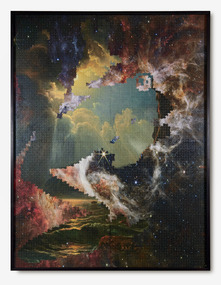
Zac Langdon-Pole, Frog B, 2023
... ...Deep space...Stonnington contemporary art collection Zac Langdon-Pole Tarantula Nebula NASA James Webb space telescope jigsaw puzzle Assemblage Johann Nepomuk Schödlberger Rocky Coast in Moonlight Science Universe Deep space Romanticism Frog B Zac Langdon-Pole ...In Frog B, Zac Langdon-Pole deconstructs and reweaves history by blending two vastly separate images into a single, cohesive collage. This intricate work merges a 2022 NASA James Webb Space Telescope photograph of the Tarantula Nebula with Johann Nepomuk Schödlberger’s 1830 Romantic landscape painting, Rocky Coast in Moonlight. Using the the common interlocking structure of jigsaw puzzles, Langdon-Pole splices deep space imagery with 19th-century European romanticism. The result is a pixelated, hybrid tapestry where disparate eras and scales collide. The composition operates like a "Mooney image"- a cognitive science tool using stark dark and light tones to test how human perception fills in gaps based on prior knowledge. Through this assemblage, Frog B challenges our impulse to find absolute order, forcing us to confront how historical, scientific, and colonial frameworks shape our understanding of the universe.stonnington contemporary art collection, zac langdon-pole, tarantula nebula, nasa, james webb space telescope, jigsaw puzzle, assemblage, johann nepomuk schödlberger, rocky coast in moonlight, science, universe, deep space, romanticism -
 Flagstaff Hill Maritime Museum and Village
Ceramic - Tile, circa 1878
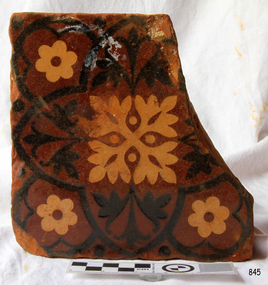
... spaces in the large civic buildings then being constructed in Australia and America. These new floor tiles were “encaustic”, meaning that their designs and colours were encased “within” the depth of the tile. Rather than their decorative patterns being glazed onto the surface of the tile, their inlaid designs were created during the manufacturing process, as “coloured slips” (or liquid clay) were poured into a deep pre-moulded casting. ...spaces in the large civic buildings then being constructed in Australia and America. These new floor tiles were “encaustic”, meaning that their designs and colours were encased “within” the depth of the tile. Rather than their decorative patterns being glazed onto the surface of the tile, their inlaid designs were created during the manufacturing process, as “coloured slips” (or liquid clay) were poured into a deep pre-moulded casting. ...This Minton floor tile is from the wreck of the LOCH ARD along with other examples of this manufacture recovered from the wreck site and form part of the collection at Flagstaff Hill. The iron-hulled clipper ship from the Loch Line was heading for Port Phillip from London when it ran into the cliffs of Mutton Bird Island near Port Campbell and was wrecked on June 1st, 1878. The LOCH ARD was laden with high-value cargo including luxury goods intended for display at the Melbourne International Exhibition in 1880. One notable survivor from the ship’s freight manifest was the well-packed Minton porcelain peacock, a two-metre-high ceramic masterpiece of vivid glazed colours. The almost total loss of life and property from the LOCH ARD registered as a shocking tragedy for the Colony of Victoria, at a time when social confidence and economic optimism were otherwise high. The wealth generated from Gold and Wool was increasingly being spent on grandiose private residences and imposing public buildings. The demand for quality furnishings and fittings was therefore strong. Among the products consigned to burgeoning colonial markets by the Milton Pottery at Stoke upon Trent, were their new range of colourfully patterned but very durable floor tiles – ideal for the high-traffic spaces in the large civic buildings then being constructed in Australia and America. These new floor tiles were “encaustic”, meaning that their designs and colours were encased “within” the depth of the tile. Rather than their decorative patterns being glazed onto the surface of the tile, their inlaid designs were created during the manufacturing process, as “coloured slips” (or liquid clay) were poured into a deep pre-moulded casting. When fired, the resulting tile was colour-fast and design-fast. A brief history of the Loch Ard (1873-1878): - The sailing ship Loch Ard was one of the famous Loch Line ships that sailed from England to Australia. Barclay, Curdle and Co. built the three-masted iron vessel in Glasgow in 1873. It had sailed three trips to Australia and one trip to Calcutta before its fateful voyage. Loch Ard left England on March 2, 1878, under the command of recently married, 29-year-old Captain Gibbs. It was bound for Melbourne with a crew of 37, plus 17 passengers. The general cargo reflected the affluence of Melbourne at the time. Onboard were straw hats, umbrellas, perfumes, clay pipes, pianos, clocks, confectionery, linen and candles, and a heavier load of railway irons, cement, lead and copper. Other cargo included items intended for display in the Melbourne International Exhibition of 1880. The Loch Ard had been sailing for three months and was close to its destination on June 1, 1878. Captain Gibbs had expected to see land at about 3 am but the Loch Ard ran into a fog that greatly reduced visibility and there was no sign of land or the Cape Otway lighthouse. The fog lifted at 4 am and the sheer cliffs of Victoria's west coast were much closer to them than Captain Gibbs expected. He tried to manage the vessel but failed and the ship struck a reef at the base of Mutton Bird Island, near Port Campbell. The top deck loosened from the hull, and the masts and rigging crashed down, knocking passengers and crew overboard. The lifeboat was launched by Tom Pearce but crashed into the side of Loch Ard and capsized. He clung onto its overturned hull and sheltered under it. He drifted out to sea and the tide brought him back to what is now called Loch Ard Gorge. He swam to shore and found a cave for shelter. A passenger, Eva Carmichael, had raced onto the deck to find out what was happening and was confronted by towering cliffs above the ship. She was soon swept off the ship by a huge wave. Eva saw Tom Pearce on a small rocky beach and yelled to attract his attention. He swam out and dragged her to the shelter of the cave. He revived her with a bottle of brandy from a case that had washed up on the beach. Tom scaled a cliff in search of help and followed some horse hoof prints. He came from two men from Glenample Station, three and a half miles away. He told the men of the tragedy and then returned to the gorge while the two men rode back to the station to get help. They reached Loch Ard Gorge and took the two shipwreck survivors to Glenample Station to recover. Eva stayed at the station for six weeks before returning to Ireland by steamship. In Melbourne, Tom Pearce received a hero's welcome and was presented with a medal and some money. Of the 54 crew members and passengers on board, only two survived: the apprentice, Tom Pearce and the young woman passenger, Eva Carmichael, who lost her family in the tragedy. One of the most unlikely pieces of cargo to have survived the shipwreck was a Minton porcelain peacock - one of only nine in the world. The peacock was destined for the Melbourne International Exhibition in 1880. It had been well packed, which gave it adequate protection during the violent storm. Today, the Minton peacock can be seen at the Flagstaff Hill Maritime Museum in Warrnambool. From Australia's most dramatic shipwreck, it has now become Australia's most valuable shipwreck artefact and is one of very few 'objects' on the Victorian State Heritage Register. The Minton floor tile is significant for its hard-wearing yet attractive design. The shipwreck of the LOCH ARD is of State significance. Victorian Heritage Register S417. Flagstaff Hill’s collection of artefacts from LOCH ARD is significant for being one of the largest collections of artefacts from this shipwreck in Victoria. It is significant for its association with the shipwreck, which is on the Victorian Heritage Register (VHR S417). The collection is significant because of the relationship between the objects, as together they have a high potential to interpret the story of the LOCH ARD. The LOCH ARD collection is archaeologically significant as the remains of a large international passenger and cargo ship. The LOCH ARD collection is historically significant for representing aspects of Victoria’s shipping history and its potential to interpret sub-theme 1.5 of Victoria’s Framework of Historical Themes (living with natural processes). The collection is also historically significant for its association with the LOCH ARD, which was one of the worst and best-known shipwrecks in Victoria’s history. A square Minton floor tile with a black and apricot pattern against a chocolate brown background. There is a large chip missing. This decorative floor tile was recovered from the shipwreck of the LOCH ARD. On the back, or base, of the tile is inscribed the number “46” and the letters “Minton & Co Patent Stoke upon Trent”.flagstaff hill, warrnambool, shipwrecked coast, flagstaff hill maritime museum, maritime museum, shipwreck coast, flagstaff hill maritime village, great ocean road, loch line, loch ard, captain gibbs, eva carmichael, tom pearce, glenample station, mutton bird island, loch ard gorge, encaustic tile, melbourne international exhibition, floor tile, minton floor tile -
 Flagstaff Hill Maritime Museum and Village
Ceramic - Tile, circa 1878
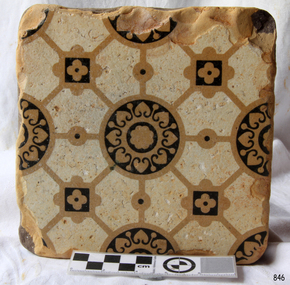
... spaces in the large civic buildings then being constructed in Australia and America. These new floor tiles were “encaustic”, meaning that their designs and colours were encased within the depth of the tile. Rather than their decorative patterns being glazed onto the surface of the tile, their inlaid designs were created during the manufacturing process, as “coloured slips” (or liquid clay) that were poured into a deep pre-moulded casting. ...spaces in the large civic buildings then being constructed in Australia and America. These new floor tiles were “encaustic”, meaning that their designs and colours were encased within the depth of the tile. Rather than their decorative patterns being glazed onto the surface of the tile, their inlaid designs were created during the manufacturing process, as “coloured slips” (or liquid clay) that were poured into a deep pre-moulded casting. ...This Minton floor tile is from the wreck of the LOCH ARD. Other examples of this manufacture have been recovered from the wreck site and form part of the collection at Flagstaff Hill. The iron-hulled clipper ship from the Loch Line was heading for Port Phillip from London when it ran into the cliffs of Mutton Bird Island near Port Campbell and was wrecked on the early morning of June 1, 1878. The LOCH ARD was laden with high-value cargo including luxury goods intended for display at the Melbourne International Exhibition in 1880. One notable survivor from the ship’s freight manifest was the well-packed Minton porcelain peacock, a two-metre-high ceramic masterpiece of vivid glazed colours. The almost total loss of life and property from the LOCH ARD registered as a shocking tragedy for the Colony of Victoria, at a time when social confidence and economic optimism were otherwise high. The wealth generated from gold and wool was increasingly being spent on magnificent private residences and imposing public buildings. The demand for quality furnishings and fittings was therefore strong. Among the products consigned to burgeoning colonial markets by the Milton Pottery at Stoke upon Trent were their new range of colourfully patterned but very durable floor tiles – ideal for the high-traffic spaces in the large civic buildings then being constructed in Australia and America. These new floor tiles were “encaustic”, meaning that their designs and colours were encased within the depth of the tile. Rather than their decorative patterns being glazed onto the surface of the tile, their inlaid designs were created during the manufacturing process, as “coloured slips” (or liquid clay) that were poured into a deep pre-moulded casting. When fired, the resulting tile was colour-fast and design-fast.The Minton encaustic floor tile is significant for its method of manufacture which makes it durable as well as decorative. The shipwreck of the LOCH ARD is of State significance. Victorian Heritage Register S417. Flagstaff Hill’s collection of artefacts from LOCH ARD is significant for being one of the largest collections of artefacts from this shipwreck in Victoria. It is significant for its association with the shipwreck, which is on the Victorian Heritage Register (VHR S417). The collection is significant because of the relationship between the objects, as together they have a high potential to interpret the story of the LOCH ARD. The LOCH ARD collection is archaeologically significant as the remains of a large international passenger and cargo ship. The LOCH ARD collection is historically significant for representing aspects of Victoria’s shipping history and its potential to interpret sub-theme 1.5 of Victoria’s Framework of Historical Themes (living with natural processes). The collection is also historically significant for its association with the LOCH ARD, which was one of the worst and best-known shipwrecks in Victoria’s history.A square Minton floor tile with a black and beige pattern against a white base. This encaustic floor tile was recovered from the shipwreck of the LOCH ARD. On the back, or base, of the tile is inscribed the number “46” and the letters “Minton & Co Patent Stoke upon Trent”.flagstaff hill, warrnambool, shipwrecked coast, flagstaff hill maritime museum, maritime museum, shipwreck coast, flagstaff hill maritime village, great ocean road, loch line, loch ard, mutton bird island, loch ard gorge, minton floor tile, encaustic tile, melbourne international exhibition, floor tile -
 Flagstaff Hill Maritime Museum and Village
Ceramic - Floor Tile, circa 1878
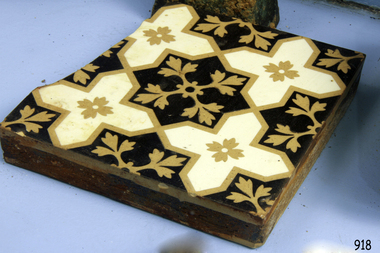
... spaces in the large civic buildings then being constructed in Australia and America. These new floor tiles were “encaustic”, meaning that their designs and colours were encased “within” the depth of the tile. Rather than their decorative patterns being glazed onto the surface of the tile, their inlaid designs were created during the manufacturing process, as “coloured slips” (or liquid clay) were poured into a deep pre-molded casting. ...spaces in the large civic buildings then being constructed in Australia and America. These new floor tiles were “encaustic”, meaning that their designs and colours were encased “within” the depth of the tile. Rather than their decorative patterns being glazed onto the surface of the tile, their inlaid designs were created during the manufacturing process, as “coloured slips” (or liquid clay) were poured into a deep pre-molded casting. ...This Minton floor tile is from the wreck of the Loch Ard and is currently on display in the Great Circle Gallery at Flagstaff Hill. The iron hulled clipper ship from the Loch Line was heading for Port Phillip from London, when it ran into the cliffs of Mutton Bird Island near Port Campbell. The Loch Ard was laden with a high value cargo including luxury goods intended for display at the Melbourne International Exhibition in 1880. One notable survivor from the ship’s freight manifest was the well packed Minton porcelain peacock, a two meter high ceramic masterpiece of vivid glazed colours. (This is also on display in the Great Circle Gallery). The almost total loss of life and property from the Loch Ard registered as a shocking tragedy for the Colony of Victoria, at a time when social confidence and economic optimism were otherwise high. Wealth generated from Gold and Wool was increasingly being spent on grandiose private residences and imposing public buildings. The demand for quality furnishings and fittings was therefore strong. Among the products consigned to burgeoning colonial markets by the Milton pottery at Stoke upon Trent, were their new range of colourfully patterned but very durable floor tiles ideal for the high-traffic spaces in the large civic buildings then being constructed in Australia and America. These new floor tiles were “encaustic”, meaning that their designs and colours were encased “within” the depth of the tile. Rather than their decorative patterns being glazed onto the surface of the tile, their inlaid designs were created during the manufacturing process, as “coloured slips” (or liquid clay) were poured into a deep pre-molded casting. When fired, the resulting tile was colours-fast and design-fast. The Minton floor tile is significant for its hard-wearing yet attractive design. The shipwreck of the Loch Ard is of significance for Victoria and is registered on the Victorian Heritage Register ( S 417). Flagstaff Hill has a varied collection of artefacts from Loch Ard and its collection is significant for being one of the largest accumulations of artefacts from this notable Victorian shipwreck of which the subject items are a small part. The collections of objects give us a snapshot of how we can interpret the story of this tragic event. The collection is also archaeologically significant as it represents aspects of Victoria's shipping history that allows us to interpret Victoria's social and historical themes of the time. Through is associated with the worst and best-known shipwreck in Victoria's history. A square Minton floor tile with a dark brown, beige and white pattern. The tile has a piece broken off along one side and some chipping along the edges. This ‘encaustic’ floor tile was recovered from the shipwreck of the LOCH ARD. Branded "... MINTON&CO Patent ..."flagstaff hill, warrnambool, flagstaff hill maritime museum, shipwreck coast, flagstaff hill maritime village, great ocean road, loch line, loch ard, captain gibbs, eva carmichael, tom pearce, glenample station, mutton bird island, minton floor tile, encaustic tile, melbourne international exhibition, floor tile -
 Marysville & District Historical Society
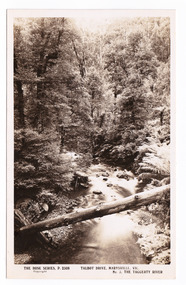
Postcard (item) - Black and white postcard, Rose Stereograph Company, Talbot Drive, Marysville, Vic. No. 3, The Taggerty River, 1913-1967
... Unfortunately space does not permit/ me to tell you much, but I must let you know/ that yesterday morning (Monday), a blanket of/ snow covered the township of Marysville to a/ depth of three or four inches. Further up, near/ Keppel's Lookout, which we visited yesterday, it/ was nearly a foot deep...Unfortunately space does not permit/ me to tell you much, but I must let you know/ that yesterday morning (Monday), a blanket of/ snow covered the township of Marysville to a/ depth of three or four inches. Further up, near/ Keppel's Lookout, which we visited yesterday, it/ was nearly a foot deep ...A postcard in a series produced by the Rose Stereograph Company in Victoria, Australia as a souvenir of Marysville.A black and white photograph taken along Lady Talbot Drive, Marysville, in Victoria, of the Taggerty River. Lady Talbot Drive is a 24 kilometer scenic rainforest car journey which passes a number of walks and waterfalls in the Yarra Ranges National Park. Lady Talbot Drive is named after Lady Sarah Elizabeth, the wife of Sir Reginald Talbot, who was the Governor of Victoria from 25th April, 1904 to 6th July 1908. This postcard was produced by the Rose Stereograph Company as a souvenir of Marysville.POST CARD The "Rose " Series/ De Luxe A Real Photograph/ Produced in Australia Published by the Rose Stereograph Co./ Armadale, Victoria. Dear John,/ I am writing this note in my room/ at Mt. Kitchener House before sallying forth for/ dinner. Unfortunately space does not permit/ me to tell you much, but I must let you know/ that yesterday morning (Monday), a blanket of/ snow covered the township of Marysville to a/ depth of three or four inches. Further up, near/ Keppel's Lookout, which we visited yesterday, it/ was nearly a foot deep everywhere, and it snowed/ the whole time we were walking./ Will tell you all later, your friend, Billtalbot drive, marysville, victoria, taggerty river, p. 2308, rose series postcard, postcard, souvenir, sir reginald talbot, lady sarah elizabeth talbot -
 Federation University Historical Collection
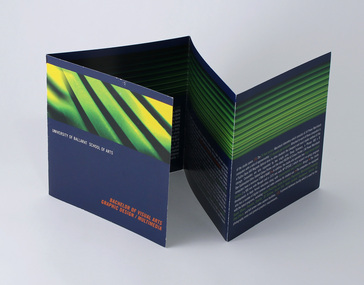
Pamphlet - Promotional brochure, Bachelor of Visual Arts, Graphic Design/Multimedia, c1999
... The course promised to "Promote creativity, originality and imaginative thinking; Develop self-directed learners, displaying initiative in the formation of ideas and the confidence to construct personal responses; Develop appropriate conceptual, technical and professional skills; Develop the student's critical process: ability to undertake research, and to make informed decisions; Clarify thinking, concepts and understanding and deep knowledge, attitudes and skills enabling the designer to respond to community needs." Studio and working environment described as "one open space with working facilities for approximately 75 students across 3 year levels. ...The course promised to "Promote creativity, originality and imaginative thinking; Develop self-directed learners, displaying initiative in the formation of ideas and the confidence to construct personal responses; Develop appropriate conceptual, technical and professional skills; Develop the student's critical process: ability to undertake research, and to make informed decisions; Clarify thinking, concepts and understanding and deep knowledge, attitudes and skills enabling the designer to respond to community needs." Studio and working environment described as "one open space with working facilities for approximately 75 students across 3 year levels. ...Promoting the Graphic Design/Multimedia program being offered by the University of Ballarat at the Mt Helen Campus. Promoted course as "one of the smallest and arguably the best three year programs of its kind in Australia and the South Pacific region." The brochure lists student awards received including Platinum and Gold in the AGFA International Young Designer Contest, 1999; two meritorious awards in The Art Directors Club Student Awards, New York, USA 1999; Graphis New Talent 1999; two Gold in Souther Cross Packaging Awards, 1998. At time of publication, the School of Arts, Visual Arts reportedly had 210 students with majors in Graphic Design/Multimedia, Ceramics/3D, Painting, Drawing, and Multidiscipline. Minors studies included Printmaking, Photography, 3D, 2D, and Graphic Communication. ___ Course aimed to train "independent, flexible thinkers". The course promised to "Promote creativity, originality and imaginative thinking; Develop self-directed learners, displaying initiative in the formation of ideas and the confidence to construct personal responses; Develop appropriate conceptual, technical and professional skills; Develop the student's critical process: ability to undertake research, and to make informed decisions; Clarify thinking, concepts and understanding and deep knowledge, attitudes and skills enabling the designer to respond to community needs." Studio and working environment described as "one open space with working facilities for approximately 75 students across 3 year levels. The area is divided up into work stations where 1st, 2nd and 3rd year students intermix, allowing a natural interaction. These workstations are configurations of six, consisting of two students from each year level. This reinforces the area's ongoing development with an open ethos and cross-level delivery and learning. This maximises the use of information in order for it to be applied throughout all levels of the learning process, whilst allowing a natural mentor arrangment to be developed for all first year students, " "The open ethos approach also encourages students and staff to freely express their opinions in relation to design via cross-level critiques, whilst allowing for a liberal arts approach and structure to the development of the creative process." "Emphasis is placed on experimentation, innovation, expression and the development of the individual's design philosophies, concepts and style." Also notes the 24 hour access Macintosh laboratory, with 34 Power Macintosh computers, ratio of one for every 2.5 students. Each with a Fujitsu Dyna Magneto Optical drive for file storage and transport. Two Sharp scanners, Phaser Dye-Sublimation Extra Tabloid colour printer and Ricoh A3 colour printer. Two large format printers. Digital and video cameras. Software: Adobe Photoshop, Illustrator, Acrobat; QuarkXpress; Macromedia Freehand; Pagemaker; Premier; Director; 3D Extreme; Sound Eidt, Shockwave, Infinite 3D and After Effects. Approx 4.5 staff, "all of whom are practicing designers. They have a full understanding of industry requirements and trends which assists in the development of industrial contacts when specialists are required." Prospective students interviewed in late Nov/ early Dec, face to face. Present a "comprehensive folio of work", academic records, references. "Selection is determined by the perceived potential of the student, their motivation and reason for study within the field as well as their previous experience in the Visual Arts. Folio work should be representative of the individual's ideas and abilities. Qualities of importance are: originality, innovation, imagination, experimentation and a competent display of the basic skills associated with visual arts [evidence of drawing skills should be included]." Demonstration of GD/MM computer skills an advantage. Students also asked to bring sketch books. Promotional brochure for prospective students. 8pp Double fold brochureuniversity of ballarat, federation university, graphic design, multimedia, bachelor, degree -
 Flagstaff Hill Maritime Museum and Village
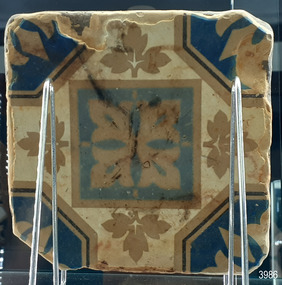
Ceramic - Floor Tile, circa 1878
... spaces in the large civic buildings then being constructed in Australia and America. These floor tiles were “encaustic”, meaning that their designs and colours were encased “within” the depth of the tile. Rather than their decorative patterns being glazed onto the surface of the tile, their inlaid designs were created during the manufacturing process, as “coloured slips” (or liquid clay) were poured into a deep pre-moulded casting. ...spaces in the large civic buildings then being constructed in Australia and America. These floor tiles were “encaustic”, meaning that their designs and colours were encased “within” the depth of the tile. Rather than their decorative patterns being glazed onto the surface of the tile, their inlaid designs were created during the manufacturing process, as “coloured slips” (or liquid clay) were poured into a deep pre-moulded casting. ...This Minton floor tile is from the wreck of the Loch Ard. The iron-hulled clipper ship from the Loch Line was heading for Port Phillip from London, when it ran into the cliffs of Mutton Bird Island near Port Campbell. The Loch Ard was laden with high-value cargo including luxury goods intended for display at the Melbourne International Exhibition in 1880. One notable survivor from the ship’s freight manifest was the well-packed Minton porcelain peacock, a two-meter high ceramic masterpiece of vivid glazed colours. (This is also on display in the Great Circle Gallery). The almost total loss of life and property from the Loch Ard registered as a shocking tragedy for the Colony of Victoria, at a time when social confidence and economic optimism were otherwise high. The wealth generated from Gold and Wool was increasingly being spent on grandiose private residences and imposing public buildings. The demand for quality furnishings and fittings was therefore strong. Among the products consigned to burgeoning colonial markets by the Milton Pottery at Stoke upon Trent, were their new range of colourfully patterned but very durable floor tiles ideal for the high-traffic spaces in the large civic buildings then being constructed in Australia and America. These floor tiles were “encaustic”, meaning that their designs and colours were encased “within” the depth of the tile. Rather than their decorative patterns being glazed onto the surface of the tile, their inlaid designs were created during the manufacturing process, as “coloured slips” (or liquid clay) were poured into a deep pre-moulded casting. When fired, the resulting tile was colour-fast and design-fast. The Minton floor tile is significant for its hard-wearing yet attractive design. The shipwreck of the Loch Ard is of significance for Victoria and is registered on the Victorian Heritage Register ( S 417). Flagstaff Hill has a varied collection of artefacts from Loch Ard and its collection is significant for being one of the largest accumulations of artefacts from this notable Victorian shipwreck of which the subject items are a small part. The collections of objects give us a snapshot of how we can interpret the story of this tragic event. The collection is also archaeologically significant as it represents aspects of Victoria's shipping history that allows us to interpret Victoria's social and historical themes of the time. Through is associated with the worst and best-known shipwreck in Victoria's history. A square Minton floor tile with a white background, and beige, dark blue, light blue and black geometric pattern as well as leaves in the design. The tile has corner broken off and some chipping along the edges. The reverse has five rows of five evenly spaced holes. The back of the tile has inscriptions. Made by Minton & Co. at Stoke upon Trent. This encaustic floor tile was recovered from the shipwreck of the LOCH ARD. Branded "... MINTON&CO / PATENT / STOKE UPON TRENT"flagstaff hill, warrnambool, flagstaff hill maritime museum, shipwreck coast, flagstaff hill maritime village, great ocean road, loch line, loch ard, captain gibbs, eva carmichael, tom pearce, glenample station, mutton bird island, minton floor tile, encaustic tile, melbourne international exhibition, floor tile, minton tile, minton & co., stoke upon trent -
 City of Moorabbin Historical Society (Operating the Box Cottage Museum)
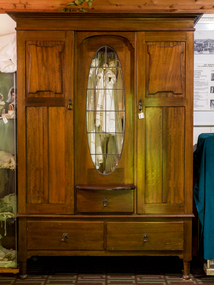
Furniture, Wardrobe 3 piece 3 drawers c1900, c1900
... Wooden Wardrobe with 3 sections- top, hanging space with a central oval glass window, a shallow central drawer and 2 doors with key locks, and drawer section with 2 deep drawers ....; bent thomas, highett william, ormond francis, maynard dennis, Wooden Wardrobe with 3 sections- top, hanging space with a central oval glass window, a shallow central drawer and 2 doors with key locks, and drawer section with 2 deep drawers Furniture, Wardrobe 3 piece 3 drawers c1900 ...The sections of this wardrobe can be lifted apart so that it can be transported easily and when assembled provides suitable hanging and storage space for the clothes and bed covers of an early settler family This wardrobe is of a type commonly used by early settler families in Moorabbin Shire c1900Wooden Wardrobe with 3 sections- top, hanging space with a central oval glass window, a shallow central drawer and 2 doors with key locks, and drawer section with 2 deep drawers early settlers, market gardeners, poultry farmers, mechanics institutes, furniture, kitchen equipment, clothing, drapery, haberdashery, green pederson carol, city of moorabbin, county of bourke, moorabbin roads board, parish of moorabbin, shire of moorabbin, henry dendy's special survey 1841, were j.b.; bent thomas, highett william, ormond francis, maynard dennis, -
 Mission to Seafarers Victoria
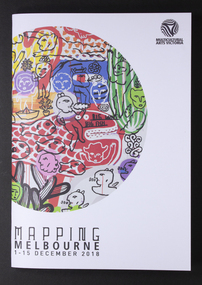
Programme, Multicutural Arts Victoria, Mapping Melbourne 2018, 2018
... spaces at Mission to Seafarer’s site through a compelling contemporary ritual performance. The Echoes Projects artists evoke fragments of stories embedded in this site through mesmerising live soundscapes, movement and imagery. Ria Soemardjo, Janette Hoe and Pongjit (Jon) Saphakhun collaborate to create an ongoing exploration of contemporary rituals in response to urban sites in Australia. Based in Melbourne, their contemporary performance work draws deeply...spaces at Mission to Seafarer’s site through a compelling contemporary ritual performance. The Echoes Projects artists evoke fragments of stories embedded in this site through mesmerising live soundscapes, movement and imagery. Ria Soemardjo, Janette Hoe and Pongjit (Jon) Saphakhun collaborate to create an ongoing exploration of contemporary rituals in response to urban sites in Australia. Based in Melbourne, their contemporary performance work draws deeply ...On 6 December 2018, a recurring event was organised at the Mission. From the Multicultural website: "Meeting at the Seafarer’s bridge on the Yarra, you will be welcomed into a little-known site nearby, a sanctuary for seafarers for the last 100 years and a symbol of old-world generosity amidst the rapidly shifting landscape of the Docklands. A journey through the quirky spaces at Mission to Seafarer’s site through a compelling contemporary ritual performance. The Echoes Projects artists evoke fragments of stories embedded in this site through mesmerising live soundscapes, movement and imagery. Ria Soemardjo, Janette Hoe and Pongjit (Jon) Saphakhun collaborate to create an ongoing exploration of contemporary rituals in response to urban sites in Australia. Based in Melbourne, their contemporary performance work draws deeply from their personal connections to Thai, Chinese and Indonesian ceremonial traditions. Featuring Intricate rhythmic compositions inspired by the rich heritage of Indonesian and Middle Eastern musical traditions, performed by Ron Reeves and Matt Stonehouse – two of Australia’s foremost world music percussionists. Note: 7 PM and 8 PM sessions include delicious vegetarian Indonesian food. 9 PM session includes Indonesian and Thai cakes and sweets. You are invited to stay and eat after the performance, drinks available for purchase at the venue. Performers: Janette Hoe – dance artist Pongjit (Jon) Sekhukhune – actor Ria Soemardjo – musician Ron Reeves – musician Matt Stonehouse – musician /instrument maker Supported by the City of Melbourne Arts Grants Program Details: 6 Dec 2018 (Thursday) Sessions: 7 PM, 8 PM & 9 PM The Mission to Seafarers Audience Meeting point – next to the entrance of the Seafarer’s Bridge, Siddeley St, Docklands. Wheelchair accessible venue. Bookings essential. Tickets: $10 – $15 via Eventbrite. Ticket price is purely to pay for the food element. Companion Card ticketing available. Please contact Multicultural Arts Victoria for ticketing options. Companion ticket will allow admission only. The Seafarers Welcome is presented as part of Mapping Melbourne 2018."The Mission has always welcomed artistic events Colour programme of events with illustrationstop right corner: Multicultural Arts Victoria lower left corner: MAPPING MELBOURNE/1-15 DECEMBER 2018arts, events, multicultural arts victoria, the seafarer welcome, echoes project, 2018, cultural events, community -
 The Beechworth Burke Museum
Animal specimen - Musk Duck, Trustees of the Australian Museum, 1860-1880
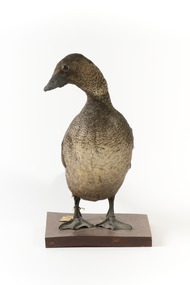
... deep water and plenty of aquatic vegetation. This specimen is part of a collection of almost 200 animal specimens that were originally acquired as skins from various institutions across Australia, including the Australian Museum and the National Museum of Victoria, as well as individuals such amateur anthropologist Reynell Eveleigh Johns between 1860-1880. These skins were then mounted by members of the Burke Museum Committee and put-on display in the formal space...deep water and plenty of aquatic vegetation. This specimen is part of a collection of almost 200 animal specimens that were originally acquired as skins from various institutions across Australia, including the Australian Museum and the National Museum of Victoria, as well as individuals such amateur anthropologist Reynell Eveleigh Johns between 1860-1880. These skins were then mounted by members of the Burke Museum Committee and put-on display in the formal space ...This particular Musk Duck is a female specimen. This is ascertained through the lack of a large bulbous lobe of skin hanging under the bill. This particular duck has a much smaller lobe on the underside of its bill which is only visible when close. The name Musk Duck comes from the strong musk odour produced from a gland on the rump of the bird. These ducks are found only in Australia, in south-western and south-eastern mainland and in Tasmania. They prefer to reside in locations which have deep water and plenty of aquatic vegetation. This specimen is part of a collection of almost 200 animal specimens that were originally acquired as skins from various institutions across Australia, including the Australian Museum and the National Museum of Victoria, as well as individuals such amateur anthropologist Reynell Eveleigh Johns between 1860-1880. These skins were then mounted by members of the Burke Museum Committee and put-on display in the formal space of the Museum’s original exhibition hall where they continue to be on display. This display of taxidermy mounts initially served to instruct visitors to the Burke Museum of the natural world around them, today it serves as an insight into the collecting habits of the 19th century. This specimen is part of a significant and rare taxidermy mount collection in the Burke Museum. This collection is scientifically and culturally important for reminding us of how science continues to shape our understanding of the modern world. They demonstrate a capacity to hold evidence of how Australia’s fauna history existed in the past and are potentially important for future environmental research. This collection continues to be on display in the Museum and has become a key part to interpreting the collecting habits of the 19th century.A large duck with a sooty-brown plumage and paler brown colouring on the stomach and areas of the neck. This bird stands with its head turned to look over its right shoulder. The eyes are made of brown coloured glass. The legs on the Musk Duck are positioned towards the far back of the stocky body and the feet are webbed. This enables the duck to swim but provides a clumsy gait. The bill of this Musk Duck is dark grey and the tail feathers are positioned in a fan-shape.Paper tag reading "9a Musk Duck. See Catalogue, page, 39."taxidermy mount, taxidermy, animalia, burke museum, beechworth, australian museum, skin, reynell eveleigh johns, duck, musk duck, aquatic, biziura lobata -
 The Beechworth Burke Museum
Animal specimen - Musk Duck, Trustees of the Australian Museum, 1860-1880
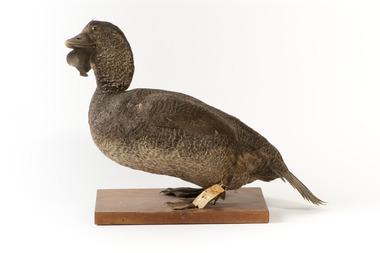
... deep water and plenty of aquatic vegetation. This specimen is part of a collection of almost 200 animal specimens that were originally acquired as skins from various institutions across Australia, including the Australian Museum and the National Museum of Victoria, as well as individuals such amateur anthropologist Reynell Eveleigh Johns between 1860-1880. These skins were then mounted by members of the Burke Museum Committee and put-on display in the formal space...deep water and plenty of aquatic vegetation. This specimen is part of a collection of almost 200 animal specimens that were originally acquired as skins from various institutions across Australia, including the Australian Museum and the National Museum of Victoria, as well as individuals such amateur anthropologist Reynell Eveleigh Johns between 1860-1880. These skins were then mounted by members of the Burke Museum Committee and put-on display in the formal space ...This particular Musk Duck is a male specimen. This is ascertained through the inclusion of a large bulbous lobe of skin hanging under the bill. The name Musk Duck comes from the strong musk odour produced from a gland on the rump of the bird. These ducks are found only in Australia, in south-western and south-eastern mainland and in Tasmania. They prefer to reside in locations which have deep water and plenty of aquatic vegetation. This specimen is part of a collection of almost 200 animal specimens that were originally acquired as skins from various institutions across Australia, including the Australian Museum and the National Museum of Victoria, as well as individuals such amateur anthropologist Reynell Eveleigh Johns between 1860-1880. These skins were then mounted by members of the Burke Museum Committee and put-on display in the formal space of the Museum’s original exhibition hall where they continue to be on display. This display of taxidermy mounts initially served to instruct visitors to the Burke Museum of the natural world around them, today it serves as an insight into the collecting habits of the 19th century. This specimen is part of a significant and rare taxidermy mount collection in the Burke Museum. This collection is scientifically and culturally important for reminding us of how science continues to shape our understanding of the modern world. They demonstrate a capacity to hold evidence of how Australia’s fauna history existed in the past and are potentially important for future environmental research. This collection continues to be on display in the Museum and has become a key part to interpreting the collecting habits of the 19th century.A male Musk Duck with a wide, heavy body covered in dark grey-brown plumage. This specimen has a broad and triangular shaped bill with a large lobe hanging from beneath the bill which helps identify this particular duck as male. The duck has glass eyes which are a dark brown colour. The legs on the Musk Duck are positioned towards the far back of the stocky body and the feet are webbed. This enables the duck to swim but provides a clumsy gait."8a Musk Duck. See Catalogue, page, 39."taxidermy mount, taxidermy, animalia, burke museum, beechworth, australian museum, skin, reynell eveleigh johns, duck, musk duck, aquatic, biziura lobata -
 The Beechworth Burke Museum
Animal specimen - Hoary-Headed Grebe, Trustees of the Australian Museum, 1860-1880
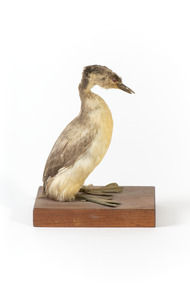
... deep diving. The Hoary-headed Grebe is bird-like in appearance with darkish grey and white plumage. When threatened while in a flock, these birds often dive beneath the water in a synchronised manoeuvre. This specimen is part of a collection of almost 200 animal specimens that were originally acquired as skins from various institutions across Australia, including the Australian Museum and the National Museum of Victoria, as well as individuals such amateur anthropologist Reynell Eveleigh Johns between 1860-1880. These skins were then mounted by members of the Burke Museum Committee and put-on display in the formal space...deep diving. The Hoary-headed Grebe is bird-like in appearance with darkish grey and white plumage. When threatened while in a flock, these birds often dive beneath the water in a synchronised manoeuvre. This specimen is part of a collection of almost 200 animal specimens that were originally acquired as skins from various institutions across Australia, including the Australian Museum and the National Museum of Victoria, as well as individuals such amateur anthropologist Reynell Eveleigh Johns between 1860-1880. These skins were then mounted by members of the Burke Museum Committee and put-on display in the formal space ...The Hoary-headed Grebe can be located in all states and territories in Australia as well as New Zealand. These birds are usually found in large open bodies of water away from shorelines. They mainly feed on aquatic arthropods which they catch by deep diving. The Hoary-headed Grebe is bird-like in appearance with darkish grey and white plumage. When threatened while in a flock, these birds often dive beneath the water in a synchronised manoeuvre. This specimen is part of a collection of almost 200 animal specimens that were originally acquired as skins from various institutions across Australia, including the Australian Museum and the National Museum of Victoria, as well as individuals such amateur anthropologist Reynell Eveleigh Johns between 1860-1880. These skins were then mounted by members of the Burke Museum Committee and put-on display in the formal space of the Museum’s original exhibition hall where they continue to be on display. This display of taxidermy mounts initially served to instruct visitors to the Burke Museum of the natural world around them, today it serves as an insight into the collecting habits of the 19th century. This specimen is part of a significant and rare taxidermy mount collection in the Burke Museum. This collection is scientifically and culturally important for reminding us of how science continues to shape our understanding of the modern world. They demonstrate a capacity to hold evidence of how Australia’s fauna history existed in the past and are potentially important for future environmental research. This collection continues to be on display in the Museum and has become a key part to interpreting the collecting habits of the 19th century.Hoary-Headed Grebe in a standing position on a wooden platform. The bird is small and stocky, similar to a duck in appearance, with a darkish grey and white plumage. The eyes are made of glass. The bill is black and the legs are a pale yellow/grey. A paper tag is tied to the left leg of the bird. Only half of the tag survives and records: "25a Hoary... Catalogu[e]...". This identifies the bird as a Hoary-Headed Grebe."25a Hoary... Catalogu[e]..."taxidermy mount, taxidermy, animalia, burke museum, beechworth, australian museum, skin, reynell eveleigh johns, bird, grebe, hoary-headed grebe -
 The Beechworth Burke Museum
Animal specimen - Crimson Rosella, Trustees of the Australian Museum, 1860-1880
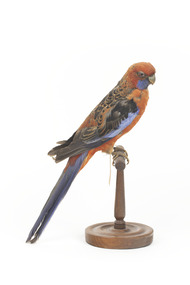
... space of the Museum’s original exhibition hall where they continue to be on display. This display of taxidermy mounts initially served to instruct visitors to the Burke Museum of the natural world around them, today it serves as an insight into the collecting habits of the 19th century. The Crimson Rosella is relatively easy to see as it forages on the ground or among the leaves of eucalypts, with its spectacular combination of deep...space of the Museum’s original exhibition hall where they continue to be on display. This display of taxidermy mounts initially served to instruct visitors to the Burke Museum of the natural world around them, today it serves as an insight into the collecting habits of the 19th century. The Crimson Rosella is relatively easy to see as it forages on the ground or among the leaves of eucalypts, with its spectacular combination of deep ...This specimen is part of a collection of almost 200 animal specimens that were originally acquired as skins from various institutions across Australia, including the Australian Museum in Sydney and the National Museum of Victoria (known as Museums Victoria since 1983), as well as individuals such as amateur anthropologist Reynell Eveleigh Johns between 1860-1880. These skins were then mounted by members of the Burke Museum Committee and put-on display in the formal space of the Museum’s original exhibition hall where they continue to be on display. This display of taxidermy mounts initially served to instruct visitors to the Burke Museum of the natural world around them, today it serves as an insight into the collecting habits of the 19th century. The Crimson Rosella is relatively easy to see as it forages on the ground or among the leaves of eucalypts, with its spectacular combination of deep-crimson, royal-blue and black plumage. However, not all Crimson Rosellas look the same. Along the Murray River, Crimson Rosellas aren’t crimson at all — they are yellow, black and blue, with the yellow feathering replacing the crimson plumage. In southern South Australia they differ again, being roughly intermediate between crimson and yellow, with varying amounts of red and yellow in their plumage. Research featured in the 'State of Australia's Birds 2015' headline and regional reports suggest that the Crimson Rosella may be declining in the East Coast. There are several populations of the Crimson Rosella. Red (crimson) birds occur in northern Queensland, in southern Queensland to south-eastern South Australia and on Kangaroo Island. Orange birds are restricted to the Flinders Ranges region of South Australia, while yellow ones are found along the Murray, Murrumbidgee and neighbouring rivers (where yellow birds meet red birds they hybridise, producing orange offspring). Red birds have been introduced to Norfolk Island and New Zealand.This specimen is part of a significant and rare taxidermy mount collection in the Burke Museum. This collection is scientifically and culturally important for reminding us of how science continues to shape our understanding of the modern world. They demonstrate a capacity to hold evidence of how Australia’s fauna history existed in the past and are potentially important for future environmental research. This collection continues to be on display in the Museum and has become a key part to interpreting the collecting habits of the 19th century.There are several colour forms of the Crimson Rosella. The form it is named for has mostly crimson (red) plumage and bright blue cheeks. The feathers of the back and wing coverts are black broadly edged with red. The flight feathers of the wings have broad blue edges and the tail is blue above and pale blue below and on the outer feathers. This particular specimen has lost some feathers in its plumage and its colour is not as bright as that of a live specimen.Label: 77a / Pennant's Parakeet / See catalogue, page 22taxidermy, crimson rosella, bird, australian bird, rosella, crimson -
 Eltham District Historical Society Inc
Document - Property Binder, 616 Main Road, Eltham; Plum Cottage
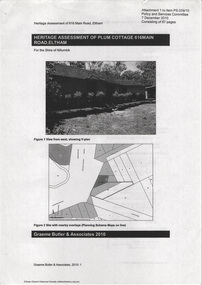
... Reputedly the ceiling joists are of a deep section and span long lengths with no need for hanging beams in the roof space. ...Reputedly the ceiling joists are of a deep section and span long lengths with no need for hanging beams in the roof space. ...Plum Cottage is covered by Heritage Overelay HO256 in the Nillumbuk Planning Scheme This two-lot land holding was created as a subdivision and sold to Charles Stuart McNeil by May 1955. Sometime in the period 1955-1960, the builder-designer, John Harcourt had created a pise house on the site, straddling the two subdivision lots. The designer, John M. Harcourt was a pioneer builder in pise-de-terre and mudbrick in the Eltham Shire, Eltham being synonymous with alternative lifestyles and building practises until the onset of suburbia in the late 20th and early 21st centuries. This hipped-roof house is set high above Main Road on a V-shape plan characteristic of the Arts & Crafts style, with rammed earth or pise walls, timber joinery and a cement tiled roof. The V shape plan was used by important English and Eltham Arts & Crafts designers. The use of natural materials such as stone and timber construction is an essential part of the Arts & Crafts style and Harcourt’s work. So too is the application of the style on both the exterior and interior of the house as a holistic concept. The house adjoins the Lim Joon adobe house built and designed by Alistair Knox in the same era (HO119), thus forming a distinctive pair, both using an uncommon plan form. This house was identified in the Shire of Shire of Eltham Heritage 1992 as contributory to the Eltham Gateway Conservation Area, then proposed as an urban conservation area (now Heritage Overlay Area). Land Ownership Emily Jane Smith of 12 Woodside Street Fitzroy owned Crown Allotments 1 & 2 Sections 14, 27 by August 1918, selling to William Henry Smith of 12 Woodside Street, Nth Fitzroy May 1921. (John) James Isherwood of Main Road, Eltham owned the property by 1928 (the year of his death) with the beneficiary of his estate and next owner of this site being his widow, Minnie Maria Isherwood of Cemetery Road, Eltham. His holding in Main Road included parts of what was described in rate records as allotments1 & 2 Section E6. In the late 1930s, early 1940s her son Alfred John Isherwood was also rated for the land around this site, with the rated nett annual value varying between £2 and £5. Alfred Isherwood also lived at Main Road, Eltham with his wife Ellen: her early death at the age of 24 was reported in the Argus of 1923. Part of the Isherwood land was divided off and sold to Charles Stuart McNeil by May1955. Sometime in the period 1955-1960, the builder-designer, John Harcourt had created a pise house on the site, straddling the two subdivision lots. The house is visible on an aerial photograph from 1960s. Reputedly the house was called Plum Cottage and erected for Harcourt’s mother-in-law. A garage was added in 1959. Charles McNeil died in1971 aged 87: he was the son of Don McNeil and Margaret Arkell. Available rate records from the construction era start in the of the 1970s (1972-3) and list Mr H.C. & M/S A.V. Charity at 616 Main Road Eltham of this property with a nett annual value of $740. More recent valuer's data describes the property as lots 1 & 2 LP25668, located in the Central Riding of Eltham Shire, owned by Ann Valerie Charity and later, in 1990, by the Chincarini family. Building Description This hipped roof 11 .5 square house is set high above Main Road on a characteristic-shape plan and has rammed earth or pise walls, timber joinery and a cement tiled roof. The V-shape plan was used by Important designers such as C.F.A. Voysey (UK) who interpreted medieval domestic architecture as part of the Arts & Crafts style of the late 19th and early 20th centuries. The pise walls are covered with a textured render while the cement roofing tiles are also seen in the Harcourt Hill examples. Reputedly the ceiling joists are of a deep section and span long lengths with no need for hanging beams in the roof space. The ceilings are low and panelled in main rooms with apparently Caneite soft board infill panels between the exposed ceiling beams. These are painted white but may have been stained at one time. The focus of the house is the large living area with its vast random stone fireplace. Significance Plum Cottage is significant to the locality of Eltham because: Historically: • Plum Cottage is closely associated with the important historical theme of earth construction evident in Eltham and elsewhere in the Shire since theear1y Arts & Crafts inspired creations at Penleigh Boyd's The Robins (1912, HO101) and those at Montsalvat (1934-, HO82) but more prominent from the Second War period when earth building in Eltham was promoted in national periodicals as an alternative building method that avoided the building materials shortages of that era; • The choice of the earth building technique also expresses the theme of refuge or alternative living, synonymous with Eltham in the early to mid 20th century; • as a good example of domestic architecture from John Harcourt who was the first major post Second War figure in an important phase of Eltham’s earth building development, using his characteristic Old English or Arts& Crafts style that relies in this case on the pise wall construction, pitched roof forms, exposed ceiling joists, half timbering, random stonework, and panelled internal wall finishes. Architecturally: • Plum Cottage's pise wall construction is uncommon among the early earth-walled structures in the Shire, that are mainly of adobe or mud brick, and as a building material is uncommon among the Shire’s suburban dwellings generally which are clad typically with either fired clay bricks or timber boarding. Aesthetically: • Plum Cottage is a good and well preserved example of a modern Old English or Arts & Crafts style earth-walled building in the Shire • For the proximity of the significant Lim Joon adobe house designed by Alistair Knox adjoining to the north, providing a distinctive earth wall house pair, with uncommon plan forms. Reference Heritage Assessment of Plum Cottage, 616 Main Road, Eltham; Graeme Butler & Associates 2010main road, eltham, property, houses, (john) james isherwood, alfred john isherwood, ann valerie charity, arts and crafts style, charles stuart mcneil, chincarini family, eltham gateway zone, emily jane smith, h.c. charity, heritage assessment, john harcourt, john m. harcourt, lim joon house, main road eltham, minnie maria isherwood, pise construction, plum cottage -
 Bendigo Historical Society Inc.
Clothing - Trousers
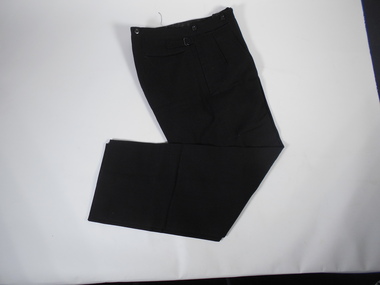
... There are two buttons either side of centre waistband seam at back, four buttons evenly spaced along front waistband and two small buttons for waistband closure at front. The fly opening at front has 5 buttons. There are two deep...There are two buttons either side of centre waistband seam at back, four buttons evenly spaced along front waistband and two small buttons for waistband closure at front. The fly opening at front has 5 buttons. There are two deep ...Woollen fabric, satin cotton lined waistband trousers with belt/buckle adjustments at either side. There are two buttons either side of centre waistband seam at back, four buttons evenly spaced along front waistband and two small buttons for waistband closure at front. The fly opening at front has 5 buttons. There are two deep cotton side pockets. Writing on lining of RHS pocket reads "Myer 3/40?. There is a back LHS pocket. The trouser lengths appear to have been altered.men's clothing, formal wear, trousers -
 Bendigo Historical Society Inc.
Clothing - MAGGIE BARBER COLLECTION: LARGE LACE COLLAR, Late 1800's early 1900's
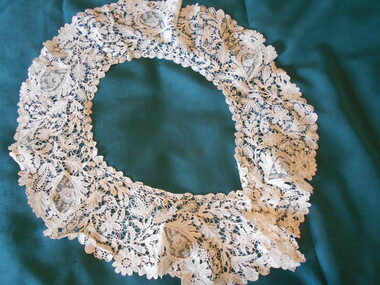
... deep, linen lace collar.- Brussells Bobbin lace. Six large ''tear-drop'' shapes - 8cm long, enclose a delicate floral design. Thirteen daisy like flowers are spaced...deep, linen lace collar.- Brussells Bobbin lace. Six large ''tear-drop'' shapes - 8cm long, enclose a delicate floral design. Thirteen daisy like flowers are spaced ...Clothing. Very large, deep, linen lace collar.- Brussells Bobbin lace. Six large ''tear-drop'' shapes - 8cm long, enclose a delicate floral design. Thirteen daisy like flowers are spaced around the outer edge, along with leaves and smaller flowers. The long neck - edge is edged with a leaf - like design lace. This collar may have been worn over an evening gown with a deep back neckline.costume accessories, female, large lace collar -
 Bendigo Historical Society Inc.
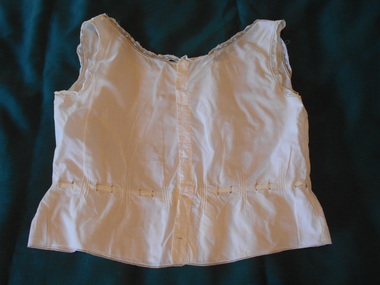
Clothing - MAGGIE BARBER COLLECTION: CAMISOLE, 1880-90's
... deep cotton lace trims the neckline and armholes. A .5 cm cotton braid trims the lower edge. Nine floral embroideries and pulled thread work 2.5 cm x 2.5 cm are spaced around the rounded front neckline. ...deep cotton lace trims the neckline and armholes. A .5 cm cotton braid trims the lower edge. Nine floral embroideries and pulled thread work 2.5 cm x 2.5 cm are spaced around the rounded front neckline. ...Clothing. Wide scooped neckline, edged with 1.5 cm deep cotton lace. The centre back opening is fastened with six tiny pearl shell buttons .8 cm in diameter- top button is fastened with a loop. 1.5 cm deep cotton lace trims the neckline and armholes. A .5 cm cotton braid trims the lower edge. Nine floral embroideries and pulled thread work 2.5 cm x 2.5 cm are spaced around the rounded front neckline. Below these embroideries on the left side breast, are embroidered the wearers initials-(M) MB. The owners initials are embroidered on the left front in a decorative manner, to compliment the floral embroidery. A lace ribbon, one cm wide at the waistline passes through 1.4 cm eyelets 2 cm apart. Between each set of eyelets, are groups of 4 cm long fine pintucks - 13 groups of two eyelets and 14 groups of pintucks.costume, female, wide scooped neckline camisole -
 Bendigo Historical Society Inc.
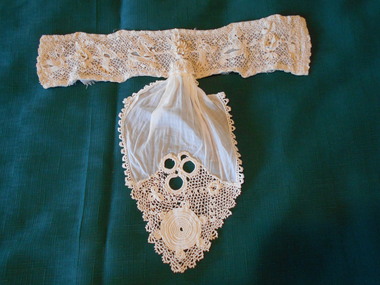
Clothing - MAGGIE BARBER COLLECTION: FOUR LACE COLLARS, Late 1800's
... c.This item is of the same design as 14.b, but is slightly larger.Cream cotton or silk, the collar is 6 cms deep at the centre front, and features a Maltese Cross shape at the centre front of the collar, and the jabot front. Ten floral motifs are spaced...No fastenings are visible at the neckline. c.This item is of the same design as 14.b, but is slightly larger.Cream cotton or silk, the collar is 6 cms deep at the centre front, and features a Maltese Cross shape at the centre front of the collar, and the jabot front. Ten floral motifs are spaced ...Clothing. Four Collars a. Stand-up lace collar with a shallow scallop at the lower neck edge-6 cm -7 cm deep. Three ''stand-up'' flower motifs and other flat floral motifs form the lace. Five boned and wired casings keep the collar erect. At the centre lower edge fine, cotton fabric is gathered tightly and forms a 10 cm long, fan shaped drop or jabot which in turn has a shield shaped crochet drop 12.5 cm deep with corded and cut-work elements. The stand-up collar is lined with fine cotton net, and fastens at the back with three metal hooks, but no loops are evident. b. Very fine creamy silk (?) stand-up collar. 4.5 cm deep, with a 32 cm deep jabot front. The same lace as the collar, edges the Vshaped front jabot. In the centre of this jabot is a stylized maltese cross, which also features at the front of the collar. No fastenings are visible at the neckline. c.This item is of the same design as 14.b, but is slightly larger.Cream cotton or silk, the collar is 6 cms deep at the centre front, and features a Maltese Cross shape at the centre front of the collar, and the jabot front. Ten floral motifs are spaced around the collar, and the same lace outlines the edges of the jabot front. No fastenings are evident. d. Collar. 8.5 cm deep at the centre back, shaped to 6.5 cm deep at the centre front. Jabot 2 cm wide at top, 10.5 cm wide at lower edge, then shaped to a point at the very lower edge. Floral elements and eyelets form the design. Centre back has six eyelets at each edge-perhaps laced to fasten. Two 5.5 cm long x .3 cm wide bones are encased on the front of collar, to support it in the front.costume, female, lace collar and jabot front -
 Bendigo Historical Society Inc.
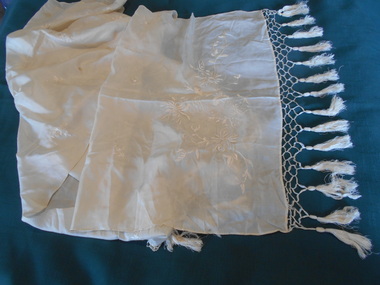
Clothing - MAGGIE BARBER COLLECTION: SILK EMBROIDERED SHAWL, Late 1800's
... Cream silk shawl, with elaborate silk floral embroidery at each end, and finished with a 12 cm deep. silk hand-knotted fringe at each end. Edges are hand-rolled and hand- stitched. Single floral embroideries are spaced across the body of the shawl, in rows of three embroideries....Cream silk shawl, with elaborate silk floral embroidery at each end, and finished with a 12 cm deep. silk hand-knotted fringe at each end. Edges are hand-rolled and hand- stitched. Single floral embroideries are spaced across the body of the shawl, in rows of three embroideries. ...Clothing. Cream silk shawl, with elaborate silk floral embroidery at each end, and finished with a 12 cm deep. silk hand-knotted fringe at each end. Edges are hand-rolled and hand- stitched. Single floral embroideries are spaced across the body of the shawl, in rows of three embroideries.costume, female, silk embroidered shawl -
 Dutch Australian Heritage Centre Victoria
Cigar Mould (Sigaren Plank), early 20th Century
... deeper slots for the cigars. The two pieces are not solid pieces of wood. The bottom piece is made from two boards/pieces of wood stuck together with aeration space left in between. ...deeper slots for the cigars. The two pieces are not solid pieces of wood. The bottom piece is made from two boards/pieces of wood stuck together with aeration space left in between. ...Dutch cigar industry was prominent in the eastern part of Noord Brabant in towns like Helmond.Dutch colonial history. Cigar smoking was popular amongst Dutch men5784(a) and 5784 (b) are two pieces made of wood (presumed to be pine). 20 slots to mould the cigars. Bottom piece has deeper slots for the cigars. The two pieces are not solid pieces of wood. The bottom piece is made from two boards/pieces of wood stuck together with aeration space left in between. The top piece has 20 individual moulds/slot glued on. The two pieces can be locked in via three wooden pegs into their corresponding slots On the back of the lower board/piece - there are two holes lined with metal rings (diameter of 1cm) Note that the size given applies when the two pieces are fitted together.On the top board - There is stamped the numeral "53". To the left of this number, we have the manufacturer's circular logo with details - L. Bezemer & Zn. N.V. Helmond Holland PERLU-VORM In front on the left-hand corner of both halves - etched number "7298"cigar, industry -
Port Melbourne Historical & Preservation Society
Book, Susan Reidy, "Port Melbourne Town Hall - A short history of the buildings and the people who used them", 2003
... spaces. A City of Port Phillip cultural development fund project. Local Government - Borough of Sandridge Local Government - Borough of Port Melbourne Local Government - Town of Port Melbourne Local Government - City of Port Melbourne Built Environment - Civic Susan REIDY Port Melbourne Town Hall Built Environment "Port Melbourne Town Hall - A short history of the buildings and the people who used them" By Susan REIDY 2003. 16 pages plus dusty pink cover, with Town Hall drawing in deep red "Port Melbourne Town Hall - A short history of the buildings and the people who used them" Book Susan Reidy ...Second in a series on Port Melbourne public spaces. A City of Port Phillip cultural development fund project."Port Melbourne Town Hall - A short history of the buildings and the people who used them" By Susan REIDY 2003. 16 pages plus dusty pink cover, with Town Hall drawing in deep redlocal government - borough of sandridge, local government - borough of port melbourne, local government - town of port melbourne, local government - city of port melbourne, built environment - civic, susan reidy, port melbourne town hall, built environment -
 National Wool Museum
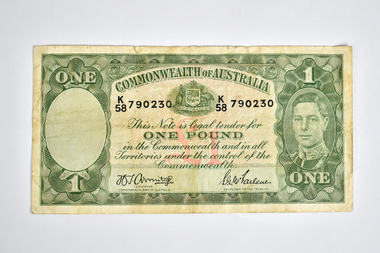
Currency - One Pound Note, John Ash, 1938 - 1948
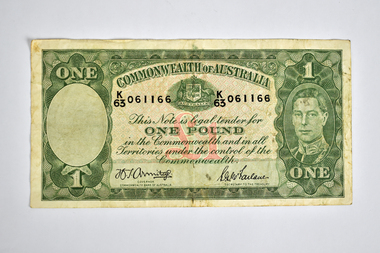
... deep shadows and touches of illusionism. A sheep in Montford's pastoral scene, for example, stands forward from the frame as if entering the viewer's space to escape branding and Manley preserves this visual conceit in his drawing. ...deep shadows and touches of illusionism. A sheep in Montford's pastoral scene, for example, stands forward from the frame as if entering the viewer's space to escape branding and Manley preserves this visual conceit in his drawing. ...John Ash succeeded Thomas Harrison as the Australian Note Printer in 1927 and oversaw the printing of a new series of banknotes, known as the Ash Series. First issued between 1933 and 1934, the new banknotes sought to improve the currency's resistance to counterfeiting. A special watermark was created to increase the security of the new series. Shaped as a medallion, the watermark showed the profile of Edward, the Prince of Wales. A new portrait of the King was also introduced, depicting him frontally rather than in profile as he had appeared in the prior banknotes of the Harrison Series (1923-1925). The back of each denomination contained an individual vignette that reflected a sector of the country's economy. The wool and agricultural industries were represented, as they had been in the first series of the nation's banknotes (1913-1914), and they were joined by manufacturing and commerce. The prominent British sculptor, Paul Montford, contributed to the design of the new series. Recognised for his sculptural works on the exterior of Melbourne's Shrine of Remembrance, Montford was commissioned to produce relief sculptures that formed the basis of the banknotes' vignettes. His sculptures were translated into wash drawings by Frank Manley, the artist and engraver for the Commonwealth Bank's Note Printing Branch. Manley accentuated the sculpture's three-dimensional qualities with deep shadows and touches of illusionism. A sheep in Montford's pastoral scene, for example, stands forward from the frame as if entering the viewer's space to escape branding and Manley preserves this visual conceit in his drawing. Whereas the printing of the previous series of Australian banknotes had been criticised for its poor definition, the sculptural basis of the Ash Series clarified the banknotes' imagery. During a period of record unemployment, the scenes emphasised the strength of the human figure in gestures of labour, evoking classical, heroic qualities in their poses. The sculptural forms suggested stability in the turbulence of the Great Depression and imparted a sense of solidity to paper currency. - museum.rba.gov.auCommonwealth of Australia paper one pound note in green and white tones depicting graphics and text. The obverse has a framed design with a blank portal to the left and King George VI in the right portal. The centre shows the Australian Coat of Arms, serial number, and detail over one pound symbol on a mosaic background, with signatories below. The reverse features a framed pastoral scene with farmers tending sheep, with a blank portal to the right.Obverse: ONE / 1 / 1 / ONE / COMMONWEALTH OF AUSTRALIA / K / 58 / 790230 / K / 58 / 790230 / This Note is legal tender for / ONE POUND / in the Commonwealth and in all / Territories under the control of the / Commonwealth. / [signature] / GOVERNOR / COMMONWEALTH BANK ON AUSTRALIA / [signature] / SECRETARY TO THE TREASURY Reverse: 1 /1 / 1 / 1 / PASTORALcurrency, money, pound note, pastoral scene, industry, commonwealth of australia, paul montford, king george vi, frank manly, john ash -
 National Wool Museum
Currency - One Pound Note, John Ash, 1938 - 1948
... deep shadows and touches of illusionism. A sheep in Montford's pastoral scene, for example, stands forward from the frame as if entering the viewer's space to escape branding and Manley preserves this visual conceit in his drawing. ...deep shadows and touches of illusionism. A sheep in Montford's pastoral scene, for example, stands forward from the frame as if entering the viewer's space to escape branding and Manley preserves this visual conceit in his drawing. ...John Ash succeeded Thomas Harrison as the Australian Note Printer in 1927 and oversaw the printing of a new series of banknotes, known as the Ash Series. First issued between 1933 and 1934, the new banknotes sought to improve the currency's resistance to counterfeiting. A special watermark was created to increase the security of the new series. Shaped as a medallion, the watermark showed the profile of Edward, the Prince of Wales. A new portrait of the King was also introduced, depicting him frontally rather than in profile as he had appeared in the prior banknotes of the Harrison Series (1923-1925). The back of each denomination contained an individual vignette that reflected a sector of the country's economy. The wool and agricultural industries were represented, as they had been in the first series of the nation's banknotes (1913-1914), and they were joined by manufacturing and commerce. The prominent British sculptor, Paul Montford, contributed to the design of the new series. Recognised for his sculptural works on the exterior of Melbourne's Shrine of Remembrance, Montford was commissioned to produce relief sculptures that formed the basis of the banknotes' vignettes. His sculptures were translated into wash drawings by Frank Manley, the artist and engraver for the Commonwealth Bank's Note Printing Branch. Manley accentuated the sculpture's three-dimensional qualities with deep shadows and touches of illusionism. A sheep in Montford's pastoral scene, for example, stands forward from the frame as if entering the viewer's space to escape branding and Manley preserves this visual conceit in his drawing. Whereas the printing of the previous series of Australian banknotes had been criticised for its poor definition, the sculptural basis of the Ash Series clarified the banknotes' imagery. During a period of record unemployment, the scenes emphasised the strength of the human figure in gestures of labour, evoking classical, heroic qualities in their poses. The sculptural forms suggested stability in the turbulence of the Great Depression and imparted a sense of solidity to paper currency. - museum.rba.gov.auCommonwealth of Australia paper one pound note in green and white tones depicting graphics and text. The obverse has a framed design with a blank portal to the left and King George VI in the right portal. The centre shows the Australian Coat of Arms, serial number, and detail over one pound symbol on a mosaic background, with signatories below. The reverse features a framed pastoral scene with farmers tending sheep, with a blank portal to the right.Obverse: ONE / 1 / 1 / ONE / COMMONWEALTH OF AUSTRALIA / K / 58 / 790230 / K / 58 / 790230 / This Note is legal tender for / ONE POUND / in the Commonwealth and in all / Territories under the control of the / Commonwealth. / [signature] / GOVERNOR / COMMONWEALTH BANK ON AUSTRALIA / [signature] / SECRETARY TO THE TREASURY Reverse: 1 /1 / 1 / 1 / PASTORALcurrency, money, pound note, pastoral scene, industry, commonwealth of australia, paul montford, king george vi, frank manly, john ash -
 Great Stupa of Universal Compassion
Ceremonial object - Gau box (amulet) with chain
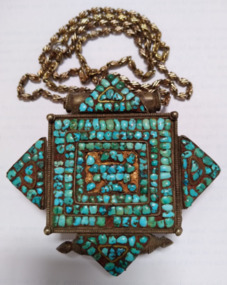
... deep cultural and spiritual significance in Tibet. Worn on a chain around the neck and hung close to the heart, they are believed to ward off negative energy and attract blessings. They open up to a concealed inner space...deep cultural and spiritual significance in Tibet. Worn on a chain around the neck and hung close to the heart, they are believed to ward off negative energy and attract blessings. They open up to a concealed inner space ...Gau boxes are ancient religious objects with deep cultural and spiritual significance in Tibet. Worn on a chain around the neck and hung close to the heart, they are believed to ward off negative energy and attract blessings. They open up to a concealed inner space, containing a picture of a deity, a scroll of mantras or sacred relics, blessed by a lama. Large square gau box incrusted with turquoiseritual implements, amulets -
 Broadmeadows Historical Society & Museum
Photograph - Group Photograph, Early Years Celebration, 1990
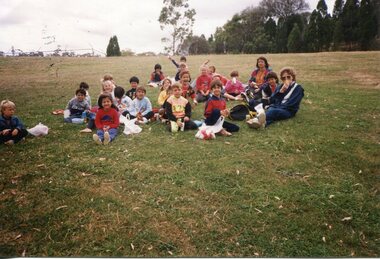
... deep sense of community. It also contributes to a broader understanding of how public education in Melbourne’s outer suburbs fostered social cohesion, local identity, and intergenerational connection during a formative period in the region’s development. This photograph from the 1990 Jacana Primary School Christmas picnic, likely held at Greenvale Reservoir Park, is a valuable visual record of community life and educational culture in Melbourne’s northern suburbs during the late 20th century. It captures the joyful participation of younger students in a cherished annual event, reflecting the school’s emphasis on inclusiveness, celebration, and connection to local natural spaces ...This photograph captures a joyful scene from Jacana Primary School’s 1990 Christmas picnic, likely held at Greenvale Reservoir Park—a popular recreational destination north of Melbourne, celebrated for its wide open spaces and welcoming, family-friendly atmosphere. The image showcases younger students enjoying an end-of-year celebration, reflecting the school’s commitment to nurturing community spirit through shared outdoor experiences. Founded in 1959, Jacana Primary School was a vital part of the local community until its closure in the early 2000s. Events like the annual Christmas picnic were central to the school’s culture, offering students—especially those in the early years—opportunities to form friendships, celebrate their achievements, and connect with peers and teachers in a relaxed, natural setting. The choice of Greenvale Reservoir Park underscores the school’s strong ties to local landscapes and its dedication to inclusive, accessible activities. This photograph stands as a visual testament to the values that defined Jacana Primary School: joy, inclusiveness, and a deep sense of community. It also contributes to a broader understanding of how public education in Melbourne’s outer suburbs fostered social cohesion, local identity, and intergenerational connection during a formative period in the region’s development.This photograph from the 1990 Jacana Primary School Christmas picnic, likely held at Greenvale Reservoir Park, is a valuable visual record of community life and educational culture in Melbourne’s northern suburbs during the late 20th century. It captures the joyful participation of younger students in a cherished annual event, reflecting the school’s emphasis on inclusiveness, celebration, and connection to local natural spaces. Jacana Primary School, established in 1959 and closed in the early 2000s, played a pivotal role in shaping the social fabric of the Jacana community. Events such as the Christmas picnic were integral to the school’s identity, fostering friendships, strengthening ties between families and educators, and promoting a sense of belonging among students. The use of Greenvale Reservoir Park highlights the school’s commitment to accessible, outdoor learning environments and its engagement with the surrounding landscape. This image is significant not only for its depiction of school traditions but also for its broader representation of how public education in Melbourne’s outer suburbs contributed to social cohesion, local identity, and intergenerational connection. It stands as a testament to the enduring values of joy, community, and inclusivity that defined Jacana Primary School and its legacy.Photograph on glossy paper of a group children in the park.PH18289 (crossed out) PH-4209 (crossed out) PH-4868jacana primary school, christmas picnic, 1990, jacana, christmas party -
 Federation University Art Collection
Work on paper - Limited Edition Coloured Print - 4/30, Geoffrey Ricardo, 'Naturalists' by Geoffrey Ricardo, 1992
... GEOFFREY RICARDO (1964- ) Born Melbourne, Australia 1984-86 Bachelor of Arts (Fine Art), Printmaking, Chisholm Institute of Technology, Melbourne 1987-89 Printing Assistant at Bill Young Studios, Editioning intaglio prints, King Valley, VIC 1988 Full-time Studio Technician at Printmaking Department, Chisholm Institute of Technology, Melbourne 1989-90 Graduate Diploma (Fine Art), Printmaking, Monash University, Melbourne 1991 Traveled to England, France, Spain and USA (Winsor & Newton International Travelling Bursary, National Students Art Prize) Worked in private studios in Gaucin, Spain and New York, USA 1994-95 Master of Fine Arts, Monash University, Melbourne 1995 Guest Lecturer, Victorian College of the Arts, Melbourne Traveled to Europe and America 1996 Guest Lecturer, Royal Melbourne Institute of Technology, Melbourne 1990-98 Sessional Lecturer, Monash University, Melbourne 1998 Traveled to America and Mexico 2001-05 Sessional Lecturer, The Victorian College of the Arts, Melbourne 2003-10 Printmaking Workshops, Warrnambool TAFE, Warrnambool, VIC 2004 Traveled to Europe, Mexico and Cuba 2005 Lecturer, National Art School (Summer School), Sydney Sessional Lecturer, Monash University, Melbourne Lecturer, Institution of Koorie Education, Deakin University, Geelong, VIC SOLO EXHIBITIONS 2012 ‘Collection of Works’ The Art Vault Mildura ‘Deeper Meanings’, The Incinerator Gallery, Melbourne ‘Three Projects’, Australian Galleries, Glenmore Road, Sydney Melbourne Art Fair Stand F33, Australian Galleries, Melbourne 2009 ‘Anno Domino, Antarctica and The Anatomy Lesson’, Australian Galleries Derby Street, Melbourne The Art Vault, Mildura, VIC 2008 MV Orlova (Quark Expeditions), The Drake Passage, Antarctica 2007 ‘Herd’, BMGArt, Adelaide ‘Herd’, Australian Galleries Painting & Sculpture, Sydney 2006 ‘Herd’, Australian Galleries Painting & Sculpture, Melbourne 2004 ‘Recent work’, BMGArt, Adelaide 2003 ‘The Rapunzel Suite and Other New Works’, Australian Galleries Works on Paper, Sydney ‘Recent Works’, Australian Galleries Painting & Sculpture, Melbourne ‘Recent works’, Cowwarr Art Space, Cowwarr, VIC 2002 ‘The Rapunzel Suite’, Australian Galleries Works on Paper, Melbourne ‘Strange Games’, Australian Galleries Works on Paper, Sydney 1999 ‘A Dark City Narrative’, Australian Galleries Works on Paper, Sydney ‘A Dark City Narrative’, Australian Galleries Works on Paper, Melbourne 1998 Cullity Gallery, School of Architecture and Fine Art, University of Western Australia, Perth 1997 Delaney Gallery, Perth Chapman Gallery, Canberra BMGArt, Adelaide ‘Menagerie’, Australian Galleries, Sydney ‘Menagerie’, Australian Galleries, Melbourne 1995 ‘Paintings, Prints and Sculpture’, Australian Galleries, Sydney ‘Prints, Paintings and Sculpture’, Australian Galleries, Melbourne 1994 Lawrence Wilson Art Gallery, University of Western Australia, Perth Graham Galleries + Editions, Brisbane ‘Wishful Thinking, Prints and Sculptures’, Lawrence Wilson Art Gallery, University of Western Australia, Perth 1992 ‘Prints, Sculptures and Watercolours’, Australian Galleries, Melbourne and Sydney 1990 ‘Watercolours, Prints and Small Bronzes’, Australian Galleries, Sydney ‘Paintings, Prints and Sculptures’, Australian Galleries, Melbourne GROUP EXHIBITIONS 2013 ‘Sculpture by the Sea’ Cottlesloe, Western Australia 2012 ‘Brave New World’, Toyota Community Spirit Gallery, Port Melbourne, VIC ‘Sculpture by the Sea’, Bondi, Sydney 2011 ‘Sculpture by the sea’, Aarhus, Denmark ‘Artwork to Tapestry’, Tarrawarra Museum of Art, Healesville, VIC Burnie Print Prize, Burnie Regional Gallery, Burnie, TAS ‘large exhibition of small works’, Australian Galleries, Roylston Street, Sydney ‘large exhibition of small works’, Australian Galleries, Derby Street, Melbourne ‘Nature of the Mark’, Australian Galleries, Smith Street, Melbourne Rick Amor Print Prize, Montsalvat, Eltham, VIC 2010 ‘Summer show’, Australian Galleries, Glenmore Road, Sydney ‘Summer stock show’, Australian Galleries, Smith Street, Melbourne ‘Sub10’, Substation, Melbourne ‘McClelland Sculpture Survey and Award 2010’, McClelland Gallery + Sculpture Park, Langwarrin, VIC ‘Artists’ Prints made with Integrity I’, Australian Galleries, Smith Street, Melbourne Montalto Sculpture Prize, Montalto Vineyard and Olive Grove, Red Hill South, VIC 2009 ‘Artists’ ink: printmaking from the Warrnambool Art Gallery Collection, 1970-2001’, Ararat Regional Art Gallery, Ararat, VIC ‘Lorne Sculpture’ (Winner), Lorne, VIC 2008 ‘Summer Stock Show’, Australian Galleries Smith Street, Melbourne 2007 ARC Biennial (Art, Design and Craft), Queensland University of Technology Art Museum, Brisbane ‘Prints Tokyo: International Print Exhibition’, Tokyo, Japan Seoul International Print, Photo and Edition Works Art Fair, Seoul, Korea Guanlan International Print Biennial, Guanlan, China ‘Summer Stock Show’, Australian Galleries Works on Paper, Sydney ‘Summer Stock Show’, Australian Galleries Painting & Sculpture, Melbourne ‘Summer Stock Show’, Australian Galleries Works on Paper, Melbourne ‘Antipodean Bestiary’, Project Space / Spare Room, RMIT University, Melbourne Montalto Sculpture Prize, Montalto Vineyard and Olive Grove, Red Hill South, VIC McClelland Sculpture Survey and Award 2007, McClelland Gallery + Sculpture Park, Langwarrin, VIC ‘2007: Works from the studio’, Lancaster Press, Melbourne ‘50 - a print exchange portfolio’, Geelong Art Gallery, Geelong, VIC ‘Small Pleasures’, Australian Galleries Painting & Sculpture, Melbourne ‘Stock Show’, Australian Galleries Painting & Sculpture, Melbourne ‘Artists for Kids Culture’, Brightspace, Melbourne 2006 ‘Partnership or perish’, Academy of the Arts, School of Visual and Performing Arts, University of Tasmania, Hobart Libris Awards, Artspace Mackay, Mackay, QLD ‘Summery’, Australian Galleries Painting & Sculpture, Sydney ‘Summer Stock Show’, Australian Galleries Works on Paper, Melbourne ‘Bookish’, Australian Galleries Works on Paper, Melbourne Melbourne Art Fair, Australian Galleries, Melbourne ‘Artists for Kids Culture’, Brightspace, Melbourne ‘50th Anniversary Exhibition’, Australian Galleries Painting & Sculpture, Melbourne 2005 ‘End of Year Group Exhibition’, Australian Galleries Painting & Sculpture, Sydney ‘Contemporary Works on Paper’, Australian Galleries Works on Paper, Melbourne ‘Expansion’, Lancaster Press, Melbourne ‘The Art of Collaboration’, Singapore Tyler Print Institute, Singapore ‘Double take’, Arts Project Australia, Melbourne ‘Small Treasures - 20 emerging and established artists’, TILT Contemporary Art, Melbourne Jacques Cadry Memorial Art Prize, Fox Studios and State Library of NSW, Sydney ‘Tales of the City’, Australian Galleries Painting & Sculpture, Melbourne ‘A Decade of Collecting 1995-2005’, Cairns Regional Gallery, Cairns, QLD ‘Artists for Kids Culture’, Brightspace, Melbourne ‘Surface Tension: 21 Contemporary Australian Printmakers’, University of Tasmania, Launceston, TAS ‘Neo-millenium’, Toyota Community Spirit Gallery, Melbourne 2004 ‘Artists for Kids Culture’, Brightspace, Melbourne ‘Group Exhibition’, Australian Galleries Painting & Sculpture, Melbourne ‘Species’, Australian Galleries Works on Paper, Melbourne ‘In the presence of creatures great and small’, Australian Galleries Works on Paper, Sydney ‘Tapestries from the Victorian Tapestry Workshop’, Australian Galleries, Melbourne ‘Sculpture’, Australian Galleries Painting & Sculpture, Sydney ‘Contemporary Australian Prints’, National Arts Club, New York, USA ‘Contemporary Australian Prints’, Gallery 101, Melbourne ‘Contemporary Australian Prints from the Collection’, Art Gallery of New South Wales, Sydney ‘Bridge’, Toyota Community Spirit Gallery, Melbourne ‘Vivid’, Fortyfive Downstairs, Melbourne Lake Gallery, Paynesville, VIC 2003 ‘Paper matters’, Lawrence Wilson Art Gallery, University of Western Australia, Perth ‘Artists for Kids Culture’, Brightspace, Melbourne ‘Less is more’, BMGArt, Adelaide ‘The ink’s on me: Bill Young master printmaker’, Wangaratta Exhibitions Gallery, Wangaratta, VIC ‘Fantastic and Visionary Art’, Touring: Global Arts Link, QLD; Ipswich Regional Gallery, QLD ; Orange Regional Gallery, NSW; Manning Regional Gallery, NSW; Parramatta Heritage Centre, Sydney; Ballarat Regional Gallery, VIC 2002 Shell Fremantle Print Award, Fremantle Arts Centre, Fremantle, WA ‘Artists for Kids Culture’, Brightspace, Melbourne 2001 Shell Fremantle Print Award, Fremantle Arts Centre, Fremantle, WA ‘Six Degrees of Collaboration’, RMIT Faculty of Art, Design and Communication Gallery, Melbourne ‘Reciprocal Moves’, Warrnambool Art Gallery, Warrnambool, VIC International Print Triennial, Kanagawa, Japan ‘Fantastic Art’, Orange Regional Gallery, Orange, NSW ‘Dancing Made a Man out of Me’, The Switchback Gallery, Monash University, Gippsland, VIC ‘Artists for Kids Culture’, Brightspace, Melbourne ‘Celebration’, Regional touring exhibition, VIC 2000-01 ‘Workings of the Mind: Melbourne Prints of the 1960s to the 1990s’, Touring: Grafton Regional Gallery, NSW; Toowoomba Regional Art Gallery, QLD; Nolan Gallery, Canberra; Bendigo Art Gallery, VIC; PercTucker Regional Gallery, QLD 2000 Shell Fremantle Print Award, Fremantle Arts Centre, Fremantle, WA The Hutchins Art Prize, Long Gallery, Hobart ‘Artists for Kids Culture’, Brightspace, Melbourne 1999 Shell Fremantle Print Award, Fremantle Arts Space, Fremantle, WA ‘We are Australian’, George Adams Gallery, Victorian Arts Centre, Melbourne Rena Ellen Jones Memorial Print Award, Warrnambool Art Gallery, Warrnambool, VIC ‘National Works on Paper’, Mornington Peninsula Gallery, Mornington, VIC ‘Artists for Kids Culture’, Brightspace, Melbourne ‘Pleasure’, Australian Galleries, Melbourne 1998-99 ‘Australian Prints’, Art Gallery of New South Wales, Sydney 1997 ‘KNOCK, KNOCK’, Australian Galleries, Melbourne ‘Woven Colour, The Art of Tapestry’, Dr Earl Lu Gallery, Singapore 1996 M.P.A.C. ...GEOFFREY RICARDO (1964- ) Born Melbourne, Australia 1984-86 Bachelor of Arts (Fine Art), Printmaking, Chisholm Institute of Technology, Melbourne 1987-89 Printing Assistant at Bill Young Studios, Editioning intaglio prints, King Valley, VIC 1988 Full-time Studio Technician at Printmaking Department, Chisholm Institute of Technology, Melbourne 1989-90 Graduate Diploma (Fine Art), Printmaking, Monash University, Melbourne 1991 Traveled to England, France, Spain and USA (Winsor & Newton International Travelling Bursary, National Students Art Prize) Worked in private studios in Gaucin, Spain and New York, USA 1994-95 Master of Fine Arts, Monash University, Melbourne 1995 Guest Lecturer, Victorian College of the Arts, Melbourne Traveled to Europe and America 1996 Guest Lecturer, Royal Melbourne Institute of Technology, Melbourne 1990-98 Sessional Lecturer, Monash University, Melbourne 1998 Traveled to America and Mexico 2001-05 Sessional Lecturer, The Victorian College of the Arts, Melbourne 2003-10 Printmaking Workshops, Warrnambool TAFE, Warrnambool, VIC 2004 Traveled to Europe, Mexico and Cuba 2005 Lecturer, National Art School (Summer School), Sydney Sessional Lecturer, Monash University, Melbourne Lecturer, Institution of Koorie Education, Deakin University, Geelong, VIC SOLO EXHIBITIONS 2012 ‘Collection of Works’ The Art Vault Mildura ‘Deeper Meanings’, The Incinerator Gallery, Melbourne ‘Three Projects’, Australian Galleries, Glenmore Road, Sydney Melbourne Art Fair Stand F33, Australian Galleries, Melbourne 2009 ‘Anno Domino, Antarctica and The Anatomy Lesson’, Australian Galleries Derby Street, Melbourne The Art Vault, Mildura, VIC 2008 MV Orlova (Quark Expeditions), The Drake Passage, Antarctica 2007 ‘Herd’, BMGArt, Adelaide ‘Herd’, Australian Galleries Painting & Sculpture, Sydney 2006 ‘Herd’, Australian Galleries Painting & Sculpture, Melbourne 2004 ‘Recent work’, BMGArt, Adelaide 2003 ‘The Rapunzel Suite and Other New Works’, Australian Galleries Works on Paper, Sydney ‘Recent Works’, Australian Galleries Painting & Sculpture, Melbourne ‘Recent works’, Cowwarr Art Space, Cowwarr, VIC 2002 ‘The Rapunzel Suite’, Australian Galleries Works on Paper, Melbourne ‘Strange Games’, Australian Galleries Works on Paper, Sydney 1999 ‘A Dark City Narrative’, Australian Galleries Works on Paper, Sydney ‘A Dark City Narrative’, Australian Galleries Works on Paper, Melbourne 1998 Cullity Gallery, School of Architecture and Fine Art, University of Western Australia, Perth 1997 Delaney Gallery, Perth Chapman Gallery, Canberra BMGArt, Adelaide ‘Menagerie’, Australian Galleries, Sydney ‘Menagerie’, Australian Galleries, Melbourne 1995 ‘Paintings, Prints and Sculpture’, Australian Galleries, Sydney ‘Prints, Paintings and Sculpture’, Australian Galleries, Melbourne 1994 Lawrence Wilson Art Gallery, University of Western Australia, Perth Graham Galleries + Editions, Brisbane ‘Wishful Thinking, Prints and Sculptures’, Lawrence Wilson Art Gallery, University of Western Australia, Perth 1992 ‘Prints, Sculptures and Watercolours’, Australian Galleries, Melbourne and Sydney 1990 ‘Watercolours, Prints and Small Bronzes’, Australian Galleries, Sydney ‘Paintings, Prints and Sculptures’, Australian Galleries, Melbourne GROUP EXHIBITIONS 2013 ‘Sculpture by the Sea’ Cottlesloe, Western Australia 2012 ‘Brave New World’, Toyota Community Spirit Gallery, Port Melbourne, VIC ‘Sculpture by the Sea’, Bondi, Sydney 2011 ‘Sculpture by the sea’, Aarhus, Denmark ‘Artwork to Tapestry’, Tarrawarra Museum of Art, Healesville, VIC Burnie Print Prize, Burnie Regional Gallery, Burnie, TAS ‘large exhibition of small works’, Australian Galleries, Roylston Street, Sydney ‘large exhibition of small works’, Australian Galleries, Derby Street, Melbourne ‘Nature of the Mark’, Australian Galleries, Smith Street, Melbourne Rick Amor Print Prize, Montsalvat, Eltham, VIC 2010 ‘Summer show’, Australian Galleries, Glenmore Road, Sydney ‘Summer stock show’, Australian Galleries, Smith Street, Melbourne ‘Sub10’, Substation, Melbourne ‘McClelland Sculpture Survey and Award 2010’, McClelland Gallery + Sculpture Park, Langwarrin, VIC ‘Artists’ Prints made with Integrity I’, Australian Galleries, Smith Street, Melbourne Montalto Sculpture Prize, Montalto Vineyard and Olive Grove, Red Hill South, VIC 2009 ‘Artists’ ink: printmaking from the Warrnambool Art Gallery Collection, 1970-2001’, Ararat Regional Art Gallery, Ararat, VIC ‘Lorne Sculpture’ (Winner), Lorne, VIC 2008 ‘Summer Stock Show’, Australian Galleries Smith Street, Melbourne 2007 ARC Biennial (Art, Design and Craft), Queensland University of Technology Art Museum, Brisbane ‘Prints Tokyo: International Print Exhibition’, Tokyo, Japan Seoul International Print, Photo and Edition Works Art Fair, Seoul, Korea Guanlan International Print Biennial, Guanlan, China ‘Summer Stock Show’, Australian Galleries Works on Paper, Sydney ‘Summer Stock Show’, Australian Galleries Painting & Sculpture, Melbourne ‘Summer Stock Show’, Australian Galleries Works on Paper, Melbourne ‘Antipodean Bestiary’, Project Space / Spare Room, RMIT University, Melbourne Montalto Sculpture Prize, Montalto Vineyard and Olive Grove, Red Hill South, VIC McClelland Sculpture Survey and Award 2007, McClelland Gallery + Sculpture Park, Langwarrin, VIC ‘2007: Works from the studio’, Lancaster Press, Melbourne ‘50 - a print exchange portfolio’, Geelong Art Gallery, Geelong, VIC ‘Small Pleasures’, Australian Galleries Painting & Sculpture, Melbourne ‘Stock Show’, Australian Galleries Painting & Sculpture, Melbourne ‘Artists for Kids Culture’, Brightspace, Melbourne 2006 ‘Partnership or perish’, Academy of the Arts, School of Visual and Performing Arts, University of Tasmania, Hobart Libris Awards, Artspace Mackay, Mackay, QLD ‘Summery’, Australian Galleries Painting & Sculpture, Sydney ‘Summer Stock Show’, Australian Galleries Works on Paper, Melbourne ‘Bookish’, Australian Galleries Works on Paper, Melbourne Melbourne Art Fair, Australian Galleries, Melbourne ‘Artists for Kids Culture’, Brightspace, Melbourne ‘50th Anniversary Exhibition’, Australian Galleries Painting & Sculpture, Melbourne 2005 ‘End of Year Group Exhibition’, Australian Galleries Painting & Sculpture, Sydney ‘Contemporary Works on Paper’, Australian Galleries Works on Paper, Melbourne ‘Expansion’, Lancaster Press, Melbourne ‘The Art of Collaboration’, Singapore Tyler Print Institute, Singapore ‘Double take’, Arts Project Australia, Melbourne ‘Small Treasures - 20 emerging and established artists’, TILT Contemporary Art, Melbourne Jacques Cadry Memorial Art Prize, Fox Studios and State Library of NSW, Sydney ‘Tales of the City’, Australian Galleries Painting & Sculpture, Melbourne ‘A Decade of Collecting 1995-2005’, Cairns Regional Gallery, Cairns, QLD ‘Artists for Kids Culture’, Brightspace, Melbourne ‘Surface Tension: 21 Contemporary Australian Printmakers’, University of Tasmania, Launceston, TAS ‘Neo-millenium’, Toyota Community Spirit Gallery, Melbourne 2004 ‘Artists for Kids Culture’, Brightspace, Melbourne ‘Group Exhibition’, Australian Galleries Painting & Sculpture, Melbourne ‘Species’, Australian Galleries Works on Paper, Melbourne ‘In the presence of creatures great and small’, Australian Galleries Works on Paper, Sydney ‘Tapestries from the Victorian Tapestry Workshop’, Australian Galleries, Melbourne ‘Sculpture’, Australian Galleries Painting & Sculpture, Sydney ‘Contemporary Australian Prints’, National Arts Club, New York, USA ‘Contemporary Australian Prints’, Gallery 101, Melbourne ‘Contemporary Australian Prints from the Collection’, Art Gallery of New South Wales, Sydney ‘Bridge’, Toyota Community Spirit Gallery, Melbourne ‘Vivid’, Fortyfive Downstairs, Melbourne Lake Gallery, Paynesville, VIC 2003 ‘Paper matters’, Lawrence Wilson Art Gallery, University of Western Australia, Perth ‘Artists for Kids Culture’, Brightspace, Melbourne ‘Less is more’, BMGArt, Adelaide ‘The ink’s on me: Bill Young master printmaker’, Wangaratta Exhibitions Gallery, Wangaratta, VIC ‘Fantastic and Visionary Art’, Touring: Global Arts Link, QLD; Ipswich Regional Gallery, QLD ; Orange Regional Gallery, NSW; Manning Regional Gallery, NSW; Parramatta Heritage Centre, Sydney; Ballarat Regional Gallery, VIC 2002 Shell Fremantle Print Award, Fremantle Arts Centre, Fremantle, WA ‘Artists for Kids Culture’, Brightspace, Melbourne 2001 Shell Fremantle Print Award, Fremantle Arts Centre, Fremantle, WA ‘Six Degrees of Collaboration’, RMIT Faculty of Art, Design and Communication Gallery, Melbourne ‘Reciprocal Moves’, Warrnambool Art Gallery, Warrnambool, VIC International Print Triennial, Kanagawa, Japan ‘Fantastic Art’, Orange Regional Gallery, Orange, NSW ‘Dancing Made a Man out of Me’, The Switchback Gallery, Monash University, Gippsland, VIC ‘Artists for Kids Culture’, Brightspace, Melbourne ‘Celebration’, Regional touring exhibition, VIC 2000-01 ‘Workings of the Mind: Melbourne Prints of the 1960s to the 1990s’, Touring: Grafton Regional Gallery, NSW; Toowoomba Regional Art Gallery, QLD; Nolan Gallery, Canberra; Bendigo Art Gallery, VIC; PercTucker Regional Gallery, QLD 2000 Shell Fremantle Print Award, Fremantle Arts Centre, Fremantle, WA The Hutchins Art Prize, Long Gallery, Hobart ‘Artists for Kids Culture’, Brightspace, Melbourne 1999 Shell Fremantle Print Award, Fremantle Arts Space, Fremantle, WA ‘We are Australian’, George Adams Gallery, Victorian Arts Centre, Melbourne Rena Ellen Jones Memorial Print Award, Warrnambool Art Gallery, Warrnambool, VIC ‘National Works on Paper’, Mornington Peninsula Gallery, Mornington, VIC ‘Artists for Kids Culture’, Brightspace, Melbourne ‘Pleasure’, Australian Galleries, Melbourne 1998-99 ‘Australian Prints’, Art Gallery of New South Wales, Sydney 1997 ‘KNOCK, KNOCK’, Australian Galleries, Melbourne ‘Woven Colour, The Art of Tapestry’, Dr Earl Lu Gallery, Singapore 1996 M.P.A.C. ...GEOFFREY RICARDO (1964- ) Born Melbourne, Australia 1984-86 Bachelor of Arts (Fine Art), Printmaking, Chisholm Institute of Technology, Melbourne 1987-89 Printing Assistant at Bill Young Studios, Editioning intaglio prints, King Valley, VIC 1988 Full-time Studio Technician at Printmaking Department, Chisholm Institute of Technology, Melbourne 1989-90 Graduate Diploma (Fine Art), Printmaking, Monash University, Melbourne 1991 Traveled to England, France, Spain and USA (Winsor & Newton International Travelling Bursary, National Students Art Prize) Worked in private studios in Gaucin, Spain and New York, USA 1994-95 Master of Fine Arts, Monash University, Melbourne 1995 Guest Lecturer, Victorian College of the Arts, Melbourne Traveled to Europe and America 1996 Guest Lecturer, Royal Melbourne Institute of Technology, Melbourne 1990-98 Sessional Lecturer, Monash University, Melbourne 1998 Traveled to America and Mexico 2001-05 Sessional Lecturer, The Victorian College of the Arts, Melbourne 2003-10 Printmaking Workshops, Warrnambool TAFE, Warrnambool, VIC 2004 Traveled to Europe, Mexico and Cuba 2005 Lecturer, National Art School (Summer School), Sydney Sessional Lecturer, Monash University, Melbourne Lecturer, Institution of Koorie Education, Deakin University, Geelong, VIC SOLO EXHIBITIONS 2012 ‘Collection of Works’ The Art Vault Mildura ‘Deeper Meanings’, The Incinerator Gallery, Melbourne ‘Three Projects’, Australian Galleries, Glenmore Road, Sydney Melbourne Art Fair Stand F33, Australian Galleries, Melbourne 2009 ‘Anno Domino, Antarctica and The Anatomy Lesson’, Australian Galleries Derby Street, Melbourne The Art Vault, Mildura, VIC 2008 MV Orlova (Quark Expeditions), The Drake Passage, Antarctica 2007 ‘Herd’, BMGArt, Adelaide ‘Herd’, Australian Galleries Painting & Sculpture, Sydney 2006 ‘Herd’, Australian Galleries Painting & Sculpture, Melbourne 2004 ‘Recent work’, BMGArt, Adelaide 2003 ‘The Rapunzel Suite and Other New Works’, Australian Galleries Works on Paper, Sydney ‘Recent Works’, Australian Galleries Painting & Sculpture, Melbourne ‘Recent works’, Cowwarr Art Space, Cowwarr, VIC 2002 ‘The Rapunzel Suite’, Australian Galleries Works on Paper, Melbourne ‘Strange Games’, Australian Galleries Works on Paper, Sydney 1999 ‘A Dark City Narrative’, Australian Galleries Works on Paper, Sydney ‘A Dark City Narrative’, Australian Galleries Works on Paper, Melbourne 1998 Cullity Gallery, School of Architecture and Fine Art, University of Western Australia, Perth 1997 Delaney Gallery, Perth Chapman Gallery, Canberra BMGArt, Adelaide ‘Menagerie’, Australian Galleries, Sydney ‘Menagerie’, Australian Galleries, Melbourne 1995 ‘Paintings, Prints and Sculpture’, Australian Galleries, Sydney ‘Prints, Paintings and Sculpture’, Australian Galleries, Melbourne 1994 Lawrence Wilson Art Gallery, University of Western Australia, Perth Graham Galleries + Editions, Brisbane ‘Wishful Thinking, Prints and Sculptures’, Lawrence Wilson Art Gallery, University of Western Australia, Perth 1992 ‘Prints, Sculptures and Watercolours’, Australian Galleries, Melbourne and Sydney 1990 ‘Watercolours, Prints and Small Bronzes’, Australian Galleries, Sydney ‘Paintings, Prints and Sculptures’, Australian Galleries, Melbourne GROUP EXHIBITIONS 2013 ‘Sculpture by the Sea’ Cottlesloe, Western Australia 2012 ‘Brave New World’, Toyota Community Spirit Gallery, Port Melbourne, VIC ‘Sculpture by the Sea’, Bondi, Sydney 2011 ‘Sculpture by the sea’, Aarhus, Denmark ‘Artwork to Tapestry’, Tarrawarra Museum of Art, Healesville, VIC Burnie Print Prize, Burnie Regional Gallery, Burnie, TAS ‘large exhibition of small works’, Australian Galleries, Roylston Street, Sydney ‘large exhibition of small works’, Australian Galleries, Derby Street, Melbourne ‘Nature of the Mark’, Australian Galleries, Smith Street, Melbourne Rick Amor Print Prize, Montsalvat, Eltham, VIC 2010 ‘Summer show’, Australian Galleries, Glenmore Road, Sydney ‘Summer stock show’, Australian Galleries, Smith Street, Melbourne ‘Sub10’, Substation, Melbourne ‘McClelland Sculpture Survey and Award 2010’, McClelland Gallery + Sculpture Park, Langwarrin, VIC ‘Artists’ Prints made with Integrity I’, Australian Galleries, Smith Street, Melbourne Montalto Sculpture Prize, Montalto Vineyard and Olive Grove, Red Hill South, VIC 2009 ‘Artists’ ink: printmaking from the Warrnambool Art Gallery Collection, 1970-2001’, Ararat Regional Art Gallery, Ararat, VIC ‘Lorne Sculpture’ (Winner), Lorne, VIC 2008 ‘Summer Stock Show’, Australian Galleries Smith Street, Melbourne 2007 ARC Biennial (Art, Design and Craft), Queensland University of Technology Art Museum, Brisbane ‘Prints Tokyo: International Print Exhibition’, Tokyo, Japan Seoul International Print, Photo and Edition Works Art Fair, Seoul, Korea Guanlan International Print Biennial, Guanlan, China ‘Summer Stock Show’, Australian Galleries Works on Paper, Sydney ‘Summer Stock Show’, Australian Galleries Painting & Sculpture, Melbourne ‘Summer Stock Show’, Australian Galleries Works on Paper, Melbourne ‘Antipodean Bestiary’, Project Space / Spare Room, RMIT University, Melbourne Montalto Sculpture Prize, Montalto Vineyard and Olive Grove, Red Hill South, VIC McClelland Sculpture Survey and Award 2007, McClelland Gallery + Sculpture Park, Langwarrin, VIC ‘2007: Works from the studio’, Lancaster Press, Melbourne ‘50 - a print exchange portfolio’, Geelong Art Gallery, Geelong, VIC ‘Small Pleasures’, Australian Galleries Painting & Sculpture, Melbourne ‘Stock Show’, Australian Galleries Painting & Sculpture, Melbourne ‘Artists for Kids Culture’, Brightspace, Melbourne 2006 ‘Partnership or perish’, Academy of the Arts, School of Visual and Performing Arts, University of Tasmania, Hobart Libris Awards, Artspace Mackay, Mackay, QLD ‘Summery’, Australian Galleries Painting & Sculpture, Sydney ‘Summer Stock Show’, Australian Galleries Works on Paper, Melbourne ‘Bookish’, Australian Galleries Works on Paper, Melbourne Melbourne Art Fair, Australian Galleries, Melbourne ‘Artists for Kids Culture’, Brightspace, Melbourne ‘50th Anniversary Exhibition’, Australian Galleries Painting & Sculpture, Melbourne 2005 ‘End of Year Group Exhibition’, Australian Galleries Painting & Sculpture, Sydney ‘Contemporary Works on Paper’, Australian Galleries Works on Paper, Melbourne ‘Expansion’, Lancaster Press, Melbourne ‘The Art of Collaboration’, Singapore Tyler Print Institute, Singapore ‘Double take’, Arts Project Australia, Melbourne ‘Small Treasures - 20 emerging and established artists’, TILT Contemporary Art, Melbourne Jacques Cadry Memorial Art Prize, Fox Studios and State Library of NSW, Sydney ‘Tales of the City’, Australian Galleries Painting & Sculpture, Melbourne ‘A Decade of Collecting 1995-2005’, Cairns Regional Gallery, Cairns, QLD ‘Artists for Kids Culture’, Brightspace, Melbourne ‘Surface Tension: 21 Contemporary Australian Printmakers’, University of Tasmania, Launceston, TAS ‘Neo-millenium’, Toyota Community Spirit Gallery, Melbourne 2004 ‘Artists for Kids Culture’, Brightspace, Melbourne ‘Group Exhibition’, Australian Galleries Painting & Sculpture, Melbourne ‘Species’, Australian Galleries Works on Paper, Melbourne ‘In the presence of creatures great and small’, Australian Galleries Works on Paper, Sydney ‘Tapestries from the Victorian Tapestry Workshop’, Australian Galleries, Melbourne ‘Sculpture’, Australian Galleries Painting & Sculpture, Sydney ‘Contemporary Australian Prints’, National Arts Club, New York, USA ‘Contemporary Australian Prints’, Gallery 101, Melbourne ‘Contemporary Australian Prints from the Collection’, Art Gallery of New South Wales, Sydney ‘Bridge’, Toyota Community Spirit Gallery, Melbourne ‘Vivid’, Fortyfive Downstairs, Melbourne Lake Gallery, Paynesville, VIC 2003 ‘Paper matters’, Lawrence Wilson Art Gallery, University of Western Australia, Perth ‘Artists for Kids Culture’, Brightspace, Melbourne ‘Less is more’, BMGArt, Adelaide ‘The ink’s on me: Bill Young master printmaker’, Wangaratta Exhibitions Gallery, Wangaratta, VIC ‘Fantastic and Visionary Art’, Touring: Global Arts Link, QLD; Ipswich Regional Gallery, QLD ; Orange Regional Gallery, NSW; Manning Regional Gallery, NSW; Parramatta Heritage Centre, Sydney; Ballarat Regional Gallery, VIC 2002 Shell Fremantle Print Award, Fremantle Arts Centre, Fremantle, WA ‘Artists for Kids Culture’, Brightspace, Melbourne 2001 Shell Fremantle Print Award, Fremantle Arts Centre, Fremantle, WA ‘Six Degrees of Collaboration’, RMIT Faculty of Art, Design and Communication Gallery, Melbourne ‘Reciprocal Moves’, Warrnambool Art Gallery, Warrnambool, VIC International Print Triennial, Kanagawa, Japan ‘Fantastic Art’, Orange Regional Gallery, Orange, NSW ‘Dancing Made a Man out of Me’, The Switchback Gallery, Monash University, Gippsland, VIC ‘Artists for Kids Culture’, Brightspace, Melbourne ‘Celebration’, Regional touring exhibition, VIC 2000-01 ‘Workings of the Mind: Melbourne Prints of the 1960s to the 1990s’, Touring: Grafton Regional Gallery, NSW; Toowoomba Regional Art Gallery, QLD; Nolan Gallery, Canberra; Bendigo Art Gallery, VIC; PercTucker Regional Gallery, QLD 2000 Shell Fremantle Print Award, Fremantle Arts Centre, Fremantle, WA The Hutchins Art Prize, Long Gallery, Hobart ‘Artists for Kids Culture’, Brightspace, Melbourne 1999 Shell Fremantle Print Award, Fremantle Arts Space, Fremantle, WA ‘We are Australian’, George Adams Gallery, Victorian Arts Centre, Melbourne Rena Ellen Jones Memorial Print Award, Warrnambool Art Gallery, Warrnambool, VIC ‘National Works on Paper’, Mornington Peninsula Gallery, Mornington, VIC ‘Artists for Kids Culture’, Brightspace, Melbourne ‘Pleasure’, Australian Galleries, Melbourne 1998-99 ‘Australian Prints’, Art Gallery of New South Wales, Sydney 1997 ‘KNOCK, KNOCK’, Australian Galleries, Melbourne ‘Woven Colour, The Art of Tapestry’, Dr Earl Lu Gallery, Singapore 1996 M.P.A.C. Print Award, Mornington Peninsula Arts Centre, Mornington, VIC Academy of Art & Culture, Calcutta, India ‘Synergy’, Touring: Lalit Kala Akademi, New Dehli, India; Jehangir Nicholson Gallery, Bombay, India; Birla, India ‘Contemporary Australian Tapestry’, Frederikshavn Kunstmuseum, Denmark; Australia House, London, UK 1995 ‘Interweave - Tapestry A Collaborative Art’, Heide Museum of Modern Art, Melbourne ‘Contemporary Printmakers’, La Trobe Regional Gallery, Morwell, VIC ‘Contemporary Australian Tapestry’, Australian High Commission, Singapore ‘Circus Capers’, Caulfield Arts Complex, Melbourne 1994 M.P.A.C. Print Award, Mornington Peninsula Arts Centre, Mornington, VIC Fremantle Print Award, Fremantle Arts Centre, Fremantle, WA Australian Universities of Visual Art, Australian High Commission, Singapore ‘Prints, Paintings and Sculpture’, BMGArt, Adelaide Fourth Australian Contemporary Art Fair, Royal Exhibition Building, Melbourne 1993 Fremantle Print Award, Fremantle Arts Centre, Fremantle, WA 1992 Fremantle Print Award, Fremantle Arts Centre, Fremantle, WA ‘Transitional Times’, Print Council of Australia, Melbourne ‘Second Kochi International Triennial Exhibition of Prints’, Japan 1991 Henry Worland Memorial Print Prize, Warrnambool Regional Art Gallery, Warrnambool, VIC Fremantle Print Award, Fremantle Arts Centre, Fremantle, WA ‘Table Top Sculpture’, Australian Galleries, Melbourne ‘Art 91’, London Contemporary Art Fair, London, UK 1990 M.P.A.C. Print Prize, Mornington Peninsula Arts Centre, Mornington, VIC Fremantle Print Prize, Fremantle Arts Centre, Fremantle WA ‘The Christmas Show’, Intaglio Printmaker, London, England ‘Australian Contemporary Art’, AZ Gallery, Tokyo, Japan 1989 National Student Art Prize, Mitchell College, Bathurst, NSW Fremantle Print Award, Fremantle Arts Centre, Fremantle, WA City of Doncaster Acquisitive Print Prize, Manningham Gallery, Melbourne ‘Affiliations’, Monash University Gallery, Melbourne 1988 M.P.A.C. Acquisitive Print Prize, Mornington Peninsula Arts Centre, Mornington, VIC Henry Worland Memorial Print Prize, Warrnambool Regional Art Gallery, Warrnambool, VIC 1987 ‘The Comedy Show’, Print Guild, Melbourne ‘Fluxus Art Flow’, Melbourne 1986 Mornington Peninsula Arts Council Acquisitive Print Prize, Mornington Peninsula, VIC Chisolm Institute of Technology, Graduating Students exhibition, Melbourne AWARDS 2013 King Valley Art Prize (printmaking) 2009 Lorne Sculpture Exhibition (Winner), Lorne, VIC 1989 Windsor and Newton International Travelling Bursary, UK Linbrook International First Prize for Printmaking, Australia COMMISSIONS 2005 Tapestry design for Bairnsdale Hospital (woven by the Victorian Tapestry Workshop, Melbourne), Bairnsdale, VIC 1999 Tapestry design ‘Emblem’ (woven by the Victorian Tapestry Workshop, Melbourne), Australia 1995 ‘A Night of Infectious Laughter’ Poster, St Kilda Festival, Melbourne 1994 Tapestry design ‘Elephant Gingham’ (woven by the Victorian Tapestry Workshop, Melbourne), Australia 1993 Tapestry design for the Festival of Perth Official Poster (woven by the Victorian Tapestry Workshop, Melbourne), Perth RESIDENCIES & PROJECTS 2013 ‘Come In Outside’, Collaboration set design for Pocketfool 2011 Mildura Wentworth Arts Festival Project, Mildura, VIC Residency, The Art Vault , Mildura, VIC 2010 ‘Wish’, Collaboration set design for Pocketfool, Artplay, Melbourne The Art Vault (included continuous public flag making workshops which were flown as part of The Wentworth Mildura Art Festival), Mildura, VIC 2009 The Art Vault (included two public printmaking workshops), Mildura, VIC 2008 Artist in residence, MV Orlova, Quark Expeditions, Antarctica 2003 Residency, Bairnsdale Regional Health Service, Bairnsdale, VIC 1998 Residency, School of Architecture & Fine Art, University of Western Australia, Perth 1997 Residency, La Salle/Fia, College of the Arts, Singapore 1996 Artist in residence, Victorian Tapestry Workshop, Melbourne 1993 Reduction Aquatint Workshop & Residency, Graphic Investigation Department, Canberra School of Art, Canberra NB: all residencies have included workshops involving students, children or the general public COLLECTIONS Artbank, Sydney Art Gallery of New South Wales, Sydney Canson Australia Pty Ltd, Australia City of Box Hill, Melbourne City of Whitehorse, Melbourne Downlands College, Toowoomba, QLD Geelong Grammar School, Geelong, VIC Gold Coast City Art Gallery, Gold Coast, QLD Griffith University, Gold Coast, QLD Helensvale High School, Brisbane Holmes à Court Collection, Perth Latrobe Regional Gallery, Morwell, VIC Monash University, Melbourne Mornington Peninsula Arts Council Collection, Mornington, VIC National Gallery of Australia, Canberra National Gallery of Victoria, Melbourne Parliament House Art Collection, Canberra Print Council of Australia, Melbourne Private collections in Australia, Switzerland, USA, UK, Singapore, Germany, Japan, Malaysia, Holland Queen Victoria Museum & Art Gallery, Launceston, TAS Queensland Art Gallery, Brisbane Queensland University of Technology, Brisbane Shire of Diamond Valley, Diamond Valley, VIC Star of the Sea College, Melbourne The Melbourne Club, Melbourne University of Central Queensland, Brisbane University of Technology, Sydney Wagga Wagga Regional Art Gallery, Wagga Wagga, NSW Warrnambool Regional Art Gallery, Warrnambool, VIC BIBLIOGRAPHY PERIODICALS AQ Journal of Contemporary Analysis, Vol. 70, Issue 4, July-August 1998 AQ Journal of Contemporary Analysis, Vol. 70, Issue 6, November-December 1998 AQ Journal of Contemporary Analysis, Vol.71, Issue 7, April 1999 Backhouse, Megan; “Going out of print and back to basics”, The Age, February 2003 Bellamy, Louise; “Renaissance of Western Art”, The Age (A2 section), 26 November 2005 Clabburn, Anna; “Fables and Foibles”, Art Monthly, September 1994 Dutkiewicz, Adam; “Edge of the sublime”, Advertiser, 1 December 2003, p. 76. Erickson, Dorothy; “The Festival that could have been”, The Bulletin, March 1994 Farmer, Alison; “Ricardo makes poster splash”, Sunday Times - Entertainment Extra, 19 September 1993 “Festival taps weaver’s art”, The West Australian, 11February 1994 Fiasco (web-page), March 2003 Jenkins, John; “A Dark City Narrative”, Imprint, Vol. 34, No. 4, 1999 Grishin, Sasha; “Multiplicity – collecting Australian prints”, Australian Art Review, Issue 13, March-June 2007, pp. 52-55 Grishin, Sasha; “Profiles in Print - Geoffrey Ricardo”, Craft Arts International, Issue 76, 2009, pp.1-4 Lloyd, Tim; “The elephant man”, The Advertiser (Review section), December 2007 Manzana Arné, Josep; “De L’Ex-Libris a L’Ex-Webis: Ex-Libris a Internet”, Ex-Libris, Associació Catalana D’Exlibristes, Barcelona, No. 27, July-December 2002, p.11 McDonald, John; “Dreams of hope and menace” The Sydney Morning Herald, 18 March 1995 McMillan, Peter; “Darkness visible”, The Age, 11September 1999 Nelson, Robert; “Circuses can be curated, but not cured”, The Age, 18 January 1995 Nelson, Robert; “Dream Weavers”, The Age, June 1995 Nelson, Robert; “Paen To Ricardo”, Imprint, Vol. 29, No.1, April, 1994 Nelson, Robert; “Revealed: Mother Nature’s vulgar past”, The Age, September 6, 2000 Nelson, Robert; “Riddled with hidden meaning”, The Age, September 8, 1999 Quadrant, April, 1995 Quadrant, Jan/Feb, 1995 Quadrant, October, 1995 Quadrant, November, 1994 “Ricardo’s surreal works at gallery”, Times-Spectator, 25 July 2003, p.7 Snell, Ted; “Art”, The Australian, 18 February1994 Snell, Ted; “Visual arts at the Festival of Perth”, Art Monthly, April 1994 Sunday Arts, ABC TV, 6 May 2007 Timms, Peter; “Geoff Ricardo: emerging from darkness”, Art Monthly, Issue 140, June 2001 Wallace, Dr Carmel; “Ways of seeing Australia”, Asian Art News, May/June 2004 BOOKS & CATALOGUES A Dark City Narrative, Australian Galleries, Melbourne, 1999 ARC Biennial Exhibition (Exhibition catalogue), Queensland University of Technology Art Museum, 2007, pp. 78-79 Clabburn, Anna; “The Collaborative Spirit”, Australian Tapestries: Victorian Tapestry Workshop, 1995, p. 37 Fantastic Art, Orange Regional Gallery, NSW, 2001 Field, Caroline; Herd, catalogue essay, Australian Galleries, Sydney, 2007 Grishin, Sasha; Australian Identities in Printmaking, Wagga Wagga Regional Art Gallery, 2000 Grishin, Sasha; Australian Printmaking in the 1990’s, Craftsman House, 1997 Havighurst, Sophie (Illustrations by Geoffrey Ricardo); When Lester lost his cool, The University of Melbourne, 2007 Kolenberg, Hendrik & Ryan, Anne; Australian Prints, Art Gallery of New South Wales, 1998 Lawrence, Michel; Framed; photographs of Australian Artists, 1998 Modern Australian Tapestries, Victorian Tapestry Workshop, 2000 The Rapunzel Suite, Australian Galleries, Melbourne, 2002 Wallace, Dr Carmel (Essay); Surface Tension, Twenty One Contemporary Australian Printmakers, Gallery 101, Melbourne, 2004 Workings of the Mind : Melbourne Prints of the 1960s to the 1990s, Queensland University of Technology Art Museum, Brisbane, 2000 TELEVISION Sunday Arts, ABC TV, 6 May 2007 Inside Art TV, Channel 31, July 2012 Framed limited edition coloured print showing two men in dinosaur masks, leaning over and heading butting each other. Edition is limited to 30, print is number four.On the left, between print and matting: 4/30 "Naturalists" On the right, between print and matting: signed Ricardo ' 92 On front upper right hand corner pale dark red stain on glass On back, left hand corner, red ink finger prints near where it appears that the backing board has been torn to remove the previous tape. On back, both vertical sides has a number of dents towards the outside of it near the tape. art, artwork, print, limited edition, geoffrey, ricardo, fantasy, colour, available, sport -
 Federation University Art Collection
Work on paper - Printmaking -Aquatint etching, 'Dog' by Geoffrey Ricardo, 1995
... GEOFFREY RICARDO Born 1964, Melbourne, Australia 1984-86 Bachelor of Arts (Fine Art), Printmaking, Chisholm Institute of Technology, Melbourne 1987-89 Printing Assistant at Bill Young Studios, Editioning intaglio prints, King Valley, VIC 1988 Full-time Studio Technician at Printmaking Department, Chisholm Institute of Technology, Melbourne 1989-90 Graduate Diploma (Fine Art), Printmaking, Monash University, Melbourne 1991 Traveled to England, France, Spain and USA (Winsor & Newton International Travelling Bursary, National Students Art Prize) Worked in private studios in Gaucin, Spain and New York, USA 1994-95 Master of Fine Arts, Monash University, Melbourne 1995 Guest Lecturer, Victorian College of the Arts, Melbourne Traveled to Europe and America 1996 Guest Lecturer, Royal Melbourne Institute of Technology, Melbourne 1990-98 Sessional Lecturer, Monash University, Melbourne 1998 Traveled to America and Mexico 2001-05 Sessional Lecturer, The Victorian College of the Arts, Melbourne 2003-10 Printmaking Workshops, Warrnambool TAFE, Warrnambool, VIC 2004 Traveled to Europe, Mexico and Cuba 2005 Lecturer, National Art School (Summer School), Sydney Sessional Lecturer, Monash University, Melbourne Lecturer, Institution of Koorie Education, Deakin University, Geelong, VIC SOLO EXHIBITIONS 2012 ‘Collection of Works’ The Art Vault Mildura ‘Deeper Meanings’, The Incinerator Gallery, Melbourne ‘Three Projects’, Australian Galleries, Glenmore Road, Sydney Melbourne Art Fair Stand F33, Australian Galleries, Melbourne 2009 ‘Anno Domino, Antarctica and The Anatomy Lesson’, Australian Galleries Derby Street, Melbourne The Art Vault, Mildura, VIC 2008 MV Orlova (Quark Expeditions), The Drake Passage, Antarctica 2007 ‘Herd’, BMGArt, Adelaide ‘Herd’, Australian Galleries Painting & Sculpture, Sydney 2006 ‘Herd’, Australian Galleries Painting & Sculpture, Melbourne 2004 ‘Recent work’, BMGArt, Adelaide 2003 ‘The Rapunzel Suite and Other New Works’, Australian Galleries Works on Paper, Sydney ‘Recent Works’, Australian Galleries Painting & Sculpture, Melbourne ‘Recent works’, Cowwarr Art Space, Cowwarr, VIC 2002 ‘The Rapunzel Suite’, Australian Galleries Works on Paper, Melbourne ‘Strange Games’, Australian Galleries Works on Paper, Sydney 1999 ‘A Dark City Narrative’, Australian Galleries Works on Paper, Sydney ‘A Dark City Narrative’, Australian Galleries Works on Paper, Melbourne 1998 Cullity Gallery, School of Architecture and Fine Art, University of Western Australia, Perth 1997 Delaney Gallery, Perth Chapman Gallery, Canberra BMGArt, Adelaide ‘Menagerie’, Australian Galleries, Sydney ‘Menagerie’, Australian Galleries, Melbourne 1995 ‘Paintings, Prints and Sculpture’, Australian Galleries, Sydney ‘Prints, Paintings and Sculpture’, Australian Galleries, Melbourne 1994 Lawrence Wilson Art Gallery, University of Western Australia, Perth Graham Galleries + Editions, Brisbane ‘Wishful Thinking, Prints and Sculptures’, Lawrence Wilson Art Gallery, University of Western Australia, Perth 1992 ‘Prints, Sculptures and Watercolours’, Australian Galleries, Melbourne and Sydney 1990 ‘Watercolours, Prints and Small Bronzes’, Australian Galleries, Sydney ‘Paintings, Prints and Sculptures’, Australian Galleries, Melbourne GROUP EXHIBITIONS 2013 ‘Sculpture by the Sea’ Cottlesloe, Western Australia 2012 ‘Brave New World’, Toyota Community Spirit Gallery, Port Melbourne, VIC ‘Sculpture by the Sea’, Bondi, Sydney 2011 ‘Sculpture by the sea’, Aarhus, Denmark ‘Artwork to Tapestry’, Tarrawarra Museum of Art, Healesville, VIC Burnie Print Prize, Burnie Regional Gallery, Burnie, TAS ‘large exhibition of small works’, Australian Galleries, Roylston Street, Sydney ‘large exhibition of small works’, Australian Galleries, Derby Street, Melbourne ‘Nature of the Mark’, Australian Galleries, Smith Street, Melbourne Rick Amor Print Prize, Montsalvat, Eltham, VIC 2010 ‘Summer show’, Australian Galleries, Glenmore Road, Sydney ‘Summer stock show’, Australian Galleries, Smith Street, Melbourne ‘Sub10’, Substation, Melbourne ‘McClelland Sculpture Survey and Award 2010’, McClelland Gallery + Sculpture Park, Langwarrin, VIC ‘Artists’ Prints made with Integrity I’, Australian Galleries, Smith Street, Melbourne Montalto Sculpture Prize, Montalto Vineyard and Olive Grove, Red Hill South, VIC 2009 ‘Artists’ ink: printmaking from the Warrnambool Art Gallery Collection, 1970-2001’, Ararat Regional Art Gallery, Ararat, VIC ‘Lorne Sculpture’ (Winner), Lorne, VIC 2008 ‘Summer Stock Show’, Australian Galleries Smith Street, Melbourne 2007 ARC Biennial (Art, Design and Craft), Queensland University of Technology Art Museum, Brisbane ‘Prints Tokyo: International Print Exhibition’, Tokyo, Japan Seoul International Print, Photo and Edition Works Art Fair, Seoul, Korea Guanlan International Print Biennial, Guanlan, China ‘Summer Stock Show’, Australian Galleries Works on Paper, Sydney ‘Summer Stock Show’, Australian Galleries Painting & Sculpture, Melbourne ‘Summer Stock Show’, Australian Galleries Works on Paper, Melbourne ‘Antipodean Bestiary’, Project Space / Spare Room, RMIT University, Melbourne Montalto Sculpture Prize, Montalto Vineyard and Olive Grove, Red Hill South, VIC McClelland Sculpture Survey and Award 2007, McClelland Gallery + Sculpture Park, Langwarrin, VIC ‘2007: Works from the studio’, Lancaster Press, Melbourne ‘50 - a print exchange portfolio’, Geelong Art Gallery, Geelong, VIC ‘Small Pleasures’, Australian Galleries Painting & Sculpture, Melbourne ‘Stock Show’, Australian Galleries Painting & Sculpture, Melbourne ‘Artists for Kids Culture’, Brightspace, Melbourne 2006 ‘Partnership or perish’, Academy of the Arts, School of Visual and Performing Arts, University of Tasmania, Hobart Libris Awards, Artspace Mackay, Mackay, QLD ‘Summery’, Australian Galleries Painting & Sculpture, Sydney ‘Summer Stock Show’, Australian Galleries Works on Paper, Melbourne ‘Bookish’, Australian Galleries Works on Paper, Melbourne Melbourne Art Fair, Australian Galleries, Melbourne ‘Artists for Kids Culture’, Brightspace, Melbourne ‘50th Anniversary Exhibition’, Australian Galleries Painting & Sculpture, Melbourne 2005 ‘End of Year Group Exhibition’, Australian Galleries Painting & Sculpture, Sydney ‘Contemporary Works on Paper’, Australian Galleries Works on Paper, Melbourne ‘Expansion’, Lancaster Press, Melbourne ‘The Art of Collaboration’, Singapore Tyler Print Institute, Singapore ‘Double take’, Arts Project Australia, Melbourne ‘Small Treasures - 20 emerging and established artists’, TILT Contemporary Art, Melbourne Jacques Cadry Memorial Art Prize, Fox Studios and State Library of NSW, Sydney ‘Tales of the City’, Australian Galleries Painting & Sculpture, Melbourne ‘A Decade of Collecting 1995-2005’, Cairns Regional Gallery, Cairns, QLD ‘Artists for Kids Culture’, Brightspace, Melbourne ‘Surface Tension: 21 Contemporary Australian Printmakers’, University of Tasmania, Launceston, TAS ‘Neo-millenium’, Toyota Community Spirit Gallery, Melbourne 2004 ‘Artists for Kids Culture’, Brightspace, Melbourne ‘Group Exhibition’, Australian Galleries Painting & Sculpture, Melbourne ‘Species’, Australian Galleries Works on Paper, Melbourne ‘In the presence of creatures great and small’, Australian Galleries Works on Paper, Sydney ‘Tapestries from the Victorian Tapestry Workshop’, Australian Galleries, Melbourne ‘Sculpture’, Australian Galleries Painting & Sculpture, Sydney ‘Contemporary Australian Prints’, National Arts Club, New York, USA ‘Contemporary Australian Prints’, Gallery 101, Melbourne ‘Contemporary Australian Prints from the Collection’, Art Gallery of New South Wales, Sydney ‘Bridge’, Toyota Community Spirit Gallery, Melbourne ‘Vivid’, Fortyfive Downstairs, Melbourne Lake Gallery, Paynesville, VIC 2003 ‘Paper matters’, Lawrence Wilson Art Gallery, University of Western Australia, Perth ‘Artists for Kids Culture’, Brightspace, Melbourne ‘Less is more’, BMGArt, Adelaide ‘The ink’s on me: Bill Young master printmaker’, Wangaratta Exhibitions Gallery, Wangaratta, VIC ‘Fantastic and Visionary Art’, Touring: Global Arts Link, QLD; Ipswich Regional Gallery, QLD ; Orange Regional Gallery, NSW; Manning Regional Gallery, NSW; Parramatta Heritage Centre, Sydney; Ballarat Regional Gallery, VIC 2002 Shell Fremantle Print Award, Fremantle Arts Centre, Fremantle, WA ‘Artists for Kids Culture’, Brightspace, Melbourne 2001 Shell Fremantle Print Award, Fremantle Arts Centre, Fremantle, WA ‘Six Degrees of Collaboration’, RMIT Faculty of Art, Design and Communication Gallery, Melbourne ‘Reciprocal Moves’, Warrnambool Art Gallery, Warrnambool, VIC International Print Triennial, Kanagawa, Japan ‘Fantastic Art’, Orange Regional Gallery, Orange, NSW ‘Dancing Made a Man out of Me’, The Switchback Gallery, Monash University, Gippsland, VIC ‘Artists for Kids Culture’, Brightspace, Melbourne ‘Celebration’, Regional touring exhibition, VIC 2000-01 ‘Workings of the Mind: Melbourne Prints of the 1960s to the 1990s’, Touring: Grafton Regional Gallery, NSW; Toowoomba Regional Art Gallery, QLD; Nolan Gallery, Canberra; Bendigo Art Gallery, VIC; PercTucker Regional Gallery, QLD 2000 Shell Fremantle Print Award, Fremantle Arts Centre, Fremantle, WA The Hutchins Art Prize, Long Gallery, Hobart ‘Artists for Kids Culture’, Brightspace, Melbourne 1999 Shell Fremantle Print Award, Fremantle Arts Space, Fremantle, WA ‘We are Australian’, George Adams Gallery, Victorian Arts Centre, Melbourne Rena Ellen Jones Memorial Print Award, Warrnambool Art Gallery, Warrnambool, VIC ‘National Works on Paper’, Mornington Peninsula Gallery, Mornington, VIC ‘Artists for Kids Culture’, Brightspace, Melbourne ‘Pleasure’, Australian Galleries, Melbourne 1998-99 ‘Australian Prints’, Art Gallery of New South Wales, Sydney 1997 ‘KNOCK, KNOCK’, Australian Galleries, Melbourne ‘Woven Colour, The Art of Tapestry’, Dr Earl Lu Gallery, Singapore 1996 M.P.A.C. ...GEOFFREY RICARDO Born 1964, Melbourne, Australia 1984-86 Bachelor of Arts (Fine Art), Printmaking, Chisholm Institute of Technology, Melbourne 1987-89 Printing Assistant at Bill Young Studios, Editioning intaglio prints, King Valley, VIC 1988 Full-time Studio Technician at Printmaking Department, Chisholm Institute of Technology, Melbourne 1989-90 Graduate Diploma (Fine Art), Printmaking, Monash University, Melbourne 1991 Traveled to England, France, Spain and USA (Winsor & Newton International Travelling Bursary, National Students Art Prize) Worked in private studios in Gaucin, Spain and New York, USA 1994-95 Master of Fine Arts, Monash University, Melbourne 1995 Guest Lecturer, Victorian College of the Arts, Melbourne Traveled to Europe and America 1996 Guest Lecturer, Royal Melbourne Institute of Technology, Melbourne 1990-98 Sessional Lecturer, Monash University, Melbourne 1998 Traveled to America and Mexico 2001-05 Sessional Lecturer, The Victorian College of the Arts, Melbourne 2003-10 Printmaking Workshops, Warrnambool TAFE, Warrnambool, VIC 2004 Traveled to Europe, Mexico and Cuba 2005 Lecturer, National Art School (Summer School), Sydney Sessional Lecturer, Monash University, Melbourne Lecturer, Institution of Koorie Education, Deakin University, Geelong, VIC SOLO EXHIBITIONS 2012 ‘Collection of Works’ The Art Vault Mildura ‘Deeper Meanings’, The Incinerator Gallery, Melbourne ‘Three Projects’, Australian Galleries, Glenmore Road, Sydney Melbourne Art Fair Stand F33, Australian Galleries, Melbourne 2009 ‘Anno Domino, Antarctica and The Anatomy Lesson’, Australian Galleries Derby Street, Melbourne The Art Vault, Mildura, VIC 2008 MV Orlova (Quark Expeditions), The Drake Passage, Antarctica 2007 ‘Herd’, BMGArt, Adelaide ‘Herd’, Australian Galleries Painting & Sculpture, Sydney 2006 ‘Herd’, Australian Galleries Painting & Sculpture, Melbourne 2004 ‘Recent work’, BMGArt, Adelaide 2003 ‘The Rapunzel Suite and Other New Works’, Australian Galleries Works on Paper, Sydney ‘Recent Works’, Australian Galleries Painting & Sculpture, Melbourne ‘Recent works’, Cowwarr Art Space, Cowwarr, VIC 2002 ‘The Rapunzel Suite’, Australian Galleries Works on Paper, Melbourne ‘Strange Games’, Australian Galleries Works on Paper, Sydney 1999 ‘A Dark City Narrative’, Australian Galleries Works on Paper, Sydney ‘A Dark City Narrative’, Australian Galleries Works on Paper, Melbourne 1998 Cullity Gallery, School of Architecture and Fine Art, University of Western Australia, Perth 1997 Delaney Gallery, Perth Chapman Gallery, Canberra BMGArt, Adelaide ‘Menagerie’, Australian Galleries, Sydney ‘Menagerie’, Australian Galleries, Melbourne 1995 ‘Paintings, Prints and Sculpture’, Australian Galleries, Sydney ‘Prints, Paintings and Sculpture’, Australian Galleries, Melbourne 1994 Lawrence Wilson Art Gallery, University of Western Australia, Perth Graham Galleries + Editions, Brisbane ‘Wishful Thinking, Prints and Sculptures’, Lawrence Wilson Art Gallery, University of Western Australia, Perth 1992 ‘Prints, Sculptures and Watercolours’, Australian Galleries, Melbourne and Sydney 1990 ‘Watercolours, Prints and Small Bronzes’, Australian Galleries, Sydney ‘Paintings, Prints and Sculptures’, Australian Galleries, Melbourne GROUP EXHIBITIONS 2013 ‘Sculpture by the Sea’ Cottlesloe, Western Australia 2012 ‘Brave New World’, Toyota Community Spirit Gallery, Port Melbourne, VIC ‘Sculpture by the Sea’, Bondi, Sydney 2011 ‘Sculpture by the sea’, Aarhus, Denmark ‘Artwork to Tapestry’, Tarrawarra Museum of Art, Healesville, VIC Burnie Print Prize, Burnie Regional Gallery, Burnie, TAS ‘large exhibition of small works’, Australian Galleries, Roylston Street, Sydney ‘large exhibition of small works’, Australian Galleries, Derby Street, Melbourne ‘Nature of the Mark’, Australian Galleries, Smith Street, Melbourne Rick Amor Print Prize, Montsalvat, Eltham, VIC 2010 ‘Summer show’, Australian Galleries, Glenmore Road, Sydney ‘Summer stock show’, Australian Galleries, Smith Street, Melbourne ‘Sub10’, Substation, Melbourne ‘McClelland Sculpture Survey and Award 2010’, McClelland Gallery + Sculpture Park, Langwarrin, VIC ‘Artists’ Prints made with Integrity I’, Australian Galleries, Smith Street, Melbourne Montalto Sculpture Prize, Montalto Vineyard and Olive Grove, Red Hill South, VIC 2009 ‘Artists’ ink: printmaking from the Warrnambool Art Gallery Collection, 1970-2001’, Ararat Regional Art Gallery, Ararat, VIC ‘Lorne Sculpture’ (Winner), Lorne, VIC 2008 ‘Summer Stock Show’, Australian Galleries Smith Street, Melbourne 2007 ARC Biennial (Art, Design and Craft), Queensland University of Technology Art Museum, Brisbane ‘Prints Tokyo: International Print Exhibition’, Tokyo, Japan Seoul International Print, Photo and Edition Works Art Fair, Seoul, Korea Guanlan International Print Biennial, Guanlan, China ‘Summer Stock Show’, Australian Galleries Works on Paper, Sydney ‘Summer Stock Show’, Australian Galleries Painting & Sculpture, Melbourne ‘Summer Stock Show’, Australian Galleries Works on Paper, Melbourne ‘Antipodean Bestiary’, Project Space / Spare Room, RMIT University, Melbourne Montalto Sculpture Prize, Montalto Vineyard and Olive Grove, Red Hill South, VIC McClelland Sculpture Survey and Award 2007, McClelland Gallery + Sculpture Park, Langwarrin, VIC ‘2007: Works from the studio’, Lancaster Press, Melbourne ‘50 - a print exchange portfolio’, Geelong Art Gallery, Geelong, VIC ‘Small Pleasures’, Australian Galleries Painting & Sculpture, Melbourne ‘Stock Show’, Australian Galleries Painting & Sculpture, Melbourne ‘Artists for Kids Culture’, Brightspace, Melbourne 2006 ‘Partnership or perish’, Academy of the Arts, School of Visual and Performing Arts, University of Tasmania, Hobart Libris Awards, Artspace Mackay, Mackay, QLD ‘Summery’, Australian Galleries Painting & Sculpture, Sydney ‘Summer Stock Show’, Australian Galleries Works on Paper, Melbourne ‘Bookish’, Australian Galleries Works on Paper, Melbourne Melbourne Art Fair, Australian Galleries, Melbourne ‘Artists for Kids Culture’, Brightspace, Melbourne ‘50th Anniversary Exhibition’, Australian Galleries Painting & Sculpture, Melbourne 2005 ‘End of Year Group Exhibition’, Australian Galleries Painting & Sculpture, Sydney ‘Contemporary Works on Paper’, Australian Galleries Works on Paper, Melbourne ‘Expansion’, Lancaster Press, Melbourne ‘The Art of Collaboration’, Singapore Tyler Print Institute, Singapore ‘Double take’, Arts Project Australia, Melbourne ‘Small Treasures - 20 emerging and established artists’, TILT Contemporary Art, Melbourne Jacques Cadry Memorial Art Prize, Fox Studios and State Library of NSW, Sydney ‘Tales of the City’, Australian Galleries Painting & Sculpture, Melbourne ‘A Decade of Collecting 1995-2005’, Cairns Regional Gallery, Cairns, QLD ‘Artists for Kids Culture’, Brightspace, Melbourne ‘Surface Tension: 21 Contemporary Australian Printmakers’, University of Tasmania, Launceston, TAS ‘Neo-millenium’, Toyota Community Spirit Gallery, Melbourne 2004 ‘Artists for Kids Culture’, Brightspace, Melbourne ‘Group Exhibition’, Australian Galleries Painting & Sculpture, Melbourne ‘Species’, Australian Galleries Works on Paper, Melbourne ‘In the presence of creatures great and small’, Australian Galleries Works on Paper, Sydney ‘Tapestries from the Victorian Tapestry Workshop’, Australian Galleries, Melbourne ‘Sculpture’, Australian Galleries Painting & Sculpture, Sydney ‘Contemporary Australian Prints’, National Arts Club, New York, USA ‘Contemporary Australian Prints’, Gallery 101, Melbourne ‘Contemporary Australian Prints from the Collection’, Art Gallery of New South Wales, Sydney ‘Bridge’, Toyota Community Spirit Gallery, Melbourne ‘Vivid’, Fortyfive Downstairs, Melbourne Lake Gallery, Paynesville, VIC 2003 ‘Paper matters’, Lawrence Wilson Art Gallery, University of Western Australia, Perth ‘Artists for Kids Culture’, Brightspace, Melbourne ‘Less is more’, BMGArt, Adelaide ‘The ink’s on me: Bill Young master printmaker’, Wangaratta Exhibitions Gallery, Wangaratta, VIC ‘Fantastic and Visionary Art’, Touring: Global Arts Link, QLD; Ipswich Regional Gallery, QLD ; Orange Regional Gallery, NSW; Manning Regional Gallery, NSW; Parramatta Heritage Centre, Sydney; Ballarat Regional Gallery, VIC 2002 Shell Fremantle Print Award, Fremantle Arts Centre, Fremantle, WA ‘Artists for Kids Culture’, Brightspace, Melbourne 2001 Shell Fremantle Print Award, Fremantle Arts Centre, Fremantle, WA ‘Six Degrees of Collaboration’, RMIT Faculty of Art, Design and Communication Gallery, Melbourne ‘Reciprocal Moves’, Warrnambool Art Gallery, Warrnambool, VIC International Print Triennial, Kanagawa, Japan ‘Fantastic Art’, Orange Regional Gallery, Orange, NSW ‘Dancing Made a Man out of Me’, The Switchback Gallery, Monash University, Gippsland, VIC ‘Artists for Kids Culture’, Brightspace, Melbourne ‘Celebration’, Regional touring exhibition, VIC 2000-01 ‘Workings of the Mind: Melbourne Prints of the 1960s to the 1990s’, Touring: Grafton Regional Gallery, NSW; Toowoomba Regional Art Gallery, QLD; Nolan Gallery, Canberra; Bendigo Art Gallery, VIC; PercTucker Regional Gallery, QLD 2000 Shell Fremantle Print Award, Fremantle Arts Centre, Fremantle, WA The Hutchins Art Prize, Long Gallery, Hobart ‘Artists for Kids Culture’, Brightspace, Melbourne 1999 Shell Fremantle Print Award, Fremantle Arts Space, Fremantle, WA ‘We are Australian’, George Adams Gallery, Victorian Arts Centre, Melbourne Rena Ellen Jones Memorial Print Award, Warrnambool Art Gallery, Warrnambool, VIC ‘National Works on Paper’, Mornington Peninsula Gallery, Mornington, VIC ‘Artists for Kids Culture’, Brightspace, Melbourne ‘Pleasure’, Australian Galleries, Melbourne 1998-99 ‘Australian Prints’, Art Gallery of New South Wales, Sydney 1997 ‘KNOCK, KNOCK’, Australian Galleries, Melbourne ‘Woven Colour, The Art of Tapestry’, Dr Earl Lu Gallery, Singapore 1996 M.P.A.C. ...GEOFFREY RICARDO Born 1964, Melbourne, Australia 1984-86 Bachelor of Arts (Fine Art), Printmaking, Chisholm Institute of Technology, Melbourne 1987-89 Printing Assistant at Bill Young Studios, Editioning intaglio prints, King Valley, VIC 1988 Full-time Studio Technician at Printmaking Department, Chisholm Institute of Technology, Melbourne 1989-90 Graduate Diploma (Fine Art), Printmaking, Monash University, Melbourne 1991 Traveled to England, France, Spain and USA (Winsor & Newton International Travelling Bursary, National Students Art Prize) Worked in private studios in Gaucin, Spain and New York, USA 1994-95 Master of Fine Arts, Monash University, Melbourne 1995 Guest Lecturer, Victorian College of the Arts, Melbourne Traveled to Europe and America 1996 Guest Lecturer, Royal Melbourne Institute of Technology, Melbourne 1990-98 Sessional Lecturer, Monash University, Melbourne 1998 Traveled to America and Mexico 2001-05 Sessional Lecturer, The Victorian College of the Arts, Melbourne 2003-10 Printmaking Workshops, Warrnambool TAFE, Warrnambool, VIC 2004 Traveled to Europe, Mexico and Cuba 2005 Lecturer, National Art School (Summer School), Sydney Sessional Lecturer, Monash University, Melbourne Lecturer, Institution of Koorie Education, Deakin University, Geelong, VIC SOLO EXHIBITIONS 2012 ‘Collection of Works’ The Art Vault Mildura ‘Deeper Meanings’, The Incinerator Gallery, Melbourne ‘Three Projects’, Australian Galleries, Glenmore Road, Sydney Melbourne Art Fair Stand F33, Australian Galleries, Melbourne 2009 ‘Anno Domino, Antarctica and The Anatomy Lesson’, Australian Galleries Derby Street, Melbourne The Art Vault, Mildura, VIC 2008 MV Orlova (Quark Expeditions), The Drake Passage, Antarctica 2007 ‘Herd’, BMGArt, Adelaide ‘Herd’, Australian Galleries Painting & Sculpture, Sydney 2006 ‘Herd’, Australian Galleries Painting & Sculpture, Melbourne 2004 ‘Recent work’, BMGArt, Adelaide 2003 ‘The Rapunzel Suite and Other New Works’, Australian Galleries Works on Paper, Sydney ‘Recent Works’, Australian Galleries Painting & Sculpture, Melbourne ‘Recent works’, Cowwarr Art Space, Cowwarr, VIC 2002 ‘The Rapunzel Suite’, Australian Galleries Works on Paper, Melbourne ‘Strange Games’, Australian Galleries Works on Paper, Sydney 1999 ‘A Dark City Narrative’, Australian Galleries Works on Paper, Sydney ‘A Dark City Narrative’, Australian Galleries Works on Paper, Melbourne 1998 Cullity Gallery, School of Architecture and Fine Art, University of Western Australia, Perth 1997 Delaney Gallery, Perth Chapman Gallery, Canberra BMGArt, Adelaide ‘Menagerie’, Australian Galleries, Sydney ‘Menagerie’, Australian Galleries, Melbourne 1995 ‘Paintings, Prints and Sculpture’, Australian Galleries, Sydney ‘Prints, Paintings and Sculpture’, Australian Galleries, Melbourne 1994 Lawrence Wilson Art Gallery, University of Western Australia, Perth Graham Galleries + Editions, Brisbane ‘Wishful Thinking, Prints and Sculptures’, Lawrence Wilson Art Gallery, University of Western Australia, Perth 1992 ‘Prints, Sculptures and Watercolours’, Australian Galleries, Melbourne and Sydney 1990 ‘Watercolours, Prints and Small Bronzes’, Australian Galleries, Sydney ‘Paintings, Prints and Sculptures’, Australian Galleries, Melbourne GROUP EXHIBITIONS 2013 ‘Sculpture by the Sea’ Cottlesloe, Western Australia 2012 ‘Brave New World’, Toyota Community Spirit Gallery, Port Melbourne, VIC ‘Sculpture by the Sea’, Bondi, Sydney 2011 ‘Sculpture by the sea’, Aarhus, Denmark ‘Artwork to Tapestry’, Tarrawarra Museum of Art, Healesville, VIC Burnie Print Prize, Burnie Regional Gallery, Burnie, TAS ‘large exhibition of small works’, Australian Galleries, Roylston Street, Sydney ‘large exhibition of small works’, Australian Galleries, Derby Street, Melbourne ‘Nature of the Mark’, Australian Galleries, Smith Street, Melbourne Rick Amor Print Prize, Montsalvat, Eltham, VIC 2010 ‘Summer show’, Australian Galleries, Glenmore Road, Sydney ‘Summer stock show’, Australian Galleries, Smith Street, Melbourne ‘Sub10’, Substation, Melbourne ‘McClelland Sculpture Survey and Award 2010’, McClelland Gallery + Sculpture Park, Langwarrin, VIC ‘Artists’ Prints made with Integrity I’, Australian Galleries, Smith Street, Melbourne Montalto Sculpture Prize, Montalto Vineyard and Olive Grove, Red Hill South, VIC 2009 ‘Artists’ ink: printmaking from the Warrnambool Art Gallery Collection, 1970-2001’, Ararat Regional Art Gallery, Ararat, VIC ‘Lorne Sculpture’ (Winner), Lorne, VIC 2008 ‘Summer Stock Show’, Australian Galleries Smith Street, Melbourne 2007 ARC Biennial (Art, Design and Craft), Queensland University of Technology Art Museum, Brisbane ‘Prints Tokyo: International Print Exhibition’, Tokyo, Japan Seoul International Print, Photo and Edition Works Art Fair, Seoul, Korea Guanlan International Print Biennial, Guanlan, China ‘Summer Stock Show’, Australian Galleries Works on Paper, Sydney ‘Summer Stock Show’, Australian Galleries Painting & Sculpture, Melbourne ‘Summer Stock Show’, Australian Galleries Works on Paper, Melbourne ‘Antipodean Bestiary’, Project Space / Spare Room, RMIT University, Melbourne Montalto Sculpture Prize, Montalto Vineyard and Olive Grove, Red Hill South, VIC McClelland Sculpture Survey and Award 2007, McClelland Gallery + Sculpture Park, Langwarrin, VIC ‘2007: Works from the studio’, Lancaster Press, Melbourne ‘50 - a print exchange portfolio’, Geelong Art Gallery, Geelong, VIC ‘Small Pleasures’, Australian Galleries Painting & Sculpture, Melbourne ‘Stock Show’, Australian Galleries Painting & Sculpture, Melbourne ‘Artists for Kids Culture’, Brightspace, Melbourne 2006 ‘Partnership or perish’, Academy of the Arts, School of Visual and Performing Arts, University of Tasmania, Hobart Libris Awards, Artspace Mackay, Mackay, QLD ‘Summery’, Australian Galleries Painting & Sculpture, Sydney ‘Summer Stock Show’, Australian Galleries Works on Paper, Melbourne ‘Bookish’, Australian Galleries Works on Paper, Melbourne Melbourne Art Fair, Australian Galleries, Melbourne ‘Artists for Kids Culture’, Brightspace, Melbourne ‘50th Anniversary Exhibition’, Australian Galleries Painting & Sculpture, Melbourne 2005 ‘End of Year Group Exhibition’, Australian Galleries Painting & Sculpture, Sydney ‘Contemporary Works on Paper’, Australian Galleries Works on Paper, Melbourne ‘Expansion’, Lancaster Press, Melbourne ‘The Art of Collaboration’, Singapore Tyler Print Institute, Singapore ‘Double take’, Arts Project Australia, Melbourne ‘Small Treasures - 20 emerging and established artists’, TILT Contemporary Art, Melbourne Jacques Cadry Memorial Art Prize, Fox Studios and State Library of NSW, Sydney ‘Tales of the City’, Australian Galleries Painting & Sculpture, Melbourne ‘A Decade of Collecting 1995-2005’, Cairns Regional Gallery, Cairns, QLD ‘Artists for Kids Culture’, Brightspace, Melbourne ‘Surface Tension: 21 Contemporary Australian Printmakers’, University of Tasmania, Launceston, TAS ‘Neo-millenium’, Toyota Community Spirit Gallery, Melbourne 2004 ‘Artists for Kids Culture’, Brightspace, Melbourne ‘Group Exhibition’, Australian Galleries Painting & Sculpture, Melbourne ‘Species’, Australian Galleries Works on Paper, Melbourne ‘In the presence of creatures great and small’, Australian Galleries Works on Paper, Sydney ‘Tapestries from the Victorian Tapestry Workshop’, Australian Galleries, Melbourne ‘Sculpture’, Australian Galleries Painting & Sculpture, Sydney ‘Contemporary Australian Prints’, National Arts Club, New York, USA ‘Contemporary Australian Prints’, Gallery 101, Melbourne ‘Contemporary Australian Prints from the Collection’, Art Gallery of New South Wales, Sydney ‘Bridge’, Toyota Community Spirit Gallery, Melbourne ‘Vivid’, Fortyfive Downstairs, Melbourne Lake Gallery, Paynesville, VIC 2003 ‘Paper matters’, Lawrence Wilson Art Gallery, University of Western Australia, Perth ‘Artists for Kids Culture’, Brightspace, Melbourne ‘Less is more’, BMGArt, Adelaide ‘The ink’s on me: Bill Young master printmaker’, Wangaratta Exhibitions Gallery, Wangaratta, VIC ‘Fantastic and Visionary Art’, Touring: Global Arts Link, QLD; Ipswich Regional Gallery, QLD ; Orange Regional Gallery, NSW; Manning Regional Gallery, NSW; Parramatta Heritage Centre, Sydney; Ballarat Regional Gallery, VIC 2002 Shell Fremantle Print Award, Fremantle Arts Centre, Fremantle, WA ‘Artists for Kids Culture’, Brightspace, Melbourne 2001 Shell Fremantle Print Award, Fremantle Arts Centre, Fremantle, WA ‘Six Degrees of Collaboration’, RMIT Faculty of Art, Design and Communication Gallery, Melbourne ‘Reciprocal Moves’, Warrnambool Art Gallery, Warrnambool, VIC International Print Triennial, Kanagawa, Japan ‘Fantastic Art’, Orange Regional Gallery, Orange, NSW ‘Dancing Made a Man out of Me’, The Switchback Gallery, Monash University, Gippsland, VIC ‘Artists for Kids Culture’, Brightspace, Melbourne ‘Celebration’, Regional touring exhibition, VIC 2000-01 ‘Workings of the Mind: Melbourne Prints of the 1960s to the 1990s’, Touring: Grafton Regional Gallery, NSW; Toowoomba Regional Art Gallery, QLD; Nolan Gallery, Canberra; Bendigo Art Gallery, VIC; PercTucker Regional Gallery, QLD 2000 Shell Fremantle Print Award, Fremantle Arts Centre, Fremantle, WA The Hutchins Art Prize, Long Gallery, Hobart ‘Artists for Kids Culture’, Brightspace, Melbourne 1999 Shell Fremantle Print Award, Fremantle Arts Space, Fremantle, WA ‘We are Australian’, George Adams Gallery, Victorian Arts Centre, Melbourne Rena Ellen Jones Memorial Print Award, Warrnambool Art Gallery, Warrnambool, VIC ‘National Works on Paper’, Mornington Peninsula Gallery, Mornington, VIC ‘Artists for Kids Culture’, Brightspace, Melbourne ‘Pleasure’, Australian Galleries, Melbourne 1998-99 ‘Australian Prints’, Art Gallery of New South Wales, Sydney 1997 ‘KNOCK, KNOCK’, Australian Galleries, Melbourne ‘Woven Colour, The Art of Tapestry’, Dr Earl Lu Gallery, Singapore 1996 M.P.A.C. Print Award, Mornington Peninsula Arts Centre, Mornington, VIC Academy of Art & Culture, Calcutta, India ‘Synergy’, Touring: Lalit Kala Akademi, New Dehli, India; Jehangir Nicholson Gallery, Bombay, India; Birla, India ‘Contemporary Australian Tapestry’, Frederikshavn Kunstmuseum, Denmark; Australia House, London, UK 1995 ‘Interweave - Tapestry A Collaborative Art’, Heide Museum of Modern Art, Melbourne ‘Contemporary Printmakers’, La Trobe Regional Gallery, Morwell, VIC ‘Contemporary Australian Tapestry’, Australian High Commission, Singapore ‘Circus Capers’, Caulfield Arts Complex, Melbourne 1994 M.P.A.C. Print Award, Mornington Peninsula Arts Centre, Mornington, VIC Fremantle Print Award, Fremantle Arts Centre, Fremantle, WA Australian Universities of Visual Art, Australian High Commission, Singapore ‘Prints, Paintings and Sculpture’, BMGArt, Adelaide Fourth Australian Contemporary Art Fair, Royal Exhibition Building, Melbourne 1993 Fremantle Print Award, Fremantle Arts Centre, Fremantle, WA 1992 Fremantle Print Award, Fremantle Arts Centre, Fremantle, WA ‘Transitional Times’, Print Council of Australia, Melbourne ‘Second Kochi International Triennial Exhibition of Prints’, Japan 1991 Henry Worland Memorial Print Prize, Warrnambool Regional Art Gallery, Warrnambool, VIC Fremantle Print Award, Fremantle Arts Centre, Fremantle, WA ‘Table Top Sculpture’, Australian Galleries, Melbourne ‘Art 91’, London Contemporary Art Fair, London, UK 1990 M.P.A.C. Print Prize, Mornington Peninsula Arts Centre, Mornington, VIC Fremantle Print Prize, Fremantle Arts Centre, Fremantle WA ‘The Christmas Show’, Intaglio Printmaker, London, England ‘Australian Contemporary Art’, AZ Gallery, Tokyo, Japan 1989 National Student Art Prize, Mitchell College, Bathurst, NSW Fremantle Print Award, Fremantle Arts Centre, Fremantle, WA City of Doncaster Acquisitive Print Prize, Manningham Gallery, Melbourne ‘Affiliations’, Monash University Gallery, Melbourne 1988 M.P.A.C. Acquisitive Print Prize, Mornington Peninsula Arts Centre, Mornington, VIC Henry Worland Memorial Print Prize, Warrnambool Regional Art Gallery, Warrnambool, VIC 1987 ‘The Comedy Show’, Print Guild, Melbourne ‘Fluxus Art Flow’, Melbourne 1986 Mornington Peninsula Arts Council Acquisitive Print Prize, Mornington Peninsula, VIC Chisolm Institute of Technology, Graduating Students exhibition, Melbourne AWARDS 2013 King Valley Art Prize (printmaking) 2009 Lorne Sculpture Exhibition (Winner), Lorne, VIC 1989 Windsor and Newton International Travelling Bursary, UK Linbrook International First Prize for Printmaking, Australia COMMISSIONS 2005 Tapestry design for Bairnsdale Hospital (woven by the Victorian Tapestry Workshop, Melbourne), Bairnsdale, VIC 1999 Tapestry design ‘Emblem’ (woven by the Victorian Tapestry Workshop, Melbourne), Australia 1995 ‘A Night of Infectious Laughter’ Poster, St Kilda Festival, Melbourne 1994 Tapestry design ‘Elephant Gingham’ (woven by the Victorian Tapestry Workshop, Melbourne), Australia 1993 Tapestry design for the Festival of Perth Official Poster (woven by the Victorian Tapestry Workshop, Melbourne), Perth RESIDENCIES & PROJECTS 2013 ‘Come In Outside’, Collaboration set design for Pocketfool 2011 Mildura Wentworth Arts Festival Project, Mildura, VIC Residency, The Art Vault , Mildura, VIC 2010 ‘Wish’, Collaboration set design for Pocketfool, Artplay, Melbourne The Art Vault (included continuous public flag making workshops which were flown as part of The Wentworth Mildura Art Festival), Mildura, VIC 2009 The Art Vault (included two public printmaking workshops), Mildura, VIC 2008 Artist in residence, MV Orlova, Quark Expeditions, Antarctica 2003 Residency, Bairnsdale Regional Health Service, Bairnsdale, VIC 1998 Residency, School of Architecture & Fine Art, University of Western Australia, Perth 1997 Residency, La Salle/Fia, College of the Arts, Singapore 1996 Artist in residence, Victorian Tapestry Workshop, Melbourne 1993 Reduction Aquatint Workshop & Residency, Graphic Investigation Department, Canberra School of Art, Canberra NB: all residencies have included workshops involving students, children or the general public COLLECTIONS Artbank, Sydney Art Gallery of New South Wales, Sydney Canson Australia Pty Ltd, Australia City of Box Hill, Melbourne City of Whitehorse, Melbourne Downlands College, Toowoomba, QLD Geelong Grammar School, Geelong, VIC Gold Coast City Art Gallery, Gold Coast, QLD Griffith University, Gold Coast, QLD Helensvale High School, Brisbane Holmes à Court Collection, Perth Latrobe Regional Gallery, Morwell, VIC Monash University, Melbourne Mornington Peninsula Arts Council Collection, Mornington, VIC National Gallery of Australia, Canberra National Gallery of Victoria, Melbourne Parliament House Art Collection, Canberra Print Council of Australia, Melbourne Private collections in Australia, Switzerland, USA, UK, Singapore, Germany, Japan, Malaysia, Holland Queen Victoria Museum & Art Gallery, Launceston, TAS Queensland Art Gallery, Brisbane Queensland University of Technology, Brisbane Shire of Diamond Valley, Diamond Valley, VIC Star of the Sea College, Melbourne The Melbourne Club, Melbourne University of Central Queensland, Brisbane University of Technology, Sydney Wagga Wagga Regional Art Gallery, Wagga Wagga, NSW Warrnambool Regional Art Gallery, Warrnambool, VIC BIBLIOGRAPHY PERIODICALS AQ Journal of Contemporary Analysis, Vol. 70, Issue 4, July-August 1998 AQ Journal of Contemporary Analysis, Vol. 70, Issue 6, November-December 1998 AQ Journal of Contemporary Analysis, Vol.71, Issue 7, April 1999 Backhouse, Megan; “Going out of print and back to basics”, The Age, February 2003 Bellamy, Louise; “Renaissance of Western Art”, The Age (A2 section), 26 November 2005 Clabburn, Anna; “Fables and Foibles”, Art Monthly, September 1994 Dutkiewicz, Adam; “Edge of the sublime”, Advertiser, 1 December 2003, p. 76. Erickson, Dorothy; “The Festival that could have been”, The Bulletin, March 1994 Farmer, Alison; “Ricardo makes poster splash”, Sunday Times - Entertainment Extra, 19 September 1993 “Festival taps weaver’s art”, The West Australian, 11February 1994 Fiasco (web-page), March 2003 Jenkins, John; “A Dark City Narrative”, Imprint, Vol. 34, No. 4, 1999 Grishin, Sasha; “Multiplicity – collecting Australian prints”, Australian Art Review, Issue 13, March-June 2007, pp. 52-55 Grishin, Sasha; “Profiles in Print - Geoffrey Ricardo”, Craft Arts International, Issue 76, 2009, pp.1-4 Lloyd, Tim; “The elephant man”, The Advertiser (Review section), December 2007 Manzana Arné, Josep; “De L’Ex-Libris a L’Ex-Webis: Ex-Libris a Internet”, Ex-Libris, Associació Catalana D’Exlibristes, Barcelona, No. 27, July-December 2002, p.11 McDonald, John; “Dreams of hope and menace” The Sydney Morning Herald, 18 March 1995 McMillan, Peter; “Darkness visible”, The Age, 11September 1999 Nelson, Robert; “Circuses can be curated, but not cured”, The Age, 18 January 1995 Nelson, Robert; “Dream Weavers”, The Age, June 1995 Nelson, Robert; “Paen To Ricardo”, Imprint, Vol. 29, No.1, April, 1994 Nelson, Robert; “Revealed: Mother Nature’s vulgar past”, The Age, September 6, 2000 Nelson, Robert; “Riddled with hidden meaning”, The Age, September 8, 1999 Quadrant, April, 1995 Quadrant, Jan/Feb, 1995 Quadrant, October, 1995 Quadrant, November, 1994 “Ricardo’s surreal works at gallery”, Times-Spectator, 25 July 2003, p.7 Snell, Ted; “Art”, The Australian, 18 February1994 Snell, Ted; “Visual arts at the Festival of Perth”, Art Monthly, April 1994 Sunday Arts, ABC TV, 6 May 2007 Timms, Peter; “Geoff Ricardo: emerging from darkness”, Art Monthly, Issue 140, June 2001 Wallace, Dr Carmel; “Ways of seeing Australia”, Asian Art News, May/June 2004 BOOKS & CATALOGUES A Dark City Narrative, Australian Galleries, Melbourne, 1999 ARC Biennial Exhibition (Exhibition catalogue), Queensland University of Technology Art Museum, 2007, pp. 78-79 Clabburn, Anna; “The Collaborative Spirit”, Australian Tapestries: Victorian Tapestry Workshop, 1995, p. 37 Fantastic Art, Orange Regional Gallery, NSW, 2001 Field, Caroline; Herd, catalogue essay, Australian Galleries, Sydney, 2007 Grishin, Sasha; Australian Identities in Printmaking, Wagga Wagga Regional Art Gallery, 2000 Grishin, Sasha; Australian Printmaking in the 1990’s, Craftsman House, 1997 Havighurst, Sophie (Illustrations by Geoffrey Ricardo); When Lester lost his cool, The University of Melbourne, 2007 Kolenberg, Hendrik & Ryan, Anne; Australian Prints, Art Gallery of New South Wales, 1998 Lawrence, Michel; Framed; photographs of Australian Artists, 1998 Modern Australian Tapestries, Victorian Tapestry Workshop, 2000 The Rapunzel Suite, Australian Galleries, Melbourne, 2002 Wallace, Dr Carmel (Essay); Surface Tension, Twenty One Contemporary Australian Printmakers, Gallery 101, Melbourne, 2004 Workings of the Mind : Melbourne Prints of the 1960s to the 1990s, Queensland University of Technology Art Museum, Brisbane, 2000 TELEVISION Sunday Arts, ABC TV, 6 May 2007 Inside Art TV, Channel 31, July 2012Framed limited edition print This item is part of the Federation University Art Collection. The Art Collection features over 1000 works and was listed as a 'Ballarat Treasure' in 2007.art, artwork, geoffrey ricardo, printmaking, etching, aquatint -
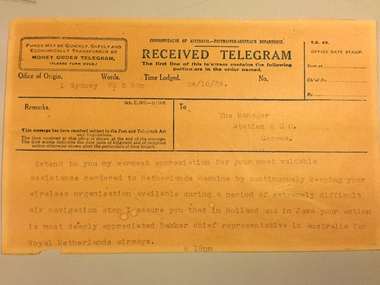 National Communication Museum
Document - Telegram, 24/10/1934
... deeply appreciated Bakker chief representative in Australia for / Royal Netherlands airways. / 6 18pm" Beige paper telegram printed with black ink and overwritten with typewriter. Telegram split into sections designating details of the telegram, details of the recipient and a space for the transmitted message. ...This telegram was sent from the Royal Netherlands Airways, Sydney, to the manager of ABC Radio Station 2CO, Corowa, New South Wales. This telegram relates to the 1934 London to Melbourne Air Race. The telegram records the Royal Netherlands Airways' thanks to ABC Radio 2CO radio staff for their efforts in broadcasting an emergency message to the residents of Albury after the Dutch airliner ‘Uiver’ became lost at night in bad weather. As requested local radio listeners drove their cars to the Albury racecourse and illuminated an emergency landing ground using their vehicle headlights. This allowed the lost airliner to land safely.This item relates to the London to Melbourne Air Race of 1934, a significant event that shaped Australia's history as it proved travelling to and from Australia could be done within a reasonable time by air, thereby making the country less isolated. Up to that time Australia was three weeks away from Europe by steam ship. The Air Race was dreamt up by the Lord Mayor of Melbourne, Harold Smith, to commemorate the centenary of Victoria's statehood and was sponsored by the Melbourne chocolate manufacturer Sir MacPherson Robertson. The Royal Netherlands Airways entered a Douglas DC2 plane 'Uiver' - the largest aircraft in the race, and the only one to carry passengers as well as crew, to show that a commercial passenger service to Australia was possible. But in the last leg of the race, the Uiver lost its way in an electrical storm over the Riverina town of Albury. Several communication methods were used to land the plane safely, including the signalling of the word "Albury" in Morse code using the town's street lights. Local ABC Radio station 2CO also made a call for locals to light up a makeshift landing strip for the plane at the town's racecourse. The plane landed safely and the next morning with the help of the townspeople who pulled it out of the mud, took off and finished the race in second place. The story of the Uiver points to the importance of communication in its various forms: two-way and broadcast radio, Morse, and light signals. The survival of the Uiver is a reflection of the ingenuity of Australian communications and the solutions that can be found through the sharing of ideas of information. The landing of the Uiver was an important moment in Albury's social history, as residents participated in the rescue of the plane and its passengers, helping the Uiver to continue on its journey and finish second in the Race. When the Uiver crashed in the Syrian Desert in December 1934, Albury residents contributed to a memorial which honoured those who were killed. Beige paper telegram printed with black ink and overwritten with typewriter. Telegram split into sections designating details of the telegram, details of the recipient and a space for the transmitted message. A small section of paper is missing from bottom left corner."Extend to you my warmest appreciation for your most valuable / assistance rendered to Netherlands machine by continuously keeping your / wireless organisation available during a period of extremely difficult / air navigation stop I assure you that in Holland and in Java your action / is most deeply appreciated Bakker chief representative in Australia for / Royal Netherlands airways. / 6 18pm"telegrams, telegraphic messages, communications, radio, uiver, royal netherlands airways, albury, london to melbourne air race, morse code -
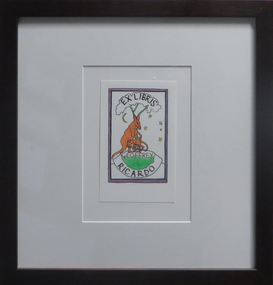 Federation University Art Collection
Artwork - bookplate, Geoffrey Ricardo, Ex Libris Geoffrey Ricardo, not dated
... GEOFFREY RICARDO (1964- ) Born Melbourne, Australia 1984-86 Bachelor of Arts (Fine Art), Printmaking, Chisholm Institute of Technology, Melbourne 1987-89 Printing Assistant at Bill Young Studios, Editioning intaglio prints, King Valley, VIC 1988 Full-time Studio Technician at Printmaking Department, Chisholm Institute of Technology, Melbourne 1989-90 Graduate Diploma (Fine Art), Printmaking, Monash University, Melbourne 1991 Traveled to England, France, Spain and USA (Winsor & Newton International Travelling Bursary, National Students Art Prize) Worked in private studios in Gaucin, Spain and New York, USA 1994-95 Master of Fine Arts, Monash University, Melbourne 1995 Guest Lecturer, Victorian College of the Arts, Melbourne Traveled to Europe and America 1996 Guest Lecturer, Royal Melbourne Institute of Technology, Melbourne 1990-98 Sessional Lecturer, Monash University, Melbourne 1998 Traveled to America and Mexico 2001-05 Sessional Lecturer, The Victorian College of the Arts, Melbourne 2003-10 Printmaking Workshops, Warrnambool TAFE, Warrnambool, VIC 2004 Traveled to Europe, Mexico and Cuba 2005 Lecturer, National Art School (Summer School), Sydney Sessional Lecturer, Monash University, Melbourne Lecturer, Institution of Koorie Education, Deakin University, Geelong, VIC SOLO EXHIBITIONS 2012 ‘Collection of Works’ The Art Vault Mildura ‘Deeper Meanings’, The Incinerator Gallery, Melbourne ‘Three Projects’, Australian Galleries, Glenmore Road, Sydney Melbourne Art Fair Stand F33, Australian Galleries, Melbourne 2009 ‘Anno Domino, Antarctica and The Anatomy Lesson’, Australian Galleries Derby Street, Melbourne The Art Vault, Mildura, VIC 2008 MV Orlova (Quark Expeditions), The Drake Passage, Antarctica 2007 ‘Herd’, BMGArt, Adelaide ‘Herd’, Australian Galleries Painting & Sculpture, Sydney 2006 ‘Herd’, Australian Galleries Painting & Sculpture, Melbourne 2004 ‘Recent work’, BMGArt, Adelaide 2003 ‘The Rapunzel Suite and Other New Works’, Australian Galleries Works on Paper, Sydney ‘Recent Works’, Australian Galleries Painting & Sculpture, Melbourne ‘Recent works’, Cowwarr Art Space, Cowwarr, VIC 2002 ‘The Rapunzel Suite’, Australian Galleries Works on Paper, Melbourne ‘Strange Games’, Australian Galleries Works on Paper, Sydney 1999 ‘A Dark City Narrative’, Australian Galleries Works on Paper, Sydney ‘A Dark City Narrative’, Australian Galleries Works on Paper, Melbourne 1998 Cullity Gallery, School of Architecture and Fine Art, University of Western Australia, Perth 1997 Delaney Gallery, Perth Chapman Gallery, Canberra BMGArt, Adelaide ‘Menagerie’, Australian Galleries, Sydney ‘Menagerie’, Australian Galleries, Melbourne 1995 ‘Paintings, Prints and Sculpture’, Australian Galleries, Sydney ‘Prints, Paintings and Sculpture’, Australian Galleries, Melbourne 1994 Lawrence Wilson Art Gallery, University of Western Australia, Perth Graham Galleries + Editions, Brisbane ‘Wishful Thinking, Prints and Sculptures’, Lawrence Wilson Art Gallery, University of Western Australia, Perth 1992 ‘Prints, Sculptures and Watercolours’, Australian Galleries, Melbourne and Sydney 1990 ‘Watercolours, Prints and Small Bronzes’, Australian Galleries, Sydney ‘Paintings, Prints and Sculptures’, Australian Galleries, Melbourne GROUP EXHIBITIONS 2013 ‘Sculpture by the Sea’ Cottlesloe, Western Australia 2012 ‘Brave New World’, Toyota Community Spirit Gallery, Port Melbourne, VIC ‘Sculpture by the Sea’, Bondi, Sydney 2011 ‘Sculpture by the sea’, Aarhus, Denmark ‘Artwork to Tapestry’, Tarrawarra Museum of Art, Healesville, VIC Burnie Print Prize, Burnie Regional Gallery, Burnie, TAS ‘large exhibition of small works’, Australian Galleries, Roylston Street, Sydney ‘large exhibition of small works’, Australian Galleries, Derby Street, Melbourne ‘Nature of the Mark’, Australian Galleries, Smith Street, Melbourne Rick Amor Print Prize, Montsalvat, Eltham, VIC 2010 ‘Summer show’, Australian Galleries, Glenmore Road, Sydney ‘Summer stock show’, Australian Galleries, Smith Street, Melbourne ‘Sub10’, Substation, Melbourne ‘McClelland Sculpture Survey and Award 2010’, McClelland Gallery + Sculpture Park, Langwarrin, VIC ‘Artists’ Prints made with Integrity I’, Australian Galleries, Smith Street, Melbourne Montalto Sculpture Prize, Montalto Vineyard and Olive Grove, Red Hill South, VIC 2009 ‘Artists’ ink: printmaking from the Warrnambool Art Gallery Collection, 1970-2001’, Ararat Regional Art Gallery, Ararat, VIC ‘Lorne Sculpture’ (Winner), Lorne, VIC 2008 ‘Summer Stock Show’, Australian Galleries Smith Street, Melbourne 2007 ARC Biennial (Art, Design and Craft), Queensland University of Technology Art Museum, Brisbane ‘Prints Tokyo: International Print Exhibition’, Tokyo, Japan Seoul International Print, Photo and Edition Works Art Fair, Seoul, Korea Guanlan International Print Biennial, Guanlan, China ‘Summer Stock Show’, Australian Galleries Works on Paper, Sydney ‘Summer Stock Show’, Australian Galleries Painting & Sculpture, Melbourne ‘Summer Stock Show’, Australian Galleries Works on Paper, Melbourne ‘Antipodean Bestiary’, Project Space / Spare Room, RMIT University, Melbourne Montalto Sculpture Prize, Montalto Vineyard and Olive Grove, Red Hill South, VIC McClelland Sculpture Survey and Award 2007, McClelland Gallery + Sculpture Park, Langwarrin, VIC ‘2007: Works from the studio’, Lancaster Press, Melbourne ‘50 - a print exchange portfolio’, Geelong Art Gallery, Geelong, VIC ‘Small Pleasures’, Australian Galleries Painting & Sculpture, Melbourne ‘Stock Show’, Australian Galleries Painting & Sculpture, Melbourne ‘Artists for Kids Culture’, Brightspace, Melbourne 2006 ‘Partnership or perish’, Academy of the Arts, School of Visual and Performing Arts, University of Tasmania, Hobart Libris Awards, Artspace Mackay, Mackay, QLD ‘Summery’, Australian Galleries Painting & Sculpture, Sydney ‘Summer Stock Show’, Australian Galleries Works on Paper, Melbourne ‘Bookish’, Australian Galleries Works on Paper, Melbourne Melbourne Art Fair, Australian Galleries, Melbourne ‘Artists for Kids Culture’, Brightspace, Melbourne ‘50th Anniversary Exhibition’, Australian Galleries Painting & Sculpture, Melbourne 2005 ‘End of Year Group Exhibition’, Australian Galleries Painting & Sculpture, Sydney ‘Contemporary Works on Paper’, Australian Galleries Works on Paper, Melbourne ‘Expansion’, Lancaster Press, Melbourne ‘The Art of Collaboration’, Singapore Tyler Print Institute, Singapore ‘Double take’, Arts Project Australia, Melbourne ‘Small Treasures - 20 emerging and established artists’, TILT Contemporary Art, Melbourne Jacques Cadry Memorial Art Prize, Fox Studios and State Library of NSW, Sydney ‘Tales of the City’, Australian Galleries Painting & Sculpture, Melbourne ‘A Decade of Collecting 1995-2005’, Cairns Regional Gallery, Cairns, QLD ‘Artists for Kids Culture’, Brightspace, Melbourne ‘Surface Tension: 21 Contemporary Australian Printmakers’, University of Tasmania, Launceston, TAS ‘Neo-millenium’, Toyota Community Spirit Gallery, Melbourne 2004 ‘Artists for Kids Culture’, Brightspace, Melbourne ‘Group Exhibition’, Australian Galleries Painting & Sculpture, Melbourne ‘Species’, Australian Galleries Works on Paper, Melbourne ‘In the presence of creatures great and small’, Australian Galleries Works on Paper, Sydney ‘Tapestries from the Victorian Tapestry Workshop’, Australian Galleries, Melbourne ‘Sculpture’, Australian Galleries Painting & Sculpture, Sydney ‘Contemporary Australian Prints’, National Arts Club, New York, USA ‘Contemporary Australian Prints’, Gallery 101, Melbourne ‘Contemporary Australian Prints from the Collection’, Art Gallery of New South Wales, Sydney ‘Bridge’, Toyota Community Spirit Gallery, Melbourne ‘Vivid’, Fortyfive Downstairs, Melbourne Lake Gallery, Paynesville, VIC 2003 ‘Paper matters’, Lawrence Wilson Art Gallery, University of Western Australia, Perth ‘Artists for Kids Culture’, Brightspace, Melbourne ‘Less is more’, BMGArt, Adelaide ‘The ink’s on me: Bill Young master printmaker’, Wangaratta Exhibitions Gallery, Wangaratta, VIC ‘Fantastic and Visionary Art’, Touring: Global Arts Link, QLD; Ipswich Regional Gallery, QLD ; Orange Regional Gallery, NSW; Manning Regional Gallery, NSW; Parramatta Heritage Centre, Sydney; Ballarat Regional Gallery, VIC 2002 Shell Fremantle Print Award, Fremantle Arts Centre, Fremantle, WA ‘Artists for Kids Culture’, Brightspace, Melbourne 2001 Shell Fremantle Print Award, Fremantle Arts Centre, Fremantle, WA ‘Six Degrees of Collaboration’, RMIT Faculty of Art, Design and Communication Gallery, Melbourne ‘Reciprocal Moves’, Warrnambool Art Gallery, Warrnambool, VIC International Print Triennial, Kanagawa, Japan ‘Fantastic Art’, Orange Regional Gallery, Orange, NSW ‘Dancing Made a Man out of Me’, The Switchback Gallery, Monash University, Gippsland, VIC ‘Artists for Kids Culture’, Brightspace, Melbourne ‘Celebration’, Regional touring exhibition, VIC 2000-01 ‘Workings of the Mind: Melbourne Prints of the 1960s to the 1990s’, Touring: Grafton Regional Gallery, NSW; Toowoomba Regional Art Gallery, QLD; Nolan Gallery, Canberra; Bendigo Art Gallery, VIC; PercTucker Regional Gallery, QLD 2000 Shell Fremantle Print Award, Fremantle Arts Centre, Fremantle, WA The Hutchins Art Prize, Long Gallery, Hobart ‘Artists for Kids Culture’, Brightspace, Melbourne 1999 Shell Fremantle Print Award, Fremantle Arts Space, Fremantle, WA ‘We are Australian’, George Adams Gallery, Victorian Arts Centre, Melbourne Rena Ellen Jones Memorial Print Award, Warrnambool Art Gallery, Warrnambool, VIC ‘National Works on Paper’, Mornington Peninsula Gallery, Mornington, VIC ‘Artists for Kids Culture’, Brightspace, Melbourne ‘Pleasure’, Australian Galleries, Melbourne 1998-99 ‘Australian Prints’, Art Gallery of New South Wales, Sydney 1997 ‘KNOCK, KNOCK’, Australian Galleries, Melbourne ‘Woven Colour, The Art of Tapestry’, Dr Earl Lu Gallery, Singapore 1996 M.P.A.C. ...GEOFFREY RICARDO (1964- ) Born Melbourne, Australia 1984-86 Bachelor of Arts (Fine Art), Printmaking, Chisholm Institute of Technology, Melbourne 1987-89 Printing Assistant at Bill Young Studios, Editioning intaglio prints, King Valley, VIC 1988 Full-time Studio Technician at Printmaking Department, Chisholm Institute of Technology, Melbourne 1989-90 Graduate Diploma (Fine Art), Printmaking, Monash University, Melbourne 1991 Traveled to England, France, Spain and USA (Winsor & Newton International Travelling Bursary, National Students Art Prize) Worked in private studios in Gaucin, Spain and New York, USA 1994-95 Master of Fine Arts, Monash University, Melbourne 1995 Guest Lecturer, Victorian College of the Arts, Melbourne Traveled to Europe and America 1996 Guest Lecturer, Royal Melbourne Institute of Technology, Melbourne 1990-98 Sessional Lecturer, Monash University, Melbourne 1998 Traveled to America and Mexico 2001-05 Sessional Lecturer, The Victorian College of the Arts, Melbourne 2003-10 Printmaking Workshops, Warrnambool TAFE, Warrnambool, VIC 2004 Traveled to Europe, Mexico and Cuba 2005 Lecturer, National Art School (Summer School), Sydney Sessional Lecturer, Monash University, Melbourne Lecturer, Institution of Koorie Education, Deakin University, Geelong, VIC SOLO EXHIBITIONS 2012 ‘Collection of Works’ The Art Vault Mildura ‘Deeper Meanings’, The Incinerator Gallery, Melbourne ‘Three Projects’, Australian Galleries, Glenmore Road, Sydney Melbourne Art Fair Stand F33, Australian Galleries, Melbourne 2009 ‘Anno Domino, Antarctica and The Anatomy Lesson’, Australian Galleries Derby Street, Melbourne The Art Vault, Mildura, VIC 2008 MV Orlova (Quark Expeditions), The Drake Passage, Antarctica 2007 ‘Herd’, BMGArt, Adelaide ‘Herd’, Australian Galleries Painting & Sculpture, Sydney 2006 ‘Herd’, Australian Galleries Painting & Sculpture, Melbourne 2004 ‘Recent work’, BMGArt, Adelaide 2003 ‘The Rapunzel Suite and Other New Works’, Australian Galleries Works on Paper, Sydney ‘Recent Works’, Australian Galleries Painting & Sculpture, Melbourne ‘Recent works’, Cowwarr Art Space, Cowwarr, VIC 2002 ‘The Rapunzel Suite’, Australian Galleries Works on Paper, Melbourne ‘Strange Games’, Australian Galleries Works on Paper, Sydney 1999 ‘A Dark City Narrative’, Australian Galleries Works on Paper, Sydney ‘A Dark City Narrative’, Australian Galleries Works on Paper, Melbourne 1998 Cullity Gallery, School of Architecture and Fine Art, University of Western Australia, Perth 1997 Delaney Gallery, Perth Chapman Gallery, Canberra BMGArt, Adelaide ‘Menagerie’, Australian Galleries, Sydney ‘Menagerie’, Australian Galleries, Melbourne 1995 ‘Paintings, Prints and Sculpture’, Australian Galleries, Sydney ‘Prints, Paintings and Sculpture’, Australian Galleries, Melbourne 1994 Lawrence Wilson Art Gallery, University of Western Australia, Perth Graham Galleries + Editions, Brisbane ‘Wishful Thinking, Prints and Sculptures’, Lawrence Wilson Art Gallery, University of Western Australia, Perth 1992 ‘Prints, Sculptures and Watercolours’, Australian Galleries, Melbourne and Sydney 1990 ‘Watercolours, Prints and Small Bronzes’, Australian Galleries, Sydney ‘Paintings, Prints and Sculptures’, Australian Galleries, Melbourne GROUP EXHIBITIONS 2013 ‘Sculpture by the Sea’ Cottlesloe, Western Australia 2012 ‘Brave New World’, Toyota Community Spirit Gallery, Port Melbourne, VIC ‘Sculpture by the Sea’, Bondi, Sydney 2011 ‘Sculpture by the sea’, Aarhus, Denmark ‘Artwork to Tapestry’, Tarrawarra Museum of Art, Healesville, VIC Burnie Print Prize, Burnie Regional Gallery, Burnie, TAS ‘large exhibition of small works’, Australian Galleries, Roylston Street, Sydney ‘large exhibition of small works’, Australian Galleries, Derby Street, Melbourne ‘Nature of the Mark’, Australian Galleries, Smith Street, Melbourne Rick Amor Print Prize, Montsalvat, Eltham, VIC 2010 ‘Summer show’, Australian Galleries, Glenmore Road, Sydney ‘Summer stock show’, Australian Galleries, Smith Street, Melbourne ‘Sub10’, Substation, Melbourne ‘McClelland Sculpture Survey and Award 2010’, McClelland Gallery + Sculpture Park, Langwarrin, VIC ‘Artists’ Prints made with Integrity I’, Australian Galleries, Smith Street, Melbourne Montalto Sculpture Prize, Montalto Vineyard and Olive Grove, Red Hill South, VIC 2009 ‘Artists’ ink: printmaking from the Warrnambool Art Gallery Collection, 1970-2001’, Ararat Regional Art Gallery, Ararat, VIC ‘Lorne Sculpture’ (Winner), Lorne, VIC 2008 ‘Summer Stock Show’, Australian Galleries Smith Street, Melbourne 2007 ARC Biennial (Art, Design and Craft), Queensland University of Technology Art Museum, Brisbane ‘Prints Tokyo: International Print Exhibition’, Tokyo, Japan Seoul International Print, Photo and Edition Works Art Fair, Seoul, Korea Guanlan International Print Biennial, Guanlan, China ‘Summer Stock Show’, Australian Galleries Works on Paper, Sydney ‘Summer Stock Show’, Australian Galleries Painting & Sculpture, Melbourne ‘Summer Stock Show’, Australian Galleries Works on Paper, Melbourne ‘Antipodean Bestiary’, Project Space / Spare Room, RMIT University, Melbourne Montalto Sculpture Prize, Montalto Vineyard and Olive Grove, Red Hill South, VIC McClelland Sculpture Survey and Award 2007, McClelland Gallery + Sculpture Park, Langwarrin, VIC ‘2007: Works from the studio’, Lancaster Press, Melbourne ‘50 - a print exchange portfolio’, Geelong Art Gallery, Geelong, VIC ‘Small Pleasures’, Australian Galleries Painting & Sculpture, Melbourne ‘Stock Show’, Australian Galleries Painting & Sculpture, Melbourne ‘Artists for Kids Culture’, Brightspace, Melbourne 2006 ‘Partnership or perish’, Academy of the Arts, School of Visual and Performing Arts, University of Tasmania, Hobart Libris Awards, Artspace Mackay, Mackay, QLD ‘Summery’, Australian Galleries Painting & Sculpture, Sydney ‘Summer Stock Show’, Australian Galleries Works on Paper, Melbourne ‘Bookish’, Australian Galleries Works on Paper, Melbourne Melbourne Art Fair, Australian Galleries, Melbourne ‘Artists for Kids Culture’, Brightspace, Melbourne ‘50th Anniversary Exhibition’, Australian Galleries Painting & Sculpture, Melbourne 2005 ‘End of Year Group Exhibition’, Australian Galleries Painting & Sculpture, Sydney ‘Contemporary Works on Paper’, Australian Galleries Works on Paper, Melbourne ‘Expansion’, Lancaster Press, Melbourne ‘The Art of Collaboration’, Singapore Tyler Print Institute, Singapore ‘Double take’, Arts Project Australia, Melbourne ‘Small Treasures - 20 emerging and established artists’, TILT Contemporary Art, Melbourne Jacques Cadry Memorial Art Prize, Fox Studios and State Library of NSW, Sydney ‘Tales of the City’, Australian Galleries Painting & Sculpture, Melbourne ‘A Decade of Collecting 1995-2005’, Cairns Regional Gallery, Cairns, QLD ‘Artists for Kids Culture’, Brightspace, Melbourne ‘Surface Tension: 21 Contemporary Australian Printmakers’, University of Tasmania, Launceston, TAS ‘Neo-millenium’, Toyota Community Spirit Gallery, Melbourne 2004 ‘Artists for Kids Culture’, Brightspace, Melbourne ‘Group Exhibition’, Australian Galleries Painting & Sculpture, Melbourne ‘Species’, Australian Galleries Works on Paper, Melbourne ‘In the presence of creatures great and small’, Australian Galleries Works on Paper, Sydney ‘Tapestries from the Victorian Tapestry Workshop’, Australian Galleries, Melbourne ‘Sculpture’, Australian Galleries Painting & Sculpture, Sydney ‘Contemporary Australian Prints’, National Arts Club, New York, USA ‘Contemporary Australian Prints’, Gallery 101, Melbourne ‘Contemporary Australian Prints from the Collection’, Art Gallery of New South Wales, Sydney ‘Bridge’, Toyota Community Spirit Gallery, Melbourne ‘Vivid’, Fortyfive Downstairs, Melbourne Lake Gallery, Paynesville, VIC 2003 ‘Paper matters’, Lawrence Wilson Art Gallery, University of Western Australia, Perth ‘Artists for Kids Culture’, Brightspace, Melbourne ‘Less is more’, BMGArt, Adelaide ‘The ink’s on me: Bill Young master printmaker’, Wangaratta Exhibitions Gallery, Wangaratta, VIC ‘Fantastic and Visionary Art’, Touring: Global Arts Link, QLD; Ipswich Regional Gallery, QLD ; Orange Regional Gallery, NSW; Manning Regional Gallery, NSW; Parramatta Heritage Centre, Sydney; Ballarat Regional Gallery, VIC 2002 Shell Fremantle Print Award, Fremantle Arts Centre, Fremantle, WA ‘Artists for Kids Culture’, Brightspace, Melbourne 2001 Shell Fremantle Print Award, Fremantle Arts Centre, Fremantle, WA ‘Six Degrees of Collaboration’, RMIT Faculty of Art, Design and Communication Gallery, Melbourne ‘Reciprocal Moves’, Warrnambool Art Gallery, Warrnambool, VIC International Print Triennial, Kanagawa, Japan ‘Fantastic Art’, Orange Regional Gallery, Orange, NSW ‘Dancing Made a Man out of Me’, The Switchback Gallery, Monash University, Gippsland, VIC ‘Artists for Kids Culture’, Brightspace, Melbourne ‘Celebration’, Regional touring exhibition, VIC 2000-01 ‘Workings of the Mind: Melbourne Prints of the 1960s to the 1990s’, Touring: Grafton Regional Gallery, NSW; Toowoomba Regional Art Gallery, QLD; Nolan Gallery, Canberra; Bendigo Art Gallery, VIC; PercTucker Regional Gallery, QLD 2000 Shell Fremantle Print Award, Fremantle Arts Centre, Fremantle, WA The Hutchins Art Prize, Long Gallery, Hobart ‘Artists for Kids Culture’, Brightspace, Melbourne 1999 Shell Fremantle Print Award, Fremantle Arts Space, Fremantle, WA ‘We are Australian’, George Adams Gallery, Victorian Arts Centre, Melbourne Rena Ellen Jones Memorial Print Award, Warrnambool Art Gallery, Warrnambool, VIC ‘National Works on Paper’, Mornington Peninsula Gallery, Mornington, VIC ‘Artists for Kids Culture’, Brightspace, Melbourne ‘Pleasure’, Australian Galleries, Melbourne 1998-99 ‘Australian Prints’, Art Gallery of New South Wales, Sydney 1997 ‘KNOCK, KNOCK’, Australian Galleries, Melbourne ‘Woven Colour, The Art of Tapestry’, Dr Earl Lu Gallery, Singapore 1996 M.P.A.C. ...GEOFFREY RICARDO (1964- ) Born Melbourne, Australia 1984-86 Bachelor of Arts (Fine Art), Printmaking, Chisholm Institute of Technology, Melbourne 1987-89 Printing Assistant at Bill Young Studios, Editioning intaglio prints, King Valley, VIC 1988 Full-time Studio Technician at Printmaking Department, Chisholm Institute of Technology, Melbourne 1989-90 Graduate Diploma (Fine Art), Printmaking, Monash University, Melbourne 1991 Traveled to England, France, Spain and USA (Winsor & Newton International Travelling Bursary, National Students Art Prize) Worked in private studios in Gaucin, Spain and New York, USA 1994-95 Master of Fine Arts, Monash University, Melbourne 1995 Guest Lecturer, Victorian College of the Arts, Melbourne Traveled to Europe and America 1996 Guest Lecturer, Royal Melbourne Institute of Technology, Melbourne 1990-98 Sessional Lecturer, Monash University, Melbourne 1998 Traveled to America and Mexico 2001-05 Sessional Lecturer, The Victorian College of the Arts, Melbourne 2003-10 Printmaking Workshops, Warrnambool TAFE, Warrnambool, VIC 2004 Traveled to Europe, Mexico and Cuba 2005 Lecturer, National Art School (Summer School), Sydney Sessional Lecturer, Monash University, Melbourne Lecturer, Institution of Koorie Education, Deakin University, Geelong, VIC SOLO EXHIBITIONS 2012 ‘Collection of Works’ The Art Vault Mildura ‘Deeper Meanings’, The Incinerator Gallery, Melbourne ‘Three Projects’, Australian Galleries, Glenmore Road, Sydney Melbourne Art Fair Stand F33, Australian Galleries, Melbourne 2009 ‘Anno Domino, Antarctica and The Anatomy Lesson’, Australian Galleries Derby Street, Melbourne The Art Vault, Mildura, VIC 2008 MV Orlova (Quark Expeditions), The Drake Passage, Antarctica 2007 ‘Herd’, BMGArt, Adelaide ‘Herd’, Australian Galleries Painting & Sculpture, Sydney 2006 ‘Herd’, Australian Galleries Painting & Sculpture, Melbourne 2004 ‘Recent work’, BMGArt, Adelaide 2003 ‘The Rapunzel Suite and Other New Works’, Australian Galleries Works on Paper, Sydney ‘Recent Works’, Australian Galleries Painting & Sculpture, Melbourne ‘Recent works’, Cowwarr Art Space, Cowwarr, VIC 2002 ‘The Rapunzel Suite’, Australian Galleries Works on Paper, Melbourne ‘Strange Games’, Australian Galleries Works on Paper, Sydney 1999 ‘A Dark City Narrative’, Australian Galleries Works on Paper, Sydney ‘A Dark City Narrative’, Australian Galleries Works on Paper, Melbourne 1998 Cullity Gallery, School of Architecture and Fine Art, University of Western Australia, Perth 1997 Delaney Gallery, Perth Chapman Gallery, Canberra BMGArt, Adelaide ‘Menagerie’, Australian Galleries, Sydney ‘Menagerie’, Australian Galleries, Melbourne 1995 ‘Paintings, Prints and Sculpture’, Australian Galleries, Sydney ‘Prints, Paintings and Sculpture’, Australian Galleries, Melbourne 1994 Lawrence Wilson Art Gallery, University of Western Australia, Perth Graham Galleries + Editions, Brisbane ‘Wishful Thinking, Prints and Sculptures’, Lawrence Wilson Art Gallery, University of Western Australia, Perth 1992 ‘Prints, Sculptures and Watercolours’, Australian Galleries, Melbourne and Sydney 1990 ‘Watercolours, Prints and Small Bronzes’, Australian Galleries, Sydney ‘Paintings, Prints and Sculptures’, Australian Galleries, Melbourne GROUP EXHIBITIONS 2013 ‘Sculpture by the Sea’ Cottlesloe, Western Australia 2012 ‘Brave New World’, Toyota Community Spirit Gallery, Port Melbourne, VIC ‘Sculpture by the Sea’, Bondi, Sydney 2011 ‘Sculpture by the sea’, Aarhus, Denmark ‘Artwork to Tapestry’, Tarrawarra Museum of Art, Healesville, VIC Burnie Print Prize, Burnie Regional Gallery, Burnie, TAS ‘large exhibition of small works’, Australian Galleries, Roylston Street, Sydney ‘large exhibition of small works’, Australian Galleries, Derby Street, Melbourne ‘Nature of the Mark’, Australian Galleries, Smith Street, Melbourne Rick Amor Print Prize, Montsalvat, Eltham, VIC 2010 ‘Summer show’, Australian Galleries, Glenmore Road, Sydney ‘Summer stock show’, Australian Galleries, Smith Street, Melbourne ‘Sub10’, Substation, Melbourne ‘McClelland Sculpture Survey and Award 2010’, McClelland Gallery + Sculpture Park, Langwarrin, VIC ‘Artists’ Prints made with Integrity I’, Australian Galleries, Smith Street, Melbourne Montalto Sculpture Prize, Montalto Vineyard and Olive Grove, Red Hill South, VIC 2009 ‘Artists’ ink: printmaking from the Warrnambool Art Gallery Collection, 1970-2001’, Ararat Regional Art Gallery, Ararat, VIC ‘Lorne Sculpture’ (Winner), Lorne, VIC 2008 ‘Summer Stock Show’, Australian Galleries Smith Street, Melbourne 2007 ARC Biennial (Art, Design and Craft), Queensland University of Technology Art Museum, Brisbane ‘Prints Tokyo: International Print Exhibition’, Tokyo, Japan Seoul International Print, Photo and Edition Works Art Fair, Seoul, Korea Guanlan International Print Biennial, Guanlan, China ‘Summer Stock Show’, Australian Galleries Works on Paper, Sydney ‘Summer Stock Show’, Australian Galleries Painting & Sculpture, Melbourne ‘Summer Stock Show’, Australian Galleries Works on Paper, Melbourne ‘Antipodean Bestiary’, Project Space / Spare Room, RMIT University, Melbourne Montalto Sculpture Prize, Montalto Vineyard and Olive Grove, Red Hill South, VIC McClelland Sculpture Survey and Award 2007, McClelland Gallery + Sculpture Park, Langwarrin, VIC ‘2007: Works from the studio’, Lancaster Press, Melbourne ‘50 - a print exchange portfolio’, Geelong Art Gallery, Geelong, VIC ‘Small Pleasures’, Australian Galleries Painting & Sculpture, Melbourne ‘Stock Show’, Australian Galleries Painting & Sculpture, Melbourne ‘Artists for Kids Culture’, Brightspace, Melbourne 2006 ‘Partnership or perish’, Academy of the Arts, School of Visual and Performing Arts, University of Tasmania, Hobart Libris Awards, Artspace Mackay, Mackay, QLD ‘Summery’, Australian Galleries Painting & Sculpture, Sydney ‘Summer Stock Show’, Australian Galleries Works on Paper, Melbourne ‘Bookish’, Australian Galleries Works on Paper, Melbourne Melbourne Art Fair, Australian Galleries, Melbourne ‘Artists for Kids Culture’, Brightspace, Melbourne ‘50th Anniversary Exhibition’, Australian Galleries Painting & Sculpture, Melbourne 2005 ‘End of Year Group Exhibition’, Australian Galleries Painting & Sculpture, Sydney ‘Contemporary Works on Paper’, Australian Galleries Works on Paper, Melbourne ‘Expansion’, Lancaster Press, Melbourne ‘The Art of Collaboration’, Singapore Tyler Print Institute, Singapore ‘Double take’, Arts Project Australia, Melbourne ‘Small Treasures - 20 emerging and established artists’, TILT Contemporary Art, Melbourne Jacques Cadry Memorial Art Prize, Fox Studios and State Library of NSW, Sydney ‘Tales of the City’, Australian Galleries Painting & Sculpture, Melbourne ‘A Decade of Collecting 1995-2005’, Cairns Regional Gallery, Cairns, QLD ‘Artists for Kids Culture’, Brightspace, Melbourne ‘Surface Tension: 21 Contemporary Australian Printmakers’, University of Tasmania, Launceston, TAS ‘Neo-millenium’, Toyota Community Spirit Gallery, Melbourne 2004 ‘Artists for Kids Culture’, Brightspace, Melbourne ‘Group Exhibition’, Australian Galleries Painting & Sculpture, Melbourne ‘Species’, Australian Galleries Works on Paper, Melbourne ‘In the presence of creatures great and small’, Australian Galleries Works on Paper, Sydney ‘Tapestries from the Victorian Tapestry Workshop’, Australian Galleries, Melbourne ‘Sculpture’, Australian Galleries Painting & Sculpture, Sydney ‘Contemporary Australian Prints’, National Arts Club, New York, USA ‘Contemporary Australian Prints’, Gallery 101, Melbourne ‘Contemporary Australian Prints from the Collection’, Art Gallery of New South Wales, Sydney ‘Bridge’, Toyota Community Spirit Gallery, Melbourne ‘Vivid’, Fortyfive Downstairs, Melbourne Lake Gallery, Paynesville, VIC 2003 ‘Paper matters’, Lawrence Wilson Art Gallery, University of Western Australia, Perth ‘Artists for Kids Culture’, Brightspace, Melbourne ‘Less is more’, BMGArt, Adelaide ‘The ink’s on me: Bill Young master printmaker’, Wangaratta Exhibitions Gallery, Wangaratta, VIC ‘Fantastic and Visionary Art’, Touring: Global Arts Link, QLD; Ipswich Regional Gallery, QLD ; Orange Regional Gallery, NSW; Manning Regional Gallery, NSW; Parramatta Heritage Centre, Sydney; Ballarat Regional Gallery, VIC 2002 Shell Fremantle Print Award, Fremantle Arts Centre, Fremantle, WA ‘Artists for Kids Culture’, Brightspace, Melbourne 2001 Shell Fremantle Print Award, Fremantle Arts Centre, Fremantle, WA ‘Six Degrees of Collaboration’, RMIT Faculty of Art, Design and Communication Gallery, Melbourne ‘Reciprocal Moves’, Warrnambool Art Gallery, Warrnambool, VIC International Print Triennial, Kanagawa, Japan ‘Fantastic Art’, Orange Regional Gallery, Orange, NSW ‘Dancing Made a Man out of Me’, The Switchback Gallery, Monash University, Gippsland, VIC ‘Artists for Kids Culture’, Brightspace, Melbourne ‘Celebration’, Regional touring exhibition, VIC 2000-01 ‘Workings of the Mind: Melbourne Prints of the 1960s to the 1990s’, Touring: Grafton Regional Gallery, NSW; Toowoomba Regional Art Gallery, QLD; Nolan Gallery, Canberra; Bendigo Art Gallery, VIC; PercTucker Regional Gallery, QLD 2000 Shell Fremantle Print Award, Fremantle Arts Centre, Fremantle, WA The Hutchins Art Prize, Long Gallery, Hobart ‘Artists for Kids Culture’, Brightspace, Melbourne 1999 Shell Fremantle Print Award, Fremantle Arts Space, Fremantle, WA ‘We are Australian’, George Adams Gallery, Victorian Arts Centre, Melbourne Rena Ellen Jones Memorial Print Award, Warrnambool Art Gallery, Warrnambool, VIC ‘National Works on Paper’, Mornington Peninsula Gallery, Mornington, VIC ‘Artists for Kids Culture’, Brightspace, Melbourne ‘Pleasure’, Australian Galleries, Melbourne 1998-99 ‘Australian Prints’, Art Gallery of New South Wales, Sydney 1997 ‘KNOCK, KNOCK’, Australian Galleries, Melbourne ‘Woven Colour, The Art of Tapestry’, Dr Earl Lu Gallery, Singapore 1996 M.P.A.C. Print Award, Mornington Peninsula Arts Centre, Mornington, VIC Academy of Art & Culture, Calcutta, India ‘Synergy’, Touring: Lalit Kala Akademi, New Dehli, India; Jehangir Nicholson Gallery, Bombay, India; Birla, India ‘Contemporary Australian Tapestry’, Frederikshavn Kunstmuseum, Denmark; Australia House, London, UK 1995 ‘Interweave - Tapestry A Collaborative Art’, Heide Museum of Modern Art, Melbourne ‘Contemporary Printmakers’, La Trobe Regional Gallery, Morwell, VIC ‘Contemporary Australian Tapestry’, Australian High Commission, Singapore ‘Circus Capers’, Caulfield Arts Complex, Melbourne 1994 M.P.A.C. Print Award, Mornington Peninsula Arts Centre, Mornington, VIC Fremantle Print Award, Fremantle Arts Centre, Fremantle, WA Australian Universities of Visual Art, Australian High Commission, Singapore ‘Prints, Paintings and Sculpture’, BMGArt, Adelaide Fourth Australian Contemporary Art Fair, Royal Exhibition Building, Melbourne 1993 Fremantle Print Award, Fremantle Arts Centre, Fremantle, WA 1992 Fremantle Print Award, Fremantle Arts Centre, Fremantle, WA ‘Transitional Times’, Print Council of Australia, Melbourne ‘Second Kochi International Triennial Exhibition of Prints’, Japan 1991 Henry Worland Memorial Print Prize, Warrnambool Regional Art Gallery, Warrnambool, VIC Fremantle Print Award, Fremantle Arts Centre, Fremantle, WA ‘Table Top Sculpture’, Australian Galleries, Melbourne ‘Art 91’, London Contemporary Art Fair, London, UK 1990 M.P.A.C. Print Prize, Mornington Peninsula Arts Centre, Mornington, VIC Fremantle Print Prize, Fremantle Arts Centre, Fremantle WA ‘The Christmas Show’, Intaglio Printmaker, London, England ‘Australian Contemporary Art’, AZ Gallery, Tokyo, Japan 1989 National Student Art Prize, Mitchell College, Bathurst, NSW Fremantle Print Award, Fremantle Arts Centre, Fremantle, WA City of Doncaster Acquisitive Print Prize, Manningham Gallery, Melbourne ‘Affiliations’, Monash University Gallery, Melbourne 1988 M.P.A.C. Acquisitive Print Prize, Mornington Peninsula Arts Centre, Mornington, VIC Henry Worland Memorial Print Prize, Warrnambool Regional Art Gallery, Warrnambool, VIC 1987 ‘The Comedy Show’, Print Guild, Melbourne ‘Fluxus Art Flow’, Melbourne 1986 Mornington Peninsula Arts Council Acquisitive Print Prize, Mornington Peninsula, VIC Chisolm Institute of Technology, Graduating Students exhibition, Melbourne AWARDS 2013 King Valley Art Prize (printmaking) 2009 Lorne Sculpture Exhibition (Winner), Lorne, VIC 1989 Windsor and Newton International Travelling Bursary, UK Linbrook International First Prize for Printmaking, Australia COMMISSIONS 2005 Tapestry design for Bairnsdale Hospital (woven by the Victorian Tapestry Workshop, Melbourne), Bairnsdale, VIC 1999 Tapestry design ‘Emblem’ (woven by the Victorian Tapestry Workshop, Melbourne), Australia 1995 ‘A Night of Infectious Laughter’ Poster, St Kilda Festival, Melbourne 1994 Tapestry design ‘Elephant Gingham’ (woven by the Victorian Tapestry Workshop, Melbourne), Australia 1993 Tapestry design for the Festival of Perth Official Poster (woven by the Victorian Tapestry Workshop, Melbourne), Perth RESIDENCIES & PROJECTS 2013 ‘Come In Outside’, Collaboration set design for Pocketfool 2011 Mildura Wentworth Arts Festival Project, Mildura, VIC Residency, The Art Vault , Mildura, VIC 2010 ‘Wish’, Collaboration set design for Pocketfool, Artplay, Melbourne The Art Vault (included continuous public flag making workshops which were flown as part of The Wentworth Mildura Art Festival), Mildura, VIC 2009 The Art Vault (included two public printmaking workshops), Mildura, VIC 2008 Artist in residence, MV Orlova, Quark Expeditions, Antarctica 2003 Residency, Bairnsdale Regional Health Service, Bairnsdale, VIC 1998 Residency, School of Architecture & Fine Art, University of Western Australia, Perth 1997 Residency, La Salle/Fia, College of the Arts, Singapore 1996 Artist in residence, Victorian Tapestry Workshop, Melbourne 1993 Reduction Aquatint Workshop & Residency, Graphic Investigation Department, Canberra School of Art, Canberra NB: all residencies have included workshops involving students, children or the general public COLLECTIONS Artbank, Sydney Art Gallery of New South Wales, Sydney Canson Australia Pty Ltd, Australia City of Box Hill, Melbourne City of Whitehorse, Melbourne Downlands College, Toowoomba, QLD Geelong Grammar School, Geelong, VIC Gold Coast City Art Gallery, Gold Coast, QLD Griffith University, Gold Coast, QLD Helensvale High School, Brisbane Holmes à Court Collection, Perth Latrobe Regional Gallery, Morwell, VIC Monash University, Melbourne Mornington Peninsula Arts Council Collection, Mornington, VIC National Gallery of Australia, Canberra National Gallery of Victoria, Melbourne Parliament House Art Collection, Canberra Print Council of Australia, Melbourne Private collections in Australia, Switzerland, USA, UK, Singapore, Germany, Japan, Malaysia, Holland Queen Victoria Museum & Art Gallery, Launceston, TAS Queensland Art Gallery, Brisbane Queensland University of Technology, Brisbane Shire of Diamond Valley, Diamond Valley, VIC Star of the Sea College, Melbourne The Melbourne Club, Melbourne University of Central Queensland, Brisbane University of Technology, Sydney Wagga Wagga Regional Art Gallery, Wagga Wagga, NSW Warrnambool Regional Art Gallery, Warrnambool, VIC BIBLIOGRAPHY PERIODICALS AQ Journal of Contemporary Analysis, Vol. 70, Issue 4, July-August 1998 AQ Journal of Contemporary Analysis, Vol. 70, Issue 6, November-December 1998 AQ Journal of Contemporary Analysis, Vol.71, Issue 7, April 1999 Backhouse, Megan; “Going out of print and back to basics”, The Age, February 2003 Bellamy, Louise; “Renaissance of Western Art”, The Age (A2 section), 26 November 2005 Clabburn, Anna; “Fables and Foibles”, Art Monthly, September 1994 Dutkiewicz, Adam; “Edge of the sublime”, Advertiser, 1 December 2003, p. 76. Erickson, Dorothy; “The Festival that could have been”, The Bulletin, March 1994 Farmer, Alison; “Ricardo makes poster splash”, Sunday Times - Entertainment Extra, 19 September 1993 “Festival taps weaver’s art”, The West Australian, 11February 1994 Fiasco (web-page), March 2003 Jenkins, John; “A Dark City Narrative”, Imprint, Vol. 34, No. 4, 1999 Grishin, Sasha; “Multiplicity – collecting Australian prints”, Australian Art Review, Issue 13, March-June 2007, pp. 52-55 Grishin, Sasha; “Profiles in Print - Geoffrey Ricardo”, Craft Arts International, Issue 76, 2009, pp.1-4 Lloyd, Tim; “The elephant man”, The Advertiser (Review section), December 2007 Manzana Arné, Josep; “De L’Ex-Libris a L’Ex-Webis: Ex-Libris a Internet”, Ex-Libris, Associació Catalana D’Exlibristes, Barcelona, No. 27, July-December 2002, p.11 McDonald, John; “Dreams of hope and menace” The Sydney Morning Herald, 18 March 1995 McMillan, Peter; “Darkness visible”, The Age, 11September 1999 Nelson, Robert; “Circuses can be curated, but not cured”, The Age, 18 January 1995 Nelson, Robert; “Dream Weavers”, The Age, June 1995 Nelson, Robert; “Paen To Ricardo”, Imprint, Vol. 29, No.1, April, 1994 Nelson, Robert; “Revealed: Mother Nature’s vulgar past”, The Age, September 6, 2000 Nelson, Robert; “Riddled with hidden meaning”, The Age, September 8, 1999 Quadrant, April, 1995 Quadrant, Jan/Feb, 1995 Quadrant, October, 1995 Quadrant, November, 1994 “Ricardo’s surreal works at gallery”, Times-Spectator, 25 July 2003, p.7 Snell, Ted; “Art”, The Australian, 18 February1994 Snell, Ted; “Visual arts at the Festival of Perth”, Art Monthly, April 1994 Sunday Arts, ABC TV, 6 May 2007 Timms, Peter; “Geoff Ricardo: emerging from darkness”, Art Monthly, Issue 140, June 2001 Wallace, Dr Carmel; “Ways of seeing Australia”, Asian Art News, May/June 2004 BOOKS & CATALOGUES A Dark City Narrative, Australian Galleries, Melbourne, 1999 ARC Biennial Exhibition (Exhibition catalogue), Queensland University of Technology Art Museum, 2007, pp. 78-79 Clabburn, Anna; “The Collaborative Spirit”, Australian Tapestries: Victorian Tapestry Workshop, 1995, p. 37 Fantastic Art, Orange Regional Gallery, NSW, 2001 Field, Caroline; Herd, catalogue essay, Australian Galleries, Sydney, 2007 Grishin, Sasha; Australian Identities in Printmaking, Wagga Wagga Regional Art Gallery, 2000 Grishin, Sasha; Australian Printmaking in the 1990’s, Craftsman House, 1997 Havighurst, Sophie (Illustrations by Geoffrey Ricardo); When Lester lost his cool, The University of Melbourne, 2007 Kolenberg, Hendrik & Ryan, Anne; Australian Prints, Art Gallery of New South Wales, 1998 Lawrence, Michel; Framed; photographs of Australian Artists, 1998 Modern Australian Tapestries, Victorian Tapestry Workshop, 2000 The Rapunzel Suite, Australian Galleries, Melbourne, 2002 Wallace, Dr Carmel (Essay); Surface Tension, Twenty One Contemporary Australian Printmakers, Gallery 101, Melbourne, 2004 Workings of the Mind : Melbourne Prints of the 1960s to the 1990s, Queensland University of Technology Art Museum, Brisbane, 2000 TELEVISION Sunday Arts, ABC TV, 6 May 2007 Inside Art TV, Channel 31, July 2012Framed bookplategeoffrey ricardo, bookplates, kangaroo -
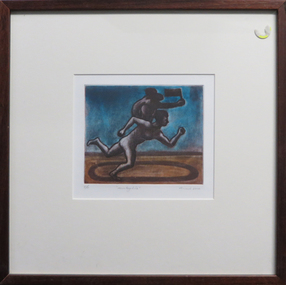 Federation University Art Collection
Work on paper - Artwork - Printmaking, Geoffrey Ricardo, 'Monkeyshine' by Geoffrey Ricardo, 2000
... GEOFFREY RICARDO (1964- ) Born Melbourne, Australia 1984-86 Bachelor of Arts (Fine Art), Printmaking, Chisholm Institute of Technology, Melbourne 1987-89 Printing Assistant at Bill Young Studios, Editioning intaglio prints, King Valley, VIC 1988 Full-time Studio Technician at Printmaking Department, Chisholm Institute of Technology, Melbourne 1989-90 Graduate Diploma (Fine Art), Printmaking, Monash University, Melbourne 1991 Traveled to England, France, Spain and USA (Winsor & Newton International Travelling Bursary, National Students Art Prize) Worked in private studios in Gaucin, Spain and New York, USA 1994-95 Master of Fine Arts, Monash University, Melbourne 1995 Guest Lecturer, Victorian College of the Arts, Melbourne Traveled to Europe and America 1996 Guest Lecturer, Royal Melbourne Institute of Technology, Melbourne 1990-98 Sessional Lecturer, Monash University, Melbourne 1998 Traveled to America and Mexico 2001-05 Sessional Lecturer, The Victorian College of the Arts, Melbourne 2003-10 Printmaking Workshops, Warrnambool TAFE, Warrnambool, VIC 2004 Traveled to Europe, Mexico and Cuba 2005 Lecturer, National Art School (Summer School), Sydney Sessional Lecturer, Monash University, Melbourne Lecturer, Institution of Koorie Education, Deakin University, Geelong, VIC SOLO EXHIBITIONS 2012 ‘Collection of Works’ The Art Vault Mildura ‘Deeper Meanings’, The Incinerator Gallery, Melbourne ‘Three Projects’, Australian Galleries, Glenmore Road, Sydney Melbourne Art Fair Stand F33, Australian Galleries, Melbourne 2009 ‘Anno Domino, Antarctica and The Anatomy Lesson’, Australian Galleries Derby Street, Melbourne The Art Vault, Mildura, VIC 2008 MV Orlova (Quark Expeditions), The Drake Passage, Antarctica 2007 ‘Herd’, BMGArt, Adelaide ‘Herd’, Australian Galleries Painting & Sculpture, Sydney 2006 ‘Herd’, Australian Galleries Painting & Sculpture, Melbourne 2004 ‘Recent work’, BMGArt, Adelaide 2003 ‘The Rapunzel Suite and Other New Works’, Australian Galleries Works on Paper, Sydney ‘Recent Works’, Australian Galleries Painting & Sculpture, Melbourne ‘Recent works’, Cowwarr Art Space, Cowwarr, VIC 2002 ‘The Rapunzel Suite’, Australian Galleries Works on Paper, Melbourne ‘Strange Games’, Australian Galleries Works on Paper, Sydney 1999 ‘A Dark City Narrative’, Australian Galleries Works on Paper, Sydney ‘A Dark City Narrative’, Australian Galleries Works on Paper, Melbourne 1998 Cullity Gallery, School of Architecture and Fine Art, University of Western Australia, Perth 1997 Delaney Gallery, Perth Chapman Gallery, Canberra BMGArt, Adelaide ‘Menagerie’, Australian Galleries, Sydney ‘Menagerie’, Australian Galleries, Melbourne 1995 ‘Paintings, Prints and Sculpture’, Australian Galleries, Sydney ‘Prints, Paintings and Sculpture’, Australian Galleries, Melbourne 1994 Lawrence Wilson Art Gallery, University of Western Australia, Perth Graham Galleries + Editions, Brisbane ‘Wishful Thinking, Prints and Sculptures’, Lawrence Wilson Art Gallery, University of Western Australia, Perth 1992 ‘Prints, Sculptures and Watercolours’, Australian Galleries, Melbourne and Sydney 1990 ‘Watercolours, Prints and Small Bronzes’, Australian Galleries, Sydney ‘Paintings, Prints and Sculptures’, Australian Galleries, Melbourne GROUP EXHIBITIONS 2013 ‘Sculpture by the Sea’ Cottlesloe, Western Australia 2012 ‘Brave New World’, Toyota Community Spirit Gallery, Port Melbourne, VIC ‘Sculpture by the Sea’, Bondi, Sydney 2011 ‘Sculpture by the sea’, Aarhus, Denmark ‘Artwork to Tapestry’, Tarrawarra Museum of Art, Healesville, VIC Burnie Print Prize, Burnie Regional Gallery, Burnie, TAS ‘large exhibition of small works’, Australian Galleries, Roylston Street, Sydney ‘large exhibition of small works’, Australian Galleries, Derby Street, Melbourne ‘Nature of the Mark’, Australian Galleries, Smith Street, Melbourne Rick Amor Print Prize, Montsalvat, Eltham, VIC 2010 ‘Summer show’, Australian Galleries, Glenmore Road, Sydney ‘Summer stock show’, Australian Galleries, Smith Street, Melbourne ‘Sub10’, Substation, Melbourne ‘McClelland Sculpture Survey and Award 2010’, McClelland Gallery + Sculpture Park, Langwarrin, VIC ‘Artists’ Prints made with Integrity I’, Australian Galleries, Smith Street, Melbourne Montalto Sculpture Prize, Montalto Vineyard and Olive Grove, Red Hill South, VIC 2009 ‘Artists’ ink: printmaking from the Warrnambool Art Gallery Collection, 1970-2001’, Ararat Regional Art Gallery, Ararat, VIC ‘Lorne Sculpture’ (Winner), Lorne, VIC 2008 ‘Summer Stock Show’, Australian Galleries Smith Street, Melbourne 2007 ARC Biennial (Art, Design and Craft), Queensland University of Technology Art Museum, Brisbane ‘Prints Tokyo: International Print Exhibition’, Tokyo, Japan Seoul International Print, Photo and Edition Works Art Fair, Seoul, Korea Guanlan International Print Biennial, Guanlan, China ‘Summer Stock Show’, Australian Galleries Works on Paper, Sydney ‘Summer Stock Show’, Australian Galleries Painting & Sculpture, Melbourne ‘Summer Stock Show’, Australian Galleries Works on Paper, Melbourne ‘Antipodean Bestiary’, Project Space / Spare Room, RMIT University, Melbourne Montalto Sculpture Prize, Montalto Vineyard and Olive Grove, Red Hill South, VIC McClelland Sculpture Survey and Award 2007, McClelland Gallery + Sculpture Park, Langwarrin, VIC ‘2007: Works from the studio’, Lancaster Press, Melbourne ‘50 - a print exchange portfolio’, Geelong Art Gallery, Geelong, VIC ‘Small Pleasures’, Australian Galleries Painting & Sculpture, Melbourne ‘Stock Show’, Australian Galleries Painting & Sculpture, Melbourne ‘Artists for Kids Culture’, Brightspace, Melbourne 2006 ‘Partnership or perish’, Academy of the Arts, School of Visual and Performing Arts, University of Tasmania, Hobart Libris Awards, Artspace Mackay, Mackay, QLD ‘Summery’, Australian Galleries Painting & Sculpture, Sydney ‘Summer Stock Show’, Australian Galleries Works on Paper, Melbourne ‘Bookish’, Australian Galleries Works on Paper, Melbourne Melbourne Art Fair, Australian Galleries, Melbourne ‘Artists for Kids Culture’, Brightspace, Melbourne ‘50th Anniversary Exhibition’, Australian Galleries Painting & Sculpture, Melbourne 2005 ‘End of Year Group Exhibition’, Australian Galleries Painting & Sculpture, Sydney ‘Contemporary Works on Paper’, Australian Galleries Works on Paper, Melbourne ‘Expansion’, Lancaster Press, Melbourne ‘The Art of Collaboration’, Singapore Tyler Print Institute, Singapore ‘Double take’, Arts Project Australia, Melbourne ‘Small Treasures - 20 emerging and established artists’, TILT Contemporary Art, Melbourne Jacques Cadry Memorial Art Prize, Fox Studios and State Library of NSW, Sydney ‘Tales of the City’, Australian Galleries Painting & Sculpture, Melbourne ‘A Decade of Collecting 1995-2005’, Cairns Regional Gallery, Cairns, QLD ‘Artists for Kids Culture’, Brightspace, Melbourne ‘Surface Tension: 21 Contemporary Australian Printmakers’, University of Tasmania, Launceston, TAS ‘Neo-millenium’, Toyota Community Spirit Gallery, Melbourne 2004 ‘Artists for Kids Culture’, Brightspace, Melbourne ‘Group Exhibition’, Australian Galleries Painting & Sculpture, Melbourne ‘Species’, Australian Galleries Works on Paper, Melbourne ‘In the presence of creatures great and small’, Australian Galleries Works on Paper, Sydney ‘Tapestries from the Victorian Tapestry Workshop’, Australian Galleries, Melbourne ‘Sculpture’, Australian Galleries Painting & Sculpture, Sydney ‘Contemporary Australian Prints’, National Arts Club, New York, USA ‘Contemporary Australian Prints’, Gallery 101, Melbourne ‘Contemporary Australian Prints from the Collection’, Art Gallery of New South Wales, Sydney ‘Bridge’, Toyota Community Spirit Gallery, Melbourne ‘Vivid’, Fortyfive Downstairs, Melbourne Lake Gallery, Paynesville, VIC 2003 ‘Paper matters’, Lawrence Wilson Art Gallery, University of Western Australia, Perth ‘Artists for Kids Culture’, Brightspace, Melbourne ‘Less is more’, BMGArt, Adelaide ‘The ink’s on me: Bill Young master printmaker’, Wangaratta Exhibitions Gallery, Wangaratta, VIC ‘Fantastic and Visionary Art’, Touring: Global Arts Link, QLD; Ipswich Regional Gallery, QLD ; Orange Regional Gallery, NSW; Manning Regional Gallery, NSW; Parramatta Heritage Centre, Sydney; Ballarat Regional Gallery, VIC 2002 Shell Fremantle Print Award, Fremantle Arts Centre, Fremantle, WA ‘Artists for Kids Culture’, Brightspace, Melbourne 2001 Shell Fremantle Print Award, Fremantle Arts Centre, Fremantle, WA ‘Six Degrees of Collaboration’, RMIT Faculty of Art, Design and Communication Gallery, Melbourne ‘Reciprocal Moves’, Warrnambool Art Gallery, Warrnambool, VIC International Print Triennial, Kanagawa, Japan ‘Fantastic Art’, Orange Regional Gallery, Orange, NSW ‘Dancing Made a Man out of Me’, The Switchback Gallery, Monash University, Gippsland, VIC ‘Artists for Kids Culture’, Brightspace, Melbourne ‘Celebration’, Regional touring exhibition, VIC 2000-01 ‘Workings of the Mind: Melbourne Prints of the 1960s to the 1990s’, Touring: Grafton Regional Gallery, NSW; Toowoomba Regional Art Gallery, QLD; Nolan Gallery, Canberra; Bendigo Art Gallery, VIC; PercTucker Regional Gallery, QLD 2000 Shell Fremantle Print Award, Fremantle Arts Centre, Fremantle, WA The Hutchins Art Prize, Long Gallery, Hobart ‘Artists for Kids Culture’, Brightspace, Melbourne 1999 Shell Fremantle Print Award, Fremantle Arts Space, Fremantle, WA ‘We are Australian’, George Adams Gallery, Victorian Arts Centre, Melbourne Rena Ellen Jones Memorial Print Award, Warrnambool Art Gallery, Warrnambool, VIC ‘National Works on Paper’, Mornington Peninsula Gallery, Mornington, VIC ‘Artists for Kids Culture’, Brightspace, Melbourne ‘Pleasure’, Australian Galleries, Melbourne 1998-99 ‘Australian Prints’, Art Gallery of New South Wales, Sydney 1997 ‘KNOCK, KNOCK’, Australian Galleries, Melbourne ‘Woven Colour, The Art of Tapestry’, Dr Earl Lu Gallery, Singapore 1996 M.P.A.C. ...GEOFFREY RICARDO (1964- ) Born Melbourne, Australia 1984-86 Bachelor of Arts (Fine Art), Printmaking, Chisholm Institute of Technology, Melbourne 1987-89 Printing Assistant at Bill Young Studios, Editioning intaglio prints, King Valley, VIC 1988 Full-time Studio Technician at Printmaking Department, Chisholm Institute of Technology, Melbourne 1989-90 Graduate Diploma (Fine Art), Printmaking, Monash University, Melbourne 1991 Traveled to England, France, Spain and USA (Winsor & Newton International Travelling Bursary, National Students Art Prize) Worked in private studios in Gaucin, Spain and New York, USA 1994-95 Master of Fine Arts, Monash University, Melbourne 1995 Guest Lecturer, Victorian College of the Arts, Melbourne Traveled to Europe and America 1996 Guest Lecturer, Royal Melbourne Institute of Technology, Melbourne 1990-98 Sessional Lecturer, Monash University, Melbourne 1998 Traveled to America and Mexico 2001-05 Sessional Lecturer, The Victorian College of the Arts, Melbourne 2003-10 Printmaking Workshops, Warrnambool TAFE, Warrnambool, VIC 2004 Traveled to Europe, Mexico and Cuba 2005 Lecturer, National Art School (Summer School), Sydney Sessional Lecturer, Monash University, Melbourne Lecturer, Institution of Koorie Education, Deakin University, Geelong, VIC SOLO EXHIBITIONS 2012 ‘Collection of Works’ The Art Vault Mildura ‘Deeper Meanings’, The Incinerator Gallery, Melbourne ‘Three Projects’, Australian Galleries, Glenmore Road, Sydney Melbourne Art Fair Stand F33, Australian Galleries, Melbourne 2009 ‘Anno Domino, Antarctica and The Anatomy Lesson’, Australian Galleries Derby Street, Melbourne The Art Vault, Mildura, VIC 2008 MV Orlova (Quark Expeditions), The Drake Passage, Antarctica 2007 ‘Herd’, BMGArt, Adelaide ‘Herd’, Australian Galleries Painting & Sculpture, Sydney 2006 ‘Herd’, Australian Galleries Painting & Sculpture, Melbourne 2004 ‘Recent work’, BMGArt, Adelaide 2003 ‘The Rapunzel Suite and Other New Works’, Australian Galleries Works on Paper, Sydney ‘Recent Works’, Australian Galleries Painting & Sculpture, Melbourne ‘Recent works’, Cowwarr Art Space, Cowwarr, VIC 2002 ‘The Rapunzel Suite’, Australian Galleries Works on Paper, Melbourne ‘Strange Games’, Australian Galleries Works on Paper, Sydney 1999 ‘A Dark City Narrative’, Australian Galleries Works on Paper, Sydney ‘A Dark City Narrative’, Australian Galleries Works on Paper, Melbourne 1998 Cullity Gallery, School of Architecture and Fine Art, University of Western Australia, Perth 1997 Delaney Gallery, Perth Chapman Gallery, Canberra BMGArt, Adelaide ‘Menagerie’, Australian Galleries, Sydney ‘Menagerie’, Australian Galleries, Melbourne 1995 ‘Paintings, Prints and Sculpture’, Australian Galleries, Sydney ‘Prints, Paintings and Sculpture’, Australian Galleries, Melbourne 1994 Lawrence Wilson Art Gallery, University of Western Australia, Perth Graham Galleries + Editions, Brisbane ‘Wishful Thinking, Prints and Sculptures’, Lawrence Wilson Art Gallery, University of Western Australia, Perth 1992 ‘Prints, Sculptures and Watercolours’, Australian Galleries, Melbourne and Sydney 1990 ‘Watercolours, Prints and Small Bronzes’, Australian Galleries, Sydney ‘Paintings, Prints and Sculptures’, Australian Galleries, Melbourne GROUP EXHIBITIONS 2013 ‘Sculpture by the Sea’ Cottlesloe, Western Australia 2012 ‘Brave New World’, Toyota Community Spirit Gallery, Port Melbourne, VIC ‘Sculpture by the Sea’, Bondi, Sydney 2011 ‘Sculpture by the sea’, Aarhus, Denmark ‘Artwork to Tapestry’, Tarrawarra Museum of Art, Healesville, VIC Burnie Print Prize, Burnie Regional Gallery, Burnie, TAS ‘large exhibition of small works’, Australian Galleries, Roylston Street, Sydney ‘large exhibition of small works’, Australian Galleries, Derby Street, Melbourne ‘Nature of the Mark’, Australian Galleries, Smith Street, Melbourne Rick Amor Print Prize, Montsalvat, Eltham, VIC 2010 ‘Summer show’, Australian Galleries, Glenmore Road, Sydney ‘Summer stock show’, Australian Galleries, Smith Street, Melbourne ‘Sub10’, Substation, Melbourne ‘McClelland Sculpture Survey and Award 2010’, McClelland Gallery + Sculpture Park, Langwarrin, VIC ‘Artists’ Prints made with Integrity I’, Australian Galleries, Smith Street, Melbourne Montalto Sculpture Prize, Montalto Vineyard and Olive Grove, Red Hill South, VIC 2009 ‘Artists’ ink: printmaking from the Warrnambool Art Gallery Collection, 1970-2001’, Ararat Regional Art Gallery, Ararat, VIC ‘Lorne Sculpture’ (Winner), Lorne, VIC 2008 ‘Summer Stock Show’, Australian Galleries Smith Street, Melbourne 2007 ARC Biennial (Art, Design and Craft), Queensland University of Technology Art Museum, Brisbane ‘Prints Tokyo: International Print Exhibition’, Tokyo, Japan Seoul International Print, Photo and Edition Works Art Fair, Seoul, Korea Guanlan International Print Biennial, Guanlan, China ‘Summer Stock Show’, Australian Galleries Works on Paper, Sydney ‘Summer Stock Show’, Australian Galleries Painting & Sculpture, Melbourne ‘Summer Stock Show’, Australian Galleries Works on Paper, Melbourne ‘Antipodean Bestiary’, Project Space / Spare Room, RMIT University, Melbourne Montalto Sculpture Prize, Montalto Vineyard and Olive Grove, Red Hill South, VIC McClelland Sculpture Survey and Award 2007, McClelland Gallery + Sculpture Park, Langwarrin, VIC ‘2007: Works from the studio’, Lancaster Press, Melbourne ‘50 - a print exchange portfolio’, Geelong Art Gallery, Geelong, VIC ‘Small Pleasures’, Australian Galleries Painting & Sculpture, Melbourne ‘Stock Show’, Australian Galleries Painting & Sculpture, Melbourne ‘Artists for Kids Culture’, Brightspace, Melbourne 2006 ‘Partnership or perish’, Academy of the Arts, School of Visual and Performing Arts, University of Tasmania, Hobart Libris Awards, Artspace Mackay, Mackay, QLD ‘Summery’, Australian Galleries Painting & Sculpture, Sydney ‘Summer Stock Show’, Australian Galleries Works on Paper, Melbourne ‘Bookish’, Australian Galleries Works on Paper, Melbourne Melbourne Art Fair, Australian Galleries, Melbourne ‘Artists for Kids Culture’, Brightspace, Melbourne ‘50th Anniversary Exhibition’, Australian Galleries Painting & Sculpture, Melbourne 2005 ‘End of Year Group Exhibition’, Australian Galleries Painting & Sculpture, Sydney ‘Contemporary Works on Paper’, Australian Galleries Works on Paper, Melbourne ‘Expansion’, Lancaster Press, Melbourne ‘The Art of Collaboration’, Singapore Tyler Print Institute, Singapore ‘Double take’, Arts Project Australia, Melbourne ‘Small Treasures - 20 emerging and established artists’, TILT Contemporary Art, Melbourne Jacques Cadry Memorial Art Prize, Fox Studios and State Library of NSW, Sydney ‘Tales of the City’, Australian Galleries Painting & Sculpture, Melbourne ‘A Decade of Collecting 1995-2005’, Cairns Regional Gallery, Cairns, QLD ‘Artists for Kids Culture’, Brightspace, Melbourne ‘Surface Tension: 21 Contemporary Australian Printmakers’, University of Tasmania, Launceston, TAS ‘Neo-millenium’, Toyota Community Spirit Gallery, Melbourne 2004 ‘Artists for Kids Culture’, Brightspace, Melbourne ‘Group Exhibition’, Australian Galleries Painting & Sculpture, Melbourne ‘Species’, Australian Galleries Works on Paper, Melbourne ‘In the presence of creatures great and small’, Australian Galleries Works on Paper, Sydney ‘Tapestries from the Victorian Tapestry Workshop’, Australian Galleries, Melbourne ‘Sculpture’, Australian Galleries Painting & Sculpture, Sydney ‘Contemporary Australian Prints’, National Arts Club, New York, USA ‘Contemporary Australian Prints’, Gallery 101, Melbourne ‘Contemporary Australian Prints from the Collection’, Art Gallery of New South Wales, Sydney ‘Bridge’, Toyota Community Spirit Gallery, Melbourne ‘Vivid’, Fortyfive Downstairs, Melbourne Lake Gallery, Paynesville, VIC 2003 ‘Paper matters’, Lawrence Wilson Art Gallery, University of Western Australia, Perth ‘Artists for Kids Culture’, Brightspace, Melbourne ‘Less is more’, BMGArt, Adelaide ‘The ink’s on me: Bill Young master printmaker’, Wangaratta Exhibitions Gallery, Wangaratta, VIC ‘Fantastic and Visionary Art’, Touring: Global Arts Link, QLD; Ipswich Regional Gallery, QLD ; Orange Regional Gallery, NSW; Manning Regional Gallery, NSW; Parramatta Heritage Centre, Sydney; Ballarat Regional Gallery, VIC 2002 Shell Fremantle Print Award, Fremantle Arts Centre, Fremantle, WA ‘Artists for Kids Culture’, Brightspace, Melbourne 2001 Shell Fremantle Print Award, Fremantle Arts Centre, Fremantle, WA ‘Six Degrees of Collaboration’, RMIT Faculty of Art, Design and Communication Gallery, Melbourne ‘Reciprocal Moves’, Warrnambool Art Gallery, Warrnambool, VIC International Print Triennial, Kanagawa, Japan ‘Fantastic Art’, Orange Regional Gallery, Orange, NSW ‘Dancing Made a Man out of Me’, The Switchback Gallery, Monash University, Gippsland, VIC ‘Artists for Kids Culture’, Brightspace, Melbourne ‘Celebration’, Regional touring exhibition, VIC 2000-01 ‘Workings of the Mind: Melbourne Prints of the 1960s to the 1990s’, Touring: Grafton Regional Gallery, NSW; Toowoomba Regional Art Gallery, QLD; Nolan Gallery, Canberra; Bendigo Art Gallery, VIC; PercTucker Regional Gallery, QLD 2000 Shell Fremantle Print Award, Fremantle Arts Centre, Fremantle, WA The Hutchins Art Prize, Long Gallery, Hobart ‘Artists for Kids Culture’, Brightspace, Melbourne 1999 Shell Fremantle Print Award, Fremantle Arts Space, Fremantle, WA ‘We are Australian’, George Adams Gallery, Victorian Arts Centre, Melbourne Rena Ellen Jones Memorial Print Award, Warrnambool Art Gallery, Warrnambool, VIC ‘National Works on Paper’, Mornington Peninsula Gallery, Mornington, VIC ‘Artists for Kids Culture’, Brightspace, Melbourne ‘Pleasure’, Australian Galleries, Melbourne 1998-99 ‘Australian Prints’, Art Gallery of New South Wales, Sydney 1997 ‘KNOCK, KNOCK’, Australian Galleries, Melbourne ‘Woven Colour, The Art of Tapestry’, Dr Earl Lu Gallery, Singapore 1996 M.P.A.C. ...GEOFFREY RICARDO (1964- ) Born Melbourne, Australia 1984-86 Bachelor of Arts (Fine Art), Printmaking, Chisholm Institute of Technology, Melbourne 1987-89 Printing Assistant at Bill Young Studios, Editioning intaglio prints, King Valley, VIC 1988 Full-time Studio Technician at Printmaking Department, Chisholm Institute of Technology, Melbourne 1989-90 Graduate Diploma (Fine Art), Printmaking, Monash University, Melbourne 1991 Traveled to England, France, Spain and USA (Winsor & Newton International Travelling Bursary, National Students Art Prize) Worked in private studios in Gaucin, Spain and New York, USA 1994-95 Master of Fine Arts, Monash University, Melbourne 1995 Guest Lecturer, Victorian College of the Arts, Melbourne Traveled to Europe and America 1996 Guest Lecturer, Royal Melbourne Institute of Technology, Melbourne 1990-98 Sessional Lecturer, Monash University, Melbourne 1998 Traveled to America and Mexico 2001-05 Sessional Lecturer, The Victorian College of the Arts, Melbourne 2003-10 Printmaking Workshops, Warrnambool TAFE, Warrnambool, VIC 2004 Traveled to Europe, Mexico and Cuba 2005 Lecturer, National Art School (Summer School), Sydney Sessional Lecturer, Monash University, Melbourne Lecturer, Institution of Koorie Education, Deakin University, Geelong, VIC SOLO EXHIBITIONS 2012 ‘Collection of Works’ The Art Vault Mildura ‘Deeper Meanings’, The Incinerator Gallery, Melbourne ‘Three Projects’, Australian Galleries, Glenmore Road, Sydney Melbourne Art Fair Stand F33, Australian Galleries, Melbourne 2009 ‘Anno Domino, Antarctica and The Anatomy Lesson’, Australian Galleries Derby Street, Melbourne The Art Vault, Mildura, VIC 2008 MV Orlova (Quark Expeditions), The Drake Passage, Antarctica 2007 ‘Herd’, BMGArt, Adelaide ‘Herd’, Australian Galleries Painting & Sculpture, Sydney 2006 ‘Herd’, Australian Galleries Painting & Sculpture, Melbourne 2004 ‘Recent work’, BMGArt, Adelaide 2003 ‘The Rapunzel Suite and Other New Works’, Australian Galleries Works on Paper, Sydney ‘Recent Works’, Australian Galleries Painting & Sculpture, Melbourne ‘Recent works’, Cowwarr Art Space, Cowwarr, VIC 2002 ‘The Rapunzel Suite’, Australian Galleries Works on Paper, Melbourne ‘Strange Games’, Australian Galleries Works on Paper, Sydney 1999 ‘A Dark City Narrative’, Australian Galleries Works on Paper, Sydney ‘A Dark City Narrative’, Australian Galleries Works on Paper, Melbourne 1998 Cullity Gallery, School of Architecture and Fine Art, University of Western Australia, Perth 1997 Delaney Gallery, Perth Chapman Gallery, Canberra BMGArt, Adelaide ‘Menagerie’, Australian Galleries, Sydney ‘Menagerie’, Australian Galleries, Melbourne 1995 ‘Paintings, Prints and Sculpture’, Australian Galleries, Sydney ‘Prints, Paintings and Sculpture’, Australian Galleries, Melbourne 1994 Lawrence Wilson Art Gallery, University of Western Australia, Perth Graham Galleries + Editions, Brisbane ‘Wishful Thinking, Prints and Sculptures’, Lawrence Wilson Art Gallery, University of Western Australia, Perth 1992 ‘Prints, Sculptures and Watercolours’, Australian Galleries, Melbourne and Sydney 1990 ‘Watercolours, Prints and Small Bronzes’, Australian Galleries, Sydney ‘Paintings, Prints and Sculptures’, Australian Galleries, Melbourne GROUP EXHIBITIONS 2013 ‘Sculpture by the Sea’ Cottlesloe, Western Australia 2012 ‘Brave New World’, Toyota Community Spirit Gallery, Port Melbourne, VIC ‘Sculpture by the Sea’, Bondi, Sydney 2011 ‘Sculpture by the sea’, Aarhus, Denmark ‘Artwork to Tapestry’, Tarrawarra Museum of Art, Healesville, VIC Burnie Print Prize, Burnie Regional Gallery, Burnie, TAS ‘large exhibition of small works’, Australian Galleries, Roylston Street, Sydney ‘large exhibition of small works’, Australian Galleries, Derby Street, Melbourne ‘Nature of the Mark’, Australian Galleries, Smith Street, Melbourne Rick Amor Print Prize, Montsalvat, Eltham, VIC 2010 ‘Summer show’, Australian Galleries, Glenmore Road, Sydney ‘Summer stock show’, Australian Galleries, Smith Street, Melbourne ‘Sub10’, Substation, Melbourne ‘McClelland Sculpture Survey and Award 2010’, McClelland Gallery + Sculpture Park, Langwarrin, VIC ‘Artists’ Prints made with Integrity I’, Australian Galleries, Smith Street, Melbourne Montalto Sculpture Prize, Montalto Vineyard and Olive Grove, Red Hill South, VIC 2009 ‘Artists’ ink: printmaking from the Warrnambool Art Gallery Collection, 1970-2001’, Ararat Regional Art Gallery, Ararat, VIC ‘Lorne Sculpture’ (Winner), Lorne, VIC 2008 ‘Summer Stock Show’, Australian Galleries Smith Street, Melbourne 2007 ARC Biennial (Art, Design and Craft), Queensland University of Technology Art Museum, Brisbane ‘Prints Tokyo: International Print Exhibition’, Tokyo, Japan Seoul International Print, Photo and Edition Works Art Fair, Seoul, Korea Guanlan International Print Biennial, Guanlan, China ‘Summer Stock Show’, Australian Galleries Works on Paper, Sydney ‘Summer Stock Show’, Australian Galleries Painting & Sculpture, Melbourne ‘Summer Stock Show’, Australian Galleries Works on Paper, Melbourne ‘Antipodean Bestiary’, Project Space / Spare Room, RMIT University, Melbourne Montalto Sculpture Prize, Montalto Vineyard and Olive Grove, Red Hill South, VIC McClelland Sculpture Survey and Award 2007, McClelland Gallery + Sculpture Park, Langwarrin, VIC ‘2007: Works from the studio’, Lancaster Press, Melbourne ‘50 - a print exchange portfolio’, Geelong Art Gallery, Geelong, VIC ‘Small Pleasures’, Australian Galleries Painting & Sculpture, Melbourne ‘Stock Show’, Australian Galleries Painting & Sculpture, Melbourne ‘Artists for Kids Culture’, Brightspace, Melbourne 2006 ‘Partnership or perish’, Academy of the Arts, School of Visual and Performing Arts, University of Tasmania, Hobart Libris Awards, Artspace Mackay, Mackay, QLD ‘Summery’, Australian Galleries Painting & Sculpture, Sydney ‘Summer Stock Show’, Australian Galleries Works on Paper, Melbourne ‘Bookish’, Australian Galleries Works on Paper, Melbourne Melbourne Art Fair, Australian Galleries, Melbourne ‘Artists for Kids Culture’, Brightspace, Melbourne ‘50th Anniversary Exhibition’, Australian Galleries Painting & Sculpture, Melbourne 2005 ‘End of Year Group Exhibition’, Australian Galleries Painting & Sculpture, Sydney ‘Contemporary Works on Paper’, Australian Galleries Works on Paper, Melbourne ‘Expansion’, Lancaster Press, Melbourne ‘The Art of Collaboration’, Singapore Tyler Print Institute, Singapore ‘Double take’, Arts Project Australia, Melbourne ‘Small Treasures - 20 emerging and established artists’, TILT Contemporary Art, Melbourne Jacques Cadry Memorial Art Prize, Fox Studios and State Library of NSW, Sydney ‘Tales of the City’, Australian Galleries Painting & Sculpture, Melbourne ‘A Decade of Collecting 1995-2005’, Cairns Regional Gallery, Cairns, QLD ‘Artists for Kids Culture’, Brightspace, Melbourne ‘Surface Tension: 21 Contemporary Australian Printmakers’, University of Tasmania, Launceston, TAS ‘Neo-millenium’, Toyota Community Spirit Gallery, Melbourne 2004 ‘Artists for Kids Culture’, Brightspace, Melbourne ‘Group Exhibition’, Australian Galleries Painting & Sculpture, Melbourne ‘Species’, Australian Galleries Works on Paper, Melbourne ‘In the presence of creatures great and small’, Australian Galleries Works on Paper, Sydney ‘Tapestries from the Victorian Tapestry Workshop’, Australian Galleries, Melbourne ‘Sculpture’, Australian Galleries Painting & Sculpture, Sydney ‘Contemporary Australian Prints’, National Arts Club, New York, USA ‘Contemporary Australian Prints’, Gallery 101, Melbourne ‘Contemporary Australian Prints from the Collection’, Art Gallery of New South Wales, Sydney ‘Bridge’, Toyota Community Spirit Gallery, Melbourne ‘Vivid’, Fortyfive Downstairs, Melbourne Lake Gallery, Paynesville, VIC 2003 ‘Paper matters’, Lawrence Wilson Art Gallery, University of Western Australia, Perth ‘Artists for Kids Culture’, Brightspace, Melbourne ‘Less is more’, BMGArt, Adelaide ‘The ink’s on me: Bill Young master printmaker’, Wangaratta Exhibitions Gallery, Wangaratta, VIC ‘Fantastic and Visionary Art’, Touring: Global Arts Link, QLD; Ipswich Regional Gallery, QLD ; Orange Regional Gallery, NSW; Manning Regional Gallery, NSW; Parramatta Heritage Centre, Sydney; Ballarat Regional Gallery, VIC 2002 Shell Fremantle Print Award, Fremantle Arts Centre, Fremantle, WA ‘Artists for Kids Culture’, Brightspace, Melbourne 2001 Shell Fremantle Print Award, Fremantle Arts Centre, Fremantle, WA ‘Six Degrees of Collaboration’, RMIT Faculty of Art, Design and Communication Gallery, Melbourne ‘Reciprocal Moves’, Warrnambool Art Gallery, Warrnambool, VIC International Print Triennial, Kanagawa, Japan ‘Fantastic Art’, Orange Regional Gallery, Orange, NSW ‘Dancing Made a Man out of Me’, The Switchback Gallery, Monash University, Gippsland, VIC ‘Artists for Kids Culture’, Brightspace, Melbourne ‘Celebration’, Regional touring exhibition, VIC 2000-01 ‘Workings of the Mind: Melbourne Prints of the 1960s to the 1990s’, Touring: Grafton Regional Gallery, NSW; Toowoomba Regional Art Gallery, QLD; Nolan Gallery, Canberra; Bendigo Art Gallery, VIC; PercTucker Regional Gallery, QLD 2000 Shell Fremantle Print Award, Fremantle Arts Centre, Fremantle, WA The Hutchins Art Prize, Long Gallery, Hobart ‘Artists for Kids Culture’, Brightspace, Melbourne 1999 Shell Fremantle Print Award, Fremantle Arts Space, Fremantle, WA ‘We are Australian’, George Adams Gallery, Victorian Arts Centre, Melbourne Rena Ellen Jones Memorial Print Award, Warrnambool Art Gallery, Warrnambool, VIC ‘National Works on Paper’, Mornington Peninsula Gallery, Mornington, VIC ‘Artists for Kids Culture’, Brightspace, Melbourne ‘Pleasure’, Australian Galleries, Melbourne 1998-99 ‘Australian Prints’, Art Gallery of New South Wales, Sydney 1997 ‘KNOCK, KNOCK’, Australian Galleries, Melbourne ‘Woven Colour, The Art of Tapestry’, Dr Earl Lu Gallery, Singapore 1996 M.P.A.C. Print Award, Mornington Peninsula Arts Centre, Mornington, VIC Academy of Art & Culture, Calcutta, India ‘Synergy’, Touring: Lalit Kala Akademi, New Dehli, India; Jehangir Nicholson Gallery, Bombay, India; Birla, India ‘Contemporary Australian Tapestry’, Frederikshavn Kunstmuseum, Denmark; Australia House, London, UK 1995 ‘Interweave - Tapestry A Collaborative Art’, Heide Museum of Modern Art, Melbourne ‘Contemporary Printmakers’, La Trobe Regional Gallery, Morwell, VIC ‘Contemporary Australian Tapestry’, Australian High Commission, Singapore ‘Circus Capers’, Caulfield Arts Complex, Melbourne 1994 M.P.A.C. Print Award, Mornington Peninsula Arts Centre, Mornington, VIC Fremantle Print Award, Fremantle Arts Centre, Fremantle, WA Australian Universities of Visual Art, Australian High Commission, Singapore ‘Prints, Paintings and Sculpture’, BMGArt, Adelaide Fourth Australian Contemporary Art Fair, Royal Exhibition Building, Melbourne 1993 Fremantle Print Award, Fremantle Arts Centre, Fremantle, WA 1992 Fremantle Print Award, Fremantle Arts Centre, Fremantle, WA ‘Transitional Times’, Print Council of Australia, Melbourne ‘Second Kochi International Triennial Exhibition of Prints’, Japan 1991 Henry Worland Memorial Print Prize, Warrnambool Regional Art Gallery, Warrnambool, VIC Fremantle Print Award, Fremantle Arts Centre, Fremantle, WA ‘Table Top Sculpture’, Australian Galleries, Melbourne ‘Art 91’, London Contemporary Art Fair, London, UK 1990 M.P.A.C. Print Prize, Mornington Peninsula Arts Centre, Mornington, VIC Fremantle Print Prize, Fremantle Arts Centre, Fremantle WA ‘The Christmas Show’, Intaglio Printmaker, London, England ‘Australian Contemporary Art’, AZ Gallery, Tokyo, Japan 1989 National Student Art Prize, Mitchell College, Bathurst, NSW Fremantle Print Award, Fremantle Arts Centre, Fremantle, WA City of Doncaster Acquisitive Print Prize, Manningham Gallery, Melbourne ‘Affiliations’, Monash University Gallery, Melbourne 1988 M.P.A.C. Acquisitive Print Prize, Mornington Peninsula Arts Centre, Mornington, VIC Henry Worland Memorial Print Prize, Warrnambool Regional Art Gallery, Warrnambool, VIC 1987 ‘The Comedy Show’, Print Guild, Melbourne ‘Fluxus Art Flow’, Melbourne 1986 Mornington Peninsula Arts Council Acquisitive Print Prize, Mornington Peninsula, VIC Chisolm Institute of Technology, Graduating Students exhibition, Melbourne AWARDS 2013 King Valley Art Prize (printmaking) 2009 Lorne Sculpture Exhibition (Winner), Lorne, VIC 1989 Windsor and Newton International Travelling Bursary, UK Linbrook International First Prize for Printmaking, Australia COMMISSIONS 2005 Tapestry design for Bairnsdale Hospital (woven by the Victorian Tapestry Workshop, Melbourne), Bairnsdale, VIC 1999 Tapestry design ‘Emblem’ (woven by the Victorian Tapestry Workshop, Melbourne), Australia 1995 ‘A Night of Infectious Laughter’ Poster, St Kilda Festival, Melbourne 1994 Tapestry design ‘Elephant Gingham’ (woven by the Victorian Tapestry Workshop, Melbourne), Australia 1993 Tapestry design for the Festival of Perth Official Poster (woven by the Victorian Tapestry Workshop, Melbourne), Perth RESIDENCIES & PROJECTS 2013 ‘Come In Outside’, Collaboration set design for Pocketfool 2011 Mildura Wentworth Arts Festival Project, Mildura, VIC Residency, The Art Vault , Mildura, VIC 2010 ‘Wish’, Collaboration set design for Pocketfool, Artplay, Melbourne The Art Vault (included continuous public flag making workshops which were flown as part of The Wentworth Mildura Art Festival), Mildura, VIC 2009 The Art Vault (included two public printmaking workshops), Mildura, VIC 2008 Artist in residence, MV Orlova, Quark Expeditions, Antarctica 2003 Residency, Bairnsdale Regional Health Service, Bairnsdale, VIC 1998 Residency, School of Architecture & Fine Art, University of Western Australia, Perth 1997 Residency, La Salle/Fia, College of the Arts, Singapore 1996 Artist in residence, Victorian Tapestry Workshop, Melbourne 1993 Reduction Aquatint Workshop & Residency, Graphic Investigation Department, Canberra School of Art, Canberra NB: all residencies have included workshops involving students, children or the general public COLLECTIONS Artbank, Sydney Art Gallery of New South Wales, Sydney Canson Australia Pty Ltd, Australia City of Box Hill, Melbourne City of Whitehorse, Melbourne Downlands College, Toowoomba, QLD Geelong Grammar School, Geelong, VIC Gold Coast City Art Gallery, Gold Coast, QLD Griffith University, Gold Coast, QLD Helensvale High School, Brisbane Holmes à Court Collection, Perth Latrobe Regional Gallery, Morwell, VIC Monash University, Melbourne Mornington Peninsula Arts Council Collection, Mornington, VIC National Gallery of Australia, Canberra National Gallery of Victoria, Melbourne Parliament House Art Collection, Canberra Print Council of Australia, Melbourne Private collections in Australia, Switzerland, USA, UK, Singapore, Germany, Japan, Malaysia, Holland Queen Victoria Museum & Art Gallery, Launceston, TAS Queensland Art Gallery, Brisbane Queensland University of Technology, Brisbane Shire of Diamond Valley, Diamond Valley, VIC Star of the Sea College, Melbourne The Melbourne Club, Melbourne University of Central Queensland, Brisbane University of Technology, Sydney Wagga Wagga Regional Art Gallery, Wagga Wagga, NSW Warrnambool Regional Art Gallery, Warrnambool, VIC BIBLIOGRAPHY PERIODICALS AQ Journal of Contemporary Analysis, Vol. 70, Issue 4, July-August 1998 AQ Journal of Contemporary Analysis, Vol. 70, Issue 6, November-December 1998 AQ Journal of Contemporary Analysis, Vol.71, Issue 7, April 1999 Backhouse, Megan; “Going out of print and back to basics”, The Age, February 2003 Bellamy, Louise; “Renaissance of Western Art”, The Age (A2 section), 26 November 2005 Clabburn, Anna; “Fables and Foibles”, Art Monthly, September 1994 Dutkiewicz, Adam; “Edge of the sublime”, Advertiser, 1 December 2003, p. 76. Erickson, Dorothy; “The Festival that could have been”, The Bulletin, March 1994 Farmer, Alison; “Ricardo makes poster splash”, Sunday Times - Entertainment Extra, 19 September 1993 “Festival taps weaver’s art”, The West Australian, 11February 1994 Fiasco (web-page), March 2003 Jenkins, John; “A Dark City Narrative”, Imprint, Vol. 34, No. 4, 1999 Grishin, Sasha; “Multiplicity – collecting Australian prints”, Australian Art Review, Issue 13, March-June 2007, pp. 52-55 Grishin, Sasha; “Profiles in Print - Geoffrey Ricardo”, Craft Arts International, Issue 76, 2009, pp.1-4 Lloyd, Tim; “The elephant man”, The Advertiser (Review section), December 2007 Manzana Arné, Josep; “De L’Ex-Libris a L’Ex-Webis: Ex-Libris a Internet”, Ex-Libris, Associació Catalana D’Exlibristes, Barcelona, No. 27, July-December 2002, p.11 McDonald, John; “Dreams of hope and menace” The Sydney Morning Herald, 18 March 1995 McMillan, Peter; “Darkness visible”, The Age, 11September 1999 Nelson, Robert; “Circuses can be curated, but not cured”, The Age, 18 January 1995 Nelson, Robert; “Dream Weavers”, The Age, June 1995 Nelson, Robert; “Paen To Ricardo”, Imprint, Vol. 29, No.1, April, 1994 Nelson, Robert; “Revealed: Mother Nature’s vulgar past”, The Age, September 6, 2000 Nelson, Robert; “Riddled with hidden meaning”, The Age, September 8, 1999 Quadrant, April, 1995 Quadrant, Jan/Feb, 1995 Quadrant, October, 1995 Quadrant, November, 1994 “Ricardo’s surreal works at gallery”, Times-Spectator, 25 July 2003, p.7 Snell, Ted; “Art”, The Australian, 18 February1994 Snell, Ted; “Visual arts at the Festival of Perth”, Art Monthly, April 1994 Sunday Arts, ABC TV, 6 May 2007 Timms, Peter; “Geoff Ricardo: emerging from darkness”, Art Monthly, Issue 140, June 2001 Wallace, Dr Carmel; “Ways of seeing Australia”, Asian Art News, May/June 2004 BOOKS & CATALOGUES A Dark City Narrative, Australian Galleries, Melbourne, 1999 ARC Biennial Exhibition (Exhibition catalogue), Queensland University of Technology Art Museum, 2007, pp. 78-79 Clabburn, Anna; “The Collaborative Spirit”, Australian Tapestries: Victorian Tapestry Workshop, 1995, p. 37 Fantastic Art, Orange Regional Gallery, NSW, 2001 Field, Caroline; Herd, catalogue essay, Australian Galleries, Sydney, 2007 Grishin, Sasha; Australian Identities in Printmaking, Wagga Wagga Regional Art Gallery, 2000 Grishin, Sasha; Australian Printmaking in the 1990’s, Craftsman House, 1997 Havighurst, Sophie (Illustrations by Geoffrey Ricardo); When Lester lost his cool, The University of Melbourne, 2007 Kolenberg, Hendrik & Ryan, Anne; Australian Prints, Art Gallery of New South Wales, 1998 Lawrence, Michel; Framed; photographs of Australian Artists, 1998 Modern Australian Tapestries, Victorian Tapestry Workshop, 2000 The Rapunzel Suite, Australian Galleries, Melbourne, 2002 Wallace, Dr Carmel (Essay); Surface Tension, Twenty One Contemporary Australian Printmakers, Gallery 101, Melbourne, 2004 Workings of the Mind : Melbourne Prints of the 1960s to the 1990s, Queensland University of Technology Art Museum, Brisbane, 2000 TELEVISION Sunday Arts, ABC TV, 6 May 2007 Inside Art TV, Channel 31, July 2012Framed coloured aquatint on paper. Donated through the Australian Government's Cultural Gifts Programme by Katherine Littlewood.Under image in pencil ' T/P "Monkeyshine" Ricardo 2000'geoffrey ricardo, framed print
