
Showing 52 items matching "demolished in 1973"
-
 Melbourne Tram Museum
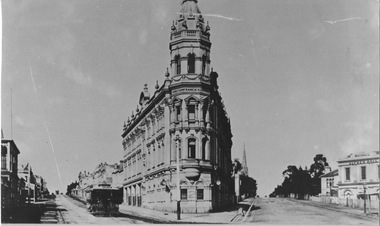
Photograph - Junction Hotel, St Kilda, c1890
... ...demolished in 1973...The hotel was demolished in 1973 when High Street was widened. ...The hotel was demolished in 1973 when High Street was widened. Yields information about the Junction Hotel, St Kilda Junction Hotel St Kilda Junction High Street Barkley Street demolished in 1973 Black and white photograph glued to cardboard with no note. ...This photograph shows the uniquely designed Junction Hotel at the St Kilda Junction bounded by High Street and Barkley Street with a cable tram in High Street. This is a poor copy of the original photograph. The hotel was demolished in 1973 when High Street was widened. Yields information about the Junction Hotel, St Kilda Black and white photograph glued to cardboard with no note. junction hotel, st kilda junction, high street, barkley street, demolished in 1973 -
 Ringwood and District Historical Society
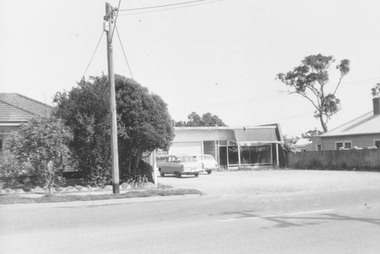
Photograph, Warrandyte Road, Ringwood. Shops adjacent to corner store. 1972. Demolished February 1973
... Shops adjacent to corner store. Demolished February 1973". Photograph dated, 10/11/72"....Shops adjacent to corner store. 1972. Demolished February 1973 Photograph ...Written on catalogue card, "Warrandyte Road. Shops adjacent to corner store. Demolished February 1973". Photograph dated, 10/11/72". -
 Kew Historical Society Inc
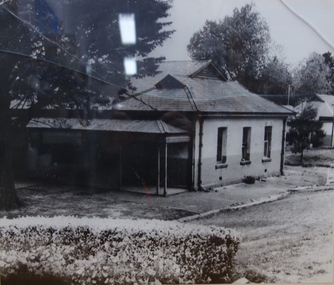
Photograph - Old Ward 21 (The Nursery), Kew Cottages
... Old Ward 21, previously the 'nursery', and demolished in 1973 to make way for units 4 and 5. "...Old Ward 21, previously the 'nursery', and demolished in 1973 to make way for units 4 and 5. " Framed photograph, forming part of the Kew Cottages collection, donated by Dr Cliff Judge in 1993. ...The Children's Cottages at Kew were first opened in 1887 as the "Idiot Ward" of Kew Asylum. Located on the asylum's grounds, the children's cottages were established to provide separate accommodation for child inmates who had previously been housed with adult patients. Although the Cottages only admitted children as patients, many of those children remained in residence at the Cottages as adults. The function of the institution was to provide accommodation and educational instruction for intellectually disabled children. Some Wards of the State and other various "difficult" children were also admitted.Shortly after opening, the Idiot Ward began functioning separately from the Kew Lunatic Asylum, and became known as the Kew Idiot Asylum from 1887 until c.1929. From 1929 they have been known as the "Children's Cottages, Kew" or alternatively "Kew Cottages Training Centre". The institution was finally closed in July 2008. [Source: Wikipedia, 2016]One of a series of framed historical photographs of the Kew Cottages that once formed part of the collection of the Kew Cottages Historical Society, founded by Dr. Cliff Judge and Fran Van Brummelen in the 1980s. The set contains both copies of originals in other collections such as the Public Record Office Victoria and photographs taken by Dr Judge for his books on intellectual disability in Victoria. The significance of the set of framed photographs is that they provide a curated collection of images of the development of the Cottages over a one hundred year period.Framed photograph, forming part of the Kew Cottages collection, donated by Dr Cliff Judge in 1993. Dr. Judge was a consultant psychiatrist at the cottages for 14 years, as well as an author and vocal advocate for the intellectually disabled and their families. [Conservation note: Glass to be replaced]"Kew Cottages - Old Ward 21 (The Nursery). Old Ward 21, previously the 'nursery', and demolished in 1973 to make way for units 4 and 5. "kew cottages, dr cliff judge, kew cottages historical society 1987-1993 -
 Flagstaff Hill Maritime Museum and Village
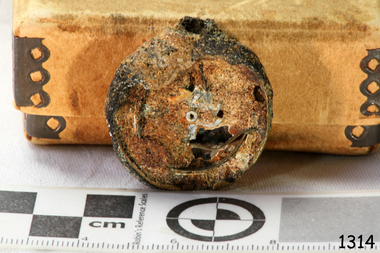
Instrument - Fob Watch, ca 1878
... demolished in 1971. During those years, different family members lived at the Nepean Hotel or Glencove. In 1877, Julia Ford married a significant landowner, John Cain, a limeburner from Rye. They had five daughters, four of whom were never married; Kathleen (1880-1949), Mabel (1881-1973...demolished in 1971. During those years, different family members lived at the Nepean Hotel or Glencove. In 1877, Julia Ford married a significant landowner, John Cain, a limeburner from Rye. They had five daughters, four of whom were never married; Kathleen (1880-1949), Mabel (1881-1973 ...The story of this gold fob watch is intriguing. The letter is dated March 6, 1905, 27 years after the Loch Ard was wrecked. It appears to be a quick personal note from a relative or friend who briefly writes the history of the enclosed ‘souvenir’ watch, found in Loch Ard Gorge at Port Campbell. Although the finder is not named, it is likely the letter’s author. The writer mentions that the letter and watch would be sent once photographs of the area where the watch was found had been added. The fancy, lined envelope’s date stamp is October 12th, 1917 (12.10.17), almost 12 years after the letter was written. It has a postmark from Florence (Firenze), Italy. The handwriting on the envelope differs from that of the letter, and there is no further mention of photographs being included. The condition of the watch certainly shows the effects of time in the sea. Some inner workings can be seen through broken encrustations and missing sections of its case. The winding knob on the top is recognisable even though it is covered by sand and other adhesions from the sea. Its dainty size and gold case suggest that it was made for a well-to-do female. The watch, envelope and letter were donated along with a 1971 newspaper cutting, all neatly folded and tucked with the watch into a small, strong cardboard box with metal reinforcing on the corners and a fitted lid. The newspaper article gives context to the watch, telling the story of the Loch Ard shipwreck tragedy and the two survivors, but does not refer to the watch. Perhaps one of the 17 passengers sailing on the Loch Ard, including members of the Carmichael family, owned the watch, or maybe it was amongst the cargo, as the ship’s manifest includes ‘clocks and watches £25’. . Considering the dates of the letter and the envelope, did the finder of the ‘souvenir’ watch take it to Europe? Was it used for good luck during service in the military? . Comparing the different writing on the letter and the envelope, does it suggest that the watch’s finder was overseas and asked someone to send the envelope to the intended recipient, with postage from Italy? ABOUT the address, “Glencove”: The details on the envelope are faint and obscured by stiff creases in the paper. The address appears to be “Mrs J. Mortton, Glencove, Portsea, Victoria, Australia”; though the family at that address had the surname “Morton”. Mrs J. Morton, formerly Elizabeth Ford, married her second husband, James Morton, in 1904, the year before the date of the letter. The couple lived at the Nepean Hotel before they were at “Glencove”. Although they never owned that property, it was their home when James died in 1937. Elizabeth’s nephew, Alfred Sandle Ford (1894-1981), and a nephew-in-law were overseas during World War I. Alfred Ford had moved to Melbourne as a young boy with his father. He entered service as Second Lieutenant in 1915, naming his father, Alfred Sandle Ford, as his next of kin. He served in Egypt, France and Belgium with the Australian Imperial Forces as a member of the Field Artillery Brigades. He returned to Melbourne in 1919 and worked in Richmond and Box Hill. He later married Frances Whyburn. Previously, in 1872, Elizabeth Ford’s sister, Julia Ford, acquired the 1-acre property with a 3-room house that became known as “Glencove”, Portsea. The building was originally the first school in the area, established before Crown Land sales. In the Parish of Nepean, it was first assessed for rates in 1871. Julia Ford (1843-1912) and Elizabeth Ford (1859-1957) were daughters of James Sandle Ford (1811-1890), a well-known pioneer of Portsea, formerly a convict limeburner. James Ford acquired several Crown allotments in Portsea. In 1872, he converted his old hotel into the large residential establishment known as the Nepean Hotel, which his family largely ran until it was demolished in 1971. During those years, different family members lived at the Nepean Hotel or Glencove. In 1877, Julia Ford married a significant landowner, John Cain, a limeburner from Rye. They had five daughters, four of whom were never married; Kathleen (1880-1949), Mabel (1881-1973), who was the last family member to own the house until her death, Hilda (1884-1974) and Julia Ethel (1888-1949). Some of the newspaper records refer to “Glencove”, Portsea, inform that: 1927 - Dr. and Mrs. J. E. Shilliday are staying with Mrs. R. B. Sanderson at Glencove. (Australasian) 1937 - James Morton died at his property, Glencove, Portsea, aged 83 years (Argus) 1949 - Julia Ethel Cain died at Glencove, Portsea. (Argus) 1949 - Probate application by sisters of Julia Ethel Cain, deceased, formerly of Nepean Hotel, Portsea, but late of Glencove, Nepean Highway, Portsea. The connection of the watch with the sands of Loch Ard Gorge and to the ship Loch Ard contributes to our knowledge of personal items brought to Australia in 1878, whether as the belongings of a passenger or as cargo; a gold watch would be intended for a wealthy buyer. The little artefact helps us understand the survival of artefacts in the powerful sea, over a quarter of a century after the wreck of the ship. Although many people would have visited the shipwreck site, the length of time before it was found helps us understand the effects of the sea on shipwreck artefacts. The survival of the carefully packaged watch and related documents shows the respectful understanding of preservation of historic artefacts, even from almost 150 years ago at the time of writing (2025). Ladies' fob watch, thought to be gold. It is now covered in encrustation. A bump on the edge would be the winding mechanism for the watch. A small section of the back of the case has broken away, and an engraved surface can be seen. Face and hands are missing, revealing the spring workings inside. Donated with the watch were two documents and a newspaper cutting about the story of the shipwreck of the Loch Ard. They are all in a strong cardboard box with reinforced corners on the base and lid. Found at Loch Ard Gorge and said to have been from the Loch Ard. The three donated documents are: - 1. A rectangular envelope made of cream waxy paper lined with black and white diagonally striped paper. The top right corner, usually meant for a postage stamp, has been torn off, partly exposing text on a rectangular printed logo. A round black postmark stamp near the top centre shows the post office location and date. The address on the front is handwritten in black ink. The creases on the envelope suggest it has been folded three times. 2. A letter on cream rectangular paper features clear, handwritten script in black ink. The unevenly cut bottom edge has two short black vertical lines, possibly the tops of tall written letters. There are creases where the page has been folded three times. 3. A newspaper clipping featuring text, an illustration, and handwritten details of the newspaper’s source.1. Envelope: - Address: ”Australia (per Postage) / [looks like “Mrs J. Mortton”] / Glencove, (Portsea) / Victoria” Postmark: “FIRENZE” 12 10 17” “ - - - -PORTEN – (illegible)” Logo inside envelope: “BUSTA BRE--- / Earliera Lialia” [Italian; Busta = envelope, Earliera == earlier] 2. Letter: - “I am sending you a ‘souvenir’ from the wreck of the Loch Ard 28 years ago at Port Campbell. It is the remains of a lady’s gold watch found in the gorge where Miss Carmichael & Tom Pearce (the only two saved) were washed up. This souvenir was lying there ever since. I went down into the awful gorge & saw the cave where these two unfortunates (or fortunate perhaps, as they were saved) lived until rescued. I also saw the graves of those who were washed up from the wreck. One grave contains Dr and Mrs Carmichael & six of their children. Later on, when I can get some good views of that wild coast I will send them to you. 6/3/05.” 3. Newspaper cutting: - History of the Lochard. Refer to the Sydney Morning Herald, Nov. 28th, 1971: “Loch Ard: the wreck that became a legend” flagstaff hill, warrnambool, shipwreck coast, flagstaff hill maritime museum, maritime museum, flagstaff hill maritime village, great ocean road, loch ard, eva carmichael, tom pearce, loch ard gorge, loch ard souvenir, port campbell, miss carmichael, mrs carmichael, dr carmichael, 1878, loch ard: the wreck that became a legend, ladies fob watch, gold watch, fob watch, pocket watch, horology, accessory, time keeping, scientific instrument, ladies' watch, ladies' pocket watch, lady's watch, souvenir watch, survivor, clocks and watches, diagonally striped envelope lining, firenze, busta, earliera, florence, italy, glencove, portsea, victoria, 1905, 1917, nepean hotel, moreton, morton, elizabeth morton, mrs j. morton, james morton, elizabeth ford, julia ford, alfred sandle ford, frances whyburn, james sandle ford, john cain, kathleen cain, mabel cain, hilda cain, julia ethel cain, australian imperial forces, field artillery brigades, limeburner -
 Flagstaff Hill Maritime Museum and Village
Functional object - Kerosene Lamp Burner, Bradley and Hubbard Manufacturing Company, Late 19th to early 20th century
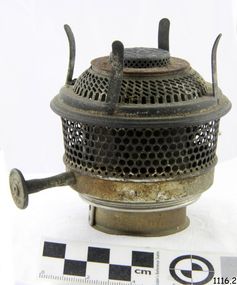
... In 1973, the Bradley and Hubbard buildings were demolished, effectively ending that chapter in American lighting manufacture....In 1973, the Bradley and Hubbard buildings were demolished, effectively ending that chapter in American lighting manufacture. ...Bradley and Hubbard established their company in 1852 in Meriden, Connecticut when Nathaniel and William Bradley, Orson and Chitten Hatch, and Walter Hubbard, formed Bradley, Hatch & Company. This incarnation of the company only manufactured clocks. The Hatch brothers sold their interest in the company in 1854 and it was renamed, Bradley & Hubbard. Clocks remained the firm's primary product into the 1860s. In addition to their line of clocks, Bradley & Hubbard also produced a wide range of household items including match safes, call bells, andirons, urns, bookends, frames, desk accessories and vases. Technological advances in drilling and refining crude oil in the late 1850s and early 1860s paved the way for the demise of whale oil as lamp fuel. Soon after Colonel Edwin Drake struck oil in Titusville, Pennsylvania on August 27, 1859, Nathaniel Bradley saw an opportunity to capitalize on the future of this new fuel. Nathaniel decided to produce an extensive line of kerosene burning lamps this proved to be a wise business decision. Kerosene was soon to become a widely used, safe and relatively inexpensive lamp fuel. Between April 7, 1868, and December 23, 1913, the company was listed as the assignee for at least 89 lighting patents. Many of these patents were for lamp and chandelier designs and various improvements in lamp burners. In 1875 the company reorganized to form the Bradley and Hubbard Manufacturing Company. Walter Hubbard served as President and Nathaniel Bradley as Treasurer. The firm enjoyed rapid growth throughout the 1880s. By 1888, the company employed over one thousand workers and had showrooms in major cities including New York, Philadelphia, Boston and Chicago. One of the most prolific of the B&H products was the Rayo lamp it produced under contract for Standard Oil. In keeping with the changing times, Bradley & Hubbard produced a variety of electric lamps as well. Walter Hubbard passed away in 1911 and Nathaniel Bradley in 1915. The company continued through the 1930s and was purchased by the Charles Parker Company, also of Meriden, Connecticut, in 1940. The Parker Company was quite diversified in its product line, also producing an extensive line of lamps and high-end chandeliers. Parker operated its acquisition as the "Bradley & Hubbard Division." Parker ceased production of the Rayo lamp in the early 1950s. In 1973, the Bradley and Hubbard buildings were demolished, effectively ending that chapter in American lighting manufacture.Early innovation in kerosene lamp burner design by Bradley and Hubbard lamp manufacturers who at the turn of the 20th century were the biggest lamp producers in the world. The item is significant due to its historic connection with a major innovator of lamp design.Lamp Burner, metal container with turning screw for wick and mesh walls. Is made in 2 parts. Raised embossing on wick adjustment screw " PAT APPLIED FOR" on top of burner "B & H Patented.July.1.90.Nov.20.94"flagstaff hill, warrnambool, flagstaff-hill-maritime-museum, maritime-museum, shipwreck-coast, flagstaff-hill-maritime-village, bradley & hubbard manufacturing company, kerosene lamp burner, early lighting -
 Federation University Historical Collection
Container - Container - Wooden Box, Ballarat Institute of Advanced Education: Wooden Book Box with Rope Handles
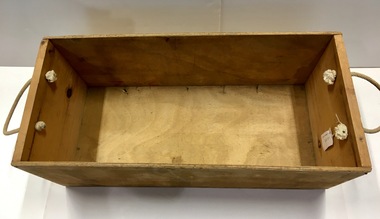
... 1973. At that time it was Ballarat Institiute of Adult Education. This was the fore runner of what is now Federation University. The SMB library was in the Ballarat Gaol Building. This was demolished...1973. At that time it was Ballarat Institiute of Adult Education. This was the fore runner of what is now Federation University. The SMB library was in the Ballarat Gaol Building. This was demolished ...Solid wooden box with rope handles was used to move library books from the Library at Ballarat School of Mines to the E J Barker Library at Mount Helen Campus. The Mount Helen Campus Library was opened in 1973. At that time it was Ballarat Institiute of Adult Education. This was the fore runner of what is now Federation University. The SMB library was in the Ballarat Gaol Building. This was demolished and the new E J Tippett Library was built on the site in 1977.Wooden book box with rope handles.Sticker with 8 on each end. BIAE written on each end.ballarat institute of advanced education, ballarat school of mines, e j barker library, mount helen campus, federation university, ballarat gaol building, e j tippett, library, wooden book box -
 Federation University Historical Collection
Photograph - Photograph - black and white, Ballarat East State School (No 1071)
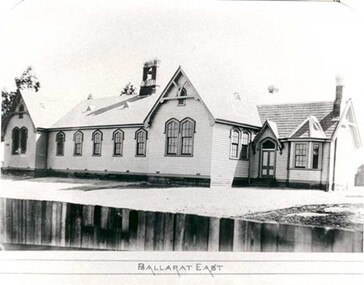
... The minister issued instructions for the old wooden part of the school to be demolished, and brick additions to be erected, so that the whole premises would accommodate 350 students. (''Visions and Realisations: A Century of State Education in Victoria, Vol. 2'', Education Department of Victoria, 1973, p 729-730.)...The minister issued instructions for the old wooden part of the school to be demolished, and brick additions to be erected, so that the whole premises would accommodate 350 students. (''Visions and Realisations: A Century of State Education in Victoria, Vol. 2'', Education Department of Victoria, 1973, p 729-730.) ballarat east state school education st paul's school Specimen Hill State School Black and white photograph of a weatherboard school with shingle roof known as Ballarat East (SS1071). ...The weatherboard Ballarat East State School SS 1071 was formerly known as Specimen Hill. According to 'Visions and Realisations' The Eureka gold lead opened in August 1852, running from Little Bendigo, south beneath Yarrowee Creek into Pennyweight flat, where it was joined 100 yards or so from the intersection of main and Eureka Streets by the Canadian Lead. State School 1071 was formerly known as Ballarat Common School No. 71, and was founded by the Free Presbyterian Church on Specimen Hill in Eureka Street, Ballarat on 01 January 1854. On 20 May 1869 the trustees of the Presbyterian School, Specimen Hill, Ballarat, consented to the transfer of the site to the Board of Education. On 01 September 1870, Specimen Hill, Ballarat, was vested in the Board and then became known as SS 1071. On 01 March 1879 the Minister, The Hon. William Collard Smith, and William Dobbie, Inspector of School Buildings, visited Ballarat to report on the buildings with a view to extensions and renovations. The minister issued instructions for the old wooden part of the school to be demolished, and brick additions to be erected, so that the whole premises would accommodate 350 students. (''Visions and Realisations: A Century of State Education in Victoria, Vol. 2'', Education Department of Victoria, 1973, p 729-730.)Black and white photograph of a weatherboard school with shingle roof known as Ballarat East (SS1071). The building has a brick chimney and bell tower. This school has Castlemaine flagging in the passages.ballarat east state school, education, st paul's school, specimen hill state school -
![Photograph - Digital image, Barn Site [Pope Place Greensborough], 02/05/2013](/media/collectors/4f729f5697f83e03086015b8/items/57286e072162f115acc6afe5/item-media/57286e402162f115acc6b473/item-fit-380x285.jpg?cb=6) Greensborough Historical Society
Greensborough Historical SocietyPhotograph - Digital image, Barn Site [Pope Place Greensborough], 02/05/2013
... This photograph of the site of the "Old Barn" (now Pope Place Greensborough) was taken in 2013 to show changes over 40 years, based on Ron Reynold’s sketches in the 1973 publication “Greensborough and Greenhills” published by Cypress Books. The old barn was built at the turn of the century (1900) and demolished in the early 1970s. ...This photograph of the site of the "Old Barn" (now Pope Place Greensborough) was taken in 2013 to show changes over 40 years, based on Ron Reynold’s sketches in the 1973 publication “Greensborough and Greenhills” published by Cypress Books. The old barn was built at the turn of the century (1900) and demolished in the early 1970s. ...This photograph of the site of the "Old Barn" (now Pope Place Greensborough) was taken in 2013 to show changes over 40 years, based on Ron Reynold’s sketches in the 1973 publication “Greensborough and Greenhills” published by Cypress Books. The old barn was built at the turn of the century (1900) and demolished in the early 1970s. A retirement village is now on this site.Digital copy of colour photograph.greensborough and greenhills, pope place greensborough, ron reynolds -
 Phillip Island and District Historical Society Inc.
Newspaper Clipping, The Killara, 29/6/1967
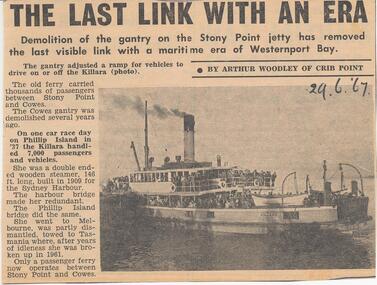
... Collection of Newspaper Clippings from Scrap Book 1960 - 1973 Stony Point The Killara Ferry cowes jetty cowes jetty - ferry ss "killara" Phillip Island Newspaper clipping Jean Jamieson Article about the demolition of the gantry on the Stony Point jetty in June 1967. Cowes gantry was demolished ...Collection of Newspaper Clippings from Scrap Book 1960 - 1973Article about the demolition of the gantry on the Stony Point jetty in June 1967. Cowes gantry was demolished several years earlier. The Killara on one race day on Phillip Island handled 7,000 passengers and vehicles.stony point, the killara ferry, cowes jetty, cowes jetty - ferry ss "killara", phillip island, newspaper clipping, jean jamieson -
 Halls Gap & Grampians Historical Society
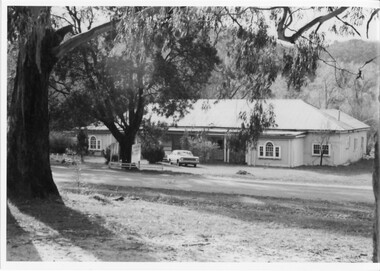
Photograph - B/W, C 1973
... In 1973 it was decided too much money would have to be spent to restore Grampian House Guest House to its original glory after a clearing auction it was demolished by Bawalda Bros. from Horsham. ...In 1973 it was decided too much money would have to be spent to restore Grampian House Guest House to its original glory after a clearing auction it was demolished by Bawalda Bros. from Horsham. ...In 1973 it was decided too much money would have to be spent to restore Grampian House Guest House to its original glory after a clearing auction it was demolished by Bawalda Bros. from Horsham. The property was sold to Mr Gary West of Stawell and Mr Lyle Jamieson of Ararat who proposed to build a Tavern-bistro Conference Centre. This did not proceed and the property was auctioned on 14th July 1984 but was passed in a auction. It was later sold to a syndicate of Halls Gap businessmen, Mr. Keith Smith, Mr. John Ingram and Mr Arthur Mangle. Arthur Mangle together with his brother Charles bought our the syndicate and still own the property today (2001).Photo shows front view of Grampians House with car in foreground and roadway. ( 2 photos one black & white one coloured)accommodation, guesthouses, accommodation, grampian house -
 Glen Eira Historical Society
Document - Cantala
... demolished and the land subdivided. The first document is a typed 3 page history from Caulfield Historical Society dated 02/1974, describing the owner of the property, Septimus Miller, as well as architectural features of the house Cantala. The second document is one page of typed correspondence from T J Hart to the editor of Southern Cross, dated 01/11/1973...demolished and the land subdivided. The first document is a typed 3 page history from Caulfield Historical Society dated 02/1974, describing the owner of the property, Septimus Miller, as well as architectural features of the house Cantala. The second document is one page of typed correspondence from T J Hart to the editor of Southern Cross, dated 01/11/1973 ...Various documents and correspondence detailing the history of the house and land on the corner of Dandenong and Waiora Roads, Caulfield, known as Cantala before being demolished and the land subdivided. The first document is a typed 3 page history from Caulfield Historical Society dated 02/1974, describing the owner of the property, Septimus Miller, as well as architectural features of the house Cantala. The second document is one page of typed correspondence from T J Hart to the editor of Southern Cross, dated 01/11/1973, describing the architectural features and history of Cantala. The file also includes a copy of a typed letter from Brighton Historical Society concerning research conducted about Cantala and the subdivision and detailing the owners and occupiers of flats erected where Cantala stood. Accompanying this document is a one page handwritten note providing the same details. Finally, the file includes a one page photocopy, undated, of an entry in Who’s Who in the World of Women of Mrs Septimus Miller (Muriel), the second wife and widow of Septimus Miller.miller septimus, miller henry money, mattinson elizabeth, bell clara johnstone, stewart gwendoline, henderson helen muriel, miller ronald nevil damian, salway william, hart t j, miller helen, pirera m t, fetter a, bullock hilary, landells rosalind, redleap, cantala, caulfield, caulfiled north, dandenong road, wiora, waiora road, alma road, brighton cemetery, caulfield racecourse, findon avenue, cantala avenue, olgita, rivoli, caulfield historical society, victoria racing club, horse racing, italianate style, art deco, architectural styles, architectural features, balconies, towers, stairs, bay windows, mansions, stables, land subdivisions, monuments and memorials, gothic (revival) architecture, drawing rooms, walking trails, parks and reserves, gardens, flats -
 Eltham District Historical Society Inc
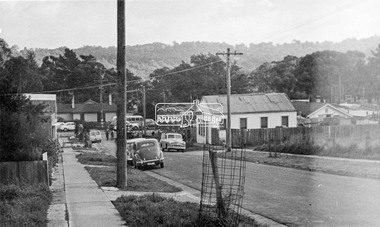
Photograph, Looking down Pryor Street to Main Road, Eltham, c.1960
... The Railway Station Master's house on opposite side was later demolished to make way for a carpark. 27 Aug 1963: Pettion for Bankruptcy re Jeanette Patricia Whiteway of 88 Napoleon Street, Eltham, house duties, and lately carrying on a business at Pryor Street, Eltham in partnership with another as a plumber under the names Eltham Plumbing Supplies and L. & J.P. Whiteway 1963 'SEQUESTRATION ORDERS AND FIRST MEETINGS', Commonwealth of Australia Gazette (National : 1901 - 1973...The Railway Station Master's house on opposite side was later demolished to make way for a carpark. 27 Aug 1963: Pettion for Bankruptcy re Jeanette Patricia Whiteway of 88 Napoleon Street, Eltham, house duties, and lately carrying on a business at Pryor Street, Eltham in partnership with another as a plumber under the names Eltham Plumbing Supplies and L. & J.P. Whiteway 1963 'SEQUESTRATION ORDERS AND FIRST MEETINGS', Commonwealth of Australia Gazette (National : 1901 - 1973 ...Eltham Plumbing Supplies (Lennie Whiteway Plumbing) located on the right side of the street. It later became the Eltham Bookshop and sold cane ware as well. On the corner with Main Road is the local branch of the State Bank of Victoria. The building still stands and is the present day Westpac bank branch. The Railway Station Master's house on opposite side was later demolished to make way for a carpark. 27 Aug 1963: Pettion for Bankruptcy re Jeanette Patricia Whiteway of 88 Napoleon Street, Eltham, house duties, and lately carrying on a business at Pryor Street, Eltham in partnership with another as a plumber under the names Eltham Plumbing Supplies and L. & J.P. Whiteway 1963 'SEQUESTRATION ORDERS AND FIRST MEETINGS', Commonwealth of Australia Gazette (National : 1901 - 1973), 12 September, p. 3259. , viewed 10 Jul 2018, http://nla.gov.au/nla.news-article241015035 Orders for discharge of bankruptcy suspended till 23 March 1967 for Leonard Whiteway and Jeanette Patricia Whiteway of 5 John Street, Eltham 1967 'NOTICE OF ORDERS OF DISCHARGE', Commonwealth of Australia Gazette (National : 1901 - 1973), 11 May, p. 2427. , viewed 10 Jul 2018, http://nla.gov.au/nla.news-article241040009Black and white photograph prints (x3) Negative (copy) 4x5 large format Black and White (x2)Shire of Elthampryor street, eltham plumbing supplies, main road, eltham, eltham bookshop, jeanette patricia whiteway, lennie whiteway plumbing, leonard whiteway, state bank of victoria, station masters house, westpac bank -
 Bendigo Historical Society Inc.
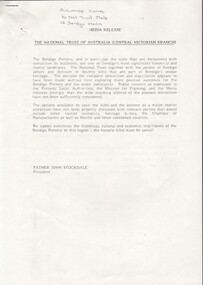
Document - National Trust Collection: Bendigo Pottery (Epsom) Pty Ltd - three-page correspondence regarding concern over the future of the Bendigo Pottery kilns, 07/1987
... "after protracted but amiable discussions with the Bendigo Pottery management, it is evident that the Pottery has taken care to preserve the important kins and promote the historic nature of the Bendigo Pottery" 3 pink-page from Shire Engineer, Shire of Huntly to the Managing Director Bendigo Pottery stating, "that there has been unconfirmed reports of possible future demolition works at your premises", and "bringing to their notice requirements under the: * Victorian Building Regulations 1983, regarding demolition * Regulation No. 14 Rats and Mice Destruction Regulations 1973 buildings shall not be altered or demolished without a permit from Council * Historic Buildings Act 1981..."after protracted but amiable discussions with the Bendigo Pottery management, it is evident that the Pottery has taken care to preserve the important kins and promote the historic nature of the Bendigo Pottery" 3 pink-page from Shire Engineer, Shire of Huntly to the Managing Director Bendigo Pottery stating, "that there has been unconfirmed reports of possible future demolition works at your premises", and "bringing to their notice requirements under the: * Victorian Building Regulations 1983, regarding demolition * Regulation No. 14 Rats and Mice Destruction Regulations 1973 buildings shall not be altered or demolished without a permit from Council * Historic Buildings Act 1981 Document National Trust Collection: Bendigo Pottery (Epsom) Pty Ltd - three-page correspondence regarding concern over the future of the Bendigo Pottery kilns ...historic significant of Bendigo Pottery physical assets National Trust - three-page correspondence 23 - 28 July 1977 regarding the future of the Bendigo Pottery 1 white A4 media release from the National Trust (Central Victorian Branch) from Father John Stockdale President "stressing the historical, cultural and economic importance of the Bendigo Pottery to this region". 2 stapled green A4 page a file note dated 28 July 1987. "after protracted but amiable discussions with the Bendigo Pottery management, it is evident that the Pottery has taken care to preserve the important kins and promote the historic nature of the Bendigo Pottery" 3 pink-page from Shire Engineer, Shire of Huntly to the Managing Director Bendigo Pottery stating, "that there has been unconfirmed reports of possible future demolition works at your premises", and "bringing to their notice requirements under the: * Victorian Building Regulations 1983, regarding demolition * Regulation No. 14 Rats and Mice Destruction Regulations 1973 buildings shall not be altered or demolished without a permit from Council * Historic Buildings Act 1981regulations regarding demolition of buildings bendigo pottery bottle kilns -
 Melbourne Water
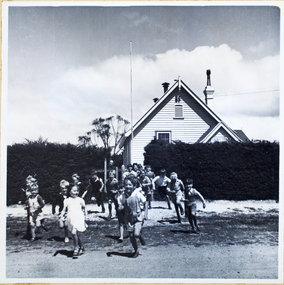
Photograph, North Cocoroc State Primary School, 1950s
... By 1973 most of the houses and other buildings were demolished or moved to Werribee. ...By 1973 most of the houses and other buildings were demolished or moved to Werribee. ...As the Yarra became unsuitable as a source of water, several attempts were made to find alternative sources for the growing population of Melbourne. It was not until 1891 that the efforts to sewer Melbourne came to fruition with the setting up of the Melbourne Metropolitan Board of Works (MMBW), now known as Melbourne Water. From 1891 until 1992, it was the responsibility of the MMBW to safeguard public health by providing a sewerage system and a safe water supply system. In 1992, The MMBW merged with a number of smaller urban water authorities to form Melbourne Water. The township of Cocoroc was created in 1894 at the Metropolitan Sewage Farm (now the Western Treatment Plant) to house the workers it employed. The name 'Cocoroc' means 'frog' in the language of the Wathaurung people — the Traditional Owners of the land the treatment plant was built on. By the early 1950s there were nearly 100 houses, a town hall, football ground (and team), swimming pool, tennis courts, four schools and a post office, and by the 1970s some 500 people were living in Cocoroc. As it became too expensive for the MMBW to subsidise, Cocoroc was abandoned. By 1973 most of the houses and other buildings were demolished or moved to Werribee. All that is left now of Cocoroc are two small, empty, concrete swimming pools, a few weatherboard sheds and a big iron water tank. This photograph detailing an exterior view of the North Cocoroc State Primary School, is historically significant as it captures children at play within a purpose built community. The School that was one of four was built to educate the children of the MMBW workers. As the school no longer exists, this photograph is the only tangible evidence left of the building, also showcasing the style of buildings in this era. cocoroc, township, school, mmbw, melbourne metropolitan board of works, melbourne water -
 Bendigo Historical Society Inc.
Document - National Trust Collection: Post Office, Pall Mall, Bendigo, 1972
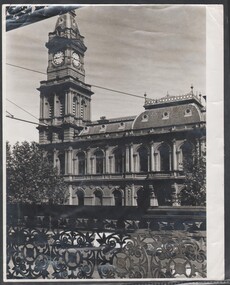
... Mullins, dated 28 Aug/ 27 Sept/ 2 Oct 1972; referencing Mrs Mullins letter of 19 Aug concerns demolishing the Shepparton and review of the Bendigo Post Office 3232 M draft letter, exchange dated 10 March 1973, between Bendigo and South Yarra National Trust; referencing review of the Bendigo Post Office and noting: * aluminium telephone boxes * unnecessary street number tacked at an angle on one of the granite pillars, ugly handrail * recent toilet block in modern idiom under the shade of the clock tower under the shadow of the clock tower 3232 N three typed documents regarding the history of the Bendigo Post Office: * Building Citation * Post office architect G. ...Mullins, dated 28 Aug/ 27 Sept/ 2 Oct 1972; referencing Mrs Mullins letter of 19 Aug concerns demolishing the Shepparton and review of the Bendigo Post Office 3232 M draft letter, exchange dated 10 March 1973, between Bendigo and South Yarra National Trust; referencing review of the Bendigo Post Office and noting: * aluminium telephone boxes * unnecessary street number tacked at an angle on one of the granite pillars, ugly handrail * recent toilet block in modern idiom under the shade of the clock tower under the shadow of the clock tower 3232 N three typed documents regarding the history of the Bendigo Post Office: * Building Citation * Post office architect G. ...Social history, Historic buildings National Trust Collection: Post Office, Pall Mall, Bendigo Eight B&W photographs and three postcards, and reports regarding the external façade of the Post Office, cnr of Pall Mall and Williamson Street, Bendigo 3232 A large print Pall Mall façade from the Shamrock Hotel Balcony 3232 B Williamson Street façade including clock tower 3232 C corner facades of the Post Office to major streets including the clock tower 3232 D Entry steps off Pall Mall into the Post Office 3232 E Pall Mall façade including clock tower and side of the Post Office 3232 F three bay pedestrian entry to the Post Office from Pall Mall 3232 G 51-67 street numbers of Pall Mall 3232 H postcard (1) of Post Office and Law courts, full frontage to Pall Mall 3232 I coloured postcard (2) of Post Office and Law courts, full frontage to Pall Mall 3232 J postcard (3) of Post Office looking towards the Shamrock Hotel 3232 K small photograph showing the Post Office and Law Courts facades to Pall Mall Correspondence: 3232 L Three letter exchange between National Trust and Mrs. Mullins, dated 28 Aug/ 27 Sept/ 2 Oct 1972; referencing Mrs Mullins letter of 19 Aug concerns demolishing the Shepparton and review of the Bendigo Post Office 3232 M draft letter, exchange dated 10 March 1973, between Bendigo and South Yarra National Trust; referencing review of the Bendigo Post Office and noting: * aluminium telephone boxes * unnecessary street number tacked at an angle on one of the granite pillars, ugly handrail * recent toilet block in modern idiom under the shade of the clock tower under the shadow of the clock tower 3232 N three typed documents regarding the history of the Bendigo Post Office: * Building Citation * Post office architect G. W. Watson & Builder J. Pigdon * details of the materials used in the structure (ego Bells J.W. Horwood, Castlemaine £549.00.00 3232 O an open typed invitation to a Public Meeting to be held on 7:30 PM Thursday, 23 February 1995; and three sheets of attendee's names and addresses of the 68 residents who attended the meeting (handwritten). 3232 P minutes (4 pages) of the Public Meeting concerning the Bendigo Post Office, held on 23 February 1995 at the National Trust Chambers, 45 View Street, Bendigo 3232 Q two-page history of establishment of the Bendigo Post Office from 1/07/1852 to 30/09/1887 3232 R four typed /stapled pages on the history of the Bendigo Post Office (construction 1884-87, foundation stone 1884, official opening 1887, dimensions, cost £50,000, description, the Post Office Clock and Dame Nellie Melba, major repairs in 1977 and maintenance). 3232 S chronological list of Development (of the Post Office) at Bendigo 1836 - 1979, over two typed pagesbendigo post office -
 Narre Warren and District Family History Group
Book, Narre Warren & District Family History Group Inc, Casey Cardinia Collection - Narre Warren Information File, 2016
... Aug 1987 Brechin – The Heart of a Village that Grew 02 Aug 1990 Brechin Demolished 23 Jul 1992 The Lawless Days of Captain Dana 1972 Early History of Narre Warren, Narre Warren Nth and Harkaway 18 Aug 1994 Narre Warren – many theories of name origins 16 Jul 1992 Walton family of Narre Warren 11 Jan 1999 Webb Street Bakery Unknown Sketch of Princes Highway, Narre Warren 22 Jun 2000 Webb Street Bakery 06 Jul 2000 Webb Street Bakery & Murdoch family 22 Jun 2000 Webb Street Bakery 29 Oct 1998 Vale Sir Ian McLennan 1973 The Kent Family 26 Jan 1993 Narre Warren Mechanics Institute 02 Sep 1992 Legacy of S.J. ...Aug 1987 Brechin – The Heart of a Village that Grew 02 Aug 1990 Brechin Demolished 23 Jul 1992 The Lawless Days of Captain Dana 1972 Early History of Narre Warren, Narre Warren Nth and Harkaway 18 Aug 1994 Narre Warren – many theories of name origins 16 Jul 1992 Walton family of Narre Warren 11 Jan 1999 Webb Street Bakery Unknown Sketch of Princes Highway, Narre Warren 22 Jun 2000 Webb Street Bakery 06 Jul 2000 Webb Street Bakery & Murdoch family 22 Jun 2000 Webb Street Bakery 29 Oct 1998 Vale Sir Ian McLennan 1973 The Kent Family 26 Jan 1993 Narre Warren Mechanics Institute 02 Sep 1992 Legacy of S.J. ...Folder containing a table of contents and various newspaper clippings and other information pertaining to the Narre Warren area. The date the articles were published, and title of articles are listed below. Unknown Copy of photo of Princes Highway 16 Nov 2006 Casey Council honours John Byron 08 Oct 1992 Bay View House 02 Jun 1998 Allen family (vegetable growers) ?? Aug 1987 Brechin – The Heart of a Village that Grew 02 Aug 1990 Brechin Demolished 23 Jul 1992 The Lawless Days of Captain Dana 1972 Early History of Narre Warren, Narre Warren Nth and Harkaway 18 Aug 1994 Narre Warren – many theories of name origins 16 Jul 1992 Walton family of Narre Warren 11 Jan 1999 Webb Street Bakery Unknown Sketch of Princes Highway, Narre Warren 22 Jun 2000 Webb Street Bakery 06 Jul 2000 Webb Street Bakery & Murdoch family 22 Jun 2000 Webb Street Bakery 29 Oct 1998 Vale Sir Ian McLennan 1973 The Kent Family 26 Jan 1993 Narre Warren Mechanics Institute 02 Sep 1992 Legacy of S.J. Webb 25 Nov 2004 Isador Magid – Tributes for Fountain Gate Visionary 17 Nov 2004 Isador’s lasing vision 14 Jul 2004 Tony Purcell – profile 03 Feb 2005 Jack and Merle Tinkham’s 60th Anniversary 14 Feb 2005 Jack and Merle Tinkham 21 Nov 1996 Webb Street – that was then…. 11 Nov 1993 Rose Trewin remembers 13 Oct 1993 Hans Roland – a profile 25 Nov 1993 Stan Peters – a profile 23 Oct 1984 Webb Street School 11 Nov 2000 The Elms 09 Nov 2000 The Elms 17 Sep 2007 Araluen – The Bailey Home 07 Oct 1999 Narre Warren Produce Store 06 Oct 1998 Narre Warren Produce Store & Webb Street Bakery 03 Dec 1992 Native Police Corps 24 Apr 2003 Memorial Gates 22 Apr 2003 Memorial Gates 16 Apr 1997 Narre Warren Gates Unknown Narre Warren War Memorial (donated by Sylvia Nobelius) 18 Nov 1992 Mechanics Hall 31 Oct 1991 Centenary Celebrations for Mechanics Hall 16 Sep 1993 Fountain Gate Primary School overcrowding Unknown Map of Sec E Narre Warren Unknown Map of Narre Warren Unknown Narre Warren parish plans ?? Jun 1997 Narre’s Newsletter 29 Jun 2000 Narre Warren Bakery 2020 Max Pawsey Left his Mark 04 Feb 2009 Ian Pickering – People in Profile ?? Nov 1992 Narre Warren Houses and Occupants 1943 ?? Mar 2005 Narre Warren Rural Fire Brigade 1966 Narre Warren East Story 3 Dec 2008 A Message of Life and Death - Marion Mason 5 Dec 2007 A Cut Above the Rest - Les Egan 16 Jun 2021 Ploughing a Family Legacy - Thomas Walton 21 Apr 2021 Family Road to Success - Dorning family 14 Jan 2016 Spirit of Service 30 Jan 2014 Quite an Honour - Casey Australia Day Awards 30 Jan 2014 Hands-on Helper - Bert Rae 2 Jul 2008 Jeff Reflects on a Time Gone by - Jeff Spencer 5 May 2010 Wet, Homesick and Frightened - Sidney Fraser 5 Mar 2003 The Teacher who Changed Society by Personal Example 13 Sep 2012 Narre’s Ready for Grand Day Out - Narre Warren Football Club 13 Apr 2000 Council Records on Microfilm 25 May2000 See the Romans at Narre Warren Library - Library Week 30 Nov 2016 Hall Hits 125 Years - Narre Warren Mechanics Hall 28 Sep 2006 It’s for Wendy - Wendy Boyle 15 Nov 2006 Plaque for Former Mayor - John Byron 30 Jan 2014 Opportunity for Service - Dorothy Gunn 4 Jan 2001 Library’s Local History Archive Proves Popular 10 Dec 2007 Garden Tribute for Glenys - Glenys Varty 6 Sep 2006 Happy for 60 Years - Jack & Leah Pratt 24 Jan 1968 Family of Six Shot in Farmhouse - Nimmo 22 Nov 2017 A Home on The Grange - William A’Beckett 10 Nov 2016 Respect for the Fallen 19 Apr 2007 City Mourns a “Treasure” - Bill Toon 21 Sep 2017 Sparkle of Love - Joyce & Bruce Masters 28 Jul 2021 Marking the Lloyd Legacy 30 Apr 2015 Respect in a Quiet Gesture 30 Apr 2015 Nothing Stops Anzac Mission - George Nicholson 26 May2018 John Says Tanks for the Memories - John Belfield UNKNOWN For Founder Frank, it was all About Location - Frank Facey 17 Nov 2021 Settlers Leave Their Mark 16 Aug 1990 Rich History Where Narre Houses Are Now 1 Dec 2021 Sporting Pioneer’s Legacy 16 Mar 2010 Fireys Pay Tribute to Mentor - Terry Beardon 7 Sep 2006 Collection Tracks Back 150 Years 13 Feb 2008 Day to Honour Heroes Unknown 60 Years of Mighty Magpies 26 Jul 2000 Harold Upholds Family Tradition 30 Aug 2000 Dedicated Community Servant 11 Nov 2000 Elms, a Living History 6 Jul 2000 Oh, How Times Have Changed UNKNOWN Pat Sweeney One of a Kind 4 Oct 2001 Community Marks the Passing of a Local Hero 10 Dec 1992 Home of its Own for History Group UNKNOWN Narre Warren Those Early Days 26 Oct 2022 Farleys Celebrate 50 Years 16 May 2018 Estate Just Springs Up 16 Oct 2020 Ray’s Drive to Succeed - Ray Bastin 11 Nov 2020 Memorial’s Many Moves 24 Jun 2020 Hillbrich Foundations 5 Aug 2020 Family Devastated by War - Kent Family 30 Sep 2020 Elms Still Stand Today 23 Mar 2022 Grocery Family Honoured 28 Oct 2020 The Sweeney Dynasty 30 Nov 2022 From Rotary to the Berwick Show, Harry Made His Mark 17 Nov 2005 Couple Keeps Religion out of their Marriage - Alan & Gladys Trotter 2 Oct 2008 Saluting an Officer and Son - Dean Brodie 10 Aug 2023 Spiritual Stalwart Bows Out - Keith Vethaak 22 Feb 2023 Farrier’s Love for the Breed 21 Nov 2019 Old Friends Share Tales 14 Nov 2018 A Twist to the Magid Tale - Magid Drive 2 Feb 2023 Tennis Mum’s OAM Honour 27 Mar 2019 Sister City Leaves a Mark Oct 1967 Home Beautiful - It’s Our Most Ambitious 10 July 2024 Narre Toasts 60 Years 29 Aug 2024 A Life of Service Honoured - Ian Pickering 26 Apr 2018 VC Family’s Bravery Bond - Keith Payne 27 Nov 2024 A Life of Perseverance - Luis Brito 19 Nov 2025 Native Oasis to Make First Public Openingnon-fictionnarre warren (vic.) -
 Warrnambool and District Historical Society Inc.
Household, Hack saw, Early 20th century
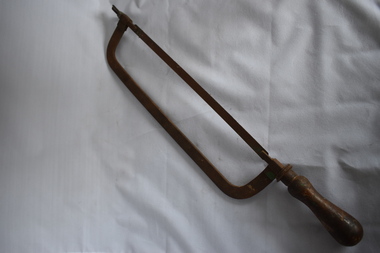
... demolished. ‘Guthrie’ was the home of the Dickson family, prominent in Warrnambool business circles. James Dickson, with his friend John Cramond, established a store in Warrnambool in the mid 19th century and this department store, known as Cramond and Dickson, was a prominent business in Warrnambool until its closure in 1973. ...The handle of this hammer looks to be home-made and to have been used as a household tool. Most homes still today include a small hammer as a household item. The provenance of this hammer is unclear but it possible that it is the hammer found at ‘Guthrie’, a house in Merri Street, Warrnambool that was demolished. ‘Guthrie’ was the home of the Dickson family, prominent in Warrnambool business circles. James Dickson, with his friend John Cramond, established a store in Warrnambool in the mid 19th century and this department store, known as Cramond and Dickson, was a prominent business in Warrnambool until its closure in 1973. James Dickson’s son and his family lived at ‘Guthrie’ and the hammer may have belonged to the Dicksons or another family connected to that property. This hammer has a metal head and a wooden handle. The top of the handle has a metal screw inserted and small slivers of the wood are missing. The end of the metal section is much worn.household tools, history of warrnambool -
 Warrnambool and District Historical Society Inc.
Household, Hammer, Early 20th century
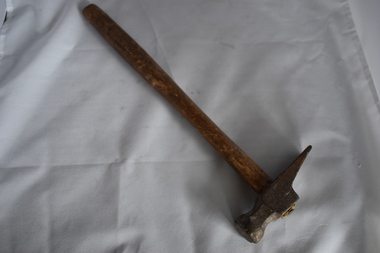
... demolished. ‘Guthrie’ was the home of the Dickson family, prominent in Warrnambool business circles. James Dickson, with his friend John Cramond, established a store in Warrnambool in the mid 19th century and this department store, known as Cramond and Dickson, was a prominent business in Warrnambool until its closure in 1973. ...The handle of this hammer looks to be home-made and to have been used as a household tool. Most homes still today include a small hammer as a household item. The provenance of this hammer is unclear but it possible that it is the hammer found at ‘Guthrie’, a house in Merri Street, Warrnambool that was demolished. ‘Guthrie’ was the home of the Dickson family, prominent in Warrnambool business circles. James Dickson, with his friend John Cramond, established a store in Warrnambool in the mid 19th century and this department store, known as Cramond and Dickson, was a prominent business in Warrnambool until its closure in 1973. James Dickson’s son and his family lived at ‘Guthrie’ and the hammer may have belonged to the Dicksons or another family connected to that property. This hammer has a metal head and a wooden handle. The top of the handle has a metal screw inserted and small slivers of the wood are missing. The end of the metal section is much worn.household tools, history of warrnambool, hammer -
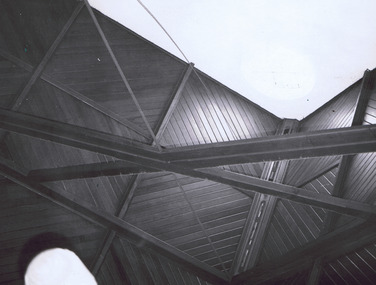 St Kilda Historical Society
Photograph
... demolished. The photograph was taken at the final service. The church closed in 1974 and gave its hymn books, carpets and curtains to its sister church, East St Kilda Congregational Church at the corner of Hotham and Inkerman Streets (later East St Kilda Uniting Church and now Trinity-St Nicholas Church). St Kilda Churches St John's Congregational Church Congregational churches Portion of ceiling of St John Cong. Church South S Kilda. Closing Service 31 Dec 1973 ...St John’s Congregational Church was established in 1888 on the corner of Barkly and Mitford Streets, near the Village Belle Hotel in South St Kilda. The building has now been demolished. The photograph was taken at the final service. The church closed in 1974 and gave its hymn books, carpets and curtains to its sister church, East St Kilda Congregational Church at the corner of Hotham and Inkerman Streets (later East St Kilda Uniting Church and now Trinity-St Nicholas Church).black and white photographPortion of ceiling of St John Cong. Church South S Kilda. Closing Service 31 Dec 1973st kilda, churches, st john's congregational church, congregational churches -
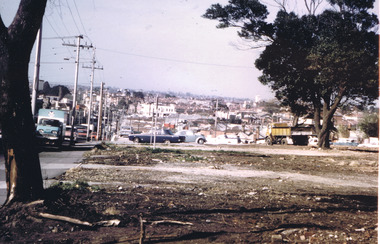 St Kilda Historical Society
Photograph, c. 1973
... High Street St Kilda was widened in 1973 and renamed St Kilda Road. The shops and houses on the south side of the road were demolished to allow for the construction of a multiple lane highway....High Street St Kilda was widened in 1973 and renamed St Kilda Road. The shops and houses on the south side of the road were demolished to allow for the construction of a multiple lane highway. ...High Street St Kilda was widened in 1973 and renamed St Kilda Road. The shops and houses on the south side of the road were demolished to allow for the construction of a multiple lane highway.colour photographst kilda, high street, -
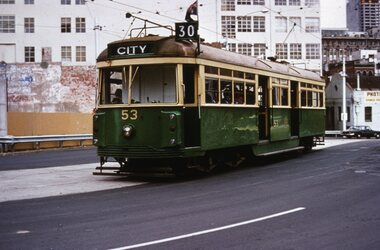 Melbourne Tram Museum
Slide, Tramway Museum Society of Victoria (TMSV), Tram VR 53 La Trobe St, c1974
... 1973 and 1978 - see reference. The concrete looks relatively new in the photograph. The tram was originally built by the Victorian Railways for their St Kilda Brighton tramway in 1942. It is currently on display at the Melbourne Tram Museum. Many of the buildings in the background have since been demolished...1973 and 1978 - see reference. The concrete looks relatively new in the photograph. The tram was originally built by the Victorian Railways for their St Kilda Brighton tramway in 1942. It is currently on display at the Melbourne Tram Museum. Many of the buildings in the background have since been demolished ...Colour slide of VR class tram 53, route 30, westbound in La Trobe St on the bypass built to enable the construction of the Melbourne Central or Museum station between Dec 1973 and 1978 - see reference. The concrete looks relatively new in the photograph. The tram was originally built by the Victorian Railways for their St Kilda Brighton tramway in 1942. It is currently on display at the Melbourne Tram Museum. Many of the buildings in the background have since been demolished. The former Myer warehouse can be seen in the top right-hand corner of the photo.Yields information about VR tram 53 and Latrobe St c1974.Kodachrome colour slides, cardboard mount.Has "MP146" in pencil and stamped "Tramways Museum Society Victoria" on rear.tramways, vr class, tram 53, route 30, latrobe st -
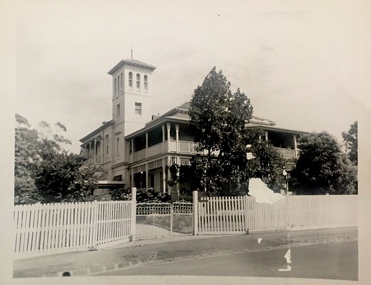 Kew Historical Society Inc
Photograph, J E & B L Rogers, 'Fernhurst', c.1959
... 1973), or the numerous articles on local history that she produced for suburban newspapers. Most of the photographs in the collection include detailed annotations in her hand. The Rogers Collection provides a comprehensive insight into the working habits of a historian in the 1960s and 1970s. Together it forms the largest privately-donated collection within the archives of the Kew Historical Society. fernhurst -- kew (vic) historical houses -- kew (vic) kew mansions "Probably built in 1860s / Fernhurst" Small, black and white photo of Fernhurst in Kew, built for the architect and surveyor George Wharton. (Now demolished ...This work forms part of the collection assembled by the historian Dorothy Rogers, that was donated to the Kew Historical Society by her son John Rogers in 2015. The manuscripts, photographs, maps, and documents were sourced by her from both family and local collections or produced as references for her print publications. Many were directly used by Rogers in writing ‘Lovely Old Homes of Kew’ (1961) and 'A History of Kew' (1973), or the numerous articles on local history that she produced for suburban newspapers. Most of the photographs in the collection include detailed annotations in her hand.The Rogers Collection provides a comprehensive insight into the working habits of a historian in the 1960s and 1970s. Together it forms the largest privately-donated collection within the archives of the Kew Historical Society.Small, black and white photo of Fernhurst in Kew, built for the architect and surveyor George Wharton. (Now demolished)"Probably built in 1860s / Fernhurst"fernhurst -- kew (vic), historical houses -- kew (vic), kew mansions -
 Kew Historical Society Inc
Photograph, Salvation Army Hall, Kew, 1967
... 1973), or the numerous articles on local history that she produced for suburban newspapers. Most of the photographs in the collection include detailed annotations in her hand. The Rogers Collection provides a comprehensive insight into the working habits of a historian in the 1960s and 1970s. Together it forms the largest privately-donated collection within the archives of the Kew Historical Society. churches -- kew (vic) salvation army -- high street -- kew (vic.) "Salvation Army / Kew 1967" Small black and white photograph of the Salvation Army Hall in High Street, Kew (now demolished ...This work forms part of the collection assembled by the historian Dorothy Rogers, that was donated to the Kew Historical Society by her son John Rogers in 2015. The manuscripts, photographs, maps, and documents were sourced by her from both family and local collections or produced as references for her print publications. Many were directly used by Rogers in writing ‘Lovely Old Homes of Kew’ (1961) and 'A History of Kew' (1973), or the numerous articles on local history that she produced for suburban newspapers. Most of the photographs in the collection include detailed annotations in her hand.The Rogers Collection provides a comprehensive insight into the working habits of a historian in the 1960s and 1970s. Together it forms the largest privately-donated collection within the archives of the Kew Historical Society.Small black and white photograph of the Salvation Army Hall in High Street, Kew (now demolished)."Salvation Army / Kew 1967"churches -- kew (vic), salvation army -- high street -- kew (vic.) -
 Kew Historical Society Inc
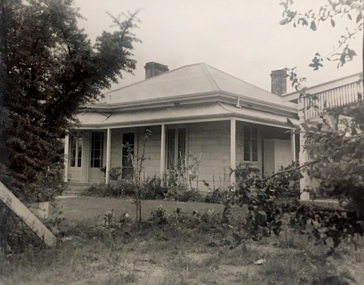
Photograph, 'Houghton', Princess Street, c.1960
... 1973), or the numerous articles on local history that she produced for suburban newspapers. Most of the photographs in the collection include detailed annotations in her hand. The Rogers Collection provides a comprehensive insight into the working habits of a historian in the 1960s and 1970s. Together it forms the largest privately-donated collection within the archives of the Kew Historical Society. historic houses -- kew (vic.) houghton -- princess street -- kew (vic.) "Houghton. ca. 1860 / 17" Small black and white photograph of 'Houghton' (now demolished ...This work forms part of the collection assembled by the historian Dorothy Rogers, that was donated to the Kew Historical Society by her son John Rogers in 2015. The manuscripts, photographs, maps, and documents were sourced by her from both family and local collections or produced as references for her print publications. Many were directly used by Rogers in writing ‘Lovely Old Homes of Kew’ (1961) and 'A History of Kew' (1973), or the numerous articles on local history that she produced for suburban newspapers. Most of the photographs in the collection include detailed annotations in her hand.The Rogers Collection provides a comprehensive insight into the working habits of a historian in the 1960s and 1970s. Together it forms the largest privately-donated collection within the archives of the Kew Historical Society.Small black and white photograph of 'Houghton' (now demolished) in Princess Street, Kew."Houghton. ca. 1860 / 17"historic houses -- kew (vic.), houghton -- princess street -- kew (vic.) -
 Kew Historical Society Inc
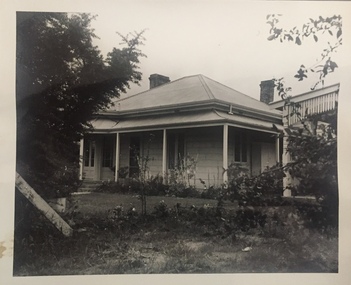
Photograph, 'Houghton', Princess Street, c.1960
... 1973), or the numerous articles on local history that she produced for suburban newspapers. Most of the photographs in the collection include detailed annotations in her hand. The Rogers Collection provides a comprehensive insight into the working habits of a historian in the 1960s and 1970s. Together it forms the largest privately-donated collection within the archives of the Kew Historical Society. historic houses -- kew (vic.) houghton -- princess street -- kew (vic.) "Houghton" Small black and white photograph of 'Houghton (demolished ...This work forms part of the collection assembled by the historian Dorothy Rogers, that was donated to the Kew Historical Society by her son John Rogers in 2015. The manuscripts, photographs, maps, and documents were sourced by her from both family and local collections or produced as references for her print publications. Many were directly used by Rogers in writing ‘Lovely Old Homes of Kew’ (1961) and 'A History of Kew' (1973), or the numerous articles on local history that she produced for suburban newspapers. Most of the photographs in the collection include detailed annotations in her hand.The Rogers Collection provides a comprehensive insight into the working habits of a historian in the 1960s and 1970s. Together it forms the largest privately-donated collection within the archives of the Kew Historical Society.Small black and white photograph of 'Houghton (demolished)', Princess Street, Kew."Houghton"historic houses -- kew (vic.), houghton -- princess street -- kew (vic.) -
 Kew Historical Society Inc
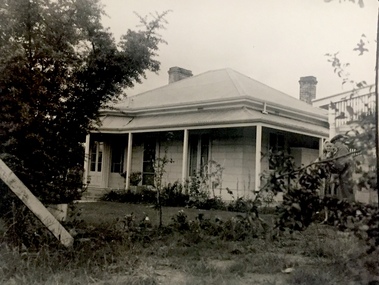
Photograph, 'Houghton', Princess Street, c.1960
... 1973), or the numerous articles on local history that she produced for suburban newspapers. Most of the photographs in the collection include detailed annotations in her hand. The Rogers Collection provides a comprehensive insight into the working habits of a historian in the 1960s and 1970s. Together it forms the largest privately-donated collection within the archives of the Kew Historical Society. historic houses -- kew (vic.) houghton -- princess street -- kew (vic.) Small black and white photograph of 'Houghton (demolished ...This work forms part of the collection assembled by the historian Dorothy Rogers, that was donated to the Kew Historical Society by her son John Rogers in 2015. The manuscripts, photographs, maps, and documents were sourced by her from both family and local collections or produced as references for her print publications. Many were directly used by Rogers in writing ‘Lovely Old Homes of Kew’ (1961) and 'A History of Kew' (1973), or the numerous articles on local history that she produced for suburban newspapers. Most of the photographs in the collection include detailed annotations in her hand.The Rogers Collection provides a comprehensive insight into the working habits of a historian in the 1960s and 1970s. Together it forms the largest privately-donated collection within the archives of the Kew Historical Society.Small black and white photograph of 'Houghton (demolished)', Princess Street, Kew.historic houses -- kew (vic.), houghton -- princess street -- kew (vic.) -
 Kew Historical Society Inc
Photograph - 'Reno', St John's Parade, c.1960
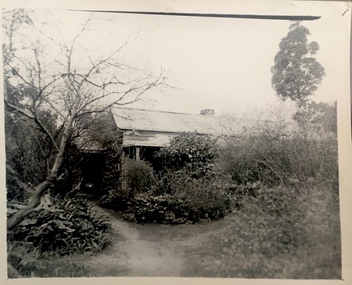
... 1973), or the numerous articles on local history that she produced for suburban newspapers. Most of the photographs in the collection include detailed annotations in her hand. The Rogers Collection provides a comprehensive insight into the working habits of a historian in the 1960s and 1970s. Together it forms the largest privately-donated collection within the archives of the Kew Historical Society. historic houses -- kew (vic.) reno -- st john's parade -- kew (vic.) "Reno / 3" Small black and white photograph of 'Reno' (demolished ...This work forms part of the collection assembled by the historian Dorothy Rogers, that was donated to the Kew Historical Society by her son John Rogers in 2015. The manuscripts, photographs, maps, and documents were sourced by her from both family and local collections or produced as references for her print publications. Many were directly used by Rogers in writing ‘Lovely Old Homes of Kew’ (1961) and 'A History of Kew' (1973), or the numerous articles on local history that she produced for suburban newspapers. Most of the photographs in the collection include detailed annotations in her hand.The Rogers Collection provides a comprehensive insight into the working habits of a historian in the 1960s and 1970s. Together it forms the largest privately-donated collection within the archives of the Kew Historical Society.Small black and white photograph of 'Reno' (demolished 1977), St John's Parade, Kew."Reno / 3"historic houses -- kew (vic.), reno -- st john's parade -- kew (vic.) -
 Kew Historical Society Inc
Photograph - 'Reno', St John's Parade, c.1960
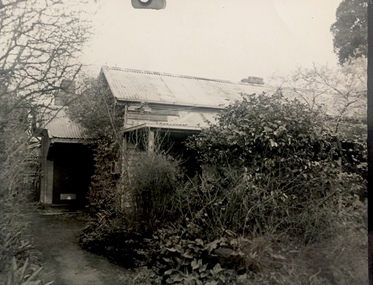
... 1973), or the numerous articles on local history that she produced for suburban newspapers. Most of the photographs in the collection include detailed annotations in her hand. The Rogers Collection provides a comprehensive insight into the working habits of a historian in the 1960s and 1970s. Together it forms the largest privately-donated collection within the archives of the Kew Historical Society. historic houses -- kew (vic.) reno -- st john's parade -- kew (vic.) "49" Small black and white photograph of 'Reno' (demolished 1977), St John's Parade, Kew. ...This work forms part of the collection assembled by the historian Dorothy Rogers, that was donated to the Kew Historical Society by her son John Rogers in 2015. The manuscripts, photographs, maps, and documents were sourced by her from both family and local collections or produced as references for her print publications. Many were directly used by Rogers in writing ‘Lovely Old Homes of Kew’ (1961) and 'A History of Kew' (1973), or the numerous articles on local history that she produced for suburban newspapers. Most of the photographs in the collection include detailed annotations in her hand.The Rogers Collection provides a comprehensive insight into the working habits of a historian in the 1960s and 1970s. Together it forms the largest privately-donated collection within the archives of the Kew Historical Society.Small black and white photograph of 'Reno' (demolished 1977), St John's Parade, Kew."49"historic houses -- kew (vic.), reno -- st john's parade -- kew (vic.) -
 Surrey Hills Historical Society Collection
Photograph, Surrey Hills railway station, c1971, c 1971
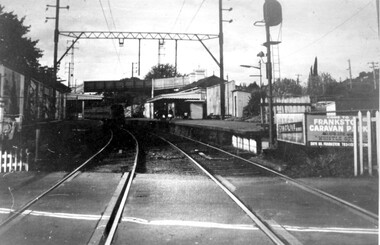
... This would have been taken shortly before the station was demolished. railways land transport surrey hills railway station Black and white photo of Surrey Hills railway station taken from the tracks near the gates in 1973. ...This would have been taken shortly before the station was demolished.Black and white photo of Surrey Hills railway station taken from the tracks near the gates in 1973. It shows the wooden pedestrian overpass and the original station buildings with extended shelters over the platforms.There is a newspaper kiosk on the southern platform. The train is coming into the platform and there is a small group of passengers waiting. Advertising hoarding for Spaceline Homes and the Frankston Caravan Park are mounted at the end of the southern platform. railways, land transport, surrey hills railway station -
 Kew Historical Society Inc
Uniform - Kew East Central School cap with badge, 1935–1945
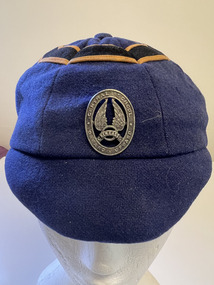
... Additional buildings, including a canteen, library, Rural Training School (now demolished), classrooms, and a new library in 1973, were added to the site over the years....Additional buildings, including a canteen, library, Rural Training School (now demolished), classrooms, and a new library in 1973, were added to the site over the years. government schools -- kew (vic.) central schools -- Melbourne Kew East Central School Badge: "Central School / Kew East / Onwards Upwards" Purple East Kew Central School cap and badge. ...Kew East Primary School officially opened on 25th April 1892. The school relocated to its current site on Kitchener Street in 1923, with the addition of the three-storey brick building in 1929. In the early 1920s, Kew East Primary became a Central School, offering secondary classes until district high schools were established. Additional buildings, including a canteen, library, Rural Training School (now demolished), classrooms, and a new library in 1973, were added to the site over the years.Purple East Kew Central School cap and badge. The purple cap includes contrasting bands. The oval, white metal badge includes the name of the school and the school motto Onwards Upwards surrounding a pair of wings.Badge: "Central School / Kew East / Onwards Upwards"government schools -- kew (vic.), central schools -- melbourne, kew east central school
