
Showing 6 items matching "department stores - sydney."
-
 Kew Historical Society Inc
Book, Ure Smith, Australia In The Good Old Days : Facsimile pages from Lassetters' commercial review, no.26, 1911, 1976
... Department stores -- Goods -- Sydney --1911...Reference books have entered the collection through donation, presentation, collection and purchase. Department stores -- Goods -- Sydney --1911 Catalogues. Facsimiles Department stores - Sydney. 264p. : all facs. ; 27cm. ...264p. : all facs. ; 27cm. non-fictiondepartment stores -- goods -- sydney --1911, catalogues. facsimiles, department stores - sydney. -
 Flagstaff Hill Maritime Museum and Village
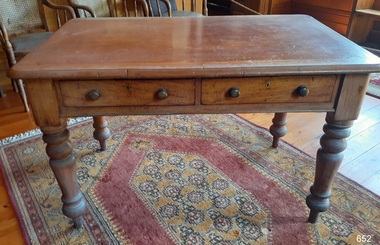
Furniture - Desk, Foy & Gibson, Circa 1880s
... Sydney. They established a business there in 1885, named after their father, Mark Foy. Gibson added to his business by starting his own manufacturing works from 1887, producing clothing, millinery, furniture, bedding and hardware for his stores. The factories, warehouses and stores complex became one of Victoria’s largest employers. He set up branches of his stores in Perth, Brisbane and Adelaide and two more branches in Melbourne. Foy & Gibson (usually referred to as Foys) became one of Australia’s largest retail department...Sydney. They established a business there in 1885, named after their father, Mark Foy. Gibson added to his business by starting his own manufacturing works from 1887, producing clothing, millinery, furniture, bedding and hardware for his stores. The factories, warehouses and stores complex became one of Victoria’s largest employers. He set up branches of his stores in Perth, Brisbane and Adelaide and two more branches in Melbourne. Foy & Gibson (usually referred to as Foys) became one of Australia’s largest retail department ...The design of this small disc is from the Australian Colonial period. The cedar wood desk was made in Australian by Foy & Gibson in the 1880s, most probably in the business’s works in Collingwood, Victoria. The heavy brass locks fitted into the desk drawers were made by the famous Hobbs & Co of London, mid-late 19th century. In 1860 the business changed hands but the locks were still branded Hobbs & Co. The desk is branded with the symbol of Victoria’s Public Works Department. There is currently no information on when, where and by whom this desk was used. However, a very similar desk with Hobbs & Co. locks is on site at the Point Hicks Lightstation in Victoria and was formerly used by the Point Hicks head light keeper there. Other light stations also have similar desks from the P.W.D. (see also ‘Desk, Parks Victoria – Point Hicks Lightstation, Victorian Collections’.) HOBBS & CO., LONDON Alfred Charles Hobbs, 1812-1891, was American born. He became an executive salesman in 1840 for renowned lock manufacturer Day & Newell. His technique of exposing the weaknesses of people’s current locks was very successful in generating sales. He represented Day & Newell at London’s Great Exhibition of 1851, competing with other lock makers. Through the Exhibition he became famous for picking the best trusted Bramah and Chubb locks. Hobbs’ fame led him to found his own company in 1851 then register it in 1852 as Hobbs & Co., London. Hobbs was awarded the Telford Medal by the British Institution of Civil Engineers in 1854 for his paper 'On the Principles and Construction of Locks'. In 1855 the very successful company added partners and became Hobbs, Ashley and Co. In 1860, it traded under the name of Hobbs, Hart & Co. and was based in Cheapside London, where the business remained. Hobbs then returned to America, having sold the complete company to John Mathias Hart. He briefly returned to attend the 21st anniversary celebrations of the successful business in 1872. Hobbs kept himself busy in America, inventing and manufacturing firearm ammunition, for which he held several patents. He passed away there in 1891, a month after his 70th birthday. FOY & GIBSON Mark Foy wan an Irish draper who migrated to Bendigo, Victoria in 1858, attracted by the gold rush. He lived and worked in the area, establishing a drapery business. In the 1870s he moved to Melbourne where there were better prospects for expansion. He chose a place in Smith Street, Collingwood, a suburb of Melbourne, and started his business at the rear. In 1883 Foy retired, bringing in William Gibson as a partner, and then transferred his own share of the company to his son Francis Foy. Not long afterwards Francis sold his half share to Gibson, and the business continued under the name of Foy & Gibson. Francis Foy and he and his brother Mark Foy (junior) moved to Sydney. They established a business there in 1885, named after their father, Mark Foy. Gibson added to his business by starting his own manufacturing works from 1887, producing clothing, millinery, furniture, bedding and hardware for his stores. The factories, warehouses and stores complex became one of Victoria’s largest employers. He set up branches of his stores in Perth, Brisbane and Adelaide and two more branches in Melbourne. Foy & Gibson (usually referred to as Foys) became one of Australia’s largest retail department stores. In 1931 Foy’s little house in Collingwood was still part of the entrance to Foy & Gibson Emporium. In 1955 the company was bought out by Cox Brothers. Later on the stores were sold to various businesses such as David Jones, Woolworths and Harris Scarfe. In 1968 Cox Brothers went into receivership, ending almost 100 years of the business known as Foy’s. The former Foy & Gibson Complex is registered by Heritage Council Victoria. “Designed by William Pitt, this magnificent 19th and early 20th century complex of factories, warehouses and showrooms saw the production of a remarkable range of goods for Foy & Gibson, Melbourne’s earliest department store chain”. (Quoted from the Plaque erected by the Collingwood Historical Society 2007) P.W.D. – Public Works Department, Victoria The desk is stamped “P.W.D,” signifying that it is from the Public Works Department in Victoria, which operated from 1855-1987. The department was responsible for, among other things, the design and supply of office furniture and equipment for public buildings and organisations. This desk is significant historically as it originated from Foy & Gibson, a colonial Australian company that had a positive and strong impact on employment, manufacturing and retailing in Melbourne, Victoria and Australia. The significance of Foy & Gibson to Victoria’s and Australia’s history is marked by the Collingwood Complex being registered in both Heritage Victoria Register (H0755, H0897 and H0896) and National Trust Register (B2668). This locks on this desk are significant for their connection with their manufacturer, Hobbs & Co, who invented a lock that surpassed the security of any other locks produced in the mid-19th century. Desk; Australian Colonial cedar desk, honey coloured. Desktop has a wooden border with a rolled edge and a fitted timber centrepiece. The four tapered legs are tulip turned. Two half-width drawers fit side by side and extend the full depth of the desk. The drawers have dovetail joints. Each drawer has two round wooden knob handles, a keyhole and a fitted, heavy brass lever lock. Inscriptions are on the desktop, drawers, desk leg and lock. Made in Australia circa 1880 by Foy & Gibson, lock made by Hobbs & Co, London.Impressed into timber frame of one drawer “FOY & GIBSON” Impressed into lock “HOBBS & CO / LONDON”, “MACHINE MADE”, “LEVER” Impressed along the front edge of the desktop [indecipherable] text. Impressed into the timber of right front leg “P. W. D.” below a ‘crown’ symbol Handwritten in white chalk under a drawer “206” flagstaff hill, warrnambool, shipwrecked coast, flagstaff hill maritime museum, maritime museum, shipwreck coast, flagstaff hill maritime village, great ocean road, desk, cedar desk, colonial desk, 1880s desk, australian colonial furniture, furniture, office furniture, office equipment, australian made furniture, colonial furniture, colonial hardware, foy & gibson, alfred charles hobbs, hobbs & co london, hobs & co lever lock, cabinetry lock, machine made lever lock, p.w.d., public works department victoria, day & newell, great exhibition of 1851, bramah lock, chubb lock, telford medal 1854, cheapside london, mark foy, mark foy – bendigo draper, smith street collingwood, william gibson, foy & gibson emporium, foy & gibson complex, cox brothers -
 City of Moorabbin Historical Society (Operating the Box Cottage Museum)
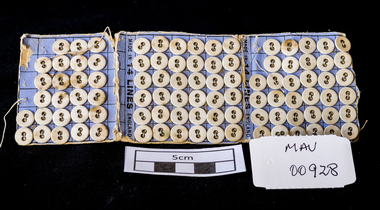
Manufactured Objects, card of buttons, c1900
... sydney...new south wales...moorabbin...department stores...department store in Sydney, New South Wales, Australia. with 52 acres (21 hectares) of retail space, and was once the largest department store in the world . It also operated one of the largest mail order businesses in Australia. One of their advertising slogans was that they sold "anything from a needle to an anchor". horden anthony senior horden and son pty ltd sydney new south wales moorabbin department stores market gardeners pioneers dressmaking craftwork sewing needles clothing buttons on backing of card a picture of an 'Anchor and Rope , Needle and Thread' / FROM A NEEDLE / TO AN ANCHOR / TRADE MARK / MADE IN ENGLAND. ...Anthony Hordern sen. (1788–1869) came from Staffordshire, as a free immigrant in 1823, and the business was originally established as a drapery store in Pitt Street by his wife Ann. The family moved to Melbourne and remained there but a son Anthony junior purchased land in George Street Sydney in 1842 and set up business with his brother Lebbeus. They broke their partnership in1855 and Anthony took his sons Anthony and Samuel into partnership as they became old enough. Anthony Hordern & Sons was the largest department store in Sydney, New South Wales, Australia. with 52 acres (21 hectares) of retail space, and was once the largest department store in the world . It also operated one of the largest mail order businesses in Australia. One of their advertising slogans was that they sold "anything from a needle to an anchor". A strip of blue cardboard with 95 small, white 2 hole buttons . The cardboard folds into 3 for easy storage with each section holding 36 buttons. 7 buttons are missing - used. The buttons are sewn onto the card with a running thread that is covered by backing paper.on backing of card a picture of an 'Anchor and Rope , Needle and Thread' / FROM A NEEDLE / TO AN ANCHOR / TRADE MARK / MADE IN ENGLAND. inside ' MADE IN 14 LINES ENGLAND 'horden anthony senior, horden and son pty ltd, sydney, new south wales, moorabbin, department stores, market gardeners, pioneers, dressmaking, craftwork, sewing needles, clothing, buttons -
 Bendigo Historical Society Inc.
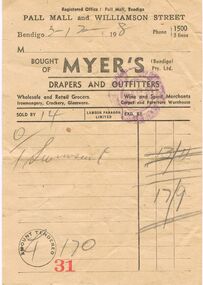
Document - MYER'S INVOICE
... Sydney Myer was born in Russia in 1878 and came to Australia in 1896. He was initially a travelling salesman before opening a drapery store in Bendigo in 1900. In 1908 he opened a second store in Bendigo. In 1911 he purchased Wright and Neil Drapery in Bourke Street. This led to the formation of the Myers Emporium that became the largest chain of department stores...Sydney Myer was born in Russia in 1878 and came to Australia in 1896. He was initially a travelling salesman before opening a drapery store in Bendigo in 1900. In 1908 he opened a second store in Bendigo. In 1911 he purchased Wright and Neil Drapery in Bourke Street. This led to the formation of the Myers Emporium that became the largest chain of department stores ...Sydney Myer was born in Russia in 1878 and came to Australia in 1896. He was initially a travelling salesman before opening a drapery store in Bendigo in 1900. In 1908 he opened a second store in Bendigo. In 1911 he purchased Wright and Neil Drapery in Bourke Street. This led to the formation of the Myers Emporium that became the largest chain of department stores with branches in all states and territories.Myer's Invoice: Cream paper with black print. Registered Office : Pall Mall, Bendigo. Pall Mall and Williamson Street. Bendigo 3/2/198 (sic) Phone 1500, 3 lines. Bought of Myer's (Bendigo) Pty Ltd. Drapers and Outfitters. Wholesale and Retail Grocers. Ironmongery, Crockery, Glassware. Wine and Spirit Merchants Carpet and Furniture Warehouse. Sold By 14. Lamson Paragon Limited. Exd By. Purchased was: 1 Swimsuit at 17/9. Amount Tendered 170 Invoice no. 31. Purple stamp with paid on. Small tear. Box 625business, retail, myer's store, myer's bendigo -
 National Wool Museum
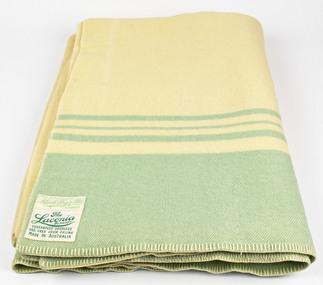
Textile - Blanket, Laconia Woollen Mills, 1930s
... department stores. To the grandparents that gave them, the people that received them, the families that kept them; thank you. I’m passionate about my collection of Australian blankets manufactured in mostly Victoria, South Australia and Tasmania from the 1930s to the end of the 1960s. The collection has blankets from each of these four decades representing the styles and fashions of their time and includes dated advertisements which help determine the eras the blankets are from." Blanket Blanket fever Wool Laconia Mills Made Expressly for Mark Foy's Ltd/Sydney ...Collector says: I'm intrigued to know why this 1930s & 1940s fashion of blanket - with panels of stripes on each end - only came in the colours of pink, baby blue and mint. Over the years I gathered many 'panel' blankets with labels from over a dozen different mills and yet they are all in these 3 colours only.Note from collector- "For more than 100 years blankets were made all over Australia in over 100 woollen mills. My aim, is to preserve 100 examples of these wonderful pieces of history. Ten years ago I started collecting the iconic Onkaparinga travel rugs, so that on movie nights at home there would be plenty to go around. Everyone had their favourite; even the cat had his own – a small red tartan one. Keeping an eye out for those travel rugs at op-shops and markets, collectable stores and bazaars, led to noticing vintage blankets. I'd never really thought about them before or paid much attention though of course I had grown up with them at my grandmother's. When I discovered my first Laconia cream blanket with blue stripes, my eyes just went gaga. Well that was it, I was hooked and since then over 500 blankets have passed through my hands. These common, everyday items, found in all households for so many decades, were traditional engagement gifts. Pairs were prized wedding presents turning into family heirlooms. They were fashionable dressers of beds, givers of warmth, bestowers of security and reliability. The comfort found in these objects resonates with almost all of us; we grew up with them ourselves or fondly recall them in a grandparent’s home. There is no modern replacement with the integrity of these old blankets, many of them now older than most of us. They are romantic, sensible, special, familiar, nostalgic and nothing else feels so appropriate in so many situations. No offense to the great Aussie doona, but from hippie to hipster, at a music festival, picnic, campsite or couch, a vintage blanket is something coveted by all. This industry that employed tens of thousands and must have been such a huge contributor to the economy is almost completely lost now. Blanket Fever is an ode to everything that came before: the land, the sheep, the shearers, the hands, the mills, the weavers, the designers, the distributors, the department stores. To the grandparents that gave them, the people that received them, the families that kept them; thank you. I’m passionate about my collection of Australian blankets manufactured in mostly Victoria, South Australia and Tasmania from the 1930s to the end of the 1960s. The collection has blankets from each of these four decades representing the styles and fashions of their time and includes dated advertisements which help determine the eras the blankets are from." Double sized blanket with mint stripes Made Expressly for Mark Foy's Ltd/Sydney/The Laconia Blanket/Guaranteed Odorless and Free From Filling/Made in Australiablanket, blanket fever, wool, laconia mills -
 Mont De Lancey
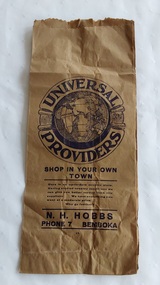
Domestic object - Universal Providers Paper bag, Universal Providers, 1900's
... "Universal Providers" was a late 19th- and early 20th-century term used by major historic department stores—such as Melbourne's George & George on Collins Street (later Georges) or Sydney's Anthony Hordern & Sons—to signify that they stocked everything under one roof. ..."Universal Providers" was a late 19th- and early 20th-century term used by major historic department stores—such as Melbourne's George & George on Collins Street (later Georges) or Sydney's Anthony Hordern & Sons—to signify that they stocked everything under one roof. ..."Universal Providers" was a late 19th- and early 20th-century term used by major historic department stores—such as Melbourne's George & George on Collins Street (later Georges) or Sydney's Anthony Hordern & Sons—to signify that they stocked everything under one roof. Original branded paper bags and packaging from these iconic "Universal Providers" are now rare pieces of ephemera. The N.H. Hobbs Store was a historic general store in Bemboka, New South Wales, run continuously by the Hobbs family for 80 years. Established in the early 1900s, it served as a regional landmark and trading post for locals and travelers crossing Brown Mountain before closing down.A vintage tall narrow rectangular brown paper bag with side gussets for greater storage. The large brand symbol Universal Providers for the N.H. Hobbs store in Bemboka is printed on the front in black lettering. There is a globe of the world surrounded by two scroll type banners with the brand Universal Providers. Underneath is further information promoting the store and a phone number. The back is plain.'Universal Providers' 'Shop in your own town' 'Ours is an up-to-date country store. Having studied country conditions we can give you better service than city suppliers. We have everything you want at a moderate price. Why go further?' N.H. Hobbs Phone 7 Bemboka'paper bags, bags, containers
