
Showing 284 items matching "design techniques"
-
 Moorabbin Air Museum
Manual (item) - Instrument Ref Handbook - Aircraft design-Materials & Techniques - RAAF 1980
... Instrument Ref Handbook - Aircraft design-Materials & Techniques - RAAF 1980...Instrument Ref Handbook - Aircraft design-Materials & Techniques - RAAF 1980...Instrument Ref Handbook - Aircraft design-Materials & Techniques - RAAF 1980 Manual Instrument Ref Handbook - Aircraft design-Materials & Techniques - RAAF 1980 ... -
Moorabbin Air Museum
Book - AGARD reports, Advances in Guidance and Control Systems Using Digital Techniques
... Advances in analytical & design techniques...AGARD reports Functional design concepts/trends & requirements Advances in analytical & design techniques Advances in digital system design Data processing & computation techniques Software design validation techniques Operational & system development Overview of use of digital techniques in guidance & control system advances , circa 1979 Advances in Guidance and Control Systems Using Digital Techniques Book AGARD reports ...Overview of use of digital techniques in guidance & control system advances , circa 1979non-fictionOverview of use of digital techniques in guidance & control system advances , circa 1979functional design concepts/trends & requirements, advances in analytical & design techniques, advances in digital system design, data processing & computation techniques, software design validation techniques, operational & system development -
Moorabbin Air Museum
Book - AGARD reports, Handbook of Brittle Material Design Technology
... ...Design techniques...AGARD reports Principles of brittle material design Design stresses Stress analysis methods Material characterization Design criteria Design techniques Mechanical property testing of brittle materials Statement of design practices & quantitative data to apply to such practices, circa 1971 Handbook of Brittle Material Design Technology Book AGARD reports ...Statement of design practices & quantitative data to apply to such practices, circa 1971non-fictionStatement of design practices & quantitative data to apply to such practices, circa 1971principles of brittle material design, design stresses, stress analysis methods, material characterization, design criteria, design techniques, mechanical property testing of brittle materials -
Whitehorse Historical Society Inc.
Document, Historical mural - leadlight group, 1987
... Three bulletins from the historical mural and leadlight group, reporting on the design, workshop technique, assembly, finishing and installation of the bicentennial leadlight mural....Nunawading bicentennial leadlight group Bicentenary Leadlight Mural Arrowsmith Ted Three bulletins from the historical mural and leadlight group, reporting on the design, workshop technique, assembly, finishing and installation of the bicentennial leadlight mural. ...Three bulletins from the historical mural and leadlight group, reporting on the design, workshop technique, assembly, finishing and installation of the bicentennial leadlight mural.Three bulletins from the historical mural and leadlight group, reporting on the design, workshop technique, assembly, finishing and installation of the bicentennial leadlight mural.Three bulletins from the historical mural and leadlight group, reporting on the design, workshop technique, assembly, finishing and installation of the bicentennial leadlight mural.nunawading bicentennial leadlight group, bicentenary leadlight mural, arrowsmith, ted -
 Robin Boyd Foundation
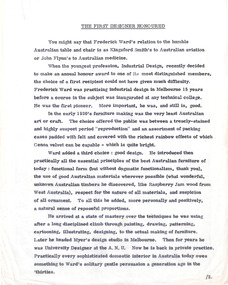
Document - Manuscript, Robin Boyd, The First Designer Honoured, c. 1964
... Discusses the work, design techniques and career of first recipient of the Essington Lewis Award (for Industrial Design) - Frederick Ward. ...Discusses the work, design techniques and career of first recipient of the Essington Lewis Award (for Industrial Design) - Frederick Ward. ...Discusses the work, design techniques and career of first recipient of the Essington Lewis Award (for Industrial Design) - Frederick Ward. Ward's work introduced all the essential principles of the best Australian furniture: functional form; use of Australian materials; respect for the nature of all materials; suspicion of ornament and a sense of purposeful proportions.Review of Fred Ward’s Award by the Industrial Design Council.Typewritten (c copy), quarto, 2 pagesfrederick ward, industrial design, australian furniture, function, form, australian materials, essington lewis award, robin boyd, manuscript -
 Embroiderers Guild, Victoria
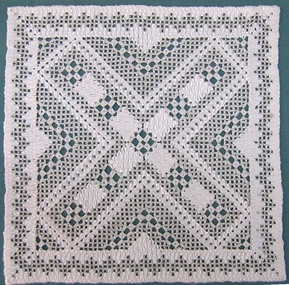
Textile - Swedish Näversöm Mat
... The Näversöm embroidery technique is unusual because it is entirely stitched from the back. The birch bark protected the front of the piece, and the final design was not revealed until the folk art was completely finished. ...Cream mat in Swedish Näversöm technique. Mat design forms a diagonal cross....Swedish Näversöm Mat Embroidery Mats Drawn thread Cream mat in Swedish Näversöm technique. Mat design forms a diagonal cross. Textile Swedish Näversöm Mat ...Originating in Sweden as early as the 17th century, Näversöm embroidery gets its name from a piece of birch bark that was used as a frame. Since the birch bark frame could be easily rolled up and carried to protect her work, the Shepherdess did her Näversöm embroidery while tending her animals. The Näversöm embroidery technique is unusual because it is entirely stitched from the back. The birch bark protected the front of the piece, and the final design was not revealed until the folk art was completely finished. This embroidery would have become extinct had it not been for a Swedish woman, who owned a needlework shop in Hudiksvall, Sweden, who studied the Näversöm stitchery and began teaching this specialized embroidery in the late 1800s. Näversöm had a revival in the 1960s and '70s in Sweden when several instructional articles were published. Näversöm was used as household linens, and in earlier times as lampshades that would display the beautiful artistry as the light shined through the needlework. Examples of new and old patterns are still available from Sweden. Swedish Näversöm MatCream mat in Swedish Näversöm technique. Mat design forms a diagonal cross.embroidery, mats, drawn thread -
 Embroiderers Guild, Victoria
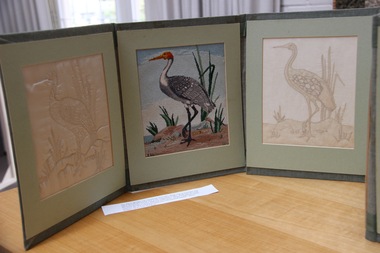
Textile - Folder, Mrs Edna Wark, "The Elegant Brolga", 20th C
... Edna Wark made the silver brolga while on holiday and Winifred Clayton suggested she repeat the design in different techniques....Edna Wark made the silver brolga while on holiday and Winifred Clayton suggested she repeat the design in different techniques. Embroidery Folder Metal quilting Black work Petit point Birds Six panels, each are a brolga in different stitches. ...Edna Wark made the silver brolga while on holiday and Winifred Clayton suggested she repeat the design in different techniques.Six panels, each are a brolga in different stitches. Pulled thread, metal thread, petit point, blackwork and quilting.embroidery, folder, metal, quilting, black work, petit point, birds -
 Emerald Museum & Nobelius Heritage Park
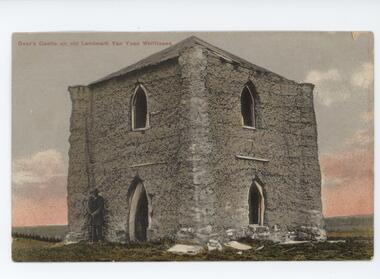
Postcard - Postcard of Bear's Castle, Yan Yean, 1890s
... Bear's Castle is a unique and historical building constructed in the 1840s and classified by the National Trust for its design and construction techniques. The purpose of the 'castle' is contested but one theory is that it was built as a defensive citadel against attacks by bushrangers which had occurred prior to the owner, John Bear, ordering its construction....Bear's Castle is a unique and historical building constructed in the 1840s and classified by the National Trust for its design and construction techniques. The purpose of the 'castle' is contested but one theory is that it was built as a defensive citadel against attacks by bushrangers which had occurred prior to the owner, John Bear, ordering its construction. ...This postcard is part of an album of postcards which date from late 19th century to mid 20th century. Bear's Castle is a unique and historical building constructed in the 1840s and classified by the National Trust for its design and construction techniques. The purpose of the 'castle' is contested but one theory is that it was built as a defensive citadel against attacks by bushrangers which had occurred prior to the owner, John Bear, ordering its construction.This postcard is in an album of postcards dating from the late 19th century to mid 20th century. It reflects the popularity of collecting postcards in Australia which reached a height in the early 1900s until around 1920. Postcard of historic Bear's Castle in Yan Yean.On front: Inscribed 'Bear's Castle on Old Landmark Yan Yean Whittlesea' On back, handwritten long message which does not mention places. It begins with: 'This is one I got on Wednesday. / Travelled with a friend of Lou and Will....'postcard, photography, 1900s, bear's castle, buildings, yan yean, "green postcard album" -
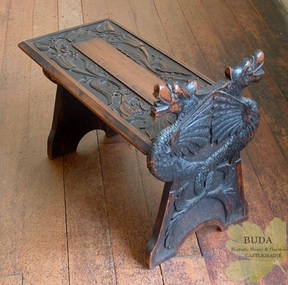 Buda Historic Home & Garden Castlemaine
Domestic furniture, Timber hand-carved boot stool, c1900
... This Movement spread knowledge of craft techniques in the decorative arts and encouraged women to partake in fields that had traditionally been the domain of men, such as metalcraft and woodwork. The Leviny women studied art, design...Made using the 'chip carving' technique, with dragon heads on upright at one end, and plant design in relief on the seat. ...This Movement spread knowledge of craft techniques in the decorative arts and encouraged women to partake in fields that had traditionally been the domain of men, such as metalcraft and woodwork. The Leviny women studied art, design ...The British Arts and Crafts Movement was a major influence on handcrafts made by the Leviny women at Buda. This Movement spread knowledge of craft techniques in the decorative arts and encouraged women to partake in fields that had traditionally been the domain of men, such as metalcraft and woodwork. The Leviny women studied art, design and craft techniques at the Castlemaine School of Mines from the 1890s to the early 1900s and this boot stool, hand-carved by Gertrude, is an example of the influence of the Arts and Crafts Movement on her decorative art. See: Zilles, Lauretta (2010), Buda and the Leviny Family, Castlemaine: Buda Historic Home & Garden Inc.This is a rare example of a unique hand-carved boot stool made in Australia by Gertrude Leviny in the British Arts and Crafts Movement style at the turn of the twentieth century.Timber boot stool, hand-carved by Gertrude Leviny. Made using the 'chip carving' technique, with dragon heads on upright at one end, and plant design in relief on the seat. Timber finish has a blackened effect.'K/40' (Old Registration Number)gertrude leviny, wood carving, arts and crafts movement, buda, castlemaine, dragon's heads, c1900, domestic furniture, castlemaine school of mines -
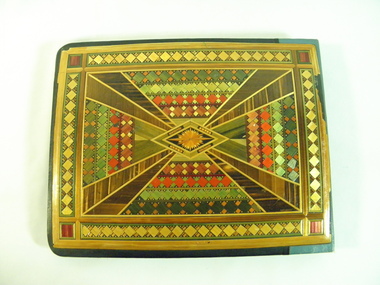 Ukrainian Historical Society Sunshine
Book, Photo Album
... The geometric pattern mimic Ukrainian embroidery design,using straw marquetry technique (which is similar to that of wood marquetry). ...The geometric pattern mimic Ukrainian embroidery design,using straw marquetry technique (which is similar to that of wood marquetry). ...The geometric pattern mimic Ukrainian embroidery design,using straw marquetry technique (which is similar to that of wood marquetry). The wheat straw was soaked in different pigments to achieve the required shades,dried,split and ironed flat. Then cut into various sizes and shapes to create this pattern. The pieces where then glued onto a backing board.The backing board was then glued on the back of the photo album. This album was received as a birthday gift in early1960's.This form of straw art is very rarely seen today.Book is black.Back page is coloured straw design. photographsphoto, book, straw, ukrainian design, 1960, family dutka -
Glen Eira Historical Society
Document - Beauville Estate
... The Guidelines set out design parameters, principles and techniques for achieving appropriate heritage conservation objectives for the defined Beauville Estate Heritage Area, to be used by the Council, property owners, residents and designers. ...The Guidelines set out design parameters, principles and techniques for achieving appropriate heritage conservation objectives for the defined Beauville Estate Heritage Area, to be used by the Council, property owners, residents and designers. ...Beauville Estate Draft Heritage Guidelines, July 2000, produced by the Glen Eira City Council, author unknown, 25 pages. The Guidelines set out design parameters, principles and techniques for achieving appropriate heritage conservation objectives for the defined Beauville Estate Heritage Area, to be used by the Council, property owners, residents and designers. A number of photographs of houses and design features are included in the document as well as a brief history of the Estate and a Key Design Checklist.a v jennings construction co, gurney edward, jennings albert v sir, beauville estate, beauville estate heritage area, beauville avenue 1-39 (odd), beauville avenue 2-36 (even), dalny road 3-25 (odd), gloucester court 1-3 (odd), gloucester court 2-6 (even), lindsay avenue 40-44 (even), murrumbeena road 227-233 (odd), murrumbeena road 222-232 (even), murrumbeena, glen eira city council, architectural features, architectural styles, plans, brick houses, shops, residential development, tennis courts, housing estates, builders, building regulations, local government, commercial development, history, maps, photographs -
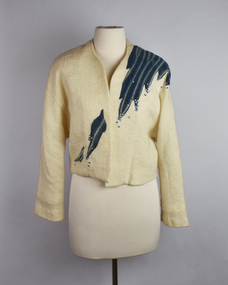 National Wool Museum
Clothing - Jacket, Mrs Jean Inglis, 1988
... This design requires very precise technique. Specific to this jacket, the fabric for the dyed section was made with the same fabric as the rest of the jacket. ...This design requires very precise technique. Specific to this jacket, the fabric for the dyed section was made with the same fabric as the rest of the jacket. ...This jacket is by the prolific spinner and weaver Jean Inglis. It has been woven with a warp of commercially brought wool & a weft of hand spun Corriedale. It is completed in a Swedish lace style of weaving. The highlight of the jacket is the blue section of fabric on the top left shoulder of the wearer, which works down to the bottom right hip. This pattern looks like long thin individual separate sections of fabric stitched to the jacket; however, only one section of fabric has been added. A dying technique has been utilised to give the appearance of multiple sections. This Japanese dyeing technique is called Shibori, “to wring, squeeze or press". It is a manual tie-dyeing technique, which produces several different patterns on fabric. The specific pattern on this fabric is known as Kumo Shibori. It utilises bound resistance. This technique involves folding sections of the cloth very finely and evenly. Then the cloth is bound in very close sections. The result is a very specific spider-like design. This design requires very precise technique. Specific to this jacket, the fabric for the dyed section was made with the same fabric as the rest of the jacket. A section of the excess fabric was concertina wrapped around a 100mm pipe and tied up before dying. This gives the consistent straight blue lines, with no bleed from the dye. The sections were then sewed into the jacket with the occasional sequin added for additional decoration and glamour. The jacket won 1st prize at the 1988 Geelong Show. Jean was assisted by the dress maker Ruth Randell with some of the design and sewing. Jean always found sewing “a bit of a bore”. The jacket also has an attached swing tag. It was added to provide information to the judges at the Melbourne Show on how the jacket was created. It comes complete with Jean’s self-proclaimed terrible handwriting. It was donated to the National Wool Museum in 2021.Cream singled breasted jacket with no overlap. The jacket has no column of buttons for fastening, or lapels. It is designed to be plain, to not draw attention. The jacket is highlighted by the Shibori dyed waves on the top left shoulder of the wearer, which works down to the bottom right hip. This blue dyed section of fabric is dotted with the occasional blue sequin. Internally, the jacket features a white silk lining for comfort. The jacket ends in a straight cut hem, including at the cuffs. The jacket has an attached swing tag. The swing tag is cream with a printed thin black boarder. Within the boarder, handwriting in black ink is found. It has a hole punch in the top left corner of the swing tag for attaching to the jacket.hand spun, hand weaving, textile design, textile production, shibori, kumo shibori -
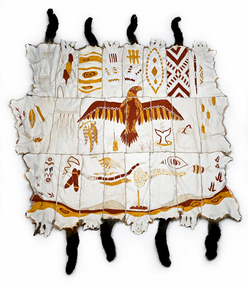 National Wool Museum
Textile - walert walert, Tammy Gilson, 2025
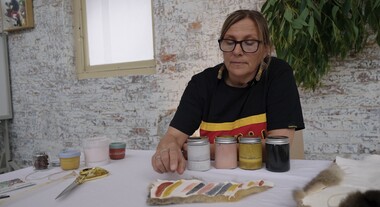
... This is where I learnt technique and design elements that remain present and relevant to lived experience. ...This is where I learnt technique and design elements that remain present and relevant to lived experience. ...My name is Tammy Gilson and I am a descendant of Wadawurrung people on Mums side, Marlene Gilson and my dear Nan, Rita Fagan from the Dalton line of our apical ancestor, John Robinson. For that I pay my respects and acknowledge my ancestors and all Elders. In Wadawurrung wurru, meaning language, the wurru name of a cloak walert walert signifies the reclaiming of language that hasn’t been spoken fluently since colonisation. Wadawurrung kinkinbil people relied on possum fur to create cloaks to wear for warmth, ceremony, adornments and medicine. Possum fur was used widely amongst neighbouring First Peoples particularly from colder parts of Victoria given the harshness of climate and particularly in Gordon where the elevation is 650m above sea level. The walert walert denotes a continuum of cultural practice and identity, can be viewed as secret and sacred and today viewed as contemporised practice of history acknowledging transfer of knowledge, practice and kinship. My experience of possum skin cloak revival was in 2014 through Traditional Ceremony, Tanderrum, where I was chosen to make several cloaks to be worn by the Elders including my Mum. This is where I learnt technique and design elements that remain present and relevant to lived experience. My work is an example of how culture and connection gives purpose and embeds a beautiful sense of belonging. Each design panel holds a visual voice, a narrative that speaks to identity and kinship. Symbols and line work are found on old artefacts that indicate belonging to Wadawurrung people. The water marks and mountain patterns were passed on to me from Mum and her grandma. Continuing this practice is for future generations as the walert walert holds significant healing properties. Making them and sharing knowledge aims to strengthen our Culture and bring family together. There is nothing like a good yarn while sewing or weaving and this is what the Elders do, and my ancestors always did together, sitting around sharing their way and teaching. Possum skin cloak consisting of twenty four pelts, stitched together with thread. Cloak features Wadawurrung designs in red, orange, white and black ochre.possum skin cloak, wadawurrung, first peoples, culture, tammy gilson, identity, tradition, design, walert walert -
 National Wool Museum
Film - walert walert, Tammy Gilson, 2026
... This is where I learnt technique and design elements that remain present and relevant to lived experience. ...This is where I learnt technique and design elements that remain present and relevant to lived experience. ...My name is Tammy Gilson and I am a descendant of Wadawurrung people on Mums side, Marlene Gilson and my dear Nan, Rita Fagan from the Dalton line of our apical ancestor, John Robinson. For that I pay my respects and acknowledge my ancestors and all Elders. In Wadawurrung wurru, meaning language, the wurru name of a cloak walert walert signifies the reclaiming of language that hasn’t been spoken fluently since colonisation. Wadawurrung kinkinbil people relied on possum fur to create cloaks to wear for warmth, ceremony, adornments and medicine. Possum fur was used widely amongst neighbouring First Peoples particularly from colder parts of Victoria given the harshness of climate and particularly in Gordon where the elevation is 650m above sea level. The walert walert denotes a continuum of cultural practice and identity, can be viewed as secret and sacred and today viewed as contemporised practice of history acknowledging transfer of knowledge, practice and kinship. My experience of possum skin cloak revival was in 2014 through Traditional Ceremony, Tanderrum, where I was chosen to make several cloaks to be worn by the Elders including my Mum. This is where I learnt technique and design elements that remain present and relevant to lived experience. My work is an example of how culture and connection gives purpose and embeds a beautiful sense of belonging. Each design panel holds a visual voice, a narrative that speaks to identity and kinship. Symbols and line work are found on old artefacts that indicate belonging to Wadawurrung people. The water marks and mountain patterns were passed on to me from Mum and her grandma. Continuing this practice is for future generations as the walert walert holds significant healing properties. Making them and sharing knowledge aims to strengthen our Culture and bring family together. There is nothing like a good yarn while sewing or weaving and this is what the Elders do, and my ancestors always did together, sitting around sharing their way and teaching. 9144.1 - Digital colour film featuring Wadawurrung woman Tammy Gilson speaking about the walert walert (possum skins cloak) she made for the National Wool Museum Collection, and the cultural practice of making cloaks. Film is 7 minutes and 3 seconds in length. 9144.2 - Digital colour film featuring Wadawurrung woman Tammy Gilson speaking about the designs which feature on the walert walert she made for the National Wool Museum Collection. Film is 14 minutes in length.possum skin cloak, wadawurrung, first peoples, culture, tammy gilson, identity, tradition, design, walert walert -
 Flagstaff Hill Maritime Museum and Village
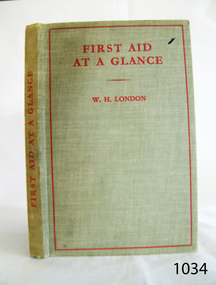
Book - Reference Medical/First Aid, William H. London, First Aid At A Glance, 1939
... Designed as a concise summary for quick reference during crisis situations, it covers core civil defence and emergency medical topics such as the treatment of wounds, severe bleeding, and shock. Other subjects covered in this publication are fracture immobilisation and bandaging techniques ...Published on the eve of World War II in 1939, First Aid at a Glance is a compact, highly practical emergency manual. Designed as a concise summary for quick reference during crisis situations, it covers core civil defence and emergency medical topics such as the treatment of wounds, severe bleeding, and shock. Other subjects covered in this publication are fracture immobilisation and bandaging techniques, resuscitation and drowning intervention, and the management of casualties in public, industrial, or home settings.Hard cover book, First Aid at a Glance Author: William H. London Publisher: Angus & Robertson, Sydney, Australia Date: 1939 Further Information: Green cloth covered hardback volume with title in rednon-fictionPublished on the eve of World War II in 1939, First Aid at a Glance is a compact, highly practical emergency manual. Designed as a concise summary for quick reference during crisis situations, it covers core civil defence and emergency medical topics such as the treatment of wounds, severe bleeding, and shock. Other subjects covered in this publication are fracture immobilisation and bandaging techniques, resuscitation and drowning intervention, and the management of casualties in public, industrial, or home settings.flagstaff hill, warrnambool, shipwrecked-coast, flagstaff-hill, flagstaff-hill-maritime-museum, maritime-museum, shipwreck-coast, flagstaff-hill-maritime-village, first aid at a glance, book, william london, w.r. angus -
 Flagstaff Hill Maritime Museum and Village
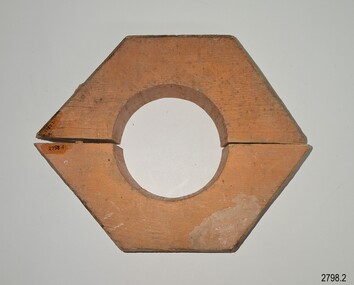
Equipment - Pattern, Briggs Brass Foundry, Early 20th century
... This pattern was an essential tool at Briggs’ Brass Foundry, specifically designed for creating sand casts. Sand casting is a time-honoured technique, with a history exceeding 2,000 years. ...This pattern was an essential tool at Briggs’ Brass Foundry, specifically designed for creating sand casts. Sand casting is a time-honoured technique, with a history exceeding 2,000 years. ...The wooden pattern forms part of a larger collection, securely stored within a durable wooden crate. This pattern was an essential tool at Briggs’ Brass Foundry, specifically designed for creating sand casts. Sand casting is a time-honoured technique, with a history exceeding 2,000 years. The handcrafted nature of this process results in the production of brass and copper alloy items, which are particularly suitable for maritime applications. Typical products include bells, boat hooks, cowls, propellers, handles, lids, rowlocks, hooks, letters, bolts, rail holders, brackets, deck plates, flanges, rudder guides, portholes and covers. The distinctive bronze mixture used at Briggs’ Foundry is copper-based, composed of local ingots of copper, tin, zinc and lead, blended in precisely measured quantities. The resulting alloy is non-ferrous, known for its exceptional durability and longevity. In the early years of Flagstaff Hill, the Briggs family generously donated the crate of patterns along with other related items such as brassware, tools and machinery. These items were prominently displayed in a simulated Brass Foundry within the Village, alongside other working crafts, trades and services typical of a maritime town. From the completion of the building in 1986 until its repurposing in 1994, visitors could view these items and gain insight into the foundering and metalwork trades that supported maritime industries, including shipwrights and boatbuilders. The castings produced at the foundry were also vital for farmers, manufacturers and other local industries. The Brass Foundry display featured a historic Cornish chimney, constructed as a working model to illustrate the process of smelting metal in furnaces and pouring it into sand moulds. The chimney, crafted from specially curved bricks, currently stands at approximately two-thirds of its original height, having previously been located at the Grassmere Cheese factory. The craft of sand-casting, which utilises intricately carved wooden patterns to create metal objects, stands as a testament to the enduring value of traditional skills. This age-old technique remains relevant today, linking past craftsmanship to ongoing industrial practices. The foundry pattern set holds particular significance due to its strong associations with brass foundries, both locally and in coastal regions across Victoria. In these areas, marine industries such as ship and boat building have long depended on high-quality metal castings for the machinery, equipment, and fittings essential to their operations. The alloys formulated by Briggs Brass Foundry, crafted from non-ferrous metals, were specifically designed to provide superior longevity and durability in maritime environments. These patterns are closely tied to the history of the Briggs Brass Foundry, a respected and long-running company that specialised in producing cast goods for the marine sector. The foundry was equipped to supply both unique, one-off items and mass-produced components, ensuring that its products found their way onto a variety of sail and steam vessels along the Victorian coast, including in Warrnambool. In addition to its broader marine applications, Briggs Brass Foundry established itself as a bell-founder specialist. The company’s expertise is notably linked to the historic Schomberg Bell at Flagstaff Hill, which they restored to its original splendour as a fine example of a bell from a luxury migrant ship of the mid-19th century. The significance of the pattern set is further heightened by its association with Briggs Brass Founders, a firm established in the early 20th century and widely recognised for its proficiency in producing, repairing, and restoring ship bells and other marine equipment. Renowned for their non-ferrous metal casting, Briggs Brass Founders consistently supplied high-quality fittings and equipment vital to maritime pursuits. Moreover, the company expanded its influence by opening a branch in Warrnambool. Through this local presence, Briggs Brass Founders supported the regional marine industry and forged strong connections with fishermen and businesses. This not only reinforced their reputation as skilled manufacturers but also highlighted their commitment to community engagement and support. Pattern; hexagonal wooden shape painted orange. The thick carved wooden shape is in halves forming a hole when locked together with the dowel pegs and opposing drilled holes. The pattern is part of a set of foundry patterns from Briggs Brass Foundry.flagstaff hill, flagstaff hill maritime museum and village, warrnambool, maritime museum, maritime village, great ocean road, shipwreck coast, briggs' bronze, trade, sand cast, cast, brass alloy, copper alloy, pattern, mould, foundry, brass foundry, metal foundry, casting, sand mould, sand casting, marine equipment, marine tools, marine fittings, copper tin zinc lead, non-ferrous, non-corrosive, brassware, metalware, foundering, metalwork, maritime, bell founders, ship chandlers, marine products, briggs family, herbert harrison briggs, h h briggs, george edward briggs, cyril falkiner mckinnon briggs, cyril briggs, briggs & son brass foundry, h h briggs & sons foundry, briggs marine, alliance casting & engineering solutions, grassmere cheese factory, cornish chimney, curved bricks, collingwood, moorabbin, collingwood foundry, moorabbin foundry, 1912, briggs, briggs brass foundry, briggs marine foundry, briggs marine products, frank lee, les lee, eva lee, briggs marine warrnambool, non-ferrous founders, bell specialists, ship bell specialists, founders, traditional send casting -
 Flagstaff Hill Maritime Museum and Village
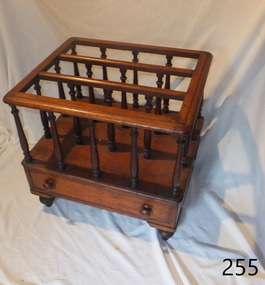
Functional object - Music stand, Early 19th Century before 1860
... designed to hold sheet music came into fashion in the late 18th Century in England and was often crafted from mahogany, rosewood or walnut. They were seen as status symbols since music was practiced exclusively by the upper classes of society. In a period when printed music was more widely available and disseminated due to more affordable printing techniques...designed to hold sheet music came into fashion in the late 18th Century in England and was often crafted from mahogany, rosewood or walnut. They were seen as status symbols since music was practiced exclusively by the upper classes of society. In a period when printed music was more widely available and disseminated due to more affordable printing techniques ...Thomas Sheraton (1751-1806) appears to have been the first to record the written term “Canterbury” music or magazine stand. In his Cabinet Dictionary of 1803 he refers to “a small music stand” with divisions for holding loose sheet or bound volumes of music. The music stand designed to hold sheet music came into fashion in the late 18th Century in England and was often crafted from mahogany, rosewood or walnut. They were seen as status symbols since music was practiced exclusively by the upper classes of society. In a period when printed music was more widely available and disseminated due to more affordable printing techniques, modern sheet music was very popular and therefore storage for such favoured tunes became a luxury and an opportunity for innovative design by cabinet makers. The Classical period of music, from about 1750 to 1820 and the Romantic Period from around 1815-1910 was the golden age of classical music. And it was at this time that The Canterbury often accompanied the piano in the parlour with styles ranging from Georgian simplicity to Victorian exuberance. Social activities of colonial Victoria would have included evening gatherings of family and friends around the piano to enjoy performances or sing along together with from old and up-to-date music sheets. The Canterbury would also be an elegant and practical place to also store newspapers, magazines, posters and drawings from overseas. The news from ‘home’ would be enjoyed by all. THE INSCRIPTION “Jack Morse” Morse. In 2010 Mr Jack Morse was recognised as one of the “people who have contributed to the long term development of Flagstaff Hill Maritime Village”. He was a member of the Flagstaff hill Planning board and a Current Life Member and had been awarded a Certificate of Service and the provision of an Annual Family Membership for life by Flagstaff Hill. The Morse’s family business, Morse’s Engineering, closed in 2010. It was considered “One of Warrnambool’s longest operating businesses with roots dating to 1883 with the design and manufacture of coaches and buggies, progressing to automotive repairs and later specialising in under-vehicle work” The Canterbury appears to have been handmade prior to 1860 as the dovetails are handmade and there are no saw marks on the drawer sides or back as well the sides. Also the back has small nicks indicating a hand plane or drawer knife was used rather than a saw blade to size the material. Additional indications are that the spindles are slightly different in size meaning they were handmade individually not mass produced. From these indicators the writer believes that the item was made before 1860 as machinery was only used after this date to produce furniture. As yet no individual maker can be attributed to this item, however it is a significant piece historically and is quite valuable if a known maker can be associated with the Canterbury. The item highlights a time in our social history when music played an everyday part in people’s lives as the only entertainment families could enjoy together in their own homes. A Canterbury music stand, having three compartments consisting of twenty turned spindles supporting the slat dividers. A drawer, with two turned wooden handles, is fitted below. The music stand has turnip style turned feet. The drawer front and carcass of the stand are veneered rosewood over a mahogany carcass. The underlined words "Jack Morse" are handwritten underneath the drawer bottom.Hand written inscription on underneath the drawer bottom "Jack Morse".flagstaff hill, warrnambool, shipwrecked-coast, flagstaff-hill, flagstaff-hill-maritime-museum, maritime-museum, shipwreck-coast, flagstaff-hill-maritime-village, canterbury, music rack, magazine rack, music stand, magazine stand, 19th century furniture, occasional furniture, frederick cornwallis, jack morse, morse’s undercar, music, thomas sheraton, regency furniture, music canterbury -
 Flagstaff Hill Maritime Museum and Village
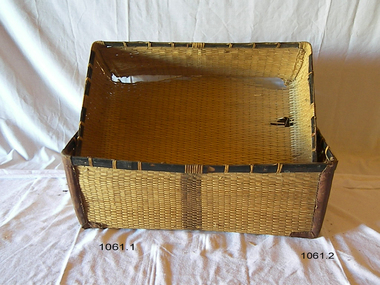
Domestic object - Basket, 1890-1920s
... Baskets made with interwoven techniques were common at 3000 BCE. Baskets were originally designed as multi-purpose vessels to carry and store materials and to keep stray items about the home. ...Baskets made with interwoven techniques were common at 3000 BCE. Baskets were originally designed as multi-purpose vessels to carry and store materials and to keep stray items about the home. ...Before the invention of woven baskets, people used tree bark to make simple containers. These containers could be used to transport gathered food and other items but crumbled after only a few uses. Weaving strips of bark or other plant material to support the bark containers would be the next step, followed by entirely woven baskets. The last innovation appears to be baskets so tightly woven that they could hold water. Depending on soil conditions, baskets may or may not be preserved in the archaeological record. Sites in the Middle East show that weaving techniques were used to make mats and possibly also baskets, circa 8000 BCE. Twined baskets date back to 7000 in Oasisamerica. Baskets made with interwoven techniques were common at 3000 BCE. Baskets were originally designed as multi-purpose vessels to carry and store materials and to keep stray items about the home. The plant life available in a region affects the choice of material, which in turn influences the weaving technique. Rattan and other members of the Arecaceae or palm tree family, the thin grasses of temperate regions, and broad-leaved tropical bromeliads each require a different method of twisting and braiding to be made into a basket. The practice of basket making has evolved into an art. Artistic freedom allows basket makers with a wide choice of colours, materials, sizes, patterns, and details.Before the advent of plastics (1907), the is now used for many different types and styles of storage container rattan, wicker or cane was used to make containers with a lid for the storage of linens etc. The subject item was probability used at the end of the Victorian era and into the Edwardian period around the 1900s as a household storage facility. These types of wicker or cane containers started to go out of fashion due to their fragility around the 1920s into the 1940s due as well to the introduction of synthetic materials. Wicker cane rectangular shaped domestic storage container with reinforced leather pads on 4 corner sides. lid fits inside the other. Black cane piece around top edge.Noneflagstaff hill, warrnambool, shipwrecked-coast, flagstaff-hill, flagstaff-hill-maritime-museum, maritime-museum, shipwreck-coast, flagstaff-hill-maritime-village -
 The Beechworth Burke Museum
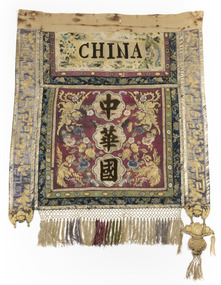
Textile - Banner, c1872
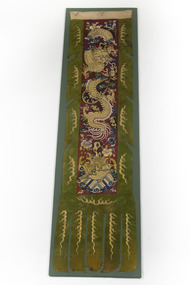
... techniques and are visually beautiful and very rare and are considered of local and national significance, with the potential to be deemed internationally significant. Beechworth Burke Museum Chinese Benevolent Asylum Ovens District Hospital Beechworth Carnival processions Carnival processions Beechworth Chinese community Beechworth Fine Arts Exhibition Donald Fiddes CHINA / Multi panelled banner with embroidery and applied design motifs on front. ...This banner was one of five banners gifted to the Beechworth Chinese community in recognition of their support of the Hospital and Benevolent Asylum in 1875, from the Carnival Committee. These banners had been purchased in China by a social envoy from Beechworth then presented to the Chinese community during the Beechworth Fine Arts Exhibition in May of that same year, by Donald Fiddes, President of the Ovens District Hospital. The Burke Museum's Chinese Collection presents the history of Chinese settlement in Beechworth from 1856 and its involvement in local community affairs in the second half of the 19th century. In settling in the area they formed their own community with distinctive Chinese cultural traditions, forming their own 'camps' with laid out streets, housing a Temple, Chinese Theatre and restaurants, hotels, stores, gambling houses and dwellings. Members of the Chinese community took an active interest in town affairs and were generous donors to the appeal to build the Ovens District Hospital in 1856/7. The vibrant colours and dynamic graphics of the silk embroidered Chinese banners were a highlight of Beechworth Charitable processions that took place in the main street. Two of the Chinese banners were conserved for the Burke Museum in 2006 by Carol Campbell of Phoenix Conservation Services with funding from Victoria’s Heritage Grants. In 2015, with the enormous support of the Copland Foundation and fundraising activities by the Friends of the Bur Museum Committee, conservation of the third banner was undertaken by Artlab Australia in Adelaide. The banners display traditional Chinese textile techniques and are visually beautiful and very rare and are considered of local and national significance, with the potential to be deemed internationally significant.Multi panelled banner with embroidery and applied design motifs on front. Back panel is painted design of two men. The front panels have been constructed using strips of various weaves and colours of silk that have been embroidered or had a design applied prior to the overall construction of the piece. The embroidery is predominantly gold work with both plyed and floss silk threads. Silk macrame fringe and tassels to central panel and padded lotus and bowl motif hanging tassel from side panels. Velvet lettering applied to front "CHINA" CHINA /beechworth, burke museum, chinese, benevolent asylum, ovens district hospital, beechworth carnival processions, carnival, processions, beechworth chinese community, beechworth fine arts exhibition, donald fiddes -
 The Beechworth Burke Museum
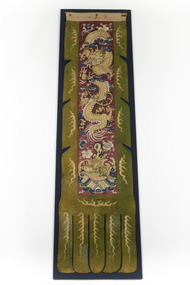
Textile - Banner, c1872
... techniques and are visually beautiful and very rare and are considered of local and national significance, with the potential to be deemed internationally significant. Beechworth Burke Museum Chinese Benevolent Asylum Ovens District Hospital Beechworth Carnival processions Carnival processions Beechworth Chinese community Beechworth Fine Arts Exhibition Donald Fiddes Multi panelled banner with embroidery and applied design motifs on front. ...This banner was one of five banners gifted to the Beechworth Chinese community in recognition of their support of the Hospital and Benevolent Asylum in 1875, from the Carnival Committee. These banners had been purchased in China by a social envoy from Beechworth then presented to the Chinese community during the Beechworth Fine Arts Exhibition in May of that same year, by Donald Fiddes, President of the Ovens District Hospital. The Burke Museum's Chinese Collection presents the history of Chinese settlement in Beechworth from 1856 and its involvement in local community affairs in the second half of the 19th century. In settling in the area they formed their own community with distinctive Chinese cultural traditions, forming their own 'camps' with laid out streets, housing a Temple, Chinese Theatre and restaurants, hotels, stores, gambling houses and dwellings. Members of the Chinese community took an active interest in town affairs and were generous donors to the appeal to build the Ovens District Hospital in 1856/7. The vibrant colours and dynamic graphics of the silk embroidered Chinese banners were a highlight of Beechworth Charitable processions that took place in the main street. Two of the Chinese banners were conserved for the Burke Museum in 2006 by Carol Campbell of Phoenix Conservation Services with funding from Victoria’s Heritage Grants. In 2015, with the enormous support of the Copland Foundation and fundraising activities by the Friends of the Bur Museum Committee, conservation of the third banner was undertaken by Artlab Australia in Adelaide.The banners display traditional Chinese textile techniques and are visually beautiful and very rare and are considered of local and national significance, with the potential to be deemed internationally significant.Multi panelled banner with embroidery and applied design motifs on front. The front panels have been constructed using strips of various weaves and colours of silk that have been embroidered or had a design applied prior to the overall construction of the piece. The embroidery is predominantly gold work with both plyed and floss silk threads.beechworth, burke museum, chinese, benevolent asylum, ovens district hospital, beechworth carnival processions, carnival, processions, beechworth chinese community, beechworth fine arts exhibition, donald fiddes -
 The Beechworth Burke Museum
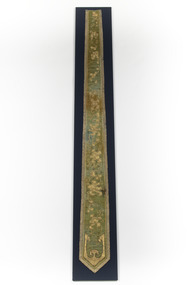
Textile - Banner, c1872
... techniques and are visually beautiful and very rare and are considered of local and national significance, with the potential to be deemed internationally significant. Beechworth Burke Museum Chinese Benevolent Asylum Ovens District Hospital Beechworth Carnival processions Carnival processions Beechworth Chinese community Beechworth Fine Arts Exhibition Donald Fiddes Multi panelled banner with embroidery and applied design motifs on front. ...This banner was one of five banners gifted to the Beechworth Chinese community in recognition of their support of the Hospital and Benevolent Asylum in 1875, from the Carnival Committee. These banners had been purchased in China by a social envoy from Beechworth then presented to the Chinese community during the Beechworth Fine Arts Exhibition in May of that same year, by Donald Fiddes, President of the Ovens District Hospital. The Burke Museum's Chinese Collection presents the history of Chinese settlement in Beechworth from 1856 and its involvement in local community affairs in the second half of the 19th century. In settling in the area they formed their own community with distinctive Chinese cultural traditions, forming their own 'camps' with laid out streets, housing a Temple, Chinese Theatre and restaurants, hotels, stores, gambling houses and dwellings. Members of the Chinese community took an active interest in town affairs and were generous donors to the appeal to build the Ovens District Hospital in 1856/7. The vibrant colours and dynamic graphics of the silk embroidered Chinese banners were a highlight of Beechworth Charitable processions that took place in the main street. Two of the Chinese banners were conserved for the Burke Museum in 2006 by Carol Campbell of Phoenix Conservation Services with funding from Victoria’s Heritage Grants. In 2015, with the enormous support of the Copland Foundation and fundraising activities by the Friends of the Bur Museum Committee, conservation of the third banner was undertaken by Artlab Australia in Adelaide. The banners display traditional Chinese textile techniques and are visually beautiful and very rare and are considered of local and national significance, with the potential to be deemed internationally significant.Multi panelled banner with embroidery and applied design motifs on front. The front panels have been constructed using strips of various weaves and colours of silk that have been embroidered or had a design applied prior to the overall construction of the piece. The embroidery is predominantly gold work with both plyed and floss silk threads.beechworth, burke museum, chinese, benevolent asylum, ovens district hospital, beechworth carnival processions, carnival, processions, beechworth chinese community, beechworth fine arts exhibition, donald fiddes -
 The Beechworth Burke Museum
Textile - Banner, c1872
... techniques and are visually beautiful and very rare and are considered of local and national significance, with the potential to be deemed internationally significant. Beechworth Burke Museum Chinese Benevolent Asylum Ovens District Hospital Beechworth Carnival processions Carnival processions Beechworth Chinese community Beechworth Fine Arts Exhibition Donald Fiddes Multi panelled banner with embroidery and applied design motifs on front. ...This banner was one of five banners gifted to the Beechworth Chinese community in recognition of their support of the Hospital and Benevolent Asylum in 1875, from the Carnival Committee. These banners had been purchased in China by a social envoy from Beechworth then presented to the Chinese community during the Beechworth Fine Arts Exhibition in May of that same year, by Donald Fiddes, President of the Ovens District Hospital. The Burke Museum's Chinese Collection presents the history of Chinese settlement in Beechworth from 1856 and its involvement in local community affairs in the second half of the 19th century. In settling in the area they formed their own community with distinctive Chinese cultural traditions, forming their own 'camps' with laid out streets, housing a Temple, Chinese Theatre and restaurants, hotels, stores, gambling houses and dwellings. Members of the Chinese community took an active interest in town affairs and were generous donors to the appeal to build the Ovens District Hospital in 1856/7. The vibrant colours and dynamic graphics of the silk embroidered Chinese banners were a highlight of Beechworth Charitable processions that took place in the main street. Two of the Chinese banners were conserved for the Burke Museum in 2006 by Carol Campbell of Phoenix Conservation Services with funding from Victoria’s Heritage Grants. In 2015, with the enormous support of the Copland Foundation and fundraising activities by the Friends of the Bur Museum Committee, conservation of the third banner was undertaken by Artlab Australia in Adelaide. The banners display traditional Chinese textile techniques and are visually beautiful and very rare and are considered of local and national significance, with the potential to be deemed internationally significant.Multi panelled banner with embroidery and applied design motifs on front. The front panels have been constructed using strips of various weaves and colours of silk that have been embroidered or had a design applied prior to the overall construction of the piece. The embroidery is predominantly gold work with both plyed and floss silk threads. beechworth, burke museum, chinese, benevolent asylum, ovens district hospital, beechworth carnival processions, carnival, processions, beechworth chinese community, beechworth fine arts exhibition, donald fiddes -
 The Beechworth Burke Museum
Photograph - Lantern Slide, c1900
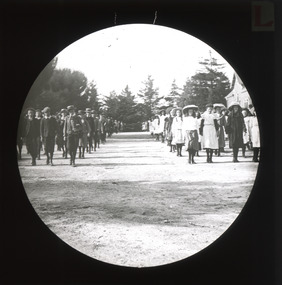
... techniques. The image is significant because it sheds light on the educational infrastructure present in Beechworth in the early part of the Twentieth Century, including the prevalence of education for students after current-day primary-school age and the education of girls. It also provides insight into the building and design ...This picture shows an angle of Beechworth Primary School (State School number 1560) which is also pictured in the building's entry in the Victorian Heritage Register (VHR record 1718). The school began as a national school in 1858 as an alternative to Wesleyan and Anglican schools already operating in the area. Its name was changed to Common School number 36 in 1862 and the Beechworth Academy prior to being taken over by the Education department in 1873. The new premises were built in 1875 utilising the skills of architect Henry Bastow though the original design may be attributable to the firm Wharton and Vickers. The design was used with modifications for other schools in Victoria, including the Competition School in Errol Street, North Melbourne. The school moved to the building pictured from its original premises in Loch Street, designed by Thomas Dalziel, which later became the office of the Ovens Advertiser. The school was opened on 2 July 1875 by former Beechworth resident G.B. Kerferd, who was then the Premier of Victoria. The image shows approximately ninety older students at the school in approximately 1900. There are approximately equal numbers of boys and girls pictured, with most of the individuals pictured appearing to be between the ages of twelve and fifteen. Although the school had more than 1000 students enrolled at its height, enrolments had declined to 304 in 1890. Also visible is a fringe of sequoia pines which were planted by the school children as a project lasting through to the late 1930s. Lantern slides, sometimes called 'magic lantern' slides, are glass plates on which an image has been secured for the purpose of projection. Glass slides were etched or hand-painted for this purpose from the Eighteenth Century but the process became more popular and accessible to the public with the development of photographic-emulsion slides used with a 'Magic Lantern' device in the mid-Nineteenth Century. Photographic lantern slides comprise a double-negative emulsion layer (forming a positive image) between thin glass plates that are bound together. A number of processes existed to form and bind the emulsion layer to the base plate, including the albumen, wet plate collodion, gelatine dry plate and woodburytype techniques. Lantern slides and magic lantern technologies are seen as foundational precursors to the development of modern photography and film-making techniques.The image is significant because it sheds light on the educational infrastructure present in Beechworth in the early part of the Twentieth Century, including the prevalence of education for students after current-day primary-school age and the education of girls. It also provides insight into the building and design practices used by Government departments at the time. Thin translucent sheet of glass with a circular image printed on the front and framed in a black backing. It is held together by metals strips to secure the edges of the slide.Obverse: L / burke museum, beechworth, lantern slide, slide, glass slide, plate, burke museum collection, photograph, monochrome, schools, education, high school, primary school, common school, state school, state school 1560, common school 36, beechworth academy, g.b. kerferd, thomas dalziel, henry bastow, victorian heritage register, beechworth primary school, girls education, boys education, public schools, education department, pines, trees, sequoias, competition school -
 Marysville & District Historical Society
Book - Hardcover book, Life on the Australian Goldfields, 1984
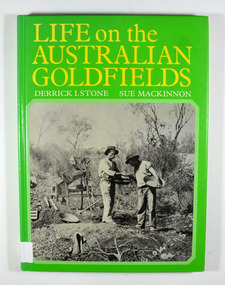
... technique. In the background are two 'Wood's dry placer-miners'. Back cover has a photograph of the interior of a steam-operated quartz crushing battery at the Mount Boppy Mine. Life on the Australian Goldfields Book Hardcover book Stone, Derrick I. Mackinnon, Sue Popular Books Pioneer Design ...A history of gold mining in AustraliaHardcover. Front cover has a photograph of two miners from West Australia using the dry-blowing technique. In the background are two 'Wood's dry placer-miners'. Back cover has a photograph of the interior of a steam-operated quartz crushing battery at the Mount Boppy Mine.Front cover has a price sticker that is discolored. Inside there is the stamp of the Marysville & District Historical Society / P.O. Box 22 / Marysville 3779 gold, gold mines, gold mining, australia, history, social life, customs, stone, derrick i, mackinnon, sue -
Federation University Historical Collection
Book - Book - Scrapbook, Ballarat Institute of Advanced Education: Scrapbook of newspaper cutting, Book 2; February 1970 to September 1970
... design course...g mainwarring...festival radio cover to be curtailed...scheme helping ballarat widows...students win scholarships...robert gray...robert norman...cheque from students...smb launch $400000 appeal...$11m from government for smb...political opponents inspect bts...closure of gaols...overnight hike...state colleges get $25m varsity image...political advertisement...smb could attract new industries...punch card technique...The cuttings cover the period from 25 February 1970 to 9 September 1970. ballarat institute of advanced education biae employment advertisements senate team visit biae minister of education visit lindsay thompson 3ba comes under fire orientation ball in wendouree hall jean mckenzie at smb art and design course g mainwarring festival radio cover to be curtailed scheme helping ballarat widows students win scholarships robert gray robert norman cheque from students smb launch $400000 appeal $11m from government for smb political opponents inspect bts closure of gaols overnight hike state colleges get $25m varsity image political advertisement smb could attract new industries punch card technique four-letter word thrills audience school news "quadrangle" alp opens election campaign alp candidates address teachers new home for smb degree courses now being considered electromagnet first stage of mt helen acceleration of scientific progress stephen donald motor mechanic apprentice degree course for institute conditions in school 'almost unbelievable' silk screen printing smb apprentices presentation john davidson wins builders award scholarship election statements clarified jack barker address by myra roper some names to remember centenary appeal for smb biae request for street light agreed to members of the biae motor cycle club gas scholarships of $100 philip walker and noel shillito a g cutts no ballarat case for fourth uni dr r shrieke and mr b shearer lecturers at biae $5000 to smb appeal experts aid students re careers Book with grey cover, front. ...Newspaper cuttings relating to Ballarat Institute of Advanced Education. These are from various newspapers and include The Age, Ballarat Courier, The Australian, The Herald. The cuttings cover the period from 25 February 1970 to 9 September 1970. Book with grey cover, front. Spiral boundballarat institute of advanced education, biae, employment advertisements, senate team visit biae, minister of education visit, lindsay thompson, 3ba comes under fire, orientation ball in wendouree hall, jean mckenzie at smb art and design course, g mainwarring, festival radio cover to be curtailed, scheme helping ballarat widows, students win scholarships, robert gray, robert norman, cheque from students, smb launch $400000 appeal, $11m from government for smb, political opponents inspect bts, closure of gaols, overnight hike, state colleges get $25m varsity image, political advertisement, smb could attract new industries, punch card technique, four-letter word thrills audience, school news, "quadrangle", alp opens election campaign, alp candidates address teachers, new home for smb, degree courses now being considered, electromagnet, first stage of mt helen, acceleration of scientific progress, stephen donald motor mechanic apprentice, degree course for institute, conditions in school 'almost unbelievable', silk screen printing, smb apprentices presentation, john davidson wins builders award scholarship, election statements clarified, jack barker, address by myra roper, some names to remember, centenary appeal for smb, biae request for street light agreed to, members of the biae motor cycle club, gas scholarships of $100, philip walker and noel shillito, a g cutts, no ballarat case for fourth uni, dr r shrieke and mr b shearer lecturers at biae, $5000 to smb appeal, experts aid students re careers -
 Flagstaff Hill Maritime Museum and Village
Textile - Bedspread, patchwork, 1976
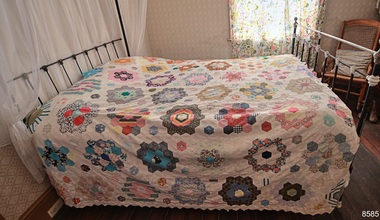
... This carefully created and designed, recently made patchwork bedspread typifies bedding and handcraft of the late 19th century. The English paper patchwork technique was used. ...This patchwork quilt or bedspread is a modern creation along the lines of the traditional 1800s handmade English paper piecing patchwork quilting craft. It is made from reproduction fabric and quilt designs and represents the bed linen typical of a late 19th-century bedroom. Years ago, patchwork was a form of recycling, where leftover or previously used pieces of fabric were used to create other useful item such as quilts, rugs, cushion covers and jackets. Special projects were sometimes made with fabrics representing special memories, such as pieces from baby clothes, wedding gowns, and school uniforms. The maker would use a cardboard template shaped like a hexagon, place it onto the fabric and trace around it. Often the cardboard was cut from a box such as a cereal box. Women would gather to work on their patchwork while enjoying their social time together. As in the case of this quilt, members of the South Western Branch of the Embroiderers Guild in Warrnambool worked on the project, designing and quilting as a group to achieve their aim, of presenting the quilt to the recently opened Flagstaff Hill Maritime Museum. It was the first Group Project of the Branch which was formed in 1974. In 1975 the members decided to make a Quilt as a project to promote the formation of friendship and togetherness. Under the foundation Treasurer, Rita Williams, members sourced their own fabrics for the 'flowers' which were then stitched into the calico borders. Provision was made for the quilt to be hung for display, with the addition of loops along one edge. The local disability services employees and members cut out octagonal paper batches and used their own fabrics to piece them together. The Branch's first exhibition raised funds for buying fabric and equipment to assemble the patchwork. The quilt was perfectly suited to dress the bed in the Lighthouse Keeper's Cottage. This carefully created and designed, recently made patchwork bedspread typifies bedding and handcraft of the late 19th century. The English paper patchwork technique was used. The quilt was the first community project of the South Western Branch of the Embroiderers' Guild of Victoria, and presented as an addition to the Lighthouse Keeper's Cottage tat Flagstaff Hill. Patchwork quilt or bedspread, double bed size, made from hundreds of hexagonal-shaped fabric of various colours and patterns, carefully stitched onto a white background. It was made using the English paper patchwork technique. One edge of the quilt has loops dispersed at regular intervals. This would allow the quit to be used as a wall hanging. It was handmade by the South Western Branch of The Embroiders Guild, Victoria, and presented to Flagstaff Hill Maritime Museum and Village in 1976. An inscription is embroidered in blue on a patch of the quilt. "Made and Presented by The Embroiderers Guild, Victoria (S.W. Branch) 1976"flagstaff hill, flagstaff hill maritime museum and village, warrnambool, maritime museum, maritime village, great ocean road, shipwreck coast, bedspread, patchwork quilt, quilt, embroiderers guild, bedding, bed linen, 1800's handcraft, quilting, south west branch, warrnambool embroiders guild, recycled fabric, 19th century, household textiles, english paper patchwork, paper patchwork technique -
 Flagstaff Hill Maritime Museum and Village
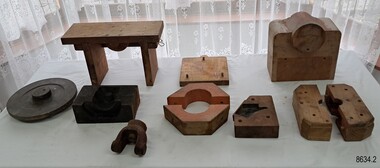
Equipment - Foundry Patterns set, Briggs Brass Foundry, 1912-1972
... The cast pattern was an essential tool at Briggs Brass Foundry, specifically designed for creating sand casts. Sand casting is a time-honoured technique, with a history exceeding 2,000 years. ...The cast pattern was an essential tool at Briggs Brass Foundry, specifically designed for creating sand casts. Sand casting is a time-honoured technique, with a history exceeding 2,000 years. ...The wooden pattern forms part of a larger collection; some of them were secured within a durable wooden crate. The cast pattern was an essential tool at Briggs Brass Foundry, specifically designed for creating sand casts. Sand casting is a time-honoured technique, with a history exceeding 2,000 years. The handcrafted nature of this process produces brass and copper alloy items particularly suitable for maritime applications. Typical products include bells, boat hooks, cowls, propellers, handles, lids, rowlocks, hooks, letters, bolts, rail holders, brackets, deck plates, flanges, rudder guides, portholes and covers. The distinctive bronze mixture used at Briggs’ Foundry is copper based. It is composed of local ingots of copper, tin, zinc and lead, blended in precisely measured quantities. The resulting alloy is non-ferrous, known for its exceptional durability and longevity. HISTORY OF BRIGGS MARINE: The Briggs Brass Foundry, trading as Briggs & Son Foundry, was established in 1912 by Herbert Harrison Briggs (1863-1931) with his son George Edward Briggs. In 1922, the youngest son, Cyril Falkiner McKinnon Briggs, joined the foundry. After Herbert died in 1931, his sons George and Cyril ran the foundry. The business became known as Briggs Marine Foundry, the “non-ferrous founders” and “bell specialists”. The foundry products were made using the traditional sand-casting method, which is now over two thousand years old and is becoming a dying art. The foundry operated at 70 Wellington St, Collingwood, and specialised in casting ship bells and other marine equipment and fittings. It also made decorative items such as miniature ship propellers. The great-granddaughter of Herbert Briggs inherited a Briggs brass bell, similar to one at Flagstaff Hill Maritime Village. In 1965, Cyril was the only remaining family member involved in Briggs Marine Products. The firm relocated to Chesterville Rd, Moorabbin and Cyril went into partnership with Frank Lee. In the same year, the firm exhibited its products at the 1965 Boat Show. When Cyril passed away in 1967, Frank took over the business with two new partners. After Frank Lee died in 1971, the foundry was run by his son and daughter-in-law, Les and Eva Lee. Briggs Marine still exists today, but the Briggs family is no longer involved. Briggs Foundry had a community-minded retail branch in Warrnambool, selling cast boat fittings and equipment to fishermen and others in the regional marine industry. The branch closed in 1972. In Flagstaff Hill’s formative years, 1972-1975, many Briggs Marine brassware products were generously donated from its Melbourne foundry, along with casting patterns, tools, machinery and a cupboard. EXHIBITION and LEGACY: The donated items were displayed in a simulated Brass Foundry within the Village, where visitors could view them and gain insight into the foundering and metalwork trades that supported maritime industries, including shipwrights and boatbuilders. The castings produced at the foundry were also vital for farmers, manufacturers and other local industries. This exhibit was part of a broader showcase of working crafts, trades and services typical of a Maritime town. The display was available to the public from the completion of the building in 1986 until 1994, when the space was repurposed. It is believed that Briggs Marine’s family members gave personal assistance in setting up the displays in the original village shops, particularly the ‘Brass Foundry’ building. A notable feature of the Village Brass Foundry was the historic Cornish chimney, presented as a working model. This chimney visually demonstrated the process of smelting metal in furnaces and pouring it into sand moulds. Constructed from specially curved bricks, the chimney now stands at about two-thirds of its original height, having been relocated from the Grassmere Cheese factory. The hand-cast sand patterns hold considerable significance due to their association with Briggs Brass Founders, a firm established in the early 20th century and widely recognised for its expertise in producing, repairing, and restoring ship bells and marine equipment. Known for their specialisation in non-ferrous metal casting, Briggs Brass Founders supplied high-quality fittings and equipment for maritime use. The company extended its operations by opening a branch in Warrnambool, where it actively supported the local community. The foundry’s ability to cast essential products was important to local and regional industries, like fishing, farming, manufacturing and commercial businesses. Through its presence, its reputation was reinforced as both a skilled manufacturer and a community-minded enterprise. The foundry is notably associated with the Schomberg Bell at Flagstaff Hill, having restored this small, historic bell to its original condition. The Schomberg Bell is a fine example from a luxury migrant vessel dating back to the mid-19th century, reflecting the craftsmanship and heritage preserved by Briggs Brass Foundry. Wooden rectangular crate with removable wooden lid. Inside is a set of wooden patterns of various shapes and sizes for making sand moulds in a metal foundry. The crate is made from thick wooden planks nailed together. The extended wooden struts on the long sides form a frame to hold the wooden lid. A pair of metal handles is at each short end of the crate, fixed with strong metal bolts. Between each pair of handles is an inscription stamped into the wood. The underside of the crate has red paint splashes. There are insect holes in the wood, but no active infestation. The patterns were made and used at Briggs Brass Foundry in Melbourne.Stamped: "H.33 / II" (H may be N or a square B)flagstaff hill maritime museum and village, great ocean road, shipwreck coast, pattern, mould, foundry, brass foundry, metal foundry, crate, box, wooden container, briggs, traditional method, trade, sand cast, cast, brass alloy, copper alloy, marine equipment, marine tools, marine fittings, briggs' bronze, copper tin zinc lead, non-corrosive, briggs family, brassware, metalware, foundering, metalwork, maritime, casting, cornish chimney, curved bricks, grassmere cheese factory, 1912, herbert harrison briggs, h h briggs, george edward briggs, briggs & son foundry, collingwood, cyril falkiner mckinnon briggs, cyril briggs, h h briggs & sons foundry, bell founders, schomberg bell, alliance casting & engineering solutions, collingwood foundry, ship chandlers, marine products, flagstaff hill, warrnambool, maritime museum, maritime village, briggs & son brass foundry, briggs marine, moorabbin, briggs brass foundry, briggs marine foundry, briggs marine products, frank lee, les lee, eva lee, briggs marine warrnambool, non-ferrous founders, bell specialists, ship bell specialists, founders, metalworking, traditional sand casting, casting pattern, foundry pattern -
 Flagstaff Hill Maritime Museum and Village
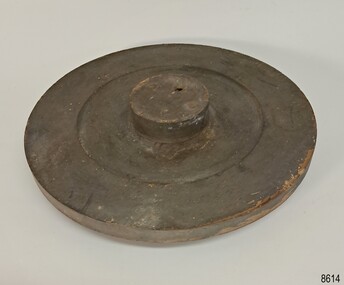
Equipment - Pattern, Briggs Brass Foundry, 1912-1972
... The cast pattern was an essential tool at Briggs Brass Foundry, specifically designed for creating sand casts. Sand casting is a time-honoured technique, with a history exceeding 2,000 years. ...The cast pattern was an essential tool at Briggs Brass Foundry, specifically designed for creating sand casts. Sand casting is a time-honoured technique, with a history exceeding 2,000 years. ...The wooden pattern forms part of a larger collection; some of them were secured within a durable wooden crate. The cast pattern was an essential tool at Briggs Brass Foundry, specifically designed for creating sand casts. Sand casting is a time-honoured technique, with a history exceeding 2,000 years. The handcrafted nature of this process produces brass and copper alloy items particularly suitable for maritime applications. Typical products include bells, boat hooks, cowls, propellers, handles, lids, rowlocks, hooks, letters, bolts, rail holders, brackets, deck plates, flanges, rudder guides, portholes and covers. The distinctive bronze mixture used at Briggs’ Foundry is copper based. It is composed of local ingots of copper, tin, zinc and lead, blended in precisely measured quantities. The resulting alloy is non-ferrous, known for its exceptional durability and longevity. HISTORY OF BRIGGS MARINE: The Briggs Brass Foundry, trading as Briggs & Son Foundry, was established in 1912 by Herbert Harrison Briggs (1863-1931) with his son George Edward Briggs. In 1922, the youngest son, Cyril Falkiner McKinnon Briggs, joined the foundry. After Herbert died in 1931, his sons George and Cyril ran the foundry. The business became known as Briggs Marine Foundry, the “non-ferrous founders” and “bell specialists”. The foundry products were made using the traditional sand-casting method, which is now over two thousand years old and is becoming a dying art. The foundry operated at 70 Wellington St, Collingwood, and specialised in casting ship bells and other marine equipment and fittings. It also made decorative items such as miniature ship propellers. The great-granddaughter of Herbert Briggs inherited a Briggs brass bell, similar to one at Flagstaff Hill Maritime Village. In 1965, Cyril was the only remaining family member involved in Briggs Marine Products. The firm relocated to Chesterville Rd, Moorabbin and Cyril went into partnership with Frank Lee. In the same year, the firm exhibited its products at the 1965 Boat Show. When Cyril passed away in 1967, Frank took over the business with two new partners. After Frank Lee died in 1971, the foundry was run by his son and daughter-in-law, Les and Eva Lee. Briggs Marine still exists today, but the Briggs family is no longer involved. Briggs Foundry had a community-minded retail branch in Warrnambool, selling cast boat fittings and equipment to fishermen and others in the regional marine industry. The branch closed in 1972. In Flagstaff Hill’s formative years, 1972-1975, many Briggs Marine brassware products were generously donated from its Melbourne foundry, along with casting patterns, tools, machinery and a cupboard. EXHIBITION and LEGACY: The donated items were displayed in a simulated Brass Foundry within the Village, where visitors could view them and gain insight into the foundering and metalwork trades that supported maritime industries, including shipwrights and boatbuilders. The castings produced at the foundry were also vital for farmers, manufacturers and other local industries. This exhibit was part of a broader showcase of working crafts, trades and services typical of a Maritime town. The display was available to the public from the completion of the building in 1986 until 1994, when the space was repurposed. It is believed that Briggs Marine’s family members gave personal assistance in setting up the displays in the original village shops, particularly the ‘Brass Foundry’ building. A notable feature of the Village Brass Foundry was the historic Cornish chimney, presented as a working model. This chimney visually demonstrated the process of smelting metal in furnaces and pouring it into sand moulds. Constructed from specially curved bricks, the chimney now stands at about two-thirds of its original height, having been relocated from the Grassmere Cheese factory. The hand-cast sand patterns hold considerable significance due to their association with Briggs Brass Founders, a firm established in the early 20th century and widely recognised for its expertise in producing, repairing, and restoring ship bells and marine equipment. Known for their specialisation in non-ferrous metal casting, Briggs Brass Founders supplied high-quality fittings and equipment for maritime use. The company extended its operations by opening a branch in Warrnambool, where it actively supported the local community. The foundry’s ability to cast essential products was important to local and regional industries, like fishing, farming, manufacturing and commercial businesses. Through its presence, its reputation was reinforced as both a skilled manufacturer and a community-minded enterprise. The foundry is notably associated with the Schomberg Bell at Flagstaff Hill, having restored this small, historic bell to its original condition. The Schomberg Bell is a fine example from a luxury migrant vessel dating back to the mid-19th century, reflecting the craftsmanship and heritage preserved by Briggs Brass Foundry. Pattern; round wooden shape with a wide concave centre and a round flat handle in the middle, painted dark brown. The underside has a large wooden disc added to the centre. The pattern is part of a set of foundry patterns from Briggs Brass Foundry.flagstaff hill, flagstaff hill maritime museum and village, warrnambool, maritime museum, maritime village, great ocean road, shipwreck coast, briggs' bronze, traditional method, trade, sand cast, cast, brass alloy, copper alloy, pattern, mould, foundry, brass foundry, metal foundry, casting, sand mould, sand casting, marine equipment, marine tools, marine fittings, copper tin zinc lead, non-ferrous, non-corrosive, brassware, metalware, foundering, metalwork, maritime, bell founders, ship chandlers, marine products, biggs, briggs family, herbert harrison briggs, h h briggs, george edward briggs, cyril falkiner mckinnon briggs, cyril briggs, briggs & son brass foundry, h h briggs & sons foundry, briggs marine, alliance casting & engineering solutions, grassmere cheese factory, cornish chimney, curved bricks, collingwood, moorabbin, collingwood foundry, moorabbin foundry, 1912, briggs, briggs brass foundry, briggs marine foundry, briggs marine products, frank lee, les lee, eva lee, briggs marine warrnambool, non-ferrous founders, bell specialists, ship bell specialists, founders, metalworking, traditional sand casting, casting pattern, foundry pattern -
 Flagstaff Hill Maritime Museum and Village
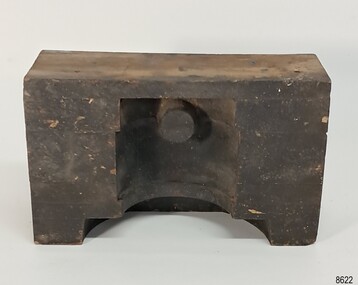
Equipment - Pattern, Briggs Brass Foundry, 1912-1972
... The cast pattern was an essential tool at Briggs Brass Foundry, specifically designed for creating sand casts. Sand casting is a time-honoured technique, with a history exceeding 2,000 years. ...The cast pattern was an essential tool at Briggs Brass Foundry, specifically designed for creating sand casts. Sand casting is a time-honoured technique, with a history exceeding 2,000 years. ...The wooden pattern forms part of a larger collection; some of them were secured within a durable wooden crate. The cast pattern was an essential tool at Briggs Brass Foundry, specifically designed for creating sand casts. Sand casting is a time-honoured technique, with a history exceeding 2,000 years. The handcrafted nature of this process produces brass and copper alloy items particularly suitable for maritime applications. Typical products include bells, boat hooks, cowls, propellers, handles, lids, rowlocks, hooks, letters, bolts, rail holders, brackets, deck plates, flanges, rudder guides, portholes and covers. The distinctive bronze mixture used at Briggs’ Foundry is copper based. It is composed of local ingots of copper, tin, zinc and lead, blended in precisely measured quantities. The resulting alloy is non-ferrous, known for its exceptional durability and longevity. HISTORY OF BRIGGS MARINE: The Briggs Brass Foundry, trading as Briggs & Son Foundry, was established in 1912 by Herbert Harrison Briggs (1863-1931) with his son George Edward Briggs. In 1922, the youngest son, Cyril Falkiner McKinnon Briggs, joined the foundry. After Herbert died in 1931, his sons George and Cyril ran the foundry. The business became known as Briggs Marine Foundry, the “non-ferrous founders” and “bell specialists”. The foundry products were made using the traditional sand-casting method, which is now over two thousand years old and is becoming a dying art. The foundry operated at 70 Wellington St, Collingwood, and specialised in casting ship bells and other marine equipment and fittings. It also made decorative items such as miniature ship propellers. The great-granddaughter of Herbert Briggs inherited a Briggs brass bell, similar to one at Flagstaff Hill Maritime Village. In 1965, Cyril was the only remaining family member involved in Briggs Marine Products. The firm relocated to Chesterville Rd, Moorabbin and Cyril went into partnership with Frank Lee. In the same year, the firm exhibited its products at the 1965 Boat Show. When Cyril passed away in 1967, Frank took over the business with two new partners. After Frank Lee died in 1971, the foundry was run by his son and daughter-in-law, Les and Eva Lee. Briggs Marine still exists today, but the Briggs family is no longer involved. Briggs Foundry had a community-minded retail branch in Warrnambool, selling cast boat fittings and equipment to fishermen and others in the regional marine industry. The branch closed in 1972. In Flagstaff Hill’s formative years, 1972-1975, many Briggs Marine brassware products were generously donated from its Melbourne foundry, along with casting patterns, tools, machinery and a cupboard. EXHIBITION and LEGACY: The donated items were displayed in a simulated Brass Foundry within the Village, where visitors could view them and gain insight into the foundering and metalwork trades that supported maritime industries, including shipwrights and boatbuilders. The castings produced at the foundry were also vital for farmers, manufacturers and other local industries. This exhibit was part of a broader showcase of working crafts, trades and services typical of a Maritime town. The display was available to the public from the completion of the building in 1986 until 1994, when the space was repurposed. It is believed that Briggs Marine’s family members gave personal assistance in setting up the displays in the original village shops, particularly the ‘Brass Foundry’ building. A notable feature of the Village Brass Foundry was the historic Cornish chimney, presented as a working model. This chimney visually demonstrated the process of smelting metal in furnaces and pouring it into sand moulds. Constructed from specially curved bricks, the chimney now stands at about two-thirds of its original height, having been relocated from the Grassmere Cheese factory. The hand-cast sand patterns hold considerable significance due to their association with Briggs Brass Founders, a firm established in the early 20th century and widely recognised for its expertise in producing, repairing, and restoring ship bells and marine equipment. Known for their specialisation in non-ferrous metal casting, Briggs Brass Founders supplied high-quality fittings and equipment for maritime use. The company extended its operations by opening a branch in Warrnambool, where it actively supported the local community. The foundry’s ability to cast essential products was important to local and regional industries, like fishing, farming, manufacturing and commercial businesses. Through its presence, its reputation was reinforced as both a skilled manufacturer and a community-minded enterprise. The foundry is notably associated with the Schomberg Bell at Flagstaff Hill, having restored this small, historic bell to its original condition. The Schomberg Bell is a fine example from a luxury migrant vessel dating back to the mid-19th century, reflecting the craftsmanship and heritage preserved by Briggs Brass Foundry. Pattern; rectangular wooden block made from laminated sections of wood painted black. A half-cylinder shape was carved into the long side, and a dowel shape was placed at the lower side. The pattern is part of a set of foundry patterns from Briggs Brass Foundry.flagstaff hill, flagstaff hill maritime museum and village, warrnambool, maritime museum, maritime village, great ocean road, shipwreck coast, briggs' bronze, traditional method, trade, sand cast, cast, brass alloy, copper alloy, pattern, mould, foundry, brass foundry, metal foundry, casting, sand mould, sand casting, marine equipment, marine tools, marine fittings, copper tin zinc lead, non-ferrous, non-corrosive, brassware, metalware, foundering, metalwork, maritime, bell founders, ship chandlers, marine products, biggs, briggs family, herbert harrison briggs, h h briggs, george edward briggs, cyril falkiner mckinnon briggs, cyril briggs, briggs & son brass foundry, h h briggs & sons foundry, briggs marine, alliance casting & engineering solutions, grassmere cheese factory, cornish chimney, curved bricks, collingwood, moorabbin, collingwood foundry, moorabbin foundry, 1912, briggs, briggs brass foundry, briggs marine foundry, briggs marine products, frank lee, les lee, eva lee, briggs marine warrnambool, non-ferrous founders, bell specialists, ship bell specialists, founders, metalworking, traditional sand casting, casting pattern, foundry pattern -
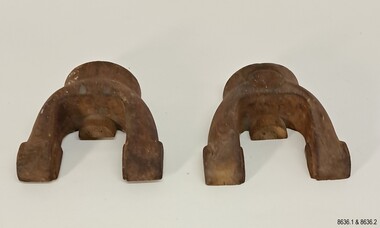 Flagstaff Hill Maritime Museum and Village
Equipment - Pattern, Briggs Brass Foundry, 1912-1972
... The cast pattern was an essential tool at Briggs Brass Foundry, specifically designed for creating sand casts. Sand casting is a time-honoured technique, with a history exceeding 2,000 years. ...The cast pattern was an essential tool at Briggs Brass Foundry, specifically designed for creating sand casts. Sand casting is a time-honoured technique, with a history exceeding 2,000 years. ...The wooden pattern forms part of a larger collection; some of them were secured within a durable wooden crate. The cast pattern was an essential tool at Briggs Brass Foundry, specifically designed for creating sand casts. Sand casting is a time-honoured technique, with a history exceeding 2,000 years. The handcrafted nature of this process produces brass and copper alloy items particularly suitable for maritime applications. Typical products include bells, boat hooks, cowls, propellers, handles, lids, rowlocks, hooks, letters, bolts, rail holders, brackets, deck plates, flanges, rudder guides, portholes and covers. The distinctive bronze mixture used at Briggs’ Foundry is copper based. It is composed of local ingots of copper, tin, zinc and lead, blended in precisely measured quantities. The resulting alloy is non-ferrous, known for its exceptional durability and longevity. HISTORY OF BRIGGS MARINE: The Briggs Brass Foundry, trading as Briggs & Son Foundry, was established in 1912 by Herbert Harrison Briggs (1863-1931) with his son George Edward Briggs. In 1922, the youngest son, Cyril Falkiner McKinnon Briggs, joined the foundry. After Herbert died in 1931, his sons George and Cyril ran the foundry. The business became known as Briggs Marine Foundry, the “non-ferrous founders” and “bell specialists”. The foundry products were made using the traditional sand-casting method, which is now over two thousand years old and is becoming a dying art. The foundry operated at 70 Wellington St, Collingwood, and specialised in casting ship bells and other marine equipment and fittings. It also made decorative items such as miniature ship propellers. The great-granddaughter of Herbert Briggs inherited a Briggs brass bell, similar to one at Flagstaff Hill Maritime Village. In 1965, Cyril was the only remaining family member involved in Briggs Marine Products. The firm relocated to Chesterville Rd, Moorabbin and Cyril went into partnership with Frank Lee. In the same year, the firm exhibited its products at the 1965 Boat Show. When Cyril passed away in 1967, Frank took over the business with two new partners. After Frank Lee died in 1971, the foundry was run by his son and daughter-in-law, Les and Eva Lee. Briggs Marine still exists today, but the Briggs family is no longer involved. Briggs Foundry had a community-minded retail branch in Warrnambool, selling cast boat fittings and equipment to fishermen and others in the regional marine industry. The branch closed in 1972. In Flagstaff Hill’s formative years, 1972-1975, many Briggs Marine brassware products were generously donated from its Melbourne foundry, along with casting patterns, tools, machinery and a cupboard. EXHIBITION and LEGACY: The donated items were displayed in a simulated Brass Foundry within the Village, where visitors could view them and gain insight into the foundering and metalwork trades that supported maritime industries, including shipwrights and boatbuilders. The castings produced at the foundry were also vital for farmers, manufacturers and other local industries. This exhibit was part of a broader showcase of working crafts, trades and services typical of a Maritime town. The display was available to the public from the completion of the building in 1986 until 1994, when the space was repurposed. It is believed that Briggs Marine’s family members gave personal assistance in setting up the displays in the original village shops, particularly the ‘Brass Foundry’ building. A notable feature of the Village Brass Foundry was the historic Cornish chimney, presented as a working model. This chimney visually demonstrated the process of smelting metal in furnaces and pouring it into sand moulds. Constructed from specially curved bricks, the chimney now stands at about two-thirds of its original height, having been relocated from the Grassmere Cheese factory. The hand-cast sand patterns hold considerable significance due to their association with Briggs Brass Founders, a firm established in the early 20th century and widely recognised for its expertise in producing, repairing, and restoring ship bells and marine equipment. Known for their specialisation in non-ferrous metal casting, Briggs Brass Founders supplied high-quality fittings and equipment for maritime use. The company extended its operations by opening a branch in Warrnambool, where it actively supported the local community. The foundry’s ability to cast essential products was important to local and regional industries, like fishing, farming, manufacturing and commercial businesses. Through its presence, its reputation was reinforced as both a skilled manufacturer and a community-minded enterprise. The foundry is notably associated with the Schomberg Bell at Flagstaff Hill, having restored this small, historic bell to its original condition. The Schomberg Bell is a fine example from a luxury migrant vessel dating back to the mid-19th century, reflecting the craftsmanship and heritage preserved by Briggs Brass Foundry Pattern: pair of U-shaped carved blocks, unpainted. The blocks have opposing metal pins and holes to hold them together. One block has a disc shape carved into the base. The pattern is part of a set of foundry patterns from Briggs Brass Foundry.flagstaff hill, flagstaff hill maritime museum and village, warrnambool, maritime museum, maritime village, great ocean road, shipwreck coast, briggs' bronze, traditional method, trade, sand cast, cast, brass alloy, copper alloy, pattern, mould, foundry, brass foundry, metal foundry, casting, sand mould, sand casting, marine equipment, marine tools, marine fittings, copper tin zinc lead, non-ferrous, non-corrosive, brassware, metalware, foundering, metalwork, maritime, bell founders, ship chandlers, marine products, biggs, briggs family, herbert harrison briggs, h h briggs, george edward briggs, cyril falkiner mckinnon briggs, cyril briggs, briggs & son brass foundry, h h briggs & sons foundry, briggs marine, alliance casting & engineering solutions, grassmere cheese factory, cornish chimney, curved bricks, collingwood, moorabbin, collingwood foundry, moorabbin foundry, 1912, briggs, briggs brass foundry, briggs marine foundry, briggs marine products, frank lee, les lee, eva lee, briggs marine warrnambool, non-ferrous founders, bell specialists, ship bell specialists, founders, metalworking, traditional sand casting, casting pattern, foundry pattern
