
Showing 49 items matching "development capital"
-
 Robin Boyd Foundation
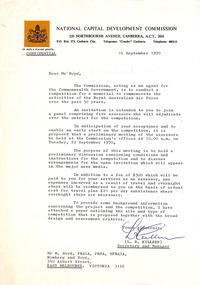
Letter, National Capital Development Commission, 14.09.1970
... Killeen, Secretary and Manager of National Capital Development Commission, is an invitation to Robin Boyd to join the judging panel for a competition for a memorial to activities of the Royal Australian Air Force over the past 50 years. ...National Capital Development Commission...Letter National Capital Development Commission ...This letter from Mr L.R. Killeen, Secretary and Manager of National Capital Development Commission, is an invitation to Robin Boyd to join the judging panel for a competition for a memorial to activities of the Royal Australian Air Force over the past 50 years. The letter also discusses financial recompense. The background information concerning the project was enclosed, but has not been found in Robin Boyd's papers here. -
 Bendigo Historical Society Inc.
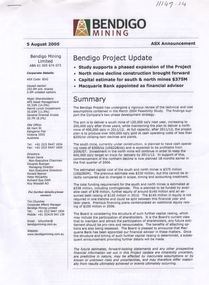
Document - Kangaroo Flat Gold Mine Collection: Bendigo Project Update ASX announcement, Bendigo Mining NL, 5 August 2005
... ...development capital...Development strategy, funding, recent expenditures, key project details, production, processing, operating costs, development capital, maintenance capital are discussed in the project update. ...Development strategy, funding, recent expenditures, key project details, production, processing, operating costs, development capital, maintenance capital are discussed in the project update. ...New Bendigo Gold Project The Bendigo goldfield is centred on the urban area of Bendigo (population approximately 60 000) in central Victoria, 130 km north west of Melbourne, Australia. Gold was discovered at Bendigo in 1851 and production continued through to 1954. The Bendigo goldfield is the second largest goldfield in total gold produced in Australia, after Kalgoorlie's Golden Mile with a total production of 22 million oz. The geology of the Bendigo Field consists of a series of tightly folded, interbedded sandstone and shale sediments. Within the sediments the gold mineralisation is hosted in quartz reefs or ribbons closely associated with anticline axes and reverse faulting. The gold within the quartz reefs is typically both coarse grained and erratically distributed. Source: https://www.ausimm.com/publications/conference-proceedings/eighth-underground-operators-conference-2002/new-bendigo-gold-project/Three page, double sided project update for the Bendigo project. On top of front page 'Bendigo Mining, 5 August 2005, ASX Announcement'. Content includes: summary of the project with the aim defined 'to deliver a south mine of 120,000 oz/y next year, increasing to 200,000 oz/y in 2011/12. At full capacity, after 2001/12, the project plan is to produce over 600,000 oz/y gold at cash operating costs of less than $200/0z utilising twin declines and plants'. Development strategy, funding, recent expenditures, key project details, production, processing, operating costs, development capital, maintenance capital are discussed in the project update. bendigo mining n.l., bendigo, mining, gold, kangaroo flat, swan decline, development strategy, funding, recent expenditures, key project details, production, processing, oeprating costs, development capital, maintenance capital, stock exchange, project update -
 Robin Boyd Foundation
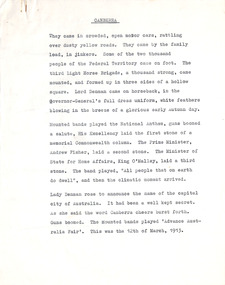
Document - Manuscript, Robin Boyd, Canberra, 1966
... ... National Capital Development Commission...Boyd starts with a vivid description of the pomp surrounding the announcement of the name for Australia's national capital on 12 March, 1913. The history of the development of a national capital, and its design is given, along with the significance of the public landscaping. ...Canberra Walter Burley Griffin Leslie Wilkinson National Capital Development Commission Canberra landscape Ebenezer Howard Garden City Robin Boyd manuscript Reverse P10 has caption in pencil 1 Typewritten, 2 Typewritten (c copy), quarto, 12 pages. ...Boyd starts with a vivid description of the pomp surrounding the announcement of the name for Australia's national capital on 12 March, 1913. The history of the development of a national capital, and its design is given, along with the significance of the public landscaping. Includes captions for three Canberra views."The City Among The Hills", in The Book of Melbourne and Canberra, The Griffin Press, Adelaide 1966, pp 32-33.1 Typewritten, 2 Typewritten (c copy), quarto, 12 pages. (Two copies)Reverse P10 has caption in pencilcanberra, walter burley griffin, leslie wilkinson, national capital development commission, canberra landscape, ebenezer howard, garden city, robin boyd, manuscript -
 Robin Boyd Foundation
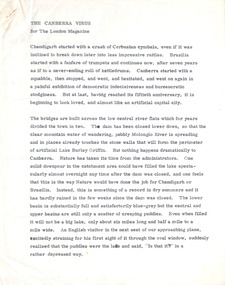
Document - Manuscript, Robin Boyd, The Canberra Virus, Jul-64
... ... National Capital Development Commission...Description of Canberra's development after Walter Burley Griffin's urban planning and the impact it has had on other architects. Original manuscript published in The London Magazine Vol.4, No.4, pp.78 - 82 Canberra Walter Burley Griffin National Capital Development Commission Robin Boyd manuscript Typewritten (c copy), pencil edits to 1, quarto, 8 pages. ...Description of Canberra's development after Walter Burley Griffin's urban planning and the impact it has had on other architects.Original manuscript published in The London Magazine Vol.4, No.4, pp.78 - 82Typewritten (c copy), pencil edits to 1, quarto, 8 pages. (Two copies)canberra, walter burley griffin, national capital development commission, robin boyd, manuscript -
 Robin Boyd Foundation
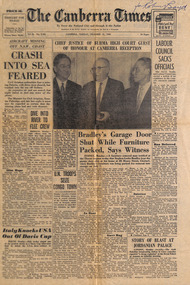
Newspaper - Clipping, The Canberra Times, Canberra Defended Against Author's Charges of Departure From Plan, 13.12.1960
... ... National Capital Development...Australian Ugliness Griffin Overall National Capital Development featurism Walsh St library Handwritten in blue pen top right 'for Robin Boyd'. ...This is a review of Robin Boyd's book 'The Australian Ugliness'. It has a local aspect looking at what Boyd says about Canberra.Article on page 2Handwritten in blue pen top right 'for Robin Boyd'.australian ugliness, griffin, overall, national capital development, featurism, walsh st library -
 Robin Boyd Foundation
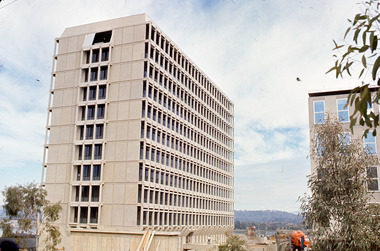
Slide, Robin Boyd, 1970
... (Architect: Max Collard from Collard Clarke & Jackson for National Capital Development Commission.)...(Architect: Max Collard from Collard Clarke & Jackson for National Capital Development Commission.) Slide Robin Boyd ...Colour slide in a mount. Russell Offices, Building 14 (now building 8) under construction, Canberra, 1972. (Architect: Max Collard from Collard Clarke & Jackson for National Capital Development Commission.)Aystralian News and Information Bureau Canberra, A.C.T / April 1970 (Handwritten) / M.J (Handwritten) / Russel Building 14 (Handwritten)canberra, slide, robin boyd -
 Ringwood and District Historical Society
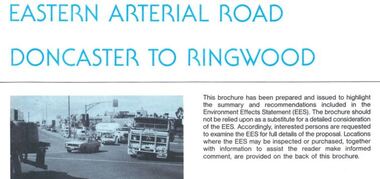
Newsletter, Eastern Arterial Road Doncaster to Ringwood Environment Effects Statement Summary Brochure - November 1987
... Topics include Community Consultation, Initial Four Lane Development, Estimated Capital Costs, Traffic Effects, Public Transport, Landscape Creek and Visual Aspects, Pedestrian/Bicycle Access, Noise, Air Quality, Lighting, Construction Impacts....Topics include Community Consultation, Initial Four Lane Development, Estimated Capital Costs, Traffic Effects, Public Transport, Landscape Creek and Visual Aspects, Pedestrian/Bicycle Access, Noise, Air Quality, Lighting, Construction Impacts. ...8-page A4 size brochure issued by Road Construction Authority reporting on the proposed extension of the Eastern Freeway between Doncaster and Ringwood. Topics include Community Consultation, Initial Four Lane Development, Estimated Capital Costs, Traffic Effects, Public Transport, Landscape Creek and Visual Aspects, Pedestrian/Bicycle Access, Noise, Air Quality, Lighting, Construction Impacts. -
 Robin Boyd Foundation
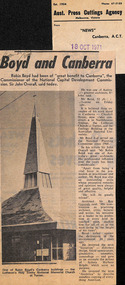
Newspaper - Clipping, News (Canberra), Boyd and Canberra, 18.10.1971
... This article contains an announcement of Robin Boyd's death on Friday 16th October and gives a short summary his career, with emphasis on Canberra buildings and quote from Sir John Overall, Commissioner of the National Capital Development Commission....This article contains an announcement of Robin Boyd's death on Friday 16th October and gives a short summary his career, with emphasis on Canberra buildings and quote from Sir John Overall, Commissioner of the National Capital Development Commission. Walsh St library Grounds and Boyd written on top left in pencil. ...This article contains an announcement of Robin Boyd's death on Friday 16th October and gives a short summary his career, with emphasis on Canberra buildings and quote from Sir John Overall, Commissioner of the National Capital Development Commission.Grounds and Boyd written on top left in pencil. Their names underlines in text and caption.walsh st library -
 Bendigo Historical Society Inc.
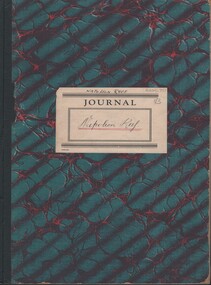
Document - MCCOLL, RANKIN AND STANISTREET COLLECTION: NAPOLEON REEF GOLD MINING CO. N.L, 1940-1952
... Document: Journal of hand written entries of share capital, calls, development expenses from 30 May 1940 to 30 November 1952 (12 Pages of Entries)....ORGANIZATION Business industrial - mining McColl Rankin & Stanistreet mining gold mining Napoleon Reef Document: Journal of hand written entries of share capital, calls, development expenses from 30 May 1940 to 30 November 1952 (12 Pages of Entries). ...Document: Journal of hand written entries of share capital, calls, development expenses from 30 May 1940 to 30 November 1952 (12 Pages of Entries).organization, business, industrial - mining, mccoll rankin & stanistreet, mining, gold mining, napoleon reef -
 Clunes Museum
Pamphlet - BROCHURE, R. FLETCHER & SONS, The Clunes District Hospital )Incorporated) Information Brochure, June 1988
... INFORMATION BROCHURE COMPILED AN DISED BY THE COMMITEE OF MANAGEMENT OF THE CLUNES DISTRICT HOSPITAL (INCORPORATED) DATED JUNE 1988 - INCLUDES NAMES OF OFFICE BEARERS AND OUTLINES HEALTH AND ANCILLARY SERVICES AVAILABLE AND PLANS FOR MINOR WORKS AND EQUIPMENT PROGRAM AND CAPITAL DEVELOPMENT...INFORMATION BROCHURE COMPILED AN DISED BY THE COMMITEE OF MANAGEMENT OF THE CLUNES DISTRICT HOSPITAL (INCORPORATED) DATED JUNE 1988 - INCLUDES NAMES OF OFFICE BEARERS AND OUTLINES HEALTH AND ANCILLARY SERVICES AVAILABLE AND PLANS FOR MINOR WORKS AND EQUIPMENT PROGRAM AND CAPITAL DEVELOPMENT CLUNES DISTRICT HOSPITAL HOSPITAL COMMITTEE OF MANAGEMENT JUNE 1988 1 X TRIFOLD INFORMATION BROCHURE BLUE PRINTING ON WHITE BACKGROUND FOR THE CLUNES DISTRICT HOSPITAL (INCORPORATED) The Clunes District Hospital )Incorporated) Information Brochure Pamphlet BROCHURE R. ...INFORMATION BROCHURE COMPILED AN DISED BY THE COMMITEE OF MANAGEMENT OF THE CLUNES DISTRICT HOSPITAL (INCORPORATED) DATED JUNE 1988 - INCLUDES NAMES OF OFFICE BEARERS AND OUTLINES HEALTH AND ANCILLARY SERVICES AVAILABLE AND PLANS FOR MINOR WORKS AND EQUIPMENT PROGRAM AND CAPITAL DEVELOPMENT1 X TRIFOLD INFORMATION BROCHURE BLUE PRINTING ON WHITE BACKGROUND FOR THE CLUNES DISTRICT HOSPITAL (INCORPORATED) JUNE 1988clunes district hospital, hospital committee of management -
 Melbourne Tram Museum
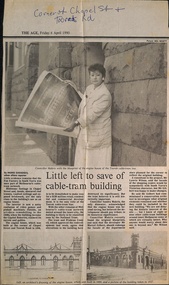
Newspaper, The Age, "Little left to save of cable-tram building", 6/4/1990
... Details the proposed development use as Capital Bakeries, along with Cr Makris holding an original plan of the building, was to be developed for a commercial residential development. ...Details the proposed development use as Capital Bakeries, along with Cr Makris holding an original plan of the building, was to be developed for a commercial residential development. ...Newspaper clipping about the demolition of the former engine house at the corner of Chapel St and Toorak Road, at the time the "Fun Factory". Details the proposed development use as Capital Bakeries, along with Cr Makris holding an original plan of the building, was to be developed for a commercial residential development. This proposal did not proceed, but a later proposal saw the building demolished.Yields information about the former Toorak engine house.Newspaper cutting from The Age, 6/4/1990 titled "Little left to save of cable-tram building"In ink "Corner of Chapel St & Toorak Road"cable trams, engine houses, winding house, toorak road car sheds, toorak road, chapel st -
 Wodonga & District Historical Society Inc
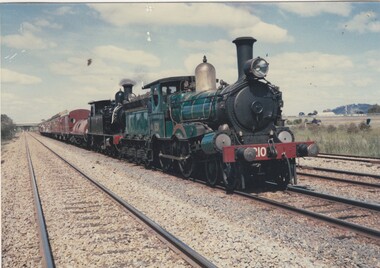
Photograph - Fred Rochow Railways Collection - Locomotives 1210 and 3112 waiting to cross, 15 October 1988
... The NSW Steam Tram and Preservation Society appealed to the National Capital Development Commission (NCDC) and the NSW Railways to assist in the locomotive's preservation. ...The NSW Steam Tram and Preservation Society appealed to the National Capital Development Commission (NCDC) and the NSW Railways to assist in the locomotive's preservation. ...The Fred Rochow Railways Collection incorporates photos related to the operation of the Wodonga Railway Station including different types of trains and railways staff C. 1930 – 1990. It was donated to the Wodonga Historical Society by Fred Rochow, a railwayman who spent many years based in Wodonga. He joined the Victorian Railways on 17th June l947 and retired in 1988. For some time, he was a member of the Australian Federated Union of Locomotive Enginemen and served a term as a member of the Trades Hall Council. He had an extensive knowledge of the struggles that took place to achieve better conditions for railway workers. Fred worked for many years as a fireman and then worked his way up the ranks to driver, experiencing many changes from the days of steam locomotives through to diesel trains, locomotives and even the modern XPT train. He worked throughout Victoria at different stages of his career, with his final working years focused on the northeast of Victoria and the Albury to Melbourne line. After his retirement, Fred continued to share his love of steam miniature trains with the community.This collection has local and statewide significance as it captures images of trains, locomotives and personnel who operated the railway services in Wodonga and throughout Northeast Victoria. The railways played a critical role in opening up Victoria and connecting Australia for trade, business, social communication and transport.This locomotive was built in 1878 by Beyer Peacock & Co, Manchester, England. It arrived in Sydney on August 19, 1878 and began its working life as No 120 of C[79] class on the southern and western lines of NSW in September that year. On 24 May 1914, when the new branch line to Canberra was completed, the locomotive unofficially opened the track by pulling the first train to the construction site of the national capital. The engine was given the new number 1210 in the 1923 re-classification of NSW engines. Locomotive 1210 continued in use until 1958 when it was finally withdrawn from service. The NSW Steam Tram and Preservation Society appealed to the National Capital Development Commission (NCDC) and the NSW Railways to assist in the locomotive's preservation. As a result of the Society's appeal the locomotive was purchased by the NCDC for 800 pounds. The locomotive was relocated to the Canberra Railway Museum in 1984. It was restored with funds received from the Australian Bicentennial Authority. It was a requirement of the Bicentennial Authority Grant that the engine be operational. The locomotive was re-commissioned by the Member for Canberra, the Hon Ros Kelly, on 19 September 1988. As part of the Australian Bicentennial celebrations Locomotive 1210 attended the AusSteam '88 event in Melbourne, travelling south in the company with Locomotive 3112. It is claimed by the Australian Railway Historical Society that No 1210 is the oldest operational main line steam locomotive in the world.On front of locomotive "1210" railways wodonga, fred rochow, locomotive 1210 -
 Flagstaff Hill Maritime Museum and Village
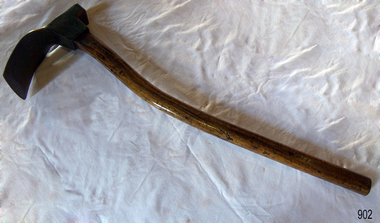
Tool - Adze, Ward & Payne Ltd, Between 1843 to Mid 20th Century
... In 1967 Wilkinson Sword purchased all the company's share capital and continued to sell Ward & Payne tools until 1970 when a fire burned the factory down and housing development was built on the site....In 1967 Wilkinson Sword purchased all the company's share capital and continued to sell Ward & Payne tools until 1970 when a fire burned the factory down and housing development was built on the site. ...An adze is an ancient and versatile cutting tool and has been in use for thousands of years. Adze are similar to an axe but with the cutting edge perpendicular to the handle rather than parallel. They have been used since the Stone Age. Adzes are hand tools used for smoothing or carving wood. The subject item was made by Ward & Payne of the Limbrick Works at Hillsborough, Sheffield England manufacturers of hand-forged tools. Their trademark registered in 1850 was a Letter "W" & "P" stamped into the steel. The firm was established by David Ward (1767-1822) in 1803 the company became David Ward & Sons, in 1837 after Ward's son Edward joined the firm. In 1845 Henry Payne the founder's son-in-law became a partner but died in 1850 after which the company reverted to the Ward family. The business then concentrated on making carving tools, chisels and gouges. In 1882 David Ward's grandson David Ward Jr. (1835-1889) purchased land and built a factory at Sheffield North known as the "Limerick Wheel". For a time Wards operated from both 106-114 West Street Sheffield and at Limbrick Road, Hillsborough on the river Loxley. By 1911 they had expanded into making spades, forks, sheep shears and many other types of edged tools including drills and wood planes. In 1967 Wilkinson Sword purchased all the company's share capital and continued to sell Ward & Payne tools until 1970 when a fire burned the factory down and housing development was built on the site.The subject item is significant as it gives a snapshot of the technological development of sailing ships and their operation before steam-powered vessels took over around the world. Tools such as the subject item demonstrate the traditional craftsmanship and skill of the shipwright and the aesthetic quality of the timber ships designs of the time. Adze with wooden handle curved painted green with patent number and maker's name inscribed on inside curve of blade. Inscribed "Patd 561 Ward" "2w". flagstaff hill, warrnambool, flagstaff-hill, flagstaff-hill-maritime-museum, maritime-museum, shipwreck-coast, flagstaff-hill-maritime-village, smoothing tool, hand tool, carpenders tool, adze, coopers tool, woodworking tools -
 Flagstaff Hill Maritime Museum and Village
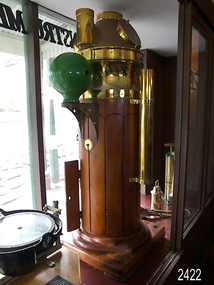
Binnacle, Early to mid 20th Century
... capital of John Lilley and Gillie Limited., but retained all the personnel and the directors. (See Links for more information) A significant item of early 20th century marine navigational equipment made by a leading manufacturer in the field from a company that is still producing marine navigational instruments today. John Lilleys company began in 1812 growing at a time when the transition of compasses from timber ships, to steel vessels. Compasses at this time required a method of compensation to allow their inclusion in steel vessels without magnetic deviation. This therefore was a period of great development ...Mr John Wilson Gillie was born on the 31st of March 1864. On the 31st of July 1880 he was apprenticed for four years to J.J. Wilson and Sons, Nautical Instrument Makers of Sunderland. Following the apprenticeship he spent six months to a year as an ‘improver’ in Glasgow, and then started a new company ‘Wilson and Gillie’ in North Shields. At this time sail had just given way to steam and wooden ships to steel, and the railways were competing with colliers for the carrying of coal from the North East of England to London and the South. In 1858 only seven out of 44 shipyards on the Tyne were using iron, but by 1862 there were ten, employing around 4,000 men. These changes had a significant effect on nautical instrument manufacturers, as the magnetic compass for a wooden sailing vessel was very simple and required little in the way of compensation. For steel vessels much more was required and this was a period of great development, both in the compass bowl and the binnacle in which it was housed. In 1870 Sir William Thomson (later Lord Kelvin) designed his dry card standard compass, which completely replaced all previous designs. Wilson and Gillie started as agents for the Thomson compass, but later J.W. Gillie, using similar principles, redesigned the compass suspension and patented the ‘UNIT’ standard compass. It became popular with local shipowners and shipbuilders. In 1910 the firm of John Lilley and Son (which had been established in London in 1812), found themselves in financial difficulties and were saved with the help of John Wilson Gillie, who established, on the 8th of August 1911, a new firm of John Lilley and Son Limited. John Lilley and Son had been the sole London agents for Sir William Thomson, a very enviable position during this period, when the Thomson compass led the field. Unfortunately, Mr. Lilley had quarreled with the Glasgow company, who withdrew the agency and established their own branch in London (later to become Kelvin White and Hutton). On November 7th 1913, the firm of John Lilley and Son Limited of London amalgamated with Wilson and Gillie of North Shields, and after this date instruments manufactured by the two companies bore the name John Lilley and Son Limited of London and North Shields. During the 1930s many of the London nautical instrument makers were in difficulties, including John Lilley and Son Limited and Reynolds and Son, Dobbie and Clyde Limited, and Mr. J.W. Gillie arranged an amalgamation between these two companies. The new firm became Lilley and Reynolds Limited. In 1943, with estate duties in mind, the North Shields company was reconstituted and took the name of John Lilley and Gillie Limited, although the shareholders, directors and personnel remained unchanged In the early 1970s Lilley and Gillie developed close links with Observator in Rotterdam, who manufactured one of the first fully reliable transmitting magnetic compass systems. The Observator shareholders, Holland America Line, bought the share capital of John Lilley and Gillie Limited., but retained all the personnel and the directors. (See Links for more information)A significant item of early 20th century marine navigational equipment made by a leading manufacturer in the field from a company that is still producing marine navigational instruments today. John Lilleys company began in 1812 growing at a time when the transition of compasses from timber ships, to steel vessels. Compasses at this time required a method of compensation to allow their inclusion in steel vessels without magnetic deviation. This therefore was a period of great development, both in the compass bowl and the binnacle in which it was housed and the Lilley company were leaders in the field. Ships binnacle, wood with brass fittings, consists of 2 brass lamp holders, place for compass, Also has an inclinometer with a scale 40 to 0 to 40, one red and one green iron Kelvin compensation balls, one on each side of binnacle denoting port and starboard, a brass cylinder attached perpendicular at the rear for storing a Flinders Bar, 2 hinged cupboards containing adjustable wooden racks with drilled holes in them to hold iron Heeling error magnets.Textured brass plate attached to front stating "JOHN LILLEY & SON LTD (WILSON & GILLIE), NAUTICAL INSTRUMENT MAKERS, NORTH SHIELDS" . Inclinometer has "JOHN LILLEY & SON LTD (Wilson & Gillie) LONDON & NORTH SHIELDS" engraved. flagstaff hill, warrnambool, shipwrecked-coast, flagstaff-hill, flagstaff-hill-maritime-museum, maritime-museum, shipwreck-coast, flagstaff-hill-maritime-village, binnacle, john lillie & son ltd, compass -
 Federation University Historical Collection
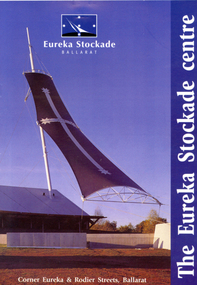
Booklet, The Eureka Stockade centre, 1998, 1998
... My congratulations to the City of Ballarat on the development of this exciting project in association with my Government, the federal Government and the wider community.' eureka eureka stockade m.a.d.e. museum of democracy at eureka jeff kennett shane brenna james coglan andrew thompson cox sanderson Ness Hooker Cockram Pty Ltd Mother's Art Shane Brennan Andrew thompson Steve Moneghetti Marino Campana Blue soft covered opening programme booklet of 6 pages. The cover features the Eureka sail on the Eureka Stockade centre. The programme lists donors to the Eureka Project Capital ...The Eureka Stockade centre was designed by Cox Sanderson Ness, with the exhibition designed by Mother's art and BCM. The builder was Hooker Cockram Pty Ltd. it is located on the corner of Eureka Street and Rodier Street, within the Eureka Reserve, The Eureka Stockade Centre was designed to the importance of the events leading up to the Rebellion at Eureka on 03 December 1854 in Ballarat, and its aftermath. The centre aimed to be a focus for continuing debate and interpretation of the Eureka Story in what it means to contemporary Australia culture. It was officially opened on Friday 27 March 1998 by the Premier of Victoria, The Hon. Jeff Kennett, M.L.A. The message from the Premier, as printed on the programme states: 'It is indeed a pleasure to be in Ballarat today to officially open the Eureka Stockade centre. The centre has been designed to show the importance of the events leading up to the Rebellion at Eureka on 3 December 1854 in Ballarat and its aftermath. This centre will remain a focus for continuing debated and interpretation of the Eureka Story in what it means to contemporary Australian culture. My congratulations to the City of Ballarat on the development of this exciting project in association with my Government, the federal Government and the wider community.'Blue soft covered opening programme booklet of 6 pages. The cover features the Eureka sail on the Eureka Stockade centre. The programme lists donors to the Eureka Project Capital Appeal, the order of events for the official opening by Premier Jeff Kennett on Friday 27 March 1998eureka, eureka stockade, m.a.d.e., museum of democracy at eureka, jeff kennett, shane brenna, james coglan, andrew thompson, cox sanderson ness, hooker cockram pty ltd, mother's art, shane brennan, andrew thompson, steve moneghetti, marino campana -
 Federation University Historical Collection
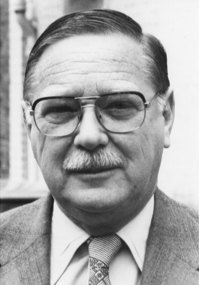
Photograph - Black and White, Kenneth Joynson Flecknoe
... His time on Council was one of rapid chance for the School, from separation of the tertiary division and the Junior Technical School to the development of TAFE. Six major capital projects were completed and buildings opened during Ken Flecknoe's time as President, as well as significant refurbishment and development across the School....His time on Council was one of rapid chance for the School, from separation of the tertiary division and the Junior Technical School to the development of TAFE. Six major capital projects were completed and buildings opened during Ken Flecknoe's time as President, as well as significant refurbishment and development across the School. kenneth flecknoe flecknoe ballarat school of mines TAFE ken flecknoe kenneth joynson flecknoe Black and white photograph of Kenneth Flecknoe. ...Kenneth Joynson Flecknoe joined the Ballarat School of Mines Council on 16 April 1975, and was elected Vice-President on 15 July 1979, and became its eleventh president in 1981. His time on Council was one of rapid chance for the School, from separation of the tertiary division and the Junior Technical School to the development of TAFE. Six major capital projects were completed and buildings opened during Ken Flecknoe's time as President, as well as significant refurbishment and development across the School.Black and white photograph of Kenneth Flecknoe.kenneth flecknoe, flecknoe, ballarat school of mines, tafe, ken flecknoe, kenneth joynson flecknoe -
Marysville & District Historical Society
THE TRIANGLE NEWS-VOL 40 NO 19-MAY 24 2013
... development...peter ryan...what's on when in may and june...buxton recreational reserve...working bee...intrepid triangle bushwalkers...the committee of management of the gallipoli park precinct...marysville community market...creative triangle...fire services levy now part of rates notices...church notices...triangle community dinner...el kanah village...biggest morning tea a success...vale brian moore...murrindindi shire council...payment of rate installment...position vacant...mayor's chair...marysville primary school mother's day raffle...advertisements...buxton fire brigade...anna's mobile patchwork quilt shop open...capital...marysville victoria australia $28 million vibe hotel marsyville breaks ground deputy premier and minister for regional & rural development peter ryan what's on when in may and june buxton recreational reserve working bee intrepid triangle bushwalkers the committee of management of the gallipoli park precinct marysville community market creative triangle fire services levy now part of rates notices church notices triangle community dinner el kanah village biggest morning tea a success vale brian moore murrindindi shire council payment of rate installment position vacant mayor's chair marysville primary school mother's day raffle advertisements buxton fire brigade anna's mobile patchwork quilt shop open capital works program supports existing infrastructure villains storm home to first ever away victory staff wanted black spur inn greenlands guesthouse open by lachlan fraser building our future draft council plan released for comment emotions anonymous international buxton hotel real estate marysville golf report snowgum hillary challenge comes to marysville last quarter assault gets villains home free mulch loading triangle community dance group marysville villains sponsors and members lunch randy the puppet is back for lunch draft council plan and budget have your say melbourne international comedy festival marysville & district lions club road maintenance and construction works free information session council delivers conservative draft budget yarra valley div 1 game in marysville a success THE TRIANGLE NEWS-VOL 40 NO 19-MAY 24 2013 ...marysville, victoria, australia, $28 million vibe hotel marsyville breaks ground, deputy premier and minister for regional & rural development, peter ryan, what's on when in may and june, buxton recreational reserve, working bee, intrepid triangle bushwalkers, the committee of management of the gallipoli park precinct, marysville community market, creative triangle, fire services levy now part of rates notices, church notices, triangle community dinner, el kanah village, biggest morning tea a success, vale brian moore, murrindindi shire council, payment of rate installment, position vacant, mayor's chair, marysville primary school mother's day raffle, advertisements, buxton fire brigade, anna's mobile patchwork quilt shop open, capital works program supports existing infrastructure, villains storm home to first ever away victory, staff wanted black spur inn, greenlands guesthouse open by lachlan fraser, building our future draft council plan released for comment, emotions anonymous international, buxton hotel, real estate, marysville golf report, snowgum hillary challenge comes to marysville, last quarter assault gets villains home, free mulch loading, triangle community dance group, marysville villains sponsors and members lunch, randy the puppet is back for lunch, draft council plan and budget have your say, melbourne international comedy festival, marysville & district lions club, road maintenance and construction works free information session, council delivers conservative draft budget, yarra valley div 1 game in marysville a success -
Federation University Historical Collection
Booklet, Ballarat School of Mines Discussion Paper for a meeting with Hon.I. Predl, 1985, 1985
... ballarat school of mines smb campus lydiard street capital works lydiard st campus l.f.j. hillman maintenance of buildings blackburn report Soft page booklet Ballarat prepared for a meeting with I. Predl - Acting Chair of the TAFE Board. Topics include Responsibilities of Council, L.F.J. Hillman Recreation Building, Maintanance of Buildings, Campus titles and future development ...Soft page booklet Ballarat prepared for a meeting with I. Predl - Acting Chair of the TAFE Board. Topics include Responsibilities of Council, L.F.J. Hillman Recreation Building, Maintanance of Buildings, Campus titles and future development, College Management Study, Uncertainties re Blackburn report. ballarat school of mines, smb campus, lydiard street, capital works, lydiard st campus, l.f.j. hillman, maintenance of buildings, blackburn report -
 City of Moorabbin Historical Society (Operating the Box Cottage Museum)
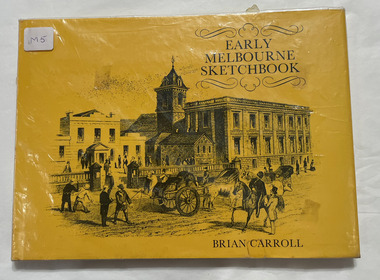
Book, Carroll, Brian, Early Melbourne sketchbook, 1977
... capital city: Batman, Fawkner, Bourke, La Trobe. In addition, there is a wealth of information about Melbourne's buildings and landmarks - places such as St Francis', the Post Office, the Town Hall, Princes Bridge, and Young and Jackson's. Early Melbourne Sketchbook describes vividly the historical development ...In 1839 a runaway horse crashed into a tree stump that stood in the middle of Bourke Street; and in 1840 there were holes in Collins Street so deep that a child was nearly drowned in one. Early Melbourne Sketchbook recaptures the exciting early days of the city, days when rainy weather rendered Elizabeth Street impassable without a punt, and when Melbourne's first city councillor was elected on the promise of free beer to his constituents. Brian Carroll has sought out an interesting collection of contemporary illustrations to take us back to the beginning of Melbourne, from the original discovery of Port Phillip in 1802. David Collins' abortive settlement at Sullivan's Bay was abandoned in 1803, and it was not until 1835 that John Batman settled on his now famous 'place for a village'. Here are fascinating stories of the men who founded and shaped Victoria's capital city: Batman, Fawkner, Bourke, La Trobe. In addition, there is a wealth of information about Melbourne's buildings and landmarks - places such as St Francis', the Post Office, the Town Hall, Princes Bridge, and Young and Jackson's. Early Melbourne Sketchbook describes vividly the historical development and cultural growth of the city that was to become Australia's financial capital and its second largest city. (Inside cover)62 pages : illustratednon-fictionIn 1839 a runaway horse crashed into a tree stump that stood in the middle of Bourke Street; and in 1840 there were holes in Collins Street so deep that a child was nearly drowned in one. Early Melbourne Sketchbook recaptures the exciting early days of the city, days when rainy weather rendered Elizabeth Street impassable without a punt, and when Melbourne's first city councillor was elected on the promise of free beer to his constituents. Brian Carroll has sought out an interesting collection of contemporary illustrations to take us back to the beginning of Melbourne, from the original discovery of Port Phillip in 1802. David Collins' abortive settlement at Sullivan's Bay was abandoned in 1803, and it was not until 1835 that John Batman settled on his now famous 'place for a village'. Here are fascinating stories of the men who founded and shaped Victoria's capital city: Batman, Fawkner, Bourke, La Trobe. In addition, there is a wealth of information about Melbourne's buildings and landmarks - places such as St Francis', the Post Office, the Town Hall, Princes Bridge, and Young and Jackson's. Early Melbourne Sketchbook describes vividly the historical development and cultural growth of the city that was to become Australia's financial capital and its second largest city. (Inside cover)melbourne, historic buildings -
 Ringwood and District Historical Society
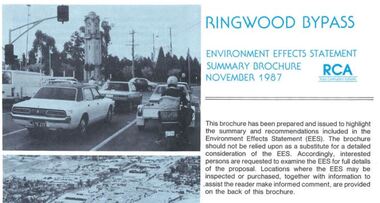
Newsletter, Ringwood Bypass Environment Effects Statement Summary Brochure - November 1987
... Topics include Community Consultation, Estimated Capital Costs, Traffic Effects, Property Effects, Mullum Mullum Creek, Landscape Development, Pedestrian/Bicycle Access, Noise, Air Quality, Compatability with Ringwood District Centre Development, Vehicle & Traffic Aspects, Lighting, Construction Impacts, Extension to Canterbury Road, Public Transport....Topics include Community Consultation, Estimated Capital Costs, Traffic Effects, Property Effects, Mullum Mullum Creek, Landscape Development, Pedestrian/Bicycle Access, Noise, Air Quality, Compatability with Ringwood District Centre Development, Vehicle & Traffic Aspects, Lighting, Construction Impacts, Extension to Canterbury Road, Public Transport. ...8-page A4 size brochure issued by Road Construction Authority reporting on the proposed Ringwood Bypass. Topics include Community Consultation, Estimated Capital Costs, Traffic Effects, Property Effects, Mullum Mullum Creek, Landscape Development, Pedestrian/Bicycle Access, Noise, Air Quality, Compatability with Ringwood District Centre Development, Vehicle & Traffic Aspects, Lighting, Construction Impacts, Extension to Canterbury Road, Public Transport. -
 Orbost & District Historical Society
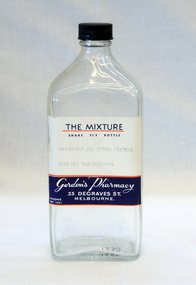
bottle, first half 20th century
... This item reflects the changes and development in over-the-counter-medicine over the last century. bottle pepper-ginger medicine label : "The Mixture Dose one tablespoonful Shake The Bottle Peppermint and Ginger Mixture" Phone MF 1691 On base: F1837 Inside a capital A is S above the letter M. ...Australia was not self sufficient in glass making until the turn of the 20th century and many bottles were made overseas and shipped to Australia with their contents and when emptied were re-filled with other company’s products. This medicine bottle was filled with a mixture made by the chemist. This item reflects the changes and development in over-the-counter-medicine over the last century.A clear rectangular bottle with a screw top black plastic lid. It is labelled "peppermint and ginger mixture" on paper label. There is a patent number inside the lid.label : "The Mixture Dose one tablespoonful Shake The Bottle Peppermint and Ginger Mixture" Phone MF 1691 On base: F1837 Inside a capital A is S above the letter M. Mbottle pepper-ginger medicine -
 Flagstaff Hill Maritime Museum and Village
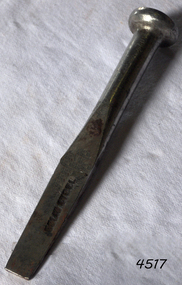
Tool - Caulking Tool, Ward & Payne Ltd, Late 19th century
... In 1967 Wilkinson Sword purchased all the company's share capital and continued to sell Ward & Payne tools until 1970 when a fire burned the factory down and housing development was built on the site. ...In 1967 Wilkinson Sword purchased all the company's share capital and continued to sell Ward & Payne tools until 1970 when a fire burned the factory down and housing development was built on the site. ...Caulking is the traditional technique used on wooden vessels built with butted or clinker-built planks to fill the gaps between these planks while still allowing the wood to flex and move. This involved driving the irons, hammered in with the mallet, deep into the seams to open them up. After this, spun yarn, oakum (hemp) or cotton was driven deep into the gaps. The hemp or cotton was soaked in creosote or pine tar to make the joins watertight. Caulking also played a structural role in tightening up the hull or deck by reducing the longitudinal movement of the neighbouring planks. The subject item was made by Ward & Payne of the Limbrick Works at Hillsborough, Sheffield England manufacturers of hand-forged tools. Their trademark registered in 1850 was a Letter "W" & "P" stamped into the steel. The firm was established by David Ward (1767-1822) in 1803 the company became David Ward & Sons, in 1837 after Ward's son Edward joined the firm. In 1845 Henry Payne the founder's son-in-law became a partner but died in 1850 after which the company reverted to the Ward family. The business then concentrated on making carving tools, chisels and gouges. In 1882 David Ward's grandson David Ward Jr. (1835-1889) purchased land and built a factory at Sheffield North known as the "Limerick Wheel". For a time Wards operated from both 106-114 West Street Sheffield and at Limbrick Road, Hillsborough on the river Loxley. By 1911 they had expanded into making spades, forks, sheep shears and many other types of edged tools including drills and wood planes. In 1967 Wilkinson Sword purchased all the company's share capital and continued to sell Ward & Payne tools until 1970 when a fire burned the factory down and housing development was built on the site. The subject item is significant as it gives a snapshot of the technological development of sailing ships and their operation before steam-powered vessels took over around the world. Tools such as the subject item demonstrate the traditional craftsmanship and skill of the shipwright and the aesthetic quality of the timber ships designs of the time. Caulking tool with square end"WARD Sheffield"flagstaff hill, warrnambool, flagstaff hill maritime museum, shipwreck coast, flagstaff hill maritime village, james s steele, caulking iron, caulking tool, shipwright tools, ward & payne sheffield, forged tools -
 Eltham District Historical Society Inc
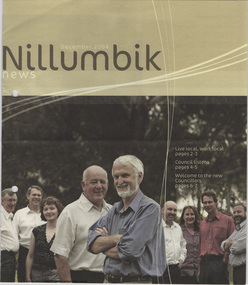
Journal - Newsletter, Nillumbik Shire Council, Nillumbik News, December 2004
... Key Points Council Projects and Infrastructure: Updates on road maintenance, capital works, and improvements to local facilities across the shire, Continued development of community infrastructure such as recreational facilities, parks, and public spaces, Council planning initiatives aimed at supporting sustainable growth and maintaining rural character. ...Key Points Council Projects and Infrastructure: Updates on road maintenance, capital works, and improvements to local facilities across the shire, Continued development of community infrastructure such as recreational facilities, parks, and public spaces, Council planning initiatives aimed at supporting sustainable growth and maintaining rural character. ...The newsletter reports on local council initiatives, community programs, environmental activities, and cultural events taking place across Nillumbik Shire in late 2004. It emphasizes community participation, environmental sustainability, infrastructure improvements, and local cultural life. Key Points Council Projects and Infrastructure: Updates on road maintenance, capital works, and improvements to local facilities across the shire, Continued development of community infrastructure such as recreational facilities, parks, and public spaces, Council planning initiatives aimed at supporting sustainable growth and maintaining rural character. Environment and Sustainability: Programs encourage residents to protect local waterways, conserve native vegetation, and control invasive weeds, Environmental initiatives involve Landcare groups, wildlife monitoring, and sustainability education, Residents are encouraged to participate in community environmental projects and conservation activities. Community Services and Programs: Promotion of community services, volunteer programs, and educational opportunities through local centres. Support for families, seniors, and young people through recreational and learning programs. Community engagement remains a priority for council planning and activities. Arts, Culture and Events: The newsletter highlights local arts initiatives, exhibitions, festivals, and performances. Programs support local artists and cultural organisations, reinforcing the area’s reputation as an artistic community. Tourism and Local Economy: Promotion of local tourism, wineries, markets, and cultural attractions in the region. Efforts to strengthen the local economy and regional identity through tourism and community events. Also includes interviews with Councillors, 2004 Nillumbik Sports Awards and calandar of events. council newsletters, nillumbik news, nillumbik shire council, warwick leeson, peter yates, bo bendtsen, helen coleman, bill penrose, greg johnson, howard bulmer, bronnie hattam, michael young, living & learning nillumbik, sally hansen, julie french, julie graham, steven wells, robert hayley, greg champion, ev hales, marjorie lapworth, jan kelly, robina summers, janet mason, karen coulton, elizabeth gardner, matthew dean, madison caulfield, nicole pless, mathew munro, sten nigol, christopher armet, rachel khaw, melinda bpuer, david parsons, anton woods, erin lorenzini, zoe carr, troy sandley, marrissa filipou, ben cukier, nillumbik reconciliation group, montsalvat, eltham craft & produce market, eltham festival, nillumbik artists open studios, hurstbridge high school, family services, kangaroo ground preschool, alan marshall short story award, tom dell'anno, gayle knight -
 Eltham District Historical Society Inc
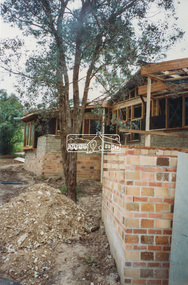
Photograph - Colour Print, Nathan Islip, Eltham Library under construction, c.1993
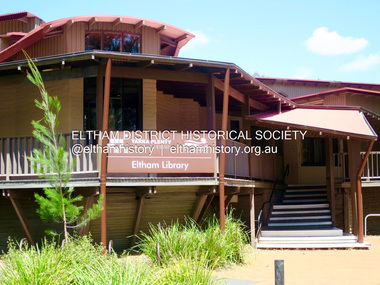
... Capital Works Program became available from October 1992 for community projects endorsed by local Councils. The Eltham Council submitted a proposal, based on library findings and requirements accumulated by the Library Occasional Committee, to the Federal Grants Committee to build a new Eltham Library. The Federal Grants Committee supported the funding request allowing commencement of the library project three years earlier than planned. With finance finalised, the Council set up its Eltham Library Re-development...Capital Works Program became available from October 1992 for community projects endorsed by local Councils. The Eltham Council submitted a proposal, based on library findings and requirements accumulated by the Library Occasional Committee, to the Federal Grants Committee to build a new Eltham Library. The Federal Grants Committee supported the funding request allowing commencement of the library project three years earlier than planned. With finance finalised, the Council set up its Eltham Library Re-development ...Photo taken by Nathan Islip who at the time was studying Architecture at the University of Melbourne. During his experience year he worked as a builder's labourer on the new Eltham Library construction project. Eltham Library Service 1930s - 1994 Originally collated by Harry Gilham, President, Eltham District Historical Society Inc (1993-2009) (edited 2022) In the Eltham township area, in the early 1930s, library books for adults were available from E J Andrew's newsagency in Main Road. In the newsagency cum haberdashery, some shelves were set aside for a lending library of adults' books. In 1935, Mr & Mrs JC Rains purchased the newsagency and continued the lending service until the late 1940s. At this time the business was extended from haberdashery to sell ladies' and men's clothing. The library section was discontinued. In the 1930s a mobile book library was also run by a Mr Foster of Bible Street, Eltham. In the 1950s adult books were available from racks in the foyer of the Eltham Shire Offices which was then located beside the Eltham Hall on the comer of Arthur Street and Main Road. In the early 1950s a referendum of ratepayers was called to seek public opinion on the issue of raising money for a public library for which the rates would have to be increased - the motion was defeated. On 11 November 1965 Eltham Shire Council, in conjunction with the City of Heidelberg and the Shire of Diamond Valley, met to form the Heidelberg Regional Library Service. Eltham was represented by Councillors Charis Pelling and John Lewis. The first library service for the Shire of Eltham from this group came in the shape of a bookmobile van which had, amongst others, a central stopover near the Shillinglaw trees outside the newly opened Shire offices at 895 Main Road, the original site of Shillinglaw Cottage and the former Shillinglaw farm. Present-day Wingrove Park was another stopover and the many recorded requests for this service can be read as denoting the areas of population or gathering points at that period throughout the Shire. 1968 saw the Shire convert the ‘Brinkkotter’ house in Dudley Street to house both adult and children's books. This library was originally staffed from the City of Heidelberg Library and records of committee meetings range from borrowing Heidelberg's old library shelving to trying to increase the Government's subsidy to a dollar for dollar basis. Book loans in the period 1966-67 totalled 30,400 and the following year ran to 52,113. With 2 books plus 1 paperback the limit per person, it was overcrowded and unable to house the range of other services which had become common library stock. Planning to extend the Shire Offices by the addition of the south wing was an opportunity to re-house the Shire's Library. The opening of the library in the extension was carried out on 17th August 1971 by the Hon R J Hamer ED, MP, Chief Secretary of Victoria. Cr Geoffrey Dreverman officiated as the Shire President. The Heidelberg Regional Library Service continued until September 1985 when it disbanded. On 21 November 1985 the Yarra Plenty Regional Library Service was established. At that time Eltham was represented by Councillors Mary Grant and Robert Manuell. By 1987, over-crowding of the Eltham Library and an inability to house the range of other services yet again rose to prominence. At a Council meeting held on 1 June 1987, the Councillors supported a resolution which threatened to close the library on 30 September 1987. Council's frustration arose from yet another re-run of the annual State Government versus Council Library funding and records show first arose in Eltham Council in 1967 with the Government of 1he day. After prolonged public anger and petitions the motion to close the library was rescinded in August 1987. Council, considering the community's concern, set up a ‘Library Review Working Party’ which a year later became the Library Occasional Committee with direct access to Council. This Committee investigated the workings of the 386 square metre library and found inadequate space for storage and display, lack of equipment, out-of-date furniture together with an increasing patronage which resulted in queues of borrowers becoming longer no matter when the library was open. Community consultation took the form of 1,000 questionnaires sent to users and non-users along with noticeboard reminders of what was planned. Council developed a strategy to set aside capital funds from 1988 on an annual basis so that preliminary planning and consultative expenses could be met, and construction could be completed early 1997. The Committee visited metropolitan libraries which were catering for a similar population as was projected for Eltham. Australia-wide Federal Government funding grants under the Local Capital Works Program became available from October 1992 for community projects endorsed by local Councils. The Eltham Council submitted a proposal, based on library findings and requirements accumulated by the Library Occasional Committee, to the Federal Grants Committee to build a new Eltham Library. The Federal Grants Committee supported the funding request allowing commencement of the library project three years earlier than planned. With finance finalised, the Council set up its Eltham Library Re-development Special Committee which was given the task of overseeing what could be the last major expansion of the Shire's Library Service as Eltham's population nears its projected maximum. The new library was designed by Gregory Burgess and Peter Ryan of Gregory Burgess Pty Ltd. Construction of the library commenced in 1993 and was officially opened May 22nd, 1994. The library building was designed to reflect its parkland setting. External features include: the roof which includes interesting aspects when viewed from Main Road; verandahs which provide ramp access and give a sheltered entrance to the building; walls which feature locally made mudbricks, conventional bricks and copper panels; and space for an outdoor courtyard/reading area which will be developed later. Internally there are several features. The building includes a foyer with a fireplace suitable for displays including artwork, a community multi-purpose room suitable for meetings or functions and an outdoor cafeteria. The ceilings are lined with Victorian Ash. The shapes for the ceiling give a free-flowing form to the building. Brush Box has been used for the circulation and information desks. The tree trunk columns are Grey lronbark from New South Wales. Arches and various-shaped windows add interest to the internal structure. The carpet design reflects the Eltham environment and compliments the natural colours and timbers used in the building. Tiles by artist Felix Bosari feature in the building and additional art by local artists added externally and internally to the building. Since 1994 the library has undergone a major extension to cater for children’s services and others. See also EDHS_02111 construction, eltham library -
 Eltham District Historical Society Inc
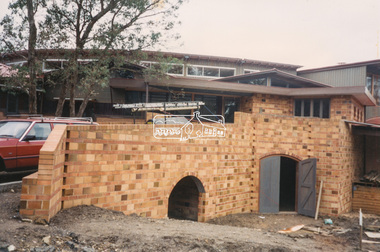
Photograph - Colour Print, Nathan Islip, Eltham Library under construction, c.1994
... Capital Works Program became available from October 1992 for community projects endorsed by local Councils. The Eltham Council submitted a proposal, based on library findings and requirements accumulated by the Library Occasional Committee, to the Federal Grants Committee to build a new Eltham Library. The Federal Grants Committee supported the funding request allowing commencement of the library project three years earlier than planned. With finance finalised, the Council set up its Eltham Library Re-development...Capital Works Program became available from October 1992 for community projects endorsed by local Councils. The Eltham Council submitted a proposal, based on library findings and requirements accumulated by the Library Occasional Committee, to the Federal Grants Committee to build a new Eltham Library. The Federal Grants Committee supported the funding request allowing commencement of the library project three years earlier than planned. With finance finalised, the Council set up its Eltham Library Re-development ...Photo taken by Nathan Islip who at the time was studying Architecture at the University of Melbourne. During his experience year he worked as a builder's labourer on the new Eltham Library construction project. Eltham Library Service 1930s - 1994 Originally collated by Harry Gilham, President, Eltham District Historical Society Inc (1993-2009) (edited 2022) In the Eltham township area, in the early 1930s, library books for adults were available from E J Andrew's newsagency in Main Road. In the newsagency cum haberdashery, some shelves were set aside for a lending library of adults' books. In 1935, Mr & Mrs JC Rains purchased the newsagency and continued the lending service until the late 1940s. At this time the business was extended from haberdashery to sell ladies' and men's clothing. The library section was discontinued. In the 1930s a mobile book library was also run by a Mr Foster of Bible Street, Eltham. In the 1950s adult books were available from racks in the foyer of the Eltham Shire Offices which was then located beside the Eltham Hall on the comer of Arthur Street and Main Road. In the early 1950s a referendum of ratepayers was called to seek public opinion on the issue of raising money for a public library for which the rates would have to be increased - the motion was defeated. On 11 November 1965 Eltham Shire Council, in conjunction with the City of Heidelberg and the Shire of Diamond Valley, met to form the Heidelberg Regional Library Service. Eltham was represented by Councillors Charis Pelling and John Lewis. The first library service for the Shire of Eltham from this group came in the shape of a bookmobile van which had, amongst others, a central stopover near the Shillinglaw trees outside the newly opened Shire offices at 895 Main Road, the original site of Shillinglaw Cottage and the former Shillinglaw farm. Present-day Wingrove Park was another stopover and the many recorded requests for this service can be read as denoting the areas of population or gathering points at that period throughout the Shire. 1968 saw the Shire convert the ‘Brinkkotter’ house in Dudley Street to house both adult and children's books. This library was originally staffed from the City of Heidelberg Library and records of committee meetings range from borrowing Heidelberg's old library shelving to trying to increase the Government's subsidy to a dollar for dollar basis. Book loans in the period 1966-67 totalled 30,400 and the following year ran to 52,113. With 2 books plus 1 paperback the limit per person, it was overcrowded and unable to house the range of other services which had become common library stock. Planning to extend the Shire Offices by the addition of the south wing was an opportunity to re-house the Shire's Library. The opening of the library in the extension was carried out on 17th August 1971 by the Hon R J Hamer ED, MP, Chief Secretary of Victoria. Cr Geoffrey Dreverman officiated as the Shire President. The Heidelberg Regional Library Service continued until September 1985 when it disbanded. On 21 November 1985 the Yarra Plenty Regional Library Service was established. At that time Eltham was represented by Councillors Mary Grant and Robert Manuell. By 1987, over-crowding of the Eltham Library and an inability to house the range of other services yet again rose to prominence. At a Council meeting held on 1 June 1987, the Councillors supported a resolution which threatened to close the library on 30 September 1987. Council's frustration arose from yet another re-run of the annual State Government versus Council Library funding and records show first arose in Eltham Council in 1967 with the Government of 1he day. After prolonged public anger and petitions the motion to close the library was rescinded in August 1987. Council, considering the community's concern, set up a ‘Library Review Working Party’ which a year later became the Library Occasional Committee with direct access to Council. This Committee investigated the workings of the 386 square metre library and found inadequate space for storage and display, lack of equipment, out-of-date furniture together with an increasing patronage which resulted in queues of borrowers becoming longer no matter when the library was open. Community consultation took the form of 1,000 questionnaires sent to users and non-users along with noticeboard reminders of what was planned. Council developed a strategy to set aside capital funds from 1988 on an annual basis so that preliminary planning and consultative expenses could be met, and construction could be completed early 1997. The Committee visited metropolitan libraries which were catering for a similar population as was projected for Eltham. Australia-wide Federal Government funding grants under the Local Capital Works Program became available from October 1992 for community projects endorsed by local Councils. The Eltham Council submitted a proposal, based on library findings and requirements accumulated by the Library Occasional Committee, to the Federal Grants Committee to build a new Eltham Library. The Federal Grants Committee supported the funding request allowing commencement of the library project three years earlier than planned. With finance finalised, the Council set up its Eltham Library Re-development Special Committee which was given the task of overseeing what could be the last major expansion of the Shire's Library Service as Eltham's population nears its projected maximum. The new library was designed by Gregory Burgess and Peter Ryan of Gregory Burgess Pty Ltd. Construction of the library commenced in 1993 and was officially opened May 22nd, 1994. The library building was designed to reflect its parkland setting. External features include: the roof which includes interesting aspects when viewed from Main Road; verandahs which provide ramp access and give a sheltered entrance to the building; walls which feature locally made mudbricks, conventional bricks and copper panels; and space for an outdoor courtyard/reading area which will be developed later. Internally there are several features. The building includes a foyer with a fireplace suitable for displays including artwork, a community multi-purpose room suitable for meetings or functions and an outdoor cafeteria. The ceilings are lined with Victorian Ash. The shapes for the ceiling give a free-flowing form to the building. Brush Box has been used for the circulation and information desks. The tree trunk columns are Grey lronbark from New South Wales. Arches and various-shaped windows add interest to the internal structure. The carpet design reflects the Eltham environment and compliments the natural colours and timbers used in the building. Tiles by artist Felix Bosari feature in the building and additional art by local artists added externally and internally to the building. Since 1994 the library has undergone a major extension to cater for children’s services and others. See also EDHS_02111 construction, eltham library -
 Eltham District Historical Society Inc
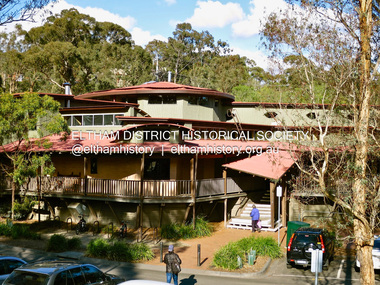
Photograph - Digital Photograph, Jim Connor, Eltham Library, 11 August 2015
... Capital Works Program became available from October 1992 for community projects endorsed by local Councils. The Eltham Council submitted a proposal, based on library findings and requirements accumulated by the Library Occasional Committee, to the Federal Grants Committee to build a new Eltham Library. The Federal Grants Committee supported the funding request allowing commencement of the library project three years earlier than planned. With finance finalised, the Council set up its Eltham Library Re-development...Capital Works Program became available from October 1992 for community projects endorsed by local Councils. The Eltham Council submitted a proposal, based on library findings and requirements accumulated by the Library Occasional Committee, to the Federal Grants Committee to build a new Eltham Library. The Federal Grants Committee supported the funding request allowing commencement of the library project three years earlier than planned. With finance finalised, the Council set up its Eltham Library Re-development ...Designed by multi-award-winning architect, Gregory Burgess, for which he won the 1995 Royal Australian Institute of architects (Vic.) Merit Award in the New Institutional category. Eltham Library Service 1930s - 1994 Originally collated by Harry Gilham, President, Eltham District Historical Society Inc (1993-2009) (edited 2022) In the Eltham township area, in the early 1930s, library books for adults were available from E J Andrew's newsagency in Main Road. In the newsagency cum haberdashery, some shelves were set aside for a lending library of adults' books. In 1935, Mr & Mrs JC Rains purchased the newsagency and continued the lending service until the late 1940s. At this time the business was extended from haberdashery to sell ladies' and men's clothing. The library section was discontinued. In the 1930s a mobile book library was also run by a Mr Foster of Bible Street, Eltham. In the 1950s adult books were available from racks in the foyer of the Eltham Shire Offices which was then located beside the Eltham Hall on the comer of Arthur Street and Main Road. In the early 1950s a referendum of ratepayers was called to seek public opinion on the issue of raising money for a public library for which the rates would have to be increased - the motion was defeated. On 11 November 1965 Eltham Shire Council, in conjunction with the City of Heidelberg and the Shire of Diamond Valley, met to form the Heidelberg Regional Library Service. Eltham was represented by Councillors Charis Pelling and John Lewis. The first library service for the Shire of Eltham from this group came in the shape of a bookmobile van which had, amongst others, a central stopover near the Shillinglaw trees outside the newly opened Shire offices at 895 Main Road, the original site of Shillinglaw Cottage and the former Shillinglaw farm. Present-day Wingrove Park was another stopover and the many recorded requests for this service can be read as denoting the areas of population or gathering points at that period throughout the Shire. 1968 saw the Shire convert the ‘Brinkkotter’ house in Dudley Street to house both adult and children's books. This library was originally staffed from the City of Heidelberg Library and records of committee meetings range from borrowing Heidelberg's old library shelving to trying to increase the Government's subsidy to a dollar for dollar basis. Book loans in the period 1966-67 totalled 30,400 and the following year ran to 52,113. With 2 books plus 1 paperback the limit per person, it was overcrowded and unable to house the range of other services which had become common library stock. Planning to extend the Shire Offices by the addition of the south wing was an opportunity to re-house the Shire's Library. The opening of the library in the extension was carried out on 17th August 1971 by the Hon R J Hamer ED, MP, Chief Secretary of Victoria. Cr Geoffrey Dreverman officiated as the Shire President. The Heidelberg Regional Library Service continued until September 1985 when it disbanded. On 21 November 1985 the Yarra Plenty Regional Library Service was established. At that time Eltham was represented by Councillors Mary Grant and Robert Manuell. By 1987, over-crowding of the Eltham Library and an inability to house the range of other services yet again rose to prominence. At a Council meeting held on 1 June 1987, the Councillors supported a resolution which threatened to close the library on 30 September 1987. Council's frustration arose from yet another re-run of the annual State Government versus Council Library funding and records show first arose in Eltham Council in 1967 with the Government of 1he day. After prolonged public anger and petitions the motion to close the library was rescinded in August 1987. Council, considering the community's concern, set up a ‘Library Review Working Party’ which a year later became the Library Occasional Committee with direct access to Council. This Committee investigated the workings of the 386 square metre library and found inadequate space for storage and display, lack of equipment, out-of-date furniture together with an increasing patronage which resulted in queues of borrowers becoming longer no matter when the library was open. Community consultation took the form of 1,000 questionnaires sent to users and non-users along with noticeboard reminders of what was planned. Council developed a strategy to set aside capital funds from 1988 on an annual basis so that preliminary planning and consultative expenses could be met, and construction could be completed early 1997. The Committee visited metropolitan libraries which were catering for a similar population as was projected for Eltham. Australia-wide Federal Government funding grants under the Local Capital Works Program became available from October 1992 for community projects endorsed by local Councils. The Eltham Council submitted a proposal, based on library findings and requirements accumulated by the Library Occasional Committee, to the Federal Grants Committee to build a new Eltham Library. The Federal Grants Committee supported the funding request allowing commencement of the library project three years earlier than planned. With finance finalised, the Council set up its Eltham Library Re-development Special Committee which was given the task of overseeing what could be the last major expansion of the Shire's Library Service as Eltham's population nears its projected maximum. The new library was designed by Gregory Burgess and Peter Ryan of Gregory Burgess Pty Ltd. Construction of the library commenced in 1993 and was officially opened May 22nd, 1994. The library building was designed to reflect its parkland setting. External features include: the roof which includes interesting aspects when viewed from Main Road; verandahs which provide ramp access and give a sheltered entrance to the building; walls which feature locally made mudbricks, conventional bricks and copper panels; and space for an outdoor courtyard/reading area which will be developed later. Internally there are several features. The building includes a foyer with a fireplace suitable for displays including artwork, a community multi-purpose room suitable for meetings or functions and an outdoor cafeteria. The ceilings are lined with Victorian Ash. The shapes for the ceiling give a free-flowing form to the building. Brush Box has been used for the circulation and information desks. The tree trunk columns are Grey lronbark from New South Wales. Arches and various-shaped windows add interest to the internal structure. The carpet design reflects the Eltham environment and compliments the natural colours and timbers used in the building. Tiles by artist Felix Bosari feature in the building and additional art by local artists added externally and internally to the building. Since 1994 the library has undergone a major extension to cater for children’s services and others. See also EDHS_02111jim connor collection, eltham, eltham library, panther place -
 Eltham District Historical Society Inc
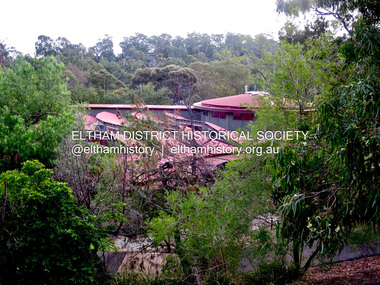
Photograph - Digital Photograph, Jim Connor, Eltham Library, 7 May 2016
... Capital Works Program became available from October 1992 for community projects endorsed by local Councils. The Eltham Council submitted a proposal, based on library findings and requirements accumulated by the Library Occasional Committee, to the Federal Grants Committee to build a new Eltham Library. The Federal Grants Committee supported the funding request allowing commencement of the library project three years earlier than planned. With finance finalised, the Council set up its Eltham Library Re-development...Capital Works Program became available from October 1992 for community projects endorsed by local Councils. The Eltham Council submitted a proposal, based on library findings and requirements accumulated by the Library Occasional Committee, to the Federal Grants Committee to build a new Eltham Library. The Federal Grants Committee supported the funding request allowing commencement of the library project three years earlier than planned. With finance finalised, the Council set up its Eltham Library Re-development ...Designed by multi-award winning architect, Gregory Burgess, for which he won the 1995 Royal Australian Insitute of architects (Vic.) Merit Award in the New Institutional category. Eltham Library Service 1930s - 1994 Originally collated by Harry Gilham, President, Eltham District Historical Society Inc (1993-2009) (edited 2022) In the Eltham township area, in the early 1930s, library books for adults were available from E J Andrew's newsagency in Main Road. In the newsagency cum haberdashery, some shelves were set aside for a lending library of adults' books. In 1935, Mr & Mrs JC Rains purchased the newsagency and continued the lending service until the late 1940s. At this time the business was extended from haberdashery to sell ladies' and men's clothing. The library section was discontinued. In the 1930s a mobile book library was also run by a Mr Foster of Bible Street, Eltham. In the 1950s adult books were available from racks in the foyer of the Eltham Shire Offices which was then located beside the Eltham Hall on the comer of Arthur Street and Main Road. In the early 1950s a referendum of ratepayers was called to seek public opinion on the issue of raising money for a public library for which the rates would have to be increased - the motion was defeated. On 11 November 1965 Eltham Shire Council, in conjunction with the City of Heidelberg and the Shire of Diamond Valley, met to form the Heidelberg Regional Library Service. Eltham was represented by Councillors Charis Pelling and John Lewis. The first library service for the Shire of Eltham from this group came in the shape of a bookmobile van which had, amongst others, a central stopover near the Shillinglaw trees outside the newly opened Shire offices at 895 Main Road, the original site of Shillinglaw Cottage and the former Shillinglaw farm. Present-day Wingrove Park was another stopover and the many recorded requests for this service can be read as denoting the areas of population or gathering points at that period throughout the Shire. 1968 saw the Shire convert the ‘Brinkkotter’ house in Dudley Street to house both adult and children's books. This library was originally staffed from the City of Heidelberg Library and records of committee meetings range from borrowing Heidelberg's old library shelving to trying to increase the Government's subsidy to a dollar for dollar basis. Book loans in the period 1966-67 totalled 30,400 and the following year ran to 52,113. With 2 books plus 1 paperback the limit per person, it was overcrowded and unable to house the range of other services which had become common library stock. Planning to extend the Shire Offices by the addition of the south wing was an opportunity to re-house the Shire's Library. The opening of the library in the extension was carried out on 17th August 1971 by the Hon R J Hamer ED, MP, Chief Secretary of Victoria. Cr Geoffrey Dreverman officiated as the Shire President. The Heidelberg Regional Library Service continued until September 1985 when it disbanded. On 21 November 1985 the Yarra Plenty Regional Library Service was established. At that time Eltham was represented by Councillors Mary Grant and Robert Manuell. By 1987, over-crowding of the Eltham Library and an inability to house the range of other services yet again rose to prominence. At a Council meeting held on 1 June 1987, the Councillors supported a resolution which threatened to close the library on 30 September 1987. Council's frustration arose from yet another re-run of the annual State Government versus Council Library funding and records show first arose in Eltham Council in 1967 with the Government of 1he day. After prolonged public anger and petitions the motion to close the library was rescinded in August 1987. Council, considering the community's concern, set up a ‘Library Review Working Party’ which a year later became the Library Occasional Committee with direct access to Council. This Committee investigated the workings of the 386 square metre library and found inadequate space for storage and display, lack of equipment, out-of-date furniture together with an increasing patronage which resulted in queues of borrowers becoming longer no matter when the library was open. Community consultation took the form of 1,000 questionnaires sent to users and non-users along with noticeboard reminders of what was planned. Council developed a strategy to set aside capital funds from 1988 on an annual basis so that preliminary planning and consultative expenses could be met, and construction could be completed early 1997. The Committee visited metropolitan libraries which were catering for a similar population as was projected for Eltham. Australia-wide Federal Government funding grants under the Local Capital Works Program became available from October 1992 for community projects endorsed by local Councils. The Eltham Council submitted a proposal, based on library findings and requirements accumulated by the Library Occasional Committee, to the Federal Grants Committee to build a new Eltham Library. The Federal Grants Committee supported the funding request allowing commencement of the library project three years earlier than planned. With finance finalised, the Council set up its Eltham Library Re-development Special Committee which was given the task of overseeing what could be the last major expansion of the Shire's Library Service as Eltham's population nears its projected maximum. The new library was designed by Gregory Burgess and Peter Ryan of Gregory Burgess Pty Ltd. Construction of the library commenced in 1993 and was officially opened May 22nd, 1994. The library building was designed to reflect its parkland setting. External features include: the roof which includes interesting aspects when viewed from Main Road; verandahs which provide ramp access and give a sheltered entrance to the building; walls which feature locally made mudbricks, conventional bricks and copper panels; and space for an outdoor courtyard/reading area which will be developed later. Internally there are several features. The building includes a foyer with a fireplace suitable for displays including artwork, a community multi-purpose room suitable for meetings or functions and an outdoor cafeteria. The ceilings are lined with Victorian Ash. The shapes for the ceiling give a free-flowing form to the building. Brush Box has been used for the circulation and information desks. The tree trunk columns are Grey lronbark from New South Wales. Arches and various-shaped windows add interest to the internal structure. The carpet design reflects the Eltham environment and compliments the natural colours and timbers used in the building. Tiles by artist Felix Bosari feature in the building and additional art by local artists added externally and internally to the building. Since 1994 the library has undergone a major extension to cater for children’s services and others. See also EDHS_02111jim connor collection, eltham, eltham library, panther place -
 Eltham District Historical Society Inc
Photograph - Digital Photograph, Jim Connor, Eltham Library, 25 December 2017
... Capital Works Program became available from October 1992 for community projects endorsed by local Councils. The Eltham Council submitted a proposal, based on library findings and requirements accumulated by the Library Occasional Committee, to the Federal Grants Committee to build a new Eltham Library. The Federal Grants Committee supported the funding request allowing commencement of the library project three years earlier than planned. With finance finalised, the Council set up its Eltham Library Re-development...Capital Works Program became available from October 1992 for community projects endorsed by local Councils. The Eltham Council submitted a proposal, based on library findings and requirements accumulated by the Library Occasional Committee, to the Federal Grants Committee to build a new Eltham Library. The Federal Grants Committee supported the funding request allowing commencement of the library project three years earlier than planned. With finance finalised, the Council set up its Eltham Library Re-development ...Designed by multi-award winning architect, Gregory Burgess, for which he won the 1995 Royal Australian Insitute of architects (Vic.) Merit Award in the New Institutional category. Eltham Library Service 1930s - 1994 Originally collated by Harry Gilham, President, Eltham District Historical Society Inc (1993-2009) (edited 2022) In the Eltham township area, in the early 1930s, library books for adults were available from E J Andrew's newsagency in Main Road. In the newsagency cum haberdashery, some shelves were set aside for a lending library of adults' books. In 1935, Mr & Mrs JC Rains purchased the newsagency and continued the lending service until the late 1940s. At this time the business was extended from haberdashery to sell ladies' and men's clothing. The library section was discontinued. In the 1930s a mobile book library was also run by a Mr Foster of Bible Street, Eltham. In the 1950s adult books were available from racks in the foyer of the Eltham Shire Offices which was then located beside the Eltham Hall on the comer of Arthur Street and Main Road. In the early 1950s a referendum of ratepayers was called to seek public opinion on the issue of raising money for a public library for which the rates would have to be increased - the motion was defeated. On 11 November 1965 Eltham Shire Council, in conjunction with the City of Heidelberg and the Shire of Diamond Valley, met to form the Heidelberg Regional Library Service. Eltham was represented by Councillors Charis Pelling and John Lewis. The first library service for the Shire of Eltham from this group came in the shape of a bookmobile van which had, amongst others, a central stopover near the Shillinglaw trees outside the newly opened Shire offices at 895 Main Road, the original site of Shillinglaw Cottage and the former Shillinglaw farm. Present-day Wingrove Park was another stopover and the many recorded requests for this service can be read as denoting the areas of population or gathering points at that period throughout the Shire. 1968 saw the Shire convert the ‘Brinkkotter’ house in Dudley Street to house both adult and children's books. This library was originally staffed from the City of Heidelberg Library and records of committee meetings range from borrowing Heidelberg's old library shelving to trying to increase the Government's subsidy to a dollar for dollar basis. Book loans in the period 1966-67 totalled 30,400 and the following year ran to 52,113. With 2 books plus 1 paperback the limit per person, it was overcrowded and unable to house the range of other services which had become common library stock. Planning to extend the Shire Offices by the addition of the south wing was an opportunity to re-house the Shire's Library. The opening of the library in the extension was carried out on 17th August 1971 by the Hon R J Hamer ED, MP, Chief Secretary of Victoria. Cr Geoffrey Dreverman officiated as the Shire President. The Heidelberg Regional Library Service continued until September 1985 when it disbanded. On 21 November 1985 the Yarra Plenty Regional Library Service was established. At that time Eltham was represented by Councillors Mary Grant and Robert Manuell. By 1987, over-crowding of the Eltham Library and an inability to house the range of other services yet again rose to prominence. At a Council meeting held on 1 June 1987, the Councillors supported a resolution which threatened to close the library on 30 September 1987. Council's frustration arose from yet another re-run of the annual State Government versus Council Library funding and records show first arose in Eltham Council in 1967 with the Government of 1he day. After prolonged public anger and petitions the motion to close the library was rescinded in August 1987. Council, considering the community's concern, set up a ‘Library Review Working Party’ which a year later became the Library Occasional Committee with direct access to Council. This Committee investigated the workings of the 386 square metre library and found inadequate space for storage and display, lack of equipment, out-of-date furniture together with an increasing patronage which resulted in queues of borrowers becoming longer no matter when the library was open. Community consultation took the form of 1,000 questionnaires sent to users and non-users along with noticeboard reminders of what was planned. Council developed a strategy to set aside capital funds from 1988 on an annual basis so that preliminary planning and consultative expenses could be met, and construction could be completed early 1997. The Committee visited metropolitan libraries which were catering for a similar population as was projected for Eltham. Australia-wide Federal Government funding grants under the Local Capital Works Program became available from October 1992 for community projects endorsed by local Councils. The Eltham Council submitted a proposal, based on library findings and requirements accumulated by the Library Occasional Committee, to the Federal Grants Committee to build a new Eltham Library. The Federal Grants Committee supported the funding request allowing commencement of the library project three years earlier than planned. With finance finalised, the Council set up its Eltham Library Re-development Special Committee which was given the task of overseeing what could be the last major expansion of the Shire's Library Service as Eltham's population nears its projected maximum. The new library was designed by Gregory Burgess and Peter Ryan of Gregory Burgess Pty Ltd. Construction of the library commenced in 1993 and was officially opened May 22nd, 1994. The library building was designed to reflect its parkland setting. External features include: the roof which includes interesting aspects when viewed from Main Road; verandahs which provide ramp access and give a sheltered entrance to the building; walls which feature locally made mudbricks, conventional bricks and copper panels; and space for an outdoor courtyard/reading area which will be developed later. Internally there are several features. The building includes a foyer with a fireplace suitable for displays including artwork, a community multi-purpose room suitable for meetings or functions and an outdoor cafeteria. The ceilings are lined with Victorian Ash. The shapes for the ceiling give a free-flowing form to the building. Brush Box has been used for the circulation and information desks. The tree trunk columns are Grey lronbark from New South Wales. Arches and various-shaped windows add interest to the internal structure. The carpet design reflects the Eltham environment and compliments the natural colours and timbers used in the building. Tiles by artist Felix Bosari feature in the building and additional art by local artists added externally and internally to the building. Since 1994 the library has undergone a major extension to cater for children’s services and others. See also EDHS_02111jim connor collection, eltham, eltham library, panther place -
 Bendigo Historical Society Inc.
Newspaper - Kangaroo Flat Gold Mine Collection: Reef Mining, Tarnagulla
... Capital raising supporters are described: Strategic Pooled Development Ltd., Greenchip; Resources and clients of Eyres Reed Ltd. are contributing to the fund raising. ...Capital raising supporters are described: Strategic Pooled Development Ltd., Greenchip; Resources and clients of Eyres Reed Ltd. are contributing to the fund raising. ...'Bendigo Advertiser' article 14th December, 1995. Article describes how Reef Mining NL is raising 2 million dollars for its exploration work in the Tarnagulla area. Capital raising supporters are described: Strategic Pooled Development Ltd., Greenchip; Resources and clients of Eyres Reed Ltd. are contributing to the fund raising. In pencil on side of article: 'Bendigo Advertiser, 14/12/93.gold mining, exploration, reef mining nl, sandner, tarnagulla -
 Bendigo Historical Society Inc.
Document - Kangaroo Flat Gold Mine Collection: Psychology of Mine Development on Bendigo Goldfield, 19th century, Bendigo Mining NL, Unknown
... development of the synclinal reefs...2. Mining methods...3. Deep mining...4. The age of the owners and managers...5. Capital...development of the synclinal reefs 2. Mining methods 3. Deep mining 4. The age of the owners and managers 5. Capital...development of the synclinal reefs 2. Mining methods 3. Deep mining 4. The age of the owners and managers 5. Capital ...Eleven page paper titled 'The Psychology of Mine Development on the Bendigo goldfield in the nineteenth century'. Initial discussion refers to Mr. Doug Buerger of Bendigo Mining N.L commenting that the central Bendigo goldfield had a 'further ten million ounces of gold' remaining 'to be extracted from beneath the old workings'. Further paragraphs include: 1. Non-development of the synclinal reefs 2. Mining methods 3. Deep mining 4. The age of the owners and managers 5. Capital raising 6. Attitude to innovation - reference to George Lansell and Gustave Thureau 7. Management structures 8. Attitudes to machinery 9. The size of claims and leases 10. Conclusionsbendigo mining n.l., bendigo, mining, gold, kangaroo flat, 1. non-development of the synclinal reefs, 2. mining methods, 3. deep mining, 4. the age of the owners and managers, 5. capital raising, 7. management structures, 8. attitudes to machinery, 9. the size of claims and leases, 10 conclusions, doug buerger, gustave thureau, quartz mining, synclinal reefs, new chum railway, victoria quartz, great extended hustlers, deborah mines, innovation
