
Showing 15 items matching "diffusers"
-
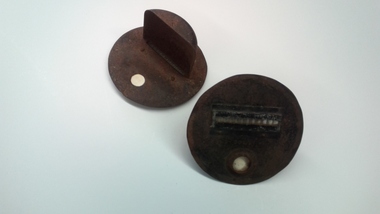 Nhill Aviation Heritage Centre
Vehicle headlight blackout covers 2 of, c1940
... round metal covers with shield and slot for light beam with glass diffuser....used to cover headlights to reduce light beam and avoid detection round metal covers with shield and slot for light beam with glass diffuser. Vehicle headlight blackout covers 2 of ...used to cover headlights to reduce light beam and avoid detectionround metal covers with shield and slot for light beam with glass diffuser. -
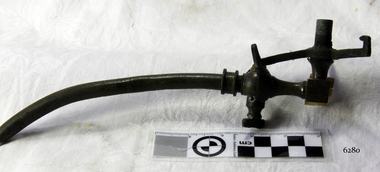 Flagstaff Hill Maritime Museum and Village
Gas Light Fitting
... Gas Light Fitting, brass has small gate-valve in line and a three armed diffuser holder. Recovered from the wreck of the Schomberg. ...It is historically significant for representing aspects of Victoria’s shipping history and for its association with the shipwreck and the ship, which was designed to be fastest and most luxurious of its day Warrnambool Shipwrecked-coast Flagstaff-Hill Flagstaff-Hill-Maritime-Museum Maritime-Museum Shipwreck-coast Flagstaff-Hill-Maritime-Village Schomberg Shipwrecked-artefact Clipper ship Black Ball line 1855 shipwreck Aberdeen clipper ship Captain Forbes Peterborough shipwreck SS Queen gas light fitting brass gas light fitting Gas Light Fitting, brass has small gate-valve in line and a three armed diffuser holder. Recovered from the wreck of the Schomberg. ...When the ship Schomberg was launched in 1855, she was considered the most perfect clipper ship ever to be built. James Blaine’s Black Ball Line had commissioned her to be built for their fleet of passenger liners. At a cost of £43,103, the Aberdeen builders designed her to sail faster than the quick clippers designed by North American Donald McKay. She was a three masted wooden clipper ship, built with diagonal planking of British oat with layers of Scottish larch. This luxury vessel was designed to transport emigrants to Melbourne in superior comfort. She had ventilation ducts to provide air to the lower decks and a dining saloon, smoking room, library and bathrooms for the first class passengers. At the launch of Schomberg’s maiden voyage, her master Captain ‘Bully’ Forbes, drunkenly predicted that he would make the journey between Liverpool and Melbourne in 60 days. Schomberg departed Liverpool on 6 October 1855 with 430 passengers and 3000 tons cargo including iron rails and equipment intended the build the Geelong Railway and a bridge over the Yarra from Melbourne to Hawthorn. The winds were poor as Schomberg sailed across the equator, slowing her journey considerably. She was 78 days out of Liverpool when she ran aground on a sand-spit near Peterborough, Victoria, on 27 December; the sand spit and the currents were not marked on Forbes’s map. Overnight, the crew launched a lifeboat to find a safe place to land the ship’s passengers. The scouting party returned to Schomberg and advised Forbes that it was best to wait until morning because the rough seas could easily overturn the small lifeboats. The ship’s Chief Officer spotted SS Queen at dawn and signalled the steamer. The master of the SS Queen approached the stranded vessel and all of Schomberg’s passengers were able to disembark safely. The Black Ball Line’s Melbourne agent sent a steamer to retrieve the passengers’ baggage from the Schomberg. Other steamers helped unload her cargo until the weather changed and prevented the salvage teams from accessing the ship. Local merchants Manifold & Bostock bought the wreck and cargo, but did not attempt to salvage the cargo still on board the ship. They eventually sold it on to a Melbourne businessman and two seafarers. After two of the men drowned when they tried to reach Schomberg, salvage efforts were abandoned.32 In 1975, divers from Flagstaff Hill, including Peter Ronald, found an ornate communion set at the wreck. The set comprised a jug, two chalices, a plate and a lid. The lid did not fit any of the other objects and in 1978 a piece of the lid broke off, revealing a glint of gold. As museum staff carefully examined the lid and removed marine growth, they found a diamond ring, which is currently on display in the Great Circle Gallery.33 Flagstaff Hill also holds ship fittings and equipment, personal effects, a lithograph, tickets and photograph from the Schomberg. Most of the artefacts were salvaged from the wreck by Peter Ronald, former director of Flagstaff Hill. The Schomberg, which is on the Victorian Heritage Register (VHR S612), has great historical significance as a rare example of a large, fast clipper ship on the England to Australia run, carrying emigrants at the time of the Victorian gold rush. She represents the technical advances made to break sailing records between Europe and Australia. Flagstaff Hill’s collection of artefacts from the Schomberg is significant for its association with the shipwreck. The collection is primarily significant because of the relationship between the objects, as together they have a high potential to interpret the story of the Schomberg. It is archaeologically significant as the remains of an international passenger Ship. It is historically significant for representing aspects of Victoria’s shipping history and for its association with the shipwreck and the ship, which was designed to be fastest and most luxurious of its day Gas Light Fitting, brass has small gate-valve in line and a three armed diffuser holder. Recovered from the wreck of the Schomberg. Artefact Reg No S/77warrnambool, shipwrecked-coast, flagstaff-hill, flagstaff-hill-maritime-museum, maritime-museum, shipwreck-coast, flagstaff-hill-maritime-village, schomberg, shipwrecked-artefact, clipper ship, black ball line, 1855 shipwreck, aberdeen clipper ship, captain forbes, peterborough shipwreck, ss queen, gas light fitting, brass gas light fitting -
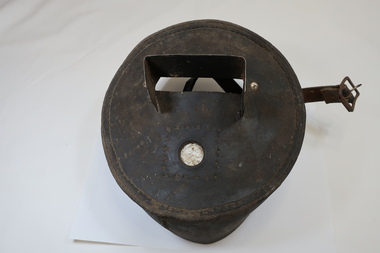 Kiewa Valley Historical Society
Vehicle Blackout Light Cover
... Below this is a 25 mm white semi-translucent light diffuser. Includes leather attachment and leather straps at rear....Below this is a 25 mm white semi-translucent light diffuser. Includes leather attachment and leather straps at rear. ...Blackout light (headlamp) covers were compulsory for civilian night driving during WW II. This example appears to closely follow the pattern suggested by the Department of Home Security for civilian motor vehicles, and appears to be for older, pre-war type vehicles, where the headlights were not integral to the front of the vehicle (Ref. Australian War Memorial) A.G. Cookson was the maker.Bogong village SECV employees manned an Observation Hut during WW 2. The SECV vehicles and their employees would have used vehicle blackout light covers on their cars when driving at night.Stitched brown leather disc cover with metal light shield over a central slit. Below this is a 25 mm white semi-translucent light diffuser. Includes leather attachment and leather straps at rear.A.G. Cookson embossed above the shield above the slit.ww 2, vehicle blackout light cover, bogong observation hut -
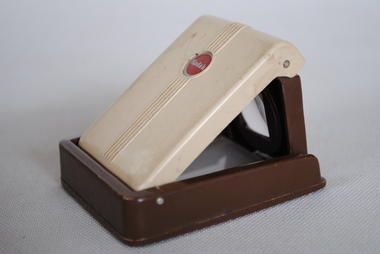 Anglesea and District Historical Society
Koda Slide Pocket Viewer, Kodak, Estimated 1950's
... The slide is placed on top of the diffusor and viewed through the lens. The slide viewer folds flat when not in use and is made of two-tone plastic (brown/cream)....The slide is placed on top of the diffusor and viewed through the lens. The slide viewer folds flat when not in use and is made of two-tone plastic (brown/cream). ...Kodak vintage slide viewer for 35mm slides. The slide is placed on top of the diffusor and viewed through the lens. The slide viewer folds flat when not in use and is made of two-tone plastic (brown/cream).Lid: Kodak Bottom: Kodaslide Pocket Viewer Made in England by Kodak Ltd, London Koda Slide is a trade mark.kodak, slide viewer -
 Moorabbin Air Museum
Book - AGARD reports, Special Course on Concepts for Drag Reduction
... ...Diffusers...AGARD reports Overview of concepts for aircraft drag reduction Methods for reducing subsonic drad due to lift Laminar flow control Slot injection for skin friction drag reduction Diffusers Drag reduction by compliant walls Effect of compliant wall motion on turbulent boundary layers Overview of research on drag reduction in aircraft, circa 1977 Special Course on Concepts for Drag Reduction Book AGARD reports ...Overview of research on drag reduction in aircraft, circa 1977non-fictionOverview of research on drag reduction in aircraft, circa 1977overview of concepts for aircraft drag reduction, methods for reducing subsonic drad due to lift, laminar flow control, slot injection for skin friction drag reduction, diffusers, drag reduction by compliant walls, effect of compliant wall motion on turbulent boundary layers -
 Kiewa Valley Historical Society
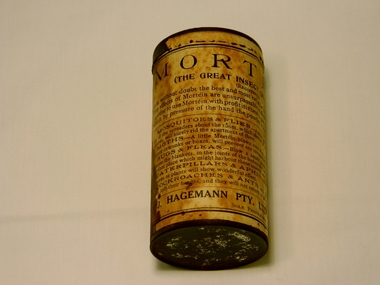
Can Mortein Powder, late 1870s to early 1920s
... The word "mortein" therefore is diffused and translated into "dead one". A thin line separates the above from the list of insects which the powdered contents will kill together with the suggested application targets. ...The word "mortein" therefore is diffused and translated into "dead one". A thin line separates the above from the list of insects which the powdered contents will kill together with the suggested application targets. ...The can(product) of powdered Mortein was used throughout Australia and especially in rural regions where environmental conditions of crops, cattle and other livestock resulted in greater amount of "invasions" from insects. The eradication of unwanted invaders into the homestead required either manual extermination or a relevant poison which in low doses would not affect humans. Fly squats were still a good measure of eradication of flying pests however those lurking in cupboards or "hard to get at" locations needed a method, such as the Mortein powder to do the deed. This product and especially this can was used at the fore front of pest eradication. Powders and pellets are still in use 100 years later and the core ingredient is still environmental friendly and meets health conscious modern Australians. The basic product has survived the passage of time and was invented by a German immigrant to Australia in the late 1800s.This can and what it represents to rural households and outhouses, is in some ways immeasurable to the peace, health and tranquility within the household of all the families within the Kiewa Valley. Although small in size the relief of those within the sanctity of the home from annoying pests is enormous. The relief not only physical but also mentally to those residents, from the sometimes grueling and painful rural existence in a "sunburnt" countryside cannot be truly expressed in words. Kiewa Valley residents are part of the sometimes harsh rural environment where the introduction of helpful products such as this powder are noticed and used more prolifically. Any product, especially invented within Australia, which allows for a easier existence is of a great significance.This small cylindrical can contains powder of crushed the chrysanthemum flowers(pyrethrum extract) and has two circles of small circular perforations in the lid (to allow contents to be sprinkled onto other surfaces). It is constructed of mild steel with both ends crimped onto the main cylinder. A paper information label has been adhered to the outside of the cylinder.Printed on the outside label is: 1st line "MORTEIN!" 2nd line "THE GREAT INSECT DESTROYER" underneath "(Registered)" and underneath "It is without doubt the best and most reliable Insect powder in the World" underneath this line "In order to use Mortein with profit it is best to get a Mortein spreader through", next line "which by pressure of the hand the powder is ejected and well diffused." An inflection mark appears over the e in "Mortein" as to signify that the word "mort" is french for (dead) and the "ein" is german for "one". The word "mortein" therefore is diffused and translated into "dead one". A thin line separates the above from the list of insects which the powdered contents will kill together with the suggested application targets. T the bottom of the instructions is printed the manufacturer "J. HAGEMANN PTY. LTD., MELBOURNE," Below is "Sole Proprietors"natural insecticide products, environmentally friendly products, household pest dispensers, australian inventions -
 Ararat Gallery TAMA
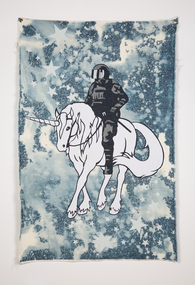
Tony Garifalakis, Mounted Stardust Unit, 2013
... The aim being to confuse, collapse or diffuse any power these symbols might contain. ...The aim being to confuse, collapse or diffuse any power these symbols might contain. ...ony Garifalakis' practice over the past two decades has constituted an examination of social relations and the semiotics of power. Garifalakis completed a Master of Fine Art at RMIT University, and has exhibited extensively in Australia and internationally. His works are represented in major public collections, including the National Gallery of Victoria and the Art Gallery of New South Wales. These three works are from Garifalakis’ series of denim works titled, Mutually Assured Destruction. The artist says of these works: “This series of works are denim collages that juxtapose political and corporate iconography with cute and benign clip art imagery. The aim being to confuse, collapse or diffuse any power these symbols might contain. The use of this particular iconography is undermined by the material it is made with. The denim becomes a tool that correlates global and political organizations with outlaw groups, gangs and criminality. I am interested in denim’s association to outlaw groups and gangs. Denim is currently a billion dollar global industry; I am aware that any cultural identification it has to a counterculture or outlaw status is obsolete and outdated. I am interested in exploring this idea – how a globally commonplace material once contained a completely different set of signifiers. The focus of these works is the material – denim. They are monochromatic works that aim to highlight the material that they are made with. In addition to the collage technique I have ‘drawn’ on some of these works by employing elements associated with biker and gang jackets such as – stitching, studs, chains, safety pins, etc.” -
 Ararat Gallery TAMA
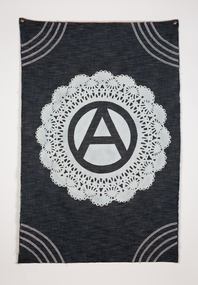
Tony Garifalakis, Anarchodandyism, 2013
... The aim being to confuse, collapse or diffuse any power these symbols might contain. ...The aim being to confuse, collapse or diffuse any power these symbols might contain. ...ony Garifalakis' practice over the past two decades has constituted an examination of social relations and the semiotics of power. Garifalakis completed a Master of Fine Art at RMIT University, and has exhibited extensively in Australia and internationally. His works are represented in major public collections, including the National Gallery of Victoria and the Art Gallery of New South Wales. These three works are from Garifalakis’ series of denim works titled, Mutually Assured Destruction. The artist says of these works: “This series of works are denim collages that juxtapose political and corporate iconography with cute and benign clip art imagery. The aim being to confuse, collapse or diffuse any power these symbols might contain. The use of this particular iconography is undermined by the material it is made with. The denim becomes a tool that correlates global and political organizations with outlaw groups, gangs and criminality. I am interested in denim’s association to outlaw groups and gangs. Denim is currently a billion dollar global industry; I am aware that any cultural identification it has to a counterculture or outlaw status is obsolete and outdated. I am interested in exploring this idea – how a globally commonplace material once contained a completely different set of signifiers. The focus of these works is the material – denim. They are monochromatic works that aim to highlight the material that they are made with. In addition to the collage technique I have ‘drawn’ on some of these works by employing elements associated with biker and gang jackets such as – stitching, studs, chains, safety pins, etc.” -
 Ararat Gallery TAMA
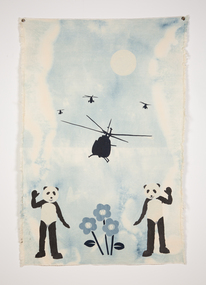
Tony Garifalakis, NWO Cameltoe, 2012
... The aim being to confuse, collapse or diffuse any power these symbols might contain. ...The aim being to confuse, collapse or diffuse any power these symbols might contain. ...ony Garifalakis' practice over the past two decades has constituted an examination of social relations and the semiotics of power. Garifalakis completed a Master of Fine Art at RMIT University, and has exhibited extensively in Australia and internationally. His works are represented in major public collections, including the National Gallery of Victoria and the Art Gallery of New South Wales. These three works are from Garifalakis’ series of denim works titled, Mutually Assured Destruction. The artist says of these works: “This series of works are denim collages that juxtapose political and corporate iconography with cute and benign clip art imagery. The aim being to confuse, collapse or diffuse any power these symbols might contain. The use of this particular iconography is undermined by the material it is made with. The denim becomes a tool that correlates global and political organizations with outlaw groups, gangs and criminality. I am interested in denim’s association to outlaw groups and gangs. Denim is currently a billion dollar global industry; I am aware that any cultural identification it has to a counterculture or outlaw status is obsolete and outdated. I am interested in exploring this idea – how a globally commonplace material once contained a completely different set of signifiers. The focus of these works is the material – denim. They are monochromatic works that aim to highlight the material that they are made with. In addition to the collage technique I have ‘drawn’ on some of these works by employing elements associated with biker and gang jackets such as – stitching, studs, chains, safety pins, etc.” -
 Federation University Historical Collection
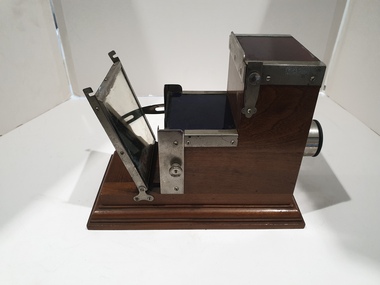
Equipment - Camera, The Junior Kromskop, c1899
... The viewer can be used in daylight, for some conditions a diffuser is used, this is hinged to the yellow reflector and laid across the steps. ...The viewer can be used in daylight, for some conditions a diffuser is used, this is hinged to the yellow reflector and laid across the steps. ...The Kromskop (pronounced Chromescope) is one of the earliest commercial applications of colour photography, and was invented by Frederic Eugene Ives and announced around 1896, it is described in his English patent of 1895 and in a US patent of 1894. It was shown at a Camera Club in Britain in January 1896 and at the February Royal Photographic Society meeting, and was available for sale from early 1897. The Photochromoscope Syndicate was formed in 1896 or 97 to promote the viewer in Britain, and wound up in 1899. It was manufactured in south London.A monocular instrument used to reproduce colours, in a mahogany box The viewer combines stereo images from three-colour separation transparencies called Kromograms, these are viewed through red, green and blue filters. A Kromogram comprises three monochrome transparencies printed from three-colour separation negatives which are taped together. The order being red image, blue image, green image with a label and caption between the red and blue images. The red image lies horizontally on the top step of the viewer above a red filter, the blue image lies on the lower step above a blue filter, the green image stands vertically at the back of the viewer. The red and blue images are reflected into the eyepieces by transparent mirrors, these are coloured to absorb the light that they reflect to prevent a double image from the rear surface of the mirror, the mirror for the red image is coloured cyan/blue, that used for the blue filter is coloured green (the patent indicates a yellow filter). The green image is illuminated by a yellow reflector. As the mirror below the blue image is green there is no need for a green filter immediately in front of the green image. The viewer can be used in daylight, for some conditions a diffuser is used, this is hinged to the yellow reflector and laid across the steps. An artificial light was also available. The mirrors and image positions can be adjusted in the event that they become misaligned. (http://www.earlyphotography.co.uk/site/entry_V80.html, accessed 08 April 2022) The Junior Kromskop was a mono viewer Kromskop. henry sutton, photochromoscope syndicate, f.e. ives, camera club, photography, colour photography, kromskop, frederic eugene ives, junior kromskop, photographic equipment, camera -
 Mission to Seafarers Victoria
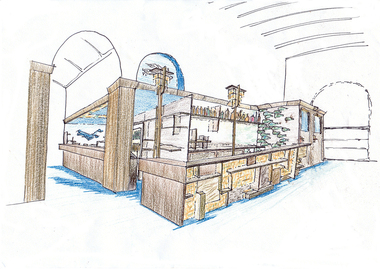
Drawing - Sketches, digital copy, Stuart Webber, 2005
... Glass bottles set in resin diffusing panels and timbers sourced from throw-outs were dressed and composed to suggest the multiple approaches to a calling of the sea. ...Glass bottles set in resin diffusing panels and timbers sourced from throw-outs were dressed and composed to suggest the multiple approaches to a calling of the sea. ..."26th March 2019 In contribution to the historical account of the Mission to Seafarers, Melbourne. To whom it may concern, In 2005, the Mission to Seafarers’ Padre Bevil Lunson assigned an upgrade to the existing bar and gift shop. The brief outlined alignment with health code and liquor licence regulations, rethink of stock display and aesthetic upgrade of white peg-board and fluorescent-lit display-case. Two students of architecture answered the call and provided pro bono design, building and installation services. Beyond the updated flooring, work surfaces and new hand-wash point their ethos of sustainable design presented a strategy of redressing the existing on a shoe-string; helping minimise trades and protect the heritage substrate. A new standing-bar was proposed to envelope the display case and re-orient the hall back toward the stage. Punters were directed to the seated-bar for purchases. The chosen palette aimed to anchor the bar below the hall’s half-timbered dado-line utilising the muted tones of recycled materials. Glass bottles set in resin diffusing panels and timbers sourced from throw-outs were dressed and composed to suggest the multiple approaches to a calling of the sea. This flotsam and jetsam was intended to provide a shifting background that is representative of the many walks of life that support and are supported by the mission. Two uninstalled elements further accented the design: -the flying angel logo was to appear hovering within the bar’s archway and also inverted by the dado-line in the bar’s rear mirror (refer attached sketch), -and the two lampshades, referencing the inverted form of nautical beacons, were to shepherd clientele to the bar (refer attached sketch). Where are they now? Derek Stevenson – Turner Townsend Thinc Stuart Webber – ARM Architecture The bar was dismantled during the renovation mid 2019 and replace by another bar.These documents provide insight into an early 21st C refurbishment to the interior of the MTSV and Mission club operations in the early 21st Century and provides names and details of both the consideration of the need to: protect heritage components, provide a functional service point, incorporate recycled materials that related to aspects of the sea and environment, the flotsam and jetsam that is found where the sea, and those from the sea meets the land. Also provides an example of early career designs by two practising 21st C Australian architects and designers. During the renovations in winter 2019, the decision was made to demolish to make space to another more convenient one brought from a cafe, along with new chairs and tables for the club.Digital copy files sent in March 2019 by architect Stuart Webber after a visit to the Mission. Along with two sketches he submitted, he sent a document telling how the bar came to life in 2005.bar, stuart webber, derek stevenson, mts club, mts interior, bevil lunson -
 City of Moorabbin Historical Society (Operating the Box Cottage Museum)
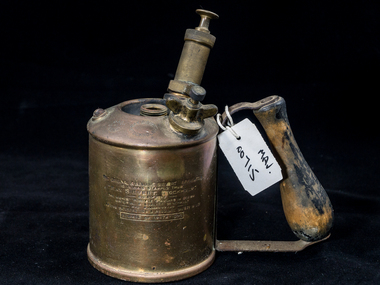
Tools, Blowtorch 'Sievert', 20thC
... The blowtorch is commonly used where a diffuse high temperature naked flame heat is required but not so hot as to cause combustion or welding: soldering, brazing, softening paint for removal, melting roof tar, or pre-heating large castings before welding such as for repairing. ...The blowtorch is commonly used where a diffuse high temperature naked flame heat is required but not so hot as to cause combustion or welding: soldering, brazing, softening paint for removal, melting roof tar, or pre-heating large castings before welding such as for repairing. ...A blowtorch or blowlamp is a fuel-burning tool used for applying flame and heat to various applications, usually metalworking. Early blowlamps used liquid fuel, carried in a refillable reservoir attached to the lamp. Modern blowtorches are mostly gas-fuelled. The blowlamp is of ancient origin and was used as a tool by gold and silversmiths. They began literally as a "blown lamp", a wick oil lamp with a mouth-blown tube alongside the flame. This type of lamp, with spirit fuel, continued to be in use for such small tasks into the late 20th century. In 1882, a new vaporizing technique was developed by Carl Richard Nyberg in Sweden, and the year after, the production of the Nyberg blow lamp started. It was quickly copied or licensed by many other manufacturers. Carl Richard Nyberg (May 28, 1858, – 1939) was the founder of Max Sievert’s Lödlampfabrik, then one of the largest industries in Sundbyberg, Sweden. After school he started working for a jeweller and later he moved to Stockholm and worked with various metalworks. 1882 and set up a workshop at Luntmakargatan in Stockholm making blowtorches. However the business didn't work well because it took too long to both manufacture and sell them. In 1886 he met Max Sievert (1849 - 1913) at a country fair and Sievert became interested in Nyberg's blowtorch and started selling it. In 1922 the company was sold to Max Sievert who continued to own it until 1964 when it was bought by Esso. The blowtorch is commonly used where a diffuse high temperature naked flame heat is required but not so hot as to cause combustion or welding: soldering, brazing, softening paint for removal, melting roof tar, or pre-heating large castings before welding such as for repairing. It is also common for use in weed control by controlled burn methods, melting snow and ice from pavements and driveways in cold climate areas, road repair crews may use a blowtorch to heat asphalt or bitumen for repairing cracks in preventive maintenance. It is also used in cooking; one common use is for the creation of the layer of hard caramelised sugar in a crème brûlée. A brass blowtorch, 'Sievert' with a wooden handleSIEVERTtools, blow torches, blow lamps, welding, brazing, jewellery, cookery, soldering, nyberg carl, sievert max, stockholm, sweden, spirit fuel, kerosene, gas fuel, moorabbin, bentleigh, cheltenham, market gardeners, pioneers, early settlers, plumbing, carpenters, -
 Melton City Libraries
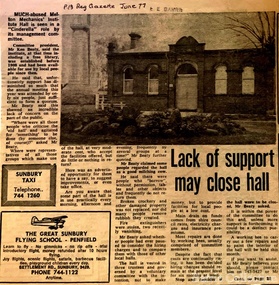
Newspaper, Lack of support may close hall, 1977
... While over 500 Mechanics’ Institutes or halls are extant, very few of these retain their original role as ‘diffusers of useful knowledge’. Most are still available for community purposes, as venues for meetings, socials, civic occasions etc, while others are employed as museums, shops and theatres. ...While over 500 Mechanics’ Institutes or halls are extant, very few of these retain their original role as ‘diffusers of useful knowledge’. Most are still available for community purposes, as venues for meetings, socials, civic occasions etc, while others are employed as museums, shops and theatres. ..."The Mechanics Institute movement flourished in Victoria from 1839 to 1950. It was based on the development of Mechanics’ Institutes in Scotland and England from the 1820s, which were intended to educate and enlighten the working classes. The term ‘mechanic’ in those days meant an artisan, craftsman or working man, especially those who had moved from rural areas to work in new city factories during the Industrial Revolution. The early Institutes were usually equipped with a reading room, a library and a lecture room. Although enjoying mixed success in Britain, they contributed to the development of public education and library services. The movement was adopted more enthusiastically in the colonies. It began slowly in Victoria but its expansion after the gold rushes population influx was rapid, especially in rural areas. Every suburb and town wanted to have a Mechanics’ Institute. During the 1850s approximately forty Institutes were established, with even greater growth in the period 1860 to 1900. By 1900 there were 400 Institutes in Victoria. The establishment of a Mechanics’ Institute was often a great achievement for a local community, requiring organising committees to raise substantial funds for a building site (where this had not been granted by the Government), and the building. Once built, the committee then had to purchase books, provide a caretaker or librarian, and finance the ongoing use of and improvements to the building. ‘The history of many Institutes is a story of tremendous community effort, and often, financial difficulties’. In addition to being monuments to local enterprise and community life, the Mechanics’ Institutes played a vital role as an intellectual forum, and in contributing to an informed and participatory democracy in the late nineteenth and early twentieth centuries. They provided journals and other reading matter on local, state, national and international issues, and hosted of lectures and held debates about wider issues such as Federation, colonial nationalism, defence, female suffrage, the price of land and labour. With the development of the school and technical education in the latter part of the nineteenth century, the need for community technical and adult education declined. As a result of the introduction of government library grants in 1867, many Mechanics’ Institutes incorporated a free library in their buildings to finance collection of their books. By 1884-85, there were 257 free libraries in Victoria. However, government support and library grants dropped off in the 1890s depression. Entertainment took on a greater role in the 1890s, with the introduction of moving pictures, billiards rooms, games rooms (chess), concerts and dances. The First World War had a devastating impact on many rural communities, and some Mechanics’ Institutes were no longer viable. On the other hand the early twentieth century was also a time of agricultural development, and many country towns were growing in this period. The 1930s depression further limited growth of many libraries and reduced grants substantially. In response many Mechanics’ Institutes were renamed, for example as memorial halls, in order to retain and attract more patrons (eg at nearby Sunbury). The diminishing role for Mechanics’ Institutes and the preference for larger and better appointed halls (with supper rooms, cloak rooms etc) resulted in demolition of some small Institutes. The advent of cars, radios, and television also provided other opportunities for recreation, learning and entertainment. The greater role of municipalities in providing library services also eroded the need for free libraries. While over 500 Mechanics’ Institutes or halls are extant, very few of these retain their original role as ‘diffusers of useful knowledge’. Most are still available for community purposes, as venues for meetings, socials, civic occasions etc, while others are employed as museums, shops and theatres. Most buildings are on Crown land, and managed by a delegated committee of management, who are responsible for raising revenue to maintain aging buildings. Many of those which were originally established on private land, such as Melton, have since reverted back to the Crown, and municipal Councils. The most common Mechanics Institute building form is the simple weatherboard gable building with iron roofs, notable for their ‘honest simplicity’ rather than as ‘monuments of the ancients’. At the other extreme there are some magnificent two storeyed brick and stucco structures with elaborate ornamentation (as was apparently envisaged by some in Melton in 1905-10)". The future of Melton Mechanic Institute Gazette articlelocal architecture -
Moorabbin Air Museum
Drawing - Spot Welding Fixture Sub-Assembly Grid Floce & Diffuser, Rolls-Royce Ltd Drawing No. MSD 2521
... MSD 2521 Drawing Spot Welding Fixture Sub-Assembly Grid Floce & Diffuser ... -
Moorabbin Air Museum
Drawing - Inner Sleeve (Diffuser), Rolls-Royce Ltd Drawing No. BL.447
... BL.447 Drawing Inner Sleeve (Diffuser) ...
