
Showing 111 items matching "discharge information."
-
 Frankston RSL Sub Branch
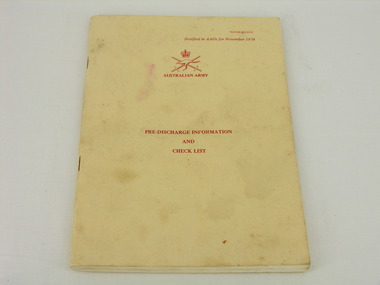
Book, Pre-Discharge Information and Check List
... Pre-Discharge Information and Check List...The handbook is covered with a buff coloured cardboard cover. Pre-Discharge Information and Check List Book ...A printed book produced by the Australian Army as a guide to service personnel leaving the Army. The handbook contains details of entitlements and instructions relating to applying for entitlements. The book also has a check list to assist users. The handbook is covered with a buff coloured cardboard cover. -
 National Vietnam Veterans Museum (NVVM)
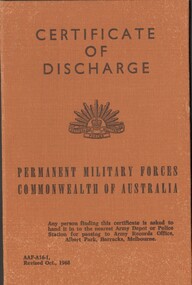
Certificate, Discharge
... Certificate of Discharge folder containing discharge information....Lette Ordnance Corps 3795490 Vietnam Discharge Certificate Certificate of Discharge/Australian Military Forces Emblem Certificate of Discharge folder containing discharge information. Discharge Certificate ...Standard military item issued to Pte Allen Doran Lette, Service No. 3795490, of the Royal Australian Army Ordnance Corps at the completion of his service. Pte Lette was conscripted to serve in Vietnam by the Birthday Ballot, which determined which young Australian men were called-up for National Service.Certificate of Discharge folder containing discharge information.Certificate of Discharge/Australian Military Forces Emblemlette, ordnance corps, 3795490, vietnam, discharge, certificate -
 Bendigo Military Museum
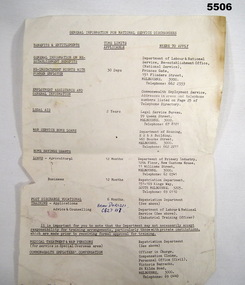
Document - GENERAL INFORMATION FOR NATIONAL SERVICE DISCHARGE
... GENERAL INFORMATION FOR NATIONAL SERVICE DISCHARGE.......Discharge Information....Single sheet white paper A.4 size with tattered bottom edge with general information that may be required on discharge. Writing only on one side....National Service Discharge Information. Against line "Advise and Counselling" written in blue pen "Brian Dorizzi C627117". ...Ref Cat No.754. Form shows contact points for various categories of service, i.e. Legal Aid, Housing Loans, Pensions etc, that the National Service may have a right to, also shows time limits that may apply.Single sheet white paper A.4 size with tattered bottom edge with general information that may be required on discharge. Writing only on one side.Against line "Advise and Counselling" written in blue pen "Brian Dorizzi C627117".national service, discharge information. -
 Bendigo Military Museum
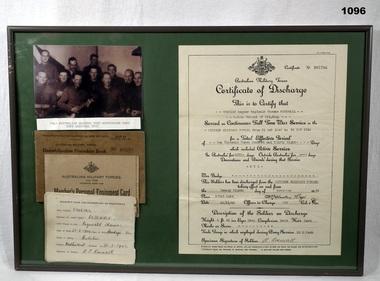
Memorabilia - COLLAGE, FRAMED, c.1942 - 1945
... Handwritten in black ink & typed in black on 2 documents, enlistment & discharge information....Handwritten in black ink & typed in black on 2 documents, enlistment & discharge information. Certificate of Discharge of Sapper Reginald T Rosewall. ...Certificate of Discharge of Sapper Reginald T Rosewall. Frame. Grey painted metal frame with dark green mount & glass front. Collage. LS black & white photograph, soldiers in uniform, informal group from the Mouth Organ Band, an Australian Military Force Demobilization Procedure Book & Members Personal Equipment Card & page of book showing Soldier's Name and Description on Enlistment. RS certificate black print on cream paper: Certificate of Discharge.Certificate of Discharge of Sapper Reginald T Rosewall. Handwritten in black ink & typed in black on 2 documents, enlistment & discharge information.documents - certificates, frame accessories, r.t.rosewall -
 Vision Australia
Text, RVIB Admissions and Discharges register, 1967-1982
... Discharge information is recorded in chronological order. ...Discharge information is recorded in chronological order. ...Client registers were used to record information about those who became RVIB clients. Upon admission, basic information would be recorded for future reference under the following headings: date of admission, name in full, year of birth, religion, birthplace, cause of blindness, terms of admission, name and address of guardian. When a client left the service, the Discharges side of the page was updated with the following information: date of discharge, name in full and remarks. Discharge information is recorded in chronological order. This book provides a record of all RVIB admissions and discharges for the period 1/7/1967 to 1/12/1982. Name searches are not available for this item. 1 v. rvib burwood school -
 Melbourne Legacy
Badge, Badges from World War One
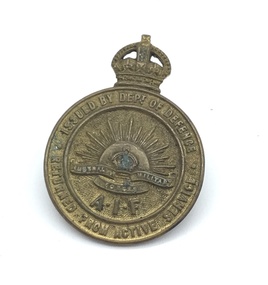
... The badges for those returned from active service could be worn by soldiers and nurses who returned to Australia from active service and were honourably discharged. From information found online: The badge from Ypres is known as a sweetheart badge. ...The badges for those returned from active service could be worn by soldiers and nurses who returned to Australia from active service and were honourably discharged. From information found online: The badge from Ypres is known as a sweetheart badge. ...A variety of badges that once belonged to J B McLean some are souvenirs and a couple are from the A.I.F. The badges for those returned from active service could be worn by soldiers and nurses who returned to Australia from active service and were honourably discharged. From information found online: The badge from Ypres is known as a sweetheart badge. Often produced post war as a souvenir. It is the arms of the city of Ypres/Ieper. The crown over the shield is called a "mural crown" and is often seen as part of the arms of cities and towns. The phrase 'sweetheart brooch' is commonly used, but is misleading, as it was not only 'sweethearts' that wore them. These were with other World War 1 memorabilia that has come from Private John Basil McLean, 2nd Reinforcements, 37th Battalion, A.I.F. J.B. McLean (Service No. 13824) was from near Maffra, Victoria and enlisted on 22 January 1916. He embarked on 16 December 1916 for Europe. He spent time with the Australian Field Artillery (Pack Section). At the end of the war he worked for a year at the A.I.F. Headquarters in London before returning to Australia on the 'Ceramic', arriving in Portsea in 1920. His full war record is available from the National Archives of Australia (B2455, MCLEAN JBM).This is an example of badges held by an ex soldier.Seven assorted badges collected by J B McLean. Two returned from active service AIF badges. A kangaroo badge on a blue enamel circle with the word ANZAC. Badge with the arms of Ypres surmounted by a crown. A pin with a field canon and a motto in latin. A pin with the Australian coat of arms from HMAS Australia sailing in the Great Fleet in 1916. A medallion with the Australian naval flag and the Union Jack.01122.1 On the front 'Issued by Dept of Defence. Returned from Active Service. Australian Military Forces. A.I.F.'. On the reverse '188589 Stokes and Sons Melb' 01122.2 'ANZAC' written in silver, on the reverse 'AJC Sterling' 01122.3 'Ypres' 01122.4 A latin phrase: 'Ubique constru stabiles Australia'. It could translate as 'everywhere together and trust'. 01122.5 On the front 'Grand Fleet. H.M.A.S. Australia 1916' 01122.6 On the front 'Issued by Dept of Defence. Returned from Active Service. Australian Military Forces. A.I.F.' On the reverse '117083 ? Perth' 01122.7 on the reverse 'Imitation'.world war one, soldier -
 Flagstaff Hill Maritime Museum and Village
Certificate - Certificates of Discharge, Commonwealth Governments Shipping Offices, 1895 - 1919
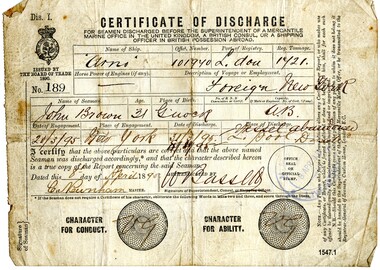
... This particular set of Certificates of Discharge belonged to a seaman called John F. Brown. Little is known about him but information taken from the cerificates tell us that John F. ...This particular set of Certificates of Discharge belonged to a seaman called John F. Brown. Little is known about him but information taken from the cerificates tell us that John F. ...The following information is taken from the PROV (Public Records Office of Victoria) website - "In Victoria regulation of the engagement and discharge of seamen was initially subject to New South Wales legislation. An Act to amend and consolidate the Laws relating to Seamen in the Merchant Service of the Colony of New South Wales, and for keeping a Register of Seamen belonging to Ships registered in the said Colony (13 Vic., No.28) of 1849 introduced requirements for ships masters to enter into written agreements with seamen engaged by them as crew, specifying wages and provisions, the capacity in which they would serve and the nature of the voyage. It also required masters to issue to seamen certificates of discharge upon their discharge or upon payment of their wages. The 1849 Act applied only to ships registered in the Colony. In 1854 the Imperial Merchant Shipping Act was passed, which had application to all British ships except those registered in the Colony. Consolidation of the separate laws occured with the passing of the Seamen Statute 1865 (28 Vic.,No.245) which adopted Part III of the Merchant Shipping Act 1854 (17 & 18 Vic, C 104) (see Parliamentary Debates, Session 1, 22 February 1865). The Imperial Act, like the New South Wales Act before it, required the master or owner of every British ship, over a certain tonnage, to enter a written agreement for the engagement and discharge of seamen. The Articles of Agreement (VPRS 566) were to be made at the start of a particular voyage, although running agreements were able to be made for a defined period in which short and frequent voyages would be made. At the end of the voyage the discharge and release of the crew was recorded. The date, place and reason for leaving the ship, and the balance of wages paid upon discharge, were recorded in the articles of agreement. Under the Merchant Shipping Act 1854 each seaman discharged was also to be issued with a certificate of discharge (this series) giving particulars of the ship, period of service and the seamans capacity, ability and conduct. No seaman could be engaged to work on a ship unless he delivered to the person engaging him a discharge from his last ship or a permit to sign articles. In the articles of agreement and in the Release Books (VPRS 945) the crew were required to sign their release of the ship, master or owner from any claims to wages or otherwise in respect of the voyage. In the release books the master also signed a release of the crew from all claims. It appears that in Victoria licensed shipping agents were initially able to facilitate the engagement and discharge of seamen. From 1 April 1859, however, the function was to be performed entirely in the Government Shipping Office (Government Gazette, 29 March 1859). In 1869, the names of Shipping Offices were changed to Mercantile Marine Offices and Shipping Masters to Superintendents of Mercantile Marine Offices. The role of the Shipping Office/Mercantile Marine Office was to facilitate and oversee the engagement and discharge of seamen and apprentices to the sea service. The facilities provided were subject to fees payable by ships masters. The Offices were located within the Department of Trade and Customs (VA 606) until 1901 and then within the Chief Secretarys Department (VA 475) to 1922. Responsibility for attesting master and seamen engagements and discharges transferred to the Commonwealth under Parts II and III of the Commonwealth Navigation Act 1912, which became effective on 1 March 1922 when the Navigation (Master and Seamen) Regulations were passed. Seamens Discharge Certificates 1882 to 1922 This series comprises counterfoils (or stubs) of Certificates of Discharge issued to seamen upon their discharge or upon payment of their wages between 1882 and 1922. The Certificates were signed by the Master of the ship and authorised by the Mercantile Marine Office. The counterfoils record details about the ships, the birthplaces and ages of the seamen, the dates of engagement and discharge, and the capacity, conduct and ability of the seamen." This particular set of Certificates of Discharge belonged to a seaman called John F. Brown. Little is known about him but information taken from the cerificates tell us that John F. Brown was born in Greenock, Scotland in about 1868 and that his rank was "Able Bodied Seaman". All of his cerificates describe his conduct and ability as "V. G. (Very Good). During the period from April 1895 to August 1908, he worked on about twenty two different ships - sailing on several Liverpool to New York voyages in 1895 and 1896. In September 1896 he began working on Australian coastal steamers - travelling up and down the coast of Australia (between the ports of Melbourne, Sydney, Newcastle, Adelaide and Brisbane) until August 1908. There is an eleven year gap in his records and his final certificate was issued in September 1919. Some of the ships he worked on include the "Arno", "Melbourne", "Burrumbeet", "Kalgoorlie", "New Guinea", "Buninyong", "Pilbarra", "Oakworth", "Cintra", "Lady Musgrave", "Dawn", "Moorabool", "Colac", "Ramazon", 'Brisbane", "City of Lincoln", "Peregrine" "Mareeba" and "Wear".Theses certificates are significant examples of the legal paperwork generated by the British and Australian governments in the day to day regulation of working seamen in the late 19th and early 20th centuries. They are also significant as they document the career of a working seaman at that time.This is a set of twenty three "Certificates of Discharge" issued to seaman John F. Brown primarily between the years 1895 and 1908 (although the last one is dated 1919). They have been issued by the Shipping Masters at U.K. Mercantile Marine Office (abroad), the Port of Melbourne Victoria, the Port of Sydney N.S.W., the Port of Newcastle N.S.W. and the Port of Brisbane. They are all of a similar size and layout with slight differences in their crests (depending on the port of issue) and the fonts used over the preceding years. They give a good overview into the career of John F. Brown as they list his place and date of birth, his voyages (places of engagement and discharge and the dates of the voyages), the ships he served on (with their tonnage, horsepower, official number and place of registry) plus his ranking, conduct and ability. All certificates are signed by the Master and authenticated by the Shipping Officer. Eight of the certificates have a purple circular stamp on the back with "S. F. 19 SEPT 1908 GLASGOW""CERTIFICATE OF DISCHARGE" "FOR SEAMEN DISCHARGED BEFORE THE SUPERINTENDENT OF A MERCANTILE / MARINE OFFICE IN THE UNITED KINGDOM, A BRITISH CONSUL, OR A SHIPPING/OFFICER IN BRITISH POSSESSION ABROAD" Headings filled out include - "Name of Ship", "Official number", "Reg. Tonnage", "Horse power of Engine (if any)", "Description of Voyage or Employment", "Name of Seaman", "Age", "Place of Birth", "No. of R.N.R. Commission or Certificate", "Capacity. If mate or Engineer. No of certificate (if any)", "Date of Engagement", "Place of Engagement", Date of Discharge", "Place of Discharge", "I certify that the above particulars are correct and that the abovenamed Seaman was discharged accordingly* and that the character described herein is a true copy of the report concerning the said seaman." "Dated this .... day of ... " , "Authenticated by ...." "Character for Conduct" , "Character for Ability".flagstaff hill, warrnambool, shipwrecked-coast, flagstaff-hill, flagstaff-hill-maritime-museum, maritime-museum, shipwreck-coast, flagstaff-hill-maritime-village, certificate of discharge for j.f.brown, certificate of discharge, certificate, discharge, discharge for j.f.brown, john f. brown, arno, s.s. melbourne, s.s. burrumbeet, s.s. kalgooli, s.s. new guinea, s.s. buninyong, s.s. pilbarra, s.s. oakworth, s.s. lady musgrave, s.s. dawn, s.s. moorabool, s.s. colac, s.s. city of lincoln, s.s. mareeba, s.s. wear, s.s. ramazon, s.s. peregrine -
 Mission to Seafarers Victoria
Certificate - Certificate of discharge, photocopy, Ministry of War Transport: continuous certificate of discharge: George Winfield Duncan, 1943
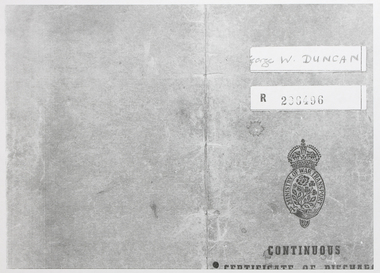
... discharge. Inside left cover: seaman photo, name reg number and official stamp with date Inside right page: notes and information....discharge. Inside left cover: seaman photo, name reg number and official stamp with date Inside right page: notes and information. small grey blue printed single fold seaman's photo identity card with printed guidelines and conditions of association / membership. ...This card together with a log book was a vital record of service for any seaman serving on a Merchant vessel that had been commandeered for War transport work and needed to be validated to ensure eligibility to be taken on as qualified member of the crew. G.W. Duncan appears to have specialised in engine room and mechanical maintenance. He appears to have served aboard a number of vessels including merchant vessels commissioned into wartime service in WW2.Mariner Duncan had a particular regard for the Mission to Seafarers. This plate for display on a commissioned new table at the MTSV chapel acknowledges his bequest and the material donated. Collectively the G W Duncan material includes: photographs, professional data memorabilia and written and commercially printed resources. The memorabilia relates to his career at sea and in particular the role of an engineer, including a handwritten manual of notes and references relating to the mechanical and engineering aspects and areas of responsibility for maintenance. small grey blue printed single fold seaman's photo identity card with printed guidelines and conditions of association / membership.stamped on front cover oval ribbon insignia surrounding roses and surmounted by crown with lettering : Ministry of War Transport Printed at lwr edge: Continuous / certificate of discharge. Inside left cover: seaman photo, name reg number and official stamp with date Inside right page: notes and information.war transport, ww2, merchant navy, merchant seamen, george winfield duncan (1922-2017), g.w. duncan -
 Flagstaff Hill Maritime Museum and Village
Administrative record - Reference Sociology/History, John Ferres, Government Printer, Victoria Police Gazettes for 1863, 1863
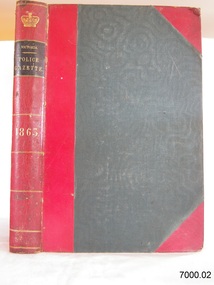
... discharge records with physical descriptions, and lists of pastoralists with descriptions of their livestock brands. No library labels or markings, on first page is the first Gazette for January 2nd 1863. Hard Bound Volume. Victorian Police Gazettes for 1863 Author: Institutional Government Publication Publisher: John Ferres, Melbourne Date: 1863 Further Information: Compilation of Weekly Victorian Police Gazettes for 1863 in a hard bound volume with red spine and red corner reinforcing. ...The Victoria Police Gazette was a confidential, internal publication of the Victoria Police, issued to inform police officers, court and justice officials, and government departments about matters relevant to policing across the colony. It commenced in December 1853 and was initially published weekly by the Victoria Police. It was distributed each week to city and rural police stations and to government offices and newspaper publishers. Inclusions in this weekly publication were people wanted for questioning in relation to various crimes, prisoners discharged from city or country gaols, extracts from Police Gazettes in New South Wales, South Australia, Queensland, Tasmania, New Zealand, and occasionally overseas countries, as well as extracts from the Hobart Town Gazette listing escaped convicts and the person to whom they were assigned. There was also a "Missing Friends" section, where most people listed were not criminals but were sought by police so relatives, old friends, or government officials could renew contact with them. In addition, there was a record of deserted wives and children, listing the offender's name, birthplace, age, occupation, last known area of residence, likely future movements and known relatives. There was also a section on court lists, warrants issued, appointments and staffing changes within the police service, arrest and discharge records with physical descriptions, and lists of pastoralists with descriptions of their livestock brands.Hard Bound Volume. Victorian Police Gazettes for 1863 Author: Institutional Government Publication Publisher: John Ferres, Melbourne Date: 1863 Further Information: Compilation of Weekly Victorian Police Gazettes for 1863 in a hard bound volume with red spine and red corner reinforcing. Front panel grey coloured lettering in gilt with gilt banding to spine. Inside is twelve issues of the Police Gazettes for 1863.non-fictionThe Victoria Police Gazette was a confidential, internal publication of the Victoria Police, issued to inform police officers, court and justice officials, and government departments about matters relevant to policing across the colony. It commenced in December 1853 and was initially published weekly by the Victoria Police. It was distributed each week to city and rural police stations and to government offices and newspaper publishers. Inclusions in this weekly publication were people wanted for questioning in relation to various crimes, prisoners discharged from city or country gaols, extracts from Police Gazettes in New South Wales, South Australia, Queensland, Tasmania, New Zealand, and occasionally overseas countries, as well as extracts from the Hobart Town Gazette listing escaped convicts and the person to whom they were assigned. There was also a "Missing Friends" section, where most people listed were not criminals but were sought by police so relatives, old friends, or government officials could renew contact with them. In addition, there was a record of deserted wives and children, listing the offender's name, birthplace, age, occupation, last known area of residence, likely future movements and known relatives. There was also a section on court lists, warrants issued, appointments and staffing changes within the police service, arrest and discharge records with physical descriptions, and lists of pastoralists with descriptions of their livestock brands.warrnambool, shipwrecked-coast, flagstaff-hill, flagstaff-hill-maritime-museum, maritime-museum, shipwreck-coast, flagstaff-hill-maritime-village, shipwrecked-artefact, book, victoria police gazette 1862, victoria police gazette, warrnambool books and records, great ocean road -
 Flagstaff Hill Maritime Museum and Village
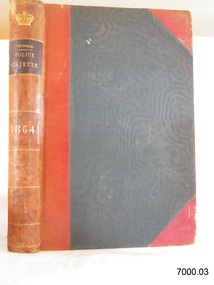
Administrative record - Reference Sociology/History, John Ferres, Government Printer, Victoria Police Gazettes for 1864, 1864
... discharge records with physical descriptions, and lists of pastoralists with descriptions of their livestock brands. No library labels or markings, on first page is the first Gazette for January 2nd 1864. Hard Bound Volume. Victorian Police Gazettes for 1864 Author: Institutional Government Publication Publisher: John Ferres, Melbourne Date: 1864 Further Information: Compilation of Weekly Victorian Police Gazettes for 1864 in a hard bound volume with red spine and red corner reinforcing. ...The Victoria Police Gazette was a confidential, internal publication of the Victoria Police, issued to inform police officers, court and justice officials, and government departments about matters relevant to policing across the colony. It commenced in December 1853 and was initially published weekly by the Victoria Police. It was distributed each week to city and rural police stations and to government offices and newspaper publishers. Inclusions in this weekly publication were people wanted for questioning in relation to various crimes, prisoners discharged from city or country gaols, extracts from Police Gazettes in New South Wales, South Australia, Queensland, Tasmania, New Zealand, and occasionally overseas countries, as well as extracts from the Hobart Town Gazette listing escaped convicts and the person to whom they were assigned. There was also a "Missing Friends" section, where most people listed were not criminals but were sought by police so relatives, old friends, or government officials could renew contact with them. In addition, there was a record of deserted wives and children, listing the offender's name, birthplace, age, occupation, last known area of residence, likely future movements and known relatives. There was also a section on court lists, warrants issued, appointments and staffing changes within the police service, arrest and discharge records with physical descriptions, and lists of pastoralists with descriptions of their livestock brands.Hard Bound Volume. Victorian Police Gazettes for 1864 Author: Institutional Government Publication Publisher: John Ferres, Melbourne Date: 1864 Further Information: Compilation of Weekly Victorian Police Gazettes for 1864 in a hard bound volume with red spine and red corner reinforcing. Front panel grey coloured lettering in gilt with gilt banding to spine. Inside is twelve issues of the Police Gazettes for 1864.non-fictionThe Victoria Police Gazette was a confidential, internal publication of the Victoria Police, issued to inform police officers, court and justice officials, and government departments about matters relevant to policing across the colony. It commenced in December 1853 and was initially published weekly by the Victoria Police. It was distributed each week to city and rural police stations and to government offices and newspaper publishers. Inclusions in this weekly publication were people wanted for questioning in relation to various crimes, prisoners discharged from city or country gaols, extracts from Police Gazettes in New South Wales, South Australia, Queensland, Tasmania, New Zealand, and occasionally overseas countries, as well as extracts from the Hobart Town Gazette listing escaped convicts and the person to whom they were assigned. There was also a "Missing Friends" section, where most people listed were not criminals but were sought by police so relatives, old friends, or government officials could renew contact with them. In addition, there was a record of deserted wives and children, listing the offender's name, birthplace, age, occupation, last known area of residence, likely future movements and known relatives. There was also a section on court lists, warrants issued, appointments and staffing changes within the police service, arrest and discharge records with physical descriptions, and lists of pastoralists with descriptions of their livestock brands.warrnambool, shipwrecked-coast, flagstaff-hill, flagstaff-hill-maritime-museum, maritime-museum, shipwreck-coast, flagstaff-hill-maritime-village, shipwrecked-artefact, book, victoria police gazette 1862, victoria police gazette, warrnambool books and records, great ocean road -
 Flagstaff Hill Maritime Museum and Village
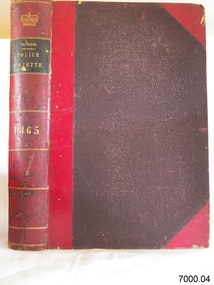
Administrative record - Reference Sociology/History, John Ferres, Government Printer, Victoria Police Gazettes for 1865, 1865
... discharge records with physical descriptions, and lists of pastoralists with descriptions of their livestock brands. No library labels or markings, on first page is the first Gazette for January 2nd 1865. Hard Bound Volume. Victorian Police Gazettes for 1865 Author: Institutional Government Publication Publisher: John Ferres, Melbourne Date: 1865 Further Information: Compilation of Weekly Victorian Police Gazettes for 1865 in a hard bound volume with red spine and red corner reinforcing. ...The Victoria Police Gazette was a confidential, internal publication of the Victoria Police, issued to inform police officers, court and justice officials, and government departments about matters relevant to policing across the colony. It commenced in December 1853 and was initially published weekly by the Victoria Police. It was distributed each week to city and rural police stations and to government offices and newspaper publishers. Inclusions in this weekly publication were people wanted for questioning in relation to various crimes, prisoners discharged from city or country gaols, extracts from Police Gazettes in New South Wales, South Australia, Queensland, Tasmania, New Zealand, and occasionally overseas countries, as well as extracts from the Hobart Town Gazette listing escaped convicts and the person to whom they were assigned. There was also a "Missing Friends" section, where most people listed were not criminals but were sought by police so relatives, old friends, or government officials could renew contact with them. In addition, there was a record of deserted wives and children, listing the offender's name, birthplace, age, occupation, last known area of residence, likely future movements and known relatives. There was also a section on court lists, warrants issued, appointments and staffing changes within the police service, arrest and discharge records with physical descriptions, and lists of pastoralists with descriptions of their livestock brands.Hard Bound Volume. Victorian Police Gazettes for 1865 Author: Institutional Government Publication Publisher: John Ferres, Melbourne Date: 1865 Further Information: Compilation of Weekly Victorian Police Gazettes for 1865 in a hard bound volume with red spine and red corner reinforcing. Front panel grey coloured lettering in gilt with gilt banding to spine. Inside is twelve issues of the Police Gazettes for 1865.non-fictionThe Victoria Police Gazette was a confidential, internal publication of the Victoria Police, issued to inform police officers, court and justice officials, and government departments about matters relevant to policing across the colony. It commenced in December 1853 and was initially published weekly by the Victoria Police. It was distributed each week to city and rural police stations and to government offices and newspaper publishers. Inclusions in this weekly publication were people wanted for questioning in relation to various crimes, prisoners discharged from city or country gaols, extracts from Police Gazettes in New South Wales, South Australia, Queensland, Tasmania, New Zealand, and occasionally overseas countries, as well as extracts from the Hobart Town Gazette listing escaped convicts and the person to whom they were assigned. There was also a "Missing Friends" section, where most people listed were not criminals but were sought by police so relatives, old friends, or government officials could renew contact with them. In addition, there was a record of deserted wives and children, listing the offender's name, birthplace, age, occupation, last known area of residence, likely future movements and known relatives. There was also a section on court lists, warrants issued, appointments and staffing changes within the police service, arrest and discharge records with physical descriptions, and lists of pastoralists with descriptions of their livestock brands.warrnambool, shipwrecked-coast, flagstaff-hill, flagstaff-hill-maritime-museum, maritime-museum, shipwreck-coast, flagstaff-hill-maritime-village, shipwrecked-artefact, book, victoria police gazette 1862, victoria police gazette, warrnambool books and records, great ocean road -
 Flagstaff Hill Maritime Museum and Village
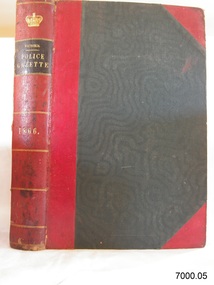
Administrative record - Reference Sociology/History, John Ferres, Government Printer, Victoria Police Gazettes for 1866, 1866
... discharge records with physical descriptions, and lists of pastoralists with descriptions of their livestock brands. No library labels or markings, on first page is the first Gazette for January 2nd 1866. Hard Bound Volume. Victorian Police Gazettes for 1866 Author: Institutional Government Publication Publisher: John Ferres, Melbourne Date: 1866 Further Information: Compilation of Weekly Victorian Police Gazettes for 1866 in a hard bound volume with red spine and red corner reinforcing. ...The Victoria Police Gazette was a confidential, internal publication of the Victoria Police, issued to inform police officers, court and justice officials, and government departments about matters relevant to policing across the colony. It commenced in December 1853 and was initially published weekly by the Victoria Police. It was distributed each week to city and rural police stations and to government offices and newspaper publishers. Inclusions in this weekly publication were people wanted for questioning in relation to various crimes, prisoners discharged from city or country gaols, extracts from Police Gazettes in New South Wales, South Australia, Queensland, Tasmania, New Zealand, and occasionally overseas countries, as well as extracts from the Hobart Town Gazette listing escaped convicts and the person to whom they were assigned. There was also a "Missing Friends" section, where most people listed were not criminals but were sought by police so relatives, old friends, or government officials could renew contact with them. In addition, there was a record of deserted wives and children, listing the offender's name, birthplace, age, occupation, last known area of residence, likely future movements and known relatives. There was also a section on court lists, warrants issued, appointments and staffing changes within the police service, arrest and discharge records with physical descriptions, and lists of pastoralists with descriptions of their livestock brands.Hard Bound Volume. Victorian Police Gazettes for 1866 Author: Institutional Government Publication Publisher: John Ferres, Melbourne Date: 1866 Further Information: Compilation of Weekly Victorian Police Gazettes for 1866 in a hard bound volume with red spine and red corner reinforcing. Front panel grey coloured lettering in gilt with gilt banding to spine. Inside is twelve issues of the Police Gazettes for 1866.non-fictionThe Victoria Police Gazette was a confidential, internal publication of the Victoria Police, issued to inform police officers, court and justice officials, and government departments about matters relevant to policing across the colony. It commenced in December 1853 and was initially published weekly by the Victoria Police. It was distributed each week to city and rural police stations and to government offices and newspaper publishers. Inclusions in this weekly publication were people wanted for questioning in relation to various crimes, prisoners discharged from city or country gaols, extracts from Police Gazettes in New South Wales, South Australia, Queensland, Tasmania, New Zealand, and occasionally overseas countries, as well as extracts from the Hobart Town Gazette listing escaped convicts and the person to whom they were assigned. There was also a "Missing Friends" section, where most people listed were not criminals but were sought by police so relatives, old friends, or government officials could renew contact with them. In addition, there was a record of deserted wives and children, listing the offender's name, birthplace, age, occupation, last known area of residence, likely future movements and known relatives. There was also a section on court lists, warrants issued, appointments and staffing changes within the police service, arrest and discharge records with physical descriptions, and lists of pastoralists with descriptions of their livestock brands.warrnambool, shipwrecked-coast, flagstaff-hill, flagstaff-hill-maritime-museum, maritime-museum, shipwreck-coast, flagstaff-hill-maritime-village, shipwrecked-artefact, book, victoria police gazette 1862, victoria police gazette, warrnambool books and records, great ocean road -
 Flagstaff Hill Maritime Museum and Village
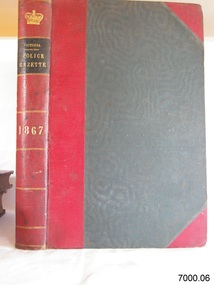
Administrative record - Reference Sociology/History, John Ferres, Government Printer, Victoria Police Gazettes for 1867, 1867
... discharge records with physical descriptions, and lists of pastoralists with descriptions of their livestock brands. No library labels or markings, on first page is the first Gazette for January 2nd 1867. Hard Bound Volume. Victorian Police Gazettes for 1867 Author: Institutional Government Publication Publisher: John Ferres, Melbourne Date: 1867 Further Information: Compilation of Weekly Victorian Police Gazettes for 1867 in a hard bound volume with red spine and red corner reinforcing. ...The Victoria Police Gazette was a confidential, internal publication of the Victoria Police, issued to inform police officers, court and justice officials, and government departments about matters relevant to policing across the colony. It commenced in December 1853 and was initially published weekly by the Victoria Police. It was distributed each week to city and rural police stations and to government offices and newspaper publishers. Inclusions in this weekly publication were people wanted for questioning in relation to various crimes, prisoners discharged from city or country gaols, extracts from Police Gazettes in New South Wales, South Australia, Queensland, Tasmania, New Zealand, and occasionally overseas countries, as well as extracts from the Hobart Town Gazette listing escaped convicts and the person to whom they were assigned. There was also a "Missing Friends" section, where most people listed were not criminals but were sought by police so relatives, old friends, or government officials could renew contact with them. In addition, there was a record of deserted wives and children, listing the offender's name, birthplace, age, occupation, last known area of residence, likely future movements and known relatives. There was also a section on court lists, warrants issued, appointments and staffing changes within the police service, arrest and discharge records with physical descriptions, and lists of pastoralists with descriptions of their livestock brands.Hard Bound Volume. Victorian Police Gazettes for 1867 Author: Institutional Government Publication Publisher: John Ferres, Melbourne Date: 1867 Further Information: Compilation of Weekly Victorian Police Gazettes for 1867 in a hard bound volume with red spine and red corner reinforcing. Front panel grey coloured lettering in gilt with gilt banding to spine. Inside is twelve issues of the Police Gazettes for 1867.non-fictionThe Victoria Police Gazette was a confidential, internal publication of the Victoria Police, issued to inform police officers, court and justice officials, and government departments about matters relevant to policing across the colony. It commenced in December 1853 and was initially published weekly by the Victoria Police. It was distributed each week to city and rural police stations and to government offices and newspaper publishers. Inclusions in this weekly publication were people wanted for questioning in relation to various crimes, prisoners discharged from city or country gaols, extracts from Police Gazettes in New South Wales, South Australia, Queensland, Tasmania, New Zealand, and occasionally overseas countries, as well as extracts from the Hobart Town Gazette listing escaped convicts and the person to whom they were assigned. There was also a "Missing Friends" section, where most people listed were not criminals but were sought by police so relatives, old friends, or government officials could renew contact with them. In addition, there was a record of deserted wives and children, listing the offender's name, birthplace, age, occupation, last known area of residence, likely future movements and known relatives. There was also a section on court lists, warrants issued, appointments and staffing changes within the police service, arrest and discharge records with physical descriptions, and lists of pastoralists with descriptions of their livestock brands.warrnambool, shipwrecked-coast, flagstaff-hill, flagstaff-hill-maritime-museum, maritime-museum, shipwreck-coast, flagstaff-hill-maritime-village, shipwrecked-artefact, book, victoria police gazette 1862, victoria police gazette, warrnambool books and records, great ocean road -
 Flagstaff Hill Maritime Museum and Village
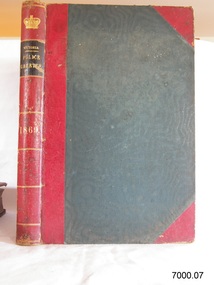
Administrative record - Reference Sociology/History, John Ferres, Government Printer, Victoria Police Gazettes for 1869, 1869
... discharge records with physical descriptions, and lists of pastoralists with descriptions of their livestock brands. No library labels or markings, on first page is the first Gazette for January 2nd 1869. Hard Bound Volume. Victorian Police Gazettes for 1869 Author: Institutional Government Publication Publisher: John Ferres, Melbourne Date: 1869 Further Information: Compilation of Weekly Victorian Police Gazettes for 1869 in a hard bound volume with red spine and red corner reinforcing. ...The Victoria Police Gazette was a confidential, internal publication of the Victoria Police, issued to inform police officers, court and justice officials, and government departments about matters relevant to policing across the colony. It commenced in December 1853 and was initially published weekly by the Victoria Police. It was distributed each week to city and rural police stations and to government offices and newspaper publishers. Inclusions in this weekly publication were people wanted for questioning in relation to various crimes, prisoners discharged from city or country gaols, extracts from Police Gazettes in New South Wales, South Australia, Queensland, Tasmania, New Zealand, and occasionally overseas countries, as well as extracts from the Hobart Town Gazette listing escaped convicts and the person to whom they were assigned. There was also a "Missing Friends" section, where most people listed were not criminals but were sought by police so relatives, old friends, or government officials could renew contact with them. In addition, there was a record of deserted wives and children, listing the offender's name, birthplace, age, occupation, last known area of residence, likely future movements and known relatives. There was also a section on court lists, warrants issued, appointments and staffing changes within the police service, arrest and discharge records with physical descriptions, and lists of pastoralists with descriptions of their livestock brands.Hard Bound Volume. Victorian Police Gazettes for 1869 Author: Institutional Government Publication Publisher: John Ferres, Melbourne Date: 1869 Further Information: Compilation of Weekly Victorian Police Gazettes for 1869 in a hard bound volume with red spine and red corner reinforcing. Front panel grey coloured lettering in gilt with gilt banding to spine. Inside is twelve issues of the Police Gazettes for 1869.non-fictionThe Victoria Police Gazette was a confidential, internal publication of the Victoria Police, issued to inform police officers, court and justice officials, and government departments about matters relevant to policing across the colony. It commenced in December 1853 and was initially published weekly by the Victoria Police. It was distributed each week to city and rural police stations and to government offices and newspaper publishers. Inclusions in this weekly publication were people wanted for questioning in relation to various crimes, prisoners discharged from city or country gaols, extracts from Police Gazettes in New South Wales, South Australia, Queensland, Tasmania, New Zealand, and occasionally overseas countries, as well as extracts from the Hobart Town Gazette listing escaped convicts and the person to whom they were assigned. There was also a "Missing Friends" section, where most people listed were not criminals but were sought by police so relatives, old friends, or government officials could renew contact with them. In addition, there was a record of deserted wives and children, listing the offender's name, birthplace, age, occupation, last known area of residence, likely future movements and known relatives. There was also a section on court lists, warrants issued, appointments and staffing changes within the police service, arrest and discharge records with physical descriptions, and lists of pastoralists with descriptions of their livestock brands.warrnambool, shipwrecked-coast, flagstaff-hill, flagstaff-hill-maritime-museum, maritime-museum, shipwreck-coast, flagstaff-hill-maritime-village, shipwrecked-artefact, book, victoria police gazette 1862, victoria police gazette, warrnambool books and records, great ocean road -
 Dunkeld Museum Inc.
Coat, Flying, During World War 1
... information to the artillery batteries which then shelled those positions. He was involved in a number of missions involving direct contact with the enemy including Baron von Richtofen and was involved in the "dog fight" which led to von Richtofen's death. In May 1918 he had been promoted to Flight Commander and temporary Captain when his cousin Captain Duigan was wounded. He represented Australia at von Richtofen's funeral and presented the Australian wreath. Following his discharge...information to the artillery batteries which then shelled those positions. He was involved in a number of missions involving direct contact with the enemy including Baron von Richtofen and was involved in the "dog fight" which led to von Richtofen's death. In May 1918 he had been promoted to Flight Commander and temporary Captain when his cousin Captain Duigan was wounded. He represented Australia at von Richtofen's funeral and presented the Australian wreath. Following his discharge ...This coat was owned and worn by Lieutenant T L(known as Leigh) Simpson D.F.C. who joined the Royal Flying Corps during Workd War 1. He was born in Hamilton Victoria and had an interest through his family in flying, before the war. In 1916 he transferred from the Light Horse Field Ambulance to the 68th Australian Sqd. Royal Flying Corps. He was promoted to lieutenant of the 3rd Squadron. During the war he was a pilot and photographer and took hundreds of reconnaissance photos over occupied territory. He was involved in photographing enemy positions and supplying information to the artillery batteries which then shelled those positions. He was involved in a number of missions involving direct contact with the enemy including Baron von Richtofen and was involved in the "dog fight" which led to von Richtofen's death. In May 1918 he had been promoted to Flight Commander and temporary Captain when his cousin Captain Duigan was wounded. He represented Australia at von Richtofen's funeral and presented the Australian wreath. Following his discharge after being seriously wounded, he returned home and became a grazier in the Dunkeld area. He maintained his interest in aviation throughout his life with a strong connection with Reg Ansett and was a director of Ansett Airways Pty Ltd for many years. He died in Dunkeld in 1960This flying coat is significant because it was owned by Lieutenant Thomas Leigh Simpson DFC while he was in the Australian Flying Corps during World War 1. World War 1 Flying coat. Tan leather, nap finish. Lining wool fabric. Map pocket on front of chest. Internal pocket on left front behind map pocket and external pocket below the waist on the left hand front towards the side.L Simpson on the inside left front.t leigh simpson, royal flying corps, baron von richtofen, australian aviation -
 Orbost & District Historical Society
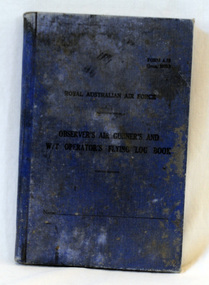
book, Observer's Air Gunner's and W/T Operator's Flying Log Book, 1938
... This information was required for official administrative purposes. The book is incompletely filled in as recorder was "Discharged on compassionate grounds"....This information was required for official administrative purposes. The book is incompletely filled in as recorder was "Discharged on compassionate grounds". ...This type of logbook was issued by the Royal Australian Air Force to non-pilot aircrew to record their flight hour and experience. This information was required for official administrative purposes. The book is incompletely filled in as recorder was "Discharged on compassionate grounds".This book is a useful reference tool.A blue, hard cover log book with details of R.A.A.F. observer/ air gunner/ telegraph operator/ radio operator, used to record exercises from bases in Victoria and South Australia. Inside, each page is printed with a table. Each column in the table has a title, 'Date', 'Hour', ' Aircraft Type and Number', 'Pilot', 'Duty', 'Remarks', 'Flying time / Day / Night'. The table has handwritten entries. air-transport flight-information royal- australian-air-force -
 Red Cliffs Military Museum
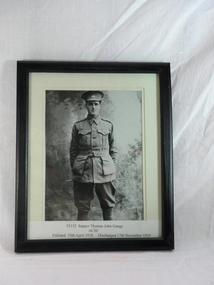
Framed Photograph, Portrait Sapper Thomas John Gange, World War One
... He enlisted 10th April 1918 and was discharged 17th November 1919. More information found at http://mappingouranzacs.naa.gov.au/list-enlist.aspx?..."Typed information on paper strip at bottom of frame this information is also written on back of photograph.'55152 Sapper Thomas John Gange/ ACSC/ Enlisted 10th April 1918 Discharged 17th November 1919"...He enlisted 10th April 1918 and was discharged 17th November 1919. More information found at http://mappingouranzacs.naa.gov.au/list-enlist.aspx? ...Sapper Thomas John Gange served in the Australian Corps of Signals. He enlisted 10th April 1918 and was discharged 17th November 1919. More information found at http://mappingouranzacs.naa.gov.au/list-enlist.aspx?enlist=Warracknabeal,%20VIC,%20AustraliaThis a reprint of an original photo, low significanceReprint of original black and white studio portrait of man in Australian World War One Army uniform standing with swagger stick set against landscape background, photograph mounted in modern wood frame.Typed information on paper strip at bottom of frame, this information is written on back of photograph."Typed information on paper strip at bottom of frame this information is also written on back of photograph.'55152 Sapper Thomas John Gange/ ACSC/ Enlisted 10th April 1918 Discharged 17th November 1919"of, world war one, australian, sapper, studio portrait, uniform world war one, thomas john gange, signals army australia, 1918, 1919, corps, signals, swagger stick -
 Red Cliffs Military Museum
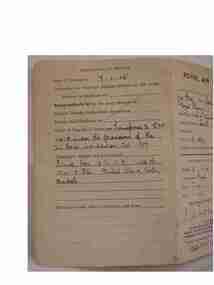
Discharge Paper WW1, Copy of WW1 Discharge Paper in cover, (estimated); 1921
... information.// Back of paper: Particulars of Service/ Date of Enlistement 7.1.15/ Preceeded on Furlough pending Transfer to the Army/ Reserve, or Discharge on... passed medically fit for the Army Reserve on/ Due for Final Discharge on../ Cause of Transfer or Discharge - Transferred to R.A.F. 1-4-18. under the provisions of the/ Air Force (Constitution) Act Oct. 1917./ Campaigns, Medals and Decorations/ France from 15.6.15 to 3.12.16/ 1914-15 Star, British War & Victory/ Medals. ...information.// Back of paper: Particulars of Service/ Date of Enlistement 7.1.15/ Preceeded on Furlough pending Transfer to the Army/ Reserve, or Discharge on... passed medically fit for the Army Reserve on/ Due for Final Discharge on../ Cause of Transfer or Discharge - Transferred to R.A.F. 1-4-18. under the provisions of the/ Air Force (Constitution) Act Oct. 1917./ Campaigns, Medals and Decorations/ France from 15.6.15 to 3.12.16/ 1914-15 Star, British War & Victory/ Medals. ...This is a part of the A.J. Roddy Collection. The Family have glued a piece on the envelope which says, "Dad's Discharge Paper/ Royal Irish Rifles & Royal Flying Corps./ 7-1-1915 to Dec 1921. Copy a the Discharge paper of Pte2 James Roddy, Royal Irish Rifles & Royal Flying Corps RAF 7-1-1915 to Dec 1921 and CoverCover: Cover for Certificates/ and other Documents of a/ soldier on Demobilization or Transfer to the Reseve/ or Discharge.// Front of Paper: Top right: Form 2067/ Royal Air Force/ Serial No/ Character Certificate of No 133458/ Rank Pte2 Name Roddy James/ Royal Flying Corp (Regiment (crossed out))/ Born in the Parish of / near the Town of South in the / County of ......... on the / Date 11.7.1897/ Trade as stated by him on Enlistment Postman/ 2 parallel lines/ * Description on Leaving the Colours/ Heoght 5ft 6in. Identification Marks:-/ Complexion Fresh Scar above 1st Lumbar/ Eyes Grey. Vertibrae/ Hair Brown/ Signature of Soldier/ (was signed J. Roddy/ * To prevent impersonation/ In the event of any doubt arising as to the bona fidis of the/ bearer, the above description and signature should be carefully compared with present appearance and hand writing. (16:957) WT 3183C/1875 5m.17/18. P&P Ltd/ Photostat copy of Original Opening the paper inside: The character here given is based on continous records of the holder's conduct and / employment throughout his Military Career./ This is to Certify that No 133458 Rank Pte2 Name Roddy James/ has served with the colours in the Royal Irish Rifles & Royal Flying Corps for 3 83/365 years. 1915-18/ Serving in the Royal Flying Corps as a Batman, and during/ the whole of this period carrying out his duites in a/ satisfactory manner/ There is no record of him having incurred any service/ entries on his conduct sheet during this period./ for service in the R.A.F. see form 280/ Signature ..... Squadron Leader/ Date December 1921 Commanding R.A.F. Records Ruislip/ If further particulars as to his character and record of service are required within three years of above date, apply to/ where he is registered for Civil Employment,/ afterwards to the Officer in Charge of Records./ * This space is intended to be filled in by any organisation which has registered the man's name and is prepared to/ supply further information.// Back of paper: Particulars of Service/ Date of Enlistement 7.1.15/ Preceeded on Furlough pending Transfer to the Army/ Reserve, or Discharge on... passed medically fit for the Army Reserve on/ Due for Final Discharge on../ Cause of Transfer or Discharge - Transferred to R.A.F. 1-4-18. under the provisions of the/ Air Force (Constitution) Act Oct. 1917./ Campaigns, Medals and Decorations/ France from 15.6.15 to 3.12.16/ 1914-15 Star, British War & Victory/ Medals. /Education and other Certificates and dates/corps, ww1, collection, royal, a j, roddy, flying, irish, rifles, pte2, james, 1915 -
 Australian Commando Association - Victoria
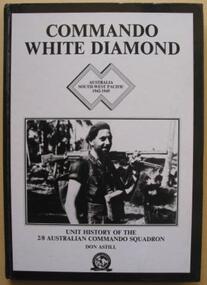
Book, Commando White Diamond: Unt History of the 2/8th Australian Commando Squadron
... information, they were free to make a ‘strike’ against the Japanese by setting an ambush or taking a prisoner. These raids were very effective, as they forced the Japanese to deploy troops to their rear areas, removing men from the front created by the infantry. Following Japan’s surrender and the end of the war, the ranks of the squadron thinned quickly as men were discharged ...The detailed history of the No.8 Independent Commando Company during World War II. Plastic protective cover over the book. The 2/8th Independent Company was formed at Wilson’s Promontory, Victoria, in July 1942 and travelled to Yandina, in Queensland, in September. While the other seven independent companies saw action in the islands off Australian and in New Guinea, the 2/8th spent most of the next two years based at Adelaide River, in the Northern Territory. While it was in the Territory, the independent companies underwent a series of reorganisations and the name of the 2/8th was changed from the 2/8th Independent Company to the 2/8th Cavalry (Commando) Squadron. This name was later simplified to just commando squadron. In July 1944, after years of waiting, the squadron left the Territory and sailed from Townsville to Lae, via Milne Bay. While at Lae, the squadron received an intake of 70 men from the 2/8th from the 2/3rd, 2/5th and 2/6th Cavalry (Commando) Squadrons, many of whom were veterans of the earlier New Guinea campaigns. Their experience was no doubt a useful reserve that would have been called upon during the 2/8th’s subsequent campaign in Bougainville. Others though, were able to implement some of their commando training when a small group from the 2/8th they made a secret landing on New Britain. Towards the end of the 1944 the 5th Division was preparing to make a landing at Jacquinot Bay in New Britain. Part of these preparations included landing a small group of officers from the division at Jacquinot Bay to make a secret reconnaissance of the potential landing site. As Jacquinot Bay was still in Japanese controlled territory, ‘C’ Troop from the 2/8th provided the protection for the reconnaissance party by establishing a position on the beach and by patrolling the surrounding country. Everything went well and the 5th Division later landed at Jacquinot Bay in November. The squadron too was on the move, and in October it sailed to Torokina, the main Australian base on Bougainville, where it joined the II Australian Corps. The campaign on Bougainville was dived into three areas, the Central, Northern and Southern Sectors. The 2/8th served in the latter two areas. The 2/8th made the first move of the Australian campaign in the Northern Sector, by patrolling from Torokina to Kuraio Mission and Amun once a week. The squadron did this from the second week of November unit the second week of December. The 2/8th was then transferred to the Southern Sector. The main battle for Bougainville was fought in the Southern Sector, as the 3rd Division advanced towards Buin – the main Japanese base on the island. As the division’s infantry brigades advanced along the coast, the 2/8th’s task was to protect their flank by conducting forward reconnaissance patrols, harassing the Japanese with raids and ambushes and conducting a form of guerrilla warfare. The squadron had a long campaign. For nine months, from the end of December until August 1945, the troopers were in action the whole time. After securing the Jaba River, they moved inland, first to Sovele Mission, then the villages of Opai, Nihero and Morokaimoro. They had reached Kilipaijino by the end of the war. Each village taken became a patrol base. Patrols were usually limited to two sections, although up to six sections could be operating at a time. Patrols generally lasted four to six days, but nine-day patrols were not unknown. The squadron collected and collated track information, terrain reports and located the enemy. Once patrols had gathered information, they were free to make a ‘strike’ against the Japanese by setting an ambush or taking a prisoner. These raids were very effective, as they forced the Japanese to deploy troops to their rear areas, removing men from the front created by the infantry. Following Japan’s surrender and the end of the war, the ranks of the squadron thinned quickly as men were discharged or were transferred to other units. For those who were left, the squadron returned to Australia at the end of December. In mid January 1946, at Liverpool, the 2/8th Commando Squadron was disbanded.non-fictionThe detailed history of the No.8 Independent Commando Company during World War II. Plastic protective cover over the book. The 2/8th Independent Company was formed at Wilson’s Promontory, Victoria, in July 1942 and travelled to Yandina, in Queensland, in September. While the other seven independent companies saw action in the islands off Australian and in New Guinea, the 2/8th spent most of the next two years based at Adelaide River, in the Northern Territory. While it was in the Territory, the independent companies underwent a series of reorganisations and the name of the 2/8th was changed from the 2/8th Independent Company to the 2/8th Cavalry (Commando) Squadron. This name was later simplified to just commando squadron. In July 1944, after years of waiting, the squadron left the Territory and sailed from Townsville to Lae, via Milne Bay. While at Lae, the squadron received an intake of 70 men from the 2/8th from the 2/3rd, 2/5th and 2/6th Cavalry (Commando) Squadrons, many of whom were veterans of the earlier New Guinea campaigns. Their experience was no doubt a useful reserve that would have been called upon during the 2/8th’s subsequent campaign in Bougainville. Others though, were able to implement some of their commando training when a small group from the 2/8th they made a secret landing on New Britain. Towards the end of the 1944 the 5th Division was preparing to make a landing at Jacquinot Bay in New Britain. Part of these preparations included landing a small group of officers from the division at Jacquinot Bay to make a secret reconnaissance of the potential landing site. As Jacquinot Bay was still in Japanese controlled territory, ‘C’ Troop from the 2/8th provided the protection for the reconnaissance party by establishing a position on the beach and by patrolling the surrounding country. Everything went well and the 5th Division later landed at Jacquinot Bay in November. The squadron too was on the move, and in October it sailed to Torokina, the main Australian base on Bougainville, where it joined the II Australian Corps. The campaign on Bougainville was dived into three areas, the Central, Northern and Southern Sectors. The 2/8th served in the latter two areas. The 2/8th made the first move of the Australian campaign in the Northern Sector, by patrolling from Torokina to Kuraio Mission and Amun once a week. The squadron did this from the second week of November unit the second week of December. The 2/8th was then transferred to the Southern Sector. The main battle for Bougainville was fought in the Southern Sector, as the 3rd Division advanced towards Buin – the main Japanese base on the island. As the division’s infantry brigades advanced along the coast, the 2/8th’s task was to protect their flank by conducting forward reconnaissance patrols, harassing the Japanese with raids and ambushes and conducting a form of guerrilla warfare. The squadron had a long campaign. For nine months, from the end of December until August 1945, the troopers were in action the whole time. After securing the Jaba River, they moved inland, first to Sovele Mission, then the villages of Opai, Nihero and Morokaimoro. They had reached Kilipaijino by the end of the war. Each village taken became a patrol base. Patrols were usually limited to two sections, although up to six sections could be operating at a time. Patrols generally lasted four to six days, but nine-day patrols were not unknown. The squadron collected and collated track information, terrain reports and located the enemy. Once patrols had gathered information, they were free to make a ‘strike’ against the Japanese by setting an ambush or taking a prisoner. These raids were very effective, as they forced the Japanese to deploy troops to their rear areas, removing men from the front created by the infantry. Following Japan’s surrender and the end of the war, the ranks of the squadron thinned quickly as men were discharged or were transferred to other units. For those who were left, the squadron returned to Australia at the end of December. In mid January 1946, at Liverpool, the 2/8th Commando Squadron was disbanded. -
 Flagstaff Hill Maritime Museum and Village
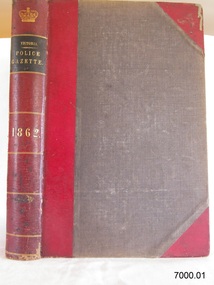
Administrative record - Reference Sociology/History, John Ferres, Government Printer, Victoria Police Gazettes for 1862, 1862
... discharge records with physical descriptions, and lists of pastoralists with descriptions of their livestock brands. No library labels or markings, on first page is the first Gazette for January 2nd 1862. Hard Bound Volume. Victorian Police Gazettes for 1862 Author: Institutional Government Publication Publisher: John Ferres, Melbourne Date: 1862 Further Information: Compilation of Weekly Victorian Police Gazettes for 1862 in a hard bound volume with red spine and red corner reinforcing. ...The Victoria Police Gazette was a confidential, internal publication of the Victoria Police, issued to inform police officers, court and justice officials, and government departments about matters relevant to policing across the colony. It commenced in December 1853 and was initially published weekly by the Victoria Police. It was distributed each week to city and rural police stations and to government offices and newspaper publishers. Inclusions in this weekly publication were people wanted for questioning in relation to various crimes, prisoners discharged from city or country gaols, extracts from Police Gazettes in New South Wales, South Australia, Queensland, Tasmania, New Zealand, and occasionally overseas countries, as well as extracts from the Hobart Town Gazette listing escaped convicts and the person to whom they were assigned. There was also a "Missing Friends" section, where most people listed were not criminals but were sought by police so relatives, old friends, or government officials could renew contact with them. In addition, there was a record of deserted wives and children, listing the offender's name, birthplace, age, occupation, last known area of residence, likely future movements and known relatives. There was also a section on court lists, warrants issued, appointments and staffing changes within the police service, arrest and discharge records with physical descriptions, and lists of pastoralists with descriptions of their livestock brands.Hard Bound Volume. Victorian Police Gazettes for 1862 Author: Institutional Government Publication Publisher: John Ferres, Melbourne Date: 1862 Further Information: Compilation of Weekly Victorian Police Gazettes for 1862 in a hard bound volume with red spine and red corner reinforcing. Front panel grey coloured lettering in gilt with gilt banding to spine. Inside is twelve issues of the Police Gazettes for 1862.non-fictionThe Victoria Police Gazette was a confidential, internal publication of the Victoria Police, issued to inform police officers, court and justice officials, and government departments about matters relevant to policing across the colony. It commenced in December 1853 and was initially published weekly by the Victoria Police. It was distributed each week to city and rural police stations and to government offices and newspaper publishers. Inclusions in this weekly publication were people wanted for questioning in relation to various crimes, prisoners discharged from city or country gaols, extracts from Police Gazettes in New South Wales, South Australia, Queensland, Tasmania, New Zealand, and occasionally overseas countries, as well as extracts from the Hobart Town Gazette listing escaped convicts and the person to whom they were assigned. There was also a "Missing Friends" section, where most people listed were not criminals but were sought by police so relatives, old friends, or government officials could renew contact with them. In addition, there was a record of deserted wives and children, listing the offender's name, birthplace, age, occupation, last known area of residence, likely future movements and known relatives. There was also a section on court lists, warrants issued, appointments and staffing changes within the police service, arrest and discharge records with physical descriptions, and lists of pastoralists with descriptions of their livestock brands.warrnambool, shipwrecked-coast, flagstaff-hill, flagstaff-hill-maritime-museum, maritime-museum, shipwreck-coast, flagstaff-hill-maritime-village, shipwrecked-artefact, book, victoria police gazette 1862, victoria police gazette, warrnambool books and records, great ocean road -
 Bendigo Military Museum
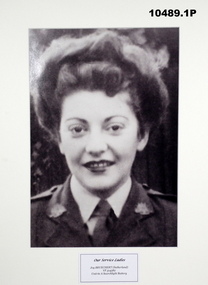
Photograph - SERVICE WOMAN WWII, Bendigo & District RSL Club, Unknown
... discharged with the rank of Gunner in 1st Aust TRG Bty. Joy was a member of the Bendigo Ex Servicewomen’s Association and the Bendigo Women’s Auxiliary of the Bendigo RSL sub Branch. Refer also Cat No 8139.3P. Photographs portrait Service Women WWII Exhibtion Joy Bruechert Information ...Collection of three photographs from WWII displayed in a Bendigo District RSL Exhibition post 2011. Exhibition called "Our Service Ladies". Joy Bruechert (born Bendigo, enlisted Bendigo) 18.12.1943, discharged with the rank of Gunner in 1st Aust TRG Bty. Joy was a member of the Bendigo Ex Servicewomen’s Association and the Bendigo Women’s Auxiliary of the Bendigo RSL sub Branch. Refer also Cat No 8139.3P.1. & 2. & 3. Photographs - black and white copies on photographic paper of a WWII Service Woman, dressed in uniform. Mounts - white cardboard with adhesive label on lower edge with printed information. 1. Portrait of a service woman. 2. Full length portrait in an informal pose of a service woman. 3. Informal group photograph of four service women.Information details - black ink print. 1.2. "Our Service Ladies/ Joy BRUECHERT (Sutherland) VF514382/ Unit 61 A Searchlight Battery". 3. "Our Service Ladies/ Joy BRUCHERT (Sutherland)/ (1st from left)/ 4 of the Ladies from/ Unit 61 A Searchlight Battery".photographs, portrait, service women, wwii, exhibtion, joy bruechert -
 Bendigo Military Museum
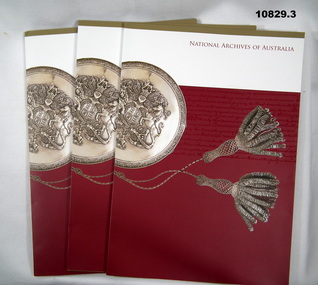
Document - SERVICE RECORDS, WW2, National Archives Aust, Unknown
... Discharge 22 Jul 1940. 3 Name: Reginald Keith MYLONAS Service Number. Publications Documents National Archives of Australia 1. 2. & 3. National Archives of Australia folder with documents pertaining to the Service Records of two servicemen from WW2. Cardboard folder with half pocket, red and white background, red print and gold and silver illustration of a medal with a cord with two tassels. Documents - white paper - with printed information ...Records: 1. & 2. Cat. Reference No. 2502. 3. Cat Reference No. 10531.6. 1. Name: William Arthur BRIGHAM Service Number V78177, DOB 26 Dec 1895. Enlisted 6 Jan 1931. Date of Discharge 7 Sep 1943. 2. Name: William Arthur BRIGHAM Service Number V83502, DOB 26 Dec 1895. Enlisted 11 April 1940. Date of Discharge 22 Jul 1940. 3 Name: Reginald Keith MYLONAS Service Number.1. 2. & 3. National Archives of Australia folder with documents pertaining to the Service Records of two servicemen from WW2. Cardboard folder with half pocket, red and white background, red print and gold and silver illustration of a medal with a cord with two tassels. Documents - white paper - with printed information and photocopied documents.publications, documents, national archives of australia -
 Bendigo Military Museum
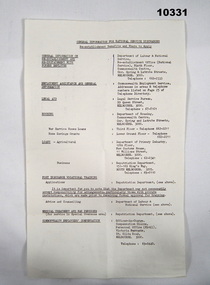
Document - NATIONAL SERVICE RE - ESTABLISMENT
... Document, paper, General Information for National Service Discharges - Re establishment benefits and where to apply. ..."General Information on Re - Establishment and Re - Instalment with former Employee" document re establishment g a jones Document, paper, General Information for National Service Discharges - Re establishment benefits and where to apply. ...Collection re G.A. Jones 3790932, refer Cat No 10053.2P for his service details. The main underlined section of this document is on the top LH side. "General Information on Re - Establishment and Re - Instalment with former Employee"Document, paper, General Information for National Service Discharges - Re establishment benefits and where to apply. All print in black, no dates or signatures. There is 8 underlined headings on LH side, the RH side has addresses, phone No's and name of Department to contact.document, re establishment, g a jones -
 Bendigo Military Museum
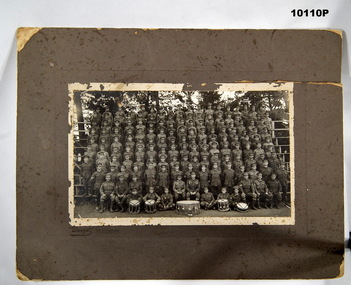
Photograph - 13th REINFORCEMENTS, 6th BTN, WW1, WW1
... Discharged 11.03.1919. Rank records a bit vague but it appears L/Sergeant 26.7.1915 and then Corporal 1.11.1915. Photograph Army WW1 6th Bn Handwritten information - black in pen; "4278/ R. ...Roland Raphael NANCARROW No.4278 Enlisted 22.07.1915 in 13th Reinforcements 6th Bn AIF. Embarked for Egypt 29.12.1915. Embarked for France. Hospital 3.6.1916, Tonsillitis, rejoined unit 30.7.1916. WIA 16.08.1916, shell shock, rejoined unit 18.08.1916. WIA 2nd occasion 31.8.1918 - Gassed. RTA 20.12.1918 - Discharged 11.03.1919. Rank records a bit vague but it appears L/Sergeant 26.7.1915 and then Corporal 1.11.1915. Photograph, black and white, professional formal group. Army photograph of the 13th Reinforcements 6thy Battalion. WW1 undated. NANCARROW, 1st front row standing, 3rd from right. This row is all Corporals and Sergeants. Photograph on paper mounted on card - grey colour cardboard mat. Handwritten information on back.Handwritten information - black in pen; "4278/ R. Nancarrow/ "RAY"/ Roland Raphael". "1st F Row standing/ 32d from R".photograph, army, ww1, 6th bn -
 Bendigo Military Museum
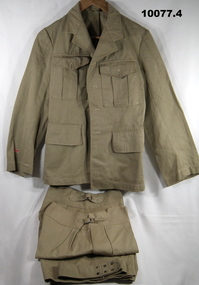
Uniform - WORK DRESS, RAAF, Australian Defence Industries, 1944
... Discharged 18.12.45. Rank LAC No.2 Medical Receiving Station. Refer Cat No. 10052.5P for service history. Uniforms Work Dress RAAF George Henry Haw Manufacturer's details - red ink print. 1. M.TX./ SIZE 16" on right pocket lining. Handwritten - black ink pen "128091/ G. HAW" 3.& 4. Black Ink print - "A^F/ V.324/ MADE IN AUSTRALIA/ 1944/ SIZE 2" Handwritten - black ink pen "128091" on waistband lining. 1.2.3.4. Khaki colour cotton twill fabric. 1. Jacket - work dress style, with collar, four front pockets, top patch with button down flap. Lower - concealed with flap. As above pocket lining. Buttonholes - no buttons. Manufacturer's information ...Uniform issued to "GEORGE HENRY HAW", 128091. Enlisted 22.03.43 - Discharged 18.12.45. Rank LAC No.2 Medical Receiving Station. Refer Cat No. 10052.5P for service history.1.2.3.4. Khaki colour cotton twill fabric. 1. Jacket - work dress style, with collar, four front pockets, top patch with button down flap. Lower - concealed with flap. As above pocket lining. Buttonholes - no buttons. Manufacturer's information - white cotton fabric. Owners information left lower pocket lining. On Right jacket sleeve - service chevron - red and khaki colour. 2. Belt - to above jacket - brown colour plastic button for buckle - no buckle. 3. & 4. Shorts - waistband with side strap and sliding metal buckles. Side pockets Three brown colour plastic fly with two beige colour plastic buttons at waistband. Manufacturer's information - white cotton fabric on waistband lining. Manufacturer's details - red ink print. 1. M.TX./ SIZE 16" on right pocket lining. Handwritten - black ink pen "128091/ G. HAW" 3.& 4. Black Ink print - "A^F/ V.324/ MADE IN AUSTRALIA/ 1944/ SIZE 2" Handwritten - black ink pen "128091" on waistband lining.uniforms, work dress, raaf, george henry haw -
 Bendigo Military Museum
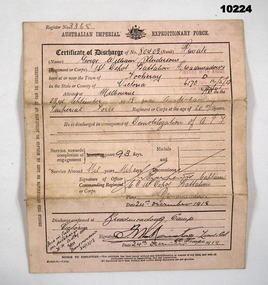
Administrative record - CERTIFICATE OF DISCHARGE, 24 Dec 1918
... Information suggests never served overseas. Was part of the 1st Depot Battalion, Broadmeadows. Part of collection of William (Bill) Thomason, Ref No. 4136P. Collection of William (Bill) Thomason Certificate of Discharge ...Certificate for "George William Anderson". Information suggests never served overseas. Was part of the 1st Depot Battalion, Broadmeadows. Part of collection of William (Bill) Thomason, Ref No. 4136P.Yellow/Pink cardboard certificate of discharge. One side has physical description including scars and birthmarks with his intended address and signatory. Main side has name of soldier being discharged. Some descriptions of origin and his current regiment. Itemises length of service and signed by Commanding Officer of Regiment and dated 24 Dec 1918.Noted at bottom "Paid in full on discharge". Stamp at top saying "Issued with badge and other details" and dated 12 May 1919.collection of william (bill) thomason, certificate of discharge, george william anderson, ww1 -
 Bendigo Military Museum
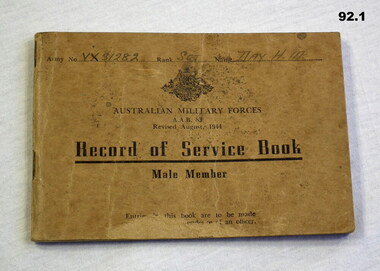
Administrative record - RECORD OF SERVICE BOOK & DISCHARGE CERTIFICATE WW2, 1945
... discharge from the Army 30.11.1945 he was a Sergeant in No 1 Ordnance Field Park AASC. Refer Reg No's 87, 88, 89, 90, 91.2. documents - certificates books - military .1) Handwritten in ink at top: Left: Army No: VX31282 Centre: Rank: Sgt Right: Name: DAY H M .2) Information typed at top centre: VX31282 Sergeant Howard Maxwell DAY 11 Jun 1940 - 30 Nov 1945 .1) Record of Service book A.A.B 83, brown, card covered. .2) Certificate of Discharge No 306694 from the 2nd AIF. ...Items relate to Howard Maxwell DAY VX31282. Born Yackandandah, enlisted Royal Park) 11.6.1940 in the 2nd AIF age 22 years 10 months. Served in the Middle East from 26.12.1940 to 15.3.1942 and Balikpapan from 23.6.1945 to 19.11.1945. On discharge from the Army 30.11.1945 he was a Sergeant in No 1 Ordnance Field Park AASC. Refer Reg No's 87, 88, 89, 90, 91.2. .1) Record of Service book A.A.B 83, brown, card covered. .2) Certificate of Discharge No 306694 from the 2nd AIF. Details name, rank, unit, service home & abroad, enlistment & discharge dates. Paper sheet with black printed ink..1) Handwritten in ink at top: Left: Army No: VX31282 Centre: Rank: Sgt Right: Name: DAY H M .2) Information typed at top centre: VX31282 Sergeant Howard Maxwell DAY 11 Jun 1940 - 30 Nov 1945documents - certificates, books - military -
 Bendigo Military Museum
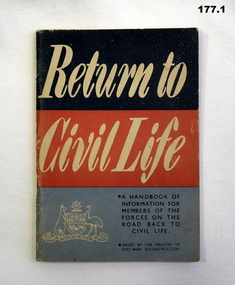
Mixed media - BOOKLETS & LETTER, 1) 1.9.1945 .3) 30.9.1945 .4) 14.6. 1946
... Paperback, white writing on dark blue, red, and light blue cover. .2) Document 'Discharged Servicemen's Clothing Priority Form.' No. 41233 re TX3528, Jordan, A.O. .3) Booklet. 'Information...Paperback, white writing on dark blue, red, and light blue cover. .2) Document 'Discharged Servicemen's Clothing Priority Form.' No. 41233 re TX3528, Jordan, A.O. .3) Booklet. 'Information ...Items belonged to Arnold Oakley JORDAN TX3528 (Tasmanian) POW. Refer Cat No 176 for his service history..1) Book. 'Return to Civil Life.' Paperback, white writing on dark blue, red, and light blue cover. .2) Document 'Discharged Servicemen's Clothing Priority Form.' No. 41233 re TX3528, Jordan, A.O. .3) Booklet. 'Information for Forces in the Far East on Recovery’. Dated 30th Sept. 1945 - light brown in colour. .4) Document, relating to 'Grant of Proficiency Pay' from 15.8.45 re Mr. A.O.Jordanbooks-military, documents-letters -
 Bendigo Military Museum
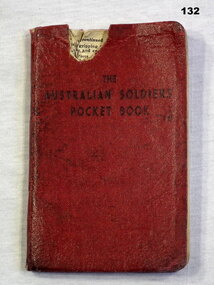
Book - SOLDIERS POCKET BOOK, 1940
... discharged on 10.3.1944. The piece missing in the pocket book was caused by a piece of Shrapnel. documents notebooks personal effects military history army Front cover: "The Australian Soldiers Pocket Book." Inside: "Col McMurray VX 33785 Gunner 2/12th Field Regt" Red-covered book, 127 pages. Useful information ...The book belonged to Colin Lawrance McMURRAY, VX33785 Gunner 2/12th Field Regiment HQ Supply Column 9th Div AIF. (Born Sydney, enlisted Royal Park) on 8.7.40, embarked 5.2.1941, disembarked Middle East 24.3.1941, posted to 2/12th Field Regt, served in the Seige of Tobruk, transferred to AACS 25.11.1941, graded group 3 Driver Mechanic 28.8.1942, hospital with lacerated scalp 12.11.1942, rejoin unit 8.1.1943, embark for Aust 22.2.1943, disembark Sydney 23.3.1943, serves then with canteen services, reclassified medically and discharged on 10.3.1944. The piece missing in the pocket book was caused by a piece of Shrapnel.Red-covered book, 127 pages. Useful information for soldiers. There is a piece missing at the top of the book with tattered sheets inside.Front cover: "The Australian Soldiers Pocket Book." Inside: "Col McMurray VX 33785 Gunner 2/12th Field Regt"documents, notebooks, personal effects, military history, army -
 Bendigo Military Museum
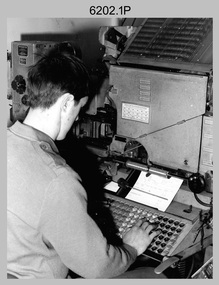
Photograph - Typesetting Equipment and Personnel, Army Survey Regiment, Fortuna, Bendigo, c1968 to 1979
... Any Misc Information: All type on maps was set on this machine. The operator of the machine (Ex SGT Lane) joined the Army in 1956 and was discharged in 1977. ...Any Misc Information: All type on maps was set on this machine. The operator of the machine (Ex SGT Lane) joined the Army in 1956 and was discharged in 1977. ...This is a set of nine photographs of cartographic typesetting equipment and personnel in Cartographic Squadron at the Army Survey Regiment, Fortuna, Bendigo circa 1968 to 1979. The rooms on the top floor of Fortuna Villa where the photos were taken were formally the nursery and boys bedrooms during the Lansell family’s occupation of the building. The Fotosetter type setting machine replaced the letterpress method of type production in 1956. Its operator entered the text using a type order provided by cartographic draughtsmen/ draughtswomen. The type was output on a film positive, which was contacted onto strip film. The text was cut out by cartographic draughtsmen/ draughtswomen and affixed onto type sheets using bees wax. Cartographic Squadron’s CPL Arty Lane specialised in the operation of the Fotosetter type setting machine for many years, as shown in photos .3P and .4P. For more information on the Fotosetter, see page 71 of Valerie Lovejoy’s book 'Mapmakers of Fortuna – A history of the Army Survey Regiment’ ISBN: 0-646-42120-4. The computer based Editwriter Model 7500 typesetting system was introduced in 1975 as a replacement to the aging Fotosetter. It was operated by a specialised technician, who generated a large variety of map type styles and sizes quickly and reliably, as well as text panels. Output on Copy proof adhesive backed stripping type film replaced messy wax and spray adhesives in 1978. The Editwriter capability supported all RASvy units and its contractor type setting requirements. SGT Jim McDonald operated the Editwriter for a couple of years in the late 1970’s. He is seen in photos .7P and .8P. reading off a type order and entering text into the computer. See item 6181.23P, photo .1P for a reduced scale photo of SGT Jim McDonald undertaking this task. Also see item 6123.12P photos .1P and .2P featuring CPL Paul Richards, who was another technician that operated the Editwriter for several years in the 1980s. The Editwriter was also operated by SSGT Pat Lumsden, as featured in photo .9P taken in 1979. The Monotype Photolettering Machine seen in photos .5P and .6P is understood to be in service for a shorter period, as it was not as productive compared to the Fotosetter and Editwriter. This is a set of nine photographs of cartographic typesetting equipment at the Army Survey Regiment, Fortuna, Bendigo, c1968 to c1979. Black and white photos are on photographic paper and scanned at 300 dpi. .1) - Photo, black & white, c1960s, Fotosetter type setting machine, unidentified technician. .2) - Photo, black & white, c1960s, Fotosetter type setting machine. .3) to .4) - Photo, black & white, c1968, Fotosetter type setting machine, CPL Arty Lane. .5) to .6) - Photo, black & white, c1970s, Monotype Photolettering Machine, unidentified technician. .7) to .8) - Photo, black & white, c1979, Typesetting machine, ‘Editwriter’ Model 7500, SGT Jim McDonald. .9) - Photo, black & white, 1979, Typesetting machine, ‘Editwriter’ Model 7500, SSGT Pat Lumsden.Personnel and equipment are identified in photos .1P to .3P. on a card. A description is provided: ‘Fotosetter: This model was used from 1956 to 1974. Where photograph was taken: Army Survey Regiment. Person in Photograph: Arty Lane. Approx date photograph taken: 1968. Any Misc Information: All type on maps was set on this machine. The operator of the machine (Ex SGT Lane) joined the Army in 1956 and was discharged in 1977. Also with Survey from 1942 to 1946. Information given by: Arty Lane’. Photo .9P is dated 1979 on the back.’royal australian survey corps, rasvy, army survey regiment, army svy regt, fortuna, asr, carto
