
Showing 27 items matching "dispersal"
-
 National Wool Museum
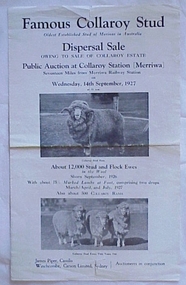
Brochure, Famous Collaroy Stud, Dispersal Sale
... Famous Collaroy Stud, Dispersal Sale...Auction brochure for the Dispersal Sale of the Collaroy Merino Stud, 14th September, 1927....Auction brochure for the Dispersal Sale of the Collaroy Merino Stud, 14th September, 1927. ...Famous collaroy Stud...Dispersal sale...Public Austion at Collaroy Station (Merriwa)...Wednesday, 14th September, 1927.. ...Auction brochure for the Dispersal Sale of the Collaroy Merino Stud, 14th September, 1927. ...Auction brochure for the Dispersal Sale of the Collaroy Merino Stud, 14th September, 1927.Auction brochure for the Dispersal Sale of the Collaroy Merino Stud, 14th September, 1927. Auction brochure for the Dispersal Sale of the Collaroy Merino Stud, 14th September, 1927. Auction brochure for the Dispersal Sale of the Collaroy Merino Stud, 14th September, 1927.Famous collaroy Stud...Dispersal sale...Public Austion at Collaroy Station (Merriwa)...Wednesday, 14th September, 1927.. ESSEXmerino sheep, sturgeon merino, sturgeon, mr glen, collaroy station, merriwa -
 Ballarat Tramway Museum
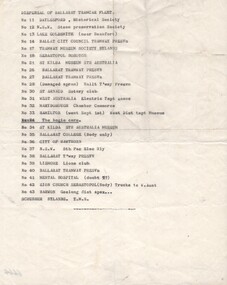
Document - List, Tom Murray, "Dispersal of Ballarat Tramcar Fleet", late 1971
... "Dispersal of Ballarat Tramcar Fleet"...Typed list on quarto paper titled "Dispersal of Ballarat Tramcar Fleet", giving a list with a few queries of the dispersal or allocation of ex Ballarat trams. ...SEC Ballarat Disposal Tramcars Typed list on quarto paper titled "Dispersal of Ballarat Tramcar Fleet", giving a list with a few queries of the dispersal or allocation of ex Ballarat trams. ...Yields information about the disposal of the SEC Ballarat tramcar fleet and locations.Typed list on quarto paper titled "Dispersal of Ballarat Tramcar Fleet", giving a list with a few queries of the dispersal or allocation of ex Ballarat trams. Not correct for No. 30 or 41. Possibly prepared by Tom Murray. See also Reg items 3929 and 5444 for other lists. sec, ballarat, disposal, tramcars -
 Tatura Irrigation & Wartime Camps Museum
Document, dispersal sale of the Hay camps, 1947
... dispersal sale of the Hay camps...In clear plastic folder - an amusing account of the dispersal sale of the Hay camps 1947. Reprints March 12 '90. 50th Dunera reunion and letter from Walter Kaufmann to his old school friend Eric Eckstein and reflections of Charles Ehrlich . ...Unknown hay site dispersal As bove In clear plastic folder - an amusing account of the dispersal sale of the Hay camps 1947. ...UnknownIn clear plastic folder - an amusing account of the dispersal sale of the Hay camps 1947. Reprints March 12 '90. 50th Dunera reunion and letter from Walter Kaufmann to his old school friend Eric Eckstein and reflections of Charles Ehrlich . Names of guests who attended Sydney Annual Dunera reunionAs bovehay site dispersal -
 National Wool Museum
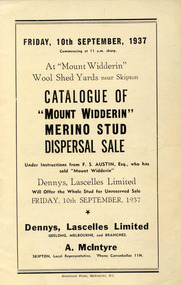
Booklet, Catalogue of Mount Widderin Merino Stud Dispersal Sale, 10 Sept. 1937
... Catalogue of Mount Widderin Merino Stud Dispersal Sale, 10 Sept. 1937..."Catalogue of 'Mount Widderin' Merino Stud Dispersal Sale" - Dennys, Lascelles Limited, 10 Sept. 1937. ..."Catalogue of 'Mount Widderin' Merino Stud Dispersal Sale" - Dennys, Lascelles Limited, 10 Sept. 1937. ..."Catalogue of 'Mount Widderin' Merino Stud Dispersal Sale" - Dennys, Lascelles Limited, 10 Sept. 1937. Catalogue from the sale of stud sheep from the Mount Widderin stud near Skipton. The Mount Widderin stud was owned by Mr F.S. Austin and was founded from the Wanganella Stud, thus descending from the original Peppin Merino line. Mr Austin introduced the Carngham strain into these sheep.Booklet / catalogue for a merino stud sale at Mount Widderin, 10-9-1937.sheep sales, merino sheep, dennys, lascelles limited, austin, mr f. s., mount widderin stud, skipton -
 National Wool Museum
Book, Review of Textile Progress Vol. 1
... One of several books donated to the Museum from the Launceston Institute of TAFE Library, after dispersal of its collection of technical books....One of several books donated to the Museum from the Launceston Institute of TAFE Library, after dispersal of its collection of technical books....One of several books donated to the Museum from the Launceston Institute of TAFE Library, after dispersal of its collection of technical books. ...One of several books donated to the Museum from the Launceston Institute of TAFE Library, after dispersal of its collection of technical books.One of several books donated to the Museum from the Launceston Institute of TAFE Library, after dispersal of its collection of technical books.For Kelsall & Kemp (Tasmania) Limitedtextile production textile research textile testing, textile institute society of dyers and colourists, hallam, ms janet - launceston institute of tafe, textile production, textile research, textile testing -
 Flagstaff Hill Maritime Museum and Village
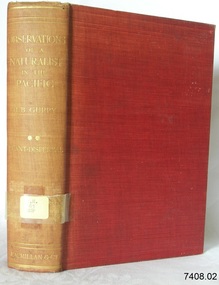
Book, Observations of a Naturalist in The Pacific Vol 2
... Observations of a Naturalist in The Pacific Vol 2 Between 1896 and 1899 Plant Dispersal Author: H B Guppy, M.B., F.R.S.E. Publisher: MacMillan & Co Date: 1906 ...Warrnambool Shipwrecked-coast Flagstaff-Hill Flagstaff-Hill-Maritime-Museum Maritime-Museum Shipwreck-coast Flagstaff-Hill-Maritime-Village Shipwrecked-artefact Book Warrnambool Mechanics’ Institute Observations of a Naturalist in The Pacific Vol 2 H B Guppy Label on spine with typed text RH 561 GUP Pastedown end page has sticker from Warrnambool Mechanics Institute and Free Library Observations of a Naturalist in The Pacific Vol 2 Between 1896 and 1899 Plant Dispersal Author: H B Guppy, M.B., F.R.S.E. Publisher: MacMillan & Co Date: 1906 Observations of a Naturalist in The Pacific Vol 2 Book ...Observations of a Naturalist in The Pacific Vol 2 Between 1896 and 1899 Plant Dispersal Author: H B Guppy, M.B., F.R.S.E. Publisher: MacMillan & Co Date: 1906 Label on spine with typed text RH 561 GUP Pastedown end page has sticker from Warrnambool Mechanics Institute and Free Librarywarrnambool, shipwrecked-coast, flagstaff-hill, flagstaff-hill-maritime-museum, maritime-museum, shipwreck-coast, flagstaff-hill-maritime-village, shipwrecked-artefact, book, warrnambool mechanics’ institute, observations of a naturalist in the pacific vol 2, h b guppy -
 Robin Boyd Foundation
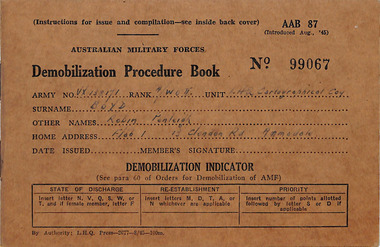
Booklet, Australian Military Forces, Demobilization Procedure Book, Sep-45
... Demobilization Procedure Book No 99067 belonging to Robin Penleigh Boyd. The Dispersal Data Form on page 25 states that Robin Boyd commenced full-time war service on 19 November 1941. ...Demobilization Procedure Book No 99067 belonging to Robin Penleigh Boyd. The Dispersal Data Form on page 25 states that Robin Boyd commenced full-time war service on 19 November 1941. ...Demobilization Procedure Book No 99067 belonging to Robin Penleigh Boyd. The Dispersal Data Form on page 25 states that Robin Boyd commenced full-time war service on 19 November 1941. It is signed 17 September 1945.32 pages with brown cardboard cover. -
 Nhill Aviation Heritage Centre
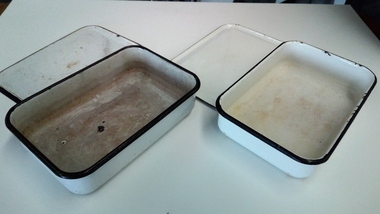
Memorabilia - Two baking dishes
... Maybery of Gymbown at the Nhill Air School dispersal sale in 1948. The dishes were used at the Nhill Air School to roast vegetables such as potatoes, pumpkin, carrots etc. ...Maybery of Gymbown at the Nhill Air School dispersal sale in 1948. The dishes were used at the Nhill Air School to roast vegetables such as potatoes, pumpkin, carrots etc. ...Purchased by L.G. Maybery of Gymbown at the Nhill Air School dispersal sale in 1948. The dishes were used at the Nhill Air School to roast vegetables such as potatoes, pumpkin, carrots etc. These dishes were donated by L.G.Maybery's daughter, Inez SpriggsWhite enamel baking dishes with enamel lids edged in black -
 Melton City Libraries
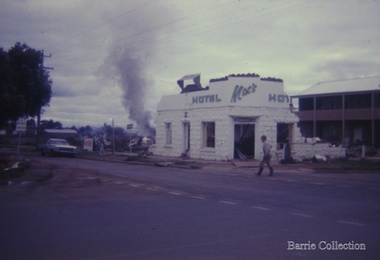
Photograph, Macs Hotel Demolition, 1973
... Hay’s estate was in the preliminary stages of dispersal and the hotel known as Minns was sold to a Mr McDowell of South Melbourne. ...Hay’s estate was in the preliminary stages of dispersal and the hotel known as Minns was sold to a Mr McDowell of South Melbourne. ...Minn's Hotel established by George Minns. In 1911 the late Mrs. Hay’s estate was in the preliminary stages of dispersal and the hotel known as Minns was sold to a Mr McDowell of South Melbourne. Mr. McDowell lived in Melton for five and a half years, and it was during this time that the cottage was erected in High Street and the hotel became Macs.Mac’s Hotel under demolition (Minns)local architecture -
 Bendigo Military Museum
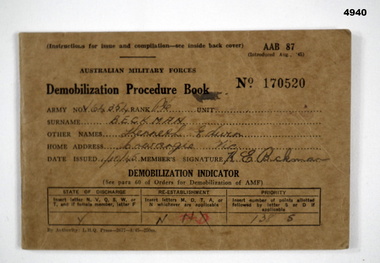
Administrative record - DEMOBILIZATION PROCEDURE BOOK, Australian Army
... It shows details such as leave entitlements, education levels and his dispersal data form DOB 11/12/1917. He was a farmer from Cowangie, Vic....It shows details such as leave entitlements, education levels and his dispersal data form DOB 11/12/1917. He was a farmer from Cowangie, Vic. ...See Cat 3163Pocket sized book. Cardboard cover, Khaki colour. Bound with 2 staples. Inside there are 31 pages. Inside are demob details for Pte Kenneth Edwin Beckman V64354. Discharged 3/10/45 from 7 Bn (AIF). It shows details such as leave entitlements, education levels and his dispersal data form DOB 11/12/1917. He was a farmer from Cowangie, Vic.Front cover has his full name. NR Home address. Issues 1 Oct 1945. Discharged in Vic.demob procedure book, ww2 -
 Ballarat Tramway Museum
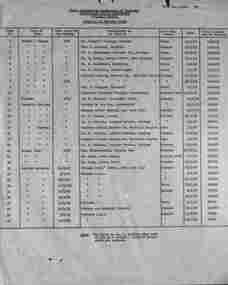
Administrative record - Geelong, State Electricity Commission of Victoria, "Disposal of Rolling Stock", 5/1961
... List details the disposal or dispersal of the Geelong Tram fleet following closure in 1956. ...List details the disposal or dispersal of the Geelong Tram fleet following closure in 1956. ...List details the disposal or dispersal of the Geelong Tram fleet following closure in 1956. Prepared by the Ballarat office of the SEC and dated 11/5/1961. Lists the tram number, type of tram, date received by Geelong, Transferred or sold to, last trip route, date of its last trap and total mileage in Geelong. Notes the three trams sold to Mr Jullien who as a dealer on sold them and "ultimate placement unknown"Demonstrates a typed list of the sale or dispersal of tramcars ex Geelong.Carbon Copy of a typed document on a large folio sheet.tramways, state electricity commission of victoria, geelong, tramcars, sale of trams, tram disposal, secv -
 Churchill Island Heritage Precinct
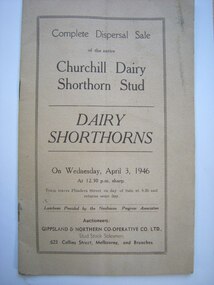
Document - Sales booklet, April 3, 1946
... Complete Dispersal Sale/of the entire/Churchill Dairy Shorthorn Stud/DAIRY SHORTHORNS/On Wednesday, April 3, 1946/At 12.30 p.m. sharp....Complete Dispersal Sale/of the entire/Churchill Dairy Shorthorn Stud/DAIRY SHORTHORNS/On Wednesday, April 3, 1946/At 12.30 p.m. sharp. ...A sales document for the complete Dispersal Sale of the Churchill Island Dairy Shorthorn Stud held on Wednesday, April 3, 1946.Small bound document featuring sales information on plain blue front cover.non-fictionA sales document for the complete Dispersal Sale of the Churchill Island Dairy Shorthorn Stud held on Wednesday, April 3, 1946.churchill island, dairy shorthorns, dairy farming, livestock, breeding, jenkins -
 Melton City Libraries
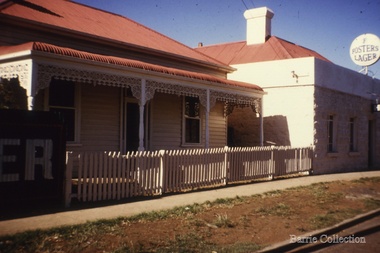
Photograph, Mac's Cottage, c.1970
... Hay’s estate was in the preliminary stages of dispersal and the hotel known as Minns was sold to a Mr McDowell of South Melbourne. ...Hay’s estate was in the preliminary stages of dispersal and the hotel known as Minns was sold to a Mr McDowell of South Melbourne. ...In 1911 the late Mrs. Hay’s estate was in the preliminary stages of dispersal and the hotel known as Minns was sold to a Mr McDowell of South Melbourne. Mr. McDowell lived in Melton for five and a half years, and it was during this time that the cottage was erected in High Street and the hotel became Macs. Mr McDowell sold the property to the McNichol family, who did not live in the cottage. Mrs McNichol’s sister later married A. McDonald of Melton South and occupancy was continued from that time. At time of removal 1977 to the Willows Park was under licence of Reidy family, owners of Macs Hotel High street, Melton.Weatherboard cottage located next to Mac's Hotel.local architecture -
 Ballarat Tramway Museum
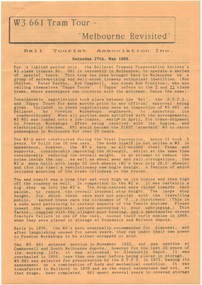
Ephemera - Tour Booking Form, Rail Tourist Association, "W3 661 Tram tour - Melbourne Revisited", May. 1989
... Also contained on pages 1 and 2 are notes on W3 class trams, their history and dispersal. Pages 2, 3 and 4 give details of the tour and the booking form. ...Also contained on pages 1 and 2 are notes on W3 class trams, their history and dispersal. Pages 2, 3 and 4 give details of the tour and the booking form. ...Four page (two sheets of A4 - double sided) on gold paper, printed as a Tour Booking form for a tour of Melbourne tram lines, titled "W3 661 Tram tour - Melbourne Revisited" for 27/5/1989. The tram was on loan at the time to "Yappa Tours" from the BTPS. See first and second paragraphs for details of the tram being in Melbourne. Also contained on pages 1 and 2 are notes on W3 class trams, their history and dispersal. Pages 2, 3 and 4 give details of the tour and the booking form. Tour operated by the Rail Tourist Association. Tour booking officer was Geoff Cargeeg. Printed using a typed wax stencil and then duplicated. The two sheets have been stapled in the top left hand corner. Note spelling of "Yappa" - other documents have used "Yapper"w3 class, yapper tours, rail tourist association, tours -
 Wangaratta RSL Sub Branch
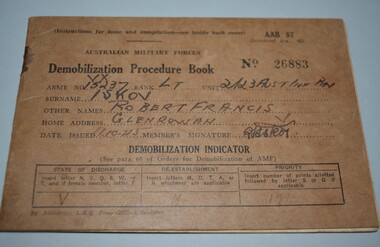
Booklet - Demobilization Procedure Book, LHQ Press, C1945
... It guided them through dispersal, rehabilitation, and discharge. Item belonged to Robert Francis ISKOV VX15237 served with the 59th Battalion/Hume Regiment CMF before joining the 2/14th Battalion at Caulfield in September 1940. ...It guided them through dispersal, rehabilitation, and discharge. Item belonged to Robert Francis ISKOV VX15237 served with the 59th Battalion/Hume Regiment CMF before joining the 2/14th Battalion at Caulfield in September 1940. ...The Demobilization Procedure Book (reference AAB 87) was an essential handbook issued by the Australian Military Forces (AMF) to service personnel at the end of World War II. It guided them through dispersal, rehabilitation, and discharge. Item belonged to Robert Francis ISKOV VX15237 served with the 59th Battalion/Hume Regiment CMF before joining the 2/14th Battalion at Caulfield in September 1940. He disembarked for the Middle East in November, 1940 and fought in the Syrian campaign in 1941. In 1942 the 2/14th Battalion returned to Australia and sent to Papua where he fought at the Battle of Isurava before the battalion was sent to Gona. On 1943 Bob returned to Australia to undertake officer training and in 1945 with the 2/23rd Battalion sailed to Morotai and served with the battalion on Tarakan. He returned to Australia in November, 1945 and discharged a month later Brown cardboard booklet with lettering in black ink on front cover containing 32 pagesNo 26883 VX15237 LT 2/23 Aust Inf Bn Robert Francis ISKOV Glenrowan Date issued 11.10.1945 ww2, bob iskov, demobilization procedure book, amf -
 Bendigo Military Museum
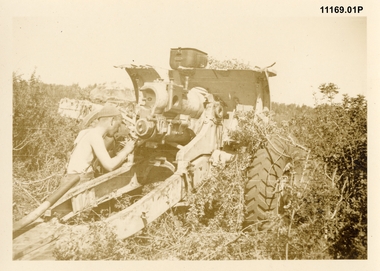
Photograph - FREDERICK HARCOURT COLLECTION, 2nd/2nd Field Workshop Western Desert 1940-1941
... Image 11169.10P shows the dispersal of the unit in encampment. Note the couple of artillery pieces being repaired. ...Image 11169.10P shows the dispersal of the unit in encampment. Note the couple of artillery pieces being repaired. ...These photographs were likely taken by Frederick Harcourt VX18344, detailing the personnel and working conditions of the 2nd/2nd Field Workshops during the desert campaign in 1940-41. Harcourt was himself a member of the unit. The job of the field workshops was to repair and maintain equipment in the field, as is illustrated by images showing a member maintaining the breach of a 6-pounder anti-tank gun. Image 11169.07P is of particular interest, showing in detail the mobile workshop and equipment. Image 11169.10P shows the dispersal of the unit in encampment. Note the couple of artillery pieces being repaired. Some of the personnel shown in these images are: Bamford, Frank Lesley. VX 19872 Newcombe, Keith VX 30716 Bartram, Wilfred VX 47765 Barrow, D.F. VX 4403 Canning, J.C.M. VX 19705 Spring, J.O.B. VX 35676 Filler, W.R. VX 31421 Collection of photographs detailing personnel and work of 2nd/2nd Field workshops in Western DesertSome photographs with captions on rear, included in images2nd/2nd field workshops western desert, frederick harcourt -
 The Beechworth Burke Museum
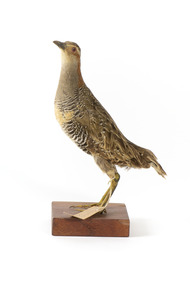
Animal specimen - Buff-banded rail, Trustees of the Australian Museum, 1860-1880
... The buff-banded rail is a medium-sized bird in the rail family, Rallidae, known for its striking plumage and strong dispersal abilities. This species includes multiple subspecies found across Australasia and the southwest Pacific, with populations in the Philippines, where it is called tikling, and New Guinea, Australia, New Zealand, where it is referred to as the banded rail or moho-pererū in Māori—and various smaller islands. ...The buff-banded rail is a medium-sized bird in the rail family, Rallidae, known for its striking plumage and strong dispersal abilities. This species includes multiple subspecies found across Australasia and the southwest Pacific, with populations in the Philippines, where it is called tikling, and New Guinea, Australia, New Zealand, where it is referred to as the banded rail or moho-pererū in Māori—and various smaller islands. ...The buff-banded rail is a medium-sized bird in the rail family, Rallidae, known for its striking plumage and strong dispersal abilities. This species includes multiple subspecies found across Australasia and the southwest Pacific, with populations in the Philippines, where it is called tikling, and New Guinea, Australia, New Zealand, where it is referred to as the banded rail or moho-pererū in Māori—and various smaller islands. This specimen was misidentified as an Australian Spotted Crake in original catalogue records and is part of a collection of almost 200 animal specimens that were originally acquired as skins from various institutions across Australia, including the Australian Museum and the National Museum of Victoria, as well as individuals such amateur anthropologist Reynell Eveleigh Johns between 1860-1880. These skins were then mounted by members of the Burke Museum Committee and put-on display in the formal space of the Museum’s original exhibition hall where they continue to be on display. This display of taxidermy mounts initially served to instruct visitors to the Burke Museum of the natural world around them, today it serves as an insight into the collecting habits of the 19th century. This specimen is part of a significant and rare taxidermy mount collection in the Burke Museum. This collection is scientifically and culturally important for reminding us of how science continues to shape our understanding of the modern world. They demonstrate a capacity to hold evidence of how Australia’s fauna history existed in the past and are potentially important for future environmental research. This collection continues to be on display in the Museum and has become a key part to interpreting the collecting habits of the 19th century.This specimen is a small, stocky bird with yellow legs and bill. The Buff-banded Rail has grey colouring on its neck and an orange on the nape of its neck. The torso and rear are striped with black and grey/cream colours and have white spots along the rear. The specimen has brown feathers on the wings. It stands on a wooden platform in a standing position with a paper identification tag tied around its left leg. 19c Spotted Water Crake. See Catalogue, Page, 35.taxidermy mount, taxidermy, animalia, burke museum, beechworth, australian museum, skin, reynell eveleigh johns, bird, spotted crake, crake, australian birds, australian spotted crake, buff-banded rail -
 National Wool Museum
Photograph - Portrait of Jarrah Wadsworth, Nicole Marie, 2021
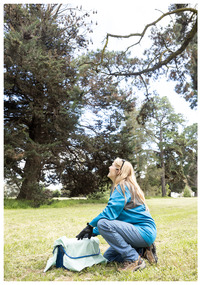
... They play a critical role in hardwood forest pollination and seed dispersal. They are often not well liked and can be seen as more of a nuisance than an asset to an area. ...They play a critical role in hardwood forest pollination and seed dispersal. They are often not well liked and can be seen as more of a nuisance than an asset to an area. ...Thousands of volunteers work tirelessly to conserve and protect the environment of Geelong and the Bellarine. Their work often goes unnoticed. In 'The Work of Nature' the National Wool Museum and the Environment Department at the City of Greater Geelong worked with photographer Nicole Marie to showcase the significant contribution of environment volunteers in our region. Each of the eight people showcased in these portraits were nominated by their peers and members of the community for their significant contribution to conserving and protecting the environment. Jarrah Wadsworth - Friends of Bats and Bushcare Geelong Grey-headed flying foxes are listed as nationally threatened. They play a critical role in hardwood forest pollination and seed dispersal. They are often not well liked and can be seen as more of a nuisance than an asset to an area. Their numbers are rapidly declining. As the world warms and we experience more days of extreme heat they are increasingly threatened. Jarrah is a registered vet nurse and in her spare time heads up the Friends of Bats and Bushcare Geelong volunteer group. She is the coordinator of the FBBG and plays a key role in supporting the Geelong grey-headed flying fox population in Eastern Park and ensuring they survive extreme heat events. Photo at Eastern Park flying fox camp by Nicole Marie.Image showing an environmental portrait of a woman crouched on grass below trees where fruit bats are roosting.environment, conservation, portraits, geelong, nature, exhibition, work of nature, geelong nature forum, volunteers, eastern park -
Moorabbin Air Museum
Book - Avro Lancaster, The Lancaster At War
... ...Dispersal...Avro Lancaster Early days In production Entry in to service Making ready Bombing up 20 Lancasters Fuelling Dispersal Briefings Interiors Start up First flight on ops Taxying & marshalling Take off En route On target The way back Safely home After the raid Battle damage Prangs Under repair Insignia Mercy missions Canadian Lancasters Graveyards The Dam Busters Historical overview of Avro Lancaster at war, circa 1972 The Lancaster At War Book Avro Lancaster ...Historical overview of Avro Lancaster at war, circa 1972non-fictionHistorical overview of Avro Lancaster at war, circa 1972early days, in production, entry in to service, making ready, bombing up, 20 lancasters, fuelling, dispersal, briefings, interiors, start up, first flight on ops, taxying & marshalling, take off, en route, on target, the way back, safely home, after the raid, battle damage, prangs, under repair, insignia, mercy missions, canadian lancasters, graveyards, the dam busters -
 Flagstaff Hill Maritime Museum and Village
Book - Fiction, Hal Porter, author, The Tilted Cross, 1961
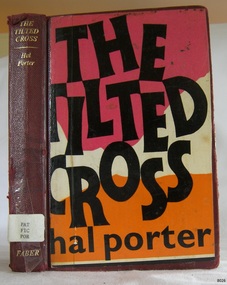
... In 1963, the Warrnambool City Council designated the site of the Mechanics’ Institute building—which included the Public Library, Museum, and Art Gallery—for the new Municipal Offices, resulting in the dispersal of the collections until 1971. The Warrnambool Library subsequently assumed responsibility for the Mechanics’ Institute Library’s holdings on behalf of the City Council. ...In 1963, the Warrnambool City Council designated the site of the Mechanics’ Institute building—which included the Public Library, Museum, and Art Gallery—for the new Municipal Offices, resulting in the dispersal of the collections until 1971. The Warrnambool Library subsequently assumed responsibility for the Mechanics’ Institute Library’s holdings on behalf of the City Council. ...The Pattison Collection: The ‘Pattison Collection’ comprises books and records that were originally owned by the Warrnambool Mechanics’ Institute, which was established in Warrnambool in 1853. By 1886, the Institute had expanded significantly, boasting a Library, Museum, and Fine Arts Gallery. The collection included notable works of art and valuable specimens from various fields, as well as remarkable national curiosities and historic relics relating to the town and district. The Institute later incorporated a School of Design. Despite being popular with the public, the Institute struggled financially and, in 1911, requested that the City Council assume control. In 1935, Ralph Pattison was appointed as City Librarian to establish and organise what was then known as the Warrnambool Library. When the Mechanics’ Institute building was demolished in 1963, a new civic building was constructed on the site, and the Warrnambool Library, managed by the City Council, acquired all the holdings of the WMI. It was during this transition that certain items were separated and designated as the ‘Pattison Collection’, in honour of Ralph Pattison. Over time, the various components of the WMI were distributed among different institutions, including the Art Gallery, Historical Society, and Flagstaff Hill. Some items were also sent to other regional branches of the Corangamite Regional Library, and their exact locations have become difficult to trace. The books at Flagstaff Hill Maritime Village typically bear stamps and markings from Pattison and various other institutions, including the Mechanics’ Institute itself. Ralph Eric Pattison: Ralph Eric Pattison was born in Rockhampton, Queensland, in 1891. In 1920, he married Maude Swan from Warrnambool, and the couple settled in Warrnambool. Pattison accepted the role of City Librarian for the Warrnambool City Council in 1935. Tasked with transforming two rooms in the Mechanics’ Institute into a functional library, he diligently cleaned, sorted, and organised a disordered collection of old books, jars of preserved specimens, and assorted items previously reserved for the city’s museum. Pattison expanded and modernised the library, ensuring it catered to a broad range of interests, including providing reference books for students—a challenging feat in the years following the Depression. He converted the lower level of the building into a library, reference room, and reading room for both members and the public. Books were organised using a cataloguing and card index system that Pattison designed himself. He also prepared the upper floor, establishing both an Art Gallery and, later, a Museum to display the many historical relics collected over the years. Among these treasures was a beautiful antique clock, which Pattison restored and used in his office throughout his tenure. He was known as a meticulous gentleman, recognised for his punctuality, impeccable courtesy, and neat appearance. His restored clock regulated his daily routine and the precise opening and closing of the library’s doors. During 1942 to 1945, Pattison took leave to serve as a Lieutenant in the Royal Australian Navy Volunteer Reserve. A few years later, he converted one of the Museum’s rooms into a Children’s Library, which quickly became popular. In the 1950s, Pattison was appointed to the Victorian Library Board, where he gained further inspiration from monthly conferences in Melbourne. He retired in 1959, after more than 23 years of service, due to having surpassed the working age limit for council officers. Nevertheless, Pattison maintained a strong interest in the ongoing development of the Library until his death in 1969. Warrnambool Public Library: The Warrnambool Mechanics’ Institute (WMI) originated from a voluntary community group in 1863, just six years after the founding of Warrnambool, with its Reading Room opening in 1854. The WMI remained in operation until 1963 and was among the oldest Mechanics’ Institutes in Victoria. Mechanics’ Institutes provided essential public services, including libraries, reading rooms, and spaces for the exhibition and storage of curiosities and local historical relics. In 1886, a Museum and Fine Arts Gallery were added to the WMI, and by the early 20th century, it also featured a billiards room and a School of Art. At this time, it was common for country Victorian Mechanics’ Institutes to have attached museums. Over the years, the Warrnambool Mechanics’ Institute Library was also referred to as the Warrnambool Public Library, the Warrnambool Library, and the Free Library. Early government funding was provided for the “Free Library”. For example, a book titled “Science of Man” was inscribed for the “Warrnambool Public Library” and donated by Joseph Archibald in 1899. Another book, “Catalogue of Plants Under Cultivation in the Melbourne Botanic Gardens 1 & 2, 1883”, was presented to the “Warrnambool Library” and signed by the author W.R. Guilfoyle. In 1903, the Warrnambool Public Library established a Juvenile Department, stocking hundreds of books suitable for young readers. In 1905, the committee updated the book collection by adding 100 new novels and arranging for the latest novels to be included as soon as they became available in Victoria. By July 1911, the Warrnambool Council had assumed management of the Public Library, Art Gallery, Museum, and Mechanics’ Institute, with plans to double the size of the existing building. In 1953, under the stewardship of Mr. R. Pattison, the Warrnambool Public Library’s senior section contained 10,000 fiction books out of a total of 13,000. The children’s section held an additional 3,400 books, equating to one book per head of population and serving around 33 percent of the local reading public. The collection comprised approximately 60 percent reference books and 40 percent fiction, with the library lending out 400 books per day. In 1963, the Warrnambool City Council designated the site of the Mechanics’ Institute building—which included the Public Library, Museum, and Art Gallery—for the new Municipal Offices, resulting in the dispersal of the collections until 1971. The Warrnambool Library subsequently assumed responsibility for the Mechanics’ Institute Library’s holdings on behalf of the City Council. Since the closure of the Mechanics’ Institute, the precise location and composition of the original WMI books and items have become unclear. Additional items have entered the collection over time, including materials from Terang MI, Warrnambool Court House, and Customs House. Many books are now identified as part of the Pattison Collection, named after the librarian who catalogued and numbered them before the Mechanics’ Institute closed. When Warrnambool joined the Corangamite Regional Library, some books and materials were sent to its head office in Colac and later returned to Warrnambool, where they were stored at the Art Gallery for an extended period. Some items subsequently went to the Warrnambool Historical Society, some remained at the Art Gallery, and others were transferred to Flagstaff Hill Maritime Village. The various stamps and labels on the books at Flagstaff Hill reflect the diverse distribution and origins of the collection. The books currently held at Flagstaff Hill Maritime Village date from the 1850s to the late 1950s and include rare and valuable volumes. Many are part of the “Pattison Collection”, named after Warrnambool’s Public Librarian, Mr. R. Pattison.Integration and Significance of the WMI Publication Collection: Many components of the Warrnambool Mechanics' Institute (WMI) publication collection serve to complement and reinforce other important cultural collections in the region, including those held by the Flagstaff Hill Maritime Museum, the Warrnambool Art Gallery, and the Warrnambool Historical Society. Collectively, these collections provide a more comprehensive understanding of the origins and development of the original Warrnambool Mechanics' Institute holdings. The presence and integration of these materials not only enhance the appreciation of the few remaining Mechanics' Institute collections in Victoria, but also contribute to the recognition of similar collections in New South Wales. Examining both the similarities and differences among these surviving collections offers valuable insights into the ways in which the people of Victoria—and the community of Warrnambool in particular—constructed a civic culture centred on adult education, ultimately fostering an informed and engaged citizenry. Local and State Importance: The Warrnambool Mechanics' Institute publication collection is significant at local and state levels. Its value lies in its relationship to other cultural collections, its historical context, and its enduring role in supporting the intellectual and social development of the community.The Tilted Cross Author: Hal Porter Publisher: Faber and Faber. London Date: 1961 Hardcover bound book with gold embossed titles on the spine, and a pasted-on title on the front cover. Inscriptions are on labels on the spine and front loose endpaper, and on a stamp on the fly page. The book is part of the Pattison CollectionLabel with typed text": "PAT FIC POR" Sticker: "Corangamite Regional Library Service" Stamp: "Warrnambool Public Library"warrnambool, shipwrecked-coast, flagstaff-hill, flagstaff-hill-maritime-museum, maritime-museum, shipwreck-coast, flagstaff-hill-maritime-village, shipwrecked-artefact, book, pattison collection, warrnambool library, warrnambool mechanics’ institute, ralph eric pattison, corangamite regional library service, warrnambool city librarian, mechanics’ institute library, victorian library board, warrnambool books and records, warrnambool children’s library, great ocean road, the tilted cross, hal porter -
 Melbourne Legacy
Document - Speech, Commemorative Address - Sir Stanley Savige K.B.E. Federal Conference of Legacy Clubs, Canberra, 10/1954
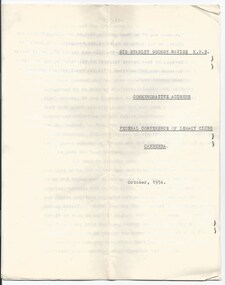
... He was called up again and again to perform important national tasks, notably that of Co-ordinator of Demobilisation and Dispersal. But his interest in Legacy never flagged it was in fact more personal than ever, for under his command many junior legatees, sons of former comrades had proved themselves worthy of their Fathers in war and in peace. ...He was called up again and again to perform important national tasks, notably that of Co-ordinator of Demobilisation and Dispersal. But his interest in Legacy never flagged it was in fact more personal than ever, for under his command many junior legatees, sons of former comrades had proved themselves worthy of their Fathers in war and in peace. ...After the death of Stan Savige this address was given at the Canberra Conference in October 1954. It is tribute to his life. Sir Stanley Savige KBE : Commemorative Address Federal Conference of Legacy Clubs, Canberra : October 1954. On the 15th of May this year Legacy learned to its enduring sorrow of the death of its Founder, Lieut. General Stanley George Savige KBE, CB, CBE, DSO, MC, ED, for more than 30 years affectionately known to us all as Legatee Stan Savige. He was the embodiment of all those things for which Legacy stands, and each one of us who knew him and worked with him feels a great and abiding sense of personal loss. It is proper, therefore, that those of us at this Conference, the first after his passing, representative of Legacy throughout the Commonwealth, and comprising so many who were his friends, so many who knew the depth of his love for Legacy, should acknowledge our debt to our Founder and ensure, so far as we may, that the inspiration of his life and work in this Cause shall not be lost to those who follow after. It was not ordained that Stanley George Savige - should enjoy a long life, but it was to prove a life of outstanding service. Born at Morwell in Victoria some 63 years ago, he received with his brothers and sisters such education as was then available to a lad in a mining district. He had no particular opportunities of advancement, but from his early days he cherished a strong ambition to make a success of his life, and with this in view he lost no opportunity of adding to his knowledge. Always a lover of the open country, a good bushman and a fine shot, he became as a young man, a Scoutmaster with a keen following of boys. Even in those early days he attracted youth and showed undoubted promise of the quality of leadership which later was to make him famous. Opportunity came with the first World War, and he took his place as a private soldier in the original 24th Battalion AIF. Followed Gallipoli and Anzac where his marksmanship and bush craft stood him in good stead. Conscious that his early training was not sufficient to secure the promotion he desired, he set himself to enlarge it. Only a man of fine fibre and rare determination could apply himself to study on that war torn Peninsula, where our men, hitherto untested, suffered every known hardship and no man knew, from hour to hour, whether he would survive. But Savige achieved it. Himself then a Corporal he found another Corporal who was a former Schoolmaster and learned from him all that he had to teach. Savige was on his way. He was commissioned on the Field and allotted the heroic task of leading the last party off that desperate coast during the famous evacuation. In France he became the Adjutant of his Battalion and one of the best known officers in the 6th Brigade. He won the Military Cross and was mentioned in despatches. Early in 1918 he received a signal distinction, He was included in a small but distinguished band of Officers and Non-Commissioned Officers from the British and Dominion Forces most carefully selected for individual courage and proved qualities of leadership, and was sent to Persia, under the command of Major-General Dunsterville, Kipling’s famous Stalky, to assist and mobilise the friendly tribes with a view to protecting the road to India, left wide open by the withdrawal of Russia. The story of the Dunsterforce, its suffering and achievements in the face of incredible hardships and difficulties, was later to be told by Savige in his book “Stalky’s Forlorn Hope”. He emerged, finally, unscathed, despite his active participation in several of the bloodiest battles of all time, with the rank of Captain and a DSO and MC to his credit, to say nothing of three mentions in despatches. In later years, further decorations were to be conferred upon him, but I believe he valued none of these so highly as his awards for outstanding personal bravery won in the Field when he was an Officer of comparatively junior rank. Such was the man who in August 1923, at the instance of his former Commander, Major-General Sir John Gellibrand, gathered around him a handful of men who had fought and laughed with him over four well remembered years. This small band adopted the name of “Legacy”, but its purpose then was, in the main, to assist in safeguarding the interests of ex-servicemen in this country. Worthy although the case undoubtedly was, the conception and ideal which was to distinguish Legacy from all kindred post-war movements did not emerge until two years later. The torch had not been lit. Legacy had not yet found its soul. What has been achieved since then is known to you all. The Legacy ideal, unique in its conception, with no known counterpart elsewhere, is now accepted, welcomed and honoured throughout the Commonwealth and abroad. But in those early days the achievements of our Founder in the face of all manner of difficulties and frustrations are worthy of our lasting memory and thankfulness. As the source of every river lies in the hills, so must the inspiration from which stems a great conceptions of service to one’s fellow men be lofty and above reproach. Savige was the embodiment of this new expression of comradeship, as he was the central figure and driving force of the little group that sponsored it. But for his zeal, his faith and determination, it is likely that the flame, newly kindled, might have flickered and died. The idea of men returned from active service pledging for the sake of their former comradeship, their personal assistance to the widows, and above all, to the children of those who had fought beside them and paid the full price of War, was so completely new and unexpected that it was by no means readily accepted. There were no funds, no precedents to guide the new adventurers, only the clear bright flame of an ideal just envisaged, and the conviction that the Cause was unassailable. Nor were there lacking many who said that the community held no place for Legacy, that it was born of sentiment only, and would quickly pass. The scoffers are gone and one since forgotten, but the torch remains and burns brighter than ever. Down the years of Legacy there are many names deserving of honour, men from all States and all stations of life, but no name stands out in such clear and bold relief as does the name of our Founder. By his works you shall know him. He was, in truth, the Soul of Legacy. He sought no office and preferred to work as one of the team. Six years went by before he accepted the Presidency of Melbourne Club, and then only because his fellows would book no further delay. “The Spirit of Legacy is Service” - so runs the Charter, and that was Savige’s Creed. By virtue of his attainments he was called upon to take a leading part in the administration of Legacy, first within his own club and later, as Chairman of the Co-ordinating Council of Legacy in Australia. But always it was the essentially human character of the work which enthralled and upheld him, and the tasks which gave him most joy were those which brought him into close personal contact with the youngsters and their home life. Like their elders they recognised his goodwill and his leadership and responded to it. It was Savige who made possible the first camps held for the boys and girls by Melbourne Club. These were erected on his own seaside property, and were originally conducted under his personal direction and largely with the aid of funds he had collected. There was hardly an important post in his own Club that Savige did not at some time occupy and adorn. He was happiest in the company of those men with whom he had served in the field, and cherished always the comradeship born of active service which is of the essence of Legacy. He was a man of strong convictions but attentive always to another’s point of view. As a Legatee he played a leading part in bringing hope and encouragement to many a mother on whom the whole responsibility of a young family had been suddenly and tragically laid; in the attainment of the ambitions of many an orphan child, which not so long since had seemed to him or her to be mere dreams, impossible of realisation. Comfort for the bereaved, new hope for the children’s physical and educational welfare, assistance with the home, aid for the sick, money for the needy and a new courage to face a future that hitherto had held no promise, all these facets of Legacy endeavour combine to present a living and enduring memorial to the man we honour as our Founder today. Between the two World Wars in addition to establishing himself successfully in civilian life and answering the constant calls of Legacy on his energy and time, Savige maintained an active association with the Army. He was convinced that a Second AIF would one day be urgently called upon, and as a Battalion Commander he spared no effort to train the Officers under his charge during the uneasy years of peace for the trial that he felt must come. These men have all subsequently had distinguished military careers, their names are well known and many of the serve in Legacy today. When the second crisis came, Savige himself was one of the first to offer, and although his youth was spent, he proudly carried the number VX13 throughout the terrible years that followed. This time he was to command, first the 17th Australian Infantry Brigade in the first action of the Second AIF against the enemy at Barida, and subsequently at Tobruk and Derna - all famous names now. It was his patrols which gave the warning - unheeded at the time - that Rommel’s reinforcements were reaching North Africa far earlier than was expected. Then followed the grim days of Greece and Crete when the fine qualities of his leadership were put to the utmost test. I have been told by those who were closest to him it was typical of Savige that when his convoys were on the move back and were being blasted from the air by the unopposed Luftwaffe, he should sit by the side of the open road, wearing his red banded cap, to steady the morale of men who had then no chance of hitting back at the enemy. Unorthodox no doubt, but here was a man indeed. Throughout the whole campaign and later when he commended the 3rd division in New Guinea and later still when with the rank of Lieutenant-General he became a Corps Commander in New Guinea and Bouganville, it was at all times characteristic of him that he should see for himself the situation in the forward areas. He dealt personally with his subordinate commanders whenever it was possible to do so. No one says his G.S.O. 1. understood better than he did the importance of front line troops seeing their G.O.C. frequently, and knowing that he was aware of and prepared to share their hardships and dangers. He took many risks that he should not have taken, exhausted himself physically and mentally times without number, and considered himself not at all in order to secure the success of his operations. Finally, in Bouganville, he brought his campaign to a victorious conclusion and accepted the personal surrender of the Japanese Commander. Savige is known as one of Australia’s most human military leaders, but let no one believe that he did not ask and receive the utmost of his men. He trained them in a hard school but he was ever conscious of their needs and observant and thoughtful of their welfare. Fearless and untiring under conditions which brought younger men down, he asked nothing that he was not himself prepared to give and do. The close of the Second World War left him with the same brave heart; but a vitality greatly impaired. He was called up again and again to perform important national tasks, notably that of Co-ordinator of Demobilisation and Dispersal. But his interest in Legacy never flagged it was in fact more personal than ever, for under his command many junior legatees, sons of former comrades had proved themselves worthy of their Fathers in war and in peace. In the bearing and achievements of the young men of the Second A.I.F. he took a particular and justifiable pride. He applied himself to the Extension of Legacy to areas where it had not previously been practicable to operate. His record of service and close personal contact with the men of both wars made him a most welcome pioneer and many new Clubs and Groups resulted from his efforts. He founded, and I doubt whether any one else could have done so, the Club in the great Capital of our Empire. His reputation and obvious sincerity surmounted obstacles that might well have daunted lesser man. Legacy’s debt to him visibly increased. But he was ever a simple man, with a great love and understanding of his fellow men and a true Legatee at heart. Much that he did will never be known or recognised, save by those who benefitted. His service in Legacy ranged from the humble kitchen of cottage and farm to our representation in Westminster Abbey itself. A knighthood set the seal upon an outstanding career. None the less when upon the death of Field Marshall Sir Thomas Blamey, Lieut. General Sir Stanley Savige became the Patron of the Melbourne Club, he retained at his own express desire, the title of Legatee Savige, and when on that final day we bade him farewell, when the Flags he had served so well were lowered and the guns which had formed a grim final salute, it was apparent to all who had eyes to see that this great and simple man had won such a place in the hearts and affection of his fellow country men as is given to few men indeed. From the packed Cathedral, escorted by his fellow Generals, followed by men of his own Units, by Legatees and a great company of others who had cause to honour and esteem him, he made his last journey. But that is not the end. His voice and presence are lost to us but his memory and inspiration must ever remain. As he has bequeathed to the National War Memorial yonder his diaries, records and battle plans, so he has bequeathed to us his fellow Legatees his greatest achievement and his trust, Legacy itself. Never was the Torch passed by worthier hands. Now it is ours to hold it high. Whatever material memorial the future many hold for him, Legacy owes its Founder a livelier recompense. It is within our power to implement what I believe to be his greatest wish, that Legacy and its ideal of comradeship and service shall flourish and endure. Let each one of us then resolve that we shall, within our Clubs, in all tasks to which we are assigned, both great and small, keep in our minds the life and spirit of Stanley George Savige, so that we may be proud at all times to say of Legacy to those who follow after - “If you would see his memorial - Look around you”.The tribute to Stanley Savige shows how greatly he was regarded by the Legatees.Off white quarto paper with black type, address given about Stan Savige to the Canberra Conference, x 12 pages.savige, speech, obituary -
Marysville & District Historical Society
THE TRIANGLE NEWS-VOL 40 NO 20-MAY 31 2013
... marysville victoria australia a memorable year for lions club lions club 40th anniversary celebration what's on when in june intrepid triangle bushwalkers the committee of management of the gallipoli park precinct marysville community market creative triangle council seeks to inform on its roadside code of practice murrindindi shire council triangle community dinner el kanah village church notices marysville golf report memorial service brian more council position vacant road maintenance and construction works free information session mayor's chair queen's birthday official closures advertisements buxton fire brigade councillor comment many ideas provide healthy response to community plan emotions anonymous international buxton hotel dinner lions triangle tool library real estate bushfire appeal money available to fire affected communities marysville long lunch auction funds dispersal free mulch loading buxton primary school walk safely to school triangle junior fire brigade junior volunteer development program no wasting chances to build on high service levels council's resource recovery centre melbourne international comedy festival marysville community centre THE TRIANGLE NEWS-VOL 40 NO 20-MAY 31 2013 ...marysville, victoria, australia, a memorable year for lions club, lions club 40th anniversary celebration, what's on when in june, intrepid triangle bushwalkers, the committee of management of the gallipoli park precinct, marysville community market, creative triangle, council seeks to inform on its roadside code of practice, murrindindi shire council, triangle community dinner, el kanah village, church notices, marysville golf report, memorial service brian more, council position vacant, road maintenance and construction works free information session, mayor's chair, queen's birthday official closures, advertisements, buxton fire brigade, councillor comment, many ideas provide healthy response to community plan, emotions anonymous international, buxton hotel dinner, lions triangle tool library, real estate, bushfire appeal money available to fire affected communities, marysville long lunch auction funds dispersal, free mulch loading, buxton primary school, walk safely to school, triangle junior fire brigade, junior volunteer development program, no wasting chances to build on high service levels, council's resource recovery centre, melbourne international comedy festival, marysville community centre -
 Warrnambool and District Historical Society Inc.
Booklet, The Shipley Stud 1918, 1918
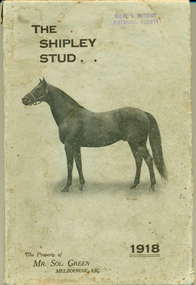
... This catalogue lists the stock which he had established at Shipley in a relatively short period of time. warrnambool allansford shipley sol green comedy king white star 1918 shipley dispersal sale shipley stud * Mallinson Pomborneit 9/1/18. ...Sol Green came to Australia as a penniless migrant who made his fortune as a bookmaker. He was inducted into the Australian Racing Museum Hall of fame in 2002. He purchased the Shipley stud from George Rolfe about 1905 and set about turning the Ayrford cattle property into a successful horse stud. His horse Comedy King won the Melbourne Cup in 1910 and was retired to stud in 1912. He became one of the top 10 Australian Stallions in the ensuing years. He dispersed his stud at Shipley in 1918 and this catalogue lists the stock sold that day. The property remained in the Green family and continued as a dairy farm with cheese factory and piggery by his son Bob Green. Sol Green was known for his philanthropic gestures extending help where needed on various fronts. Shortly before his death in 1948 he donated 47000 pounds to five Melbourne hospitals.This catalogue has significance firstly on a local level in that Shipley was an important farm in the district and secondly that it was owned by Mr Sol Green who was a person of standing within the racing industry as a bookmaker but also as a stud owner and owner of the 1910 Melbourne cup winner. This catalogue lists the stock which he had established at Shipley in a relatively short period of time.Light grey card cover with horse in brown. The title is in top left corner in brown text with the date 1918 in bottom right. Compilers details on back cover. 164 Pages. It has black and white plates of two horses, Comedy King and White Star* Mallinson Pomborneit 9/1/18. Light paper pasted inside front cover “Colac and District Historical Society, Donor Miss Betty Mallinson 1960. There are purchasers’ names and the purchase price paid, written at the base of each page. warrnambool, allansford, shipley, sol green, comedy king, white star 1918, shipley dispersal sale, shipley stud -
 Bendigo Historical Society Inc.
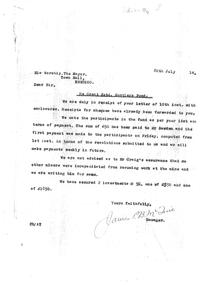
Document - GREAT EXTENDED HUSTLERS: GREAT EXTENDED HUSTLERS FATALITY FUND DISPERSAL OF FUND TO WIDOWS
... Document GREAT EXTENDED HUSTLERS: GREAT EXTENDED HUSTLERS FATALITY FUND DISPERSAL OF FUND TO WIDOWS ...Correspondence (copies, 9 pages) describing the funds raised and dispersed for the widows of the miners killed in the explosion at the Great Extended Hustlers Mine in 1914. Names of miners' families: Mrs. Campbell, 3 children Mrs. Blair, 2 children Mrs. Thomas, 3 children Mrs. Martin Mrs. Chinn Mrs. Forster, 2 children Mrs. Walkley Letter addressed to His Worship The Mayor, Town Hall dated 20 July 1914 describes the participants names and the terms of payment. Letter from Mrs. Margaret Campell authorising bearer to pick up cheque Sandhurst and Northern District Trustees managed the fund.bendigo, mining, great extended hustlers -
 Ballarat Tramway Museum
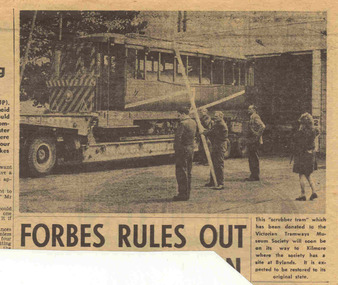
Newspaper, The Courier Ballarat, Ballarat Scrubber tram loaded on a truck, 22/09/1971
... Yields information about the dispersal of tramcars after the closure of the Ballarat system, in particular the scrubber tram to the TMSV. ...Yields information about the dispersal of tramcars after the closure of the Ballarat system, in particular the scrubber tram to the TMSV.Newspaper clipping from The Courier, Ballarat, 22/9/1971 with a photo and caption of the Ballarat Scrubber tram loaded on a truck prior to being transported to Bylands for the TMSV. Photo shows a worker with a long pole to prop up the overhead so the truck with load could clear the depot area. See Reg Item 3776 for a print of the Courier photograph.scrubber tram, tmsv, transport -
 Wangaratta RSL Sub Branch
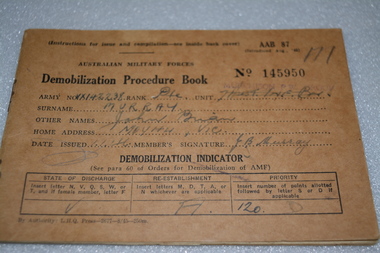
Book - Book - Demobilization, Private J. B Murray, Introduced August 1945
... Demobilization Procedure Book issued to Private John Brian MURRAY VX142238 of Moyhu Victoria The Demobilization Procedure Book was developed and issued as a handbook by the Australian Military Forces to service men and women once they became available for dispersal. The handbook was used to facilitate the action necessary for demobilisation following the end of World War II in 1945. ...Demobilization Procedure Book issued to Private John Brian MURRAY VX142238 of Moyhu VictoriaThe Demobilization Procedure Book was developed and issued as a handbook by the Australian Military Forces to service men and women once they became available for dispersal. The handbook was used to facilitate the action necessary for demobilisation following the end of World War II in 1945. The completion of the handbook and instructions were required before a Certificate of Discharge could be issued.Brown cardboard covered book with black printNo 145950 VX 142238 Pte MURRAY John Brian - Moyhu Victoriaprivate john brian murray vx142238, demobilization procedure book, ww2 -
 Mrs Aeneas Gunn Memorial Library
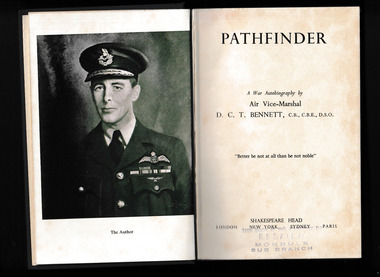
Book, Shakespeare Head, Pathfinder : a war autobiography, 1958
... Bennett played a prominent part in deploying a Mosquito intruder force to harass Germany by night and in developing FIDO, the invaluable fog dispersal system. Ill, p.287. Pathfinder : a war autobiography Book Shakespeare Head DCT Bennett ...I was posted to 29 Squadron at North Weald in Essex and I was more than pleased to be a 'fighter boy', which for some unknown reason seemed and still seems to carry with it an aura of glamour - goodness knows why! "Air Vice-Marshal Don Bennett was one of the most outstanding figures of the second World War and the creator and leader of the legendary Pathfinder Force of 8 Group. His made him the obvious choice as leader of the Pathfinders -the elite force designed to carry out pioneering target-marking and precision-bombing of Nazi-occupied Europe. Bennett played a prominent part in deploying a Mosquito intruder force to harass Germany by night and in developing FIDO, the invaluable fog dispersal system.Ill, p.287.non-fictionI was posted to 29 Squadron at North Weald in Essex and I was more than pleased to be a 'fighter boy', which for some unknown reason seemed and still seems to carry with it an aura of glamour - goodness knows why! "Air Vice-Marshal Don Bennett was one of the most outstanding figures of the second World War and the creator and leader of the legendary Pathfinder Force of 8 Group. His made him the obvious choice as leader of the Pathfinders -the elite force designed to carry out pioneering target-marking and precision-bombing of Nazi-occupied Europe. Bennett played a prominent part in deploying a Mosquito intruder force to harass Germany by night and in developing FIDO, the invaluable fog dispersal system. world war 1939 - aerial operations - britain, world war 1939-1945 - personal narratives - australia
