
Showing 593 items matching "documents - service records"
-
 Bendigo Military Museum
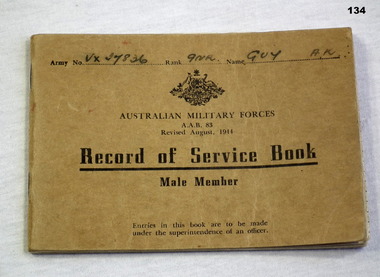
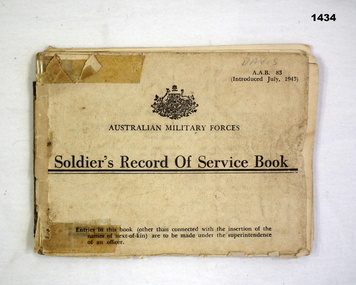
Administrative record - RECORD OF SERVICE BOOK WW2, The Specialty Press Pty Ltd, 1944
... documents...service records...Refer 131P for service details also 129, 130.3, 133.2. documents service records military "VX37836 GNR GUY, A.K" Record of Service Book A.A.B.83, brown cardboard covers re A.K.GUY. ...Relates to Andrew Keith Guy VX37836 2nd AIF. Refer 131P for service details also 129, 130.3, 133.2.Record of Service Book A.A.B.83, brown cardboard covers re A.K.GUY."VX37836 GNR GUY, A.K"documents, service records, military -
 Bendigo Military Museum
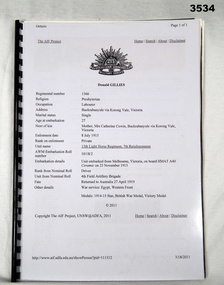
Document - SERVICE RECORDS WW1, Post WW1
... Documents...service...records...For photograph refer Cat No 3531. Documents service records Complete Personal & Service Record of Donald GILLIES Reg No 1366. ...For photographic print refer Cat No 3529P. For photograph refer Cat No 3531.Complete Personal & Service Record of Donald GILLIES Reg No 1366. Also a copy of 13th Australian Light Horse Regiment embarkation roll, 7th Reinforcement - embarked from Melbourne onboard HMAT A40 Ceramic on 23.11.1915.documents, service, records -
 Bendigo Military Museum
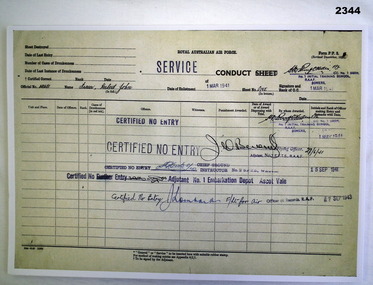
Document - SERVICE RECORD WW2, c.1940-42
... documents - service records...Document SERVICE RECORD WW2 ...Herbert John FRASER enlisted 29.5.1940 in Bendigo, aged 26 years 2 months. No 401601 RAAF, KIA 19.11.1942 in the ill fated Freshman Mission to sabotage German development of an atomic bomb at the Vermock Heavy Water Plant in Norway.One page service conduct sheet re an RAAF Officer.documents - service records, military history - air force -
 Bendigo Military Museum
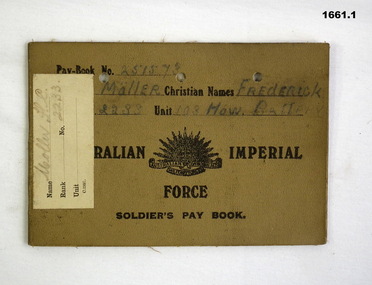
Financial record - PAY BOOKS ARMY, Australian Government, 1914-1919
... documents-service records...Refer 1662.3, 1663P. documents-service records Pay books Moller .1)& .2) Stamped on both covers "Australian Imperial Force Soldier's paybook" .1) AIF soldier's paybook for Moller, Frederick 2233, paybook no 251573. ...Frederick Campbell Moller No 2233 enlisted on 2.9.14. Embarked 22.9.14. WIA accidentally 27.7.17 GSW to chest. WIA 30.9.17 GSW to the head. To Hospital 28.7.18 with Diarrhoea . Discharged from the AIF 23.2.19. Refer 1662.3, 1663P. .1) AIF soldier's paybook for Moller, Frederick 2233, paybook no 251573. Unit 103 How Battery. .2) AIF soldier's paybook for Moller, Frederick Campbell 2233, driver 103 Bty 3 FAB, paybook no 251573. .3) Envelope to hold paybooks. Addressed to Mr FC Moller, Glengarry, Gippsland..1)& .2) Stamped on both covers "Australian Imperial Force Soldier's paybook"documents-service records, pay books, moller, -
 Bendigo Military Museum
Financial record - PAY BOOKS ARMY WW2 TO VIETNAM, Soldiers pay, 1960's
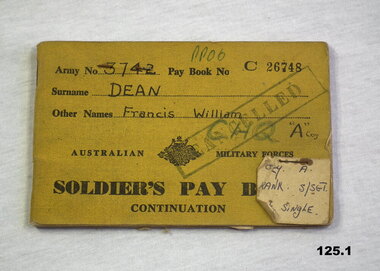
... documents...financial...service records...Refer Cat No 124.2 for his service details. documents financial service records army military history Handwritten on each pay book: "3742 Dean Francis William." .1) Pay book, mustard colour No 26748. ...The pay books belonged to Francis William (Dinky) Dean BEM, No's VX93960 2nd AIF, 3742 1RAR. Refer Cat No 124.2 for his service details..1) Pay book, mustard colour No 26748. B & W image of soldier, passport size, stapled inside back cover. .2, .3, .4) Pay books, Tan colour, No's 27965, 11195, 15297.Handwritten on each pay book: "3742 Dean Francis William."documents, financial, service records, army, military history -
 Bendigo Military Museum
Administrative record - RECORD OF SERVICE, DEMOBILIZATION BOOKS, MIRROR WW2, C. 1939 - 45
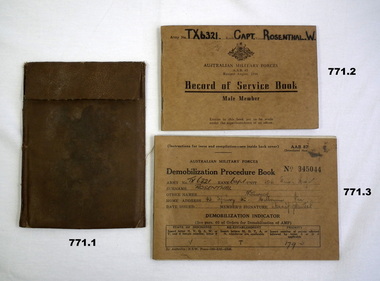
... documents...military...service records...Refer 622.3, 775. documents military service records technical .1) Shaving mirror wallet, brown, water proof material .22) Record of service Book A.A.B 83 Aust Military Forces. ...Belonged to Capt Warick Rosenthal No TX 6321 AAMC. Refer 622.3, 775. .1) Shaving mirror wallet, brown, water proof material .22) Record of service Book A.A.B 83 Aust Military Forces. Brown covers Re Service of TX6321 CAPT Rosenthal .W. .3) Demobilination Procedure Book A.A.B 87 No 345044 Australian Military Forces re TX6321 Capt Rosenthal .W.documents, military, service records, technical -
 Geelong RSL Sub Branch
Service Records VX 110629 Sig F T Purcell, Mid 20th Century
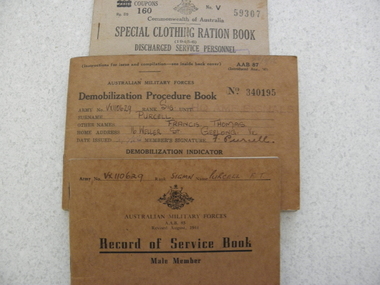
... documents...records service...The documents belong to VX 110629 Sig F T Purcell who served in the Australian Miliraty Forces from 18 April 1941 to 27 March 1946 These are the original Documents belonging to VX 110629 Sig F T Purcell documents records service book australia military VX 110629 Sig F T Purcell Record of Service Book AAB 83 VX110629 Sig F T Purcell Demobilization Proceedure Book AAB 87 V 59307 Special Clothing Ration Book Discharged Setrvice Personnel Certificate of Discharge VX 110629 Sig Francis Thomas Purcell Form WF 88 Final State of Account - Discharged Member Mr F T Purcell VX 110629 Dog Tags - one tag round VX110629, RC, Purcell FT, one tag octagional VX110629, RC, Purcell FT 3 x Oblong Books, 1 x Quarto Size Certificate of Discharge, 1 x Final Statement of Final Account - Discharged Member, set of Dog Tags Service Records VX 110629 Sig F T Purcell Various ...The documents belong to VX 110629 Sig F T Purcell who served in the Australian Miliraty Forces from 18 April 1941 to 27 March 1946These are the original Documents belonging to VX 110629 Sig F T Purcell3 x Oblong Books, 1 x Quarto Size Certificate of Discharge, 1 x Final Statement of Final Account - Discharged Member, set of Dog TagsVX 110629 Sig F T Purcell Record of Service Book AAB 83 VX110629 Sig F T Purcell Demobilization Proceedure Book AAB 87 V 59307 Special Clothing Ration Book Discharged Setrvice Personnel Certificate of Discharge VX 110629 Sig Francis Thomas Purcell Form WF 88 Final State of Account - Discharged Member Mr F T Purcell VX 110629 Dog Tags - one tag round VX110629, RC, Purcell FT, one tag octagional VX110629, RC, Purcell FTdocuments, records service, book, australia military -
 Bendigo Military Museum
Administrative record - PAY BOOKS ARMY, DEMOBILIZATION PROCEDURE, CERTIFICATE OF DISCHARGE WW2, C.WW2
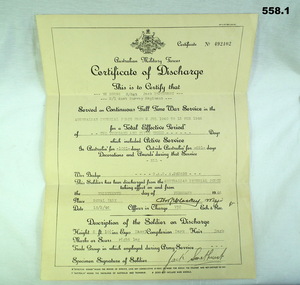
... documents-certificates, financial...service records...Refer 549.4, 550.2, 557. documents-certificates, financial service records military history-army Royal Australian Artillery 558.1 Certificate of Discharge VX28896 S/Sgt Jack Smethurst 558.2 Army pay book VX28896 Smethurst, Jack. ...Jack Smethurst VX28896. Refer 549.4, 550.2, 557.558.1 Certificate of Discharge VX28896 S/Sgt Jack Smethurst 558.2 Army pay book VX28896 Smethurst, Jack. Book no. 121582 558.3 Soldier's pay book VX28896 Smethurst, Jack. Pay book no. 80964. 558.4 Soldier's pay book VX28896 Smethurst, Jack. Pay book no. 543484. Yellow 558.5 Record of Service book VX28896 Smethurst, J. S/Sgt 558.6 Demobilization Procedure book. VX28896 Smethurst, J. Sgt. Book no. 420495documents-certificates, financial, service records, military history-army, royal australian artillery -
 Bendigo Military Museum
Administrative record - RECORD OF SERVICE BOOK WW2, C.1942
... documents...military service...army records...On discharge from the Army 25.6.1945 he held the rank of L/Sgt in RR & GDD. documents military service army records service records Davis “VX119616 DAVIS, NEIL WALTON” Soldiers Record of Service Book AAB 83 re N.W Davis. ...Neil Walton Davis initially enlisted in the CMF V68097 possibly early 1942 then transferring to the 2nd AIF as VX119616 on 1.12.1942 age 29 years. On discharge from the Army 25.6.1945 he held the rank of L/Sgt in RR & GDD.Soldiers Record of Service Book AAB 83 re N.W Davis.“VX119616 DAVIS, NEIL WALTON”documents, military service, army records, service records, davis -
 Running Rabbits Military Museum operated by the Upwey Belgrave RSL Sub Branch
EYRE A
... Eyre - Various documents , cards and service records relating to army service. ...Eyre - Various documents , cards and service records relating to army service. ...A. Eyre - Various documents , cards and service records relating to army service. Detailed list attached in collectiondocuments, 1945, army -
 Sunshine and District Historical Society Incorporated
Archive - Mr Glym Clemson Private Documents
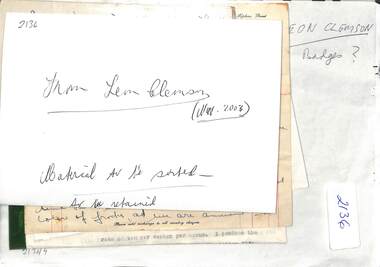
... Mr Glym Clemson Private Documents Record of Service Book Baptism Record Newspaper Wedding Annoncement Letter from London Solicitors Correspondence Superannuation Payout Photocopy of Badges...Glyn Leon Clemson Handwritten Letter from London to G Clemson from Rita Mansfield 24 November 1947|Holy Baptism for Glym Leon Clemson Born 14 March 1909 Baptised at St Marks Sunshine By Reverend Reginald McCoy on 2 March 1910|Typed Address book|Newspaper Article for Wedding Clemson and Pain 2 March 1935 Prettiest Wedding Group|Record of Service Book Glym Leon Clemson 1909 Exemptions from Training 30 June 1924|Letter from Ward Symons Studios Pty Ltd to Glym Clemson 25 February 1935 advising that your wedding photographs have been chosen the prettiest wedding out of 56 weddings|Typed Letter from Patrick J Cannon and Testro barristers and solicitors 24 June 1974 showing Trust account receipts from Desmond G Wilson|Separation Advice Form for Glym Leon Clemson 15 March 1974|Type Notice of Claim from Ella Catherine Clemson against Desmond Wilson 5 September 1974|Glym Leon Clemson Badges photocopy VFA Victorian Football Association 1966 and 1967 and others Mr Glym Clemson Private Documents Record of Service Book Baptism Record Newspaper Wedding Annoncement Letter from London Solicitors Correspondence Superannuation Payout Photocopy of Badges Archive Mr Glym Clemson Private Documents ...Handwritten Letter from London to G Clemson from Rita Mansfield 24 November 1947|Holy Baptism for Glym Leon Clemson Born 14 March 1909 Baptised at St Marks Sunshine By Reverend Reginald McCoy on 2 March 1910|Typed Address book|Newspaper Article for Wedding Clemson and Pain 2 March 1935 Prettiest Wedding Group|Record of Service Book Glym Leon Clemson 1909 Exemptions from Training 30 June 1924|Letter from Ward Symons Studios Pty Ltd to Glym Clemson 25 February 1935 advising that your wedding photographs have been chosen the prettiest wedding out of 56 weddings|Typed Letter from Patrick J Cannon and Testro barristers and solicitors 24 June 1974 showing Trust account receipts from Desmond G Wilson|Separation Advice Form for Glym Leon Clemson 15 March 1974|Type Notice of Claim from Ella Catherine Clemson against Desmond Wilson 5 September 1974|Glym Leon Clemson Badges photocopy VFA Victorian Football Association 1966 and 1967 and othersglyn leon clemson -
 Returned Nurses RSL Sub-branch
Document - Facsimilie and photocopy of Service Record, Department of Defence, 19910918
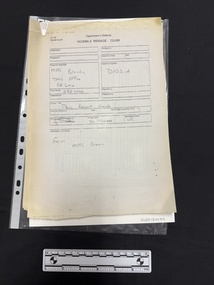
... Faxed document containing service records including personal record card, leave information and war service of Edith Lydia Shaw. ...Faxed document containing service records including personal record card, leave information and war service of Edith Lydia Shaw. ...Faxed document containing service records including personal record card, leave information and war service of Edith Lydia Shaw. Fax was received on 18 September 1991 from the Department of Defence DNS-A from MAS Brown. Information includes Shaw's biographical pre-enlistment details, ranks during service, leave details, unit served with, war service units and dates, general remarks including awards and termination information.Document on thermal fax paper held together with a white archival paperclip. Photocopy of same document also held together with a white archival paperclip. wwii, ww2, world war 2, edith lydia shaw, royal red cross, australian army nursing service, aans -
Whitehorse Historical Society Inc.
Document, Blackburn Cool Stores
... records 1981-1987; Petty Cash Book 1936-1987; Receipt book 1985-1987. Box 2: Ledgers and account books (6 vols) with Audit reports, bank statements, superannuation, shareholder lists, rentals, operating costs; Box 3: Share scrip certificates, rebuilding, plant and equipment estimates; Box 4: Land, company formation, services, provision documents; Work records for Alan Riescheck, Harry Wilson, Don Watts (2 vols) Sorted by the late Eric Fankhauser, last President of Blackburn Cool Stores, donated by his widow....records 1981-1987; Petty Cash Book 1936-1987; Receipt book 1985-1987. Box 2: Ledgers and account books (6 vols) with Audit reports, bank statements, superannuation, shareholder lists, rentals, operating costs; Box 3: Share scrip certificates, rebuilding, plant and equipment estimates; Box 4: Land, company formation, services, provision documents; Work records for Alan Riescheck, Harry Wilson, Don Watts (2 vols)...records 1981-1987; Petty Cash Book 1936-1987; Receipt book 1985-1987. Box 2: Ledgers and account books (6 vols) with Audit reports, bank statements, superannuation, shareholder lists, rentals, operating costs; Box 3: Share scrip certificates, rebuilding, plant and equipment estimates; Box 4: Land, company formation, services, provision documents; Work records for Alan Riescheck, Harry Wilson, Don Watts (2 vols) Papers of Blackburn Cool Stores Pty Ltd, established 1917, comprising Box 1-1a: Minutes of Board of Directors 1916-1935, 1940-1987 (10 vols.); Sundry debtors 1983-1987; Pool Storage, Wages, Rent records 1981-1987; Petty Cash Book 1936-1987; Receipt book 1985-1987. ...Papers of Blackburn Cool Stores Pty Ltd, established 1917, comprising Box 1-1a: Minutes of Board of Directors 1916-1935, 1940-1987 (10 vols.); Sundry debtors 1983-1987; Pool Storage, Wages, Rent records 1981-1987; Petty Cash Book 1936-1987; Receipt book 1985-1987. Box 2: Ledgers and account books (6 vols) with Audit reports, bank statements, superannuation, shareholder lists, rentals, operating costs; Box 3: Share scrip certificates, rebuilding, plant and equipment estimates; Box 4: Land, company formation, services, provision documents; Work records for Alan Riescheck, Harry Wilson, Don Watts (2 vols)Papers of Blackburn Cool Stores Pty Ltd, established 1917, comprising Box 1-1a: Minutes of Board of Directors 1916-1935, 1940-1987 (10 vols.); Sundry debtors 1983-1987; Pool Storage, Wages, Rent records 1981-1987; Petty Cash Book 1936-1987; Receipt book 1985-1987. Box 2: Ledgers and account books (6 vols) with Audit reports, bank statements, superannuation, shareholder lists, rentals, operating costs; Box 3: Share scrip certificates, rebuilding, plant and equipment estimates; Box 4: Land, company formation, services, provision documents; Work records for Alan Riescheck, Harry Wilson, Don Watts (2 vols)Papers of Blackburn Cool Stores Pty Ltd, established 1917, comprising Box 1-1a: Minutes of Board of Directors 1916-1935, 1940-1987 (10 vols.); Sundry debtors 1983-1987; Pool Storage, Wages, Rent records 1981-1987; Petty Cash Book 1936-1987; Receipt book 1985-1987. Box 2: Ledgers and account books (6 vols) with Audit reports, bank statements, superannuation, shareholder lists, rentals, operating costs; Box 3: Share scrip certificates, rebuilding, plant and equipment estimates; Box 4: Land, company formation, services, provision documents; Work records for Alan Riescheck, Harry Wilson, Don Watts (2 vols)blackburn cool store, cool stores, blackburn, wilson, harry, orchards, fankhauser, margaret, fankhauser, eric, watts, don, riescheck, alan -
 Bendigo Military Museum
Document - SERVICE RECORDS, WW2, National Archives Aust, Unknown
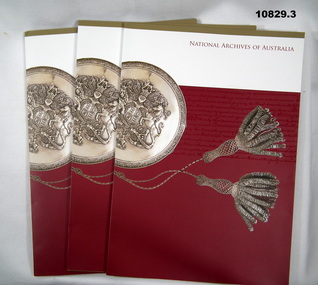
... National Archives of Australia folder with documents pertaining to the Service Records of two servicemen from WW2. ...National Archives of Australia folder with documents pertaining to the Service Records of two servicemen from WW2. ...Records: 1. & 2. Cat. Reference No. 2502. 3. Cat Reference No. 10531.6. 1. Name: William Arthur BRIGHAM Service Number V78177, DOB 26 Dec 1895. Enlisted 6 Jan 1931. Date of Discharge 7 Sep 1943. 2. Name: William Arthur BRIGHAM Service Number V83502, DOB 26 Dec 1895. Enlisted 11 April 1940. Date of Discharge 22 Jul 1940. 3 Name: Reginald Keith MYLONAS Service Number.1. 2. & 3. National Archives of Australia folder with documents pertaining to the Service Records of two servicemen from WW2. Cardboard folder with half pocket, red and white background, red print and gold and silver illustration of a medal with a cord with two tassels. Documents - white paper - with printed information and photocopied documents.publications, documents, national archives of australia -
 Flagstaff Hill Maritime Museum and Village
Functional object - Courier Bag, Government of Victoria, Late 19th to mid-20th centuries
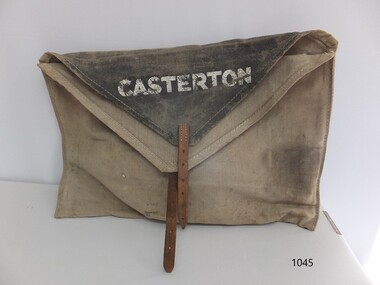
... service was active in in the western district of Victoria. It served remote properties, including a line between Merino and Casterton. The train delivered mail, cash, supplies documents, business records and people between the sheep farm properties and the township of Casterton....service was active in in the western district of Victoria. It served remote properties, including a line between Merino and Casterton. The train delivered mail, cash, supplies documents, business records and people between the sheep farm properties and the township of Casterton. ...The courier bag was once government property, as indicated by the broad arrow symbol. The flap has the name 'Boronia' - an area near Melbourne - overstamped with the town name 'Merino', and on the other side of the flap is the town 'Casterton'. Merino and Casterton are renowned for large sheep farming properties in Victoria's western district. Perhaps the courier bag was originally used between Melbourne and Boronia. During the late 19th and early-to-mid 20th centuries, a government-operated railway service was active in in the western district of Victoria. It served remote properties, including a line between Merino and Casterton. The train delivered mail, cash, supplies documents, business records and people between the sheep farm properties and the township of Casterton.This courier bag is an example of the connections and business between people in the remote areas of western Victoria. It was likely used by Victoria's railway system that transported people, goods, documents and cash between the districts of western Victoria.Courier bag; beige canvas rectangular bag with triangular black canvas flaps and a leather strap and buckle closure. The bag has stencilled stamps of three towns - Casterton, Merino and Boronia. It also has the government property symbol of a broad arrow.White stencilled paint "CASTERTON" Black stencilled paint "BORONIA" [barely visible] White over-stamped stencilled paint "MERINO"warrnambool, shipwreck coast, flagstaff hill, flagstaff hill maritime museum, flagstaff hill maritime village, bag, pouch, document pouch, courier bag, western district, western victoria, 19th century, 20th century, railway, rural business, rural trade, boronia, casterton, merino, sheep farm, sheep property, canvas bag, canvas courier bag, government courier bag, broad arrow -
 Flagstaff Hill Maritime Museum and Village
Letter - William Ferrier, 14th November 1905
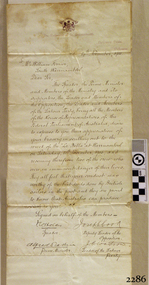
... services of a pilot. His Master Certificate was suspended for twelve months. Later he was also charged with the manslaughter of one of the crew who had died when the La Bella was wrecked but found not guilty. The event’s adverse publicity and damage to his career took a toll on his health and he died of a heart attack six months after the wreck; he was only thirty-seven. His body was buried in the Melbourne General Cemetery. The La Bella was “the best documented of all sailing ships owned in New Zealand”. Her record...services of a pilot. His Master Certificate was suspended for twelve months. Later he was also charged with the manslaughter of one of the crew who had died when the La Bella was wrecked but found not guilty. The event’s adverse publicity and damage to his career took a toll on his health and he died of a heart attack six months after the wreck; he was only thirty-seven. His body was buried in the Melbourne General Cemetery. The La Bella was “the best documented of all sailing ships owned in New Zealand”. Her record ...The letter to William Ferrier of South Warrnambool from the Prime Minister and the Parliament of the Commonwealth recognised the significance of William’s brave and courageous lifesaving act to the people of Australia; “They all feel that your conduct was worthy of the best deeds done by British sailors in the past and they are proud to know that Australia can produce such as you.” The story of that brave rescue follows on below … The ship from which the sailors were rescued was the three-masted, iron and steel barquentine the La Bella, built in Norway in 1893. She was one of two iron and steel ships by Johan Smith, The company was one of the leading shipping families in Tvedestrand, Norway. She was significant to Norwegian shipping, being one of only 27 iron and steel ships ever built in Norway. She was registered in New Zealand and engaged from 1902 in inter-colonial trading of timber in the Pacific, between New Zealand and Australia and was often in Port Phillip Bay, Victoria. On 5th October 1905, the twelve-year-old La Bella left Lyttleton, New Zealand carrying a cargo of timber bound for Warrnambool, Australia. She was manned by a crew of twelve: the Master, (Captain Mylius, previously 1st Mate of La Bella, appointed Captain to La Bella on 6th February 1903) 2 Mates, Cook, six able seamen, one ordinary seaman and a boy. Bad weather en route caused her to shelter at Burnie on Tasmania's North West coast. On November 10th, the 37th day of her journey, La Bella approached Warrnambool. Captain Mylius steered her towards Lady Bay Channel in heavy south-west seas and evening mist. He ordered the helmsman to steer for the light. As the ship came round, a tremendous sea struck her on the port quarter, causing her to breach broadside in a north-westerly direction into breakers. The helm was brought round twice more, but each time heavy seas broke over her, the third time throwing the La Bella on to a submerged reef in Lady Bay now known as La Bella Reef (about 100 yards from the Warrnambool breakwater). The sea was so rough that it even wrenched a one-and-a-half ton anchor from its fastenings and into the sea. As Captain Mylius headed to the steel wheelhouse, intending to send up a rocket flare, a huge sea slammed the steel door into him (resulting in massive bruising front and back) Despite his injuries he still managed to set off a blue light, which he held up in his hands. La Bella’s lifeboats were filled with seawater and broke up on their chocks. The blue light was the first indication to people on the shore that there was a ship in distress. The Harbour Master, Captain Roe (who lived in the Harbour Master’s House opposite Flagstaff Hill), organised a group of volunteers to crew the lifeboat because the trained crew was unavailable; the crewmen were working on a steamer in Port Fairy at the time. He then poured oil onto the water to try and smooth the sea. At around 11 pm three of the crew took shelter in the steel forecastle but the sea crashed into it and broke it up. While the rest of the crew and onlookers watched helplessly in the moonlight the bodies were washed away into the sea, never to be seen again. Some of the crew lashed themselves to the weather rail to keep from being washed away. Watson, the ordinary seaman, became tangled in the rigging lines and was too weak to move, so the 2nd Mate, Robertson, put a line onto him so that he wouldn’t wash off. Around 11 pm three of the crew were unconscious from exhaustion. The situation on La Bella was becoming dangerous. The 2nd Mate moved to the ‘house’ and soon afterwards the ship slipped in the heavy sea. The lashings of the 1st Mate and the ‘boy’ Denham had kept them safe until about 2 am when they were washed overboard; no one was able to help. One by one, the exhausted crew were being washed overboard, too weak to hold on any longer. During the night the La Bella had broken into two and the deckhouse ran out towards the sea. Two more men drowned when trying to reach the lifeboat. By sunrise, the only survivors of the twelve were the Master, 2nd Mate and three seamen. Early in the morning, Captain Roe used the rocket apparatus on shore to try and shoot a line to the ship for a safer rescue but each attempt fell short of the target. Several attempts were made by the lifeboat to rescue the stricken sailors, but the rough conditions made this difficult for the boat to get close enough to the ship and the lifeboat had to return to shore. During a final attempt to reach the ship Captain Mylius ordered his men to jump into the sea. Leonard Robertson, 2nd mate, jumped and swam towards the lifeboat, taking hold of the boat hook offered to him. Oscar Rosenholme managed to reach the boat floating on a piece of timber from the ship’s load and a third survivor, Noake, also made the boat. Along with the lifeboat rescue crew, 25-year-old William Ferrier rowed his small dingy through the heavy seas and managed to rescue the Captain, whom he landed on the breakwater. Ferrier then returned to the ship to attempt a final rescue, losing his oars and rowlocks into the high sea. Using just a spare paddle he skulled towards the La Bella, reaching her stern in time to cut loose the lone surviving sailor, Payne, from the lashing that held him to the ship; the terrified sailor dropped from the ship and into the dingy. Shortly after the last man was rescued, the La Bella was lifted by a huge wave and crashed back down on the reef; she broke up and sank. The ordeal had lasted ten hours. The survivors were taken to the nearby Bay View Hotel and gratefully received warm food and clothing, medical attention and a place to sleep. In the following days, an unidentified body of a young person has washed ashore; it was either Watson or Denham. The body was buried in the Warrnambool cemetery with an appropriate gravestone and inscription. William Ferrier became a national hero as news of the daring rescue spread. In recognition of his bravery in the two daring rescues, he was awarded the Silver Medal for Bravery by the Royal Humane Society and was honoured in the letter from the Prime Minister and the Parliament of the Commonwealth, telegrams and a cheque for £20 from the Governor-General, over £150 subscribed by the public, including Warrnambool and district and readers of The Argus, and a gold medal from the Glenelg Dinghy Club of South Australia. Ferrier’s rescue efforts are one of the most heroic in Victoria’s shipwreck history. (William Ferrier’s son, Frank, received a similar award almost fifty years later when he helped rescue four members of the crew on the yacht Merlan after it ran on to a reef near the Point Lonsdale Lighthouse. ) The wreck of La Bella now lies on her port side in 13 metres of sheltered water inside the reef she struck. The bow section is relatively intact and part of the stern has drifted north-easterly towards the mouth of the Hopkins River. The reef the La Bella struck now bears its name. Those five rescued from the La Bella were Captain George Mylius, Leonard Robertson (2nd Mate, 21 years old), R. Payne, Oscar Rosenholme and Jack Noake. Those seven who lost their lives were Mr Coulson (1st mate), Charles Jackman (cook) Gustave Johnson, Pierre Johann and Robert Gent (all able seamen), Harry Watson (ordinary seaman) and Jack Denham (ship’s boy), Captain Mylius was found guilty of careless navigation; he had sailed into the bay without the services of a pilot. His Master Certificate was suspended for twelve months. Later he was also charged with the manslaughter of one of the crew who had died when the La Bella was wrecked but found not guilty. The event’s adverse publicity and damage to his career took a toll on his health and he died of a heart attack six months after the wreck; he was only thirty-seven. His body was buried in the Melbourne General Cemetery. The La Bella was “the best documented of all sailing ships owned in New Zealand”. Her record books, ship logs, correspondence and supporting papers are still available. At the time of the tragedy, she was owned by Messers David C.Turnbull and Co. of Timaru, New Zealand timber merchants and shipping agents, who had purchased her on 13th December 1901. A detailed account of the last journey of La Bella can be read in “Leonard Robertson, the Whangaroa & La Bella” written by Jack Churchouse, published in 1982 by Millwood Press Ltd, Wellington, NZ. As well as this letter, Flagstaff Hill’s La Bella Collection includes a photograph of the wrecked La Bella, a brass rail holder and a postcard of William Ferrier with four of the survivors. Some 15 – 17 ships are believed to have sunk in Lady Bay, but only two have been discovered on the seafloor; the “La Bella” and the “Edinburgh Castle”. Both wrecks are popular diving sites and are preserved as significant historical marine and marine archaeological sites. This original congratulatory letter sent to William Ferrier by the Prime Minister and Government of Australia demonstrates the importance attached to his efforts for Victoria and to Australia. The letter is part of the La Bella Collection and is significant at both a local and state level. Its connection to the La Bella shipwreck and the rescue of five survivors highlights the dangers of Victoria’s Shipwreck Coast. The letter to William Ferrier from the Australian Government acknowledges the bravery of ordinary Australians who risked their lives to save victims of shipwrecks along the coast. The letter is significant to the history of Warrnambool as it honours William Ferrier, a local fisherman whose descendants continue to live in the area. It highlights the way of life of people who lived in coastal towns in 19th century Victoria and the effects of shipwrecks upon them. The letter connects to the postcard of William Ferrier with four of the five rescued crew, the photograph of the wreck of the La Bella and the artefact from the wreck, the rail holder. This letter is significant because of its association with the sailing ship “La Bella”. The “La Bella” is of local and state and national significance. It is one of the only two shipwrecks discovered in Lady Bay, Warrnambool, out of the 15-17 shipwrecks in the bay. Letter to William Ferrier of South Warrnambool from the Prime Minister and Members of Parliament commending him on his bravery. The printed letterhead includes a coat of arms in the top centre and the official address. The letter is very neatly hand written in black pen and includes 4 signatures of Members of Parliament. The rectangular paper is cream coloured with some yellow/brown discolouring. It has the letterhead on the right hand side of it and the written letter begins below the letterhead. The paper has been folded so that the right side becomes the cover page of the letter. The writing is continued onto the inside right hand page of the folded paper and the writing ends here. There is more recent writing on the bottom right hand corner of the back page. The paper has been officially folded in half a total 3 times and there is heavy discolouration on the sections that form the front and back of the folded letter. There is a 4th fold line that is less pronounced that the other folds and would make the paper the size to fit into a pocket. At several fold creases the paper has worn through. The edges of the paper have minor tears. The printed coat of arms is that of the House of Representatives. Underneath is printed “The Parliament of the Commonwealth, / Parliament House / Melbourne”. The hand written, letter is dated “14th November, 1905” and addressed to “Mr. William Ferrier / South Warrnambool” The letter begins “The Speaker, the Prime Minister and Members of the Ministry and its supporters, the Leader and Members of the Opposition, the Leader and Members of the Labour Party, being all the Members of the House of Representatives of the Federal Parliament of Australia” … It continues “desire to express to you their appreciation of your bravery in skulling out to the wreck of the “La Bella” at Warrnambool on Saturday, 11th November, 1905, and recovering therefrom two of the crew who were in imminent danger of their lives. They all feel that your conduct was worthy of the best deeds done by British sailors in the past and they are proud to know that Australia can produce such as you.” The letter is “Signed on behalf of the Members – Speaker (Frederick Holder ), Deputy Leader of the Opposition (Joseph Cook ), Prime Minister (Alfred Deakin), Leader of the Labour Party ( J.C. Watson)” On the back of the letter is blue ink handwriting “OWNER / G. FERRIER / TO. BE. PHOTOGRAPHED / 27-4-76”la bella, william ferrier, bill ferrier, lady bay, 1905, 10th november 1905, 11th november 1905, parliament of the commonwealth, prime minister, australian government, new zealand, flagstaff hill, warrnambool, shipwrecked coast, flagstaff hill maritime museum, maritime museum, shipwreck coast, flagstaff hill maritime village -
 Flagstaff Hill Maritime Museum and Village
Document
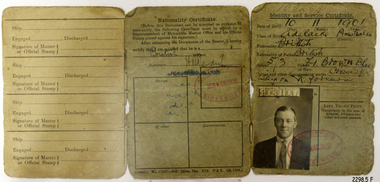
... 5 Documents relating to Norman Furniss: Letter of Reference, Certificate of Discharge, Account of Wages, Record of Vessels Served Upon, Identity and Service Certificate...flagstaff hill warrnambool shipwrecked-coast flagstaff-hill flagstaff-hill-maritime-museum maritime-museum shipwreck-coast flagstaff-hill-maritime-village 5 Documents relating to Norman Furniss: Letter of Reference, Certificate of Discharge, Account of Wages, Record of Vessels Served Upon, Identity and Service Certificate Document ...5 Documents relating to Norman Furniss: Letter of Reference, Certificate of Discharge, Account of Wages, Record of Vessels Served Upon, Identity and Service Certificateflagstaff hill, warrnambool, shipwrecked-coast, flagstaff-hill, flagstaff-hill-maritime-museum, maritime-museum, shipwreck-coast, flagstaff-hill-maritime-village -
 Flagstaff Hill Maritime Museum and Village
Book - Reference/State Government Notification Gazette, Albert John Mullett, The Victorian Government Gazette 1912 Vol 1 /146, 1912
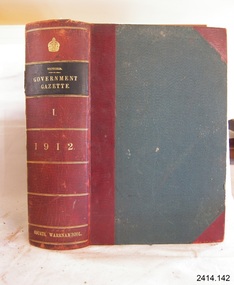
... documents, including the Victorian Government Gazette, parliamentary votes and proceedings, ordnance maps, and judicial reports. Mullet's office was responsible for printing high-profile official propaganda and patriotic materials during World War I. This included widely distributed recruitment items such as the iconic "Australians! Your Country Needs You" poster and official guides for peace celebrations and thanksgiving. He oversaw the printing of major historical works including the landmark reference books during his tenure, such as the comprehensive Handbook to Victoria compiled for the British Association for the Advancement of Science's 1914 Australian meeting, and the detailed Education Department's Record of War Service...documents, including the Victorian Government Gazette, parliamentary votes and proceedings, ordnance maps, and judicial reports. Mullet's office was responsible for printing high-profile official propaganda and patriotic materials during World War I. This included widely distributed recruitment items such as the iconic "Australians! Your Country Needs You" poster and official guides for peace celebrations and thanksgiving. He oversaw the printing of major historical works including the landmark reference books during his tenure, such as the comprehensive Handbook to Victoria compiled for the British Association for the Advancement of Science's 1914 Australian meeting, and the detailed Education Department's Record of War Service ...The Victoria Government Gazette and other government documents from 1887 were printed and published by Robert S. Brain, Government Printer, Melbourne. Brain held the position of Victorian Government Printer through the 1890s and into the early 1900s. The same imprint appears on other official Victorian publications from that era, such as the annual reports of the Board for the Protection of the Aborigines and the colony's Statistical Register. There wasn't really an editor in the modern sense the Gazette was compiled and issued under the authority of the colonial government, via the Chief Secretary's Department, with Brain's printing office producing and publishing it. In May 1906, James Kemp succeeded him, serving as Government Printer from May 1906 to August 1912, with the title of Acting Government Printer right at the very start of his tenure he was stepping into the role Brain had just vacated, and by later in December 1906 he was signing gazettes in that capacity, apparently before his appointment was made permanent. Then in 1912 Albert John Mullett took over the role starting from January 1912 the same way Kemp had as Acting Government Printer with his appointment made permanent in 1913 where he served all through the 1920s.Hard cover book. The Victorian Government Gazette 1912 Vol 1 /146 Printer: Albert John Mullett Publisher: Albert John Mullett Publisher: Authority of The Colonial Government Date: 1912 Further Information: Textured hard cover bound book leather burgundy colour spine with gilt lettering, covers embossed blue cloth & reinforced corners to front and back cover. non-fictionThe Victoria Government Gazette and other government documents from 1887 were printed and published by Robert S. Brain, Government Printer, Melbourne. Brain held the position of Victorian Government Printer through the 1890s and into the early 1900s. The same imprint appears on other official Victorian publications from that era, such as the annual reports of the Board for the Protection of the Aborigines and the colony's Statistical Register. There wasn't really an editor in the modern sense the Gazette was compiled and issued under the authority of the colonial government, via the Chief Secretary's Department, with Brain's printing office producing and publishing it. In May 1906, James Kemp succeeded him, serving as Government Printer from May 1906 to August 1912, with the title of Acting Government Printer right at the very start of his tenure he was stepping into the role Brain had just vacated, and by later in December 1906 he was signing gazettes in that capacity, apparently before his appointment was made permanent. Then in 1912 Albert John Mullett took over the role starting from January 1912 the same way Kemp had as Acting Government Printer with his appointment made permanent in 1913 where he served all through the 1920s. flagstaff hill, warrnambool, shipwrecked-coast, flagstaff-hill, flagstaff-hill-maritime-museum, maritime-museum, shipwreck-coast, flagstaff-hill-maritime-village, book, the victoria government gazette 1912 1 vol 146, the victoria government gazette 1912, the victoria government gazette -
 Flagstaff Hill Maritime Museum and Village
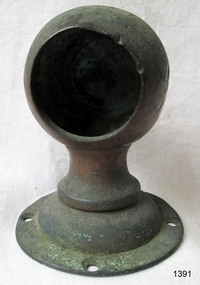
Functional object - Rail holder, About 1893, when the ship was made
... services of a pilot. His Master Certificate was suspended for twelve months. Later he was also charged with manslaughter of one of the crew who had died when the La Bella was wrecked, but found not guilty. The event’s adverse publicity and damage to his career took a toll on his health and he died of a heart attack six months after the wreck; he was only thirty-seven. His body was buried in the Melbourne General Cemetery. The La Bella was “the best documented of all sailing ships owned in New Zealand”. Her record...services of a pilot. His Master Certificate was suspended for twelve months. Later he was also charged with manslaughter of one of the crew who had died when the La Bella was wrecked, but found not guilty. The event’s adverse publicity and damage to his career took a toll on his health and he died of a heart attack six months after the wreck; he was only thirty-seven. His body was buried in the Melbourne General Cemetery. The La Bella was “the best documented of all sailing ships owned in New Zealand”. Her record ...This brass rail holder fixture would have been used to hold the end of a rail in place. There is no information as to where the fitting or rail would have been placed on the ship; sailing ships had many brass fittings. It was recovered from the wreck of the La Bella, which lies at the bottom of the Warrnambool Harbour. Some 15 ships are believed to have been wrecked in Lady Bay, but only two have been discovered on the sea floor; the La Bella and the Edinburgh Castle. Both wrecks are popular diving sites and are preserved as significant historical marine and marine archaeological sites. The story of the final voyage of the La Bella is summarised as follows … The ship from which the sailors were rescued was the three-masted, iron and steel barquentine the La Bella, built in Norway in 1893. She was one of two iron and steel ships by Johan Smith, the company being one of the leading shipping families in Tvedestrand, Norway. She was significant to Norwegian shipping, being one of only 27 iron and steel ships ever built in Norway. She was registered in New Zealand and engaged from 1902 in inter-colonial trading of timber in the pacific, between New Zealand and Australia and was often in Port Phillip Bay, Victoria. On 5th October, 1905, the twelve year old La Bella left Lyttleton, New Zealand carrying a cargo of timber bound for Warrnambool, Australia . She was manned by a crew of twelve: the Master, (Captain Mylius, previously 1st Mate of La Bella, appointed Captain to La Bella on 6th February 1903) 2 Mates, Cook, six able seamen, one ordinary seaman and a boy. . Bad weather en route caused her to shelter at Burnie on Tasmania's North West coast. On November 10th, the 37th day of her journey, La Bella approached Warrnambool. Captain Mylius steered her towards Lady Bay Channel in heavy south-west seas and evening mist. He ordered the helmsman to steer for the light. As the ship came round, a tremendous sea struck her on the port quarter, causing her to breach broadside in a north-westerly direction into breakers. The helm was brought round twice more, but each time heavy seas broke over her, the third time throwing the La Bella on to a submerged reef in Lady Bay now known as La Bella Reef (about 100 yards from the Warrnambool breakwater). The sea was so rough that it even wrenched a one-and-a-half ton anchor from its fastenings and into the sea. As Captain Mylius headed to the steel wheelhouse, intending to send up a rocket flare, a huge sea slammed the steel door into him (resulting in massive bruising front and back) Despite his injuries he still managed to set off a blue light, which he held up in his hands. La Bella’s lifeboats were filled with sea water and broke up on their chocks. The blue light was the first indication to people on shore that there was a ship in distress. The Harbour Master, Captain Roe (who lived in the Harbour Master’s House opposite Flagstaff Hill), organised a group of volunteers to crew the lifeboat because the trained crew was unavailable; the crewmen were working on a steamer in Port Fairy at the time. He then poured oil onto the water to try and smooth the sea. At around 11pm three of the crew took shelter in the steel forecastle but the sea crashed into it and broke it up. While the rest of the crew and onlookers watched helplessly in the moonlight the bodies were washed away into the sea, never to be seen again. Some of the crew lashed themselves to the weather rail to keep from being washed away. Watson, the ordinary seaman, became tangled in the rigging lines and was too weak to move, so the 2nd Mate, Robertson, put a line onto him so that he wouldn’t wash off. Around 11pm three of the crew were unconscious from exhaustion. The situation on La Bella was becoming dangerous. The 2nd Mate moved to the ‘house’ and soon afterwards the ship slipped in the heavy sea. The lashings of the 1st Mate and the ‘boy’ Denham had kept them safe until about 2am when they were washed overboard; no one was able to help. One by one, the exhausted crew were being washed overboard, too weak to hold on any longer. During the night the La Bella had broken into two and the deckhouse ran out towards the sea. Two more men drowned when trying to reach the lifeboat. By sunrise the only survivors of the twelve were the Master, 2nd Mate and three seamen. Early in the morning Captain Roe used the rocket apparatus on shore to try and shoot a line to the ship for a safer rescue but each attempt fell short of the target. Several attempts were made by the lifeboat to rescue the stricken sailors, but the rough conditions made this difficult for the boat to get close enough to the ship and the lifeboat had to return to shore. During a final attempt to reach the ship Captain Mylius ordered his men to jump into the sea. Leonard Robertson, 2nd mate, jumped and swam towards the lifeboat, taking hold of the boat hook offered to him. Oscar Rosenholme managed to reach the boat floating on a piece of timber from the ship’s load and a third survivor, Noake, also made the boat. Along with the lifeboat rescue crew, 25 year old William Ferrier rowed his small dingy through the heavy seas and managed to rescue the Captain, whom he landed on the breakwater. Ferrier then returned to the ship to attempt a final rescue, losing his oars and rowlocks into the high sea. Using just a spare paddle he skulled towards the La Bella, reaching her stern in time to cut loose the lone surviving sailor, Payne, from the lashing that held him to the ship; the terrified sailor dropped from the ship and into the dingy. Shortly after the last man was rescued, the La Bella was lifted by a huge wave and crashed back down on the reef; she broke up and sank. The ordeal had lasted ten hours. The survivors were taken to the nearby Bay View Hotel and gratefully received warm food and clothing, medical attention and a place to sleep. In the following days an unidentified body of a young person was washed ashore; it was either Watson or Denham. The body was buried in the Warrnambool cemetery with an appropriate gravestone and inscription. William Ferrier became a national hero as news of the daring rescue spread. In recognition of his bravery in the two daring rescues he was awarded the Silver Medal for Bravery by the Royal Humane Society and was honoured in the letter from the Prime Minister and the Parliament of the Commonwealth, telegrams and a cheque for £20 from the Governor General, over £150 subscribed by the public, including Warrnambool and district and readers of The Argus, and a gold medal from the Glenelg Dinghy Club of South Australia. Ferrier’s rescue efforts are one of the most heroic in Victoria’s shipwreck history. (William Ferrier’s son, Frank, received a similar award almost fifty years later, when he helped rescue four members of the crew on the yacht Merlan, after it ran on to a reef near the Point Lonsdale Lighthouse. ) The wreck of La Bella now lies on her port side in 13 metres of sheltered water inside the reef she struck. The bow section is relatively intact and part of the stern has drifted north-easterly towards the mouth of the Hopkins River. The reef the La Bella struck now bears its name. Those five rescued from the La Bella were Captain George Mylius, Leonard Robertson (2nd Mate, 21 years old), R. Payne, Oscar Rosenholme and Jack Noake. Those seven who lost their lives were Mr Coulson (1st mate), Charles Jackman (cook) Gustave Johnson, Pierre Johann and Robert Gent (all able seamen), Harry Watson (ordinary seaman) and Jack Denham (ship’s boy), Captain Mylius was found guilty of careless navigation; he had sailed into the bay without the services of a pilot. His Master Certificate was suspended for twelve months. Later he was also charged with manslaughter of one of the crew who had died when the La Bella was wrecked, but found not guilty. The event’s adverse publicity and damage to his career took a toll on his health and he died of a heart attack six months after the wreck; he was only thirty-seven. His body was buried in the Melbourne General Cemetery. The La Bella was “the best documented of all sailing ships owned in New Zealand”. Her record books, ship logs, correspondence and supporting papers are still available. At the time of the tragedy, she was owned by Messers David C.Turnbull and Co. of Timaru, New Zealand timber merchants and shipping agents, who had purchased her on 13th December 1901. A detailed account of the last journey of La Bella can be read in “Leonard Robertson, the Whangaroa & La Bella” written by Jack Churchouse, published in 1982 by Millwood Press Ltd, Wellington, NZ. Some 15 – 17 ships are believed to have sunk in Lady Bay, but only two have been discovered on the seafloor; the “La Bella” and the “Edinburgh Castle”. Both wrecks are popular diving sites and are preserved as significant historical marine and marine archaeological sites. As well as this letter, Flagstaff Hill’s La Bella Collection includes a photograph of the wrecked La Bella, a brass rail holder and a postcard of William Ferrier with four of the survivors. This original congratulatory letter sent to William Ferrier by the Prime Minister and Government of Australia demonstrates the importance attached to his efforts for Victoria and to Australia. The letter is part of the La Bella Collection and is significant at both a local and state level. Its connection to the La Bella shipwreck and the rescue of five survivors highlights the dangers of Victoria’s Shipwreck Coast. The letter to William Ferrier from the Australian Government acknowledges the bravery of ordinary Australians who risked their lives to save victims of shipwrecks along the coast. The letter is significant to the history of Warrnambool as it honours William Ferrier, a local fisherman whose descendants continue to live in the area. It highlights the way of life of people who lived in coastal towns in 19th century Victoria and the effects of shipwrecks upon them. The letter connects to the postcard of William Ferrier with four of the five rescued crew, the photograph of the wreck of the La Bella and the artefact from the wreck, the rail holder. This item is significant because of its association with the sailing ship “La Bella” . the “La Bella” is of local and state and national significance. It is one of the only two shipwrecks discovered in Lady Bay, Warrnambool, out of the 15-17 shipwrecks in the bay. Brass rail holder from the wreck "La Bella". This rail holder would have been used as a fitting for the end of a rail. It is made up of two parts and looks a little like a goblet in shape. The top is a hollow spherical shape with a circular hole cut out on one side, into which the end of a round rail would fit. There are two gouge marks close to each other on one side of the hole, about one centimetre apart, at 1 and 2 o’clock position. The sphere has a hollow pipe-like stem with a screw thread turned into the outside of the lower section and the bottom of the stem has been flared out after having the base fitted. The base is round and has a mound in the centre. The edge has four evenly spaced fixture holes around its edge. The metal shows signs of pitting and has mild encrustation. The fitting of the base is loose, allowing it to swivel in a complete circle. The top of the sphere is rough and has a dent in it. Underneath the base there is verdigris; some has flaked off and reveals a bright golden colour underneath. rail holder, brass rail holder, la bella, lady bay, norway, 1893, new zealand, captain mylius, william ferrier, flagstaff hill, warrnambool, shipwrecked coast, flagstaff hill maritime museum, maritime museum, shipwreck coast, flagstaff hill maritime village -
 Flagstaff Hill Maritime Museum and Village
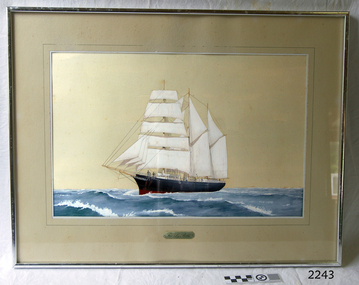
Painting - Maritime painting, The La Bella, 1980s
... services of a pilot. His Master Certificate was suspended for twelve months. Later he was also charged with manslaughter of one of the crew who had died when the La Bella was wrecked, but found not guilty. The event’s adverse publicity and damage to his career took a toll on his health and he died of a heart attack six months after the wreck; he was only thirty-seven. His body was buried in the Melbourne General Cemetery. The La Bella was “the best documented of all sailing ships owned in New Zealand”. Her record...services of a pilot. His Master Certificate was suspended for twelve months. Later he was also charged with manslaughter of one of the crew who had died when the La Bella was wrecked, but found not guilty. The event’s adverse publicity and damage to his career took a toll on his health and he died of a heart attack six months after the wreck; he was only thirty-seven. His body was buried in the Melbourne General Cemetery. The La Bella was “the best documented of all sailing ships owned in New Zealand”. Her record ...This painting of the “La Bella” is associated with Flagstaff Hill’s collection of artefacts from the wreck of the “La Bella”. It was painted around the 1980s by maritime artist Philip J. Gray. Some 15 – 17 ships are believed to have sunk in Lady Bay, but only two have been discovered on the seafloor; the “La Bella” and the “Edinburgh Castle”. Both wrecks are popular diving sites and are preserved as significant historical marine and marine archaeological sites. The Kosnar Picture Framing and Mirrors Shop identified the "GRAY 3135, Y04/111" as their job number for the framing and said that the label "ANOTHER KOSNAR FEATURE" was last used before about 1990. About artist Philip J. Gray “Philip is one of Australia’s leading maritime artists and his meticulous research and social commentary paintings of ships, such as, the Loch Ard and Schomberg form an important part of Warrnambool’s Flagstaff Hill Maritime Museum.” [Dr Marion Manifold, Artist and Art Historian, 2014] Philip James Gray was born in London but has lived most of his life in Australia. He graduated from a London school of art as an illustrator, specialising in technical and scientific illustration as well as other commercial and applied art. He was also a student for a time of Fyffe Christie - British figurative artist, mural painter and humanitarian – who had a great influence on his career. Philip has always worked as a professional artist and illustrator. Many publications on maritime history have featured his work. His paintings have been released and sold all over the world as limited edition prints. The State Library of Victoria’s ‘Latrobe Collection’ holds two of his paintings. His street painting of ‘The Ashes Contest’ decorates the brick wall of Old Bakery Laneway in Sunbury and a Sunbury café owner commissioned him to paint the ‘Sunbury Pop Festival’ as a remembrance of local history. Philip has been an active member of the Sunbury Art Society in Victoria for several years, serving on the committee for some of that time and being involved in exhibitions. He enjoys helping new artists and sharing his skills and experience. About the “La Bella” The wreck of the La Bella lies at the bottom of the Warrnambool Harbour in Lady Bay. Some 15 ships are believed to have been wrecked there but only two have been discovered on the sea floor; the La Bella and the Edinburgh Castle. Both wrecks are popular diving sites and are preserved as significant historical marine and marine archaeological sites. The story of the final voyage of the La Bella is summarised as follows … The ship from which the sailors were rescued was the three-masted, iron and steel barquentine the La Bella, built in Norway in 1893. She was one of two iron and steel ships by Johan Smith, the company being one of the leading shipping families in Tvedestrand, Norway. She was significant to Norwegian shipping, being one of only 27 iron and steel ships ever built in Norway. La Bella was registered in New Zealand and engaged from 1902 in inter-colonial trading of timber in the pacific, between New Zealand and Australia and was often in Port Phillip Bay, Victoria. On 5th October 1905 the twelve year old La Bella left Lyttleton, New Zealand carrying a cargo of timber bound for Warrnambool, Australia . She was manned by a crew of twelve: the Master, (Captain Mylius, previously 1st Mate of La Bella, appointed Captain to La Bella on 6th February 1903) 2 Mates, Cook, six able seamen, one ordinary seaman and a boy. Bad weather en-route caused her to shelter at Burnie on Tasmania's North West coast. On November 10th, the 37th day of her journey, La Bella approached Warrnambool. Captain Mylius steered her towards Lady Bay Channel in heavy south-west seas and evening mist. He ordered the helmsman to steer for the light. As the ship came round, a tremendous sea struck her on the port quarter, causing her to breach broadside in a north-westerly direction into breakers. The helm was brought round twice more, but each time heavy seas broke over her, the third time throwing the La Bella on to a submerged reef in Lady Bay now known as La Bella Reef (about 100 yards from the Warrnambool breakwater). The sea was so rough that it even wrenched a one-and-a-half ton anchor from its fastenings and into the sea. As Captain Mylius headed to the steel wheelhouse, intending to send up a rocket flare, a huge sea slammed the steel door into him (resulting in massive bruising front and back) Despite his injuries he still managed to set off a blue light, which he held up in his hands. La Bella’s lifeboats were filled with sea water and broke up on their chocks. The blue light was the first indication to people on shore that there was a ship in distress. The Harbour Master, Captain Roe (who lived in the Harbour Master’s House opposite Flagstaff Hill), organised a group of volunteers to crew the lifeboat because the trained crew was unavailable; the crewmen were working on a steamer in Port Fairy at the time. He then poured oil onto the water to try and smooth the sea. At around 11pm three of the crew took shelter in the steel forecastle but the sea crashed into it and broke it up. While the rest of the crew and onlookers watched helplessly in the moonlight the bodies were washed away into the sea, never to be seen again. Some of the crew lashed themselves to the weather rail to keep from being washed away. Watson, the ordinary seaman, became tangled in the rigging lines and was too weak to move, so the 2nd Mate, Robertson, put a line onto him so that he wouldn’t wash off. Around 11pm three of the crew were unconscious from exhaustion. The situation on La Bella was becoming dangerous. The 2nd Mate moved to the ‘house’ and soon afterwards the ship slipped in the heavy sea. The lashings of the 1st Mate and the ‘boy’ Denham had kept them safe until about 2am when they were washed overboard; no one was able to help. One by one, the exhausted crew were being washed overboard, too weak to hold on any longer. During the night the La Bella had broken into two and the deckhouse ran out towards the sea. Two more men drowned when trying to reach the lifeboat. By sunrise the only survivors of the twelve were the Master, 2nd Mate and three seamen. Early in the morning Captain Roe used the rocket apparatus on shore to try and shoot a line to the ship for a safer rescue but each attempt fell short of the target. Several attempts were made by the lifeboat to rescue the stricken sailors, but the rough conditions made this difficult for the boat to get close enough to the ship and the lifeboat had to return to shore. During a final attempt to reach the ship Captain Mylius ordered his men to jump into the sea. Leonard Robertson, 2nd mate, jumped and swam towards the lifeboat, taking hold of the boat hook offered to him. Oscar Rosenholme managed to reach the boat floating on a piece of timber from the ship’s load and a third survivor, Noake, also made the boat. Along with the lifeboat rescue crew, 25 year old William Ferrier rowed his small dingy through the heavy seas and managed to rescue the Captain, whom he landed on the breakwater. Ferrier then returned to the ship to attempt a final rescue, losing his oars and rowlocks into the high sea. Using just a spare paddle he skulled towards the La Bella, reaching her stern in time to cut loose the lone surviving sailor, Payne, from the lashing that held him to the ship; the terrified sailor dropped from the ship and into the dingy. Shortly after the last man was rescued, the La Bella was lifted by a huge wave and crashed back down on the reef; she broke up and sank. The ordeal had lasted ten hours. The survivors were taken to the nearby Bay View Hotel and gratefully received warm food and clothing, medical attention and a place to sleep. In the following days an unidentified body of a young person was washed ashore; it was either Watson or Denham. The body was buried in the Warrnambool cemetery with an appropriate gravestone and inscription. William Ferrier became a national hero as news of the daring rescue spread. In recognition of his bravery in the two daring rescues he was awarded the Silver Medal for Bravery by the Royal Humane Society and was honoured in the letter from the Prime Minister and the Parliament of the Commonwealth, telegrams and a cheque for £20 from the Governor General, over £150 subscribed by the public, including Warrnambool and district and readers of The Argus, and a gold medal from the Glenelg Dinghy Club of South Australia. Ferrier’s rescue efforts are one of the most heroic in Victoria’s shipwreck history. (William Ferrier’s son, Frank, received a similar award almost fifty years later, when he helped rescue four members of the crew on the yacht Merlan, after it ran on to a reef near the Point Lonsdale Lighthouse. ) The wreck of La Bella now lies on her port side in 13 metres of sheltered water inside the reef she struck. The bow section is relatively intact and part of the stern has drifted north-easterly towards the mouth of the Hopkins River. The reef the La Bella struck now bears its name. Those five rescued from the La Bella were Captain George Mylius, Leonard Robertson (2nd Mate, 21 years old), R. Payne, Oscar Rosenholme and Jack Noake. Those seven who lost their lives were Mr Coulson (1st mate), Charles Jackman (cook) Gustave Johnson, Pierre Johann and Robert Gent (all able seamen), Harry Watson (ordinary seaman) and Jack Denham (ship’s boy). Captain Mylius was found guilty of careless navigation; he had sailed into the bay without the services of a pilot. His Master Certificate was suspended for twelve months. Later he was also charged with manslaughter of one of the crew who had died when the La Bella was wrecked, but found not guilty. The event’s adverse publicity and damage to his career took a toll on his health and he died of a heart attack six months after the wreck; he was only thirty-seven. His body was buried in the Melbourne General Cemetery. The La Bella was “the best documented of all sailing ships owned in New Zealand”. Her record books, ship logs, correspondence and supporting papers are still available. At the time of the tragedy she was owned by Messers David C.Turnbull and Co. of Timaru, New Zealand timber merchants and shipping agents, who had purchased her on 13th December 1901. A detailed account of the last journey of La Bella can be read in “Leonard Robertson, the Whangaroa & La Bella” written by Jack Churchouse, published in 1982 by Millwood Press Ltd, Wellington, NZ.This painting of the La Bella by Philip J. Gray is part of the La Bella Collection and is significant at both a local and state level. Its connection to the La Bella shipwreck and the rescue of five survivors highlights the dangers of Victoria’s Shipwreck Coast. The painting connects with other objects and artefacts associated with the wreck of the La Bella. This painting is significant because of its association with the sailing ship “La Bella” . the “La Bella” is of local and state and national significance. It is one of the only two shipwrecks discovered in Lady Bay, Warrnambool, out of the 15-17 shipwrecks in the bay. Large framed painting of the three masted barquentine "La Bella" fully rigged. Painted by Phillip J Gray. A fine printed line squares off the painting. Beneath painting and line is a gold plate with black copper plate designating "La Bella" is encased in glass, surrounded by a silver-metal frame. Yellow and brown paper label is adhered to back of painting. Picture framed by Kosnar in Melbourne."The La Bella" on gold plaque Logo of "K" inside a brown square. "GRAY 3135, Y04/111", "ANOTHER KOSNAR FEATURE" flagstaff hill, warrnambool, shipwrecked-coast, flagstaff-hill, flagstaff-hill-maritime-museum, maritime-museum, shipwreck-coast, flagstaff-hill-maritime-village, painting, la bella, artist phillip j gray, maritime painting, lady bay warrnambool -
 Mission to Seafarers Victoria
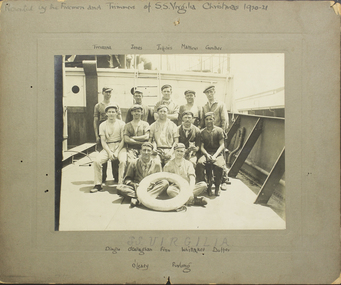
Photograph - Mounted photograph, Sepia, S.S. Virgilia, 1920
... service documenting ship crews and passengers. The crew members in this photograph would have primarily worked in the engine rooms of the Steam ship Virgilia. Names of the crewmen: Trevanna, Jones, Jeffries, Mathews, Gunther, Dingle, O'Callaghan , Finn , Whittaker, Duffey, O'Leary, Furlong Appears to have been presented to the Mission possibly in appreciation of the services these crewmen had used or events they had attended. The photograph is valuable as all the crew featured are named with surnames and may crosslink with documented records ...Various ports in all parts of the world would provide a photographic service documenting ship crews and passengers. The crew members in this photograph would have primarily worked in the engine rooms of the Steam ship Virgilia. Names of the crewmen: Trevanna, Jones, Jeffries, Mathews, Gunther, Dingle, O'Callaghan , Finn , Whittaker, Duffey, O'Leary, FurlongAppears to have been presented to the Mission possibly in appreciation of the services these crewmen had used or events they had attended. The photograph is valuable as all the crew featured are named with surnames and may crosslink with documented records of their visits also held in the archive collection.Studio Mounted Black and white Photograph of 12 crewmen on board ship with ship kitten and with primary and secondary inscriptionsOn top in black ink: Presented by the Firemen and Trimmers of S.S. Virgilia Christmas 1920-21 also crew names handwritten in ink above image: Trevanna, Jones, Jeffries, Mathews, Gunther below image: Dingle, O'Callaghan , Finn , Whittaker, Duffey / O'Leary, Furlong In pencil handwritten lower centre: S.S. VIRGILIA On Verso in pencil Lwr right quadrant PH-SC 24steam ships, ss virgilia, trimmers, firemen, christmas, crew, seafarers, seamen, 1920, 1921, crews and ships -
 Mission to Seafarers Victoria
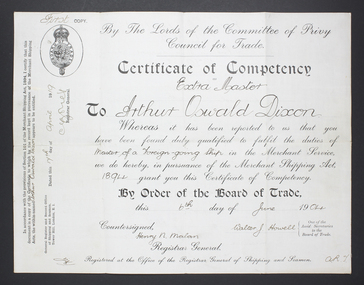
Certificate - Certificate of Competency Extra Master, 1919
... document one of several papers and objects from the estate of Mr Arthur O. Dixon, an ex-master mariner and later smallhold farmer. Other correspondence and papers gifted to the Mission indicates the year 1919 (post his service in World War 1) was a time of some changes for Mr Dixon, possibly leading to his subsequent re-location to Australia show that he served as a crew member on the Merchant vessel "Hororata" a vessel which is noted in the MTSV records including an image of the crew in the early 1920s. ...service at sea two images of Mr Dixon were included in the gift of papers. Personal objects included an unusual small travel size New Testament (see VC record ) heavily annotated provide further insights into the experience of early 20th C. seafarers. certificate of competency master captain sailor arthur oswald dixon seamanship sailors seamen seafarers officers 1904 See image for both sides of the document for extensive text. ...This document one of several papers and objects from the estate of Mr Arthur O. Dixon, an ex-master mariner and later smallhold farmer. Other correspondence and papers gifted to the Mission indicates the year 1919 (post his service in World War 1) was a time of some changes for Mr Dixon, possibly leading to his subsequent re-location to Australia show that he served as a crew member on the Merchant vessel "Hororata" a vessel which is noted in the MTSV records including an image of the crew in the early 1920s. (see VC record ).This vessel is also mentioned in a narrative poem by a de-mobbed Soldier of WW1 as the transport for a number of returning servicemen and families. The poem is held in the National Library of Australia.Unusually for the early 20th C. era of Mr Dixon's service at sea two images of Mr Dixon were included in the gift of papers. Personal objects included an unusual small travel size New Testament (see VC record ) heavily annotated provide further insights into the experience of early 20th C. seafarers. Officially printed document, and official copy of an original certificate of competency issued by the office of the Register General of Shipping and Seamen recognising Arthur Oswald Dixon as an Extra Master. At right angles to the certificate is a small margin at left indication the current document is an approved copy in 1919 of the original certificate issued in 1904. See image for both sides of the document for extensive text.certificate of competency, master, captain, sailor, arthur oswald dixon, seamanship, sailors, seamen, seafarers, officers, 1904 -
 Flagstaff Hill Maritime Museum and Village
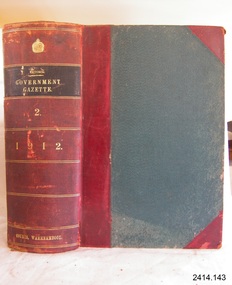
Book - Reference/State Government Notification Gazette, Albert John Mullett, The Victorian Government Gazette 1912 Vol 2 /147, 1912
... documents, including the Victorian Government Gazette, parliamentary votes and proceedings, ordnance maps, and judicial reports. Mullet's office was responsible for printing high-profile official propaganda and patriotic materials during World War I. This included widely distributed recruitment items such as the iconic "Australians! Your Country Needs You" poster and official guides for peace celebrations and thanksgiving. He oversaw the printing of major historical works including the landmark reference books during his tenure, such as the comprehensive Handbook to Victoria compiled for the British Association for the Advancement of Science's 1914 Australian meeting, and the detailed Education Department's Record of War Service...documents, including the Victorian Government Gazette, parliamentary votes and proceedings, ordnance maps, and judicial reports. Mullet's office was responsible for printing high-profile official propaganda and patriotic materials during World War I. This included widely distributed recruitment items such as the iconic "Australians! Your Country Needs You" poster and official guides for peace celebrations and thanksgiving. He oversaw the printing of major historical works including the landmark reference books during his tenure, such as the comprehensive Handbook to Victoria compiled for the British Association for the Advancement of Science's 1914 Australian meeting, and the detailed Education Department's Record of War Service ...The Victoria Government Gazette and other government documents from 1887 were printed and published by Robert S. Brain, Government Printer, Melbourne. Brain held the position of Victorian Government Printer through the 1890s and into the early 1900s. The same imprint appears on other official Victorian publications from that era, such as the annual reports of the Board for the Protection of the Aborigines and the colony's Statistical Register. There wasn't really an editor in the modern sense the Gazette was compiled and issued under the authority of the colonial government, via the Chief Secretary's Department, with Brain's printing office producing and publishing it. In May 1906, James Kemp succeeded him, serving as Government Printer from May 1906 to August 1912, with the title of Acting Government Printer right at the very start of his tenure he was stepping into the role Brain had just vacated, and by later in December 1906 he was signing gazettes in that capacity, apparently before his appointment was made permanent. Then in 1912 Albert John Mullett took over the role starting from January 1912 the same way Kemp had as Acting Government Printer with his appointment made permanent in 1913 where he served all through the 1920s.Hard cover book. The Victorian Government Gazette 1912 Vol 2 /147 Printer: Albert John Mullett Publisher: Albert John Mullett Publisher: Authority of The Colonial Government Date: 1912 Further Information: Textured hard cover bound book leather burgundy colour spine with gilt lettering, covers embossed blue cloth & reinforced corners to front and back cover. non-fictionThe Victoria Government Gazette and other government documents from 1887 were printed and published by Robert S. Brain, Government Printer, Melbourne. Brain held the position of Victorian Government Printer through the 1890s and into the early 1900s. The same imprint appears on other official Victorian publications from that era, such as the annual reports of the Board for the Protection of the Aborigines and the colony's Statistical Register. There wasn't really an editor in the modern sense the Gazette was compiled and issued under the authority of the colonial government, via the Chief Secretary's Department, with Brain's printing office producing and publishing it. In May 1906, James Kemp succeeded him, serving as Government Printer from May 1906 to August 1912, with the title of Acting Government Printer right at the very start of his tenure he was stepping into the role Brain had just vacated, and by later in December 1906 he was signing gazettes in that capacity, apparently before his appointment was made permanent. Then in 1912 Albert John Mullett took over the role starting from January 1912 the same way Kemp had as Acting Government Printer with his appointment made permanent in 1913 where he served all through the 1920s. flagstaff hill, warrnambool, shipwrecked-coast, flagstaff-hill, flagstaff-hill-maritime-museum, maritime-museum, shipwreck-coast, flagstaff-hill-maritime-village, book, the victoria government gazette 1912 1 vol 146, the victoria government gazette 1912, the victoria government gazette -
 Flagstaff Hill Maritime Museum and Village
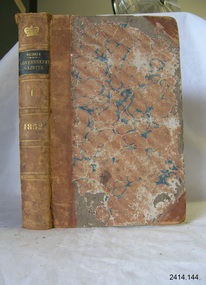
Book - Reference/Legal Statutes, John Ferres, Government Printer, The Victorian Government Gazette Vol 1 (January 1st to 30th June), 1852
... For more information on the Pattison Collection see item 3678 Flagstaff Hill collections) https://victoriancollections.net.au/items/5580c7e72162f114d8b758db flagstaff hill warrnambool shipwrecked coast flagstaff hill maritime museum maritime museum shipwreck coast flagstaff hill maritime village great ocean road book pattison collection warrnambool library warrnambool mechanics’ institute ralph eric pattison corangamite regional library service warrnambool city librarian mechanics’ institute library victorian library board warrnambool books and records warrnambool children’s library This volume is a primary historical document recording the foundational legal acts, official proclamations, and government notices that established the administration of the newly independent Colony of Victoria. ...This volume is a primary historical document recording the foundational legal acts, official proclamations, and government notices that established the administration of the newly independent Colony of Victoria. Volume 1, one of the earliest Victorian Statutes, contains the initial Acts passed by the newly formed Legislative Council of Victoria following its formal separation from New South Wales on 1 July 1851. The inclusion of Charles Joseph La Trobe, Victoria's first Lieutenant-Governor, appointed in July 1851, signifies that this volume records official proclamations establishing colonial courts, administrative divisions, civil service appointments, and public order measures.Hard cover book,The Victorian Statutes Vol 1. Author: Corporate Author Charles Joseph L A Trobe “The Colony of Victoria” Publisher: John Ferres Government Printer Melbourne. Date: 1852 Three quarter leather, patterned covers. Top section of leather on spine frayed, lettering in gilt. No Library labels. Pencil text to flyleaf unreadable.non-fictionThis volume is a primary historical document recording the foundational legal acts, official proclamations, and government notices that established the administration of the newly independent Colony of Victoria. Volume 1, one of the earliest Victorian Statutes, contains the initial Acts passed by the newly formed Legislative Council of Victoria following its formal separation from New South Wales on 1 July 1851. The inclusion of Charles Joseph La Trobe, Victoria's first Lieutenant-Governor, appointed in July 1851, signifies that this volume records official proclamations establishing colonial courts, administrative divisions, civil service appointments, and public order measures.flagstaff hill, warrnambool, shipwrecked coast, flagstaff hill maritime museum, maritime museum, shipwreck coast, flagstaff hill maritime village, great ocean road, book, pattison collection, warrnambool library, warrnambool mechanics’ institute, ralph eric pattison, corangamite regional library service, warrnambool city librarian, mechanics’ institute library, victorian library board, warrnambool books and records, warrnambool children’s library -
 Flagstaff Hill Maritime Museum and Village
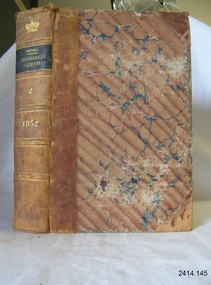
Book - Reference/Legal Statutes, John Ferres, Government Printer, The Victorian Government Gazette Vol 2 (July 1st to 31st December), 1852
... For more information on the Pattison Collection see item 3678 Flagstaff Hill collections) https://victoriancollections.net.au/items/5580c7e72162f114d8b758db flagstaff hill warrnambool shipwrecked coast flagstaff hill maritime museum maritime museum shipwreck coast flagstaff hill maritime village great ocean road book pattison collection warrnambool library warrnambool mechanics’ institute ralph eric pattison corangamite regional library service warrnambool city librarian mechanics’ institute library victorian library board warrnambool books and records warrnambool children’s library This volume is a primary historical document recording the foundational legal acts, official proclamations, and government notices that established the administration of the newly independent Colony of Victoria. ...This volume is a primary historical document recording the foundational legal acts, official proclamations, and government notices that established the administration of the newly independent Colony of Victoria. Volume 1, one of the earliest Victorian Statutes, contains the initial Acts passed by the newly formed Legislative Council of Victoria following its formal separation from New South Wales on 1 July 1851. The inclusion of Charles Joseph La Trobe, Victoria's first Lieutenant-Governor, appointed in July 1851, signifies that this volume records official proclamations establishing colonial courts, administrative divisions, civil service appointments, and public order measures.Hard cover book,The Victorian Statutes Vol 2. Author: Corporate Author Charles Joseph L A Trobe “The Colony of Victoria” Publisher: John Ferres Government Printer Melbourne. Date: 1852 Further information: Three quarter leather, patterned covers. Top section of leather on spine frayed at top, lettering in gilt. No Library labels.non-fictionThis volume is a primary historical document recording the foundational legal acts, official proclamations, and government notices that established the administration of the newly independent Colony of Victoria. Volume 1, one of the earliest Victorian Statutes, contains the initial Acts passed by the newly formed Legislative Council of Victoria following its formal separation from New South Wales on 1 July 1851. The inclusion of Charles Joseph La Trobe, Victoria's first Lieutenant-Governor, appointed in July 1851, signifies that this volume records official proclamations establishing colonial courts, administrative divisions, civil service appointments, and public order measures.flagstaff hill, warrnambool, shipwrecked coast, flagstaff hill maritime museum, maritime museum, shipwreck coast, flagstaff hill maritime village, great ocean road, book, pattison collection, warrnambool library, warrnambool mechanics’ institute, ralph eric pattison, corangamite regional library service, warrnambool city librarian, mechanics’ institute library, victorian library board, warrnambool books and records, warrnambool children’s library -
Flagstaff Hill Maritime Museum and Village
Book - Reference/State Government Notification Gazette, Albert John Mullett, The Victorian Government Gazette 1912 Vol 3 /148, 1912
... documents, including the Victorian Government Gazette, parliamentary votes and proceedings, ordnance maps, and judicial reports. Mullet's office was responsible for printing high-profile official propaganda and patriotic materials during World War I. This included widely distributed recruitment items such as the iconic "Australians! Your Country Needs You" poster and official guides for peace celebrations and thanksgiving. He oversaw the printing of major historical works including the landmark reference books during his tenure, such as the comprehensive Handbook to Victoria compiled for the British Association for the Advancement of Science's 1914 Australian meeting, and the detailed Education Department's Record of War Service...documents, including the Victorian Government Gazette, parliamentary votes and proceedings, ordnance maps, and judicial reports. Mullet's office was responsible for printing high-profile official propaganda and patriotic materials during World War I. This included widely distributed recruitment items such as the iconic "Australians! Your Country Needs You" poster and official guides for peace celebrations and thanksgiving. He oversaw the printing of major historical works including the landmark reference books during his tenure, such as the comprehensive Handbook to Victoria compiled for the British Association for the Advancement of Science's 1914 Australian meeting, and the detailed Education Department's Record of War Service ...The Victoria Government Gazette and other government documents from 1887 were printed and published by Robert S. Brain, Government Printer, Melbourne. Brain held the position of Victorian Government Printer through the 1890s and into the early 1900s. The same imprint appears on other official Victorian publications from that era, such as the annual reports of the Board for the Protection of the Aborigines and the colony's Statistical Register. There wasn't really an editor in the modern sense the Gazette was compiled and issued under the authority of the colonial government, via the Chief Secretary's Department, with Brain's printing office producing and publishing it. In May 1906, James Kemp succeeded him, serving as Government Printer from May 1906 to August 1912, with the title of Acting Government Printer right at the very start of his tenure he was stepping into the role Brain had just vacated, and by later in December 1906 he was signing gazettes in that capacity, apparently before his appointment was made permanent. Then in 1912 Albert John Mullett took over the role starting from January 1912 the same way Kemp had as Acting Government Printer with his appointment made permanent in 1913 where he served all through the 1920s.Hard cover book. The Victorian Government Gazette 1912 Vol 3 /148 Printer: Albert John Mullett Publisher: Albert John Mullett Publisher: Authority of The Colonial Government Date: 1912 Further Information: Textured hard cover bound book leather burgundy colour spine with gilt lettering, covers embossed blue cloth & reinforced corners to front and back cover. non-fictionThe Victoria Government Gazette and other government documents from 1887 were printed and published by Robert S. Brain, Government Printer, Melbourne. Brain held the position of Victorian Government Printer through the 1890s and into the early 1900s. The same imprint appears on other official Victorian publications from that era, such as the annual reports of the Board for the Protection of the Aborigines and the colony's Statistical Register. There wasn't really an editor in the modern sense the Gazette was compiled and issued under the authority of the colonial government, via the Chief Secretary's Department, with Brain's printing office producing and publishing it. In May 1906, James Kemp succeeded him, serving as Government Printer from May 1906 to August 1912, with the title of Acting Government Printer right at the very start of his tenure he was stepping into the role Brain had just vacated, and by later in December 1906 he was signing gazettes in that capacity, apparently before his appointment was made permanent. Then in 1912 Albert John Mullett took over the role starting from January 1912 the same way Kemp had as Acting Government Printer with his appointment made permanent in 1913 where he served all through the 1920s. flagstaff hill, warrnambool, shipwrecked-coast, flagstaff-hill, flagstaff-hill-maritime-museum, maritime-museum, shipwreck-coast, flagstaff-hill-maritime-village, book, the victoria government gazette 1912 1 vol 146, the victoria government gazette 1912, the victoria government gazette -
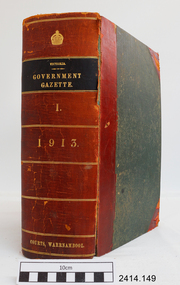 Flagstaff Hill Maritime Museum and Village
Book - Reference/State Government Notification Gazette, Albert John Mullett, The Victorian Government Gazette 1913 Vol 1 /149 ( Vol Number Mis Print on Volume Title CXLVIX See Note Section), 1913
... documents, including the Victorian Government Gazette, parliamentary votes and proceedings, ordnance maps, and judicial reports. Mullet's office was responsible for printing high-profile official propaganda and patriotic materials during World War I. This included widely distributed recruitment items such as the iconic "Australians! Your Country Needs You" poster and official guides for peace celebrations and thanksgiving. He oversaw the printing of major historical works including the landmark reference books during his tenure, such as the comprehensive Handbook to Victoria compiled for the British Association for the Advancement of Science's 1914 Australian meeting, and the detailed Education Department's Record of War Service...documents, including the Victorian Government Gazette, parliamentary votes and proceedings, ordnance maps, and judicial reports. Mullet's office was responsible for printing high-profile official propaganda and patriotic materials during World War I. This included widely distributed recruitment items such as the iconic "Australians! Your Country Needs You" poster and official guides for peace celebrations and thanksgiving. He oversaw the printing of major historical works including the landmark reference books during his tenure, such as the comprehensive Handbook to Victoria compiled for the British Association for the Advancement of Science's 1914 Australian meeting, and the detailed Education Department's Record of War Service ...The Victoria Government Gazette and other government documents from 1887 were printed and published by Robert S. Brain, Government Printer, Melbourne. Brain held the position of Victorian Government Printer through the 1890s and into the early 1900s. The same imprint appears on other official Victorian publications from that era, such as the annual reports of the Board for the Protection of the Aborigines and the colony's Statistical Register. There wasn't really an editor in the modern sense the Gazette was compiled and issued under the authority of the colonial government, via the Chief Secretary's Department, with Brain's printing office producing and publishing it. In May 1906, James Kemp succeeded him, serving as Government Printer from May 1906 to August 1912, with the title of Acting Government Printer right at the very start of his tenure he was stepping into the role Brain had just vacated, and by later in December 1906 he was signing gazettes in that capacity, apparently before his appointment was made permanent. Then in 1912 Albert John Mullett took over the role starting from January 1912 the same way Kemp had as Acting Government Printer with his appointment made permanent in 1913 where he served all through the 1920s.Hard cover book. The Victorian Government Gazette 1913 Vol 1 /149 Printer: Albert John Mullett Publisher: Albert John Mullett Publisher: Authority of The Colonial Government Date: 1913 Further Information: Textured hard cover bound book leather burgundy colour spine with gilt lettering, covers embossed blue cloth & reinforced corners to front and back cover. non-fictionThe Victoria Government Gazette and other government documents from 1887 were printed and published by Robert S. Brain, Government Printer, Melbourne. Brain held the position of Victorian Government Printer through the 1890s and into the early 1900s. The same imprint appears on other official Victorian publications from that era, such as the annual reports of the Board for the Protection of the Aborigines and the colony's Statistical Register. There wasn't really an editor in the modern sense the Gazette was compiled and issued under the authority of the colonial government, via the Chief Secretary's Department, with Brain's printing office producing and publishing it. In May 1906, James Kemp succeeded him, serving as Government Printer from May 1906 to August 1912, with the title of Acting Government Printer right at the very start of his tenure he was stepping into the role Brain had just vacated, and by later in December 1906 he was signing gazettes in that capacity, apparently before his appointment was made permanent. Then in 1912 Albert John Mullett took over the role starting from January 1912 the same way Kemp had as Acting Government Printer with his appointment made permanent in 1913 where he served all through the 1920s. flagstaff hill, warrnambool, shipwrecked-coast, flagstaff-hill, flagstaff-hill-maritime-museum, maritime-museum, shipwreck-coast, flagstaff-hill-maritime-village, book, the victoria government gazette 1912 1 vol 146, the victoria government gazette 1912, the victoria government gazette -
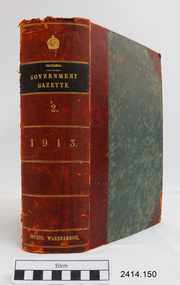 Flagstaff Hill Maritime Museum and Village
Book - Reference/State Government Notification Gazette, Albert John Mullett, The Victorian Government Gazette 1913 Vol 2 /150, 1913
... documents, including the Victorian Government Gazette, parliamentary votes and proceedings, ordnance maps, and judicial reports. Mullet's office was responsible for printing high-profile official propaganda and patriotic materials during World War I. This included widely distributed recruitment items such as the iconic "Australians! Your Country Needs You" poster and official guides for peace celebrations and thanksgiving. He oversaw the printing of major historical works including the landmark reference books during his tenure, such as the comprehensive Handbook to Victoria compiled for the British Association for the Advancement of Science's 1914 Australian meeting, and the detailed Education Department's Record of War Service...documents, including the Victorian Government Gazette, parliamentary votes and proceedings, ordnance maps, and judicial reports. Mullet's office was responsible for printing high-profile official propaganda and patriotic materials during World War I. This included widely distributed recruitment items such as the iconic "Australians! Your Country Needs You" poster and official guides for peace celebrations and thanksgiving. He oversaw the printing of major historical works including the landmark reference books during his tenure, such as the comprehensive Handbook to Victoria compiled for the British Association for the Advancement of Science's 1914 Australian meeting, and the detailed Education Department's Record of War Service ...The Victoria Government Gazette and other government documents from 1887 were printed and published by Robert S. Brain, Government Printer, Melbourne. Brain held the position of Victorian Government Printer through the 1890s and into the early 1900s. The same imprint appears on other official Victorian publications from that era, such as the annual reports of the Board for the Protection of the Aborigines and the colony's Statistical Register. There wasn't really an editor in the modern sense the Gazette was compiled and issued under the authority of the colonial government, via the Chief Secretary's Department, with Brain's printing office producing and publishing it. In May 1906, James Kemp succeeded him, serving as Government Printer from May 1906 to August 1912, with the title of Acting Government Printer right at the very start of his tenure he was stepping into the role Brain had just vacated, and by later in December 1906 he was signing gazettes in that capacity, apparently before his appointment was made permanent. Then in 1912 Albert John Mullett took over the role starting from January 1912 the same way Kemp had as Acting Government Printer with his appointment made permanent in 1913 where he served all through the 1920s.Hard cover book. The Victorian Government Gazette 1913 Vol 2 /150 Printer: Albert John Mullett Publisher: Albert John Mullett Publisher: Authority of The Colonial Government Date: 1913 Further Information: Textured hard cover bound book leather burgundy colour spine with gilt lettering, covers embossed blue cloth & reinforced corners to front and back cover. non-fictionThe Victoria Government Gazette and other government documents from 1887 were printed and published by Robert S. Brain, Government Printer, Melbourne. Brain held the position of Victorian Government Printer through the 1890s and into the early 1900s. The same imprint appears on other official Victorian publications from that era, such as the annual reports of the Board for the Protection of the Aborigines and the colony's Statistical Register. There wasn't really an editor in the modern sense the Gazette was compiled and issued under the authority of the colonial government, via the Chief Secretary's Department, with Brain's printing office producing and publishing it. In May 1906, James Kemp succeeded him, serving as Government Printer from May 1906 to August 1912, with the title of Acting Government Printer right at the very start of his tenure he was stepping into the role Brain had just vacated, and by later in December 1906 he was signing gazettes in that capacity, apparently before his appointment was made permanent. Then in 1912 Albert John Mullett took over the role starting from January 1912 the same way Kemp had as Acting Government Printer with his appointment made permanent in 1913 where he served all through the 1920s. flagstaff hill, warrnambool, shipwrecked-coast, flagstaff-hill, flagstaff-hill-maritime-museum, maritime-museum, shipwreck-coast, flagstaff-hill-maritime-village, book, the victoria government gazette 1912 1 vol 146, the victoria government gazette 1912, the victoria government gazette -
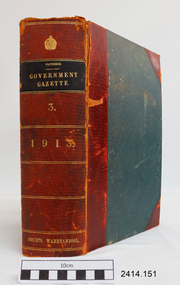 Flagstaff Hill Maritime Museum and Village
Book - Reference/State Government Notification Gazette, Albert John Mullett, The Victorian Government Gazette 1913 Vol 3 /151, 1913
... documents, including the Victorian Government Gazette, parliamentary votes and proceedings, ordnance maps, and judicial reports. Mullet's office was responsible for printing high-profile official propaganda and patriotic materials during World War I. This included widely distributed recruitment items such as the iconic "Australians! Your Country Needs You" poster and official guides for peace celebrations and thanksgiving. He oversaw the printing of major historical works including the landmark reference books during his tenure, such as the comprehensive Handbook to Victoria compiled for the British Association for the Advancement of Science's 1914 Australian meeting, and the detailed Education Department's Record of War Service...documents, including the Victorian Government Gazette, parliamentary votes and proceedings, ordnance maps, and judicial reports. Mullet's office was responsible for printing high-profile official propaganda and patriotic materials during World War I. This included widely distributed recruitment items such as the iconic "Australians! Your Country Needs You" poster and official guides for peace celebrations and thanksgiving. He oversaw the printing of major historical works including the landmark reference books during his tenure, such as the comprehensive Handbook to Victoria compiled for the British Association for the Advancement of Science's 1914 Australian meeting, and the detailed Education Department's Record of War Service ...The Victoria Government Gazette and other government documents from 1887 were printed and published by Robert S. Brain, Government Printer, Melbourne. Brain held the position of Victorian Government Printer through the 1890s and into the early 1900s. The same imprint appears on other official Victorian publications from that era, such as the annual reports of the Board for the Protection of the Aborigines and the colony's Statistical Register. There wasn't really an editor in the modern sense the Gazette was compiled and issued under the authority of the colonial government, via the Chief Secretary's Department, with Brain's printing office producing and publishing it. In May 1906, James Kemp succeeded him, serving as Government Printer from May 1906 to August 1912, with the title of Acting Government Printer right at the very start of his tenure he was stepping into the role Brain had just vacated, and by later in December 1906 he was signing gazettes in that capacity, apparently before his appointment was made permanent. Then in 1912 Albert John Mullett took over the role starting from January 1912 the same way Kemp had as Acting Government Printer with his appointment made permanent in 1913 where he served all through the 1920s.Hard cover book. The Victorian Government Gazette 1913 Vol 3 /151 Printer: Albert John Mullett Publisher: Albert John Mullett Publisher: Authority of The Colonial Government Date: 1913 Further Information: Textured hard cover bound book leather burgundy colour spine with gilt lettering, covers embossed blue cloth & reinforced corners to front and back cover. non-fictionThe Victoria Government Gazette and other government documents from 1887 were printed and published by Robert S. Brain, Government Printer, Melbourne. Brain held the position of Victorian Government Printer through the 1890s and into the early 1900s. The same imprint appears on other official Victorian publications from that era, such as the annual reports of the Board for the Protection of the Aborigines and the colony's Statistical Register. There wasn't really an editor in the modern sense the Gazette was compiled and issued under the authority of the colonial government, via the Chief Secretary's Department, with Brain's printing office producing and publishing it. In May 1906, James Kemp succeeded him, serving as Government Printer from May 1906 to August 1912, with the title of Acting Government Printer right at the very start of his tenure he was stepping into the role Brain had just vacated, and by later in December 1906 he was signing gazettes in that capacity, apparently before his appointment was made permanent. Then in 1912 Albert John Mullett took over the role starting from January 1912 the same way Kemp had as Acting Government Printer with his appointment made permanent in 1913 where he served all through the 1920s. flagstaff hill, warrnambool, shipwrecked-coast, flagstaff-hill, flagstaff-hill-maritime-museum, maritime-museum, shipwreck-coast, flagstaff-hill-maritime-village, book, the victoria government gazette 1912 1 vol 146, the victoria government gazette 1912, the victoria government gazette -
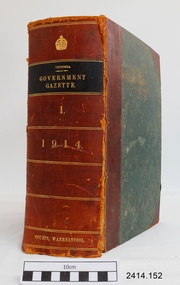 Flagstaff Hill Maritime Museum and Village
Book - Reference/State Government Notification Gazette, Albert John Mullett, The Victorian Government Gazette 1914 Vol 1 /152, 1914
... documents, including the Victorian Government Gazette, parliamentary votes and proceedings, ordnance maps, and judicial reports. Mullet's office was responsible for printing high-profile official propaganda and patriotic materials during World War I. This included widely distributed recruitment items such as the iconic "Australians! Your Country Needs You" poster and official guides for peace celebrations and thanksgiving. He oversaw the printing of major historical works including the landmark reference books during his tenure, such as the comprehensive Handbook to Victoria compiled for the British Association for the Advancement of Science's 1914 Australian meeting, and the detailed Education Department's Record of War Service...documents, including the Victorian Government Gazette, parliamentary votes and proceedings, ordnance maps, and judicial reports. Mullet's office was responsible for printing high-profile official propaganda and patriotic materials during World War I. This included widely distributed recruitment items such as the iconic "Australians! Your Country Needs You" poster and official guides for peace celebrations and thanksgiving. He oversaw the printing of major historical works including the landmark reference books during his tenure, such as the comprehensive Handbook to Victoria compiled for the British Association for the Advancement of Science's 1914 Australian meeting, and the detailed Education Department's Record of War Service ...The Victoria Government Gazette and other government documents from 1887 were printed and published by Robert S. Brain, Government Printer, Melbourne. Brain held the position of Victorian Government Printer through the 1890s and into the early 1900s. The same imprint appears on other official Victorian publications from that era, such as the annual reports of the Board for the Protection of the Aborigines and the colony's Statistical Register. There wasn't really an editor in the modern sense the Gazette was compiled and issued under the authority of the colonial government, via the Chief Secretary's Department, with Brain's printing office producing and publishing it. In May 1906, James Kemp succeeded him, serving as Government Printer from May 1906 to August 1912, with the title of Acting Government Printer right at the very start of his tenure he was stepping into the role Brain had just vacated, and by later in December 1906 he was signing gazettes in that capacity, apparently before his appointment was made permanent. Then in 1912 Albert John Mullett took over the role starting from January 1912 the same way Kemp had as Acting Government Printer with his appointment made permanent in 1913 where he served all through the 1920s.Hard cover book. The Victorian Government Gazette 1914 Vol 1 /152 Printer: Albert John Mullett Publisher: Albert John Mullett Publisher: Authority of The Colonial Government Date: 1914 Further Information: Textured hard cover bound book leather burgundy colour spine with gilt lettering, covers embossed blue cloth & reinforced corners to front and back cover. non-fictionThe Victoria Government Gazette and other government documents from 1887 were printed and published by Robert S. Brain, Government Printer, Melbourne. Brain held the position of Victorian Government Printer through the 1890s and into the early 1900s. The same imprint appears on other official Victorian publications from that era, such as the annual reports of the Board for the Protection of the Aborigines and the colony's Statistical Register. There wasn't really an editor in the modern sense the Gazette was compiled and issued under the authority of the colonial government, via the Chief Secretary's Department, with Brain's printing office producing and publishing it. In May 1906, James Kemp succeeded him, serving as Government Printer from May 1906 to August 1912, with the title of Acting Government Printer right at the very start of his tenure he was stepping into the role Brain had just vacated, and by later in December 1906 he was signing gazettes in that capacity, apparently before his appointment was made permanent. Then in 1912 Albert John Mullett took over the role starting from January 1912 the same way Kemp had as Acting Government Printer with his appointment made permanent in 1913 where he served all through the 1920s. flagstaff hill, warrnambool, shipwrecked-coast, flagstaff-hill, flagstaff-hill-maritime-museum, maritime-museum, shipwreck-coast, flagstaff-hill-maritime-village, book, the victoria government gazette 1912 1 vol 146, the victoria government gazette 1912, the victoria government gazette
