
Showing 7 items matching "dog embroidery"
-
 National Wool Museum
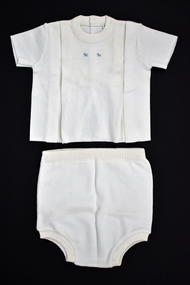
Textile - Diaper Set, Kathryn Knitwear, c.1960
... ...dog embroidery...Their legacy forms an integral part of both Australian social and manufacturing history. children's knitwear children's clothing knitwear clothing manufacturing Fashion Textile Production embroidery embroiderer hand embroidery dog embroidery animal embroidery animal motif dog motif dog animal baby clothes baby knitwear baby clothing .1 [label at back neck of top] Kathryn Reg’d / All Cotton / 18 .3 [sample label] [Obverse] STYLE: 314. ...Kathryn Knitwear, founded by Robert Blake, manufactured high quality children’s knitwear in Melbourne from the 1940s – 1980s. Robert Blake began manufacturing children’s knitwear in his bedroom in Strathmore using a hand powered machine in the late 1940s. The operation moved to Ascot Vale and Essendon, before eventually establishing a factory in Moonee Ponds in the early 1950s. The business continued to expand, necessitating a move to a new factory in Broadmeadows. By 1962, the Broadmeadows factory was producing an average of 20,000 garments per month, which increased to 24,000 by 1964. Robert Blake’s Son, Brendan recalls that “The Kathryn brand was famous around Australia, anywhere children needed to keep warm and dress smartly. It also won a number of wool fashion awards”, including the 1969 Wool Awards, which was held by the Australian Wool Bureau and published in Women’s Weekly. The Kathryn range was designed for durability, comfort and care, without sacrificing style. They used patterning techniques that increase stretchiness, comfort and fit, as well as integrating decorative elements into the fabric to prevent them from being bulky, uncomfortable or tight. Making longevity of style a priority, Brendan Blake remembers that “there was one particular garment that was in the range for at least thirty years”. He also recalls “In the past, when women have found out that I was associated with Kathryn Knitwear, they would often relate to me the story of a garment they had purchased or received as a gift and, when their child had grown out of it, they would hand it on to another child. Several ladies have told me of purchasing garments for their daughters’ glory box, or saving a particular garment after their daughter had grown out of it. Brendan Blake: “At the peak of their operation they employed approximately two hundred people, mainly women and girls. A family would often seek to send their daughter to work in this company because they knew they would be looked after and safe. One lady wrote to me telling me that working at the Moonee Ponds Factory prior to getting married was the happiest time of her life.” In 1963, workers at the Kathryn factory earned £13 per week, which was 8 shillings and 8 pence higher than the minimum weekly wage for female workers in the textile manufacturing industry (£12 11s 4d). By 1970, the Kathryn Knitwear brand expanded from children’s knitwear into womenswear under the brand name ‘Lady Kathryn’, and for boys and men under ‘Robert Blake’. Continuing to diversify their distribution, they also began exporting ‘Kathryn’ garments to New Zealand, the Pacific Islands, and Japan. ‘Kathryn Knitwear’ was well-known for their early adoption of modern materials and techniques that had broad appeal to their customer base. This is shown in their early use of the acrylic fibre ‘Orlon’ in the 50s and 60s and ‘Superwash’ wool in the 1970s. Many of Kathryn Knitwear’s styles, particularly those that were long running staples of the brand, were available in both wool and Orlon to suit the consumer’s preference. Cotton is a common material for knitwear worn in the warmer months, as it is very breathable and absorbs moisture easily. While we mostly associate knitwear with keeping us warm in the cold, the market for Australian knitwear would be very limited without options to wear all year round. The decoration on this garment was embroidered by hand by a skilled worker at the Kathryn Knitwear factory. Far from the humble origins of one man in his bedroom with a hand-cranked machine; at its closure in 1980, the Broadmeadows factory of ‘Kathryn’ housed more than 100 machines, including 53 sewing machines and 45 knitting machines. Robert Blake was “a passionate advocate for wool and Australian Made” throughout his whole life. A strong thread that ties through the lifespan of Robert Blake and Kathryn Knitwear is a balance between adopting new innovations without sacrificing the core values of durability, comfort, care and style that had made the brand so well known. Their legacy forms an integral part of both Australian social and manufacturing history.White diaper set. Short sleeved white top with two inverted box pleats along whole length, stitched at shoulder and mid chest. Embroidered in half cross stitch with two blue dogs on front. Closes in centre back with three plastic pearlescent buttons. White baby diaper shorts with ribbing at waist and leg holes .3 is a sample tag with manufacturing information, including price, size and colours available .4 is a swing tag with manufacturer care instructions.1 [label at back neck of top] Kathryn Reg’d / All Cotton / 18 .3 [sample label] [Obverse] STYLE: 314. Diaper Sat [sic] – Emb top. Combed Cotton. SIZE: 18” PRICE: 26/- COLOR: BLUE. LEMON. WHITE. [reverse] KATHRYN Garments are •PRE-SHRUNK •STANDARD MEASUREMENTS •FIT EXACTLY •LAUNDER PERFECTLY Designed and Manufactured by ROBERT BLAKE, MELBOURNE .4 [retail label] [obverse] Kathryn PRE-SHRUNK KNITWEAR Style: 314 [handwritten] DESIGNED & MANUFACTURED BY Robert Blake MELBOURNE [reverse] IMPORTANT. Special care should be taken with white and pastel shades. Rinse thoroughly. Do NOT dry in sunlight. WASHING INSTRUCTIONS 1.Wash frequently to AVOID HEAVY SOILING 2.Wash garment BY HAND, in lukewarm Velvet Soap suds. ON NO ACCOUNT RUB SOAP ON GARMENT. 3.Squeeze suds gently through garment but DO NOT RUB. Rubbing will cause garment to thicken. 4.RINSE AT LEAST TWICE IN CLEAN WATER TO REMOVE ALL SOAP. 5.To dry, roll garment in a towel to remove excess moisture, turn garment inside out and pull it lengthwise, then safety-pin to line through shoulder tape. 6.To keep Brushed Wool garments like new brush frequently with nylon brush.children's knitwear, children's clothing, knitwear, clothing, manufacturing, fashion textile production, embroidery, embroiderer, hand embroidery, dog embroidery, animal embroidery, animal motif, dog motif, dog, animal, baby clothes, baby knitwear, baby clothing -
 Montmorency–Eltham RSL Sub Branch
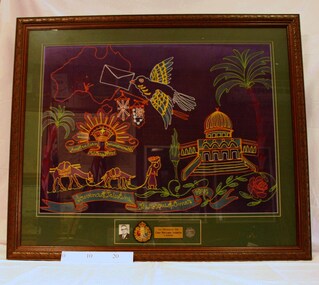
Souvenir - Framed World War 2 Embroidered Banner, WW2 Embroidered Souvenir, Estimated date 1941
... embroidery 1941 souvenir palestine mosque omar 'In Honour of Corp Benjamin Ackroyd VX 5001. Souvenir of Palestine, The Mosque of Omar 1941.' Framed embroidered banner – a souvenir of World War Two. A multi-coloured map of Australia, a bird carrying a letter, an Australian military badge, camels and a mosque are depicted on a dark blue background. At the bottom there is a photo, a 1939 associate badge, a dog ...Framed embroidered banner – a souvenir of World War Two. A multi-coloured map of Australia, a bird carrying a letter, an Australian military badge, camels and a mosque are depicted on a dark blue background. At the bottom there is a photo, a 1939 associate badge, a dog tag and a brass plaque. 'In Honour of Corp Benjamin Ackroyd VX 5001. Souvenir of Palestine, The Mosque of Omar 1941.'world war two, embroidery, 1941, souvenir, palestine, mosque, omar -
 Embroiderers Guild, Victoria
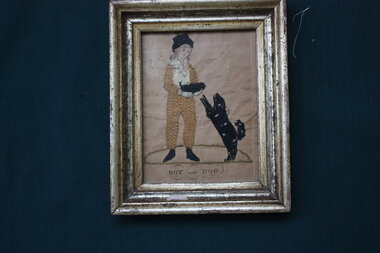
Textile - Embroidery on Paper Picture 1705, T Colley, "Boy and Dog", 1705
... "Boy and Dog" Textile Embroidery on Paper Picture 1705 T Colley ...Note on back. "Given me by Grandma Harvey. The picture appears to have been worked by T (?) Colley of 3 Union St. Portsea, England on March 10th 1705. In Queen Anne's reign".Small framed picture of a boy and black and white dog. Design has been drawn on the brown paper and then embroidered in tan, black and white silk. "Boy & Dog" / Note on back. "Given me by Grandma Harvey". The picture appears to have been worked by T (?) Colley of 3 Union St. Portsea, England on March 10th 1705. " In Queen Anne's reign".embroidery, picture, paper -
 Embroiderers Guild, Victoria
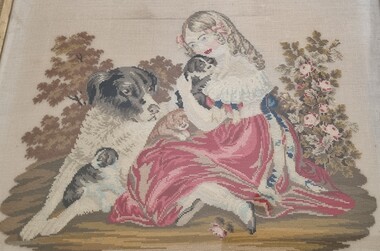
Textile - Berlin Wool Work Embroidered Picture, 19th C
... Framed embroidery depicting a young girl with a dog and three puppies. ...By the mid 1800's they were the most popular embroidery patterns in England and the United States. dogs child girl Framed embroidery depicting a young girl with a dog and three puppies. ...Embroidered in late 1800's by Mrs Ball in Boisdale or Briagalong NSW. Gifted to donors grandmother Catherine Forbes (nee Landy). Embroidery was originally much larger but cut down by donors mother Enid Clota to fit on her wall.Berlin wool work became popular in the 19th century due to the development of hand-painted charts in Berlin, Germany. Amateur embroiderers could use these charts to stitch the design in a soft wool embroidery thread. The first chart was produced in 1804, and by 1840 more than 14,000 different designs were published. By the mid 1800's they were the most popular embroidery patterns in England and the United States.Framed embroidery depicting a young girl with a dog and three puppies. Stitched in wool using gros and petit point stitches.dogs, child, girl -
 Geelong Naval and Maritime Museum
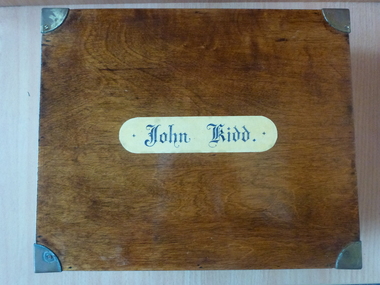
Ditty Box, John Kidd's Ditty Box, c.1915-1930
... Cadman & Sons, Sheffield England), black and white bakelite buttons with embossed crown and anchor and brass shank (either for war time or junior officers), gold naval buttons with embossed naval anchor and 2 piece shank (from a coat and cuffs), a bullet casing (Webley '45), a petty officers cloth badge (crossed anchors with a Crown), 4 shells, a good conduct badge (black with gold embroidery) and a red/brown vulcanized asbestos fibre fireproof dog- tag with rope attached....Cadman & Sons, Sheffield England), black and white bakelite buttons with embossed crown and anchor and brass shank (either for war time or junior officers), gold naval buttons with embossed naval anchor and 2 piece shank (from a coat and cuffs), a bullet casing (Webley '45), a petty officers cloth badge (crossed anchors with a Crown), 4 shells, a good conduct badge (black with gold embroidery) and a red/brown vulcanized asbestos fibre fireproof dog- tag with rope attached. ...There is a single record with the RAN for a John Kidd, who commenced service in 1909 and left in 1912. Kidd was born in 1885 in Sydney and his mother lived in Queenscliff. He served on the HMAS Parramatta from 1911-1912. There is no evidence of him having served on the HMAS Melbourne. Kidd served from 1911-1912 on the HMAS Parramatta, the first ship launched for the Royal Australian Navy (RAN).A wooden box with mortise and tenon joins, brass fittings, circular handles, silver hinges and a name plate on the front. The box has a lift out section creating compartments. On the inside lid of the box is a postcard of the HMAS Melbourne surrounded by small rope decoration. A number of keepsakes are inside including a fidd for splicing ropes, a Capstan Wills tobacco tin, 3 postcards, a "Bengall Imperial" cut throat razor (T.R. Cadman & Sons, Sheffield England), black and white bakelite buttons with embossed crown and anchor and brass shank (either for war time or junior officers), gold naval buttons with embossed naval anchor and 2 piece shank (from a coat and cuffs), a bullet casing (Webley '45), a petty officers cloth badge (crossed anchors with a Crown), 4 shells, a good conduct badge (black with gold embroidery) and a red/brown vulcanized asbestos fibre fireproof dog- tag with rope attached."John Kidd" on front of box. "20171" stamped on edge of box. Tobacco tin: "Medium/"Capstan"/Registered/Ready Rubbed Fine Cut Tobacco/-1 oz net weight when packed/W.D. & H.O. Wills/(Australia) Ltd., Sydney. Postcard: Main Street, Samarai. Postcard: Sydney from Lavender Bay Kerry (Copyright) Sydney. Postcard: "Docks showing cathedral, Bristol BL 193. Copyright Lilywhite (1932) Ltd, Sowerby Bridge". Buttons: "AUSTRALIA/Y6-298", "Buttons Ltd B'HAM mark trade" "AUSTRALIA Stokes & Son Melbourne". Bullet casing "WEB WRA 45". Dog-Tag may read "L/Ford" written in ink?ditty box, john kidd, dog-tag, wwi identification tag, lilywhite ltd, w.d & h.o wills, stokes & son melbourne, naval buttons, hmas melbourne -
 Whitehorse Historical Society Inc.
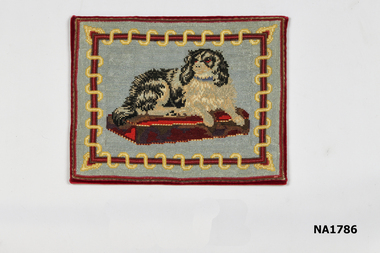
Artwork, other - Picture
... Canvas embroidery done on canvas with the same stitch through out so as to resemble tapestry handcrafts needlework Canvas needlework picture. Dog ...Canvas embroidery done on canvas with the same stitch through out so as to resemble tapestryCanvas needlework picture. Dog sitting on cushion. Blue background with yellow wound round red border. Backed in red Felt.handcrafts, needlework -
 Embroiderers Guild, Victoria
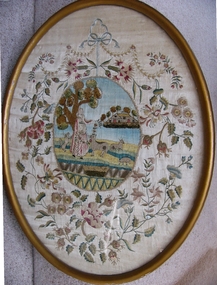
Textile - Georgian Embroidered Picture, c. 1800
... Embroidery Pictures Silk Embroidery Early 1800's Europe Sticker on reverse showing it was framed in Melbourne at the Leighton Gallery of Art in Collins St. Embroidered picture in gold oval frame. Cream silk with a central oval panel depicting a shepherdess under a tree, 3 sheep and a dog. ...Embroidered picture in gold oval frame. Cream silk with a central oval panel depicting a shepherdess under a tree, 3 sheep and a dog. House in background. Embroidered in silk and chenille threads. The wide border surrounding the central oval is of flowers, leaves, garlands, with a bow and loop at the top. The face of shepherdess is painted.Sticker on reverse showing it was framed in Melbourne at the Leighton Gallery of Art in Collins St.embroidery, pictures, silk embroidery, early 1800's, europe
