
Showing 11 items matching "domestic bed linen"
-
 Whitehorse Historical Society Inc.
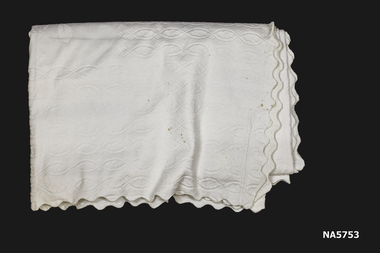
Domestic object - Counterpane, C 1900
... Domestic bed linen.... - Scalloped edging appears to be machine made. Domestic bed linen Nil - C 1900 - White cotton counterpane - Scallop edging with blanket stitching - embossed self-pattern with self-border Domestic object Counterpane ...- Family considers it to be created early 20th century. - Scalloped edging appears to be machine made.- C 1900 - White cotton counterpane - Scallop edging with blanket stitching - embossed self-pattern with self-borderNildomestic bed linen -
 Bendigo Historical Society Inc.
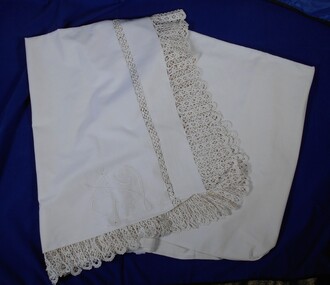
Textile - FAVALORO COLLECTION: BED-SPREAD PART OF MATCHING SET WITH PILLOW CASES, Late 1800-1900's
... Domestic...Woven linen bed spread...TEXTILES Domestic Woven linen bed spread Textiles. Finely woven linen bed spread, white in colour, and with a ''turn-back'' top to come over or under the pillows. ...Textiles. Finely woven linen bed spread, white in colour, and with a ''turn-back'' top to come over or under the pillows. A 10.5 cm deep band of cotton lace trims the edge of this turn-back, and is gathered around the two lower corners, and extends 74 cm. along the side edges of the turn-back. An insert of lace, 2.5 cm wide, also outlines the turn-back, 8 cm from the edge of the linen. The lace trim has a scalloped edge, and a corded effect. Above the narrow band of lace, are beautifully embroidered initials CF. Some small red cotton embroidery on top hem-left hand corner. Embroidered in white cotton satin stitch, the initials are embellished with floral motifs and leaves, and some embroidered eyelets May be the initials of Caterina (Ina) Lamaro who married Giovanni "Jack" Favaloro, or Caterina "Kitty" Lopes who married Salvatoro "Salve" Favaloro.textiles, domestic, woven linen bed spread -
 Flagstaff Hill Maritime Museum and Village
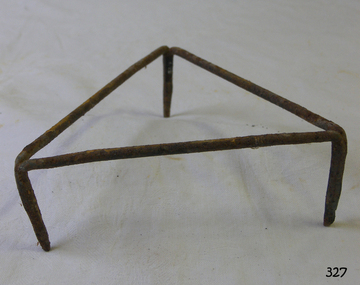
Domestic object - Iron stand
... Households from the 18th century onwards used a hot iron to removed wrinkles and creases in fabric such as clothing, table and bed linen This simple iron stand provided a rest for a hot iron between use during an ironing session and a place for the iron to cool when the session was completed. This item is associated with domestic ...Households from the 18th century onwards used a hot iron to removed wrinkles and creases in fabric such as clothing, table and bed linen This simple iron stand provided a rest for a hot iron between use during an ironing session and a place for the iron to cool when the session was completed. This item is associated with domestic life during the 19th and early 20th centuries. Triangular shaped stand made from metal rods welded together at feet. Painted black.flagstaff hill, flagstaff hill maritime museum and village, warrnambool, maritime museum, maritime village, great ocean road, shipwreck coast, iron stand, triangular iron stand, ironing, laundry equipment -
 Flagstaff Hill Maritime Museum and Village
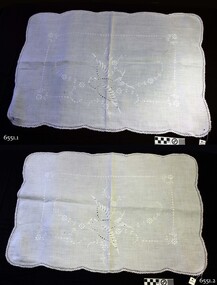
Textile - Pillow Shams, Daisy Dale, 1844-1900
... domestic items. Flagstaff Hill Warrnambool Flagstaff Hill Maritime Museum and Village Great Ocean Road Chamberlain family Dale family Lees Family Betty Stone Warrnambool Pioneer Warrnambool genealogy Wangoom Chamberlain Dale Lees collection glory box handmade craft manchester linen haberdashery needlework crochet pillow shams bed linen pillow covers Daisy Dale Daisy Welsh Betty Stone's mother A pair of white pillow shams, rectangular in shape with a shallow scalloped crochet edge. ...The two embroidered pillow shams were made by Betty Stones's mother Daisy (nee Dale) Welsh. A number of crocheted and embroidered articles were donated to Flagstaff Hill Museum by Betty Stone who advised that they cover a period of three generations from Sarah (nee Chamberlain) Lees, Ann (nee Lees) Dale, and Daisy Elvena (nee Dale) Welsh. All three were accomplished needlewomen, both Sarah Lees (born 1844) and her daughter, Ann (1865) these women crocheted a wide variety of articles for use in their homes. Today we have a few surviving examples of their skill that has survived the years.This item and others in the collection donated by Betty Stone are significant for their association with the early Warrnambool pioneering families of Chamberlain, Dale and Lees. These families are listed in the "Pioneers' Register" for Warrnambool Township and Shire, 1835-1900, and published by A.I.G.S. Warrnambool Branch. The item is a fine example of early 20th-century needlework and handmade domestic items.A pair of white pillow shams, rectangular in shape with a shallow scalloped crochet edge. The embroidered central design includes a bird motif. Made by Daisy Walsh (nee Dale). Part of the Chamberlain Dale Lees Collection.flagstaff hill, warrnambool, flagstaff hill maritime museum and village, great ocean road, chamberlain family, dale family, lees family, betty stone, warrnambool pioneer, warrnambool genealogy, wangoom, chamberlain dale lees collection, glory box, handmade, craft, manchester, linen, haberdashery, needlework, crochet, pillow shams, bed linen, pillow covers, daisy dale, daisy welsh, betty stone's mother -
 Glenelg Shire Council Cultural Collection
Domestic object - Bed Sheets, 1850s
... domestic item Fawn in colour and has been dyed. Three pieces of linen joined length ways by hand stitching. Items hand stitched. Domestic object Bed ...Arrived on the "John Davies" 9/11/1852 - Portland. The JOhn Davies arrived in Portland in November of 1852 having left Liverpool, England in July 1852.Fawn in colour and has been dyed. Three pieces of linen joined length ways by hand stitching. Items hand stitched.immigration, liverpool, manchester, domestic item -
 Orbost & District Historical Society
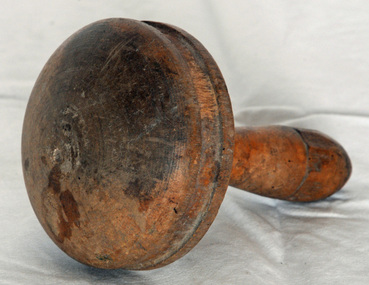
darning mushroom, 1950's
... bed linen. This darning tool was an essential item in 19th and early 20th century household as self-reliant women often had to make and repair all their clothing. darning-mushroom needlework handicraft domestic A mushroom-shaped piece of smooth wood used to stretch and support material being darned. darning mushroom ...The darning mushroom would have been an essential tool in an era when women were constantly repairing worn socks.Before the common use of synthetic materials, socks and other items of clothing were in constant need of repair. Darning would have been considered a necessary skill for girls and young women, part of their education as future wives and mothers. The mushroom was used to make repairs to clothing and bed linen.This darning tool was an essential item in 19th and early 20th century household as self-reliant women often had to make and repair all their clothing.A mushroom-shaped piece of smooth wood used to stretch and support material being darned.darning-mushroom needlework handicraft domestic -
 Flagstaff Hill Maritime Museum and Village
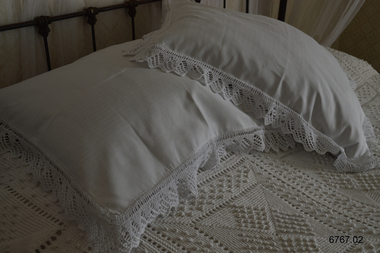
Textile - Pillow Case, Mary Jane Giles (Mrs Harry Giles), Late 19th to Early 20th Century
... But the Giles collection also gives us today a snapshot into what domestic life was like in early colonial times prior to Federation. warrnambool shipwrecked-coast flagstaff-hill flagstaff-hill-maritime-museum shipwreck-coast flagstaff-hill-maritime-village manchester pillowcases hand crafted pillowcases bed linen giles collection henry giles tower hill warrnambool breakwater mailor’s flat wangoom 19th century household goods Textiles None Pillow Cases (2), white, with hand knitted lace border. ...These pillow cases are are of many 19th century items of furniture, linen and crockery donated to Flagstaff Hill Maritime Village by, Vera and Aurelin Giles. The items are associated with Warrnambool and the Giles Family history. Items donated by the family have come to be known as the “Giles Collection”. Many items in the Lighthouse Keeper’s Cottage were donated by Vera and Aurelin Giles and mostly came from the home of Vera’s parents-in-law, Henry Giles and his wife Mary Jane (nee Freckleton) who married in 1880 and whose photos are on display in the parlour. Henry was born at Tower Hill in 1858, and was a labourer on the construction of the Warrnambool Breakwater before leaving in 1895 for around seven years to build bridges in NSW. Mary Jane was born in 1860 at Cooramook and she attended Mailor’s Flat State School and where she eventually was to become a student teacher. After which she became a governess at “Injemiara” where her grandfather, Francis Freckleton, had once owned land. Henry and Mary’s family consisted of six, some of the children were born at Mailor’s Flat and later some children at Wangoom. They lived with their parents at Wangoom and Purnim west, and this is where Henry died in 1933 and Mary Jane in 1940. The Giles family collection is of social significance at a local level, because it not only illustrates the level of material support the Warrnambool community gave to Flagstaff Hill during it’s establishment. But the Giles collection also gives us today a snapshot into what domestic life was like in early colonial times prior to Federation.Pillow Cases (2), white, with hand knitted lace border. (Giles Collection)Nonewarrnambool, shipwrecked-coast, flagstaff-hill, flagstaff-hill-maritime-museum, shipwreck-coast, flagstaff-hill-maritime-village, manchester, pillowcases, hand crafted pillowcases, bed linen, giles collection, henry giles, tower hill, warrnambool breakwater, mailor’s flat, wangoom, 19th century household goods, textiles -
 Bendigo Historical Society Inc.
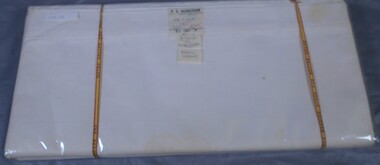
Domestic object - Bed sheets - The Beehive
... Linen Sheets Pair of folded bed sheets for 3/4 bed or large single bed plain cream weave. Label on sheets - R.O Henderson "The Beehive" Sheets are tied with yellow and red ribbon "The Beehive Store for Better Value" Sheets are priced 65/- . Still in original cellophane wrapping. Domestic ...Pair of folded bed sheets for 3/4 bed or large single bed plain cream weave. Label on sheets - R.O Henderson "The Beehive" Sheets are tied with yellow and red ribbon "The Beehive Store for Better Value" Sheets are priced 65/- . Still in original cellophane wrapping.the beehive, r.o. henderson, linen sheets -
 Duldig Studio museum + sculpture garden
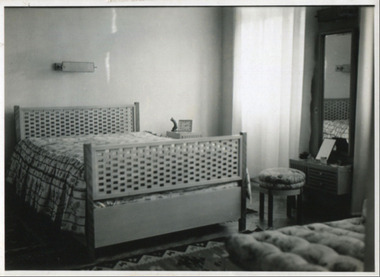
Furniture, Sigmund Jaray et al, Viennese bedroom suite manufactured by Sigmund Jaray Kunstmobelfabrik 1931, 1931
... domestic interior design in Vienna during the 1930s. The bedroom suite is intact, and has been preserved in its entirety – double bed and side tables, wardrobe and linen press, stool and day bed. ...The Wiener Werkstätte (Viennese workshops) established by Josef Hoffman and Kolomon Moser in 1903 are today celebrated for their work in promoting the involvement of artists, designers and craftspeople in the manufacture of home furnishings; however Sigmund Járay’s firm was also an important, although today lesser-known, Viennese manufacturer of Kunstmöbel (art furniture). An Austro-Hungarian designer of Jewish descent, Sigmund Járay (1838-1908) established his Kunstmöbelfabrik (art furniture factory) in Vienna in the 1870s in partnership with his brother Sándro Járay (1845-1916), a sculptor. The firm with its team of cabinet makers, modellers, sculptors, upholsterers, painters and gilders, manufactured bespoke furnishings and decorated interiors for public and private clients, including the Imperial court. Such was the prominence of the work of this factory, that in 1899 one of the first purchases of the newly formed Austrian Museum of Applied art was a suite of furniture designed by Sigmund Járay for a married worker. In commissioning the furniture, Slawa was adopting the custom of Viennese couples to furnish their homes with bespoke furniture from the interior design firms that flourished in early 20th century in Vienna. Comparative material is held in the National Gallery of Victoria collection; a suite of furniture by Josef Hoffman commissioned by the Gallia family in 1912; and a suite of furniture by Adolf Loos commissioned by the Langer family in 1903. Ann Carew 2016The bedroom suite is aesthetically significant for the quality of its craftsmanship and design. It is a significant example of domestic interior design in Vienna during the 1930s. The bedroom suite is intact, and has been preserved in its entirety – double bed and side tables, wardrobe and linen press, stool and day bed. It has the potential to be displayed in situ in the place where it was last in use. It is of historical significance. Many Jewish families had all their possessions lost or destroyed during the war years. The story of the furniture’s journey from Austria to Australia is relevant to the study of the experience of émigré families during the Holocaust, and the importance of return of their property. It is rare, as it and the furniture in the living and dining room, are the only known examples in Australia of furniture manufactured by the firm of Sigmund Jàray. The provenance of the furniture is excellent, and is demonstrated by photographs taken in Vienna; correspondence with the donor’s sister, Rella; and the quotation from Sigmund Járay Kunstmöbelfabrik. It is in excellent condition. Ann Carew 2016Bedroom suite consisting of a double bed, two side tables, an upholstered stool and upholstered day bed, and a wardrobe and linen press. Made of Maple and Rosewood. Designed by the firm of Sigmund Jaray with Slawa Horowitz-Duldig. -
 Embroiderers Guild, Victoria
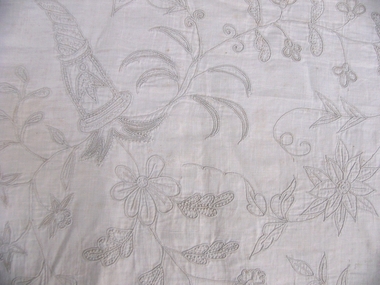
Domestic Object - Irish Knotted Work Bed Cover, 18th Century
... Embroidery Whitework Bedcover 18th Century Ireland Knotted linen thread couched onto white linen bed cover. Domestic Object Irish Knotted Work Bed Cover ...Donor's mother brought this from the west of Ireland in 1950. Said to have been embroidered by her grandmother and her ladies in 1780-1800. (This may be a later rather than actual date). Knotting was a genteel pastime for leisured ladies requiring little concentration, so conversation could be carried out. Favoured at Court and practised in England in the late 17th C in William and Mary's reign and Queen Anne's reign in the early 18th C.Knotting was a genteel pastime for leisured ladies requiring little concentration, so conversation could be carried out. Favoured at Court and practised in England in the late 17th C in William and Mary's reign and Queen Anne's reign in the early 18th C. A knotting shuttle, larger than a tatting shuttle, made knots at every quarter inch or 6 mm intervals in string, linen, silk or wool. Mrs Mary Delaney enjoyed knotting and preferred linen thread which was stronger. The Ulster Museum in Belfast holds an embroidered bedcover by Delany, one of the few complete pieces of embroidery made by her. The threads between the knots was dependent on the thickness of the thread. This fashionable occupation was often mocked by men, Sir Charles Sedley, a wit and libertine wrote a verse mocking Queen Mary, the dull Protestant wife of William 111: "Blest we, who from such queens are freed/ Who, buy vain superstition led,/ Are always telling beads;/But here's a queen now, thanks to God/ Who, when she rides in Coach abroad/ Is always knotting threads. In the Spectator of 1712 it was suggested that men might take up knotting. Dr Johnson attempted to learn the skill but told Boswell "I once tried knotting: Dempster's sister undertook to teach me, but I could not learn it." Knotted linen thread couched onto white linen bed cover. embroidery, whitework, bedcover, 18th century, ireland -
 Friends of Westgarthtown
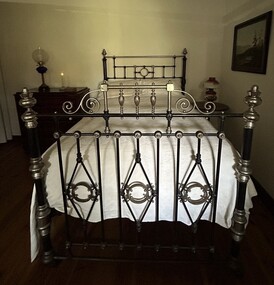
Furniture - Bed, double, Late 1800s
... bed throughout her long life.” The linens displayed on the bed are traditional cotton fabrics with intricate lace detailing, donated to the museum by Sylvia Ziebell. These textiles closely resemble the types of linens that would originally have dressed the bed, helping to evoke its historic domestic context. ...This object is of primary significance. The nickel plated brass bedstead was made by Carl Alfred Ziebell for his wife Dorothea. Carl Alfred Ziebell ( 23.08.1867 - 26.10. 1940) was the third generation grandson of Christian Ziebell. Dorothea remained proud of her bed throughout her long life. (14.7.1873 - 14.12.1969) The bed linen and quilts remain traditionally dressed as they were in 1850. This ornate iron bed holds strong historical and cultural significance as a rare surviving example of craftsmanship by Carl Heinrich Alfred “Carl Alfred” Ziebell (1867–1940), grandson of Christian and Sophia Ziebell, early German-Wendish settlers of Westgarthtown. A skilled wheelwright by trade, Carl Alfred possessed deep technical knowledge of metalworking, timber precision, and traditional fabrication techniques required for constructing and repairing wagon wheels. These same skills are reflected in the bed’s carefully forged ironwork and its distinctive circular decorative motifs. Carl Alfred crafted this bed for his wife, Dorothea, who, as family accounts recall, “remained proud of her bed throughout her long life.” The linens displayed on the bed are traditional cotton fabrics with intricate lace detailing, donated to the museum by Sylvia Ziebell. These textiles closely resemble the types of linens that would originally have dressed the bed, helping to evoke its historic domestic context. The bed represents both the material resourcefulness and artisanal expertise present within the second generation of the Ziebell family. Its construction demonstrates a blending of practical skill with aesthetic ambition, illustrating how tradespeople adapted their craft to create durable and decorative domestic furnishings. As Carl Alfred and Dorothea are buried in the Lutheran Cemetery adjacent to Ziebell’s Farmhouse, the bed also strengthens the site’s tangible connection to the family’s multi-generational presence in Westgarthtown. The piece is significant for its rarity, its association with an identified maker within the Ziebell lineage, and its ability to illuminate the lived experience, creativity, and craftsmanship of the early community. Nickel plated and painted tubular steel bedstead with double bed mattress and spreads. On four castor wheels, ornate decoration on both ends. Turned sections on each corner post, four on the bottom ends, only caps on the top ends. Spring wire mattress base.furniture, domestic, double bed, bedstead, nickel-plated, steel, turned
