
Showing 21 items matching "dr bottomley"
-
 Emerald Museum & Nobelius Heritage Park
Photograph - Photographic Portrait of Dr Bottomley, Dorothy Welding, 1930s
... Photographic Portrait of Dr Bottomley...Dr Bottomley...Bottomley Drive in Emerald is named after Dr Bottomley....Framed photographic portrait in color of Collins St specialist, Dr Bottomley, by Dorothy Welding, Sydney, 1930s....Photograph Photographic Portrait of Dr Bottomley Dorothy Welding ...Dr William Bottomley was a well-known specialist, humanist and social advocate in Melbourne in the first few decades of the 20th century. He also became a member of two syndicates who purchased land from Carl Axel Nobelius nursery property. Emerald Pty Ltd purchased 600 acres and with it developed the Emerald Country Club, including a golf course and properties. Dr Bottomley retired to Emerald. TheEmerald Museum has a number of objects (including medical instruments) and documents relating to Dr Bottomley. These can be found by a 'Bottomley' search of the catalogue. The Nobelius Station Estate purchased 300 acres, which includes sites of the current Nobelius Heritage Park and Emerald Lake Park. Bottomley Drive in Emerald is named after Dr Bottomley.This portrait is of historic significance because Dr Bottomley was instrumental in the establishment of the iconic Emerald Country Club.Framed photographic portrait in color of Collins St specialist, Dr Bottomley, by Dorothy Welding, Sydney, 1930s.dr bottomley, photographic portrait, doctors (medical), dorothy welding, 1930s, photographer, emerald country club -
Emerald Museum & Nobelius Heritage Park
Equipment - Medical instruments, Various, C. 1930
... ...Dr Bottomley...Used by Dr Bottomley, medical practitioner, Emerald....Medical instruments used by Dr Bottomley at his Emerald clinic. 1. Milne Murray obstetrical forceps 2. ...Used by Dr Bottomley, medical practitioner, Emerald. Emerald Victoria Australia medical services Medical practioners doctors (medical) Dr Bottomley Medical instruments used by Dr Bottomley at his Emerald clinic. 1. ...Used by Dr Bottomley, medical practitioner, Emerald.Medical instruments used by Dr Bottomley at his Emerald clinic. 1. Milne Murray obstetrical forceps 2. Ditto (smaller size) 3. Vetinary syringes 4. Hellige haemometer 5. Hellige haemocytometer 6. "Klinostik" super diagnostic "AuroscSteel|Glassemerald, victoria, australia, medical services, medical practioners, doctors (medical), dr bottomley -
Emerald Museum & Nobelius Heritage Park
Sign - Nameplate
... nameplate from Dr Bottomley's premises in Collins Street Melbourne. ...Dr Bottomley...nameplate from Dr Bottomley's premises in Collins Street Melbourne. ...nameplate from Dr Bottomley's premises in Collins Street Melbourne. Dr Bottomley was a member of a syndicate which bought Nobelius land for the Emerald Country Club and later lived in Emerald.brass nameplate with inlaid lettering in unknown materialBrassDr Bottomleyplaques, emerald, victoria, australia, doctors (medical), doctor bottomley -
Emerald Museum & Nobelius Heritage Park
Equipment - Razors for Shaving, Christ Johnson & Co et al, 19th C
... Cut throat razors used by Dr Bottomley of Emerald, early 1900s....2 cut throat razors used by Dr Bottomley of EmeraldBakelite...Cut throat razors used by Dr Bottomley of Emerald, early 1900s. Emerald Victoria Australia personal effects W. ...Cut throat razors used by Dr Bottomley of Emerald, early 1900s.2 cut throat razors used by Dr Bottomley of EmeraldBakeliteDavey. Metropolitan.|The Royal Razor with crest.emerald, victoria, australia, personal effects, w. bottomley -
Emerald Museum & Nobelius Heritage Park
Instrument - Obstetrical forceps, Milne-Murray, Robert, 1890s-1920s
... These Victorian-era obstetrical forceps are from the collection of equipment used by Dr William Bottomley. Dr Bottomley was born in Fitzroy in 1881 and obtained a Bachelor of Surgery from the University of Melbourne in 1906. ...Dr Bottomley had a weekend residence in Emerald. ...These Victorian-era obstetrical forceps are from the collection of equipment used by Dr William Bottomley. Dr Bottomley was born in Fitzroy in 1881 and obtained a Bachelor of Surgery from the University of Melbourne in 1906. ...These Victorian-era obstetrical forceps are from the collection of equipment used by Dr William Bottomley. Dr Bottomley was born in Fitzroy in 1881 and obtained a Bachelor of Surgery from the University of Melbourne in 1906. He lived in South Yarra with a weekend log cabin called Forest Lodge in Emerald and practiced in Collins Street in Melbourne. In the 1920s Dr Bottomley and business partner W.H. Treganowan initiated the Emerald Country Club syndicate to purchase land from Carl Axel Nobelius' Gembrook Nurseries estate, which led to the formation of the golf course and Country Club facilities. Bottomley Drive in Emerald is named after Dr Bottomley; the street is located near Silver Birches, the house commissioned by the doctor from modernist architect Harry Norris. 'Action traction' obstetrical forceps were invented by Dr Robert Milne-Murray, a practicing physician at the Royal Maternity and the Simpson Memorial Pavilion in Edinburgh in 1891. They were designed to allow the attending physician to obtain a secure hold on the infant before pulling backwards on the handle to facilitate the baby's birth. Forceps to extract fetuses from women who would otherwise die during complications in labour have been used as a last resort since 1500 BCE, though it has only been in the last 300-500 years that forceps design has shifted to focusing on saving the lives of both mother and infant. These are fenestrated forceps, with a hollow 'blade' or loop, which have been superseded as a design by solid models that are less likely to cause compression damage to the baby's head.These items are significant as they provide insights into medical practice in the early Twentieth-Century in Melbourne and surrounds. They are also significant because they were used by Dr William Bottomley, who owned property in Emerald and whose business dealings significantly shaped the development of the town.The silver-coloured item is approximately fifteen centimetres long; it has a solid metal handle bar and a stem leading to a flat panel with two holes that are designed to connect it to the body of the forceps. These forceps are from the collection of equipment used by Dr William Bottomley, who practiced in Collins Street in Melbourne after receiving his Bachelor of Surgery from the University of Melbourne in 1906. Dr Bottomley had a weekend residence in Emerald. In the 1920s Dr Bottomley and his business partner W.H. Treganowan initiated the Emerald Country Club syndicate and purchased land from the Gembrook Nurseries estate to build a golf course and Country Club.1890s, 1900s, 1910s william bottomley, w.h. treganowan, medical equipment, women's health, medical practice, forceps, birth, obstetrics, forest lodge, silver birches, harry norris, emerald country club and golf course -
Emerald Museum & Nobelius Heritage Park
Booklet - File of medical-related information
... ...Dr. W F Bottomley...Documents relating to medicines, some relating to items in the Dr Bottomley collection...Documents relating to medicines, some relating to items in the Dr Bottomley collection Emerald Victoria Australia doctors (medical) Dr. ...Documents relating to medicines, some relating to items in the Dr Bottomley collectionPhotocopy of document 'Obstetric Forceps' pp16 (unreferenced)|instruction booklet for Haemacytometer|First Aid Hints (Trafalgar Trading Co. Pty Ltd)|Wartime newspaper cutting advertisement for Lantigen C|Stypwool instruction leafletemerald, victoria, australia, doctors (medical), dr. w f bottomley -
 Emerald Museum & Nobelius Heritage Park
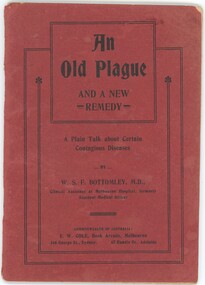
Booklet, W.S.F. Bottomley, An Old Plague And a New Remedy, 1911
... Dr Bottomley...Dr William Bottomley (1881-1952) was a specialist based at Collins Street who advocated for humanist and practical solutions to public health issues. ...Dr Bottomley also has close connections with the origin of the Emerald Country Club. ...Dr William Bottomley (1881-1952) was a specialist based at Collins Street who advocated for humanist and practical solutions to public health issues. His love of the Emerald countryside which he visited at weekends with his family led him to being the primary instigator of the late 1920s development - the iconic and beautiful Emerald Country Club. He later retired to Emerald where he built a Modernist-inspired home, Silver Birches, which is of architectural significance. This 1911 booklet outlines his argument for sexually transmitted diseases to be treated as a public health issue instead of the practice at that time which was to blame the victim.This book is significant because it outlines Dr Bottomley's argument for treating sexually transmitted diseases as a public health problem in the early 20th century when this was not a widely held view. Dr Bottomley also has close connections with the origin of the Emerald Country Club.Booklet with dark red paper cover. 30 pages.On front cover: 'An / Old Plague / And A New / Remedy / A Plain Talk About Certain / Contagious Diseases / By / W. S. F. Bottomley M. D., / Clinical Assistant at Melbourne Hospital, formerly / Resident Medical Officer / Commonwealth of Australia / E. W. Cole, Book Arcade, Melbourne / 346 George St., Sydney 67 Rundle St., Adelaide'dr bottomley, an old plague and a new remedy, 1911, silver birches, emerald country club -
Emerald Museum & Nobelius Heritage Park
Functional object - Apothecary weights, H.B. Selby, 1900s
... Bottomley...Fischer...Dr...These Victorian-era apothecary scales are from the collection of equipment used by Dr William Bottomley. Dr Bottomley was born in Fitzroy in 1881 and obtained a Bachelor of Surgery from the University of Melbourne in 1906. ...These Victorian-era apothecary scales are from the collection of equipment used by Dr William Bottomley. Dr Bottomley was born in Fitzroy in 1881 and obtained a Bachelor of Surgery from the University of Melbourne in 1906. ...These Victorian-era apothecary scales are from the collection of equipment used by Dr William Bottomley. Dr Bottomley was born in Fitzroy in 1881 and obtained a Bachelor of Surgery from the University of Melbourne in 1906. He lived in South Yarra with a weekend log cabin called Forest Lodge in Emerald and practiced in Collins Street in Melbourne. These weights were used with a scale to dispense correct quantities of drugs or ingredients; the tweezers may have been used to combine substances on the glass slide ready for use. In the 1920s Dr Bottomley and business partner W.H. Treganowan initiated the Emerald Country Club syndicate to purchase land from Carl Axel Nobelius' Gembrook Nurseries estate, which led to the formation of the golf course and Country Club facilities. Bottomley Drive in Emerald is named after Dr Bottomley; the street is located near Silver Birches, the house commissioned by the doctor from modernist architect Harry Norris. These weights were used with a scale to dispense correct quantities of drugs or ingredients; the tweezers may have been used to combine substances on the glass slide ready for use. The apothecary system of weights was tailored to measuring medicinal ingredients; it and the Troy system (which was used for measuring precious metals such as silver and gold) both have twelve ounces to the pound, in comparison to the Avoirdupois method which was used for heavier items and had sixteen ounces to the pound. These measurement systems were used extensively throughout the world until the 1960s when the widespread adoption of the metric system standardised processes.These items are significant as they provide insights into medical practice in the early Twentieth-Century in Melbourne and surrounds. They are also significant because they were used by Dr William Bottomley, who owned property in Emerald and whose business dealings significantly shaped the development of the town.Wooden box with a metal latch, maker's label and owner's name. Inside the box there is a black cloth lining to encase eight brass and five tin weights, a glass slide and tweezers. There is space for an additional brass weight and eight tin weights, but these spaces are empty.Obverse: D W H BOTTOMLEY / H.B SELBY & CO. LTD. / SCIENTIFIC APPARATUS / MELBOURNE & SYDNEY /emerald, victoria, australia, gold weights, apothecary weights, bottomley, fischer, dr. w f bottomley, w.h. treganowan, harry norris, forest lodge, silver birches, medical practice, drug dispensing, pharmacy equipment, h.b. selby & co, emerald country club and golf course -
Emerald Museum & Nobelius Heritage Park
Functional object - Coin holder, H. Watson & Sons Ltd
... ...Dr Bottomley...Emerald Victoria Australia Spectacles Magnifying glasses Dr Bottomley Adjusta on glasses bridge bar. "Speera" magnifiers on case flap (outside). ...Magnifying glasses, binocular, 20 mm diameter. Lenses in metal frame. Lenses, held in metal bands, are adjustable. Complete with canvas caseAdjusta on glasses bridge bar. "Speera" magnifiers on case flap (outside). On inside flap: H. Watson & Sons Ltd., Opticians to H.M. Governmentemerald, victoria, australia, spectacles, magnifying glasses, dr bottomley -
Emerald Museum & Nobelius Heritage Park
Certificate - Medical degree
... Medical degree for Dr Bottomley...Medical degree for Dr Bottomley Emerald Victoria Australia education doctors (medical) W F Bottomley University of Melbourne University of Melbourne degree Doctor of Medicine W F Bottomley 1906 Certificate Medical degree ...Medical degree for Dr BottomleyUniversity of Melbourne degree Doctor of Medicine W F Bottomley 1906emerald, victoria, australia, education, doctors (medical), w f bottomley, university of melbourne -
Emerald Museum & Nobelius Heritage Park
Book - Account book, Bottomley, William, 1936-1937
... The book was used between 1936-1937 by Dr William Bottomley at Mary Street, Emerald. Dr Bottomley was a member of a syndicate who bought land from the Nobelius Nursery and was involved in the founding of Emerald Country Club....The book was used between 1936-1937 by Dr William Bottomley at Mary Street, Emerald. Dr Bottomley was a member of a syndicate who bought land from the Nobelius Nursery and was involved in the founding of Emerald Country Club. ...The book was used between 1936-1937 by Dr William Bottomley at Mary Street, Emerald. Dr Bottomley was a member of a syndicate who bought land from the Nobelius Nursery and was involved in the founding of Emerald Country Club.Soft cover day book containing hand-written entries of expenditures, used at the 'Homestead at Emerald'. The cover is khaki coloured with a red spine. Loose receipts and bank statements are also stored within the book.Handwritten in pencil on inner front cover: '19/8 2/- 10 (illegible) 1/2 42- 84 10 -- 94/- 32 -- 10 hours at ordinary rate - 64 1 1/2 30 -- 94/- Hand-drawn map on back outer cover, unknown location.emerald, victoria, australia, historic buildings, construction industry, w.s. bottomley, william bottomley, e.m. bottomley -
Emerald Museum & Nobelius Heritage Park
Book - Catalogue, Catalogue of Surgical instruments and Surgical Sundries
... This catalogue of surgical instruments and sundries belonged to Dr Bottomley a notable doctor with progressive ideas who retired to Emerald and was closely involved with the development which became the Emerald Country Club....This catalogue of surgical instruments and sundries belonged to Dr Bottomley a notable doctor with progressive ideas who retired to Emerald and was closely involved with the development which became the Emerald Country Club. ...This catalogue of surgical instruments and sundries belonged to Dr Bottomley a notable doctor with progressive ideas who retired to Emerald and was closely involved with the development which became the Emerald Country Club. -
Emerald Museum & Nobelius Heritage Park
Accessory - Eye glasses, W. Watson & Sons, 1920s-1940s
... These magnifying eyeglasses belonged to Dr William Bottomley. Dr Bottomley received his Bachelor of Surgery from the University of Melbourne in 1906 and had a medical practice on Collins St, Melbourne. ...These magnifying eyeglasses belonged to Dr William Bottomley. Dr Bottomley received his Bachelor of Surgery from the University of Melbourne in 1906 and had a medical practice on Collins St, Melbourne. ...These magnifying eyeglasses belonged to Dr William Bottomley. Dr Bottomley received his Bachelor of Surgery from the University of Melbourne in 1906 and had a medical practice on Collins St, Melbourne. He built a log cabin in Emerald which he would use on weekends.Dr Bottomley was a member of two syndicates who purchased land from Carl Axel Nobelius nursery property. Emerald Pty Ltd purchased 600 acres and with it developed the Emerald Country Club, including a golf course and properties. The Nobelius Station Estate purchased 300 acres, which includes sites of the current Nobelius Heritage Park and Emerald Lake Park. Bottomley Drive in Emerald is named after Dr Bottomley.This object is of historic significance as it provides insight into an early design of a late-nineteenth/early-twentieth century piece of medical equipment. (Early designs of magnifying eyeglasses date back to 1876 - Kwitko et al., 1998.) It is also of social significance as they belonged to Dr William Bottomley, who was instrumental in the establishment of the Emerald Country Club.Small pair of magnifying eyeglasses made of silver-coloured metal. Lenses are thick and unframed.eyeglasses, magnifying glasses, doctors (medical), medical equipment -
Emerald Museum & Nobelius Heritage Park
Container - Eyeglasses case, W. Watson & Sons, 1920s-1940s
... These magnifying eyeglasses belonged to Dr William Bottomley. Dr Bottomley received his Bachelor of Surgery from the University of Melbourne in 1906 and had a medical practice on Collins St, Melbourne. ...These magnifying eyeglasses belonged to Dr William Bottomley. Dr Bottomley received his Bachelor of Surgery from the University of Melbourne in 1906 and had a medical practice on Collins St, Melbourne. ...These magnifying eyeglasses belonged to Dr William Bottomley. Dr Bottomley received his Bachelor of Surgery from the University of Melbourne in 1906 and had a medical practice on Collins St, Melbourne. He built a log cabin in Emerald which he would use on weekends. He was a member of two syndicates who purchased land from Carl Axel Nobelius nursery property. Emerald Pty Ltd purchased 600 acres and with it developed the Emerald Country Club, including a golf course and properties. The Nobelius Station Estate purchased 300 acres, which includes sites of the current Nobelius Heritage Park and Emerald Lake Park. Bottomley Drive in Emerald is named after Dr Bottomley.This object is of historic significance as it provides insight into an early design of a late-nineteenth/early-twentieth century piece of medical equipment. The object is also of social significance as they belonged to Dr William Bottomley, who was instrumental in the establishment of the Emerald Country Club.Burgundy-coloured, cylindrical eyeglasses case. Lid closes with a snap fastener. The inside of the lid has the maker's label and the outside has the model of glasses printed in gold lettering. Early designs of magnifying eyeglasses date back to 1876 (Kwitko et al., 1998).Exterior of lid: "SPEERA" / MAGNIFIERS. / Interior of lid: OPTICIANS TO / H.M. GOVERNMENT. / W. WATSON & SONS / ESTABLISHED 1837 TD / 313 / HIGH HOLBORN / LONDON / -
Emerald Museum & Nobelius Heritage Park
Document - Certificate, Melbourne Hospital
... Certification of Residency at Melbourne Hospital of Dr W. Bottomley, Emerald landowner....Certification of Residency at Melbourne Hospital of Dr W. Bottomley, Emerald landowner. Emerald Victoria Australia doctors (medical) certificates William Francis Bottomley Royal Melbourne Hospital Stiff cardboard. ...Certification of Residency at Melbourne Hospital of Dr W. Bottomley, Emerald landowner.Stiff cardboard.emerald, victoria, australia, doctors (medical), certificates, william francis bottomley, royal melbourne hospital -
Emerald Museum & Nobelius Heritage Park
Book - Reference Book, Storey, John B. et al, Transactions of the Royal Academy of Medicine in Ireland. Vol 4. 1902, 1902
... Medical reference book which belonged to Dr William Bottomley, landowner in Emerald in 1920s and 1930s....Medical reference book which belonged to Dr William Bottomley, landowner in Emerald in 1920s and 1930s. ...Medical reference book which belonged to Dr William Bottomley, landowner in Emerald in 1920s and 1930s.Hard cover, 487 p. : ill. ;Hard coveremerald, victoria, australia, health, medical services, william bottomley, john b. storey -
Emerald Museum & Nobelius Heritage Park
Instrument - Obstetricah forceps, Milne-Murray, Robert, 1890s-1920s
... These Victorian-era obstetrical forceps are from the collection of equipment used by Dr William Bottomley. Dr Bottomley was born in Fitzroy in 1881 and obtained a Bachelor of Surgery from the University of Melbourne in 1906. ...These Victorian-era obstetrical forceps are from the collection of equipment used by Dr William Bottomley. Dr Bottomley was born in Fitzroy in 1881 and obtained a Bachelor of Surgery from the University of Melbourne in 1906. ...These Victorian-era obstetrical forceps are from the collection of equipment used by Dr William Bottomley. Dr Bottomley was born in Fitzroy in 1881 and obtained a Bachelor of Surgery from the University of Melbourne in 1906. He lived in South Yarra with a weekend log cabin called Forest Lodge in Emerald and practiced in Collins Street in Melbourne. These Victorian-era 'action traction' obstetrical forceps were invented by Dr Robert Milne-Murray, a practicing physician at the Royal Maternity and the Simpson Memorial Pavilion in Edinburgh in 1891. They were designed to allow the attending physician to obtain a secure hold on the infant before pulling backwards on the handle to facilitate the baby's birth. In the 1920s Dr Bottomley and business partner W.H. Treganowan initiated the Emerald Country Club syndicate to purchase land from Carl Axel Nobelius' Gembrook Nurseries estate, which led to the formation of the golf course and Country Club facilities. Bottomley Drive in Emerald is named after Dr Bottomley; the street is located near Silver Birches, the house commissioned by the doctor from modernist architect Harry Norris. 'Action traction' obstetrical forceps were invented by Dr Robert Milne-Murray, a practicing physician at the Royal Maternity and the Simpson Memorial Pavilion in Edinburgh in 1891. They were designed to allow the attending physician to obtain a secure hold on the infant before pulling backwards on the handle to facilitate the baby's birth. Forceps to extract fetuses from women who would otherwise die during complications in labour have been used as a last resort since 1500 BCE, though it has only been in the last 300-500 years that forcep design has shifted to focusing on saving the lives of both mother and infant. These are fenestrated forceps, with a hollow 'blade' or loop, which have been superseded as a design by solid models that are less likely to cause compression damage to the baby's head.These items are significant as they provide insights into medical practice in the early twentieth-century in Melbourne and surrounds. They are also significant because they were used by Dr William Bottomley, who owned property in Emerald and whose business dealings significantly shaped the development of the town.The silver-coloured item is approximately thirty centimetres long and features two rounded metal loops opened and closed by manipulating the stem of the object, which ends in short feet that attach to a separate handle.1890s, 1900s, 1910s william bottomley, w.h. treganowan, medical practice, women's health, obstetrics, forceps, robert milne-murray, birth, forest lodge, silver birches, harry norris, emerald country club and golf course -
 Sunshine and District Historical Society Incorporated
Audio - City Of Sunshine Council Meeting Tape Recordings 7th May 1972 Seminar
... Coulson MMBW/CE Mrs Wilson Lower Yarra D. Bottomley Dr. Jenkins J. W. Rooper Dr. Cains M. ...Coulson MMBW/CE Mrs Wilson Lower Yarra D. Bottomley Dr. Jenkins J. W. Rooper Dr. Cains M. ...The City of Sunshine conducted regularly council meetings, some were open to the public and others were private. These meetings must follow governance rules so the public can see how decisions are made. Agendas and reports must be published beforehand, and minutes must accurately record decisions. This ensured accountability and transparency behind the Council's decisions. This tape is a recording of some of these meetings.7/5/1972 City of Sunshine Tape Recorder Register Sheet Seminar 72 Speakers W. Williams J. Lewis Mayor Cr. Thomas Cr. Coulson MMBW/CE Mrs Wilson Lower Yarra D. Bottomley Dr. Jenkins J. W. Rooper Dr. Cains M. Pentreath N. loeffler H. Brown R. James R. Burgess M. Buuer Cr. L. Crofts A. Whittle Cr. R. Hall Cr. P. Lalor Cr. J. Robertson Mr Du Baugcity of sunshine -
 Surrey Hills Historical Society Collection
Photograph, 627 Whitehorse Road, Surrey Hills
... Dr Alan Herbert McNaughton graduated in 1932 and was the general practitioner during the WW2. He is listed at the address in the 1942 and 1943 electoral roll. He married Nancy Winifred Bottomley...Dr Alan Herbert McNaughton graduated in 1932 and was the general practitioner during the WW2. He is listed at the address in the 1942 and 1943 electoral roll. He married Nancy Winifred Bottomley ...This has been a home/surgery for a number of general practitioners. Dr Hedley Francis Summons is listed on the 1931 and 1936 electoral roll as resident / practising here. He was born in Kew in 1899 (died in 1967) and married Elsie Florence Finlayson in 1925. They had a son and daughter. In 1937 the family returned to Melbourne from Edinburgh. He became Lt Colonel of the 2nd 9th Field Ambulance, 2nd AIF in WW2. He was taken POW on the fall of Singapore and there is a portrait of him by Murray Griffin done in Changi. Dr Lorimer Grant Morton (1904-1989) graduated in 1931 and was registered at 627 Whitehorse Road in that year until c1937. Dr Alan Herbert McNaughton graduated in 1932 and was the general practitioner during the WW2. He is listed at the address in the 1942 and 1943 electoral roll. He married Nancy Winifred Bottomley in 1940. Dr Jack Ramsay Collie (1914-1990) was a general practitioner at 627 Whitehorse Road from c1954-1980. He served in RAN in WW2; married Mary Sewell Graham in 1945 and had a son and a daughter. 627 Whitehorse Road probably ceased as a medical practice after his retirement. Sale history: Sold in November 2007 by Marshall White Real Estate for $1.455M Sold in September 2011 by Jellis Craig real Estate for $1.75MThe house is significant as an example of past practice of general practitioners having their surgeries as part of their home. This example is from a later date than the Surrey Hills Medical Centre (SHMC) at 174 Union Road, which was purpose-built for Dr James Landells Blakie in c1911. In this case the building has reverted to domestic use, whereas in the case of SHMC its use became solely medical.A coloured photograph of a house with an established garden and a wire fence along the front. A tall gum tree stands in front of the house.surrey hills, whitehorse road, doctors, dr hedley francis summons, dr jack ramsay collie, (miss) mary sewell graham, (mrs) mary sewell collie, dr donald malcolm collie, (miss) elsie florence finlayson, (mrs) elsie florence summons, dr alan herbert mcnaughton, (mrs) nancy winifred mcnaughton, dr lorimer grant morton -
 International House, The University of Melbourne
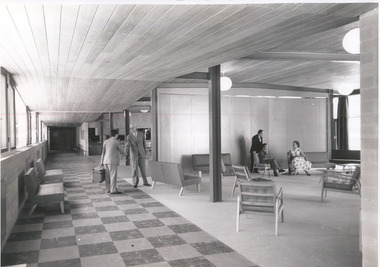
Photograph (Item), Cliff Bottomley, Australian News and Information Bureau, Warden Brian Jones shaking hands with Dr Ang Kok-Peng, from the University of Malaya
... Brian Jones Interior Black and white photograph of Warden Brian Jones shaking hands with Dr Ang Kok-Peng, from the University of Malaya Warden Brian Jones shaking hands with Dr Ang Kok-Peng, from the University of Malaya Photograph Cliff Bottomley, Australian News and Information Bureau ...Dr Ang Kok-Peng was in the first group of twenty-one international students at International House in 1957, originally from the University of Malaya. Brian Jones was the first Warden of International House, selected in 1956, and leaving the position in 1959, taking a position representing the British Council in Cyprus.brian jones, interior -
Surrey Hills Historical Society Collection
Work on paper - Vertical file, Awards
... Bottomley...William Swinson...David Kissane...Dr...Bottomley and William Swinson) Progress Leader, 14.6.2016 (1 page). 4. ‘Order of Australia awards’, (re David Kissane and John Payne) SHNN c. Feb. 2018 (1 page). 5. ‘Conservator honoured’, (re John Payne) Age ?, 26.1.2018 (1 page). 6. ‘Making world a better place’, (re David Kissane and others) Whitehorse Leader, 29.1.2018 (1 page). 7. ‘Honours for local people’, re Dr...Antonio Trivisonno David Bottomley William Swinson David Kissane Dr Hari Harayan Sinha Stanley Bruce McKenzie Andrew Wall Martin Culkin Jean Jackson Vivian Bennett Caroline Carroll Jack Ma Christopher Thorn Prof. ...A vertical file containing the following items regarding awards of various nature; all individuals having some local connection: 1. ‘Proudly humble retiree’, re Antonio Trivisonno paper and date unknown (1 page); and ‘OAM for seniors work’ Whitehorse Leader, 2.2.2011 (1 page). 2. ‘Antonio Trivisonno - enthusiasm for life’, SHNN, No. 170, Feb./March 2011 (1 page). 3. ‘Boroondara‘s Queen’s Birthday Honours list’, (re David Bottomley and William Swinson) Progress Leader, 14.6.2016 (1 page). 4. ‘Order of Australia awards’, (re David Kissane and John Payne) SHNN c. Feb. 2018 (1 page). 5. ‘Conservator honoured’, (re John Payne) Age ?, 26.1.2018 (1 page). 6. ‘Making world a better place’, (re David Kissane and others) Whitehorse Leader, 29.1.2018 (1 page). 7. ‘Honours for local people’, re Dr Hari Harayan Sinha and Stanley Bruce McKenzie, SHNN 44, Feb./March 1990 (1 page). 8. ‘Congratulations’, re Martin Culkin, Andrew Wall and Jean Jackson, SHNN No. 185 Aug./Sept. 2013 (1 page). 9. ‘A bloomin’ good life’, re Mr. Vivian Bennett, 1989 (source unknown), (1 page). 10. “Know your plants” medallist advises re Mr. Vivian Bennett, 1979 (source unknown), (1 page). 11. ‘Community contributions recognised’ re Caroline Carroll and Jack Ma, SHNN No. 188, Feb./March 2014 (2 pages). 12. Christopher Thorn, SHNN No. 206, Feb./March 2017 (1 page). 13. ‘Calculation is worth a medal’ re Prof. Kate Smith-Miles, Progress Leader, 23.11.2010 (1 page). 14. ‘Reward for dedicated work a dream once thought impossible for Caroline’, re Caroline Carroll, Progress Leader, 28.1.2014 (1 page). 15. ‘Community service – with a smile’, re Nina Buscombe, SHNN No. 92, Feb./March 1998 (1 page). 16. ‘Local resident awarded OAM’, re Charlie Wei Quan Xu, SHNN 225 April/May 2020 (1 page). 17. ‘David Winter, Whitehorse Citizen of the Year’, SHNN 230, Feb./March 2021 (1 page). 18. Gwen Smith Victorian Senior of the Year 2016, The Senior, November, 2016 (1 page). 19. ‘Local Traders win Oz awards!’ SHNN 142, June/July 2006 (1 page). 20. Centenary Medal Presentation 24.3.2003 at Ashwood Secondary College, 12 page booklet provided by Anna Burke, MP, Federal member for Chisholm. Note Elizabeth Meredith. 21. ‘Father of the Year!’ SHNN 138, October/November 2005 re Robert Moodie (1 page). 22. Burwood Bulletin Inc., Issue 159, Autumn 2021, re David Winter (3 sheets). 23. ‘Mont Albert Resident receives Order of Australia’, SHNN 158 re Dr. Rodney Arambewela (1 page). 24. ‘Citizen of the year 2000’, SHNN 106, June/July 2000 re Gert Rainey (1 page). 25. “’Best Friend’ award for Philip Crohn, SHNN 181, Dec. 2012/Jan./2013 (1 page). 26. ‘Surrey Hills Citizen of the Year 2002’, SHNN 118, June/July 2002 re Suzanna Henman (1 page). 27. ‘Bill Chandler awarded OAM’, SHNN 191, August/September, 2014 (1 page). 28. Kevin Donnelly AM, SHNN 206, February/March, 2017 (1 page). 29. ‘Just her cup of tea’, Progress Press, 1.5.2000. (1 page). 30. ‘Congratulations Greg Buchanan!’, SHNN No. 236, February, 2022 (1 page), and Citizenship Ceremony 26.1.2022. (A4 folded sheet). 31. ‘Meet our 2022 Citizens of the Year’, Boroondara Bulletin, March, 2022: Greg Buchanan, Rhea Werner and Belinda Battey (2 sheets). 32. ‘Order of Australia awards’: John Grace AO; Lesley (Pat) Farrant AM; Helen Buckingham OAM; Margaret Zacharin OAM; SHHN No. 215, August-September 2018 (1 page). 33. ‘It’s an Honour!’ Graeme Davison AM; Graham Bartle OAM; Stephen Dinham OAM; SHHN No. 173 August-September 2011 (1 page). 34. Mrs. Anne Patricia Murphy, awarded OAM, (no date), (1 page). 35. Citizen of the year 2023 Maxine Gross, Boroondara Bulletin, March, 2023 (1 page). 36. ‘Citizen of the year 2000’, Gert Rainey, SHNN No. 106, June/July 2000 (1 page). 37. ‘Arthur Tonkin Surrey Hills Citizen of the year 2001’, SHNN No. 112, June/July 2001 (1 page). 38. ‘Surrey Hills Citizen of the year 2001’, Suzanna Henman, SHNN No. 118, June/July 2002 (1 page). 39. ‘Surrey Hills Citizens of the year 2004’, Sue Barnett and Andrew White, SHNN No. 130, June/July 2004 (1 page). 40. ‘A creative and rich life’, Peter Hardham OAM, SHNN ? , June 2019 (1 page). 41. ‘Australia Day Honours’, Craig Kenny and Jillian Wright both OAM and of Mont Albert, SHNN No. 219, April/May 2019, (1 page). 42. Professor Marilyn Liddell, AM, Progress Press, Feb. 2010 (1 page). antonio trivisonno, david bottomley, william swinson, david kissane, dr hari harayan sinha, stanley bruce mckenzie, andrew wall, martin culkin, jean jackson, vivian bennett, caroline carroll, jack ma, christopher thorn, prof. kate smith-miles, nina buscombe, charlie wei quan xu, gwen smith, david winter, robert moodie, elizabeth meredith, rodney arambewela, philip crohn, suzanna henman, gert rainey, bill chandler, kevin donnelly, greg buchanan, rhea werner, belinda battey, john grace, lesley (pat) farrant, helen buckingham, margaret zacharin, graeme davison, graham bartle, stephen dinham, anne patricia murphy, maxine gross, arthur tonkin, peter hardham, andrew white, craig kenny, sue barnett, jillian wright, marilyn liddell, john payne
