
Showing 13 items matching "draw bar"
-
 Orbost & District Historical Society
draw bar
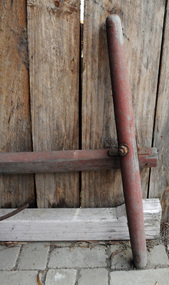
... draw bar...transport wagon-draw-bar pulling-bar... Vehicles pulled by a pair have a pole which attaches between the wheel pair. This draw bar belonged to a wagon or coach pulled by two horses. ...A wooden draw bar / pulling pole painted red. It was used for a wagon or coach and has a cross bar for attaching two horses....This item is associated with that time. transport wagon-draw-bar pulling-bar A wooden draw bar / pulling pole painted red. ...Vehicles pulled by a pair have a pole which attaches between the wheel pair. This draw bar belonged to a wagon or coach pulled by two horses. It would have been used in the Orbost district before modern transport.This item is an example of transport in Orbost before more moderrn road transport. This item is associated with that time.A wooden draw bar / pulling pole painted red. It was used for a wagon or coach and has a cross bar for attaching two horses.transport wagon-draw-bar pulling-bar -
 Moorabbin Air Museum
Document (Item) - RAAF Specification Engineering - Tractor Wheeled Aircraft Towing 80 000 N Draw Bar Pull. No.C530
... RAAF Specification Engineering - Tractor Wheeled Aircraft Towing 80 000 N Draw Bar Pull. No.C530...RAAF Specification Engineering - Tractor Wheeled Aircraft Towing 80 000 N Draw Bar Pull. No.C530...RAAF Specification Engineering - Tractor Wheeled Aircraft Towing 80 000 N Draw Bar Pull. No.C530 Document RAAF Specification Engineering - Tractor Wheeled Aircraft Towing 80 000 N Draw Bar Pull. ...Description: 100 pages. Published by RAAF. Published on unknown date. JAC Syllabus Junior Officer's Training, Point Cook OTS Level of Importance: World. -
 Melbourne Tram Museum
Photograph - Cable tram coupling equipment, K McCarthy
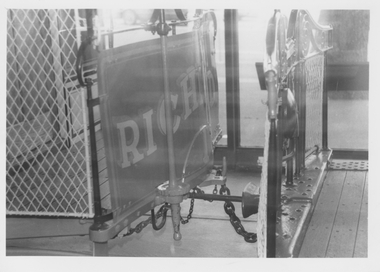
... ...draw bar...The photograph shows the trailer car's draw bar inserted into the grip car's socket held in place with a pin. ...The photograph shows the trailer car's draw bar inserted into the grip car's socket held in place with a pin. ...Photograph shows part of the preserved cable grip car number 1 and trailer car number 1 in a large glass covered display case in Russell Street behind the (then) Melbourne Museum and State Library. The photograph shows the trailer car's draw bar inserted into the grip car's socket held in place with a pin. It also shows the car and grip secured with a safety chain. The trailer coupling was guided into the socket by a chain worked from the trailer platform through a pipe fastened inside the end apron.Yields information about cable tram componentsBlack and white photograph with note on rearIn ink "28" and "K McC"cable trams, russell street, melbourne museum, state library, draw bar, tie rod, pin, safety chain, trailer coupling -
 Melbourne Tram Museum
Photograph - Cable tram gripman's compartment with levers, K McCarthy
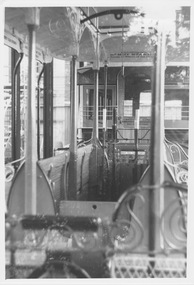
... ...draw bar...Yields information about cable tram components cable trams Russell Street Melbourne Museum State Library draw bar tie rod pin safety chain trailer coupling In ink "29" and "K McC" Black and white photograph with note on rear Photograph Cable tram gripman's compartment with levers K McCarthy ...Photograph shows part of the preserved cable grip car number 1 and trailer car number 1 in a large glass covered display case in Russell Street behind the (then) Melbourne Museum and State Library. The photograph shows the gripman's compartment with two brake levers and the central grip lever. At the top of the photo above the levers is curved metal beam to which a block and tackle were fastened to lift and lower the grip into the tunnel. At either end of the compartment is a knee high board with whole at the top that fitted into slots between the end traverse seats to stop winter drafts blowing across the gripman's feet. Yields information about cable tram componentsBlack and white photograph with note on rearIn ink "29" and "K McC"cable trams, russell street, melbourne museum, state library, draw bar, tie rod, pin, safety chain, trailer coupling -
Moorabbin Air Museum
Booklet (Item) - Westland Helicopters Brochure
... RAAF Specification Engineering for Tractor Wheeled Aircraft Towing 80,000 N Draw Bar Full Level of Importance: World. ...RAAF Specification Engineering for Tractor Wheeled Aircraft Towing 80,000 N Draw Bar Full Level of Importance: World. Author: K. ...Description: 50 pages. Published by RAAF. Published 6/10/1980. RAAF No. 0530. RAAF Specification Engineering for Tractor Wheeled Aircraft Towing 80,000 N Draw Bar Full Level of Importance: World. Author: K. Sayers -
 Flagstaff Hill Maritime Museum and Village
Vehicle - Beach Cart, Government of Victoria, 1860s
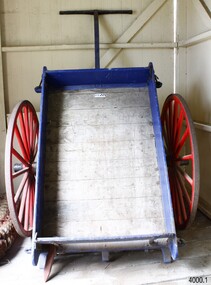
... The cart has a long draw bar with T- handles at the end. It was pulled by two people, usually steered by another two and pushed by a further two. ...The cart has a long draw bar with T- handles at the end. It was pulled by two people, usually steered by another two and pushed by a further two. ...The beach cart was hand drawn by a team of six people; two in front, one on each side and two behind. The wide iron tyres on the the wheels helped prevent the cart from sinking into the sand. The load of heavy beach apparatus equipment was held in place by a separate hand worked rope net cover. It would be stored in the Rocket House packed and ready to use for practice or rescue. Beach apparatus equipment - In the mid-1800s the equipment could include a line throwing set, coiled line in wooden carrying case, rockets, cartridges, breeches buoy, hawser and traveller block, line-throwing pistol, beach cart, hand barrow, sand anchor, crotch pole, and tools such as spade, pick, mallet and hawser cutter. Around the 1860s Warrnambool had a Rocket House installed beside the Harbour. Saving lives in Warrnambool – The coastline of South West Victoria is the site of over 600 shipwrecks and many lost lives; even in Warrnambool’s Lady Bay there were around 16 known shipwrecks between 1850 and 1905, with eight lives lost. Victoria’s Government responded to the need for lifesaving equipment and, in 1858, the provision of rocket and mortar apparatus was approved for the lifeboat stations. In 1859 the first Government-built lifeboat arrived at Warrnambool Harbour and a shed was soon built for it on the Tramway Jetty, followed by a rocket house in 1864 to safely store the rocket rescue equipment. In 1878 the buildings were moved to the Breakwater (constructed from 1874-1890), and in 1910 the new Lifeboat Warrnambool arrived with its ‘self-righting’ design. For almost a hundred years the lifesaving and rescue crews, mostly local volunteers, trained regularly to rehearse and maintain their rescue skills. They were summoned when needed by alarms, gunshots, ringing bells and foghorns. In July 1873 a brass bell was erected at Flagstaff Hill specifically to call the rescue crew upon news of a shipwreck. Some crew members became local heroes but all served an important role. Rocket apparatus was used as recently as the 1950s. This cart and its matching cover is significant for its connection with local history, maritime history and marine technology. Lifesaving has been an important part of the services performed from Warrnambool's very early days, supported by State and Local Government, and based on the methods and experience of Great Britain. Hundreds of shipwrecks along the coast are evidence of the rough weather and rugged coastline. Ordinary citizens, the Harbour employees, and the volunteer boat and rescue crew, saved lives in adverse circumstances. Some were recognised as heroes, others went unrecognised. In Lady Bay, Warrnambool, there were around 16 known shipwrecks between 1850 and 1905. Many lives were saved but tragically, eight lives were lost.Beach cart; a blue and white painted, wooden cart with two, red coloured metal wheels. The wheels have twelve spokes and wide iron tyres. The cart has a long draw bar with T- handles at the end. It was pulled by two people, usually steered by another two and pushed by a further two. It was supplied by the Government of Victoria. There is an inscription on the front end panel.Stencilled in white paint “G of V” flagstaff hill, warrnambool, maritime village, maritime museum, shipwreck coast, great ocean road, flagstaff hill maritime museum and village, lady bay, warrnambool harbour, port of warrnambool, shipwreck, life-saving, lifesaving, rescue crew, rescue, rocket rescue, rocket crew, beach rescue, rescue equipment, rocket rescue equipment, rocket equipment, marine technology, lifeboat, volunteer lifesavers, volunteer crew, lifesaving rescue crew, rocket apparatus, shore to ship, stranded vessel, rocket rescue apparatus, line thrower, beach apparatus, breeches buoy, life jacket, rocket house, rocket shed, rocket machine, rocket head, rocket launcher, rocket line, beach rescue set, rocket set, beach cart, harbour board, government of victoria, harbour master, l.s.r.c., lsrc, rope cover, rope net -
 Ballarat Tramway Museum
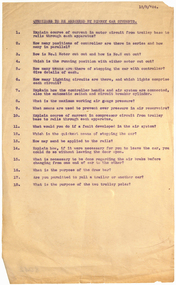
Document - Instruction, Melbourne Electric Supply Co. (MESCo), "Questions to be answered by Birney Car Students", 1/08/1924 12:00:00 AM
... Instruction or question sheet - foolscap carbon copy, titled "Questions to be answered by Birney Car Students", giving 18 questions, about electrical path, controllers, lighting, stopping the tram, faults, sand, leaving the tram, draw bar, purpose of the two trolley poles. ...Trams tramways Birney MESCo Instructions Training Instruction or question sheet - foolscap carbon copy, titled "Questions to be answered by Birney Car Students", giving 18 questions, about electrical path, controllers, lighting, stopping the tram, faults, sand, leaving the tram, draw bar, purpose of the two trolley poles. ...Yields information about the training of crews.Instruction or question sheet - foolscap carbon copy, titled "Questions to be answered by Birney Car Students", giving 18 questions, about electrical path, controllers, lighting, stopping the tram, faults, sand, leaving the tram, draw bar, purpose of the two trolley poles. Two copies - one copy dated 15/8/19245 - suggesting it was made for Geelong by MESCotrams, tramways, birney, mesco, instructions, training -
 Flagstaff Hill Maritime Museum and Village
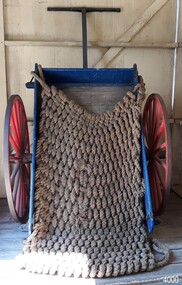
Vehicle - Beach cart and cover, Government of Victoria, 1860s
... The cart has a long draw bar with T- handles at the end. It was pulled by two people, usually steered by another two and pushed by a further two. ...The cart has a long draw bar with T- handles at the end. It was pulled by two people, usually steered by another two and pushed by a further two. ...The beach cart was hand drawn by a team of six people; two in front, one on each side and two behind. The wide iron tyres on the the wheels helped prevent the cart from sinking into the sand. The load of heavy beach apparatus equipment was held in place by the hand worked rope net cover. It would be stored in the Rocket House packed and ready to use for practice or rescue. Beach apparatus equipment - In the mid-1800s the equipment could include a line throwing set, coiled line in wooden carrying case, rockets, cartridges, breeches buoy, hawser and traveller block, line-throwing pistol, beach cart, hand barrow, sand anchor, crotch pole, and tools such as spade, pick, mallet and hawser cutter. Around the 1860s Warrnambool had a Rocket House installed beside the Harbour. Saving lives in Warrnambool – The coastline of South West Victoria is the site of over 600 shipwrecks and many lost lives; even in Warrnambool’s Lady Bay there were around 16 known shipwrecks between 1850 and 1905, with eight lives lost. Victoria’s Government responded to the need for lifesaving equipment and, in 1858, the provision of rocket and mortar apparatus was approved for the lifeboat stations. In 1859 the first Government-built lifeboat arrived at Warrnambool Harbour and a shed was soon built for it on the Tramway Jetty, followed by a rocket house in 1864 to safely store the rocket rescue equipment. In 1878 the buildings were moved to the Breakwater (constructed from 1874-1890), and in 1910 the new Lifeboat Warrnambool arrived with its ‘self-righting’ design. For almost a hundred years the lifesaving and rescue crews, mostly local volunteers, trained regularly to rehearse and maintain their rescue skills. They were summoned when needed by alarms, gunshots, ringing bells and foghorns. In July 1873 a brass bell was erected at Flagstaff Hill specifically to call the rescue crew upon news of a shipwreck. Some crew members became local heroes but all served an important role. Rocket apparatus was used as recently as the 1950s. This cart and cover set is significant for its connection with local history, maritime history and marine technology. Lifesaving has been an important part of the services performed from Warrnambool's very early days, supported by State and Local Government, and based on the methods and experience of Great Britain. Hundreds of shipwrecks along the coast are evidence of the rough weather and rugged coastline. Ordinary citizens, the Harbour employees, and the volunteer boat and rescue crew, saved lives in adverse circumstances. Some were recognised as heroes, others went unrecognised. In Lady Bay, Warrnambool, there were around 16 known shipwrecks between 1850 and 1905. Many lives were saved but tragically, eight lives were lost.Beach cart; a blue and white painted, wooden cart with two, red coloured metal wheels. The wheels have twelve spokes and wide iron tyres. The cart has a long draw bar with T- handles at the end. It was pulled by two people, usually steered by another two and pushed by a further two. It was supplied by the Government of Victoria. There is an inscription on the front end panel. The cart has a removable hand worked rope cover. Stencilled in white paint “G of V” flagstaff hill, warrnambool, maritime village, maritime museum, shipwreck coast, great ocean road, flagstaff hill maritime museum and village, lady bay, warrnambool harbour, port of warrnambool, shipwreck, life-saving, lifesaving, rescue crew, rescue, rocket rescue, rocket crew, beach rescue, rescue equipment, rocket rescue equipment, rocket equipment, marine technology, lifeboat, volunteer lifesavers, volunteer crew, lifesaving rescue crew, rocket apparatus, shore to ship, stranded vessel, rocket rescue apparatus, line thrower, beach apparatus, breeches buoy, life jacket, rocket house, rocket shed, rocket machine, rocket head, rocket launcher, rocket line, beach rescue set, rocket set, beach cart, hand barrow, welsh hand barrow, harbour board, government of victoria, harbour master, l.s.r.c., lsrc -
 Royal Melbourne Yacht Squadron
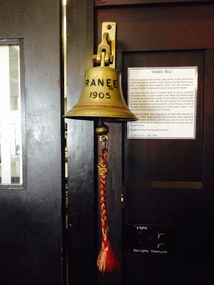
Functional object - Yacht Bell "Ranee", 1903 (exact)
... He then presented the bell to the club to summon members attention to announcements in the club bar where it remains today and is used for the same purpose. It was also rung to draw attention to impending bar closing times, when it was rung 5 mins before closing, then at closing. ...He then presented the bell to the club to summon members attention to announcements in the club bar where it remains today and is used for the same purpose. It was also rung to draw attention to impending bar closing times, when it was rung 5 mins before closing, then at closing. ...“RANEE BELL” This bell originally adorned the cabin of the 12.6m yacht “Ranee”, built for a Doctor Craig of Sydney by the famous Logan Bros of Auckland New Zealand, she was launched as Heather in 1900. A subsequent owner renamed her “Ranee”. Her name reverted to “Heather” prior to being purchased, September 1919, by club members Joe White and David Cargill. Joe White purchased her outright in season 1920-21. He then presented the bell to the club to summon members attention to announcements in the club bar where it remains today and is used for the same purpose. It was also rung to draw attention to impending bar closing times, when it was rung 5 mins before closing, then at closing. Ironically Joe White, when applying for a Admiralty Warrant for Heather in 1924, found out she had previously been registered under the name of Ranee, and the only way to carry on that Warrant, was for him to change her name back to Ranee mid-way during the season. J.H. (Bert) Ferris 1/03/09Very significant - Squadron history - Yachting history AustraliaShips bell, brass, mounted on brass bracket,Ranee 1903brass, white, bell, ranee, heather, joe white, david cargill -
 Bendigo Historical Society Inc.
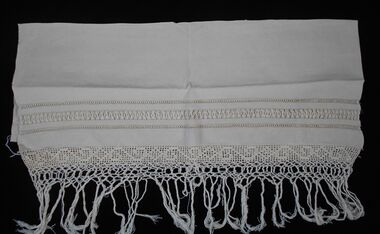
Textile - FAVALORO COLLECTION: LINEN TABLECLOTH OR TABLE CENTRE WITH CROCHET TRIM, 1920-30's
... These are edged with a spoke stitch, which draws the thread into little ''bar shapes" - 3 to each centimeter. ...These are edged with a spoke stitch, which draws the thread into little ''bar shapes" - 3 to each centimeter. ...Textiles. Cream linen fabric, with a selvedge edge on each side. Three bands of drawn thread work at each end-a centre band 2.5 cm wide, and stitched to form a decorative pattern, and two bands, 1 cm wide-one on either side of the wider band. These are edged with a spoke stitch, which draws the thread into little ''bar shapes" - 3 to each centimeter. A 4.5 cm wide band of fillet crochet and a 20 cm long fringe, edges each end.textiles, domestic, linen tablecloth or table centre -
 Bendigo Military Museum
Photograph - Army Survey Regiment SGTS Mess Activities, Fortuna Villa, Bendigo, 1990
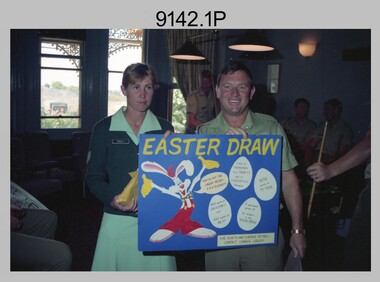
... Draw. .2) - Photo, colour, 1990. L to R: WO2 George Graham, SGT Martin Evans, SGT Mick Minchin and SSGT Bob Garritty catch up with the latest news during Morning Tea. .3) - Photo, colour, 1990. L to R: WO2 George Graham, SGT Martin Evans, SSGT Bob Garritty and, SGT Mick Minchin and catch up with the latest news during Morning Tea. .4) - Photo, colour, 1990. Australian Army Catering Corps (AACC) steward PTE MJ Barker serves slices of roast lamb during a SGTs Mess function. .5) & .6) - Photo, colour, 1990. Tradesman lay a new concrete floor in bar...bar area. Royal Australian Survey Corps RASvy Army Survey Regiment Army Svy Regt Fortuna There are no annotations. This is a collection of eight photographs taken in the Army Survey Regiment SGTs Mess function at Fortuna Villa, Bendigo in 1990. The colour photographs are on 35mm negative film and scanned at 2400 dpi. They are part of the Army Survey Regiment’s Collection. .1) - Photo, colour, 1990. L to R: SGT Sherri (Dally) Burke, WO2 Adrian ‘Charlie’ Creedy promote the 1990 SGTs Mess Easter Draw ...This is a set of eight informal photographs taken in the Army Survey Regiment SGTs Mess function at Fortuna Villa, Bendigo in 1990. They encapsulate activities enjoyed by members of the Mess. It includes photos taken during renovations to the bar area.This is a collection of eight photographs taken in the Army Survey Regiment SGTs Mess function at Fortuna Villa, Bendigo in 1990. The colour photographs are on 35mm negative film and scanned at 2400 dpi. They are part of the Army Survey Regiment’s Collection. .1) - Photo, colour, 1990. L to R: SGT Sherri (Dally) Burke, WO2 Adrian ‘Charlie’ Creedy promote the 1990 SGTs Mess Easter Draw. .2) - Photo, colour, 1990. L to R: WO2 George Graham, SGT Martin Evans, SGT Mick Minchin and SSGT Bob Garritty catch up with the latest news during Morning Tea. .3) - Photo, colour, 1990. L to R: WO2 George Graham, SGT Martin Evans, SSGT Bob Garritty and, SGT Mick Minchin and catch up with the latest news during Morning Tea. .4) - Photo, colour, 1990. Australian Army Catering Corps (AACC) steward PTE MJ Barker serves slices of roast lamb during a SGTs Mess function. .5) & .6) - Photo, colour, 1990. Tradesman lay a new concrete floor in bar area during renovations to the SGTs Mess. .7) & .8) - Photo, colour, 1990. New concrete floor in bar area during renovations to the SGTs Mess.There are no annotations.royal australian survey corps, rasvy, army survey regiment, army svy regt, fortuna -
 National Wool Museum
Machine - Gill Box, Deutscher Spinnereimaschinenbau Ingolstadt, 1963
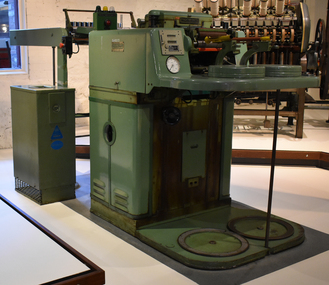
... This machine uses a series of combs attached to bars that move with increasing speed away from a starting point. This draws-out and aligns the wool fibres to produce a gilled top. ...This machine uses a series of combs attached to bars that move with increasing speed away from a starting point. This draws-out and aligns the wool fibres to produce a gilled top. ...This machine uses a series of combs attached to bars that move with increasing speed away from a starting point. This draws-out and aligns the wool fibres to produce a gilled top. The gilling process is also used in other positions along the worsted production line. A gill box draws and combs the fibres prior to spinning. Gold plaque on display with machine until 2018 read: G.H. Mitchell & Son, Adelaide have celebrated 125 Years of involvement with the Australian Wool Processing Industry by contributing the funds necessary to restore The Carding Machine, Noble Comb & The Gill Box.Gill box. Green painted steel.Deutscher / Spinnereimaschinenbau / Ingolstadt / 1963deutscher spinnereimaschinenbau ingolstadt, gilling, gill box, textile industry, wool processing, factory, machine, mills, spinning, fibre, comb -
 Beechworth RSL Sub-Branch
Uniform - Hat Beret
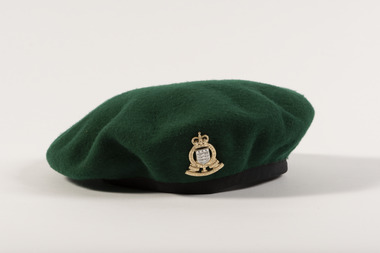
... Inside beret storage bar code label with: NSN 8410-66-097-7302/Beret W Dark Green 52/ self adhesive clothing stores sales price tag / D8410 66/M097 7302/ >>>$8.80 Beret dark green size 52 of the Royal Australian Ordnance Corp; black cotton bias ribbon securing the outer and inner material; cotton bias ribbon draw string to adjust fit to head size; Royal Australian Army Ordnance Corps cap badge there is a plastic weather proof lining on the inside four air holes 5mm dia 20 mm apart Uniform Hat Beret Beret MNFRS Pty Ltd ...Beret dark green size 52 of the Royal Australian Ordnance Corp; black cotton bias ribbon securing the outer and inner material; cotton bias ribbon draw string to adjust fit to head size; Royal Australian Army Ordnance Corps cap badge there is a plastic weather proof lining on the inside four air holes 5mm dia 20 mm apart Inside beret storage bar code label with: NSN 8410-66-097-7302/Beret W Dark Green 52/ self adhesive clothing stores sales price tag / D8410 66/M097 7302/ >>>$8.80
