
Showing 49 items matching "dress cutting"
-
 Federation University Historical Collection
Document, Ballarat Technical Art School Staff Timetable and Salaries, c1906
... ...dress cutting...Ballarat East Technical and Art School is an early division of the School of Mines Ballarat ballarat east technical and art school f. foster g. wightman j.c. barber a.w. steane a. hughes jno l. eddy freehand geometry brush drawing engineering drawing sign writing model drawing wood carving and repousse dress cutting ballarat east art school albert w. steane Ballarat East Technical and Art School stamp at the bottom of the page. ...Ballarat East Technical and Art School is an early division of the School of Mines Ballarat Handwritten sheet showing teachers' names, subjects, days, hours etc.Ballarat East Technical and Art School stamp at the bottom of the page.ballarat east technical and art school, f. foster, g. wightman, j.c. barber, a.w. steane, a. hughes, jno l. eddy, freehand, geometry, brush drawing, engineering drawing, sign writing, model drawing, wood carving and repousse, dress cutting, ballarat east art school, albert w. steane -
Federation University Historical Collection
Booklet, Ballarat School of Mines Register of Attendances for Dresscutting, 1909, 1909
... ...dress cutting...The Ballarat School of Mines is a predecessor institution of Federation University Australia. ballarat school of mines dress cutting dressmaking mrs green A slim, green pastel, hard cover volume with dark green spine. ...The Ballarat School of Mines is a predecessor institution of Federation University Australia. A slim, green pastel, hard cover volume with dark green spine. Two full-width pages for entering names of those enrolled.ballarat school of mines, dress cutting, dressmaking, mrs green -
Federation University Historical Collection
Booklet, Ballarat School of Mines Register of Attendances for Dresscutting, 1909, 1909
... ...dress cutting...The Ballarat School of Mines is a predecessor institution of Federation University Australia. ballarat school of mines dress cutting dressmaking mrs green dressmaking and dresscutting A slim, green pastel, hard cover volume with dark blue spine. ...The Ballarat School of Mines is a predecessor institution of Federation University Australia. A slim, green pastel, hard cover volume with dark blue spine. Two full-width pages for entering names of those enrolled.ballarat school of mines, dress cutting, dressmaking, mrs green, dressmaking and dresscutting -
Federation University Historical Collection
Booklet, Ballarat School of Mines Register of Attendances for Dresscutting, 1909, 1909
... ...dress cutting...The Ballarat School of Mines is a predecessor institution of Federation University Australia. ballarat school of mines dress cutting dressmaking mrs green dressmaking and dresscutting A slim, green pastel, hard cover volume with dark blue spine. ...The Ballarat School of Mines is a predecessor institution of Federation University Australia. A slim, green pastel, hard cover volume with dark blue spine. Two full-width pages for entering names of those enrolled.ballarat school of mines, dress cutting, dressmaking, mrs green, dressmaking and dresscutting -
 Trafalgar Holden Museum
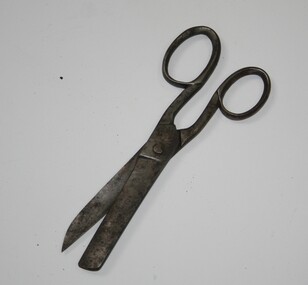
Tool - Fabric shears
... Cloth cutting shears as used in dress making during the late 1800's and early 1900's...Steel dress makers cloth cutting shears...Cloth cutting shears as used in dress making during the late 1800's and early 1900's Object holds significance in the tailoring industry as retailed by Holden and Frost Dress making shears steel Steel dress makers cloth cutting shears Tool Fabric shears ...Cloth cutting shears as used in dress making during the late 1800's and early 1900'sObject holds significance in the tailoring industry as retailed by Holden and FrostSteel dress makers cloth cutting shearsdress making shears, steel -
 Ringwood and District Historical Society
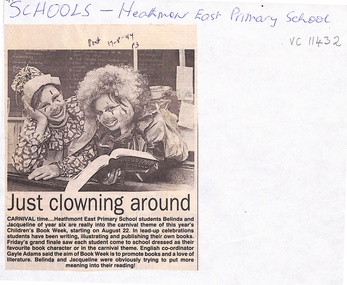
Newspaper, Heathmont East State School - Newspaper article - 2 students dressed up (Belinda and Jacqueline, Year 6)
... Cutting from Ringwood Post 17-8-1994. "Just clowning around". Carnival time at Heatmont East Primary Schol - Children's Book Week August 22. Heathmont East State School - Newspaper article - 2 students dressed up (Belinda and Jacqueline, Year 6). ...Newspaper Cutting from Ringwood Post 17-8-1994. "Just clowning around". Carnival time at Heatmont East Primary Schol - Children's Book Week August 22. -
 Federation University Historical Collection
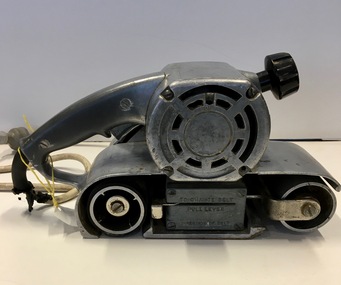
Tool - Electrical Instrument, Electric Belt Sander, c1960s
... The sander used to sand rough timber smooth, remove old finish from wood, put a bevel on a door, reduce the thickness of timber, dress up a poor saw cut. Also used for back cutting miter cuts for neater joints and for polishing and cutting....The sander used to sand rough timber smooth, remove old finish from wood, put a bevel on a door, reduce the thickness of timber, dress up a poor saw cut. Also used for back cutting miter cuts for neater joints and for polishing and cutting. ballarat school of mines building studies david flintoff timber smooth miter cuts polishing buffing thinning Maker's Plate: MILLER FALL TOOLS CATALOG 830 3 INCH BELT SANDER MODEM "C" USE 3" X 21" BELT 230/250 VOLTS 3 AMPS 25-60 CYCLES MADE IN USA PATENT 2,991,595 MILLER FALLS COMPANY, GREEFIELDS, MASS. ...Used in Building Studies at Ballarat School of Mines. The sander used to sand rough timber smooth, remove old finish from wood, put a bevel on a door, reduce the thickness of timber, dress up a poor saw cut. Also used for back cutting miter cuts for neater joints and for polishing and cutting.Stainless steel with rollers and sanding plate. Hand held. Continuous loop of sandpaper would be mounted.Maker's Plate: MILLER FALL TOOLS CATALOG 830 3 INCH BELT SANDER MODEM "C" USE 3" X 21" BELT 230/250 VOLTS 3 AMPS 25-60 CYCLES MADE IN USA PATENT 2,991,595 MILLER FALLS COMPANY, GREEFIELDS, MASS. TO CHANGE BELT PULL LEVER DIRECTION OF BELT ballarat school of mines, building studies, david flintoff, timber, smooth, miter cuts, polishing, buffing, thinning -
 City of Moorabbin Historical Society (Operating the Box Cottage Museum)
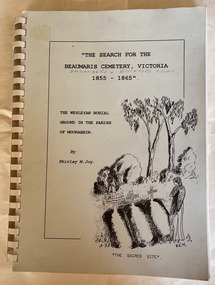
Book - Family History, Joy, Shirley, The Search For The Beaumaris Cemetery Victoria 1855--1865 : The Wesleyan burial ground in the Parish of Moorabbin, 1995
... On the inside cover is a stamp "City of Moorabbin Historical Society" and a cutting out of The Moorabbin Standard 10/3/98 about the Beaumaris Pioneer Cemetery on the facing page is a dedication "This book is published as a limited edition of 300 copies, of which this is 141 and signed by the author. vii, 92 leaves : ill., facsims., 1 plan, ports. A large spiral bound book with a soft cover detailing the early burial sites in the Beaumaris Cemetery.The front cover is white with a drawn picture of three graves and a girl in a long dress ...A history of the Beaumaris Cemetery and who is buried there and the subdivision of the Wesleyan church.vii, 92 leaves : ill., facsims., 1 plan, ports. A large spiral bound book with a soft cover detailing the early burial sites in the Beaumaris Cemetery.The front cover is white with a drawn picture of three graves and a girl in a long dress standing beside them also on the cover is the The Wesleyan Burial Ground in the Parish of Moorabbin.non-fictionA history of the Beaumaris Cemetery and who is buried there and the subdivision of the Wesleyan church.beaumaris, cheltenham, graves, burials, cemetery, registrar's records, subdivision, wesleyan. -
 Geelong RSL Sub Branch
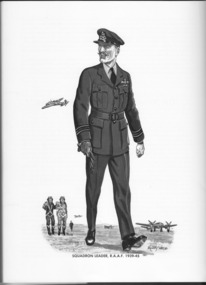
Uniform - RAAF Service Dress, 1945
... This uniform was made in 1945 and was owned by F/Lt A S Cutting. raaf 036319 a s cutting 1945 Inside the jacket a small tag - A F (the I in the shape of the 'broad arrow', used to indicate military use (Navy, Army, Air Force) 1945, M. TX, Size 22. Service Dress ...This uniform belonged to 036319 F/Lt A S Cutting who served in the RAAF During WW2.This uniform was made in 1945 and was owned by F/Lt A S Cutting.Service Dress Blue Jacket and Trousers with buckle belt, RAAF Buttons, badges of Rank on both sleeves and Ribbons of three Decorations above the left pocket.Inside the jacket a small tag - A F (the I in the shape of the 'broad arrow', used to indicate military use (Navy, Army, Air Force) 1945, M. TX, Size 22.raaf, 036319 a s cutting 1945 -
 Orbost & District Historical Society
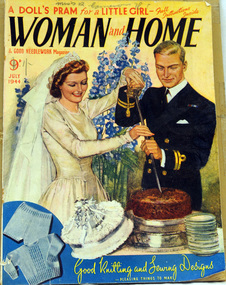
magazine, Woman and Home July 1944, July 1944
... On the front cover is a picture of a bride and groom cutting a wedding cake. The groom is dressed in military uniform. the price 9D has been crossed out and 1/- is below it. ...On the front cover is a picture of a bride and groom cutting a wedding cake. The groom is dressed in military uniform. the price 9D has been crossed out and 1/- is below it. ...This magazine belonged to Roma Cameron, who was the daughter of Harry Purchase Cameron and Lilian Gladys (nee Harding). Roma married Ronald Richard Smith in 1944 and is the mother of Lorraine (Mrs Peter Coulton) and Margaret Smith. Harry's father, James Cameron, came to Bellagoogan on Majors Creek in 1882. Bellagoogan was on Majors Creek near Orbost and was the site of the first race course. Like many others at the time, the Camerons bred race horses.Harry died in 1964 aged 75. Roma was the youngest of three siblings: Jean (Mrs John Gavin (Jack) Ralston) and James (Jim) (m. Joan Hossack). Women’s magazines during WWII played a “reflecting role,” meaning they cooperated with government agendas while still including topics of readers’ interests Women’s employment rate had skyrocketed during WWII. However, even though the number of women working outside the home grew rapidly most of them were still engaged entirely in homemaking. Therefore women’s magazines centered mostly on the stresses and shortages of wartime. Articles as well as advertisements presented information on “product rationing, tips on keeping the family healthy, guidelines for thrifty shopping and advice on how to look good through it all. This is an example of an English women's magazine published during WW11.It gives practical advice on needlework / knitting and evidences the widespread interest in contemporary fashion. In doing so it shows what were the fashionable, but broadly affordable, women's and children's clothing styles of their day. These magazines also reflect women's interests An English magazine published monthly. It is titled Woman and Home & Good Needlework Magazine, July 1944. On the front cover is a picture of a bride and groom cutting a wedding cake. The groom is dressed in military uniform. the price 9D has been crossed out and 1/- is below it. The magazine contains advertisements, stories, needlework patters and news articles.On front cover handwritten in pen : Miss R. Cameronmagazine-woman-and-home magazines-women's cameron -
 Bendigo Historical Society Inc.
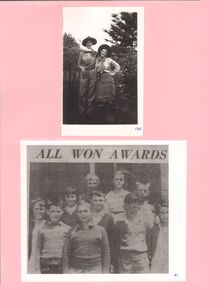
Photograph - GOLDEN SQUARE LAUREL STREET P.S. COLLECTION: STAFF IN FANCY DRESS AND CLASS
... Top, [a] Female staff dressed as cow-girls no caption. [b] Newspaper cutting illustrating seven boys, three girls with 'All Won Awards' caption....Top, [a] Female staff dressed as cow-girls no caption. [b] Newspaper cutting illustrating seven boys, three girls with 'All Won Awards' caption. ...Two female staff in fancy dress, with award winners below laminated upon pink cardboard. Top, [a] Female staff dressed as cow-girls no caption. [b] Newspaper cutting illustrating seven boys, three girls with 'All Won Awards' caption.bendigo, institutions, golden square primary school -
 Bendigo Historical Society Inc.
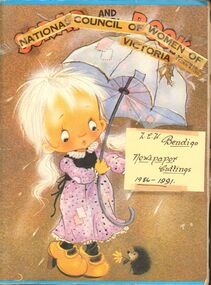
Book - NATIONAL COUNCIL OF WOMEN OF VICTORIA BENDIGO BRANCH COLLECTION: SCRAPBOOK
... dress with spots and patches with yellow shoes and black bodice. An echidna holding a yellow daisy is at her feet. Attached to the front cover is a piece of card with: N.C. W. Bendigo Newspaper Cuttings...dress with spots and patches with yellow shoes and black bodice. An echidna holding a yellow daisy is at her feet. Attached to the front cover is a piece of card with: N.C. W. Bendigo Newspaper Cuttings ...Scrapbook with a coloured front and back, It has an illustration of a child holding a patched umbrella. She is wearing a mauve dress with spots and patches with yellow shoes and black bodice. An echidna holding a yellow daisy is at her feet. Attached to the front cover is a piece of card with: N.C. W. Bendigo Newspaper Cuttings 1986 - 1991. Cuttings cover many Bendigo topics . Also stuck to the front with sticky tape is: National Council of Women of Victoria Incorporated.organisation, women, national council of women, national council of women of victoria bendigo branch collection, ncwv scrap book -
 Bendigo Historical Society Inc.
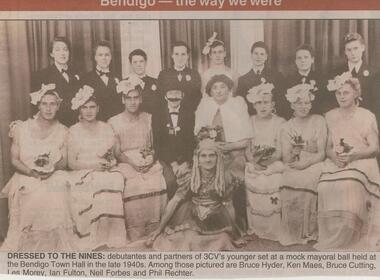
Newspaper - JENNY FOLEY COLLECTION: DRESSED TO THE NINES
... Dressed to the nines: debutantes and partners of 3CV's younger set at a mock mayoral ball held at the Bendigo Town Hall in the late 1940s. Among those pictured are Bruce Hyder, Ken Maes, Bruce Cutting, Les Morey, Ian Fulton, Neil Forbes and Phil Rechter. ...Dressed to the nines: debutantes and partners of 3CV's younger set at a mock mayoral ball held at the Bendigo Town Hall in the late 1940s. Among those pictured are Bruce Hyder, Ken Maes, Bruce Cutting, Les Morey, Ian Fulton, Neil Forbes and Phil Rechter. ...BHS CollectionBendigo Advertiser ''The way we were'' from 2002. Dressed to the nines: debutantes and partners of 3CV's younger set at a mock mayoral ball held at the Bendigo Town Hall in the late 1940s. Among those pictured are Bruce Hyder, Ken Maes, Bruce Cutting, Les Morey, Ian Fulton, Neil Forbes and Phil Rechter. The clip is in a folder.newspaper, bendigo advertiser, the way we were -
 Bendigo Historical Society Inc.
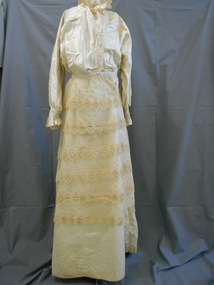
Clothing - CREAM SATIN AND LACE WEDDING DRESS, 1850
... cutting out layout of fabric. A one cm wide ribbon finishes the neckline, and the lace frill is hand stitched to the ribbon. Some seams are hand neatened. A 2.5cm wide flat bow finishes the back neckline. Clothing CREAM SATIN AND LACE WEDDING DRESS ...High waisted bodice, with centre front seam, back opening fastened with metal press-studs, and finished on the right side, with ball-shaped pearl buttons sewn in pairs - six groups of two. A placket extends into the skirt at back, and is fastened with metal press-studs. Bodice is gathered onto skirt at waistline, and defined with a 1.5cm wide tape. An 8.5cm wide cotton lace frill is gathered around the high neckline. The wrist-length sleeves are an extension of the bodice and have a 4cm band, and 4cm wide gathered frill at the wrist. The sleeves are shaped from the high waistline, and also at the cuff edge. The skirt has an overlay of fine lace, made up of six X 17cm wide bands of lace, with a scalloped edge. No shoulder seams. Back opening and centre front seam indicate the cutting out layout of fabric. A one cm wide ribbon finishes the neckline, and the lace frill is hand stitched to the ribbon. Some seams are hand neatened. A 2.5cm wide flat bow finishes the back neckline.costume, female, cream satin and lace wedding dress -
 Ithacan Historical Society
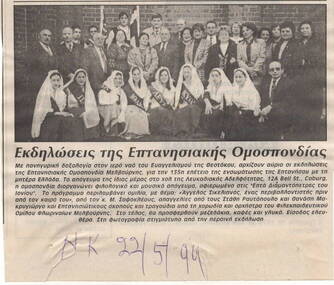
Newspaper, Heptanesian Federation Celebration, May 1999
... A newspaper cutting mounted on white cardboard which includes a photograph taken in front of a brick building with a caption below in Greek. The photograph is of a celebration and features eight ladies dressed in Greek traditional dress in front of a group of people. ...A newspaper cutting mounted on white cardboard which includes a photograph taken in front of a brick building with a caption below in Greek. The photograph is of a celebration and features eight ladies dressed in Greek traditional dress in front of a group of people. ...The photograph was taken outside the Evangelismos Greek Orthodox Church East Melbourne following a celebratory eulogy marking the unification of the Heptanese (seven islands) with Greece in 1864. The Heptanese are located in Western Greece in the Ionian Sea. They include Kerkira, Zakinthos, Lefkada, Ithaca, Paxos, Kefallonia, and Kythera. The celebration is organised each year by Melbourne's Heptanesean Federation and commences with a celebratory church eulogy followed by afternoon tea and cultural activities at the host clubrooms. The women are dressed in traditional dress of each island .Ithaca (and the other islands of the Heptanese) were unified with Greece in 1864. From approx 1500 Ithaca was under centuries-long Venetian rule, which largely preserved it from becoming part of the Ottoman Empire, thus creating a distinct cultural identity with Venetian influences. Following a brief period in 1797 of French rule, Ithaca became a British protectorate from 1809 until 1864 followng which the island was reunified with the modern Greek state. Although Ithacans made up the largest number of Greek migrants who settled in Melbourne in the first half of the twentieth century, other Greeks from the neighbouring Ionian Islands also migrated to Australia during those years. In particular from Lefkada, and also from Kythera most of whom settled in regional towns in New South Wales and Queensland.A newspaper cutting mounted on white cardboard which includes a photograph taken in front of a brick building with a caption below in Greek. The photograph is of a celebration and features eight ladies dressed in Greek traditional dress in front of a group of people. The celebrations by the Heptanesian Federation of Melbourne for the 135th anniversary of the unification of the the seven Ionian islands with mother Greece, commence tomorrow with a celebratory eulogy at the The Holy Temple of the Evangelismos Church East Melbourne. The afternoon of the same day at the Lefkadian Brotherhood Hall, 12A Bell St; Coburg, the Federation has organised a cultural and musical afternoon dedicated to 'The Seven Diamonds of the Ionian'. The program will feature a talk, 'Angelos Sikelianos, an environmentalist, before his time', by Mr. N.Sofokleos; recitations from Stathis Raftopoulos and Thanasis Makrigeorgos; and Heptanesian melodies and songs from the choir and orchestra of the Educational Group of Florina, Melbourne. At the conclusion , savoury snacks, coffee and sweets will be served. Entry is free. In the photo, a snapshot of last year's event.eptanesian -
 Port Melbourne Historical & Preservation Society
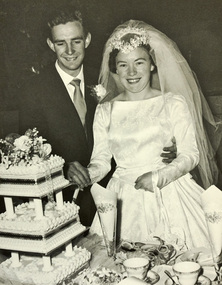
Photograph - Bob and Barbara GARDINER cutting their wedding cake, 1 Nov 1958
... dresses were made by Margaret Conn who was one of the bridesmaids. Weddings Celebrations Fetes and Exhibitions Domestic Life Religion - Anglican (Holy Trinity) Robert (Bob) GARDINER Barbara GARDINER nee HEGARTY B&W photograph of Barbara GARDINER nee HEGARTY and Bob GARDINER cutting their wedding cake. ...Barbara GARDINER (nee HEGARTY) married Robert GARDINER, at Holy Trinity Church, Port Melbourne on November 1 1958. The dress was made by Barbara's mother, Alice HEGARTY (nee MOTT). The bridesmaids dresses were made by Margaret Conn who was one of the bridesmaids.B&W photograph of Barbara GARDINER nee HEGARTY and Bob GARDINER cutting their wedding cake.weddings, celebrations fetes and exhibitions, domestic life, religion - anglican (holy trinity), robert (bob) gardiner, barbara gardiner nee hegarty -
 Warrnambool and District Historical Society Inc.
Memorabilia - Dance Academy Scrapbook, 1970s
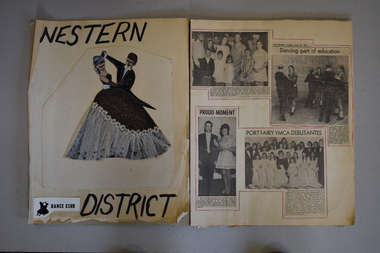
... The front page has a cut-out of a dancing couple with the figures coloured in and and glitter and cotton material added for the lady's dress. The pages contain newspaper cuttings, some of them loose but most have been pasted in. ...cuttings are not dated but appear to be from the 1970s. This scrapbook is of interest as a memento of a dance club that operated in the Warrnambool district forty to fifty years ago. Dance Clubs in Warrnambool Western district dance academy W.D.D.A. Teachers: Mr and Mrs David Nunn Western District Dance Cub This is a scrapbook with a green cover with black printing and black and white images. The front page has a cut-out of a dancing couple with the figures coloured in and and glitter and cotton material added for the lady's dress ...This scrapbook features newspaper cuttings about the Western District Dance Academy ( also called a Dance Club). The Academy appears to have operated from the late 1960s to 1982 and two teachers named in the scrapbook were David and Audrey Nunn. There is reference also to the Warrnambool Dancing Studio, the East Warrnambool School of Dancing and the Y.M.C.A. Dance Club. Most of the cuttings are not dated but appear to be from the 1970s.This scrapbook is of interest as a memento of a dance club that operated in the Warrnambool district forty to fifty years ago.This is a scrapbook with a green cover with black printing and black and white images. The front page has a cut-out of a dancing couple with the figures coloured in and and glitter and cotton material added for the lady's dress. The pages contain newspaper cuttings, some of them loose but most have been pasted in. There are some blank pages and the cover is partly detached.W.D.D.A. Teachers: Mr and Mrs David Nunn Western District Dance Cubdance clubs in warrnambool, western district dance academy -
 Uniting Church Archives - Synod of Victoria
Photograph, 1955 - 1962
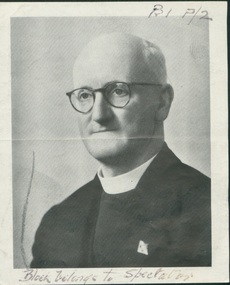
... cutting from The Spectator. F68-2 shows Pederick looking directly at the camera, unsmiling. F68-3 shows Pederick smiling looking to the right of the camera. F68-4 and F68-5 were taken as he was seated holding a large, open folder of papers, looking at the folder in -4 and to the right of the camera in -5. F 68-6 shows Pederick standing outside in a garden or "the bush" dressed...cutting from The Spectator. F68-2 shows Pederick looking directly at the camera, unsmiling. F68-3 shows Pederick smiling looking to the right of the camera. F68-4 and F68-5 were taken as he was seated holding a large, open folder of papers, looking at the folder in -4 and to the right of the camera in -5. F 68-6 shows Pederick standing outside in a garden or "the bush" dressed ...Alec Pederick was born in 1902 and left school at 15 to work on his parents' farm at Wyuna, Kyabrum,Victoria. After receiving a sense of call he trained for the Methodist ministry and was appointed to his first parish at Zeehan, Tasmania in 1927. He was called to serve with the Methodist Overseas Mission in New Britain and New Ireland in 1929. He married Dorothy Clarke just before he left. After four years in PNG he returned through ill-health to Victoria. He was appointed to the Beaufort Circuit in 1933 and then in 1936 to the Methodist Home Missions Department. He was called up as an Army chaplain in 1942 and sent on active service in Papua New Guinea. He was discharged in 1944 and returned to the Home Missions Department. He was appointed acting General Superintendent in 1944 and then General Superintendent in 1946, a position he held until 1962. He also served as Director of the Federal Methodist Inland Mission for a time. He died in 1972.Set of 8 photos (F68-3 has two additional copies) of Rev. Alec W. Pederick L. Th. All six photographs were taken at approximately the same age - late middle age - while still General Superintendent of the Victorian Home Missions department. Mostly bald, bespectacled man wearing glasses and clerical collar and stock and dark suit. All B&W. F68-1 is a cutting from The Spectator. F68-2 shows Pederick looking directly at the camera, unsmiling. F68-3 shows Pederick smiling looking to the right of the camera. F68-4 and F68-5 were taken as he was seated holding a large, open folder of papers, looking at the folder in -4 and to the right of the camera in -5. F 68-6 shows Pederick standing outside in a garden or "the bush" dressed in clerical garb with an overcoat. He is holding what looks like a camera and he is looking away from the camera.All the photos except F68-6 have an identification by name (Rev. A. W. Pederick" and all bar F68-6 have also identified him as General Superintendent and F68-3-5 identify him as General Superintendent Methodist Home Missions. F68-3 has "President of Conference 1955" typed on the back in red ink.pederick, a. w., zeehan, methodist overseas mission, methodist inland mission, beaufort, army chaplain, new britain, new ireland -
 Ballarat Tramway Museum
Newspaper - cutting, The Courier Ballarat, "Big Success" & "Conductressess' fund", August 1944
... The two cuttings report on the Gala Ball, late August 1944, the attendees and positions, the ladies dresses along with other details....The two cuttings report on the Gala Ball, late August 1944, the attendees and positions, the ladies dresses along with other details. ...The two cuttings report on the Gala Ball, late August 1944, the attendees and positions, the ladies dresses along with other details.Demonstrates newspaper reporting re the Sylvia Mitchell fund raising.Set of 2 newspaper cuttings pasted onto a sheet of card with a small folded section at the base of the first item.most popular conductress, sylvia mitchell, tramways, sec, red cross -
 Ballarat Tramway Museum
Photograph - Set of 4 - "Ballarat Trambulance", 3/1969
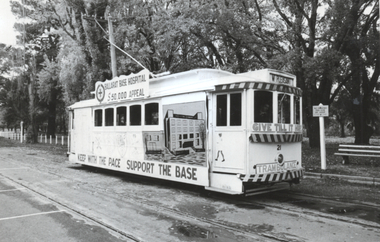
... Set of four Black and white photographs of tram 21 dressed as the "Trambulance" to raise funds for the Ballarat Base Hospital. See item 3750 for the launch photograph and 1110 for associated Newspaper cutting. ...Set of four Black and white photographs of tram 21 dressed as the "Trambulance" to raise funds for the Ballarat Base Hospital. See item 3750 for the launch photograph and 1110 for associated Newspaper cutting. ...Set of four Black and white photographs of tram 21 dressed as the "Trambulance" to raise funds for the Ballarat Base Hospital. See item 3750 for the launch photograph and 1110 for associated Newspaper cutting. Launched on 28/3/1969. Not known who took the photograph or the date. 1 - tram at Gardens Loop 2 - ditto 3 - ditto front on photo 4 - Tram 21 - Trambulance in Barkly St. Mt PleasantYields information about the Trambulance of 1969 and tram 21.Set of four Black and white photographs on plain paper.trams, tramways, ballarat base hospital, appeals, tram 21, decorated trams, brakly st, ballarat tramway -
 Ballarat Tramway Museum
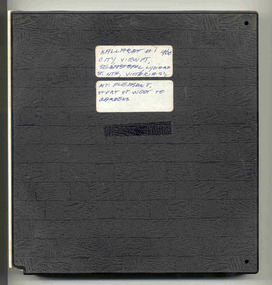
Film - Movie Film & Box, Kodak, 1960
... Possibly filmed on a Sunday given the ladies dresses and quieter streets. 14:01 30 outbound, passes the camera and stops at Macarthur St. Filmed alongside the brick wall of the cutting. 14:28 30 inbound arrives, passes through the Gregory St loop and then proceeds past the camera, making a stop to pick up passengers. 15:14 28 in Lydiard St Nth – location?...Possibly filmed on a Sunday given the ladies dresses and quieter streets. 14:01 30 outbound, passes the camera and stops at Macarthur St. Filmed alongside the brick wall of the cutting. 14:28 30 inbound arrives, passes through the Gregory St loop and then proceeds past the camera, making a stop to pick up passengers. 15:14 28 in Lydiard St Nth – location? ...Yields information in movie film format of Ballarat trams in 1960, how the system operated and was used by people., Yields information in movie film format of Ballarat trams in 1960, how the system operated and was used by people.Movie film - 8mm, approx. 30mins, with leader strip on a plastic reel, within a black and white plastic box, titled "Ballarat No. 1. 1960". Has been transferred to DVD - see Reg item 4100 as Segment No. 2. Made by Ben Parle. Also transferred to DVD by Rod Cook Oct. 2015, via Roger Greenwood for use in his DVD, "The City of Ballarat Trams, Gardens & Gold" of 2016. See Reg Item 6883. Synopsis: based on time. 0:00 View of typed introduction, noting that this is a pictorial record of Ballarat. 0:10 Title “The Tramways of Ballarat 1960, Part 1” 0:16 13, showing “View Point” at Stones Corner, Bridge St, east end, with trolley pole being turned, while another single trucker heads out towards Mt Pleasant. 0:25 13 leaving Stones Corner, short approach and then longer trailing shot of the tram going towards the City in Bridge St. 0:44 View out of front of tram in Bridge St heading towards the City, with cars in the photo, then passing through city Loop, no trams in the loop and running up to Lydiard St Nth and crossing the road. 1:22 Running up Sturt St from Armstrong St, passes over Dawson St X-over and up to the next intersection, Lyons St. 1:54 Title “The View Point Line” 1:59 19 inbound, in Ripon St, from crossing Mair St, towards camera and then passing away and turning into Sturt St. 2:49 View of a “Warning Oncoming Trams” sign 2:52 19 in Ripon St, going to View Point, crossing Webster St towards camera, then going away through the disconnected Victoria Ave loop, pass the “Warning Oncoming Trams” sign. Note very windy scene with people running across roads. 3:17 19 in Wendouree Parade, in bound, though showing destination View Point, going away from the camera, past the View Point Hotel. 3:39 19 coming towards camera near Excerpt or Devon St and then going away towards the terminus. 4:04 19 at the terminus, stationary, with a single trucker 3?, passing from Macarthur St into Wendouree Parade, behind 19. 4:20 33 coming towards camera in Wendouree Parade from St Aidans Drive, stopping to pick up passenger at Forest St and then going away towards the City, photographed from near the depot, on a wet and windy day. 4:54 35 in Wendouree Parade, coming towards the Camera from St Aidans Drive and then going away with the Gardens Loop area in the background. Tram stops at stop to let a passenger off. 5:28 21 leaving Gardens Loop for the City via the Depot, green light in signal can be seen. 5:43 28?, closely followed by 26 turn from Drummond St South into Sturt St. 6:18 Scene opens with shot of “Sebastopol” destination on a bogie tram. 6:21 Title “The Sebastopol Line” 6:24 21 turning from Sturt St into Drummond St Sth with destination of Bell St and then going away from the camera. 6:55 38 in Drummond St Sth, coming towards the camera and then passing the camera with Sturt St just in the view. 7:10 21, showing Gregory St, in Drummond St Sth, approaching and then going away, entering the Urquhart St Loop, 7:39 34 in Drummond St Sth (location check required (Latrobe?)), approaches camera, picks up passengers and the goes away. 8:09 39 at ? Street, turns from Drummond St Sth into Skipton St, after picking up and setting down passengers, bound for Sebastopol 8:55 35 inbound in Skipton St passes through the Bell Street Loop, and then goes away from the camera. 9:33 42 outbound in Skipton St, approaches the camera, passes and then crosses over the half the road into Albert St. 10:00 39 inbound in Albert St – location? 10:31 34 outbound for Sebastopol, approaches camera and just starts to pass by. 10:36 34 in Grey St crossing loop, crosses 42 inbound. 10:59 39 outbound in Albert St, with shopping centre in bound, approaches camera, passes and then crosses over Albert St. Mid morning scene. 11:39 39 inbound, Albert St south, approaches camera and then passes and the crosses over Albert St. 12:16 41 outbound in Albert St passes the camera, and pulls into the terminus with the conductor getting out on the back bumper to pull the pole down as the tram stops and a passenger walks into the Royal Hotel. 12:39 Title “The Lydiard Street North Line” 12:44 Filmed from the Hotel balcony, 21 inbound in Lydiard St Nth passes over Mair St, stops while 33 passes in the other direction. 13:18 With the red light showing on the Seymour St loop signal, 33 inbound for Sebastopol stops and picks up many passengers, passes the camera and runs past the VRI building in the background and through the loop. Possibly filmed on a Sunday given the ladies dresses and quieter streets. 14:01 30 outbound, passes the camera and stops at Macarthur St. Filmed alongside the brick wall of the cutting. 14:28 30 inbound arrives, passes through the Gregory St loop and then proceeds past the camera, making a stop to pick up passengers. 15:14 28 in Lydiard St Nth – location?, approaches and goes away from the camera, north of Gregory St. 15:34 28 ditto location? 15:53 21 arrives at the terminus with passengers getting on and off. 16:11 View of the a vertical positioned “End of Section” sign on a pole at the terminus and then lifting the camera to see the timetable board and the stop sign. 16:33 31 in Bridge St passing Morseheads and then turning into Sturt St, stops at the Grenville St stop, while another single trucker comes down to the stop from the City. 16:58 31 outbound in Bridge St, with destination of Victoria St. 17:14 Title “The Victoria Street Line” 17:18 31 outbound to Victoria St from Stones Corner. Starts with an overhead shot, shows clock at the Caltex service station,. 17:37 31 inbound approaching Bakery Hill and then descending to the junction after it passes camera. 18:09 25 climbing outbound in Victoria St, passing the camera, to then pass through the King St loop. 18:47 25 inbound in Victoria St, passing the camera, then pass through the King St loop, with St Alypius Church in the background. 19:36 14 approaching the rail bridge in Victoria St and stopping at the 2nd last stop to left of passengers. 20:01 14 leaving the terminus and approaching the camera and the a short sequence going away, to the next stop to pick up quite a few passengers. 20:14 “Trams Stop Here” sign, metal wrap around on a steel pole. 20:16 Title “The Mount Pleasant Line” 20:21 11 inbound in Main St, with a passenger leaping off the tramcar and another getting off just before the junction. 20:45 11 passes the junction and then proceeds away from the camera in Bridge St. 21:04 30 outbound in Main St, then turns into Barkly St, a bus (Eclipse Motors) passes in Main St just before the sequence ends. 21:31 30 inbound near Steinfield St. (exact location?) 21:49 25 approaches the camera, then proceeds away and passes through the Grant St. loop. 22:29 25 inbound, windy day, between Grant and Cobden, (exact location?), with a horse drawn bread van in the view and the breadman walking behind the tram as it passes. 23:02 11 outbound in Barkly St, (exact location?) 23:37 11 inbound in Barkly St (exact location?) 23:44 Mt Pleasant terminus signage 23:50 30 approaches the terminus and then stops with the conductor alighting turning the pole, passengers getting on and off and the driver appearing at the other end. 24:32 Title “The Gardens Via Sturt St. West Line” 24:35 21 outbound in Sturt St near Raglan St, approaches and passes the Camera. 25:09 12, showing City Oval, approaches and passes the camera, outbound near Windermere St. 25:33 13 showing View Point, goes away from the camera – location? 25:44 12 comes from St. West, inbound passes the camera and then stop as the next stop next Talbot St? 26:21 Short sequence of a “Warning Oncoming Trams” sign 26:28 42 inbound in Sturt St West, just before Ripon St, view coming towards camera and then going away to cross Ripon St. 27:10 34 passes through the Parker St loop 27:25 35 or 39 inbound past the college in Sturt St West 28:04 41 outbound at the Russell St curve, passes away from the camera. 28:11 35? inbound passes away from the camera through the Victoria Park or Morrison St loop, swinging out into the roadway. 28:29 View of timetable sign at Hamilton Ave. 28:37 35 turning from Sturt St West into Hamilton Ave, can see the conductor changing over the barrier rails. 29:11 42 inbound, crosses another bogie tram (35?) at Carlton St loop then passes the camera and goes past the Olympic rings monument. 29:42 12 approaches the Carlton St gates. 30:07 12 outbound, crosses a bogie tram in the loop with both trams then leaving the loop. 30:20 Title “End of Part One” Written labels giving title information on outside of box.trams, tramways, ballarat, sebastopol, lydiard st north, victoria st, mt pleasant, sturt st west -
 National Wool Museum
Clothing - 35 Life, Canwen Zhao, 2022
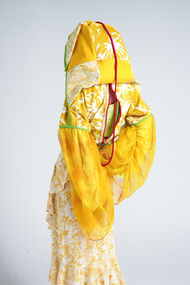
... This yellow look, named "elegant beach sunscreen monarch," draws its fashion inspiration from traditional Han Chinese attire and its storage concept from the Chinese cultural concept of "jiu jiu gui yi." the design employs flat pattern cutting, utilizing materials from the second-hand market such as beach towels, children's waterproof clothing, and women's dresses. ...This yellow look, named "elegant beach sunscreen monarch," draws its fashion inspiration from traditional Han Chinese attire and its storage concept from the Chinese cultural concept of "jiu jiu gui yi." the design employs flat pattern cutting, utilizing materials from the second-hand market such as beach towels, children's waterproof clothing, and women's dresses. ...Canwen Zhao was awarded the $10,000 We The Makers Acquisitive Prize for '35 Life' in 2023. Artist Statement: "35life" is a sustainable fashion project that transforms second-hand clothing materials into urban street outdoor-style products. Highlighting prominent Chinese classic red and green colours not only conveys eastern aesthetics but also adds a sense of unity to the clothing collection. The high-saturation and high-brightness full-colour palette keeps the clothing consistently "fresh," allowing any trendy colours to seamlessly integrate into the project's designs, thus extending the lifespan of the garments. Additionally, all clothing items can quickly transform into a stylish bag for convenient daily carrying and home storage. These bags are made from leftover fabric generated during the production process and serve as original packaging for sale. This approach not only reduces excessive packaging but also enhances the chances of resale in the second-hand market. The project draws inspiration from the traditional Chinese cultural concept of "huo feng ding," meaning "exchange the old for the new." it's also influenced by the designer's personal experience with health issues, making the designs suitable for individuals who can't be exposed to sunlight for extended periods, adapting to the changing urban lifestyle. 35life aims to provide visually pleasing and comfortable dressing experiences for urban dwellers who are busy with work and experience high levels of stress. Unlike traditional design patterns, this project adopts a unique design approach. It selects 3-5 pieces of raw materials based on their colours, and then disassembles them through structural lines. While retaining most of their functionality, these materials are rearranged and assembled on a flat surface before being shaped on a dress form. Subsequently, various ways of creating storage bags are derived from the initial clothing prototypes. After refining the designs, the final products are developed, and similar materials are used to create samples. Therefore, under this design methodology, even for the same garment, it is impossible to produce two identical pieces of clothing. Each garment is truly one-of-a-kind, which enhances its rarity and contributes to the longevity of the fashion pieces. The project includes various types of clothing, each with unique storage methods. This yellow look, named "elegant beach sunscreen monarch," draws its fashion inspiration from traditional Han Chinese attire and its storage concept from the Chinese cultural concept of "jiu jiu gui yi." the design employs flat pattern cutting, utilizing materials from the second-hand market such as beach towels, children's waterproof clothing, and women's dresses. Similar colours and patterns are reassembled through cutting and combining. For the sleeves, quick-drying, sun-protective sport fabric forms the base, overlaid with discarded silk fabric dyed with turmeric and plant dyes. This not only ensures functionality but also adds a sense of elegance. The length can be adjusted using drawstrings. Artist Bio: Zhao Canwen is a multidisciplinary fashion designer with a strong passion for integrating art, history, culture, and sustainable design. With over 15 years of experience in painting, she draws inspiration from ancient Chinese philosophy and aesthetics, which gives her a unique sense of beauty. After 8 years of fashion and art training, she possesses a keen insight into current trends and tends to combine art with commercial needs. Zhao's design style is diverse, characterized by a multidimensional approach, a focus on colour application, and storytelling through details.Outfit consisting of six pieces: - Orange plastic eye wear with green paint - Pair of red and green metal clip on earrings - Red beaded phone case with attached beads on string - Pair of red and green painted running shoes - Yellow and green hooded garment with red piping and zips - Brown bag with green beaded handlessustainable, fashion, we the makers, art, culture, design, chinese philosophy, prize -
 Brighton Historical Society
Swimsuit, Marina Couture, circa 1960s
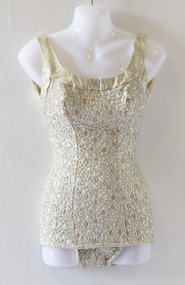
... cutting patterns in one room while a machinist sewed them together in the next. His company, which he named Watersun, would become an iconic Australian swimwear label. During the early 1960s, Watersun developed its "Unquestionable Bra", an inbuilt moulded bra which was marketed as giving wearers a more natural bustline than other labels. The company was also known for its matching swimwear and beachwear, producing dresses...cutting patterns in one room while a machinist sewed them together in the next. His company, which he named Watersun, would become an iconic Australian swimwear label. During the early 1960s, Watersun developed its "Unquestionable Bra", an inbuilt moulded bra which was marketed as giving wearers a more natural bustline than other labels. The company was also known for its matching swimwear and beachwear, producing dresses ...Marina Couture was a luxe swimwear line produced by Watersun in the 1960s. Polish-born designer David Waters first began producing swimwear in 1952. His mother Halina had recently opened a stall at Melbourne Queen Victoria Markets and was looking for swimsuits to sell; unable to find any she liked, she asked David to design something. He began making swimming costumes using his mother's sewing machine, in between his shifts working at a knitting factory. He had soon set up a small business in his parents' home, cutting patterns in one room while a machinist sewed them together in the next. His company, which he named Watersun, would become an iconic Australian swimwear label. During the early 1960s, Watersun developed its "Unquestionable Bra", an inbuilt moulded bra which was marketed as giving wearers a more natural bustline than other labels. The company was also known for its matching swimwear and beachwear, producing dresses, kaftans, tops and skirts in identical colours and prints to those used for many of its swimsuits. By 1967, the company was reportedly one of Australia's two biggest swimwear manufacturers, with over one hundred employees. Watersun was sold to Ada Productions in 1984 and was later acquired by Trackerjack Australasia. This swimsuit is believed to be one of a large quantity of samples, seconds and unsold Ada Productions stock donated to Brighton Historical Society in late 1990 by Brian Samuel, who worked at the company between 1979 and 1990.Silver lamé swimsuit featuring delicate brocade embellishment, an inbuilt underwire bra, a zippered back and elasticised edging on the legs and back.Label in bra, blue with gold crown logo and text: “MARINA COUTURE / 32”.swimwear, watersun, david waters, ada productions, melbourne designers, marina couture -
 Brighton Historical Society
Swimsuit ensemble, Watersun, Pool party ensemble, 1973
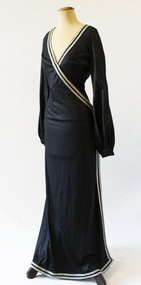
... cutting patterns in one room while a machinist sewed them together in the next. His company, which he named Watersun, would become an iconic Australian swimwear label. During the early 1960s, Watersun developed its "Unquestionable Bra", an inbuilt moulded bra which was marketed as giving wearers a more natural bustline than other labels. The company was also known for its matching swimwear and beachwear, producing dresses...cutting patterns in one room while a machinist sewed them together in the next. His company, which he named Watersun, would become an iconic Australian swimwear label. During the early 1960s, Watersun developed its "Unquestionable Bra", an inbuilt moulded bra which was marketed as giving wearers a more natural bustline than other labels. The company was also known for its matching swimwear and beachwear, producing dresses ...This striking pool party ensemble from Australian swimwear company Watersun was designed by Carmela DiBernado, nee Savino, for the opening of the Sydney Opera House in 1973. Polish-born designer David Waters first began producing swimwear in 1952. His mother Halina had recently opened a stall at Melbourne Queen Victoria Markets and was looking for swimsuits to sell; unable to find any she liked, she asked David to design something. He began making swimming costumes using his mother's sewing machine, in between his shifts working at a knitting factory. He had soon set up a small business in his parents' home, cutting patterns in one room while a machinist sewed them together in the next. His company, which he named Watersun, would become an iconic Australian swimwear label. During the early 1960s, Watersun developed its "Unquestionable Bra", an inbuilt moulded bra which was marketed as giving wearers a more natural bustline than other labels. The company was also known for its matching swimwear and beachwear, producing dresses, kaftans, tops and skirts in identical colours and prints to those used for many of its swimsuits. By 1967, the company was reportedly one of Australia's two biggest swimwear manufacturers, with over one hundred employees. Watersun was sold to Ada Productions in 1984 and was later acquired by Trackerjack Australasia. This swimsuit is believed to be one of a large quantity of samples, seconds and unsold Ada Productions stock donated to Brighton Historical Society in late 1990 by Brian Samuel, who worked at the company between 1979 and 1990.Pool party ensemble consisting of a swimsuit (.1) and robe dress (.2), both black with silver trim. Dress has a crossover front, fastening at side waist, with v-neck at front and plunging back. Swimsuit has a v-neck, with silver trim extending forming an X-shape across the body.Label (identical in both items), blue text on white: “Watersun / SIZE 10 / BUST 32 / Made in Australia”swimwear, watersun, david waters, ada productions, melbourne designers, 1970s, carmela savino, carmela dibernardo, sydney opera house -
 Brighton Historical Society
Swimsuit ensemble, Watersun, Pool party ensemble, circa 1970s
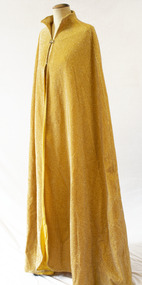
... cutting patterns in one room while a machinist sewed them together in the next. His company, which he named Watersun, would become an iconic Australian swimwear label. During the early 1960s, Watersun developed its "Unquestionable Bra", an inbuilt moulded bra which was marketed as giving wearers a more natural bustline than other labels. The company was also known for its matching swimwear and beachwear, producing dresses...cutting patterns in one room while a machinist sewed them together in the next. His company, which he named Watersun, would become an iconic Australian swimwear label. During the early 1960s, Watersun developed its "Unquestionable Bra", an inbuilt moulded bra which was marketed as giving wearers a more natural bustline than other labels. The company was also known for its matching swimwear and beachwear, producing dresses ...Polish-born designer David Waters first began producing swimwear in 1952. His mother Halina had recently opened a stall at Melbourne Queen Victoria Markets and was looking for swimsuits to sell; unable to find any she liked, she asked David to design something. He began making swimming costumes using his mother's sewing machine, in between his shifts working at a knitting factory. He had soon set up a small business in his parents' home, cutting patterns in one room while a machinist sewed them together in the next. His company, which he named Watersun, would become an iconic Australian swimwear label. During the early 1960s, Watersun developed its "Unquestionable Bra", an inbuilt moulded bra which was marketed as giving wearers a more natural bustline than other labels. The company was also known for its matching swimwear and beachwear, producing dresses, kaftans, tops and skirts in identical colours and prints to those used for many of its swimsuits. By 1967, the company was reportedly one of Australia's two biggest swimwear manufacturers, with over one hundred employees. Watersun was sold to Ada Productions in 1984 and was later acquired by Trackerjack Australasia. This swimsuit is believed to be one of a large quantity of samples, seconds and unsold Ada Productions stock donated to Brighton Historical Society in late 1990 by Brian Samuel, who worked at the company between 1979 and 1990.Gold lurex one-piece swimsuit (.1) with v-neck and built-in bra. Matching floor-length gold cape (.2) with high collar and yellow lining. Fastens at collar with hook.Label, blue text on white: “Watersun / SIZE 10 / BUST 32 / Made in Australia”swimwear, watersun, david waters, ada productions, melbourne designers, 1970s -
 Brighton Historical Society
Swimsuit ensemble, Watersun
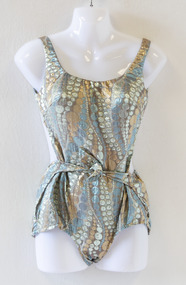
... cutting patterns in one room while a machinist sewed them together in the next. His company, which he named Watersun, would become an iconic Australian swimwear label. During the early 1960s, Watersun developed its "Unquestionable Bra", an inbuilt moulded bra which was marketed as giving wearers a more natural bustline than other labels. The company was also known for its matching swimwear and beachwear, producing dresses...cutting patterns in one room while a machinist sewed them together in the next. His company, which he named Watersun, would become an iconic Australian swimwear label. During the early 1960s, Watersun developed its "Unquestionable Bra", an inbuilt moulded bra which was marketed as giving wearers a more natural bustline than other labels. The company was also known for its matching swimwear and beachwear, producing dresses ...Polish-born designer David Waters first began producing swimwear in 1952. His mother Halina had recently opened a stall at Melbourne Queen Victoria Markets and was looking for swimsuits to sell; unable to find any she liked, she asked David to design something. He began making swimming costumes using his mother's sewing machine, in between his shifts working at a knitting factory. He had soon set up a small business in his parents' home, cutting patterns in one room while a machinist sewed them together in the next. His company, which he named Watersun, would become an iconic Australian swimwear label. During the early 1960s, Watersun developed its "Unquestionable Bra", an inbuilt moulded bra which was marketed as giving wearers a more natural bustline than other labels. The company was also known for its matching swimwear and beachwear, producing dresses, kaftans, tops and skirts in identical colours and prints to those used for many of its swimsuits. By 1967, the company was reportedly one of Australia's two biggest swimwear manufacturers, with over one hundred employees. Watersun was sold to Ada Productions in 1984 and was later acquired by Trackerjack Australasia. This swimsuit is believed to be one of a large quantity of samples, seconds and unsold Ada Productions stock donated to Brighton Historical Society in late 1990 by Brian Samuel, who worked at the company between 1979 and 1990.Backless lamé one-piece swimsuit (.1) with pattern of silver, blue and bronze circles in various sizes. Waist ties knotted at front for cinched-in waist. Built-in underwire bra. Sleeveless A-line jacket (.2) in same fabric, falling past hips. Front zip and close-fitting hood.Label in bra, blue with yellow sunburst logo containing the word “Watersun” in red, above the text: “32 / Unquestionable Bra”.swimwear, watersun, david waters, ada productions, melbourne designers -
 Brighton Historical Society
Top and pants ensemble, Watersun, Crop top and pants ensemble
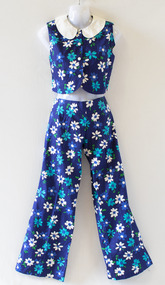
... cutting patterns in one room while a machinist sewed them together in the next. His company, which he named Watersun, would become an iconic Australian swimwear label. During the early 1960s, Watersun developed its "Unquestionable Bra", an inbuilt moulded bra which was marketed as giving wearers a more natural bustline than other labels. The company was also known for its matching swimwear and beachwear, producing dresses...cutting patterns in one room while a machinist sewed them together in the next. His company, which he named Watersun, would become an iconic Australian swimwear label. During the early 1960s, Watersun developed its "Unquestionable Bra", an inbuilt moulded bra which was marketed as giving wearers a more natural bustline than other labels. The company was also known for its matching swimwear and beachwear, producing dresses ...Polish-born designer David Waters first began producing swimwear in 1952. His mother Halina had recently opened a stall at Melbourne Queen Victoria Markets and was looking for swimsuits to sell; unable to find any she liked, she asked David to design something. He began making swimming costumes using his mother's sewing machine, in between his shifts working at a knitting factory. He had soon set up a small business in his parents' home, cutting patterns in one room while a machinist sewed them together in the next. His company, which he named Watersun, would become an iconic Australian swimwear label. During the early 1960s, Watersun developed its "Unquestionable Bra", an inbuilt moulded bra which was marketed as giving wearers a more natural bustline than other labels. The company was also known for its matching swimwear and beachwear, producing dresses, kaftans, tops and skirts in identical colours and prints to those used for many of its swimsuits. By 1967, the company was reportedly one of Australia's two biggest swimwear manufacturers, with over one hundred employees. Watersun was sold to Ada Productions in 1984 and was later acquired by Trackerjack Australasia. This piece is believed to be one of a large quantity of samples, seconds and unsold Ada Productions stock donated to Brighton Historical Society in late 1990 by Brian Samuel, who worked at the company between 1979 and 1990.Ensemble consisting of sleeveless crop top (.1) and full length pants (.2). Bold floral print features blue and white flowers on a navy blue background. Top has a white Peter Pan collar. Swing tag attached.Swing tag: "SIZE 34 / STYLE 186/11 / PRICE $13.00".swimwear, watersun, david waters, ada productions, melbourne designers -
 Ballarat Tramway Museum
Book, H.P. James, "In Other Days", late 1930's
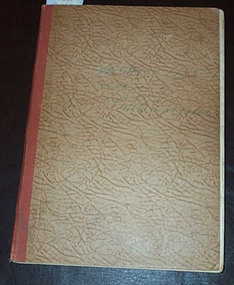
... cuttings etc often have side notes written by Mr. James. Inside front cover has certificate recording Mr. James membership to the Ballarat Historical Society (on Australasian Historical Record Society paper) for 1937 - 1938. A side note records Mr. James elected as Vice President in 1939. Receipt signed by Edward Crimmins (See Reg. Item 2486) Has a table of contents for pages 1 to 65. Opposite is a photograph of Mr. James dressed...cuttings etc often have side notes written by Mr. James. Inside front cover has certificate recording Mr. James membership to the Ballarat Historical Society (on Australasian Historical Record Society paper) for 1937 - 1938. A side note records Mr. James elected as Vice President in 1939. Receipt signed by Edward Crimmins (See Reg. Item 2486) Has a table of contents for pages 1 to 65. Opposite is a photograph of Mr. James dressed ...ESCo Employee Hours Work Record book that has been used by an ESCo/SEC inspector, H. P. James as a record / note book for his personal collection or papers or journal titled "In Other Days". Book sewn with string in 36 page sections, blank end papers, board covers with stipple paper out sides and Rexene cloth binding. Comprising plain paper end papers and 104 printed pages (52 leaves), with each sheet printed in black on feint ruled paper for recording the hours worked and other details of drivers and conductors employed by ESCo. Printed for daily use, with Day and date page headings - made out for the 1930's. Text generically printed feint ruled paper. Images: Book - i1 Inside front cover - i2 Members Certificate - i3 Photo of H.P. James and index page - i4 Has been used to gather mementos such as photos, articles, newspaper clippings, letters and other miscellaneous documents on Ballarat local history. Newspaper cuttings etc often have side notes written by Mr. James. Inside front cover has certificate recording Mr. James membership to the Ballarat Historical Society (on Australasian Historical Record Society paper) for 1937 - 1938. A side note records Mr. James elected as Vice President in 1939. Receipt signed by Edward Crimmins (See Reg. Item 2486) Has a table of contents for pages 1 to 65. Opposite is a photograph of Mr. James dressed for the Ballarat Tramways Social Club function - See Reg. Item No. 506 Primary items are: 1 - Newspaper cutting "A stroll along Bridge St. 50 years ago" - Nathan F. Speilvogel. 3 - Newspaper cutting "What I Remember of Early Ballarat" - James Sainsberry. 4 - Newspaper cutting "Magnet that Made Ballarat - New Monument Marks Gold Discovery" 7 - Newspaper cutting "Romance of a Ballarat Street Block" - Speilvogel 9 - Newspaper cutting "Sixty years of Dana St. School"- Speilvogel 11 - Newspaper cutting "The White Flat - its Transitions of Service - Historical Review" - J. Hargreaves 15 - Newspaper cutting "Memories of Russell Square - Fireman's Carnivals" - James 16 - Notes on the Alfred Hall 17 - Newspaper cutting - "Alfred Hall" - James 21 - Letter re Russell Square dated 24/2/38, J. McLeish 23 - Newspaper cutting "The First Train to Ballarat" 25 - Newspaper cutting "Story of Ballarat's Horse Trams 1887 to 1913", James - see Reg. Item 2489. 27 - Photos and Newspaper cutting of items re horse trams, and photo of ESCo No. 18 - See Reg. Items 2490, 2491 and 2492. 28 - ESCo opening ticket (See other Reg. Items 608 for examples of this) ticket No. 1595. 29 - Newspaper cutting "Story of Ballarat's Electric Trams", James, See Reg. Item 2493. 30 - Poster - SEC - Ballarat "The New System of Fares and Sections" - 3/10/1997 - See Reg. Item 2494. SEC - Tourist Ticket - See Reg. Item 2495 ESCo - 3d check ticket - See Reg. Item 2496 31 - Tickets and handwritten notes - with reference to page 51 ESCo 1d - See Reg. Item 2497 (2 No.) ESCo/SEC? - lunch hour weekly ticket - See Reg. Item 2498 ESCo/SEC? - Morning and evening weekly ticket - See Reg. Item 2499 ESCo/SEC? - 3d Adult Transfer - See Reg. Item 2500 ESCo/SEC? - 2d child Transfer - See Reg. Item 2501 ESCo - 1.1/2 child ticket - See Reg. Item 2502 ESCo - 3d Adult ticket - See Reg. Item 2503 Extract of an item titled "History of Ballarat Tramways", SEC Magazine, Feb. 1939 - See Reg. Item 2504 2d ESCo token (See other reg items 1794 and 1943 for details of this object) - sewn into page. 33 - Handwritten notes "Alfred Hall" 35 - Handwritten notes "Russell Square" 36, 37 - miscellaneous cuttings from the Courier for 1939 and 1940 39 - Newspaper cutting "South Street Band Contests" - cutting dated 27/10/1932. (See images - i5 to 41, 43, - ditto - contest results 44 - Photo of the Tramway Shelter in Sturt Street being removed - Courier dated 18/12/1923 - see Reg Item 2523. 45 - Extract of April 1938 from SEC Magazine, photos of the launch of the illuminated Ballarat Centenary tram - see Reg Item 2524. 47 - Newspaper cutting "Peeps into the Past" 48 - Listing of "Members of Returned Soldiers Band", Ballarat, dated 18/11/1919. 49 - Newspaper cutting "Ballarat, The Home of the Band Contests", dated 27/10/1932. 51 - Handwritten notes - "Tram Fares methods of collection" - See Reg. Item 2505. 53 - Newspaper cutting "100 years ago", Port Phillip Herald for 1840. 54 - Black and white photo of a gathering of people (tramway?) at the Showgrounds - See Reg. Item 2506 55 - Six black and white photos with handwritten notes ESCo 19 or 20 - See Reg. Item 2507 Group of ESCo employees by ESCo tram - See Reg. Item 2508 Photo of ESCo employee, Si Barker - See Reg. Item 2509 Photo of ESCo company bus - See Reg. Item 2510 (See also Reg Item 3813) Photo of No. 25 - Barkly St - See Reg. Item 2511 Photo of two ESCo employees - See Reg. Item 2512 56 - Loose newspaper cutting "San Francisco Struggle Buggies" - cable trams - The Age 15/3/1947 57 - Letter from Mr. Pringle of ESCo to Inspector James and Handwritten notes on ESCo management - See Reg. Item 2513 Handwritten notes on the token systems - See Reg. Item 2514 59 - Page titled "Bundy clocks and meters" but no notes 61 - Hand drawn map of Ballarat tramways with notes on tracks - horse, SEC and ESCo and loops - See Reg. Item 2515. 63 - Miscellaneous newspaper cuttings and photo of the Arch of Victory 64 - Photo of W. J.K. Dunstan ??? (has notes written on back, but difficult to read)* - Notes on rear of photo p64. "49 years in service W.J.K. Dunstan Office Manager Ballarat Branch Retired 18/3/46" 65 - Newspaper cutting "Old Victorian Schooldays, letters and reminiscences by past scholars". 67 - Newspaper cuttings - photo of Ballarat Choral Union and Urquhart St. school 69 - Newspaper cutting "Saint with a top hat" 71, 73 - Newspaper cutting "District Mining Disasters of By-Gone Days" - John Hargreaves 75 - Newspaper cutting "The Ballarat Courier" banners for 2/9/1939 - outbreak of World War Two - normal and a special edition. 77, 79 - Newspaper cutting "My Youth in Ballarat" - T.P. Long. 81 - Two photos and handwritten notes showing trams in Sturt St and the line up of horse trams - See Reg Item 2516. 83 - Newspaper cutting "Theatrical History - The Charlie Napier" - Speilvogel 85, 87 - Newspaper cutting "Story of the Eureka Stockade Monument" - Speilvogel 89 - Newspaper cutting "The Beginning of Buninyong" - Speilvogel 91 - Newspaper cutting "St. David's Day" 93, 95 - Newspaper cutting "From 1856 to 1894, Ballarat's Foremost Citizen Major (William Collard) Smith Recalled - J. Hargreaves. 97 - Newspaper cutting "All Electrical Exhibition / Ballarat's Electric Supply, its development" - 1936, See Reg. Item 2517. 98 - Loose photo of the ESCo Power station chimney and steeplejacks - See Reg. Item 2518. 98 - Loose sheet of paper about the origin of the ESCo trams - See Reg. Item 2525. 99 - Newspaper cutting - about Electricity in Ballarat and tramway services, and handwritten notes on ESCo Inspectors - See Reg. Item 2519 100, 101 - Newspaper cuttings - "Mr. Melbourne Day by Day" cartoon series and the artist's death notice dated 22/8/1939. 102 - Poster - Dana Street School Jubilee Re-union, has N. Speilvogel and H. James as joint secretaries. 103 - Newspaper cutting of various photos and a scene of a gold train at Bendigo 104 - Newspaper cuttings - Bob Menzies and Adolph Hitler and backs of Melbourne tram tickets - "School Boy Howlers". 105 - Letter in an envelope to H.P. James dated 11/10/1937, by a person about the building of the tram sheds at Wendouree - See Reg. Item 2520. Newspaper cutting of the opening of the tramway to Lydiard St. North from Gregory St. - See Reg. Item 2521 Loose item - 1/- SEC Tourist Ticket No. A2676 - See Reg. Item 2522.Many in pencil and inktrams, tramways, h.p. james, esco, horse trams, ballarat, civic history -
 Brighton Historical Society
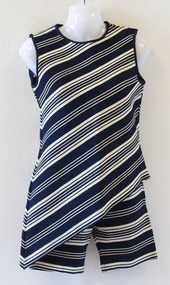
Swimsuit ensemble, Watersun
... cutting patterns in one room while a machinist sewed them together in the next. His company, which he named Watersun, would become an iconic Australian swimwear label. During the early 1960s, Watersun developed its "Unquestionable Bra", an inbuilt moulded bra which was marketed as giving wearers a more natural bustline than other labels. The company was also known for its matching swimwear and beachwear, producing dresses...cutting patterns in one room while a machinist sewed them together in the next. His company, which he named Watersun, would become an iconic Australian swimwear label. During the early 1960s, Watersun developed its "Unquestionable Bra", an inbuilt moulded bra which was marketed as giving wearers a more natural bustline than other labels. The company was also known for its matching swimwear and beachwear, producing dresses ...Polish-born designer David Waters first began producing swimwear in 1952. His mother Halina had recently opened a stall at Melbourne Queen Victoria Markets and was looking for swimsuits to sell; unable to find any she liked, she asked David to design something. He began making swimming costumes using his mother's sewing machine, in between his shifts working at a knitting factory. He had soon set up a small business in his parents' home, cutting patterns in one room while a machinist sewed them together in the next. His company, which he named Watersun, would become an iconic Australian swimwear label. During the early 1960s, Watersun developed its "Unquestionable Bra", an inbuilt moulded bra which was marketed as giving wearers a more natural bustline than other labels. The company was also known for its matching swimwear and beachwear, producing dresses, kaftans, tops and skirts in identical colours and prints to those used for many of its swimsuits. By 1967, the company was reportedly one of Australia's two biggest swimwear manufacturers, with over one hundred employees. Watersun was sold to Ada Productions in 1984 and was later acquired by Trackerjack Australasia. This swimsuit is believed to be one of a large quantity of samples, seconds and unsold Ada Productions stock donated to Brighton Historical Society in late 1990 by Brian Samuel, who worked at the company between 1979 and 1990.Two-piece swimsuit with navy blue and white horizontal stripes. Cropped top (.1) has inbuilt underwire bra and metal fastening at back. Shorts (.2) are high-waisted with longer legs. Matching top (.3) has diagonal navy and white stripes and an asymmetrical hem. Sleeveless with round neck. Velcro fastening on shoulder and side seam of shorter side. No label.swimwear, watersun, david waters, ada productions, melbourne designers -
 Brighton Historical Society
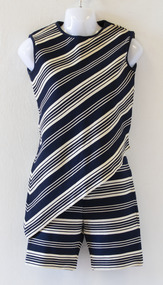
Swimsuit ensemble, Watersun
... cutting patterns in one room while a machinist sewed them together in the next. His company, which he named Watersun, would become an iconic Australian swimwear label. During the early 1960s, Watersun developed its "Unquestionable Bra", an inbuilt moulded bra which was marketed as giving wearers a more natural bustline than other labels. The company was also known for its matching swimwear and beachwear, producing dresses...cutting patterns in one room while a machinist sewed them together in the next. His company, which he named Watersun, would become an iconic Australian swimwear label. During the early 1960s, Watersun developed its "Unquestionable Bra", an inbuilt moulded bra which was marketed as giving wearers a more natural bustline than other labels. The company was also known for its matching swimwear and beachwear, producing dresses ...Polish-born designer David Waters first began producing swimwear in 1952. His mother Halina had recently opened a stall at Melbourne Queen Victoria Markets and was looking for swimsuits to sell; unable to find any she liked, she asked David to design something. He began making swimming costumes using his mother's sewing machine, in between his shifts working at a knitting factory. He had soon set up a small business in his parents' home, cutting patterns in one room while a machinist sewed them together in the next. His company, which he named Watersun, would become an iconic Australian swimwear label. During the early 1960s, Watersun developed its "Unquestionable Bra", an inbuilt moulded bra which was marketed as giving wearers a more natural bustline than other labels. The company was also known for its matching swimwear and beachwear, producing dresses, kaftans, tops and skirts in identical colours and prints to those used for many of its swimsuits. By 1967, the company was reportedly one of Australia's two biggest swimwear manufacturers, with over one hundred employees. Watersun was sold to Ada Productions in 1984 and was later acquired by Trackerjack Australasia. This swimsuit is believed to be one of a large quantity of samples, seconds and unsold Ada Productions stock donated to Brighton Historical Society in late 1990 by Brian Samuel, who worked at the company between 1979 and 1990.Two-piece swimsuit with navy blue and white horizontal stripes. Cropped top (.1) has inbuilt underwire bra and metal fastening at back. Shorts (.2) are high-waisted with longer legs. Matching top (.3) has diagonal navy and white stripes and an asymmetrical hem. Sleeveless with round neck. Velcro fastening on shoulder and side seam of shorter side. Labels inside bra and top.Label in bra (.1), blue with yellow sunburst logo containing the word “Watersun” in red, above the text: “Unquestionable Bra / MADE IN AUSTRALIA / 34”. Label in side of bikini top (.1): “BRI NYLON” Label in back collar of top (.3): blue with yellow sunburst logo containing the word “Watersun” in red, above the text: “34”, with words “Unquestionable Bra” truncated. Appears to be a repurposed bra label.swimwear, watersun, david waters, ada productions, melbourne designers
