
Showing 42 items matching "dress making in the home"
-
 Whitehorse Historical Society Inc.
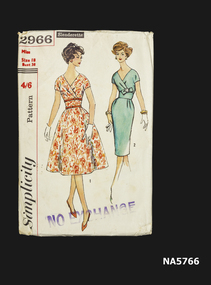
Domestic object - Simplicity Dress Pattern - No. 2966, Simplicity Patterns, 1950
... Dress making in the home...Simplicity sewing pattern - Ladies dresses Full skirt, Slim line Dress making in the home Slenderrette Paper dress pattern in envelope Ladies fashion 2 styles - slim line and full skirt Size 18 - Bust 38 Sewing guide Domestic object Simplicity Dress Pattern - No. 2966 Simplicity Patterns ...Simplicity sewing pattern - Ladies dresses Full skirt, Slim linePaper dress pattern in envelope Ladies fashion 2 styles - slim line and full skirt Size 18 - Bust 38 Sewing guideSlenderrettedress making in the home -
 Whitehorse Historical Society Inc.
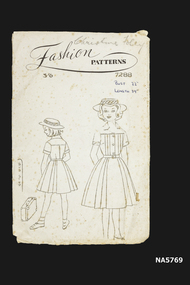
Domestic object - Dress Making Pattern, 1950's
... Dress making in the home...Fashion dress making - child's school dress Dress making in the home Fashion Patterns Girl's school dress Fashion Pattern No. 7288 Bust 32" Length 39" Full skirt short sleeves Domestic object Dress Making Pattern ...Fashion dress making - child's school dress Girl's school dress Fashion Pattern No. 7288 Bust 32" Length 39" Full skirt short sleevesFashion Patternsdress making in the home -
 Whitehorse Historical Society Inc.
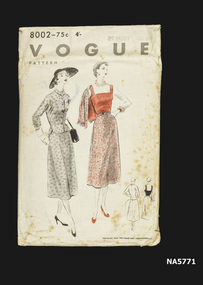
Domestic object - Vogue Dress making pattern No. 8002, The Conde Nast Publications Inc, 1953
... Dress making in the home...Vogue sewing pattern - Ladies skirt and bodice (1 piece) and jacket Dress making in the home Bogue Paper dress making pattern and envelope Vogue Dress making pattern No. 8002 -Lady suit and bodice 32" Bust Size 14 The First Learn-as-you-sew Book Domestic object Vogue Dress making pattern No. 8002 The Conde Nast Publications Inc ...Vogue sewing pattern - Ladies skirt and bodice (1 piece) and jacketPaper dress making pattern and envelope Vogue Dress making pattern No. 8002 -Lady suit and bodice 32" Bust Size 14 The First Learn-as-you-sew BookBoguedress making in the home -
 Federation University Historical Collection
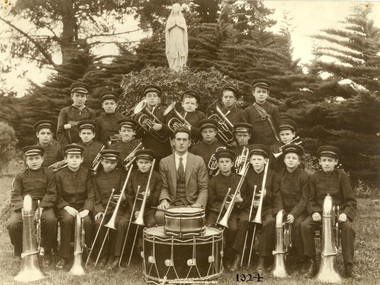
Photograph - Photograph - black and white, St Joseph's Orphanage Brass Band, 1924, 1924
... making an outstanding contribution to brass music in Australia. St Joseph's home was later known as Nazareth House. frank wright brass band catholic mary statue orphanage st joseph's home sebastopol St Joseph's Orphanage Band Written in ink on front - '1924' Black and white photograph of a group of boys dressed in a band uniform all carrying brass instruments. ...Frank Wright was a renown resident of Smeaton. He lived at Laura Villa, and attended Smeaton State School. His father William was a gold miner and his mother was Sarah Wright. Their family won many singing and instrumental awards. Frank was tutored by Percy Code and became the Australian Open Cornet Champion by the age of eighteen. A year later, Frank conducted the City of Ballarat Band, and later the Ballarat Soldiers’ Memorial Band. He formed the Frank Wright Frisco Band and Frank Wright and his Coliseum Orchestra. These bands won many South Street awards, and Frank as conductor won many awards in the Australian Band Championship contest. In 1933 Frank Wright sailed to England to conduct the famous St Hilda’s Band and was later appointed Musical Director of the London County Council, where he organized many amazing concerts in parks, in and around the London district. He was made Professor of Brass and Military Band Scoring and conducted at the Guildhall of Music and Drama. Frank was often invited to adjudicate Brass Band Championships around Europe, in Australia, including South Street and in New Zealand. The Frank Wright Medal at the Royal South Street competition is awarded to an individual recognized as making an outstanding contribution to brass music in Australia. St Joseph's home was later known as Nazareth House.Black and white photograph of a group of boys dressed in a band uniform all carrying brass instruments. The conductor is seated centre front with two drums, one on top of the other placed in front of him. The group is arranged in front of shrubbery and a statue of Mary. The conductor is Frank Wright and the grounds are the boys orphanage, St Joseph's Home - now Blythewood GrangeWritten in ink on front - '1924'frank wright, brass band, catholic, mary statue, orphanage, st joseph's home, sebastopol, st joseph's orphanage band -
 Federation University Historical Collection
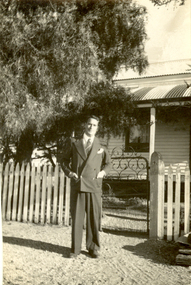
Photograph - Black and White, Frank Wright at Smeaton
... making an outstanding contribution to brass music in Australia. Photo outside his home in Smeaton frank wright smeaton cornet Small black and white photo of Frank Wright dressed in suit standing outside Family home at Smeaton Frank Wright at Smeaton Photograph - Black and White ...Frank Wright was a renown resident of Smeaton, where he was born. He lived at Laura Villa, and attended Smeaton State School. His father William was a gold miner and his mother's name was Sarah. Their family won many singing and instrumental awards. Frank was tutored by Percy Code and was awarded a gold medal for the highest marks in the ALCM examinations in the British Colonies at the age of seventeen years. He became the Australian Open Cornet Champion by the age of eighteen. A year later, Frank conducted the City of Ballarat Band, and later the Ballarat Soldiers’ Memorial Band. He formed the Frank Wright Frisco Band and Frank Wright and his Coliseum Orchestra. These bands won many South Street awards, and Frank as conductor won many awards in the Australian Band Championship contest. In 1933 Frank Wright sailed to England to conduct the famous St Hilda’s Band and was later appointed Musical Director of the London County Council, where he organized many amazing concerts in parks, in and around the London district. He was made Professor of Brass and Military Band Scoring and conducted at the Guildhall of Music and Drama. Frank was often invited to adjudicate Brass Band Championships around Europe, in Australia, including South Street and in New Zealand. The Frank Wright Medal at the Royal South Street competition is awarded to an individual recognized as making an outstanding contribution to brass music in Australia.Photo outside his home in SmeatonSmall black and white photo of Frank Wright dressed in suit standing outside Family home at Smeatonfrank wright, smeaton, cornet -
 Federation University Historical Collection
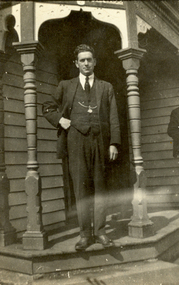
Photograph - Black and White, Frank Wright
... making an outstanding contribution to brass music in Australia. Frank Wright in suit frank wright Small Black and white photo of Frank Wright dressed in a three piece suit, with a phob watch on his vest standing outside a home Frank Wright Photograph - Black and White ...Frank Wright was a renown resident of Smeaton, where he was born. He lived at Laura Villa, and attended Smeaton State School. His father William was a gold miner and his mother's name was Sarah. Their family won many singing and instrumental awards. Frank was tutored by Percy Code and was awarded a gold medal for the highest marks in the ALCM examinations in the British Colonies at the age of seventeen years. He became the Australian Open Cornet Champion by the age of eighteen. A year later, Frank conducted the City of Ballarat Band, and later the Ballarat Soldiers’ Memorial Band. He formed the Frank Wright Frisco Band and Frank Wright and his Coliseum Orchestra. These bands won many South Street awards, and Frank as conductor won many awards in the Australian Band Championship contest. In 1933 Frank Wright sailed to England to conduct the famous St Hilda’s Band and was later appointed Musical Director of the London County Council, where he organized many amazing concerts in parks, in and around the London district. He was made Professor of Brass and Military Band Scoring and conducted at the Guildhall of Music and Drama. Frank was often invited to adjudicate Brass Band Championships around Europe, in Australia, including South Street and in New Zealand. The Frank Wright Medal at the Royal South Street competition is awarded to an individual recognized as making an outstanding contribution to brass music in Australia.Frank Wright in suitSmall Black and white photo of Frank Wright dressed in a three piece suit, with a phob watch on his vest standing outside a homefrank wright -
 Federation University Historical Collection
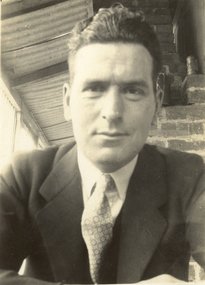
Photograph - Black and White, Frank Wright, 1920s
... making an outstanding contribution to brass music in Australia. He died on 16 November 1970. frank wright laura villa musician Black and white photograph of the torso of a young man dressed in a dark suit and tie. The camera is pointing upward so the background is of the underside of a verandah roof and part of the brickwork of the chimney a house upon with have been placed a couple of objects including a can. The man is Frank Wright and the place could be the family home ...Frank Wright was a renoun resident of Smeaton, where he was born on 2 August 1901. He lived at Laura Villa, and attended Smeaton State School. His father William was a gold miner and his mother's name was Sarah. Their family won many singing and instrumental awards. Frank was tutored by Percy Code and was awarded a gold medal for the highest marks in the ALCM examinations in the British Colonies at the age of seventeen years. He became the Australian Open Cornet Champion by the age of eighteen. A year later, Frank conducted the City of Ballarat Band, and later the Ballarat Soldiers’ Memorial Band. He formed the Frank Wright Frisco Band and Frank Wright and his Coliseum Orchestra. These bands won many South Street awards, and Frank as conductor won many awards in the Australian Band Championship contest. In 1933 Frank Wright sailed to England to conduct the famous St Hilda’s Band and was later appointed Musical Director of the London County Council, where he organized many amazing concerts in parks, in and around the London district. He was made Professor of Brass and Military Band Scoring and conducted at the Guildhall of Music and Drama. Frank was often invited to adjudicate Brass Band Championships around Europe, in Australia, including South Street and in New Zealand. The Frank Wright Medal at the Royal South Street competition is awarded to an individual recognized as making an outstanding contribution to brass music in Australia. He died on 16 November 1970.Black and white photograph of the torso of a young man dressed in a dark suit and tie. The camera is pointing upward so the background is of the underside of a verandah roof and part of the brickwork of the chimney a house upon with have been placed a couple of objects including a can. The man is Frank Wright and the place could be the family home, Laura Villa at Smeaton.frank wright, laura villa, musician -
 Flagstaff Hill Maritime Museum and Village
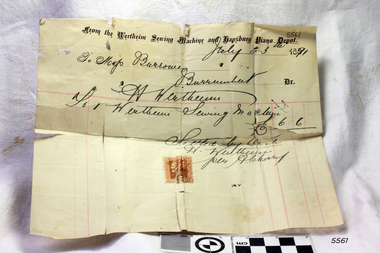
Document - Receipt, Joseph Wertheim, Wertheim Sewing Machine and Hapsburg Piano Depot, 23-07-1891
... ...dress making...home...Wertheim Wertheim Sewing Machines Domestic machines dress making home industry fashion Receipt Queen Victoria stamp one-penny stamp Printed "From the Wertheim Sewing Machine and Hapsburg Piano Depot" Handwritten "Mrs Burrowes, Burrumbeet" "July 23rd 1891" "Wertheim Sewing Machine" "£6 6" "Settled by Cash" Signatures "H. ...This receipt was donated with our collection's Wertheim sewing machine accessory box. The box contains twelve accessories, the instruction book and the receipt for the purchase of a Wertheim sewing machine. The receipt was written on July 23rd 1891 by the Wertheim distributor in Melbourne, Hugo Wertheim. His business was the Wertheim Sewing Machine and Hapsburg Piano Depot, trading at 173 Williams Street, Melbourne. The purchaser was Mrs Burrowes from Burrumbeet, Victoria, a district northwest of Ballarat. She paid £6-6 (six pounds and six shillings) in cash. The receipt was signed by H. Wertheim and the other signatory looks like John A. Cherry. Hugo Wertheim (1854-1919) was an agent for his father’s cousin Joseph Wertheim, a well-established sewing machine manufacturer in Germany. He was born in Lispenhausen, Germany, and migrated to Melbourne in October 1875, where he opened a merchandising business at 39 Flinders Lane East. He returned to Germany in 1885 to marry Joseph Wertheim's daughter Sophie Emilie. The couple came back to Melbourne, and Hugo quickly established a substantial business selling sewing machines, bicycles, pianos and other mechanical devices, under brands such as Wertheim, Electra, Planet, Griffin and Hapsburg. He exhibited at agricultural shows and in 1901 at the Pan American Exposition, Buffalo, United States of America. One of his staff was O. C. Beale, who later set up his own piano business in New South Wales. Hugo continued to own 25 per cent of one of Beale's companies, which became Wertheim's Queensland business. In 1908 Hugo Wertheim opened a piano factory in Richmond, Melbourne, aiming to produce 2000 pianos and player pianos a year, predominantly using Australian materials. In laying the foundation stone, Prime Minister Alfred Deakin observed that “few men with such opportunities for a life of ease would have embarked on such an enterprise” Hugo died of chronic hepatitis in 1919 at his home in South Yarra. His eldest son, Herbert Joseph (1886-1972), continued the business. The piano factory closed in 1935, becoming a Heinz food processing plant and in 1955, GTV Channel 9 studios and offices. The Wertheim Sewing Machine Company – Joseph Wertheim (1804–1899) founded the company in 1868 in Frankfurt, Germany. At this time Joseph was the Frankfurt city delegate for the Democratic Party. At its height, the Wertheim factory employed approximately 650 workers. The company used a trademark of a dwarf holding a hammer which is known to have been used until at least 1925, however in 1909 a Star of David was also registered. In 1870 a Wertheim subsidiary was formed in Barcelona, Spain. The business imported and sold complete machines, including the English Jones machine. Locals began calling the sewing machines “las rapidas”, and the business became known as “las casa de las rapidas”. In 1915 production began of a totally manufactured Spanish Wertheim machine. Wertheim in Germany continued manufacturing machines until 1932 when the Wertheim family fled to Spain. Despite converting to Christianity from Judaism, they feared the political unrest in Germany during that time. Wertheim Spain became Rapida SA and was then the sole manufacturer of the Wertheim machines. The factory was managed by Karl Wertheim under the alias Carlos Vallin.The receipt is significant for its connection with Victoria's northwestern district, the Melbourne distributor Hugo Wertheim, and the well-known German manufacturer of the early domestic sewing machines, Joseph Wertheim. The stamp with Queen Victoria's profile also connects the receipt to the Victorian era and connects Melbourne to Colonial Australia. The receipt also gives a fixed date to the machine accessories and instruction book in our Collection, connecting them all to domestic life in the Victorian era.Receipt on cream paper, rectangular, with red horizontal and vertical lines. Printed letterhead and heading text. Handwritten details of the seller, owner, the item purchased, method of payment, and cost. Signed by two signatories. A one-penny stamp is attached. Sold by Wertheim Sewing Machines and Hapsburg Pianos,.dated 23rd July 1891 for £6 6/- from Mrs Burrowes, Burrumbeet, Victoria, for the purchase of a Wertheim sewing machine.Printed "From the Wertheim Sewing Machine and Hapsburg Piano Depot" Handwritten "Mrs Burrowes, Burrumbeet" "July 23rd 1891" "Wertheim Sewing Machine" "£6 6" "Settled by Cash" Signatures "H. Wertheim" and (Looks Like) "John A Cherry" Ont the stamp, [image of Queen Victoria's profile] and "VICTORIA" "ONE PENNY" flagstaff hill, flagstaff hill maritime museum and village, warrnambool, maritime museum, maritime village, great ocean road, shipwreck coast, wertheim, sewing machine, victorian era, sewing machine accessories, sewing machine instructions, wertheim sewing machine and hapsburg piano depot, 23-7-1891, £6 6/-, mrs burrowes, burrumbeet, h. wertheim, wertheim sewing machines, domestic machines, dress making, home industry, fashion, receipt, queen victoria stamp, one-penny stamp -
 Coal Creek Community Park & Museum
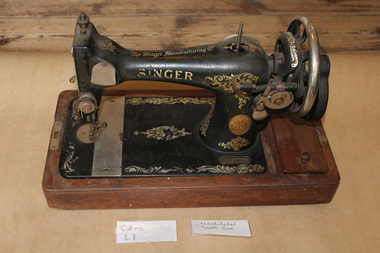
Singer Sewing Machine, Singer, Circa 1927
... home-made, designed, knitted, painted and created things like pegs, pincushions, soaps, kitchen utensils and Pokerwork art, to sell door-to-door or in the streets. ‘Make Do and Mend’ was the mantra of the time. Making and mending clothing at home became a means to save money and an income offering services mending, altering or making clothes for the working people. Making over garments had been a time-honoured tradition since pioneer days. During the Depression clothes were a luxury and new fashions were created by altering old clothes. A best dress...home-made, designed, knitted, painted and created things like pegs, pincushions, soaps, kitchen utensils and Pokerwork art, to sell door-to-door or in the streets. ‘Make Do and Mend’ was the mantra of the time. Making and mending clothing at home became a means to save money and an income offering services mending, altering or making clothes for the working people. Making over garments had been a time-honoured tradition since pioneer days. During the Depression clothes were a luxury and new fashions were created by altering old clothes. A best dress ...In May 1931 the Australian government announced a 20% reduction in expenditure, cuts to wages and pensions, and increased taxation. Despite workers striking, wages were reduced and working hours increased. The economy plunged into depression. Workers blamed the hardships on greedy bankers and the rich elite. The unemployed’ home-made, designed, knitted, painted and created things like pegs, pincushions, soaps, kitchen utensils and Pokerwork art, to sell door-to-door or in the streets. ‘Make Do and Mend’ was the mantra of the time. Making and mending clothing at home became a means to save money and an income offering services mending, altering or making clothes for the working people. Making over garments had been a time-honoured tradition since pioneer days. During the Depression clothes were a luxury and new fashions were created by altering old clothes. A best dress became a housedress, a church suit became a mine suit. Old shirts became new aprons, old trousers became new hats. Magazines and newspapers published Instructions on making and mending clothing and these became curriculums for sewing classes. Darning, mending, patching, saving fabric for rags, patches or upcycling became a necessity. Having a Sewing machine like this 1927 Singer housed in Oliver Gilpin’s store at Coal Creek Community Park and Museum could be the difference between survival and starvation The popularity of publications such as ‘Make do and mend’ lasted through the Second World War and into the 20th Century. Hand operated Singer sewing machine with wooden cover, circa 1927Y4476618 -
 Ithacan Historical Society
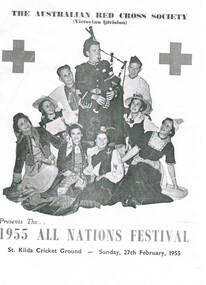
Poster, All Nations Festival, 1955
... It was the period of post WW2 mass migration which saw many nationalities making Australia their home. folk dancing national costimes THE AUSTRALIAN RED CROSS SOCIETY / VICTORIAN DIVISION/PRESENTS THE / 1955 ALL NATIONS FESTIVAL / ST. KILDA CRICKET GROUND - SUNDAY, 27TH FEBRUARY 1955 Photocopy of a poster for the 1955 All Nations Festival. Consisting of a group 3 men and 6 women dressed ...An advertising poster for the 1955 All Nations Festival which was presented by the Australia Red Cross Society, Victorian Branch. Nina and Olga Black participated in the festival and were featured on the poster (seated at front first and second from left) wearing Greek traditional costumes. Other recognisable national costumes are Scottish Piper and Dutch.The event held in 1955 by the Australian Red Cross promoted multicultural Australia and members of the Ithacan Philanthropic Club participated. It was the period of post WW2 mass migration which saw many nationalities making Australia their home.Photocopy of a poster for the 1955 All Nations Festival. Consisting of a group 3 men and 6 women dressed in different national traditional dress. There is a Red Cross symbol either side of the group.THE AUSTRALIAN RED CROSS SOCIETY / VICTORIAN DIVISION/PRESENTS THE / 1955 ALL NATIONS FESTIVAL / ST. KILDA CRICKET GROUND - SUNDAY, 27TH FEBRUARY 1955folk dancing, national costimes -
 National Wool Museum
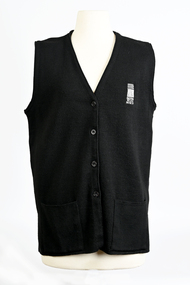
Textile - Black Woollen Vest, 2000s
... home management, and how to be a ‘good’ housekeeper. I enjoyed all the domestic subjects. Ray and I were engaged in August 1963. We purchased our engagement ring in Melbourne and went to dinner at the Playboy Club in Melbourne to celebrate. In preparation for our wedding, I spent many hours making my own wedding dress...home management, and how to be a ‘good’ housekeeper. I enjoyed all the domestic subjects. Ray and I were engaged in August 1963. We purchased our engagement ring in Melbourne and went to dinner at the Playboy Club in Melbourne to celebrate. In preparation for our wedding, I spent many hours making my own wedding dress ...This vest was worn by Lynette Wekwerth when she worked as a volunteer in the National Wool Museum shop during the early 2000s. Lynette volunteered at the National Wool Museum for 25 years from 2001 until her passing in 2025, and was a much loved and respected member of the team. "I was born at Coonara Private Hospital at 173 Yarra Street, Geelong, on the 29th of March 1944, the third of five children. My father was in the RAAF when I was born, and on leaving the air force he became a carpenter/joiner. When I was young, we had the bread and milk delivered. There was a special tin for the bread and a big billy for the milk left of the front veranda to collect these items. My mother, elder sister, Wendy and my younger sister Zaidee, all went to “Physical Culture” held downstairs under the old Plaza Theatre building in Ryrie Street. We girls made our own sports clothes to do exercises (rods, dumbbells, and song and dance). It kept us fit, and we all won medals at some stage at the end-of-year concert. I was the only girl of my age in the street where I lived. There were boys my age, so I learned to play cricket and kick a football, all of which I did well. I attended Tate Street and then went on to Matthew Flinders Girls Secondary College in 1956. Matthew Flinders was a domestic arts school, where I learnt sewing, cookery, home management, and how to be a ‘good’ housekeeper. I enjoyed all the domestic subjects. Ray and I were engaged in August 1963. We purchased our engagement ring in Melbourne and went to dinner at the Playboy Club in Melbourne to celebrate. In preparation for our wedding, I spent many hours making my own wedding dress (with assistance from my mother). We were married at 11 am on Saturday, the 10th April 1965 at St. Matthew’s, Church of England, Geelong. When Ray retired, he responded to an advertisement for volunteers at the National Wool Museum to be a volunteer. He started in 1998. The year that the ‘Pharaohs exhibition’ started. That was fine by me, as he wouldn’t be getting under my feet. At this time I was playing golf regularly and didn’t want to miss out on this activity. I joined the volunteers in the Wool Museum in March/April 2001. I was allocated to the Museum Shop and thoroughly enjoyed being a member of the shop staff. I then became shop assistant. I enjoyed talking and serving the customers. I was soon asked if I would mind repairing some of the garments that may have pulled a thread or a minor fault. I also enjoyed doing ‘stock taking’ in the shop. (Not many staff enjoyed this job, but I did.) In those early days, the Museum staff wore the red blazer and the black wool cardigan." - Lynette WekwerthBlack woollen vest with four buttons at the front, and two pockets. Vest has National Wool Museum logo on left chest. printed [label]: BELLA / Collection / made in australia / WEKWERTH / TO FIT / SIZE / 12working life, volunteer, national wool museum, clothing, uniform, lynette wekwerth, staff, employment, wool clothing, geelong -
 National Wool Museum
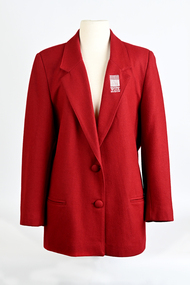
Textile - Red Woollen Jacket, Sabena, 2000s
... home management, and how to be a ‘good’ housekeeper. I enjoyed all the domestic subjects. Ray and I were engaged in August 1963. We purchased our engagement ring in Melbourne and went to dinner at the Playboy Club in Melbourne to celebrate. In preparation for our wedding, I spent many hours making my own wedding dress...home management, and how to be a ‘good’ housekeeper. I enjoyed all the domestic subjects. Ray and I were engaged in August 1963. We purchased our engagement ring in Melbourne and went to dinner at the Playboy Club in Melbourne to celebrate. In preparation for our wedding, I spent many hours making my own wedding dress ...This jacket was worn by Lynette Wekwerth when she worked as a volunteer in the National Wool Museum shop during the early 2000s. Lynette volunteered at the National Wool Museum for 25 years from 2001 until her passing in 2025, and was a much loved and respected member of the team. "I was born at Coonara Private Hospital at 173 Yarra Street, Geelong, on the 29th of March 1944, the third of five children. My father was in the RAAF when I was born, and on leaving the air force he became a carpenter/joiner. When I was young, we had the bread and milk delivered. There was a special tin for the bread and a big billy for the milk left of the front veranda to collect these items. My mother, elder sister, Wendy and my younger sister Zaidee, all went to “Physical Culture” held downstairs under the old Plaza Theatre building in Ryrie Street. We girls made our own sports clothes to do exercises (rods, dumbbells, and song and dance). It kept us fit, and we all won medals at some stage at the end-of-year concert. I was the only girl of my age in the street where I lived. There were boys my age, so I learned to play cricket and kick a football, all of which I did well. I attended Tate Street and then went on to Matthew Flinders Girls Secondary College in 1956. Matthew Flinders was a domestic arts school, where I learnt sewing, cookery, home management, and how to be a ‘good’ housekeeper. I enjoyed all the domestic subjects. Ray and I were engaged in August 1963. We purchased our engagement ring in Melbourne and went to dinner at the Playboy Club in Melbourne to celebrate. In preparation for our wedding, I spent many hours making my own wedding dress (with assistance from my mother). We were married at 11 am on Saturday, the 10th April 1965 at St. Matthew’s, Church of England, Geelong. When Ray retired, he responded to an advertisement for volunteers at the National Wool Museum to be a volunteer. He started in 1998. The year that the ‘Pharaohs exhibition’ started. That was fine by me, as he wouldn’t be getting under my feet. At this time I was playing golf regularly and didn’t want to miss out on this activity. I joined the volunteers in the Wool Museum in March/April 2001. I was allocated to the Museum Shop and thoroughly enjoyed being a member of the shop staff. I then became shop assistant. I enjoyed talking and serving the customers. I was soon asked if I would mind repairing some of the garments that may have pulled a thread or a minor fault. I also enjoyed doing ‘stock taking’ in the shop. (Not many staff enjoyed this job, but I did.) In those early days, the Museum staff wore the red blazer and the black wool cardigan." - Lynette WekwerthRed jacket with two buttons and two pockets at the front, and two decorative buttons on each cuff. Jacket has National Wool Museum logo on the left lapel. printed [label]: SABENA / 14working life, volunteer, national wool museum, clothing, uniform, lynette wekwerth, staff, employment, wool clothing, geelong -
 National Wool Museum
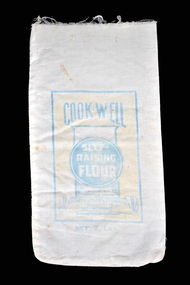
Textile - Cook Well Self Raising Flour Bag
... home, usually by women, containing household items which would not spoil, such as flour, sugar, animal feed, seeds, and other commodities. In modern times a trip to the supermarket is a daily chore, in the past however, these trips happened far less often, with big sacks such as these a large reason why. In the rural US and Canada, Feed sack dresses and Flour sack dresses, were an iconic part of rural life from the 1920s through the Great Depression, World War II, and post-World War II years. Australia also reused these sacks, typically for making...home, usually by women, containing household items which would not spoil, such as flour, sugar, animal feed, seeds, and other commodities. In modern times a trip to the supermarket is a daily chore, in the past however, these trips happened far less often, with big sacks such as these a large reason why. In the rural US and Canada, Feed sack dresses and Flour sack dresses, were an iconic part of rural life from the 1920s through the Great Depression, World War II, and post-World War II years. Australia also reused these sacks, typically for making ...These domestic kitchen bags were donated to the National Wool Museum by Lila Gore. Lila donated Children’s Clothing (RGE 8324) to the museum in 2022 and at her time of donating, inquired as to whether the museum would also be interested in these bags she had been collecting. Lila said there was no reason as to why she was saving the bags, other than she liked the art works and thought they were too good to end up in landfill. She had thought perhaps she would make something out of the bags, or perhaps give the bags to a friend to make something. When Lila was donating the Children’s Clothing to the museum, she thought that the National Wool Museum would be the perfect home for the bags. Domestic kitchen bags such as these date from the late 19th century through the mid-20th century. They were used at home, usually by women, containing household items which would not spoil, such as flour, sugar, animal feed, seeds, and other commodities. In modern times a trip to the supermarket is a daily chore, in the past however, these trips happened far less often, with big sacks such as these a large reason why. In the rural US and Canada, Feed sack dresses and Flour sack dresses, were an iconic part of rural life from the 1920s through the Great Depression, World War II, and post-World War II years. Australia also reused these sacks, typically for making wagga style blankets, but re-use for clothing was not unusual.Calico bag with yellow and blue graphic text on front.Front: COOK-WELL \ SELF- \ RAISING \ FLOUR \ PREPARED WITH \ PHOSHATE AERATOR \ HENRY BERRY & Co (A/S??Ltd) \ 568 580 COLLINS STREET \ MELBOURNE \ NET 7 LBSwagga, flour, oats, bag, calico, lila, gore, depression, war, kitchen -
 National Wool Museum
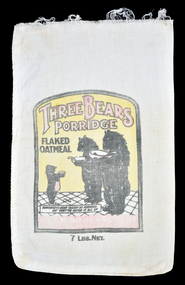
Textile - Three Bears Porridge Flaked Oatmeal Bag
... home, usually by women, containing household items which would not spoil, such as flour, sugar, animal feed, seeds, and other commodities. In modern times a trip to the supermarket is a daily chore, in the past however, these trips happened far less often, with big sacks such as these a large reason why. In the rural US and Canada, Feed sack dresses and Flour sack dresses, were an iconic part of rural life from the 1920s through the Great Depression, World War II, and post-World War II years. Australia also reused these sacks, typically for making...home, usually by women, containing household items which would not spoil, such as flour, sugar, animal feed, seeds, and other commodities. In modern times a trip to the supermarket is a daily chore, in the past however, these trips happened far less often, with big sacks such as these a large reason why. In the rural US and Canada, Feed sack dresses and Flour sack dresses, were an iconic part of rural life from the 1920s through the Great Depression, World War II, and post-World War II years. Australia also reused these sacks, typically for making ...These domestic kitchen bags were donated to the National Wool Museum by Lila Gore. Lila donated Children’s Clothing (RGE 8324) to the museum in 2022 and at her time of donating, inquired as to whether the museum would also be interested in these bags she had been collecting. Lila said there was no reason as to why she was saving the bags, other than she liked the art works and thought they were too good to end up in landfill. She had thought perhaps she would make something out of the bags, or perhaps give the bags to a friend to make something. When Lila was donating the Children’s Clothing to the museum, she thought that the National Wool Museum would be the perfect home for the bags. Domestic kitchen bags such as these date from the late 19th century through the mid-20th century. They were used at home, usually by women, containing household items which would not spoil, such as flour, sugar, animal feed, seeds, and other commodities. In modern times a trip to the supermarket is a daily chore, in the past however, these trips happened far less often, with big sacks such as these a large reason why. In the rural US and Canada, Feed sack dresses and Flour sack dresses, were an iconic part of rural life from the 1920s through the Great Depression, World War II, and post-World War II years. Australia also reused these sacks, typically for making wagga style blankets, but re-use for clothing was not unusual.Calico oat bag with graphic image on front showing three bears holding porridge bowls with yellow background and red, white and black text. Back of bag shows red and white graphic image of a woman wearing a dress and heeled shoes holding a coffee cup, with red and white text.Front: THREE BEARS \ PORRIDGE \ FLAKED \ OATMEAL \ SOMEBODYS BEEN TASTIN' MY PORRIDGE \ AN' THEY'VE EATEN IT ALL UP \ Jas. F. McKenzie & Co. Pty. Ltd. \ AUSTRALIA \ 7 LBS. NET. Back: MCKENZIES \ EXCELSIOR \ COFFEE \ ESSENCEwagga, flour, oats, bag, calico, lila, gore, depression, war, kitchen -
 National Wool Museum
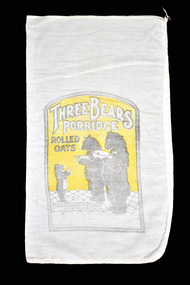
Textile - Three Bears Porridge Rolled Oats Bag
... home, usually by women, containing household items which would not spoil, such as flour, sugar, animal feed, seeds, and other commodities. In modern times a trip to the supermarket is a daily chore, in the past however, these trips happened far less often, with big sacks such as these a large reason why. In the rural US and Canada, Feed sack dresses and Flour sack dresses, were an iconic part of rural life from the 1920s through the Great Depression, World War II, and post-World War II years. Australia also reused these sacks, typically for making...home, usually by women, containing household items which would not spoil, such as flour, sugar, animal feed, seeds, and other commodities. In modern times a trip to the supermarket is a daily chore, in the past however, these trips happened far less often, with big sacks such as these a large reason why. In the rural US and Canada, Feed sack dresses and Flour sack dresses, were an iconic part of rural life from the 1920s through the Great Depression, World War II, and post-World War II years. Australia also reused these sacks, typically for making ...These domestic kitchen bags were donated to the National Wool Museum by Lila Gore. Lila donated Children’s Clothing (RGE 8324) to the museum in 2022 and at her time of donating, inquired as to whether the museum would also be interested in these bags she had been collecting. Lila said there was no reason as to why she was saving the bags, other than she liked the art works and thought they were too good to end up in landfill. She had thought perhaps she would make something out of the bags, or perhaps give the bags to a friend to make something. When Lila was donating the Children’s Clothing to the museum, she thought that the National Wool Museum would be the perfect home for the bags. Domestic kitchen bags such as these date from the late 19th century through the mid-20th century. They were used at home, usually by women, containing household items which would not spoil, such as flour, sugar, animal feed, seeds, and other commodities. In modern times a trip to the supermarket is a daily chore, in the past however, these trips happened far less often, with big sacks such as these a large reason why. In the rural US and Canada, Feed sack dresses and Flour sack dresses, were an iconic part of rural life from the 1920s through the Great Depression, World War II, and post-World War II years. Australia also reused these sacks, typically for making wagga style blankets, but re-use for clothing was not unusual.Calico oat bag with graphic image on front showing three bears holding porridge bowls with yellow background and white and black text.Front: THREE BEARS \ PORRIDGE \ ROLLED \ OATS \ SOMEBODYS BEEN TASTIN' MY PORRIDGE / AN' THEY'VE EATEN IT ALL UPwagga, flour, oats, bag, calico, lila, gore, depression, war, kitchen -
 National Wool Museum
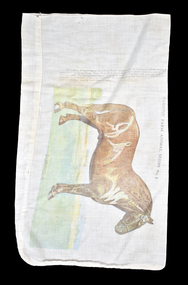
Textile - Parsons Rolled Oats Bag
... home, usually by women, containing household items which would not spoil, such as flour, sugar, animal feed, seeds, and other commodities. In modern times a trip to the supermarket is a daily chore, in the past however, these trips happened far less often, with big sacks such as these a large reason why. In the rural US and Canada, Feed sack dresses and Flour sack dresses, were an iconic part of rural life from the 1920s through the Great Depression, World War II, and post-World War II years. Australia also reused these sacks, typically for making...home, usually by women, containing household items which would not spoil, such as flour, sugar, animal feed, seeds, and other commodities. In modern times a trip to the supermarket is a daily chore, in the past however, these trips happened far less often, with big sacks such as these a large reason why. In the rural US and Canada, Feed sack dresses and Flour sack dresses, were an iconic part of rural life from the 1920s through the Great Depression, World War II, and post-World War II years. Australia also reused these sacks, typically for making ...These domestic kitchen bags were donated to the National Wool Museum by Lila Gore. Lila donated Children’s Clothing (RGE 8324) to the museum in 2022 and at her time of donating, inquired as to whether the museum would also be interested in these bags she had been collecting. Lila said there was no reason as to why she was saving the bags, other than she liked the art works and thought they were too good to end up in landfill. She had thought perhaps she would make something out of the bags, or perhaps give the bags to a friend to make something. When Lila was donating the Children’s Clothing to the museum, she thought that the National Wool Museum would be the perfect home for the bags. Domestic kitchen bags such as these date from the late 19th century through the mid-20th century. They were used at home, usually by women, containing household items which would not spoil, such as flour, sugar, animal feed, seeds, and other commodities. In modern times a trip to the supermarket is a daily chore, in the past however, these trips happened far less often, with big sacks such as these a large reason why. In the rural US and Canada, Feed sack dresses and Flour sack dresses, were an iconic part of rural life from the 1920s through the Great Depression, World War II, and post-World War II years. Australia also reused these sacks, typically for making wagga style blankets, but re-use for clothing was not unusual.Calico oat bag with colour image and black text. Image shows a full length brown horse with bridle.Front: PARSONS FARM ANIMAL SERIES No.3 \ SUFFOLK \ The Suffolk, often known as the Suffolk Punch, originated in the County of Suffolk, England \ and is noted for its hardiness. From 15 to 16 hands in height. The Suffolk in general is smaller than \ the Clydesdale. The head is rather coarse, with the neck short. The body long deep and wide with \ a round full appearance. The croup is straight and legs short and free from leather. The invariable \ colour is chestnut, varying from light to dark.wagga, flour, oats, bag, calico, lila, gore, depression, war, kitchen -
 National Wool Museum
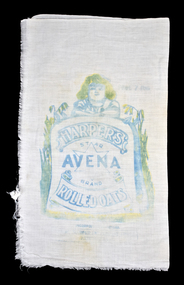
Textile - Harpers Star Avena Brand Rolled Oats Bag
... home, usually by women, containing household items which would not spoil, such as flour, sugar, animal feed, seeds, and other commodities. In modern times a trip to the supermarket is a daily chore, in the past however, these trips happened far less often, with big sacks such as these a large reason why. In the rural US and Canada, Feed sack dresses and Flour sack dresses, were an iconic part of rural life from the 1920s through the Great Depression, World War II, and post-World War II years. Australia also reused these sacks, typically for making...home, usually by women, containing household items which would not spoil, such as flour, sugar, animal feed, seeds, and other commodities. In modern times a trip to the supermarket is a daily chore, in the past however, these trips happened far less often, with big sacks such as these a large reason why. In the rural US and Canada, Feed sack dresses and Flour sack dresses, were an iconic part of rural life from the 1920s through the Great Depression, World War II, and post-World War II years. Australia also reused these sacks, typically for making ...These domestic kitchen bags were donated to the National Wool Museum by Lila Gore. Lila donated Children’s Clothing (RGE 8324) to the museum in 2022 and at her time of donating, inquired as to whether the museum would also be interested in these bags she had been collecting. Lila said there was no reason as to why she was saving the bags, other than she liked the art works and thought they were too good to end up in landfill. She had thought perhaps she would make something out of the bags, or perhaps give the bags to a friend to make something. When Lila was donating the Children’s Clothing to the museum, she thought that the National Wool Museum would be the perfect home for the bags. Domestic kitchen bags such as these date from the late 19th century through the mid-20th century. They were used at home, usually by women, containing household items which would not spoil, such as flour, sugar, animal feed, seeds, and other commodities. In modern times a trip to the supermarket is a daily chore, in the past however, these trips happened far less often, with big sacks such as these a large reason why. In the rural US and Canada, Feed sack dresses and Flour sack dresses, were an iconic part of rural life from the 1920s through the Great Depression, World War II, and post-World War II years. Australia also reused these sacks, typically for making wagga style blankets, but re-use for clothing was not unusual.Calico oat bag with graphic blue and yellow image and text on front. Image shows head and shoulders of person resting on forearms surrounded by flora. Back of bag shows blue and white image of a cube with text and star graphics.Front: HARPER'S \ STAR \ AVENA \ BRAND \ ROLLED OATS \ ??INCORPOR?? ??STORIA?? \ ????? \ AUSTRALIA Back: THE \ SILVER STAR \ RICE \ STARCH \ ROBERT HARPERS AND CO LIMITED \ AUSTRALIA \ THE \ BEST \ IN \ THE \ WORLD \ WONT \ STICK \ TO THE \ IRON \wagga, flour, oats, bag, calico, lila, gore, depression, war, kitchen -
 National Wool Museum
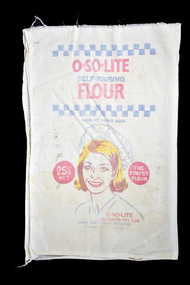
Textile - O*So*Lite Self-Raising Flour Bag
... home, usually by women, containing household items which would not spoil, such as flour, sugar, animal feed, seeds, and other commodities. In modern times a trip to the supermarket is a daily chore, in the past however, these trips happened far less often, with big sacks such as these a large reason why. In the rural US and Canada, Feed sack dresses and Flour sack dresses, were an iconic part of rural life from the 1920s through the Great Depression, World War II, and post-World War II years. Australia also reused these sacks, typically for making...home, usually by women, containing household items which would not spoil, such as flour, sugar, animal feed, seeds, and other commodities. In modern times a trip to the supermarket is a daily chore, in the past however, these trips happened far less often, with big sacks such as these a large reason why. In the rural US and Canada, Feed sack dresses and Flour sack dresses, were an iconic part of rural life from the 1920s through the Great Depression, World War II, and post-World War II years. Australia also reused these sacks, typically for making ...These domestic kitchen bags were donated to the National Wool Museum by Lila Gore. Lila donated Children’s Clothing (RGE 8324) to the museum in 2022 and at her time of donating, inquired as to whether the museum would also be interested in these bags she had been collecting. Lila said there was no reason as to why she was saving the bags, other than she liked the art works and thought they were too good to end up in landfill. She had thought perhaps she would make something out of the bags, or perhaps give the bags to a friend to make something. When Lila was donating the Children’s Clothing to the museum, she thought that the National Wool Museum would be the perfect home for the bags. Domestic kitchen bags such as these date from the late 19th century through the mid-20th century. They were used at home, usually by women, containing household items which would not spoil, such as flour, sugar, animal feed, seeds, and other commodities. In modern times a trip to the supermarket is a daily chore, in the past however, these trips happened far less often, with big sacks such as these a large reason why. In the rural US and Canada, Feed sack dresses and Flour sack dresses, were an iconic part of rural life from the 1920s through the Great Depression, World War II, and post-World War II years. Australia also reused these sacks, typically for making wagga style blankets, but re-use for clothing was not unusual.Calico flour bag with red, blue, white and yellow graphic image and text. Image shows head and shoulders of a woman wearing a bakers hat. Reverse side shows same image with slightly different text.Front: O*SO*LITE \ SELF-RAISING \ FLOUR \ 25lb \ NET \ THE \ FINEST \ FLOUR \ O-SO-LITE \ PRODUCTS PTY. LTD. \ LENNON STREET, SOUTH KENSINGTON \ VICTORIA 13 0261 \ SELF RAISING \ SELF RAISING \ SELF RAISING Back: O*SO*LITE \ SELF-RAISING \ FLOUR \ PREPARED WITH PROSPHATE AERATOR \ 25lb \ NET \ THE \ FINEST \ FLOUR \ O-SO-LITE \ PRODUCTS PTY. LTD. \ LENNON STREET, SOUTH KENSINGTON \ VICTORIA 13 0261wagga, flour, oats, bag, calico, lila, gore, depression, war, kitchen -
 Brighton Historical Society
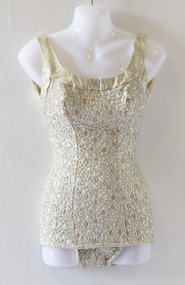
Swimsuit, Marina Couture, circa 1960s
... making swimming costumes using his mother's sewing machine, in between his shifts working at a knitting factory. He had soon set up a small business in his parents' home, cutting patterns in one room while a machinist sewed them together in the next. His company, which he named Watersun, would become an iconic Australian swimwear label. During the early 1960s, Watersun developed its "Unquestionable Bra", an inbuilt moulded bra which was marketed as giving wearers a more natural bustline than other labels. The company was also known for its matching swimwear and beachwear, producing dresses...making swimming costumes using his mother's sewing machine, in between his shifts working at a knitting factory. He had soon set up a small business in his parents' home, cutting patterns in one room while a machinist sewed them together in the next. His company, which he named Watersun, would become an iconic Australian swimwear label. During the early 1960s, Watersun developed its "Unquestionable Bra", an inbuilt moulded bra which was marketed as giving wearers a more natural bustline than other labels. The company was also known for its matching swimwear and beachwear, producing dresses ...Marina Couture was a luxe swimwear line produced by Watersun in the 1960s. Polish-born designer David Waters first began producing swimwear in 1952. His mother Halina had recently opened a stall at Melbourne Queen Victoria Markets and was looking for swimsuits to sell; unable to find any she liked, she asked David to design something. He began making swimming costumes using his mother's sewing machine, in between his shifts working at a knitting factory. He had soon set up a small business in his parents' home, cutting patterns in one room while a machinist sewed them together in the next. His company, which he named Watersun, would become an iconic Australian swimwear label. During the early 1960s, Watersun developed its "Unquestionable Bra", an inbuilt moulded bra which was marketed as giving wearers a more natural bustline than other labels. The company was also known for its matching swimwear and beachwear, producing dresses, kaftans, tops and skirts in identical colours and prints to those used for many of its swimsuits. By 1967, the company was reportedly one of Australia's two biggest swimwear manufacturers, with over one hundred employees. Watersun was sold to Ada Productions in 1984 and was later acquired by Trackerjack Australasia. This swimsuit is believed to be one of a large quantity of samples, seconds and unsold Ada Productions stock donated to Brighton Historical Society in late 1990 by Brian Samuel, who worked at the company between 1979 and 1990.Silver lamé swimsuit featuring delicate brocade embellishment, an inbuilt underwire bra, a zippered back and elasticised edging on the legs and back.Label in bra, blue with gold crown logo and text: “MARINA COUTURE / 32”.swimwear, watersun, david waters, ada productions, melbourne designers, marina couture -
 Brighton Historical Society
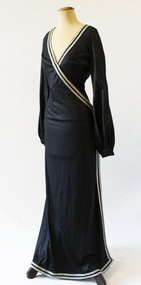
Swimsuit ensemble, Watersun, Pool party ensemble, 1973
... making swimming costumes using his mother's sewing machine, in between his shifts working at a knitting factory. He had soon set up a small business in his parents' home, cutting patterns in one room while a machinist sewed them together in the next. His company, which he named Watersun, would become an iconic Australian swimwear label. During the early 1960s, Watersun developed its "Unquestionable Bra", an inbuilt moulded bra which was marketed as giving wearers a more natural bustline than other labels. The company was also known for its matching swimwear and beachwear, producing dresses...making swimming costumes using his mother's sewing machine, in between his shifts working at a knitting factory. He had soon set up a small business in his parents' home, cutting patterns in one room while a machinist sewed them together in the next. His company, which he named Watersun, would become an iconic Australian swimwear label. During the early 1960s, Watersun developed its "Unquestionable Bra", an inbuilt moulded bra which was marketed as giving wearers a more natural bustline than other labels. The company was also known for its matching swimwear and beachwear, producing dresses ...This striking pool party ensemble from Australian swimwear company Watersun was designed by Carmela DiBernado, nee Savino, for the opening of the Sydney Opera House in 1973. Polish-born designer David Waters first began producing swimwear in 1952. His mother Halina had recently opened a stall at Melbourne Queen Victoria Markets and was looking for swimsuits to sell; unable to find any she liked, she asked David to design something. He began making swimming costumes using his mother's sewing machine, in between his shifts working at a knitting factory. He had soon set up a small business in his parents' home, cutting patterns in one room while a machinist sewed them together in the next. His company, which he named Watersun, would become an iconic Australian swimwear label. During the early 1960s, Watersun developed its "Unquestionable Bra", an inbuilt moulded bra which was marketed as giving wearers a more natural bustline than other labels. The company was also known for its matching swimwear and beachwear, producing dresses, kaftans, tops and skirts in identical colours and prints to those used for many of its swimsuits. By 1967, the company was reportedly one of Australia's two biggest swimwear manufacturers, with over one hundred employees. Watersun was sold to Ada Productions in 1984 and was later acquired by Trackerjack Australasia. This swimsuit is believed to be one of a large quantity of samples, seconds and unsold Ada Productions stock donated to Brighton Historical Society in late 1990 by Brian Samuel, who worked at the company between 1979 and 1990.Pool party ensemble consisting of a swimsuit (.1) and robe dress (.2), both black with silver trim. Dress has a crossover front, fastening at side waist, with v-neck at front and plunging back. Swimsuit has a v-neck, with silver trim extending forming an X-shape across the body.Label (identical in both items), blue text on white: “Watersun / SIZE 10 / BUST 32 / Made in Australia”swimwear, watersun, david waters, ada productions, melbourne designers, 1970s, carmela savino, carmela dibernardo, sydney opera house -
 Brighton Historical Society
Swimsuit ensemble, Watersun, Pool party ensemble, circa 1970s
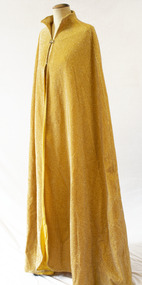
... making swimming costumes using his mother's sewing machine, in between his shifts working at a knitting factory. He had soon set up a small business in his parents' home, cutting patterns in one room while a machinist sewed them together in the next. His company, which he named Watersun, would become an iconic Australian swimwear label. During the early 1960s, Watersun developed its "Unquestionable Bra", an inbuilt moulded bra which was marketed as giving wearers a more natural bustline than other labels. The company was also known for its matching swimwear and beachwear, producing dresses...making swimming costumes using his mother's sewing machine, in between his shifts working at a knitting factory. He had soon set up a small business in his parents' home, cutting patterns in one room while a machinist sewed them together in the next. His company, which he named Watersun, would become an iconic Australian swimwear label. During the early 1960s, Watersun developed its "Unquestionable Bra", an inbuilt moulded bra which was marketed as giving wearers a more natural bustline than other labels. The company was also known for its matching swimwear and beachwear, producing dresses ...Polish-born designer David Waters first began producing swimwear in 1952. His mother Halina had recently opened a stall at Melbourne Queen Victoria Markets and was looking for swimsuits to sell; unable to find any she liked, she asked David to design something. He began making swimming costumes using his mother's sewing machine, in between his shifts working at a knitting factory. He had soon set up a small business in his parents' home, cutting patterns in one room while a machinist sewed them together in the next. His company, which he named Watersun, would become an iconic Australian swimwear label. During the early 1960s, Watersun developed its "Unquestionable Bra", an inbuilt moulded bra which was marketed as giving wearers a more natural bustline than other labels. The company was also known for its matching swimwear and beachwear, producing dresses, kaftans, tops and skirts in identical colours and prints to those used for many of its swimsuits. By 1967, the company was reportedly one of Australia's two biggest swimwear manufacturers, with over one hundred employees. Watersun was sold to Ada Productions in 1984 and was later acquired by Trackerjack Australasia. This swimsuit is believed to be one of a large quantity of samples, seconds and unsold Ada Productions stock donated to Brighton Historical Society in late 1990 by Brian Samuel, who worked at the company between 1979 and 1990.Gold lurex one-piece swimsuit (.1) with v-neck and built-in bra. Matching floor-length gold cape (.2) with high collar and yellow lining. Fastens at collar with hook.Label, blue text on white: “Watersun / SIZE 10 / BUST 32 / Made in Australia”swimwear, watersun, david waters, ada productions, melbourne designers, 1970s -
 Brighton Historical Society
Swimsuit ensemble, Watersun
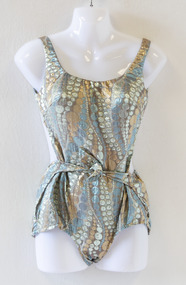
... making swimming costumes using his mother's sewing machine, in between his shifts working at a knitting factory. He had soon set up a small business in his parents' home, cutting patterns in one room while a machinist sewed them together in the next. His company, which he named Watersun, would become an iconic Australian swimwear label. During the early 1960s, Watersun developed its "Unquestionable Bra", an inbuilt moulded bra which was marketed as giving wearers a more natural bustline than other labels. The company was also known for its matching swimwear and beachwear, producing dresses...making swimming costumes using his mother's sewing machine, in between his shifts working at a knitting factory. He had soon set up a small business in his parents' home, cutting patterns in one room while a machinist sewed them together in the next. His company, which he named Watersun, would become an iconic Australian swimwear label. During the early 1960s, Watersun developed its "Unquestionable Bra", an inbuilt moulded bra which was marketed as giving wearers a more natural bustline than other labels. The company was also known for its matching swimwear and beachwear, producing dresses ...Polish-born designer David Waters first began producing swimwear in 1952. His mother Halina had recently opened a stall at Melbourne Queen Victoria Markets and was looking for swimsuits to sell; unable to find any she liked, she asked David to design something. He began making swimming costumes using his mother's sewing machine, in between his shifts working at a knitting factory. He had soon set up a small business in his parents' home, cutting patterns in one room while a machinist sewed them together in the next. His company, which he named Watersun, would become an iconic Australian swimwear label. During the early 1960s, Watersun developed its "Unquestionable Bra", an inbuilt moulded bra which was marketed as giving wearers a more natural bustline than other labels. The company was also known for its matching swimwear and beachwear, producing dresses, kaftans, tops and skirts in identical colours and prints to those used for many of its swimsuits. By 1967, the company was reportedly one of Australia's two biggest swimwear manufacturers, with over one hundred employees. Watersun was sold to Ada Productions in 1984 and was later acquired by Trackerjack Australasia. This swimsuit is believed to be one of a large quantity of samples, seconds and unsold Ada Productions stock donated to Brighton Historical Society in late 1990 by Brian Samuel, who worked at the company between 1979 and 1990.Backless lamé one-piece swimsuit (.1) with pattern of silver, blue and bronze circles in various sizes. Waist ties knotted at front for cinched-in waist. Built-in underwire bra. Sleeveless A-line jacket (.2) in same fabric, falling past hips. Front zip and close-fitting hood.Label in bra, blue with yellow sunburst logo containing the word “Watersun” in red, above the text: “32 / Unquestionable Bra”.swimwear, watersun, david waters, ada productions, melbourne designers -
 Brighton Historical Society
Top and pants ensemble, Watersun, Crop top and pants ensemble
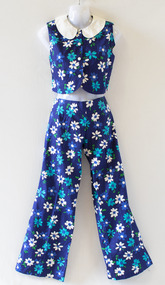
... making swimming costumes using his mother's sewing machine, in between his shifts working at a knitting factory. He had soon set up a small business in his parents' home, cutting patterns in one room while a machinist sewed them together in the next. His company, which he named Watersun, would become an iconic Australian swimwear label. During the early 1960s, Watersun developed its "Unquestionable Bra", an inbuilt moulded bra which was marketed as giving wearers a more natural bustline than other labels. The company was also known for its matching swimwear and beachwear, producing dresses...making swimming costumes using his mother's sewing machine, in between his shifts working at a knitting factory. He had soon set up a small business in his parents' home, cutting patterns in one room while a machinist sewed them together in the next. His company, which he named Watersun, would become an iconic Australian swimwear label. During the early 1960s, Watersun developed its "Unquestionable Bra", an inbuilt moulded bra which was marketed as giving wearers a more natural bustline than other labels. The company was also known for its matching swimwear and beachwear, producing dresses ...Polish-born designer David Waters first began producing swimwear in 1952. His mother Halina had recently opened a stall at Melbourne Queen Victoria Markets and was looking for swimsuits to sell; unable to find any she liked, she asked David to design something. He began making swimming costumes using his mother's sewing machine, in between his shifts working at a knitting factory. He had soon set up a small business in his parents' home, cutting patterns in one room while a machinist sewed them together in the next. His company, which he named Watersun, would become an iconic Australian swimwear label. During the early 1960s, Watersun developed its "Unquestionable Bra", an inbuilt moulded bra which was marketed as giving wearers a more natural bustline than other labels. The company was also known for its matching swimwear and beachwear, producing dresses, kaftans, tops and skirts in identical colours and prints to those used for many of its swimsuits. By 1967, the company was reportedly one of Australia's two biggest swimwear manufacturers, with over one hundred employees. Watersun was sold to Ada Productions in 1984 and was later acquired by Trackerjack Australasia. This piece is believed to be one of a large quantity of samples, seconds and unsold Ada Productions stock donated to Brighton Historical Society in late 1990 by Brian Samuel, who worked at the company between 1979 and 1990.Ensemble consisting of sleeveless crop top (.1) and full length pants (.2). Bold floral print features blue and white flowers on a navy blue background. Top has a white Peter Pan collar. Swing tag attached.Swing tag: "SIZE 34 / STYLE 186/11 / PRICE $13.00".swimwear, watersun, david waters, ada productions, melbourne designers -
 Brighton Historical Society
Doll, Bead doll, c.1937
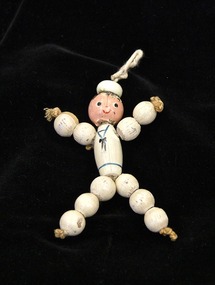
... home, doing work for a factory in Flinders Lane. Using a cotton reel, a threepence and a sixpence she created and embroidered designs on hundreds of blouses. Olga spent her preschool days sitting at the table where her mother worked. Toula would involve Olga by allowing her to help choose the colour combinations. Toula lived with Olga in Brighton until her death in 1976. Olga inherited her mother's sewing skills. She re-invented some of Toula’s trousseau nightdresses and skilfully altered other clothing, making dresses...home, doing work for a factory in Flinders Lane. Using a cotton reel, a threepence and a sixpence she created and embroidered designs on hundreds of blouses. Olga spent her preschool days sitting at the table where her mother worked. Toula would involve Olga by allowing her to help choose the colour combinations. Toula lived with Olga in Brighton until her death in 1976. Olga inherited her mother's sewing skills. She re-invented some of Toula’s trousseau nightdresses and skilfully altered other clothing, making dresses ...Made by the cousin of Brighton local Olga Black. The cousin gave her the doll in 1937, when Olga was around seven years old. Olga Maria Black was born in Melbourne in 1930, the daughter of Ithacan migrants Constantine and Toula Mavrokefalos. Constantine first emigrated to Australia in 1902, returning to Greece circa 1912-13 to serve his home country in the Balkan Wars. Toula's family had left Ithaca for Romania when she was only six months old, but she happened to be visiting the island at the very time that Constantine arrived, fresh from the war. Within three weeks they were married, and when Constantine returned to Melbourne in 1914 his new bride came with him. Constantine had trained as an accountant, but his qualifications were not recognised in Australia. Changing his surname to the Anglicised "Black", he started off working in his older brother Dionysios's cafés before going into business on his own. In 1917 he opened the Paris Residential Café at 54-56 Swanston Street, which offered both dining and accommodation. The business saw some years of success, but did not survive the Great Depression. Constantine died in 1944. Olga's mother Toula learned to sew as a child, while growing up in the Romanian village of Brila. She developed her skills making lace and embroidering items for her trousseau. Some of the linen she embroidered had been woven from flax on Ithaca by her own grandmother, Efstathia. During the Depression, when money was scarce, Toula embroidered at home, doing work for a factory in Flinders Lane. Using a cotton reel, a threepence and a sixpence she created and embroidered designs on hundreds of blouses. Olga spent her preschool days sitting at the table where her mother worked. Toula would involve Olga by allowing her to help choose the colour combinations. Toula lived with Olga in Brighton until her death in 1976. Olga inherited her mother's sewing skills. She re-invented some of Toula’s trousseau nightdresses and skilfully altered other clothing, making dresses which she wore around Brighton for many years.Handmade painted wooden bead doll representing a sailor. Cream coloured body and limbs and pink head. The body is made from one long oval bead and the limbs from small round beads.doll, child's toy, childhood, sailor, olga black -
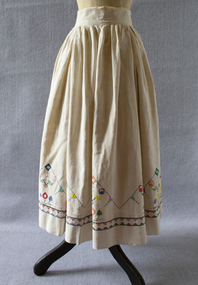 Brighton Historical Society
Skirt, late-nineteenth century & 1950s
... home, doing work for a factory in Flinders Lane. Using a cotton reel, a threepence and a sixpence she created and embroidered designs on hundreds of blouses. Olga spent her preschool days sitting at the table where her mother worked. Toula would involve Olga by allowing her to help choose the colour combinations. Toula lived with Olga in Brighton until her death in 1976. Olga inherited her mother's sewing skills. She re-invented some of Toula’s trousseau nightdresses and skilfully altered other clothing, making dresses...home, doing work for a factory in Flinders Lane. Using a cotton reel, a threepence and a sixpence she created and embroidered designs on hundreds of blouses. Olga spent her preschool days sitting at the table where her mother worked. Toula would involve Olga by allowing her to help choose the colour combinations. Toula lived with Olga in Brighton until her death in 1976. Olga inherited her mother's sewing skills. She re-invented some of Toula’s trousseau nightdresses and skilfully altered other clothing, making dresses ...This skirt belonged to Olga Black, a long-time Brighton resident. The linen used for the skirt were woven by Olga's great-grandmother Efstathia in the late-nineteenth century with flax grown on the island of Ithaca. In the 1950s, Olga made the fabric into a skirt, embellishing it with hand embroidery. Olga Maria Black was born in Melbourne in 1930, the daughter of Ithacan migrants Constantine and Toula Mavrokefalos. Constantine first emigrated to Australia in 1902, returning to Greece circa 1912-13 to serve his home country in the Balkan Wars. Toula's family had left Ithaca for Romania when she was only six months old, but she happened to be visiting the island at the very time that Constantine arrived, fresh from the war. Within three weeks they were married, and when Constantine returned to Melbourne in 1914 his new bride came with him. Constantine had trained as an accountant, but his qualifications were not recognised in Australia. Changing his surname to the Anglicised "Black", he started off working in his older brother Dionysios's cafés before going into business on his own. In 1917 he opened the Paris Residential Café at 54-56 Swanston Street, which offered both dining and accommodation. The business saw some years of success, but did not survive the Great Depression. Constantine died in 1944. Olga's mother Toula learned to sew as a child, while growing up in the Romanian village of Brila. She developed her skills making lace and embroidering items for her trousseau. Some of the linen she embroidered had been woven from flax on Ithaca by her own grandmother, Efstathia. During the Depression, when money was scarce, Toula embroidered at home, doing work for a factory in Flinders Lane. Using a cotton reel, a threepence and a sixpence she created and embroidered designs on hundreds of blouses. Olga spent her preschool days sitting at the table where her mother worked. Toula would involve Olga by allowing her to help choose the colour combinations. Toula lived with Olga in Brighton until her death in 1976. Olga inherited her mother's sewing skills. She re-invented some of Toula’s trousseau nightdresses and skilfully altered other clothing, making dresses which she wore around Brighton for many years.Ankle-length full cream linen skirt with multi-coloured cross stitch embroidery featuring mountains, birds and trees. Fullness is pleated into wide waist band. Left side opening. The fabric widths have been whipped together by hand probably at the time the cloth was woven in the late-nineteenth century. The skirt is machine stitched.skirt, linen, hand woven, embroidery, ithaca, migration, greek diaspora, olga black -
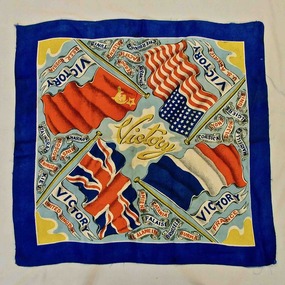 Brighton Historical Society
Scarf, Victory scarf, circa 1945
... home, doing work for a factory in Flinders Lane. Using a cotton reel, a threepence and a sixpence she created and embroidered designs on hundreds of blouses. Olga spent her preschool days sitting at the table where her mother worked. Toula would involve Olga by allowing her to help choose the colour combinations. Toula lived with Olga in Brighton until her death in 1976. Olga inherited her mother's sewing skills. She re-invented some of Toula’s trousseau nightdresses and skilfully altered other clothing, making dresses...home, doing work for a factory in Flinders Lane. Using a cotton reel, a threepence and a sixpence she created and embroidered designs on hundreds of blouses. Olga spent her preschool days sitting at the table where her mother worked. Toula would involve Olga by allowing her to help choose the colour combinations. Toula lived with Olga in Brighton until her death in 1976. Olga inherited her mother's sewing skills. She re-invented some of Toula’s trousseau nightdresses and skilfully altered other clothing, making dresses ...This scarf belonged to Olga Black, a longtime Brighton resident. Olga Maria Black was born in Melbourne in 1930, the daughter of Ithacan migrants Constantine and Toula Mavrokefalos. Constantine first emigrated to Australia in 1902, returning to Greece circa 1912-13 to serve his home country in the Balkan Wars. Toula's family had left Ithaca for Romania when she was only six months old, but she happened to be visiting the island at the very time that Constantine arrived, fresh from the war. Within three weeks they were married, and when Constantine returned to Melbourne in 1914 his new bride came with him. Constantine had trained as an accountant, but his qualifications were not recognised in Australia. Changing his surname to the Anglicised "Black", he started off working in his older brother Dionysios's cafés before going into business on his own. In 1917 he opened the Paris Residential Café at 54-56 Swanston Street, which offered both dining and accommodation. The business saw some years of success, but did not survive the Great Depression. Constantine died in 1944. Olga's mother Toula learned to sew as a child, while growing up in the Romanian village of Brila. She developed her skills making lace and embroidering items for her trousseau. Some of the linen she embroidered had been woven from flax on Ithaca by her own grandmother, Efstathia. During the Depression, when money was scarce, Toula embroidered at home, doing work for a factory in Flinders Lane. Using a cotton reel, a threepence and a sixpence she created and embroidered designs on hundreds of blouses. Olga spent her preschool days sitting at the table where her mother worked. Toula would involve Olga by allowing her to help choose the colour combinations. Toula lived with Olga in Brighton until her death in 1976. Olga inherited her mother's sewing skills. She re-invented some of Toula’s trousseau nightdresses and skilfully altered other clothing, making dresses which she wore around Brighton for many years.Victory scarf with the flags of France, the United Kingdom, USA and the USSR. 'Victory' printed in yellow in the centre surrounded by names of countries and regions.scarf, world war ii, second world war, 1945, olga black -
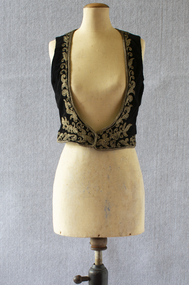 Brighton Historical Society
Waistcoat, 1950s
... home, doing work for a factory in Flinders Lane. Using a cotton reel, a threepence and a sixpence she created and embroidered designs on hundreds of blouses. Olga spent her preschool days sitting at the table where her mother worked. Toula would involve Olga by allowing her to help choose the colour combinations. Toula lived with Olga in Brighton until her death in 1976. Olga inherited her mother's sewing skills. She re-invented some of Toula’s trousseau nightdresses and skilfully altered other clothing, making dresses...home, doing work for a factory in Flinders Lane. Using a cotton reel, a threepence and a sixpence she created and embroidered designs on hundreds of blouses. Olga spent her preschool days sitting at the table where her mother worked. Toula would involve Olga by allowing her to help choose the colour combinations. Toula lived with Olga in Brighton until her death in 1976. Olga inherited her mother's sewing skills. She re-invented some of Toula’s trousseau nightdresses and skilfully altered other clothing, making dresses ...This waistcoat belonged to Olga Black, a long-time Brighton resident. Part of a Greek national costume, it was designed by Olga in the 1950s, with the silver cornelli work completed by a Collins Street workshop. Olga Maria Black was born in Melbourne in 1930, the daughter of Ithacan migrants Constantine and Toula Mavrokefalos. Constantine first emigrated to Australia in 1902, returning to Greece circa 1912-13 to serve his home country in the Balkan Wars. Toula's family had left Ithaca for Romania when she was only six months old, but she happened to be visiting the island at the very time that Constantine arrived, fresh from the war. Within three weeks they were married, and when Constantine returned to Melbourne in 1914 his new bride came with him. Constantine had trained as an accountant, but his qualifications were not recognised in Australia. Changing his surname to the Anglicised "Black", he started off working in his older brother Dionysios's cafés before going into business on his own. In 1917 he opened the Paris Residential Café at 54-56 Swanston Street, which offered both dining and accommodation. The business saw some years of success, but did not survive the Great Depression. Constantine died in 1944. Olga's mother Toula learned to sew as a child, while growing up in the Romanian village of Brila. She developed her skills making lace and embroidering items for her trousseau. Some of the linen she embroidered had been woven from flax on Ithaca by her own grandmother, Efstathia. During the Depression, when money was scarce, Toula embroidered at home, doing work for a factory in Flinders Lane. Using a cotton reel, a threepence and a sixpence she created and embroidered designs on hundreds of blouses. Olga spent her preschool days sitting at the table where her mother worked. Toula would involve Olga by allowing her to help choose the colour combinations. Toula lived with Olga in Brighton until her death in 1976. Olga inherited her mother's sewing skills. She re-invented some of Toula’s trousseau nightdresses and skilfully altered other clothing, making dresses which she wore around Brighton for many years.Black velvet waistcoat, decorated with silver cornelli work. Pale blue cotton lining. Fastens with hooks and eyes.greece, ithaca, migration, olga black -
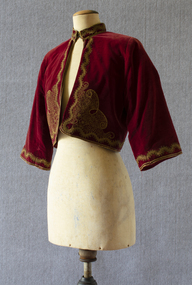 Brighton Historical Society
Jacket, Bolero, c.1948
... home, doing work for a factory in Flinders Lane. Using a cotton reel, a threepence and a sixpence she created and embroidered designs on hundreds of blouses. Olga spent her preschool days sitting at the table where her mother worked. Toula would involve Olga by allowing her to help choose the colour combinations. Toula lived with Olga in Brighton until her death in 1976. Olga inherited her mother's sewing skills. She re-invented some of Toula’s trousseau nightdresses and skilfully altered other clothing, making dresses...home, doing work for a factory in Flinders Lane. Using a cotton reel, a threepence and a sixpence she created and embroidered designs on hundreds of blouses. Olga spent her preschool days sitting at the table where her mother worked. Toula would involve Olga by allowing her to help choose the colour combinations. Toula lived with Olga in Brighton until her death in 1976. Olga inherited her mother's sewing skills. She re-invented some of Toula’s trousseau nightdresses and skilfully altered other clothing, making dresses ...This bolero is part of a Greek national costume from the Peloponnese. Long-time Brighton resident Olga Black wore it to the 1956 Melbourne Olympic Games to represent her Greek heritage. She remembers the stands at the MCG being full of migrants wearing their traditional national costumes. Olga Maria Black was born in Melbourne in 1930, the daughter of Ithacan migrants Constantine and Toula Mavrokefalos. Constantine first emigrated to Australia in 1902, returning to Greece circa 1912-13 to serve his home country in the Balkan Wars. Toula's family had left Ithaca for Romania when she was only six months old, but she happened to be visiting the island at the very time that Constantine arrived, fresh from the war. Within three weeks they were married, and when Constantine returned to Melbourne in 1914 his new bride came with him. Constantine had trained as an accountant, but his qualifications were not recognised in Australia. Changing his surname to the Anglicised "Black", he started off working in his older brother Dionysios's cafés before going into business on his own. In 1917 he opened the Paris Residential Café at 54-56 Swanston Street, which offered both dining and accommodation. The business saw some years of success, but did not survive the Great Depression. Constantine died in 1944. Olga's mother Toula learned to sew as a child, while growing up in the Romanian village of Brila. She developed her skills making lace and embroidering items for her trousseau. Some of the linen she embroidered had been woven from flax on Ithaca by her own grandmother, Efstathia. During the Depression, when money was scarce, Toula embroidered at home, doing work for a factory in Flinders Lane. Using a cotton reel, a threepence and a sixpence she created and embroidered designs on hundreds of blouses. Olga spent her preschool days sitting at the table where her mother worked. Toula would involve Olga by allowing her to help choose the colour combinations. Toula lived with Olga in Brighton until her death in 1976. Olga inherited her mother's sewing skills. She re-invented some of Toula’s trousseau nightdresses and skilfully altered other clothing, making dresses which she wore around Brighton for many years.Red velvet bolero decrated with gold stitching and braid. Lined with red satin. Stand collar which fastens with two metal hooks and eyes. bolero, jacket, greece, ithaca, migration, olympic games, 1956 olympic games, olga black -
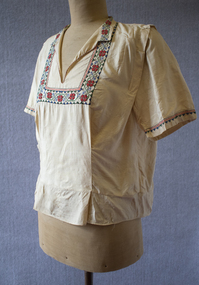 Brighton Historical Society
Blouse
... home, doing work for a factory in Flinders Lane. Using a cotton reel, a threepence and a sixpence she created and embroidered designs on hundreds of blouses. Olga spent her preschool days sitting at the table where her mother worked. Toula would involve Olga by allowing her to help choose the colour combinations. Toula lived with Olga in Brighton until her death in 1976. Olga inherited her mother's sewing skills. She re-invented some of Toula’s trousseau nightdresses and skilfully altered other clothing, making dresses...home, doing work for a factory in Flinders Lane. Using a cotton reel, a threepence and a sixpence she created and embroidered designs on hundreds of blouses. Olga spent her preschool days sitting at the table where her mother worked. Toula would involve Olga by allowing her to help choose the colour combinations. Toula lived with Olga in Brighton until her death in 1976. Olga inherited her mother's sewing skills. She re-invented some of Toula’s trousseau nightdresses and skilfully altered other clothing, making dresses ...Silk blouse made by Toula Mavrokefalos, the mother of long-time Brighton resident Olga Black. Olga Maria Black was born in Melbourne in 1930, the daughter of Ithacan migrants Constantine and Toula Mavrokefalos. Constantine first emigrated to Australia in 1902, returning to Greece circa 1912-13 to serve his home country in the Balkan Wars. Toula's family had left Ithaca for Romania when she was only six months old, but she happened to be visiting the island at the very time that Constantine arrived, fresh from the war. Within three weeks they were married, and when Constantine returned to Melbourne in 1914 his new bride came with him. Constantine had trained as an accountant, but his qualifications were not recognised in Australia. Changing his surname to the Anglicised "Black", he started off working in his older brother Dionysios's cafés before going into business on his own. In 1917 he opened the Paris Residential Café at 54-56 Swanston Street, which offered both dining and accommodation. The business saw some years of success, but did not survive the Great Depression. Constantine died in 1944. Olga's mother Toula learned to sew as a child, while growing up in the Romanian village of Brila. She developed her skills making lace and embroidering items for her trousseau. Some of the linen she embroidered had been woven from flax on Ithaca by her own grandmother, Efstathia. During the Depression, when money was scarce, Toula embroidered at home, doing work for a factory in Flinders Lane. Using a cotton reel, a threepence and a sixpence she created and embroidered designs on hundreds of blouses. Olga spent her preschool days sitting at the table where her mother worked. Toula would involve Olga by allowing her to help choose the colour combinations. Toula lived with Olga in Brighton until her death in 1976. Olga inherited her mother's sewing skills. She re-invented some of Toula’s trousseau nightdresses and skilfully altered other clothing, making dresses which she wore around Brighton for many years.Cream silk short-sleeved blouse. Hand embroidered around inside of stand collar, centre front panel and sleeve edge in red, blue, black and green floral and geometric design.migration, ithaca, romania, olga black, toula mavrokefalos, toula black -
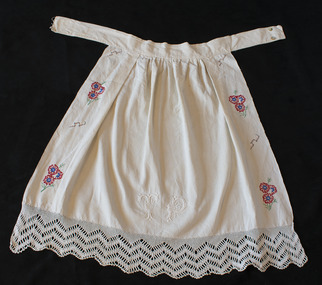 Brighton Historical Society
Apron, circa late 1800s, 1908 and 1950
... home, doing work for a factory in Flinders Lane. Using a cotton reel, a threepence and a sixpence she created and embroidered designs on hundreds of blouses. Olga spent her preschool days sitting at the table where her mother worked. Toula would involve Olga by allowing her to help choose the colour combinations. Toula lived with Olga in Brighton until her death in 1976. Olga inherited her mother's sewing skills. She re-invented some of Toula’s trousseau nightdresses and skilfully altered other clothing, making dresses...home, doing work for a factory in Flinders Lane. Using a cotton reel, a threepence and a sixpence she created and embroidered designs on hundreds of blouses. Olga spent her preschool days sitting at the table where her mother worked. Toula would involve Olga by allowing her to help choose the colour combinations. Toula lived with Olga in Brighton until her death in 1976. Olga inherited her mother's sewing skills. She re-invented some of Toula’s trousseau nightdresses and skilfully altered other clothing, making dresses ...Three generations of women are represented in this apron. The linen used was woven by Olga's great-grandmother Efstathia in the late nineteenth century with flax grown on the island of Ithaca. Olga's mother Toula Raftopoulos added the whitework around 1908 at age 16 - the first piece of lacework she made on her own - and embroidered her initials on the front. Olga embellished the apron with coloured embroidery around 1950 at age 20. Olga Maria Black was born in Melbourne in 1930, the daughter of Ithacan migrants Constantine and Toula Mavrokefalos. Constantine first emigrated to Australia in 1902, returning to Greece circa 1912-13 to serve his home country in the Balkan Wars. Toula's family had left Ithaca for Romania when she was only six months old, but she happened to be visiting the island at the very time that Constantine arrived, fresh from the war. Within three weeks they were married, and when Constantine returned to Melbourne in 1914 his new bride came with him. Constantine had trained as an accountant, but his qualifications were not recognised in Australia. Changing his surname to the Anglicised "Black", he started off working in his older brother Dionysios's cafés before going into business on his own. In 1917 he opened the Paris Residential Café at 54-56 Swanston Street, which offered both dining and accommodation. The business saw some years of success, but did not survive the Great Depression. Constantine died in 1944. Olga's mother Toula learned to sew as a child, while growing up in the Romanian village of Brila. She developed her skills making lace and embroidering items for her trousseau. Some of the linen she embroidered had been woven from flax on Ithaca by her own grandmother, Efstathia. During the Depression, when money was scarce, Toula embroidered at home, doing work for a factory in Flinders Lane. Using a cotton reel, a threepence and a sixpence she created and embroidered designs on hundreds of blouses. Olga spent her preschool days sitting at the table where her mother worked. Toula would involve Olga by allowing her to help choose the colour combinations. Toula lived with Olga in Brighton until her death in 1976. Olga inherited her mother's sewing skills. She re-invented some of Toula’s trousseau nightdresses and skilfully altered other clothing, making dresses which she wore around Brighton for many years.Cream linen embroidered half apron. White lace along hem, along with white embroidered initials, "T.P." Coloured floral and abstract embroidery along sides in red, black, blue and green.olga black, toula raftopoulos, migration, embroidery
