
Showing 51 items matching "dressing gown"
-
 Brighton Historical Society
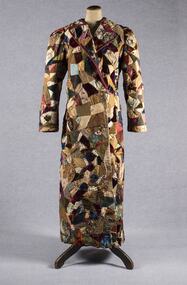
Dressing gown, circa 1880s-1910s
... Dressing gown...Dressing gown...dressing gown...This dressing gown was made from a patchwork quilt begun around the 1880s or 1890s by the daughters of William and Polly Hodgens, owners of the Adelphi Hotel near Montague Station, South Melbourne. ...Crazy patchwork dressing gown made from a patchwork bedspread. ...One of the pieces on the back has an inscription dated 11/7/94 (1894). Dressing gown Dressing gown ...This dressing gown was made from a patchwork quilt begun around the 1880s or 1890s by the daughters of William and Polly Hodgens, owners of the Adelphi Hotel near Montague Station, South Melbourne. The quilt became a communal project, added to over many years by the Hodgens children, relatives, friends and guests. Together, they filled the colourful patchwork with images and figures from their everyday lives, giving us a unique glimpse into the world of early Melbourne.Crazy patchwork dressing gown made from a patchwork bedspread. Made from irregular pieces of silk, satin, velvet and brocades and embellished with embroidered and painted motifs. Fully lined with maroon silk. Neckline trimmed with thick silk cord. Right over left fastening with two large metal press studs. One of the pieces on the back has an inscription dated 11/7/94 (1894).dressing gown, patchwork, embroidery, hand painted -
 Bendigo Historical Society Inc.
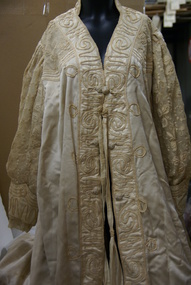
Clothing - LONG SLEEVED FULL LENGTH DRESSING GOWN, Dressing Gown
... LONG SLEEVED FULL LENGTH DRESSING GOWN...Dressing Gown......long sleeved dressing gown...Long sleeved full length dressing gown of cream coloured satin. Front opening with three passementerie buttons at centre front with fabric ties at waist (60cm). ...This gown dated to c. 1910-1910 COSTUME Female long sleeved dressing gown Long sleeved full length dressing gown of cream coloured satin. ...This gown dated to c. 1910-1910Long sleeved full length dressing gown of cream coloured satin. Front opening with three passementerie buttons at centre front with fabric ties at waist (60cm). Ties split into two parts at halfway point Each tie is tied at the end with a thin cord and finished with two tassels with cord covered beads. Garment, including long sleeves, is fully lined with cream coloured satin with decorative stitching pattern.Rounded neckline at back with stand up collar (5cm) decorated with lace. Lace fabric panel across shoulders at front and back. Both sides of front opening have a border (7cm) from shoulder to hem. Neckline dips to V shape above waist. Panels decorated with piping. Front panels lined with cream coloured embroidered lace netting to top button. A different patterned lace lines the top part of the opening panels and extends across the neckline at the back.Two hanging loops attached inside shoulders at top of sleeves. Long sleeves of cream coloured lace fabric with double layer of satin lining. Each sleeve has a panel of decorative fabric from the top of the shoulder to the wrist (same decorative fabric as that used for border of front opening). Satin cuff (12 cm) scalloped edge above wrist. Inside cuff edge of sleeve is lined with lace fabric with a row of pleated net inserted at hemline at wrist. Front inside on LHS has a pocket handstitched to the lining, (30cm X 24 cm). Pocket has decorative pleated ribbon edging.costume, female, long sleeved dressing gown -
 National Wool Museum
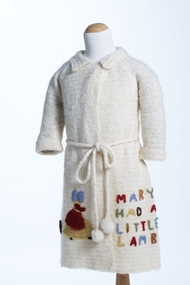
Dressing Gown
... Dressing Gown...Dressing gown crocheted by Joyce Hucker. Detail from crocheted dressing gown by Joyce Hucker. ...Detail from crocheted dressing gown by Joyce Hucker. Dressing Gown ...Crocheted example by Joyce Hucker. Hucker began working with unspun wool and making dyes from the natural sources from her garden and the farm trees around her. From knitting and crocheting articles, she progressed to felting and a 'wrapping' technique, always using unspun wool. She was a successful exhibitor at many craft shows and was always willing to pass on her experience and knowledge to others, often travelling widely to help groups requiring a demonstration.Dressing gown crocheted by Joyce Hucker. Detail from crocheted dressing gown by Joyce Hucker. Detail from crocheted dressing gown by Joyce Hucker.crochet, hucker, mrs joyce -
 Emerald Museum & Nobelius Heritage Park
Clothing - Dressing Gown, 1920s
... Dressing Gown...Dressing Gown - cream colour with embroidered pink and mauve flowers. ...Cross-over style. 1920s. Clothing Dressing Gown ...Dressing Gown - cream colour with embroidered pink and mauve flowers. Cross-over style. 1920s.emerald, victoria, australia, nobelius family, clothing, 1920s -
Emerald Museum & Nobelius Heritage Park
Clothing - Dressing Gown
... Dressing Gown...Pale green satin dressing gown with coffee lace inlay. Tied in front. ...Damaged - torn and stained. Clothing Dressing Gown ...Pale green satin dressing gown with coffee lace inlay. Tied in front. Damaged - torn and stained.emerald, victoria, australia, nobelius family, clothing -
 Whitehorse Historical Society Inc.
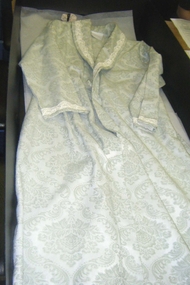
Clothing - Dressing Gown, c 1980's
... Dressing Gown...'Givoni' Green & light grey patterned dressing gown with lace on collar, long sleeves, made of polyester and cotton....Clothing Dressing Gown ...Purchased for the 'Little Shop on the Hill' at Burke Road CamberwellGivoni is one of Australia's largest dressing gown, sleepwear and daywear producers. Givoni was started by Stan and Malca Givoni in 1947. Don Givoni, their son, took over from them and built the company into a major clothing manufacturer with factories based in Victoria. Now owned and managed by a third generation son, the company continues to pride itself in delivering top quality merchandise. The designers at Givoni create beautiful sleepwear and daywear, encompassing classic style, quality, attention to detail and great value for money.'Givoni' Green & light grey patterned dressing gown with lace on collar, long sleeves, made of polyester and cotton.'Givoni'costume, female nightwear, female -
 Mont De Lancey
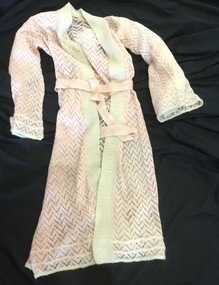
Dressing gown, Myrtle Smith, 1934
... Dressing gown...Pink hand knitted dressing gown. Has whitebands embroidered with floral motifs. ...Formerly of Wonga Park. dressing-gowns nightware Pink hand knitted dressing gown. ...Knitted by Myrtle Smith for her trousseau (1934). Formerly of Wonga Park.Pink hand knitted dressing gown. Has whitebands embroidered with floral motifs. Thin knitted pink belt.dressing-gowns, nightware -
 Brighton Historical Society
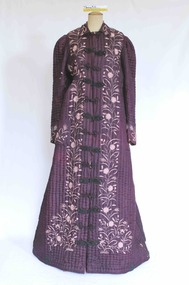
Clothing - Dressing gown, circa 1894
... Dressing gown...This dressing gown belonged to Clara Johnstone Miller (nee Bell, 1866-1910). ...A hand stitched purple pink silk quilted dressing gown with pale pink embroidery from circa 1894. ...This dressing gown belonged to Clara Johnstone Miller (nee Bell, 1866-1910). ...This dressing gown belonged to Clara Johnstone Miller (nee Bell, 1866-1910). Clara was the only daughter of Mr James Bell, a councillor of the Shire of Leigh (today a part of Golden Plains Shire) and owner of Woolbrook Homestead in Teesdale, near Geelong. In 1888, Clara married prominent businessman, racehorse owner, racing identity and pastoralist Septimus Miller (1854-1925). Septimus was the sixth of seven children born to Henry 'Money' Miller and Eliza Miller (nee Mattinson). 'Money' Miller was a well known financier and politician and reputedly one of Australia's wealthiest people in his time. In 1889, Clara and Septimus moved into the house 'Cantala' in Dandenong Road, Caulfield, where they hosted lavish receptions for Melbourne's elite. Clara was known as a stylish hostess who wore elegant imported fashions. This dressing gown is believed to have been manufactured by Japanese silk merchant Shiino Shōbei. Following the opening of the port of Yokohama to foreign trade in 1859, Shōbei began producing western-style silk garments, initially selling them to foreigners living in Japan and later exporting them around the world, even exhibiting at the Melbourne International Exhibition of 1880. His popular exports included quilted 'at-home' gowns or dressing gowns similar to this one. They had one child, Gwendoline Stewart Miller, who died in 1902 at the age of thirteen of diabetes - a largely untreatable condition at the time (insulin would not be discovered until 1921). Clara died in 1910, aged only 44. Septimus subsequently married Helen (nee Henderson), with whom he had a son, Ronald (1915-1990). The Millers were buried in the Brighton General Cemetery in a large Gothic-style vault. Upon Clara's death, Septimus sent much of her clothing and Gwendoline's to her mother Mary Bell. Some of these items were passed down to two of Clara's nieces, Miss Mary Bell and Mrs Lois Lillies, who donated them to BHS around 1973.A hand stitched purple pink silk quilted dressing gown with pale pink embroidery from circa 1894. The dressing gown is embroidered from the collar and shoulders though the centre front body to just above the hemline, on the cuffs and remaining pocket in a pale pink Perle thread embroidery featuring leaves and flowers. The entire gown is hand quilted with vertical parallel lines. The gown's neckline features a flat collar and the sleeve head fits on the neat shoulder line. The sleeve head is gathered and full tapering to a loose flat cuff at the wrist. The front of the garment is currently secured by fourteen decorative frogs of two different styles, none of which appear to be original. There is also evidence of a fifteenth toggle that has been removed from the base. The gown's original left hand pocket has been removed and attached to an area around the right breast presumably to patch a hole or obscure some damage. It is unknown when these modifications have been made. The back of the gown features a gathered pink and black concertina pleated silk insert panel from the neck through to the base of the garment. The garment is lined with a very fine pale pink silk over the woollen batting.clara miller, woolbrook, septimus miller, cantala, gwendoline miller, caulfield, brighton general cemetery, shiino shobei, s. shobey -
Stawell Historical Society Inc
Clothing - Woollen Dressing Gown c1950's
... Woollen Dressing Gown c1950's...Mans Tartan Woollen dressing gown. Fabric designed and woven at Stawell Woollen Mills Colour Blue Violet. ...Brand New - Norwellan Clothing Woollen Dressing Gown c1950's ...North Western Woollen Mills became Norwellan Textiles then AUNDEMans Tartan Woollen dressing gown. Fabric designed and woven at Stawell Woollen Mills Colour Blue Violet. Brand New - Norwellan Norwellan label on insidemanufacture -
 Ararat Gallery TAMA
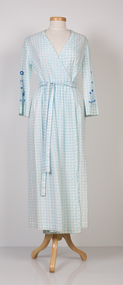
Clothing, Jour et nuit Lingerie, Dressing Gown with Belt
... Dressing Gown with Belt...Excerpt from 'Hot Pink Summers' catalogue essay, Helen Jackson, 1995. Dressing Gown with Belt Clothing Jour et nuit Lingerie ...The Lady Barbara Grimwade Costume Collection is comprised of Lady Barbara Grimwade's personal apparel and includes 145 pieces of clothing, 10 hats, 19 handbags, 66 pairs of shoes and assorted accessories of gloves, belts and scarves. In its breadth, this significant acquisition ranges from the mundane to the memorable, therefore giving a balanced representation of one person's taste. Following Lady Barbara Grimwade’s death in March 1990, Ararat Gallery formally accepted the generous gift of clothing and accessories donated by Lady Grimwade's son, Mr Angus K Grimwade, on 28 August 1991. Subsequent smaller donations in 1995 enhanced the collection. Lady Grimwade's Scottish forebears, the Gaerloch Campbells, first settled in Australia in 1861 in the Ararat-Beaufort district. Her great great grandfather, Mr Henry Campbell, died on the voyage to Australia. His widow, Jane, with 10 of her 13 children, farmed and grazed land, firstly at Stockyard Hill then at Fiery Creek, near Buangor, before leaving the shire in 1873. Lady Grimwade held a privileged position in Melbourne society. As the wife of Sir Andrew Grimwade, a prominent businessman, Chairman of several boards and a Trustee of various committees, Lady Grimwade met with royalty, heads of state, politicians, corporate directors, and horse and cattle breeders. Excerpt from 'Hot Pink Summers' catalogue essay, Helen Jackson, 1995. -
 National Vietnam Veterans Museum (NVVM)
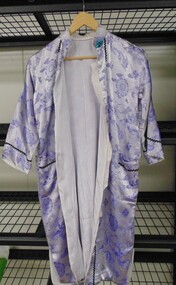
Clothing
... Silk dressing gown...Patterned mauve silk dressing gown lined with white silk. Has embroidered patterns and dark blue rickrack on cuffs, pocket and front openings. ...It contributes to an understanding of the experience of family and friends of those who served in the war in Vietnam. Silk dressing gown Vietnam souvenir gown Vietnamese silk Budd Roger Budd Patterned mauve silk dressing gown lined with white silk. ...This item was purchased in Vietnam by serviceman Roger Budd as a gift. It contributes to an understanding of the experience of family and friends of those who served in the war in Vietnam.Patterned mauve silk dressing gown lined with white silk. Has embroidered patterns and dark blue rickrack on cuffs, pocket and front openings. silk dressing gown, vietnam, souvenir, gown, vietnamese, silk, budd, roger budd -
 National Wool Museum
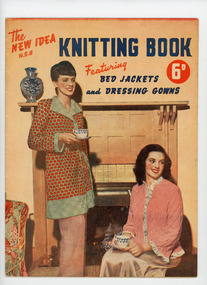
Book, Knitting, The New Idea Knitting Book featuring bed jackets and dressing gowns
... This knitting pattern book was published by The New Idea magazine and contains knitting patterns for womens bed jackets and dressing gowns....The / NEW IDEA / N.S.8 / KNITTING BOOK / Featuring / BED JACKETS / and DRESSING GOWNS / 6D...This knitting pattern book was published by The New Idea magazine and contains knitting patterns for womens bed jackets and dressing gowns. Knitting Handicrafts - history The New Idea Knitting Handicrafts - history The / NEW IDEA / N.S.8 / KNITTING BOOK / Featuring / BED JACKETS / and DRESSING GOWNS / 6D The New Idea Knitting Book featuring bed jackets and dressing gowns Book, Knitting ...This knitting pattern book was published by The New Idea magazine and contains knitting patterns for womens bed jackets and dressing gowns.The / NEW IDEA / N.S.8 / KNITTING BOOK / Featuring / BED JACKETS / and DRESSING GOWNS / 6Dknitting handicrafts - history, the new idea, knitting, handicrafts - history -
 Brighton Historical Society
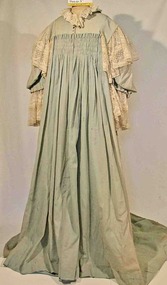
Clothing - Dressing gown, Peignoir, Mid 19th Century
... Dressing gown...Peignoir Clothing Dressing gown unknown ...This peignoir or morning gown is believed to have belonged to Mrs Thomas Anne Ward Cole, an early Brighton resident and wife of George Ward Cole. George Ward Cole was an early member of the Victorian Parliament and the family featured prominently in Melbourne Society in their time. They established a substantial home known as “St Ninians” at 10 Miller Street in 1841. The family reportedly entertained Melbourne’s first Royal visitor the Duke Of Edinburgh, Queen Victoria’s second son, at St Ninians in 1867. In later years St Ninians was subsequently subdivided and later demolished.A mid blue-green cotton and lace peignoir or morning gown, c.1860. The bodice starts at the neck with a clavicle height, rounded neckline with a turn down flat collar, and is finished with a cream lace frill next to the face. The sleeve starts at the natural shoulder line and its overall silhouette is reminiscent of a soft three quarter length imbecile sleeve constructed of four layers of alternating fabrics. At the shoulder, there is a blue-green flap, which crosses across the top and back of the shoulders towards the centre upper back in a 'v' shape. Here it finishes where it meets with the gathered top of the fabric that creates the train. Underneath this shoulder flap is a gathered, long cream frill that finishes just above the elbow. Underneath this frill is the full gathered blue-green sleeve. Finally falling from this a second gathered long cream frill finishes at the three quarter arm. The bodice buttons with five metal buttons from the neckline to just above the bust. Here it meets a heavily gathered front in two pieces, which falls with fullness to the floor. This full section is secured closed at the centre front with four hooks and eyes over the bust and then continues with shell buttons through the remainder of the garment.st ninians, george ward cole, morning gown, peignoir, brighton, thomas anne ward cole, margaret morrison ward cole, agnes bruce ward cole -
 Kew Historical Society Inc
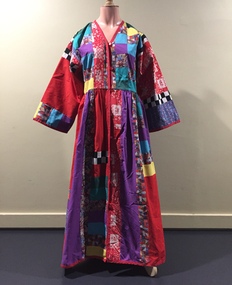
Clothing - Multi-coloured Patchwork Dressing Gown, Grace James, 1987
... Multi-coloured Patchwork Dressing Gown...Clothing Multi-coloured Patchwork Dressing Gown Grace James Grace James ...Grace James, the creator of the items in the Grace James collection, designed and created costumes over a 19 year period (1969-1988) for her daughter Ceri. The collection of clothing ranges from evening wear to knitted garments. All the items display exemplary dressmaking skills. The designs are of the period and reflect evolving fashions of the time. Some items are copies of published designs whereas others are original creations. The collection was donated in 2006.While most of the items in the Fashion & Design Collection of the Kew Historical Society are commercially designed items of clothing, there are also items made by home dressmakers. Many of these exhibit outstanding design knowledge and technical skills. A large and important group of these items of women's clothing is contained in the Grace James collection of outfits created for the dressmaker's daughter. The items have additional significance due to information about the purpose of the creation and the date when it was constructed.Multicoloured patchwork waisted dress featuring a full skirt.grace james, women's clothing, australian fashion 1969-1988, dressmakers - surrey hills (vic), fashion design, fashion -- 1980s -
 Stawell Historical Society Inc
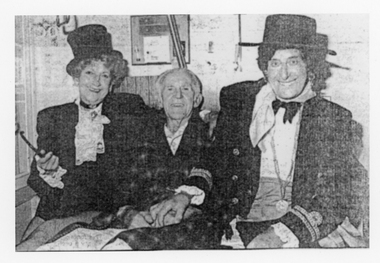
Photograph, Mr. Jim Wharrie with Ruby Wharrie and Lewis van Praagh in fancy dress
... Ruby Wharrie in Fancy Dress with Lewis van Praagh, Jim Wharrie is sitting between Ruby & Lewis in his dressing gown. Taken in 19th May 1982 from "The Heidelgerger" ( Melbourne)....Ruby is dressed in a blazer with a frilled blouse underneath and a bowler hat. Jim is in a dressing gown and Lewis dressed in a blazer with decorative cuffs, a bow tie and a stiff rimmed hat with a medallion & scarf around his neck....Ruby is dressed in a blazer with a frilled blouse underneath and a bowler hat. Jim is in a dressing gown and Lewis dressed in a blazer with decorative cuffs, a bow tie and a stiff rimmed hat with a medallion & scarf around his neck. ...Ruby Wharrie in Fancy Dress with Lewis van Praagh, Jim Wharrie is sitting between Ruby & Lewis in his dressing gown. Taken in 19th May 1982 from "The Heidelgerger" ( Melbourne).Black & white print form a newspaper of Jim & Ruby Wharrie with co performer Lewis van Praagh, aged 86 at the Austin Hospital. Both Jim & Ruby are 80 years of age. Ruby is dressed in a blazer with a frilled blouse underneath and a bowler hat. Jim is in a dressing gown and Lewis dressed in a blazer with decorative cuffs, a bow tie and a stiff rimmed hat with a medallion & scarf around his neck.stawell -
 Musculoskeletal Health Australia (now held by the Glen Eira Historical Society)
Photograph - Group photo, 1992
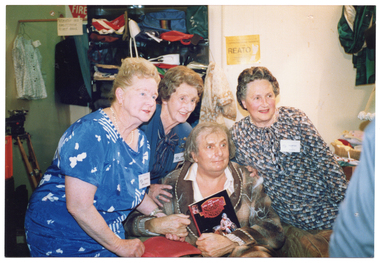
... In this photo, Humphries (dressed in an old brown checked dressing gown) sits on a art deco club lounge armchair, holding his book "The Life and Death of Sandy Stone" (1991). ...COL photo of a elderly man, dressed in an old brown checked dressing gown, sitting on a art deco club lounge armchair in a crowded room. ...In this photo, Humphries (dressed in an old brown checked dressing gown) sits on a art deco club lounge armchair, holding his book "The Life and Death of Sandy Stone" (1991). ...In 1992, internationally renowned Australian satirist, Barry Humphries, visited the Malvern Op Shop as one of his characters, pensioner Sandy Stone. Media crews covered the event. In this photo, Humphries (dressed in an old brown checked dressing gown) sits on a art deco club lounge armchair, holding his book "The Life and Death of Sandy Stone" (1991). He is surrounded by three women, all Arthritis Foundation of Victoria volunteers, as they pose for a photo.COL photo of a elderly man, dressed in an old brown checked dressing gown, sitting on a art deco club lounge armchair in a crowded room. He is surrounded by three middle-aged women, each wearing a name tag that says "Volunteer". He is holding the hand of one of the women with one hand, and a book with his other hand. The book is titled, "The Life and Death of Sandy Stone". In the background, there are miscellaneuous items protruding from a large hanging wall pocket storage organiser, a shirt handing from a rod in the corner, and other miscellaneous items around the room.[Handwritten in thick black ink or pencil] 1/65% [On a yellow sticky note, handwritten in black ink] Barry Humphriesarthritis foundation of victoria, afv, opportunity shop, op shop, charity shop, thrift store, fundraising, barry humphries, satirist, comedian, author, book promotion, sandy stone, pensioner, the life and death of sandy stone, volunteers, malvern, 1992 -
 National Wool Museum
Book, Knitting, Woolworths no. 12 Economy Knit Book
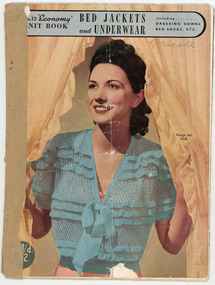
... No. 12 "Economy" / KNIT BOOK / BED JACKETS / and UNDERWEAR / including ... / DRESSING GOWNS / BED SOCKS, ETC. / Design No. / 1928 / 6 1/2d....This book was produced by Woolworths and contains knitting patterns for womens bed jackets, under clothes etc. knitting handicrafts - history woolworths ltd knitting handicrafts - history No. 12 "Economy" / KNIT BOOK / BED JACKETS / and UNDERWEAR / including ... / DRESSING GOWNS / BED SOCKS, ETC. / Design No. / 1928 / 6 1/2d. ...This book was owned by the late Dr Elizabeth Kerr and was donated to the Museum by the executor of her estate, Margaret Cameron. This book was produced by Woolworths and contains knitting patterns for womens bed jackets, under clothes etc.No. 12 "Economy" / KNIT BOOK / BED JACKETS / and UNDERWEAR / including ... / DRESSING GOWNS / BED SOCKS, ETC. / Design No. / 1928 / 6 1/2d.knitting handicrafts - history, woolworths ltd, knitting, handicrafts - history -
 Musculoskeletal Health Australia (now held by the Glen Eira Historical Society)
Photograph - Group photo, 1992
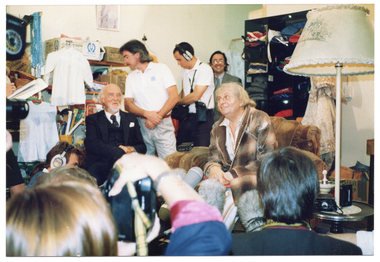
... In this photo, Humphries (dressed in an old brown checked dressing gown as his character, Sandy Stone) sits on a art deco club lounge armchair as he is being interviewed and filmed by the media. ...COL photo of a elderly man, dressed in an old brown checked dressing gown, sitting on a art deco club lounge armchair in a crowded room. ...In this photo, Humphries (dressed in an old brown checked dressing gown as his character, Sandy Stone) sits on a art deco club lounge armchair as he is being interviewed and filmed by the media. ...In 1992, internationally renowned Australian satirist, Barry Humphries, visited the Malvern Op Shop as one of his characters, pensioner Sandy Stone. He was promoting his latest book, "The Life and Death of Sandy Stone". Television media crews covered the event. In this photo, Humphries (dressed in an old brown checked dressing gown as his character, Sandy Stone) sits on a art deco club lounge armchair as he is being interviewed and filmed by the media. Sitting near him is an unidentified man. A small group of people are watching him being interviewed.COL photo of a elderly man, dressed in an old brown checked dressing gown, sitting on a art deco club lounge armchair in a crowded room. He is surrounded by several people, including two television camera operators and a boom microphone operator. Sitting near him is an unidentified man with grey hair and beard, wearing a navy blue three-piece suit. A woman wearing a white shirt and navy blue skirt is standing nearby. In the background, shelves filled with second hand items and cardboard boxes line the walls. In the foreground, several people's heads (Photographed from behind) are evident.[On a yellow sticky note, handwritten in black ink] Op Shop visit by Sandy Stone (Barry Humphries) 1992arthritis foundation of victoria, afv, opportunity shop, op shop, charity shop, thrift store, fundraising, barry humphries, satirist, comedian, author, book promotion, sandy stone, pensioner, the life and death of sandy stone, television crews, television cameras, broadcast television, television media, reporters, interview, malvern, 1992 -
 Musculoskeletal Health Australia (now held by the Glen Eira Historical Society)
Photograph - Group photo, 1992
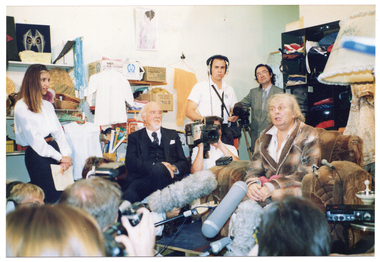
... In this photo, Humphries (dressed in an old brown checked dressing gown as his character, Sandy Stone) sits on an art deco club lounge armchair as he is being interviewed and filmed by the media. ...COL photo of a elderly man, dressed in an old brown checked dressing gown, sitting on a art deco club lounge armchair in a crowded room. ...In this photo, Humphries (dressed in an old brown checked dressing gown as his character, Sandy Stone) sits on an art deco club lounge armchair as he is being interviewed and filmed by the media. ...In 1992, internationally renowned Australian satirist, Barry Humphries, visited the Malvern Op Shop as one of his characters, pensioner Sandy Stone. He was promoting his latest book, "The Life and Death of Sandy Stone". Television media crews were in attendance to cover the event. In this photo, Humphries (dressed in an old brown checked dressing gown as his character, Sandy Stone) sits on an art deco club lounge armchair as he is being interviewed and filmed by the media. Sitting near him is an unidentified man, and standing nearby is an unidentified woman. A small group of people are watching him being interviewed.COL photo of a elderly man, dressed in an old brown checked dressing gown, sitting on a art deco club lounge armchair in a crowded room. He is surrounded by several people, including two television camera operators and a boom microphone operator. Sitting near him is an unidentified man with grey hair and beard, wearing a navy blue three-piece suit. A woman wearing a white shirt and navy blue skirt is standing nearby. In the background, shelves filled with second hand items and cardboard boxes line the walls. In the foreground, several people's heads (Photographed from behind) are evident.[Handwritten in black ink] 1992 Moonee Ponds Op Shop Sandy Stoner [sic] (Barry Humphries)arthritis foundation of victoria, afv, opportunity shop, op shop, charity shop, thrift store, fundraising, barry humphries, satirist, comedian, author, book promotion, sandy stone, pensioner, the life and death of sandy stone, television crews, television cameras, broadcast television, television media, reporters, interview, malvern, 1992 -
 Bendigo Historical Society Inc.
Newspaper - Article from the Bendigo Advertiser - Swimming pools in Bendigo, Sat Nov 26 2017
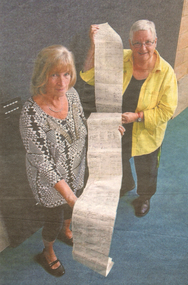
... This document highlights the historical and community significance of swimming pools in Bendigo, focusing on personal stories, community efforts, and social change: Items belonging to Olympic champion Faith Leech, such as her dressing gown and Olympic torch, are displayed to honor her achievements and inspire others. ...Article from the Bendigo Advertiser - Swimming pools in Bendigo Sat Nov 26 2017 Pictures Mark Kearney This item contains the following documents: 3486.53a Kay MacGregor and Vivien Newton hold the original petition from the Golden Square residents 3486.53b Faith Leech's dressing gown is among other belongings from the Olympic champion to go on show 3486.53c Article on swimming pools in Bendigo from the Advertiser...This document highlights the historical and community significance of swimming pools in Bendigo, focusing on personal stories, community efforts, and social change: Items belonging to Olympic champion Faith Leech, such as her dressing gown and Olympic torch, are displayed to honor her achievements and inspire others. ...This document highlights the historical and community significance of swimming pools in Bendigo, focusing on personal stories, community efforts, and social change: Items belonging to Olympic champion Faith Leech, such as her dressing gown and Olympic torch, are displayed to honor her achievements and inspire others. Family members and local historians emphasize the determination and impact of local swimming figures. The push for modern, Olympic-size pools in Bendigo was inspired by the 1956 Olympic Games. While government grants supported pool construction, significant fundraising was done by local residents, who contributed £17,500—a major portion of the total cost. Fundraising was competitive, with community members recognized for their efforts (e.g., being crowned "Queen of the Pool"). Early advocacy for pools began in the 1880s, with Golden Square residents lobbying for their own facility. Golden Square's pool, opened in 1918, was the first in Bendigo to allow mixed-gender swimming. The Bendigo Municipal Pool only permitted mixed bathing after its late 1950s reopening, reflecting broader social changes. Even into the 1920s, women had to request dedicated swimming times for instruction. Learning to swim was vital for safety, especially due to the risk of drowning in mining dams during early settlement. Local newspapers published swimming instructions, and community members shared stories about learning to swim. The document promotes an exhibition and encourages visitors to record their own pool-related memories, which will be shared at a community event called 'Stories from the Pool.'Article from the Bendigo Advertiser - Swimming pools in Bendigo Sat Nov 26 2017 Pictures Mark Kearney This item contains the following documents: 3486.53a Kay MacGregor and Vivien Newton hold the original petition from the Golden Square residents 3486.53b Faith Leech's dressing gown is among other belongings from the Olympic champion to go on show 3486.53c Article on swimming pools in Bendigo from the Advertiserbendigo, swimming pools in bendigo -
 Kilmore Historical Society
Textile - Kimono with matching cap, c1920s
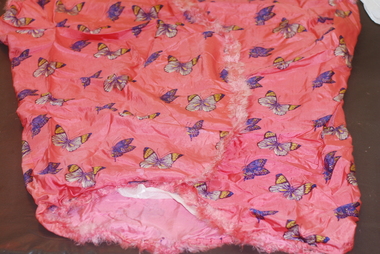
... Pink silk kimono style dressing gown with butterfly pattern & feather trim. ...Turner Collection. nightwear Turner Collection Pink silk kimono style dressing gown with butterfly pattern & feather trim. ...Turner Collection.Pink silk kimono style dressing gown with butterfly pattern & feather trim. Matching cap/bonnet. Feathers shedding and trim detached in places. Small moth holes present in kimono. Good - fair condition. Very fragile.nightwear, turner collection -
 National Wool Museum
Book, Knitting, Patons Knitting Book no. 189
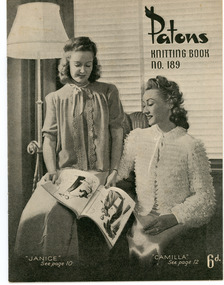
... This book was produced by Patons and Baldwins and contains knitting patterns for womens dressing gowns, bed jackets and under garments....This book was produced by Patons and Baldwins and contains knitting patterns for womens dressing gowns, bed jackets and under garments. knitting handicrafts - history patons and baldwins (australia) ltd knitting handicrafts - history Patons / KNITTING BOOK / NO. 189 / "JANICE" / See page 10 / "CAMILLA" / See page 12 / 6d. ...This book was owned by the late Dr Elizabeth Kerr and was donated to the Museum by the executor of her estate, Margaret Cameron. This book was produced by Patons and Baldwins and contains knitting patterns for womens dressing gowns, bed jackets and under garments.Patons / KNITTING BOOK / NO. 189 / "JANICE" / See page 10 / "CAMILLA" / See page 12 / 6d.knitting handicrafts - history, patons and baldwins (australia) ltd, knitting, handicrafts - history -
 Wodonga & District Historical Society Inc
Uniform - Wodonga High School Sport Uniform, 1960s
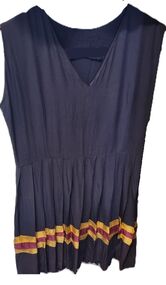
... It was worn with a coloured dressing gown cord depending on which Sports House the student represented....It was worn with a coloured dressing gown cord depending on which Sports House the student represented. ...Post primary education in Wodonga began in 1923 when the existing primary school, which opened in 1857, became the Wodonga Central School. It extended students for a further 2 years of secondary schooling. In 1938 the school was declared a higher elementary school with 90 students in the secondary classes. Following rapid growth after the Second World War, the High School was established as a separate school in 1954 with 249 students and the primary students were relocated to premises in Ariel Street. However it rapidly became evident that a new school building needed to be established to cater for growing enrolments and specialist facilities. After persistent pressure from the Advisory Council, Stage 1 of the new school was built and occupied by Form 1 and 2 students in 1960. The final stages were completed during term 3, 1962. The official opening of the new Wodonga High School was declared by The Hon. J. S. Bloomfield M.L.A., Minister for Education, on Friday 30th April 1965. This sport tunic was worn by female students in the 1960s.This uniform is significant because it documents the evolution of accepted styles of girls' uniform at Wodonga High School.Wodonga High School Girls' Sports tunic. Waisted with v neck bodice and pleated skirt. A stripe in maroon and gold stripe of 6 centimetres width placed 16 centimetres above the hemline. It was worn with a coloured dressing gown cord depending on which Sports House the student represented.wodonga high school, secondary education wodonga -
 Federation University Historical Collection
Photograph - Photograph - Black and White, Laura Ritchie and Sarah Wright at 214 Armstrong (Nth) Street, Ballarat, late 1920's
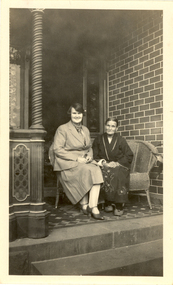
... The older woman is wearing a dressing gown and slippers and the younger woman is wearing a light coloured suit. ...The older woman is wearing a dressing gown and slippers and the younger woman is wearing a light coloured suit. ...Sarah Wright was married to a gold miner named William. They lived at Laura Villa, Smeaton. Their family won many singing and instrumental awards. Frank Wright their son was born and attended Smeaton State School and was a renown resident of Smeaton. Frank was tutored by Percy Code and was awarded a gold medal for the highest marks in the ALCM examinations in the British Colonies at the age of seventeen years. He became the Australian Open Cornet Champion by the age of eighteen. A year later, Frank conducted the City of Ballarat Band, and later the Ballarat Soldiers’ Memorial Band. He formed the Frank Wright Frisco Band and Frank Wright and his Coliseum Orchestra. These bands won many South Street awards, and Frank as conductor won many awards in the Australian Band Championship contest. In 1933 Frank Wright sailed to England to conduct the famous St Hilda’s Band and was later appointed Musical Director of the London County Council, where he organized many amazing concerts in parks, in and around the London district. He was made Professor of Brass and Military Band Scoring and conducted at the Guildhall of Music and Drama. Frank was often invited to adjudicate Brass Band Championships around Europe, in Australia, including South Street and in New Zealand. The Frank Wright Medal at the Royal South Street competition is awarded to an individual recognized as making an outstanding contribution to brass music in Australia. Laura Ritchie was his sister and lived in Ballarat with her family. A black and white photo of two women sitting on a wicker couch on the verandah of a brick house. The older woman is wearing a dressing gown and slippers and the younger woman is wearing a light coloured suit. The women are Sarah Wright and her daughter Laura Ritchie. The house is Laura's home at 214 Armstrong Street Nth, BallaratWritten in pencil 214 Armstrong St Nth, Laura and Sarah Wrightsarah wright, laura ritchie, frank wright, cornet, ballarat -
 Returned Nurses RSL Sub-branch
Newspaper - Newspaper lift out, The Weekend Australian et al, 100 years of War Nursing : ANZAC Day Special, 19990424
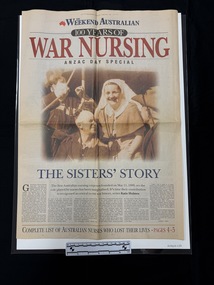
... Front cover has large headings and a large sepia toned photo featuring a woman in nurses uniform with men in dressing gowns around her. The lift out is made up of two pieces of paper folded to make 8 pages of articles....Front cover has large headings and a large sepia toned photo featuring a woman in nurses uniform with men in dressing gowns around her. The lift out is made up of two pieces of paper folded to make 8 pages of articles. 100 years of War Nursing : ANZAC Day Special Newspaper Newspaper lift out The Weekend Australian Katie Holmes Jan Bassett Catherine Kenny Siobhan McHugh Ken Inglis Denis Gibbons David Sproule Michael Visontay ...The Weekend Australian lift out from ANZAC Day 1999. Contains article titles as follows: 'The Sisters' story' by Katie Holmes - p1 - Beginning of an article talking about the circumstances of nurses in warfare, duties, conditions, etc. Continued on p8 'Private battles' by Jan Bassett - p2 - Article gives a brief overview of how armed forces nursing services were formed, why and how they developed, including major players such as Nellie Gould and Grace Wilson. '100 years of service, dedication' - p2 - Timeline of armed forces nursing services. 'Wild dogs and 13 patients' by Jan Bassett - p2 - Edited extract from recollections of Julia Anderson who served as a nurse in the Boer War. 'A pioneer called Nellie' by Jan Bassett - p2 - Brief biographical article on Nellie Gould. 'Into the mess' by Jan Bassett - p3 - Article on the conditions faced by WWI nurses serving overseas including memories of various nurses. 'Tragedy made more personal' by Jan Bassett - p3 - Brief biographical article on Grace Wilson. 'The old ship is heaven after the peninsula' - p3 - Edited excerpt from WWI diary of Ella Jane Tucker. 'In Memoriam' - p4-5 - Names of nurses who have died as a result of war service from Boer war to Vietnam war. 'Hell of Banka' by Catherine Kenny - p6 - Article providing basic details on the sinking of the Vyner Brooke, massacre on Banka Island, survival of Vivian Bullwinkel and later surrender to Japanese. 'A will to remember' by Catherine Kenny - p6 - Article providing overview of stories shared by surviving Japanese POW nurses including Betty Jeffrey, Wilma Young (neé Oram), Jessie Hookway (neé Simons), Pat Darling (neé Gunther), Vivian Bullwinkel, Lorna Johnson (neé Whyte), and Mavis Cation (neé Cullen). Article also discussed artistic representations of the stories on stage and screen. 'Making do to survive' by Jessie Simons - p6 - Reprinted excerpt from book by same author 'Japanese Hands Australian Nurses as POWs'. 'Grim miracles' by Siobhan McHugh - p7 - Article on experiences of nurses in the Vietnam war including Colleen Mealy, Anne Hall, Trish Ferguson, Jan McCarthy, Del Waterman, Terrie Roach and Anne Healy. 'Anyone's blood was welcome' by Siobhan McHugh - p7 - Brief article of the working conditions of civilian nurses in Vietnam during the war, including recollections of Jenny James, Fran Sardelich and Kay Collett (radiographer not nurse). 'A long day's journey' - p7 - Brief interview article with Del Waterman an RAAF Nurse who served in Malaysia during the Vietnam war. 'Attitudes changes in the face of suffering' by Siobhan McHugh - p7 - Brief interview article with Anne Hall on her time as an army nurse during the Vietnam war. 'Neglected heroes' by Ken Inglis - p8 - An article on war memorial recognition or lack of for nurses throughout history of memorials in Australia, how some were recognised and others not and how attitudes have changed over time. '100 years of service, skill and sacrifice' by Katie Holmes - p8 - Continuation of article on p1. 'Sisters in arms' - p8 - Box insert of numbers of military nurses who served in major conflicts from Boer - Gulf wars.A large newspaper lift out with text in red, blue and black. Front cover has large headings and a large sepia toned photo featuring a woman in nurses uniform with men in dressing gowns around her. The lift out is made up of two pieces of paper folded to make 8 pages of articles.nursing in warfare, anzac day, memorial -
 Returned Nurses RSL Sub-branch
Newspaper - Newspaper lift out, The Weekend Australian et al, 100 years of War Nursing : ANZAC Day Special, 19990424
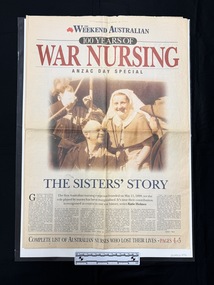
... Front cover has large headings and a large sepia toned photo featuring a woman in nurses uniform with men in dressing gowns around her. The lift out is made up of two pieces of paper folded to make 8 pages of articles....Front cover has large headings and a large sepia toned photo featuring a woman in nurses uniform with men in dressing gowns around her. The lift out is made up of two pieces of paper folded to make 8 pages of articles. 100 years of War Nursing : ANZAC Day Special Newspaper Newspaper lift out The Weekend Australian Katie Holmes Jan Bassett Catherine Kenny Siobhan McHugh Ken Inglis Denis Gibbons David Sproule Michael Visontay ...The Weekend Australian lift out from ANZAC Day 1999. Contains article titles as follows: 'The Sisters' story' by Katie Holmes - p1 - Beginning of an article talking about the circumstances of nurses in warfare, duties, conditions, etc. Continued on p8 'Private battles' by Jan Bassett - p2 - Article gives a brief overview of how armed forces nursing services were formed, why and how they developed, including major players such as Nellie Gould and Grace Wilson. '100 years of service, dedication' - p2 - Timeline of armed forces nursing services. 'Wild dogs and 13 patients' by Jan Bassett - p2 - Edited extract from recollections of Julia Anderson who served as a nurse in the Boer War. 'A pioneer called Nellie' by Jan Bassett - p2 - Brief biographical article on Nellie Gould. 'Into the mess' by Jan Bassett - p3 - Article on the conditions faced by WWI nurses serving overseas including memories of various nurses. 'Tragedy made more personal' by Jan Bassett - p3 - Brief biographical article on Grace Wilson. 'The old ship is heaven after the peninsula' - p3 - Edited excerpt from WWI diary of Ella Jane Tucker. 'In Memoriam' - p4-5 - Names of nurses who have died as a result of war service from Boer war to Vietnam war. 'Hell of Banka' by Catherine Kenny - p6 - Article providing basic details on the sinking of the Vyner Brooke, massacre on Banka Island, survival of Vivian Bullwinkel and later surrender to Japanese. 'A will to remember' by Catherine Kenny - p6 - Article providing overview of stories shared by surviving Japanese POW nurses including Betty Jeffrey, Wilma Young (neé Oram), Jessie Hookway (neé Simons), Pat Darling (neé Gunther), Vivian Bullwinkel, Lorna Johnson (neé Whyte), and Mavis Cation (neé Cullen). Article also discussed artistic representations of the stories on stage and screen. 'Making do to survive' by Jessie Simons - p6 - Reprinted excerpt from book by same author 'Japanese Hands Australian Nurses as POWs'. 'Grim miracles' by Siobhan McHugh - p7 - Article on experiences of nurses in the Vietnam war including Colleen Mealy, Anne Hall, Trish Ferguson, Jan McCarthy, Del Waterman, Terrie Roach and Anne Healy. 'Anyone's blood was welcome' by Siobhan McHugh - p7 - Brief article of the working conditions of civilian nurses in Vietnam during the war, including recollections of Jenny James, Fran Sardelich and Kay Collett (radiographer not nurse). 'A long day's journey' - p7 - Brief interview article with Del Waterman an RAAF Nurse who served in Malaysia during the Vietnam war. 'Attitudes changes in the face of suffering' by Siobhan McHugh - p7 - Brief interview article with Anne Hall on her time as an army nurse during the Vietnam war. 'Neglected heroes' by Ken Inglis - p8 - An article on war memorial recognition or lack of for nurses throughout history of memorials in Australia, how some were recognised and others not and how attitudes have changed over time. '100 years of service, skill and sacrifice' by Katie Holmes - p8 - Continuation of article on p1. 'Sisters in arms' - p8 - Box insert of numbers of military nurses who served in major conflicts from Boer - Gulf wars.A large newspaper lift out with text in red, blue and black. Front cover has large headings and a large sepia toned photo featuring a woman in nurses uniform with men in dressing gowns around her. The lift out is made up of two pieces of paper folded to make 8 pages of articles.nursing in warfare, anzac day, memorial -
 Federation University Historical Collection
Photograph - Photograph - black and white, Sarah Wright and family, 1928?
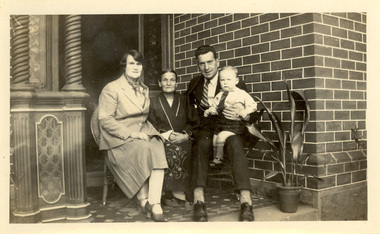
... As Sarah is in her dressing gown and slippers these photos could refer to a note on an envelope left by Frank which says 'Mother taken on the first day up out of bed - at Lauls on 13th May 1928'. ...The woman is wearing a dressing gown and slippers. The man is Frank Wright and the woman is Sarah Wright, his mother. .2) black and white photograph of a woman sitting on a wicker armchair with a pillow behind her back. ...The woman is wearing a dressing gown and slippers. The man is Frank Wright and the woman is Sarah Wright, his mother. .2) black and white photograph of a woman sitting on a wicker armchair with a pillow behind her back. ...Frank Wright was a renown resident of Smeaton, where he was born. He lived at Laura Villa, and attended Smeaton State School. His father William was a gold miner and his mother's name was Sarah. Their family won many singing and instrumental awards. Frank was tutored by Percy Code and became the Australian Open Cornet Champion by the age of eighteen. A year later, Frank conducted the City of Ballarat Band, and later the Ballarat Soldiers’ Memorial Band. He formed the Frank Wright Frisco Band and Frank Wright and his Coliseum Orchestra. These bands won many South Street awards, and Frank as conductor won many awards in the Australian Band Championship contest. In 1933 Frank Wright sailed to England to conduct the famous St Hilda’s Band and was later appointed Musical Director of the London County Council, where he organized many amazing concerts in parks, in and around the London district. He was made Professor of Brass and Military Band Scoring and conducted at the Guildhall of Music and Drama. Frank was often invited to adjudicate Brass Band Championships around Europe, in Australia, including South Street and in New Zealand. The Frank Wright Medal at the Royal South Street competition is awarded to an individual recognized as making an outstanding contribution to brass music in Australia. As Sarah is in her dressing gown and slippers these photos could refer to a note on an envelope left by Frank which says 'Mother taken on the first day up out of bed - at Lauls on 13th May 1928'. .1) black and white photograph of a man and a woman sitting on a wicker chair which is on a tessellated floor of the front porch of a brick building. The woman is wearing a dressing gown and slippers. The man is Frank Wright and the woman is Sarah Wright, his mother. .2) black and white photograph of a woman sitting on a wicker armchair with a pillow behind her back. The chair is on a tessellated floor on the front porch of a brick building. The woman is Sarah Wright. .3) black and white photograph of a man, two women and a child sitting on a wicker chair which is on a tessellated floor on the front porch of a brick building. The man is Frank Wright and the older woman is his mother Sarah Wright. The younger woman is his sister Laura and her son, Frank Ritchie is sitting on Frank's lap.On the left hand side of the porch are ornate columns and on the right hand side is a potted plant.frank wright, sarah wright, laura wright, tessilated floor, wicker chair, ornate column, child -
 Bendigo Military Museum
Photograph - PHOTOGRAPH, BENNETTS, c.1947
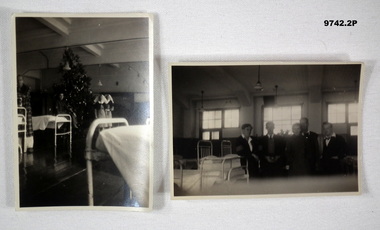
... Black and white photograph featuring two nurses in uniform and a soldier in uniform. A patient in dressing gown is standing on left of photograph. ...Black and white photograph featuring two nurses in uniform and a soldier in uniform. A patient in dressing gown is standing on left of photograph. ...Photographs taken in the 130 Australian General Hospital, which arrived in Japan on 10 March 1946. It was established on the island of Eta Jima where Alva Bennetts served. Part of the Bennetts Collection. See Cat 9726P for details of service for Alva Marie Bennetts.1. Black and white photograph featuring two nurses in uniform and a soldier in uniform. A patient in dressing gown is standing on left of photograph. Hospital beds in foreground and a decorated Christmas tree is in the background. Photo has a white border. 2. Black and white photograph of a group of five people standing in a hospital ward. Hospital beds visible. Photo has a white border.bennetts collection, alva bennetts, bcof, 130 australian general hospital -
 National Wool Museum
Quilt
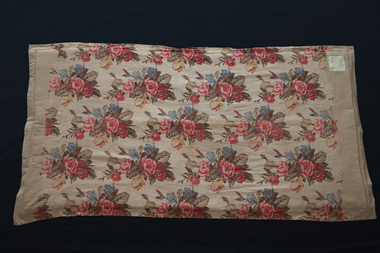
... She was noted for her quilt making and also made items such as dressing gowns. She exhibited at many country shows and with the Queensland Country Women's Association. ...She was noted for her quilt making and also made items such as dressing gowns. She exhibited at many country shows and with the Queensland Country Women's Association. ...The quilt was made by Ada Maud Allen, the grandmother of the donor. Mrs Allen was from a Queensland wool growing property and was a prolific wool quilter. She was noted for her quilt making and also made items such as dressing gowns. She exhibited at many country shows and with the Queensland Country Women's Association. The wool used in the quilt was from her own property. The quilt was made in the 1930s and subsequently used by Mrs Allen's children, grandchildren and great-grandchildren.Wool quilt made by Ada Maud Allen, c.1930s. Detail of woollen quilt made by Ada Maud Allen, c.1930s. The woollen contents of the quilt and aspects of its construction can be seen. Conservation report and treatment proposals prepared by Abigail Hart, Textile Conservation, 19-1-01, for quilts 430 and 4053. Conservation treatment proposal prepared by Abigail Hart, Textile Conservation, 19-4-2001, for quilt 430. Report on the conservation treatment undertaken on the quilt by Abigail Hart, textile conservator. Country Women's Association pamphlet 'Use More Wool' Letter to Miss Ruth Lane, 30 November 1991 Letter to Mrs Allen from Margaret Travill, 22 March 1934 Letter to Mrs Allen from S.J. Rayment, 23 March 1934 Letter to Mrs Allen from E. Maitham, 21 April 1934, page 1 Letter to Mrs Allen from E. Maitham, 21 April 1934 page 2 Instructions on making woollen quilts page 1 Instructions on making woollen quilts page 2 Allen family photos from Queensland Museum page 1 - stud lambs Allen family photos from Queensland Museum page 5 - 'Nalemba', Sept. 1918 Allen family photos from Queensland Museum page 2 - at 'Stanbroke', early 1942 Allen family photos from Queensland Museum page 3 - 'Stanbroke', 1936 Allen family photos from Queensland Museum page 4 - Mr Marsh, Shearing Contractor Allen family photos from Queensland Museum page 6 - Mrs A. M. Allen c.1937 with grandson Allen Photos taken before conservation treatment March 2002quilting handicrafts, allen, mrs ada maud, quilting, handicrafts -
 Sunbury Family History and Heritage Society Inc.
Photograph
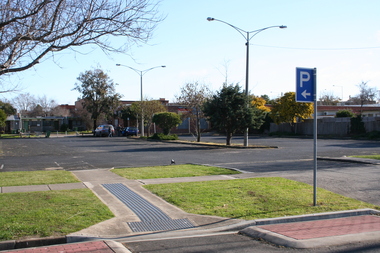
... From 1946 - 48, the business was known as Angee Clothing, which produced gloves, slippers and dressing gowns. In 1949, the site was taken over by Yakka, where work clothes were made. ...From 1946 - 48, the business was known as Angee Clothing, which produced gloves, slippers and dressing gowns. In 1949, the site was taken over by Yakka, where work clothes were made. ...The carpark is in Barkly Street, behind the O'Shanassy Shopping strip. In the 1940s-1950s, a former textile factory occupied the site. The factory was housed in an ex-army hut and many of Sunbury's women were employed there. From 1946 - 48, the business was known as Angee Clothing, which produced gloves, slippers and dressing gowns. In 1949, the site was taken over by Yakka, where work clothes were made. As the business expanded it moved to Broadmeadows in a large modern factory.While the factory was in Sunbury, it provided employment for a lot of the local women.A coloured photograph of an off-street carpark behind a shopping complex. Two cars are parked in the area and a nature strip with a parking sign in the foreground.yakka factory, barkly street, angee clothing, sunbury
