
Showing 154 items matching "drying green"
-
 Merbein District Historical Society
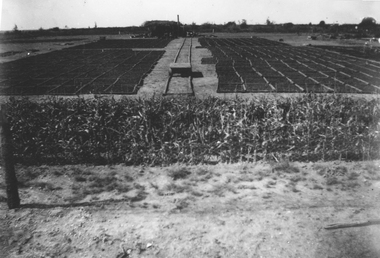
Photograph - Drying green on early Merbein vineyard
... Drying green on early Merbein vineyard...Drying green on early Merbein vineyard......drying green...Drying green on early Merbein vineyard Photograph Drying green on early Merbein vineyard ...Reproduced black and white photo.grapes, dried fruit, hot dip, merbein, block, drying green, harvest, summer, trolley -
 Merbein District Historical Society
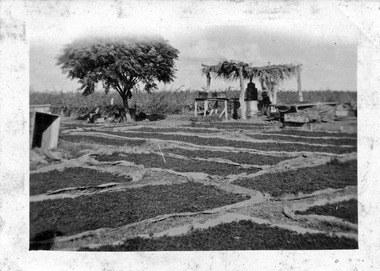
Photograph, Drying Green, unknown
... Drying Green...Grape Block Drying Green Photograph ...grape block -
 Merbein District Historical Society
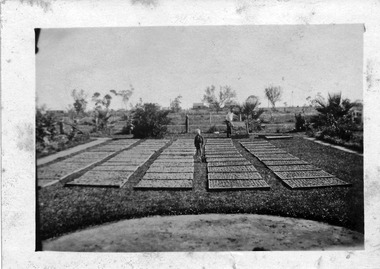
Photograph, Drying Green, unknown
... Drying Green...Grape Block Drying Green Photograph ...grape block -
 Federation University Art Collection
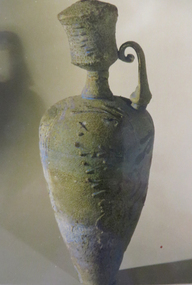
Ceramic, Dry Glaze Bottle by Alan Peascod, c1980
... Blue and green dry glaze bottle. ...They bought works from visiting lecturers who became leading ceramic artists around the world, as well as from many of the staff who taught there. alan peascod ceramics gippsland jan feder memorial ceramics collection gippsland campus visiting artist Blue and green dry glaze bottle. Dry Glaze Bottle by Alan Peascod Ceramic ...Alan PEASCOD (1943-2007). Born England. Arrived Australia 1952. Alan Peascod was one of Australia’s most highly acclaimed ceramic artists. For over 35 years his work has been at the forefront of the Australian ceramics movement, developing radical techniques previously unexplored with his developments in unusual glazes and firing methods. His creative repertoire includes dry glazed vessels, alkaline glazes, majolica, saturated metals, and many post firing finishes. Alan's work with the very difficult reduced lustre technique is highly regarded. He was taught the method by Professor Said El Sadr in Cairo, Egypt in 1972 and this led to lifelong research of the technique throughout the Middle East and Europe. His work in the field led to the completion of his doctoral studies at the University of Wollongong in 1994. This study also led to satirical figurative sculpture themes dealing with the human condition. This work is part of the Jan Feder Memorial Ceramics Collection. Jan Feder was an alumna of the Gippsland Campus who studied ceramics on the campus. She passed away in the mid 1980s. Her student peers raised funds to buy ceramic works in her memory. They bought works from visiting lecturers who became leading ceramic artists around the world, as well as from many of the staff who taught there.Blue and green dry glaze bottle. alan peascod, ceramics, gippsland, jan feder memorial ceramics collection, gippsland campus, visiting artist -
 Mont De Lancey
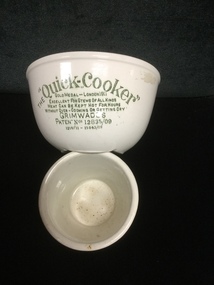
Cooking pot
... Meat will keep hot for hours without overcooking and getting dry. White/green....Meat will keep hot for hours without overcooking and getting dry. White/green. Cooking pot Grimwades Ltd. ...Quick cooker used for stews. Meat will keep hot for hours without overcooking and getting dry. White/green.Patent no. 12835/09cooking equipment, cooking pots -
 Federation University Historical Collection
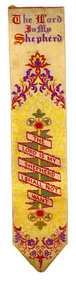
Accessory - Bookmark, Adam And Charles Black, The English Lakes and Religious Bookmark, 1949
... Palmer. .2) Woven silk bookmark with white (now cream) and yellow background and red, purple, green and yellow detail and the start of Psalm 23 woven into the bookmark. Possibly made in the late nineteenth century. .3) Small card with dried flowers glued with the words Flowers from the Holy Land .4) WW2 photograph of the bust of a man in uniform with a cap. ...Palmer. .2) Woven silk bookmark with white (now cream) and yellow background and red, purple, green and yellow detail and the start of Psalm 23 woven into the bookmark. Possibly made in the late nineteenth century. .3) Small card with dried flowers glued with the words Flowers from the Holy Land .4) WW2 photograph of the bust of a man in uniform with a cap. ...This bookmark was found in a book called 'The English Lakes' owned by Elizabeth Chatham-Holmes. The bookmark is a Stevenograph. In 1854 Thomas Stevens began with weaving plain and fancy ribbons, but was soon experimenting with a development of jacquard weaving to produce pictures. For this, the picture was plotted on squared paper, in the fashion of a cross-stitch embroidery design, and a large card then perforated to represent each colour appearing in every "line" of the picture. The cards, arranged in an endless chain and attached to the loom, controlled the manipulation of the warp threads. Each time the shuttle crossed the loom a different card came into use, changing the arrangement of the warp threads and, consequently, the pattern woven..When the industry collapsed in 1860, Stevens determined to make use of his experiments by producing pictures in such variety as to appeal to all tastes. The earliest productions seem to have been bookmarkers... The pictures included portraits of celebrities and local scenes, scriptural texts, hymns and psalms, and verses from the poets. Stevens also introduced to the Admiralty a hat ribbon with the name of the ship woven in gold wire. This he patented; it was adopted and for many years the firm was the sole supplier to the Admiralty Contracts Department. https://stevengraphs.com/thomstevandh.html Also found in the book was a small card with dried flowers glued with the words 'Flowers from the Holy Land' and a WW2 photograph of the bust of a man in uniform with a cap..1) Red hard covered book called 'The English Lakes' by W.T. Palmer. .2) Woven silk bookmark with white (now cream) and yellow background and red, purple, green and yellow detail and the start of Psalm 23 woven into the bookmark. Possibly made in the late nineteenth century. .3) Small card with dried flowers glued with the words Flowers from the Holy Land .4) WW2 photograph of the bust of a man in uniform with a cap. .1) Inside front cover "E.S. Holmes Ascot" .2) Woven into the bookmark - The Lord is my Shepard I shall not want, & T. Stevens, Coventry .3) Printed on the front - Flowers from the Holy Land, Placed on the Holy Sepulchreholmes, ec holmes, ascot, religious, religion, bookmark, english lakes, w.t. palmer, chatham-holmes collection, flowers from the the holy land, stevengraph -
 The Beechworth Burke Museum
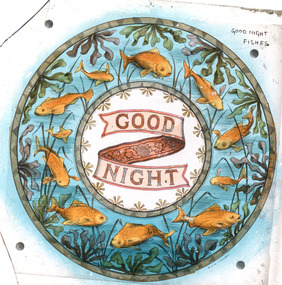
Photograph - Lantern Slide, c1900
... dry plate and Woodburytype techniques. Lantern slides and magic lantern technologies are seen as foundational precursors to the development of modern photography and film-making techniques This glass slide is significant because it provides insight into early photographic and film-making technology in use in regional Victoria during the late 1800s and early 1900s. Burke Museum Beechworth Lantern Slide Slide Glass Slide Plate Burke Museum Collection Photograph Monochrome fish hand-painted good night 1900s Thin translucent sheet of glass with a circular image printed on the front and hand-painted in shades of orange, red, blue, and green ...A hand-painted slide from c.1900 depicting a circular image of 11 goldfish swimming around the words 'Good Night'. Lantern slides, sometimes called 'magic lantern' slides, are glass plates on which an image has been secured for the purpose of projection. Glass slides were etched or hand-painted for this purpose from the Eighteenth Century but the process became more popular and accessible to the public with the development of photographic-emulsion slides used with a 'Magic Lantern' device in the mid-Nineteenth Century. Photographic lantern slides comprise a double-negative emulsion layer (forming a positive image) between thin glass plates that are bound together. A number of processes existed to form and bind the emulsion layer to the base plate, including the albumen, wet plate collodion, gelatine dry plate and Woodburytype techniques. Lantern slides and magic lantern technologies are seen as foundational precursors to the development of modern photography and film-making techniquesThis glass slide is significant because it provides insight into early photographic and film-making technology in use in regional Victoria during the late 1800s and early 1900s.Thin translucent sheet of glass with a circular image printed on the front and hand-painted in shades of orange, red, blue, and green.burke museum, beechworth, lantern slide, slide, glass slide, plate, burke museum collection, photograph, monochrome, fish, hand-painted, good night, 1900s -
 Frankston RSL Sub Branch
Webbing, Belt, No maker discernible, Unknown
... Towards the end of World War II, some 37 Webbing was produced in jungle green for troops fighting in the Pacific Theatre, although purpose-made 44 Pattern Webbing was then introduced for the humid jungle conditions, being lighter in weight, quicker drying, and rot-proofed.[ Although 44 Pattern continued in use with the British Army for jungle warfare in its various post-World War II colonial conflicts, it did not replace 37 Pattern in general service, which was in use up until the introduction of 58 Pattern. ...Towards the end of World War II, some 37 Webbing was produced in jungle green for troops fighting in the Pacific Theatre, although purpose-made 44 Pattern Webbing was then introduced for the humid jungle conditions, being lighter in weight, quicker drying, and rot-proofed.[ Although 44 Pattern continued in use with the British Army for jungle warfare in its various post-World War II colonial conflicts, it did not replace 37 Pattern in general service, which was in use up until the introduction of 58 Pattern. ...Used with dress uniform for ceremonious purposes.An example of the standard issue webbing belt used by Australian service personnel. The name "Bretterecker" and the number 360053, (possibly a post World War 2 service number) is written in black ink on the inside surface of the belt. The belt has been "blackened" for ceremonial use and has brass fittings, the 2 angled buckles normally located on the rear of the belt have been removed. The 1937 pattern equipment (also known as '37 webbing') was an item of military load-carrying equipment. Pattern 37 replaced the 1908 Pattern and 1925 Pattern—on which it was based—and was standard issue for British and Commonwealth troops from its introduction in 1937, throughout World War II, and in the post-war period until it was superseded by 58 pattern webbing. The design was confirmed on 8 June 1938 and wide-scale issue began in 1939. Towards the end of World War II, some 37 Webbing was produced in jungle green for troops fighting in the Pacific Theatre, although purpose-made 44 Pattern Webbing was then introduced for the humid jungle conditions, being lighter in weight, quicker drying, and rot-proofed.[ Although 44 Pattern continued in use with the British Army for jungle warfare in its various post-World War II colonial conflicts, it did not replace 37 Pattern in general service, which was in use up until the introduction of 58 Pattern. However, 37 Pattern was used for ceremonial purposes and still issued to Cadets in the 1990s. 1937 Pattern Webbing was made from cotton webbing, which was waterproofed and dyed before being woven. The fittings were made of stamped brass and it was produced by various manufacturers.Written in black ink on the inside "Bretterecker" and the number 360053, possibly a post World War 2 service number.webbing belt, dress webbing -
Federation University Historical Collection
Document, Zelda Martin, Central Victorian Goldmining towns - Boom Towns or Ghost Towns?, c1996
... *Three articles published by Buninyong and District Historical Society Inc: (Magpie Exploration; Finding Gold In The Green Hills; Magpie Exploration; Burnt Bridge to Cargarie to Mt Mercer) *Copies of newspaper articles/items *Buninyong Street Directory Carisbrook: *In the Beginning There Was Carisbrook *The History of the Carisbrook Racecourse Carngham / Snake Valley: *Brief History *Directory Castlemaine: *Directory 1865-1866 - Alphabetical and Street *Poster - Castlemaine A Contemporary Guide "The Great Centre" 1866 - A Contemporary Guide to the Fascinating Past *Pamphlet - Castlemaine District Community Hospital *Map - Castlemaine, Maldon & Surrounding Districts *Map and Information - The Dry Diggings Track - a 55kl walk among historic goldfields relics ( Castlemaine Fryerstown Vaughan Mt Franklin Hepburn Daylesford) *Postcard - Former Court House *Directory 1867 - Alphabetical, Trade [.10] Resource No.3 Grey folder Titled Towns 3 Creswick to Maryborough Creswick: *Brief History *Booklet - "Creswick Cemetery Walk" *Booklet - The Buried Rivers of Gold Heritage Trail Creswick *Creswick Historical Museum Information Sheet *Chronological History of Creswick *Alphabetical Directory of the Borough of Creswick *Creswick's Creek Directory 1856 *Historic Creswick Walking Tour *A Brief Account of the Schools of Creswick - Past and Present *100 Years of Railway Travel in Creswick *The Berry Deep Leads *The Spence Home at Jackass Gully in the Creswick State Forest ( William Guthrie Spence - Pioneer) *The New Australian Mine and the 1882 Disaster *Creswick District News, Issue 7, July August 1999 *The Creswick Miners Walk - Information and Map *Maps Chewton: *Brief History *Directory Clunes: *Brief History *Clunes Street Directory Daylesford: *Brief History *Notable Bushfires in Daylesford District Over More Than a Century - "Black Thursday" 1851; 1862; 1899; the Disastrous Hepburn Fire of 1906; 1939; 1944; 1969. ...*Three articles published by Buninyong and District Historical Society Inc: (Magpie Exploration; Finding Gold In The Green Hills; Magpie Exploration; Burnt Bridge to Cargarie to Mt Mercer) *Copies of newspaper articles/items *Buninyong Street Directory Carisbrook: *In the Beginning There Was Carisbrook *The History of the Carisbrook Racecourse Carngham / Snake Valley: *Brief History *Directory Castlemaine: *Directory 1865-1866 - Alphabetical and Street *Poster - Castlemaine A Contemporary Guide "The Great Centre" 1866 - A Contemporary Guide to the Fascinating Past *Pamphlet - Castlemaine District Community Hospital *Map - Castlemaine, Maldon & Surrounding Districts *Map and Information - The Dry Diggings Track - a 55kl walk among historic goldfields relics ( Castlemaine Fryerstown Vaughan Mt Franklin Hepburn Daylesford) *Postcard - Former Court House *Directory 1867 - Alphabetical, Trade [.10] Resource No.3 Grey folder Titled Towns 3 Creswick to Maryborough Creswick: *Brief History *Booklet - "Creswick Cemetery Walk" *Booklet - The Buried Rivers of Gold Heritage Trail Creswick *Creswick Historical Museum Information Sheet *Chronological History of Creswick *Alphabetical Directory of the Borough of Creswick *Creswick's Creek Directory 1856 *Historic Creswick Walking Tour *A Brief Account of the Schools of Creswick - Past and Present *100 Years of Railway Travel in Creswick *The Berry Deep Leads *The Spence Home at Jackass Gully in the Creswick State Forest ( William Guthrie Spence - Pioneer) *The New Australian Mine and the 1882 Disaster *Creswick District News, Issue 7, July August 1999 *The Creswick Miners Walk - Information and Map *Maps Chewton: *Brief History *Directory Clunes: *Brief History *Clunes Street Directory Daylesford: *Brief History *Notable Bushfires in Daylesford District Over More Than a Century - "Black Thursday" 1851; 1862; 1899; the Disastrous Hepburn Fire of 1906; 1939; 1944; 1969. ...Zelda Martin was a PhD candidate at the University of Melbourne.[.1] 4th item in light blue display book titled Research Approach/Overview of Chapters/Confirmation of Canditure/Chapters1,2,3&4 of proposed thesis. *Twenty-seven page article on Victorian goldfields towns titled: Central Victorian Goldmining Towns - Boom Towns or Ghost Towns. The article was written during the author's PhD study. It outlines the context methodology, and resources and the chapters of the proposed thesis: (1) Central Victorian Goldmining Towns - The Context (2) Contemporary Views of the Factors Necessary for Town Growth (3) Outward Manifestations of Town Growth (4) The Trappings of Government (5-9) The Main Towns and Their Hinterland. [.2] 5th item in Light Blue display book as above item. *Chapter 1 of proposed thesis titled 'Pick, Shovel and Tin Dish Mining.' Covers in Section A: Central Victoria - Pre 1851: Aborigines in Central Victoria, Squatters, and Government. Section B: The years 1851-1854: The Early Gold Rushes, Government Reaction, Township Surveys, Legislation, Town Development, Local Government and Early Settlement. [.3] 6th item in Light Blue display book as above item. *2A of proposed thesis titled 'Contemporary Views of the Factors Necessary for Town Growth'. Similar information to Chapter 1 plus extra re towns and maps. Sections: Introduction, Context of Place - Geographical Towns Listed, The Context of Time - Pre1851 Aborigines, Governance of Port Phillip, The Squatters, The Villages of Central Victorian Highlands, Conclusion, Condensed Version of Chapter2B. [.4] 7th item in Light Blue display book as above item. *Chapter2B of proposed thesis. Sections: Area of Research, Schools, Banks, Newspapers, Progress Association, Town Development - Sandhurst (Bendigo), Ballarat, Castlemaine,, Maryborough, Ararat and Stawell. [.5] 8th item in Light Blue display book as above item. *Chapter 3 of proposed thesis titled 'Outward Manifestations of Town Growth'. Sections: Introduction, Contemporary Writing, Educationalists, The Bankers, The Townsfolk, Current Theory, General Theories of Urban Development, and Conclusion. [.6] 9th item in Light Blue display book as above item. *Chapter 4 of proposed thesis titled 'Trappings of Government' Sections: Introduction, Early Government Attitudes to Mining and Town Development, Law and Order, Township Surveys, Legislation, Local Government, Transport and Communication, The People and Lobbyists. [.7] 10th item in Light Blue display book as above item. *'The Rise and Fall of Central Victorian Goldmining Towns'. Includes a map showing main Goldfields, a table showing towns and villages at two points in time - 1857 and 1871; a Bibliography of Primary and Secondary Sources. [.8] Resource No1. Black display book titled Local Towns 1 : Alma: *Brief history *Directory *Maps Amphitheatre / Mountain Hut: *Brief History Post Office Directory Ararat: *Brief History *Post Office Directory 1869 - Alphabetical Listing by Occupation *Ararat - Prominent Citizens of 1858 *Langi-Morgala Museum Avoca: *Brief History *Excerpts from 'Avoca The Early Years', Margery and Betty Beavis; pg1 - Beginnings; pg11 - The Midas Touch; pg25 - Local Gold Escorts; pg27 - A Town is Born; pg51- The Administration of Justice; pg53 - The Ways of the Law; pg61 - News of the Day; pg65 - A Time to Play; pg72 - Land Ownership *Post Office Directory (Bailliere's) 1869 *Tourism Map and Information of area *Historic Avoca - A 5.5km Tour *Avoca & the Pyrenees Region - information pamphlet Ballarat: *Early History of Ballarat - Ballarat Historical Society, Publication No.1: origin of the name; Ballaarat - the Beginning; Fabulous Yields from the Ballaarat Goldfield; *Streetscape Lydiard Street. *Hand drawn map showing Leigh River, Old Portland Bay Road, plaque on road to Colac; etc. *Newspaper article re 'The Theatre Royal' ( which stood in the vicinity of the current Owen Williams store) - 'The News'15/04/1998 *Article - 'Ballarat's Mechanics' Institute Lives On' Ballarat Courier, 14/09/1985 *Article - Standing the Test of Time' The News 17/11/1993 re The Mechanics Institute & picture of the Reading Room *'Ballarat a Study of a City, Phyllis Reichl, pub. Nelson, 1968; no.3 place, time and people field studies series *Investigator Vol.33 No.2, 1998 Geelong Historical Society. Article on pg75 describes Ballarat in 1861 *Folded poster - 'Ballarat 100' a history of telegraph communication, pub. Telecom. Beaufort (Fiery Creek): *Brief history *Post Office Directory [.9] Resource No.2 Black Folder Titled Towns cont.No2 Bendigo (Sandhurst): *'Family & Local History at the Bendigo Library - 1851-2001 150 years of gold'. *Bendigo Government Camp in 1853 illustration; key to sketch and names of Government officers stationed there *Excerpts from 'Bendigo and Vicinity' Adolph Haman *The Bendigo Goldfield Registry - pgs 1-7 Introduction *Excerpt: 'Breaking the Grip' *Excerpt: The Most Go-Ahead Place *Excerpts from 'History of Bendigo' - anti license agitation; laying out of town; proposed railway; gold calls and dividends; the Sandhurst Municipality; journalism *Bibliography Blackwood: *Excerpts from 'Aspects of Early Blackwood - The Goldfield, the Landmarks, the Pioneers' Alan J Buckingham and Margaret F Hitchcock, JG Publishing,1980 Buninyong: *A Brief History *Investigator Vol1 No.2 Feb 1966 Geelong Historical Society. Pg3 - Article re gold escort route - Mt Alexander to Adelaide - (see a simple monument on the Western Highway a few miles out of Horsham. Pg 15 - Ballarat Excursion - re the finding of gold. *Three articles published by Buninyong and District Historical Society Inc: (Magpie Exploration; Finding Gold In The Green Hills; Magpie Exploration; Burnt Bridge to Cargarie to Mt Mercer) *Copies of newspaper articles/items *Buninyong Street Directory Carisbrook: *In the Beginning There Was Carisbrook *The History of the Carisbrook Racecourse Carngham / Snake Valley: *Brief History *Directory Castlemaine: *Directory 1865-1866 - Alphabetical and Street *Poster - Castlemaine A Contemporary Guide "The Great Centre" 1866 - A Contemporary Guide to the Fascinating Past *Pamphlet - Castlemaine District Community Hospital *Map - Castlemaine, Maldon & Surrounding Districts *Map and Information - The Dry Diggings Track - a 55kl walk among historic goldfields relics ( Castlemaine Fryerstown Vaughan Mt Franklin Hepburn Daylesford) *Postcard - Former Court House *Directory 1867 - Alphabetical, Trade [.10] Resource No.3 Grey folder Titled Towns 3 Creswick to Maryborough Creswick: *Brief History *Booklet - "Creswick Cemetery Walk" *Booklet - The Buried Rivers of Gold Heritage Trail Creswick *Creswick Historical Museum Information Sheet *Chronological History of Creswick *Alphabetical Directory of the Borough of Creswick *Creswick's Creek Directory 1856 *Historic Creswick Walking Tour *A Brief Account of the Schools of Creswick - Past and Present *100 Years of Railway Travel in Creswick *The Berry Deep Leads *The Spence Home at Jackass Gully in the Creswick State Forest ( William Guthrie Spence - Pioneer) *The New Australian Mine and the 1882 Disaster *Creswick District News, Issue 7, July August 1999 *The Creswick Miners Walk - Information and Map *Maps Chewton: *Brief History *Directory Clunes: *Brief History *Clunes Street Directory Daylesford: *Brief History *Notable Bushfires in Daylesford District Over More Than a Century - "Black Thursday" 1851; 1862; 1899; the Disastrous Hepburn Fire of 1906; 1939; 1944; 1969. *Post Office Directory -Daylesford and Hepburn Dunolly / Inkerman: *Brief History *Directory *Pamphlet - Goldfields Historical Museum *Pamphlet - Historic Dunolly - Victoria's Best Kept Secret *Map of Gold Workings at Dunolly Area - showing where the main gold rushes occurred *Brief History - Inglewood *Directory - Inglewood - Name Occupation, Dwelling Kingower: *Brief History *Directory - Name / Ocupation / Dwelling Linton / Happy Valley / Piggoreet: *Brief History *Directory - Lintons McIvor: *"A History of the Shire and the Township of Heathcote" by J.O. Randell Majorca: *Brief History *Official Post Office Directory 1869 - Name / Occupation/ Address Maldon (Tarrangower): *Brief History Part 1 *Brief History Part 2 *Post Office Directory *List - Alphabetical Order by Names plus Business and Trade (Tarrangower Times Oct/1858) *List - Alphabetical Order by Trade plus Name and Business *Directory - Name / Occupation / Dwelling Maryborough: *Worsley Cottage - built by Arthur Worsley, a contractor in stonework in 1894 [.11] Resource No. 4 Blue Display Book titled Towns 4 Moliagul to Stawell Moliagul: *Brief History *Moligul Legislative Assembly (Voting?) List - Names and Occupations *Moliagul Victorian Post Office Directory 1868 - Name / Ocupation / Address / Comments *"The Welcome Stranger" gold nugget *The Sunday School *The Welcome Stranger Discovery Walk - information and map Moonambel (Mountain Creek) Redbank *Brief History *List of names extracted from advertisments of the Pioneer and Mountain Creek Advertiser 16/02/1861. *Bailliere's Directory 1869 - Alphabetical List of Name / Occupation / Place St Arnaud: *Brief History Sebastapol: *Brief History *Directory 1869 - Alphabetical by Name; plus occupation and address. Browns and Scarsdale: *Brief History *Browns Street Directory - Name and Occupation Smythesdale: *Brief Description *Smythesdale Street Directory -Name and Occupation Stawell (Pleasant Creek) *Brief History *Victorian Official Post Office Directory - Name /Occupation / Dwelling *Chronology - 1841-1920 *Production of gold statistics - 1879 - 1900 *Big Hill *Extracts from "The Golden Years of Stawell". Chapt 1 - Stawell's Coming Out. Capt. 2 - The Gold Rush. Caapt.3 - Cradle of Democracy. Chapt.4 - The Reefs Becomes Stawell. Chapt. 5 - Rushing In. Chapt.6 - The Pioneers. Chapt 7 - The Decade of Optimism. [.12] Resource No. 5: Blue Display Book titled 'Towns Steiglitz to the The Golden Triangle. Steiglitz: Brief History Victorian Post Office Directory 1869 *Map of Steiglitz *List of maps relevant to Steiglitz history *Information 6 tables of data from "Reports of Mining Surveyors Talbot (Back Creek) Brief History Taradale: Post office Directory 1869 - Name/Occupation/Street. Also list in alphabetical order by Occupation Taradale *Chronological Reference to Taradale Mines *Water - The Coliban System of Waterworks *Joseph Brady *The Syphon Tarnagulla (Sandy Creek) *Brief History *Tarnagulla Businessmen Cameos to give depth to advertisments in 'The Tarnagulla Courier' various issues 1864-1871 *Directory - Name/Occupation /Address *List - Name/Business/Trade Wedderburn (Koorong) *Brief History *List - Name/Occupation The Golden Triangle: *The Early Rushes - Wedderburn / Moliagul / Sandy Creek - Tarnagulla / Jones Creek - Waanyarra / Kingower / Dunolly - Goldsborough / Inglweood *Census of 1857 - Population / Occupations *1858-1871 - A Time of Consolidation- Wedderburn / Moliagul / Sandy Creek- Tarnagulla / Arnold *Census 1871 - Population *Information gleaned from the census data - Demographics / Population / Occupations / marital / Birthplace / Religion / Literacy/ Occupation and Housing Cameos *Graphs - Birthplace of settlers /Male-Female Ratio / Married males / Children under 15 as Percentage of Population / Religion *Census 1857 - Statistical data *Maps *Bibliography [.13] Resource No. 6 - Black Display Book Information and Research in Central Victoria including: *Banking - Research from ANZ Bank Archives *Institutions - also includes articles listed from the Ballarat Times Newspaper *Australian mining History Association - A.M.H.A. Bibliography *Australia's Mining History * Bibliography - Land Surveys Victoria - *1853 Administration (Statistics and Other) includes: schools / ministers of religion / police / military / local administration / licences for sale of spirits / distances between various Victorian gold fields. * Victoria Government Gazette (Copy) - N0. 116, 12/12/1854 includes: Gold Felds Commission of Enquiry & No. 85, 15/09/1854 - Addresses presented to the Lieutenant Governor (Sir Charles Hotham) during his tour through the Gold Fields of Victoria,1854. Addresses on behalf of : the people of Bendigo; Members of the Church of England, Bendigo; Members of the Wesleyan Church on the Bendigo Gold Fields; Bendigo Gold District General Hospital; the Bendigo Prospecting Association; Committee of the Bendigo Local Exhibition; Bendigo District Medical Association; Coloured Americans Resident at Bendigo; German Inhabitants of Bendigo; Landowners, Inhabitants, and Miners of Castlemaine; Inhabitants of Forest Creek; Inhabitants of Heathcote and Gold Miners of McIvor; Residents and landholders of the District of Bacchus Marsh; Inhabitants of Kilmore and Vicinity. *Gold Fields Correspondence 1853: letter from Lieutenant Colonel Valiant, (Officer commanding the Troops in Victoria) to the Lieutenant Governor re threatened disturbance at Sandhurst (Bendigo) regarding the Gold License Fee. * Extracts from a book "Victoria" re Gold Fields Commission of Enquiry involving mainly Ballarat and Castlemaine and a chapter titled 'A Tour to the Victorian Gold-Fields' *Lists of central Victorian newspapers - listed by date published 1851to 1874; by first date available to State Library. *A list of cities and towns showing County, population in 1861 &1871, and municipal status. [.14] Resource no.7. Black display book. *Reference: Papers presented to Parliament Victoria - 1859-1860 4 volumes - relevant sections copied. Contains information on Branches of Government. General / Finance / Gold / Gazette / Commission and Warrant / Statistic. *Gold Fields Act. In accordance with the Act the gold fields are divided into six districts - Ballaarat, Castlemaine , Sandhurst, Avoca, Ararat, and Beechworth.. Official staff in each gold district consists of a Resident Warden, Wardens, Wardens' Clerks, Bailiffs, Chinese Protectors, Chinese Interpreters, and Mining Surveyors. *Gold Receiver *Gaols *Police magistrates and Clerks of Petty Sessions, etc. *Field Branch *Immigration and Emigration Overland - Chinese - 1859 *Population on the Goldfields *The Geological Survey - The Government Geologist is assisited by staff from four branches - the office Branch; the Publishing Branch; the Field Branch and the Museum Branch. *Commission to Enquire Into Sludge dated 10/02/1859 (Some sections copied) - Report to the Honorable Chief Commissioner of Public Works, Melbourne re the mode of carrying the sludge from the puddling mills in Sandhurst without interfering with the drainage of the town and the roads in the neighbourhood. [.15] Resource No.8: Camel display book titled Resource No. 8. Aborigines *Lists of book titles - +"Readings in Victorian prehistory" +"The Aborigines of Port Phillip" +Aboriginal languages and clans" +"A History of the Port Phillip District" +"Langi Ghiran 1: Aboriginal Rock...." +"Koorie History: sources for aboriginal studies in the State Library of Victoria", ed. Tom Griffiths, Melb. Friends of the State Library, 1989 +"The Public Lands of Australia Felix"; settlement and land appraisal in Victoria1834-91 with special reference to the Western Plains", J.M.Powell, Melb. Oxford University Press 1970 +*Bibliography of the Victorian Aborigines' from the earliest manuscripts to 31st December 1970, Massoa, Aldo, Melb. Hawthorn Press, 1971 +"Aborigines in Colonial Victoria, 1836-1886", M.F. Christie, Sydney University Press, 1979 +"Urban and Industrial Australia: readings in Human Geography" ed J.M. Powell, Melb. Sorrett Pub. 1974 *Extracts: -Processes of Pioneer Settlement - The Squatting Occupation of Victoria, 1834-60. J.M. Powell -Areal Variations in the Class Structure of the Central-Place Hierarchy. P. Scott - Volume1 and Volume 2: Notes Relating to the Habits of the Natives of Other Parts of Australia and Tasmania. Compiled from various sources for the Government of Victoria by R Brough Smyth. John Curry, O'Neil, Melb. 1st pub. Melb. 1876. p31-45 - Numbers and Distribution of the Aborigines in Victoria -Victorian Aborigines 1835-1901 - A Resource Guide to the Holdings of the Public Record Office, Victoria; published by the Government Information Centre 1984. *History of the Aboriginal Artefacts Displayed in the Daylesford Museum. F. G. Powell (4 page pamphlet) *Letter to Zelda Martin from Peter Lovett, Cultural Officer, Ballarat & District Aboriginal Co- Operative, 05/02/1997 *Map: Ian Clarke Victorian Tribunal Boundary Map - Clans of Central Victoria. *Victorian Rock Art and Mythology - Article about Mount Langhi Ghiran and myths of the Tjapwarong people. *Two Aboriginal myths relating to the Grampians - 'The Monster Emu' / 'The Aquisition of Fire', by the Aborigines in the Grampians Areas *Article titled (chapter 8) Ballarat - information re camping sites in the region. Lake Wendouree / Lake Burrumbeet (includes a myth) / Mt Bunninyong / Lal Lal / Pitfield / Mount Elephant / Mount Egerton / Meredith / Lake Goldsmith / Lake Learmonth / Ercildoune *Notes on the Aborigines of the Wider Ballarat Region plus European names=Aboriginal names. John Morris 26/07/1995 *Role of Aborigines in Town Development in Central Victoria. Mentions Native Police Force est. in Port Phillip 1842 and Central Board for Aborigines est. 1860 *The Grave of King Billy. (Frank Wilson) Pamphlet. *Camping Places in Central and Northern Victoria. Article re Lake Burrumbeet site. *Programme for the Unveiling of Memorial Cairn for Edward Stone Parker 1802-1865. Note portrait not accurate. Accurate portrait is available in the book "A Successful Failure A Trilogy The Aborigines and Early Settlers", Edgar Morrison, Graffiti Publications, 2002. * Large envelope addressed to Mr G Netherway containing newspaper cuttings regarding the life of Edward Stone Parker, the unveiling of the Memorial Cairn as mentioned above, articles titled 'Episodes from Our Early Days' (Edgar Morrison, Yandoit)- The Black's School, A School At Last and The Final years. Also a typed page titled 'Historical Background to E.S.Parker's Career. Includes an interesting tale titled 'When the cat lay doggo' re laying power leads for the unveiling ceremony at the memorial site. [.16] green display folder titled 'Research Aids' *List of references to Commissioners' & W'ardens' Reports (formerly held at La Trobe Library Archives, now at Public Records Office [PRO]). Indicates town referred to / date of report / name of camp if different to town. * Archive information re Anglican Records *Movement around the Goldfields - Miners and Storekeepers - usefulness of newspapers in providing information - areas covered - Castlemaine, Maldon, Ararat, Stawell, Tarnagulla, Dunolly. *Port Phillip /Victoria Directories 1839/1867 - Chronological list of Directories included in this series. *"Notes on the History of Local Government in Victoria" A.W. Greig Melb. University Press 1925 - Photo-copied extract p5-p40. (Source - Deakin University Library) - Introduction by W.Harrison Moore. Section 1 - Development in New South Wales Before Separation. Section 2 - Development in Victoria After Its Separation from New South Wales. Hand written notations: 'roads, markets, and local government 1855 on' ;'opportunity of squatters in parliament' and 'opportunities of matters in parliament p33' * Notes on the Establishment of Surveyor General's Department 1851and Commissioner of Crown Lands and Survey. * Newspaper articles from The Argus, 1849, re the discovery of gold in the Pyrenees region. * Excerpt - a report on schools - A.B.Orlebar, Inspector; re the need for permanent school buildings rather than tents. *Excerpt from - 'Approaches to Urban History', Sean Glynn: The Case for Caution * Except from - 'The Urban Sprinkle', Weston Bate: Country Towns and Australian Regional History *Reference- 'The History of Land Tenure in the Colony of Victoria', John Quick. References the Haines Land Bill, land tenure and Land Leagues. [.17] Light blue envelope folder titled 'Birtchnell's Ballarat, etc. Directory 1862 *Contains various directories for Smythesdale, Buninyong, Clunes, Brown's and Creswick. [.18] Red envelope folder no.2 titled Victorian Gazetteer *Selected pages from 1869 Victorian Gazetteer on A4 paper (with a handwritten note questioning if some pages are from 1868 Victorian Gazetteer as appears to be different sizes - A3 pages.) Information includes locations and descriptions of towns, hotels, banks, communications and populations. (Does not include names, residences and occupations) [.19] Red Envelope folder titled Bailliere's Official Post Office Directory 1868 (or1869 or a mixture of both?) *Preface *Contains a selection of pages of towns highlighted in yellow in the the index *Work on this directory was commenced in 1867. *Information includes: Municipalities - mayors and councilors; lists of towns naming male inhabitants and their occupations. [.20]Yellow manila folder titled Post Grad Seminar Presentation 1996 *Gives some background to Zelda Martin's proposed thesis and why she chose the topic Gold Mining Towns Boom or Bust [.21] A3 display book - No. 1A * A list of 'Relevant Newspapers collected: The Tarrangower Times and Maldon Advertiser (first published 1858) Includes dates 1858-1867. The Mount Alexander Mail. Includes dates 1854-1866 The Tarnagulla Courier. Includes dates from1864-1871 Dunolly and Burnt Creek Express. Includes dates from 1862-1871 * Selection of newspaper pages from The Mount Alexander Mail 1854 to 1856, mostly showing advertisements for businesses and services provided to that community. [.22] A3 display book - No. 1B * Selection of newspaper pages from The Mount Alexander Mail 1857 to 1866, mostly showing advertisements for businesses and services provided to that community. [.23] A3 display book -No. 2 * Selection of newspaper pages from The Tarnagulla Courier 1864 to 1871, mostly showing advertisements for businesses and services provided to that community. [.24] A3 display book - No. 3 *Selection of newspaper pages from The Tarrangower Times (and Maldon and Newstead) Advertiser 1858 to1867, mostly showing advertisements for businesses and services provided to that community. [.25] A3 display book - No.4 * Selection of newspaper pages from The Dunolly and Burnt Creek Express; and The Dunolly and Betbetshire Express 1862 to 1871, mostly showing advertisements for businesses and services provided for that community. [.26] A3 display book - No.5 Includes: * Bryce Ross's Diggings Directory. Includes instructions for using this directory. This directory was used by "all persons having connexion or desiring to communicate with 'working parties, private friends, or Stores at the Diggings." As a directory for each area wwas completed it was published in each month's issue of Bonwick's "Digger's Magazine." Years c1852/1853. This Directory commences first at the head of Forest Creek. Includes a directory for Bendigo and Ballarat. Of interest at the end of the Bendigo and Ballarat directory is a list of the number of storekeepers, butchers, doctors, smiths, eating houses, lemonade sellers and chapels. * The Castlemaine Directory and Book of General Information Comprehending Glass's Model Calendar for the Two Years 1862 and1863. "zelda martin, victorian goldfield towns, bendigo, castlemaine, ballarat, maldon, stawell, ararat, maryborough, creswick, avoca, heathcote, banks, bank of australasia, union bank of australia, government camp, sandhurst, water supply, tarnagulla, talbot, back creek, mountain creek, police court, carisbrook, dunolly, thompson's foundry, charles clacy, anthony trollope, robert cecil, mount alexander, urbanisation, national schools, education, govenrment, industry, railway, transport, settlement, land settlement in central victoria, steiglitz, joseph brady, the new australian mine, berry deep leads, william guthrie spence, creswick state forest, arthur worsley, worsley cottage, the welcome stranger, moliagul, moonambel, redbank, st arnaud, sebastapol, brown's, scarsdale, clunes, chewton, daylesford, bushfires, inkerman, inglewood, kingower, lintons, happy valley, piggoreet, mcivor, majorca, tarrangower, taradale, the coliban system, the syphon, sandy creek, wedderburn, koorong, arnold, jones creek, waanyarra, the golden triangle, census 1857, blackwood, buninyong, durham lead, magpie, carngham, snake valley, alma, amherst, daisy hill, amphitheatre, mountain hut, beaufort, fiery creek, counties, population, gold fields commission of enquiry1854, william westgarth, gold license fee, lieutenant colonel valiant, administration of the victorian gold fields, commission to enquire into sludge 1859, e.s. parker, edward stone parker, edgar morrison, mount franklin protectorate, dja dja wurrung, memorial cairn, franklinford, mt franklin memorial cairn, jajowurrong, dja dja wurung, tjaowarong, wothowurong, assistant protectors, daylesford museum, buluk, rock art - grampians, aboriginal mythology - grampians, aborigines, first nations people, mount franklin, aboriginal artifacts, lake burrumbeet, native police force, central board of aborigines, yandoit, commissioners' reports, wardens' reports, port phillip/victoria directories 1839-1867, local government - victoria 1853/1854, surveyor general's department - 1850's, victorian schools 1850's, a.b.orlebar, haines land bill, william charles haines, wilson gray, land tenure, land leagues, victorian gazetteer, the tarrangower times and maldon advertiser - 1858-1867, the mount alexander mail 1854-1866, the tarnagulla courier 1864, dunolly and burnt creek express 1862-1871, bryce rose's diggings directory, the castlemaine directory 1862-1863 -
 Federation University Historical Collection
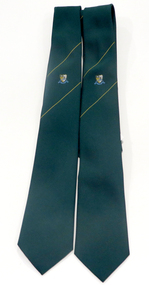
Costume Accessories, School of Mines Ballarat Tie, c1970
... They remained three entities until 1976. smb school of mines ballarat school tie costume textiles uniform On a label tag at the back - Hollygreen, 100% polyester, Dry clean only, Made in Australia These three green polyester ties have a small SMB crest set within two gold diagonal pin stripes (5cm apart) in the middle of the wider front and one on the narrower end. ...This was a School of Mines Ballarat tie. The School of Mines was established in 1870, making it Australia's third oldest tertiary institution. The School of Mines had two divisions - a tertiary division and a technical division. The tertiary division provided higher education courses such as mining engineering, geology, education and business studies, while the technical division provided such programs as wool classing, plumbing and bricklaying. The organisation remained in that form until the 1967 when it was split into three institutions, Ballarat School of Industries, Ballarat Technical School, and Ballarat Institute of Advanced Education. They remained three entities until 1976. These three green polyester ties have a small SMB crest set within two gold diagonal pin stripes (5cm apart) in the middle of the wider front and one on the narrower end. (Men's polyester tie made In Australia under licence By Hollygreen) On a label tag at the back - Hollygreen, 100% polyester, Dry clean only, Made in Australiasmb, school of mines ballarat, school tie, costume, textiles, uniform -
Federation University Historical Collection
Booklet, Ballarat School of Mines Register of Attendances for Practical Dry Assaying, 1907
... The Ballarat School of Mines is a predecessor institution of Federation University Australia. ballarat school of mines assaying dry assaying henry murphy h.r. murphy A slim, green pastel, hard cover volume with dark green spine. ...The Ballarat School of Mines is a predecessor institution of Federation University Australia. A slim, green pastel, hard cover volume with dark green spine. Two full-width pages for entering names of those enrolled.ballarat school of mines, assaying, dry assaying, henry murphy, h.r. murphy -
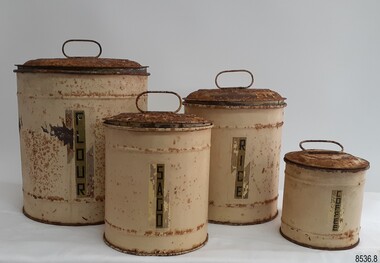 Flagstaff Hill Maritime Museum and Village
Container - Kitchen Canister set, Late 19th to early 20th century
... Flagstaff Hill Flagstaff Hill Maritime Museum and Village Warrnambool Maritime Museum Maritime Village Great Ocean Road Shipwreck Coast canister set kitchen storage food storage metal canisters dry food storage food packaging kitchen container vintage flour rice sago coffee kitchenalia late 19th to early 20th centuries nesting canisters Labels, in descending order: "FLOUR" "RICE" "SAGO" "COFFEE" Canister set; four cylindrical cream coloured metal canisters with domed lids that have lift-up handles on top. They are made from rolled metal and the bases and lids have a side seam. Each canister is a different size and displays a label for different contents. The adhesive labels are vertical, and a gold colour with black vertical text. The cream paint has brush strokes and small areas have exposed green ...This set of kitchen dry food canisters is made of metal; each container has a different height, width and capacity. The rolled thin metal has created a strong, round design with decorative rings on the circumference. The base and close-fitting lid protect the contents from vermin and most insects, and the handle on top aids in the removal of the lid. Metal containers like these are reusable and can be re-purposed, which is advantageous when living in regional or rural areas. The type of manufacture indicates that the set was made in the late 19th to early 20th century. Gradually, colourful and attractive plastic kitchenware began to replace metalware. One of the canisters is labelled 'coffee'; coffee plants and seeds were transported from Brazil into Australia in 1788 when the First Fleet arrived although their growth was unsuccessful. However, by the 1920s, a tenth of the Australian population was drinking readily stored coffee. Large quantities of harvested grains such as maize, wheat and barley were protected from pests by being stored in airy buildings, often raised from the ground. This was an age-old practice used by civilizations such as the ancient Egyptians and early Hebrews. Smaller quantities of food for short-term use in the homes were stored in woven baskets or clay pots.This set of kitchen food containers is an example of colonial food storage used in a domestic setting to store and preserve dry ingredients. These canisters give a snapshot of early domestic life in Australia. Canister set; four cylindrical cream coloured metal canisters with domed lids that have lift-up handles on top. They are made from rolled metal and the bases and lids have a side seam. Each canister is a different size and displays a label for different contents. The adhesive labels are vertical, and a gold colour with black vertical text. The cream paint has brush strokes and small areas have exposed green paint under the cream. The insides of the bases are painted dark grey but the lids have no paint underneath. The empty canisters can fit one inside the other. Labels, in descending order: "FLOUR" "RICE" "SAGO" "COFFEE"flagstaff hill, flagstaff hill maritime museum and village, warrnambool, maritime museum, maritime village, great ocean road, shipwreck coast, canister set, kitchen storage, food storage, metal canisters, dry food storage, food packaging, kitchen container, vintage, flour, rice, sago, coffee, kitchenalia, late 19th to early 20th centuries, nesting canisters -
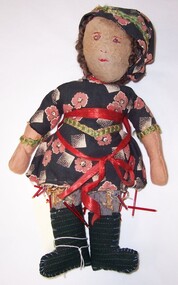 Glenelg Shire Council Cultural Collection
Craft - Rag Doll, c. 1910
... Beading at base of skirt in red, white, green, yellow and clear beads (plastic). Stuff with dried plant material. ...Beading at base of skirt in red, white, green, yellow and clear beads (plastic). Stuff with dried plant material. ...Displayed at History HouseHand-made fabric doll. Cotton body (stocking material?), cotton print fabric (red and white flowers and squares on black background) for dress. Embroidered belt (green and gold), bonnet and cuffs. Felt boots with blue and green stitching. Beading at base of skirt in red, white, green, yellow and clear beads (plastic). Stuff with dried plant material. Red ribbon tied around waist. Curly brown hair (human?). Embroidered face.toy, doll, childhood -
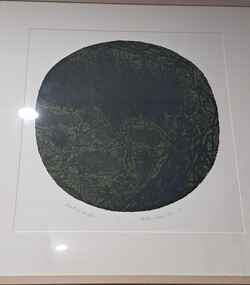 Glenelg Shire Council Cultural Collection
Print, Hertha Kluge-Pott, Facet of a Site, 2001
... Dry point etching. Circular, olive green and black foliage. Limed wood frame, single window mount....Female Artists Women Front: 'Facet of a site v/s Herthe Kluge-Pott 2001' - pencil Dry point etching. Circular, olive green and black foliage. Limed wood frame, single window mount. ...Dry point etching. Circular, olive green and black foliage. Limed wood frame, single window mount.Front: 'Facet of a site v/s Herthe Kluge-Pott 2001' - pencilfemale artists, women -
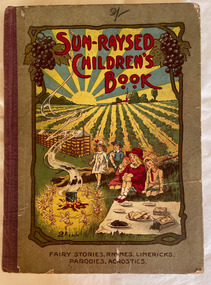 City of Moorabbin Historical Society (Operating the Box Cottage Museum)
Book, DeGaris, C. J. (Clement John), Sun-Raysed Children's Book : Fairy Stories, Rhymes, Limericks, Parodies, Acrostics, 1919
... fairy tales dried fruit children's literature Contains prize-winning fairy stories, rhymes, limericks, etc. from entries in the Sun-raysed competitions of January, 1919. Inside cover hand written: "Donald Green ...Contains prize-winning fairy stories, rhymes, limericks, etc. from entries in the Sun-raysed competitions of January, 1919.52 p. : ill. (some col.) ;fictionContains prize-winning fairy stories, rhymes, limericks, etc. from entries in the Sun-raysed competitions of January, 1919.fairy tales, dried fruit, children's literature -
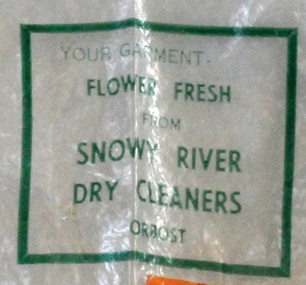 Orbost & District Historical Society
plastic bag, c 1960's
... A clear plastic bag with green print. - Snowy River Dry Cleaners. attached is orange card - E. ...(more information in Orbost & District Historical Society Newsletter No. 138 - John Phillips) This item is from a business no longer existing. dry-cleaners-orbost laundry Your garment Flower Fresh from Snowy River Dry Cleaners Orbost A clear plastic bag with green print. - Snowy River Dry Cleaners. attached is orange card - E. ...Snowy River Dry Cleaners was situated in Stanley Street, Orbost (previously a hat factory). There was also a shop in the CBD of Orbost. Basil Dowie moved his dry cleaning business from Nicholson Street to 31 Stanley Street where Stuart Hats had been. He had originally bought the business from Laurie Harrington in August 1950. (more information in Orbost & District Historical Society Newsletter No. 138 - John Phillips) This item is from a business no longer existing.A clear plastic bag with green print. - Snowy River Dry Cleaners. attached is orange card - E. Scott 004408Your garment Flower Fresh from Snowy River Dry Cleaners Orbostdry-cleaners-orbost laundry -
Mission to Seafarers Victoria
Letter - Correspondence, 14/06/1951
... dried fruit that Allan asked his mother to send. She writes "... we have not not very much fruit in Norway at this time of the year." Quinn Collection letters-from-abroad allan quinn norway oslo alette andersen A self-folding letter written in green ink (0874.a) headed Oslo and dated 14/06/51. ...Alette is writing to thank Mrs Hayes for a parcel of tinned foods and dried fruit that Allan asked his mother to send. She writes "... we have not not very much fruit in Norway at this time of the year."Quinn CollectionA self-folding letter written in green ink (0874.a) headed Oslo and dated 14/06/51. It is from Alette Andersen to Mrs K Hayes, 14 Fitzroy Street, St Kilda, Victoria, Australia. The return address is C/- Fru Strom, Neuberg gt. GB.,Oslo, Norway. letters-from-abroad, allan quinn, norway, oslo, alette andersen -
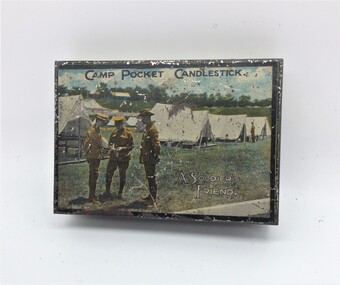 Montmorency–Eltham RSL Sub Branch
Souvenir - 'Soldier's Friend' Camp Pocket Candlestick WW1, 1915
... dry and readily available. The lid also aided in shielding the direct flame of the candle. Used by Australian troops in WWI candlestick soldier's friend camp pocket wwi Camp Pocket Candlestick - A Soldiers Friend Patented 19-7-15 No 16856 Rectangular tin with hinged lid. The lid is illustrated with a coloured image of three Australian soldiers at camp (WWI era) with the words 'Camp Pocket Candlestick - A Soldier's Friend'. The border of the lid is decorated in a daisy pattern. The body of the tin is decorated in a monotone green ...This printed tinplate candle holder appears to have been made in Australia from the middle of 1915 and was available for private purchase to Australian troops (including Light Horse) prior to their departure overseas in WWI. The purpose of the tin was to ensure the contents were kept dry and readily available. The lid also aided in shielding the direct flame of the candle.Used by Australian troops in WWIRectangular tin with hinged lid. The lid is illustrated with a coloured image of three Australian soldiers at camp (WWI era) with the words 'Camp Pocket Candlestick - A Soldier's Friend'. The border of the lid is decorated in a daisy pattern. The body of the tin is decorated in a monotone green tartan, with the base displaying a small panel entitled 'Patented 19-7-15 No 16856'. Inside the tin is coloured olive green, with a fitted pressed tin circular candle holder, located over a hole in the base, and a folded tin match holder. A half used white wax candle is contained within.Camp Pocket Candlestick - A Soldiers Friend Patented 19-7-15 No 16856candlestick, soldier's friend, camp pocket, wwi -
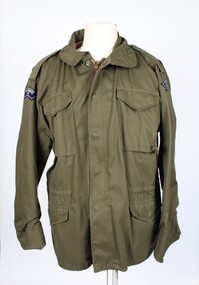 Montmorency–Eltham RSL Sub Branch
Uniform - Coat, US Cold Weather, M-65, US Cold Weather Coat
... green colour. Style 8120/8542 DSA 102-81-C1204. 1. Wear as outer garment or as under-layer in cold-dry climate. 2. ...green colour. Style 8120/8542 DSA 102-81-C1204. 1. Wear as outer garment or as under-layer in cold-dry climate. 2. ...In 1951 - in the context of the Cold War - the Menzies government established the 'National Service Act 1951', which called-up men for compulsory military training for a period of 176 days. The 14th Battallion was located in Victoria. The coat has historic significance in the wider context of Australia’s involvement in the Cold War (particularly in Vietnam) and in the establishment of a National Service Scheme. Olive green army man coat with four outside pockets - two on the chest, two at the bottom; each pocket has one metallic button attached. Coat has a metallic zip as well as metallic buttons; two velcro scratches at the wrist level. Extra removable padding inside, which is attached with plastic buttons. Two identical inscriptions on right and left shoulder reading '14 National Service Battalion'. Two identical inscriptions on right and left shoulder - reading '14 National Service Battalion' Manufacturing details on the inside reading: Coat, Cold weather, Man's, Field M-65. Olive green colour. Style 8120/8542 DSA 102-81-C1204. 1. Wear as outer garment or as under-layer in cold-dry climate. 2. Wear button-in liner for added insulation. 3. Adjust closures and drawcords to ventilate; avoid over-heating of body. 4. When hood is used, lower extension shall be worn over neck opening, preventing water. 5. Brush snow or frost from garments before entering opening. 6. For fast drying, remove liner from coat. 7. Do not expose to high temperature of a stove. 8. Lubricate slide fasteners with wax. 9. For cleaning and restoring of water repellency return to laundry for machine washing in accordance with established procedures for quarpel garments. 10. Do not starch. Do not remove this label. Black ink pen inscription on manufacturing label reading '3/715875' and 'N.Wain'war, army, coat, man's coat, australian army, military uniform, national service scheme, cold war, vietnam war -
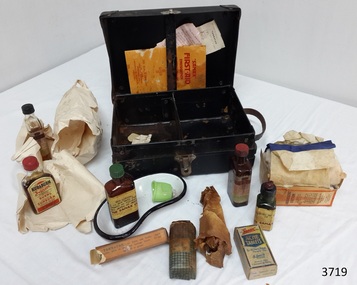 Flagstaff Hill Maritime Museum and Village
Equipment - First Aid Case, Thomas Urquhart & Son Pty Ltd (Thos. Urquhart), 1930-1939
... dry, and bandage loosely. Do not apply oil or grease. - bottle wrapped in brown paper, unknown contents, paper adhered to bottle. - dish, kidney shaped, metal, white enamel with black rim - eye bath, green, plastic or Bakelite SANAX COMPANY The Sanax Company was at the address of 5 Brunswick Street, Fitzroy [Melbourne] at least as early as November 1924, as shown by its advertisement of Ache Powder in the Weekly Times, 8th November 1924. ...dry, and bandage loosely. Do not apply oil or grease. - bottle wrapped in brown paper, unknown contents, paper adhered to bottle. - dish, kidney shaped, metal, white enamel with black rim - eye bath, green, plastic or Bakelite SANAX COMPANY The Sanax Company was at the address of 5 Brunswick Street, Fitzroy [Melbourne] at least as early as November 1924, as shown by its advertisement of Ache Powder in the Weekly Times, 8th November 1924. ...This small, portable 1930s Sanax First Aid Case has been strongly constructed, with corners reinforced with metal to take knocks and bumps, so it could be quickly transported to the site of an emergency. Having these supplies organised into a kit made them easily accessible and reduces time to take them to the site of the accident. It was possibly designed for use in factories because the booklet in the case states that the kit complies with “Part 1, Victorian Factories Regulations”. The text of the printed brand “Sanax First Aid Case” is right-way up when the case stands vertically on its hinged side. In modern times people are well aware of the importance of quick treatment when accident and injury occur. However, before the first commercial First Aid Kit was made by Johnson & Johnson in 1888, people had little knowledge about treating injuries and lacked information about suitable supplies to keep on hand for emergencies. They were often unaware of how to help in that critical time before the doctor or other assistance arrived, a particularly important time for the many people living in remote areas. A quote from Johnson’s & Johnson’s 1888 price list explains “It is a fact, which is everywhere being recognized, that many lives are lost and much suffering entailed in such accidents on account of the lack of the simple but necessary articles required to afford prompt assistance to the wounded.” One example of the value of First Aid assistance to community groups is shown in an article from the Weekly Times, 29th November 1930. It records a report from the Annuello Branch of the Younger Set (a Country Women’s Organisation), telling that on Armistice Day their president Mrs Jamieson, presented the Annuello School with the gift of a Sanax Red Cross First Aid outfit, which was accepted as being “of great practical use to the scholars.” (Annuello is a remote wheat growing area in the Mallee region of North Western Victoria, which became a soldier settlement area after World War I. There is a strain of wheat named ‘Annuello’ due to its suitability for that area. ) The Sanax Case in our Collection contains instructions, equipment and medical items suitable for use in emergency situations. The Case was one of 42 patterns available from Sanax that conformed to ‘Part 1, Victorian Factories Regulations’. It includes items made by Sanax Company and by Burroughs Wellcome & Co. (Australia) Ltd., Sydney, NSW. A quote at the back of the First Aid Emergency Instructions booklet says: “Sanax products are made in Australia by or under the supervision of qualified chemists, from the highest quality materials. They are dependable for the purposes written on labels.” BOOKLET included in First Aid Case: “SANAX” First-Aid Emergency Instructions has orange cover and white pages, joined in the centre by two staples. Booklet contains First Aid Instructions for general events listed in alphabetical order. It also contains an indexed sections headed “Poisoning, and what to do” written by S.A. Burrows, Ph.C., Vuc and N.Z. There are instructions and diagrams on how to perform Artificial Respiration. There are advertisement for Sanax products throughout the booklet that include; - Sanax Ambulance Stretcher for timber mills, mines, ships and quarries - Saw dust masks (porous rubber) for workers in dust, paint or duco sprayers Inside cover lists Sanax’s Australian made products including - tablets and powders for headaches, neuralgia, influenza, colds - snuff for Catarrh that is “quite harmless” - First Aid Cases that come in a range of 42 patterns - sunburn preventatives and treatments - healing salve for carbuncles, pock, pimples, boils, varicose ulcers etc. - snake bite outfits and kits LEAFLETS included in First Aid Case: (1) Tannafax Tannic Acid Jelly. Tannafax should be kept at hand in every home. It should be applied direct from the tube and used with neither oil nor grease. Where a large area has to be covered the clamped end may be torn or cut off to give a wider mouth to the tube. Collapsible tubes of different sizes. Made in Australia. Burroughs Wellcome & Co. (Australia) Ltd. (Incorporated in England). Sydney, NSW. Assorted Houses, London, New York, Montreal, Cape Town, Milan, Bombay, Shanghai, Buenos Aires. Copyright A. 1817, J. 9463 (2) Tabloid. The strong thing is the just - - . Tabloid marks the wor - - Burroughs Wellcome & Comp. The use of the word is to enab – the prescriber, dispenser and patient to get the right thing with one short word, instead of the firm’s long name. If another maker apply the word to his product, the act is unlawful. Tabloid is our trade mark and brand. If a vendor disregard it in dispensing or selling, the act is unlawful for the same reason. We prosecute both offenders rigorously, in the interest of prescribers, dispensers, patients and the owners of the trade mark. Please inform us of any instance of either offence. Burroughs Wellcome & Co. (Australia) Ltd. (Incorporated in England). Telephone Number - M 4184 (4 lines) All communications to G.P.O. Box No. 1185 DD. Copyright Sy. 20. & J 9894. Medicines and Equipment included in First Aid Case: - Absorbent Cotton, Sanax, for absorbing blood or drying a wound. As a swab for washing wounds; to place above a compress to keep the heat in: or as a pad to protect wounds or fractures. The Sanax Co. Manuf. Chemists, Melbourne. Regd. Office: 5 Brunswick St, Fitzroy. N.6. - ACHE tablets, Sanax, for all aches, pains, fevers etc. Dose: 2 to 3 tablets with a draught of water, every 3 hours. Children in proportion. For influenza or colds, take the bedtime dose with a hot lemon drink or toddy. Recommended for Headaches, Colds, Influenza, Fevers, Neuralgia, Rheumatism, Nerve Pains, Sleeplessness, and Seasickness. Three Sanax Ache tablets equals one Sanax Ache powder. Each tablet contains 1.75grs. each Phenacotinum and Acety acSzilcyl, and .75grs Ammon Brom. Etc.. Sanax brand specialties are prepared by highly qualified pharmaceutical chemists and may be accepted as safe and effective for the purpose indicated on the label. The Sanax Co. Melbourne - Eye lotion, Sanax, “in eye bath full strength or diluted with equal parts of water. Sanax Co. Brunswich St, Fitzroy, Melbourne. - Iodine, Sanax, POISON, with instructions for what to do if swallowed. - Kuraburn, Sanax, Applied to the burn and allowed to dry, the pain and heat instantly disappear, and blistering is prevented. If necessary, apply again in an hours. To safeguard against burning when sunbathing, apply before exposure to the sun. If already sunburnet, use Kuraburn as directions above. Safe and harmless. Sole makers, The Sanax Co. Brunswick St. - - Vic. - Sal Volatile, Sanax, - - stimulant for - - nervous aches - - or as smelling salts Dose - - - - Solution of A- - - 5%, . The Sanax Co. Brunswick St, Melbourne. - Tannafax, Burroughs Wellcome & Co. Australia Ltd. Sydney, N.S.W., 20gm. Approx., Tannic Acid Jelly, (Tannic Acid with 0.5% Phenol in a water-soluble base) for burns and scalds. A.N. 15050, p188, logo of a unicorn. Apply lightly, allow to dry, and bandage loosely. Do not apply oil or grease. - bottle wrapped in brown paper, unknown contents, paper adhered to bottle. - dish, kidney shaped, metal, white enamel with black rim - eye bath, green, plastic or Bakelite SANAX COMPANY The Sanax Company was at the address of 5 Brunswick Street, Fitzroy [Melbourne] at least as early as November 1924, as shown by its advertisement of Ache Powder in the Weekly Times, 8th November 1924. It was still at this address in September 1951, when it advertised First Aid outfits and components in the Post Master General’s section of the Commonwealth of Australia Gazette. REFERENCES: Annuello, Victoria; Wikipedia, https://en.wikipedia.org/wiki/Annuello,_Victoria Annuello Younger Set, Branch Activities and Local Reports, Country Women’s Organisations, Weekly Times, 29 November 1930, Trove http://trove.nla.gov.au/newspaper/article/224921009?searchTerm=%22sanax%22%20and%20%22melbourne%22&searchLimits=# Commonwealth of Australia Gazette, Issue 32, 24th April 1915, https://www.legislation.gov.au/file/1915GN32 [Johnson & Johnson Price List, September 1, 1888, p. 20. From our archives], Celebrating the 125th Birthday of the First Aid Kit , The Story of Johnson & Johnson, , http://www.kilmerhouse.com/2013/06/from-1888-to-2013-celebrating-the-125th-birthday-of-the-first-aid-kit/ Post Master General’s section of the Commonwealth of Australia Gazette, Issue No. 73, Thursday 27th September 1951 http://trove.nla.gov.au/newspaper/article/232185299?searchTerm=%22sanax%22%20and%20%22fitzroy%22&searchLimits= Sanax First Aid Emergency Instructions, by S.A. Burrows, publisher Sanax Ltd. Fitzroy, Victoria, 1930-1939 English, book, Illustrated edition, Trove http://trove.nla.gov.au/version/40948895 Access to emergency medical help in early settlement days of Victoria could take quite some time, especially in remote areas. From 1888 First Aid Kits and instructions became available for work sites, offices, community groups and individuals, helping to bridge the gap between the accident and the arrival of medical assistance. This portable Sanax First Aid Case is an example of portable medical equipment made in Melbourne, Australia, in the 1930’s and available to the public. It contains a range of items plus information to be used in a variety of injuries and emergencies in in factories, households, businesses and local communities, and instructions on their use. First Aid Case, portable, Sanax First Aid Case. First Aid kit in strong black cardboard carry case with metal reinforced corners, metal hinges on lid, metal catch and leather carry handle. Inside lid is a vertical strap with narrow gap behind it. Base is divided into two compartments. Manufactured by Sanax, Fitzroy, Melbourne, C. 1930-1939 Contents include "Sanax" First Aid instructions booklet, 2 leaflets, metal kidney dish enamelled in white with black trim on edge, green plastic or Bakelite eye bath, eye lotion, Tannafax tannic acid jelly, Sal Volitile, Kuraburn, Iodine, Argyrol, ACHE tablets, absorbent cotton in cardboard box, gauze bandage, and UNKNOWN wrapped bottle. Printed in gold on lid of case “SANAX” FIRST AID CASE. Most of the contents, as well as the case, show the “SANAX” brand. Some contents are inscribed Burroughs Wellcome & Co. (Australia) Ltd., flagstaff hill, warrnambool, shipwrecked coast, flagstaff hill maritime museum, maritime museum, shipwreck coast, flagstaff hill maritime village, great ocean road, first aid items, first aid kit, emergency first aid, medical emergency kit, home emergency kit, industrial emergency kit, sanax company fitzroy melbourne, burroughs wellcome & co. (australia) ltd, thos. urquhart & son pty. ltd. melbourne, sanax first aid case, sanax first-aid emergency instructions, part 1 victorian factories regulations, tabloid medical supplies -
 Greensborough Historical Society
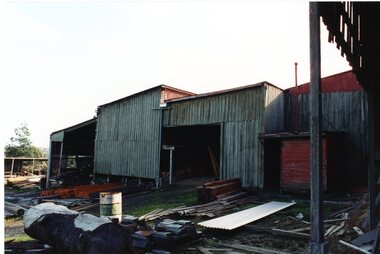
Photograph - Photograph Collection, Alison Lendoudis et al, Timber drying shed 1996, 1996
... This green timber was airdried in the stackyard where the Motor Wreckers operated in 1996. After air drying the transfer trolley shifted the lengths of timber down to the kilns, which are the buildings seen in the background....This green timber was airdried in the stackyard where the Motor Wreckers operated in 1996. After air drying the transfer trolley shifted the lengths of timber down to the kilns, which are the buildings seen in the background. ...Briar Hill Timber originally milled hardwood only. This green timber was airdried in the stackyard where the Motor Wreckers operated in 1996. After air drying the transfer trolley shifted the lengths of timber down to the kilns, which are the buildings seen in the background.The Briar Hill Timber and Trading Company was active during the 1930s - 1950s during the development of the local area with many houses being built by owner-builders who used the company for their needs. Group of 10 colour photographsbriar hill timber and trading company, briar hill timber, alison lendoudis, bob manuell, sherbourne road briar hill, squire family, purdys furniture briar hill -
 Orbost & District Historical Society
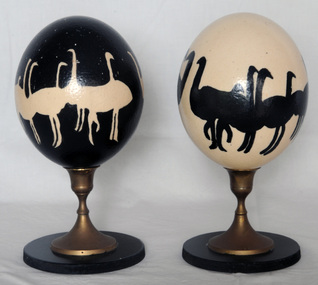
eggs
... green outer layer. The contents must be removed through a small hole (either tool drilled or poked with a needle). After the yolk has been blown out (scrambling the yolk first by poking with a needle will make it easier to remove), the egg needs to be washed through and left to drain dry. ...green outer layer. The contents must be removed through a small hole (either tool drilled or poked with a needle). After the yolk has been blown out (scrambling the yolk first by poking with a needle will make it easier to remove), the egg needs to be washed through and left to drain dry. ...These eggs could be ostrich eggs from an ostrich farm which operated just out of Marlo. It is likely that they were donated by Kate and Richard Earle who ran the enterprise. Emu and ostrich eggs are perfect for decorating, painting or carving. Emu egg shells have multiple layers ranging from an inner white layer through to the dark green outer layer. The contents must be removed through a small hole (either tool drilled or poked with a needle). After the yolk has been blown out (scrambling the yolk first by poking with a needle will make it easier to remove), the egg needs to be washed through and left to drain dry. It can then be painted, carved, etched or decorated. Emu decorating is a traditional Aboriginal art. The carving of emu eggs by Indigenous and non-Indigenous people was popular in the late 19th century but production declined in the 20th century, partly due to the protection of eggs through legislation. This has been overturned in recent years with the development of commercial emu farms. In the period between the two world wars particularly, with the production of other Aboriginal artefacts for an outside market, the carving of emu eggs provided an important source of income for Aboriginal people in many parts of Australia. It was a widespread practice in the south-east and it was not unusual for Aboriginal people to decorate their own homes with carved eggs and other items created by themselves or community members, serving to affirm an Indigenous identity within the domestic environment. (ref National Gallery of Australia)This item is significant for its uniqueness and aesthetic appeal.Two painted eggs on stands. 1907.1 is painted black and has white emus or ostriches painted on it. 1907.2 is painted white and has black emus or ostriches painted on it. Both stands are wooden with brass pedestals. The eggs are possibly ostrich eggs.handcraft emu-egg ornament ostrich-egg -
 Orbost & District Historical Society
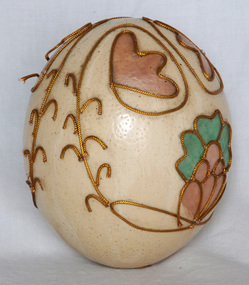
emu egg
... green outer layer. The contents must be removed through a small hole (either tool drilled or poked with a needle). After the yolk has been blown out (scrambling the yolk first by poking with a needle will make it easier to remove), the egg needs to be washed through and left to drain dry. ...green outer layer. The contents must be removed through a small hole (either tool drilled or poked with a needle). After the yolk has been blown out (scrambling the yolk first by poking with a needle will make it easier to remove), the egg needs to be washed through and left to drain dry. ...Emu eggs are perfect for decorating, painting or carving. Emu egg shells have multiple layers ranging from an inner white layer through to the dark green outer layer. The contents must be removed through a small hole (either tool drilled or poked with a needle). After the yolk has been blown out (scrambling the yolk first by poking with a needle will make it easier to remove), the egg needs to be washed through and left to drain dry. It can then be painted, carved, etched or decorated. Emu decorating is a traditional Aboriginal art. The carving of emu eggs by Indigenous and non-Indigenous people was popular in the late 19th century but production declined in the 20th century, partly due to the protection of eggs through legislation. This has been overturned in recent years with the development of commercial emu farms. In the period between the two world wars particularly, with the production of other Aboriginal artefacts for an outside market, the carving of emu eggs provided an important source of income for Aboriginal people in many parts of Australia. It was a widespread practice in the south-east and it was not unusual for Aboriginal people to decorate their own homes with carved eggs and other items created by themselves or community members, serving to affirm an Indigenous identity within the domestic environment. (ref National Gallery of Australia)This item is significant for its uniqueness and its aesthetic appeal.An emu egg which has been painted white and decorated with glued on cord/thread to make a pattern of flowers and leaves.emu-egg ornament handcraft -
 Orbost & District Historical Society
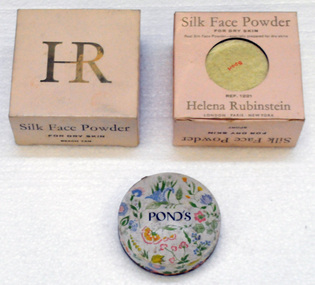
face powder, mid 20th century
... 2483.54 : on base ; green text on white - Pond's Face Powder Suntan Made by Pond's Extract Co Ltd Perrivale Middx 2483.55 : Helena Rubinstein HR Silk Face Powder for Dry Skin Sport Boots 10/6 2483.56 : Helena Rubinstein HR Silk Face Powder for dry skin Beach Tan Inside is Exclusive Boots offer 6d off Your Next Purchase of Chikka panties...Cosmetics were an important part of most women's personal effects. cosmetics skincare Burton-Marjorie 2483.54 : on base ; green text on white - Pond's Face Powder Suntan Made by Pond's Extract Co Ltd Perrivale Middx 2483.55 : Helena Rubinstein HR Silk Face Powder for Dry Skin Sport Boots 10/6 2483.56 : Helena Rubinstein HR Silk Face Powder for dry skin Beach Tan Inside is Exclusive Boots offer 6d off Your Next Purchase of Chikka panties Three containers of face powder. 2483.54 is a circular container, white with coloured flowers - the "Dreamflower Pattern". ...These items were owned by Marjorie Burton. Marjorie Burton ( nee Whiteman), born 12 June, in Birmingham, England came to Orbost in 1995. In England she did office work – typing, shorthand and secretarial work - in accountants’ offices and also trained as a comptometrist with Burroughs in London. She came from a middle-class, working, church-going family. Her mother was a milliner who mademany of Marjorie’s clothes, hats and outfits. Marjorie married in 1938 to a salesman who later became a mechanic in the R.A.F. during WW11In the 1940’s women’s makeup was a huge industry. Despite war rationing, women began using makeup from the teens onwards. Cosmetics were an important part of most women's personal effects.Three containers of face powder. 2483.54 is a circular container, white with coloured flowers - the "Dreamflower Pattern". It contains some powder. 2483.55 and 2483.56 are pink boxes with gold print. 2483.54 : on base ; green text on white - Pond's Face Powder Suntan Made by Pond's Extract Co Ltd Perrivale Middx 2483.55 : Helena Rubinstein HR Silk Face Powder for Dry Skin Sport Boots 10/6 2483.56 : Helena Rubinstein HR Silk Face Powder for dry skin Beach Tan Inside is Exclusive Boots offer 6d off Your Next Purchase of Chikka pantiescosmetics skincare burton-marjorie -
 Flagstaff Hill Maritime Museum and Village
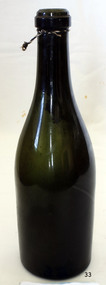
Container - Bottle, 1880s to 1910s
... green glass. Handmade turn-moulded bottle with seamless body and tooled lip. Deeply indented base has push-up mark with a ‘mamelon’ bump in the centre. Bottle is straight from base to half height, then tapers to a shoulder over the next quarter, than almost straight up to the mouth. There is a portion of cork in the bottle’s mouth and dry...green glass. Handmade turn-moulded bottle with seamless body and tooled lip. Deeply indented base has push-up mark with a ‘mamelon’ bump in the centre. Bottle is straight from base to half height, then tapers to a shoulder over the next quarter, than almost straight up to the mouth. There is a portion of cork in the bottle’s mouth and dry ...This handmade green glass bottle was made using the turn-moulded or rotated-moulded method, a variation of the mould-blown process. The bottle has the remnants of a cork seal in its mouth. It possibly contained ginger beer, soda or mineral water, flavoured drinks, liquor or wine. TURN-MOULDED BOTTLE production method This bottle was handmade using the ‘turn-moulded’ process, one of a variety of mould-blown processes that followed the earlier mouth-blown method. The maker would add a portion of hot soft glass to the end of his blowpipe then blow air through the pipe while placing the end inside a bottle mould. The mould was then turned and twisted, giving the bottle a round, seamless body, and usually a round indented base. The cooled body of the bottle would then be finished with the addition of an applied top. A small amount of soft glass would be applied to the top of the bottle and a lip would be formed using a tooling implement. A concentric ring would also form below the lip, caused by the rotated lipping tool. The bases of bottles made with the turn-moulded method were generally not embossed but would commonly have a mamelon or ‘dot’ in the centre of the base. SEALING THE BOTTLE After filling this type of bottle with its contents it is then sealed with a straight, cylindrical cork with the aid of a hand operated tool called a bottle corker. The bottle corker compresses the cork as it is driven into the bottle. Once inside the bottle the cork expands evenly into the opening to tightly seal the contents – the denser the cork the better the seal. This turn-moulded glass bottle is made distinctive due to its round seamless body and indented base.Bottle, dark green glass. Handmade turn-moulded bottle with seamless body and tooled lip. Deeply indented base has push-up mark with a ‘mamelon’ bump in the centre. Bottle is straight from base to half height, then tapers to a shoulder over the next quarter, than almost straight up to the mouth. There is a portion of cork in the bottle’s mouth and dry remnants in the bottle’s base. Possibly used for ginger beer. Produced in 1880s to 1910’s. flagstaff hill, warrnambool, shipwrecked coast, flagstaff hill maritime museum, maritime museum, shipwreck coast, flagstaff hill maritime village, great ocean road, green glass bottle, handmade glass bottle, bottle with indented base, turn-moulded bottle, rotate-moulded bottle, tooled lip on bottle mouth, applied lip bottle, bottle corker -
 Flagstaff Hill Maritime Museum and Village
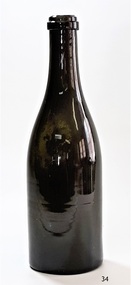
Container - Bottle, 1880s to 1910s
... green glass. Handmade turn-moulded bottle with seamless body and tooled lip. Deeply indented base has push-up mark with a ‘mamelon’ bump in the centre. Bottle is straight from base to half height, then tapers to a shoulder over the next quarter, than almost straight up to the mouth. There is a portion of cork in the bottle’s mouth and dry...green glass. Handmade turn-moulded bottle with seamless body and tooled lip. Deeply indented base has push-up mark with a ‘mamelon’ bump in the centre. Bottle is straight from base to half height, then tapers to a shoulder over the next quarter, than almost straight up to the mouth. There is a portion of cork in the bottle’s mouth and dry ...This handmade green glass bottle was made using the turn-moulded or rotated-moulded method, a variation of the mould-blown process. The bottle has the remnants of a cork seal in its mouth. It possibly contained ginger beer, soda or mineral water, flavoured drinks, liquor or wine. TURN-MOULDED BOTTLE production method This bottle was handmade using the ‘turn-moulded’ process, one of a variety of mould-blown processes that followed the earlier mouth-blown method. The maker would add a portion of hot soft glass to the end of his blowpipe then blow air through the pipe while placing the end inside a bottle mould. The mould was then turned and twisted, giving the bottle a round, seamless body, and usually a round indented base. The cooled body of the bottle would then be finished with the addition of an applied top. A small amount of soft glass would be applied to the top of the bottle and a lip would be formed using a tooling implement. A concentric ring would also form below the lip, caused by the rotated lipping tool. The bases of bottles made with the turn-moulded method were generally not embossed but would commonly have a mamelon or ‘dot’ in the centre of the base. SEALING THE BOTTLE After filling this type of bottle with its contents it is then sealed with a straight, cylindrical cork with the aid of a hand operated tool called a bottle corker. The bottle corker compresses the cork as it is driven into the bottle. Once inside the bottle the cork expands evenly into the opening to tightly seal the contents – the denser the cork the better the seal. This hand made, green glass bottle is representative of bottle making before mass production and is made distinctive due to its round seamless body and indented base.Bottle, dark green glass. Handmade turn-moulded bottle with seamless body and tooled lip. Deeply indented base has push-up mark with a ‘mamelon’ bump in the centre. Bottle is straight from base to half height, then tapers to a shoulder over the next quarter, than almost straight up to the mouth. There is a portion of cork in the bottle’s mouth and dry remnants in the bottle’s base. Possibly used for ginger beer. Produced in 1880s to 1910’s. flagstaff hill, warrnambool, shipwrecked coast, flagstaff hill maritime museum, maritime museum, shipwreck coast, flagstaff hill maritime village, great ocean road, green glass bottle, handmade glass bottle, bottle with indented base, turn-moulded bottle, rotate-moulded bottle, tooled lip on bottle mouth, applied lip bottle, bottle corker -
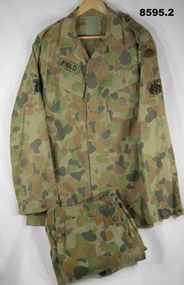 Bendigo Military Museum
Uniform - SHIRT, TROUSERS, WORKDRESS, ARMY, Australian Defence Industries, 1990 - 1994
... DRY ONLY/ DO NOT IRON DO NOT STARCH/ DO NOT BLEACH". Shirt and Trousers Word dress. 1. & 2. DPCU (Disruptive Pattern Camouflage Uniform) work dress. Colours light to dark green ...Original owner - 'FIELD'.Shirt and Trousers Word dress. 1. & 2. DPCU (Disruptive Pattern Camouflage Uniform) work dress. Colours light to dark green through to light to dark brown. Cotton/polyester fabric. Khaki colour plastic buttons. 1. Shirt work dress, collar, shoulder epaulettes, two front pockets with concealed button closure flaps. Front - five buttons with concealed placket, long sleeves with cuff. Name patch has been sewn on "FIELD". Australian Army Rising Sun patch, top left sleeve. Rank insignia - Australian Coat of Arms - Warrant officer Class One on both sleeves. Manufacturers label - green cotton fabric - below collar. 2. Trousers - new style. Two side pockets, two large patch side pockets with two button closer flaps. One back patch pocket with button. Belt loops with buttons. Nylon/metal zipper fly. DPCU pocket lining. Manufacturers label - on right front pocket.Manufacturers information - black ink print. 1. "VICTORIA/ 1990/ ^/ ???? 66.130.0039/ SIZE 107L/ NAME/ SERVICE NO/ MACHINE WASHABLE/ DRIP DRY ONLY/ DO NOT IRON/ DO NOT STARCH/ DO NOT BLEACH". 2. "VICTORIA/ 1994/ ^/ 8415.66.134.8920/ SIZE 95L/ CUT NO 2200/ SERVICE NO/ NAME/ 50% POLYESTER 50% COTTON/ MACHINE WASHABLE DRIP DRY ONLY/ DO NOT IRON DO NOT STARCH/ DO NOT BLEACH".uniforms, army, work dress, dpcu, passchendaele barracks trust -
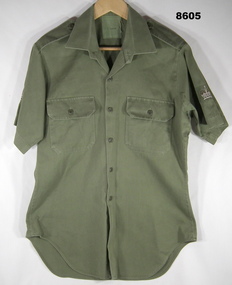 Bendigo Military Museum
Uniform - SHIRT, WORK DRESS, ARMY, 1987
... "AGCF/ 1987/^/ SIZE 39/81/ 8405.66.093.2434/ service no/ name/ do not boil or wring/ machine washable/ drip dry, iron lightly/ with warm iron" Handwritten in black ink pen "R. HOSKING". Work dress shirt. Shirt - green ...Work dress shirt. Shirt - green colour cotton/polyester fabric, short sleeves, collar, shoulder epaulettes, two front pockets with button down flap. Green colour plastic buttons. Green colour cotton fabric manufacturers label back below collar. Commonly known as "Greens". Right and left sleeves - Rank Insignia patch - Queen's colour - Warrant Officer Second Class.Manufacturers information - black ink print. "AGCF/ 1987/^/ SIZE 39/81/ 8405.66.093.2434/ service no/ name/ do not boil or wring/ machine washable/ drip dry, iron lightly/ with warm iron" Handwritten in black ink pen "R. HOSKING".passchendaele barracks trust, uniforms, army, work dress shirt. -
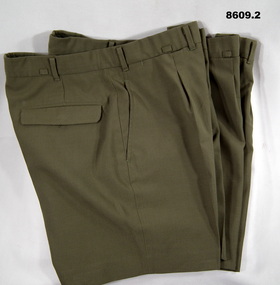 Bendigo Military Museum
Uniform - SHORTS, ARMY, Australian Defence Industries, 1978, 1979
... DRY CLEANING PREFERABLE/ MAY BE HAND WASHED/ AS FOR WOOL/ CLOSE SLIDE FASTENER/ PRIOR TO PRESSING. REPRESS/ ON ORIGINAL CREASES". 1. & 2. Shorts - Khaki colour wool/polyester fabric. Waist band, belt loops, fob pocket front, two side pockets, one inset back pocket with button and cover flap. Nylon and metal zipper fly. Green ...1. & 2. Shorts - Khaki colour wool/polyester fabric. Waist band, belt loops, fob pocket front, two side pockets, one inset back pocket with button and cover flap. Nylon and metal zipper fly. Green colour plastic buttons. Lining - all pockets, green colour polyester fabric. Manufacturers label - white colour cotton fabric - on back pocket lining.Manufacturer's label - black ink print. 1. "A.G.C.F./ VIC 1978/ ^/ 8405.66.090.0094/ SIZE 95/ NO./ NAME". 2. "A.G.C.F./ VIC 1997/ ^/ SIZE 92.5/ 8405.66.090.0093/ / NO./ NAME". 1. & 2. "DRY CLEANING PREFERABLE/ MAY BE HAND WASHED/ AS FOR WOOL/ CLOSE SLIDE FASTENER/ PRIOR TO PRESSING. REPRESS/ ON ORIGINAL CREASES". passchendaele barracks trust, uniforms, army service dress shorts -
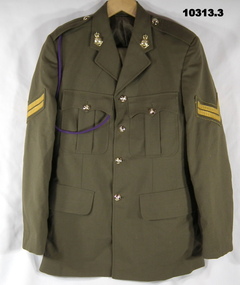 Bendigo Military Museum
Uniform - SERVICE DRESS, ARMY, A.G.C.F, 1966, 1988
... dry cleaning instructions. Service dress jacket, with lanyard and trousers. 1. Jacket - khaki colour wool/ polyester fabric. Service Dress style with collar, shoulder epaulettes, top two patch pockets with button down flap, lower two inset pockets with flap. Gold colour plastic buttons with shank and metal pin. Bottoms have raised emblem, Queen's Crown, globe and boomerang. - Royal Australian Survey Corps. Collar badges, gold colour plastic with metal holder. Queen's Crown, globe and boomerang. Rank insignia cloth patch on top of both sleeves - two stripes, gold colour - Corporal. Lining - green ...Uniform issued to "D. Hutchinson".Service dress jacket, with lanyard and trousers. 1. Jacket - khaki colour wool/ polyester fabric. Service Dress style with collar, shoulder epaulettes, top two patch pockets with button down flap, lower two inset pockets with flap. Gold colour plastic buttons with shank and metal pin. Bottoms have raised emblem, Queen's Crown, globe and boomerang. - Royal Australian Survey Corps. Collar badges, gold colour plastic with metal holder. Queen's Crown, globe and boomerang. Rank insignia cloth patch on top of both sleeves - two stripes, gold colour - Corporal. Lining - green colour polyester fabric. Manufacturer's labels - white cotton fabric. Left side lining. 2. Trousers - khaki colour wool/polyester fabric, service dress style with fob pocket, two side pockets and one back pocket with button down flap. Metal zipper fly. Brown plastic buttons waistband and belt loops. Lining - green colour polyester fabric. Manufacturer's labels - three- white cotton fabric. 3. Lanyard - purple colour, cotton cord with knots.Manufacturer's information on labels = black ink print. 1. "A.G.C.F./ VIC 1988/ ^ / SIZE 95R/ 8405-66-01908462/ MACQUARIE 88/ BATCH P/ MATCHING TRS/ NO/ NAME/ followed by dry cleaning instructions. 2. "E.W. P/LTD/ SOUTH AUSTRALIA/ 1966/ ^ / SIZE 33 LONG/ W33 1/6 32 i/2 / CLASS 8405/ 66-019-8490" On waistband "ARMY NO./ NAME (Handwritten 329650 Commons)". Om waistband - fabric care and dry cleaning instructions.uniforms, army, service dress, d. hutchinson
