
Showing 5 items matching "dummy floor"
-
 Melbourne Tram Museum
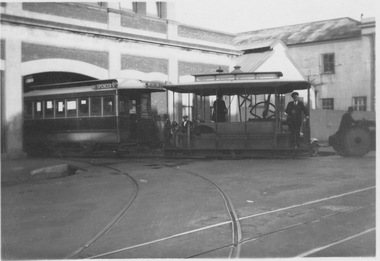
Photograph - Cable tram leaving the Nicholson Street car house, 1930s
... ...dummy floor...The grip mechanism sat high on the dummy floor when in the car house and was only lowered into the cable tunnel only when the tram was on the street. ...The grip mechanism sat high on the dummy floor when in the car house and was only lowered into the cable tunnel only when the tram was on the street. ...Cable tram sets were moved onto Nicholson Street from the car house using horses or tractors. The grip mechanism sat high on the dummy floor when in the car house and was only lowered into the cable tunnel only when the tram was on the street. Here the gripman and conductor are standing in the dummy in their M&MTB issued uniforms. The car house with upstairs offices has a brick facade. The double storey corruguted iron building in the background is the tram construction factory and workshop. Yields information about Nicholson Street car houseBlack and white photograph with no note on rearcable tram sets, car house, tractors, horses, the grip, dummy floor, gripman, conductor, m&mtb issued uniforms, brick facade, corruguted iron building, tram construction factory, workshop, nicholson street -
 Flagstaff Hill Maritime Museum and Village
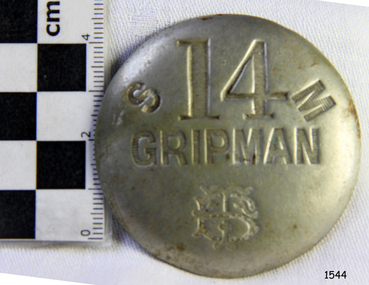
Badge - Gripman Badge, Stokes & Sons, Jul 1916 - Nov. 1919
... dummy car, operating the heavy levers to connect the gripping gears to the cable installed in a slot in the road. To turn at intersections he would skilfully disconnect, freewheel around the corner and carefully reconnect to the continuously operating steel cable. Large winding gears in an Engine House along the line pulled the cable along, powered by steam engines and later electric engines. The gripping gears were in the centre of the car's floor...dummy car, operating the heavy levers to connect the gripping gears to the cable installed in a slot in the road. To turn at intersections he would skilfully disconnect, freewheel around the corner and carefully reconnect to the continuously operating steel cable. Large winding gears in an Engine House along the line pulled the cable along, powered by steam engines and later electric engines. The gripping gears were in the centre of the car's floor ...This cable tram Gripman’s badge, or driver’s badge, was part of a tram driver’s uniform. The inscriptions on the front of the badge identify it as belonging to Gripman number 14, at the South Melbourne Car House depot of the Tramways Board. The Gripman Badge would be re-issued whenever another Gripman takes over the position. Cable trams were invented in America in 1873. In Melbourne, cable trams were in use from 1885 until 1940, with a network of up to 1200 cable cars or 'dummies' and trailers travelling at around 9.5 miles (15km) per hour along 46 miles (74km) of double tracks. The Gripman drove the dummy car, operating the heavy levers to connect the gripping gears to the cable installed in a slot in the road. To turn at intersections he would skilfully disconnect, freewheel around the corner and carefully reconnect to the continuously operating steel cable. Large winding gears in an Engine House along the line pulled the cable along, powered by steam engines and later electric engines. The gripping gears were in the centre of the car's floor with seating all around the sides, a dangerous place for curious children. , whose worried parents would guide them into the tram that was towed behind the dummy car. The Melbourne Tramways Board operated the cable trams between July 1916 and November 1919 after taking over from the privately operated Melbourne Tramway and Omnibus Company. In 1919, the Melbourne and Metropolitan Tramways Board (MMTB) took over the Tramways Board. Stokes & Sons: - The maker of the badge, Thomas Stokes, migrated to Melbourne from Birmingham in 1854 and set up business in Mincer Lane as a die-sinker, producing medals, tokens, buttons and silverware, and an engraving service. He moved to Flinders Lane in 1856. After a time, in 1894, the business became Stokes & Sons Pty: Ltd, electroplates and badge makers at Post Office Place in Melbourne. The maker's mark 'Stokes & Sons' was made on badges until 1962. LOCAL CONNECTION: -t was common practice to recycle the used cables from the tramway. For example, the Wollaston Bridge in Warrnambool, Victoria, is suspended by recycled cable tram Melbourne. (Other recycled cables were used for fencing wire.) -Portland's cable tram is an example of the cable trams used in Melbourne from 1885 to 1940.This badge was used to identify a Gripman who operated a cable car tram's dummy car for the Tramways Board in Melbourne between 1916 and 1919. It represents the need for people to be able to identify workers in the service industry, a need still addressed today by staff ID badges and digital identification. The badge also represents the period in Melbourne's history when cable cars were used for public transport for over four decades, gradually changing from steam to electric power. Trams still have an important role in Melbourne's public transport. Badge, round hollow metal dome with two open metal guides on the back. A cable tram Gripman (driver) badge with embossed inscriptions on the front and stamped on the back. There is a logo of entwined letters T and B on the front. It identifies Gripman number 14, South Melbourne, Tramway Board. It was made by Stokes & Sons of Melbourne. Impressed into the front: "S / 14 / M" "GRIPMAN" Logo intertwined "T" and "B" Embossed on reverse "STOKES &o SONS"flagstaff hill, flagstaff hill maritime museum and village, warrnambool, maritime museum, maritime village, great ocean road, shipwreck coast, badge, gripman, stokes & sons, numesmatics, tramway, tram, tram driver, uniform, cable tram, identification, cable car driver, tramway board, south melbourne, melbourne tramways board, tb, mtb, mmtb, melbourne and metropolitan tramways board, tramway button, gripman button, id, identification badg, staff badge, name badge, employee, grip car, dummy car -
 Flagstaff Hill Maritime Museum and Village
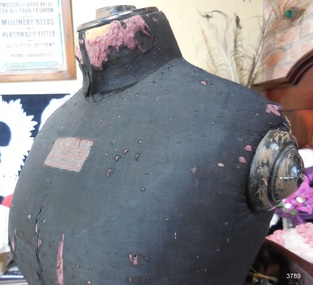
Equipment - Mannequin, J. A. Walker, before April 1874
... The mannequin is also an example of an item manufactured in Melbourne in colonial times. mannequin wooden mannequin made in melbourne dressmaker’s mannequin 19th century mannequin dress form display mannequin custom made mannequin dressmaker’s dummy andique mannequin clothing display j.a. walker manufacturer melbourne j.a. walker mannequin manufacturer evening outfit Mannequin maker’s fabric label “J.A. WALKER / MANUFACTURER / MELBOURNE” This wooden display mannequin is from neck to floor length. ...THE MANNEQUIN The included wooden mannequin made by J.A. Walker of Melbourne has been very well used, as can be seen from the pin marks and split and torn fabric in areas where pins would have been used many times. The painted wood of the bodice is wearing away. The top of the neck is very rough in the centre, indicating that it possibly had a knob, handle or even a head shape on top. The mannequin could have been used for storing and cleaning of the evening outfit and even in the process of making it. It is made to match the measurements of the outfit beautifully and would be close in measurement to Mrs. Isabella Mitchell. Isabella’s sister-in-law Eliza Russell made her own wedding dress and perhaps she or Isabella herself made the evening outfit using the mannequin for fittings. The mannequin is significant as its size gives an image of the shape of the evening outfit’s owner. It is also significant as an example of the process and skills to create garments of fashion during the period, with many people making their own garments. The mannequin is also an example of an item manufactured in Melbourne in colonial times. This wooden display mannequin is from neck to floor length. It has a round pedestal. The mannequin’s bodice has been painted black. It is padded then covered in black fabric. The maker of the mannequin was J.A. Walker of Melbourne. It dates to the mid-late 19th century.Mannequin maker’s fabric label “J.A. WALKER / MANUFACTURER / MELBOURNE”mannequin wooden, mannequin made in melbourne, dressmaker’s mannequin, 19th century mannequin, dress form, display mannequin, custom made mannequin, dressmaker’s dummy, andique mannequin, clothing display, j.a. walker manufacturer melbourne, j.a. walker mannequin manufacturer, evening outfit -
 Melbourne Tram Museum
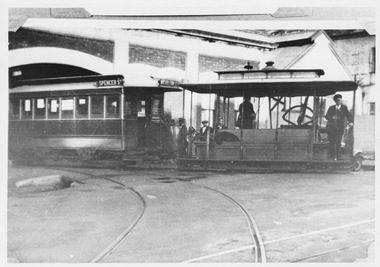
Photograph - Cable dummy and car towed from Nicholson St car house, c1930s
... Photograph shows a cable tram dummy and car being towed out of Nicholson Street car house with the crew standing on the dummy in M&MTB uniforms and the grip resting high on the floor. The horizontal tow bar at the front of the dummy indicates it is attached to a small out-of-view small tractor used at this car house. ...Photograph shows a cable tram dummy and car being towed out of Nicholson Street car house with the crew standing on the dummy in M&MTB uniforms and the grip resting high on the floor. The horizontal tow bar at the front of the dummy indicates it is attached to a small out-of-view small tractor used at this car house. ...Photograph shows a cable tram dummy and car being towed out of Nicholson Street car house with the crew standing on the dummy in M&MTB uniforms and the grip resting high on the floor. The horizontal tow bar at the front of the dummy indicates it is attached to a small out-of-view small tractor used at this car house. The car destinations read 'Nicholson St' and 'Spencer St'.Yields information about Nicholson St car house Black and white photograph with no note on rear. nicholson st, spencer st, dummy, m&mtb uniform, grip, tow bar, tractor -
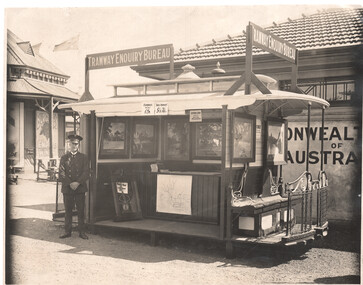 Melbourne Tram Museum
Photograph - Former cable grip modified for a Show, Melbourne & Metropolitan Tramways Board (MMTB), "Tramway Enquiry Bureau", mid to late 1920s
... The tram has signs advertising dummies or grip cars for sale at 5 pounds each and bell punches for 5/- & 7/6 each. On the floor of the car is one of the working models of the cable tram grip and a map showing electric and cable lines. ...The tram has signs advertising dummies or grip cars for sale at 5 pounds each and bell punches for 5/- & 7/6 each. On the floor of the car is one of the working models of the cable tram grip and a map showing electric and cable lines. ...The photo shows a man in a MMTB uniform standing beside a tram-shaped booth, made from a cable tram labeled "Tramway Enquiry Bureau," displaying maps and framed pictures of scenery, with a large sign reading "COMMONWEALTH OF AUSTRALIA" in the background. The tram has signs advertising dummies or grip cars for sale at 5 pounds each and bell punches for 5/- & 7/6 each. On the floor of the car is one of the working models of the cable tram grip and a map showing electric and cable lines. In the background is a sign for Burgoyne's Empire Wines. Possibly for a Royal Show at Flemington mid to late 1920's after the conversion of Swanston St. Bell punches were phased out during the early 1920s.Demonstrates the conversion of a cable grip for use at a public event or show.Black and white photographmmtb, royal show, cable trams, bell punches, cable grip
