
Showing 6 items matching "dutch-english stories"
-
 Tatura Irrigation & Wartime Camps Museum
book, George Harrap & Co Ltd, Five Stories by W.W.Jacobs
... ...Dutch-English stories...English. He was most appreciative. This book is a series of five stories in Dutch and English. ...This book was provided to "Dunera" boy Werner Haarburger by International Student Services to help Internees learn English. He was most appreciative. This book is a series of five stories in Dutch and English.Small book with hard cover, covered with brown paper. The left side pages are in Dutch with English on the right sideWerner Haarburger, Tatura. November 1944internationals student service, five stories, w w jacobs, vijf novellen, dutch-english stories -
 Dutch Australian Heritage Centre Victoria
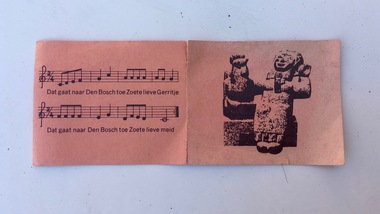
Small statue
... The pink paper folder contains a description of the story of Zoete Lieve Gerritje in Dutch, French, German and English. ...The pink paper folder contains a description of the story of Zoete Lieve Gerritje in Dutch, French, German and English. A small grey coloured statue depicting a farmer's wife sitting on a bench. ...A small grey coloured statue depicting a farmer's wife sitting on a bench. Beside her is a basket with a rooster in it. The item is accompanied by a small paper folder explaining the statue's connection with the Dutch folk song: Zoete Lieve Gerritje.The pink paper folder contains a description of the story of Zoete Lieve Gerritje in Dutch, French, German and English. -
 Plutarch Project
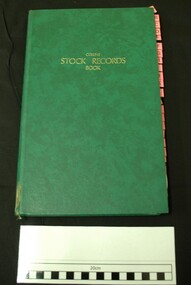
Film screening Log Book, Log Book, Collins late 1950's
... English, French, German, Swedish, Dutch language films. “Cosmopolitan Motion Pictures” was the first company to bring Swedish and Dutch films to Australia. They also showed Martial Arts films for the first time in Australia in 1975 at the Galaxy Theatre in Melbourne. However one of the most significant pieces that tell the story...English, French, German, Swedish, Dutch language films. “Cosmopolitan Motion Pictures” was the first company to bring Swedish and Dutch films to Australia. They also showed Martial Arts films for the first time in Australia in 1975 at the Galaxy Theatre in Melbourne. However one of the most significant pieces that tell the story ...Yiannoudes Family Film Memorabilia It is normally a time consuming and difficult task to accurately assess a collection’s significance to the primary criteria, however in the case of the “Yiannoudes Family Film Memorabilia” we have no hesitation of its high significance about its historic, social, rarity, interpretive, cultural and provenance to Australia, including the country side where most of this collection memorabilia visited. From January 1959 and until 1982, “Cosmopolitan Motion Pictures”, owned by Mr Peter Yannoudes (Παναγιώτης Γιαννούδης) and Mr Stathis Raftopoulos (Στάθης Ραφτόπουλος) travelled around Australia to entertain the Greek, Turkish, Indian and Yugoslav speaking population of Australia and provide a significant cinema culture. They travelled as far as Perth in WA, Adelaide in SA, Tasmania, Darwin in Nt, Canberra in ACT and Sydney and NSW. However they found themselves also in places like Berri and Renmark in NSW, where concentrations of migrants lived and thrived during the period. Initially they were travelling by train, carrying all their equipment by hand and placing them in boxes and suitcases. However after 1962 when they acquired their first automobile, travelling became less of a burden, nevertheless cumbersome and laborious. They carried with them initially two portable projectors (second one as a backup) and at times travelled with a third in order to ensure that technology will not be letting them down at the time of film projection. At times the films were projected onto a white sheet of cloth because there was no proper screen to project it on at the venue they were using. Mr P. Yiannoudes has also published a book in October 2010, titled “Greek Cinema Across Australia – Behind the Scenes”. The book was published in two languages, English and in Greek. Details about the launch can be found on the Diasporic Literature Spot website at this address (in the Greek language) http://diasporic.org/ellinika/biblia/greek-films-in-australia/. His book is devoted to those with whom he co-operated in order to bring for the first time Greek language films into Australia. Their names are: Stathis Raftopoulos, Andreas Papadopoulos, Andreas Katopodis, Theodoros Kanellopoulos, Michael Ioannou, Fotis Hatzipavlides, Kostas Vrahnas, Evaggelos Terpenos, Dionysis Lourantos, Dimitris Georgiou, Vasilis Florias and Jim Gragie. All businessmen with the right entrepreneurial spirit to be the first and to make their mark in the making of cultural Australia. Mr P. Yiannoudes a Cypriot by descent born in the town of Vouni, a village in the area of Lemesos. In Lemesos he learned the first few things about cinema which would help him in all his later life. He migrated to Australia in 1956 has been a prominent member of the Greek & Cypriot Communities in Melbourne for many decades. He has been President of the Cypriot Community, President of Federation of Cypriot Communities in Australia (for 18 years), President of SEKA (for 26 years) and highly regarded member of the Greek-Cypriots Diaspora since he also has been Vice-President of the Global Federation of Cypriots of Diaspora for 18 years. Mr P. Yiannoudes is now working on creating a small museum of these pieces in the back of the Westgarth Theatre with the help of the Plutarch Project and …. In this collection numbering hundreds of items, we will try and capture some of the glory that was the Greek film industry in Australia for 23 years between 1959 and 1982. “Cosmopolitan Motion Pictures” also owned a large number of cinemas in Melbourne, the National Theatre in Richmond, the Westgarth Theatre in Northcote (which is still owned by the Yiannoudes family today), Sun Theatre in Yarraville, Kinema in Albert Park, Empire Theatre in Brunswick, Paramount Theatre in Oakleigh, Globe Theatre in Richmond, Galaxy Theatre in Brunswick and the Cosmopolitan Theatre in Brusnwick. At the same time they were hiring other theatres for film projections. They were the Astor Theatre in St. Kilda, Victoria Theatre in Richmond, Sunshine Theatre in Sunshine. Apart from Melbourne they were using the Pantheon Theatre in Adelaide, the Norwood Town Hall in Adelaide, the Shepparton Town Hall in Shepparton, the Premier Theatre in Perth, the Rivoli Theatre in Berri and the Renmark Theatre in Renmark. The number of films shown around Australia were over 1500 in total whilst about 1218 of them were in the Greek language. Other languages shown were in Turkish (about 150 films), Yugoslavian (about 100 films), English, French, German, Swedish, Dutch language films. “Cosmopolitan Motion Pictures” was the first company to bring Swedish and Dutch films to Australia. They also showed Martial Arts films for the first time in Australia in 1975 at the Galaxy Theatre in Melbourne. However one of the most significant pieces that tell the story with places and dates is the Show Logbook. The Show Logbook has a large number of stories to tell. It is still intact and in fair condition after all these years of travelling around Australia. It is categorised with an alphabetic index on the right by film title. Greek, Indian, Turkish and Yugoslav language film titles adorn its pages alongside the place where they were first shown, the towns and cities they visited and the dates for each one. It is an extremely significant part of history of the settlement of migrants in Australia. This Log Book is of Primary Significance to the "Cosmopolitan Motion Pictures" and the Yiannoudes family film memorabilia collection. It has a Historic, Social, Provenance and Rarity significance for the settlement of migrants in Australia and the entertainment industry.This is the Log Book, manually updated and used by "Cosmopolitan Motion Pictures" for films shown in different parts of AustraliaCollins Stock Records Booklogbook, films, shown, cultural, language, greek, australia, γιαννούδης, κατάσταση, yiannoudes -
 Melbourne Legacy
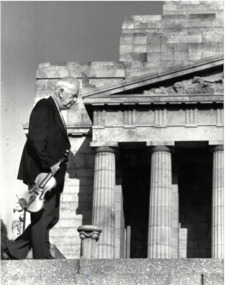
Photograph, The Changi Violin, 1989
... Dutch, British and American Concert Parties scratched in to the varnish. There are some well-known names scratched into the violin including: The English author and cartoonist, Ronald Searle; Australian entertainer, Frank Rich; and Australian Author, Russell Braddon. Mr Arnel died in 1982 and the violin was presented to Melbourne Legacy for preservation, safe keeping and display by his widow Mrs Florence Arnel in 1983. A record of a poignant reunion, Jack Geoghegan knew the violin while in Changi Prison and posed for photos on the Shrine to tell the story ...A photo of Jack Geoghegan holding the violin that is part of Melbourne Legacy's collection (see 00080) at The Shrine. The photo appeared in an article in The Age in 1989. One photo also appeared in the President's Highlights report in 1989. The caption of that photo says, 'Pensive thoughts for ex-prisoner of Changi Prison, Jack Geohegan when, as a guest of Melbourne Legacy, he was reunited with a very special possession kept in Legacy's care. Jack, whose signature is one of many, had not seen the violin since his days at Changi.' Background: This violin was played by VX30301 Dvr Roy Arnel, as a member of the Australian Imperial Force Concert Party, in the Changi POW camp, Singapore from 1942-1945. It is claimed that the violin, in its case was thrown over the wall by a Chinese civilian. Roy Arnel, a South African by birth enlisted on 7 June 1940 at Royal Park, Melbourne and served with 2 AASC Company as a driver. He was captured by the Japanese Imperial Army at the fall of Singapore in February 1942. There was more than one concert party in Changi as indicated on the rear of the violin. The details of the Dutch, British and American Concert Parties scratched in to the varnish. There are some well-known names scratched into the violin including: The English author and cartoonist, Ronald Searle; Australian entertainer, Frank Rich; and Australian Author, Russell Braddon. Mr Arnel died in 1982 and the violin was presented to Melbourne Legacy for preservation, safe keeping and display by his widow Mrs Florence Arnel in 1983.A record of a poignant reunion, Jack Geoghegan knew the violin while in Changi Prison and posed for photos on the Shrine to tell the story in The Age. Black and white photo x 3 of the Changi Violin at The Shrinechangi violin, pow, jack geohegan -
 Musculoskeletal Health Australia (now held by the Glen Eira Historical Society)
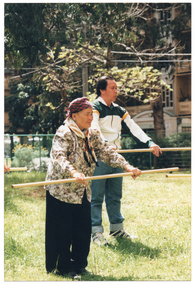
Photograph - Group photo, Circa 1998 to 2000
... In the background, there is a multi-story building in the distance. arthritis foundation of victoria afv osteoporosis victoria ov culturally and linguistically diverse cald languages other than english lote migrant communities vietnamese move it or lose it pole exercises holland court playground 1998 2000 [On a yellow sticky note, in thick black pencil] 60+ COL photo of a man and an elderly woman exercising outdoors on a grass lawn. ...In the 1990s and early 2000s, the Arthritis Foundation of Victoria conducted a range of exercise classes under the theme, "Move It Or Lose It". One such class was a pole exercise class for the Vietnamese community, designed for people 60 years of age and over. In this photo, a man and an elderly woman are exercising outdoors on a grass lawn. They each are holding a wooden pole horizontally in front of them, at waist height. In the background, there is a multi-story building in the distance.COL photo of a man and an elderly woman exercising outdoors on a grass lawn. They each are holding a wooden pole horizontally in front of them, at waist height. In the background, there is a multi-story building in the distance.[On a yellow sticky note, in thick black pencil] 60+arthritis foundation of victoria, afv, osteoporosis victoria, ov, culturally and linguistically diverse, cald, languages other than english, lote, migrant communities, vietnamese, move it or lose it, pole exercises, holland court playground, 1998, 2000 -
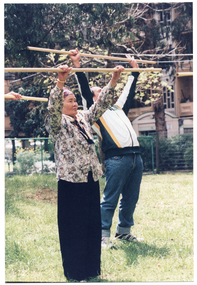 Musculoskeletal Health Australia (now held by the Glen Eira Historical Society)
Photograph - Group photo, Circa 1998 to 2000
... In the background, there is a multi-story building in the distance. arthritis foundation of victoria afv osteoporosis victoria ov culturally and linguistically diverse cald languages other than english lote migrant communities vietnamese move it or lose it pole exercises holland court playground 1998 2000 COL photo of a man and an elderly woman (and one other, partially obscured) exercising on a grass lawn outdoors with poles. ...In the 1990s and early 2000s, the Arthritis Foundation of Victoria conducted a range of exercise classes under the theme, "Move It Or Lose It". One such class was a pole exercise class for the Vietnamese community, designed for people 60 years of age and over. In this photo, a man and an elderly woman (and another person, partially obscured) are exercising on a grass lawn outdoors. They are each holding a wooden pole horizontally above their heads, with their arms outstretched. The man is leaning backwards, as he pushes his pelvis pushed forward. In the background, there is a multi-story building in the distance.COL photo of a man and an elderly woman (and one other, partially obscured) exercising on a grass lawn outdoors with poles. They are holding the poles above their heads, with their arms outstretched. The man is leaning backwards, with his pelvis pushed forwards. There is a multi-story building in the distance behind them.arthritis foundation of victoria, afv, osteoporosis victoria, ov, culturally and linguistically diverse, cald, languages other than english, lote, migrant communities, vietnamese, move it or lose it, pole exercises, holland court playground, 1998, 2000
