
Showing 408 items matching "e north"
-
 Eltham District Historical Society Inc
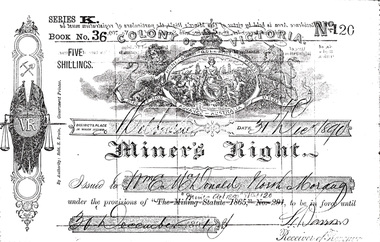
Document, Miner's Right issued to William E. McDonald of North Morang for one year, 31 December 1890
... Miner's Right issued to William E. McDonald of North Morang for one year, 31 December 1890...Miner's Right, William Edward McDonald Digital file only scanned by EDHS from item on loan (photocopy only) Miner's Right issued to William E. McDonald of North Morang for one year, 31 December 1890 Document ...Digital file only scanned by EDHS from item on loan (photocopy only)miner's right, william edward mcdonald -
 Ringwood and District Historical Society
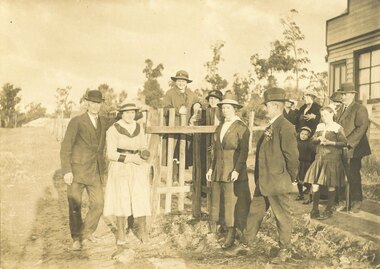
Photograph, Group around new tree Wandin North near E. Reads present home
... Group around new tree Wandin North near E. Reads present home...Tree planted for Harry Lord, Main Road, Wandin North, near E. Reads present home"....Tree planted for Harry Lord, Main Road, Wandin North, near E. Reads present home". Photograph missing from archives after having been scanned and catalogued as follows, however no clear information on location or date: Group around new tree Wandin North near E. ...Photograph missing from archives after having been scanned and catalogued as follows, however no clear information on location or date:Written on mounting sheet above the photograph, "R.B. Lord, Dolly Lord, Eileen Mitchell, Dot Mitchell, Ethel Mao, James Mitchell??? (Scotty) (around tree), Mrs. Chris Russell, Mrs. Ruby Lydster and child and lady unknown, (Thos Tuadion?) Jean Mitchell". Written on back of mounting sheet, "Please return to Mrs. A. Cooke, Smith Street, Healesville. Tree planted for Harry Lord, Main Road, Wandin North, near E. Reads present home". -
 Port Melbourne Historical & Preservation Society
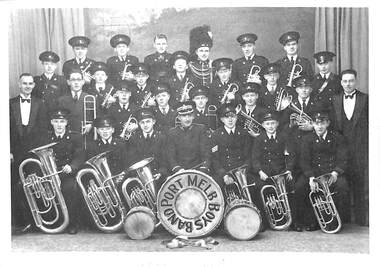
Photograph - Port Melbourne City (Boys) Band, Jan 1939
... ...E NORTH...Copy with names Identifies Bill GOUDIE above as R GAMBLE. arts and entertainment - music port melbourne city band E NORTH L ROBERTSON E MARLOW E LOVELL K ROGERS B THOM Rf HANOS J ALEXANDER Bill GRIDLAND J KELLY R BAILEY T MARLOW W KIRBY L BROWN L McBRIDE R GAMBLE S WISBY 'Orgy' BAILEY J BROWN W WILSON H SYKES G MATTHEWS Albert JENKINS H COOK R WINZAR C COWARD Bill GOUDIE One of a set of five photographs copied from prints brought in by Len McMurrich in 1995: Studio portrait of Port Melbourne City (Boys) Band January 1939. ...Bill GOUDIE is in second row from front, four from the right holding trombone. Bandmaster, Albert JENKINS in front row behind the bass drum. Copy with names Identifies Bill GOUDIE above as R GAMBLE.One of a set of five photographs copied from prints brought in by Len McMurrich in 1995: Studio portrait of Port Melbourne City (Boys) Band January 1939. Copy with most names in Show & Tell (B.11.17), see media.arts and entertainment - music, port melbourne city band, e north, l robertson, e marlow, e lovell, k rogers, b thom, rf hanos, j alexander, bill gridland, j kelly, r bailey, t marlow, w kirby, l brown, l mcbride, r gamble, s wisby, 'orgy' bailey, j brown, w wilson, h sykes, g matthews, albert jenkins, h cook, r winzar, c coward, bill goudie -
 Eltham District Historical Society Inc
Document - Folder, North, Edley
... ...Tralford E North...Joseph Benjamin North was a well-known professional musician in Melbourne in late 1800 to mid 1900s, teaching music and playing in what became the Melbourne Symphony Orchestra. He married Lucinda Matilda and their children were Tralford E...Marjorie North Tralford Norman Sherbourne Road Montmorency Looker Road Montmorency Briar Hill Montmorency Catholic Ladies College Merton Hall Melbourne Girls Grammar School Ivanhoe Girls Grammar School Wesley College Meruka Park St Helena Road St Faith's Anglican Church Montmorency William Sapsford Floods in Eltham Joseph Benjamin North Leon Lambert Melbourne Symphony Orchestra Karingal Drive Meruka House Alan Gardner Lucinda Matilda North Tralford E North Camille D North Montmorency Cricket Club Diamond Creek Eltham Railway Station Judge Book Village Fred Warne Edley North Caroline North Eltham Cemetery. ...Joseph Benjamin North was a well-known professional musician in Melbourne in late 1800 to mid 1900s, teaching music and playing in what became the Melbourne Symphony Orchestra. He married Lucinda Matilda and their children were Tralford E and Camille D. With friend Leon Lambert, North purchased 60 acres of land around Karingal Drive and Sherbourne Road and built two houses; they paid for a wooden bridge for access. North eventually sold his house to a family named Green but later the land was sold to the Shire of Eltham, and it is now known as Meruka Park, and the house, Meruka House; Alan Gardner named the park. After Lambert's death, his property was bought by Fred Warne. Edley North was born in 1835, and died 26 March 1923; he married Caroline North, born 1835, died 23 July 1922. Edley's family migrated from England in 1859, settling in Adelaide. He was granted an allotment of 221 acres on Phillip Island 1868-1870. on 7 April 1874 he travelled to Pine Lodge and later moved his wife and five children. He and Caroline later moved to a small farm, Willow Grove in Eltham, purchased between 1905 and 1910 (first mentioned in the rate book in 1908 as being a house and 10 acres on Susan Street, and would also have had frontage on Brougham Street); Their daughter Violet Alice inherited it; she married Walter J Dobson around 1921; he died on 25 March 1948 aged 77 and Violet on 4 January 1947. Willow Grove was later purchased by A George and P Audrey Hester April/May 1947. Edley, Caroline and Violet are all buried in Eltham Cemetery. Marjorie Mary North was born in 1909 ; the family travelled in a horse-drawn waggon from Fitzroy to spend weekends in their little holiday house in Sherbourne Road on 10 acres of land. In 1933, she married Tralford Norman whose parents owned 62 acres of land including Meruka Park. Marjorie and Tralford lived in Looker Road, Montmorency; she died 7 February 2003. Contents Newspaper article: "When life centred on a weekender", Diamond Valley News, 25 September 1984, memories of Montmorency of Marjorie North. Newspaper article: "Worse floods seem likely", Diamond Valley News, 25 September 1984, floods in Eltham Handwritten notes: Information by Marjorie North's about her grandmother, September 1989. Handwritten and typed transcript: "J. B. North", by Marjorie North, history of Joseph Benjamin North. Letter: From Monash University to Marjorie North, 15 November 1989, being unable to assist with her enquiry about the meaning of name [unspecified in the letter but possibly Meruka] Letter: June Stanton (nee Hester) to Eltham District Historical Society, 17 February 1993, seeking information on her great grandfather Edley North and wife Caroline. Christmas card [attached to letter from June Stanton]: Line drawing Eltham Primary School 1856, text history of school Letter: Eltham Historical Society to June Hester, 11 June 1993, providing information held by the Society. Letter: Nancy Chandler (nee Williamson) to Jo McCormick 18 March 2001, providing information about Edley and Carline North, her great grandparents. Email: Patsy Moppett to Eltham District Historical Society October 2010: A photograph of Edley and Caroline North found, wish to return it to family. Family tree: North/Dobson family. Death notice: Marjorie May North, died 7 February 2003.Newspaper clippings, A4 photocopies, etcmarjorie north, tralford norman, sherbourne road montmorency, looker road montmorency, briar hill, montmorency, catholic ladies college, merton hall, melbourne girls grammar school, ivanhoe girls grammar school, wesley college, meruka park, st helena road, st faith's anglican church montmorency, william sapsford, floods in eltham, joseph benjamin north, leon lambert, melbourne symphony orchestra, karingal drive, meruka house, alan gardner, lucinda matilda north, tralford e north, camille d north, montmorency cricket club, diamond creek, eltham railway station, judge book village, fred warne, edley north, caroline north, eltham cemetery., violet alice dobson (nee north), willow farm eltham, edley north family tree, walter john dobson family tree, nancy chandler (nee williamson), pine lodge, elijah north -
 National Wool Museum
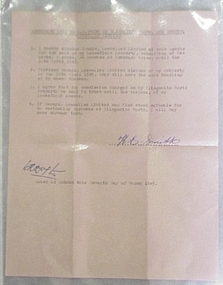
Agreement
... ...H E - Elingamite North...Agreement between HE Smith of Eligamite North and Dennys Lascelles Limited, dated 7 March 1949. Wool Sales - Auction System Dennys Lascelles Limited Smith H E - Elingamite North Agreement between HE Smith of Eligamite North and Dennys Lascelles Limited, dated 7 March 1949. ...Agreement between HE Smith of Eligamite North and Dennys Lascelles Limited, dated 7 March 1949.Agreement between HE Smith of Eligamite North and Dennys Lascelles Limited, dated 7 March 1949.wool sales - auction system, dennys, lascelles limited, smith, h e - elingamite north -
Glen Eira Historical Society
Document - Wheatley Road, 143, Ormond
... E.... Brighton Estate... North...Wheatley Road Ormond Wheatley Alexander E. Brighton Estate North Road Malva Street Ruby Street Maud Street Barrett Edward E. ...Handwritten document regarding Alexander E. Wheatley. List of owners from 1892 to 1990 who lived at 143 Wheatley Road. Document is undated and unsigned.land subdivision, wheatley alfred e., wheatley road, ormond, wheatley alexander e., brighton estate, north road, malva street, ruby street, maud street, barrett edward e., mcdonald john, ryan m.a. mrs, mellor william, burman ernest, mann harry, mann jean mrs., mann k. miss., mann j. miss., mann c.h. miss., palfrey r.m., barrett edward -
Glen Eira Historical Society
Letter - Kooyong Road, 75, Caulfield North
... E... Kooyong Road... North...A handwritten report, 2 pages, by Dorothea E Hancock dated 24/11/1982 concerning the Conferring of the Freedom of Entry to the City of Caulfield upon the Third Ordnance Services Unit Royal Australian Army Ordnance Corps ceremony held in Caulfield Park on 4 August 1978. Provides history of the occupation of the Units premises at 75 Kooyong Road, North...Hancock Dorothea E Kooyong Road North Caulfield Red Cab company Yellow Cab company Brick houses Caulfield Park City of Caulfield Caulfield Taxi’s Armed forces Public transport Third Ordnance Services Unit Royal Australian Army Ordnance Corps Tanks corps World War 1939 – 1945 Letter Kooyong Road, 75, Caulfield North ...A handwritten report, 2 pages, by Dorothea E Hancock dated 24/11/1982 concerning the Conferring of the Freedom of Entry to the City of Caulfield upon the Third Ordnance Services Unit Royal Australian Army Ordnance Corps ceremony held in Caulfield Park on 4 August 1978. Provides history of the occupation of the Units premises at 75 Kooyong Road, North Caulfield and information about the Red Cab company which occupied the premises in the 1930’s.hancock dorothea e, kooyong road, north caulfield, red cab company, yellow cab company, brick houses, caulfield park, city of caulfield, caulfield, taxi’s, armed forces, public transport, third ordnance services unit royal australian army ordnance corps, tanks corps, world war 1939 – 1945 -
 Bendigo Historical Society Inc.
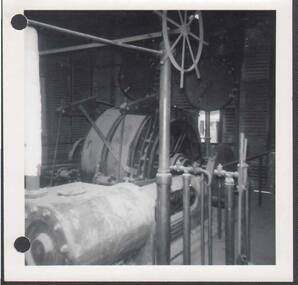
Photograph - MINING PHOTOGRAPHS
... [d] Central Deborah approx 1968 caption. [e] North Deborah Battery caption. [f] Deborah Engine Room caption. ...[d] Central Deborah approx 1968 caption. [e] North Deborah Battery caption. [f] Deborah Engine Room caption. ...Black & White photographs of 1960's mining equipment located Bendigo. [a] Deborah Engine room caption. [b] North Deborah Battery caption. [c] Central Deborah caption. [d] Central Deborah approx 1968 caption. [e] North Deborah Battery caption. [f] Deborah Engine Room caption. [g] South Deborah caption.bendigo, gold mining, gold mine -
 Bendigo Historical Society Inc.
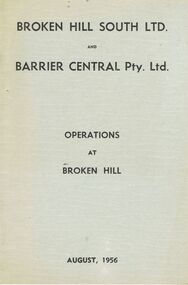
Document - MCCOLL, RANKIN AND STANISTREET COLLECTION: BOOKS RELATED TO BROKEN HILL MINING COMPANIES, 1950s
... Books related to Broken Hill Mining companies. a/ Broken Hill South, operations at Broken Hill. b/ North Broken Hill LTD, summery of operations. c/ Zinc Corp LTD New Broken Hill Consolidated Limited Southern Power Corporation Limited PTY LTD. d/ The Broken Hill Mining Industry. e/ North Broken Hill LTD, reports & statements of accounts June 1934. ...Books related to Broken Hill Mining companies. a/ Broken Hill South, operations at Broken Hill. b/ North Broken Hill LTD, summery of operations. c/ Zinc Corp LTD New Broken Hill Consolidated Limited Southern Power Corporation Limited PTY LTD. d/ The Broken Hill Mining Industry. e/ North Broken Hill LTD, reports & statements of accounts June 1934. ...McColl Rankin & Stanistreet. Books related to Broken Hill Mining companies. a/ Broken Hill South, operations at Broken Hill. b/ North Broken Hill LTD, summery of operations. c/ Zinc Corp LTD New Broken Hill Consolidated Limited Southern Power Corporation Limited PTY LTD. d/ The Broken Hill Mining Industry. e/ North Broken Hill LTD, reports & statements of accounts June 1934. Markings/inscriptions: each book labelled on front cover as above.organization, mining, mccoll rankin & stanistreet, broken hill miming industry zinc reports and statement of accounts -
Ringwood and District Historical Society
Map, Ringwood -Montrose-Heathmont folded Map with ads for local businesses. C1960s
... White folded map from Ringwood > Montrose E > W and North Ringwood > Heathmont N > S surrounded by ads for local businesses. ...White folded map from Ringwood > Montrose E > W and North Ringwood > Heathmont N > S surrounded by ads for local businesses. ...Front cover missing - ad for power cords and piston rings - originally back cover.White folded map from Ringwood > Montrose E > W and North Ringwood > Heathmont N > S surrounded by ads for local businesses. Not dated. -
 University of Melbourne, Burnley Campus Archives
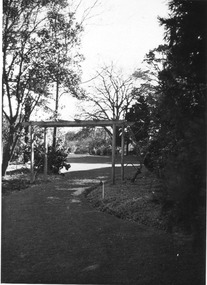
Photograph - Black and white print, E.M. Gibson, Garden View, Early August 1947
... "E/Aug 1947. Oak Lawn - view through pergola looking north." E M Gibson 9/2 364...oak lawn pergola e. m. gibson collection garden view "E/Aug 1947. Oak Lawn - view through pergola looking north." E M Gibson 9/2 364 Black and white photograph of a timber pergola and lawn, trees and shrubs. ...Black and white photograph of a timber pergola and lawn, trees and shrubs."E/Aug 1947. Oak Lawn - view through pergola looking north." E M Gibson 9/2 364oak lawn, pergola, e. m. gibson collection, garden view -
Glenelg Shire Council Cultural Collection
Photograph - Sheet of 12 contact prints - Various historic Portland buildings and Landmarks, c. 1970
... Identifying numbers 5711 a, b, c, d, e, f, g, h, i, j, k, l Measurements unframed (a, d, e, g, h, k, l)5 x 3.24.6 x 3 (b, c, f, i, j) Framed (d, g, h, k)5.3 x 3.65 x 3.5 (b, c, f, i, j) (a) All Saints Catholic Church (b) 'Blainslie' (c) Railway Line and Dutton's beach, towards Whalers Bluff (d) Lighthouse, Observatory Hill (e) North side Julia Sreet, looking west, Bank of Australasia (f) Fire station, C of E grounds (g) Julia Street from Percy Street intersection looking towards sea (h) Richmond House - W.M. ...Identifying numbers 5711 a, b, c, d, e, f, g, h, i, j, k, l Measurements unframed (a, d, e, g, h, k, l)5 x 3.24.6 x 3 (b, c, f, i, j) Framed (d, g, h, k)5.3 x 3.65 x 3.5 (b, c, f, i, j) (a) All Saints Catholic Church (b) 'Blainslie' (c) Railway Line and Dutton's beach, towards Whalers Bluff (d) Lighthouse, Observatory Hill (e) North side Julia Sreet, looking west, Bank of Australasia (f) Fire station, C of E grounds (g) Julia Street from Percy Street intersection looking towards sea (h) Richmond House - W.M. ...Sheet of 12 contact prints of rephotographed photographs. Identifying numbers 5711 a, b, c, d, e, f, g, h, i, j, k, l Measurements unframed (a, d, e, g, h, k, l)5 x 3.24.6 x 3 (b, c, f, i, j) Framed (d, g, h, k)5.3 x 3.65 x 3.5 (b, c, f, i, j) (a) All Saints Catholic Church (b) 'Blainslie' (c) Railway Line and Dutton's beach, towards Whalers Bluff (d) Lighthouse, Observatory Hill (e) North side Julia Sreet, looking west, Bank of Australasia (f) Fire station, C of E grounds (g) Julia Street from Percy Street intersection looking towards sea (h) Richmond House - W.M. Learmonth (i) London Inn (j) Julia Street. Hewly and Learmonth Woolstores, Bank of Australasia (k) View from Henty Beach - Old Town Hall (l) Annie Clark's ladies school -
 Ballarat Tramway Museum
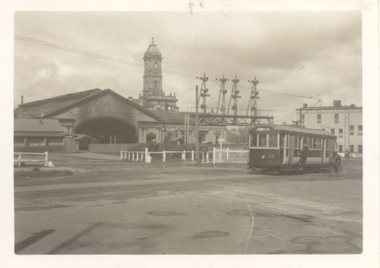
Photograph - SECV Ballarat No. 29 passing over the level crossing, E. A. Downs, Sept. 1943
... Sept. 1943, Photograph E. Downs. Lydiard St North....Sept. 1943, Photograph E. Downs. Lydiard St North. Photograph SECV Ballarat No. 29 passing over the level crossing E. ...Black and white photograph of Ballarat No. 29 passing over the level crossing at the Ballarat Railway Station, with the station building in the background. The conductor is on the footboards of the tram. Sept. 1943, Photograph E. Downs. Lydiard St North.On rear in ink "Ballarat Railway Station - from Down end Sept. 1943 Photo E. Downs.trams, tramways, ballarat station, railway crossing, lydiard st north, tram 29 -
 Flagstaff Hill Maritime Museum and Village
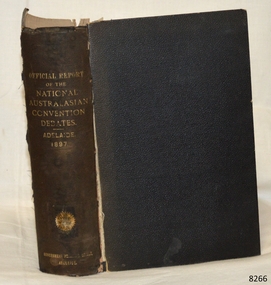
Book - Publication of Speeches, C. E. Bristow Government Printer, Official Report of The National Australasian Convention Debates Adelaide, 1897
... (Debate Speeches March 22nd to May 5th 1897) Author: Various Speeches by various Speakers Publisher: C. E. Bristow Government Printer, North Terrace ,Adelaide. SA. ...(Debate Speeches March 22nd to May 5th 1897) Author: Various Speeches by various Speakers Publisher: C. E. Bristow Government Printer, North Terrace ,Adelaide. SA. ...This volume is one of the primary founding documents of the Australian Federation. Published in Adelaide in 1897 by Charles Edward Bristow (the South Australian Government Printer), this heavy octavo volume captures the verbatim transcript of the First Session of the Australasian Federal Convention, held in Adelaide from 22 March to 5 May 1897. The volume contains verbatim debates from the convention, where statesmen from across the colonies drafted the framework for the Australian Constitution.Hard cover book, National Australasian Convention. (Debate Speeches March 22nd to May 5th 1897) Author: Various Speeches by various Speakers Publisher: C. E. Bristow Government Printer, North Terrace ,Adelaide. SA. Editor: C. E. Bristow Government Printer Date: 1897 Further Information: Black embossed cloth hardcover with a brown spine and lettering in gilt. The spine has a publishers logo in gilt.non-fictionThis volume is one of the primary founding documents of the Australian Federation. Published in Adelaide in 1897 by Charles Edward Bristow (the South Australian Government Printer), this heavy octavo volume captures the verbatim transcript of the First Session of the Australasian Federal Convention, held in Adelaide from 22 March to 5 May 1897. The volume contains verbatim debates from the convention, where statesmen from across the colonies drafted the framework for the Australian Constitution.flagstaff hill, warrnambool, shipwrecked coast, flagstaff hill maritime museum, maritime museum, shipwreck coast, flagstaff hill maritime village, great ocean road, book, pattison collection, warrnambool library, warrnambool mechanics’ institute, ralph eric pattison, corangamite regional library service, warrnambool city librarian, mechanics’ institute library, victorian library board, warrnambool books and records, warrnambool children’s library, official report of the national australasian convention debates adelaide -
 Bendigo Historical Society Inc.
Photograph - WES HARRY COLLECTION: Photographs, 1870's - 1890's
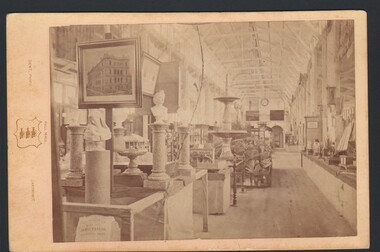
... Photo taken in the early 1870's looking north. (e) In the garden of Fortuna, with George Lansell? ...Photo taken in the early 1870's looking north. (e) In the garden of Fortuna, with George Lansell? ...Group of five photographs mounted on card: (a) Exhibit at Melbourne exhibition, probably 1888, for James Taylor Monumental Works; photo by 'Bent' Pall Mall Sandhurst. (b) Family group( two adults, Four children) in front of a Victorian home, the home has a bay window and ornate stonework. (c) Workers posed in front of an unnamed Brewery, High St. Golden Square. This photo is by R. Dermer Smith, Bull St. Sandhurst. (d) Royal Hustlers Mine (1150), Barnard St. Bendigo, adjoining the old upper reserve dam (now the Olympic pool). Photo taken in the early 1870's looking north. (e) In the garden of Fortuna, with George Lansell? In the foregroundR. Dermer Smith, Bentphotograph, bendigo area, george lansell, fortuna, royal hustlers mine, brewery golden square, james taylor monumental works, r. dermer smith. bent sandhurst -
Canterbury History Group
Photograph - Maling Road shops and environs, Stuart Warmington, 1993
... north side - 88 coloured photographs taken by Jan Pigot in 1993.|Section C- Bryson Street shops - car park - 4 coloured photographs taken by Jan Pigot in 1993-4.|Section D- Canterbury shops and streetscapes - 76 coloured photographs taken by Stuart Warmington c.1995.|Section E...north side - 88 coloured photographs taken by Jan Pigot in 1993.|Section C- Bryson Street shops - car park - 4 coloured photographs taken by Jan Pigot in 1993-4.|Section D- Canterbury shops and streetscapes - 76 coloured photographs taken by Stuart Warmington c.1995.|Section E ...Photographs recording interiors and exteriors of Canterbury shops, shopkeepers and Federation details of architecture. Section A -Maling Road shops, south side - 87 coloured photographs taken by Jan Pigot in 1993.|Section B- Maling Road shops, north side - 88 coloured photographs taken by Jan Pigot in 1993.|Section C- Bryson Street shops - car park - 4 coloured photographs taken by Jan Pigot in 1993-4.|Section D- Canterbury shops and streetscapes - 76 coloured photographs taken by Stuart Warmington c.1995.|Section E- Maling Road shops, north side - 27 coloured photographs taken by Stuart Warmington c. 1995.|Section F- Maling Road shops, north and south side - 24 coloured photographs taken by Stuart Warmington 1995.|Section G- Plaques and Signs in Canterbury - 14 coloured photographs taken by Jan Pigot c. 1994.Collection of coloured photosmaling road, canterbury, shops, shopkeepers, hel> f, petroro> tony, bourke> francis, d'annibale> grace, buckley> june, buckley> ken, godfrey, greengrocers, newsagents, gift shops, furniture restorers, florists, nurseries (plants), cake shops, cafes, butchers -
 Bendigo Historical Society Inc.
Magazine - AILEEN AND JOHN ELLISON COLLECTION: THE NEW NATION MAGAZINE
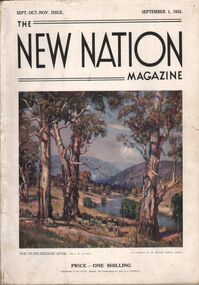
... Cardinal) - "The hidden bird" (by E. M. England) - North Australia trails ( by C. Price Conigrave) - Tales of the turf Fred Archer (by S. ...Cardinal) - "The hidden bird" (by E. M. England) - North Australia trails ( by C. Price Conigrave) - Tales of the turf Fred Archer (by S. ...The New Nation Magazine Sept. Oct. Nov. Issue. September 1, 1932. On the front cover a painting "The Murrumbidgee River by J. R. Jackson. Price 1 shilling the magazine has 112 pages, the last two pages are ripped and the back cover is missing. Contents: Frontispiece "morning of the dogger bank" (by T. Benetter)- The British commonwealth of Nations - Switzerland, land of lakes and mountains (by Hilary lofting) - Highways of the Syrian desert (by Francis Birtles) - Seven ages of the Australian aboriginal - The game of the empire, the approaching cricket test matches (by M. A. Noble) - Short story, the last run (by H. H. Cardinal) - "The hidden bird" (by E. M. England) - North Australia trails ( by C. Price Conigrave) - Tales of the turf Fred Archer (by S. A. Marden) - The wide world round - Cape Horn (by J. Newman Barker) - "The home in the clearing" (by Sydney long) - Whitsunday passage (by Henry G. Lamond) - Old bridges (by J. L. Ranken) - The city of the longest drink (by A. C. Cummins) - The life of the cuckoo (by M. S.) - Radio - The world of music (by A. L. Kelly) - The world of women (by E. G. Manby Suttor) - Shopping from an easy chair - The Australian wool trade - Our verse farm - My wool clip (by H. W. Wright) - Windjammer days (by Gerald M. Moody) - Quarterly review of the stock and meat industry (by J. B. Cramsie) - New Zealand letter - At ye booksellers today - A number of things - The modern home - Portland cement - The good housewife (by E. G. Manby Suttor) - Cousin Shirley.book, magazine, the new nation -
 Narre Warren and District Family History Group
Booklet, Narre Warren & District Family History Group Inc, Casey Cardinia Collection - Beaconsfield Information File
... The dates the articles were published, and the titles of the articles are listed below: 2/02/2004 Dedicated to the job 17/08/2005 Memorial to shine again 29/08/2007 Obituary – Mona Treasure dies, aged 80 4/04/2007 Developer’s bid demolished – the old Coach House 23/08/2007 Kellbrae circa 1923 Undated Beaconsfield Roll of Honor 11/04/2007 Death shocks town – Tony Rushton 12/04/2006 Cenotaph History Revisited 10/06/2009 Hauntingly Beautiful and now Preserved - Nature Reserve 15/09/2021 Mr Methven’s Lasting Legacy - Gary Methven 8/09/2021 New Era at Beacy Primary - Heidi Ingis 8/09/2021 Drizabones and Beards - a Farewell to Mr Methven 16/06/2021 Scout Life Member on the Honour List - Margaret Turner 13/03/2013 Beaconsfield Avenue of Honour - Official Opening 17/06/2015 Modest, But Solid Foundation - Beaconsfield Primary School 9/07/2014 Kay’s at the Wheel - Kay Rankin 18/02/2009 Little Berwick Grows an Identity 13/02/2013 Beacy Loses a Favorite Son From the Field - Alex Robson 7/09/2016 Fine Innings Comes to an End - Len Maddocks 18/04/2007 Grief Takes Its Toll - Tony Rushton UNKNOWN Shipwatchers’ Memorial to be Unveiled Nov 18 23/11/2022 Locals Against Demolition - Railway House 14/02/2024 Fiery Passion to Protect - Mick Ott 1/03/2023 Battle on Over Rail House 24/10/2018 History on a Plate 24/10/2018 Golfing Milestone Marked 21/12/2022 Stories Behind the Names 10/07/2024 Beaconsfield’s Very Best - Beaconsfield Football Club 16/10/2024 Reservoir Issue Ignored - Beaconsfield Reservoir 31/10/2024 Roots Run Deep as Beaconsfield Mitre 10 Celebrates 40 Years 22/04/2020 The Battle of the Creek 11/06/2025 OAM Honour for Couple - Graeme and Ann Taylor 9/07/2025 Beaconsfield’s Best On Show 19/03/2025 Scouting Doyen Mourned - Margaret Turner UNKNOWN A Slice of Beaconsfield - Corner Post Cafe 1/12/2025 Gwen & Audrey - Two Precious Ladies 1/12/2025 Beaconsfield Hall Relevant names relating to the articles in the folder are: Gary Ablett, Jack Adamson, James Adamson, Jim Adamson, John Adamson, Robert Sym Adamson, John Airdrie, Kane Airdrie, Alex Robson Perpetual Shield, Peter Allen, Alma Treloar Reserve, Linda Amos, Tim Anderson, Vic Anderson, Ken Archer, Joan Armitage, John Bailey, Daniel Battaglin, Cr Tania Baxter, Lord Beaconsfield, Beaconsfield Home Timber & Hardware, Beaconsfield Mitre 10, Beaconsfield Timber & Hardware, Bears Lagoon, Paul Beck, Peter Benazic, Mr E Bennett-North, Thomas Bent, Cley Bertoncello, Ned Bertoncello, Katherine Lucy Beswick, Cr George Blenkhorn, Sue Blenkhorn, Bonette Reserve, Mick Boraston, Emily Brightwell, Kelly Brooks-MacMillan, Bob Bysouth, Darren Bysouth, Josie Bysouth, Gordon Cameron, Kerry Canning, Laura Canning, Lawrie Canning, Carson Simpson Pty Ltd, Eris Cashman, Rick Cashman, Troy Cashman, Eric Chaplin, Mavis Cleary, Frank (Rocky) Clifford, Leigh Clifford, Paul Cohen, Frank Conn, Cooinda Road, Corangamite Light Horse Association, Norman Crawley, Margaret Cromb, Rik Crook, Adrian Crowe, Beverley Crowe, Pat Darcy, Geoff Davidson, Stephanie Davies, Pat Dean, Todd Devine, Amirthalingam Dhileepan, Laura Dixon, Tony Dodemaide, Audrey Dodson, Cliff Donegan, Andrew Downey, Bunny Drake, Drouin Home Timber & Hardware, Drouin Mitre 10, Edwin Flack Reserve, Warren Ellam, Gary Elliott, Kim Ellis, Clint Evans, Peter Evans, Corey Everitt, Keith Ewensen, Max Excell, Marc Fahkry, Marcell Fahkry, Ray Field, Michael Fisher, PM Andrew Fisher, Bill Flight, Joan Florence, Glenn Gambetta, John Gardiner, Jayden Gee, Bill Gehling, Tim Gerbes, Ken Goodes, Wayne Goodes, Kerrie Graham, Peter (Bonga) Graham, George Thomas Grant, Gwen Neve Garden, H J Heinz Co, Bluey Hampshire, Alf Harbour, William Harbour, Claud Harris, Joseph Harris, John Harrison, Royce Hart, Neil Harvey, Lois Hateley, Haunted Gully Olives, Fran Healy, Ray Heathcote, Anthony Hester, Paul Higgott, Scotty Hilton, Lindsay Hobson, Brad Hollick, Holm Park Reserve, Bob Hook, Loorain Hope, Pauline Hopkins, Jim Hower, Heidi Inglis, Iris Lewis Writing Competition, Craig Jackson, Ross Jackson, Harry Jensen, Damien Johnston, Tom Jok, Craig Jolliffe, Josie Bysouth Reserve, Kalora Park Cricket Club, Kellbrae, Kenilworth Villa Estate, Matt Kenny, Ben Kerrigan, Miss Joan Keys, Mrs George Keys, Kia Ora Nurseries, Graham Kneen, Afraa Kori, Graeme Legge, Cr Kate Lempriere, Light Horse & Field Artillery Museum, Little Berwick, Tammy Lobato, Di Lockwood, Patrick Lohan, Neil Lucas, Edmund Thomas Luke, Monty Luke, Una Luke, Sarah Maclagan, Len Maddocks, Ron Malhotra, Mick Malthouse, Elizabeth Markham, Alec Leslie May, Aleck May, Albert Maye, Bridgette McCallum, Anne McCormick, Troy McDermott, Neil McDonald, Maria McEwan, Fraser McGill, Ben McGowan, Don McKenzie, Jim McNamara, Cynthia Merrill, Gary Methven, Jann Methven, Scott Meyer, Frank Monyitte, Joseph Morgan, Cr Mick Morland, Kay Morland, Rebecca Mouy, MP Daniel Mulino, Ken Murphy, David Nagel, Gwen Neve, Ken Newitt, June Nicholas, Darryl Nisbet, Harry Nixon, Henry Nixon, Archie Nobelius, Carl Axel Nobelius, Carl Oscar Nobelius, Clifford Nobelius, Emily Nobelius, Florence Nobelius, Hilda Nobelius, Jack Nobelius, Percy Nobelius, Ron Nobelius, Ruby Nobelius, Rupert Nobelius, Stella Nobelius, Sylvia Nobelius, Charles Nott, Catherine Oldenburger, Paul Olsson, Jim Osborne, Oscar Nobelius Honey, Mick Ott, Cr Brett Owen, Ian Owen, Graeme Pateman, Bill Pearson, Perc Allison Oval, Thomas John Pettit, Arthur Pollard, Shaun Pollard, Samantha-Jane Potter, Scott Poulton, Yvonne Ramp, James Randle, Anne Read, Jamie Read, Jim Read, Les Reader, Jack Reid, Jason Reynolds, Rik Crook Cup, Rodney Robbie, Herman (Mac) Roberts, Katherine Lucy (Kath) Roberts, Les Roberts, Mary Roberts, Patricia Roberts, Haydn Robins, Troy Robinson, Alex Robson, Meagan Rogers, Gary Runge, Dulcie Rushton, Simone Rushton, Tony Rushton, Lou Russell, Miss Ryland, Margaret Sansom, Stuart Saw, Carolyn Schroen, Evelyn Seath, Darryl (Shags) Sheehan, Matthew Sims, Gary Sissons, L L Harold Smith, Noel Smith, St John of God Hospital, Stan Henwood Award, Cr Amanda Stapledon, Alan Stephenson, Lyn Studham, Hans Sumberg, Joan Szalman, Ann Taylor, Graeme Taylor, Taylor & Sangster Nursery, Casey Thomsen, Dick Tonks, Tooradin-Dalmore Football Club, Russell Trait, Gaylene June Treasure, Gerald Treasure, Merrilyn Joy Treasure, Mona Treasure, Rohan James Treasure, Rosalie Dawn Treasure, Alma Treloar, Betty Treloar, Margaret Treloar, Trevor Treloar, Trethowan, J H Tucker, Jessie Turner, Margaret Turner, Ted Turner, David Van Lambaart, Michael Vandenberghe, Russell Vincent, Phil Walton, Tom Watson, William Alexander Watt, Graham Watts, Charlie West, Thomas Clair Whiteside, Ted Whitten, Christine Wickes, Frederick John Williams, Rupert Ernest Williams, Bill Williamson, Cr Leticia Wilmot, Kerry Wilson, Windrush, MP Jason Wood, Rod Woodfine, Bill Zeldenryk, Dean Ziesler....The dates the articles were published, and the titles of the articles are listed below: 2/02/2004 Dedicated to the job 17/08/2005 Memorial to shine again 29/08/2007 Obituary – Mona Treasure dies, aged 80 4/04/2007 Developer’s bid demolished – the old Coach House 23/08/2007 Kellbrae circa 1923 Undated Beaconsfield Roll of Honor 11/04/2007 Death shocks town – Tony Rushton 12/04/2006 Cenotaph History Revisited 10/06/2009 Hauntingly Beautiful and now Preserved - Nature Reserve 15/09/2021 Mr Methven’s Lasting Legacy - Gary Methven 8/09/2021 New Era at Beacy Primary - Heidi Ingis 8/09/2021 Drizabones and Beards - a Farewell to Mr Methven 16/06/2021 Scout Life Member on the Honour List - Margaret Turner 13/03/2013 Beaconsfield Avenue of Honour - Official Opening 17/06/2015 Modest, But Solid Foundation - Beaconsfield Primary School 9/07/2014 Kay’s at the Wheel - Kay Rankin 18/02/2009 Little Berwick Grows an Identity 13/02/2013 Beacy Loses a Favorite Son From the Field - Alex Robson 7/09/2016 Fine Innings Comes to an End - Len Maddocks 18/04/2007 Grief Takes Its Toll - Tony Rushton UNKNOWN Shipwatchers’ Memorial to be Unveiled Nov 18 23/11/2022 Locals Against Demolition - Railway House 14/02/2024 Fiery Passion to Protect - Mick Ott 1/03/2023 Battle on Over Rail House 24/10/2018 History on a Plate 24/10/2018 Golfing Milestone Marked 21/12/2022 Stories Behind the Names 10/07/2024 Beaconsfield’s Very Best - Beaconsfield Football Club 16/10/2024 Reservoir Issue Ignored - Beaconsfield Reservoir 31/10/2024 Roots Run Deep as Beaconsfield Mitre 10 Celebrates 40 Years 22/04/2020 The Battle of the Creek 11/06/2025 OAM Honour for Couple - Graeme and Ann Taylor 9/07/2025 Beaconsfield’s Best On Show 19/03/2025 Scouting Doyen Mourned - Margaret Turner UNKNOWN A Slice of Beaconsfield - Corner Post Cafe 1/12/2025 Gwen & Audrey - Two Precious Ladies 1/12/2025 Beaconsfield Hall Relevant names relating to the articles in the folder are: Gary Ablett, Jack Adamson, James Adamson, Jim Adamson, John Adamson, Robert Sym Adamson, John Airdrie, Kane Airdrie, Alex Robson Perpetual Shield, Peter Allen, Alma Treloar Reserve, Linda Amos, Tim Anderson, Vic Anderson, Ken Archer, Joan Armitage, John Bailey, Daniel Battaglin, Cr Tania Baxter, Lord Beaconsfield, Beaconsfield Home Timber & Hardware, Beaconsfield Mitre 10, Beaconsfield Timber & Hardware, Bears Lagoon, Paul Beck, Peter Benazic, Mr E Bennett-North, Thomas Bent, Cley Bertoncello, Ned Bertoncello, Katherine Lucy Beswick, Cr George Blenkhorn, Sue Blenkhorn, Bonette Reserve, Mick Boraston, Emily Brightwell, Kelly Brooks-MacMillan, Bob Bysouth, Darren Bysouth, Josie Bysouth, Gordon Cameron, Kerry Canning, Laura Canning, Lawrie Canning, Carson Simpson Pty Ltd, Eris Cashman, Rick Cashman, Troy Cashman, Eric Chaplin, Mavis Cleary, Frank (Rocky) Clifford, Leigh Clifford, Paul Cohen, Frank Conn, Cooinda Road, Corangamite Light Horse Association, Norman Crawley, Margaret Cromb, Rik Crook, Adrian Crowe, Beverley Crowe, Pat Darcy, Geoff Davidson, Stephanie Davies, Pat Dean, Todd Devine, Amirthalingam Dhileepan, Laura Dixon, Tony Dodemaide, Audrey Dodson, Cliff Donegan, Andrew Downey, Bunny Drake, Drouin Home Timber & Hardware, Drouin Mitre 10, Edwin Flack Reserve, Warren Ellam, Gary Elliott, Kim Ellis, Clint Evans, Peter Evans, Corey Everitt, Keith Ewensen, Max Excell, Marc Fahkry, Marcell Fahkry, Ray Field, Michael Fisher, PM Andrew Fisher, Bill Flight, Joan Florence, Glenn Gambetta, John Gardiner, Jayden Gee, Bill Gehling, Tim Gerbes, Ken Goodes, Wayne Goodes, Kerrie Graham, Peter (Bonga) Graham, George Thomas Grant, Gwen Neve Garden, H J Heinz Co, Bluey Hampshire, Alf Harbour, William Harbour, Claud Harris, Joseph Harris, John Harrison, Royce Hart, Neil Harvey, Lois Hateley, Haunted Gully Olives, Fran Healy, Ray Heathcote, Anthony Hester, Paul Higgott, Scotty Hilton, Lindsay Hobson, Brad Hollick, Holm Park Reserve, Bob Hook, Loorain Hope, Pauline Hopkins, Jim Hower, Heidi Inglis, Iris Lewis Writing Competition, Craig Jackson, Ross Jackson, Harry Jensen, Damien Johnston, Tom Jok, Craig Jolliffe, Josie Bysouth Reserve, Kalora Park Cricket Club, Kellbrae, Kenilworth Villa Estate, Matt Kenny, Ben Kerrigan, Miss Joan Keys, Mrs George Keys, Kia Ora Nurseries, Graham Kneen, Afraa Kori, Graeme Legge, Cr Kate Lempriere, Light Horse & Field Artillery Museum, Little Berwick, Tammy Lobato, Di Lockwood, Patrick Lohan, Neil Lucas, Edmund Thomas Luke, Monty Luke, Una Luke, Sarah Maclagan, Len Maddocks, Ron Malhotra, Mick Malthouse, Elizabeth Markham, Alec Leslie May, Aleck May, Albert Maye, Bridgette McCallum, Anne McCormick, Troy McDermott, Neil McDonald, Maria McEwan, Fraser McGill, Ben McGowan, Don McKenzie, Jim McNamara, Cynthia Merrill, Gary Methven, Jann Methven, Scott Meyer, Frank Monyitte, Joseph Morgan, Cr Mick Morland, Kay Morland, Rebecca Mouy, MP Daniel Mulino, Ken Murphy, David Nagel, Gwen Neve, Ken Newitt, June Nicholas, Darryl Nisbet, Harry Nixon, Henry Nixon, Archie Nobelius, Carl Axel Nobelius, Carl Oscar Nobelius, Clifford Nobelius, Emily Nobelius, Florence Nobelius, Hilda Nobelius, Jack Nobelius, Percy Nobelius, Ron Nobelius, Ruby Nobelius, Rupert Nobelius, Stella Nobelius, Sylvia Nobelius, Charles Nott, Catherine Oldenburger, Paul Olsson, Jim Osborne, Oscar Nobelius Honey, Mick Ott, Cr Brett Owen, Ian Owen, Graeme Pateman, Bill Pearson, Perc Allison Oval, Thomas John Pettit, Arthur Pollard, Shaun Pollard, Samantha-Jane Potter, Scott Poulton, Yvonne Ramp, James Randle, Anne Read, Jamie Read, Jim Read, Les Reader, Jack Reid, Jason Reynolds, Rik Crook Cup, Rodney Robbie, Herman (Mac) Roberts, Katherine Lucy (Kath) Roberts, Les Roberts, Mary Roberts, Patricia Roberts, Haydn Robins, Troy Robinson, Alex Robson, Meagan Rogers, Gary Runge, Dulcie Rushton, Simone Rushton, Tony Rushton, Lou Russell, Miss Ryland, Margaret Sansom, Stuart Saw, Carolyn Schroen, Evelyn Seath, Darryl (Shags) Sheehan, Matthew Sims, Gary Sissons, L L Harold Smith, Noel Smith, St John of God Hospital, Stan Henwood Award, Cr Amanda Stapledon, Alan Stephenson, Lyn Studham, Hans Sumberg, Joan Szalman, Ann Taylor, Graeme Taylor, Taylor & Sangster Nursery, Casey Thomsen, Dick Tonks, Tooradin-Dalmore Football Club, Russell Trait, Gaylene June Treasure, Gerald Treasure, Merrilyn Joy Treasure, Mona Treasure, Rohan James Treasure, Rosalie Dawn Treasure, Alma Treloar, Betty Treloar, Margaret Treloar, Trevor Treloar, Trethowan, J H Tucker, Jessie Turner, Margaret Turner, Ted Turner, David Van Lambaart, Michael Vandenberghe, Russell Vincent, Phil Walton, Tom Watson, William Alexander Watt, Graham Watts, Charlie West, Thomas Clair Whiteside, Ted Whitten, Christine Wickes, Frederick John Williams, Rupert Ernest Williams, Bill Williamson, Cr Leticia Wilmot, Kerry Wilson, Windrush, MP Jason Wood, Rod Woodfine, Bill Zeldenryk, Dean Ziesler. ...Folder containing various newspaper clippings and other informative articles about the Beaconsfield area. There is a table of contents at the start of the folder listing the publication dates and titles of each article. The dates the articles were published, and the titles of the articles are listed below: 2/02/2004 Dedicated to the job 17/08/2005 Memorial to shine again 29/08/2007 Obituary – Mona Treasure dies, aged 80 4/04/2007 Developer’s bid demolished – the old Coach House 23/08/2007 Kellbrae circa 1923 Undated Beaconsfield Roll of Honor 11/04/2007 Death shocks town – Tony Rushton 12/04/2006 Cenotaph History Revisited 10/06/2009 Hauntingly Beautiful and now Preserved - Nature Reserve 15/09/2021 Mr Methven’s Lasting Legacy - Gary Methven 8/09/2021 New Era at Beacy Primary - Heidi Ingis 8/09/2021 Drizabones and Beards - a Farewell to Mr Methven 16/06/2021 Scout Life Member on the Honour List - Margaret Turner 13/03/2013 Beaconsfield Avenue of Honour - Official Opening 17/06/2015 Modest, But Solid Foundation - Beaconsfield Primary School 9/07/2014 Kay’s at the Wheel - Kay Rankin 18/02/2009 Little Berwick Grows an Identity 13/02/2013 Beacy Loses a Favorite Son From the Field - Alex Robson 7/09/2016 Fine Innings Comes to an End - Len Maddocks 18/04/2007 Grief Takes Its Toll - Tony Rushton UNKNOWN Shipwatchers’ Memorial to be Unveiled Nov 18 23/11/2022 Locals Against Demolition - Railway House 14/02/2024 Fiery Passion to Protect - Mick Ott 1/03/2023 Battle on Over Rail House 24/10/2018 History on a Plate 24/10/2018 Golfing Milestone Marked 21/12/2022 Stories Behind the Names 10/07/2024 Beaconsfield’s Very Best - Beaconsfield Football Club 16/10/2024 Reservoir Issue Ignored - Beaconsfield Reservoir 31/10/2024 Roots Run Deep as Beaconsfield Mitre 10 Celebrates 40 Years 22/04/2020 The Battle of the Creek 11/06/2025 OAM Honour for Couple - Graeme and Ann Taylor 9/07/2025 Beaconsfield’s Best On Show 19/03/2025 Scouting Doyen Mourned - Margaret Turner UNKNOWN A Slice of Beaconsfield - Corner Post Cafe 1/12/2025 Gwen & Audrey - Two Precious Ladies 1/12/2025 Beaconsfield Hall Relevant names relating to the articles in the folder are: Gary Ablett, Jack Adamson, James Adamson, Jim Adamson, John Adamson, Robert Sym Adamson, John Airdrie, Kane Airdrie, Alex Robson Perpetual Shield, Peter Allen, Alma Treloar Reserve, Linda Amos, Tim Anderson, Vic Anderson, Ken Archer, Joan Armitage, John Bailey, Daniel Battaglin, Cr Tania Baxter, Lord Beaconsfield, Beaconsfield Home Timber & Hardware, Beaconsfield Mitre 10, Beaconsfield Timber & Hardware, Bears Lagoon, Paul Beck, Peter Benazic, Mr E Bennett-North, Thomas Bent, Cley Bertoncello, Ned Bertoncello, Katherine Lucy Beswick, Cr George Blenkhorn, Sue Blenkhorn, Bonette Reserve, Mick Boraston, Emily Brightwell, Kelly Brooks-MacMillan, Bob Bysouth, Darren Bysouth, Josie Bysouth, Gordon Cameron, Kerry Canning, Laura Canning, Lawrie Canning, Carson Simpson Pty Ltd, Eris Cashman, Rick Cashman, Troy Cashman, Eric Chaplin, Mavis Cleary, Frank (Rocky) Clifford, Leigh Clifford, Paul Cohen, Frank Conn, Cooinda Road, Corangamite Light Horse Association, Norman Crawley, Margaret Cromb, Rik Crook, Adrian Crowe, Beverley Crowe, Pat Darcy, Geoff Davidson, Stephanie Davies, Pat Dean, Todd Devine, Amirthalingam Dhileepan, Laura Dixon, Tony Dodemaide, Audrey Dodson, Cliff Donegan, Andrew Downey, Bunny Drake, Drouin Home Timber & Hardware, Drouin Mitre 10, Edwin Flack Reserve, Warren Ellam, Gary Elliott, Kim Ellis, Clint Evans, Peter Evans, Corey Everitt, Keith Ewensen, Max Excell, Marc Fahkry, Marcell Fahkry, Ray Field, Michael Fisher, PM Andrew Fisher, Bill Flight, Joan Florence, Glenn Gambetta, John Gardiner, Jayden Gee, Bill Gehling, Tim Gerbes, Ken Goodes, Wayne Goodes, Kerrie Graham, Peter (Bonga) Graham, George Thomas Grant, Gwen Neve Garden, H J Heinz Co, Bluey Hampshire, Alf Harbour, William Harbour, Claud Harris, Joseph Harris, John Harrison, Royce Hart, Neil Harvey, Lois Hateley, Haunted Gully Olives, Fran Healy, Ray Heathcote, Anthony Hester, Paul Higgott, Scotty Hilton, Lindsay Hobson, Brad Hollick, Holm Park Reserve, Bob Hook, Loorain Hope, Pauline Hopkins, Jim Hower, Heidi Inglis, Iris Lewis Writing Competition, Craig Jackson, Ross Jackson, Harry Jensen, Damien Johnston, Tom Jok, Craig Jolliffe, Josie Bysouth Reserve, Kalora Park Cricket Club, Kellbrae, Kenilworth Villa Estate, Matt Kenny, Ben Kerrigan, Miss Joan Keys, Mrs George Keys, Kia Ora Nurseries, Graham Kneen, Afraa Kori, Graeme Legge, Cr Kate Lempriere, Light Horse & Field Artillery Museum, Little Berwick, Tammy Lobato, Di Lockwood, Patrick Lohan, Neil Lucas, Edmund Thomas Luke, Monty Luke, Una Luke, Sarah Maclagan, Len Maddocks, Ron Malhotra, Mick Malthouse, Elizabeth Markham, Alec Leslie May, Aleck May, Albert Maye, Bridgette McCallum, Anne McCormick, Troy McDermott, Neil McDonald, Maria McEwan, Fraser McGill, Ben McGowan, Don McKenzie, Jim McNamara, Cynthia Merrill, Gary Methven, Jann Methven, Scott Meyer, Frank Monyitte, Joseph Morgan, Cr Mick Morland, Kay Morland, Rebecca Mouy, MP Daniel Mulino, Ken Murphy, David Nagel, Gwen Neve, Ken Newitt, June Nicholas, Darryl Nisbet, Harry Nixon, Henry Nixon, Archie Nobelius, Carl Axel Nobelius, Carl Oscar Nobelius, Clifford Nobelius, Emily Nobelius, Florence Nobelius, Hilda Nobelius, Jack Nobelius, Percy Nobelius, Ron Nobelius, Ruby Nobelius, Rupert Nobelius, Stella Nobelius, Sylvia Nobelius, Charles Nott, Catherine Oldenburger, Paul Olsson, Jim Osborne, Oscar Nobelius Honey, Mick Ott, Cr Brett Owen, Ian Owen, Graeme Pateman, Bill Pearson, Perc Allison Oval, Thomas John Pettit, Arthur Pollard, Shaun Pollard, Samantha-Jane Potter, Scott Poulton, Yvonne Ramp, James Randle, Anne Read, Jamie Read, Jim Read, Les Reader, Jack Reid, Jason Reynolds, Rik Crook Cup, Rodney Robbie, Herman (Mac) Roberts, Katherine Lucy (Kath) Roberts, Les Roberts, Mary Roberts, Patricia Roberts, Haydn Robins, Troy Robinson, Alex Robson, Meagan Rogers, Gary Runge, Dulcie Rushton, Simone Rushton, Tony Rushton, Lou Russell, Miss Ryland, Margaret Sansom, Stuart Saw, Carolyn Schroen, Evelyn Seath, Darryl (Shags) Sheehan, Matthew Sims, Gary Sissons, L L Harold Smith, Noel Smith, St John of God Hospital, Stan Henwood Award, Cr Amanda Stapledon, Alan Stephenson, Lyn Studham, Hans Sumberg, Joan Szalman, Ann Taylor, Graeme Taylor, Taylor & Sangster Nursery, Casey Thomsen, Dick Tonks, Tooradin-Dalmore Football Club, Russell Trait, Gaylene June Treasure, Gerald Treasure, Merrilyn Joy Treasure, Mona Treasure, Rohan James Treasure, Rosalie Dawn Treasure, Alma Treloar, Betty Treloar, Margaret Treloar, Trevor Treloar, Trethowan, J H Tucker, Jessie Turner, Margaret Turner, Ted Turner, David Van Lambaart, Michael Vandenberghe, Russell Vincent, Phil Walton, Tom Watson, William Alexander Watt, Graham Watts, Charlie West, Thomas Clair Whiteside, Ted Whitten, Christine Wickes, Frederick John Williams, Rupert Ernest Williams, Bill Williamson, Cr Leticia Wilmot, Kerry Wilson, Windrush, MP Jason Wood, Rod Woodfine, Bill Zeldenryk, Dean Ziesler.non-fictionupper beaconsfield (vic.), beaconsfield (vic.) -
 Ballarat Heritage Services
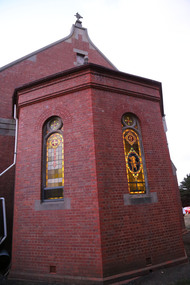
Digital photographs, L.J. Gervasoni, St Brigid's Crossley - Christmas Carols - stained glass windows night, 12/2016
... Fritsch, of Melbourne, and the contractors Messrs F. and E. Deague, of North Fitzroy. On the doors being thrown open for the admission of the congregation, the seating accommodation was immediately fully taxed, and the lengthy service and sermon were listened to with the greatest interest and attention. ...Fritsch, of Melbourne, and the contractors Messrs F. and E. Deague, of North Fitzroy. On the doors being thrown open for the admission of the congregation, the seating accommodation was immediately fully taxed, and the lengthy service and sermon were listened to with the greatest interest and attention. ..."NEW CROSSLEY CHURCH. BLESSING AND OPENING CEREMONY. A lasting testimony to the faithful generosity of the Catholic community at Crossley was vouchsafed on Sunday last, when the beautiful new church of St. Brigid was formally blessed and opened, in the presence of a particularly large congregation of adherents of the Roman Catholic faith, and many supporters of the doctrines of other churches. The function was further enhanced by the presence of two noted Catholics in Dr. Higgins (Bishop of Ballarat) and Dr. Mannix (Coadjutor Archbishop of Melbourne.) Upon arrival at the church the prelates were received by a guard of honor formed by the members of the H.A.C.B. Society, and were introduced to the members of the local committee. Then his Lordship the Bishop formally blessed the exterior and interior of the building. The building is handsome and commo dious, and one that should suffice for the population of the Crossley district for many years to come. Standing upon the highest point in the vicinity it occupies a commanding position and is a prominent landmark for many miles around. At first it was intended to pull down the old church and erect the new one upon the space occupied by it, but subsequently the land adjoining was purchased, and the sacred edifice built upon it. The style of architecture is a free treatment of the Romanesque. In a short space of time the grounds and walks were transformed by working bees and made to conform to the beauty of the building. The interior is most artistic, and would be difficult to improve upon in elegance of design, while the furnishings are most appropriate, and harmonise excellently with the general scheme of decoration. It seats 400 people and in addition there is a choir gallery with a seating capacity of 60. The church is lighted with leaded Cathedral glass windows, and the front presents a pleasing appearance, the entrance porch being surmounted with a semi-Gothic window. The floor is tiled throughout. The ceilings are semi-circular in form, with beautiful designs worked in fibrous plaster. The brickwork of the structure is faced with cement, and it has a slate roof. It is undoubtedly an addition to the ecclesiastical buildings of the district, and was universally admired. The architect was Mr. A. A. Fritsch, of Melbourne, and the contractors Messrs F. and E. Deague, of North Fitzroy. On the doors being thrown open for the admission of the congregation, the seating accommodation was immediately fully taxed, and the lengthy service and sermon were listened to with the greatest interest and attention. Missa Cantata was sung, the Rev. Father Phelan, Koroit, being the celebrant. The musical arrangements were in the capable hands of Mr. Renwick, of Warrnambool, while Miss Logan presided at the organ. Mrs. Dan. Ryan was the soprano soloist, and sang Gounod's Ave Maria at the offertory very sweetly and expressively. At the consecration Rossi's Tantum Ergo was sung by Messrs Crowley and Renwick; Farmer's Kyrie Gloria and Agnus Dei and Webb's Credo were rendered during mass, and while the collection was being taken additional numbers were sung. The occasional sermon was preached by the Coadjutor Archbishop (Dr. Mannix), who based his remarks upon the Gospel for the day, St. Luke V., verses I to II, dealing with the miraculous draught of fish. On His return from Galilee Christ found that the fishermen had been toiling all night, and had caught nothing. He entered one of the ships, and addressed the multitude on shore. It was a beautiful picture, and no doubt he spoke to them about the kingdom to be established on earth. When He had finished speaking He told the fishermen to launch out into the deep. Peter said " Master, we have fished all night, and have found nothing." Still, they obeyed His command, and the nets were filled almost to breaking point. Having brought their ships to land they left everything and followed Him. In that lesson they had a symbol of God's dealing with men through the church He has established on earth. Their confidence was richly rewarded, and Christ founded His church upon those twelve Apostles. At that time the world was mostly pagan, steeped in iniquity and sin. The chosen people of God worshipped with their lips, but their hearts were far from it. When Christ wanted to estab lish His church on earth, and leave an organisation to carry on the work, did He select the most intellectual, or the most rich or powerful men? Neither did the time seem propitious. He selected twelve men who from a human point of view were quite incapable of accomplishing anything. What happened when the Jews put Him to death? The chosen twelve left Him at the critical hour, and when He came to die on the cross they were not there, but hid themselves from the hate and fury of the Jews. When the Holy Ghost came down upon them and strengthened them they became courageous and went forth at the bidding of their Master to teach all nations. Their success was not confined to the first meet ing after Pentecost, at which they made 5000 converts, but continued until the whole world had been brought into the net. It was surely a consolation to them as well as to him (the preacher), that they came from a land which of all others had been faithful to the teaching of Jesus Christ. The sons and daughters of St. Patrick had taken a great part in bringing men into the meshes of the church. It was due to the nation they belonged to that the church flourished not only in Ireland, but in England, Scotland, Ame rica, and Australia. It may have seemed hard that in the providence of God so many had to leave their homes and find a home in other lands. They had emi grated to the towns of England and Scotland, and had been the means of keeping the Catholic faith living in those places. In the United States and Canada many had made a home for themselves, and were always found faithful to God and to the true church. If to-day the Irish Catholics and Catholics of Irish des cent were taken out of the English and Scotch population there would be little left of the true Church of God. Perhaps they had not the learning of other nations. Certainly they had not the wealth of other nations, and not the power of the sword, but God was with them, and the faith they took from the old land nourished in the distant places. There was a time in Aus tralia when those opposed to God and God's Church thought they could rule Providence and make Australia a Pro testant land. They had lived to see whe ther God or His enemies are the more powerful, and the names of those who tried to stamp out the Catholic religion were forgotten, or only remembered be cause of their persecution. They had lived to see the glorious success which rested upon the Catholic Church in Aus-tralia, which the Irish people had built up stone by stone. Nowhere was it held in higher esteem than in these islands, and the people would always be faithful to God and His church. It was an inspira tion to go into the glorious church opened that day. It stood for loyalty and faith fulness and was a credit and a consola tion to the Bishop and people of the diocese, to the architect, and to the priests and the honest and zealous administrator of the parish. There was hope and an inspiration in that day's celebrations, and surely the Catholic faith would sink deeper and deeper into the people as time went on, and the progress of the last fifty years would be small as compared to the progress of the future. He congratulated the Bishop and priests who had raised that temple, and the people of Crossley upon their generosity and self-sacrifice. He prayed that the blessing of God and St. Brigid would rest upon them, their children, and their children's children. He hoped that not one of those who had received the sacrament at that church would be missing when called before the Judgment Seat, and that all would be counted into the enjoyment of eternal bliss. The Rev. Father Kerin then made a statement of the position of the finances, after which a special col lection was made towards the cost of the building. A list of subscribers of £l and upwards was read, to which Bishop Higgins contributed £250, Rev. Father Kerin £20, and the Coadjutor Archbishop £5. The amount totalled £1245 10s 7d. Pre vious donations totalled £1077 3s, and His Lordship gave an additional £250. An indebtedness of £3974 had been reduced by £1245, leaving a debit balance of £2728. The cost ot the church completed was £6250. They had broken the back of the debt, and were not frightened of it. It was also announced that the beautiful Stations of the Cross, which adorn the walls, had been donated by the following: Mr and Mrs. P. Crowe, Mr. and Mrs. T. Bushell, Mr. and Mrs. P. Gorman, Miss M. Dunne, Mr. Mugavin and Miss Mugavin, Mr. and Mrs. C. Conway, Misses A. and F. Broderick, Mr. and Mrs. Michael Hennessy, Miss K. A. M'Carthy, Mr. and Mrs. Wm. Dalton, Mrs. M. J. Greene, Mrs. and Miss K. Dwyer, Mr. and Mrs. John Mugavin, and the Rev. J. J. Manning. The new Estey organ was contributed by the school children, as the result of an enter tainment. Other donors of furnishings, etc., were Mrs. Brown, senr., (Kirkstall), and Mrs. James Maloney (Killarney), and Mrs. and Miss O'Donohue. The vestments were the gifts of Mr. and Mrs. M. Foley, of Killarney. The furnishings, carpeting, etc., of the sanctuary have been carried out by the Crossley Altar Society, of which Mrs. Jno. O'Brien is president, and Miss Mary Ryan secretary. In the course of a brief address Dr. Higgins expressed his deep indebtedness to the Coadjutor Archbishop for coming amongst them at a great sacrifice to assist in the ceremonies. He heartily thanked the people for their unbounded generosity, and congratulated priests and people upon the magnificent results of their efforts. They had an able champion in Dr. Mannix, who since coming amongst them had distinguished himself by his zeal for the church in this new land. He hoped he would be spared for many years to come to use his splendid talents in the service of the church. (Koroit Sentinel and Tower Hill Advocate, Saturday 4 July 1914, page 2)Digital images of the cathedral leadlight windowns in St Brigid's catholic Church, Crossley. st brigid's crossley, st brigid's, catholic church, catholic, church, religion, celebrations, christmas, christmas carols, carols, stained glass, window -
 Ballarat Heritage Services
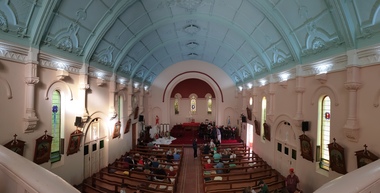
Photograph - Digital photographs, L.J. Gervasoni, Interior of St Brigid's Crossley, 2018
... Fritsch. of Melbourne, and the contractors Messrs F. and E. Deagne, of North Fitzroy. The contract price for the building was £5,500. ...Fritsch. of Melbourne, and the contractors Messrs F. and E. Deagne, of North Fitzroy. The contract price for the building was £5,500. ..."LARGE GATHERINGNG AT - CROSSLEY DEDICATION AND OPENING SERVICES. SERMON BY DR. MANNIX. Yesterday was an important and historic day for the Roman Catholic community of Crossley and Koroit, in as much as it will be always associated in the memories of all con cerned with the opening of the new St. Brigid's Church, Crossley. This building is far above the average standard of sacred edifices in country towns, and is certainly superior to any ercted in this district outside the churches in the two larger centres - Warrnambool and Koroit. The style of architecture chosen is a free treatment of the Romanesque, which is something quite original in the Western District. This noble style, from which, with its near re lative the Byzantine, spring the great Gothic school of architecture, is characterised by a special charm of its own, one of its chief features being graceful and sweeping circular curves in roof, window heads and in the ar rangenent of the ground plan. The building is of brick finished off with true Romanesqiue pillared pinnacles in concrete and plaster, the brick and concrete producing a pleasing contrast. The main characteristic of the front is a large rose window filled with Romlanesque circular tracery, and below a bold porch and entrance. The two sides are pierced with long circular-headed windows between graceful buttresses and the wall line is pleasingly broken by the projecting bays of the confessionals and also by the vestries. The main building is 80 feet by 30 feet' and the Sanctuary is spacious and semi-circular in shape, and lighted by three windows. The interior of the church is most artistic. The ceiling is semi-circular and of fibrous plaster in ornate designs. All the windows are lead lighted, throwing a rich and mellow harmony of' color throughout the interior and the white wails, mouldings, architraves and other fibrous plaster decorations: are further relieved by the rich coloring: in the stations of.the Cross arrranged around the nave. The central window of the Sanctuary contains a splendidly executed stained glass representation of St. Brigid. At.the western end is a room gallery. The altar is a choice piece of Gothic woodwork, in light, soft coloring, and there are two altars on either side of the Sanctuary in oak, and above whlch are very fine colored figures of Christ; and the Madonna. On either side of the altar are life-size figures of angels holding high brass candalabra. The whole of the furnishings of the church are on a sumptuous scale, and the edifice reflects credit on all concerned. The church can seat nearly 500 people. The architect was Mr. A. A. Fritsch. of Melbourne, and the contractors Messrs F. and E. Deagne, of North Fitzroy. The contract price for the building was £5,500. THE OPENING SERVICE. After the cereimony of solemnly blesssing the church was performed by His Lordship the Bishop of the Diocese, Dr. Higgins, assisted by His Grace the Coadjutor Archbishop of Melbourne. Dr. Mannix, the great gatheiring from all parts of the district entered the church, which was soon completely filled. The members of the H.A.C.B.S. attended wearing their green and gold regalia, and acted as a 'guard of honor' to the Co-adjlutor Arclhbishop and Bishop. Mass was celebrated by the Rev. Father Phelan, of Koroit, and a feature of the solemn service was the singing of a choir which consisted of picked voices from St. Carthage's choir, with friends from Warrnam bool and assisted by some of the mem bers of the Koroit choir, with Miss Logan as organist and Mr. Arthur H. Renwick as conductor. They rendered the music in splendid style throghonut. The "Kyrie," "Gloria." "Agnus Dei' and Dona Nobis" were from Farmer's Mass in B flat, and the "Credo" and "Sanctus" from Webbe's Mass in G. The soloists in the Mass were Mrs. Ryan, the Misses McEntee. Miss Katie O'Brien. and Messrs. J. M. Crowley, W. J. Callaghan; B. McEntee and W. Mahony. The chorus sang with great precision, special attention being paid to at tack. At the offertory Mrs. Dan Ryan gave a beautiful rendering of Gounod's "Ava Maria." After the Elevation that fine duet "Tantum Ergo." by Rossi, was sung by Messrs. Crowley and Renwick in an artistic manner, their fine voices blending splendidly. During the collection, Mr. Renwick sang with much feeling that devotional solo, "Lead Thou Me On,", after which Mr Crowley gave .an ex cellent rendering of Weissi's "0 Salu taris Hostia;" and the choir sang several hymns." It might here be mentioned that at the request of Fa ther Kerin, the same choir will repeat the music.at the Koroit Church on Sunday next, on the occasion of the ceremnly of laying the foundation stone of the cormpletion of the church. Dr. Mannix preachled the sermon for the occasion, taking his text from St. Luke first 11 verses. He re viewed the Gospel story of Christ preaching to the multitude from a boat on Lake Gennesaret and the miraculous draught of fish. The obedi ence of the poor fishermen in casting their nets at Christ's bidding was richly rewarded, and the miraculous occurrence was a striking example of what was to happen when Christ established His Church and built it up on those twelve apostles. When they came to think of it, nothing so re markable and marvellous had happened before or since in the history of mankind. The world at that time was for the most part a Pagan world steeped in iniquity and sin. The chosen people of God had God's re velation, but they worshipped with their lips and not with their hearts. When Christ was to establish His Church upon earth and leave an or gantisation that would continue His work, did He select learned men, powerful men, rich men, or a time that would seem propituous? No. He selected twelve poor, igorant simple fishermen, without money, power, learning or anything calculated to enable them to do anything striking in the world's history. The success of the first morning after pentecost was not confined to those first days when the plentitude of the Holy Ghost sat upon the .Apostles, but it continued age after age until the whole world was brought within the sphere of ac tion of the Church. Greece, Rome Europe Asia and America, and now Australia had been brought into the net. This must be a consolation to them all as well as it was to him (the preacher), when they remembered that they came from a land which of all others had been faithful to the Gospel of Jesus Christ. It was a consolation to them that in that great work that had been accomplished in bringing men into the meshes of the Church, and bringing them to God the nation to which they belontged had taken so great a part. Their religion flourished in England, Scotland, America and Australia. Surely it was due to the sons of St. Patrick, the sons and daughters of Ireland to find consolation in these great facts might It might seem hard that so many had to leave their native-land for England, Scotland, America and Australia. But if hard it was the means of keeping the Catholic faith living in England and Scotland. If to-day the Irish Catholics and Catholics of Irish de scent were taken out of the English and Scotch population there would be little left of the true Church of God. It seemed hard to emigrate to distant lands, but the result had been the new magnificent church in the United States, the flourishing churches in Canada and South Africa. Those Irish emigrants were a cornparatively small band. Perhaps they had not the learning of other nations. Certainly they had not the wealth and it did not fall to their lot to have the power of the sword, but God was with them, and the faith they took from Ireland flourished in those distant lands. In this fair land of Australia they had a glorious herit age handed down from the pioneer Irish Catholics, who came to this fair Austral land. There was a time when those who were opposed to God and God's Church,thought that Australia should be a wholly Protestant land. They had lived to see whether God or His enemies were the stronger. They had lived to see that those who in distant days would have stamped out the Catholic religion in Australia, had not prevailed. Their names had been forgotten because of their persecution of the Catholic Church, and they had lived - to see the glorious success that now, in every part of the Common wealth, rested upon the Catholic Church in Australia. Might God bless that Church and those Irish people, and the people of Irish descent, who had built it up. In that locality, and there was no place in.the Common wealth where the Catholic Church was held in higher esteem, the people would always be faithful to God and His Church. That beautiful building, and all it signified in loyalty and faithfulness, was a credit and a consolation to the Bishop and people of the diocese, to the architect who had done his work so artistically and skil fully. to the priests and the zealous administration of the parish. There was surely hope and inspiration in that day's celebration, that as time went on the Catholic faith would sink deeper and deeper into ther coming generation, and that the Catholic progress of the past 50 years would be small in comparison to the great progress of the future. He congratulated the Bishop priests and people who had raised that temple. He congratulated the people of Crossley; upon their generosity and self-sacrifice, and he prayed that God's blessing and the blessing of St. Brigid would rest upon them; their children and children's children. And when those who had received the sacraments and had been instructed in that Church were called before the Judgment Seat he pray ed that not one would be missing, and St. Peter aind St. Brigid would be able to count them all into the en joyment .of Eternal bliss. THE CELEBRATION The Rev. Father Kerin, Adninistra tor of the Parish, after the collection, read a lengthy list of the principal donations, headed by the Bishop, Dr. Higgins, with £250. All the furnish ings of the Church were also donations, and the Coadjutor-Archbishop added £5 to the list. The Rev. Father Kerin stated that the total to hand was £1245/10/7, which was an other proof of the generosity of the Crossley and district people. The amount previously received in donations was £1077/3. They started buildiing with a credit balance of £262 10/5 and ther now had a debit balance of £2,728/18/5. The total cost of the Church was £6,250, so that they would see the greater part of the indebtedness had already been wiped out. The Bishop (Dr. Higgins) delivered a brief address, in the course of which he congratulated the priests and people upon the completion of their magnificent Church. He congratulated the people on their magnificent generosity. He expressed his of deep indebtedness to the Coadjutor Archbishop of Melbourne for the services he had rendered to them. He had attended at considerable sacrifice to himself, and they were extremely grateful for the presence of so distinguished a champion who had shown such zeal and interest in their Church in this new land. He (the Bishop) trusted that his splendid talents would long be devoted to the defence of the Church." (Warrnambul Standard, 02 July 1914)Digital panoramic image of the interior of St Brigid's Crossley.st brigid's crossley, st brigid's, catholic church, catholic, church, community, ceiling, stations of the cross, confessional, statues, windows -
 Ballarat Heritage Services
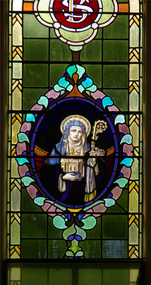
Photograph, Lisa Gervasoni, St Brigid Stained Glass Window, Crossley, 18/08/2013
... Fritsch. of Melbourne, and the contractors Messrs F. and E. Deagne, of North Fitzroy. The contract price for the building was £5,500. ...Fritsch. of Melbourne, and the contractors Messrs F. and E. Deagne, of North Fitzroy. The contract price for the building was £5,500. ..."LARGE GATHERINGNG AT - CROSSLEY DEDICATION AND OPENING SERVICES. SERMON BY DR. MANNIX. Yesterday was an important and historic day for the Roman Catholic community of Crossley and Koroit, in as much as it will be always associated in the memories of all con cerned with the opening of the new St. Brigid's Church, Crossley. This building is far above the average standard of sacred edifices in country towns, and is certainly superior to any ercted in this district outside the churches in the two larger centres - Warrnambool and Koroit. The style of architecture chosen is a free treatment of the Romanesque, which is something quite original in the Western District. This noble style, from which, with its near re lative the Byzantine, spring the great Gothic school of architecture, is characterised by a special charm of its own, one of its chief features being graceful and sweeping circular curves in roof, window heads and in the ar rangenent of the ground plan. The building is of brick finished off with true Romanesqiue pillared pinnacles in concrete and plaster, the brick and concrete producing a pleasing contrast. The main characteristic of the front is a large rose window filled with Romlanesque circular tracery, and below a bold porch and entrance. The two sides are pierced with long circular-headed windows between graceful buttresses and the wall line is pleasingly broken by the projecting bays of the confessionals and also by the vestries. The main building is 80 feet by 30 feet' and the Sanctuary is spacious and semi-circular in shape, and lighted by three windows. The interior of the church is most artistic. The ceiling is semi-circular and of fibrous plaster in ornate designs. All the windows are lead lighted, throwing a rich and mellow harmony of' color throughout the interior and the white wails, mouldings, architraves and other fibrous plaster decorations: are further relieved by the rich coloring: in the stations of.the Cross arrranged around the nave. The central window of the Sanctuary contains a splendidly executed stained glass representation of St. Brigid. At.the western end is a room gallery. The altar is a choice piece of Gothic woodwork, in light, soft coloring, and there are two altars on either side of the Sanctuary in oak, and above whlch are very fine colored figures of Christ; and the Madonna. On either side of the altar are life-size figures of angels holding high brass candalabra. The whole of the furnishings of the church are on a sumptuous scale, and the edifice reflects credit on all concerned. The church can seat nearly 500 people. The architect was Mr. A. A. Fritsch. of Melbourne, and the contractors Messrs F. and E. Deagne, of North Fitzroy. The contract price for the building was £5,500. THE OPENING SERVICE. After the cereimony of solemnly blesssing the church was performed by His Lordship the Bishop of the Diocese, Dr. Higgins, assisted by His Grace the Coadjutor Archbishop of Melbourne. Dr. Mannix, the great gatheiring from all parts of the district entered the church, which was soon completely filled. The members of the H.A.C.B.S. attended wearing their green and gold regalia, and acted as a 'guard of honor' to the Co-adjlutor Arclhbishop and Bishop. Mass was celebrated by the Rev. Father Phelan, of Koroit, and a feature of the solemn service was the singing of a choir which consisted of picked voices from St. Carthage's choir, with friends from Warrnam bool and assisted by some of the mem bers of the Koroit choir, with Miss Logan as organist and Mr. Arthur H. Renwick as conductor. They rendered the music in splendid style throghonut. The "Kyrie," "Gloria." "Agnus Dei' and Dona Nobis" were from Farmer's Mass in B flat, and the "Credo" and "Sanctus" from Webbe's Mass in G. The soloists in the Mass were Mrs. Ryan, the Misses McEntee. Miss Katie O'Brien. and Messrs. J. M. Crowley, W. J. Callaghan; B. McEntee and W. Mahony. The chorus sang with great precision, special attention being paid to at tack. At the offertory Mrs. Dan Ryan gave a beautiful rendering of Gounod's "Ava Maria." After the Elevation that fine duet "Tantum Ergo." by Rossi, was sung by Messrs. Crowley and Renwick in an artistic manner, their fine voices blending splendidly. During the collection, Mr. Renwick sang with much feeling that devotional solo, "Lead Thou Me On,", after which Mr Crowley gave .an ex cellent rendering of Weissi's "0 Salu taris Hostia;" and the choir sang several hymns." It might here be mentioned that at the request of Fa ther Kerin, the same choir will repeat the music.at the Koroit Church on Sunday next, on the occasion of the ceremnly of laying the foundation stone of the cormpletion of the church. Dr. Mannix preachled the sermon for the occasion, taking his text from St. Luke first 11 verses. He re viewed the Gospel story of Christ preaching to the multitude from a boat on Lake Gennesaret and the miraculous draught of fish. The obedi ence of the poor fishermen in casting their nets at Christ's bidding was richly rewarded, and the miraculous occurrence was a striking example of what was to happen when Christ established His Church and built it up on those twelve apostles. When they came to think of it, nothing so re markable and marvellous had happened before or since in the history of mankind. The world at that time was for the most part a Pagan world steeped in iniquity and sin. The chosen people of God had God's re velation, but they worshipped with their lips and not with their hearts. When Christ was to establish His Church upon earth and leave an or gantisation that would continue His work, did He select learned men, powerful men, rich men, or a time that would seem propituous? No. He selected twelve poor, igorant simple fishermen, without money, power, learning or anything calculated to enable them to do anything striking in the world's history. The success of the first morning after pentecost was not confined to those first days when the plentitude of the Holy Ghost sat upon the .Apostles, but it continued age after age until the whole world was brought within the sphere of ac tion of the Church. Greece, Rome Europe Asia and America, and now Australia had been brought into the net. This must be a consolation to them all as well as it was to him (the preacher), when they remembered that they came from a land which of all others had been faithful to the Gospel of Jesus Christ. It was a consolation to them that in that great work that had been accomplished in bringing men into the meshes of the Church, and bringing them to God the nation to which they belontged had taken so great a part. Their religion flourished in England, Scotland, America and Australia. Surely it was due to the sons of St. Patrick, the sons and daughters of Ireland to find consolation in these great facts might It might seem hard that so many had to leave their native-land for England, Scotland, America and Australia. But if hard it was the means of keeping the Catholic faith living in England and Scotland. If to-day the Irish Catholics and Catholics of Irish descent were taken out of the English and Scotch population there would be little left of the true Church of God. It seemed hard to emigrate to distant lands, but the result had been the new magnificent church in the United States, the flourishing churches in Canada and South Africa. Those Irish emigrants were a cornparatively small band. Perhaps they had not the learning of other nations. Certainly they had not the wealth and it did not fall to their lot to have the power of the sword, but God was with them, and the faith they took from Ireland flourished in those distant lands. In this fair land of Australia they had a glorious herit age handed down from the pioneer Irish Catholics, who came to this fair Austral land. There was a time when those who were opposed to God and God's Church,thought that Australia should be a wholly Protestant land. They had lived to see whether God or His enemies were the stronger. They had lived to see that those who in distant days would have stamped out the Catholic religion in Australia, had not prevailed. Their names had been forgotten because of their persecution of the Catholic Church, and they had lived - to see the glorious success that now, in every part of the Common wealth, rested upon the Catholic Church in Australia. Might God bless that Church and those Irish people, and the people of Irish descent, who had built it up. In that locality, and there was no place in.the Common wealth where the Catholic Church was held in higher esteem, the people would always be faithful to God and His Church. That beautiful building, and all it signified in loyalty and faithfulness, was a credit and a consolation to the Bishop and people of the diocese, to the architect who had done his work so artistically and skil fully. to the priests and the zealous administration of the parish. There was surely hope and inspiration in that day's celebration, that as time went on the Catholic faith would sink deeper and deeper into ther coming generation, and that the Catholic progress of the past 50 years would be small in comparison to the great progress of the future. He congratulated the Bishop priests and people who had raised that temple. He congratulated the people of Crossley; upon their generosity and self-sacrifice, and he prayed that God's blessing and the blessing of St. Brigid would rest upon them; their children and children's children. And when those who had received the sacraments and had been instructed in that Church were called before the Judgment Seat he prayed that not one would be missing, and St. Peter aind St. Brigid would be able to count them all into the enjoyment of Eternal bliss. THE CELEBRATION The Rev. Father Kerin, Adninistra tor of the Parish, after the collection, read a lengthy list of the principal donations, headed by the Bishop, Dr. Higgins, with £250. All the furnishings of the Church were also donations, and the Coadjutor-Archbishop added £5 to the list. The Rev. Father Kerin stated that the total to hand was £1245/10/7, which was an other proof of the generosity of the Crossley and district people. The amount previously received in donations was £1077/3. They started building with a credit balance of £262 10/5 and they now had a debit balance of £2,728/18/5. The total cost of the Church was £6,250, so that they would see the greater part of the indebtedness had already been wiped out. The Bishop (Dr. Higgins) delivered a brief address, in the course of which he congratulated the priests and people upon the completion of their magnificent Church. He congratulated the people on their magnificent generosity. He expressed his of deep indebtedness to the Coadjutor Archbishop of Melbourne for the services he had rendered to them. He had attended at considerable sacrifice to himself, and they were extremely grateful for the presence of so distinguished a champion who had shown such zeal and interest in their Church in this new land. He (the Bishop) trusted that his splendid talents would long be devoted to the defence of the Church." (Warrnambul Standard, 02 July 1914)Colour photograph of a portrait of St Brigid in stained glass. The depiction of St Brigid is located at St Brigid's former Catholic Church, Crossley. The stained glass window of St. Brigid in St. Brigid's Church, Crossley, Victoria, is a significant feature of the church, which was built by the local community in 1914. The church itself is notable for its "sumptuous scale" and the community's efforts to preserve it as a cultural heritage center. The central window in the sanctuary is a "splendidly executed stained glass representation of St. Brigid". st brigid, stained glass, st brigid's crossley -
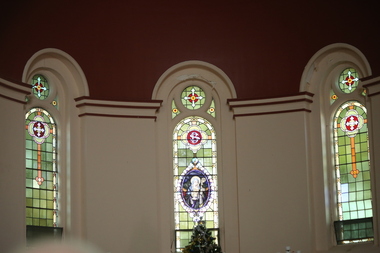 Ballarat Heritage Services
Photograph - Digital photographs, L.J. Gervasoni, St Brigid's Crossley - stained glass window, 2016
... Fritsch. of Melbourne, and the contractors Messrs F. and E. Deagne, of North Fitzroy. The contract price for the building was £5,500. ...Fritsch. of Melbourne, and the contractors Messrs F. and E. Deagne, of North Fitzroy. The contract price for the building was £5,500. ..."LARGE GATHERINGNG AT - CROSSLEY DEDICATION AND OPENING SERVICES. SERMON BY DR. MANNIX. Yesterday was an important and historic day for the Roman Catholic community of Crossley and Koroit, in as much as it will be always associated in the memories of all con cerned with the opening of the new St. Brigid's Church, Crossley. This building is far above the average standard of sacred edifices in country towns, and is certainly superior to any ercted in this district outside the churches in the two larger centres - Warrnambool and Koroit. The style of architecture chosen is a free treatment of the Romanesque, which is something quite original in the Western District. This noble style, from which, with its near re lative the Byzantine, spring the great Gothic school of architecture, is characterised by a special charm of its own, one of its chief features being graceful and sweeping circular curves in roof, window heads and in the ar rangenent of the ground plan. The building is of brick finished off with true Romanesqiue pillared pinnacles in concrete and plaster, the brick and concrete producing a pleasing contrast. The main characteristic of the front is a large rose window filled with Romlanesque circular tracery, and below a bold porch and entrance. The two sides are pierced with long circular-headed windows between graceful buttresses and the wall line is pleasingly broken by the projecting bays of the confessionals and also by the vestries. The main building is 80 feet by 30 feet' and the Sanctuary is spacious and semi-circular in shape, and lighted by three windows. The interior of the church is most artistic. The ceiling is semi-circular and of fibrous plaster in ornate designs. All the windows are lead lighted, throwing a rich and mellow harmony of' color throughout the interior and the white wails, mouldings, architraves and other fibrous plaster decorations: are further relieved by the rich coloring: in the stations of.the Cross arrranged around the nave. The central window of the Sanctuary contains a splendidly executed stained glass representation of St. Brigid. At.the western end is a room gallery. The altar is a choice piece of Gothic woodwork, in light, soft coloring, and there are two altars on either side of the Sanctuary in oak, and above whlch are very fine colored figures of Christ; and the Madonna. On either side of the altar are life-size figures of angels holding high brass candalabra. The whole of the furnishings of the church are on a sumptuous scale, and the edifice reflects credit on all concerned. The church can seat nearly 500 people. The architect was Mr. A. A. Fritsch. of Melbourne, and the contractors Messrs F. and E. Deagne, of North Fitzroy. The contract price for the building was £5,500. THE OPENING SERVICE. After the cereimony of solemnly blesssing the church was performed by His Lordship the Bishop of the Diocese, Dr. Higgins, assisted by His Grace the Coadjutor Archbishop of Melbourne. Dr. Mannix, the great gatheiring from all parts of the district entered the church, which was soon completely filled. The members of the H.A.C.B.S. attended wearing their green and gold regalia, and acted as a 'guard of honor' to the Co-adjlutor Arclhbishop and Bishop. Mass was celebrated by the Rev. Father Phelan, of Koroit, and a feature of the solemn service was the singing of a choir which consisted of picked voices from St. Carthage's choir, with friends from Warrnam bool and assisted by some of the mem bers of the Koroit choir, with Miss Logan as organist and Mr. Arthur H. Renwick as conductor. They rendered the music in splendid style throghonut. The "Kyrie," "Gloria." "Agnus Dei' and Dona Nobis" were from Farmer's Mass in B flat, and the "Credo" and "Sanctus" from Webbe's Mass in G. The soloists in the Mass were Mrs. Ryan, the Misses McEntee. Miss Katie O'Brien. and Messrs. J. M. Crowley, W. J. Callaghan; B. McEntee and W. Mahony. The chorus sang with great precision, special attention being paid to at tack. At the offertory Mrs. Dan Ryan gave a beautiful rendering of Gounod's "Ava Maria." After the Elevation that fine duet "Tantum Ergo." by Rossi, was sung by Messrs. Crowley and Renwick in an artistic manner, their fine voices blending splendidly. During the collection, Mr. Renwick sang with much feeling that devotional solo, "Lead Thou Me On,", after which Mr Crowley gave .an ex cellent rendering of Weissi's "0 Salu taris Hostia;" and the choir sang several hymns." It might here be mentioned that at the request of Fa ther Kerin, the same choir will repeat the music.at the Koroit Church on Sunday next, on the occasion of the ceremnly of laying the foundation stone of the cormpletion of the church. Dr. Mannix preachled the sermon for the occasion, taking his text from St. Luke first 11 verses. He re viewed the Gospel story of Christ preaching to the multitude from a boat on Lake Gennesaret and the miraculous draught of fish. The obedi ence of the poor fishermen in casting their nets at Christ's bidding was richly rewarded, and the miraculous occurrence was a striking example of what was to happen when Christ established His Church and built it up on those twelve apostles. When they came to think of it, nothing so re markable and marvellous had happened before or since in the history of mankind. The world at that time was for the most part a Pagan world steeped in iniquity and sin. The chosen people of God had God's re velation, but they worshipped with their lips and not with their hearts. When Christ was to establish His Church upon earth and leave an or gantisation that would continue His work, did He select learned men, powerful men, rich men, or a time that would seem propituous? No. He selected twelve poor, igorant simple fishermen, without money, power, learning or anything calculated to enable them to do anything striking in the world's history. The success of the first morning after pentecost was not confined to those first days when the plentitude of the Holy Ghost sat upon the .Apostles, but it continued age after age until the whole world was brought within the sphere of ac tion of the Church. Greece, Rome Europe Asia and America, and now Australia had been brought into the net. This must be a consolation to them all as well as it was to him (the preacher), when they remembered that they came from a land which of all others had been faithful to the Gospel of Jesus Christ. It was a consolation to them that in that great work that had been accomplished in bringing men into the meshes of the Church, and bringing them to God the nation to which they belontged had taken so great a part. Their religion flourished in England, Scotland, America and Australia. Surely it was due to the sons of St. Patrick, the sons and daughters of Ireland to find consolation in these great facts might It might seem hard that so many had to leave their native-land for England, Scotland, America and Australia. But if hard it was the means of keeping the Catholic faith living in England and Scotland. If to-day the Irish Catholics and Catholics of Irish de scent were taken out of the English and Scotch population there would be little left of the true Church of God. It seemed hard to emigrate to distant lands, but the result had been the new magnificent church in the United States, the flourishing churches in Canada and South Africa. Those Irish emigrants were a cornparatively small band. Perhaps they had not the learning of other nations. Certainly they had not the wealth and it did not fall to their lot to have the power of the sword, but God was with them, and the faith they took from Ireland flourished in those distant lands. In this fair land of Australia they had a glorious herit age handed down from the pioneer Irish Catholics, who came to this fair Austral land. There was a time when those who were opposed to God and God's Church,thought that Australia should be a wholly Protestant land. They had lived to see whether God or His enemies were the stronger. They had lived to see that those who in distant days would have stamped out the Catholic religion in Australia, had not prevailed. Their names had been forgotten because of their persecution of the Catholic Church, and they had lived - to see the glorious success that now, in every part of the Common wealth, rested upon the Catholic Church in Australia. Might God bless that Church and those Irish people, and the people of Irish descent, who had built it up. In that locality, and there was no place in.the Common wealth where the Catholic Church was held in higher esteem, the people would always be faithful to God and His Church. That beautiful building, and all it signified in loyalty and faithfulness, was a credit and a consolation to the Bishop and people of the diocese, to the architect who had done his work so artistically and skil fully. to the priests and the zealous administration of the parish. There was surely hope and inspiration in that day's celebration, that as time went on the Catholic faith would sink deeper and deeper into ther coming generation, and that the Catholic progress of the past 50 years would be small in comparison to the great progress of the future. He congratulated the Bishop priests and people who had raised that temple. He congratulated the people of Crossley; upon their generosity and self-sacrifice, and he prayed that God's blessing and the blessing of St. Brigid would rest upon them; their children and children's children. And when those who had received the sacraments and had been instructed in that Church were called before the Judgment Seat he pray ed that not one would be missing, and St. Peter aind St. Brigid would be able to count them all into the en joyment .of Eternal bliss. THE CELEBRATION The Rev. Father Kerin, Adninistra tor of the Parish, after the collection, read a lengthy list of the principal donations, headed by the Bishop, Dr. Higgins, with £250. All the furnish ings of the Church were also donations, and the Coadjutor-Archbishop added £5 to the list. The Rev. Father Kerin stated that the total to hand was £1245/10/7, which was an other proof of the generosity of the Crossley and district people. The amount previously received in donations was £1077/3. They started buildiing with a credit balance of £262 10/5 and ther now had a debit balance of £2,728/18/5. The total cost of the Church was £6,250, so that they would see the greater part of the indebtedness had already been wiped out. The Bishop (Dr. Higgins) delivered a brief address, in the course of which he congratulated the priests and people upon the completion of their magnificent Church. He congratulated the people on their magnificent generosity. He expressed his of deep indebtedness to the Coadjutor Archbishop of Melbourne for the services he had rendered to them. He had attended at considerable sacrifice to himself, and they were extremely grateful for the presence of so distinguished a champion who had shown such zeal and interest in their Church in this new land. He (the Bishop) trusted that his splendid talents would long be devoted to the defence of the Church." (Warrnambul Standard, 02 July 1914)Digital images of the stained glass windows at St Brigid's, Crossley.victoria, crossley, st brigid's crossley, st brigid's, catholic church, catholic, church, religion, stained glass, window -
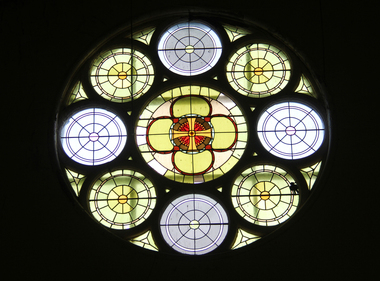 Ballarat Heritage Services
Photograph - Digital photographs, St Brigid's Crossley stained glass windows, last weekend June 2014
... Fritsch. of Melbourne, and the contractors Messrs F. and E. Deagne, of North Fitzroy. The contract price for the building was £5,500. ...Fritsch. of Melbourne, and the contractors Messrs F. and E. Deagne, of North Fitzroy. The contract price for the building was £5,500. ..."LARGE GATHERINGNG AT - CROSSLEY DEDICATION AND OPENING SERVICES. SERMON BY DR. MANNIX. Yesterday was an important and historic day for the Roman Catholic community of Crossley and Koroit, in as much as it will be always associated in the memories of all con cerned with the opening of the new St. Brigid's Church, Crossley. This building is far above the average standard of sacred edifices in country towns, and is certainly superior to any ercted in this district outside the churches in the two larger centres - Warrnambool and Koroit. The style of architecture chosen is a free treatment of the Romanesque, which is something quite original in the Western District. This noble style, from which, with its near re lative the Byzantine, spring the great Gothic school of architecture, is characterised by a special charm of its own, one of its chief features being graceful and sweeping circular curves in roof, window heads and in the ar rangenent of the ground plan. The building is of brick finished off with true Romanesqiue pillared pinnacles in concrete and plaster, the brick and concrete producing a pleasing contrast. The main characteristic of the front is a large rose window filled with Romlanesque circular tracery, and below a bold porch and entrance. The two sides are pierced with long circular-headed windows between graceful buttresses and the wall line is pleasingly broken by the projecting bays of the confessionals and also by the vestries. The main building is 80 feet by 30 feet' and the Sanctuary is spacious and semi-circular in shape, and lighted by three windows. The interior of the church is most artistic. The ceiling is semi-circular and of fibrous plaster in ornate designs. All the windows are lead lighted, throwing a rich and mellow harmony of' color throughout the interior and the white wails, mouldings, architraves and other fibrous plaster decorations: are further relieved by the rich coloring: in the stations of.the Cross arrranged around the nave. The central window of the Sanctuary contains a splendidly executed stained glass representation of St. Brigid. At.the western end is a room gallery. The altar is a choice piece of Gothic woodwork, in light, soft coloring, and there are two altars on either side of the Sanctuary in oak, and above whlch are very fine colored figures of Christ; and the Madonna. On either side of the altar are life-size figures of angels holding high brass candalabra. The whole of the furnishings of the church are on a sumptuous scale, and the edifice reflects credit on all concerned. The church can seat nearly 500 people. The architect was Mr. A. A. Fritsch. of Melbourne, and the contractors Messrs F. and E. Deagne, of North Fitzroy. The contract price for the building was £5,500. THE OPENING SERVICE. After the cereimony of solemnly blesssing the church was performed by His Lordship the Bishop of the Diocese, Dr. Higgins, assisted by His Grace the Coadjutor Archbishop of Melbourne. Dr. Mannix, the great gatheiring from all parts of the district entered the church, which was soon completely filled. The members of the H.A.C.B.S. attended wearing their green and gold regalia, and acted as a 'guard of honor' to the Co-adjlutor Arclhbishop and Bishop. Mass was celebrated by the Rev. Father Phelan, of Koroit, and a feature of the solemn service was the singing of a choir which consisted of picked voices from St. Carthage's choir, with friends from Warrnam bool and assisted by some of the mem bers of the Koroit choir, with Miss Logan as organist and Mr. Arthur H. Renwick as conductor. They rendered the music in splendid style throghonut. The "Kyrie," "Gloria." "Agnus Dei' and Dona Nobis" were from Farmer's Mass in B flat, and the "Credo" and "Sanctus" from Webbe's Mass in G. The soloists in the Mass were Mrs. Ryan, the Misses McEntee. Miss Katie O'Brien. and Messrs. J. M. Crowley, W. J. Callaghan; B. McEntee and W. Mahony. The chorus sang with great precision, special attention being paid to at tack. At the offertory Mrs. Dan Ryan gave a beautiful rendering of Gounod's "Ava Maria." After the Elevation that fine duet "Tantum Ergo." by Rossi, was sung by Messrs. Crowley and Renwick in an artistic manner, their fine voices blending splendidly. During the collection, Mr. Renwick sang with much feeling that devotional solo, "Lead Thou Me On,", after which Mr Crowley gave .an ex cellent rendering of Weissi's "0 Salu taris Hostia;" and the choir sang several hymns." It might here be mentioned that at the request of Fa ther Kerin, the same choir will repeat the music.at the Koroit Church on Sunday next, on the occasion of the ceremnly of laying the foundation stone of the cormpletion of the church. Dr. Mannix preachled the sermon for the occasion, taking his text from St. Luke first 11 verses. He re viewed the Gospel story of Christ preaching to the multitude from a boat on Lake Gennesaret and the miraculous draught of fish. The obedi ence of the poor fishermen in casting their nets at Christ's bidding was richly rewarded, and the miraculous occurrence was a striking example of what was to happen when Christ established His Church and built it up on those twelve apostles. When they came to think of it, nothing so re markable and marvellous had happened before or since in the history of mankind. The world at that time was for the most part a Pagan world steeped in iniquity and sin. The chosen people of God had God's re velation, but they worshipped with their lips and not with their hearts. When Christ was to establish His Church upon earth and leave an or gantisation that would continue His work, did He select learned men, powerful men, rich men, or a time that would seem propituous? No. He selected twelve poor, igorant simple fishermen, without money, power, learning or anything calculated to enable them to do anything striking in the world's history. The success of the first morning after pentecost was not confined to those first days when the plentitude of the Holy Ghost sat upon the .Apostles, but it continued age after age until the whole world was brought within the sphere of ac tion of the Church. Greece, Rome Europe Asia and America, and now Australia had been brought into the net. This must be a consolation to them all as well as it was to him (the preacher), when they remembered that they came from a land which of all others had been faithful to the Gospel of Jesus Christ. It was a consolation to them that in that great work that had been accomplished in bringing men into the meshes of the Church, and bringing them to God the nation to which they belontged had taken so great a part. Their religion flourished in England, Scotland, America and Australia. Surely it was due to the sons of St. Patrick, the sons and daughters of Ireland to find consolation in these great facts might It might seem hard that so many had to leave their native-land for England, Scotland, America and Australia. But if hard it was the means of keeping the Catholic faith living in England and Scotland. If to-day the Irish Catholics and Catholics of Irish de scent were taken out of the English and Scotch population there would be little left of the true Church of God. It seemed hard to emigrate to distant lands, but the result had been the new magnificent church in the United States, the flourishing churches in Canada and South Africa. Those Irish emigrants were a cornparatively small band. Perhaps they had not the learning of other nations. Certainly they had not the wealth and it did not fall to their lot to have the power of the sword, but God was with them, and the faith they took from Ireland flourished in those distant lands. In this fair land of Australia they had a glorious herit age handed down from the pioneer Irish Catholics, who came to this fair Austral land. There was a time when those who were opposed to God and God's Church,thought that Australia should be a wholly Protestant land. They had lived to see whether God or His enemies were the stronger. They had lived to see that those who in distant days would have stamped out the Catholic religion in Australia, had not prevailed. Their names had been forgotten because of their persecution of the Catholic Church, and they had lived - to see the glorious success that now, in every part of the Common wealth, rested upon the Catholic Church in Australia. Might God bless that Church and those Irish people, and the people of Irish descent, who had built it up. In that locality, and there was no place in.the Common wealth where the Catholic Church was held in higher esteem, the people would always be faithful to God and His Church. That beautiful building, and all it signified in loyalty and faithfulness, was a credit and a consolation to the Bishop and people of the diocese, to the architect who had done his work so artistically and skil fully. to the priests and the zealous administration of the parish. There was surely hope and inspiration in that day's celebration, that as time went on the Catholic faith would sink deeper and deeper into ther coming generation, and that the Catholic progress of the past 50 years would be small in comparison to the great progress of the future. He congratulated the Bishop priests and people who had raised that temple. He congratulated the people of Crossley; upon their generosity and self-sacrifice, and he prayed that God's blessing and the blessing of St. Brigid would rest upon them; their children and children's children. And when those who had received the sacraments and had been instructed in that Church were called before the Judgment Seat he pray ed that not one would be missing, and St. Peter aind St. Brigid would be able to count them all into the en joyment .of Eternal bliss. THE CELEBRATION The Rev. Father Kerin, Adninistra tor of the Parish, after the collection, read a lengthy list of the principal donations, headed by the Bishop, Dr. Higgins, with £250. All the furnish ings of the Church were also donations, and the Coadjutor-Archbishop added £5 to the list. The Rev. Father Kerin stated that the total to hand was £1245/10/7, which was an other proof of the generosity of the Crossley and district people. The amount previously received in donations was £1077/3. They started buildiing with a credit balance of £262 10/5 and ther now had a debit balance of £2,728/18/5. The total cost of the Church was £6,250, so that they would see the greater part of the indebtedness had already been wiped out. The Bishop (Dr. Higgins) delivered a brief address, in the course of which he congratulated the priests and people upon the completion of their magnificent Church. He congratulated the people on their magnificent generosity. He expressed his of deep indebtedness to the Coadjutor Archbishop of Melbourne for the services he had rendered to them. He had attended at considerable sacrifice to himself, and they were extremely grateful for the presence of so distinguished a champion who had shown such zeal and interest in their Church in this new land. He (the Bishop) trusted that his splendid talents would long be devoted to the defence of the Church." (Warrnambul Standard, 02 July 1914)Digital images of the stained glass windows at St Brigid's Crossleyst brigid's crossley, st brigid's, catholic church, catholic, church, religion, centenary, celebrations, 100, anniversary, commemoration, stained glass, windows -
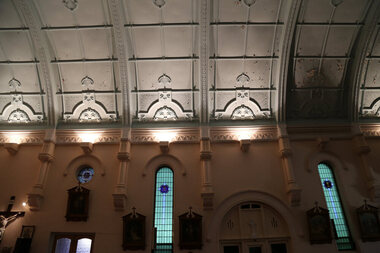 Ballarat Heritage Services
Digital photographs, St Brigid's Crossley - Christmas Carols, 2016, Christmas 2016
... Fritsch. of Melbourne, and the contractors Messrs F. and E. Deagne, of North Fitzroy. The contract price for the building was £5,500. ...Fritsch. of Melbourne, and the contractors Messrs F. and E. Deagne, of North Fitzroy. The contract price for the building was £5,500. ..."LARGE GATHERINGNG AT - CROSSLEY DEDICATION AND OPENING SERVICES. SERMON BY DR. MANNIX. Yesterday was an important and historic day for the Roman Catholic community of Crossley and Koroit, in as much as it will be always associated in the memories of all con cerned with the opening of the new St. Brigid's Church, Crossley. This building is far above the average standard of sacred edifices in country towns, and is certainly superior to any ercted in this district outside the churches in the two larger centres - Warrnambool and Koroit. The style of architecture chosen is a free treatment of the Romanesque, which is something quite original in the Western District. This noble style, from which, with its near re lative the Byzantine, spring the great Gothic school of architecture, is characterised by a special charm of its own, one of its chief features being graceful and sweeping circular curves in roof, window heads and in the ar rangenent of the ground plan. The building is of brick finished off with true Romanesqiue pillared pinnacles in concrete and plaster, the brick and concrete producing a pleasing contrast. The main characteristic of the front is a large rose window filled with Romlanesque circular tracery, and below a bold porch and entrance. The two sides are pierced with long circular-headed windows between graceful buttresses and the wall line is pleasingly broken by the projecting bays of the confessionals and also by the vestries. The main building is 80 feet by 30 feet' and the Sanctuary is spacious and semi-circular in shape, and lighted by three windows. The interior of the church is most artistic. The ceiling is semi-circular and of fibrous plaster in ornate designs. All the windows are lead lighted, throwing a rich and mellow harmony of' color throughout the interior and the white wails, mouldings, architraves and other fibrous plaster decorations: are further relieved by the rich coloring: in the stations of.the Cross arrranged around the nave. The central window of the Sanctuary contains a splendidly executed stained glass representation of St. Brigid. At.the western end is a room gallery. The altar is a choice piece of Gothic woodwork, in light, soft coloring, and there are two altars on either side of the Sanctuary in oak, and above whlch are very fine colored figures of Christ; and the Madonna. On either side of the altar are life-size figures of angels holding high brass candalabra. The whole of the furnishings of the church are on a sumptuous scale, and the edifice reflects credit on all concerned. The church can seat nearly 500 people. The architect was Mr. A. A. Fritsch. of Melbourne, and the contractors Messrs F. and E. Deagne, of North Fitzroy. The contract price for the building was £5,500. THE OPENING SERVICE. After the cereimony of solemnly blesssing the church was performed by His Lordship the Bishop of the Diocese, Dr. Higgins, assisted by His Grace the Coadjutor Archbishop of Melbourne. Dr. Mannix, the great gatheiring from all parts of the district entered the church, which was soon completely filled. The members of the H.A.C.B.S. attended wearing their green and gold regalia, and acted as a 'guard of honor' to the Co-adjlutor Arclhbishop and Bishop. Mass was celebrated by the Rev. Father Phelan, of Koroit, and a feature of the solemn service was the singing of a choir which consisted of picked voices from St. Carthage's choir, with friends from Warrnam bool and assisted by some of the mem bers of the Koroit choir, with Miss Logan as organist and Mr. Arthur H. Renwick as conductor. They rendered the music in splendid style throghonut. The "Kyrie," "Gloria." "Agnus Dei' and Dona Nobis" were from Farmer's Mass in B flat, and the "Credo" and "Sanctus" from Webbe's Mass in G. The soloists in the Mass were Mrs. Ryan, the Misses McEntee. Miss Katie O'Brien. and Messrs. J. M. Crowley, W. J. Callaghan; B. McEntee and W. Mahony. The chorus sang with great precision, special attention being paid to at tack. At the offertory Mrs. Dan Ryan gave a beautiful rendering of Gounod's "Ava Maria." After the Elevation that fine duet "Tantum Ergo." by Rossi, was sung by Messrs. Crowley and Renwick in an artistic manner, their fine voices blending splendidly. During the collection, Mr. Renwick sang with much feeling that devotional solo, "Lead Thou Me On,", after which Mr Crowley gave .an ex cellent rendering of Weissi's "0 Salu taris Hostia;" and the choir sang several hymns." It might here be mentioned that at the request of Fa ther Kerin, the same choir will repeat the music.at the Koroit Church on Sunday next, on the occasion of the ceremnly of laying the foundation stone of the cormpletion of the church. Dr. Mannix preachled the sermon for the occasion, taking his text from St. Luke first 11 verses. He re viewed the Gospel story of Christ preaching to the multitude from a boat on Lake Gennesaret and the miraculous draught of fish. The obedi ence of the poor fishermen in casting their nets at Christ's bidding was richly rewarded, and the miraculous occurrence was a striking example of what was to happen when Christ established His Church and built it up on those twelve apostles. When they came to think of it, nothing so re markable and marvellous had happened before or since in the history of mankind. The world at that time was for the most part a Pagan world steeped in iniquity and sin. The chosen people of God had God's re velation, but they worshipped with their lips and not with their hearts. When Christ was to establish His Church upon earth and leave an or gantisation that would continue His work, did He select learned men, powerful men, rich men, or a time that would seem propituous? No. He selected twelve poor, igorant simple fishermen, without money, power, learning or anything calculated to enable them to do anything striking in the world's history. The success of the first morning after pentecost was not confined to those first days when the plentitude of the Holy Ghost sat upon the .Apostles, but it continued age after age until the whole world was brought within the sphere of ac tion of the Church. Greece, Rome Europe Asia and America, and now Australia had been brought into the net. This must be a consolation to them all as well as it was to him (the preacher), when they remembered that they came from a land which of all others had been faithful to the Gospel of Jesus Christ. It was a consolation to them that in that great work that had been accomplished in bringing men into the meshes of the Church, and bringing them to God the nation to which they belontged had taken so great a part. Their religion flourished in England, Scotland, America and Australia. Surely it was due to the sons of St. Patrick, the sons and daughters of Ireland to find consolation in these great facts might It might seem hard that so many had to leave their native-land for England, Scotland, America and Australia. But if hard it was the means of keeping the Catholic faith living in England and Scotland. If to-day the Irish Catholics and Catholics of Irish de scent were taken out of the English and Scotch population there would be little left of the true Church of God. It seemed hard to emigrate to distant lands, but the result had been the new magnificent church in the United States, the flourishing churches in Canada and South Africa. Those Irish emigrants were a cornparatively small band. Perhaps they had not the learning of other nations. Certainly they had not the wealth and it did not fall to their lot to have the power of the sword, but God was with them, and the faith they took from Ireland flourished in those distant lands. In this fair land of Australia they had a glorious herit age handed down from the pioneer Irish Catholics, who came to this fair Austral land. There was a time when those who were opposed to God and God's Church,thought that Australia should be a wholly Protestant land. They had lived to see whether God or His enemies were the stronger. They had lived to see that those who in distant days would have stamped out the Catholic religion in Australia, had not prevailed. Their names had been forgotten because of their persecution of the Catholic Church, and they had lived - to see the glorious success that now, in every part of the Common wealth, rested upon the Catholic Church in Australia. Might God bless that Church and those Irish people, and the people of Irish descent, who had built it up. In that locality, and there was no place in.the Common wealth where the Catholic Church was held in higher esteem, the people would always be faithful to God and His Church. That beautiful building, and all it signified in loyalty and faithfulness, was a credit and a consolation to the Bishop and people of the diocese, to the architect who had done his work so artistically and skil fully. to the priests and the zealous administration of the parish. There was surely hope and inspiration in that day's celebration, that as time went on the Catholic faith would sink deeper and deeper into ther coming generation, and that the Catholic progress of the past 50 years would be small in comparison to the great progress of the future. He congratulated the Bishop priests and people who had raised that temple. He congratulated the people of Crossley; upon their generosity and self-sacrifice, and he prayed that God's blessing and the blessing of St. Brigid would rest upon them; their children and children's children. And when those who had received the sacraments and had been instructed in that Church were called before the Judgment Seat he pray ed that not one would be missing, and St. Peter aind St. Brigid would be able to count them all into the en joyment .of Eternal bliss. THE CELEBRATION The Rev. Father Kerin, Adninistra tor of the Parish, after the collection, read a lengthy list of the principal donations, headed by the Bishop, Dr. Higgins, with £250. All the furnish ings of the Church were also donations, and the Coadjutor-Archbishop added £5 to the list. The Rev. Father Kerin stated that the total to hand was £1245/10/7, which was an other proof of the generosity of the Crossley and district people. The amount previously received in donations was £1077/3. They started buildiing with a credit balance of £262 10/5 and ther now had a debit balance of £2,728/18/5. The total cost of the Church was £6,250, so that they would see the greater part of the indebtedness had already been wiped out. The Bishop (Dr. Higgins) delivered a brief address, in the course of which he congratulated the priests and people upon the completion of their magnificent Church. He congratulated the people on their magnificent generosity. He expressed his of deep indebtedness to the Coadjutor Archbishop of Melbourne for the services he had rendered to them. He had attended at considerable sacrifice to himself, and they were extremely grateful for the presence of so distinguished a champion who had shown such zeal and interest in their Church in this new land. He (the Bishop) trusted that his splendid talents would long be devoted to the defence of the Church." (Warrnambul Standard, 02 July 1914)Digital images of the interior of St Brigid's, Crossley.st brigid's crossley, st brigid's, catholic church, catholic, church, religion, celebrations, christmas, christmas carols, carols, stained glass, window -
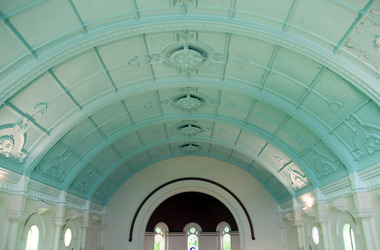 Ballarat Heritage Services
Photograph - Digital photographs, L.J. Gervasoni, Interior of St Brigid's Crossley, C2016
... Fritsch. of Melbourne, and the contractors Messrs F. and E. Deagne, of North Fitzroy. The contract price for the building was £5,500. ...Fritsch. of Melbourne, and the contractors Messrs F. and E. Deagne, of North Fitzroy. The contract price for the building was £5,500. ..."LARGE GATHERINGNG AT - CROSSLEY DEDICATION AND OPENING SERVICES. SERMON BY DR. MANNIX. Yesterday was an important and historic day for the Roman Catholic community of Crossley and Koroit, in as much as it will be always associated in the memories of all con cerned with the opening of the new St. Brigid's Church, Crossley. This building is far above the average standard of sacred edifices in country towns, and is certainly superior to any ercted in this district outside the churches in the two larger centres - Warrnambool and Koroit. The style of architecture chosen is a free treatment of the Romanesque, which is something quite original in the Western District. This noble style, from which, with its near re lative the Byzantine, spring the great Gothic school of architecture, is characterised by a special charm of its own, one of its chief features being graceful and sweeping circular curves in roof, window heads and in the ar rangenent of the ground plan. The building is of brick finished off with true Romanesqiue pillared pinnacles in concrete and plaster, the brick and concrete producing a pleasing contrast. The main characteristic of the front is a large rose window filled with Romlanesque circular tracery, and below a bold porch and entrance. The two sides are pierced with long circular-headed windows between graceful buttresses and the wall line is pleasingly broken by the projecting bays of the confessionals and also by the vestries. The main building is 80 feet by 30 feet' and the Sanctuary is spacious and semi-circular in shape, and lighted by three windows. The interior of the church is most artistic. The ceiling is semi-circular and of fibrous plaster in ornate designs. All the windows are lead lighted, throwing a rich and mellow harmony of' color throughout the interior and the white wails, mouldings, architraves and other fibrous plaster decorations: are further relieved by the rich coloring: in the stations of.the Cross arrranged around the nave. The central window of the Sanctuary contains a splendidly executed stained glass representation of St. Brigid. At.the western end is a room gallery. The altar is a choice piece of Gothic woodwork, in light, soft coloring, and there are two altars on either side of the Sanctuary in oak, and above whlch are very fine colored figures of Christ; and the Madonna. On either side of the altar are life-size figures of angels holding high brass candalabra. The whole of the furnishings of the church are on a sumptuous scale, and the edifice reflects credit on all concerned. The church can seat nearly 500 people. The architect was Mr. A. A. Fritsch. of Melbourne, and the contractors Messrs F. and E. Deagne, of North Fitzroy. The contract price for the building was £5,500. THE OPENING SERVICE. After the cereimony of solemnly blesssing the church was performed by His Lordship the Bishop of the Diocese, Dr. Higgins, assisted by His Grace the Coadjutor Archbishop of Melbourne. Dr. Mannix, the great gatheiring from all parts of the district entered the church, which was soon completely filled. The members of the H.A.C.B.S. attended wearing their green and gold regalia, and acted as a 'guard of honor' to the Co-adjlutor Arclhbishop and Bishop. Mass was celebrated by the Rev. Father Phelan, of Koroit, and a feature of the solemn service was the singing of a choir which consisted of picked voices from St. Carthage's choir, with friends from Warrnam bool and assisted by some of the mem bers of the Koroit choir, with Miss Logan as organist and Mr. Arthur H. Renwick as conductor. They rendered the music in splendid style throghonut. The "Kyrie," "Gloria." "Agnus Dei' and Dona Nobis" were from Farmer's Mass in B flat, and the "Credo" and "Sanctus" from Webbe's Mass in G. The soloists in the Mass were Mrs. Ryan, the Misses McEntee. Miss Katie O'Brien. and Messrs. J. M. Crowley, W. J. Callaghan; B. McEntee and W. Mahony. The chorus sang with great precision, special attention being paid to at tack. At the offertory Mrs. Dan Ryan gave a beautiful rendering of Gounod's "Ava Maria." After the Elevation that fine duet "Tantum Ergo." by Rossi, was sung by Messrs. Crowley and Renwick in an artistic manner, their fine voices blending splendidly. During the collection, Mr. Renwick sang with much feeling that devotional solo, "Lead Thou Me On,", after which Mr Crowley gave .an ex cellent rendering of Weissi's "0 Salu taris Hostia;" and the choir sang several hymns." It might here be mentioned that at the request of Fa ther Kerin, the same choir will repeat the music.at the Koroit Church on Sunday next, on the occasion of the ceremnly of laying the foundation stone of the cormpletion of the church. Dr. Mannix preachled the sermon for the occasion, taking his text from St. Luke first 11 verses. He re viewed the Gospel story of Christ preaching to the multitude from a boat on Lake Gennesaret and the miraculous draught of fish. The obedi ence of the poor fishermen in casting their nets at Christ's bidding was richly rewarded, and the miraculous occurrence was a striking example of what was to happen when Christ established His Church and built it up on those twelve apostles. When they came to think of it, nothing so re markable and marvellous had happened before or since in the history of mankind. The world at that time was for the most part a Pagan world steeped in iniquity and sin. The chosen people of God had God's re velation, but they worshipped with their lips and not with their hearts. When Christ was to establish His Church upon earth and leave an or gantisation that would continue His work, did He select learned men, powerful men, rich men, or a time that would seem propituous? No. He selected twelve poor, igorant simple fishermen, without money, power, learning or anything calculated to enable them to do anything striking in the world's history. The success of the first morning after pentecost was not confined to those first days when the plentitude of the Holy Ghost sat upon the .Apostles, but it continued age after age until the whole world was brought within the sphere of ac tion of the Church. Greece, Rome Europe Asia and America, and now Australia had been brought into the net. This must be a consolation to them all as well as it was to him (the preacher), when they remembered that they came from a land which of all others had been faithful to the Gospel of Jesus Christ. It was a consolation to them that in that great work that had been accomplished in bringing men into the meshes of the Church, and bringing them to God the nation to which they belontged had taken so great a part. Their religion flourished in England, Scotland, America and Australia. Surely it was due to the sons of St. Patrick, the sons and daughters of Ireland to find consolation in these great facts might It might seem hard that so many had to leave their native-land for England, Scotland, America and Australia. But if hard it was the means of keeping the Catholic faith living in England and Scotland. If to-day the Irish Catholics and Catholics of Irish de scent were taken out of the English and Scotch population there would be little left of the true Church of God. It seemed hard to emigrate to distant lands, but the result had been the new magnificent church in the United States, the flourishing churches in Canada and South Africa. Those Irish emigrants were a cornparatively small band. Perhaps they had not the learning of other nations. Certainly they had not the wealth and it did not fall to their lot to have the power of the sword, but God was with them, and the faith they took from Ireland flourished in those distant lands. In this fair land of Australia they had a glorious herit age handed down from the pioneer Irish Catholics, who came to this fair Austral land. There was a time when those who were opposed to God and God's Church,thought that Australia should be a wholly Protestant land. They had lived to see whether God or His enemies were the stronger. They had lived to see that those who in distant days would have stamped out the Catholic religion in Australia, had not prevailed. Their names had been forgotten because of their persecution of the Catholic Church, and they had lived - to see the glorious success that now, in every part of the Common wealth, rested upon the Catholic Church in Australia. Might God bless that Church and those Irish people, and the people of Irish descent, who had built it up. In that locality, and there was no place in.the Common wealth where the Catholic Church was held in higher esteem, the people would always be faithful to God and His Church. That beautiful building, and all it signified in loyalty and faithfulness, was a credit and a consolation to the Bishop and people of the diocese, to the architect who had done his work so artistically and skil fully. to the priests and the zealous administration of the parish. There was surely hope and inspiration in that day's celebration, that as time went on the Catholic faith would sink deeper and deeper into ther coming generation, and that the Catholic progress of the past 50 years would be small in comparison to the great progress of the future. He congratulated the Bishop priests and people who had raised that temple. He congratulated the people of Crossley; upon their generosity and self-sacrifice, and he prayed that God's blessing and the blessing of St. Brigid would rest upon them; their children and children's children. And when those who had received the sacraments and had been instructed in that Church were called before the Judgment Seat he pray ed that not one would be missing, and St. Peter aind St. Brigid would be able to count them all into the en joyment .of Eternal bliss. THE CELEBRATION The Rev. Father Kerin, Adninistra tor of the Parish, after the collection, read a lengthy list of the principal donations, headed by the Bishop, Dr. Higgins, with £250. All the furnish ings of the Church were also donations, and the Coadjutor-Archbishop added £5 to the list. The Rev. Father Kerin stated that the total to hand was £1245/10/7, which was an other proof of the generosity of the Crossley and district people. The amount previously received in donations was £1077/3. They started buildiing with a credit balance of £262 10/5 and ther now had a debit balance of £2,728/18/5. The total cost of the Church was £6,250, so that they would see the greater part of the indebtedness had already been wiped out. The Bishop (Dr. Higgins) delivered a brief address, in the course of which he congratulated the priests and people upon the completion of their magnificent Church. He congratulated the people on their magnificent generosity. He expressed his of deep indebtedness to the Coadjutor Archbishop of Melbourne for the services he had rendered to them. He had attended at considerable sacrifice to himself, and they were extremely grateful for the presence of so distinguished a champion who had shown such zeal and interest in their Church in this new land. He (the Bishop) trusted that his splendid talents would long be devoted to the defence of the Church." (Warrnambul Standard, 02 July 1914)Digital images of the in..terior of St Brigid's Crossleyst brigid's crossley, st brigid's, catholic church, catholic, church, community, ceiling, stations of the cross, confessional, statues, windows -
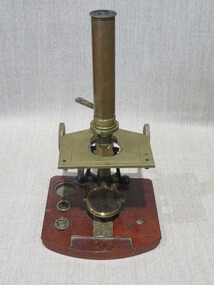 Federation University Historical Collection
Instrument - Microscope, Travelling Pocket Microscope, c1850s
... E. Llewellyn studied Chemistry at the Ballarat School of Mines in 1885. It may also be associated with Palmer's Chemist in Lydiard Street Ballarat. "OBITUARY. - The many friends here and in the surrounding districts will regret to learn of the tragically sudden death of Mr Erskine Llewellyn, who for many years was associated with the firm of A. M. Palmer and Co., chemists, of Lydiard street. For some considerable time Mr Llewellyn had been associated with the U.F.S. Dispensary at North...E. Llewellyn studied Chemistry at the Ballarat School of Mines in 1885. It may also be associated with Palmer's Chemist in Lydiard Street Ballarat. "OBITUARY. - The many friends here and in the surrounding districts will regret to learn of the tragically sudden death of Mr Erskine Llewellyn, who for many years was associated with the firm of A. M. Palmer and Co., chemists, of Lydiard street. For some considerable time Mr Llewellyn had been associated with the U.F.S. Dispensary at North ...This microscope is thought to be associated with Chemist Erskine Llewellyn of Ballarat. Erskine E. Llewellyn studied Chemistry at the Ballarat School of Mines in 1885. It may also be associated with Palmer's Chemist in Lydiard Street Ballarat. "OBITUARY. - The many friends here and in the surrounding districts will regret to learn of the tragically sudden death of Mr Erskine Llewellyn, who for many years was associated with the firm of A. M. Palmer and Co., chemists, of Lydiard street. For some considerable time Mr Llewellyn had been associated with the U.F.S. Dispensary at North Carlton, and there, as in the case here, by his courtesy and attention to business, he made a host of friends, and his sudden demise will be deplored." [Ballarat Courier, 21/08/1917] http://www.anbg.gov.au/botanical-history/botanical-discovery.html Antique brass microscope in custom made hinged wooden case with brass handles and key. Interior is fitted with drawers for various instruments, lenses, tools and glass plates. microscope, llewellyn, pharmacy, ballarat school of mines, travelling microscope, erskine llewellyn, alumni, palmers pharmacy -
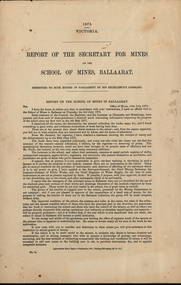 Federation University Historical Collection
Booklet - Report, John Ferres, Government Printer, Report of The Secretary for Mines on the School of Mines, Ballarat, 1873, 1873
... e. bull...bickett...j.m. bickett...parliament...louis ballhausen...alexander millan...tuckey quartz mining co (new zealand)...egerton mining company, park gold mining company...s. livingston learmonth...new north...Livingston Learmonth, New North Clunes Mining Company, Malcolm Morris, Mr Seal. ballarat school of mines serjeant r.m. serjeant flude joseph flude richard gibbs stawell lynch john lynch r.s. mitchell mitchell bull e. bull bickett j.m. bickett parliament louis ballhausen alexander millan tuckey quartz mining co (new zealand) egerton mining company, park gold mining company s. livingston learmonth new north clunes mining company malcolm morris seal f. ive rev. g.j. russell p.c. fitzpatrick j. m. bickett b. bryant n. kent a. martin p. matthews j. robinson j.m. troup Five printed foolscap pages presented to both houses of Parliament in 1873. ...The following are listed as having pyrites treated at the Ballarat School of Mines: Louis Ballhausen, Alexander Millan, Tuckey Quartz Mining Co (New Zealand), Egerton Mining Company, Park Gold Mining Company, S. Livingston Learmonth, New North Clunes Mining Company, Malcolm Morris, Mr Seal.Five printed foolscap pages presented to both houses of Parliament in 1873. The report details budget, student numbers, examiners, candidate for examination, museum and rooms.ballarat school of mines, serjeant, r.m. serjeant, flude, joseph flude, richard gibbs, stawell, lynch, john lynch, r.s. mitchell, mitchell, bull, e. bull, bickett, j.m. bickett, parliament, louis ballhausen, alexander millan, tuckey quartz mining co (new zealand), egerton mining company, park gold mining company, s. livingston learmonth, new north clunes mining company, malcolm morris, seal, f. ive, rev. g.j. russell, p.c. fitzpatrick, j. m. bickett, b. bryant, n. kent, a. martin, p. matthews, j. robinson, j.m. troup -
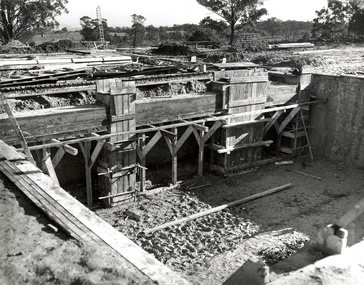 Federation University Historical Collection
Photograph, N.l. Harvey & Son, Mount Helen Campus, 1968, 1969
... Earthworks, general view .4) Aerial View from above the South West corner of E building. .5) Aerial View from North East. Gear Avenue in background .6) Aerial View from North West. ...Earthworks, general view .4) Aerial View from above the South West corner of E building. .5) Aerial View from North East. Gear Avenue in background .6) Aerial View from North West. ...The Federation University campus at Mount Helen was first used by students in 1970.Seven photographs of the Mt Helen Campus Stage one development. .1) Aerial view of foundation work, from west, towards Green Hill .2) Aerial View from South. Earthworks and foundations .3) Aerial View from south west. Earthworks, general view .4) Aerial View from above the South West corner of E building. .5) Aerial View from North East. Gear Avenue in background .6) Aerial View from North West. Earthworks extend from Gear Avenue .7) Ground level view. First columns of E building. .13) Mt Helen development Stage One, Engineering Diploma Buildings. This image shows the wall beam and pier construction to the East Wall of the Fluid Mechanics Laboratory adjacent to the pump chamber, 17 June 1968. .18) Flume Pit and Pump Chamber, 15 July 1968. .28) East Wing Pit Looking North, 26 August 1968 .40) Construction as of 04 November 1968federation university, federation university australia, feduni, university of ballarat, ballarat college of advanced education, ballarat institute of advanced education, building, earthworks, foundation, early development, soil testing laboratory -
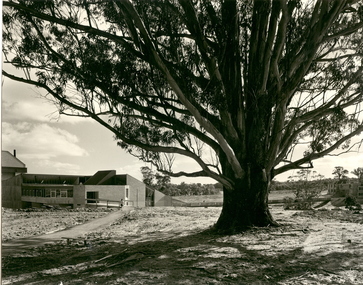 Federation University Historical Collection
Photograph - Black and White, Tree of Knowledge, Mount Helen Campus, 1973, 1973
... Six black and white photographs showing external views of the recently completed Union Building (Coates Centre) on the Mount Helen Campus of Federation University Australia. .1) Union Building north entrance, part of library on right, 'S' building in back. .2) Union Building north west corner, residences in background, two males. .3) Union Building north west corner, student residences in background .4) Union Building north west corner, view towards library .5) Union Building north entrance, part of library on right, 'S' building in back. Shows earthworks for the Electrical engineering building ('E' building)...In 1973 the Union Building (Building 'U' now the Albert Coates Centre) was completed federation university federation university australia feduni university of ballarat ballarat college of advanced education albert coates albert coates centre union building Six black and white photographs showing external views of the recently completed Union Building (Coates Centre) on the Mount Helen Campus of Federation University Australia. .1) Union Building north entrance, part of library on right, 'S' building in back. .2) Union Building north west corner, residences in background, two males. .3) Union Building north west corner, student residences in background .4) Union Building north west corner, view towards library .5) Union Building north entrance, part of library on right, 'S' building in back. Shows earthworks for the Electrical engineering building ('E' building) Tree of Knowledge, Mount Helen Campus, 1973 Photograph - Black and White Ian McKenzie Photography P/L ...The sod for the Mount Helen Campus was turned in 1967, and students first studied on campus in 1970. In 1973 the Union Building (Building 'U' now the Albert Coates Centre) was completedSix black and white photographs showing external views of the recently completed Union Building (Coates Centre) on the Mount Helen Campus of Federation University Australia. .1) Union Building north entrance, part of library on right, 'S' building in back. .2) Union Building north west corner, residences in background, two males. .3) Union Building north west corner, student residences in background .4) Union Building north west corner, view towards library .5) Union Building north entrance, part of library on right, 'S' building in back. Shows earthworks for the Electrical engineering building ('E' building)federation university, federation university australia, feduni, university of ballarat, ballarat college of advanced education, albert coates, albert coates centre, union building -
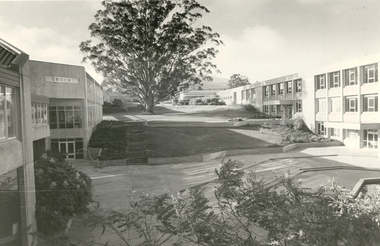 Federation University Historical Collection
Photograph - Black and White, Mount Helen Campus, 1979
... north-west. Coates Centre ('U' building, formerly Union Building) with Stage Two is on the right. The library is centre. To the left is 'S' building .4) View from the East end of Coates Centre ('U' building) towards 'E' building....north-west. Coates Centre ('U' building, formerly Union Building) with Stage Two is on the right. The library is centre. To the left is 'S' building .4) View from the East end of Coates Centre ('U' building) towards 'E' building. ...Five black and white images of the courtyard at the Mount Helen Campus of Federation University Australia. .1) View of the courtyard North of 'S' building, towards east .2) View westward, across the courtyard pool (since demolished). The walkway joins the library building (right) and 'S' building. .3) View towards the north-west. Coates Centre ('U' building, formerly Union Building) with Stage Two is on the right. The library is centre. To the left is 'S' building .4) View from the East end of Coates Centre ('U' building) towards 'E' building.
