
Showing 4 items matching "e.g. beer"
-
 Returned Nurses RSL Sub-branch
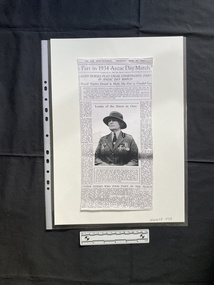
Newspaper - Photocopy of newspaper clipping, The Sun News-Pictorial, Army nurses play usual unobstrusive part in Anzac Day march: Record number, dressed in mufti, slip past in crowded cars, April 26 1934
... ...E.G. Beer...Simpson M. Thomas E.G. Beer Goodman S. Greenaway W. Williamson J. ...Dressed in mufti, attended by no band or banners, more than 200 women slid past the almost unheeding crowd in a battalion of cars, unobtrusively taking their part in the Anzac Day march, as they played their part during World War One. They were all returned army nurses who served in Egypt, Salonika, Flanders, Belgium, England and India. Many were wearing medals such as the Commander of the Order of the British Empire medal (CBE), the Royal Red Cross medal (RRC), the Florence Nightingale medal, the Order of St Sava and the Medal of Honour of Greece. The article goes on to list many of the women who participated in the march.A photocopy of a newspaper clipping consisting of titles, one large photo and several columns of text. The photo depicts a woman in nurse's uniform and war medals.ww1, wwi, world war 1, e conyers, matron in chief, australian army nursing service, aans, australian imper, australian imperial forces, aif, a dowsley, 3rd military district, e cornwell, edith cavell trust fund, mchardie white, gertrude davis, hamilton russell wing, alfred hospital, i o'dwyer, repatriation hospital, caulfield, m.e. nicholson, methodist homes for children, cheltenham, a.f. roberts, masonic homes, punt rd, d ryall (nee newton), trinity college, g douglas, newport, e cameron, melbourne university, nan reay, bryant and may, c fisher (nee pratti), grace wilson, edith cavell memorial service, returned army nurses' club, parliament house, h. hayes (nee gawler), m.m. loughron, children's welfare department, e hart, b.m. gibbings, a.r. broughton (nee bolton), a forrest, baby health centre, ivanhoe, buckham, a. king, lily rutherford, m. coombes, v woinarski, m. humphrey, police hospital, n. rhoden, anzac hostel, j. tyers, mont park, j. stanbury, bundoora, f. grylls, children's health bureau, anzac house, m. ambler, jean robertson, macrobertson's, rose quarterman, buckleu and nunn, v. payne, tanganyika, w.b. healy (nee brocklebank), rushworth, c. murray, nauru, e.m. mccarthy, traralgon, l.e. wheeler, st arnaud, b. g. stubbs, tecoma, e.l. weitnaure (nee trant), bateford, cope (nee hewlett), tatura, w.s. philip (nee green), echuca, b. o'connor (nee balkam), maldon, scurry (nee barry), silvan, long (nee garden), fussell (nee garden), gillies, m peet, a purcell, geelong, j.r. porter, peake (nee ekers), harcourt (nee tuxworth), o. sommerville (nee deane), lorimer (nee pilkington), r. b. kelley (nee malcolm), i. owen, e cullen (nee newton), e shepard (nee harrison), gaff (nee steele), wilkinson (nee peters), p. n. lewis (nee evans), p dooley (nee haynes), barber (nee webb), d monat (nee crossing), w. scurry (nee barry), e. geddison (nee edwards), arruthers, winfield, hambridge, l. dutton, w. b. heily (nee bocklebank), e. glyde (nee whitely), b o'connor (nee balham), i. prime (nee ogilvie), r. e.ireland (nee grove), e. kitchen (nee neville), c. matheson (nee donaldson), m. clyne (nee hardie), s. buckley (nee flett), stewart cowan, wiseman (nee jamieson), h. welch (nee white), jj. sedgeick (nee waddell), n drysdale, m. roberts (nee brown), geach, c. bonwick (nee strom), l. thompson (nee stewart), g. easter (nee jeremiah), n. kenward, h. davis (nee colwill), geddison, g. owen, g. cochran, hales (nee whitfield), l. sheppard, g. levinson (nee irvine), g. sylvester, tregellis smith (nee sampson), h. f. allison wallilien (nee canard), v. woinarski, l. leich, d. white, s. bennett smith, mcphail, l. rutherford, m. hall, n. coombs, w. holding, c. cadwellader, dowling, stewart, j. bage, m. hobler, i. mcalpine, condon, s. malcolm, m. smith, a. h. stone, m. nuzum, j. burgess, m. burtley, k. devine, e. simpson, s. pines, i. bonnin, a. cassidy, kendall, i. f. donald, j. currie, t. tyson, j. robertson, r. quarterman, g. grace, m. tilton, m. robinson, a. lee-brown, c. williams, l. moxham, e. reddie, f. tabor, n. isaacs, e. m. renard, mackenzie, k. garney, g. duncan, f.m. dowell, n.w. gillespie, e.l. prescott, sandbrook, m. peet, e. thistlewaite, e. palmer, b. lord, b. mckinnell, g. bishop, b mcphail, m. pearce, l. hancock, o. saloway, e. dixon, g.c. marum, m. folwer, a.m. gallen, a. brown, a. hardie, j. simpson, m. thomas, e.g. beer, goodman, s. greenaway, w. williamson, j. donald, a. gill, e. gill, k. fegan, m. humphreys, j.m. matthews, e.c. kerr, holding, g. sumner, a. kitchen, e. pitchford, m. cumming, m. donnellan, o. gillin, a. purcell, j. jennings, m. delehenty, m. stevens, m. duggan, j. reeves, a. neunham -
 Kiewa Valley Historical Society
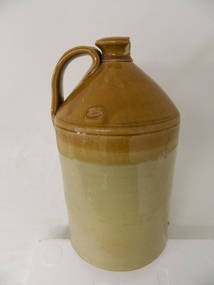
Jar/ Demi John Stone Ware, Circa 1860
... beer and other "brews" for human consumption were the prime target. The ability to refill these vessels were of the utmost importance to the consumer. Over time these containers were reduced in size and produced for "special" liquids e.g. alcoholic Port. ...beer and other "brews" for human consumption were the prime target. The ability to refill these vessels were of the utmost importance to the consumer. Over time these containers were reduced in size and produced for "special" liquids e.g. alcoholic Port. ...This kiln glazed container for liquid's, was the type used in the 1700's to mid 1900's to contain fluids mainly for human consumption which needed to retain liquid that could be affected by sunlight and or required to be maintained at a cooler temperatures. Ginger beer and other "brews" for human consumption were the prime target. The ability to refill these vessels were of the utmost importance to the consumer. Over time these containers were reduced in size and produced for "special" liquids e.g. alcoholic Port. This Demi John stone ware was manufactured in Tamworth (England) and imported into Australia during a period when the majority of "quality" domestic items were sourced from "the Mother Country" and the ties between the still "colonial" outpost were very strong. This bondage remained longer in rural communities than in the cities. The "multi-culturalism of the post World War II era resulted in the lessening of the earlier ties. The growing of nationalism, the Aussie evolution, was brought about by the increased social and business/commercial interactions between Australia and the United States of America, post World War II.This container(jug) is very significant to the Kiewa Valley, a rural region that required these type of liquid storage vessels, especially in the late 1800's to the mid 1900's. These were times when household refrigeration, if available, would be from the "block ice" coolers or "cool" storage nooks and crannies within farmhouse locations.This large "stone ware" glazed Demi John, alias Carboy has a capacity of over 20 litres. It has a conical smooth lipped neck top with a wide, flat(three to four finger) carry and poring handle. The top third portion of the jug is caramel in colour and the bottom a darker cream. It has a manufacturer's seal stamped into the surface before glazing. This item would have been corked and then sealed (air tight) with wax.manufacturer's seal "GEORGE SKEY WILNECOTE TAMWORTH"household liquid jar container, 1800's food storage, kiln fired glazed pottery -
 Kiewa Valley Historical Society
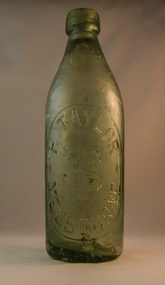
Bottle - Ginger Beer, early to late 1900's
... beer processing plants from the brewing vats/holding tanks to the final corking/sealing of the bottles for eventual distribution. From 1990s the bottle slowly became phased out of production however boutique suppliers still preferred thick glass to contain any explosive action. Two major glass bottle works companies, e.g...beer processing plants from the brewing vats/holding tanks to the final corking/sealing of the bottles for eventual distribution. From 1990s the bottle slowly became phased out of production however boutique suppliers still preferred thick glass to contain any explosive action. Two major glass bottle works companies, e.g ...This glass ginger beer bottle was manufactured and used early to late 1900's, until the time that cheaper containers were invented(plastic bottles). This bottle was so constructed to be easily moved within the ginger beer processing plants from the brewing vats/holding tanks to the final corking/sealing of the bottles for eventual distribution. From 1990s the bottle slowly became phased out of production however boutique suppliers still preferred thick glass to contain any explosive action. Two major glass bottle works companies, e.g. Melbourne Glass Bottle Works Co. were the main suppliers for the Victorian State. In the period when this bottle was manufactured and used the major ginger beer brewing plants for the whole of Victoria were located in Melbourne because this was where its greatest consumer base was there and most rural areas were supplied by domestic sources (mother brewing ginger beer for the children). The Kiewa Valley and its region was one rural area which until road invrastructure was enhance covered the ginger beer thirst by local family production. As the population expanded considerably in the late 1940's (SECV Hydro Scheme) with a greater demand for "soft" drinks" being established supplies from larger towns and cities were call for. Each bottle was "branded" during manufacturing to show the contents were from a reputable supplier (H Taylor) and where it originated from. These bottles were recyled by the manufacturer as a way to cut production costs. This method of recycling the bottles back to the specific manufacturer has (except for South Australia)been overtaken by a no cost recycling collection by councils (funded by their communities). This method by passes the user cost principle as the bottles are processed as non generic. The uneconomical "on cost" which was replaced by the "throw away" less costly plastic containers however did not provide the keen domestic brewer of the "beer" with a reusable bottle. This heavy gauged glass ginger beer bottle has a rim and a distinctive head at the top. This head has been manufactured to facilitate the movement of the bottled along the filling production line. The method of pouring ginger beer into the bottle has been part of the "production line". This bottle has a one and a half pint capacity and is made from "light green" coloured glass(a protection against light penetration). This thick glass bottle, to contain ginger beer, required its thickness because of the extensive handling (man and machine) before final consumption. During this period delivery to homes in cities and towns was made initially by horse and cart and later by truck. Ginger beer was a "soft drink" of great demand. On the middle portion of this bottle is a large elongated circle within it and following the spherical line is "H. TAYLOR" ans a star separates this from "MELBOURNE" rounding out the bottom curviture. Within these words are the large initials "T H" . The "T" superimposed onto the "H". On the base and covering the whole bottom is the letter "T". At the opposite side to the manufacturers logo is "THIS BOTTLE CANNOT BE SOLD OR USED BY ANY OTHER PERSON & IS NOT COMPLETE WITHOUT STOPPER" glass bottle, non alcoholic drink, taylor ginger beer bottle, reuseable bottles -
 Kiewa Valley Historical Society
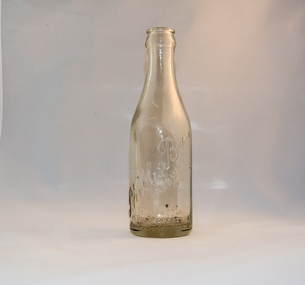
Bottle Ginger Beer, circa mid to late 1900's
... beer processing plants from the brewing vats/holding tanks to the final corking/sealing of the bottles for eventual distribution. From 1990s the bottle slowly became phased out of production however boutique suppliers still preferred thick glass to contain any explosive action. Two major glass bottle works companies, e.g...beer processing plants from the brewing vats/holding tanks to the final corking/sealing of the bottles for eventual distribution. From 1990s the bottle slowly became phased out of production however boutique suppliers still preferred thick glass to contain any explosive action. Two major glass bottle works companies, e.g ...This glass ginger beer bottle was manufactured and used early to late 1900's, until the time that cheaper containers were invented(plastic bottles). This bottle was so constructed to be easily moved within the ginger beer processing plants from the brewing vats/holding tanks to the final corking/sealing of the bottles for eventual distribution. From 1990s the bottle slowly became phased out of production however boutique suppliers still preferred thick glass to contain any explosive action. Two major glass bottle works companies, e.g. Australian Glass Manufacturers and the Melbourne Glass Bottle Works Co. were the main suppliers for the Victorian State.In the period when this bottle was manufactured and used the major ginger beer brewing plants for the whole of Victoria were located in Melbourne because this was where its greatest consumer base was there and most rural areas were supplied by domestic sources (mother brewing ginger beer for the children). The Kiewa Valley and its region was one rural area which until road invrastructure was enhance covered the ginger beer thirst by local family production. As the population expanded considerably in the late 1940's (SECV Hydro Scheme) with a greater demand for "soft" drinks" being established supplies from larger towns and cities were call for. Each bottle was "branded" during manufacturing to show the contents were from a reputable supplier (PHIBBS Bros) and where it originated from. These bottles were recycled by the manufacturer as a way to cut production costs. This method of recycling the bottles back to the specific manufacturer has (except for South Australia)been overtaken by a no cost recycling collection by councils (funded by their communities). This method by passes the user cost principle as the bottles are processed as non generic. The uneconomical "on cost" which was replaced by the "throw away" less costly plastic containers however did not provide the keen domestic brewer of the "beer" with a reusable bottle.This heavy gauged glass bottle (Ginger Beer) has a rim and a distinctive head at the top. This head has been manufactured to facilitate the movement of the bottled along the production line. The method of pouring ginger beer into the bottle has been part of the "production line" process of automation. This bottle has a capacity to hold 250ml of ginger beer and is made from "clear" glass. The marority of ginger beer bottles produced in this time frame where made with a "green" tint in them.This tinting helped reduce the sunlight effecting the contentsAround the bottom side of the bottle and blown into the glass is "THIS BOTTLE IS THE PROPERTY OF PHIBBS BROS, ALBURY" above this, in "running script" and sloping up from left to right is "Phibbs Bros" and underneath parallel to it "ALBURY". On the base of the bottle is molded a big "L 289" underneath this "M" and below this "AGM".ginger beer bottle, soft drink bottles, cordial bottles
