
Showing 551 items matching "early settlers. market gardeners"
-
 City of Moorabbin Historical Society (Operating the Box Cottage Museum)
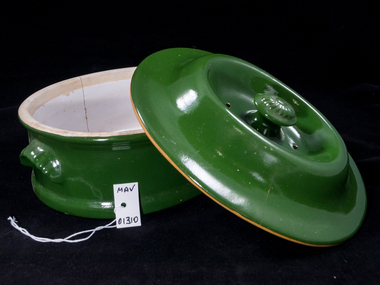
Kitchen Equipment, green casserole dish with lid, early 20thC
... kitchen equipment, cooking, crockery, casserole, stewed meat, vegetables, early settlers , market gardeners, moorabbin shire, bentleigh, cheltenhsm,...Early settler market gardeners had a good source of nourishing food and casseroles and stews were common meals for the families in Moorabbin Shire. ...Early settler market gardeners had a good source of nourishing food and casseroles and stews were common meals for the families in Moorabbin Shire. ...Early settler market gardeners had a good source of nourishing food and casseroles and stews were common meals for the families in Moorabbin Shire. Typical of the crockery used in early 20thC homes to cook casseroles and stews for early settler families in Moorabbin ShireA green crockery casserole dish with a lidkitchen equipment, cooking, crockery, casserole, stewed meat, vegetables, early settlers , market gardeners, moorabbin shire, bentleigh, cheltenhsm, -
 City of Moorabbin Historical Society (Operating the Box Cottage Museum)
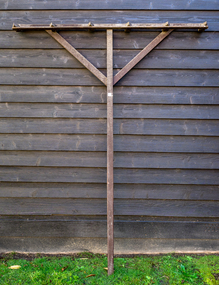
Farm Equipment, Rake, large Hay c1900, c1900
... farm equipment, hay rakes, hammers, early settlers, market gardeners, blacksmiths, tools, building equipment, moorabbin shire, bentleigh, mckinnon, highett, cheltenham,ormond...Early settlers established productive market gardens, poultry,. pig and dairy farms , orchards and vineyards on the land in the 'Henry Dendy Special Survey Brighton 1841' - now Ormond, Bentleigh, East Bentleigh, Brighton, ...Early settlers established productive market gardens, poultry,. pig and dairy farms , orchards and vineyards on the land in the 'Henry Dendy Special Survey Brighton 1841' - now Ormond, Bentleigh, East Bentleigh, Brighton, This hay rake is typical of the type used by early settlers in Moorabbin Shire c1900 farm equipment, hay rakes, hammers, early settlers, market gardeners, blacksmiths, tools, building equipment, moorabbin shire, bentleigh, mckinnon, highett, cheltenham,ormond Large wooden Hay rake , hand made c1900 Farm Equipment, Rake, large Hay c1900 ...A hay rake is an agricultural rake used to collect cut hay or straw into windrows for later collection (e.g. by a baler or a loader wagon). It is also designed to fluff up the hay and turn it over so that it may dry. The next day it is spread again, so that the hay dries more quickly. Early settlers established productive market gardens, poultry,. pig and dairy farms , orchards and vineyards on the land in the 'Henry Dendy Special Survey Brighton 1841' - now Ormond, Bentleigh, East Bentleigh, Brighton, This hay rake is typical of the type used by early settlers in Moorabbin Shire c1900Large wooden Hay rake , hand made c1900farm equipment, hay rakes, hammers, early settlers, market gardeners, blacksmiths, tools, building equipment, moorabbin shire, bentleigh, mckinnon, highett, cheltenham,ormond -
 City of Moorabbin Historical Society (Operating the Box Cottage Museum)
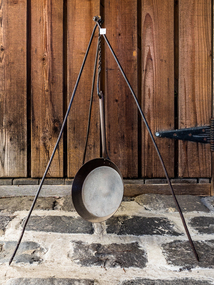
Functional object - Kitchen Equipment, billy holder, c1880
... early settlers...pioneers...market gardeners...Banjo Paterson's most famous of many references to the billy is surely in the first verse and chorus of Waltzing Matilda: "And he sang as he looked at the old billy boiling", which was later changed by the Billy Tea Company to "And he sang as he watched and waited 'til his billy boiled”. Early settlers , market gardeners and blacksmiths would use this portable iron stake to hold their Billies at meal times when out working their fields, travelling for work or pleasure....Banjo Paterson's most famous of many references to the billy is surely in the first verse and chorus of Waltzing Matilda: "And he sang as he looked at the old billy boiling", which was later changed by the Billy Tea Company to "And he sang as he watched and waited 'til his billy boiled”. Early settlers , market gardeners and blacksmiths would use this portable iron stake to hold their Billies at meal times when out working their fields, travelling for work or pleasure. early settlers pioneers market gardeners moorabbin bentleigh brighton cheltenham tools blacksmiths c1880 A molded, iron tripod stake that would hold a 'Billy can' of water over a camp or kitchen fire Functional object Kitchen Equipment, billy holder Unrecorded early settler ...A billycan, is a lightweight cooking pot which is used on a campfire or a camping stove, particularly associated with Australian usage, but is also used in the UK and Ireland. It is widely accepted that the term "billycan" is derived from the large cans used for transporting bouilli or bully beef on Australia-bound ships or during exploration of the outback, which after use were modified for boiling water over a fire. However there is a suggestion that the word may be associated with the Aboriginal billa (meaning water; cf. Billabong In Australia. The billy has come to symbolise the spirit of exploration of the outback. To boil the billy most often means to make tea. "Billy Tea" is the name of a popular brand of tea long sold in Australian grocers and supermarkets. Billies feature in many of Henry Lawson's stories and poems. Banjo Paterson's most famous of many references to the billy is surely in the first verse and chorus of Waltzing Matilda: "And he sang as he looked at the old billy boiling", which was later changed by the Billy Tea Company to "And he sang as he watched and waited 'til his billy boiled”. Early settlers , market gardeners and blacksmiths would use this portable iron stake to hold their Billies at meal times when out working their fields, travelling for work or pleasure.c1880 A molded, iron tripod stake that would hold a 'Billy can' of water over a camp or kitchen fireearly settlers, pioneers, market gardeners, moorabbin, bentleigh, brighton, cheltenham, tools, blacksmiths -
 City of Moorabbin Historical Society (Operating the Box Cottage Museum)
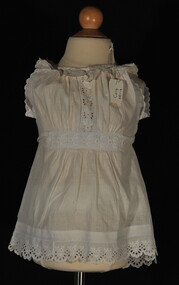
Clothing - Clothing, girl's pinafore, c1900
... early settlers...market gardeners...settlers and market gardeners of the Moorabbin Shire 1900. The pioneer settlers and market gardeners of Moorabbin Shire had to be self reliant and made their own clothing and utensils. This is one of many items that exhibit the skill and craftsmanship of the women in these families. Moorabbin brighton pioneers early ...This white fine lawn girls pinafore is an example of the dressmaking skills of the wives of the pioneer settlers and market gardeners of the Moorabbin Shire 1900. The pioneer settlers and market gardeners of Moorabbin Shire had to be self reliant and made their own clothing and utensils. This is one of many items that exhibit the skill and craftsmanship of the women in these families.A white, fine lawn girl's sleeveless pinafore. Guipure lace frill around armholes, neck and hem. Guipure lace insert to bodice and feather-stitch embroidery to skirt. Waist ties.moorabbin, brighton, pioneers, early settlers, market gardeners, home, dressmaker, garments, craftwork -
 City of Moorabbin Historical Society (Operating the Box Cottage Museum)
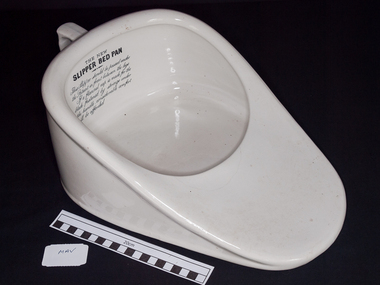
Functional object - Medical Equipment, china bed-pan, c1910-1940
... early settlers...market gardeners...This porcelain 'New Slipper' bed pan was used early 20thC. toilets invalids cummerford family moorabbin bentleigh cheltenham early settlers market gardeners Inside back 'The New Slipper bed pan should be passed under the patient in front between the legs. ...A bedpan is a receptacle used for the toileting of a bedridden patient in the home or in a hospital and are usually made of a metal, glass, or plastic . A bed pan can be used for both urinary and faecal discharge. This porcelain 'New Slipper' bed pan was used early 20thC.A white china bed-pan with handle at centre back 'The New Slipper'Inside back 'The New Slipper bed pan should be passed under the patient in front between the legs. If a flannel cap is made for the blade, fastened by string to the handle, considerable comfort will be affected." on base 'F Large"toilets, invalids, cummerford family, moorabbin, bentleigh, cheltenham, early settlers, market gardeners -
 City of Moorabbin Historical Society (Operating the Box Cottage Museum)
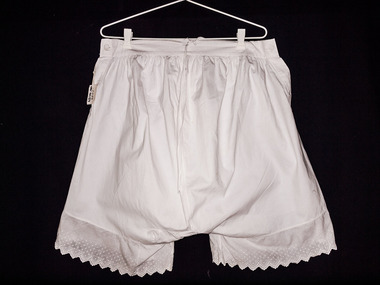
Clothing - Clothing, lady's underwear, c1900
... early settlers...market gardeners... settlers in Moorabbin Shire clothing craftwork dressmaking pioneers early settlers market gardeners moorabbin brighton A pair of lady's cotton draw-string drawers Clothing Clothing, lady's underwear Thompson family ...The pioneer settlers and market gardeners of Moorabbin Shire had to be self reliant and made their own clothing and utensils. This is one of the many items that exhibit the skill and craftsmanship of the women of these families This pair of lady’s underwear is an example of the dressmaking skills and craftwork of the women of the pioneer families. The Thompson family were early settlers in Moorabbin ShireA pair of lady's cotton draw-string drawersclothing, craftwork, dressmaking, pioneers, early settlers, market gardeners, moorabbin, brighton -
 City of Moorabbin Historical Society (Operating the Box Cottage Museum)
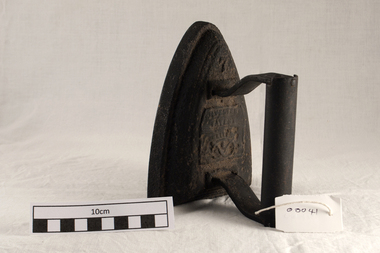
Domestic object - Kitchen equipment, sad iron, c1880
... early settlers...market gardeners...early settlers of Moorabbin Shire. The family of Miss M Curtis were early settlers in Moorabbin Shire. sad iron kitchen equipment pioneers early settlers market gardeners sewing craftwork clothing moorabbin brighton bentleigh fireplaces stoves SILVESTER'S/ PATENT/ SALTERS / No 6 with the pretzel & a arrow going through the centre Sad-iron, domestic, flat, cast iron, Silvester's Patent, No 6, Salter, England, c. 1890-1900s A sad iron made from cast iron was heated over a fire or on a stove and used for pressing clothing and table ware Domestic object Kitchen equipment, sad iron Silvester's Salter Pty Ltd ...Sad-irons or "solid" irons were made by blacksmiths and used to smooth out material by pressing the hot iron over it. A piece of sheet -iron was placed over the kitchen fire and the irons placed on it could be heated whilst remaining clean of ash.. The women used 2 irons - one heating while the other was used. Thick cloth or gloves protected their hands from the hot irons. The handle was removed from the cool iron and re- attached to remove the hot iron from the fire. The cool iron was replaced on the fire or stove to heat again. These irons were cleaned with steel wool to prevent them marking the material. If the iron was too hot the material would scorch. Most homes set aside one day for ironing and some large households had an ironing room with a special stove designed to heat irons. However, most women had to work with a heavy, hot iron close to the fireplace even in summer.These sad irons remind us of the difficult circumstances experienced in their daily routines by the pioneers and early settlers of Moorabbin Shire. The family of Miss M Curtis were early settlers in Moorabbin Shire. Sad-iron, domestic, flat, cast iron, Silvester's Patent, No 6, Salter, England, c. 1890-1900s A sad iron made from cast iron was heated over a fire or on a stove and used for pressing clothing and table wareSILVESTER'S/ PATENT/ SALTERS / No 6 with the pretzel & a arrow going through the centresad iron, kitchen equipment, pioneers, early settlers, market gardeners, sewing, craftwork, clothing, moorabbin, brighton, bentleigh, fireplaces, stoves -
 City of Moorabbin Historical Society (Operating the Box Cottage Museum)
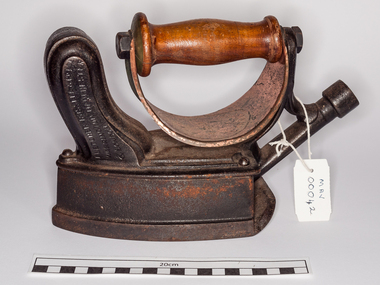
Domestic object - Kitchen equipment, gas-fuelled flat iron, c1900 - 30
... early settlers...market gardeners...However , not many houses had access to a gas supply until much later and this iron was popular in 1920’s These sad irons remind us of the difficult circumstances experienced in their daily routines by the pioneers and early settlers of Moorabbin Shire The family of Miss M Curtis were early settlers in Moorabbin Shire. sad iron kitchen equipment fletcher russell co. ltd. england warrington manchester pioneers early settlers market gardeners sewing craftwork clothing moorabbin brighton bentleigh fireplaces stoves domestic gas supply gas-light gas cannisters FLETCHER RUSSELL CO. / LIM/ PATENT/ WARRINGTON on right side of handle 'Registered' on left side of handle ' Fletcher Russell Co L / Warrington, Manchester / & London. ...Sad-irons or "solid" irons were made by blacksmiths and used to smooth out material by pressing the hot iron over it. A piece of sheet -iron was placed over the kitchen fire and the irons placed on it could be heated whilst remaining clean of ash.. The women used 2 irons - one heating while the other was used. Thick cloth or gloves protected their hands from the hot irons. The handle was removed from the cool iron and re- attached to remove the hot iron from the fire. The cool iron was replaced on the fire or stove to heat again. These irons were cleaned with steel wool to prevent them marking the material. If the iron was too hot the material would scorch. Most homes set aside one day for ironing and some large households had an ironing room with a special stove designed to heat irons. However, most women had to work with a heavy, hot iron close to the fireplace even in summer. Thomas Fletcher (1840-1903). By 1880s he had a gas appliance manufactory in Thynne Street, Warrington. By 1895 the company had become Fletcher Russell and Co Gas Engineers, his firm having merged with Alexander and William Russell of Pendleton Iron Works. Circa 1950, the firm merged into Radiation Ltd which was later acquired by 'TI New World'; 1902: Fletcher, Russell & Co. Ltd., Palatine Works, Warrington In 1880 gas -fuelled irons were connected by rubber tubing to the gas light-fittings of the house or to gas canisters. However , not many houses had access to a gas supply until much later and this iron was popular in 1920’sThese sad irons remind us of the difficult circumstances experienced in their daily routines by the pioneers and early settlers of Moorabbin Shire The family of Miss M Curtis were early settlers in Moorabbin Shire.A gas-fuelled flat iron, made in USA , It would have been attached to a gas hose fitting that was also used at night for light in the house. There is a small chimney to allow for air and to try to control the amount of heat in the iron. A 'shield' is under the leather covered handle to protect the user's hand from the heat, however it is made of copper metal - a heat conductor.FLETCHER RUSSELL CO. / LIM/ PATENT/ WARRINGTON on right side of handle 'Registered' on left side of handle ' Fletcher Russell Co L / Warrington, Manchester / & London.sad iron, kitchen equipment, fletcher russell co. ltd., england, warrington, manchester, pioneers, early settlers, market gardeners, sewing, craftwork, clothing, moorabbin, brighton, bentleigh, fireplaces, stoves, domestic gas supply, gas-light, gas cannisters -
 City of Moorabbin Historical Society (Operating the Box Cottage Museum)
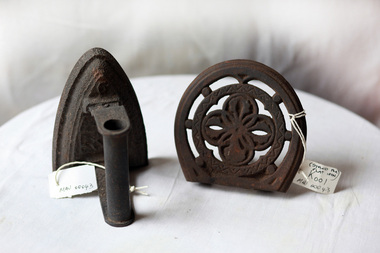
Domestic object - Kitchen Equipment, flat iron with trivet stand, c1880
... early settlers...market gardeners...These sad irons remind us of the difficult circumstances experienced in their daily routines by the pioneers and early settlers of Moorabbin Shire The family of Miss M Curtis were early settlers in Moorabbin Shire. sad iron kitchen equipment pioneers early settlers market gardeners sewing craftwork clothing moorabbin brighton bentleigh fireplaces stoves A) 5 on tip of iron A) A heavy cast iron, flat iron with B) horseshoe shaped trivet stand c1880 The trivet can be attached to a table by an adjustable clamp. ...Sad-irons or "solid" irons were made by blacksmiths and used to smooth out material by pressing the hot iron over it. A piece of sheet -iron was placed over the kitchen fire and the irons placed on it could be heated whilst remaining clean of ash.. The women used 2 irons - one heating while the other was used. Thick cloth or gloves protected their hands from the hot irons. The handle was removed from the cool iron and re- attached to remove the hot iron from the fire. The cool iron was replaced on the fire or stove to heat again. These irons were cleaned with steel wool to prevent them marking the material. If the iron was too hot the material would scorch. Most homes set aside one day for ironing and some large households had an ironing room with a special stove designed to heat irons. However, most women had to work with a heavy, hot iron close to the fireplace even in summer. These sad irons remind us of the difficult circumstances experienced in their daily routines by the pioneers and early settlers of Moorabbin Shire The family of Miss M Curtis were early settlers in Moorabbin Shire. A) A heavy cast iron, flat iron with B) horseshoe shaped trivet stand c1880 The trivet can be attached to a table by an adjustable clamp.A) 5 on tip of ironsad iron, kitchen equipment, pioneers, early settlers, market gardeners, sewing, craftwork, clothing, moorabbin, brighton, bentleigh, fireplaces, stoves -
 City of Moorabbin Historical Society (Operating the Box Cottage Museum)
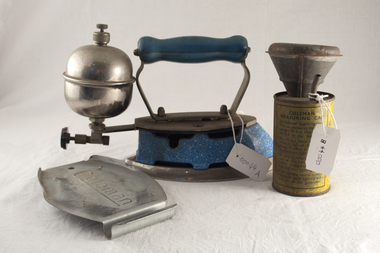
Domestic object - Kitchen equipment, spirit-fuelled sad iron, c1920
... early settlers...market gardeners...This spirit- fuelled flat iron was very popular in 1920s - 30s These sad irons remind us of the difficult circumstances experienced in their daily routines by the pioneers and early settlers of Moorabbin Shire The family of Miss M Curtis were early settlers in Moorabbin Shire sad iron kitchen equipment coleman william kansas oklahoma pioneers early settlers market gardeners sewing craftwork clothing moorabbin brighton bentleigh fireplaces stoves petrol fuelled irons spirit flat irons coleman lamp stove co. ltd. ...Sad-irons or "solid" irons were made by blacksmiths and used to smooth out material by pressing the hot iron over it. A piece of sheet -iron was placed over the kitchen fire and the irons placed on it could be heated whilst remaining clean of ash.. The women used 2 irons - one heating while the other was used. Thick cloth or gloves protected their hands from the hot irons. The handle was removed from the cool iron and re- attached to remove the hot iron from the fire. The cool iron was replaced on the fire or stove to heat again. These irons were cleaned with steel wool to prevent them marking the material. If the iron was too hot the material would scorch. Most homes set aside one day for ironing and some large households had an ironing room with a special stove designed to heat irons. However, most women had to work with a heavy, hot iron close to the fireplace even in summer. Late in the 19thC designers experimented with heat retaining fillings for these irons. William Coleman began selling Kerosene lanterns in 1900 in Kingfisher, Oklahoma, USA. He moved to Wichita, Kansas in 1902 and the company became world wide. The company also produced a range of cooking stoves and domestic irons. This spirit- fuelled flat iron was very popular in 1920s - 30s These sad irons remind us of the difficult circumstances experienced in their daily routines by the pioneers and early settlers of Moorabbin Shire The family of Miss M Curtis were early settlers in Moorabbin ShireA) spirit- fuelled, sad iron with chrome plated sole c1920, and metal trivet The iron is blue enamel with a white speckled body, with a hemispherical tank for the Coleman 'Lighting Petrol' that provided the heat for smoothing the material B) Coleman Fuel measuring can and funnellMetal Trivet/stand " COLEMAN" ; Petrol can " COLEMAN" / MEASURING CAN / for INSTANT LIGHTING IRON/ with printed instructionssad iron, kitchen equipment, coleman william, kansas, oklahoma, pioneers, early settlers, market gardeners, sewing, craftwork, clothing, moorabbin, brighton, bentleigh, fireplaces, stoves, petrol fuelled irons, spirit flat irons, coleman lamp stove co. ltd. -
 City of Moorabbin Historical Society (Operating the Box Cottage Museum)
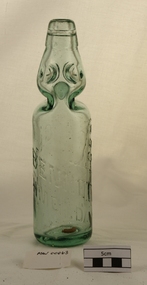
Container - Manufactured glass, Codd bottle, c1888
... early settlers...market gardeners...Ltd of Richmond, Victoria for their Lemonade and sold as refreshment to early settlers of Moorabbin Shire c1880 codd hiram glass manufacture glass bottles moorabbin brighton barnsley england carbonated water soft drink mineral water bennetts lemonade maker richmond early settlers market gardeners melbourne BENNETTS / LEMONADE diagonally across bottle A slightly green tinted, glass bottle with a groove inside the top which held a rubber ring, against which, the small glass ball inside the bottle was held by the pressure of the 'fizzy' drink inside. ...The Codd Bottle was first invented by English manufacturer, Hiram Codd at Barnsley in 1870. The groove inside the top of the bottle held a rubber ring. A small glass balll was held against this ring by the pressure of the 'pop' or 'fizzy' carbonated drink inside the bottle. This style of bottle was widely manufactured and used in the production of mineral waters and lemonade. The glass has a slight green tint, known as aqua glass, and is what the Victorian era produced as 'clear glass'This glass Codd bottle with glass ball and partial rubber ring was probably imported from England by Bennetts Pty. Ltd of Richmond, Victoria for their Lemonade and sold as refreshment to early settlers of Moorabbin Shire c1880A slightly green tinted, glass bottle with a groove inside the top which held a rubber ring, against which, the small glass ball inside the bottle was held by the pressure of the 'fizzy' drink inside.BENNETTS / LEMONADE diagonally across bottlecodd hiram, glass manufacture, glass bottles, moorabbin, brighton, barnsley england, carbonated water, soft drink, mineral water, bennetts lemonade maker, richmond, early settlers, market gardeners, melbourne -
 City of Moorabbin Historical Society (Operating the Box Cottage Museum)
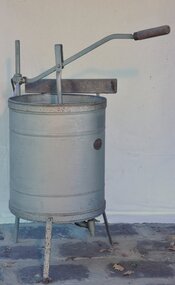
Functional object - Laundry Equipment, washing machine, c1919
... early settlers...market gardeners...Such hand washing machines greatly reduced the workload of the women of pioneer familes in Moorabbin Shire lehman eduard hand washing machines laundry equipment pioneers early settlers market gardeners moorabbin brighton cheltenham THE / LEHMAN/ COMPRESSED AIR AND / VACUUM WASHING MACHINE / Pat. ...Eduard Lehman, Zurich Switzerland patented a metal barrel shaped hand washing machine with a hand crank to operate a metal plunger in 1919. Such hand washing machines were used by settlers in Moorabbin Shire An 83 year old Visitor on site remembers using this type of washing machine. He had to push the agitator for 5 minutes. Prior to his mother buying the washer, all laundry was hand washed in troughs.Such hand washing machines greatly reduced the workload of the women of pioneer familes in Moorabbin ShireThis hand washing machine c1919 consists of a metal barrel, standing on 4 legs, and has a hand crank to operate a cone shaped metal agitator.THE / LEHMAN/ COMPRESSED AIR AND / VACUUM WASHING MACHINE / Pat. No. 50614/30lehman eduard, hand washing machines, laundry equipment, pioneers, early settlers, market gardeners, moorabbin, brighton, cheltenham -
 City of Moorabbin Historical Society (Operating the Box Cottage Museum)
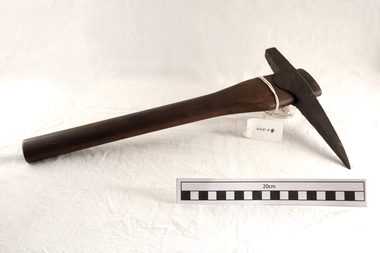
Tool - Gold-miner's Pick, Ballarat c 1920, c1920
... early settlers...market gardeners...This pick is an example of the hand made tools many pioneers took with them when they abandoned their farms and market gardens in the District of Brighton to try their luck at prospecting when gold was discovered in Ballarat and Bendigo c1853. Some were successful , most were not and retuned again to the hard life of farming. gold mining ballarat bendigo early settlers market gardeners moorabbin bentleigh mining equipment gold rush immigrants blacksmiths forges tools A forged steel pick with a wooden handle. ...This gold miner's pick from the Ballarat Goldfields c 1920 was donated by Mr David Hopcraft, a dealer at the Arkuna Market Berwick, Victoria in December 2010. When Gold was discovered in Victoria c1853 most of the labourers and some landowners left the market gardens and farms to try their luck on the goldfields. Local Blacksmiths made picks similar to this one for them. There was a great shortage of labour in Melbourne and at the same time, due to the huge influx of people lured by the Gold, there was an increased demand for food. The market gardeners were getting very good prices for their produce and many increased their wealth considerably and many of these tenant farmers were able to purchase their blocks of land and live a profitable life. There was such a shortage of labour that J.B.Were applied for Irish immigrants to work the farms. This pick is an example of the hand made tools many pioneers took with them when they abandoned their farms and market gardens in the District of Brighton to try their luck at prospecting when gold was discovered in Ballarat and Bendigo c1853. Some were successful , most were not and retuned again to the hard life of farming. A forged steel pick with a wooden handle. The steel pick-head was hand-forged by a blacksmith. This miner's pick was used on the Ballarat gold-fields c1920gold mining, ballarat, bendigo, early settlers, market gardeners, moorabbin, bentleigh, mining equipment, gold rush, immigrants, blacksmiths, forges, tools -
 City of Moorabbin Historical Society (Operating the Box Cottage Museum)
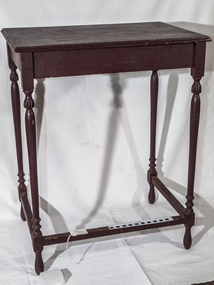
Furniture - Furniture, spindle-leg, wood table, 20thC
... early settlers...market gardeners...furniture woodwork craftsmen moorabbin bentleigh melbourne early settlers market gardeners A small wooden occasional table with 4 turned legs with 4 rails running around the base Furniture Furniture, spindle-leg, wood table Unrecorded ...A small wooden occasional table with 4 turned legs with 4 rails running around the basefurniture, woodwork, craftsmen, moorabbin, bentleigh, melbourne, early settlers, market gardeners -
 City of Moorabbin Historical Society (Operating the Box Cottage Museum)
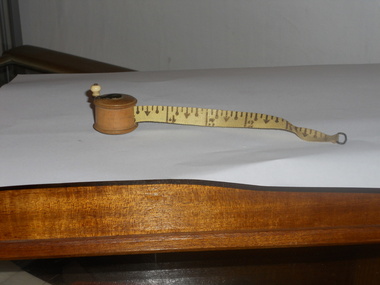
Craft - Craftwork, tape measure c 1880, c1880
... early settlers...market gardeners...The case is of polished timber, and the little winder, to retract the tape, is made of brass with a small ivory handle Early settlers and market gardeners of Moorabbin Shire had to be self reliant producing their own food and making their farm equipment and clothing. ...c1880 This tiny tape measure, in Imperial measurements, was part of a Victorian era lady's sewing basket. The case is of polished timber, and the little winder, to retract the tape, is made of brass with a small ivory handleEarly settlers and market gardeners of Moorabbin Shire had to be self reliant producing their own food and making their farm equipment and clothing. The women of these families were skilful in all craftwork.c1880 this tiny, retractable, tape measure, in Imperial measure, is made of polished timber with a brass winder and ivory handle. Imperial ‘inch’ measurements on tape dressmaking, tape measure, sewing, craftwork, pioneers, early settlers, market gardeners, moorabbin, brighton, bentleigh cheltenham -
 City of Moorabbin Historical Society (Operating the Box Cottage Museum)
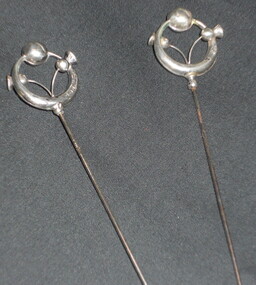
Accessory - Jewellery , lady's silver hatpins, Circa 1910
... early settlers...market gardeners...The Maggs family were early settlers in Moorabbin Shire jewellery clothing dressmaking craftwork silversmiths maggs geoff early settlers market gardeners moorabbin bentleigh cheltenham brighton Hallmark Birmingham Assay Office England c1910, 2 lady's silver hat-pins, with hollow circular silver surround, around a thistle flower Accessory Jewellery , lady's silver hatpins Pearce and Thompson ...Hat-pins were worn to anchor hats to the head and could be considered a functional piece of jewellery. Traditionally inserted into the crown of the hat and through the hair piled atop the head.Hat-pins were needed to secure the large, lady’s hats fashionable at the time. The Maggs family were early settlers in Moorabbin Shirec1910, 2 lady's silver hat-pins, with hollow circular silver surround, around a thistle flowerHallmark Birmingham Assay Office Englandjewellery, clothing, dressmaking, craftwork, silversmiths, maggs geoff, early settlers, market gardeners, moorabbin, bentleigh, cheltenham, brighton -
 City of Moorabbin Historical Society (Operating the Box Cottage Museum)
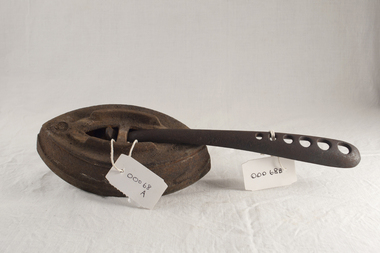
Domestic object - Kitchen Equipment, sad iron with lifter, c1900
... early settlers...market gardeners...early settlers of Moorabbin Shire. The Curtis family were early settlers in Moorabbin Shire sad iron kitchen equipment fireplaces stoves pioneers early settlers market gardeners sewing craftwork clothing moorabbin brighton bentleigh A) This heavy sad iron, made from cast iron, was heated over a fire or on a stove and used for pressing clothing and haberdashery. ...Sad-irons or "solid" irons were made by blacksmiths and used to smooth out material by pressing the hot iron over it. A piece of sheet -iron was placed over the kitchen fire and the irons placed on it could be heated whilst remaining clean of ash.. The women used 2 irons - one heating while the other was used. Thick cloth or gloves protected their hands from the hot irons. The handle was removed from the cool iron and using the lifter the cool iron was replaced on the fire or stove to heat again. These irons were cleaned with steel wool to prevent them marking the material. If the iron was too hot the material would scorch. Most homes set aside one day for ironing and some large households had an ironing room with a special stove designed to heat irons. However, most women had to work with a heavy, hot iron close to the fireplace even in summer.These sad irons remind us of the difficult circumstances experienced in their daily routines by the pioneers and early settlers of Moorabbin Shire. The Curtis family were early settlers in Moorabbin ShireA) This heavy sad iron, made from cast iron, was heated over a fire or on a stove and used for pressing clothing and haberdashery. B) The separate tapered handle was used to lift the hot iron from the fire and when a "Potts" Handle was attached the ironing commenced. sad iron, kitchen equipment, fireplaces, stoves, pioneers, early settlers, market gardeners, sewing, craftwork, clothing, moorabbin, brighton, bentleigh -
 City of Moorabbin Historical Society (Operating the Box Cottage Museum)
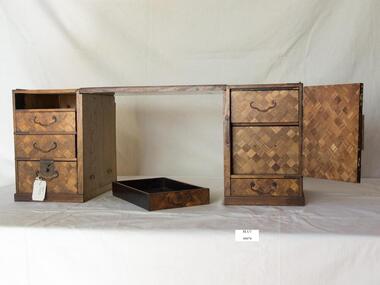
Furniture - Furniture, small wooden portable cabinet of "Dr" Palk, c1850
... early settlers...market gardeners...This portable cabinet with writing board was used by "Dr" Palk, one of the first "Doctors" to practice medicine in Melbourne c1850 . bland c. melbourne medical practitioners Palk dr Emerald Hill moorabbin brighton pioneers early settlers market gardeners dairymen farmers A Japanese Meiji Parquetry Scholars box. ..."Dr" Robert Palk (1813 - 1890), a self proclaimed doctor, set up his practice in Coventry Street, Emerald Hill (South Melbourne). He was also a mineral surveyor and a municipal councillor for Emerald Hill. His Grandson Mr Charles Bland donated the cabinet to CMHS.This portable cabinet with writing board was used by "Dr" Palk, one of the first "Doctors" to practice medicine in Melbourne c1850 .A Japanese Meiji Parquetry Scholars box. Late 19th Century wooden portable cabinet with 3 sections that belonged to "Dr" Palk c1850. Two side cabinets that lock together by grooves on inner sides, and a flat writing board that sits on a shelf at the top of the inner sides. One of the cabinets has 4 drawers, one of which has a lock. The other cabinet has 1 drawer and a cupboard with a door lock No Keys are available, The cabinet is decorated on the outer surfaces by inlaid bamboo squares with metal decorative hinges and handles and at the corners on the door. bland c. melbourne, medical practitioners, palk dr, emerald hill, moorabbin, brighton, pioneers, early settlers, market gardeners, dairymen, farmers -
 City of Moorabbin Historical Society (Operating the Box Cottage Museum)
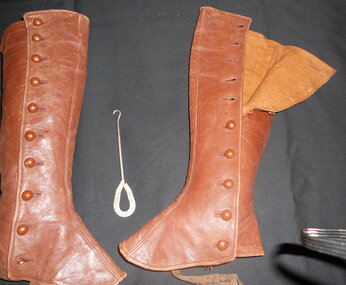
Footwear - Clothing, boy's leather leggings and button hook, c1900
... early settlers...market gardeners...An elastic strip is attached to the bottom of each legging and this passes under the child's boot and is buckled up to keep the legging in place. early settlers market gardeners bootmakers moorabbin bentleigh cheltenham clothing No maker's mark Circa 19th century. ...Circa 19th century. A pair of child's mid-brown leather leggings that extended over the child's knee. The leggings are lined with a soft napped fabric. They button-up down the outside of each leg, with leather covered buttons. An elastic strip is attached to the bottom of each legging and this passes under the child's boot and is buckled up to keep the legging in place.Circa 19th century. A pair of child's mid-brown leather leggings. The leggings extended over the child's knee. The leggings are line with a soft napped fabric. They button up down the outside of each leg, with leather covered buttons. An elastic strip is attached to the bottom of each legging and this passes under the child's boot and is buckled up to keep the legging in place. A metal button-hook trade marked Ezy Walking is also displayed.No maker's markearly settlers, market gardeners, bootmakers, moorabbin, bentleigh, cheltenham, clothing -
 City of Moorabbin Historical Society (Operating the Box Cottage Museum)
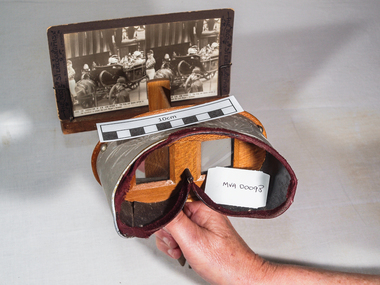
Leisure object - Stereographs, view-finder & photo cards, Stereographic Photos Copyright 1911
... early settlers...market gardeners...The London Stereoscopic Company quickly developed technologies for mass - producing stereo-graphs; and between 1854 and 1856 the company sold over half a million stereo-graphs. stereographs stereoscopes photographs view-finder wheatstone charles london moorabbin melbourne bentleigh early settlers market gardeners entertainment Stereograph cards Photocards 'ROSE' Small, hand-held metal and timber steroeographic view-finder. ...Stereo-graphs were popular 1850 - 1930 Most stereoscopic methods present two offset images separately to the left and right eye of the viewer. Stereo-graphs feature two photographs or printed images positioned side by side about two and half inches apart, one for the left eye and one for the right. When a viewer uses a stereoscope, a device for viewing stereo-graphs, the two-dimensional images are combined by the brain to give the perception of 3D depth. The London Stereoscopic Company quickly developed technologies for mass - producing stereo-graphs; and between 1854 and 1856 the company sold over half a million stereo-graphs. Small, hand-held metal and timber steroeographic view-finder. The metal goggles are engraved with a free-flowing design. The rim of the goggles are covered in red velvet. A timber handle is attached with a metal hinge to the timber extension that has a wire frame to hold the stereo photographs. The streographic photos comprise 2 identical black and white photos mounted, side by side on brown card.Photocards 'ROSE'stereographs, stereoscopes, photographs, view-finder, wheatstone charles, london, moorabbin, melbourne, bentleigh, early settlers, market gardeners, entertainment, stereograph cards -
 City of Moorabbin Historical Society (Operating the Box Cottage Museum)
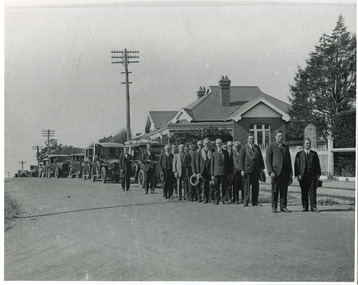
Photograph, 14th Dec. 1927 Funeral of Cr. F.T. Le Page JP Cheltenham, 14th Dec. 1927 Funeral of Cr. F.T. Le Page JP Cheltenham, 14th December 1927
... cheltenham church of christ, early settlers, market gardeners, rellgious rites, justice of the peace, star of moorabbin order of the sons of temperance friendly society...John Cribbin ' Moorabbin A Pictorial History 1862-1994 ' p37 funeral 14th december 1927 cr. f.t. le page cheltenham cemetery mr george brough mr horace brough george roberts tom tilley frank martin. cheltenham church of christ, early settlers, market gardeners, rellgious rites, justice of the peace, star of moorabbin order of the sons of temperance friendly society daphne cottage cheltenham victoria, cheltenham cream and butter factory ltd, tommy bent, moorabbin shire, le page everest , le page frank w. , le page frank t, two acre village, dendy's special survay 1841, holloway josiah morris, Written as above signed D. ...14th December 1927. The funeral of Cr. F.T. Le Page, leaving Cheltenham Church of Christ, Chesterville Road, for the old Cheltenham Cemetary. The undertakers were W.D. Rose & Son. Standing alongside the hearse is Mr Wally Rose. In front him is Mr Clarrie Judd, father of Mrs Clarice Whitehead. At the front of the procession are two Church of Christ Ministers. On the right is Mr Daniel Wakefield, who was minister at the time. On the left is Mr Mudge who was the previous minister. The man wearing collars are members of the Star of Moorabbin Order, of the Sons of Temperance Friendly Society. Others are elders from the church. Some of the names are: Mr George Brough, Mr Horace Brough, George Roberts, Tom Tilley, and Frank Martin. The house in the photograph was the home of Mr and Mrs Fred. Judd. The picket fence was at the front of the Church and the Cypress hedge on the right, was the home of Mr Chas. Fairbank, now the Church Manse grounds.Frank T Le Page arrived in Cheltenham, ( Two Acre Village) aged 3 with his father Nicholas Le Page , a tailor from Guernsey in the Channel Islands. Nicholas purchased one of Holloway's two-acre lots and established a market garden. Frank T Le Page worked on his father's market garden from age 14, then worked as a coachman and met Tommy Bent whilst employed at Brighton Grammar School. He bought land adjacent to his father's , built Daphne Cottage in 1876 and later established the Cheltenham Cream and Butter Factory. Frank T. Le Page was member of many community groups and was a Moorabbin Shire Councillor for 25 years serving a term as President. 'The Le Pages became one of the best known Moorabbin market gardening families, with a tradition of service to communal and civic affairs that is unmatched.' John Cribbin ' Moorabbin A Pictorial History 1862-1994 ' p3714th December 1927. The funeral of Cr. F.T. Le Page, leaving Cheltenham Church of Christ, Chesterville Road, for the old Cheltenham Cemetary. The undertakers were W.D. Rose & Son. Standing alongside the hearse is Mr Wally Rose. In front him is Mr Clarrie Judd, father of Mrs Clarice Whitehead. At the front of the procession are two Church of Christ Ministers. On the right is Mr Daniel Wakefield, who was minister at the time. On the left is Mr Mudge who was the previous minister. The man wearing collars are memebers of the Star of Moorabbin Order, of the Sons of Temperance Friendly Society. Others are elders from the church. Some of the names are: Mr George Brough, Mr Horace Brough, George Roberts, Tom Tilley, and Frank Martin. The house in the photograph was the home of Mr and Mrs Fred. Judd. The picket fence was at the front of the Church and the Cypress hedge on the right, was the home of Mr Chas. Fairbank, now the Church Manse grounds.Written as above signed D. Maynard 2/4/86funeral, 14th december 1927, cr. f.t. le page, cheltenham cemetery, mr george brough, mr horace brough, george roberts, tom tilley, frank martin., cheltenham church of christ, early settlers, market gardeners, rellgious rites, justice of the peace, star of moorabbin order of the sons of temperance friendly society, daphne cottage cheltenham victoria, cheltenham cream and butter factory ltd, tommy bent, moorabbin shire, le page everest , le page frank w. , le page frank t,, two acre village, dendy's special survay 1841, holloway josiah morris, -
 City of Moorabbin Historical Society (Operating the Box Cottage Museum)
Tools, small cylinder with 3 screw drivers, 20thC
... tools, tool manufacturers, early settlers , market gardeners, moorabbin, bentleigh, cheltenham, tool kits,...A small portable tool kit for a man or woman tools, tool manufacturers, early settlers , market gardeners, moorabbin, bentleigh, cheltenham, tool kits, A metal cylinder in 2 parts containing 3 screwdrivers. ...A small portable tool kit for a man or woman A metal cylinder in 2 parts containing 3 screwdrivers. The top unscrews to reveal the 3 small screwdrivers. A screwdriver base slots into a groove on the base of the cylinder thus forming a handle for turning the head fitted into the appropriate screwtools, tool manufacturers, early settlers , market gardeners, moorabbin, bentleigh, cheltenham, tool kits, -
 City of Moorabbin Historical Society (Operating the Box Cottage Museum)
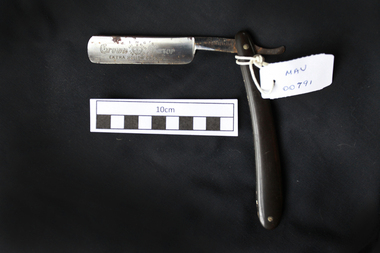
Personal Effects, cut-throat razor “Kings Crown’, 20thC
... cut-throat razors, straight razors, shaving equipment, steel blades, swords, weyersberg family, king crown pty ltd., solingen, germany, early settlers, market gardeners, moorabbin, bentleigh, cheltenham,...King's Crown™ cut-throat razors, straight razors, shaving equipment, steel blades, swords, weyersberg family, king crown pty ltd., solingen, germany, early settlers, market gardeners, moorabbin, bentleigh, cheltenham, on blade ; KING'S / CROWN 'a crown trademark' RAZOR / EXTRA HOLLOW GROUND around 'trademark' ; SET READY FOR USE on steel handle; MADE IN GERMANY A folding cut-throat razor Personal Effects, cut-throat razor “Kings Crown’ Kings Crown Manufacturing Company ...KING RAZOR MFG. CO.Pittsburgh, Pennsylvania; moved to Indiana, Pennsylvania in 1911.ca. 1904 - 1919 Marked "Made in Germany", although the company's offices were located at 118 E. 28th Street, New York City. ca. 1934-1943 Used the "THE KING OF RAZORS REGISTERED TRADEMARK" trademark. 47-1/2 and Trademark: Crown and Wolf. For 500 years the Weyersberg family has been producing the finest blades in the world. For centuries the King’s Crown™ mark has been synonymous with exacting precision, hand-craftsmanship and quality. For the first few hundred years the blades, made in Solingen, Germany (the “City of Blades”), were for swords. As times changed, the Weyersberg family transitioned into making cut throat razors. The Greb. Weyersberg™ family business.continue to place our mark on each and every product sold as we have done since first being able to register it in 1774. For over a 100 years, the straight razors continue to be produced in Solingen (Germany). King's Crown™A folding cut-throat razoron blade ; KING'S / CROWN 'a crown trademark' RAZOR / EXTRA HOLLOW GROUND around 'trademark' ; SET READY FOR USE on steel handle; MADE IN GERMANYcut-throat razors, straight razors, shaving equipment, steel blades, swords, weyersberg family, king crown pty ltd., solingen, germany, early settlers, market gardeners, moorabbin, bentleigh, cheltenham, -
 City of Moorabbin Historical Society (Operating the Box Cottage Museum)
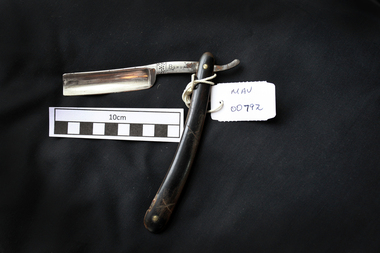
Personal Effects, Cut-throat razor ‘Bengal’, early 20thC
... cut-throat razors, straight razors, shaving equipment, steel blades, Sheffield steel, England, thomas radley Cadman & sons ltd., cutlers, steel manufacturers, ‘Bengal’ trade mark, early settlers, market gardeners, moorabbin, bentleigh, cheltenham,...T.R.Cadman & Sons, Ltd. ceased trading in 1965. cut-throat razors, straight razors, shaving equipment, steel blades, Sheffield steel, England, thomas radley Cadman & sons ltd., cutlers, steel manufacturers, ‘Bengal’ trade mark, early settlers, market gardeners, moorabbin, bentleigh, cheltenham, on blade 'BENGAL' A man's cut-throat razor that folds to protect the blade inside the handle , 'Bengal' Personal Effects, Cut-throat razor ‘Bengal’ THOMAS RADLEY CADMAN & SONS ...Bengal’ THOMAS RADLEY CADMAN & SONS St. Mary's Road, Sheffield In business at least 1892-1919 Originally a trademark of Luke Cadman, Sheffield, England from ca. 1748-1906. From ca. 1906 - 1953, used by: Thomas Radley Cadman & Sons St. Mary's Road, Sheffield. In business at least between 1892 and 1965. The Cadman family originally came from Derbyshire and settled in the village of Eckington, to the south of Sheffield. Luke Cadman (1727-1788) moved to Sheffield in 1740 and became apprenticed into the cutlery trade. He became a freeman of the Cutlers' Company of Hallamshire in 1748 and was granted the trademark "BENGALL". (Another branch of the family was granted the trademark "SENEGALL"). Two of Cadman's sons followed him into the business. The Cadmans' business was located at various addresses in Sheffield over the years. In the early 1870s Thomas Radley Cadman (1833-1917) took over the firm. By 1933 the firm had diversified into safety razor and pocket knife manufacture. T.R.Cadman & Sons, Ltd. ceased trading in 1965. A man's cut-throat razor that folds to protect the blade inside the handle , 'Bengal'on blade 'BENGAL'cut-throat razors, straight razors, shaving equipment, steel blades, sheffield steel, england, thomas radley cadman & sons ltd., cutlers, steel manufacturers, ‘bengal’ trade mark, early settlers, market gardeners, moorabbin, bentleigh, cheltenham, -
 City of Moorabbin Historical Society (Operating the Box Cottage Museum)
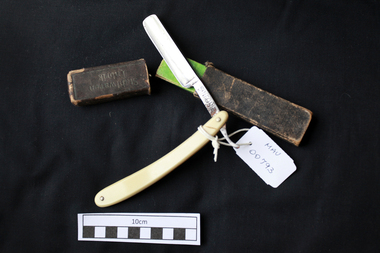
Personal Effects, Cut-throat razor ‘Sinfonie’, c1900 -1930
... cut-throat razors, straight razors, shaving equipment, steel blades, stoll gebruder ltd., Solingen germany, cutlers, steel manufacturers, ‘Sinfonie’ trade mark, early settlers, market gardeners, moorabbin, bentleigh, cheltenham,...Straight razors require considerable skill to hone and strop, and require more care during shaving cut-throat razors, straight razors, shaving equipment, steel blades, stoll gebruder ltd., Solingen germany, cutlers, steel manufacturers, ‘Sinfonie’ trade mark, early settlers, market gardeners, moorabbin, bentleigh, cheltenham, on blade 'SINFONIE' on case; Stahlwaron / Fabrik A man's cut-throat razor that folds to protect blade inside handle. with a case Personal Effects, Cut-throat razor ‘Sinfonie’ Gebrüder Stoll ...Gebrüder Stoll, Central-Stahlwarenfabrik Founded in 1889 . Solingen-Foche in 1900- 1930. Names: ‘Gallop’, ‘Pedecor’ (Dedecor?), ‘Sinfonie’, ‘Stoll’, ‘Stoll Brothers’. The parts of a straight razor and their function are described as follows: The narrow end of the blade rotates on a pin called the pivot, between two protective pieces called the scales or handle. The upward curved metal end of the narrow part of the blade beyond the pivot is called the tang and acts as a lever to help raise the blade from the handle. One or two fingers resting on the tang also help stabilize the blade while shaving. The narrow support piece between the tang and the main blade is called the shank, but this reference is often avoided because it can be confusing. The shank sometimes features decorations and the stamp of the country of origin. The top side and the underside of the shank can sometimes exhibit indentations known as fluting, or jimps for a more secure grip. The curved lower part of the main blade from the shank to the cutting edge is called the shoulder. The point where the shoulder joins the cutting edge is called the heel. A thick strip of metal running transversely at the junction where the main blade attaches to the shank is called the stabiliser. Although straight razors were once the principal method of manual shaving, they have been largely overshadowed by the safety razor, which incorporates a disposable blade. Electric razors of various types have also been an available alternative, especially since the 1950s. Straight razors require considerable skill to hone and strop, and require more care during shaving A man's cut-throat razor that folds to protect blade inside handle. with a caseon blade 'SINFONIE' on case; Stahlwaron / Fabrikcut-throat razors, straight razors, shaving equipment, steel blades, stoll gebruder ltd., solingen germany, cutlers, steel manufacturers, ‘sinfonie’ trade mark, early settlers, market gardeners, moorabbin, bentleigh, cheltenham, -
 City of Moorabbin Historical Society (Operating the Box Cottage Museum)
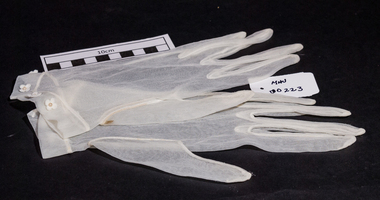
Accessory - Clothing, lady's cream nylon gloves, c1950
... early settlers...market gardeners...early settlers in Moorabbin Shire. Carole was a founding member of CMHS clothing gloves nylon moorabbin bentleigh brighton early settlers market gardeners hong kong pedersen-green carole green carole denmark A pair of cream, nylon, lady's wrist length gloves There are 4 cotton flower shapes at centre back of wrist with a tiny pearl in each centre Accessory Clothing, lady's cream nylon gloves Unrecorded ...Ladies' gloves for formal and semi-formal wear come in three lengths for women: wrist, elbow, and opera or full-length (over the elbow, usually reaching to the biceps but sometimes to the full length of the arm). In the late 19thC and early 20thC Gloves were expected to be worn for both daytime and evening wear with most types of outfits. The most expensive gloves are custom-made of kid leather. These gloves were probably made in Hong Kong, then as now, a place where fashions can be made cheaply because the cost of labour is inexpensiveThe family of Carole Pedersen-Green were early settlers in Moorabbin Shire. Carole was a founding member of CMHSA pair of cream, nylon, lady's wrist length gloves There are 4 cotton flower shapes at centre back of wrist with a tiny pearl in each centreclothing, gloves, nylon, moorabbin, bentleigh, brighton, early settlers, market gardeners, hong kong, pedersen-green carole, green carole, denmark -
 City of Moorabbin Historical Society (Operating the Box Cottage Museum)
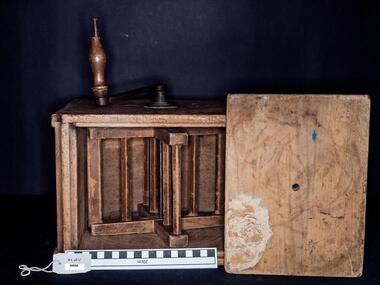
Churn, small domestic butter, c1880
... early settlers...market gardeners...Early settlers had to be self sufficient, growing their own vegetables, making tools and clothing and usually had a house cow to produce their milk supply This domestic butter churn is an example of the skill of the pioneer craftsman, carpenters and tool makers c1900. As pioneers and early settlers had to be self sufficient they usually kept a dairy cow or 'house cow' to provide milk for drinking and for butter and cheese to made by the family. pioneers early settlers market gardeners moorabbin brighton cheltenham dairy products. dairy farmers milk butter dairies E. ...A butter churn is a device used to convert cream into butter. This is done through a mechanical process, via a crank used to manually turn a rotating device inside the barrel shaped churn. The agitation of the cream, caused by the mechanical motion of the device, disrupts the milk fat. The membranes that surround the fats are broken down, subsequently forming clumps known as butter grains. These butter grains, during the process of churning, fuse with each other and form larger fat globules. Air bubbles are introduced into these fat globules via the continued mechanical action of the churn. The butter grains become more dense as fat globules attach to them while the air is forced out of the mixture. This process creates a liquid known as buttermilk. With constant churning, the fat globules eventually form solid butter and separate from the buttermilk. The buttermilk is then drained off and the butter is squeezed to eliminate excess liquid and to form it into a solid mass. Then rinsing could be done simply by washing in water, followed by draining, salting and working or "kneading" the butter with a pair of wooden butter pats, or with bare hands. This is a paddle churn, a barrel that contains a paddle, which is operated by a handle. The paddle churned the butter inside the container when the handle was turned. Early settlers had to be self sufficient, growing their own vegetables, making tools and clothing and usually had a house cow to produce their milk supplyThis domestic butter churn is an example of the skill of the pioneer craftsman, carpenters and tool makers c1900. As pioneers and early settlers had to be self sufficient they usually kept a dairy cow or 'house cow' to provide milk for drinking and for butter and cheese to made by the family.A small wooden, domestic butter churn with a lid and a crank that manually rotated the paddle inside. E. CHERRY / MAKER / GISBORNE / VICTORIA / Apioneers, early settlers, market gardeners, moorabbin, brighton, cheltenham, dairy products. dairy farmers, milk, butter, dairies -
 City of Moorabbin Historical Society (Operating the Box Cottage Museum)
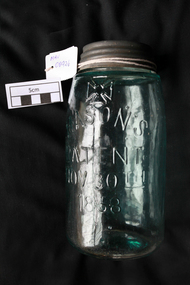
Manufactured Glass, jar 'Mason's', c1900
... early settlers...market gardeners...The same design was used on the jars well into the 1900's The early settlers of Moorabbin Shire had to be self sufficient and grew their own fruit and vegetables even if not market gardeners They preserved their produce for use all year. early settlers market gardeners mason's jar mason john landis food preservation moorabbin bentleigh cheltenham 'keystone' symbol / MASON'S / PATENT / NOV 30TH / 1858 base 67. ...A Mason jar is a moulded glass jar used in canning to preserve food. The mouth of the jar has screw threads on its outer perimeter to accept a metal ring (or "band"). The band, when screwed down, presses a separate stamped steel disc-shaped lid against the rim of the jar. An integral rubber ring on the underside of the lid creates a hermetic seal to the jar. The bands and lids usually come with new jars, and bands and lids are also sold separately; while the bands are reusable, the lids are intended for single use when canning.The Mason jar was invented and patented in November1858 by Philadelphia tinsmith John Landis Mason. The same design was used on the jars well into the 1900'sThe early settlers of Moorabbin Shire had to be self sufficient and grew their own fruit and vegetables even if not market gardeners They preserved their produce for use all year. A clear, glass jar with a metal screw top lid used for preserving food c1900. This jar has a 'keystone' symbol. 'keystone' symbol / MASON'S / PATENT / NOV 30TH / 1858 base 67. PAT NOV 96early settlers, market gardeners, mason's jar, mason john landis, food preservation, moorabbin, bentleigh, cheltenham -
 City of Moorabbin Historical Society (Operating the Box Cottage Museum)
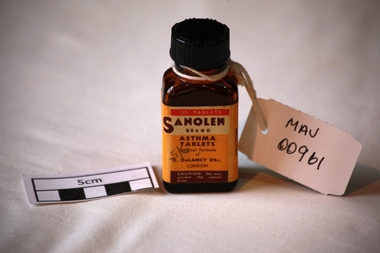
Manufactured Glass, bottle 'Sanolen' asthma tablets, mid 20thC
... early settlers...market gardeners...A medication for the treatment of Asthma made by J.L Brown Chemist Pty Ltd Melbourne c 1950 pharmacy medicines asthma respiratory diseases early settlers market gardeners moorabbin bentleigh cheltenham manufactured glass bottles j l brown & co ltd melbourne Front: 25 TABLETS/ SANOLEN / BRAND / ASTHMA / TABLETS/ Original Formula / of / D. ...A medication for the treatment of Asthma made by J.L Brown Chemist Pty Ltd Melbourne c 1950A brown glass bottle with a plastic screw lid for 'Sanolin' asthma tablets Front: 25 TABLETS/ SANOLEN / BRAND / ASTHMA / TABLETS/ Original Formula / of / D. DeLancy DSc. / LONDON / Caution: Do not / exceed the stated / dose. Back: SANOLEN / BRAND / ASTHMA TABLETS / give instant relief and positive / relief from Asthma, Hay / Fever, …. etc. / J.L. BROWN & Co. / 123 Williams St., Melbourne. Left Side: INGREDIENTS……….. “POISON”…… / Reg. Vic. No. 388 . Right Side : DIRECTIONS pharmacy, medicines, asthma, respiratory diseases, early settlers, market gardeners, moorabbin, bentleigh, cheltenham, manufactured glass, bottles, j l brown & co ltd melbourne -
 City of Moorabbin Historical Society (Operating the Box Cottage Museum)
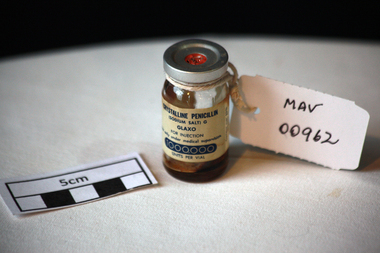
Manufactured Glass, bottle 'Crystalline Penicillin', December 1955
... early settlers...market gardeners...The development of penicillin for use as a medicine is attributed to the Australian Nobel laureate Howard Walter Florey, together with the German Nobel laureate Ernst Chain and the English biochemist Norman Heatley pharmacy medicines penicillin early settlers market gardeners moorabbin bentleigh cheltenham manufactured glass bottles glaxo laboratories melbourne Front: CRYSTALLINE PENICILLIN / ( SODIUM SALT) G / GLAXO / FOR INJECTION / Use only under medical supervision / 1000000 / UNITS PER VIAL. ...Penicillin is a group of antibiotics derived from Penicillium fungi, including penicillin G, procaine penicillin, benzathine penicillin, and penicillin V. Penicillin antibiotics are historically significant because they are the first drugs that were effective against many previously serious diseases, such as syphilis, and infections caused by staphylococci and streptococci. Penicillins are still widely used today, though many types of bacteria have now become resistant. All penicillins are β-lactam antibiotics and are used in the treatment of bacterial infections caused by susceptible, usually Gram-positive, organisms. The development of penicillin for use as a medicine is attributed to the Australian Nobel laureate Howard Walter Florey, together with the German Nobel laureate Ernst Chain and the English biochemist Norman Heatley A clear glass bottle with a metal fixed top in which the central rubber disc has been pierced by a needle .Front: CRYSTALLINE PENICILLIN / ( SODIUM SALT) G / GLAXO / FOR INJECTION / Use only under medical supervision / 1000000 / UNITS PER VIAL. Left side : Refrigeration unnecessary....MANFD. DEC. 1955 / EXPIRY DEC. 1958 / POTENCY 1667 / IU/MG / BATCH 269. Right side :Contains over 90% / penicillin G / Contains no preservatives / GLAXO LABORATORIES / (AUST.) PTY. LTD. / Melbourne Sydneypharmacy, medicines, penicillin, early settlers, market gardeners, moorabbin, bentleigh, cheltenham, manufactured glass, bottles, glaxo laboratories melbourne
