
Showing 95 items matching "early thirties"
-
 Phillip Island and District Historical Society Inc.
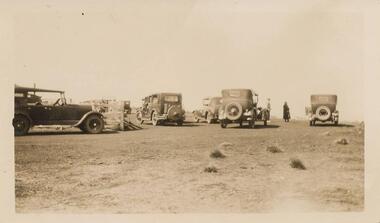
Photograph, Early 1930's
... On Back: Cars at The Nobbies early thirties....Grayden the nobbies phillip island b c grayden On Back: Cars at The Nobbies early thirties. Photograph of 6 to 7 cars parked at The Nobbies. ...Donated by B. C. GraydenPhotograph of 6 to 7 cars parked at The Nobbies. Two figures of a man and woman in background.On Back: Cars at The Nobbies early thirties.the nobbies, phillip island, b c grayden -
 Moorabbin Air Museum
Book - RAAF air bases, Air Base Richmond The Story of the RAAF base on the Hawkesbury
... ...Early thirties...RAAF bases Early days Enter the RAAF The squadrons arrive Early thirties Expansion War declared The early war years The WAAAF The paratroopers The war continues Aftermath of war On to the nineties Bicentennial air show Historical overview of RAAF base Richmond, circa 1991 Air Base Richmond The Story of the RAAF base on the Hawkesbury Book RAAF air bases ...Historical overview of RAAF base Richmond, circa 1991non-fictionHistorical overview of RAAF base Richmond, circa 1991early days, enter the raaf, the squadrons arrive, early thirties, expansion, war declared, the early war years, the waaaf, the paratroopers, the war continues, aftermath of war, on to the nineties, bicentennial air show -
Moorabbin Air Museum
Book - Aircraft engineering, Head in the Clouds
... Early years...Thirties...Aircraft engineering Early years Thirties to forties Jet age Biography of aircraft engineer from Sopwith Pups to DC-10 airliners, circa 1978 Head in the Clouds Book Aircraft engineering ...Biography of aircraft engineer from Sopwith Pups to DC-10 airliners, circa 1978non-fictionBiography of aircraft engineer from Sopwith Pups to DC-10 airliners, circa 1978early years, thirties to forties, jet age -
 University of Melbourne, Burnley Campus Archives
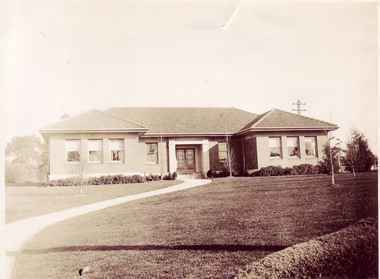
Photograph - Sepia print, Plant Research Institute, c. 1930
... Kneen 24 June1992, "Plant Research Institute was the home of the Biology Branch of the Department Of Agriculture (and not under the control of the Principal.) Early thirties."...Kneen 24 June1992, "Plant Research Institute was the home of the Biology Branch of the Department Of Agriculture (and not under the control of the Principal.) Early thirties." plant research institute biology branch department of agriculture Sepia photograph. ...Note by T.H. Kneen 24 June1992, "Plant Research Institute was the home of the Biology Branch of the Department Of Agriculture (and not under the control of the Principal.) Early thirties."Sepia photograph. Plant Research Instituteplant research institute, biology branch, department of agriculture -
 City of Kingston
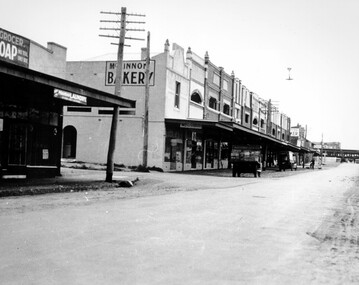
Photograph - Black and white, c. 1930
... Typed in black on white strip of paper stuck to reverse: McKinnon Road, McKinnon / circa late twenties/early thirties / $50 reproduction fee applies Blue ink stamped on reverse: COPYRIGHT / Public Transport Corporation / For re-ordering photographs / Please quote negative No ADV 491 / Enquiries C/- PTC Photographic Unit / Telephone switchboard 619 111...McKinnon Suburbs Shopping strip Trains Level crossing Typed in black on white strip of paper stuck to reverse: McKinnon Road, McKinnon / circa late twenties/early thirties / $50 reproduction fee applies Blue ink stamped on reverse: COPYRIGHT / Public Transport Corporation / For re-ordering photographs / Please quote negative No ADV 491 / Enquiries C/- PTC Photographic Unit / Telephone switchboard 619 111 Black and white photograph of McKinnon Road, McKinnon. ...Black and white photograph of McKinnon Road, McKinnon. The shopping strip can be seen on the left of the image, along with a couple of trucks parked along the roadway. There a train visible in the distance, crossing at the level crossing while the gates are closed.Typed in black on white strip of paper stuck to reverse: McKinnon Road, McKinnon / circa late twenties/early thirties / $50 reproduction fee applies Blue ink stamped on reverse: COPYRIGHT / Public Transport Corporation / For re-ordering photographs / Please quote negative No ADV 491 / Enquiries C/- PTC Photographic Unit / Telephone switchboard 619 111mckinnon, suburbs, shopping strip, trains, level crossing -
 Bendigo Historical Society Inc.
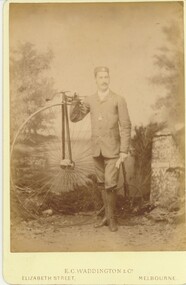
Photograph - HARRIS COLLECTION: MALE PHOTO, Ninteenth Century
... Barely discernible on gate photo right hand side. Male early thirties clothed in jackboots, breeches, buttoned up jacket, turned down collar with pale bow tie, moustache and badged cap. ...Barely discernible on gate photo right hand side. Male early thirties clothed in jackboots, breeches, buttoned up jacket, turned down collar with pale bow tie, moustache and badged cap. ...Black & white E C Waddington & Co studio portrait of male standing beside penny farthing bicycle. Melbourne Show xxv xxv ? Barely discernible on gate photo right hand side. Male early thirties clothed in jackboots, breeches, buttoned up jacket, turned down collar with pale bow tie, moustache and badged cap. Double 'Albert' chain & fob watch.E C Waddington & Co Elizabetth St Melbourne.photograph, person, male -
 Ringwood and District Historical Society
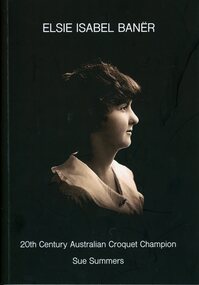
Book, Dr Sue Summers, Elsie Isabel Baner - 20th Century Australian Croquet Champion, 2023
... Foreword Intro: Life story of Australian croquet champion Elsie Isabel Baner (1900-1983) who, in her early thirties in late 1933, began to play crouet on a newly-formed lawn adjoining the Ringwood Bowling Club. ...Foreword Intro: Life story of Australian croquet champion Elsie Isabel Baner (1900-1983) who, in her early thirties in late 1933, began to play crouet on a newly-formed lawn adjoining the Ringwood Bowling Club. ...Foreword Intro: Life story of Australian croquet champion Elsie Isabel Baner (1900-1983) who, in her early thirties in late 1933, began to play crouet on a newly-formed lawn adjoining the Ringwood Bowling Club. Within three years, she won the hightly prestigious English Silver Medal (B Class Division) and was immediately upgraded to A Grade. Elsie remained a champion player for the next three decades and was acknowledged by her colleagues as "a legend in her own lifetime. Author, Dr Sue Summers, is the maternal granddaughter of Elsie Isabel Baner and Frederick Thomas Baner. Awarded to the Croquet Australia Hall of Fame on 1st December 2023, for demonstrated leadership and influence in croquet in Australia as a player, coach and mentor. -
 Ballarat Heritage Services
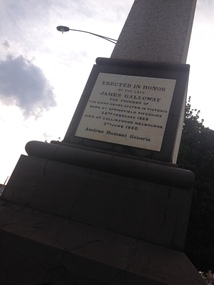
Photograph, James Gallaway Monument, Sturt Street, Ballarat, 23/01/2014
... In 1860 Galloway died at the early age of thirty-two....In 1860 Galloway died at the early age of thirty-two. James Gallaway Monument Sturt Street Ballarat A. ...A monument to Scottish stonemason James Galloway was erected in Sturt Street, Ballarat. James Galloway was the founder of the Eight Hour Day, and the monument was erected by the working men of Ballarat. The principle of eight hours work, eight hours recreation and eight hours sleep won unanimous support amongst various building unions and soon became widely accepted throughout Australia. James Galloway was born in Springfield, Fifeshire, Scotland, in 1828. He arrived in Melbourne in 1854. By 1856 Galloway had helped form a Committee of Masons with its chief goal being the introduction of an eight hour working day. In 1860 Galloway died at the early age of thirty-two.Colour photograph of a monument to James Galloway.james gallaway monument, sturt street, ballarat, a. simpson -
 Melbourne Tram Museum
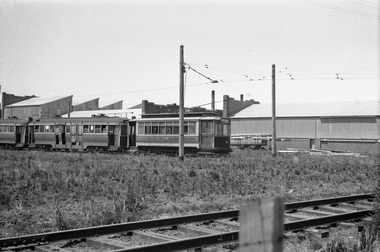
Negative, Wal Jack, 19/01/1941 12:00:00 AM
... Then in 1929 they were all transferred to the ADC chassis but four were retained in late thirties to early forties for possible further use. ...Then in 1929 they were all transferred to the ADC chassis but four were retained in late thirties to early forties for possible further use. ...Black and white negative by Wal Jack of U206 and a C Class or N class stored at Preston Workshops. Based on image the number of the second car is number 125. Note the two cable grip cars and the bus body in the background. Rod Atkins advised 11/10/2020: "The bus body is one of the four James Motors of South Melbourne body's first fitted to the group of 12 Thornycroft "J" chassis in 1924-1925 numbered 13 to 24. Then in 1929 they were all transferred to the ADC chassis but four were retained in late thirties to early forties for possible further use. The four bodies were then fitted to the new International K6 chassis in 1943. The vehicle numbers were 19 to 308 16 to 309 24 to 311 and 18 to 312. They were finally disposed of in 1949." Photo 19-1-1941, based on other similar photo dates.trams, tramways, preston workshops, u class, c class, n class, grip tram, buses, tram 206, tram 125 -
 Flagstaff Hill Maritime Museum and Village
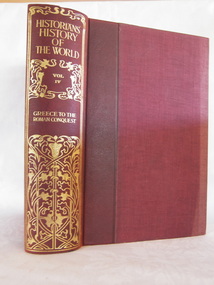
Book - Reference Book/History, Henry Smith Williams, The Historians History of the World Vol 4 set 1 - Edited by Henry Smith Williams L.L.D. Published by “The Times” 1908, 1908
... early 20th century, The Times entered the book trade to boost its prestige and revenue, notably marketing this set and the “Encyclopedia Britannica”. Volume 4 is a deep dive into the later history of Ancient Greece, specifically focusing on the period from the aftermath of the Peloponnesian War through to the Roman conquest. This volume bears the subtitle "Greece to the Roman Conquest." It covers several pivotal shifts in power regards the post war struggle (404 to 374 BC.) The book begins with the "Reign of Terror" in Athens under the Thirty...early 20th century, The Times entered the book trade to boost its prestige and revenue, notably marketing this set and the “Encyclopedia Britannica”. Volume 4 is a deep dive into the later history of Ancient Greece, specifically focusing on the period from the aftermath of the Peloponnesian War through to the Roman conquest. This volume bears the subtitle "Greece to the Roman Conquest." It covers several pivotal shifts in power regards the post war struggle (404 to 374 BC.) The book begins with the "Reign of Terror" in Athens under the Thirty ...The 1908 edition of The Historians' History of the World is a monumental work of Edwardian scholarship, representing a specific era of "universal history" where the goal was to synthesise all human knowledge into a single narrative. Volume 4 is a deep dive into the later history of Ancient Greece, specifically focusing on the period from the aftermath of the Peloponnesian War through to the Roman conquest. This volume bears the subtitle "Greece to the Roman Conquest." It covers several pivotal shifts in power regards the post war struggle (404 to 374 BC.)Book is part of a 25 volume set with red cloth bindings and gold filigree design to rib.non-fictionThe 1908 edition of The Historians' History of the World is a monumental work of Edwardian scholarship, representing a specific era of "universal history" where the goal was to synthesise all human knowledge into a single narrative. Volume 4 is a deep dive into the later history of Ancient Greece, specifically focusing on the period from the aftermath of the Peloponnesian War through to the Roman conquest. This volume bears the subtitle "Greece to the Roman Conquest." It covers several pivotal shifts in power regards the post war struggle (404 to 374 BC.)flagstaff hill, warrnambool, shipwrecked-coast, flagstaff-hill, flagstaff-hill-maritime-museum, maritime-museum, book, the historians history of the world vol 4 set 1, henry smith williams -
 Australian Jazz Museum
Musical Instrument
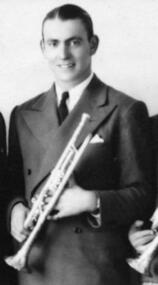
... The brass cornet was owned by early Australian Jazz musician and multi-instrumentalist Benny Featherstone Benny Featherstone is considered "one of the most fascinating and gifted musicians in the history of Australian jazz" (Johnson, Oxford Companion to Australian Jazz, p 154). Once described as "Australia's Louis Armstrong" benny featherstone prince of good fellows thirties ...The brass cornet was owned by early Australian Jazz musician and multi-instrumentalist Benny Featherstone Benny Featherstone is considered "one of the most fascinating and gifted musicians in the history of Australian jazz" (Johnson, Oxford Companion to Australian Jazz, p 154). Once described as "Australia's Louis Armstrong"Buescher brass cornetTrue tone. Pat. Oct 89.07 287335 LP 262 The Buescher Elkhart Ind. U.S.A.benny featherstone, prince of good fellows, thirties, jazz musician, melbourne jazz musician, drummer, 1930 s, buescher cornet, trumpeter, trombonist, clarinetist, pianist, early australian jazz -
 Federation University Historical Collection
Booklet, Threshold: The Magazine of the Ballarat Girls' Technical School, 1959, 1959
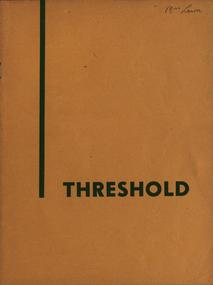
... In 1951 thirty girls started a junior technical course for the first time in Ballarat, under the Principal of the Ballarat School of Mines. By 1959 it had increased enormously with an enrolment of 284 students, and its own headmistress. The early...In 1951 thirty girls started a junior technical course for the first time in Ballarat, under the Principal of the Ballarat School of Mines. By 1959 it had increased enormously with an enrolment of 284 students, and its own headmistress. The early ...1959 was the first issue of 'Threshold'. In 1951 thirty girls started a junior technical course for the first time in Ballarat, under the Principal of the Ballarat School of Mines. By 1959 it had increased enormously with an enrolment of 284 students, and its own headmistress. The early school took place in the Dana Street Primary School and a large portion of the Ballarat Technical Art School. It was not thought necessary for girls to produce a magazine, but Joan Hood (Kirner) was determined that the girls would have the same opportunity as the boys. “When I went out teaching, I went to Ballarat Girls Tech, where I met [husband] Ron who was at Ballarat Boys Tech. They were seen as tough schools, and I saw the disadvantage faced by these girls who were at the lowest of the low of the education rung – and yet there were some fantastic girls there who needed equal opportunity. So I think it was teaching that cemented in my mind that people don’t get an even go – and in particular girls. It didn’t take me too long to realise blokes were largely empowered. And it was teaching that cemented how equity and empowerment for women could be achieved through education.” Sarah Capper: You graduated from Melbourne University in 1958, and as mentioned, began work as a teacher in Ballarat. You married Ron in 1960 and received one of those government letters asking you to resign - JK: Yes, I think it burnt a hole in my pocket when I brought it home! We were both teachers, and I said to Ron, “Well, you got married – where’s your letter?!” That really clarified that the world wasn’t quite even, even in this profession that I’d always wanted and loved. I didn’t get superannuation – I think I got something like 100 pounds as pay in lieu of permanent service. And that wasn’t just me – that was a whole generation. Fancy that – that’s what it said – “pay in lieu of permanent service”. So that made me livid. If I hadn’t been a feminist before then, I certainly was by then. I realised the distribution of power was different for women and men. http://sheilas.org.au/2014/02/a-bonza-joan-kirner/, accessed 06/06/2015 The four houses of the Ballarat Girls' Technical School were Bass House, Sturt House, Flinders House and Mitchell House. Orange and green soft covered magazine of 24 pages. Includes a message from the headmistress, Fay Moore, and a photograph of the Magazine Committee featuring teacher Joan Hook (later Joan Kirner, Premier of Victoria). Information and a photograph is given for the following personalities: Sandra McHenry, Sylvia Rowe, Heather Young, Beverley Davis, Lorna Robertson, Janice Hunter, Margaret Ayars, Margaret Veal, Heather O'Brien, Hilary Batt, Leone Davies, Marlene Drever, Janet Smith.ballarat girls' technical school, joan hood, joan kirner, fay moore, i.e. harris, faye hilton, marilyn miller, lesley cutts, margaret jones, moira blair, rosemary davies, lorraine button, vivienne guy, lorraine krankovich, loralie crabbe, beverley davis, shirley dean, lorrice campbell, hilary batt, valerie stewat, sandra mchenry, joy henderson -
 Flagstaff Hill Maritime Museum and Village
Instrument - Marine Telescope, 1870-1880
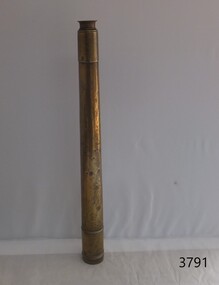
... early 1870s, practical optics had become John Browning's primary interest, and he listed his occupation as an optician on the census records from 1871 to 1901. He was well known among London's ophthalmic surgeons for his various ophthalmic instruments. He had a large part in reforming the art of crafting spectacles. Other achievements were as an author of the book, How to Use Our Eyes and How to Preserve them by the Aid of Spectacles. Published in 1883, the book included thirty...early 1870s, practical optics had become John Browning's primary interest, and he listed his occupation as an optician on the census records from 1871 to 1901. He was well known among London's ophthalmic surgeons for his various ophthalmic instruments. He had a large part in reforming the art of crafting spectacles. Other achievements were as an author of the book, How to Use Our Eyes and How to Preserve them by the Aid of Spectacles. Published in 1883, the book included thirty ...This telescope was amongst various items collected from a sea dive in Port Phillip Bay. The diver was the caretaker of the Port Lonsdale Lighthouse, who dived on various wrecks in the bay during the 1960's. After the caretaker's death, his son sold off many of the shipwreck artefacts. The telescope was purchased from the caretaker's son in the 1990's by a previous owner of the Marine Shop, Queenscliff, Victoria. John Browning was particularly well known for his scientific advances in the fields of spectroscopy, astronomy, and optometry. Between 1856 and 1872, Browning acquired provisional patents for designs of numerous scientific instruments. He was also the recipient of an award at the 1862 International Exhibition held in London. Also recognised for his temperature-compensated aneroid barometer. Browning's scientific instruments were used in physics, chemistry, and biology. The products he designed and manufactured included spectroscopes, telescopes, microscopes, barometers, photometers, cameras, ophthalmologist, and electrical equipment such as electric lamps. John Browning was born around 1831 in Kent, England. His father, William Spencer Browning, was a maker of nautical instruments. John Browning's great-grandfather was also an instrument maker as well as John’s brother Samuel Browning of the firms Spencer & Browning and Spencer, Browning & Rust, who also manufactured navigational instruments. The latter firm was in operation in London from 1784 to 1840 and was succeeded by the firm of Spencer, Browning & Co. John Browning initially intended to follow the medical profession and entered Guy's Hospital, a teaching hospital and a school of medicine. Despite having passed the required examinations, however, he abandoned his plans. Instead, he apprenticed with his father, William Spencer Browning. At the same time, in the late 1840s, he was a student attending the Royal College of Chemistry several days per week. By the early 1870s, practical optics had become John Browning's primary interest, and he listed his occupation as an optician on the census records from 1871 to 1901. He was well known among London's ophthalmic surgeons for his various ophthalmic instruments. He had a large part in reforming the art of crafting spectacles. Other achievements were as an author of the book, How to Use Our Eyes and How to Preserve them by the Aid of Spectacles. Published in 1883, the book included thirty-seven illustrations, including a diagram demonstrating the anatomy of the eye. In 1895, he was one of the founders of the "British Ophthalmology" the first professional organisation for optometry. He was not only its first president but also registered as its first member so many considered him to be the first professional optometrist. Other professional organisations he belonged too was as a member of “The Aeronautical Society of Great Britain”. In 1871 constructing the first wind tunnel located at Greenwich Marine Engineering Works. He was also a member of other scientific organisations, such as the “Microscopical Society of London”, the “Meteorological Society”, and the “Royal”. Then in 1908 the company of W. Watson & Son, opticians and camera makers, took over John Browning's company since 1901 John Browning had been semi-retired but in 1908 he fully retired and moved to Bournemouth in Hampshire. He died in Cheltenham, Gloucestershire in 1925.The telescope is significant for its association with one of the world’s leading scientific instrument makers and inventor of the 19th and early 20th century. It is believed the donation came off a wreck either in Port Philip Bay or between Point Lonsdale and the Nepean Heads making it a significant maritime historical artefact. Its provenance is good given it was taken off a wreck in this area by the Point Lonsdale lighthouse caretaker. Examples of John Browning's telescopes because of their scientific and historical importance are highly valued by collectors.Marine style single draw brass telescope with a sunshade. The single draw has no split and the second cartridge is held in a long brass tube within the single draw, mounted from the objective end. The eyepiece is flat and at the end of the first draw in a very faded engraving that is believed to read "John Browning, 63 Strand, and should read London under the word strand but this is hard to establish given the engravings condition. This interpretation of the engraving has been arrived at by examination of other John Browning telescope engraving examples."John Browning, engraved to the first tube in copper plate style "63 STRAND" Engraved under in capital textflagstaff hill, flagstaff hill maritime museum and village, warrnambool, maritime museum, maritime village, great ocean road, shipwreck coast, shipwreck artefact, port phillip bay, port lonsdale lighthouse, wreck, 1960’s diver, queenscliff marine shop, john browning, telescope, spectroscopy, optometry, scientific instruments, william spencer browning, optician, navigational instrument, microscopical society of london, aeronautical society, marine technology -
 Flagstaff Hill Maritime Museum and Village
Currency - Banknote Belfast, Bank of Victoria, 1853
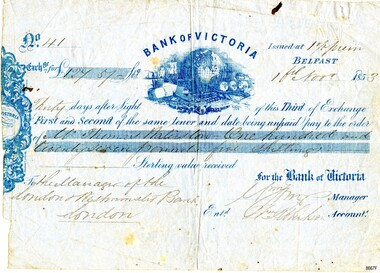
... early colonial system of banking and reflects the economic growth and entrepreneurship of the South West Region of Victoria. Flagstaff Hill Warrnambool Maritime Village Maritime Museum Flagstaff Hill Maritime Museum and Village Shipwreck coast Great Ocean Road Promissory notes Bank Notes Bank of Victoria Smith & Watts Smith & Watts Architects 1853 William Highett William F. Splatt Alex Wilson W.H. Tuckett Henry Miller Money Miller Belfast (now Port Fairy) banknote The front of the banknote reads: "No.41/ Exch.ge for £127.57- Bank of Victoria/Issued at 1% prem/Thirty ...The promissory note issued at Belfast, now Port Fairy, Victoria by the “Bank of Victoria” is an early example of currency issued by a private bank. This note was issued in 1853 the same year that the bank commenced business in Belfast. Details of the first production of a banknote backed by the Australian Government occurred on 1 May 1913 following the "Australian Notes Act of 1910" (Australian National Museum). The first building the Bank of Victoria purchased in Belfast was of timber and later sold. Smith & Watts Architects advertised for tenders in the Melbourne Argus on Thursday 29/4/1869 for the erection of a substantial building that is now occupied by Moyne Shire Council in Cox Street. A meeting of the Directors of the Bank of Victoria elected on 1 October 1852. A ballot took place for four directors resulting in Wm. Highett Esq. Wm F. Splatt, Esq. M.L.C., Alex. Wilson, Esq. and W.H. Tuckett” elected as Directors. It was reported from a later meeting in “The Argus” Melbourne on 3 August 1853 that a branch had opened in Swanston Street, Melbourne on 3rd January 1852 with Henry Miller as Chairman of the Board and J. Matheson as the Manager; followed by Geelong on 12 August 1852. Then at the request of “influential inhabitants”, the Belfast branch commenced on 11 May 1853, which had “already met with very general support and encouragement”. This was a colonial bank at the time of vast pastoral runs and gold speculation – how "Mr Thomas [....ton?]" came by his fortune of One Hundred and Twenty-Seven Pound and five shillings can only be wondered at until further research reveals the story. This promissory note records the early colonial system of banking and reflects the economic growth and entrepreneurship of the South West Region of Victoria.Banknote of fine paper. There is a fold multi-crease down the centre top to bottom, lighter creasing across the top and angular creasing to the bottom left and right-hand corners. Yellow spotting is visible across the object breaking through the grey blue colour of the paper. A dark ink blot appears near the top right-hand corner. The left-hand side of the banknote is uneven. The back of the document has darker spotting, a used dirty look patina and some insect spotting. Horizontal crease markings can be seen creating quarter marks. The front of the banknote reads: "No.41/ Exch.ge for £127.57- Bank of Victoria/Issued at 1% prem/Thirty days after Sight of this Third of Exchange/First and Second of the same tenor and date being unpaid pay to the order of/Mr. Thomas [Raliston?]/One hundred and twenty seven pounds five shillings Sterling silver received/To the Manager of the London Westminister Bank London/for the Bank of Victoria [signed?] Manager/Ent.d [?] Robertson Account.t. The blue printed Bank of Victoria logo features a world globe, sailing ships, wool bails, sheep, colonial building and mining tools. flagstaff hill, warrnambool, maritime village, maritime museum, flagstaff hill maritime museum and village, shipwreck coast, great ocean road, promissory notes, bank notes, bank of victoria, smith & watts, smith & watts architects, 1853, william highett, william f. splatt, alex wilson, w.h. tuckett, henry miller, money miller, belfast (now port fairy), banknote -
 Orbost & District Historical Society
black / white photograph, C1893
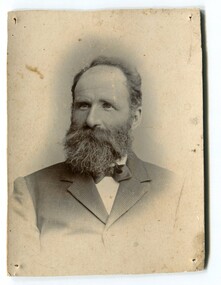
... He was also president of the Agricultural Society and Chairman of the local School Committee for over thirty years, (from Richard Johnston -1969 in "Personalities and Stories of the Early Orbost District: by Mary Gilbert)...He was also president of the Agricultural Society and Chairman of the local School Committee for over thirty years, (from Richard Johnston -1969 in "Personalities and Stories of the Early Orbost District: by Mary Gilbert) John Johnston was a prominent citizen of Orbost in the late 19th and early 20th centuries. ...This is a photograph of John Johnston. John Johnston was elected as a member of the Orbost Council and during thirty-five years of service, he was president four times. He was also president of the Agricultural Society and Chairman of the local School Committee for over thirty years, (from Richard Johnston -1969 in "Personalities and Stories of the Early Orbost District: by Mary Gilbert)John Johnston was a prominent citizen of Orbost in the late 19th and early 20th centuries. He was referred to as "the father of the council".A black / white portrait photograph of a man, with beard and moustache, wearing a bow tie and suit jacket. johnston-john orbost-shire-council -
 Ringwood and District Historical Society
Newspaper, Scrapbook Clipping, Library Collection, Ringwood, Victoria
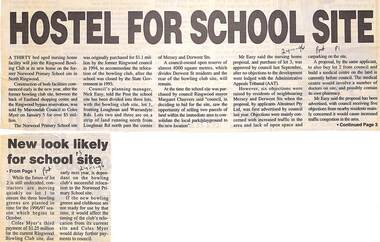
... A thirty bed aged nursing home facility will join the Ringwood Bowling Club at its new home on the former Norwood Primary School site in North Ringwood. Construction of both facilities commenced early...A thirty bed aged nursing home facility will join the Ringwood Bowling Club at its new home on the former Norwood Primary School site in North Ringwood. Construction of both facilities commenced early ...Newspaper Clipping from the ""Post", 24-1-96, P 1. "Hostel for school site", and P3 "New look likely for school site".A thirty bed aged nursing home facility will join the Ringwood Bowling Club at its new home on the former Norwood Primary School site in North Ringwood. Construction of both facilities commenced early in the new year, after the former bowling clib site was sold by Maroondah Council to Coles Myer on January 5 for over $5 million. -
 Ringwood and District Historical Society
Book, Educational Media Services, Victoria College et al, Prelude to Heidelberg - The Artists' Camp at Box Hill, 1991
... early 20th centuries or the infinitely varied styles of today. At the beginning of the 1930s, when I first began to take any sort of interest in art, I had the natural feeling of youth that anything that had happened thirty to forty years ago was already far down the dark and backward abysm of time. ...early 20th centuries or the infinitely varied styles of today. At the beginning of the 1930s, when I first began to take any sort of interest in art, I had the natural feeling of youth that anything that had happened thirty to forty years ago was already far down the dark and backward abysm of time. ...Image of a Tom Roberts painting on front of soft covered book titled The Artists' Camp at Box Hill - Eleanor Finlay, Marjorie MorganFOREWORD by William Dargie Kt., C.B.E., FRSA (London) FRAS (NSW) As one born between two worlds I find it difficult to identify wholly with either Australian art of the late 19th and early 20th centuries or the infinitely varied styles of today. At the beginning of the 1930s, when I first began to take any sort of interest in art, I had the natural feeling of youth that anything that had happened thirty to forty years ago was already far down the dark and backward abysm of time. As for today, all that one of my generation can do is to enjoy what is enjoyable and avert one's eyes and close one's ears against the rest. This is the time of life one realizes that distaste, as well as taste can be cultivated. Well, youth repeats itself in each generation and among the young there will always be .some determined and dedicated to the making of new images of the physical world. All artists throughout history have shared this common experience. All have remembered the suddenly-formed friendships, the sketching expeditions and camps, the first exhibitions, the formation of groups, the 'manifestos' - these last to return in later life all too often as embarrassments - but above all, the enthusiasm. 'Bliss was it in that dawn to be alive but to be young was very heaven'. Thus we can be time-travellers back one hundred and six years to that first plein-air camp set up by Roberts, McCubbin and Abrahams on part of David Houston's property at Box Hill. This was indeed the prelude to all that followed: Mentone and the meeting with the young Streeton painting on the rocks, and Heidelberg later. -
 Mission to Seafarers Victoria
Booklet - Manual, Sailing directions for Port Phillip, in the colony of Victoria including the ports of Melbourne and Geelong, 1854
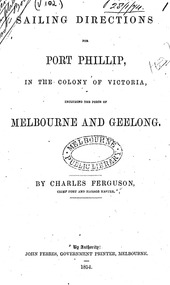
... thirty individuals, then numbered 230. The character of Captain Ferguson’s unbroken service during the fourteen years which have elapsed since I left the colony must be well known to the Government and the people he has served so long and so faithfully. I confine myself to recalling to mind those earlier...thirty individuals, then numbered 230. The character of Captain Ferguson’s unbroken service during the fourteen years which have elapsed since I left the colony must be well known to the Government and the people he has served so long and so faithfully. I confine myself to recalling to mind those earlier ...Captain Charles Ferguson was born in Scotland in 1813. He was the Master of the "Rajah" from 1838 to 1850 on voyages from England to Australia and vice versa. He became the First Chief Harbour Master for the port of Melbourne in 1852 after being the first Harbour Master and Water Police Officer in Geelong for 12 months. On the 5th of April 1841, the Rajah sailed with James Donovan M.D. as Surgeon Superintendent, and the Rajah sailed from Woolwich with 180 female convicts. The Rajah arrived on the 19th of July in Hobart, with 179 females (one died during the voyage) and 10 children. Miss Kezia Elizabeth Hayter was the matron on board. On page 28 of the "Sailing directions for Port Phillip, in the colony of Victoria including the ports of Melbourne and Geelong", a mention is made of the Mariner's Hospital and Floating Church soon to be established. There were discussions to built the hospital in Williamstown but instead the Government decided to build it in Melbourne. The Harbour Master and a commiittee decided to use the water police hulk, Emily, left unsold in 1856, to create a floating church: the Bethel was open in July 1857 with Reverend Kerr Johnston as Chaplain. Latrobe wrote a letter to Captain Cole in 1869, a few months after learning his death : "To Captain George Ward Cole † [from a draft in another’s hand] Clapham House, Lewes, Sussex, January 28th, 1869. My dear Captain Cole, Last mail will have taken out the sad intelligence of the death of our excellent old friend, Captain Ferguson. This will have been a terrible blow to his children and to his friends in the colony, who may have held reason to expect his early return to his home, with a not unreasonable prospect of ultimate restoration to health and activity. In the course of last October I went up to town with one of my children, mainly with the purpose of finding my way to Pinner, where he and Mrs. Ferguson were staying with an intimate friend. I found him in excellent health and spirits, and enjoying the prospect of a speeding resumption of the service to which he had devoted his best days, and upon the furtherance of which his entire energy was still directed. A week or two later Captain and Mrs. Ferguson went to Dover for change of air, and being still under the impression received from the advisers by whom they had been guided during their residence at a hydropathic establishment at Matlock, felt encouraged to plan almost immediate return to the colony by the Jerusalem early in December. However, certain misgivings in the mind of a medical gentleman, then in England, under whose care Captain Ferguson had at one time placed himself in Williamtown, led them to consider it judicious before departure to take the advice of some surgeon of eminence in London. Accordingly they came up to town at the close of November. The first London practitioners they consulted shook their heads, and advised consultation with Sir Wm. Ferguson. The result was that amputation, without loss of time, was pronounced necessary. The rest is soon told. He received the painful intelligence with calmness and full resignation to God's will, and underwent the operation at King's College Hospital with exemplary firmness and Courage on the 28th of November. Perfect success seemingly attended it, and there seemed, humanly speaking, to be every prospect of a prompt cure and early convalescence; everything seemed in his favour. A few days later, however, all was clouded by symptoms of hospital fever (pyoe æm ia). This resisted all control, and finally carried him off on the 27th of December, just one month after the operation. He had lived a Christian life, and his death was the peaceful and resigned death of a Christian. It was a melancholy satisfaction to me to be able to join a few friends in following his remains to their resting place in one of the outlying London cemeteries on the last day of the year. You know Mrs Ferguson well, and will be prepared to hear me say that her whole conduct and demeanour throughout this period of suspense and bitter trial has been worthy of her high character and steadfast principle. Come what will, and happen what may, I have the fullest conviction that neither the widow nor the children will be forsaken, however doubtful and clouded the future may appear, in consequence of the irreparable loss which, they have sustained. And now, dear Captain Cole, it is possible that you may already have heard all this from other sources, but I have dictated it to you under strong impulse, for I feel assured that there is no member of the community in which you live who will more sincerely deplore the loss of Captain Ferguson on private grounds; at the same time that there is no one who, from long acquaintance with his official character and services, will be in a better position to estimate their real value or the loss which the colony has sustained. The circumstances in which Captain Ferguson's family are left not only demands the utmost display of sympathy and interest on the part of friends, but may call for decided and prompt action; therefore I cannot rest satisfied without discharging what I consider my duty, and seeking to strengthen your hands as far as I may in bringing the character of his long services before the existing colonial authorities. Of his private career previous to his entering the service of the Colonial Government in 1851 nothing need be said. Captain Ferguson was appointed as the Harbour Master at Geelong in April, 1851 – a few months before the separation of the colony from New South Wales. He there did excellent service in a variety of ways calculated to advance the interests of the port, and to introduce www.latrobesociety.org.au 27 order, where, from circumstances, but little order had hitherto prevailed. His was the first appointment of this class in that locality. The separation of the colony from New South Wales took place in the month of July following. Shortly after, the late Captain Bunbury resigned the Harbour Mastership of Port Phillip. Captain Ferguson was at once (February, 1852) appointed to succeed him, and from that time performed all duties of Chief Harbour Master of the colony. The previous year (May 1851) the first gold discoveries in New South Wales had taken place, and in the month of August those of our colony followed. At the time of Captain Ferguson’s taking charge of the Port of Melbourne their influence had begun to be fully felt, and in no department more seriously than in that of the Harbour Master. This is no place for statistical details, but they must bear me out in reminding you of a few facts connected with our late friend’s career. At the time of separation that department comprised only 30 individuals of all ranks, and when he took charge the number was much reduced. There were at that time, according to the returns, no fewer than 54 vessels, registering 26,785 tons, in Hobson’s Bay alone. The crews on arrival numbered 1,235 men. Of this number only 463 remained on board, 500 having deserted, and the rest having been discharged by arrangement or pure necessity. For the first six months after Captain Ferguson’s assumption of office as Harbour Master the duties of Police Magistrate and Chief of the Water Police were superadded, and how much labour they involved may be surmised from the fact that from 1st of April to the 31st July, 1852, four months only, no less than 236 marine cases were brought before the bench at Williamstown - sometimes as many as 30 in a day. A year later (March 1853) the returns show that the number of vessels in the harbour in Hobson’s Bay alone were 91, tonnage 43,754; and passing on to the still later returns of May, 1853, two years after Captain Ferguson’s assumption of office, we find from the records that the number of ships in port had increased to 129; tonnage, 63,292; crew on board on arrival, 2872, and at the date of report, 1628; the amount of desertions at that time having, however, proportionally diminished, in consequence of the abatement of the gold fever, caused by the non-success attendant upon the labours of thousands at the goldfields. The above numbers take no account of the large number of vessels and amount of tonnage lying at the wharves at Melbourne or elsewhere. From these figures alone it may be judged what must have been a struggle in which the Chief Harbour Master was engaged from the very outset to secure order, and answer the innumerable calls on every branch of his department, at the same time that there was for many months an almost complete impossibility of securing subordinate agency, such as boatmen, pilots, and police, at any price. But I may bear witness to the untiring diligence, energy, and self-devotion with which Captain Ferguson grappled with the difficulties of his position, and the seemingly insurmountable obstacles which stood in his way. Ashore and afloat he was always ready, showing the same directness of purpose, intelligence, and forgetfulness of self. He shunned no responsibility, and turned his hand from no work, whether within or beyond the ordinary scope of his duty, which the hard necessity of the times forced the Government to bring under his notice. Already in 1852, when the overflowing of our gaol and stockade rendered the adoption of other methods of restraint absolutely necessary, and addition to the existing buildings could not be thought of, it was Captain Ferguson who first suggested the employment of hulks; and it was with his personal assistance and supervision, and under his unflagging energy, that the three first of these – the Success, the President, and the Sacramento – were purchased, fitted up, and made available for the purpose in view, and the rules and regulations for the employment and safety of the men afloat and ashore prescribed and carried out. He carried the same energy into every branch of his department, and his influence was soon apparent. His subordinates of every class became actuated by his spirit. As time moved on, the range of his duties, both ordinary and extraordinary, increased. In the formation of the quarantine station at the heads, in the management if not the erection of lighthouses, sailing directions, port and wharf regulations, buoys, signal stations, www.latrobesociety.org.au 28 steam dredging &c., he was the main and most active agent. The whole pilot establishment and regulations, men, and vessels, were under his charge; and when I left the colony in May, 1854, the entire range of ports outside Port Phillip Heads from Point Lonsdale to Portland, as well as that of Geelong had felt the influence of his intelligent supervision and care. The entire department of Chief Harbour Master, which I have numbered at the period of separation about thirty individuals, then numbered 230. The character of Captain Ferguson’s unbroken service during the fourteen years which have elapsed since I left the colony must be well known to the Government and the people he has served so long and so faithfully. I confine myself to recalling to mind those earlier, and what must have been the hardest and most difficult, period – none can know how difficult but those who were in that fierce struggle for the maintenance of order under so many disadvantages; and on this subject I have spoken advisedly and with reason, for I may truly say he worked under my own eye. I had sincere regard for the man, and just pride in the qualities of his heart, head, and hand. Whatever mistakes may have been made by the Government of the colony in those hard and difficult times (and I am quite ready to admit that there were many, especially if the past is to be judged by the light of the present), I never have hesitated in believing that, in appointing Captain Ferguson to the office he has so long filled, it was the right man in the right place. I shall be heartily rejoiced to find that the Government and inhabitants of the colony admit that this has been the case, and to learn that they have not forgotten the strong claims of one who has served them so long and so faithfully, and who, removed by God’s providence, so to say, in the maturity of his powers, has left a widow and young family behind him. I have done, I leave you to make use of this communication, or any portion of it, which you may think judicious and called for. There may be among Ferguson’s friends those who may not be sorry to be reminded of facts. By-the-bye, I may mention as a proof how completely Captain Ferguson’s mind was engrossed by devotion to his public duty, that while in Dover, only ten days before the operation, he took an opportunity to drag himself up into the lantern of the S. Foreland Lighthouse, and made a most careful scrutiny of the whole apparatus and arrangement, with a view of the adoption of any hint for the perfection of those under his charge in the colony. And now, goodbye. I trust this will find you in good health, and in comparative vigour. Believe me ever, dear Captain Cole, Yours very truly, C. J. La Trobe"The attempt for a floating church was made as early as 1853 following similar examples in London like the Seamen's Hospital. Captain Ferguson was instrumental in the foundation of the Bethel Church.Digital copies of the 37 pages ; 22 cm.1854, hobsons bay, geelong, melbourne, williamstown, sandridge, mariner's hospital, floating church, seamen's hospital, captain charles ferguson (1813-1868), kezia elizabeth hayter (1818-1885), rajah quilt, prison hulks, water police, harbour master, harbor master, gaols -
 Orbost & District Historical Society
book, East Gippsland's ANZACS a tribute to those who served in World War 1, 2016
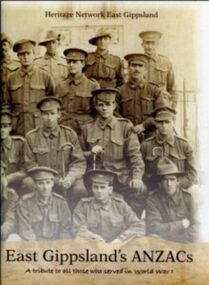
... On the front cover is a sepia photograph of "Thirty East Gippsland Boys" taken in early 1916 during training at Heliopolis (Greece) before embarkation for France. ...On the front cover is a sepia photograph of "Thirty East Gippsland Boys" taken in early 1916 during training at Heliopolis (Greece) before embarkation for France. ...This book was produced as a project for the 1915 ANZAC centenary. The book became too unwieldy and was then divided into written information and a CD with the details of each man - name; rank; service number and unit. Almost 2500 names have been traced. For current Australians, the Anzac Centenary is one of the most significant commemorations to take place during their lifetime. It was a time to contemplate the legacy of those who served in World war 1 and those who never returned to their families or friends. This book records that time and especially honours those from East Gippsland.A paper back book, titled "East Gippsland's ANZACS a tribute to those who served in World War 1". On the front cover is a sepia photograph of "Thirty East Gippsland Boys" taken in early 1916 during training at Heliopolis (Greece) before embarkation for France. The book contains a selection of stories from those who served, along with a CD of the names and service records of all of those known to have enlisted from East Gippsland.anzac ww1 military-history--east-gippsland -
 Mission to Seafarers Victoria
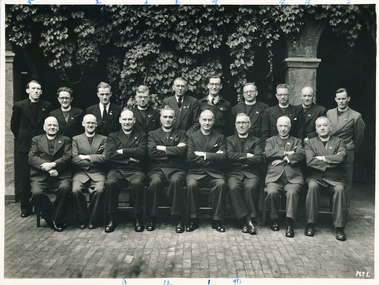
Photograph - Photograph, Black and white, Australian Chaplains' Conference, Melbourne, 1952, 1952
... early 1950s. Reverend Frank Oliver served as Chaplain at the Mission to Seafarers Victoria for almost thirty years. ...This photograph is representative of the relationship between the Mission to Seafarers Victoria and the Anglican Church. The image also historically depicts the courtyard at the Mission to Seafarers Victoria from approximately the early 1950s.Reverend Frank Oliver served as Chaplain at the Mission to Seafarers Victoria for almost thirty years. The photograph shows the historical ties between the Mission and the Anglican Church towards the end of Oliver's chaplaincy in the 1950s. Standing in back row on the left is Rev Alex Crigan, Assistant Chaplain. Black and white photograph with a white border. Pictured are 18 men, 15 of which are wearing white collars of the church. They are positioned in two rows; the back row consists of ten men, the front row has eight men. All the men in the front row have their arms crossed, and many in the back row appear to have their arms behind their backs. The men are situated in the courtyard of the Mission to Seafarers Victoria, in front of the pillars with hanging vine leaves.In blue ink (written by Padre Oliver): On the top section of the white border in blue pen reads: "5", "3", "4". "6":, "7", "8", "9", "2". Whilst the lower line of the white border reads; "11", "12", "!", "!0". These number correspond to the names and numbers on the reverse side of the photograph. This reads: "1.Cyril Brown (Gen. / 2. Peter Smith (L/R - Melb.) / 3. Roberts (T.ville) / 4. Palmer (? Hobart) / 5. Alex Crigan (Melb) / 6. Bob Clarke (L/R . W'town) / 7. John Beaverstock (L/R Melb) / 8. Joe Forstes (Melb) / 9. Nichols, Vicar. H Trinity, Port Melb. (Late Chap, T'ville) / 10. Williams (Wellington) / 11. Max (Cowle), (Port Melbourne) / 12. F.L. Oliver (Melb.). Below this is a hand-drawn line that leads to the name "COWLE" melbourne, ties, men, williams, nichols, reverend, hobart, pillars, suits, courtyard, brickwork, chair, creeper, cyril-brown, peter-smith, roberts, palmer, townsville, williamson, vicar, h-trinity, port-melbourne, wellington, alex crigan, missio to seafarers, seamen's mission, mission to seamen, conference, flinders street, padre oliver, frank leslie oliver, anglican church, alec crigan, bob clarke, reverend c.j. brown, cyril j. brown, max cowle, john beaverstock, joe forster, chaplain conferences, chaplains group -
 Flagstaff Hill Maritime Museum and Village
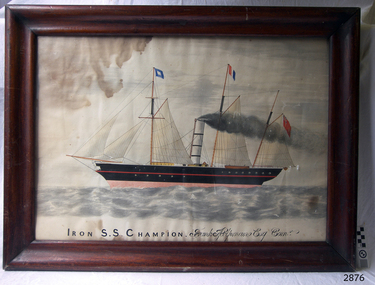
Painting - Lithograph, Iron S.S. Champion Frank Helpmann Esq. Comr, 1853 or later
... CHAMPION was an early steamship and one of the first coastal traders to operate between Melbourne and Portland in Victoria from December 1853 until August 1857, when she collided with the S.S. LIRDY BIRD in the open sea off Cape Otway. CHAMPION was returning from Melbourne, and sank with thirty...CHAMPION was an early steamship and one of the first coastal traders to operate between Melbourne and Portland in Victoria from December 1853 until August 1857, when she collided with the S.S. LIRDY BIRD in the open sea off Cape Otway. CHAMPION was returning from Melbourne, and sank with thirty ...Captain Benjamin Francis (Frank) Helpmann was once the owner of the S.S. CHAMPOIN, then owned it in partnership with S. G. Henty. S.S. CHAMPION was an early steamship and one of the first coastal traders to operate between Melbourne and Portland in Victoria from December 1853 until August 1857, when she collided with the S.S. LIRDY BIRD in the open sea off Cape Otway. CHAMPION was returning from Melbourne, and sank with thirty-two people still on board. The thirty others were saved by the LIRDY BIRD (ref. The Story of a Port : Portland, Victoria, by Noel F. Learmonth)This picture Lithograph) is associated with the S.S. Champion, which is listed on the Victorian Heritage Database VHR S110. The wreck of the SS Champion is significant historically as one of Victoria's worst shipwrecks. As an early steamship it played an important part in the development of and communications between the Western district and Melbourne . Although the site has not yet been located it is predicted to be highly significant archaeologically with the potential to yield information about early coastal shipping and the western district passenger and cargo trade. It is significant technically as an example of an early iron screw steamship, and is part of the western district steamship resource including the SS Casino, SS Coramba and SS Julia Percy.Painting. Lithograph of the schooner S S Champion, hand coloured watercolour, in a cedar frame behind glass. Unusual cross member bracing on the corners of the frame (one missing). Title "Iron S.S. Champion Frank Helpmann Esq. Comr" (in script) on bottom of picture.On the bottom of the painting "Iron S.S. Champion" (in printing), "Frank Helpmann Esq. Comr" (in script) shipwrecked coast, flagstaff hill, flagstaff hill maritime museum, maritime museum, shipwrecked artefact, flagstaff hill maritime village, shipwreck coast, warrnambool, lithograph, frank helpmann, henty -
 Ringwood and District Historical Society
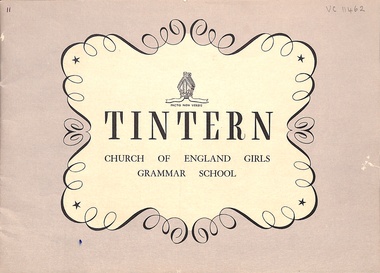
Archive - Parent Record, Tintern CEGS / Tintern CEG Primary and Seconday College, East Ringwood - Archive Collection (Parent Record)
... thirty Tintern girls are doing courses at the University. In Mrs. Cook’s day the school was noted for its music. It has now a flourishing orchestra, and Tintern choir was amongst those chosen to broadcast in Education Week 1947. Art and Craft have an important place in the curriculum. Games such as hockey, tennis and croquet were started as early...thirty Tintern girls are doing courses at the University. In Mrs. Cook’s day the school was noted for its music. It has now a flourishing orchestra, and Tintern choir was amongst those chosen to broadcast in Education Week 1947. Art and Craft have an important place in the curriculum. Games such as hockey, tennis and croquet were started as early ...Parent Record for Archive collection of photographs and documents relating to Tintern CEGS / Tintern CEG Primary and Seconday College, East Ringwood East Ringwood School Foundation Stone laid 10th June 1950 (See VC 11465)Transcription of Foreword to VC11462 c1950 memorial Booklet: "Tintern, one of the oldest girls’ schools in Victoria, was founded in 1877 by Mrs. Emma Bartlett Cook. It was then known as Tintern Ladies College. In 1918 it was taken over by the Church of England. From its inception it has sent out into the world women who have played an important part in the life of the community — as Doctors, Scientists, Lawyers, Teachers, University Lecturers, Heads of Schools and Colleges, Musicians, Artists, Architects, Nurses, Missionaries, Social Service Workers, Journalists, Business Women and Home-Makers. Tintern girls have served their country in the Boer War and in the two World Wars. The school has maintained throughout the years a high scholastic standard. It has achieved outstanding successes in the Public Examinations in both Arts and Science subjects. In this year 1948 thirty Tintern girls are doing courses at the University. In Mrs. Cook’s day the school was noted for its music. It has now a flourishing orchestra, and Tintern choir was amongst those chosen to broadcast in Education Week 1947. Art and Craft have an important place in the curriculum. Games such as hockey, tennis and croquet were started as early as the 1880s. In 1900 the girls were daring enough to start a bicycle club. Nowadays Tintern plays baseball, basketball, hockey and tennis. As the years have passed the curriculum has been widened and buildings have been added — the senior classrooms in 1918, the laboratory block in 1930, the Junior School (the gift of Sir William Angliss) in 1937, the library (the gift of Mr. E. R. Cullen) in 1938, the craft house in 1938 and the Domestic Science kitchen in 1946. ESTABLISHED 1877" -
 Eltham District Historical Society Inc
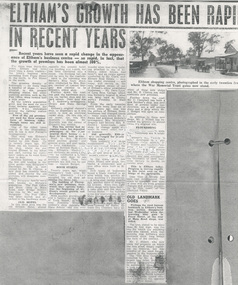
Document - Newspaper article, Eltham's growth has been rapid in recent years, c.1960
... early twenties until little more than six or seven years ago that was the picture of Eltham. Some businesses had changed hands - many years before Mr. C. Rains had acquired Andrew's news agency, Mrs. Monteith's drapery had become Mrs. R. Smith's home-made cake shop, to change again and again to many other types of business. But generally, Eltham was unchanged, for nearly thirty...early twenties until little more than six or seven years ago that was the picture of Eltham. Some businesses had changed hands - many years before Mr. C. Rains had acquired Andrew's news agency, Mrs. Monteith's drapery had become Mrs. R. Smith's home-made cake shop, to change again and again to many other types of business. But generally, Eltham was unchanged, for nearly thirty ...ELTHAM’S GROWTH HAS BEEN RAPID IN RECENT YEARS Unknown local paper c.1960s Recent years have seen a rapid change in the appearance of Eltham’s business centre - so rapid, in fact, that the growth of premises has been almost 300%. For more than thirty-five years Eltham had little more than a dozen traders - the town's business area spreading from Pryor Street in the north, to Pitt Street in the south. The greatest density of businesses - no more than a handful of shops - were situated in the present shopping centre but other essential services such as the Post Office, were located half a mile away. As the town's population grew and the need for more shops became apparent, the growth was centralised around the railway station and Shire hall. Few of the old premises are used for their original form of business today, though many are still in existence. One of the oldest (seen clearly in the illustration) still in use is now Ferrari's Greengrocery. This shop was Eltham's butchery in early days, conducted by Jim Ryan. Up to twenty years ago, Mr. Ryan ran his business from the shop. whilst his son toured Eltham in his horse and cart, cutting his customers' orders as he went from door to door. Another business - one of the few still trading in the same goods-was Burgoyne's Hardware. This is now owned by Mr. R. Clinton, a new shop has recently been added and shortly the old premises will disappear completely. The Burgoyne family were well known to Eltham's population. The Post Office and Store (then in Main Road, near Bridge Street) was run by Mr. and Mrs. Burgoyne. The Post Office was later moved, and attached to the hardware store. OLD HOTEL In this same area was the old Eltham Hotel, almost opposite the present hotel. The building still stands, but has been converted into a house. The hitching rail can still be seen by the roadside. Back in the township was Barber's Blue Gum store, later conducted by Mrs. Burges (mother of Garnet Burges) and claimed to be Eltham's oldest shop. Further down the road, just past the hardware store, was the barber shop and billiard saloon. Next door was E. J. Andrew's news agency, library and State Savings Bank. Eltham's original chemist's shop, or dispensary as it was called, is now an electrical repair shop. On this side of the street too, was Mrs. Monteith - Draper. Mr Monteith was the owner of Eltham' s bus service. This bus service had no regular route, but deposited passengers at the point nearest their homes - a. door to door taxi service. Next to Mrs. Monteith stood another grocery - and general store, and next again, the local blacksmith. Another of Butcher Ryan's sons was Eltham's blacksmith and obviously an enterprising man he conducted a timber business next door to his smithy's shop. These two premises are still run by one man - Garnet Burges. BOOM STARTS Twenty years ago, when Thompson's took over Eltham's pharmacy they occupied the old shop adjoining the Shire hall. The building of Thompson's new premises, from which· they operate today, was the beginning of Eltham's recent growth and development. With another grocery store and a bakery at the corner of York Street, a butcher near Franklin Street, a cobbler's shop opposite the State School (did you ever wonder what that-little building attached to one of Eltham's oldest houses had been?), and an estate agency conducted by Mr. Clark, now Eltham Real Estate - only one trader remained - and today, still carries on, the only original owner of one of Eltham's .oldest established businesses - Mr. Dave Lyon, of Lyon Bros. Garage, which was formerly located in what was later used as Chenowyth's Foundry in Main Road. From the early twenties until little more than six or seven years ago that was the picture of Eltham. Some businesses had changed hands - many years before Mr. C. Rains had acquired Andrew's news agency, Mrs. Monteith's drapery had become Mrs. R. Smith's home-made cake shop, to change again and again to many other types of business. But generally, Eltham was unchanged, for nearly thirty years. Then suddenly new shops mushroomed. The new news agency and drapery, the chemist and adjoining shops, a new butcher, a green grocer and several more. POPULATION DOUBLED In the space of a few years, fifteen new shops, two banks, a restaurant and a post office were built at Eltham. New types of businesses found a ready market in an area which was quickly almost doubling its population. A little over twelve months ago, another wave of progress hit Eltham. Since then eight more shops have been built - a cake shop and fish shop in Dalton [sic – Dudley] Street - for building areas are unprocurable in the Main Street shopping centre now – have been built by Mr. D. Kimball; a new ladies’ and children’s wear shop has been opened by Rains; Eltham Dry Cleaners have another of these new shops, and Mr. R. Clinton has built elaborate new premises. Further down the road, Mr. C. Campbell has built a new butcher's shop, and next door, at present under construction, are a self service store and a shop which Mr. J. Hodges will open on completion. In addition to these new shops, Mr. J. Millett has extended his grocery to almost twice its original size. FLOURISHING Outside the central area, other businesses are flourishing. Latimer's felt factory is being developed in a picturesque rustic setting; P. J. Timber and Trading Company have recently completed a large showroom and timber yard, and in the town itself Nicholson and Merritt are now completing the extension of their foot wear factory to double its former area. This is Eltham today. Progress is moving rapidly in this rural area on the fringe of the metropolis. Less than a decade has seen vast development. The years to complete that span of time will see even greater changes and greater prosperity in this heart: of the Diamond Valley. OLD LANDMARK GOES Perhaps the most famous landmark in Eltham's' business section disappeared last Wednesday when the towering blue gum in Pryor Street at the rear of Main Road shops was felled. The tree, stated to be more than 80 feet high, was the one for which the adjoining café was named, when that business was Eltham’s only provision store, long before the turn of the century. Mr. J. Millett, who now owns the property on which the tree stood, deeply regretted its removal, but was mindful of the need for expansion in the business area. The "Old Blue Gum" was removed by Mr. A. Wilson, expert tree feller, from Heidelberg. Its proportions might be assessed by these facts – it took a gang of experienced men two days to completely fell and clear the tree, and, falling sections being brought down by cable tipped electricity wires on the opposite side of Pryor Street.andrew's news agency, bakery, barber shop, barber's blue gum store, billiard saloon, blacksmith, blue gum, burgoyne's hardware, butcher, cake shop, chemist's shop, chenowyth's foundry, cobbler's shop, dave lyon, dispensary, draper shop. mr monteith, dudley street, e. j. andrew's news agency, electrical repair shop, eltham bus service, eltham butchery, eltham dry cleaners, eltham hotel, eltham railway station, eltham real estate, eltham shire hall, eltham shopping centre, eltham shops, eltham town centre, estate agency, expert tree feller, ferrari's greengrocery, fish shop, foot wear factory, franklin street, garnet burges, general store, grocery, heidelberg, horace clark, jim ryan, ladies’ and children’s wear shop, latimer's felt factory, library, lyon bros. garage, main road, mr. a. wilson, mr. c. campbell, mr. c. rains, mr. d. kimball, mr. j. hodges, mr. j. millett, mr. r. clinton, mrs. burges, mrs. monteith, mrs. monteith's drapery, mrs. r. smith's home-made cake shop, nicholson and merritt, p. j. timber and trading company, pitt street, post office, pryor street, self service store, shopping centre, state savings bank, taxi service, thompson's pharmacy, york street -
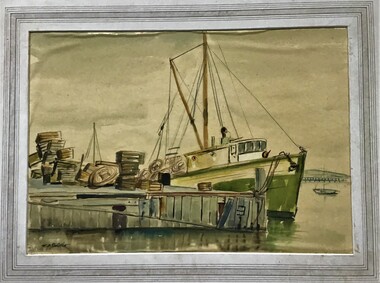 Queenscliffe Maritime Museum
Painting - Framed Watercolour, Fishermen's Pier Queenscliff
... It was not until some thirty years later that the second Steamer Pier was constructed adjacent to the former and periodically extended from the mid to late 1880s to cope with the demand in pleasure bay steamer services. The last of these extensions was to provide a dog-leg construction and the extant shelter shed. 1960 witnessed the demolition of the original Fishermen’s Pier - by this time having been extended in the late nineteenth and early twentieth centuries to the equivalent length of the Steamer Pier - and saw the relocation of its 1926-29 lifeboat house to the Steamer Pier, now Queenscliff Pier. ...It was not until some thirty years later that the second Steamer Pier was constructed adjacent to the former and periodically extended from the mid to late 1880s to cope with the demand in pleasure bay steamer services. The last of these extensions was to provide a dog-leg construction and the extant shelter shed. 1960 witnessed the demolition of the original Fishermen’s Pier - by this time having been extended in the late nineteenth and early twentieth centuries to the equivalent length of the Steamer Pier - and saw the relocation of its 1926-29 lifeboat house to the Steamer Pier, now Queenscliff Pier. ...Queenscliff’s first pier, then known as the Fishermen’s Pier, was completed in 1857. It was not until some thirty years later that the second Steamer Pier was constructed adjacent to the former and periodically extended from the mid to late 1880s to cope with the demand in pleasure bay steamer services. The last of these extensions was to provide a dog-leg construction and the extant shelter shed. 1960 witnessed the demolition of the original Fishermen’s Pier - by this time having been extended in the late nineteenth and early twentieth centuries to the equivalent length of the Steamer Pier - and saw the relocation of its 1926-29 lifeboat house to the Steamer Pier, now Queenscliff Pier. The mid to late 2000s saw Queenscliff Harbour undergo large-scale redevelopment in order to deepen its waters for pleasure craft and increase its berths to over 300. This was met with strong community opposition, largely with concerns for neighbourhood character and perceived cause for gentrification its stakeholders would impart. With early construction estimates of $20 million dollars, this figure had almost doubled upon realisation. (Lovell Chen Architects. ‘Individual Property Citation’, Queenscliffe Heritage Study, 2009.) (Freya Mitchell, ‘Queenscliff residents fight a tide of development sweeping the historic town’ ABC radio, 15 April 2005).Fishermen's Pier Watercolour painting of Fishermen's Pier in Queenscliffwatercolour, fishermen's pier, queenscliff -
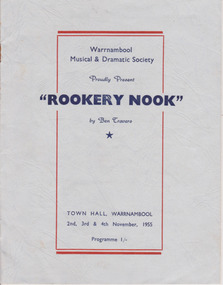 Warrnambool and District Historical Society Inc.
Programme - Rookery Nook, Collett and Bain, 1955
... thirty years. Today the Warrnambool Theatre Company is the successor of the Warrnambool Musical and Dramatic Society. This programme is retained as a memento of a 1950s Warrnambool theatre performance and of the early work of the Haywards who dominated the arts and theatre scene in Warrnambool in the second half of the 20th century. ...This is a programme of the stage production of the Warrnambool Musical and Dramatic Society of "Rookery Nook" in 1955. This is one of the earliest productions associated with Joyce and Cyril Hayward who founded the Warrnambool Musical and Dramatic Society and who were the dominant theatrical couple in Warrnambool for thirty years. Today the Warrnambool Theatre Company is the successor of the Warrnambool Musical and Dramatic Society.This programme is retained as a memento of a 1950s Warrnambool theatre performance and of the early work of the Haywards who dominated the arts and theatre scene in Warrnambool in the second half of the 20th century. This programme has ten pages with a thickened card cover, sixteen advertisements and printed material, some in black and some in blue. The pages have been stapled but the staples have now been removed. Warrnambool Musical & Dramatic Society Proudly Presents "ROOKERY NOOK" by Ben Travers. TOWN HALL, WARRNAMBOOL 2nd, 3rd & 4th November 1955. Programme 1 /-cyril and joyce hayward, warrnambool -
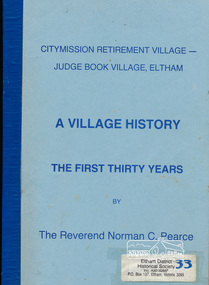 Eltham District Historical Society Inc
Book, Citymission Retirement Village - Judge Book Village, Eltham: A Village History; the first thirty years / The Reverend Norman C. Pearce, 1986
... This history documents the first thirty years through to 1986. Founded by the Melbourne City Mission, the significant early history of the "village for the aged" is documented including the various challenges faced including ongoing expansions and building develoment needs and impacts of flooding from the nearby Diamond Creek. ...This history documents the first thirty years through to 1986. Founded by the Melbourne City Mission, the significant early history of the "village for the aged" is documented including the various challenges faced including ongoing expansions and building develoment needs and impacts of flooding from the nearby Diamond Creek. ...CityMission Retirement Village, also known as Eltham Retirement Centre, also formerly known as Judge Book Memorial Village, was officially opened on Sunday 28 October 1956. This history documents the first thirty years through to 1986. Founded by the Melbourne City Mission, the significant early history of the "village for the aged" is documented including the various challenges faced including ongoing expansions and building develoment needs and impacts of flooding from the nearby Diamond Creek. It mentions some people associated with the organisation with reference to the Eltham Auxillary which was a group of Eltham residents formed to support the organisation and its residents through activity and fundraising efforts.Softcover; 60p.judge book village, retirement village, melbourne citymission, eltham, aged care, seniors, social service, older people, housing -
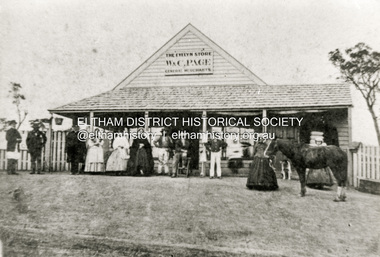 Eltham District Historical Society Inc
Photograph - Copy of photograph, The Evelyn Store, W. & C. Page, General Merchants, Little Eltham, located on northeast corner of Main Road and John Street, c.1865
... It was situated on the eastern side of Maria Street (Main Road) on what was Lot 355 of Josiah Holloway’s Plan of Subdivision of Little Eltham The property is described as having a frontage of one hundred and fifty one feet six inches to Maria-street by a depth of one hundred and thirty two feet with John Street on the south side. That property is now known as 816 Main Road and is occupied by Goodstart Early Learning Eltham. ...It was situated on the eastern side of Maria Street (Main Road) on what was Lot 355 of Josiah Holloway’s Plan of Subdivision of Little Eltham The property is described as having a frontage of one hundred and fifty one feet six inches to Maria-street by a depth of one hundred and thirty two feet with John Street on the south side. That property is now known as 816 Main Road and is occupied by Goodstart Early Learning Eltham. ...W. and C. Page’s Evelyn Store was in the centre of the Eltham township in the 1860s. It was situated on the eastern side of Maria Street (Main Road) on what was Lot 355 of Josiah Holloway’s Plan of Subdivision of Little Eltham The property is described as having a frontage of one hundred and fifty one feet six inches to Maria-street by a depth of one hundred and thirty two feet with John Street on the south side. That property is now known as 816 Main Road and is occupied by Goodstart Early Learning Eltham. William Austin Page and Charlotte Moyses were married in the last quarter of 1840 in Wisbech, Cambridgeshire, England. Records of their arrival in Australia have not been found. The first record of W.A and C. Page, General Merchants is an advertisement placed in The Argus newspaper in February 1854 for The White Flag Store in Wellington Street, Collingwood. William Austin Page is next recorded in the 1856 Electoral Roll for Evelyn as a storekeeper of Little Eltham. The nature of his qualification being a dwelling house in Little Eltham. There is no C. Page recorded so it is likely that this is William’s wife. It is not known when the store was built, possibly at the direction of W. and C. Page but most likely circa 1855-1856. The Page’s previous business in 1854 being The White Flag Store in Wellington Street, Collingwood. On 21 April 1857, W.A. Page along with John Pearson, Richard Warren (owner of the Eltham Hotel), James Kiddle and Thomas Marland petitioned the Licensing Magistrates of the District of Heidelberg, seeking for better police protection for the district. They pointed out that Eltham had two hotels, a local population of about a thousand persons, a great number of them strangers employed on the public roads. The Bourke District police inspector investigated and recommended that the application be approved; and he advised the Chief Commissioner of the availability of a cottage (not very good) and a two-stalled stable with a fenced paddock of four acres, for the sum of ten shillings a week. This was William Jarrold' s cottage, on the west side of Main Road which became Eltham's first police station - with Constable George Reid in charge. In 1858 the newly established Eltham Road District Board implemented a rate charge. For the year ending October 14, 1858, William A. Page of Little Eltham was listed as the owner and occupier of a shop in Little Eltham, assessed 10 shillings based on building rate of 6d per £, the store valued at £20. The same was assessed for 1859 through 1861. The business was advertised for sale with four years remaining on the then present lease in October 1860. Apparently, there was a lack of interest as they attempted to sell the business again in September 1861 with three years remaining on the lease. Again, to no avail. No record of W.A. Page or the store appears in the 1862 rates assessment however in 1863 the store was valued at £25, owned by T. Hunniford and occupied by W.A. Page. Presumably Thomas Hunniford, purchased the property in 1862 and it may have been unoccupied for a period of time or the owner/occupier entries could have been transposed incorrectly in the rates book. In April 1863, William Austin Page, storekeeper of Little Eltham advertised his intention to have Lot 345 (sic) of Josiah Holloway’s Plan of Subdivision brought under the provisions of the Real Property Act. The property is described as having a frontage of one hundred and fifty one feet six inches to Maria-street by a depth of one hundred and thirty two feet with John Street on the south side. The actual lot described is Lot 355 and this is most likely the location of Page’s Evelyn Store. This action suggests the Pages remained owners of the property and this move was to facilitate a future sale. By September 1867 the Pages had been appointed official agents for The Leader newspaper. In January 1868 the business was once again put up for sale, the owners having been in business 12 years and desirous to return to England. Once more it did not sell and was offered again for sale in March and October of that year. Presumably businesses must have been difficult to sell in those times. No further evidence has been located so far of the Pages having sold their business, but an advertisement was placed in December 1870 offering the store and dwelling house for sale, presently occupied by the Pages. The property was finally sold January 28, 1871, by auction for £150. Whether the Pages ever did return to England, at least for a visit also has not been established but death records show William Austin Page died 12 April 1884 and his wife Charlotte died 4 August 1896. Both are buried in St Kilda Cemetery. - Research by Peter Pidgeon, EDHS, June 2026Black and white copy of photographeltham, evelyn store, general merchants, general store, shops, w. & c. page, william austin page, charlotte page (nee moyses), little eltham -
 Bendigo Historical Society Inc.
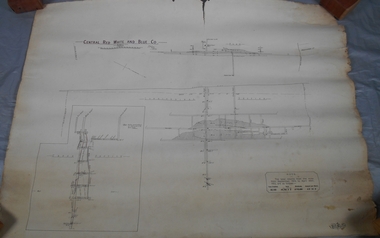
Map - Central Red White and Blue Co, 1913
... thirty thousand at 2 shillings each. The Manager was Mr. William Weeks Barker. Ref: https://gazette.slv.vic.gov.au/view.cgi?year=1891&class=general&page_num=4465&state=v&classnum=g138&id= Extract from Whitelaw Report: Central Red White and Blue Mine, Bendigo. Author: H E Whitelaw Abstract Early...thirty thousand at 2 shillings each. The Manager was Mr. William Weeks Barker. Ref: https://gazette.slv.vic.gov.au/view.cgi?year=1891&class=general&page_num=4465&state=v&classnum=g138&id= Extract from Whitelaw Report: Central Red White and Blue Mine, Bendigo. Author: H E Whitelaw Abstract Early ...The Central Red White and Blue Gold Mine was Bendigo's leading gold mine from 1910 - 1913. During the mine's operation, the main shaft was sunk 670 metres, and retrieved over 2500KG of gold. The Central Red White and Blue Gold Mine was located on the corner of Chum St and Honeysuckle St in Golden Square.. During the mine's operation, the main shaft was sunk 670 metres, and retrieved over 2500KG of gold. The registration of the Company in 1891 (Government Gazette 138, November 6th. 1891, page 4465) lists the value of the Company's property as three hundred and fifty pounds. The number of shares was thirty thousand at 2 shillings each. The Manager was Mr. William Weeks Barker. Ref: https://gazette.slv.vic.gov.au/view.cgi?year=1891&class=general&page_num=4465&state=v&classnum=g138&id= Extract from Whitelaw Report: Central Red White and Blue Mine, Bendigo. Author: H E Whitelaw Abstract Early in 1910, some considerable time after it had become generally known that a rich reef at a depth of 405 ft was being worked southward from the privately owned Lansell's Little 180 shaft and immediately following the plotting of the Geological Survey pitch diagram of the Sheepshead line of reefs, some wide awake local mining men seized the opportunity to secure the holding known as Eadie's which, overlapping Lansell's lease and containing a stretch of the Sheepshead reef channel between the Little 180 north and south shafts, had been declared void some five years previously. That the Lansell Estate did not acquire this property on its becoming available is puzzling in the light of the fact that in Eadie's day the late Mr G W Lansell, on discovering auriferous spurs in the south shaft (now the Central Blue) had offered 2,000 pounds for, and a percentage of gold won from the lease. https://search.informit.org/doi/10.3316/aesis.200105326 Hand drawn plan of Central Red, White and Blue Mine. Cross section and longitudinal plan drawn on plan. Printed name on top of plan: 'Central Red White and Blue Co' Plan printed by Troedel & Cooper Pty Ltd. Surveyor W. H. Cundy, Bendigo April 1913 Plan is part of the Margaret Roberts Collection of mining records.bendigo, margaret roberts, gold, central red white and blue gold mine, map, margaret roberts collection -
 Monbulk RSL Sub Branch
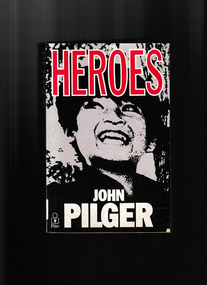
Book, John Pilger, Heroes, 1986
... thirty years, as well as the daily realities of injustices normally hidden from society's view. His reporting of these events has always been distinguished by his tenaciously researched facts - especially facts that governments and powerful interests would prefer to keep secret - and by his unerring and always compassionate pursuit of the truth. Highlights the silence of early ...The bestselling book from one of the finest investigative journalists of our time. The heroes of John Pilger's narrative are the many ordinary people he has witnessed coping with their lives in difficult and often brutal conditions- dissidents in the Soviet Union; victims of conflicts in Vietnam, Cambodia, Africa, India, the Middle East and Central America. They also include the Irish labouring generation of his great-great-grandfather, transported in irons to Australia for uttering 'unlawful oaths'. It is a vivid, engrossing and sometimes blackly amusing personal story covering the periods for which his journalism is renowned. John Pilger has witnessed many of the major world upheavals of the past thirty years, as well as the daily realities of injustices normally hidden from society's view. His reporting of these events has always been distinguished by his tenaciously researched facts - especially facts that governments and powerful interests would prefer to keep secret - and by his unerring and always compassionate pursuit of the truth. Highlights the silence of early historians about violent conflict; discusses contemporary issues; includes interviews with B. Randall and C. Perkins.Ill, index, p.194.non-fictionThe bestselling book from one of the finest investigative journalists of our time. The heroes of John Pilger's narrative are the many ordinary people he has witnessed coping with their lives in difficult and often brutal conditions- dissidents in the Soviet Union; victims of conflicts in Vietnam, Cambodia, Africa, India, the Middle East and Central America. They also include the Irish labouring generation of his great-great-grandfather, transported in irons to Australia for uttering 'unlawful oaths'. It is a vivid, engrossing and sometimes blackly amusing personal story covering the periods for which his journalism is renowned. John Pilger has witnessed many of the major world upheavals of the past thirty years, as well as the daily realities of injustices normally hidden from society's view. His reporting of these events has always been distinguished by his tenaciously researched facts - especially facts that governments and powerful interests would prefer to keep secret - and by his unerring and always compassionate pursuit of the truth. Highlights the silence of early historians about violent conflict; discusses contemporary issues; includes interviews with B. Randall and C. Perkins. journalism - 20th century - history, social conflict - 20th century - history -
Port Melbourne Historical & Preservation Society
Photograph - Raising the Flying Angel flag, Mission Arts Centre, Missions to Seamen buiding, Port Melbourne, Alison Kelly, 1990
... One of thirty photos taken by Alison Kelly at the Mission Arts Centre, late 1980s, early 1990s. ...One of thirty photos taken by Alison Kelly at the Mission Arts Centre, late 1980s, early 1990s. ...One of thirty photos taken by Alison Kelly at the Mission Arts Centre, late 1980s, early 1990s. Some with captions. Many have copies already in collection. Flying Angel flag raising 1990. On roof of Mission building, caretaker Brian Couldrey, Lloyd Finch of Stokes Street, Michael Nicholls (caretaker), Amelia Finch, and Pat Grainger of Station Street toast the raising of a Flying Angel flag hand painted by Alison Kelly.Details in pencil on back. missions to seamen, arts and entertainment, alison kelly, lloyd finch, amelia finch, brian couldrey, michael nicholls, pat grainger, mission arts centre
