
Showing 71 items matching "eastern european"
-
 Sunshine and District Historical Society Incorporated
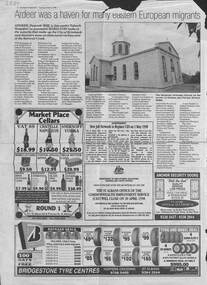
Article - Ardeer was a haven for many eastern European migrants
... Ardeer was a haven for many eastern European migrants...Newspaper article Brimbank Independent 28 April 1998 - 'Ardeer was a haven for many eastern European migrants'...Ardeer Migrant Immigration Newspaper article Brimbank Independent 28 April 1998 - 'Ardeer was a haven for many eastern European migrants' A brief history of the development of Ardeer after WW11 due to immigration Article Ardeer was a haven for many eastern European migrants ...Newspaper article Brimbank Independent 28 April 1998 - 'Ardeer was a haven for many eastern European migrants'ardeer, migrant, immigration -
 Bendigo Military Museum
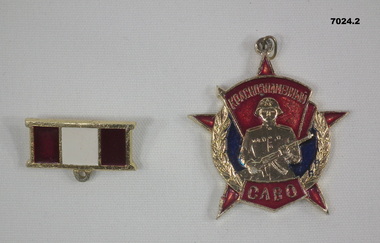
Medal - MEDALS, EASTERN EUROPEAN, unknown
... MEDALS, EASTERN EUROPEAN...Medal MEDALS, EASTERN EUROPEAN ...See Cat 7003.2 - Greenwood.1. This is a lightweight medal. It is based on a gold wreath. It has a red wedge at top and in centre is a cold war era East European soldier with AK47. He is wearing cold war vintage helmet. Cyrillic word above the soldier and with the letters "CABO" in a rectangle at bottom. It has 5 pointed star tips protruding, the top one has a holding ring. 2. A rectangular piece, it has gold borders with the inside divided into three sections. They have two red and one enamel fill ins It has a mounting clip on the rear and a mounting ring on the top border.east europe, badges, greenwood -
 Embroiderers Guild, Victoria
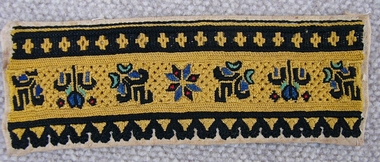
Textile - Eastern European Embroidered Cuff
... Eastern European Embroidered Cuff...Worked on a natural linen or cotton fabric Textile Eastern European Embroidered Cuff ...From the collection of the late Dr. Georgina Sweet, who was the first woman veterinarian in Victoria and who travelled extensively in Middle Europe in the Early 20th century.Probably a cuff band. Silk embroidery thread in black and gold with touches of blue, red and turquoise. Needlewoven one edge in black and gold. Centre start, flower and other motif in stitched ground, other edge black and gold triangle patterns. Worked on a natural linen or cotton fabricembroidery, needle weaving, surface embroidery, czechoslovakia, hungary, garment -
 Embroiderers Guild, Victoria
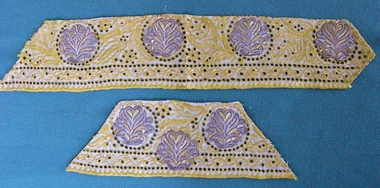
Headwear - Eastern European Embroidered Cap Pieces
... Eastern European Embroidered Cap Pieces...Large circular motifs worked over a card template in silver and gold threads. Headwear Eastern European Embroidered Cap Pieces ...Possibly from Slovakia or Hungary. Womans cap (part) (2 strips). Fine cotton with gold with embroidery of satin stitch and eyelets in a floral design. Large circular motifs worked over a card template in silver and gold threads.embroidery, fragments, metal thread, surface stitchery, hungary -
 Embroiderers Guild, Victoria
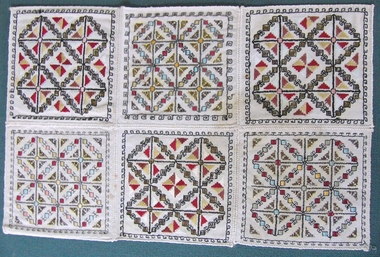
Textile - Eastern European Embroidered Mat, Baroness Viola, Late 19th century
... Eastern European Embroidered Mat...Designs are in satin stitch in cotton and metal threads (gold). Textile Eastern European Embroidered Mat Baroness Viola ...Belonged to Baroness Felicitas Wiedersperger of Tazivitz, worked by her sister the Baroness Viola.6 squares of white cotton joined to make a larger mat. 3 squares in one design and 3 in another. All 6 squares are outlined in a black border. Designs are in satin stitch in cotton and metal threads (gold).czechoslovakia, embroidery, mats, counted thread, late 19th century, mid european -
 Emerald Museum & Nobelius Heritage Park
Souvenir - Souvenir doll - Eastern Europe, Unknown maker, 1900s - 1950s
... Souvenir doll - Eastern Europe......Eastern European...Doll dressed in traditional peasant costume, probably derived from an Eastern European country. White plaits tucked under red bonnet. ...Souvenir Souvenir doll - Eastern Europe Unknown maker ...This doll is part of a collection of dolls dressed in a form of national dress and sold as souvenirs of those countries. It is believed they belonged to a former teacher of Emerald Primary School who taught there in the 1950s. This doll is older than the others in the collection which seem to date around mid-20th century. People might collect souvenir dolls on their overseas travels as a reminder of the interesting and 'exotic' places they have been to.Doll dressed in traditional peasant costume, probably derived from an Eastern European country. White plaits tucked under red bonnet. Long-sleeved calico blouse. Blue and white striped apron over green tunic. White sox and red shoes. Doll is made with material stretched over possibly wooden frame. Legs jointed at the hips. Painted blue eyes, brown eyebrows and red 'rosebud' lips. Early to mid-20th century.None discernibledolls, souvenir, national costume, eastern european, peasant, joyce wescombe, emerald primary school -
Emerald Museum & Nobelius Heritage Park
Souvenir - Souvenir dolls - Eastern Europe, Unknown maker, mid-20th century
... Souvenir dolls - Eastern Europe......Eastern European...Souvenir Souvenir dolls - Eastern Europe Unknown maker ...These dolls are a part of a collection sold as souvenirs of those countries. It is believed they belonged to a former teacher of Emerald Primary School who taught there in the 1950s. These dolls seem to date from the mid-20th century. People might collect souvenir dolls on their overseas travels as a reminder of the interesting and 'exotic' places they have been to.6 small dolls dressed in traditional costumes from European countries, estimated from the mid-20th century.dolls, souvenir, national costume, italy, france, joyce wescombe, emerald primary school, eastern european, czechoslovakia -
National Wool Museum
Book, Wool in the eastern Europe area, 1980
... Wool in the eastern Europe area, 1980..."Wool in the eastern Europe area, 1980." Simon Newland, International Wool Secretariat...."Wool in the eastern Europe area, 1980." Simon Newland, International Wool Secretariat. ..."Wool in the eastern Europe area, 1980." Simon Newland, International Wool Secretariat.wool growing sheep - european yarn production textile production trade - international, international wool secretariat, carpet, cloth - woollen, wool growing, sheep - european, yarn production, textile production, trade - international -
National Wool Museum
Book, Report on objective measurement: technical mission to Eastern Europe
... Report on objective measurement: technical mission to Eastern Europe..."Report on objective measurement: technical mission to Eastern Europe"- Australian Wool Corporation Research and Development Department, 1975...."Report on objective measurement: technical mission to Eastern Europe"- Australian Wool Corporation Research and Development Department, 1975. ..."Report on objective measurement: technical mission to Eastern Europe"- Australian Wool Corporation Research and Development Department, 1975.textile industry wool - measurement wool marketing wool sales trade - international export - wool woolclassing - objective measurement, carding, scouring, combing, spinning, wool clip preparation, textile industry, wool - measurement, wool marketing, wool sales, trade - international, export - wool, woolclassing - objective measurement -
 Mission to Seafarers Victoria
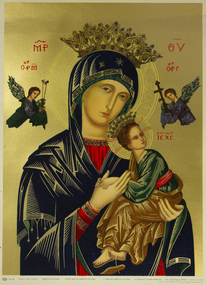
Print - Reproduction of a painting, Perpetual Succour
... Probably a gift from an Eastern European crew member visiting the Mission TBC....Probably a gift from an Eastern European crew member visiting the Mission TBC. orthodox church nativity mary jesus crown angel artwork-paintings printed inscription lower edge of image Print of Eastern Orthodox style painting of Madonna and child on gold ground Perpetual Succour Print Reproduction of a painting ...Discovered in the Chapel of St Peter when packing up for renovations. Probably a gift from an Eastern European crew member visiting the Mission TBC.Print of Eastern Orthodox style painting of Madonna and child on gold ground printed inscription lower edge of imageorthodox church, nativity, mary, jesus, crown, angel, artwork-paintings -
 Bendigo Military Museum
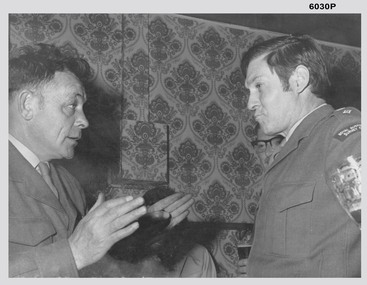
Photograph - AHQ Survey Regiment - LTCOL DR Ridge and SSGT G Haswell Circa 1972-1975, 1975
... WO2 Szentirmay (in the background) was a Lithographic Technical Warrant Officer. 4233 LTCOL DR Ridge was commissioned from the ranks and served from 1946 - 1975, he was Commanding Officer of the Army Survey Regiment from 1972-1975. 310207 SSGT G Haswell served 1950- 1978 after a British Army career, 14613 WO2 T Szentirmay BEM served 1958-1980 after an Eastern European Army career....WO2 Szentirmay (in the background) was a Lithographic Technical Warrant Officer. 4233 LTCOL DR Ridge was commissioned from the ranks and served from 1946 - 1975, he was Commanding Officer of the Army Survey Regiment from 1972-1975. 310207 SSGT G Haswell served 1950- 1978 after a British Army career, 14613 WO2 T Szentirmay BEM served 1958-1980 after an Eastern European Army career. Royal Australian Survey Corps RASvy Fortuna Army Survey Regiment Army Svy Regt ASR Black and White photograph of LTCOL DR Ridge and SSGT G Haswell Circa 1972-1975 taken at the Sergeants Mess at Fortuna Villa, Bendigo Photograph AHQ Survey Regiment - LTCOL DR Ridge and SSGT G Haswell Circa 1972-1975 Army Survey Regiment ...Photograph taken in the Sergeants Mess, Fortuna Villa circa 1972-1975 whilst LTCOL DR Ridge was the Commanding Officer of the Army Survey Regiment and SSGT G Haswell was a stores NCO. WO2 Szentirmay (in the background) was a Lithographic Technical Warrant Officer. 4233 LTCOL DR Ridge was commissioned from the ranks and served from 1946 - 1975, he was Commanding Officer of the Army Survey Regiment from 1972-1975. 310207 SSGT G Haswell served 1950- 1978 after a British Army career, 14613 WO2 T Szentirmay BEM served 1958-1980 after an Eastern European Army career.Black and White photograph of LTCOL DR Ridge and SSGT G Haswell Circa 1972-1975 taken at the Sergeants Mess at Fortuna Villa, Bendigoroyal australian survey corps, rasvy, fortuna, army survey regiment, army svy regt, asr -
Australian Multicultural Community Services
Annual Report, Australian - Polish Community Services first Annual Report 1983-1984, 1984
... Currently the agency manages eight aged care programs (funded by the federal and state governments) that support over 500 clients a week, with a particular focus on elders from Eastern European backgrounds. Additionally, organisation's activities include emergency relief, English and computer classes, aged care courses and several sustainability projects per year....Currently the agency manages eight aged care programs (funded by the federal and state governments) that support over 500 clients a week, with a particular focus on elders from Eastern European backgrounds. Additionally, organisation's activities include emergency relief, English and computer classes, aged care courses and several sustainability projects per year. first Annual Report in history of Australian - Polish Community Services which highlights initiatives and achievements undertaken during the first year of existence annual report 1983 Polish community signature of Treasurer J.B. ...Australian - Polish Community Services was established as an independent organisation at the inaugural meeting on the 10th May 1983. There were four full-time workers who used office at 1 French Street, Footscray by the courtesy of MRC Footscray. The office acted as a first point of contact for all persons of the Polish community who needed welfare services or assistance of any kind. Currently the agency manages eight aged care programs (funded by the federal and state governments) that support over 500 clients a week, with a particular focus on elders from Eastern European backgrounds. Additionally, organisation's activities include emergency relief, English and computer classes, aged care courses and several sustainability projects per year.first Annual Report in history of Australian - Polish Community Services which highlights initiatives and achievements undertaken during the first year of existencecolour: cream, 10 pages including cover page, one-sided printingsignature of Treasurer J.B. Talaskaannual report, 1983, polish community -
 The Beechworth Burke Museum
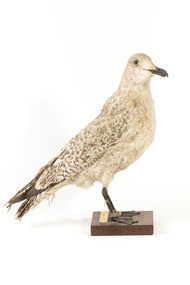
Animal specimen - European Herring Gull, Trustees of the Australian Museum, 1860-1880
... This particular species can be found in Northern Europe, Western Europe, Central Europe, Eastern Europe, Scandinavia and the Baltic States. ...This particular species can be found in Northern Europe, Western Europe, Central Europe, Eastern Europe, Scandinavia and the Baltic States. ...This gull specimen is a young Herring Gull (Larus argentatus). It is a large gull and one of the most well known of the gulls. This particular species can be found in Northern Europe, Western Europe, Central Europe, Eastern Europe, Scandinavia and the Baltic States. Juvenile and first-winter Herring Gulls are a brown colour with some darker streaks with a bark bill and dark eyes. These colours identifies this particular specimen as a juvenile bird. These birds are commonly seen near the seaside and are omnivores who scavenge from garbage dumps, landfill sites and sewage outflows. This specimen is part of a collection of almost 200 animal specimens that were originally acquired as skins from various institutions across Australia, including the Australian Museum and the National Museum of Victoria, as well as individuals such amateur anthropologist Reynell Eveleigh Johns between 1860-1880. These skins were then mounted by members of the Burke Museum Committee and put-on display in the formal space of the Museum’s original exhibition hall where they continue to be on display. This display of taxidermy mounts initially served to instruct visitors to the Burke Museum of the natural world around them, today it serves as an insight into the collecting habits of the 19th century. This specimen is part of a significant and rare taxidermy mount collection in the Burke Museum. This collection is scientifically and culturally important for reminding us of how science continues to shape our understanding of the modern world. They demonstrate a capacity to hold evidence of how Australia’s fauna history existed in the past and are potentially important for future environmental research. This collection continues to be on display in the Museum and has become a key part to interpreting the collecting habits of the 19th century.This specimen is a juvenile Herring Gull with pale cream and brown coloured plumage. It has a dark bill and dark legs with webbed toes. The eyes are small and are made of glass. They are a pale brown and black colour. The feathers on on the lower back and tail are a darker brown colour compared to the pale plumage on the rest of the bird.Paper Tag: "2yd variega[ted]... Catelogu[e]..." Paper Tag: "Larus argentatus" Metal Tag: "1511"taxidermy mount, taxidermy, animalia, burke museum, beechworth, australian museum, skin, reynell eveleigh johns, bird, gull, pacific gull -
 Australian Gliding Museum
Machine - Glider – Sailplane, 2015
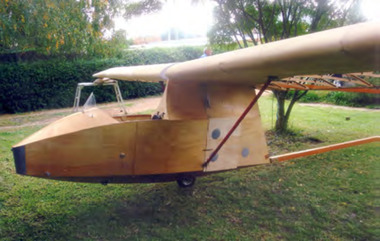
... This glider, designated “W.W.S.1”, was produced in substantial numbers prior to the second world war and used in Poland and some other eastern European countries for training pilots. ...This glider, designated “W.W.S.1”, was produced in substantial numbers prior to the second world war and used in Poland and some other eastern European countries for training pilots. Only one example survived the war, hidden away in the village of Goleszow in Silesia. ...The Salamandra is a Polish glider designed by Waclaw Czerwinski at the Military Glider Workshops in Krakow in 1936. This glider, designated “W.W.S.1”, was produced in substantial numbers prior to the second world war and used in Poland and some other eastern European countries for training pilots. Only one example survived the war, hidden away in the village of Goleszow in Silesia. In addition, no technical drawings could be found, so when the glider was discovered, the Gliding Institute being keen to re-establish gliding in Poland, used the glider to draw up new plans for construction. Five were built for the Institute in 1947 before production was resumed of the “Salamandra 48” at the SZD Jezow Workshops. Improvement were made by adding airbrakes and structural changes for the “Salamandra 49” and a windscreen and larger tailplane were changes adopted for the “Salamandra 53”. An export version designated “53A” was sold to and built under licence in China. Production of the Salamandra ceased in the early 1960s. Total production may have been in excess of 500. The glider was well regarded as a light weight trainer capable of soaring performance. The Museum’s replica was built by Ray Ash and may be may be classified as a “Salamandra 53”. However, he has added something of his own to the design by replacing the cable runs in the wings with control rods. The glider is substantially complete. The wings and tail / rudder surfaces have been covered with poly-fibre fabric. The fuselage woodwork is sealed with varnish. In addition to the finishing work (including painting) and rigging of the main components, the linkages for Ray’s control rod modification may need further engineering to make them operational. The Ray Ash Salamandra is the first of the type to appear in Australia. The Salamandra did not play any role in the development of gliding in Australia in the early years. However, it is an important exhibit in that it shows in tangible form a nacelle fuselage training glider in configuration and construction detail. As such it revisits the pioneering era of the 1930s and 1940s in Australia when wood, wire and fabric were the rule and the nacelle primary glider was generally the first step up for pilots who had mastered the basics in an open primary.Nacelled solo training glider of traditional wood and fabric construction. Construction incomplete.Noneaustralian gliding, sailplane, glider, salamandra, czerwinshi, poland, ash -
 Duldig Studio museum + sculpture garden
Fabric, Mathilda Flogl, Falter designed by Mathilda Flogl 1924-31, 1924-31
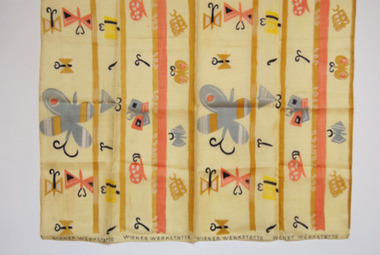
... The designs were characterised by simplified forms and vivid colours, and inspired by Eastern European peasant art and geometric motifs in contemporary painting. ...The designs were characterised by simplified forms and vivid colours, and inspired by Eastern European peasant art and geometric motifs in contemporary painting. ...This piece of fabric, known Fälter (butterfly), was designed by Mathilda Flögl (1893-1958), who worked in the textile department of the Wiener Werkstätte in Vienna. It is a remnant of the fabric that was used to make a bedspread for Karl and Slawa’s bed in their Vienna apartment where it lay decoratively over a gold brocade eiderdown. The purchase demonstrated Slawa’s interest in and knowledge of modern design and her commitment to the idea of enriching everyday life with beautiful objects, a principal of the Viennese Secession. Following the Duldigs removal from Vienna, the original bedspread and remnant were safeguarded and preserved by Slawa’s sister, Rella, in the basement of her Paris apartment. In 1948 the bedspread and this remnant were sent to Australia. The bedspread was a much-loved item but deteriorated over the years. In 1955 it was made into curtains, which are held in the Duldig Studio Collection. The Photographs of the bedspread in its original location are also held in the collection. The remnant is in pristine condition. The Wiener Werkstätte (Vienna Workshop) was a guild of designers and craftsmen that was founded by the architect Josef Hoffman (1879-1956) and the designer Koloman Moser (1868-1918). The firm manufactured a range of interior furnishings between 1903 and 1932. The textile department opened in 1900, and produced about 1,800 designs, mainly for printed fabrics for furnishings and apparel. The designs were characterised by simplified forms and vivid colours, and inspired by Eastern European peasant art and geometric motifs in contemporary painting. The workshop had a profound impact of European art and design, and its work is still celebrated today. Mathilde Flögl was born in the Czech Republic in 1893, and studied at the Kunstgerwerbeschule in Vienna. In 1916 she began working at the Weiner Werkstätte, and where she designed more than 120 textile patterns. This fabric Fälter or Butterfly was designed in 1924. The butterfly was a favourite motif of Flögl. In this design she plays with a variety of whimsical abstractions and arrangement of both the butterfly and the snail on a background of abstract colour stripes and blocks. Ann Carew 2016The fabric is of great aesthetic interest as an example of the work of the Viennese workshops, and the noted designer textile designer Mathilde Flögl. The original pencil drawings, pencil and gouache designs, and fabric swatches for Fälter are held in the MAK Museum in Vienna, and the Victorian and Albert Museum in London have a sample of piece of the silk fabric in an alternate colour wave. The Museum of Applied Arts in Sydney holds a swatch book of textiles from the Wiener Werkstätte, however Flögl’s work is not represented. The National Gallery of Victoria holds a similar swatch book. The remnant has an excellent provenance, is associated with a powerful personal narrative, and is significant and rare item relating to history of the Wiener Werkstätte in Vienna, and the oeuvre of Matilda Flögl. Ann Carew 2016Remnant of a block-printed silk fabric used to make the bedspread for Karl Duldig and Slawa Horowitz-Duldig's bed in Vienna. -
 Flagstaff Hill Maritime Museum and Village
Article - Reward Poster - Portuguese Caravel, 1992
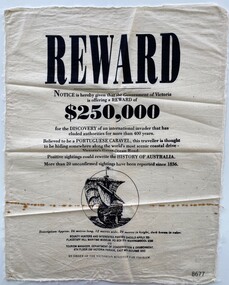
... For over a century this mystery has fascinated Australians because the existence of such a vessel could throw light on the earliest phase of exploration of Eastern Australia by Europeans. The interest in the mystery was high enough for the Victorian Government to offer a reward in 1992 which was subsequently withdrawn a year later with no monies being paid....For over a century this mystery has fascinated Australians because the existence of such a vessel could throw light on the earliest phase of exploration of Eastern Australia by Europeans. The interest in the mystery was high enough for the Victorian Government to offer a reward in 1992 which was subsequently withdrawn a year later with no monies being paid. ...The mystery of the Portuguese Caravel, commonly known as the ‘Mahogany Ship’ is today regarded as legend and refers to an ancient wreck that is said to lie beneath the sand between Warrnambool and Port Fairy. Its location is currently unknown, but many people have searched for it through the years since the first reported sighting of an unidentified wreck in 1836. For over a century this mystery has fascinated Australians because the existence of such a vessel could throw light on the earliest phase of exploration of Eastern Australia by Europeans. The interest in the mystery was high enough for the Victorian Government to offer a reward in 1992 which was subsequently withdrawn a year later with no monies being paid.This item is historically significant because of its relationship to an ongoing mystery (the Mahogany Ship) that may throw light on the early exploration of Australia. The offering of a reward, 150+years after the first recorded sighting, by the Victorian Government points to the ongoing fascination with this subject to the Victorian people.A reward poster printed on calico. Even though the poster was created in 1992 it follows the regular structure of a reward poster from earlier times; the word REWARD in large print at the top, the amount $250,000 in bold type and an imagined drawing of the missing Portuguese Caravel.Printed text: REWARD Notice is hereby given that the Government of Victoria is offering a REWARD of $250,000 for the DISCOVERY of an international invader that has eluded authorities for more than 400 years. Believed to be a PORTUGUESE CARAVEL, this traveller is thought to be hiding somewhere along the world's most scenic coastal drive- Victoria's Great Ocean Road. Positive sightings could rewrite the HISTORY OF AUSTRALIA. More than 20 unconfirmed sightings have been reported since 1836. Description: Approx. 26 metres long, 12 metres wide, 20 metres in height, dark brown in colour. BOUNTY HUNTERS AND INTERESTED PARTIES SHOULD APPLY TO: FLAGSTAFF HILL MARITIME MUSEUM, PO BOX 574 WARRNAMBOOL 3280 OR TOURISM MANAGER, DEPARTMENT OF CONSERVATION & ENVIRONMENT, 8TH FLOOR 250 VICTORIA PARADE, EAST MELBOURNE 3002 BY ORDER OF THE VICTORIAN MINISTER FOR TOURISM. Printed image: back view of a Caravel in full sail flagstaff hill maritime museum and village, great ocean road, shipwreck coast, warrnambool, port fairy, portuguese caravel, mahogany ship, reward poster, victorian government -
 Sunshine and District Historical Society Incorporated
Archive - Churches
... Albans The Martyr 15 March 1970|Newspaper Article The Advocate 9 November 1999 Ministry transcends politics and price Apostolic Christian Church Nazarene|Newspaper Article The Advocate 18 January 2001 Mosque marvel|Newspaper Article Sunshine Advocate 8 July 1992 Christ the King - Parish remembers day fire destroyed a dream|Typed report Stained glass window at Sunshine Uniting Church|Newspaper Article The Advocate 21 November 2000 Worship to continue Melkite Church|Newspaper Article Star 8 October 2019 Church chalks up 100 The Slovak Baptist and GraceWest Bible Church in Albion|Newspaper Article The Advocate 16 November 1999 Baptists go with the flow|Newspaper Article The Advocate 17 February 2004 Engaging all Buddhists|Newspaper Article The Advocate 17 February 2004 Week of Festivity to Mark St Pauls 50th|Newspaper Article The Advocate 23 November1999 Youth niche for outreach Keilor Christian City Church|Newspaper Article The Advocate 10th August 1977 Our Lady's Reunion|Our Lady's Catholic Church|Flyer Sunshine Presbyterian Church 90 years of Ministry Rewards and Crowns|Typed Notes of talk given by Ron Crosbie History of Churches in Sunshine|Typed Notes of talk given by Faye Meehon History of Our Lady's Catholic Church on 12 October 1995|Typed Notes about Sunshine Presbyterian Centenary|Copy of two photos of Sunshine Presbyterian Church Old wood church & New brick church|Newspaper Article The Advocate 19th October 1999 Page 23 Church looks at future option Church of Christ|Newspaper Article Brimbank Independent Ardeer was a haven for many eastern European migrants...Albans The Martyr 15 March 1970|Newspaper Article The Advocate 9 November 1999 Ministry transcends politics and price Apostolic Christian Church Nazarene|Newspaper Article The Advocate 18 January 2001 Mosque marvel|Newspaper Article Sunshine Advocate 8 July 1992 Christ the King - Parish remembers day fire destroyed a dream|Typed report Stained glass window at Sunshine Uniting Church|Newspaper Article The Advocate 21 November 2000 Worship to continue Melkite Church|Newspaper Article Star 8 October 2019 Church chalks up 100 The Slovak Baptist and GraceWest Bible Church in Albion|Newspaper Article The Advocate 16 November 1999 Baptists go with the flow|Newspaper Article The Advocate 17 February 2004 Engaging all Buddhists|Newspaper Article The Advocate 17 February 2004 Week of Festivity to Mark St Pauls 50th|Newspaper Article The Advocate 23 November1999 Youth niche for outreach Keilor Christian City Church|Newspaper Article The Advocate 10th August 1977 Our Lady's Reunion|Our Lady's Catholic Church|Flyer Sunshine Presbyterian Church 90 years of Ministry Rewards and Crowns|Typed Notes of talk given by Ron Crosbie History of Churches in Sunshine|Typed Notes of talk given by Faye Meehon History of Our Lady's Catholic Church on 12 October 1995|Typed Notes about Sunshine Presbyterian Centenary|Copy of two photos of Sunshine Presbyterian Church Old wood church & New brick church|Newspaper Article The Advocate 19th October 1999 Page 23 Church looks at future option Church of Christ|Newspaper Article Brimbank Independent Ardeer was a haven for many eastern European migrants Collection of documents relating to churches in the district Archive Churches ...Letter 28 October 2003 St Marks Church Building is to be closed|Booklet The Rite for the dedication of the Parish Church of St. Albans The Martyr 15 March 1970|Newspaper Article The Advocate 9 November 1999 Ministry transcends politics and price Apostolic Christian Church Nazarene|Newspaper Article The Advocate 18 January 2001 Mosque marvel|Newspaper Article Sunshine Advocate 8 July 1992 Christ the King - Parish remembers day fire destroyed a dream|Typed report Stained glass window at Sunshine Uniting Church|Newspaper Article The Advocate 21 November 2000 Worship to continue Melkite Church|Newspaper Article Star 8 October 2019 Church chalks up 100 The Slovak Baptist and GraceWest Bible Church in Albion|Newspaper Article The Advocate 16 November 1999 Baptists go with the flow|Newspaper Article The Advocate 17 February 2004 Engaging all Buddhists|Newspaper Article The Advocate 17 February 2004 Week of Festivity to Mark St Pauls 50th|Newspaper Article The Advocate 23 November1999 Youth niche for outreach Keilor Christian City Church|Newspaper Article The Advocate 10th August 1977 Our Lady's Reunion|Our Lady's Catholic Church|Flyer Sunshine Presbyterian Church 90 years of Ministry Rewards and Crowns|Typed Notes of talk given by Ron Crosbie History of Churches in Sunshine|Typed Notes of talk given by Faye Meehon History of Our Lady's Catholic Church on 12 October 1995|Typed Notes about Sunshine Presbyterian Centenary|Copy of two photos of Sunshine Presbyterian Church Old wood church & New brick church|Newspaper Article The Advocate 19th October 1999 Page 23 Church looks at future option Church of Christ|Newspaper Article Brimbank Independent Ardeer was a haven for many eastern European migrantschurch -
 The Beechworth Burke Museum
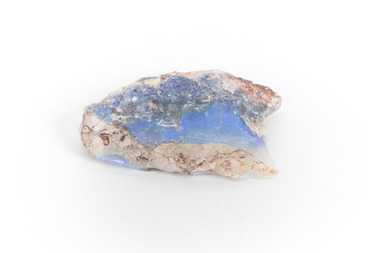
Geological specimen - Precious Opal
... As early as 250 BC the Romans prized opals, thought to have come from mines in Eastern Europe, the ancient world's main source of opals. ...As early as 250 BC the Romans prized opals, thought to have come from mines in Eastern Europe, the ancient world's main source of opals. ...In Australia, precious opal is found in Cretaceous age sandstones and mudstones. These sedimentary rocks were deeply weathered and this weathering released silica into the groundwater.Australia is the only part of the world where opalised animal and plant fossils have been found. Opal artefacts several thousands of years old have been discovered in East Africa. As early as 250 BC the Romans prized opals, thought to have come from mines in Eastern Europe, the ancient world's main source of opals. There are many aboriginal dreamtime stories that feature opal. Australian opals discovered during the late 1800's found little favour with European markets but their commercial value increased in the 1900's and in 1932 Australia took over as the major producer of opals in the world and remains the largest producer to this day. Opal is found around the world (Brazil, Mexico, Honduras and the western US) however Australia produces 95% of the world's precious opal and it is our official national gemstone. Opal was first mined commercially at Listowel Downs in Queensland in 1875 and later at White Cliffs in NSW. Today, Coober Pedy (SA) is the main producer of white opal, though in recent years this field has expanded and all types of opals are found. Other centres in SA include Andamooka and Mintabe. Lightning Ridge (NSW) is renowned for black opal and formerly White Cliffs was a large producer of high quality opal. Boulder opals (opals in concretionary ironstone) are mined in Queensland from numerous localities in a zone extending from the Eulo and Cunnamulla district in the south and northwest for a distance of over 700 km to Kynuna in the north. The towns of Quilpie, Yowah and Winton are the main opal mining and wholesale centres. Opals are considered gemstones and have been used in jewellery for thousands of years.Throughout much of history, opals were actually believed to be good luck. The Romans thought that opals were one of the luckiest gemstones and a symbol of hope. In the Middle Ages, opals were believed to be bestowed with all the positive properties of coloured gemstones due to its rainbow-like play of colour. Finally, there is a superstition that you should not wear an opal unless it is your birthstone otherwise misfortune will befall you. This, of course, is far-fetched, but the notion could have been promoted in the late 19th and early 20th Centuries by diamond traders who were trying to increase sales of diamonds and deter people from buying opals. Possibly related to this is the thought that you should set opal jewellery with diamonds as their powers of good fortune will override any negativity held by the opal. The great majority of opal does not show play of colour and is called common opal or potch however this is not the case with a precious opal. Opal is a precious gemstone, like rubies, emeralds or diamonds. Opal is rare, and it is expensive to prospect and mine for.Silica is one of the most common minerals on the planet, but precious opal is very rare – far more rare than diamonds. Precious opal is rare because the natural processes that create it rarely occur.Most (at least 95%) of the opal found by miners is common opal without gem colour. In Australia we call it potch. It can be white, grey, black or amber coloured. Even when a miner finds gem-coloured opal, most of it can’t be cut into gemstones because it’s too thin, or sandy. This specimen is part of a larger collection of geological and mineral specimens collected from around Australia (and some parts of the world) and donated to the Burke Museum between 1868-1880. A large percentage of these specimens were collected in Victoria as part of the Geological Survey of Victoria that begun in 1852 (in response to the Gold Rush) to study and map the geology of Victoria. Collecting geological specimens was an important part of mapping and understanding the scientific makeup of the earth. Many of these specimens were sent to research and collecting organisations across Australia, including the Burke Museum, to educate and encourage further study.It is not known where this opal originated, except that it is probably from Victoria, as it has been recorded from many localities in the State. Common Opal is formed from silica-rich water circulating through rocks near the Earth’s surface. It consists of minute spheres of silica arranged in different ways. In common opal, the spheres are of different sizes and randomly arranged, unlike in precious opal where the spheres are of similar size and uniformly arranged in three dimensions. These differences account for common opal generally being translucent to opaque and without the play of colours, or opalescence, displayed by precious opal. Common opal is found in many localities and different geological environments throughout Australia and the world. Precious opal requires special conditions to form and is much less common. Australia produces most to the world’s precious opal. burke museum, beechworth, indigo shire, beechworth museum, geological, geological specimen, precious opal, opal, brazil, mexico, honduras, queensland, coober pedy, gemstones, jewellery, play-of-colour, light blue -
 Flagstaff Hill Maritime Museum and Village
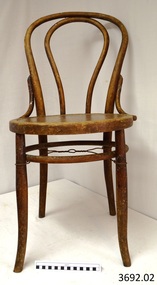
Furniture - Chair, early 29th century
... In the next years, five more Eastern European production sites were established in Bystritz (1862), Nagy-Ugrócz (1866), Wsetin (1867), Hallenkau(1867) and Nowo-Radomsk(1880). ...In the next years, five more Eastern European production sites were established in Bystritz (1862), Nagy-Ugrócz (1866), Wsetin (1867), Hallenkau(1867) and Nowo-Radomsk(1880). ...The Bentwood chair has been called ‘the world’s most popular chair’. The original Bentwood chair, was designed by German-Austrian cabinet maker and Master Joiner, Michael Thonet (b.1796 - d.1871) and introduced to the market in 1859. Thonet started his business in his home town of Boppard as an independent cabinet maker in 1819. In the 1830’s he began trying to make furniture from glued (laminated) and bent wooden slats. Over the next few years his attempts to patent this process failed in Germany, Great Britain, France, and Russia. He then began using lightweight, strong wood and bending it into elegant, comfortable furniture. The Bentwood technology took Thonet years to perfect. In simple terms, the wooden rods or lengths were wet by soaking or steaming, bent into shape and then held in place until they hardened into the moulded curved shape or pattern. The wood usually chosen for the bentwood chairs was maple or beech. Thonet had revolutionised an older process by industrialising the process. The dowels of wood were cut and prepared as components of furniture, treated by the ‘bentwood’ process, then ready immediately for assembling with very little extra workmanship needed. Thonet held 2 patents for this process, the second one ended on 10th July 1869 and was non-renewable. At the Trade Fair at Koblenz of 1841 Prince Klemens Wenzel von Mettemich was very impressed with Thonet’s furniture, especially the chairs. In 1842 Thonet sold his Boppard business and emigrated to Vienna, and began working, along with his sons, on the interior decoration of the Palais Leichtenstein, for the Carl Leistler establishment. In 1849 he began his own business again, the Gebruder Thonet to include his sons (translated “Brothers Thonet”). He produced the “No. 1” Bentwood chair. He received a bronze medal for his Vienna bentwood chairs at the World Fair in London in 1851, and a silver medal in Paris in 1855. In 1856 he opened a new factory in Koritchan (Moravia), where there were extensive woods of beech trees available for his enterprise. In the next years, five more Eastern European production sites were established in Bystritz (1862), Nagy-Ugrócz (1866), Wsetin (1867), Hallenkau(1867) and Nowo-Radomsk(1880). Thonet’s 1859 No. 14 “chair of chairs” (or “Konsumstuhl Nr. 14” – coffee shop chair no. 14) was the most famous of all of Thonet’s Bentwood chairs. In 1867 he received a gold medal at the Paris World Fair. This new style of furniture making became very popular. Up until 1830 50 million of these chairs had been produced. By the 1870’s Thonet owned offices in almost 20 countries, with sales locations across Europe, in Chicago and New York. In 1889 he set Thonet set up a head office in Frankenberg, Hesse. Bentwood models designed in the mid to late 19th century featured hand-caned or laminated wood seats and were usually stamped with the country of origin. The Bentwood elements were the backrest, seat rim and legs. Typically the seat was covered with ‘bucket’ leather. After the Patent ran out in 1869, companies such as Jacob & Josef Kohn began the production of bentwood furniture.The popularity of the Bentwood chair that was introduced by Michael Thonet in the 1850s is due to its versatility and timeless quality. Its style, whether varnished or painted, suits any room in the house. The lightweight chairs are also popular for café and restaurant seating, as well as for public gatherings. They can be easily moved around and grouped in a variety of ways to suit any occasion.Chair, bentwood, pair of two. Backrest has full length inverted U inside frame. Support rail and wire reinforcing between legs. 3692.01 seat has floral pattern pressed into wood 3692.02 seat is plain (replacement seat). Made by Harnison & Co.3692.01 chair's marks; Label ""HARNISON & CO./ NEUSOL / BUDAPEST" and "WIENER NOBEL" and "(symbol) N inside circle, under Crown" flagstaff hill, warrnambool, shipwrecked coast, flagstaff hill maritime museum, maritime museum, shipwreck coast, flagstaff hill maritime village, great ocean road, domestic furniture, dining furniture, bentwood chair, harnison & co., neusol, budapest, wiener nobel -
 Sunshine and District Historical Society Incorporated
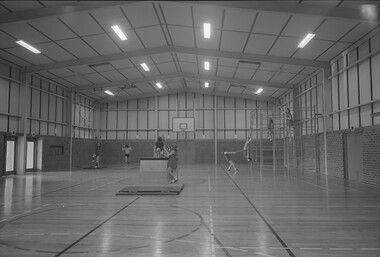
Photograph - Maribyrnong High School Gymnasium Photographs
... During the post war and migration era’s (1950s–1970s), the school became increasingly multicultural due to the nearby Maribyrnong Migrant Hostel (opened 1949) with many European, Middle Eastern, and later Asian migrant students. ...During the post war and migration era’s (1950s–1970s), the school became increasingly multicultural due to the nearby Maribyrnong Migrant Hostel (opened 1949) with many European, Middle Eastern, and later Asian migrant students. ...Maribyrnong High School opened in 1958. The school served in the rapidly growing Maidstone and Maribyrnong districts. During the post war and migration era’s (1950s–1970s), the school became increasingly multicultural due to the nearby Maribyrnong Migrant Hostel (opened 1949) with many European, Middle Eastern, and later Asian migrant students. The school became known for its multicultural student body and union activism in the 1970s. This included the 1971 teacher’s “Control of Entry” strike of 11 weeks, one of the most important industrial actions in Victorian education history that helped to establish the principle that all students must be taught by qualified teachers. The school was later renamed to the Maribyrnong Secondary College and then Maribyrnong College. The school is now well known for its sports academy program. maribyrnong high school, river street, maribyrong, maidstone -
 Sunshine and District Historical Society Incorporated
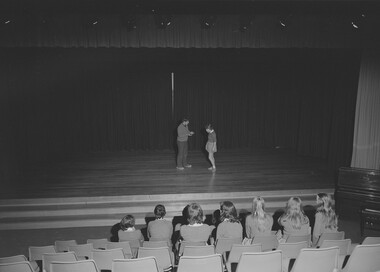
Photograph - Maribyrnong High School Drama Class Photograph
... During the post war and migration era’s (1950s–1970s), the school became increasingly multicultural due to the nearby Maribyrnong Migrant Hostel (opened 1949) with many European, Middle Eastern, and later Asian migrant students. ...During the post war and migration era’s (1950s–1970s), the school became increasingly multicultural due to the nearby Maribyrnong Migrant Hostel (opened 1949) with many European, Middle Eastern, and later Asian migrant students. ...Maribyrnong High School opened in 1958. The school served in the rapidly growing Maidstone and Maribyrnong districts. During the post war and migration era’s (1950s–1970s), the school became increasingly multicultural due to the nearby Maribyrnong Migrant Hostel (opened 1949) with many European, Middle Eastern, and later Asian migrant students. The school became known for its multicultural student body and union activism in the 1970s. This included the 1971 teacher’s “Control of Entry” strike of 11 weeks, one of the most important industrial actions in Victorian education history that helped to establish the principle that all students must be taught by qualified teachers. The school was later renamed to the Maribyrnong Secondary College and then Maribyrnong College. The school is now well known for its sports academy program. maribyrnong high school, river street, maribyrong, maidstone -
 Sunshine and District Historical Society Incorporated
Photograph - Maribyrnong State School Under Construction Photographs
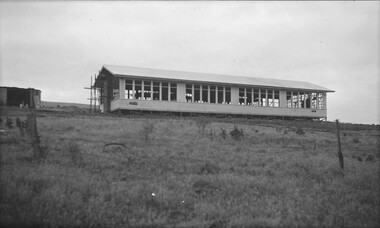
... During the post war and migration era’s (1950s–1970s), the school became increasingly multicultural due to the nearby Maribyrnong Migrant Hostel (opened 1949) with many European, Middle Eastern, and later Asian migrant students. ...During the post war and migration era’s (1950s–1970s), the school became increasingly multicultural due to the nearby Maribyrnong Migrant Hostel (opened 1949) with many European, Middle Eastern, and later Asian migrant students. ...Maribyrnong State School (also known as Maribyrnong Primary School) operated from the early 20th century until the late 20th century, serving the riverside industrial–residential community around Raleigh Road and the Maribyrnong River. The school was established in 1912. At first the school assembled in the Maribyrnong Methodist Church on the corner of Raleigh Street and Rosamond Rd. In 1916 the school was relocated to the corner of Raleigh Street and Wests Rd. In 1942 the school moved to the Warrs Rd site. During the post war and migration era’s (1950s–1970s), the school became increasingly multicultural due to the nearby Maribyrnong Migrant Hostel (opened 1949) with many European, Middle Eastern, and later Asian migrant students. Maribyrnong State School was one of the first inner west schools to run integration programs for newly arrived children, a pattern later continued by Maribyrnong High School. The school closed on the 31st December 1993. The school side was the sold to land developers who developed it into a small housing estate.This photograph captures the new school being built on the Warrs Road site in the early 1940's.maribyrnong state school, warrs road, maribyrnong -
 Flagstaff Hill Maritime Museum and Village
Craft - Ship Model, Portuguese Carvel, 1999
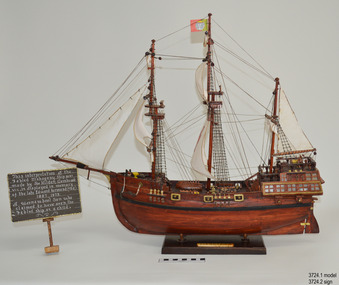
... For well over a century the mystery of this ship has fascinated Australians because the existence of such a vessel could throw a different light on the earliest phases of exploration of eastern Australia by Europeans. The story is that in January 1836 a party of whalers from Port Fairy travelled to the mouth of the Hopkins River in search of seals. ...For well over a century the mystery of this ship has fascinated Australians because the existence of such a vessel could throw a different light on the earliest phases of exploration of eastern Australia by Europeans. The story is that in January 1836 a party of whalers from Port Fairy travelled to the mouth of the Hopkins River in search of seals. ...The Mahogany Ship is today regarded as a legend and refers to an ancient wreck that is purported to lie beneath the sand beside Armstrong Bay, several kilometres west of Warrnambool, Its location is currently unknown. For well over a century the mystery of this ship has fascinated Australians because the existence of such a vessel could throw a different light on the earliest phases of exploration of eastern Australia by Europeans. The story is that in January 1836 a party of whalers from Port Fairy travelled to the mouth of the Hopkins River in search of seals. Their boat overturned and one man was drowned. The three survivors were walking the 30 kilometres back to Port Fairy along the coast when, about halfway along, they discovered the wrecked ship in the dunes. It is said that Captain John Mills, who was in charge of the whaling station at Port Fairy promptly visited the wreck with several of his men, including Hugh Donnelly. Donnelly who was the originator of that version of events is now regarded as unreliable. Local history researcher Joan Fawcett believes Donnelly could not have visited the wreck in 1836 because he did not arrive in Victoria until 1841. The "mahogany" description can be traced to a letter from Port Fairy builder, architect and surveyor John Mason and published in the Melbourne Argus in 1876. He said he had seen the hull in 1846 and it "had the appearance of either cedar or mahogany." In 1884 Argus journalist `The Vagabond' wrote that the hull was built of "Spanish mahogany" and six years later Mason wrote another letter saying it might not have been mahogany but red gum or ironbark from New South Wales. He was too late with this new description as the wrecks mahogany tag was here to stay all through the hull was not visible as it had disappeared beneath the shifting sands by 1880. A more reliable account was later presented by the former editor of the Warrnambool Examiner, historian Richard Osburne, who wrote about the wreck in his book History of Warrnambool (published 1887). In it the author remembers to have noticed a wreck in the hummocks between Belfast and Warrnambool, in 1847 or 1848; he stated it was much nearer Warrnambool than Belfast, now known as Port Fairy, going on to state “in fact, it was only two or three miles from the former place, to the west of the big hummock which was supposed to fill Warrnambool Bay with drift sand washed by the Merri River before the cutting was made.” Osburne followed up with a letter to the Port Fairy Gazette on June 25, 1876, during a period of heightened interest in the wreck, although he was unsure of the provenance of the ship he went on to state in his letter. “The old wreck was, in fact, miles away from the Port Fairy beach, and only about four miles from Warrnambool. In the years 1847 and 1848. I have often seen the wreck and I regret to say I do not believe she was a foreign ship at all.”The ship model is significant for its association with the Warrnambool story of what is now referred to as the Mahogany Ship, an ancient shipwreck. The model is significant as it is an interpretation of a Portuguese caravel and possibly associated with the early history and exploration of Southern Australia. The model is a fine example of a hand crafted ship made from plans, not from a kit. Some of the materials used for the model are significant to the Gembrook community in that the timber used is a portion from a 30-meter pine tree that fell onto and destroyed the 120-year-old Gembrook church building. The model is also a dedication to Edward Kermond, who grew up in Warrnambool and claimed to have seen the shipwreck in the dunes when he was a lad in the late 19th century. (See note section of this document for further information on the creator and donation of the subject item).Ship model, an interpretation of a mahogany Portuguese carvel vessel in a glass display case with wood frame and a description plaque. Model is made from dark stained wood. The three masted vessel is fully rigged, with a Portuguese-like flag on mast. Plaque is rectangular, free standing on a pedestal. The model was handmade by Joe Hilder (Senior) in 1999 from flooring obtained from the Gembrook Uniting Church in Victoria. Inscriptions, hand written, under base of case and on plaque.Under base, black felt tip pen “Ship & Case made From / Flooring from Gembrook uniting Church, Flattened in 1999 / By Large Pine Tree.” On plaque, white paint "This interpretation of the Fabled Mahogany Ship was made by Joe Hilder, Gembrook Vic. is displayed in the memory of the late Edward Kermond (Ted) 1887-1973, a Warrnambool son who claimed to have seen the original ship as a child." flagstaff hill, warrnambool, flagstaff hill maritime museum, shipwreck coast, flagstaff hill maritime village, great ocean road, ship model, mahogany ship, mahogany ship story, portuguese caravel, joe hilder, edward kermond, ted kermond, gembrook uniting church, gembrook storm 1999, port fairy whalers, belfast whalers -
 Flagstaff Hill Maritime Museum and Village
Book - Reference Book/History, Henry Smith Williams, The Historians History of the World Vol 10 set 1 - Edited by Henry Smith Williams L.L.D. Published by “The Times” 1908, 1908
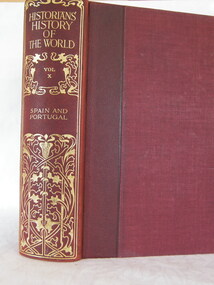
... Eastern Islam. The "Crucible Effect “ text as it was known argues that the constant warfare against the Moors forged the Spanish identity into one that was uniquely militaristic and intensely devout. This the text argues formed a cultural synthesis within Spain despite the conflict. The volume highlights the intellectual "Golden Age" of Muslim Spain, noting how it preserved Greek and Roman knowledge for the rest of Europe...Eastern Islam. The "Crucible Effect “ text as it was known argues that the constant warfare against the Moors forged the Spanish identity into one that was uniquely militaristic and intensely devout. This the text argues formed a cultural synthesis within Spain despite the conflict. The volume highlights the intellectual "Golden Age" of Muslim Spain, noting how it preserved Greek and Roman knowledge for the rest of Europe ...The 1908 edition of The Historians' History of the World is a monumental work of Edwardian scholarship, representing a specific era of "universal history" where the goal was to synthesise all human knowledge into a single narrative. Volume 10 specifically focuses on the Late “Middle Ages” and the “Renaissance period”, particularly in Italy and Spain. Starting with the clash of civilisations, Islam vs. Christianity.The Book is part of a 25 volume set with red cloth bindings and gold filigree design to rib.non-fictionThe 1908 edition of The Historians' History of the World is a monumental work of Edwardian scholarship, representing a specific era of "universal history" where the goal was to synthesise all human knowledge into a single narrative. Volume 10 specifically focuses on the Late “Middle Ages” and the “Renaissance period”, particularly in Italy and Spain. Starting with the clash of civilisations, Islam vs. Christianity. flagstaff hill, warrnambool, shipwrecked-coast, flagstaff-hill, flagstaff-hill-maritime-museum, maritime-museum, shipwreck-coast, flagstaff-hill-maritime-village, the historians history of the world vol 10 set 1, book -
 Flagstaff Hill Maritime Museum and Village
Book - Reference Book/History, Henry Smith Williams, The Historians History of the World Vol 16 set 1 - Edited by Henry Smith Williams L.L.D. Published by “The Times” 1908, 1908
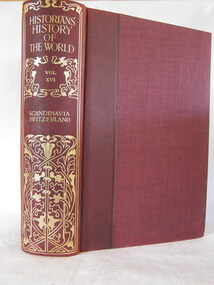
... It acts as the bridge between the Western European powers and the Eastern European/Slavic nations (Russia and Poland) which begin in the latter half of Volume 17. ...Henry Smith Williams’ “The Historians' History of the World” is a chronological and geographical "tapestry" of human events, these twenty five volumes occupy a very specific and prestigious place in historical research. The primary subjects of Volume 16 are Scandinavia (including the history of Norway, Sweden, and Denmark) and the history of Switzerland up to the year 1715.The Book is part of a 25 volume set with red cloth bindings and gold filigree design to rib.non-fictionHenry Smith Williams’ “The Historians' History of the World” is a chronological and geographical "tapestry" of human events, these twenty five volumes occupy a very specific and prestigious place in historical research. The primary subjects of Volume 16 are Scandinavia (including the history of Norway, Sweden, and Denmark) and the history of Switzerland up to the year 1715.flagstaff hill, warrnambool, shipwrecked-coast, flagstaff-hill, flagstaff-hill-maritime-museum, maritime-museum, shipwreck-coast, flagstaff-hill-maritime-village, book, the historians history of the world vol 16 set 1 -
 Flagstaff Hill Maritime Museum and Village
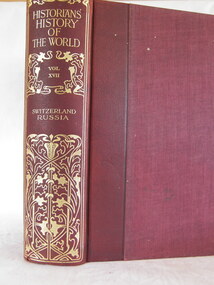
Book - Reference Book/History, The Times Newspaper, The Historians History of the World Vol 17 set 1 - Edited by Henry Smith Williams L.L.D. Published by “The Times” 1908, 1908
... Volume 17 is significant for several reasons It marks the transition from the histories of Western and Central Europe (France, Netherlands, Germanic Empires) toward the "Eastern Question" and the rise of the Slavic nations. ...Henry Smith Williams’ “The Historians' History of the World” is a chronological and geographical "tapestry" of human events, these twenty five volumes occupy a very specific and prestigious place in historical research. Volume 17 focuses primarily on the history of Switzerland with concluding sections on Russia, and Poland. The volume concludes the Swiss narrative began in volume 16.The Book is part of a 25 volume set with red cloth bindings and gold filigree design to rib.non-fictionHenry Smith Williams’ “The Historians' History of the World” is a chronological and geographical "tapestry" of human events, these twenty five volumes occupy a very specific and prestigious place in historical research. Volume 17 focuses primarily on the history of Switzerland with concluding sections on Russia, and Poland. The volume concludes the Swiss narrative began in volume 16.flagstaff hill, warrnambool, shipwrecked-coast, flagstaff-hill, flagstaff-hill-maritime-museum, maritime-museum, shipwreck-coast, flagstaff-hill-maritime-village, book, the historians history of the world vol 17 set 1 -
 Flagstaff Hill Maritime Museum and Village
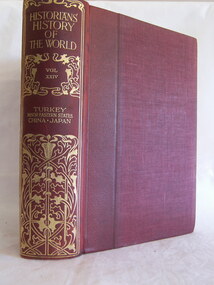
Book - Reference Book/History, Henry Smith Williams, The Historians History of the World Vol 24 set 1 - Edited by Henry Smith Williams L.L.D. Published by “The Times” 1908, 1908
... While previous volumes handled the major empires (Britain, France, Germany), Volume 24 completes the map of Europe by giving voice to the smaller or occupied nations, ensuring the set lived up to its name as a world history. flagstaff hill warrnambool shipwrecked-coast flagstaff-hill flagstaff-hill-maritime-museum maritime-museum shipwreck-coast flagstaff-hill-maritime-village book the historians history of the world vol 24 set 1 In the 1908 edition of The Historians' History of the World, Volume 24 acts as the definitive survey of the "Eastern Question" and the peripheral powers of Europe. ...In the 1908 edition of The Historians' History of the World, Volume 24 acts as the definitive survey of the "Eastern Question" and the peripheral powers of Europe. It shifts focus away from the Western powers of the time to examine the complex histories of the East and the South. The contents cover, Poland, the Balkans, Turkey, and Minor Nations Volume 24 becomes a geographically diverse volume that covers the history of several regions that were, in 1908, centres of intense geopolitical tension.The Book is part of a 25 volume set with red cloth bindings and gold filigree design to rib.non-fictionIn the 1908 edition of The Historians' History of the World, Volume 24 acts as the definitive survey of the "Eastern Question" and the peripheral powers of Europe. It shifts focus away from the Western powers of the time to examine the complex histories of the East and the South. The contents cover, Poland, the Balkans, Turkey, and Minor Nations Volume 24 becomes a geographically diverse volume that covers the history of several regions that were, in 1908, centres of intense geopolitical tension. flagstaff hill, warrnambool, shipwrecked-coast, flagstaff-hill, flagstaff-hill-maritime-museum, maritime-museum, shipwreck-coast, flagstaff-hill-maritime-village, book, the historians history of the world vol 24 set 1 -
Federation University Historical Collection
Document, Articles on the Bunyip, 1983 - 1989
... Eastern Australia. However, the bunyip appears to have formed part of traditional Aboriginal beliefs and stories throughout Australia, although its name varied according to tribal nomenclature. Various written accounts of bunyips were made by Europeans...Eastern Australia. However, the bunyip appears to have formed part of traditional Aboriginal beliefs and stories throughout Australia, although its name varied according to tribal nomenclature. Various written accounts of bunyips were made by Europeans ...The bunyip is a large mythical creature from Aboriginal mythology, said to lurk in swamps, billabongs, creeks, riverbeds, and waterholes. The origin of the word bunyip has been traced to the Wemba-Wemba or Wergaia language of Aboriginal people of South-Eastern Australia. However, the bunyip appears to have formed part of traditional Aboriginal beliefs and stories throughout Australia, although its name varied according to tribal nomenclature. Various written accounts of bunyips were made by Europeans in the early and mid-19th century, as settlement spread across the country. (http://en.wikipedia.org/wiki/Bunyip) This material was collected and used for resarch purposes by David Waldron A number of articles on the Bunyip * The Nessie Mystery Solver by Roy Fraser (October 1983) * Developers meet match (Wagyl) (The Age, 06 Jan 1989) * Narrandera's bunyips burst into tourism's limelight by Melanie Sincock (wagga Advertiser, 18 November 1986) * Hunting the bunyip by M.A. Troyahn (Australiasian Post, 06 October 1883) * Beware the bunyip, you Moomba skiers by Edel Wignell (The Age, 05 March 1982) * The yarn that grew the bunyip legend (Australasian Post, 30 December 1971) australian animal folklore collections, bunyip, bunyipswagyl, shane picket, narrandera, swan river, david waldron -
 Flagstaff Hill Maritime Museum and Village
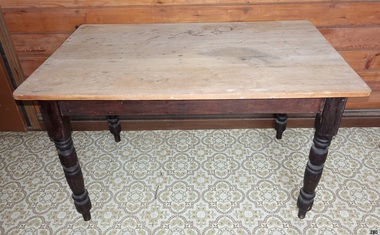
Furniture - Table
... Eastern Roman Empire, tables were made of metal or wood, usually with four feet and frequently linked by x-shaped stretchers. Tables for eating were large and often round or semicircular. A combination of a small round table and a lectern seemed very popular as a writing table. In western Europe...Eastern Roman Empire, tables were made of metal or wood, usually with four feet and frequently linked by x-shaped stretchers. Tables for eating were large and often round or semicircular. A combination of a small round table and a lectern seemed very popular as a writing table. In western Europe ...Some very early tables were made and used by the Ancient Egyptians around 2500 BC, using wood and alabaster. They were often little more than stone platforms used to keep objects off the floor, though a few examples of wooden tables have been found in tombs. Food and drinks were usually put on large plates deposed on a pedestal for eating. The Egyptians made use of various small tables and elevated playing boards. The Chinese also created very early tables in order to pursue the arts of writing and painting, as did people in Mesopotamia, where various metals were used. The Greeks and Romans made more frequent use of tables, notably for eating, although Greek tables were pushed under a bed after use. The Greeks invented a piece of furniture very similar to the guéridon. Tables were made of marble or wood and metal (typically bronze or silver alloys), sometimes with richly ornate legs. Later, the larger rectangular tables were made of separate platforms and pillars. The Romans also introduced a large, semicircular table to Italy, the mensa lunata. Plutarch mentions use of "tables" by Persians. Furniture during the Middle Ages is not as well known as that of earlier or later periods, and most sources show the types used by the nobility. In the Eastern Roman Empire, tables were made of metal or wood, usually with four feet and frequently linked by x-shaped stretchers. Tables for eating were large and often round or semicircular. A combination of a small round table and a lectern seemed very popular as a writing table. In western Europe, the invasions and internecine wars caused most of the knowledge inherited from the classical era to be lost. As a result of the necessary movability, most tables were simple trestle tables, although small round tables made from joinery reappeared during the 15th century and onward. In the Gothic era, the chest became widespread and was often used as a table. Refectory tables first appeared at least as early as the 17th century, as an advancement of the trestle table; these tables were typically quite long and wide and capable of supporting a sizeable banquet in the great hall or other reception room of a castle. https://en.wikipedia.org/wiki/Table_(furniture)The table is one of the most important items of furniture used in the home, including the kitchen.Table wooden with 4 wooden turned legs and unvarnished raw wood topNone flagstaff hill, warrnambool, shipwrecked-coast, flagstaff-hill, flagstaff-hill-maritime-museum, maritime-museum, shipwreck-coast, flagstaff-hill-maritime-village, table, kitchen furniture -
 Flagstaff Hill Maritime Museum and Village
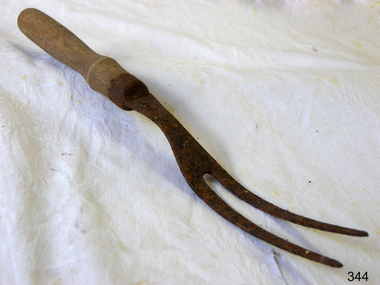
Domestic object - Fork
... Eastern Roman (or Byzantine) Empire. Its use spread to what is now the Middle East during the first millennium AD and then spread into Southern Europe during the second millennium. ...Eastern Roman (or Byzantine) Empire. Its use spread to what is now the Middle East during the first millennium AD and then spread into Southern Europe during the second millennium. ...Naturally, we tend to take commonplace objects for granted, because they have always been there. Yet how many of you actually have thought “hey, where do forks come from?” Well, it takes one trip to China and a 3-year-old laughing at your face because of your desperate attempt to eat with chopsticks to finally appreciate something so ordinary such as a fork. So, where do forks come from? The early history of the fork is obscure. As a kitchen and dining utensil, it is believed to have originated in the Roman Empire, as proved by archaeological evidence. The personal table fork most likely originated in the Eastern Roman (or Byzantine) Empire. Its use spread to what is now the Middle East during the first millennium AD and then spread into Southern Europe during the second millennium. It did not become common in northern Europe until the 18th century and was not common in North America until the 19th century. Carving fork from 1640. Source: Wikipedia/Public Domain Carving Fork from 1640. Source: Wikipedia/Public Domain Some of the earliest known uses of forks with food occurred in Ancient Egypt, where large forks were used as cooking utensils. Bone forks had been found on the burial site of the Bronze Age Qijia culture (2400–1900 BC) as well as later Chinese dynasties’ tombs.The Ancient Greeks used the fork as a serving utensil. Read also: Steven Spielberg to Remake the Classic Musical ‘West Side Story’ In the Roman Empire, bronze and silver forks were used. The use varied according to local customs, social class and the nature of food, but forks of the earlier periods were mostly used as cooking and serving utensils. The personal table fork was most likely invented in the Eastern Roman (Byzantine) Empire, where they were in everyday use by the 4th century (its origin may even go back to Ancient Greece, before the Roman period). Records show that by the 9th century a similar utensil known as a barjyn was in limited use in Persia within some elite circles. By the 10th century, the table fork was in common use throughout the Middle East. Bronze forks made in Persia during the 8th or 9th century.Source: Wikipedia/Public Domain Bronze forks made in Persia during the 8th or 9th century.Source: Wikipedia/Public Domain The first recorded introduction of the fork to Western Europe, as recorded by the theologian and Cardinal Peter Damian, was by Theophano Sklereina the Byzantine wife of Holy Roman Emperor Otto II, who nonchalantly wielded one at an Imperial banquet in 972, astonishing her Western hosts.By the 11th century, the table fork had become increasingly prevalent in the Italian peninsula. It gained a following in Italy before any other Western European region because of historical ties with Byzantium and continued to get popularity due to the increasing presence of pasta in the Italian diet. At first, pasta was consumed using a long wooden spike, but this eventually evolved into three spikes, design better suited to gathering the noodles. In Italy, it became commonplace by the 14th century and was almost universally used by the merchant and upper classes by 1600. It was proper for a guest to arrive with his fork and spoon enclosed in a box called a cadena; this usage was introduced to the French court with Catherine de’ Medici’s entourage. In Portugal, forks were first used at the time of Infanta Beatrice, Duchess of Viseu, King Manuel I of Portugal’s mother around 1450. However, forks were not commonly used in Western Europe until the 16th century when they became part of Italian etiquette. The utensil had also gained some currency in Spain by this time, and its use gradually spread to France. Nevertheless, most of Europe did not adopt the use of the fork until the 18th century. Read also: The 8 Most Famous ‘Functioning Alcoholics’ in History Long after the personal table fork had become commonplace in France, at the supper celebrating the marriage of the Duc de Chartres to Louis XIV’s natural daughter in 1692, the seating was described in the court memoirs of Saint-Simon: “King James having his Queen on his right hand and the King on his left, and each with their cadenas.” In Perrault’s contemporaneous fairy tale of La Belle au bois dormant (1697), each of the fairies invited for the christening is presented with a splendid “fork holder”. The fork’s adoption in northern Europe was slower. Its use was first described in English by Thomas Coryat in a volume of writings on his Italian travels (1611), but for many years it was viewed as an unmanly Italian affectation. Some writers of the Roman Catholic Church expressly disapproved of its use, St. Peter Damian seeing it as “excessive delicacy.” It was not until the 18th century that the fork became commonly used in Great Britain, although some sources say that forks were common in France, England, and Sweden already by the early 17th century. Spaghetti fork By Lady alys - Own work, CC BY-SA 3.0, https://commons.wikimedia.org/w/index.php?curid=6414948 Spaghetti Fork By Lady alys – Own work, CC BY-SA 3.0, The fork did not become popular in North America until near the time of the American Revolution. The curved fork used in most parts of the world today was developed in Germany in the mid 18th century while the standard four-tine design became current in the early 19th century. The fork was important in Germany because they believed that eating with the fingers was rude and disrespectful. The fork led to family dinners and sit-down meals, which are important features of German culture. https://www.thevintagenews.com/2016/08/31/priority-fork-came-italy-european-country-pasta/?chrome=1Serving fork, two prongs, with a shaped wooden handle. Badly rusted.None.flagstaff hill, warrnambool, shipwrecked-coast, flagstaff-hill, flagstaff-hill-maritime-museum, maritime-museum, shipwreck-coast, flagstaff-hill-maritime-village, food, meat, carving
