
Showing 7 items matching "eastern hill fire brigade station"
-
 Melbourne Tram Museum
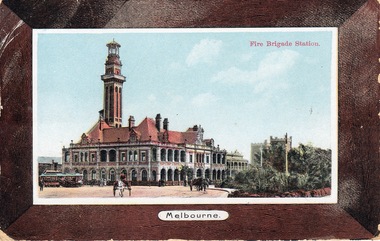
Postcard - Fire Brigade Station, 'Ward, Lock & Co Ltd', 1910s
... ...Eastern Hill Fire Brigade Station...Photograph looks south west across the broad junction of Victoria Pde, Brunswick St and Gisborne St, East Melbourne toward the large Eastern Hill Fire Brigade Station with its tall watch tower. ...Yields information about Eastern Hill Fire Brigade Station Victoria Pde Brunswick St Gisborne St Eastern Hill Fire Brigade Station watch towe cable tram set engine house On front 'Fire Brigade Station. ...Photograph looks south west across the broad junction of Victoria Pde, Brunswick St and Gisborne St, East Melbourne toward the large Eastern Hill Fire Brigade Station with its tall watch tower. A cable tram set is about to turn the corner towards the photographer. The engine house that drove the cables is behind the photographer.Yields information about Eastern Hill Fire Brigade StationHand coloured postcard with title on front and short personal message, delivery address, but stamp removed from rear.On front 'Fire Brigade Station. Melbourne'. On rear: postcard markings, 'Ward, Lock & Co Ltd', postmarked partially removed, short hand written note of thanks for parcel from Hobart. victoria pde, brunswick st, gisborne st, eastern hill fire brigade station, watch towe, cable tram set, engine house -
 Ambulance Victoria Museum
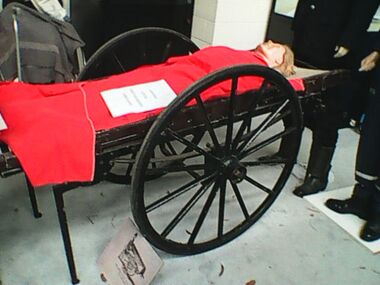
Ambulance, Cart, Human Propelled, Ashford Litter, 1887
... stations. Another was located at the Melbourne Town Hall on Swanston Street and from 1896 the sixth was located at the Eastern Hill Metropolitan Fire Brigade station. ...stations. Another was located at the Melbourne Town Hall on Swanston Street and from 1896 the sixth was located at the Eastern Hill Metropolitan Fire Brigade station. ...in 1887 six Ashford Litters were purchased by St John Ambulance Association after Lady Janet Clarke (of Rupertswood) and her friends raised enough money to allow these items to be ordered. These were Victoria's first official ambulances. The litter consisted of a two wheeled undercarriage with elliptical springs which supported a stretcher. It has four legs which support the carriage when stationary but fold up to form handles so that one person could push the machine while another pushed. Four Ashford Litter ambulances were located at the Russell Street, Little Bourke Street, King Street and West Melbourne police stations. Another was located at the Melbourne Town Hall on Swanston Street and from 1896 the sixth was located at the Eastern Hill Metropolitan Fire Brigade station. Initially is was expected that police and fire fighters would take patients to hospitals if required.Two wheeled ambulance cart with sprung wheels.ashford, ashford litter, st john -
 Glen Eira Historical Society
Document - Glen Huntly Fire Station
... Fire Station... Glen Huntly Road... Glenhuntly Road... Grange Road... Eastern Hill Fire Station... Electric trams... Metropolitan Fire Brigade...Fire Engine with No. 13197 outside the Glen Huntly Fire Station. Two firefighters are seated in the carriage and three others stand on the running board. It is noted 'D DISTRICT' at the top and 'No. 29 STATION GLENHUNTLY' on the bottom. Glenhuntly Glen Huntly Fire Station Glen Huntly Road Glenhuntly Road Grange Road Eastern Hill Fire Station Electric trams Metropolitan Fire Brigade ...This folder contains 3 copies of photographs plus notes about the Glen Huntly Fire Station: 1/A print of a small black and white photograph (95mm x 127mm) of the exterior of Glen Huntly Fire Station accompanied by typed notes sourced 13/03/2007 from the Melbourne Fire Brigade Museum. The notes indicate that the fire engine shown parked out the front was in service 1919 to circa 1924: Car 55 Rego 8499 Hose Carriage Engine No. 3178 Napier. 2/An A4 sepia copy of the same photograph (210mm x 291mm) with street advertising of one of the shops clearly visible: 'DRAPERY EMPORIUM. UNDERCLOTHING BABY LINEN; HOSIERY HABERDASHERY MILLINERY'. The electric tram at the terminus on Grange Road is also seen in the photograph. Noted on the reverse of the photo: 'Glen Huntly Road and Grange Road' in pencil. 3/A photocopy of a black and white photograph (154mm x 200mm) of Fire Engine with No. 13197 outside the Glen Huntly Fire Station. Two firefighters are seated in the carriage and three others stand on the running board. It is noted 'D DISTRICT' at the top and 'No. 29 STATION GLENHUNTLY' on the bottom.glenhuntly, glen huntly fire station, glen huntly road, glenhuntly road, grange road, eastern hill fire station, electric trams, metropolitan fire brigade board, fire stations, fire brigades, fire engines, firefighters, firefighting equipment, hose carriage engine no 3178 napier, glen huntly, melbourne fire brigade museum, russell david -
 Williamstown Historical Society Inc
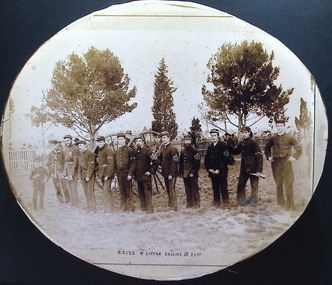
Photograph - Williamstown Volunteer Fire Brigade, with Central Fire Brigade, c.1860's
... Fire Brigade with members of the Central Fire Brigade Station. The Central Fire Brigade were situated in Little Collins Street, and later relocated to current location at Eastern Hill. ...Williamstown Volunteer Fire Brigade c.1860's Central Fire Brigade Williamstown Volunteer Fire Brigade with members of the Central Fire Brigade Station. The Central Fire Brigade were situated in Little Collins Street, and later relocated to current location at Eastern Hill. ...Williamstown Volunteer Fire Brigade with members of the Central Fire Brigade Station. The Central Fire Brigade were situated in Little Collins Street, and later relocated to current location at Eastern Hill. (source https://trove.nla.gov.au/newspaper/article/63185390/5731757#) From left: Mascot, 1. Uknown, 2. J.Murdoch, 3. Elsum, 4. Unknown, 5. Unknown, 6. Livingstone, 7. Johnstone, 8. William Alfred Hall, 9. Lester, 10. Burtonclay, 11. Unknown williamstown volunteer fire brigade, c.1860's, central fire brigade -
 City of Melbourne Libraries
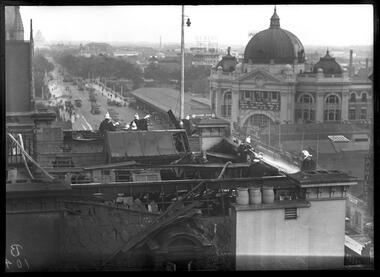
Photograph, Bull, Hugh Jones, 1897-1993, Fire at Cathedral Hotel, Swanston Street, Melbourne
... fire fighting efforts. The photo gives a feeling of elevation, as the firemen are in focus, with an out of focus panoramic background, showing the dome of Flinders Street Station, and St Kilda Road down to the Shrine. Research by project volunteer, Louise McKenzie: The Age reported on 4 March 1936 that the fire broke out in rubbish between the roof space and wooden ceiling of the Cathedral Hotel at 4.30 pm. “The Eastern Hill fire brigade...fire fighting efforts. The photo gives a feeling of elevation, as the firemen are in focus, with an out of focus panoramic background, showing the dome of Flinders Street Station, and St Kilda Road down to the Shrine. Research by project volunteer, Louise McKenzie: The Age reported on 4 March 1936 that the fire broke out in rubbish between the roof space and wooden ceiling of the Cathedral Hotel at 4.30 pm. “The Eastern Hill fire brigade ...Fire at the Cathedral Hotel! Southward view Firemen in their shiny brass Merryweather style helmets battle a fire in the roof of the Cathedral Hotel, Tuesday 3 March 1936. It was located on the corner of Swanston Street and Flinders Lane and so named for its proximity to St Paul’s Cathedral, just visible at top left. The fire broke out in between the roof space and wooden ceiling of the hotel at around 4.30 pm, causing disruption to afternoon commuters – hence the banked-up trams along St Kilda Road. The hoses snaking across the roof have been dragged up through the hotel’s front door. The scene of devastation on the roof appears to be a result of both the fire and firefighting efforts. The panoramic background is dominated by the dome of Flinders Street Station, the wide, treed boulevard of St Kilda Road, and a densely built-up industrial area south of the Yarra with its elevated signage and substantial buildings. Featured in "Newsworthy: Melbourne in photographs 1933-1936" exhibition at East Melbourne Library, October to December 2023. Exhibition caption by project volunteer, Louise McKenzie. Photographer notations on slide: "Fire at Cathedral Hotel Swanston St 1936 B104" Description: This photo, taken from an adjacent building, shows 12 firemen fighting a fire on the roof of the Cathedral Hotel, Melbourne. There is evidence of considerable damage to the roof of the building as a result of the fire and fire fighting efforts. The photo gives a feeling of elevation, as the firemen are in focus, with an out of focus panoramic background, showing the dome of Flinders Street Station, and St Kilda Road down to the Shrine. Research by project volunteer, Louise McKenzie: The Age reported on 4 March 1936 that the fire broke out in rubbish between the roof space and wooden ceiling of the Cathedral Hotel at 4.30 pm. “The Eastern Hill fire brigade was notified by telephone, and an almost simultaneous call was also received at fire brigade headquarters from a street alarm.” The firemen in their dark uniforms with brass buttons, gold epaulettes and shiny brass Merryweather helmets, stand out against the broken slate tiles and dislodged timber of the damaged roofing, all of which look blackened and in disarray. Two pale water hoses snake thickly across the roof. It is a scene of some devastation and chaos. Three chimney pots by contrast sit plump and strong against the damage. The Cathedral Hotel is located on the corner of Swanston Street and Flinders Lane, so named due to its proximity to St Pauls Cathedral (just visible at far left) on the corner of Flinders and Swanston streets. This intersection is a hub and focus of Melbourne activity. The backgrounded Melbourne skyline, while not in clear focus, is of interest. On the right is the impressive dome of Flinders Street Station, with the clock at 4.50 pm. Its grand frontage, and some of the façade along Flinders Street, are visible. To the left is the wide and grand-scaled St Kilda Road, leading down to the Shrine of Remembrance. There are many trams on Princes Bridge (mostly heading northward), together with some trucks and pedestrians. The pedestrian walkway along Princes Bridge is wide, and the Bridge balustrade lined with flag poles. The middle background shows a large number of trees. This was the site of Wirths Brothers Circus, an impressive complex including an octagonal circus Hippodrome (5000 seat auditorium), Pleasure Park, roller skating rink, and Dance Hall. Today it is the site of the Melbourne Arts Centre. Adjacent to the station is a large covered area, still extant today as part of the Station precinct. Floating above the horizon is sign advertising 'DUNLOP', located in the formerly industrial area which is today’s Southbank. Port Phillip Bay is faintly visible in the distance. The city seems sprawling, but uncrowded, and well punctuated by trees. Two photos were included an Age pictorial, one showing the firefighters at work, the other a crowd scene at street level (see References). These images are not part of the McKenzie Collection. References: No title (1936, March 4). The Age (Melbourne, Vic. : 1854 - 1954), p. 13. Retrieved February 5, 2024, from http://nla.gov.au/nla.news-article205256255 FIRE AT A CITY HOTEL. (1936, March 4). The Age (Melbourne, Vic. : 1854 - 1954), p. 12. Retrieved February 5, 2024, from http://nla.gov.au/nla.news-article205256231 FIRE IN ROOF OF CITY HOTEL (1936, March 4). The Argus (Melbourne, Vic. : 1848 - 1957), p. 8. Retrieved February 5, 2024, from http://nla.gov.au/nla.news-article11018696 Hotel Roof Fire Draws Crowd (1936, March 4). Examiner (Launceston, Tas. : 1900 - 1954), p. 8 (DAILY). Retrieved February 5, 2024, from http://nla.gov.au/nla.news-article52000751 'Flinders Lane Melbourne 1966', Peter Andrew Barrett, Facebook, 12 June 2020, https://www.facebook.com/120943481324886/photos/a.512123662206864/3025002490918956/?type=3Photographer notations on slide: "Fire at Cathedral Hotel Swanston St 1936 B104".fires, 1930-1939, hotels -
 Melbourne Tram Museum
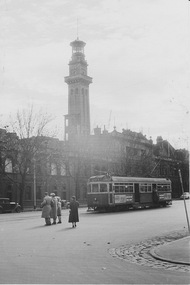
Photograph - W7 tram at Eastern Hill Fire Station, 1950s
... The dominant watch tower sits high above the fire brigade station. Yields information about Eastern Hill Fire Station W7 class tram 'City' Gisborne St Albert St watch tower fire station Black and white photograph with no note on rear. ...Photograph shows a W7 class tram with destination 'City' route 42 in Gisborne St, East Melbourne slowing for passengers who are waiting at the Albert St stop. The dominant watch tower sits high above the fire brigade station.Yields information about Eastern Hill Fire StationBlack and white photograph with no note on rear. w7 class tram, 'city', gisborne st, albert st, watch tower, fire station -
 Williamstown Historical Society Inc
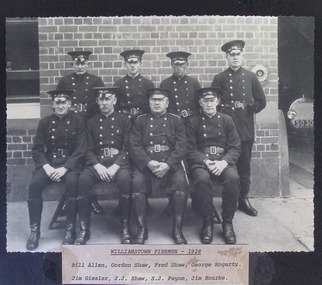
Photograph - Williamstown Fire Brigade members, 1928
... Fire Brigade. Eight men in uniform, four sitting and four standing, with the brick wall of the Fire Brigade headquarters behind them. This is a group photograph of Williamstown Fire Brigade, 1928. According to his granddaughter, George Hogarty was a member of the Williamstown Fire Brigade in the late 1920s and early 1930s. Later he worked at the Eastern Hill Fire Station...Fire Brigade members 1928 Back row: L-R: Bill Allen, Gordon Shaw, Fred Shaw, George Hogarty; Front row L-R: Jim Giesler, J.J. (Joe) Shaw, Sam J. Payne, Jim (Paddy) Bourke Staff Photograph of Williamstown Fire Brigade. Eight men in uniform, four sitting and four standing, with the brick wall of the Fire Brigade headquarters behind them. This is a group photograph of Williamstown Fire Brigade, 1928. According to his granddaughter, George Hogarty was a member of the Williamstown Fire Brigade in the late 1920s and early 1930s. Later he worked at the Eastern Hill Fire Station ...Back row: L-R: Bill Allen, Gordon Shaw, Fred Shaw, George Hogarty; Front row L-R: Jim Giesler, J.J. (Joe) Shaw, Sam J. Payne, Jim (Paddy) Bourke Staff Photograph of Williamstown Fire Brigade. Eight men in uniform, four sitting and four standing, with the brick wall of the Fire Brigade headquarters behind them. This is a group photograph of Williamstown Fire Brigade, 1928. According to his granddaughter, George Hogarty was a member of the Williamstown Fire Brigade in the late 1920s and early 1930s. Later he worked at the Eastern Hill Fire Station. He arrived in Australia from Dublin in January 1923. He had been a court recorder at Dublin Castle as a member of the Royal Irish Constabulary. There was a Civil War going on between 1922 and 1923, and George 'had to leave in a hurry.' He worked as a fireman in various capacities until he died in 1944. (Source: https://collections.museumsvictoria.com.au/items/1689716) williamstown fire brigade members, 1928
