
Showing 6 items matching "edmund wheeler"
-
 Port Melbourne Historical & Preservation Society
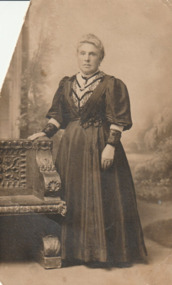
Photograph - Sarah Wale, c.1870
... ...Edmund WHEELER...Sarah WALE nee WHEELER is believed to have been born c.1851 at Ambrosden, Oxfordshire, England. She was the daughter of Edmund & Sophie WHEELER nee HAMILTON. ...near London (crossed out) Ambrosden Daughter of Edmund Whelan (crossed out) Wheeler Sophie Whelan (crossed out) (nee Hamilton)...George WALE Sarah WALE nee WHEELER Edmund WHEELER Sophie WHEELER nee HAMILTON Ernest WALE Genealogy Cardwine (?) ...Sarah WALE nee WHEELER is believed to have been born c.1851 at Ambrosden, Oxfordshire, England. She was the daughter of Edmund & Sophie WHEELER nee HAMILTON. She married George WALE, a saddler, from London and was the mother of Ernest WALE. Sarah was donor's great grandmother.The sepia photograph is of Sarah WALE (nee WHEELER) the wife of Ernest (Henry) WALE. Cardwine (?) Sarah Wale 18.7.1851(?) near London (crossed out) Ambrosden Daughter of Edmund Whelan (crossed out) Wheeler Sophie Whelan (crossed out) (nee Hamilton)george wale, sarah wale nee wheeler, edmund wheeler, sophie wheeler nee hamilton, ernest wale, genealogy -
 Port Melbourne Historical & Preservation Society
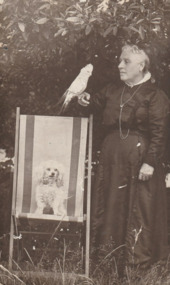
Photograph - Sarah Wale nee Wheeler, c.1880
... ...Edmund WHEELER...Sarah WALE nee WHEELER is believed to have been born c.1851 at Ambrosden, Oxfordshire, England. She was the daughter of Edmund & Sophie WHEELER nee HAMILTON. ...George WALE Sarah WALE nee WHEELER Edmund WHEELER Sophie WHEELER nee HAMILTON Ernest WALE Genealogy To Ernie with Love From Mother. ...Sarah WALE nee WHEELER is believed to have been born c.1851 at Ambrosden, Oxfordshire, England. She was the daughter of Edmund & Sophie WHEELER nee HAMILTON. She married George WALE, a saddler, from London and was the mother of Ernest WALE. Sarah was donor's great grandmother.The sepia photograph is of Sarah WALE (nee WHEELER) the wife of Ernest (Henry) WALE, is shown holding a cockatoo with a small dog in the deckchair beside her.To Ernie with Love From Mother. Grandma WALE (Sarah)george wale, sarah wale nee wheeler, edmund wheeler, sophie wheeler nee hamilton, ernest wale, genealogy -
 Warrnambool and District Historical Society Inc.
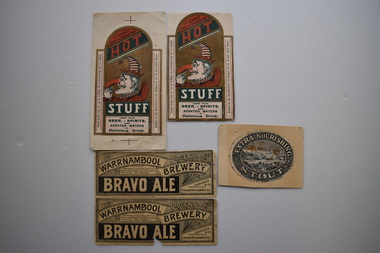
5x Labels, Hodgens, Early 20th century
... These labels come from the Brewery of Hodgens & Co. who operated the Warrnambool Brewery west of the corner of Timor and Banyan Streets This brewery was established by Edmund Wheeler as the Western Brewery in 1866. Daniel Hodgens the principal of Hodgens & Co. owned the Warrnambool Brewery from sometime in the 1890s until 1909. ...These labels come from the Brewery of Hodgens & Co. who operated the Warrnambool Brewery west of the corner of Timor and Banyan Streets This brewery was established by Edmund Wheeler as the Western Brewery in 1866. Daniel Hodgens the principal of Hodgens & Co. owned the Warrnambool Brewery from sometime in the 1890s until 1909. ...These labels come from the Brewery of Hodgens & Co. who operated the Warrnambool Brewery west of the corner of Timor and Banyan Streets This brewery was established by Edmund Wheeler as the Western Brewery in 1866. Daniel Hodgens the principal of Hodgens & Co. owned the Warrnambool Brewery from sometime in the 1890s until 1909. (Hodgens died in 1907.) Daniel Hodgens also owned the National Hotel and the Pieter Both Hotel and leased the Union, Princess Royal, Prince of Wales and the Bayview hotels in the late 1890s.These labels are of considerable interest as they are artistically pleasing and are part of an important brewery business in Warrnambool in times past. .1 Oval grey and white label adhered to a piece of cream coloured card. It has a sketch of a lake and hills in the centre which resembles Tower Hill .This is surrounded by a wide border containing text. The label is discoloured .2,.3 Dark cream paper rectangular labels with black and white text. There are decorations of berries and leaves in one corner. The primary texts are contained in two long arcs and a black rectangle. Both labels are torn. .2 has a section missing. .4,.5 Rectangular labels with a curved top and extended side panels. It features,on a gold coloured background, the profile of Punch wearing a crown with a striped red and white stocking attachment. Punch has a long hooked red nose and is raising a flask towards his mouth. Above him in the curved top section are two diagonal red and dark green panels containing text. Underneath Punch are two rectangular wide, dark green and white panels containing text. The extended side panels are at right angles to the central section.There are two crosses on the top and bottom of .5 The section containing these and also a sections beside the side extensions have been removed from .4. .1EXTRA NOURISHING STOUT HODGENS & CO WARRNAMBOOL .2,.3 HODGENS & CO. WARRNAMBOOL BREWERY BRAVO ALE Refreshing, Invigorating and Contstiting (sic.) an Appetising Tonic while slightly Stimulating. Easy of Digestion HODGENS & CO PROPRIETORS WARRNAMBOOL .4,.5 A CERTAIN CURE FOR INDIGESTION HOT STUFF USED WITH BEER SPIRITS AND AERATED WATERS A DELICIOUS DRINK . Bottled for the Manufacturers by Hodgens & Co. at their Spirits Stores. . warrnambool brewery 1885-1909 -
 Australian Gliding Museum
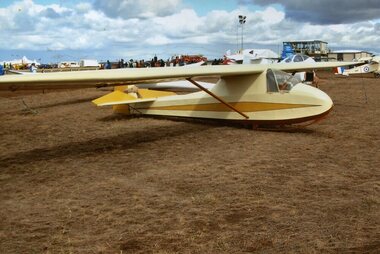
Machine - Glider – Sailplane, 1952-1953
... wheel. However, the wing design came from an existing Grunau 3 type that was being built in Germany. The glider has given extensive service for a number of owners – including the Gliding Club of Victoria, Sunraysia Gliding Club, Millicent Gliding Club, Max Bugler of Morwell and Garth Hudson of Brighton in Victoria. Prior to being donated to the Australian Gliding Museum in January 2001 the glider had logged over 2200 hours flying time from over 9000 flights. The glider is an improved Grunau Baby design that Edmund ...This aircraft, the first glider built by Schneiders after they immigrated to Australia, was test flown on 3 January 1953 by Dave Darbyshire and Owen Lewis. It is the only machine of its type. It is essentially a Grunau Baby 2B with a Perspex enclosed cockpit, wing airbrakes and a landing wheel. However, the wing design came from an existing Grunau 3 type that was being built in Germany. The glider has given extensive service for a number of owners – including the Gliding Club of Victoria, Sunraysia Gliding Club, Millicent Gliding Club, Max Bugler of Morwell and Garth Hudson of Brighton in Victoria. Prior to being donated to the Australian Gliding Museum in January 2001 the glider had logged over 2200 hours flying time from over 9000 flights. The glider is an improved Grunau Baby design that Edmund Schneider built after coming to Australia.Single seat glider of wood and fabric construction, with steel wing struts. Currently painted crème with yellow details. Underside of fuselage is painted orange.australian gliding, grunau, grunau baby, schneider, gliding club of victoria, sunraysia gliding club, millicent gliding club, darbyshire, lewis, bugler, hudson -
 Australian Gliding Museum
Machine - Glider - Sailplane, 1937
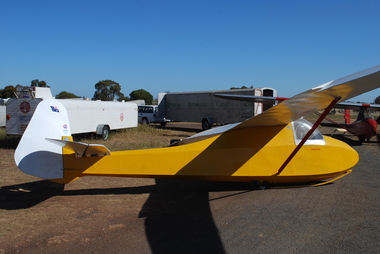
... Edmund Schneider in Germany. The Golden Eagle was found to fly well, having a similar performance to the Grunau Baby. In the 1950s, the Golden Eagle was modified by rebuilding the front of the fuselage to enclose the cockpit with a Perspex canopy. A landing wheel...Edmund Schneider in Germany. The Golden Eagle was found to fly well, having a similar performance to the Grunau Baby. In the 1950s, the Golden Eagle was modified by rebuilding the front of the fuselage to enclose the cockpit with a Perspex canopy. A landing wheel ...The Golden Eagle is an original design by Geoff Richardson. Geoff commenced gliding in the early days of the sport circa 1933 in Melbourne, flying at Coode Island and Mt Frazer. In 1934, he began construction of a secondary type glider but scrapped it upon realizing that a better design was needed. He conducted further research and came up with a sailplane of similar size and general arrangement to the Grunau Baby but with a “Gull” wing using a Gottingen 535 wing section (the same as for the Grunau Baby). Geoff did all the technical calculations himself and even made up and tested a Casein glue for the construction. Geoff competed construction of his new sailplane (which he called the “Golden Eagle”) in 1937 and it was test flown at Laverton at the western edge of Melbourne in September 1937. On the same day, at Laverton, the Gliding Club of Victoria flew its new Grunau Baby 2 sailplane which it had imported as a finished machine from Edmund Schneider in Germany. The Golden Eagle was found to fly well, having a similar performance to the Grunau Baby. In the 1950s, the Golden Eagle was modified by rebuilding the front of the fuselage to enclose the cockpit with a Perspex canopy. A landing wheel was incorporated behind the skid. Spoilers were added to the wings and a trim tab to the elevators. The Golden Eagle has been flown with the VMFG (Victorian Motorless Flight Group) for most of its long life. When donated to the Australian Gliding Museum in 2016 by Alan Patching it was probably the oldest, continuously airworthy glider in the world. Having regard to the historical significance of the Golden Eagle, the Museum has decided to not to fly it anymore to avoid risk of loss or damage. The exhibit is of great significance for Australian gliding history – the Golden Eagle is a flyable 1930s aircraft in excellent condition that was designed and built by an Australian gliding pioneer. Single seat wood and fabric sailplane finished with white wings, tailplane and rudder and yellow fuselage Registration letters “FC” on fuselage nose port side, Australian flag, Vintage Gliders Australia and VMFG decals on rudder, “Golden Eagle” lettering in red on each side of the fuselage below the canopy, Aboriginal flag decal on port side of fuselage below the canopy. australian gliding, glider, sailplane, golden eagle, richardson, patching, vmfg, victorian motorless flight group -
 Australian Gliding Museum
Machine - ES56 Nymph Sailplane
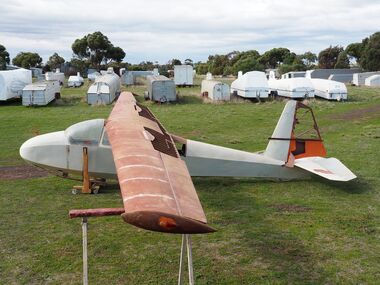
... wheel behind the skid on the fuselage. On one of the Nymph-II a dorsal was added on top of the fuselage forward of the vertical fin when repairs were made rectifying damage incurred as a result of an accident at Benalla on 31 March 1963. Even before these ES56 gliders were finished, Edmund...wheel behind the skid on the fuselage. On one of the Nymph-II a dorsal was added on top of the fuselage forward of the vertical fin when repairs were made rectifying damage incurred as a result of an accident at Benalla on 31 March 1963. Even before these ES56 gliders were finished, Edmund ...ES 56 Nymph Following the successful introduction of the ES 52 Kookaburra two-seater in mid-1954, Edmund Schneider Ltd designed a higher performance single seat sailplane of similar construction and with similar handling qualities. It was designated the ES 56 and became known as the ES56 “Nymph”. The ES56 Nymph was a success in that it delivered the anticipated performance and was found to have satisfactory flying characteristics. However, only the prototype (“Nymph -I”) and three production examples (“Nymph-II”) were built. Schneiders made some changes to the design before building the production version. The wing chord at the tip on the prototype measured 650 mm. This was reduced to 500 mm for subsequent builds. The explanation is that provision was made in the original design for the possible lengthening of the tapered wing to 13 metres. However, apparently it was decided to retain the 11.900 metre span which allowed the tip chord to be reduced slightly. Other changes included the installation of scissor type air brakes in the wing instead of simple hinged flap spoilers and the addition of a landing wheel behind the skid on the fuselage. On one of the Nymph-II a dorsal was added on top of the fuselage forward of the vertical fin when repairs were made rectifying damage incurred as a result of an accident at Benalla on 31 March 1963. Even before these ES56 gliders were finished, Edmund Schneider Ltd decided to offer a less expensive single seat design to cater in particular for newly solo pilots, the ES57 Kingfisher. With the Kingfisher, Schneiders reverted to a traditional airfoil (Gott 549) for the wing instead of the laminar flow section that was chosen for the Nymph in the pursuit of performance. As such, the Kingfisher was more appropriately characterised as a single seat version of the Kookaburra in comparison to the Nymph. Schneiders continued for a time to offer the ES56 Nymph as a high-performance sailplane. However, its place in the market was soon overtaken by imported designs with superior performance, such as the Schleicher KA6, which Schneiders also imported and built under license. Nymph-I was test flown in December 1955 and entered by Harry Schneider into the gliding championships held at Waikerie from 5th to 16th of that month. Harry finished 12th in the individual placing out of a field of approximately 24. The capabilities of the Nymph were further demonstrated by Harry Schneider in January 1956 with a Gold C flight of 193 miles from Gawler in South Australia to Walpeup in Victoria. Nymph-I was acquired by the Port Pirie Gliding Club in South Australia. It has been saved and restored and is a regular feature at vintage glider rallies in Victoria and New South Wales. See Museum Newsletter No 35 Winter Edition 2017 pages 3 -6, for that story. The Nymph-II production models were delivered by Edmund Schneider Ltd in October 1956 to the Gliding Club of Victoria, the Victorian Motorless Flight Group and the Royal Australian Navy Gliding Association. The VMFG flew its Nymph in the First National Gliding Championships at Tocumwal, NSW, in December 1956 and all three were flown at the Second National Gliding Championships at Benalla in 29th December 1958 to 8th January 1959, delivering competitive performances based on handicap. Nymph-I Serial Number 17 Original owner – Port Pirie Gliding Club, S.A. Registered VH-GHG on 20 August 1957 Re-registered VH-GHA on 11 October 2016 Currently Raywood, Victoria Believed airworthy Nymph-II Serial Number 20 Original owner – R.A.N. Gliding Association Registered VH-GDX on 20 May 1957 Currently Locksley, Victoria. In storage Nymph-II Serial Number 21 Original owner – Gliding Club of Victoria Registered VH-GHU on 27 August 1957 Currently Bendick Murrell, N.S.W. In storage Nymph-II Serial Number 22 Original owner – Victorian Motorless Flight Group Registered VH-GFE on 5 March 1957 Currently Bacchus Marsh, Victoria Under restoration for display. The Museum’s exhibit is the ES56, serial number 22, registered as VH-GFE. The glider was flown by the VMFG in Victoria until approximately September 1968. GFA records show that it was transferred to Queensland in 1968, and it passed through several owners until the mid-1970s. Information received indicates that it was flown by the Leichardt Soaring Club at Mount Isa in the (late?) 1960s. The history from then is not presently known except to say that it has been kept in dry storage for many years. It is not known when the glider was last flown. What is Significant? The Schneider ES 56 Nymph single seat sailplane, serial number 22, designed and built in 1955-1956, by Edmund Schneider Ltd in Adelaide. It was delivered to its original owner, the Victorian Motorless Flight Group, in October 1956, and registered as VH-GFE on 5 March 1957. How it is Significant? The ES56 Nymph is of historical, aesthetic, scientific and research, and social significance to the Australian gliding community. Why it is Significant? The ES56 is of historical significance as it was designed and built by Edmund and Harry Schneider. The Schneiders immigrated to Australia after the end of the second world war bringing with them considerable expertise in relation to glider design and construction. Over the following decades they maintained a close association with the Gliding Federation of Australia and the gliding clubs and through their glider production made a major contribution to the sport. The ES56 is part of that story. The ES56 in its design and construction exhibits the glider construction technology of the time, which principally consisted of lightweight wooden framework skinned with ply and doped fabric. It exbibits design innovation, notably the use of a laminar flow wing profile in pursuit of better glide performance. Also, considerable attention was given to simplifying the structure in order to keeping cost and the weight low. The ES56 played a useful role at gliding clubs where it was operated, especially the late 1950s and early 1960s and is remembered well by pilots who flew her. The glider is in the course of restoration and provides an insight into the skills and workmanship that were involved in design, building and maintenance of these wooden aircraft. It is of aesthetic and scientific and research significance. Glider airframe of a traditional wood and fabric covered constructionNoneglider, sailplane, edmund schneider, harry schneider, es56, nymph, es57, kingfisher, victorian motorless flight group, gliding club of victoria, ran gliding association, port pirie gliding club, leichardt soaring club.
