
Showing 98 items matching "educational activities"
-
 Victorian Aboriginal Corporation for Languages
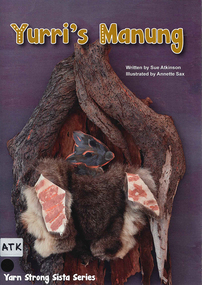
Book, Sue Atkinson, Yurri's manung, 2013
... ...educational activities...Yorta Yorta Barmah Forest bark hut language list educational activities Illustrations, maps, CD Yurri needed a warm place to sleep when winter came to the Barmah forest, her friends had no room for her in their homes in the trees, bushes, burrows and caves of the forest. ...Yurri needed a warm place to sleep when winter came to the Barmah forest, her friends had no room for her in their homes in the trees, bushes, burrows and caves of the forest. With the help of Uncle Ambrose a Yorta Yorta Elder they make her a home of her own. Yurri?s Manung written by Sue Atkinson (Yorta Yorta) and illustrated by Annette Sax (Taungurung). This is the second book in the YSS series, giving insight into Indigenous Victorian culture. The ?Yarn Strong Sista? series is supported by background notes and ideas for related activities.Illustrations, maps, CDyorta yorta, barmah forest, bark hut, language list, educational activities -
 Victorian Aboriginal Corporation for Languages
Book, Sue Atkinson, Bartja and Mayila, 2013
... ...educational activities...Yorta Yorta educational activities Barmah Forest language list Maps, illustrations, CD When Bartja? ...When Bartja?s best friend Mayila plans to leave the forest they live in to visit the ocean, Bartja wants to find her the perfect parting gift. With some advice from Uncle Ambrose and the forest animals, Bartja creates a gift that Mayila will treasure. Bartja and Mayila written by Sue Atkinson (Yorta Yorta) and illustrated by Annette Sax (Taungurung). This is the first book in the YSS series, giving young children insight into Indigenous Victorian culture. The ?Yarn Strong Sista? series is supported by background notes and ideas for related activities.Maps, illustrations, CDyorta yorta, educational activities, barmah forest, language list -
 Victorian Aboriginal Corporation for Languages
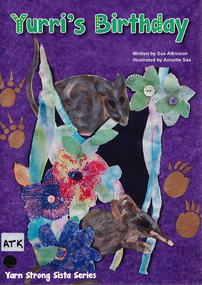
Book, Sue Atkinson, Yurri's birthday, 2013
... ...educational activities...yorta yorta barmah forest basket weaving educational activities language list Illustrations, maps Tonight would be a very special night for Yurri, it is her birthday. ...Tonight would be a very special night for Yurri, it is her birthday. At midnight each of Yurri's friends arrive with a basket. Inside each basket is a gift for Yurri. Each illustrated basket has been made by women who live in Victoria and are passionate about the revival of basket coiling! Yurri's Birthday written by Sue Atkinson (Yorta Yorta) and illustrated by Annette Sax (Taungurung). This is the third book in the YSS series, giving young children insight into Indigenous Victorian culture. The Yarn Strong Sista series is supported by background notes and ideas for related activities.Illustrations, mapsyorta yorta, barmah forest, basket weaving, educational activities, language list -
 Melbourne Legacy
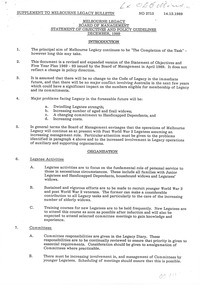
Document, Melbourne Legacy, Board of Management, Statement of Objectives and Policy Guidelines, December, 1989
... Funding of youth and educational activities. Expenditure control....Funding of youth and educational activities. Expenditure control. Document recognises some major problems facing Legacy into the future and seeks to address these problems. objectives policies Black type, notation in red biro top right hand corner, page one. ...Document notes the declining number of Legatees and increasing number of elderly widows. Importance of Widows Clubs. The provision of accommodation to elderly widows. Handicapped dependants. Funding of youth and educational activities. Expenditure control.Document recognises some major problems facing Legacy into the future and seeks to address these problems.White A4 paper x 4 pages of policy guidelines.Black type, notation in red biro top right hand corner, page one. Notation in blue biro, top left hand side, page four.objectives, policies -
 Melbourne Legacy
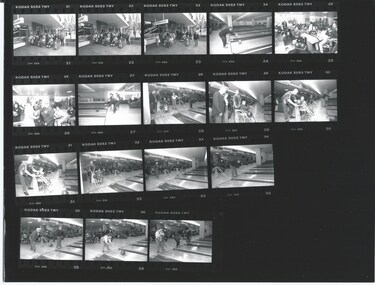
Photograph - Junior legatee outing, Bowling
... Every month Legacy's handicapped dependents were invited to go on outing for take part in recreational and educational activities. These programmes aimed to develop independence and thus lessen the need for reliance on others for simple routine functions. ...Every month Legacy's handicapped dependents were invited to go on outing for take part in recreational and educational activities. These programmes aimed to develop independence and thus lessen the need for reliance on others for simple routine functions. ...These photos show a gathering of Legacy's handicapped dependents outside Legacy House. Also an outing to a bowling alley. Every month Legacy's handicapped dependents were invited to go on outing for take part in recreational and educational activities. These programmes aimed to develop independence and thus lessen the need for reliance on others for simple routine functions. Once a year there is a two week camp this also gave the mothers some respite. The photos are from approximately early 1990s.A record of the type of activities Legacy provided for the handicapped dependents of the Legacy families.Black and white proof sheet of photos taken at a HDC outing at a bowling alley and a gathering outside Legacy House.junior legatee outing, hdc, bowling -
 Melbourne Legacy
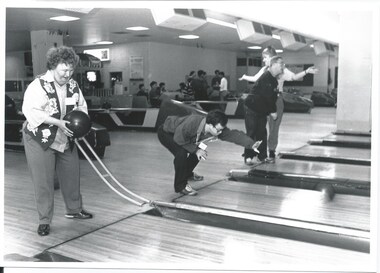
Photograph - Junior legatee outing, Bowling, 1994
... Every month Legacy's handicapped dependents were invited to go on outing for take part in recreational and educational activities. These programmes aimed to develop independence and thus lessen the need for reliance on others for simple routine functions. ...Every month Legacy's handicapped dependents were invited to go on outing for take part in recreational and educational activities. These programmes aimed to develop independence and thus lessen the need for reliance on others for simple routine functions. ...This photo shows a few of Legacy's disabled dependents on an outing to a bowling alley. Every month Legacy's handicapped dependents were invited to go on outing for take part in recreational and educational activities. These programmes aimed to develop independence and thus lessen the need for reliance on others for simple routine functions. Once a year there is a two week camp this also gave the mothers some respite. The photos are from early 1994 as they were featured in the Answer newsletter in April 1994.A record of the type of activities Legacy provided for the handicapped dependents of the Legacy families. Names on a slip of paper have tried to identify the dependents. 'Russell Sister, Julie Kenny (?), David Mossof (?)'Black and white photo taken at a HDC outing at a bowling alley.junior legatee outing, bowling, answer, ddc, hdc -
 Kiewa Valley Historical Society
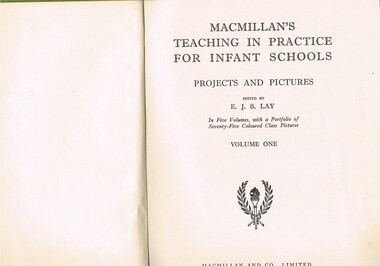
Book - Reference Teaching Infants, MacMillan's Teaching in Practice for Infant Schools Projects and Pictures Vol. 1, 1949
... It was not until the mid 1950s that the Australian dialect and social mores were accepted as suitable for educational activities....It was not until the mid 1950s that the Australian dialect and social mores were accepted as suitable for educational activities. This item was used in Mount Beauty Primary School as part of a teacher's curriculum. ...This item was reprinted in 1949 (first edition in 1934) in Great Britain and used in Victorian Infant school classes.This was in the era where "mother England" was still the favourite source of educational text books for Australian primary schools. "Australianism" was frowned upon by educational institutions as being not proper English. This belief lingered on for a longer period in private schools, where "ockerism" was a dirty word. It was not until the mid 1950s that the Australian dialect and social mores were accepted as suitable for educational activities.This item was used in Mount Beauty Primary School as part of a teacher's curriculum. The fact that it was in a rural area, Kiewa Valley did present a slightly different learning atmosphere than in the larger towns and cities. The majority of parents within the Kiewa Valley, had a slight resentment of the "high and mighty" attitude of city dwellers with a "plum in their mouths" and the effectiveness of city bred teachers was how to overcome these ingrained mores. The mentioning of European nations and lifestyles was to the pupils in the infant schools far more like "fairyland" than the realism that they experienced on the "land". However at this age level fantasy was more important than reality. Australian fantasy tales e.g. Blinky Bill (circa 1930s) introduced main characters that infants could identify, especially in rural schools.This item is a green coloured hard backed book containing 384 double sided pages. Nearly all pages have black writing and free hand sketches. There are some pages of duplicated sheet music.See KVHS 0046, KVHS 0047, KVHS 0048 for the other volumes held.On the spine is "MACMILLANS TEACHING IN PRACTICE" below this "PROJECTS and PICTURES" underneath "VOL 1". On title page "edited by E.J.S.Lay" underneath VOLUME ONE. Below this there is printed a two branch wreath within these an "Olympic" type torch.infant school curriculum, teacher's aid reference, instruction book -
 Kiewa Valley Historical Society
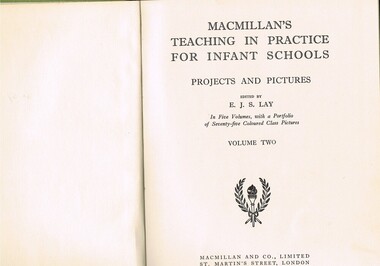
Book - Reference Teaching Infants, MacMillan's Teaching in Practice for Infant Schools Projects and Pictures Vol. 2, 1949
... It was not until the mid 1950s that the Australian dialect and social mores were accepted as suitable for educational activities....It was not until the mid 1950s that the Australian dialect and social mores were accepted as suitable for educational activities. This item was used in Mount Beauty Primary School as part of a teacher's curriculum. ...This item was reprinted in 1949 (first edition in 1934) in Great Britain and used in Victorian Infant school classes.This was in the era where "mother England" was still the favourite source of educational text books for Australian primary schools. "Australianism" was frowned upon by educational institutions as being not proper English. This belief lingered on for a longer period in private schools, where "ockerism" was a dirty word. It was not until the mid 1950s that the Australian dialect and social mores were accepted as suitable for educational activities.This item was used in Mount Beauty Primary School as part of a teacher's curriculum. The fact that it was in a rural area, Kiewa Valley did present a slightly different learning atmosphere than in the larger towns and cities. The majority of parents within the Kiewa Valley, had a slight resentment of the "high and mighty" attitude of city dwellers with a "plum in their mouths" and the effectiveness of city bred teachers was to overcome these ingrained mores. The mentioning of European nations and lifestyles was to the pupils in the infant schools far more like "fairyland" than the realism that they experienced on the "land". However at this age level fantasy was more important than reality. Australian fantasy tales e.g. Blinky Bill (circa 1930s) introduced main characters that infants could identify, especially in rural schools.This item is a green coloured hard backed book containing 768 double sided pages. Nearly all pages have black writing and free hand sketches. There are some pages of duplicated sheet music. See KVHS 0045, KVHS 0047, KVHS 0048 for the other volumes held.On the spine is "MACMILLANS TEACHING IN PRACTICE" below this "PROJECTS and PICTURES" underneath "VOL 2". On title page "edited by E.J.S.Lay" underneath VOLUME TWO. Below this there is printed a two branch wreath within these an "Olympic" type torch.infant school curriculum, teacher's aid reference, instruction book -
 Kiewa Valley Historical Society
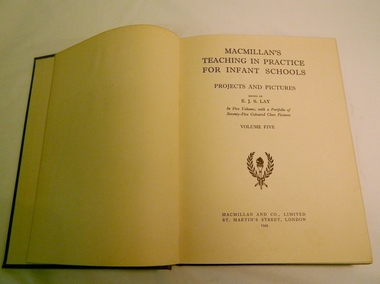
Book - Reference Teaching Infants, MacMillan's Teaching in Practice for Infant Schools Projects and Pictures Vol. 5, 1949
... It was not until the mid 1950s that the Australian dialect and social mores were accepted as suitable for educational activities....It was not until the mid 1950s that the Australian dialect and social mores were accepted as suitable for educational activities. This item was used in Mount Beauty Primary School as part of a teacher's curriculum. ...This item was reprinted in 1949 (first edition in 1934) in Great Britain and used in Victorian Infant school classes.This was in the era where "mother England" was still the favourite source of educational text books for Australian primary schools. "Australianism" was frowned upon by educational institutions as being not proper English. This belief lingered on for a longer period in private schools, where "ockerism" was a dirty word. It was not until the mid 1950s that the Australian dialect and social mores were accepted as suitable for educational activities.This item was used in Mount Beauty Primary School as part of a teacher's curriculum. The fact that it is in a rural area, Kiewa Valley did present a slightly different learning atmosphere than in the larger towns and cities. The majority of parents within the Kiewa Valley, had a slight resentment of the "high and mighty" attitude of city dwellers with a "plum in their mouths" and the effectiveness of city bred teachers was to overcome these ingrained mores. The mentioning of European nations and lifestyles was to the pupils in the infant schools far more like "fairyland" than the realism that they experienced on the "land". However at this age level fantasy was more important than reality. Australian fantasy tales e.g. Blinky Bill (circa 1930s) introduced main characters that infants could identify, especially in rural schools.This item is a green coloured hard backed book containing 2067 double sided pages. Nearly all pages have black writing and free hand sketches. There are some pages of duplicated sheet music.The last 13 pages contain the index of the total 5 volumes of the set. See KVHS 0045, KVHS 0046, KVHS 0047 for the the volumes held.On the spine is "MACMILLANS TEACHING IN PRACTICE" below this "PROJECTS and PICTURES" underneath "VOL 5". On title page "edited by E.J.S.Lay" underneath"VOLUME FIVE". Below this there is printed a two branch wreath within these an "Olympic" type torch.teacher's aid reference, instruction book, infant school curriculum -
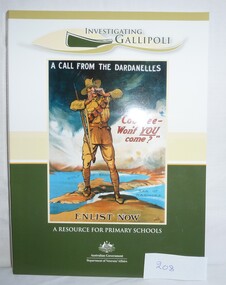 Greensborough Historical Society
Mixed media - Book and CD, Australia. Department of Veterans Affairs, Investigating Gallipoli : a resource for secondary schools, 2010
... Educational worksheets and activities used to teach children about Australia's role in the Gallipoli Campaign....Educational worksheets and activities used to teach children about Australia's role in the Gallipoli Campaign. australia department of veterans affairs gallipoli world war i educational aids Book: 80 p., illus. ...Educational worksheets and activities used to teach children about Australia's role in the Gallipoli Campaign.Book: 80 p., illus. (some col.), maps, worksheets. Includes 2 discs: Disc 1 (video) Australians at War Episode 2; Disc 2 (DVD-ROM) Interactive activities and ABCs Gallipoli: the First Day website.australia department of veterans affairs, gallipoli, world war i, educational aids -
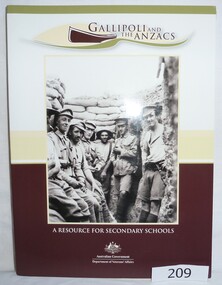 Greensborough Historical Society
Book - Book and CD, Australia. Department of Veterans Affairs, Gallipoli and the ANZACS : a resource for secondary schools, 2010_
... Educational worksheets and activities used to teach children about Australia's role in the Gallipoli Campaign....Educational worksheets and activities used to teach children about Australia's role in the Gallipoli Campaign. australia department of veterans affairs gallipoli world war i educational aids Book: 120 p., illus. ...Educational worksheets and activities used to teach children about Australia's role in the Gallipoli Campaign.Book: 120 p., illus. (some col.), maps, worksheets. Includes 2 discs: Disc 1 (video) Australians at War Episode 2 and, Revealing Gallipoli; Disc 2 (DVD-ROM) Interactive activities and ABCs Gallipoli: the First Day website.australia department of veterans affairs, gallipoli, world war i, educational aids -
Australian Commando Association - Victoria
Mixed media - From Tidal River to Timbered Knoll, Education Package - From Tidal River to Timbered Knoll
... It is particularly focused on those students who are attending Wilsons Promontory National Park and undertaking educational activities through the Parks Victoria Education Centre. ...It is particularly focused on those students who are attending Wilsons Promontory National Park and undertaking educational activities through the Parks Victoria Education Centre. ...This training package was produced by AVA Vic for use within the Victorian educational curriculum for years 10 to 12. It is particularly focused on those students who are attending Wilsons Promontory National Park and undertaking educational activities through the Parks Victoria Education Centre. The eight module program and teachers notes provides a historical workbook for students to gain a better understanding of the role of Tidal River as the initial training location for Australian and New Zealand commandos during World War II and the later military operations that were undertaken by commandos during World War II.Using original World War II footage, supplemented by later official record data this video and training package provides unique material regarding the history of Australian special operations during World War II.ww2, world war ii, independent companies, commando companies, australian special forces, tidal river -
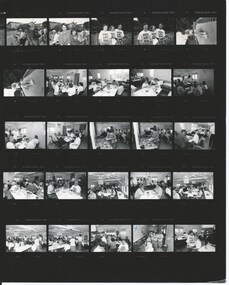 Melbourne Legacy
Photograph, HDC Camp at Somers Camp
... Every month Legacy's handicapped dependents were invited to go on outing for take part in recreational and educational activities. These programmes aim to develop independence and thus lessen the need for reliance on others for simple routine functions. ...Every month Legacy's handicapped dependents were invited to go on outing for take part in recreational and educational activities. These programmes aim to develop independence and thus lessen the need for reliance on others for simple routine functions. ...Every month Legacy's handicapped dependents were invited to go on outing for take part in recreational and educational activities. These programmes aim to develop independence and thus lessen the need for reliance on others for simple routine functions. Once a year there is a two week camp at Somers, believed to be the Somers School Camp. The date of these photos are not known. An article in the widows' newsletter in 1992 explains more detail on the 1992 camp. The article mentions that the annual camps run for two weeks at Somers Camp. It is a wonderful gathering of Junior Legatees, Legatees, and dedicated helpers. 50 junior legatees attended the 1992 camp with the personal attention almost one-to-one. With ages ranging from 22 to into the 60s, Legacy has to ensure it caters for the differing needs. A record of the type of activities Legacy provided for the handicapped dependents of the Legacy families.Black and white proof sheet of photos taken at a HDC at Somers.junior legatee outing, handicapped dependents, hdc -
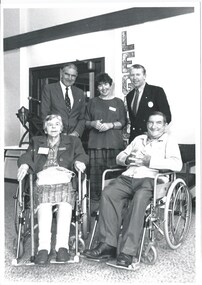 Melbourne Legacy
Photograph, New Wheelchairs, 1994
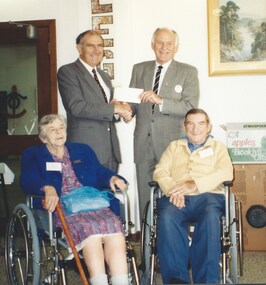
... Every month Legacy's handicapped dependents were invited to go on outing for take part in recreational and educational activities. These programmes aimed to develop independence and thus lessen the need for reliance on others for simple routine functions. ...Every month Legacy's handicapped dependents were invited to go on outing for take part in recreational and educational activities. These programmes aimed to develop independence and thus lessen the need for reliance on others for simple routine functions. ...Photo of Senator Barney Cooney (standing on left) with the recipients of two new wheelchairs. Senator Cooney represented the Department of Veterans Affairs when he presented the wheelchairs and a cheque for $7,000 to President George Woodward at Legacy House. The article in the Answer newsletter mentions: 'The grant of $7,000 will greatly assist Legacy's programs by covering the cost of bus hire needed for the regular outings organised during the year and the wheelchairs will provide additional assistance allowing more Junior Legatees to participate in activities.' After the presentation the junior Legatees went to the cinema and 10 pin bowling. Every month Legacy's handicapped dependents were invited to go on outing for take part in recreational and educational activities. These programmes aimed to develop independence and thus lessen the need for reliance on others for simple routine functions. Once a year there is a two week camp this also gave the mothers some respite. A record of the type of activities Legacy provided for the handicapped dependents of the Legacy families.Black and white photo of two wheelchair recipients at Legacy House.junior legatee outing, donation, hdc, ddc -
 Melbourne Legacy
Photograph, New Wheelchairs, 1994
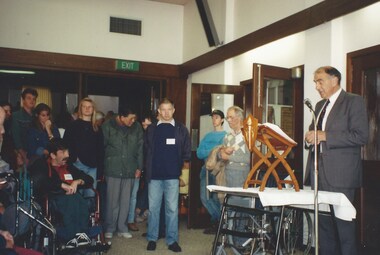
... Every month Legacy's handicapped dependents were invited to go on outing for take part in recreational and educational activities. These programmes aimed to develop independence and thus lessen the need for reliance on others for simple routine functions. ...Every month Legacy's handicapped dependents were invited to go on outing for take part in recreational and educational activities. These programmes aimed to develop independence and thus lessen the need for reliance on others for simple routine functions. ...Photo of Senator Barney Cooney (standing on left) with the recipients of two new wheelchairs. Senator Cooney represented the Department of Veterans Affairs when he presented the wheelchairs and a cheque for $7,000 to President George Woodward at Legacy House. The article in the Answer newsletter mentions: 'The grant of $7,000 will greatly assist Legacy's programs by covering the cost of bus hire needed for the regular outings organised during the year and the wheelchairs will provide additional assistance allowing more Junior Legatees to participate in activities.' After the presentation the junior Legatees went to the cinema and 10 pin bowling. Every month Legacy's handicapped dependents were invited to go on outing for take part in recreational and educational activities. These programmes aimed to develop independence and thus lessen the need for reliance on others for simple routine functions. Once a year there is a two week camp this also gave the mothers some respite. A record of the type of activities Legacy provided for the handicapped dependents of the Legacy families.Colour photo x 3 of two wheelchair recipients and the presentation at Legacy House.junior legatee outing, donation, hdc, ddc -
 Melbourne Legacy
Photograph, New Wheelchairs, 1994
... Every month Legacy's handicapped dependents were invited to go on outing for take part in recreational and educational activities. These programmes aimed to develop independence and thus lessen the need for reliance on others for simple routine functions. ...Every month Legacy's handicapped dependents were invited to go on outing for take part in recreational and educational activities. These programmes aimed to develop independence and thus lessen the need for reliance on others for simple routine functions. ...Photo of Senator Barney Cooney presenting a cheque to Legacy in front of a gathering of Legacy disabled dependents. Also some of the mothers gathered to watch. Senator Cooney represented the Department of Veterans Affairs when he presented two wheelchairs and a cheque for $7,000 to President George Woodward at Legacy House. The article in the Answer newsletter mentions: 'The grant of $7,000 will greatly assist Legacy's programs by covering the cost of bus hire needed for the regular outings organised during the year and the wheelchairs will provide additional assistance allowing more Junior Legatees to participate in activities.' After the presentation the junior Legatees went to the cinema and 10 pin bowling. Every month Legacy's handicapped dependents were invited to go on outing for take part in recreational and educational activities. These programmes aimed to develop independence and thus lessen the need for reliance on others for simple routine functions. Once a year there is a two week camp this also gave the mothers some respite. A record of the type of activities Legacy provided for the handicapped dependents of the Legacy families.Colour photo x 3 of two wheelchair recipients and the presentation at Legacy House.junior legatee outing, donation, hdc, ddc -
 Melbourne Legacy
Photograph, HDC Camp 1991, 1991
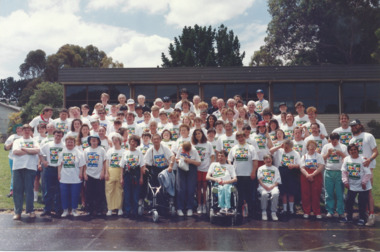
... Every month Legacy's handicapped dependents are invited to go on outing for take part in recreational and educational activities. These programmes aim to develop independence and thus lessen the need for reliance on others for simple routine functions. ...Every month Legacy's handicapped dependents are invited to go on outing for take part in recreational and educational activities. These programmes aim to develop independence and thus lessen the need for reliance on others for simple routine functions. ...Every month Legacy's handicapped dependents are invited to go on outing for take part in recreational and educational activities. These programmes aim to develop independence and thus lessen the need for reliance on others for simple routine functions. Once a year there is a two week camp at Somers Camp (believed to be Somers School Camp). This photo is from 1991. An article in the widows' newsletter in 1992 explains more detail on the 1992 camp. The article mentions that the annual camps run for two weeks at Somers Camp. It is a wonderful gathering of Junior Legatees, Legatees, and dedicated helpers. 50 junior legatees attended this camp (in 1992) with the personal attention almost one-to-one. With ages ranging from 22 to into the 60s, Legacy has to ensure it caters for the differing needs. Legatees headed by Camp Chief, Jim Hammon and Chairman of the Handicapped Dependents Committee, Merv Tickell, were supported by two Camp Co-Ordinators and 50 helpers known as 'leaders'. Many of the leaders are people in the workforce wishing to give something back to the community. Junior Legatees are organised into groups. They participate in horse-riding, swimming, golfing, strawberry picking, and many other activities. Photos were in a scrapbook of photos spanning 1983 to 1991.A record of the type of activities Legacy provided for the handicapped dependents of the Legacy families. Colour photo of a HDC camp and a yellow paper label.Handwritten in blue pen ' HDC Camp Jan 91'junior legatee outing, hdc, somers camp -
 Melbourne Legacy
Photograph, HDC Camp 1992, 1992
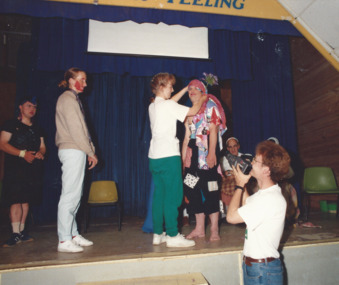
... Every month Legacy's handicapped dependents are invited to go on outings or take part in recreational and educational activities. These programmes aim to develop independence and thus lessen the need for reliance on others for simple routine functions. ...Every month Legacy's handicapped dependents are invited to go on outings or take part in recreational and educational activities. These programmes aim to develop independence and thus lessen the need for reliance on others for simple routine functions. ...Photos from a camp for handicapped dependents in January 1992. These photos show costumes and a stage production. Other photos from the camp are at 01560, 01562, 01563 and 01564. Some appeared in the newsletter in March 1992. The article mentions that the annual camps run for two weeks at Somers Camp (believed to be Somers School Camp). It is a wonderful gathering of Junior Legatees, Legatees, and dedicated helpers. 50 Legatees attended this camp with the personal attention almost one-to-one. With ages ranging from 22 to into the 60s, Legacy has to ensure it caters for the differing needs. Legatees headed by Camp Chief, Jim Hammon and Chairman of the Handicapped Dependents Committee, Merv Tickell, were supported by two Camp Co-Ordinators and 50 helpers known as 'leaders'. Many of the leaders are people in the workforce wishing to give something back to the community. Junior Legatees are organised into groups. They participate in horse-riding, swimming, golfing, strawberry picking, and many other activities. Every month Legacy's handicapped dependents are invited to go on outings or take part in recreational and educational activities. These programmes aim to develop independence and thus lessen the need for reliance on others for simple routine functions. Photos were in a scrapbook of photos spanning 1983 to 1991.A record of the type of activities Legacy provided for the handicapped dependents of the Legacy families. Colour photo x 3 of a HDC camp, a label and an article in the newsletter.Handwritten in blue pen 'HDC Camp -Somers / Jan 1992 / Camp Chief: L/ J Hammon / Co-ordinator Julien Hardy-Smith / Photo Eric Wadsworth / 51 J/Ls'junior legatee outing, hdc, somers camp -
 Melbourne Legacy
Photograph, HDC Camp 1992, 1992
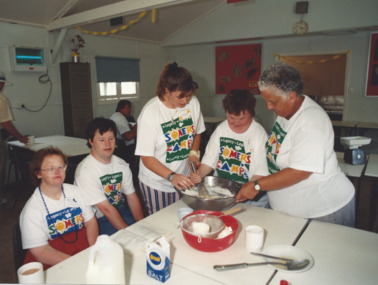
... Every month Legacy's handicapped dependents are invited to go on outing for take part in recreational and educational activities. These programmes aim to develop independence and thus lessen the need for reliance on others for simple routine functions. ...Every month Legacy's handicapped dependents are invited to go on outing for take part in recreational and educational activities. These programmes aim to develop independence and thus lessen the need for reliance on others for simple routine functions. ...Photos from a camp for handicapped dependents in January 1992. These photos show cooking classes. Other photos from the camp are at 01560, 01561, 01563 and 01564. Some appeared in the newsletter in March 1992. The article mentions that the annual camps run for two weeks at Somers Camp (believed to be Somers School Camp). It is a wonderful gathering of Junior Legatees, Legatees, and dedicated helpers. 50 Legatees attended this camp with the personal attention almost one-to-one. With ages ranging from 22 to into the 60s, Legacy has to ensure it caters for the differing needs. Legatees headed by Camp Chief, Jim Hammon and Chairman of the Handicapped Dependents Committee, Merv Tickell, were supported by two Camp Co-Ordinators and 50 helpers known as 'leaders'. Many of the leaders are people in the workforce wishing to give something back to the community. Junior Legatees are organised into groups. They participate in horse-riding, swimming, golfing, strawberry picking, and many other activities. Every month Legacy's handicapped dependents are invited to go on outing for take part in recreational and educational activities. These programmes aim to develop independence and thus lessen the need for reliance on others for simple routine functions. Photos were in a scrapbook of photos spanning 1983 to 1991.A record of the type of activities Legacy provided for the handicapped dependents of the Legacy families. Colour photo x 3 of a HDC camp, a label and an article in the newsletter.Handwritten in blue pen 'HDC Camp -Somers / Jan 1992 / Camp Chief: L/ J Hammon / Co-ordinator Julien Hardy-Smith / PhotoEric Wadsworth / 51 J/Ls'junior legatee outing, hdc, somers camp -
 Melbourne Legacy
Photograph, HDC Camp 1992, 1992
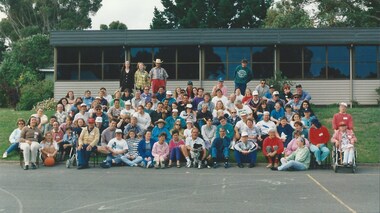
... Every month Legacy's handicapped dependents are invited to go on outing for take part in recreational and educational activities. These programmes aim to develop independence and thus lessen the need for reliance on others for simple routine functions. ...Every month Legacy's handicapped dependents are invited to go on outing for take part in recreational and educational activities. These programmes aim to develop independence and thus lessen the need for reliance on others for simple routine functions. ...Every month Legacy's handicapped dependents are invited to go on outing for take part in recreational and educational activities. These programmes aim to develop independence and thus lessen the need for reliance on others for simple routine functions. Once a year there is a two week camp, this is believed to be Somers School Camp. These photos are from 1992. An article in the widows' newsletter in 1992 explains more detail on the 1992 camp. The article mentions that the annual camps run for two weeks at Somers Camp. It is a wonderful gathering of Junior Legatees, Legatees, and dedicated helpers. 50 junior legatees attended this camp (in 1992) with the personal attention almost one-to-one. With ages ranging from 22 to into the 60s, Legacy has to ensure it caters for the differing needs. Legatees headed by Camp Chief, Jim Hammon and Chairman of the Handicapped Dependents Committee, Merv Tickell, were supported by two Camp Co-Ordinators and 50 helpers known as 'leaders'. Many of the leaders are people in the workforce wishing to give something back to the community. Junior Legatees are organised into groups. They participate in horse-riding, swimming, golfing, strawberry picking, and many other activities. Photos were in a scrapbook of photos spanning 1983 to 1991.A record of the type of activities Legacy provided for the handicapped dependents of the Legacy families. Colour photo x 5 of the HDC camp in January 1992 and a white paper label.Label says 'January is holiday time for Legacy's Junior Legatees. Children aged 7 to 17 join together for a 10 day action packed holiday at Camp Howqua and Legacy's disabled dependants enjoy quality time at Somers Camp. Legatees, members of the Melbourne Legacy Leadership Group and volunteer helpers ensure all have a memorable time.'camp, handicapped dependents, somers school camp -
 Ringwood and District Historical Society
Newspaper, Ringwood college's very busy August. - Post, 31-08-94, Page 13
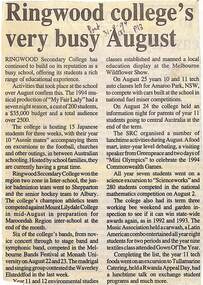
... Ringwood Secondary College has continued to build on its reputation as a busy school, offering its students a rich range of educational experience. Activities that took place at the school over August confirm this. ...Ringwood Secondary College has continued to build on its reputation as a busy school, offering its students a rich range of educational experience. Activities that took place at the school over August confirm this. ...ClippingRingwood Secondary College has continued to build on its reputation as a busy school, offering its students a rich range of educational experience. Activities that took place at the school over August confirm this. "My Fair Lady" had a 7 night season. The school hosted 15 Japanese students for three weeks and engaged in all types of educational experiences. Badminton, Hockey and athletics were successful. College bands and singing groups were in fine form. The SRC held a number of lunchtime activities. A visit to Scienceworks and garden working bees added to the myriad of August activities. -
 Melbourne Legacy
Photograph, HDC Camp 1992, 1991
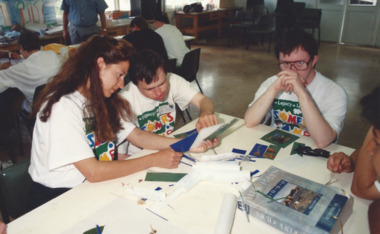
... Every month Legacy's handicapped dependents are invited to go on outings or take part in recreational and educational activities. These programmes aim to develop independence and thus lessen the need for reliance on others for simple routine functions. ...Every month Legacy's handicapped dependents are invited to go on outings or take part in recreational and educational activities. These programmes aim to develop independence and thus lessen the need for reliance on others for simple routine functions. ...Photos from a camp for handicapped dependents in January 1992. These photos show craft activities. One photo shows Chief Executive Terry Walsh with the children. Also a photo of a participant with the label 'Sharon proudly shows off her room'. Other photos from the camp are at 01561, 01562, 01563 and 01564. Some appeared in the newsletter in March 1992. The article mentions that the annual camps run for two weeks at Somers Camp (believed to be Somers School Camp). It is a wonderful gathering of Junior Legatees, Legatees, and dedicated helpers. 50 Legatees attended this camp with the personal attention almost one-to-one. With ages ranging from 22 to into the 60s, Legacy has to ensure it caters for the differing needs. Legatees headed by Camp Chief, Jim Hammon and Chairman of the Handicapped Dependents Committee, Merv Tickell, were supported by two Camp Co-Ordinators and 50 helpers known as 'leaders'. Many of the leaders are people in the workforce wishing to give something back to the community. Junior Legatees are organised into groups. They participate in horse-riding, swimming, golfing, strawberry picking, and many other activities. Every month Legacy's handicapped dependents are invited to go on outings or take part in recreational and educational activities. These programmes aim to develop independence and thus lessen the need for reliance on others for simple routine functions. Photos were in a scrapbook of photos spanning 1983 to 1992.A record of the type of activities Legacy provided for the handicapped dependents of the Legacy families. Colour photo x 6 of a HDC camp, a label and an article in the newsletter.Handwritten in blue pen 'HDC Camp -Somers / Jan 1992 / Camp Chief: L/ J Hammon / Co-ordinator Julien Hardy-Smith / PhotoEric Wadsworth / 51 J/Ls'junior legatee outing, hdc, somers camp -
 Melbourne Legacy
Photograph, HDC Camp 1992, 1992
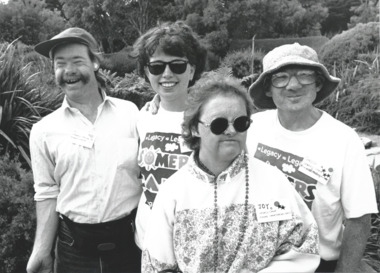
... Every month Legacy's handicapped dependents are invited to go on outing for take part in recreational and educational activities. These programmes aim to develop independence and thus lessen the need for reliance on others for simple routine functions. ...Every month Legacy's handicapped dependents are invited to go on outing for take part in recreational and educational activities. These programmes aim to develop independence and thus lessen the need for reliance on others for simple routine functions. ...Photos from a camp for handicapped dependents in January 1992. These photos show different camp activities, including arts and craft, eating meals, cleaning up in the kitchen and outside activities. Some appeared in the newsletter in March 1992. The article mentions that the annual camps run for two weeks at Somers Camp (believed to be Somers School camp). It is a wonderful gathering of Junior Legatees, Legatees, and dedicated helpers. 50 Legatees attended this camp with the personal attention almost one-to-one. With ages ranging from 22 to into the 60s, Legacy has to ensure it caters for the differing needs. Legatees headed by Camp Chief, Jim Hammon and Chairman of the Handicapped Dependents Committee, Merv Tickell, were supported by two Camp Co-Ordinators and 50 helpers known as 'leaders'. Many of the leaders are people in the workforce wishing to give something back to the community. Junior Legatees are organised into groups. They participate in horse-riding, swimming, golfing, strawberry picking, and many other activities. Every month Legacy's handicapped dependents are invited to go on outing for take part in recreational and educational activities. These programmes aim to develop independence and thus lessen the need for reliance on others for simple routine functions. Other photos from the camp are at 01560, 01561, and 01562 and 01564. Photos were in a scrapbook of photos spanning 1983 to 1992.A record of the type of activities Legacy provided for the handicapped dependents of the Legacy families. Black and white photo x 3 of a HDC camp, a label and an article in the newsletter.Handwritten in blue pen 'HDC Camp -Somers / Jan 1992 / Camp Chief: L/ J Hammon / Co-ordinator Julien Hardy-Smith / Photo Eric Wadsworth / 51 J/Ls'junior legatee outing, somers camp -
 Melbourne Legacy
Photograph, HDC Camp 1992, 1992
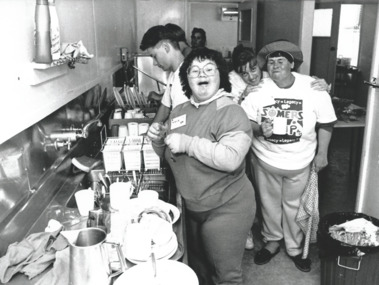
... Every month Legacy's handicapped dependents were invited to go on outings or take part in recreational and educational activities. These programmes aim to develop independence and thus lessen the need for reliance on others for simple routine functions. ...Every month Legacy's handicapped dependents were invited to go on outings or take part in recreational and educational activities. These programmes aim to develop independence and thus lessen the need for reliance on others for simple routine functions. ...Photos from a cam for handicapped dependents in January 1992. These photos show different camp activities, including arts and craft, eating meals, cleaning up in the kitchen and outside activities. Some appeared in the newsletter in March 1992. The article mentions that the annual camps run for two weeks at Somers Camp (believed to be Somers School Camp). It is a wonderful gathering of Junior Legatees, Legatees, and dedicated helpers. 50 Legatees attended this camp with the personal attention almost one-to-one. With ages ranging from 22 to into the 60s, Legacy has to ensure it caters for the differing needs. Legatees headed by Camp Chief, Jim Hammon and Chairman of the Handicapped Dependents Committee, Merv Tickell, were supported by two Camp Co-Ordinators and 50 helpers known as 'leaders'. Many of the leaders are people in the workforce wishing to give something back to the community. Junior Legatees are organised into groups. They participate in horse-riding, swimming, golfing, strawberry picking, and many other activities. Every month Legacy's handicapped dependents were invited to go on outings or take part in recreational and educational activities. These programmes aim to develop independence and thus lessen the need for reliance on others for simple routine functions. Other photos from the camp are at 01560, 01561, 01562 and 01563. Photos were in a scrapbook of photos spanning 1983 to 1991.A record of the type of activities Legacy provided for the handicapped dependents of the Legacy families. Black and white photo x 2 of a HDC camp, a label and an article in the newsletter.Handwritten in blue pen 'HDC Camp -Somers / Jan 1992 / Camp Chief: L/ J Hammon / Co-ordinator Julien Hardy-Smith / Photo Eric Wadsworth / 51 J/Ls'junior legatee outing, somers, somers camp -
 Federation University Historical Collection
Booklet, The Ballarat School of Mines and Industries 1870-1920 Jubilee Booklet, 1920 (estimated)
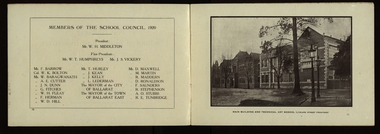
... educational purposed, and is yearly becoming more and more appreciated throughout the State. The chairman of one of Ballarat's biggests industries claims that the workman can do twice the day's work here that he can do in Melbourne. he was a little enthusiastic over it, perhaps, but it is a well-known fact that the healthy and invigourating Ballarat climate is conducive to both physical and mental activity, and the records of the School provide ample proof of it. ...educational purposed, and is yearly becoming more and more appreciated throughout the State. The chairman of one of Ballarat's biggests industries claims that the workman can do twice the day's work here that he can do in Melbourne. he was a little enthusiastic over it, perhaps, but it is a well-known fact that the healthy and invigourating Ballarat climate is conducive to both physical and mental activity, and the records of the School provide ample proof of it. ...The first school of Mines in Australia was established at Ballarat in 1870. At the time of its jubilee (1930) the following people were members of the School Council: W.H. Middleton (President), W.T. Humphreys (VP), J.S. Vickery (VP), F. Barrow, Col. W.K. Bolton, William Baragwanath, A.E. Cutter, J.N. Dunn, G. Fitches, W.H. Fleay, F. Herman. W.D. Hill, T. Hurley, K. Kean. J. Kelly, L. Lederman, Mayor of Ballarat, Mayour of Ballarat East, D. Maxwell, M. Martin, R. Maddern, D. Ronaldson, F. Saunders, R. Stephenson, A.O. Stubbs, R.E. Tunbridge. The School Staff in 1920 comprised: Herbert H. Smith, Walter Rowbotham, Reginald L. Cutter, M.C. Young, Hilda Wardle, M. Wiliamson, P.S. Richards, L.H. Archibald, J. Woods, Ken Moss, W. Kenneth, Mrs McIlvena. B. Robinson, S. Rowe, E. Hope-Jones, Miss Abrams, L.St.G.P. Austin, Alfred Mica Smith, J.R. Pound, Herbert R. Murphy, N.H. Junner, Maurice Copland, L.H. Archibald, E.J.A. McConnon, Newton King, D.m. Hull, T.R. Gordon, John M. Sutherland, T.K. Jebb, Dick Richards, C. Tonkin, A.W. Steane, J. Paterson, H.W. Malin, R.V. Maddison, S.M. Mayo, F.A. King, W.H. Steane, T.R. Gordon, T.A. Williams, H. Waldron, G. Black, E.J. McConnon, R.V. Duncan. R. Cutter, E.G. Vawdrey, Hilda WardleWhite stapled booklet - landscape format - 20pp + soft covers with blue writing. Includes an historical sketch of the Ballarat School of Mines. Contains images of the school from around 1920. The history outlined in the booklet follows: 'Ballarat has helped to influence the life and destinies of Australia in many ways, the recital of which would perhaps prove tedious to the citizens of less favoured localities! However, it can be said, without much fear of contradiction, that only less known thought Australia than its fame as a gold field is the reputation won for it by its school of Mines, ... Ballarat was still quite a new place when the School was founded, but a very propserous and popular place all the same, with a go-ahead lot of citizens brim full of the spirit of enterprise which seemsto animate mining populations generally. Money was plentiful, and they launched out into ventures, which later, were to develop and take the place of the gold mines, while what is more to the point, they understood the value of education. the old digging days were passing away. So far as Ballarat itself was concerned the day of the cradle and tin dish had already passed into an antiquity "as dead and distant as the age of the Tubal Caon," said dir redmond Barry on declaring the School open. Mining had become a serious business, and the mining engineer, the metallurgist, and the geologist had become a power in the land. In these circumstances the suggestions to found a School of Mines met with ready acceptance. The late Mr James M. Bickett had the honor of bringing forward the proposition at a meeting of the Ballarat Mining Board in October, 1869. it was agreed to, and the Government, having been approached for assistance, granted a lease of the old Supreme Court buildings at a nominal reantal. A modest sum, including 100 pounds from the Borough Council of Ballarat West, was subscribed by a number of sympathisers, and on the 26th October, 1870, the inaugural address was delivered by Sir Redmond Barry, the first President of the School. Classes were commenced on the 23rd January, 1871. The students at first were mostly adults. They were chiefly men emloyed at the mines, who had the wisdom and energy to devote their spare time to study, and, though their attendance was somewhat irregular, they made very good progress. Old prints which have been preserved show them at work at furnaces, big bearded men of the old-fashioned type of miner. It is interesting to note that among those who gave evidence and encouragement was Sir Roderick Murchison, who many years before had advised Cornish miners to emigrate to Australia to search for gold, and who in 1848 was in possession of gold ore sent from this country. Sir Roderick sent a parcel of books for the library, and gave useful advice as to the curriculum which should be adopted. The Museum, which now contains a most valuable collection of minerals, was one of the first things attended to, and the reports presented to the Council from time to time speak of additions being made from all parts of the world. New equipment was constantly being added to the School, a good deal of assay work was done, and some specimens were sent from the East Indies for examination as far back as 1873. By this time there was a difficulty in providing accomodation for the students who wished to enrol, and the number of instructors had grown from two to four. In 1882 the first building was being erected on what was then part of the gaol reserve. A little more than ten years afterwards a buildnig formerly serving as a Methodist Church was absorbed, while later on, the demand for accomodation increasing, the attack upon the gaol was renewed. The School continued to grow in reputation and size, and became the science centre of the district, and in 1889 a learge new building was opened by Sir Alexander Peacock. Students came from over seas as well as from all the States of Australia, and after going through their courses they took with them the name and fame of the old School to all parts of the globe. School of Mines boys have played a great part in developing the mining fields of Western Australia, South Australia, and africa, while old students who have made a name in their profession are constantly dropping in to see how the old place is getting along. It was not to be expected, however, that the Ballarat School would be left without rivals, its very success inspiring competition. Mining Schools were started in other parts of Australia, and, at the same time, Victoria ceased to hold first place as a mining state. On the other hand there was a great advance in manufacturing, and the demand for technicaly trained men became a great and as insistent as ever it had been for trained mining men. The Council was quick to adapt the school to the new conditions, and the result is seen in the institution, which is one of Ballarat's proudest possession. Instruction is given in all branches of technical work, and the classes are filled with students who are building up for Ballarat a reputation as an industrial centre, which promises to equal that which it formerly held as a mining town. Owing to its bracing climate, its abundant opportunities for recreations, and its accessibilty, Ballarat as a city is an ideal place for educational purposed, and is yearly becoming more and more appreciated throughout the State. The chairman of one of Ballarat's biggests industries claims that the workman can do twice the day's work here that he can do in Melbourne. he was a little enthusiastic over it, perhaps, but it is a well-known fact that the healthy and invigourating Ballarat climate is conducive to both physical and mental activity, and the records of the School provide ample proof of it. One of the most interesting and successful branches of the School of Mines and Industries - if the name be enlarged with the enlargement of its scope - is the Technical Art School. "The City of Statues" has from its earliest days been a stronghold of art. Art schools have flourised here, and in 1905 the Education Department came to the conclusion that the best thing to do with them was to place them under the management of the School of Mines Council. A magnificent new Technical Art School was built at a cost of some 12,000 pounds on the site of the old Supreme Court building, and was formally opened on the 23rd July, 1915. The results have not only been justified but surpassed all anticipations. The most comprehensive list of subjects is taught, and this list is constantly added to. Students have flocked to the art School, which may be said to occupy a unique position in Australia, and its record of success is really astonishing. Its students supply art teachers for the newer schools that are being built, and many occupy leading positinos in important business houses. So well is its reputation known that orders are constantly being received, not only from Victoria, but from other States, for honor boards and challenge shields to be designed and made. The most recent addition to the School of Mines and Industries is the Junior Technical School, for which a new building is now being erected on a portion of the gaol site, transferred to the School of Mines Counci by the Government. At the present moment temporary quarters are being occupied. Some students after passing through the Junior School go straight to employment, continuing perhaps to attend the evening trade classes, while others move on to the senior School. In a review of the work of the School of Mines mention must be made of a series of industrial research carried out under supervision of the Principal. One in particular, regarding the suitability of the local ores for the manufacture of pigments attracted much attention, while the experiemtns on the manufacture of white potery from Victorian clayes were considered of sufficient importance by the Federal Advisory Council of Science and Industry to warrant the appointment of a special investigator. The results of these have been most encouraging, and may have far-reaching consequences. The vocational training of returned soldiers also should not be overlooked. The work was taken in hand from the first, before the Repatriation Department gave assistance, and now with the help of the department of the School has become one of the largest vocational training centres in Victoria outside of Melbourne. The soldiers, trained in a variety of occupations, have made remarkable progress, and already considerable numbers have found employment in local workshops and factories. To sum up, the School is divided into the following departments, each well staffed and equipped: - The School of Mines, science, and Engineering; the Techncial Art School, the Boys' Junior Technical School, the Girl's Preparatory Technical Classes, Trade Classes, and the Commercial School. The school of Mines, science and Engineering, comprises the following branches: - Mining, Metallurgy, Geology, Electrical Engineering, Civil Engineering, Mechanical Engineering, Applied Chemistry, and Pharmacy. Battery treatments, Cyanide Testing, Smelting, Assays, and Clay Testing from a regular part of the School's work. Students gaining qualifications obtain concession in their courses at the university, should they proceed there to continue their studies. The technical Art school curriculum includes training in all branches of pictorial and applied art, an Architectural Diploma Course, a Draughtman's Course, technical Art teachers' Course, Photography,Ticket Writing, Art Metal Work, Woodcarving, Needlework, and Leather work. The Trade Classes give instruction in Telephone Mechanics, telegraphy, Carpentry, Cabinet Making, Plumbing, Blacksmithing, Fitting, Electric Wiring, and Printing. Numerous Scholarships are offered every year, and altogether students will find few places to equal the Ballarat School of Mines and Industries as a training place for their life's work. One of the first in the continent to be established, its Jubilee finds it still in the front rank, keeping pace with the times, and offering to the youths of this country the means of taking advantage of Australia's teeming opportunities. william, battery, smith, herbert, drawing from the antique, ballarat school of mines botanical gardens, ballarat school of mines, redmond barry, alfred mica smith, james bickett, museum, dick richards, ballarat junior technical school, s m b, ballarat school of mines and industries, ballarat technical art school, model mine, james m bickett, j m bickett, roderick murchison, vocational training rooms, wesley church, methodist church, alexander peacock, lathes, repatriation, repatriatin department, war service, school council, baragwanath, gold mining, mining laboratory, plaster cast, r.w. richards, anniversary, jubilee -
Federation University Historical Collection
Booklet, The Ballarat School of Mines and Industries 1870-1920 Jubilee Booklet, 1920 (estimated)
... educational purposed, and is yearly becoming more and more appreciated throughout the State. The chairman of one of Ballarat's biggests industries claims that the workman can do twice the day's work here that he can do in Melbourne. he was a little enthusiastic over it, perhaps, but it is a well-known fact that the healthy and invigourating Ballarat climate is conducive to both physical and mental activity, and the records of the School provide ample proof of it. ...educational purposed, and is yearly becoming more and more appreciated throughout the State. The chairman of one of Ballarat's biggests industries claims that the workman can do twice the day's work here that he can do in Melbourne. he was a little enthusiastic over it, perhaps, but it is a well-known fact that the healthy and invigourating Ballarat climate is conducive to both physical and mental activity, and the records of the School provide ample proof of it. ...The first school of Mines in Australia was established at Ballarat in 1870. At the time of its jubilee (1930) the following people were members of the School Council: W.H. Middleton (President), W.T. Humphreys (VP), J.S. Vickery (VP), F. Barrow, Col. W.K. Bolton, William Baragwanath, A.E. Cutter, J.N. Dunn, G. Fitches, W.H. Fleay, F. Herman. W.D. Hill, T. Hurley, K. Kean. J. Kelly, L. Lederman, Mayor of Ballarat, Mayour of Ballarat East, D. Maxwell, M. Martin, R. Maddern, D. Ronaldson, F. Saunders, R. Stephenson, A.O. Stubbs, R.E. Tunbridge. The School Staff in 1920 comprised: Herbert H. Smith, Walter Rowbotham, Reginald L. Cutter, M.C. Young, Hilda Wardle, M. Wiliamson, P.S. Richards, L.H. Archibald, J. Woods, Ken Moss, W. Kenneth, Mrs McIlvena. B. Robinson, S. Rowe, E. Hope-Jones, Miss Abrams, L.St.G.P. Austin, Alfred Mica Smith, J.R. Pound, Herbert R. Murphy, N.H. Junner, Maurice Copland, L.H. Archibald, E.J.A. McConnon, Newton King, D.m. Hull, T.R. Gordon, John M. Sutherland, T.K. Jebb, Dick Richards, C. Tonkin, A.W. Steane, J. Paterson, H.W. Malin, R.V. Maddison, S.M. Mayo, F.A. King, W.H. Steane, T.R. Gordon, T.A. Williams, H. Waldron, G. Black, E.J. McConnon, R.V. Duncan. R. Cutter, E.G. Vawdrey, Hilda WardleWhite stapled booklet - landscape format - 20pp + soft covers with blue writing. Includes an historical sketch of the Ballarat School of Mines. Contains images of the school from around 1920. The history outlined in the booklet follows: 'Ballarat has helped to influence the life and destinies of Australia in many ways, the recital of which would perhaps prove tedious to the citizens of less favoured localities! However, it can be said, without much fear of contradiction, that only less known thought Australia than its fame as a gold field is the reputation won for it by its school of Mines, ... Ballarat was still quite a new place when the School was founded, but a very propserous and popular place all the same, with a go-ahead lot of citizens brim full of the spirit of enterprise which seemsto animate mining populations generally. Money was plentiful, and they launched out into ventures, which later, were to develop and take the place of the gold mines, while what is more to the point, they understood the value of education. the old digging days were passing away. So far as Ballarat itself was concerned the day of the cradle and tin dish had already passed into an antiquity "as dead and distant as the age of the Tubal Caon," said dir redmond Barry on declaring the School open. Mining had become a serious business, and the mining engineer, the metallurgist, and the geologist had become a power in the land. In these circumstances the suggestions to found a School of Mines met with ready acceptance. The late Mr James M. Bickett had the honor of bringing forward the proposition at a meeting of the Ballarat Mining Board in October, 1869. it was agreed to, and the Government, having been approached for assistance, granted a lease of the old Supreme Court buildings at a nominal reantal. A modest sum, including 100 pounds from the Borough Council of Ballarat West, was subscribed by a number of sympathisers, and on the 26th October, 1870, the inaugural address was delivered by Sir Redmond Barry, the first President of the School. Classes were commenced on the 23rd January, 1871. The students at first were mostly adults. They were chiefly men emloyed at the mines, who had the wisdom and energy to devote their spare time to study, and, though their attendance was somewhat irregular, they made very good progress. Old prints which have been preserved show them at work at furnaces, big bearded men of the old-fashioned type of miner. It is interesting to note that among those who gave evidence and encouragement was Sir Roderick Murchison, who many years before had advised Cornish miners to emigrate to Australia to search for gold, and who in 1848 was in possession of gold ore sent from this country. Sir Roderick sent a parcel of books for the library, and gave useful advice as to the curriculum which should be adopted. The Museum, which now contains a most valuable collection of minerals, was one of the first things attended to, and the reports presented to the Council from time to time speak of additions being made from all parts of the world. New equipment was constantly being added to the School, a good deal of assay work was done, and some specimens were sent from the East Indies for examination as far back as 1873. By this time there was a difficulty in providing accomodation for the students who wished to enrol, and the number of instructors had grown from two to four. In 1882 the first building was being erected on what was then part of the gaol reserve. A little more than ten years afterwards a buildnig formerly serving as a Methodist Church was absorbed, while later on, the demand for accomodation increasing, the attack upon the gaol was renewed. The School continued to grow in reputation and size, and became the science centre of the district, and in 1889 a learge new building was opened by Sir Alexander Peacock. Students came from over seas as well as from all the States of Australia, and after going through their courses they took with them the name and fame of the old School to all parts of the globe. School of Mines boys have played a great part in developing the mining fields of Western Australia, South Australia, and africa, while old students who have made a name in their profession are constantly dropping in to see how the old place is getting along. It was not to be expected, however, that the Ballarat School would be left without rivals, its very success inspiring competition. Mining Schools were started in other parts of Australia, and, at the same time, Victoria ceased to hold first place as a mining state. On the other hand there was a great advance in manufacturing, and the demand for technicaly trained men became a great and as insistent as ever it had been for trained mining men. The Council was quick to adapt the school to the new conditions, and the result is seen in the institution, which is one of Ballarat's proudest possession. Instruction is given in all branches of technical work, and the classes are filled with students who are building up for Ballarat a reputation as an industrial centre, which promises to equal that which it formerly held as a mining town. Owing to its bracing climate, its abundant opportunities for recreations, and its accessibilty, Ballarat as a city is an ideal place for educational purposed, and is yearly becoming more and more appreciated throughout the State. The chairman of one of Ballarat's biggests industries claims that the workman can do twice the day's work here that he can do in Melbourne. he was a little enthusiastic over it, perhaps, but it is a well-known fact that the healthy and invigourating Ballarat climate is conducive to both physical and mental activity, and the records of the School provide ample proof of it. One of the most interesting and successful branches of the School of Mines and Industries - if the name be enlarged with the enlargement of its scope - is the Technical Art School. "The City of Statues" has from its earliest days been a stronghold of art. Art schools have flourised here, and in 1905 the Education Department came to the conclusion that the best thing to do with them was to place them under the management of the School of Mines Council. A magnificent new Technical Art School was built at a cost of some 12,000 pounds on the site of the old Supreme Court building, and was formally opened on the 23rd July, 1915. The results have not only been justified but surpassed all anticipations. The most comprehensive list of subjects is taught, and this list is constantly added to. Students have flocked to the art School, which may be said to occupy a unique position in Australia, and its record of success is really astonishing. Its students supply art teachers for the newer schools that are being built, and many occupy leading positinos in important business houses. So well is its reputation known that orders are constantly being received, not only from Victoria, but from other States, for honor boards and challenge shields to be designed and made. The most recent addition to the School of Mines and Industries is the Junior Technical School, for which a new building is now being erected on a portion of the gaol site, transferred to the School of Mines Counci by the Government. At the present moment temporary quarters are being occupied. Some students after passing through the Junior School go straight to employment, continuing perhaps to attend the evening trade classes, while others move on to the senior School. In a review of the work of the School of Mines mention must be made of a series of industrial research carried out under supervision of the Principal. One in particular, regarding the suitability of the local ores for the manufacture of pigments attracted much attention, while the experiemtns on the manufacture of white potery from Victorian clayes were considered of sufficient importance by the Federal Advisory Council of Science and Industry to warrant the appointment of a special investigator. The results of these have been most encouraging, and may have far-reaching consequences. The vocational training of returned soldiers also should not be overlooked. The work was taken in hand from the first, before the Repatriation Department gave assistance, and now with the help of the department of the School has become one of the largest vocational training centres in Victoria outside of Melbourne. The soldiers, trained in a variety of occupations, have made remarkable progress, and already considerable numbers have found employment in local workshops and factories. To sum up, the School is divided into the following departments, each well staffed and equipped: - The School of Mines, science, and Engineering; the Techncial Art School, the Boys' Junior Technical School, the Girl's Preparatory Technical Classes, Trade Classes, and the Commercial School. The school of Mines, science and Engineering, comprises the following branches: - Mining, Metallurgy, Geology, Electrical Engineering, Civil Engineering, Mechanical Engineering, Applied Chemistry, and Pharmacy. Battery treatments, Cyanide Testing, Smelting, Assays, and Clay Testing from a regular part of the School's work. Students gaining qualifications obtain concession in their courses at the university, should they proceed there to continue their studies. The technical Art school curriculum includes training in all branches of pictorial and applied art, an Architectural Diploma Course, a Draughtman's Course, technical Art teachers' Course, Photography,Ticket Writing, Art Metal Work, Woodcarving, Needlework, and Leather work. The Trade Classes give instruction in Telephone Mechanics, telegraphy, Carpentry, Cabinet Making, Plumbing, Blacksmithing, Fitting, Electric Wiring, and Printing. Numerous Scholarships are offered every year, and altogether students will find few places to equal the Ballarat School of Mines and Industries as a training place for their life's work. One of the first in the continent to be established, its Jubilee finds it still in the front rank, keeping pace with the times, and offering to the youths of this country the means of taking advantage of Australia's teeming opportunities. william, battery, smith, herbert, drawing from the antique, ballarat school of mines botanical gardens, ballarat school of mines, redmond barry, alfred mica smith, james bickett, museum, dick richards, ballarat junior technical school, s m b, ballarat school of mines and industries, ballarat technical art school, model mine, james m bickett, j m bickett, roderick murchison, vocational training rooms, wesley church, methodist church, alexander peacock, lathes, repatriation, repatriatin department, war service, school council, baragwanath, gold mining, mining laboratory, plaster cast, r.w. richards, anniversary, jubilee -
Federation University Historical Collection
Book - Book - Scrapbook, Ballarat School of MInes: Scrapbook of Newspaper Cuttings, Book 78, April 1997 to June 1997
... activities and advertisements for staff. The papers concerned are The Courier, Ballarat, The Australian, The Age and other region papers over the period of 4 April 1997 to 5 June 1997. teaching positions advertised pre-employment courses courses available enrolment for smb courses asian trip to lift profiles uni ans smb unit to fight outsider peter bailey champion welder trip to world titles angela mazur keeps up tradition graduates aid uni recruiting ballarat - a centre of educational excellence safer food handling uni proposal to wimmera merger would provide benefits wimmera institute of tafe horsham campus overseas campus coup malaysian tertiary campus contract ararat tafe stands to benefit from merger apprentice andrew rodgers takes top award support for arts assets drive smb expands training program uni to offer courses in indonesia trainees a credit to employers trainee of the year award academy needs help to succeed arthur senior - obituary ashes to be scattered near the heads smb new course in hygiene smb presents "ship of fools" $18m to ballarat program puts rural women into study maeve mckeown co-ordinator of rwap uni chief hits back at call for mergers joint venture in china newspaper important teaching tool tertiary merger closer early childhood studies at smb your university - message from vice-chancellor interview with dr ron wild university tafe plan worries australian education union tertiary merger hinges on smb talks video link overcomes distance opportunity and agriculture smb seeks extra time bapa launch smb will keep title in merger smb awards night Book with yellow cover, front, spiral bound. ...Collection of newspaper articles related to Ballarat School Of Mines.They cover activities and advertisements for staff. The papers concerned are The Courier, Ballarat, The Australian, The Age and other region papers over the period of 4 April 1997 to 5 June 1997. Book with yellow cover, front, spiral bound. teaching positions advertised, pre-employment courses, courses available, enrolment for smb courses, asian trip to lift profiles, uni ans smb unit to fight outsider, peter bailey champion welder, trip to world titles, angela mazur keeps up tradition, graduates aid uni recruiting, ballarat - a centre of educational excellence, safer food handling, uni proposal to wimmera, merger would provide benefits, wimmera institute of tafe, horsham campus, overseas campus coup, malaysian tertiary campus contract, ararat tafe stands to benefit from merger, apprentice andrew rodgers takes top award, support for arts assets drive, smb expands training program, uni to offer courses in indonesia, trainees a credit to employers, trainee of the year award, academy needs help to succeed, arthur senior - obituary, ashes to be scattered near the heads, smb new course in hygiene, smb presents "ship of fools", $18m to ballarat, program puts rural women into study, maeve mckeown co-ordinator of rwap, uni chief hits back at call for mergers, joint venture in china, newspaper important teaching tool, tertiary merger closer, early childhood studies at smb, your university - message from vice-chancellor, interview with dr ron wild, university tafe plan worries australian education union, tertiary merger hinges on smb talks, video link overcomes distance, opportunity and agriculture, smb seeks extra time, bapa launch, smb will keep title in merger, smb awards night -
Federation University Historical Collection
Book - Book - Scrapbook, Ballarat School of MInes: Scrapbook of Newspaper Cuttings, Book 15, June 1982 to October 1982
... activities and advertisements for staff. The papers concerned are The Courier, Ballarat, The Australian, The Age over the period of 18 June 1982 to 27 October 1982. courses available teaching positions advertised tafe sales and marketing course regional boards face axe the welcome nugget heavy demand for computer classes at smb apprenticeship scheme to cater for 15 new apprentices neil ferguson - educational imbalance tippett receives city award seminar on tertiary education retirement planning urged plumbing apprentices move at smb robert lovell deputy head at smb smb women's access program dorothy jenkins judy mills carol woolman glen sobey finalist in top apprentice for the year waiter training course completed alison shears sally hill jill reid geraldine o'hearn gavindooley peter nunn glen sobey apprentice of the year 1982 statewide building society award to glen sobey secretarial course at smb smb welfare course 112 years of technical education in australia Book with white cover, front, spiral bound. ...Collection of newspaper articles related to Ballarat School Of Mines.They cover activities and advertisements for staff. The papers concerned are The Courier, Ballarat, The Australian, The Age over the period of 18 June 1982 to 27 October 1982.Book with white cover, front, spiral bound. courses available, teaching positions advertised, tafe sales and marketing course, regional boards face axe, the welcome nugget, heavy demand for computer classes at smb, apprenticeship scheme to cater for 15 new apprentices, neil ferguson - educational imbalance, tippett receives city award, seminar on tertiary education, retirement planning urged, plumbing apprentices move at smb, robert lovell deputy head at smb, smb women's access program, dorothy jenkins, judy mills, carol woolman, glen sobey finalist in top apprentice for the year, waiter training course completed, alison shears, sally hill, jill reid, geraldine o'hearn, gavindooley, peter nunn, glen sobey apprentice of the year 1982, statewide building society award to glen sobey, secretarial course at smb, smb welfare course, 112 years of technical education in australia -
Federation University Historical Collection
Book - Book - Scrapbook, Ballarat School of MInes: Scrapbook of Newspaper Cuttings, Book 17, February 1983 to June 1983
... activities and advertisements for staff. The papers concerned are The Courier, Ballarat, The Australian, The Age over the period of 12 February 1983 to 4 June 1983. courses available teaching positions advertised helping unemployed cope with life jill ewence coordinator of ballarat program women's access program at smb judy mills convenor new clothing firm aims for high quality ballarat teacher's antarctic adventure catering and hospitality course at smb tafe manager peter cutter official opening of smb hairdressing training school at smb 10/03/1983 revising educational aims smb catering course gillian malone pam hekkema fiona cox rod brangrove janine cody joanne filippe bernadette groat sherri lang oddie brings state's first country exchange to ballarat introduction of phone smb starts course for machinists rick van berkel wins tippett award motorcycle riders' training complex - site selected greg mannix fashion and fabric design visit by indonesian education advisors geoff mainwaring artist - work belongs to the nation vocational skills centre opened at smb - 29 April 1983 graduates face great challenges money for smb sports building philiptjerkstra competing in internationalskill olympics in austria mining education returns home bcae gains honor position helping young unemployed john francis top apprentice motor mechanic new breed of secretary industrial training centre Book with white cover, front, spiral bound. ...Collection of newspaper articles related to Ballarat School Of Mines.They cover activities and advertisements for staff. The papers concerned are The Courier, Ballarat, The Australian, The Age over the period of 12 February 1983 to 4 June 1983.Book with white cover, front, spiral bound. courses available, teaching positions advertised, helping unemployed cope with life, jill ewence coordinator of ballarat program, women's access program at smb, judy mills convenor, new clothing firm aims for high quality, ballarat teacher's antarctic adventure, catering and hospitality course at smb, tafe manager peter cutter, official opening of smb hairdressing training school at smb, 10/03/1983, revising educational aims, smb catering course, gillian malone, pam hekkema, fiona cox, rod brangrove, janine cody, joanne filippe, bernadette groat, sherri lang, oddie brings state's first country exchange to ballarat, introduction of phone, smb starts course for machinists, rick van berkel wins tippett award, motorcycle riders' training complex - site selected, greg mannix fashion and fabric design, visit by indonesian education advisors, geoff mainwaring artist - work belongs to the nation, vocational skills centre opened at smb - 29 april 1983, graduates face great challenges, money for smb sports building, philiptjerkstra competing in internationalskill olympics in austria, mining education returns home, bcae gains honor position, helping young unemployed, john francis top apprentice motor mechanic, new breed of secretary, industrial training centre -
Federation University Historical Collection
Notes, Kath Cunningham, Ballarat Teachers' College Creative Activities Notes, 1962, 1962
... educational and social equity, teaching excellence, research distinction, environmental sustainability and regional capacity building has enabled it to develop in a way that draws on its proud heritage to inform its future. Its regional character sets a framework for the University’s priorities but does not constrain it from serving wider community interests, nationally and internationally. The name Federation University Australia was chosen to convey the scope and capacity of an expanded regional university with a federated network of campuses. education creative activities ...Ballarat Teachers' College notes on teaching Creative Studies and Needlework to primary school children. Federation University Australia was established on 1 January 2014. Formerly known as the University of Ballarat, its enabling legislation was the University of Ballarat Amendment (Federation University Australia) Act 2013. Although formally created as a University in 1994, the University of Ballarat has a lineage back to 1870 with the establishment of the School of Mines Ballarat, making it the third institution of higher learning to be established in Australia and the first to be established in regional Australia. On 1 January 1994, Ballarat University College became the University of Ballarat and in 1998 the University merged with three TAFE Institutes to become a dual sector institution with multiple campuses. On 1 January 2014, the University of Ballarat amalgamated with the Monash University Gippsland Campus to form Federation University Australia. The Gippsland Campus also had a long lineage dating back to 1928 with the establishment of the Yallourn Technical School which became a predecessor institution to the Gippsland College of Advanced Education formed in 1968. In 1990, it was renamed the Monash University College and in 1993 became the Gippsland Campus of Monash University. In 2016, Federation University Australia announced plans to take possession, over a two-year period, of Monash’s Berwick Campus in the south-east corridor of Melbourne. Federation University Australia, or FedUni, is headquartered in Ballarat and offers programs in Higher Education and Vocational Education and Training to regional Victoria and beyond. The University’s commitment to educational and social equity, teaching excellence, research distinction, environmental sustainability and regional capacity building has enabled it to develop in a way that draws on its proud heritage to inform its future. Its regional character sets a framework for the University’s priorities but does not constrain it from serving wider community interests, nationally and internationally. The name Federation University Australia was chosen to convey the scope and capacity of an expanded regional university with a federated network of campuses.A number of notes relating to teaching creative activities to primary school children. Includes needlework samples. education, creative activities, art, needlework, samples, apron
