
Showing 48 items matching "electric bell"
-
 Federation University Historical Collection
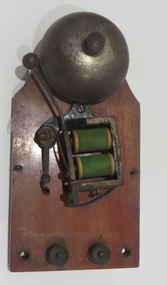
Object, Electric Bell
... Electric Bell...electric bell...Electric bell used for a door or telephone. Bell has a backing of wood and the electrical components....electric bell bell doorbell telephone bell Electric bell used for a door or telephone. ...Electric bell used for a door or telephone. Bell has a backing of wood and the electrical components.electric bell, bell, doorbell, telephone bell -
 Bendigo Historical Society Inc.
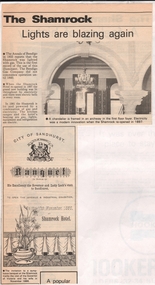
Newspaper - NEWSPAPER CLIPPINGS SHAMROCK HOTEL, Unknown
... Electric light lit the interior throughout and there were electric bells in every room. (The fourth Image directly underneath) depicts an invitation to the Governor of Victoria and his wife Lady Loch to a sumptuous banquet at The Shamrock in Novemebr 1886 to commemmorate their visit Sandhurst for the opening of the Juvenile and Industrial Exhibition....Electric light lit the interior throughout and there were electric bells in every room. (The fourth Image directly underneath) depicts an invitation to the Governor of Victoria and his wife Lady Loch to a sumptuous banquet at The Shamrock in Novemebr 1886 to commemmorate their visit Sandhurst for the opening of the Juvenile and Industrial Exhibition. ...(Third Newspaper Clipping )The Shamrock lights are blazing again article. Photograph of a chandelier framed in an archway in the first floor foyer. Electricity was a modern innovation when the Shamrock re-opened in 1897. Electric light lit the interior throughout and there were electric bells in every room. (The fourth Image directly underneath) depicts an invitation to the Governor of Victoria and his wife Lady Loch to a sumptuous banquet at The Shamrock in Novemebr 1886 to commemmorate their visit Sandhurst for the opening of the Juvenile and Industrial Exhibition.bendigo, history, shamrock hotel -
 Kiewa Valley Historical Society
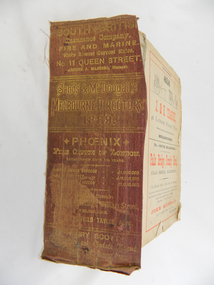
Book - Reference Melbourne Directory, Melbourne and Suburban Directory for 1889, Circa 1889
... This was a period of high moral standing within the community and hotels advertised rooms " suites of rooms for families and single rooms for Ladies and Gentlemen" also "electric bells throughout the house. Telephone, night porter and hot and cold baths."...This was a period of high moral standing within the community and hotels advertised rooms " suites of rooms for families and single rooms for Ladies and Gentlemen" also "electric bells throughout the house. Telephone, night porter and hot and cold baths." ...This Directory of 1889 covers the location of Melbourne based trade and professional offices by street and in Alphabetical order. It covers all of Melbourne and its suburbs. It also covers government and official, ecclesiastic, legal, municipal and miscellaneous information. The directory details a cross section of a developing city with a splattering of advertisements opening up an in depth look of all aspects of living in the late 1800s. It is interesting to see that all the advertisements do not have any telecommunication numbers listed (personal shoppers or mail orders only). This was a period of high moral standing within the community and hotels advertised rooms " suites of rooms for families and single rooms for Ladies and Gentlemen" also "electric bells throughout the house. Telephone, night porter and hot and cold baths."This directory would be used by the majority of families and businesses working and living within the Kiewa Valley and the surrounding area. Melbourne was the only place where every aspect of living requirement was catered for. Although the delivery of services and goods were not at a high rate, certain items or transactions would require a visit to "the big smoke". Business information are listed both by suburb and alphabetically. There is also a section for British and Foreign Trade. This directory covered nearly everything to do with commerce, an example pay days for principle firms. Greater evolution of trade locations started to balloon out after the mid 1950's. Increased populations and greater levels of communication and safe fast transport facilities permitted greater devolution of commercial enterprises into rural communities, such as the Kiewa Valley.This directory has no front or back cover and is held together by its cloth spine. It contains over 1300 pages, however there may be some pages missing front and back of the directory which would have contained advertisements of some unknown shops. All the sides of this directory (except the spine) have advertisements and content information stamped on. The spine cover has been placed in the directory until further conservation work is carried out. It has gold coloured printing and in the central section, a gold coloured background with the words "Sands & McDougall's Melbourne Directory 1889." The spine has three adverts on the spine.On the spine in gold colour "South * British insurance Company Fire and Marine. Risks Lowest Current Rates No. 11 Queen Street, Arthur J Masters, Manager" and half way down " *Phoenix* Fire Office of London established over 100 years Annual Income exceeds (pound sign) 1,000,000" underneath "Losses Paid Over (pound sign) 16,000,000" underneath "Reserve Fund Exceeds (pound sign) 1,000,000" underneath "9 Market Buildings William Street, Melbourne " underneath " R. Manfield Taylor, Agent" and at the bottom section" Henry Scott Auctioneer and Estate Agent 49 Bridport St., Albert Park" stamped on the bottom side across the page endings "The Wonderful Wertheim Sewing Machines Swanston Street opposite Town Hall", stamped on the top side across the page endings " The Sweet Hapsburg Pianos & Organs Swanston Street Opposite Town Hall"state government listings, names and location of early melbourne population business names, 1889 members of the victorian executive council -
 Federation University Historical Collection
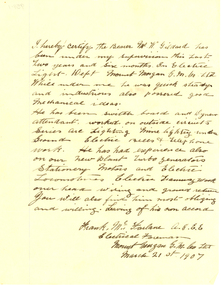
Letter - Correspondence, Norman F. White, Correspondence on Mount Morgan Gold-mining Company, Limited Letterhead, 1907, 22/03/1907
... He has been switch board and Dynamo attendant worked on outside circuits series are Lighting Mine Lighting under Ground Electric Bells and Telephone work. He has had experience also on our new plant turbo generators Stationary Motors and Electric Locomotives Electric Tramway Work over head wiring and ground return you will also find him most obliging and willing. ...He has been switch board and Dynamo attendant worked on outside circuits series are Lighting Mine Lighting under Ground Electric Bells and Telephone work. He has had experience also on our new plant turbo generators Stationary Motors and Electric Locomotives Electric Tramway Work over head wiring and ground return you will also find him most obliging and willing. ...Typed letter on Mount Morgan Gold-mining Company, Limited Letterhead relating to staffmember W. Gildard who worked in the Electrical Department at Mount Morgan. The letter is signed by Norman F. White..1) I hereby certify the Bearer Mr W. Gildard has been under my supervision this last two years and six months in Electric Light Dept Mount Morgan G.M.Co. Ltd While under me he was quick steady and industrious also possessed good mechanical ideas. He has been switch board and Dynamo attendant worked on outside circuits series are Lighting Mine Lighting under Ground Electric Bells and Telephone work. He has had experience also on our new plant turbo generators Stationary Motors and Electric Locomotives Electric Tramway Work over head wiring and ground return you will also find him most obliging and willing. Leaving of his own accord. Frank McFarlane A.G.E.E. Electric Foreman Mount Morgan G.M. Co. Ltd march 21st 1907ballarat school of mines, mount morgan gold-mining company, mount morgan, norman f. white, electricity, w. gildard, letterhead -
 City of Melbourne Libraries
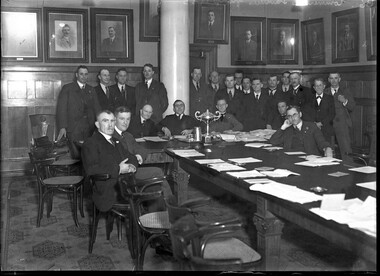
Photograph, Bull, Hugh Jones, 1897-1993, Commercial Travellers' Association, Victoria, Board Room
... The walls were lined with members’ cues and for spectators, comfortable lounges with marble topped tables and electric bell pushes for drinks service. There were 150 bedrooms over five floors, each with their own telephone and wash basin and five suites with a private sitting room attached. ...The walls were lined with members’ cues and for spectators, comfortable lounges with marble topped tables and electric bell pushes for drinks service. There were 150 bedrooms over five floors, each with their own telephone and wash basin and five suites with a private sitting room attached. ...Seven seated and fifteen standing men dressed in suits around a long table in a panelled room hung with formal portraits of men. A trophy sits on the long table amongst loose paper sheets. Research by project volunteer, Fiona Collyer: The Commercial Travellers’ Association of Victoria (CTA) was formed at a meeting of 40 commercial travellers held at the Duke of Rothesay Hotel, 24 Elizabeth Street on 1 December 1880. Their charter was to advocate for better working conditions for commercial travelling salesmen, including improved accommodation at discounted rates and travel concession fares. At first by locomotive, horse and buggy, steamers and horseback, later also by motor car and motorcycle, “The Man on the Road” went into the back-blocks of the country to extend the interests of commerce to the stores and households of Australian regional towns and isolated settlements. Affiliated organisations existed in all states and New Zealand and in 1895 they integrated to form the United Commercial Travellers’ Association of Australasia (UCTAA). By the turn of the 20th century, the Victorian branch of the CTA had 421 Association Members and 520 Club members. The CTA continued to hold meetings in leased rooms in hotels and offices until 1898 when they commissioned purpose-built premises at 190-192 Flinders Street (extant, now the Macstore, next to former Metropolitan Gas Company Buildings). Designed by leading architectural firm of brothers H.W. & F.B.Tompkins (Dimmey’s Model Store, Swan Street, London Stores, Herald and Weekly Times, Myer building, Diamond House, Centreway Arcade, Manton’s Store) in the Queen Anne Revival style at the cost of £20,000, the four storey building had a facade of red Northcote bricks and an entrance of Pyrmont stone. It was very modern for the time, featuring elevators, offices, bars, kitchen, dining, card and billiard rooms and 31 bedrooms with shared bathrooms for the footsore travellers. However, despite adding two storeys in 1901, and another storey and a basement in 1905, they soon outgrew their premises, and in 1912 the CTA commissioned a new building at 328 Flinders Street. At this time, buildings in Melbourne were constrained by the city height limit of 132 feet (40 metres)- the maximum height of firefighting ladders. The new CTA building was the tallest building in Melbourne until 1932 when regulations changed allowing the Manchester Unity Building to be built. The new CTA headquarters was the epitome of comfort and luxury with cutting edge facilities to ease the fatigued salesman and prepare him for another stint on the road. General Secretary, James Davies travelled to Britain and America to acquire the very best and latest innovations. After visiting the new premises, Punch magazine 11 June 1914 reported “furnishings, appliances, and labour-saving conveniences which were more than up to date- they were up to-morrow.” The Edwardian Baroque style building was again designed by architects H.W. & F.B. Tompkins at the cost of £100,000 and built by contractors F.E. Shillabeer and Sons (Nicholas Building, Kellow-Falkiner Pty Ltd car showroom). The nine storey plus basement building is of steel frame construction with concrete floors. The ground floor facade is of grey granite and above that it is faced with cream glazed bricks chosen to combat discolouration from the pollution emitted by Flinders Street Station trains across the road. The facade is decorated with mascarons, gum leaf trim and balconies with classical style balustrade. The club was entered through revolving doors into a two storey high, circular, domed lobby with white columns, American oak panelled walls and intricate mosaic flooring. The ceiling is festooned with plaster gum leaf and gum nut detail, a theme that is repeated throughout the building. The basement kitchen had modern, labour saving appliances that would be the envy of any Edwardian housewife, including an electric toaster, a potato peeling machine, heated dumb waiter, dishwashing machine and electric refrigeration and cooking. It serviced the commodious second floor dining room which seated 200 people and the cafe/breakfast room, 80 people. Members were permitted to entertain their lady friends there for afternoon tea between the hours of 3 and 5 pm every day, except Sunday. The members’ facilities included a barbershop, clothes pressing machine, boot cleaning chair, pipe and cigar stall with electric humidor, public telephones, lockers and safe deposit. The building was serviced with five elevators, a built in vacuum cleaning plant, hot water radiators and linen and postal chutes. The first floor was devoted to business and relaxing, containing the Board, Writing, Reading and four Business Rooms. The board room had Queensland maple panelling with huge blackwood tables topped with blue morocco and golden tortoise-shell trim and cane bottomed chairs. Large framed photographs of past presidents since 1884 lined the walls. The Reading Room ran the whole width of the building. Arthur Streeton’s painting “Between the Lights, Princes Bridge 1888” and Frederick McCubbin’s “Looking North from Mount Macedon” were hung there, as well as paintings by renowned Australian artists Hans Heysen, Walter Withers, John Mather, Jan Hendrik Scheltema. The Argus 30 May 1914 quipped “Around the walls hang evidences that the commercial traveller's soul has not been killed in his pursuit of commerce”. The blackwood panelled room was furnished with Queen Anne style tables and chairs and green leather armchairs with inviting rocker foot rests allowing weary travellers to relax after traversing the railways and dusty roads of Victoria while planning their next sales trip. “The Australasia Traveller” Volume 10, Number 2, April 1914 page 35 noted “An attendant will be constantly employed on this floor to take care of the stationary supply, to tidy up newspapers, and generally study the convenience of members.” The third floor was for amusements with billiards, a bar and four rooms for playing cards, dominoes and chess. The huge billiard room had seven Alcock billiard tables including a table in a partitioned match-room for tournaments, exhibitions and matches. The walls were lined with members’ cues and for spectators, comfortable lounges with marble topped tables and electric bell pushes for drinks service. There were 150 bedrooms over five floors, each with their own telephone and wash basin and five suites with a private sitting room attached. There were four bathrooms per bedroom floor and capacious, well-lighted shaving rooms. Top rate club tariff for bed and breakfast - 6 shillings, if called for a country train leaving Melbourne before 8am - 4 shillings, suite and breakfast- 9 shillings, sixpence. “The Australasia Traveller” Volume 10, Number 2, April 1914 page 35 reported “All “early calls” will be made from the Club Office to Bedrooms by means of the Telephone, so that instead of waking everybody else up on the corridor, only the member concerned will know that it is his unpleasant duty to get up.” The new CTA premises was widely regarded as the finest club in the Southern Hemisphere. The CTA also built the adjacent six storey Commerce House with 52 sample rooms for travellers to display their wares with the remainder rented to retail businesses and a post and telegraph office. After the CTA moved into their new, larger premises in 1914, neighbouring department store Ball & Welch expanded into the former CTA. The CTA saw themselves in a nation building role and were an influential lobby group to the Government. They advocated for inter city trunk telephone lines, standard gauge railway lines between NSW and Victoria, improved roads and highways, the Murray River water scheme and maintaining the White Australia Policy. They were very active in fund raising for the war efforts. The CTA offered its members support in other ways with benevolent funds for widows and orphans, mortuary, accident, sickness and an annuities fund for members over 65 years. There were scholarships for members’ children and home purchase scheme to assist with home ownership. A secondary membership scheme provided access to non commercial travellers (men only) to its exclusive club premises. They also organised social events and activities such as billiard tourneys, golf tournaments, dances and an annual “Smoke Social” which was a social event where men gathered for a formal dinner, community singing, lectures, speeches and of course, to smoke! Daylesford born James Davies OBE, (1865-1931) worked at the CTA for 50 years, starting as an office boy and working his way up to General Secretary and editor of the monthly trade journal for UCTAA members, “The Traveller” (1890-1905, later “The Australasian Traveller” 1905-1924 and then “The Australian Traveller” 1925-1976) and the annual colour supplement magazine “Australia To-Day” (1904-1973). “The Australasia Traveller” featured commentary on the issues of the day like wars, tariffs and trade, articles on new products and hotel recommendations and their rates and lots of advertising, especially alcohol, tobacco and accommodation in regional hotels. There were regular columns, each illustrated with a line drawing and these included “Our Immigration Record” a state by state summary of arrivals of “desirable immigrants” to Australia, while bemoaning the declining (white) birth rate. The column followed the arrival of British boys sent to Australia as agricultural apprentices to work on rural properties which were short of labour. Between 1913-1928, 1750 “Barwell Boys”, some as young as 14 years of age arrived in South Australia to work. NSW had a similar program known as the Dreadnaught Boys Scheme where 5595 boys immigrated between 1911-1939. The boys were considered of “good British stock”. There was a “Home Page For The Ladies” showcasing the latest fashions in women’s clothing, millinery and hairstyles and tips and trends in home furnishings.“Children’s Corner for Dear Little Folks” which featured puzzles, jokes and stories and members could send in photographs of their children. “Road Echoes” devoted to “The Man On The Road” and his doings. “Face Massage, Smiling is the Best Face Massage”, the humour page full of jokes and funny stories. “Railway Rumbles” news of innovations, timetables, tickets and grumbles about lavatories, food and drinking water on trains and at railway stations. And in case we forget that members had a home away from their CTA home, gardening tips with “The C.T. as Gardener”column. The annual magazine “Australia To-Day” was a vehicle to promote Australia here and overseas as a modern, prosperous country with abundant opportunities and pleasant climate. It sought to showcase its manufacturing, agriculture and tourism and encourage British immigration to Australia. The magazine featured articles about recently arrived migrants at work, quirky native flora and fauna, beach culture, recreation and the Australian way of life in the settler nation. Many of the articles were written by politicians of the day, including Robert Menzies. The UCTAA commissioned original artwork for the front covers and feature articles of “Australia To-day” from leading Australian artists. These included Norman Lindsay, Frederick McCubbin, Napier Waller, Lionel Lindsay, Hans Heysen, C Dudley Wood, Louis McCubbin, Penleigh Boyd, Louis Buvelot, Christian Waller and Ellis Rowan and her Australian wildflowers. Some of the photographs in “Australia To-Day” were provided by state and federal government departments as well as manufacturers, newspapers and mining companies. Amongst of the credited photographers was Helmut Newton who later earned world acclaim as a fashion photographer and architectural and industrial photographer Wolfgang Sievers (unfortunately their photographs remain in copyright and aren’t available online). Also featured was Richard C. Strangman, a professional photographer from Canberra, William Howieson of Melbourne, who has 22 photographs in the collection of NGV, Tasmanian wilderness photographer Frederick Smithies, Athol Shmith, portrait photographer and educator from Melbourne, Gordon de Lisle, a Melbourne commercial, industrial, aerial and society portrait photographer. (One of Gordon’s assignments was as the stills photographer for the 1959 movie “On The Beach” filmed in Melbourne). Photographs taken by acclaimed Antarctic and official war photographer Captain Frank Hurley OBE for Adelaide’s Centenary were also featured. The Australian Government was keenly aware of the influence and quality of the UCTAA publications. On 1 June 1914 The Age reported that to advertise Australia in Great Britain and elsewhere, the Department of External Affairs purchased 6500 copies of “Australia To-Day” magazine for £515 to distribute free to “places where they are most likely to come under the notice of a desirable class of immigrants.” In 1950, the office of Prime Minister Robert Menzies ordered 2550 copies of that year’s issue of “Australia To-Day” for the Department of Commerce and Information to distribute. The CTA donated their archives to University of Melbourne Archives which includes original artworks and photos used in “Australia To-Day” (Melbourne University has digitised 1114 photos) and sundry items including trophies, ashtrays, commemorative souvenirs, menus, a rare “Safechek” sovereign changer, a bust of James Davies and even a CTA embossed wash bowl and chamber pot. After the death of General Secretary James Davies in 1931, the CTA held the annual “James Davies Memorial Cup” golf tournament at various Melbourne golf courses, the winner receiving a splendid silver cup. “Table Talk” magazine photographs from 29 June 1933 depict the travellers beautifully (and I would say correctly) attired in tweedy plus fours, Fair Isle knitwear, flat caps and of course fringed brogues. I have been unable to ascertain whether the trophy in our photo is for golf or another CTA social activity. The CTA Victoria membership peaked in 1951 with 4,672 Aassociation members and 3,693 Club members. In 1959, Hollywood came to Melbourne when film stars Gregory Peck, Ava Gardner, Anthony Perkins and Fred Astaire descended to film ‘On the Beach,’ directed by Stanley Kramer. The film is based on the bestselling Neville Shute novel about the aftermath of World War Three, a nuclear war that has obliterated most of the Northern Hemisphere. Radioactive dust is heading toward Australia and everyone is preparing for death. Scenes with Anthony Perkins were filmed in the CTA billiards room as the exclusive Pastoral Club. Anthony Perkins’ character, Lieutenant Commander Peter Holmes of RAN tells Gregory Peck’s character, Commander Dwight Lionel, that The Pastoral Club is…”A mahogany and polished brass sort of place-some people claim it was the stuffiest club in the Commonwealth” before assuring him that despite shortages, the club is likely to have some Scotch left. In a scene at the Pastoral Club two, old (probably red faced) codgers discuss the challenge of drinking all of the 400 bottles of Gould Campbell vintage port in the club wine cellar before they succumb to radiation sickness in five months time. The NGV has 12 photographs in their collection of wardrobe stills of Ava Gardner modelling costumes designed by the Fontana Sisters of Rome for “On The Beach”, taken by Italian photographer G.B.Poletto. During the filming, Gregory Peck and his family stayed at “Kurneh” 206 Domain Road, South Yarra, the former home of three times Grand Slam winner Norman Brookes. Through the decades, Australian society was changing and in order to stay relevant, the CTA had to change too. In 1971, two women were elected for club membership, although they were only granted limited access to the club’s facilities and in 1972, women were invited for the first time to participate in the previously men only annual “Smoke Social”. In 1975, dwindling membership forced the closure of The Commercial Travellers’ Association building and in 1977, the building was sold, with the CTA ceasing to operate in 2014. It was the end of the road for the “Knights of the Road”. In 1992, the CTA building at 328 Flinders Street was placed on the Victorian Heritage Register in recognition of its architectural and cultural significance. The building has been meticulously restored with many of the original fittings, decorative plasterwork, mosaic flooring, stained glass windows, columns, chandeliers and the panelling made from Australian timbers retained. After renovations the building became first the Euro Asia Hotel, then the Duxton Hotel and in 2005 The Rendezvous Hotel, Melbourne. In tribute to the history of the building and the film “On The Beach”, the Rendezvous Hotel has the Ms Ava Bar, Perkins room, Mr Tompkins restaurant, Commerce Room and the Davies Room. References: COMMERCIAL TRAVELLERS' ASSOCIATION OF VICTORIA. (1899, May 27). The Australasian (Melbourne, Vic. : 1864 - 1946), p. 25. Retrieved February 21, 2025, from http://nla.gov.au/nla.news-article138615498 COMMERCIAL TRAVELLERS. (1914, May 30). The Argus (Melbourne, Vic. : 1848 - 1957), p. 8. Retrieved February 13, 2025, from http://nla.gov.au/nla.news-article7272511 NEWS OF THE DAY. (1914, June 1). The Age (Melbourne, Vic. : 1854 - 1954), p. 8. Retrieved February 19, 2025, from http://nla.gov.au/nla.news-article189414314 COMMERCIAL TRAVELLERS' "AT HOME." (1914, June 11). Punch (Melbourne, Vic. : 1900 - 1918; 1925), p. 32. Retrieved March 19, 2025, from http://nla.gov.au/nla.news-article129699692 https://archives.library.unimelb.edu.au/nodes/view/69669 https://vhd.heritagecouncil.vic.gov.au/places/757 http://www.pikitiapress.com/blog/2015/1/26/australia-today Commercial Travellers at Yarra Yarra (1933, June 29). Table Talk (Melbourne, Vic. : 1885 - 1939), p. 6. Retrieved February 28, 2025, from http://nla.gov.au/nla.news-article149547845 https://archives.library.unimelb.edu.au/nodes/view/537460 https://viewer.slv.vic.gov.au/?entity=IE7420895&file=FL19171568&mode=browse https://www.history.sa.gov.au/wp-content/uploads/2021/03/Barwell_Boys_Catalogue-compressed-compressed-compressed.pdf Australia Today," 1927 (1926, December 11). Weekly Times (Melbourne, Vic. : 1869 - 1954), p. 15. Retrieved March 17, 2025, from http://nla.gov.au/nla.news-article223844810 https://blogs.unimelb.edu.au/librarycollections/2020/12/19/an-inhabited-space-helmut-newtons-lovers/ https://www.ngv.vic.gov.au/explore/collection/artist/2075/ https://www.ngv.vic.gov.au/?s=Poletto+&type=collection https://rendezvousmelbourne.com.au/digital-history-tour/Photographer notations on slide: "Commercial Travellers Group B6".clubs, department stores, 1930-1939, commerce, manufacturing, federation/edwardian style architecture, railways, tourism, games, agriculture -
 City of Moorabbin Historical Society (Operating the Box Cottage Museum)
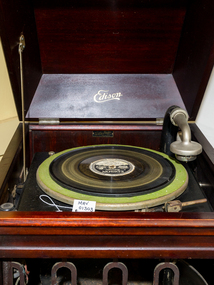
Musical Equipment, Gramaphone Edison c1900, late 19C / early 20C
... The phonograph was invented in 1877 by Thomas Edison. in USA and Alexander Graham Bell's Volta Laboratory made several improvements in the 1880s and introduced the graphophone, This Edison was donated to CMHs by the family of John Box 1841-1913 This gramophone belonged to John Box 1841-1913 an early settler in the area of Henry Dendy's Special Survey Brighton 1841 manufactured objects, music, musical records, long playing records, gramophone, phonogram, wireless, edison thomas, edison pty ltd, electric lights; EDISON A wooden cabinet with a lift up lid enclosing a turntable , record , trumpet and handle . ...A Gramophone / Phonogram is a device for the mechanical recording and reproduction of sound. The phonograph was invented in 1877 by Thomas Edison. in USA and Alexander Graham Bell's Volta Laboratory made several improvements in the 1880s and introduced the graphophone, This Edison was donated to CMHs by the family of John Box 1841-1913This gramophone belonged to John Box 1841-1913 an early settler in the area of Henry Dendy's Special Survey Brighton 1841A wooden cabinet with a lift up lid enclosing a turntable , record , trumpet and handle . This cabinet stands on another storage cabinet with shelf and doorEDISONmanufactured objects, music, musical records, long playing records, gramophone, phonogram, wireless, edison thomas, edison pty ltd, electric lights; -
 Bendigo Military Museum
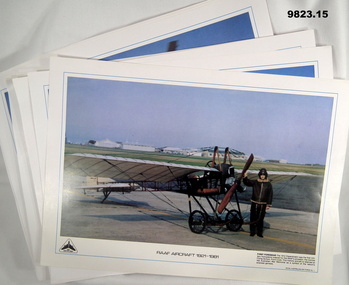
Print - AIRCRAFT, RAAF, Royal Australian Air Force, 1981
... Electric Canberra". No. 9. 9. "CAC Sabre 1954" No. 10. 10. "CAC Winjeel or Young Eagle 1957". No. 11. 11. "Lockheed C-130 Hercules" No. 12. 12. "CAC-GAF Dassault Mirage 111.Os 1964" No. 13. 13. "Bell...Electric Canberra". No. 9. 9. "CAC Sabre 1954" No. 10. 10. "CAC Winjeel or Young Eagle 1957". No. 11. 11. "Lockheed C-130 Hercules" No. 12. 12. "CAC-GAF Dassault Mirage 111.Os 1964" No. 13. 13. "Bell ...Part of the "William (Bill) THOMASON" Collection. Refer Cat. No. 4136P for more items.1. to 15. Prints - gloss white colour paper. Black colour print with illustrations in colour of RAAF Aircraft from 1921 to 1981. This is a RAAF DIAMOND JUBILEE Collection.Print numbers, Royal Australian Air Force. No. 1 to No. 16 with print No. 3 missing. 1. "1912 Deperdussin" No. 1. 2. 'AVRO AB' INITIO 1921" No. 2. 3. "Wirraway A20-653" No. 4. 4. "Lockheed Hudson" No. 5. 5. 'CAC Wackett Trainer 1939" No. 6. 6. "de Haviland DH82 Tiger Moth". No. 7. 7. "Douglas C-47 Dakota 1943" No. 8. 8. "English Electric Canberra". No. 9. 9. "CAC Sabre 1954" No. 10. 10. "CAC Winjeel or Young Eagle 1957". No. 11. 11. "Lockheed C-130 Hercules" No. 12. 12. "CAC-GAF Dassault Mirage 111.Os 1964" No. 13. 13. "Bell Iroquois" No. 14. 14. "Lockheed P-3B Orion" No. 15. 15. "General Dynamics F-111C 1963". No.16. prints, raaf, diamond jubilee, william (bill) thomason collection -
 Kiewa Valley Historical Society
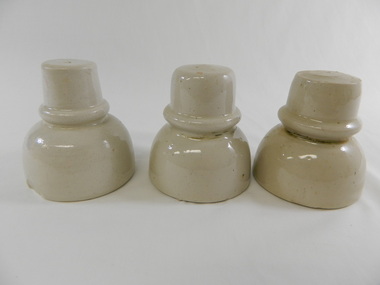
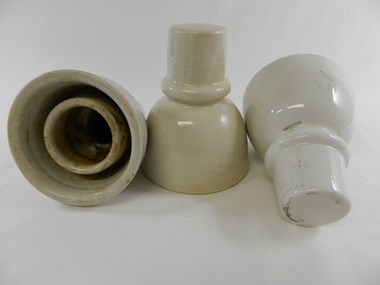
Insulator - Porcelain small x3
... bell' shape (in the groove). Screwed onto the cross arm of a power pole. Non conductive so electricity doesn't short out to the ground. Used on power poles in the Kiewa Valley. kiewa hydro electric scheme. electricity. power lines. insulator. ...Insulates electrical wire/cable which is attached between the narrow and wide ends of the 'bell' shape (in the groove). Screwed onto the cross arm of a power pole. Non conductive so electricity doesn't short out to the ground.Used on power poles in the Kiewa Valley.White porcelain bell shaped insulator with an indent between the wide open end and the narrow closed end. The indent is for the wire/cable to be attached. The wide end is open with a white porcelain cylinder inside narrowing to thread for screwing, in the narrow section. kiewa hydro electric scheme. electricity. power lines. insulator. -
 Kiewa Valley Historical Society
Insulator - Porcelain large x3
... bell' shape (in a groove). Screwed onto the cross arm of a power pole. Non conductive so electricity doesn't short out to the ground. Used on power poles in the Kiewa Valley. kiewa hydro electric scheme. electricity. power lines. insulator. ...Insulates electrical wire/cable which is attached between narrow and wide ends of the 'bell' shape (in a groove). Screwed onto the cross arm of a power pole. Non conductive so electricity doesn't short out to the ground. Used on power poles in the Kiewa Valley.White porcelain bell shaped insulator with an indent between the wide open end and the narrow closed end (for cable to be attached). The wide end is open with a white porcelain cylinder inside narrowing to thread for screwing in the narrow section.kiewa hydro electric scheme. electricity. power lines. insulator. -
 Emerald Museum & Nobelius Heritage Park
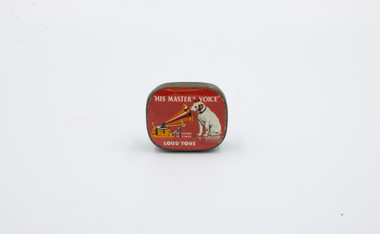
Container - Tin for Gramophone Needles, The Gramophone Company Limited, 1899 - c. 1931
... Bell manager James Hough declined to purchase the artwork by stating that "dogs don't listen to phonographs." William Barry Owen of the Gramophone Company purchased the trademark on the condition that the original phonograph be replaced with a gramophone, and began using the artwork first in catalogues and gramophone machines, and in 1909 on record labels. It is unclear exactly when the artwork began to appear on gramophone needles. This specific tin was almost certainly made between 1899 - when the trademark was acquired - and 1931, when the Gramophone Company merged with the English Columbia Graphophone Company to form Electric...Bell manager James Hough declined to purchase the artwork by stating that "dogs don't listen to phonographs." William Barry Owen of the Gramophone Company purchased the trademark on the condition that the original phonograph be replaced with a gramophone, and began using the artwork first in catalogues and gramophone machines, and in 1909 on record labels. It is unclear exactly when the artwork began to appear on gramophone needles. This specific tin was almost certainly made between 1899 - when the trademark was acquired - and 1931, when the Gramophone Company merged with the English Columbia Graphophone Company to form Electric ...The Gramophone Company Limited acquired Francis Barraud's 1898 "His Master's Voice" artwork in 1899, after Edison Bell manager James Hough declined to purchase the artwork by stating that "dogs don't listen to phonographs." William Barry Owen of the Gramophone Company purchased the trademark on the condition that the original phonograph be replaced with a gramophone, and began using the artwork first in catalogues and gramophone machines, and in 1909 on record labels. It is unclear exactly when the artwork began to appear on gramophone needles. This specific tin was almost certainly made between 1899 - when the trademark was acquired - and 1931, when the Gramophone Company merged with the English Columbia Graphophone Company to form Electric and Musical Industries Ltd (EMI). However, the Gramophone Company was still used in some cases after this point, so it is not impossible that this tin could come from later. Gramophone needles were typically worn out after only one or a few uses, necessitating the purchasing of tins like this one filled with hundreds of needles to allow for constant replacements. "His Master's Voice" was an iconic brand in Australia for much of the 20th century, from the time of the Gramophone Company (when gramophones were still in use) through the subsequent EMI and HMV brands and the popularity of record players.This small tin is decorated with a red-painted lid surface, depicting Nipper the dog - an iconic symbol of the company - curiously looking into a gramophone. The red background is punctuated by white lettering, announcing the brand name and type of gramophone needle inside - 'Loud Tone'. The exposed metallic surface elsewhere on the tin is heavily tarnished everywhere except for parts of the bottom of the tin (which may have been exposed less than the rest of the tin if it was stored face-up). There is also partly faded, black lettering on the bottom of the tin, and a label on the stop side (opposite the hinge). The tin opens with a hinge, though it is now quite difficult to open. The inside of the tin is empty and undecorated, with similarly tarnished metallic surfaces.Front: " "HIS MASTER'S VOICE" / REGISTERED / TRADE MARK / LOUD TONE" Stop Side: "MADE IN Gt BRITAIN" Reverse: "APPROXIMATELY / 200 ENGLISH / GRAMOPHONE / NEEDLES / THE GRAMOPHONE / COMPANY LIMITED"music, 20th century -
 Bendigo Historical Society Inc.
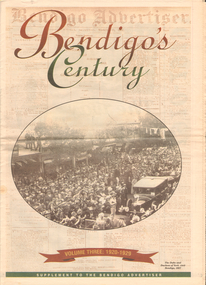
Newspaper - LONG GULLY HISTORY GROUP COLLECTION: BENDIGO'S CENTURY VOLUME THREE: 1920 - 1929
... BENDIGO History long gully history group The Long Gully History Group - Bendigo's Century - Volume Three: 1920 - 1929 Bendigo Advertiser Duke and Duchess of York Cr E M Vains R Putnam A J Taylor J H Jackson W Crowley Sandhurst Football Club George Lansell St Peter's Church Bendigo Junior Technical School Prince of Wales Unity Mine Mr W Wilson Badak Tin Mining Syndicate Mr T W OrtonMr H Scarborough Mr Raleigh General Sir W R Birdwood The Soldiers' Memorial Committee Bendigo City Council RSL Memorial Hall Captain G C Wilson Lietenant R J Parer Lieutenant J C McIntosh Cr J P Carolin H K Morris E A Morris Turf Tavern Hotel Rev Donald Baker All Saints' Pro--Cathedral Keck's Nursery Bendigo Amalgamated Goldfields Rising Sun Hotel Leanne McDonnell Most Rev John McCarthy Sir John Quick Prime Minister Billy Hughes State Rivers and Water Supply Commission Diptheria Edna Stevens Bendigo Railway Workshops Watson Sustenance Fund Sir Joseph Cook Dr Lanza Bendigo Amalgamated Goldfields Bendigo Benevolent Asylum Miner's Phthisis Bendigo Gas Company Electric Light Company Bendigo Sewerage Authority Commonwealth bank Cr Curnow the Earl of Stradbroke Dame Nellie Melba Princess Theatre Lt-Col G Hurry H SW Lawson Countess of Stradbroke Clunes Woollen Mills Girton College Mrs Polglaise Mrs Kennedy Gold Discovery Memorial Cr M G Giudice Victorian Co-operative Freezing Company Bendigo Brick and Tile Company Mr Lawson Soldiers' Memorial Windermere Hotel Toni Riley Pharmacy Bendigo Gaol Mr A A Dunstan MLA New Red White and Blue Mine Claude de Vere Walter Osborne Sir John and Lady Quick Jonathan Smalley Bendigo Advertiser St Paul's Bells Mr T Cambridge Epsom Public Hall Bendigo School of Mines Major Lansell Mr H S W Lawson Cr David Andrew Colonel Hurry Mr S Bruce Bendigo Sewerage Authority Eppalock Weir Scheme Bendigo Football League R S L Memorial Major G V Lansell Lempriere MR S M Bruce Sandhurst Hotel Market Square Big Hill Tunnel Bendigo Football League Bendigo United Cricket Club South Bendigo Rex Sacred Heart Cathedral Hercules Mine Gillies Aids & Appliance Shop Anne Caudle Centre Fizelle & Mulqueen South New Moon Mine Bendigo Sewerage Authority Mr A A Kelley Epsom Sewerage Works White Hills Botanical Gardens Mr J Sternberg MLC Bendigo Book of Remembrance Bendigo Football League Senator General Drake-Brockman Captain Dyett School of Mines Handschin and Romus Hanro (Aust.) ...Newspaper supplement titled Bendigo's Century Volume Three: 1920 - 1929. Front page has a photo of The Duke and Duchess of York visit to Bendigo, 1927. Each year has heading of Who's Who, Weather, Sport and Business. First years are 1910 - 1919 titled The way we were. 1920 is titled Prince hailed. 1921 - City racks up a milestone. 1922 - Furore erupts. 1923 - Felons escape from city gaol. 1924 - Bid to finish RSL memorial. 1925 - Foul odour over sewerage plan. 1926 - Lest we forget Bendigo's fallen. 1927 - Royal Visit captures city. 1928 - Four shot in farm tragedy. 1929 - Billie's trip to remember.bendigo, history, long gully history group, the long gully history group - bendigo's century - volume three: 1920 - 1929, bendigo advertiser, duke and duchess of york, cr e m vains, r putnam, a j taylor, j h jackson, w crowley, sandhurst football club, george lansell, st peter's church, bendigo junior technical school, prince of wales, unity mine, mr w wilson, badak tin mining syndicate, mr t w ortonmr h scarborough, mr raleigh, general sir w r birdwood, the soldiers' memorial committee, bendigo city council, rsl memorial hall, captain g c wilson, lietenant r j parer, lieutenant j c mcintosh, cr j p carolin, h k morris, e a morris, turf tavern hotel, rev donald baker, all saints' pro--cathedral, keck's nursery, bendigo amalgamated goldfields, rising sun hotel, leanne mcdonnell, most rev john mccarthy, sir john quick, prime minister billy hughes, state rivers and water supply commission, diptheria, edna stevens, bendigo railway workshops, watson sustenance fund, sir joseph cook, dr lanza, bendigo amalgamated goldfields, bendigo benevolent asylum, miner's phthisis, bendigo gas company, electric light company, bendigo sewerage authority, commonwealth bank, cr curnow, the earl of stradbroke, dame nellie melba, princess theatre, lt-col g hurry, h sw lawson, countess of stradbroke, clunes woollen mills, girton college, mrs polglaise, mrs kennedy, gold discovery memorial, cr m g giudice, victorian co-operative freezing company, bendigo brick and tile company, mr lawson, soldiers' memorial, windermere hotel, toni riley pharmacy, bendigo gaol, mr a a dunstan mla, new red white and blue mine, claude de vere, walter osborne, sir john and lady quick, jonathan smalley, bendigo advertiser, st paul's bells, mr t cambridge, epsom public hall, bendigo school of mines, major lansell, mr h s w lawson, cr david andrew, colonel hurry, mr s bruce, bendigo sewerage authority, eppalock weir scheme, bendigo football league, r s l memorial, major g v lansell, lempriere, mr s m bruce, sandhurst hotel, market square, big hill tunnel, bendigo football league, bendigo united cricket club, south bendigo rex, sacred heart cathedral, hercules mine, gillies, aids & appliance shop, anne caudle centre, fizelle & mulqueen, south new moon mine, bendigo sewerage authority, mr a a kelley, epsom sewerage works, white hills botanical gardens, mr j sternberg mlc, bendigo book of remembrance, bendigo football league, senator general drake-brockman, captain dyett, school of mines, handschin and romus, hanro (aust.) bendigo knitting mills, charles handschin, farmers' union, andrew sunstan mla, country progressive party, john allan, captain g j c dyett, eahlehawk ufs dispensary, data fundamentals, the duke and duchess of york, the hercules mine, cr j a michelsen, lansell family, bendigo agricultural society, huntly shire council, bendigo creek trust, south african war memorial, cr j h curnow, st paul's church of england diamond jubilee, bendigo chamber of commerce, bendigo freezing works, bendigo pottery, bendigo trotting club, new red white and blue mine, the conservatory, cr e g batchelder, hercules mine, billie rigby, bendigo railway station, travellers' aid society, eppalock weir, the state rivers and water supply commission, bendigo railway workshops, frank grove, cr curnow, electric supply company, state electricity commission, australian aero club, bendigo preserving company, jardine, busbridge, feeman, mr h pearce, bfl, fred wood -
 Bendigo Historical Society Inc.
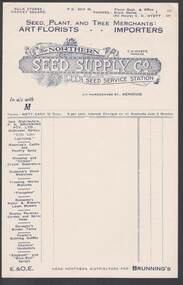
Document - CAMBRIDGE PRESS COLLECTION: ACCOUNT - NORTHERN SEED SUPPLY COMPANY
... Electric Lawn Mowers... Dunlop Perdriau Garden and Spray Hose... Donaghy's Binder Twine... Fowler's Bottling Outfits... Charters' Incubators... Elephant and Blue-Bell...They are: F H Brunning Pty Ltd, Destruxol Sprays, Manning's Cattle and Poultry Spice, Wolseley and 'Climax' Cream Separators, Ruddock's Stock Medicines, Freezing Works Manures, Floraphos, Ransome's Motor & Electric Lawn Mowers, Dunlop Perdriau Garden and Spray Hose, Donaghy's Binder Twine, Fowler's Bottling Outfits, Charters' Incubators, Elephant and Blue-Bell Sprays, and Brunnings....BUSINESS Printers cambridge press Cambridge Press Collection The Northern Seed Supply Co C K Hyett F H Brunning Pty Ltd Destruxol Sprays Manning's Cattle and Poultry Spice Wolseley and 'Climax' Cream Separators Ruddock's Stock Medicines Freezing Works Manures Floraphos Ransome's Motor & Electric Lawn Mowers Dunlop Perdriau Garden and Spray Hose Donaghy's Binder Twine Fowler's Bottling Outfits Charters' Incubators Elephant and Blue-Bell Sprays Brunnings Account page from the Northern Seed Supply Co., 315 Hargreaves St., Bendigo. ...Account page from the Northern Seed Supply Co., 315 Hargreaves St., Bendigo. Printed in dark blue with decoration around the name. On the left side are the name of the companies they are distributors for. They are: F H Brunning Pty Ltd, Destruxol Sprays, Manning's Cattle and Poultry Spice, Wolseley and 'Climax' Cream Separators, Ruddock's Stock Medicines, Freezing Works Manures, Floraphos, Ransome's Motor & Electric Lawn Mowers, Dunlop Perdriau Garden and Spray Hose, Donaghy's Binder Twine, Fowler's Bottling Outfits, Charters' Incubators, Elephant and Blue-Bell Sprays, and Brunnings.business, printers, cambridge press, cambridge press collection, the northern seed supply co, c k hyett, f h brunning pty ltd, destruxol sprays, manning's cattle and poultry spice, wolseley and 'climax' cream separators, ruddock's stock medicines, freezing works manures, floraphos, ransome's motor & electric lawn mowers, dunlop perdriau garden and spray hose, donaghy's binder twine, fowler's bottling outfits, charters' incubators, elephant and blue-bell sprays, brunnings -
 Bendigo Historical Society Inc.
Document - NEW CHUM & VICTORIA LINES OF REEF - MINING MACHINERY, NEW CHUM LINE, EAGLEHAWK
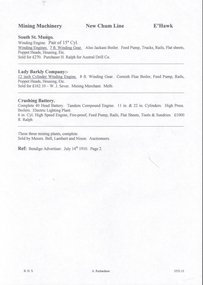
... Electric Lighting Plant. 6 in Cyl. High Speed Engine, Fire-proof, Feed Pump, Rails, Flat Sheets, Tools & Sundries. 1000 pound to R. Ralph. These three mining plants, complete. Sold by Messrs. Bell...Electric Lighting Plant. 6 in Cyl. High Speed Engine, Fire-proof, Feed Pump, Rails, Flat Sheets, Tools & Sundries. 1000 pound to R. Ralph. These three mining plants, complete. Sold by Messrs. Bell ...Handwritten notes on mining machinery sold at auction. South St Mungo - Winding Engine. Pair of 15 ? Cyl. Winding Engines. 7 ft Winding Gear. Also, Jackass Boiler. Feed Pump, Trucks, Rails, Flat Sheets, Poppet Heads, Housing, etc. Sold for 270 pounds. Purchaser H Ralph for Austral Drill Co. Lady Barkly Company - 12-inch Cylinder Winding Engine. 8 ft Winding Gear. Cornish Flue Boiler, Feed Pump, Rails, Poppet Heads, Housing, etc. Sold for 162 pound 10 shillings. Purchaser W. J. Sever, Mining Merchants, Melb. Crushing Battery - Complete 40 Head Battery. Tandem Compound Engine. 11 in & 22 in Cylinders. High Press, Boilers, Electric Lighting Plant. 6 in Cyl. High Speed Engine, Fire-proof, Feed Pump, Rails, Flat Sheets, Tools & Sundries. 1000 pound to R. Ralph. These three mining plants, complete. Sold by Messrs. Bell, Lambert and Nixon - Auctioneers. Ref; Bendigo Advertiser. July 14th, 1910, Page 2.document, gold, new chum & victoria lines of reef, mining machinery new chum line eaglehawk, south st mungo, h ralph, austral drill co, lady barkly company, w j sever, crushing battery, messrs bell, lambert and nixon -
 Bendigo Historical Society Inc.
Document - BROADCASTING STATION 3CV, MARYBOROUGH, 2 March, 1956
... electric undertakings and the manufacture of cars and tractors. From 1858... W Phelan & Sons Pty Ltd... incorporated 1929. 1940 joinery manufacture. Ready Built Housing field in 1950 - 1951 established a factory at Cairns... Northern Queensland to overcome the manufacturing difficulties being experienced due to the shortage of plywood in Victoria. Present activities: Ready Built Housing Factory... on-site building... a modern joinery... timber yard... drying kilns... etc.... and plumbing & electrical & engineering services... a door and panel factory at Cairns... retail hardware store... Melbourne Sales Depot. Hedges & Bell...electric undertakings and the manufacture of cars and tractors. From 1858 W Phelan & Sons Pty Ltd incorporated 1929. 1940 joinery manufacture. Ready Built Housing field in 1950 - 1951 established a factory at Cairns Northern Queensland to overcome the manufacturing difficulties being experienced due to the shortage of plywood in Victoria. Present activities: Ready Built Housing Factory on-site building a modern joinery timber yard drying kilns etc. and plumbing & electrical & engineering services a door and panel factory at Cairns retail hardware store Melbourne Sales Depot. Hedges & Bell ...Broadcasting Station 3CV, Maryborough. A souvenir of the opening of the New Studios and Offices of Central Victoria Broadcasters Pty Ltd. March 2nd, 1956. Established 1956, offices in Burke Street, opening coincides with the stations 21st birthday, March 2 for the former celebration, October 26 for the latter. Coverage included Bendigo, Ballarat, Daylesford, Castlemaine and Maryborough. 3CV plays active part in assisting charities and hospitals at Maryborough, Daylesford, Maldon and Dunolly. Active Women's Radio Club with branches in country centres adds strength to station's charitable efforts. Opening 3CV's new premises will widen the scope of the station's charitable efforts, and stronger link with Australian Commercial Broadcasting stations. Writer Harold V Nunn writes history of district of Mayborough. Manager Ken J Parker, Central Victoria Broadcasters Pty. Ltd. The Souvenir brochure also covers topics such as: deep lead mining. WWI. Houses being pulled down. New settlements of Mildura. Secondary Industries. Bowenvale, Alma, Majorca, Craigie, Amherst, Adelaide Lead, Havelock, Bet Bet, Bently. Primary production and a railway staff of approximately 150. Maryborough a little town without a future. Coal fields at Wonthaggi. 1917 a public meeting was convened in an effort to stem the tide of adversity. Mayor George Frost, M.L.A., decision to form a Progress Association, a policy of secondary industry was decided upon and committees were appointed, James L Drew much credit is due. Maryborough's move for rejuvenation was revolutionary, because apart from Ballarat, Bendigo and Geelong, it was regarded as so much presumption that industry could be expected to function with success in a country town. Governments were unsympathetic. Maryborough & district people showed determination to succeed and their faith in their town. Employment and economic security provided by the industries outweighed the debt. Maryborough's general position is that it is no longer dependent upon one particular phase of activity. The first of the industries to be formed in 1918 was the Butter Factory. The nearer dairy companies did not take kindly to the prospect of another opposition company taking supplies from their districts, and in the first few years of establishment completion made the going hard for the management. But adopting a conservative policy and placing all profits to reserve I the first six years of operation headway was gradually made. Thus it was a red letter day for the company in 1925 when the first dividend of 5 percent was paid.1955 dividend of 10 per cent. Operating it's own trucks the dairy serviced local dairymen up to 40 miles. Maryborough Knitting mills est. 1923, having transferred from Clunes. Out bid Ballarat and Bendigo to the industry. The mill has what is probably the largest circular underwear plant in the Commonwealth, which is conservatively valued at 198,913 pounds. It produces between four and five million garments each year, worth over one million pounds. The company has established subsidiary mills at Dunolly, Talbot and Avoca. The company also assisted in the establishment of the Interknit Hosiery Co. Ltd., Clunes. The Maryborough Flour Mills is the second oldest of Mayborough's industries. It was built by Mr Cadwallader over 70 years ago. It was later sold to Mr. A Land and then to Jas. Minifie & Co. It had a somewhat 'in-and -out' existence until purchased in 1923 by Messrs. Willersdorf and Forbes, of Eddington. In 1939 the firm began to build silos for the storage of bulk wheat and the present storage capacity is 100,000 bushels. 1944 power was changed from steam to electricity. The mill has an out put of 20 sacks an hour. 1938 a chaff mill was built, and now is regarded as one of the best in Victoria. Its output in one year of approximately 6,800 tons is a State record for a single cutter. During this 30 year period Patience and Nicholson Limited has grown with Maryborough and is now one of the major key industries of Australia. The P&N brand covers precision tools - taps, dies and twist drills - indispensable to the country's economy, and quality is acknowledged equally by an air craft factory in Canada, a dockyard in Thailand, a railway workshop in New Zealand, no less than by our own Australian industries. Maryborough can be proud of the part played by P&N in war when, geared to the needs of the times, it poured countless millions of tools into defence factories and to the armed forces of the Allies, and now in peace when it is providing, hydro-electric undertakings and the manufacture of cars and tractors. From 1858, W Phelan & Sons Pty Ltd has made phenomenal and spectacular growth, becoming incorporated as a private company in 1929. It is without doubt the greatest private development in the history of Maryborough. 1940 joinery manufacture was commenced. The company entered the Ready Built Housing field in `950 - and in 1951 established a factory at Cairns, Northern Queensland to overcome the manufacturing difficulties being experienced due to the shortage of plywood in Victoria. Present activities include: Ready Built Housing Factory, on-site building, a modern joinery, timber yard, drying kilns, etc., and plumbing & electrical & engineering services, a door and panel factory at Cairns, retail hardware store, Melbourne Sales Depot. Hedges & Bell Pty Ltd were est 1945, with a staff of 40 employees are the largest printing firm outside the metropolitan area. The branch of Premier Wireworks is a contribution made by the decentralisation policy of the State.event, official, celebration, broadcasting station 3cv, maryborough. a souvenir of the opening of the new studios and offices of central victoria broadcasters pty ltd. march 2nd, 1956. established 1956, offices in burke street, 21st birthday. coverage bendigo, ballarat, daylesford, castlemaine maryborough. assisting charities and hospitals maldon and dunolly. women's radio club opening 3cv's new premises australian commercial broadcasting stations. writer harold v nunn writes history of district of mayborough. manager ken j parker, central victoria broadcasters pty. ltd. souvenir brochure: deep lead mining. wwi. houses pulled down. new settlements. primary production railway staff. coal fields wonthaggi. 1917 a public meeting was convened in an effort to stem the tide of adversity. mayor george frost, m.l.a., form a progress association, policy of secondary industry, james l drew rejuvenation was revolutionary, employment and economic security. the first of the industries to be formed in 1918 was the butter factory. thus it was a red letter day for the company in 1925 when the first dividend of 5 percent was paid.1955 dividend of 10 per cent. operating it's own trucks serviced local dairymen. maryborough knitting mills est. 1923 largest circular underwear plant in the commonwealth. established subsidiary mills at dunolly, talbot, avoca. interknit hosiery co. ltd., clunes. the maryborough flour mills it was built by mr cadwallader. mr. a land jas. minifie & co. messrs. willersdorf and forbes, build silos for wheat storage capacity is 100, 000 bushels. 1944 power was changed from steam to electricity. 20 sacks an hour. 1938 a chaff mill was built, best in victoria. patience and nicholson limited the p&n precision tools - taps, dies and twist drills. war, geared to the needs of the times, countless millions of tools into defence factories the armed forces of the allies, hydro-electric undertakings and the manufacture of cars and tractors. from 1858, w phelan & sons pty ltd, incorporated 1929. 1940 joinery manufacture. ready built housing field in 1950 - 1951 established a factory at cairns, northern queensland to overcome the manufacturing difficulties being experienced due to the shortage of plywood in victoria. present activities: ready built housing factory, on-site building, a modern joinery, timber yard, drying kilns, etc., and plumbing & electrical & engineering services, a door and panel factory at cairns, retail hardware store, melbourne sales depot. hedges & bell pty ltd were est. 1945, with a staff of 40 employees are the largest printing firm outside the metropolitan area. the branch of premier wireworks is a contribution made by the decentralisation policy of the state. -
 Bendigo Historical Society Inc.
Book - THE BENDIGO TRAMWAYS AN ILLUSTRATED HISTORY, 1972
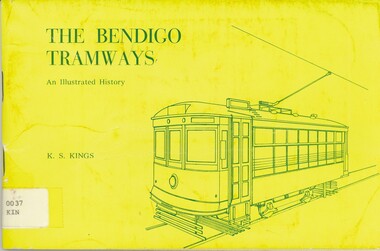
... Bell Pty. Ltd. Maryborough. Chapters include battery trams, steam trams, electric supply company years and S.E.C. era....electric traction public transport K.S. Kings The Bendigo Tramways - an illustrated history 80 pages, photographs, illustrations and map. Published by Hedges and Bell ...The Bendigo Tramways - an illustrated history 80 pages, photographs, illustrations and map. Published by Hedges and Bell Pty. Ltd. Maryborough. Chapters include battery trams, steam trams, electric supply company years and S.E.C. era.K.S. Kingstramways, history, trams, electric traction, public transport -
 Bendigo Historical Society Inc.
Document - BASIL MILLER COLLECTION: TRAMS - 'RUNNING JOURNAL', December 1972
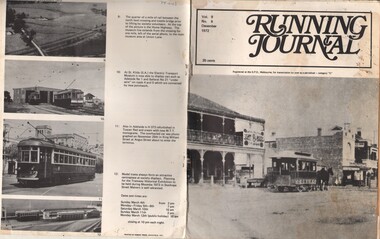
... Bell Street with horse tram bound for the Brunswick cable tram terminus at Moreland Road. The horse tram was established by the Northern Tramway Company in 1889. Purchased by the Coburg Council in 1911 they operated until 1916 when replaced by the electric trams of the Melbourne Brunswick and Coburg Tramway Trust. ...Bell Street with horse tram bound for the Brunswick cable tram terminus at Moreland Road. The horse tram was established by the Northern Tramway Company in 1889. Purchased by the Coburg Council in 1911 they operated until 1916 when replaced by the electric trams of the Melbourne Brunswick and Coburg Tramway Trust. ...Journal of the Tramway Museum Society of Victoria. Ltd. Volume 9, No. 6. December 1972, 35 cents, thirteen pages. Cover photo (right) shows Sydney Road Coburg looking south from Bell Street with horse tram bound for the Brunswick cable tram terminus at Moreland Road. The horse tram was established by the Northern Tramway Company in 1889. Purchased by the Coburg Council in 1911 they operated until 1916 when replaced by the electric trams of the Melbourne Brunswick and Coburg Tramway Trust. History of document: Part of 'Basil Miller Tramways Collection'.document -
 National Vietnam Veterans Museum (NVVM)
Machine, GET58-GE8 Turboshaft engine
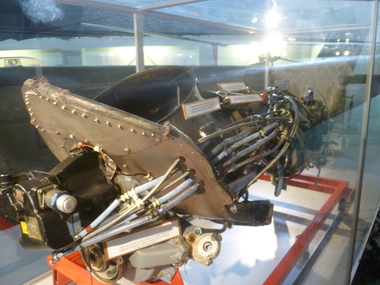
... General electric turboshaft engine fitted to Bell UH1 helicopter....Aircraft engine GET58 General electric turboshaft engine fitted to Bell UH1 helicopter. GET58-GE8 Turboshaft engine Machine Machine General Electric Aviation ...General electric turboshaft engine fitted to Bell UH1 helicopter.aircraft engine, get58 -
Moorabbin Air Museum
Document (item) - Roland Jahne Collection - See Description for details
... Electric Lightning. Manilla folder Jul-98 Enstrom. Australian Aviation. Manilla folder Various Farman F.220 and F.2200 series. Aeroplane Monthly May 1991. Manilla folder Various Falklands War. Manilla folder October 1997. Charles Fauvel. Aeroplane Monthly October 1997. Manilla folder Various FFA P16. Manilla folder Jan-94 Fiat G.12 and G.212. Aeroplane Monthly January 1994. Manilla folder Various Fiat B.R. 20. Manilla folder Various Fiat CR.32. Manilla folder Various Fiat CR.42. Manilla folder Various Bell...Electric Lightning. Manilla folder Jul-98 Enstrom. Australian Aviation. Manilla folder Various Farman F.220 and F.2200 series. Aeroplane Monthly May 1991. Manilla folder Various Falklands War. Manilla folder October 1997. Charles Fauvel. Aeroplane Monthly October 1997. Manilla folder Various FFA P16. Manilla folder Jan-94 Fiat G.12 and G.212. Aeroplane Monthly January 1994. Manilla folder Various Fiat B.R. 20. Manilla folder Various Fiat CR.32. Manilla folder Various Fiat CR.42. Manilla folder Various Bell ... -
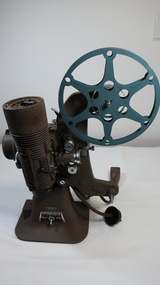 Kiewa Valley Historical Society
Projector
... electric cord and 3 papers. The reel is dark grey steel. The cord is brown rubber and very long. At the front is an attached plastic label with a switch in the centre. There is a black, red and gold disc with a Bell...Bell & Howell / 8 mm projector / Model 606 / 110-250 / volts / 5 Amps A/C/ or D/C/ England London. Above this label is : Lamp 400 Watts Max.. 9039 is printed in silver on the side. Inside bottom of lid: Cabinet by Raddports Pty. Ltd. / NSW / Leatherette Dark brown box with lid and clip fastener. The lid has a handle at the top.Lid & inside of box lined in red velvet. There is a separate narrow compartment for the reel. There is an electric ...Possibly early 1950sDark brown box with lid and clip fastener. The lid has a handle at the top.Lid & inside of box lined in red velvet. There is a separate narrow compartment for the reel. There is an electric cord and 3 papers. The reel is dark grey steel. The cord is brown rubber and very long. At the front is an attached plastic label with a switch in the centre. There is a black, red and gold disc with a Bell and Howell guarantee. A Registration card indicating model 606 & Serial no. 9039 and another card with a Safety message in 8 languages.On the base: G.B. Bell & Howell / 8 mm projector / Model 606 / 110-250 / volts / 5 Amps A/C/ or D/C/ England London. Above this label is : Lamp 400 Watts Max.. 9039 is printed in silver on the side. Inside bottom of lid: Cabinet by Raddports Pty. Ltd. / NSW / Leatheretteprojector, g. b. bell & hovell -
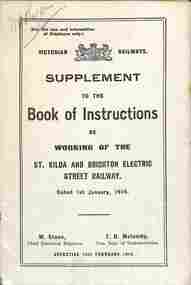 Ballarat Tramway Museum
Booklet, Victorian Railways (VR), "Supplement to the Book of Instructions re the working of the St Kilda and Brighton Electric Street Railway", 1917
... Titled "Supplement to the Book of Instructions re the working of the St Kilda and Brighton Electric Street Railway, dated 1/1/1915". Gives changes to a previous issued rule book, bell signals, air brake orders, operating orders, operation while running and instructions cancelled. ...Titled "Supplement to the Book of Instructions re the working of the St Kilda and Brighton Electric Street Railway, dated 1/1/1915". Gives changes to a previous issued rule book, bell signals, air brake orders, operating orders, operation while running and instructions cancelled. ...Titled "Supplement to the Book of Instructions re the working of the St Kilda and Brighton Electric Street Railway, dated 1/1/1915". Gives changes to a previous issued rule book, bell signals, air brake orders, operating orders, operation while running and instructions cancelled. Effective 12/2/1917. Issued under the name of W. Stone Chief Electrical Engineer and T. B. Molomby General Superintendent of Transportation.Demonstrates a Victorian Railway Rule book for electric tramways or Street Railways.Booklet - 12 off white or light brown pages + white cloth card cover centre stapled.On inside of front cover an inscription from Gerald Dee to Richard Gilbert dated 22/10/1999.tramways, trams, victorian railways, vr, st kilda - brighton tramway, rules, employees, safe working -
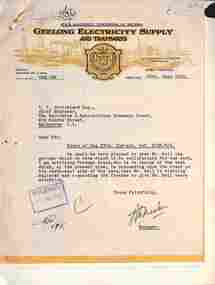 Ballarat Tramway Museum
Letter - Ballarat Rail head grinder, State Electricity Commission of Victoria (SECV), 7/1935
... Bell - MMTB perway Engineer to see the grinder in use. Typed on SEC letterhead of the period. 2 - Carbon copy of letter from T P Strickland, Chief Engineer MMTB dated 27/7/1935 setting up the visit - typed on orange paper. 4 - Pamphlet - four pages, titled "Quasi-Arc" about the welding of rail heads in points and crossings with the rear page showing the welding set and the portable electric grinder....Bell - MMTB perway Engineer to see the grinder in use. Typed on SEC letterhead of the period. 2 - Carbon copy of letter from T P Strickland, Chief Engineer MMTB dated 27/7/1935 setting up the visit - typed on orange paper. 4 - Pamphlet - four pages, titled "Quasi-Arc" about the welding of rail heads in points and crossings with the rear page showing the welding set and the portable electric grinder. ...Set of letters regarding the grinding of rails in Ballarat and the equipment used: 1 - letter from R H Meakin to Mr T P Strickland dated 30/7/1953 about the visit of Mr H Bell - MMTB perway Engineer to see the grinder in use. Typed on SEC letterhead of the period. 2 - Carbon copy of letter from T P Strickland, Chief Engineer MMTB dated 27/7/1935 setting up the visit - typed on orange paper. 4 - Pamphlet - four pages, titled "Quasi-Arc" about the welding of rail heads in points and crossings with the rear page showing the welding set and the portable electric grinder.Yields information about the equipment used in Ballarat to maintain rail heads using a portable grinder.Set of two letters, and a printed pamphlet "Quasi-Arc"tramways, state electricity commission of victoria, secv, mmtb, rails, track maintenance, grinding -
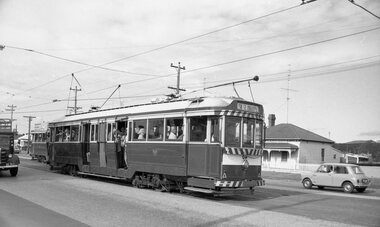 Ballarat Tramway Museum
Negative - SECV Ballarat operations the last day - set of 9, Robert Green, 19/9/1971
... Set of 9 photographs by Robert Green 19/9/1971, showing the tramcar operations of the SECV system on the last day of SECV Operations in Ballarat. 1 -Trams 40, 42 crossing at the Bell St loop. 2 -Tram 40 Sturt St, side on view at Dawson St with St Patricks Cathedral in the background. Tram has a Eureka Tiles and an Electric cooking roof adverts 3 -Tram 40 ditto with Prestige Homes, Franklin Chemist, H P Stevens Furriers, Boronia Florist, 4 -Trams 34, 35 at Dawson St with the Golden City Hotel in the background. 5 -Tram 35 at ditto 6 -Tram 42 in Sturt St with St Andrews Kirk in the background 7 -Tram 42 ditto from the Golden City Hotel 8 -Tram 42 Sturt St with the Franklin Chemist, H P Stevens Furrier, 34in the background' 9 -Tram 39 Sturt St with a light load with the Queen Alexandria bandstand and Bongiornos store in the background. ...Set of 9 photographs by Robert Green 19/9/1971, showing the tramcar operations of the SECV system on the last day of SECV Operations in Ballarat. 1 -Trams 40, 42 crossing at the Bell St loop. 2 -Tram 40 Sturt St, side on view at Dawson St with St Patricks Cathedral in the background. Tram has a Eureka Tiles and an Electric cooking roof adverts 3 -Tram 40 ditto with Prestige Homes, Franklin Chemist, H P Stevens Furriers, Boronia Florist, 4 -Trams 34, 35 at Dawson St with the Golden City Hotel in the background. 5 -Tram 35 at ditto 6 -Tram 42 in Sturt St with St Andrews Kirk in the background 7 -Tram 42 ditto from the Golden City Hotel 8 -Tram 42 Sturt St with the Franklin Chemist, H P Stevens Furrier, 34in the background' 9 -Tram 39 Sturt St with a light load with the Queen Alexandria bandstand and Bongiornos store in the background. ...Set of 9 photographs by Robert Green 19/9/1971, showing the tramcar operations of the SECV system on the last day of SECV Operations in Ballarat. 1 -Trams 40, 42 crossing at the Bell St loop. 2 -Tram 40 Sturt St, side on view at Dawson St with St Patricks Cathedral in the background. Tram has a Eureka Tiles and an Electric cooking roof adverts 3 -Tram 40 ditto with Prestige Homes, Franklin Chemist, H P Stevens Furriers, Boronia Florist, 4 -Trams 34, 35 at Dawson St with the Golden City Hotel in the background. 5 -Tram 35 at ditto 6 -Tram 42 in Sturt St with St Andrews Kirk in the background 7 -Tram 42 ditto from the Golden City Hotel 8 -Tram 42 Sturt St with the Franklin Chemist, H P Stevens Furrier, 34in the background' 9 -Tram 39 Sturt St with a light load with the Queen Alexandria bandstand and Bongiornos store in the background. Yields information about the SECV Ballarat tramways last day of operations on 19/9/1971.35mm negative in a film strip - set of 9tramways, last day, closure, tram 42, sturt st, tram 34, lydiard st, tram 40, bell st loop, tram 35, tram 39 -
 Ballarat Tramway Museum
Slide - 35mm slide/s, Travis Jeffrey, c1962
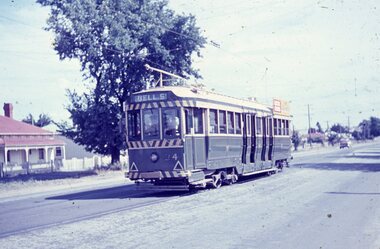
... Agfa plastic mount (blue base, white cover) of a photograph of No. 34 showing Bell St., Drummond St. South, advertising electric globes, in Skipton St., at the Bell St loop. ...Tramways trams Bell St Skipton St tram 34 "BAS 30" in pencil Agfa plastic mount (blue base, white cover) of a photograph of No. 34 showing Bell St., Drummond St. South, advertising electric globes, in Skipton St., at the Bell St loop. ...Agfa plastic mount (blue base, white cover) of a photograph of No. 34 showing Bell St., Drummond St. South, advertising electric globes, in Skipton St., at the Bell St loop. Photo taken c1962. Slide rescanned at 3200 dpi 25-10-2020, jpg replaced, tiff file retained. This file was scanned in 2003 and may show colour changes. "BAS 30" in penciltramways, trams, bell st, skipton st, tram 34 -
 Ballarat Tramway Museum
Document - ESCo, Electric Supply Co. of Vic (ESCo), "Rules for Conductors"
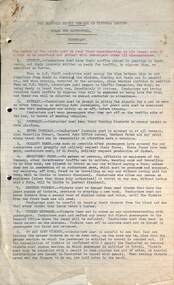
... Electric Supply Co of Victoria (ESCo) Conductors. ESCo was the operator of the Ballarat Tramways from 1905 to 1934. Notes issuing of tickets, operational issues, trailers, bell signs, cash handling, parcels, behavior, uniforms, and inspectors. ...Electric Supply Co of Victoria (ESCo) Conductors. ESCo was the operator of the Ballarat Tramways from 1905 to 1934. Notes issuing of tickets, operational issues, trailers, bell signs, cash handling, parcels, behavior, uniforms, and inspectors. ...The typed document, most likely from an original document, details the rules for Electric Supply Co of Victoria (ESCo) Conductors. ESCo was the operator of the Ballarat Tramways from 1905 to 1934. Notes issuing of tickets, operational issues, trailers, bell signs, cash handling, parcels, behavior, uniforms, and inspectors. Conductors were primarily youths, under 21 and could be sacked for errors and were generally not employed after they turned 21. Notes the Grenville St shelter/office of ESCo. Not known who retyped the document.Yields information about the rules that ESCo conductors operated under and the operation of trailers.Six page typed document on ruled foolscap paper with four punch holes on left side and stapled in top left hand corner.tramcars, tramways, conductors, tickets, esco, trailers -
 Ballarat Tramway Museum
Administrative record, Electric Supply Co. of Vic (ESCo), "Ballarat Tramways Punch Register", c1905
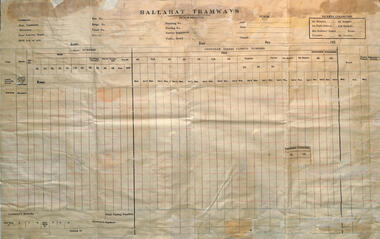
... Demonstrates an ESCo trip waybill and bell punch register. tramways Ballarat fares Pay-in Forms tickets Trip Waybills esco Bell Punch Preprinted form - double layer of paper with red horizontal ruling. "Ballarat Tramways Punch Register" Administrative record Electric Supply Co. of Vic (ESCo) ...Form headed "Ballarat Tramways Punch Register" - with extensive entries required for the record of tramcar operations on ESCo Ballarat tramways. Principally around the number of tickets sold, punched and trips with the pay-in details along the lower edge. HP James notes the use of Bell punches of two types in his notes on tickets - see item 2541. See item 2531 for a 4d ticket that states it had to be Bell punched. Has space for 4d return, 1d night school, disabled soldiers, and various values of dockets. Has a piece of paper glued to the top - lower right hand area to record 4d and 3d exchange tickets.Demonstrates an ESCo trip waybill and bell punch register.Preprinted form - double layer of paper with red horizontal ruling.tramways, ballarat, fares, pay-in forms, tickets, trip waybills, esco, bell punch -
 Ballarat Tramway Museum
Postcard, Ron Scholten, SEC Ballarat tram 17
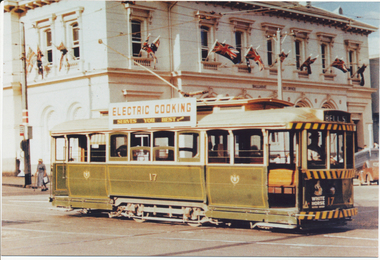
... Tram has an SEC Electric Cooking advertisement and the destination of Bell St....Tram has an SEC Electric Cooking advertisement and the destination of Bell St. SEC Ballarat tram 17 Postcard Ron Scholten ...Yields information about the use of Special trams and the Ballarat railway station level crossing.Colour photograph, printed on a postcard back format of SEC Ballarat tram 17 crossing Sturt St from Lydiard St north with the Ballarat Post Office in the background. Doors have been changed over for the Sturt St central median strip. Note the lady with the walking stick behind the tram and the tram stop sign. Tram has an SEC Electric Cooking advertisement and the destination of Bell St.trams, tramways, lydiard st north, sturt st, post office, tram 26 -
 Ballarat Tramway Museum
Photograph - interior Bendigo ESCo 9, Keith Kings, 15/09/1962
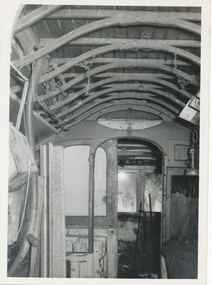
... bell cord straps. Black and White print contained within the Wal Jack Bendigo and Geelong Album, see Reg Item 5003 for more details. Yields information about the interior of former ESCo tram No. 9 Trams tramways Bendigo ESCo Duncan Fraser Tramcar Bodies tram 9 on rear in ink "Bendigo Interior of original electric tram No. 9, rear of house in Thistle St. ...Photo of the interior Bendigo ESCo 9 after the body had been sold, in Thistle St, Bendigo, 15-9-1962, photo by Keith Kings. Shows the structure of the tram, very similar to the Duncan and Fraser horse tram structure. Has the D&F bell cord straps. Black and White print contained within the Wal Jack Bendigo and Geelong Album, see Reg Item 5003 for more details. Yields information about the interior of former ESCo tram No. 9Black and white print with photographer’s notes on the rear.on rear in ink "Bendigo Interior of original electric tram No. 9, rear of house in Thistle St. Flash 1/25. f22, 9 ft 15/9/62" and in the top right hand corner, the Keith Kings copyright stamp with the number "N(v)(13)" written in.trams, tramways, bendigo, esco, duncan fraser, tramcar bodies, tram 9 -
 Sunshine and District Historical Society Incorporated
Administrative record - City of Sunshine - Commissioner Mr Alexander Alex George Gillon Collection 1976 - 1982 - Notice of ordinary meeting of the council 12th February 1980, City of Sunshine, 6th January 1980
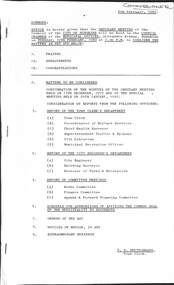
... Land Transfers to and from Council Drainage Easement rear of Sunshine Swimming Pool, Withers Street (Last house owned by Ada Mary Bell Nee Jelly to be converted in council car parking area) and Stanley Street Licence Agreement Sunshine Swimming Pool Kiosk Introduction of electric trolley bus services Proposed review of voters rolls Rates, sanitary and interest charges adjustments and abandonments Proposed lease YCW building Co-Operative Kinder Smith Reserve Proposed Branch Library at the Deer Park Shopping Centre Proposed purchase of land from ICI - ICI Oval and surrounding lands and land Fitzgerald Road and Whitesides Avenue...ICI Oval Ballarat Road Fitzgerald Road Whitesides Avenue Ardeer Sunshine Swimming Pool Kennedy Street Stanley Street Braybrook YCW Kinder Smith Reserve Lily Street Deer Park Library Station Road Neale Road Deer Park Land Transfers to and from Council Drainage Easement rear of Sunshine Swimming Pool, Withers Street (Last house owned by Ada Mary Bell Nee Jelly to be converted in council car parking area) and Stanley Street Licence Agreement Sunshine Swimming Pool Kiosk Introduction of electric trolley bus services Proposed review of voters rolls Rates, sanitary and interest charges adjustments and abandonments Proposed lease YCW building Co-Operative Kinder Smith Reserve Proposed Branch Library at the Deer Park Shopping Centre Proposed purchase of land from ICI - ICI Oval and surrounding lands and land Fitzgerald Road and Whitesides Avenue Foolscap sized document. ...Land Transfers to and from Council Drainage Easement rear of Sunshine Swimming Pool, Withers Street (Last house owned by Ada Mary Bell Nee Jelly to be converted in council car parking area) and Stanley Street Licence Agreement Sunshine Swimming Pool Kiosk Introduction of electric trolley bus services Proposed review of voters rolls Rates, sanitary and interest charges adjustments and abandonments Proposed lease YCW building Co-Operative Kinder Smith Reserve Proposed Branch Library at the Deer Park Shopping Centre Proposed purchase of land from ICI - ICI Oval and surrounding lands and land Fitzgerald Road and Whitesides Avenueici oval, ballarat road, fitzgerald road, whitesides avenue, ardeer, sunshine swimming pool, kennedy street, stanley street, braybrook, ycw, kinder smith reserve, lily street, deer park library, station road, neale road, deer park -
 Sunshine and District Historical Society Incorporated
Administrative record - City of Sunshine - Commissioner Mr Alexander Alex George Gillon Collection 1976 - 1982 - Minutes of the ordinary meeting of council held on 12th February 1980, City of Sunshine, 12th January 1980
... Land Transfers to and from Council Drainage Easement rear of Sunshine Swimming Pool, Withers Street (Last house owned by Ada Mary Bell Nee Jelly to be converted in council car parking area) and Stanley Street Licence Agreement Sunshine Swimming Pool Kiosk Introduction of electric trolley bus services Proposed review of voters rolls Rates, sanitary and interest charges adjustments and abandonments Proposed lease YCW building Co-Operative Kinder Smith Reserve Proposed Branch Library at the Deer Park Shopping Centre Proposed purchase of land from ICI - ICI Oval and surrounding lands and land Fitzgerald Road and Whitesides Avenue...ICI Oval Ballarat Road Fitzgerald Road Whitesides Avenue Ardeer Sunshine Swimming Pool Kennedy Street Stanley Street Braybrook YCW Kinder Smith Reserve Lily Street Deer Park Library Station Road Neale Road Deer Park Land Transfers to and from Council Drainage Easement rear of Sunshine Swimming Pool, Withers Street (Last house owned by Ada Mary Bell Nee Jelly to be converted in council car parking area) and Stanley Street Licence Agreement Sunshine Swimming Pool Kiosk Introduction of electric trolley bus services Proposed review of voters rolls Rates, sanitary and interest charges adjustments and abandonments Proposed lease YCW building Co-Operative Kinder Smith Reserve Proposed Branch Library at the Deer Park Shopping Centre Proposed purchase of land from ICI - ICI Oval and surrounding lands and land Fitzgerald Road and Whitesides Avenue Foolscap sized document. ...Land Transfers to and from Council Drainage Easement rear of Sunshine Swimming Pool, Withers Street (Last house owned by Ada Mary Bell Nee Jelly to be converted in council car parking area) and Stanley Street Licence Agreement Sunshine Swimming Pool Kiosk Introduction of electric trolley bus services Proposed review of voters rolls Rates, sanitary and interest charges adjustments and abandonments Proposed lease YCW building Co-Operative Kinder Smith Reserve Proposed Branch Library at the Deer Park Shopping Centre Proposed purchase of land from ICI - ICI Oval and surrounding lands and land Fitzgerald Road and Whitesides Avenueici oval, ballarat road, fitzgerald road, whitesides avenue, ardeer, sunshine swimming pool, kennedy street, stanley street, braybrook, ycw, kinder smith reserve, lily street, deer park library, station road, neale road, deer park -
Box Hill Historical Society
Book, Catherine Turnbull, Favourite Escapes to the Outer-East. 100 Years of Holidays. Picnics, Excursions and Sporting Carnivals held in the Outer Eastern Region of Melbourne
... Head> Isabel Head's Tea Rooms> Ferntree Gully Lilydale Ferntree Gully Yarra Flats Sabbath School Bell's Gulf Station Yarra Glen McLean> Jack Box Hill Historical Society Surrey Hills Hephzibah Villa Wilson Hill Albert Hill Wilson> Alfred Wilson> Joseph Wilson> Caroline (Mrs.) Smith's gully Hildebrand> Mr. Hirt> Mr. Harris> R.J. (Mr.) Dandenong Ranges Herman> - (Mr.) Trains Duncanson> - (Mr.) Jones> - (Mr.) Ward> - (Mr.) Charman> - (Mr.) Electric ...Articles submitted by member societies of the Association of Eastern (regional) Historical societies, covering one hundred years of holidays, picnics, excursions and sporting carnivals held in the Outer Eastern regions of Melbourne, 1865-1960. Note the article on "Empire Day Train Services to Surrey Hills 24th May, 1907" written by Jack McLean, a member of Box Hill Historical Society.57 p.Articles submitted by member societies of the Association of Eastern (regional) Historical societies, covering one hundred years of holidays, picnics, excursions and sporting carnivals held in the Outer Eastern regions of Melbourne, 1865-1960. Note the article on "Empire Day Train Services to Surrey Hills 24th May, 1907" written by Jack McLean, a member of Box Hill Historical Society.bailey> william, cole> harry, haywood> charlie, gomm> henry t., head> isabel, head's tea rooms> ferntree gully, lilydale, ferntree gully, yarra flats sabbath school, bell's gulf station, yarra glen, mclean> jack, box hill historical society, surrey hills, hephzibah villa, wilson hill, albert hill, wilson> alfred, wilson> joseph, wilson> caroline (mrs.), smith's gully, hildebrand> mr., hirt> mr., harris> r.j. (mr.), dandenong ranges, herman> - (mr.), trains, duncanson> - (mr.), jones> - (mr.), ward> - (mr.), charman> - (mr.), electric tram, golf, huntingdale golf club, metropolitan golf club, reilly> j.l. (mr.), mcculloch family, eastern golf club, maroondah aquaduct, guest houses, sport, golf
