
Showing 8 items matching "electric measuring instruments"
-
 Moorabbin Air Museum
Book - Northrop Institute of Technology publications, Electricity and Electronics for Aerospace Vehicles
... ...Electric Measuring Instruments...Northrop Institute of Technology publications Fundamentals of electricity Magnetism & electromagnetism Capacitors & inductors Alternating ciurrent Electric Measuring Instruments Batteries Generators D-C & A-C generators & controls Electric motors Installation of electrical systems Principles of electronics Receivers & transmitters Electric instruments Electronic control systems Radar 2 way radio for light aircraft Radio systems for modern ( as of 1961) airliners Electronic navigation equipment Autopilot for light aircraft & airliners Missile guidance & control Communication systems for space vehicles Basic electrical & electronic theory for students, circa 1961 Electricity and Electronics for Aerospace Vehicles Book Northrop Institute of Technology publications ...Basic electrical & electronic theory for students, circa 1961non-fiction Basic electrical & electronic theory for students, circa 1961 fundamentals of electricity, magnetism & electromagnetism, capacitors & inductors, alternating ciurrent, electric measuring instruments, batteries, generators, d-c & a-c generators & controls, electric motors, installation of electrical systems, principles of electronics, receivers & transmitters, electric instruments, electronic control systems, radar, 2 way radio for light aircraft, radio systems for modern ( as of 1961) airliners, electronic navigation equipment, autopilot for light aircraft & airliners, missile guidance & control, communication systems for space vehicles -
 Flagstaff Hill Maritime Museum and Village
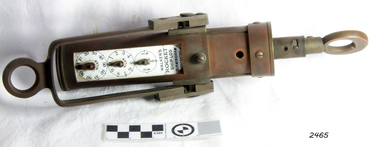
Ship Log, 1900-1920
... electric log and the Walker factory was one of the first to introduce the 48 hour work week for employees. This ship log was invented and made by a significant marine instrument maker and innovator of machinery. It demonstrates the huge leap taken to improve navigational accuracy at sea with an instrument that was in use for decades. flagstaff hill warrnambool shipwrecked-coast flagstaff-hill flagstaff-hill-maritime-museum maritime-museum shipwreck-coast flagstaff-hill-maritime-village ship log rocket log mechanical ship log measuring instrument marine instrument nautical instrument speed recording instrument ship log register walker ship log walkers rocket ship-log thomas walker thomas walker & son thomas ferdinand walker walker log business reynolds ship log rotor taffrail log taff rail log west india association "Walkers Rocket Ship-Log Birmingham (Patented)" printed on face-plate. ...Thomas Walker & Son was internationally renowned in the manufacturing of ships logs. Founding father Thomas Walker (1805–1871), an engineer in Birmingham, patented a mechanical log in 1878 which was a recording instrument that attached to a rail at the stern of a vessel connected by a long cord with a rotor which was towed behind the ship. The instrument dial recorded the distance travelled. Thomas Walker first went into business to manufacture stoves at 58 Oxford Street Birmingham. Walker’s self-feeding stove was widely lauded at the Paris Exhibition of 1855, winning a prize medal and kick starting the first of many notable innovations for the Walker family's manufacturing business. However, it wasn’t until working on an earlier ships log model invented by his Uncle that Thomas Walker became interested in the further development of this device, used to ascertain a ship’s speed. Walker continued to improve on the common log for the company of Massey & Sons and these improvements were deemed revolutionary. This log became a firm favourite of the West India Association (British-based organisation promoting ties and trade with the British Caribbean) and the most common log in use for two generations. It took till 1861 for Thomas Walker and his son, Thomas Ferdinand Walker (1831-1921) to patent the first Walker log of many. Together, with the introduction of the A1 Harpoon Log two years later, they established the Walker Log Business as a force to be reckoned with. By the time of his passing in 1871, Thomas Walker Snr had not only founded a family business with considerable staying power but also instilled a tradition of public service. Having sat as a representative on the Birmingham Town Council for 15 years and played an active role in public works, he was soon given the nickname of ‘Blue Brick Walker’. Much like his father, Thomas Ferdinand Walker changed the face of the maritime industry. His patent of 1897, the ‘Cherub’ log, was a notable departure from the past providing a far more accurate reading and replacing the majority of logs of the age. They were the first to produce an electric log and the Walker factory was one of the first to introduce the 48 hour work week for employees. This ship log was invented and made by a significant marine instrument maker and innovator of machinery. It demonstrates the huge leap taken to improve navigational accuracy at sea with an instrument that was in use for decades. Ship Log, three analogue dials calibrated in increments of Miles, the Rocket Log is a nautical instrument for measuring a vessel’s speed and distance traveled. The floating log was drawn behind the ship over a fixed time period in order to measure the distance traveled. The counter could measure enough miles to cover the maximum distance traveled by a ship in one day. The log has two distinct parts; a brass register, made by Walker, showing the distance recorded and the rotator made by Reynolds, that spins in the water driving the counter. both parts are connected by a linked chain. The register has a cylindrical brass body approx 4.5 cm diameter containing registering mechanism with hardened steel bearings. Distance is indicated by the three pointers on enamel plate as follows: graduated every 10 miles from 0-100; every mile from 1-10; every 1/4 mile from 1/4 -1. A brass sling and eye secured to the body enables it to be attached to the taffrail. The original rotator would have had a cylindrical tapered wooden body, approx 4.5 cm in diameter with three metal alloy fins or could be all made from brass. A towing eye is fitted to the tapered end. The two pieces of apparatus are connected by a length of linked chain, length 22.9 cm. "Walkers Rocket Ship-Log Birmingham (Patented)" printed on face-plate. "Made by Thomas Walker". flagstaff hill, warrnambool, shipwrecked-coast, flagstaff-hill, flagstaff-hill-maritime-museum, maritime-museum, shipwreck-coast, flagstaff-hill-maritime-village, ship log, rocket log, mechanical ship log, measuring instrument, marine instrument, nautical instrument, speed recording instrument, ship log register, walker ship log, walkers rocket ship-log, thomas walker, thomas walker & son, thomas ferdinand walker, walker log business, reynolds ship log rotor, taffrail log, taff rail log, west india association -
 Federation University Historical Collection
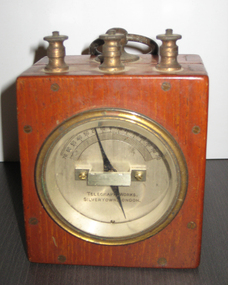
Equipment - Galvonometer, 1930 (estimated)
... Galvanometers are an instrument used for detecting and measuring electric current. They had a magnetic needle moved by the magnetic field produced by coils carrying the current to be measured, and the earth's field had to be taken into consideration. ...Galvanometers are an instrument used for detecting and measuring electric current. They had a magnetic needle moved by the magnetic field produced by coils carrying the current to be measured, and the earth's field had to be taken into consideration. ...Galvanometers are an instrument used for detecting and measuring electric current. They had a magnetic needle moved by the magnetic field produced by coils carrying the current to be measured, and the earth's field had to be taken into consideration. They were used to detect current in either direction in telegraphy systems, and to test equipment. Post Office Galvonometer. A hinged polished timber case with three brass terminals at the top, and ring (handle) and a dial (0 to 70) with an indictor needle. The opened box reveals wires leading to the terminals with two compartments covered in blue woven material (possibly silk). telegraph works, galvonometer, scientific instruments -
 Federation University Historical Collection
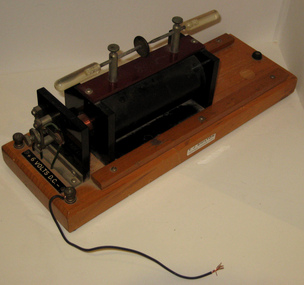
Scientific Instrument, Induction Coil
... electric spark, to jump across an air gap separating the secondary's output terminals. For this reason, induction coils were called spark coils. The size of induction coils was usually specified by the length of spark it could produce; an '8 inch' (20 cm) induction coil was one that could produce an 8 inch arc. (http://en.wikipedia.org/wiki/Induction_coil) ballarat college of advanced education scientific instrument induction coil scientific instruments electricity A metal and plastic object on a timber stand. In an induction coil the distance between the plates is often used to measure ...An induction coil consists of two coils of insulated copper wire wound around a common iron core. One coil, called the primary winding, is made from relatively few (tens or hundreds) turns of coarse wire. The other coil, the secondary winding, typically consists of many (thousands) turns of fine wire. An electric current is passed through the primary, creating a magnetic field. Because of the common core, most of the primary's magnetic field couples with the secondary winding. The primary behaves as an inductor, storing energy in the associated magnetic field. When the primary current is suddenly interrupted, the magnetic field rapidly collapses. This causes a high voltage pulse to be developed across the secondary terminals through electromagnetic induction. Because of the large number of turns in the secondary coil, the secondary voltage pulse is typically many thousands of volts. This voltage is often sufficient to cause an electric spark, to jump across an air gap separating the secondary's output terminals. For this reason, induction coils were called spark coils. The size of induction coils was usually specified by the length of spark it could produce; an '8 inch' (20 cm) induction coil was one that could produce an 8 inch arc. (http://en.wikipedia.org/wiki/Induction_coil) A metal and plastic object on a timber stand. In an induction coil the distance between the plates is often used to measure the voltage of the spark since the air breaks down at 30 000 volts per centimetre ballarat college of advanced education, scientific instrument, induction coil, scientific instruments, electricity -
 Federation University Historical Collection
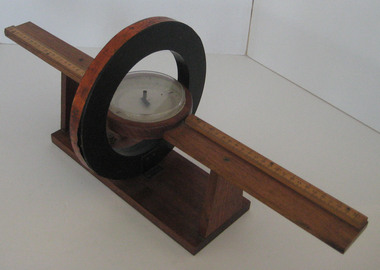
Equipment - Scientific Instrument, Tangent Galvanometer
... measuring electric current. It works by using a compass needle to compare a magnetic field generated by the known current to the magnetic field of the Earth. elementary physics experiment galvanonometer ballarat school of mines scientific instruments A "compass rose" type of horizontal full-circle scale, with 4 0-90 unit quandrants. ...Used for measuring electric current. It works by using a compass needle to compare a magnetic field generated by the known current to the magnetic field of the Earth. A "compass rose" type of horizontal full-circle scale, with 4 0-90 unit quandrants. Balanced, free-floating needle. Located centrally wired to a vertical coil. Horizontal distance scales, one each side and perpendicular to the core. All mounted on polished wood base, equipped with 3 terminal posts. Materials: glass, wood, metal. elementary, physics, experiment, galvanonometer, ballarat school of mines, scientific instruments -
 Federation University Historical Collection
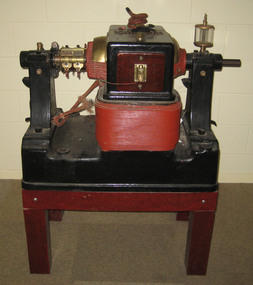
Equipment, Elwell-Powell, Elwell-Parker AC Generator
... Parker, surrounded by dynamos, secondary batteries, measuring instruments etc. Electric tram cars are going to be a big thing in England. ...Parker, surrounded by dynamos, secondary batteries, measuring instruments etc. Electric tram cars are going to be a big thing in England. ...This AC generator operated for the State Electricity Commission in the Ballarat North Power Station prior to World War Two. James Oddie of Ballarat has an association with Thomas Parker of Elswell-Parker. In early 1887 Oddie arrived in England seeking information on electrical knowledge and its developments. At this time Henry Sutton was teaching Electricity and Magnetism at the Ballarat School of Mines. Oddie stayed in the United Kingdom for around three years and during that time became a close friend of Thomas Parker and his family. The two first met at the first official running of the Blackpool tram, and Oddie was invited to visit Parker at Wolverhampton. Over the years Thomas Parker kept newspaper cuttings (mainly Australian) relating to James Oddie and his work. The following article is a description of the Wolverhampton works by James Oddie, and was collected by Thomas Parker. After the dinner at Blackpool, Mr. Parker visited me, and cordially invited me to see his extensive works at Wolverhampton, an invitation I was not slow to avail myself of. This was the keynote of the best friendship I made in England. I went shortly afterwards and stayed several days, visiting the works daily, as Mr. Parker gave me the run of the whole works. There I ordered the installation of a 60 light dynamo, with a 28 cell storage battery and paraphernalia, now doing duty at the Observatory. I subsequently visited the works frequently, sometimes for a week at a time, and I regard it as the brightest spot in my English constellation. Mr. Parker started his works in 1880, with one man beside himself. He never had a single day’s instruction in electricity in his life; now he daily instructs between 300 and 400 employees, who worship him as a father. He is said to be now the most practical electrical engineer and mechanist in Europe. During one of my visits I took with me an artist, who is painting for me a portrait, 6 feet by 5 feet, of Mr. Parker, surrounded by dynamos, secondary batteries, measuring instruments etc. Electric tram cars are going to be a big thing in England. Parker’s Company Limited, is now, with three other companies, in the hands of the Electric Construction Company, with Mr. Parker as manager of the lot. The whole of the works will be taken to Wolverhampton. Before I left, a tender for £50,000 was accepted for the construction of new works. AC Generator painted read and black on a stand. This AC generator operated for the State Electricity Commission in the Ballarat North Power Station prior to World War Two generator, ac generator, elwell-parker ltd, state electricity commission, sec, ballarat north power station, james oddie, wolverhampton -
 J. Ward Museum Complex
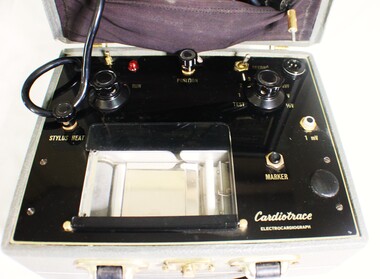
Instrument - Electrocardiograph Machine - Cardiotrace Heat Mark II, circa 1920
... Contains: Electric cord Cords to link electrodes Graph paper to measure heart beats Instruments on panel marked 'stylus heat', 'off', 'run', 'position', 'test', 'record', '1', '2', '3', 'aVR', 'aVL', 'aVP', 'V', '1/2V', 'lmV', marker....Instrument Co. Pty. Ltd. Distributor: Watson Victor Limited Serial No: 3362 Cardiotrace Heat Mark III Electrocardiograph/Voltage 220-240 A/C /Frequency 50 cycles per second/Watts 45 serial 3362/Caution: Refer to Manual for full detail. Cardiotrace Electrocardiograph Machine in blue plastic case with black handle. Contains: Electric cord Cords to link electrodes Graph paper to measure ...With the advent of electricity, so to came the invention of the Electrocardiograph Machine. This piece of medical equipment gave nursing staff and doctors a more precise indication of a patients heart beat and was used extensively across Victoria's medical institutions. The equipment is significant because it is a fully intact example of diagnostic equipment used in a mental health hospital in Victoria Australia. Cardiotrace Electrocardiograph Machine in blue plastic case with black handle. Contains: Electric cord Cords to link electrodes Graph paper to measure heart beats Instruments on panel marked 'stylus heat', 'off', 'run', 'position', 'test', 'record', '1', '2', '3', 'aVR', 'aVL', 'aVP', 'V', '1/2V', 'lmV', marker. Manufacturer: Medical Instrument Co. Pty. Ltd. Distributor: Watson Victor Limited Serial No: 3362 Cardiotrace Heat Mark III Electrocardiograph/Voltage 220-240 A/C /Frequency 50 cycles per second/Watts 45 serial 3362/Caution: Refer to Manual for full detail. electrocardiograph machine, medical instrument, medicine, health, mental health, ararat mental hospital, j ward -
 Whitehorse Historical Society Inc.
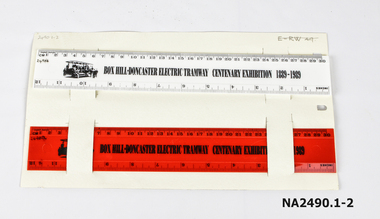
Memorabilia - Rulers
... instruments measuring civic mementoes souvenirs Red and white rulers commemorating Box Hill - Doncaster Electric Tramway Exhibition 1889 - 1989. ...Red and white rulers commemorating Box Hill - Doncaster Electric Tramway Exhibition 1889 - 1989. Mounted on cardboard instruments, measuring, civic mementoes, souvenirs
