
Showing 8 items matching "electrical shortages"
-
 Ballarat Tramway Museum
Photograph - Ballarat Tram 33, View from the lake looking towards Wendouree Parade, near View Point, 11 August 1971
... ...electrical shortages...Due to the First World War shortages of electrical equipment, the tram could not be completed. ...Due to the First World War shortages of electrical equipment, the tram could not be completed. ...Tram 33 was built by Duncan and Fraser in 1917 for the Hawthorn Tramways Trust. It was on-sold to the Footscray Tramways Trust. Due to the First World War shortages of electrical equipment, the tram could not be completed. Melbourne and Metropolitan Tramways Board took over the Trust and completed the tram. It was purchased by the SEC in 1935 and became part of the Ballarat fleet. In 1971 the tram was acquired by the Hamilton Pastoral Museum and there until Ballarat Tramways Museum acquired it in 1977. Photograph taken by Campbell Duncan. Colour image in cardboard Kodak mount. 35mm slideHandwritten notation in ink on mount.duncan and fraser, adelaide, hawthorn tramway trust, ballarat, wendouree parade, ballarat tramway preservation society, ballarat tramway museum, campbell duncan, photographer, footscray tramways trust, 1917, electrical shortages, first world war, sec, 1935, hamilton pastoral museum, ballarat tramways museum, 1977 -
 Ballarat Tramway Museum
Photograph - Ballarat Tram 33, Tram travelling in Wendouree Parade, near where the Ballarat Tramway Museum Depot Junction is now
... ...electrical shortages...Due to the First World War shortages of electrical equipment, the tram could not be completed. ...Due to the First World War shortages of electrical equipment, the tram could not be completed. ...Tram 33 was built by Duncan and Fraser in 1917 for the Hawthorn Tramways Trust. It was on-sold to the Footscray Tramways Trust. Due to the First World War shortages of electrical equipment, the tram could not be completed. Melbourne and Metropolitan Tramways Board took over the Trust and completed the tram. It was purchased by the SEC in 1935 and became part of the Ballarat fleet. In 1971 the tram was acquired by the Hamilton Pastoral Museum and there until Ballarat Tramways Museum acquired it in 1977. Photograph taken by Campbell Duncan. Colour image in cardboard Kodak mount. 35mm slideHandwritten notation in ink on mount.duncan and fraser, adelaide, hawthorn tramway trust, ballarat, wendouree parade, ballarat tramway preservation society, ballarat tramway museum, campbell duncan, photographer, footscray tramways trust, 1917, electrical shortages, first world war, sec, 1935, hamilton pastoral museum, ballarat tramways museum, 1977 -
 Ballarat Tramway Museum
Photograph - Ballarat Tram 33, In Wendouree Parade, near where the Ballarat Tramway Museum Depot junction is now, 11 August 1971
... ...electrical shortages...Due to the First World War shortages of electrical equipment, the tram could not be completed. ...Due to the First World War shortages of electrical equipment, the tram could not be completed. ...Tram 33 was built by Duncan and Fraser in 1917 for the Hawthorn Tramways Trust. It was on-sold to the Footscray Tramways Trust. Due to the First World War shortages of electrical equipment, the tram could not be completed. Melbourne and Metropolitan Tramways Board took over the Trust and completed the tram. It was purchased by the SEC in 1935 and became part of the Ballarat fleet. In 1971 the tram was acquired by the Hamilton Pastoral Museum and there until Ballarat Tramways Museum acquired it in 1977. Photograph shows the tram in Wendouree Parade near where the Ballarat Tramway Museum Depot is now. Photograph taken by Campbell Duncan. Colour image in cardboard Kodak mount. 35mm slideHandwritten notation in ink on mount.duncan and fraser, adelaide, hawthorn tramway trust, ballarat, wendouree parade, ballarat tramway preservation society, ballarat tramway museum, campbell duncan, photographer, footscray tramways trust, 1917, electrical shortages, first world war, sec, 1935, hamilton pastoral museum, ballarat tramways museum, 1977, ballarat tram 33, ballarat tramway museum depot -
 Ballarat Tramway Museum
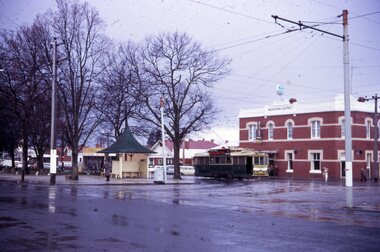
Photograph - Ballarat Tram 33, Photograph of No. 33 at the intersection of Ripon Street and Sturt Street, outside the Western Hotel, 11 August 1971
... ...electrical shortages...Due to the First World War shortages of electrical equipment, the tram could not be completed. ...Due to the First World War shortages of electrical equipment, the tram could not be completed. ...Tram 33 was built by Duncan and Fraser in 1917 for the Hawthorn Tramways Trust. It was on-sold to the Footscray Tramways Trust. Due to the First World War shortages of electrical equipment, the tram could not be completed. Melbourne and Metropolitan Tramways Board took over the Trust and completed the tram. It was purchased by the SEC in 1935 and became part of the Ballarat fleet. In 1971 the tram was acquired by the Hamilton Pastoral Museum and there until Ballarat Tramways Museum acquired it in 1977. The photo shows Tram33 in Sturt Street at the corner of Ripon Street, outside the Western Hotel. Tram shelter is shown on the grassed area in the middle of Sturt Street. Photograph taken by Campbell Duncan 0n 11 August 1971. Colour image in cardboard Kodak mount. 35mm slideHandwritten notation in ink on mount.duncan and fraser, adelaide, hawthorn tramway trust, ballarat, wendouree parade, ballarat tramway preservation society, ballarat tramway museum, campbell duncan, photographer, footscray tramways trust, 1917, electrical shortages, first world war, sec, 1935, hamilton pastoral museum, ballarat tramways museum, 1977, sturt street, ripon street, western hotel, tram shelter, 1971 -
 Kiewa Valley Historical Society
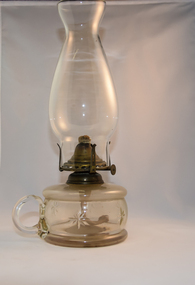
Lamp Table Kerosene, pre 1950s
... These table lights would have still been used after this time as emergency lighting during electrical power shortages (outages). These emergency lighting lamps, including candles, were eventually replaced by battery power. ...These table lights would have still been used after this time as emergency lighting during electrical power shortages (outages). These emergency lighting lamps, including candles, were eventually replaced by battery power. ...This particular lamp was made for the dinner table or "parlour". This was the most effective indoor lighting before electrical lighting was introduced in the 1940's. These table lights would have still been used after this time as emergency lighting during electrical power shortages (outages). These emergency lighting lamps, including candles, were eventually replaced by battery power. The Kiewa Valley was supplied by electricity well before many other rural regions due to the State Electricity Commission constructing the Kiewa Hydro Electricity power turbines (late 1930's to mid 1950's). Petrol and diesel generators were used in other rural regions before state wide electricity was available.The significance of this kerosene lamp to the Kiewa Valley is that it provides the proof that before the Hydro electricity scheme was established in the valley, householder and commerce relied on candle/kerosene power. Although at certain times before battery and solar energy became the night time lighters the sole source of lighting was candle power and kerosene power. The supply of both however was still required by most of the population by supply from city and larger country town suppliers. This nearly fully glass made table lamp(kerosene) has a large glass bowl/basin like kerosene storage unit with a glass circular finger handle (similar to a ordinary cup). Formed single star like patterns (50mm apart) encircle the centre of the bowl. On top of the bowl sits the metal (brass) wick holder with a small wheel protruding out one side for adjusting the wick length(increasing or decreasing the strength(regulating) of the amount of light projected. Four prongs rise from the circular base light fixture holding the windproof and refractive glass "pot belly" shield. lamp table, kerosene lamp, household lighting (non electrical) -
 Federation University Historical Collection
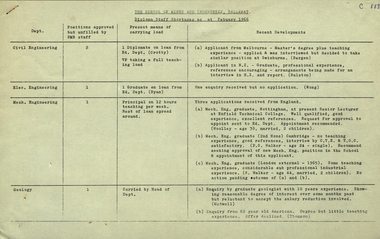
Document, School of Mines Ballarat, Diploma Staff shortages as at February 1966, 1966
... staffing ballarat school of mines civil engineering electrical engineering mechanical engineering geology mathematica humanities time allocations Typed sheets listing departments, staff and developments School of Mines Ballarat, Diploma Staff shortages as at February 1966 Document ...Typed sheets listing departments, staff and developmentsstaffing, ballarat school of mines, civil engineering, electrical engineering, mechanical engineering, geology, mathematica, humanities, time allocations -
 Kiewa Valley Historical Society
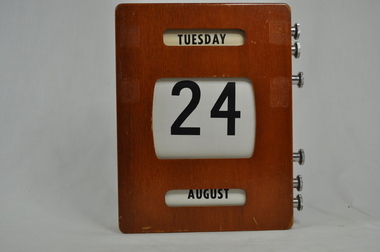
Calendar Desk Perpetual, circa mid 1950s
... The time this item was first used, electrical or battery powered desk and office calendars did not exist for semi isolated rural regions. These type of perpetual calendars not only looked impressive but were not affected by power shortages. ...The time this item was first used, electrical or battery powered desk and office calendars did not exist for semi isolated rural regions. These type of perpetual calendars not only looked impressive but were not affected by power shortages. ...This item appears to be a calendar which was in use for a multiple clientele office e.g. post office, commercial office or bank, school or educational administration area, small government office or hospital administration in the Kiewa Valley or its region. The time this item was first used, electrical or battery powered desk and office calendars did not exist for semi isolated rural regions. These type of perpetual calendars not only looked impressive but were not affected by power shortages. This was a time when not all of Victoria was adequately supplied by power. This item is quite relevant to the Kiewa Valley as it demonstrates that the time before the Hydro electricity generators where built (Mount Beauty to Falls Creek), power supplies were not keeping up to the ever increasing demand from city and rural customers. This item was in a period before mass produced automated date and time pieces were available and hand operated date and time pieces were both in a social and commercial sphere a necessity.Wooden box (varnished) with three openings (on the front) detailing ,the day(Monday to Sunday), the date (1st to 31st) and the month (January to December). On the right side of the calendar box are two winding screws (RHS 6 steel) for each opening. These permit the scrolling of the information i.e. day, number and month. This ability results in a desk calendar which is perpetual. On the back there is a steel (screwed on) hanger with a slot for wall screw.perpetual calendar, office calendars, desk calendars, desk furniture -
 Bendigo Historical Society Inc.
Document - BROADCASTING STATION 3CV, MARYBOROUGH, 2 March, 1956
... shortage of plywood in Victoria. Present activities: Ready Built Housing Factory... on-site building... a modern joinery... timber yard... drying kilns... etc.... and plumbing & electrical...shortage of plywood in Victoria. Present activities include: Ready Built Housing Factory, on-site building, a modern joinery, timber yard, drying kilns, etc., and plumbing & electrical & engineering services, a door and panel factory at Cairns, retail hardware store, Melbourne Sales Depot. ...shortage of plywood in Victoria. Present activities: Ready Built Housing Factory on-site building a modern joinery timber yard drying kilns etc. and plumbing & electrical & engineering services a door and panel factory at Cairns retail hardware store Melbourne Sales Depot. ...Broadcasting Station 3CV, Maryborough. A souvenir of the opening of the New Studios and Offices of Central Victoria Broadcasters Pty Ltd. March 2nd, 1956. Established 1956, offices in Burke Street, opening coincides with the stations 21st birthday, March 2 for the former celebration, October 26 for the latter. Coverage included Bendigo, Ballarat, Daylesford, Castlemaine and Maryborough. 3CV plays active part in assisting charities and hospitals at Maryborough, Daylesford, Maldon and Dunolly. Active Women's Radio Club with branches in country centres adds strength to station's charitable efforts. Opening 3CV's new premises will widen the scope of the station's charitable efforts, and stronger link with Australian Commercial Broadcasting stations. Writer Harold V Nunn writes history of district of Mayborough. Manager Ken J Parker, Central Victoria Broadcasters Pty. Ltd. The Souvenir brochure also covers topics such as: deep lead mining. WWI. Houses being pulled down. New settlements of Mildura. Secondary Industries. Bowenvale, Alma, Majorca, Craigie, Amherst, Adelaide Lead, Havelock, Bet Bet, Bently. Primary production and a railway staff of approximately 150. Maryborough a little town without a future. Coal fields at Wonthaggi. 1917 a public meeting was convened in an effort to stem the tide of adversity. Mayor George Frost, M.L.A., decision to form a Progress Association, a policy of secondary industry was decided upon and committees were appointed, James L Drew much credit is due. Maryborough's move for rejuvenation was revolutionary, because apart from Ballarat, Bendigo and Geelong, it was regarded as so much presumption that industry could be expected to function with success in a country town. Governments were unsympathetic. Maryborough & district people showed determination to succeed and their faith in their town. Employment and economic security provided by the industries outweighed the debt. Maryborough's general position is that it is no longer dependent upon one particular phase of activity. The first of the industries to be formed in 1918 was the Butter Factory. The nearer dairy companies did not take kindly to the prospect of another opposition company taking supplies from their districts, and in the first few years of establishment completion made the going hard for the management. But adopting a conservative policy and placing all profits to reserve I the first six years of operation headway was gradually made. Thus it was a red letter day for the company in 1925 when the first dividend of 5 percent was paid.1955 dividend of 10 per cent. Operating it's own trucks the dairy serviced local dairymen up to 40 miles. Maryborough Knitting mills est. 1923, having transferred from Clunes. Out bid Ballarat and Bendigo to the industry. The mill has what is probably the largest circular underwear plant in the Commonwealth, which is conservatively valued at 198,913 pounds. It produces between four and five million garments each year, worth over one million pounds. The company has established subsidiary mills at Dunolly, Talbot and Avoca. The company also assisted in the establishment of the Interknit Hosiery Co. Ltd., Clunes. The Maryborough Flour Mills is the second oldest of Mayborough's industries. It was built by Mr Cadwallader over 70 years ago. It was later sold to Mr. A Land and then to Jas. Minifie & Co. It had a somewhat 'in-and -out' existence until purchased in 1923 by Messrs. Willersdorf and Forbes, of Eddington. In 1939 the firm began to build silos for the storage of bulk wheat and the present storage capacity is 100,000 bushels. 1944 power was changed from steam to electricity. The mill has an out put of 20 sacks an hour. 1938 a chaff mill was built, and now is regarded as one of the best in Victoria. Its output in one year of approximately 6,800 tons is a State record for a single cutter. During this 30 year period Patience and Nicholson Limited has grown with Maryborough and is now one of the major key industries of Australia. The P&N brand covers precision tools - taps, dies and twist drills - indispensable to the country's economy, and quality is acknowledged equally by an air craft factory in Canada, a dockyard in Thailand, a railway workshop in New Zealand, no less than by our own Australian industries. Maryborough can be proud of the part played by P&N in war when, geared to the needs of the times, it poured countless millions of tools into defence factories and to the armed forces of the Allies, and now in peace when it is providing, hydro-electric undertakings and the manufacture of cars and tractors. From 1858, W Phelan & Sons Pty Ltd has made phenomenal and spectacular growth, becoming incorporated as a private company in 1929. It is without doubt the greatest private development in the history of Maryborough. 1940 joinery manufacture was commenced. The company entered the Ready Built Housing field in `950 - and in 1951 established a factory at Cairns, Northern Queensland to overcome the manufacturing difficulties being experienced due to the shortage of plywood in Victoria. Present activities include: Ready Built Housing Factory, on-site building, a modern joinery, timber yard, drying kilns, etc., and plumbing & electrical & engineering services, a door and panel factory at Cairns, retail hardware store, Melbourne Sales Depot. Hedges & Bell Pty Ltd were est 1945, with a staff of 40 employees are the largest printing firm outside the metropolitan area. The branch of Premier Wireworks is a contribution made by the decentralisation policy of the State.event, official, celebration, broadcasting station 3cv, maryborough. a souvenir of the opening of the new studios and offices of central victoria broadcasters pty ltd. march 2nd, 1956. established 1956, offices in burke street, 21st birthday. coverage bendigo, ballarat, daylesford, castlemaine maryborough. assisting charities and hospitals maldon and dunolly. women's radio club opening 3cv's new premises australian commercial broadcasting stations. writer harold v nunn writes history of district of mayborough. manager ken j parker, central victoria broadcasters pty. ltd. souvenir brochure: deep lead mining. wwi. houses pulled down. new settlements. primary production railway staff. coal fields wonthaggi. 1917 a public meeting was convened in an effort to stem the tide of adversity. mayor george frost, m.l.a., form a progress association, policy of secondary industry, james l drew rejuvenation was revolutionary, employment and economic security. the first of the industries to be formed in 1918 was the butter factory. thus it was a red letter day for the company in 1925 when the first dividend of 5 percent was paid.1955 dividend of 10 per cent. operating it's own trucks serviced local dairymen. maryborough knitting mills est. 1923 largest circular underwear plant in the commonwealth. established subsidiary mills at dunolly, talbot, avoca. interknit hosiery co. ltd., clunes. the maryborough flour mills it was built by mr cadwallader. mr. a land jas. minifie & co. messrs. willersdorf and forbes, build silos for wheat storage capacity is 100, 000 bushels. 1944 power was changed from steam to electricity. 20 sacks an hour. 1938 a chaff mill was built, best in victoria. patience and nicholson limited the p&n precision tools - taps, dies and twist drills. war, geared to the needs of the times, countless millions of tools into defence factories the armed forces of the allies, hydro-electric undertakings and the manufacture of cars and tractors. from 1858, w phelan & sons pty ltd, incorporated 1929. 1940 joinery manufacture. ready built housing field in 1950 - 1951 established a factory at cairns, northern queensland to overcome the manufacturing difficulties being experienced due to the shortage of plywood in victoria. present activities: ready built housing factory, on-site building, a modern joinery, timber yard, drying kilns, etc., and plumbing & electrical & engineering services, a door and panel factory at cairns, retail hardware store, melbourne sales depot. hedges & bell pty ltd were est. 1945, with a staff of 40 employees are the largest printing firm outside the metropolitan area. the branch of premier wireworks is a contribution made by the decentralisation policy of the state.
