
Showing 18 items matching "electricity usage"
-
 University of Melbourne, Burnley Campus Archives
Administration, Dept of Agriculture, Victoria, Installation & Maintenance 19/1, 1971-1981
... ...electricity usage...Manila folder containing letter and memoranda re electricity usage...electricity electricity usage saving electricity Manila folder containing letter and memoranda re electricity usage Installation & Maintenance 19/1 Administration Dept of Agriculture, Victoria ...electricity, electricity usage, saving electricity -
University of Melbourne, Burnley Campus Archives
Administration, Department of Agriculture, Supply & Reticulation 19/2, 1978-1981
... ...electricity usage...Memoranda re electricity supply and usage 06.12.1978-24.11.1981....electricity electricity supply electricity usage Manila folder with a shoelace tie. ...electricity, electricity supply, electricity usage -
 Ballarat Tramway Museum
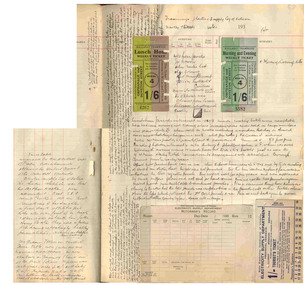
Document - Handwritten Notes, H.P. James, Tickets and fare boxes, 8/04/1940 12:00:00 AM
... Topics covered include: Weekly Tickets Colouring and methods of tickets Ticket punches Ticket nipping Bell punches Timetables Power meters in trams Fare Boxes Tokens Electricity usage by tramcars Image 2541i, shows the position of items 2542 to 2545. ...Topics covered include: Weekly Tickets Colouring and methods of tickets Ticket punches Ticket nipping Bell punches Timetables Power meters in trams Fare Boxes Tokens Electricity usage by tramcars Image 2541i, shows the position of items 2542 to 2545. ...Handwritten notes contained within Reg. Item 2526, page 58 in black ink on various subjects concerning items 2542 to 2545: Dated 8/4/1940. Topics covered include: Weekly Tickets Colouring and methods of tickets Ticket punches Ticket nipping Bell punches Timetables Power meters in trams Fare Boxes Tokens Electricity usage by tramcars Image 2541i, shows the position of items 2542 to 2545. Note Item Not formally Numbered. trams, tramways, esco, fare boxes, tickets, power meters, weekly tickets -
 Ballarat Tramway Museum
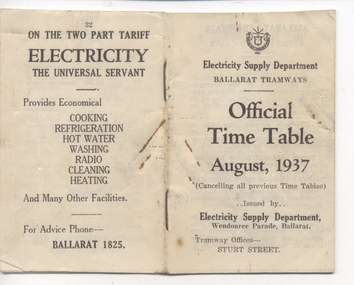
Ephemera - Timetable/s, State Electricity Commission of Victoria (SECV), "Official Time Table August 1937, Aug. 1937
... Page 29 detail the fares and charges, page 30 - luggage, page 28 gives travel information and rear cover advertises electricity usage. Contained originally within Reg Item 5623 at the front of this note book. ...Page 29 detail the fares and charges, page 30 - luggage, page 28 gives travel information and rear cover advertises electricity usage. Contained originally within Reg Item 5623 at the front of this note book. ...Yields information about tram services and how timetables were printed using a clock face for use in Ballarat. Demonstrates timetable making.Thirty two page, white paper, saddle stapled booklet, titled "Electricity Supply Department - Ballarat Tramways - Official Time Table August 1937", Gives notes on the through routing of the tram service, how the clock style format works and that it operates from the Tramway Centre. Also details when extra services are run and times as specific points along the route. Page 29 detail the fares and charges, page 30 - luggage, page 28 gives travel information and rear cover advertises electricity usage. Contained originally within Reg Item 5623 at the front of this note book. For items see btm5623 loose items list.pdf. See Reg Item 3352 for the January 1939 version. 2nd copy added 9/1/2020, received from Nina Netherway 4/1/2021Copy 1 - On pages 2 and 3, numbers have been marked against each route within a circle using ink "0" to "6".timetables, ballarat, fares -
 Federation University Historical Collection
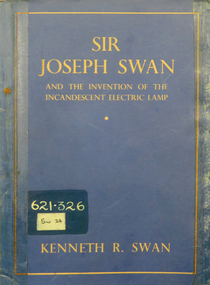
Book, Longman's, Green and Co, Sir Joseph Swan and the Invention of the Incandescent Electric Lamp, 1946, 1948 reprint
... usage. This book was withdrawn from the Ballarat School of Mines Library sir joseph swan, invention, incandescent electric lamp, history, filament lamp, electricity, ballarat school of mines library Blue paperback book, 50 pages: Biography Sir Joseph Swan and the invention of the incandescent electric lamp. ...Joseph Wilson Swan was born in 1882, he made many discoveries and inventions covering a wide range of scientific interest and practical usage. This book was withdrawn from the Ballarat School of Mines LibraryBlue paperback book, 50 pages: Biography Sir Joseph Swan and the invention of the incandescent electric lamp. Includes photographic images of Joseph Swan a carbon filament lamp.sir joseph swan, invention, incandescent electric lamp, history, filament lamp, electricity, ballarat school of mines library -
 Orbost & District Historical Society
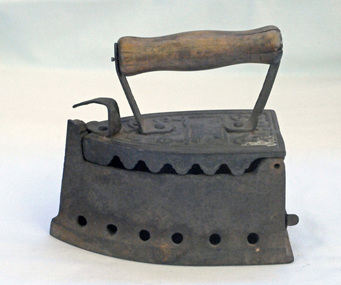
charcoal iron, early 20th century
... This item is an example of a domestic appliance in common usage before the advent of electricity. iron-charcoal domestic Top- "M.G." ...Following the use of flat irons the base of the iron was made into a container to put glowing coals inside it and keep it hot a bit longer. This was called a charcoal iron. It had a hinged lid and air holes to allow the charcoal to keep smouldering. They are sometimes called ironing boxes, or charcoal box irons, and may come with their own stand.This item is an example of a domestic appliance in common usage before the advent of electricity.This is a charcoal iron which was heated by burning charcoal inside it. It is made of iron and has wooden handles, one on top for lifting it and one on the catch at the front that keeps the iron closed. Both of these handles were needed to load the iron with charcoal easily. As wood does not conduct heat well, these handles made the task of filling the iron much easier. The holes around the base of the iron are for letting the fumes out.Top- "M.G."iron-charcoal domestic -
 Orbost & District Historical Society
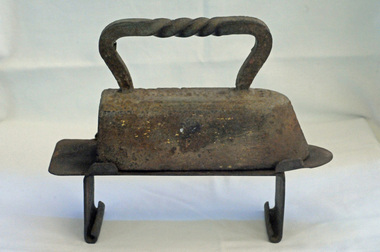
tailor's iron
... This item is an example of a commercial appliance in common usage before the advent of electricity. iron goose-iron tailor A goose iron. ...These large, heavy irons were used by tailors to press trousers. It would be heated on the range or stove to achieve a high temperature. This item is an example of a commercial appliance in common usage before the advent of electricity.A goose iron. These large, heavy irons were used by tailors to press trousers. It would be heated on the range or stove to achieve a high temperature. It has a twisted handle. It has a stand with it.iron goose-iron tailor -
 Orbost & District Historical Society
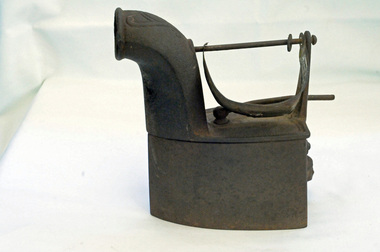
iron, 1867
... This item is an example of a domestic appliance in common usage before the advent of electricity. ir0n-charcoal domestic Large black ornate charcoal iron with a chimney on the top. ...Charcoal irons followed the use of flat irons when the base was made into a box in which to put charcoal which would keep the iron hotter for a longer time.This item is an example of a domestic appliance in common usage before the advent of electricity.Large black ornate charcoal iron with a chimney on the top. It has an ornate metal hand protector. It has a hollow base into which charcoal is placed. The small hole at the back has a sliding cover that was used to regulate the temperature of the iron. ir0n-charcoal domestic -
 Orbost & District Historical Society
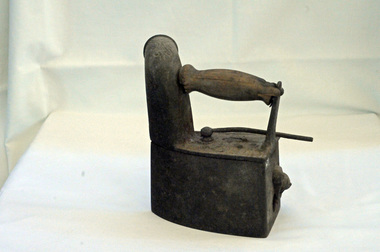
iron
... This item is an example of a domestic appliance in common usage before the advent of electricity. charcoal-iron domestic A large charcoal iron with chimney. ...Charcoal irons followed flat irons when the base was made into a hinged box into which charcoal could be placed, This would keep the iron hotter for a longer time.This item is an example of a domestic appliance in common usage before the advent of electricity.A large charcoal iron with chimney. It has a carved wooden handle.charcoal-iron domestic -
 Orbost & District Historical Society
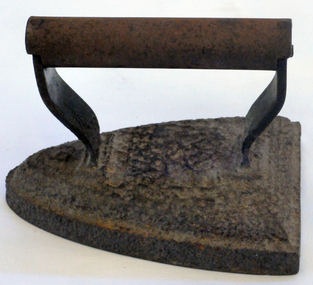
iron
... This item is an example of a domestic appliance in common usage before the advent of electricity. domestic iron flat-iron Small rusty flat iron. iron ...Iron was heated on top of stove. Often the person ironing had two irons - one to iron with and the other heating on stove ready to use when the other cooled down. They were heavy to use and were generally cleaned with bees' wax and a cloth before use. Wooden handles were patented in 1865.This item is an example of a domestic appliance in common usage before the advent of electricity.Small rusty flat iron.domestic iron flat-iron -
 Orbost & District Historical Society
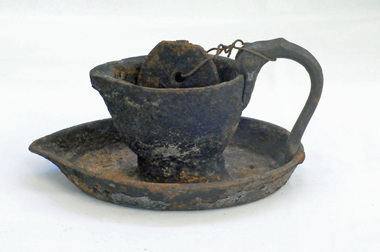
slush lamp
... electricity was connected. In the days before battery powered torches many used a slush lamp to provide the light they needed to carry out their duties. It held a flammable liquid like paraffin. When the wick was lit the slush lamp provided sufficient light Slush lamps were designed to be carried around but they could be dangerous because they have flame as a source of light. This is an example of a portable lighting device in common usage ...This slush lamp was used in the Newmerella Bakehouse ( Sederlan's Bakery) before electricity was connected. In the days before battery powered torches many used a slush lamp to provide the light they needed to carry out their duties. It held a flammable liquid like paraffin. When the wick was lit the slush lamp provided sufficient lightSlush lamps were designed to be carried around but they could be dangerous because they have flame as a source of light. This is an example of a portable lighting device in common usage before the use of batteries.A cast iron slush lamp. It is a a crude lamp or burning slush, tallow, or grease.It is a jug shaped container on a shallow dish that holds the fuel and a wick that draws the fuel by capillary action. There is some burnt hessian impregnated with fat. lighting lamp-slush newmerella-bakehouse -
 Kiewa Valley Historical Society
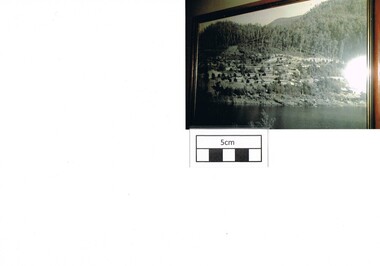
Photograph Bogong, Bogong Township Circa 1950, circa 1940s to 1950s
... Electricity Commission to house, engineers and construction workers working on the Kiewa Hydroelectric Scheme. These workers were initially settled in 26 houses and were mainly of European heritage. At the completion of the scheme, in the 1960's, the village was opened to public/tourism use. This photograph shows the village before beautification for tourism was introduced and "bare bones" homes and village usage...Electricity Commission to house, engineers and construction workers working on the Kiewa Hydroelectric Scheme. These workers were initially settled in 26 houses and were mainly of European heritage. At the completion of the scheme, in the 1960's, the village was opened to public/tourism use. This photograph shows the village before beautification for tourism was introduced and "bare bones" homes and village usage ...The Bogong Village was originally constructed (1937-1940) by the State Electricity Commission to house, engineers and construction workers working on the Kiewa Hydroelectric Scheme. These workers were initially settled in 26 houses and were mainly of European heritage. At the completion of the scheme, in the 1960's, the village was opened to public/tourism use. This photograph shows the village before beautification for tourism was introduced and "bare bones" homes and village usage existed.This photo clearly presents a period of restricted human occupation of a very fragile Alpine environment(up to 4000 workmen involved). This was the beginning of a planned and controlled form of sustainable tourist orientated development of the Victorian Alps and high plains region. The Bogong Township was the base camp for workers employed by the State Electricity Commission. After the construction phase was completed, the planning and controls originating from this period have been modified to allow a greater public access of this unique environment.Photograph of a framed glass enclosed black and white photograph of the Bogong settlement Paper details "KodakXtraLife paper" on back of photo. bogong village, bogong township, sec alpine constructions, hydro, kiewa scheme -
 Kiewa Valley Historical Society
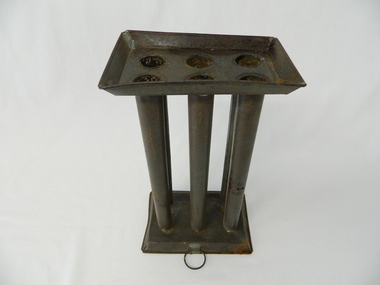
Mould Candle Making, Circa mid 1900's
... electricity tariffs. This equality did not take place until 1965. The demand and usage of cheaper and affordable lighting that wax candles provided was for some rural families a way of life until the mid 1900's. parrafin wax candles domestic household ighting This candle making mould is made from mild rolled sheet steel(tin). ...Candle stick manufacturing moulds were extensively used throughout the Kiewa Valley and its regions to provide rural homes and businesses with illumination during times of limited light e.g. night time. These candles were used before the Kiewa Valley was placed of the electrical grid. The candles were made from parrafin wax. Before the 1920"s electricity was in limited supply due to the inability of the private electricity suppliers to service isolated rural regions. It was not until the Victorian State Government passed legislation (1920) to improve electricity supplies by forming the State Electricity Commission of Victoria (S.E.C.V.) Isolated rural communities could not meet the higher costs to have electricity supplies connected and therefore it was not until the 1950's that adequate domestic electrical power could be supplied.The isolation that the Kiewa Valley provided was of a greater hindrance to any utility (power,roads & telephone) where the cost per instillation was beyond the rural population's ability to pay either directly or indirectly. One of the benefits that the "closed" community of Mount Beauty had, when it was administered by the SECV was that some utility costs were a lot lower than that of the other settlements in the Kiewa Valley. This disparity led to a conference in 1928 of the rural and regional councils to demand from the Government an equality of electricity tariffs. This equality did not take place until 1965. The demand and usage of cheaper and affordable lighting that wax candles provided was for some rural families a way of life until the mid 1900's.This candle making mould is made from mild rolled sheet steel(tin). The top basin is rectangular in shape with beveled edges(facing in on all sides. There are six holes in the top basin for vertical hollow tubes to feed off. The six tapered cyclindrical tubes running from the top basin to the bottom raised platform base. All connections are welded together. The bottom of each cylinder has an opening for the candle wick. The wick is positioned in place before the molten wax is poured into the cylinders. A positioning ring has been welded to one bottom ring for stability.parrafin wax, candles, domestic household ighting -
 Bendigo Historical Society Inc.
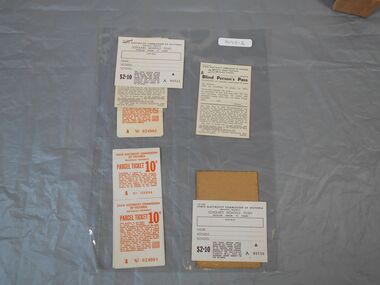
Document - Various passes and tickets
... electricity. After WW1 the SEC was formed and took over the running of the trams. With the increased usage of cars, patronage of the trams began to drop off after WW2. ...electricity. After WW1 the SEC was formed and took over the running of the trams. With the increased usage of cars, patronage of the trams began to drop off after WW2. ...Sandhurst and Electric Tramways Company introduced the first trams to Bendigo in June 1890. These were battery operated trams but it soon became obvious that the battery life was unable to copy with Bendigo's hilly terrain. The trams were converted to steam in 1892. In 1899 the tramways were sold to the Electric Supply Company of Victoria and in 1903 the trams were converted to electricity. After WW1 the SEC was formed and took over the running of the trams. With the increased usage of cars, patronage of the trams began to drop off after WW2. In 1972 the tramways closed as a commuter service. The Bendigo trust then restored trams and infrastructure and began the tourist/talking trams.State Electricity Commission of Victoria Provincial Tramways: 2 x single parcel tickets Nos 024004 and 024005, 1 x single Scholars Monthly ticket, 1 x single Blind persons pass, 1 x transfer with image of by holding sign with quote "Electricity makes life easier!". Also stapled together 1 x Scholars Monthly ticket, 1 x Blind persons pass and 2 x parcel tickets. Parcel tickets have orange print on thin paper. Monthly ticket and Blind persons pass have black print on cardboard. Transfer is on original brown cardboard.provincial tramways, tramways, tickets, passes, electricity -
 Bendigo Historical Society Inc.
Administrative record - Tramways student passes
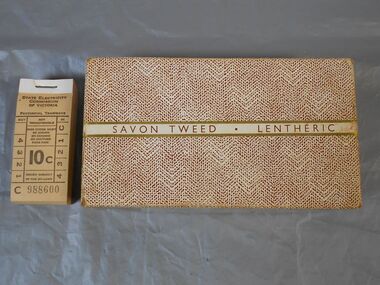
... electricity. After WW1 the SEC was formed and took over the running of the trams. With the increased usage of cars, patronage of the trams began to drop off after WW2. ...electricity. After WW1 the SEC was formed and took over the running of the trams. With the increased usage of cars, patronage of the trams began to drop off after WW2. ...Sandhurst and Electric Tramways Company introduced the first trams to Bendigo in June 1890. These were battery operated trams but it soon became obvious that the battery life was unable to copy with Bendigo's hilly terrain. The trams were converted to steam in 1892. In 1899 the tramways were sold to the Electric Supply Company of Victoria and in 1903 the trams were converted to electricity. After WW1 the SEC was formed and took over the running of the trams. With the increased usage of cars, patronage of the trams began to drop off after WW2. In 1972 the tramways closed as a commuter service. The Bendigo trust then restored trams and infrastructure and began the tourist/talking trams.State Electricity Commission of Victoria Provincial Tramways: student passes One box containing various types of tram tickets. Bottom of box is red. Top of box has a mottled pattern with a stripe across the length with the words "SAVON TWEED LENTHERIC". 1 separate bundle of 10c paper tickets with cardboard backing and whitestripe where tickets are stapled together. Tickets are a beige color with black print. Bottom of box has a blue sticker with white typeface - "JW Jones Chemist Hargreaves St. Bendigo" 13/6 is written in the middle of this sticker with pencil.On back of separate ticket bundle is blue pen with OCT 1972 crossed out and 16.4.1972 Trams Finishedprovincial tramways, tramways, tickets, passes, electricity -
 Ballaarat Mechanics' Institute (BMI Ballarat)
Tram At SEC Building Wendouree Pde
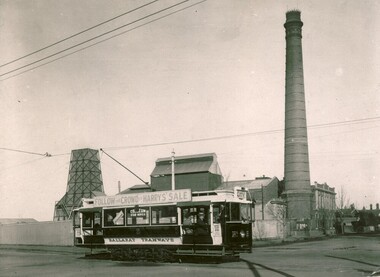
... Please contact BMI for all print and usage inquiries. Ballarat Tram SEC Electricity Commission Wendouree Parade Tram At SEC Building Wendouree Pde ...This photograph is from the Max Harris Collection held by the Ballaraat Mechanics' Institute. Please contact BMI for all print and usage inquiries.ballarat, tram, sec, electricity commission, wendouree parade -
Ballarat Tramway Museum
Document - BA-T8-8100, State Electricity Commission of Victoria (SECV), "Tramways - Tail Lights", 1/11/1949
... usage, alternatives, experimental work on tram 26, and costs. See item 9024 revision B of the drawing and item 10046 for drawing 8357. Yields information about the modifications proposed to the tramcars to provide a rear tail light and lights when at a terminus. tramcars safety tail lights Lights Ballarat tram 26 Memo - two copies of the three foolscap sheets and one copy of the dye line print. "Tramways - Tail Lights" Document BA-T8-8100 State Electricity ...Document or memo dated 1/11/1949, from A V Mawby to the Manager Ballarat Branch, titled "Tramways - Tail Lights" detailing the work done and comments by the Ballarat Branch, noting issues with the headlight types, visibility, power usage, alternatives, experimental work on tram 26, and costs. See item 9024 revision B of the drawing and item 10046 for drawing 8357.Yields information about the modifications proposed to the tramcars to provide a rear tail light and lights when at a terminus.Memo - two copies of the three foolscap sheets and one copy of the dye line print.tramcars, safety, tail lights, lights, ballarat, tram 26 -
 Ballarat Tramway Museum
Document - Report, State Electricity Commission of Victoria (SECV), "Ballarat Tramways - Statistics", Mar. 1962
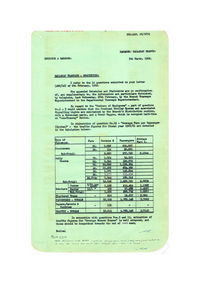
... Details types of passengers (Pensions, Adults, Scholars, chartered trams, passenger totals including parcels) for 1960/61. .2 - Four foolscap sheets giving details of fares and charges, route length, services, fare sections, length of fare sections, employees, trams in service, tram usage, area and population served, expenditure, revenue, loss, average fare per passenger and extra trams needed for events. Also refers to Reg Item 7932 and 7951 for the original request. All sheets have rounded corners. "Ballarat Tramways - Statistics" Document Report State Electricity ...Yields detailed information about the statistics of the Ballarat Tramway system during the 1960/61 Financial year, passenger loadings, finances and tramcar operation..1 - Report titled "Ballarat Tramways - Statistics", carbon copy, dated 5/3/1962, responding to a head office letter of 6/3/1962. Compiled in association with Schedules and Statements required, in response to specific questions for compilation of reports by the SEC. Details types of passengers (Pensions, Adults, Scholars, chartered trams, passenger totals including parcels) for 1960/61. .2 - Four foolscap sheets giving details of fares and charges, route length, services, fare sections, length of fare sections, employees, trams in service, tram usage, area and population served, expenditure, revenue, loss, average fare per passenger and extra trams needed for events. Also refers to Reg Item 7932 and 7951 for the original request. All sheets have rounded corners.trams, tramways, reports, passengers, employees, fares, tramcars, routes, revenue, finances, tickets
