
Showing 14 items matching "elizabeth stephenson"
-
 Narre Warren and District Family History Group
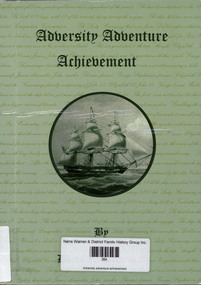
Book, Doris R Preusker, Adversity adventure achievement, 2006
... Elizabeth Stephenson...Elizabeth Stephenson James Pigdon A tribute to the author's second great grandmother Elizabeth Stephenson and his grandfather James Pigdon Adversity adventure achievement Book Doris R Preusker ...A tribute to the author's second great grandmother Elizabeth Stephenson and his grandfather James Pigdonnon-fictionA tribute to the author's second great grandmother Elizabeth Stephenson and his grandfather James Pigdonelizabeth stephenson, james pigdon -
 Lakes Entrance Historical Society
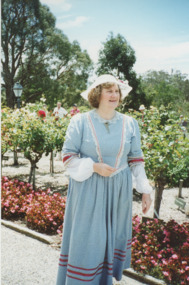
Photograph - Australia Day Nyerimilang Park 1995, Lakes Post Newspaper, 1/01/1995 12:00:00 AM
... Frank and Vida Stephenson, Elizabeth DeRoss, Bill Whelan, Perc Baily and Colin Campbell...Also Photograph of Elizabeth DeRoss reciting poetry at the same event 04797.1 Celebration Genealogy Historic Houses performance Colour photograph showing Country Ramblers Band during Australia Day ceremony at Nyerimilang Park Nungurner Victoria. Frank and Vida Stephenson ...Also Photograph of Elizabeth DeRoss reciting poetry at the same event 04797.1Colour photograph showing Country Ramblers Band during Australia Day ceremony at Nyerimilang Park Nungurner Victoria. Frank and Vida Stephenson, Elizabeth DeRoss, Bill Whelan, Perc Baily and Colin Campbellcelebration, genealogy, historic houses, performance -
 Surrey Hills Historical Society Collection
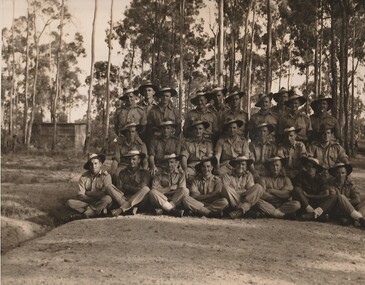
Work on paper - Photograph, The 2/1 Australian Field Butchery Platoon, Petrie, Queensland, 1945, 9 March 1945
... Leslie George Lobb - born 15 July 1920 in Box Hill; married Elizabeth Annie Stephenson in 1954; died 14 Nov. 1997. ...Leslie George Lobb - born 15 July 1920 in Box Hill; married Elizabeth Annie Stephenson in 1954; died 14 Nov. 1997. ...This is an official group portrait of the 2/1st Field Butchery Platoon who are identified as: Left to right, back row: VX33117 Corporal (Cpl) F M Hogan; NX85618 Private (Pte) A J Nicol; VX127710 Pte E C J Kemp; VX143647 Lance Corporal (LCpl) L G Lobb; QX44905 Pte C L Adams; SX25540 Lance Sergeant R J Gray; NX193508 Pte K A Burgess; VX5112 Pte J T Roberts; NX153073 Pte D J Evans; WX9743 Pte M F Lynch. Middle row: QX49356 Pte L V Symes; QZ31697 Pte N R Underhill; QX16156 Staff Sergeant H L Cairns; VX19172 Lieutenant W H Thomas; VX55658 Sgt D W Craig; QX47082 Sgt E S Wilbraham; SX19778 Pte D Weatherald. Front row: NX155215 Pte E Corrigan; QX56335 Pte E Corrigan; NX57204 LCpl W H Jackson; VX59081 Pte B Moszkowicz; SX31901 Pte J Lambre; NX94941 Cpl R A Hanson; QX40009 Pte T G O’Neill; VX84971 Pte S J Welsh. The photo was taken under the command of 1 Aust Base Sub Area and Lt R B Irving. According to the Australian War Memorial website, the photographer was David Tennant Gaery Eastman and the photo was taken on 9 March 1945. In the AWM collection there is also a photo of members of the platoon at the unit slaughter yards in Milne Bay, New Guinea (REF: AWM 0703790). An overview of the history of the unit can be found at https://birtwistlewiki.com.au/wiki/2/1st_Field_Butchery_Company Leslie George Lobb, the father of the donor, was the platoon sergeant. He had multiple copies of this photo, which may have been obtained with the aim of distributing them to other platoon members. Leslie George Lobb - born 15 July 1920 in Box Hill; married Elizabeth Annie Stephenson in 1954; died 14 Nov. 1997. Leslie became a service station / garage proprietor at 352 Mont Albert Road, Mont Albert a business he took over from his father. An associated mechanical business operated under the name of Leo Green Motors, at the same address. The family lived next door at 354 Mont Albert Road, Mont Albert. Leslie's father Harry Lobb had operated at an adjoining property (350 Mont Albert Road, Mont Albert) as a fuel and ice merchant, before installing a petrol bowser to service the expanding motor car industry. The house at 354 Mont Albert Road, Mont Albert was removed and relocated by the family in 2000 to Mirboo North, Gippsland, Victoria, where it still stands.The photo is a touchstone to local servicemen who served in World War 2.A B&W / sepia photo with a narrow white border of 25 men in uniform. They are standing / sitting in 3 distinct rows with the rear row standing and the other 2 sitting on a 'sandy' area with sapling eucalypts and a (?) corrugated iron shed in the background.REAR: Purple photographer's stamp approximately in the centre: "Photograph No. MH [in lead pencil 87544] / Supplied by Military History / Section (S.D.9) / General Staff L H Q. / For personal enjoyment ONLY / and on condition that it will / not be reproduced in any form." f m hogan, a j nicol, c j kemp, l g lobb, c l adams, r j gray, k a burgess, j t roberts, d j evans, m f lynch, l v symes, n r underhill, h l cairns, w h thomas, d w craig, e s wilbraham, d weatherald, e corrigan, w h jackson, b moszkowicz, j lambre, r a hanson, t g o’neill, s j welsh, 2/1st field butchery platoon, petrie, world war, 1939-1945, mont albert -
 Flagstaff Hill Maritime Museum and Village
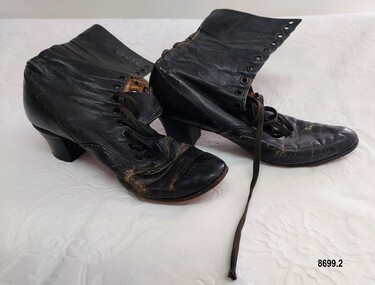
Footwear - Leather boots, Adler Boots and Shoes, circa 1920
... Matthew Stephenson (1861 – 1943) who had grown up on the Bendigo goldfields and shifted to Melbourne in the early 1900’s was a train driver and later, a fireman with the railways. His wife Elizabeth...Matthew Stephenson (1861 – 1943) who had grown up on the Bendigo goldfields and shifted to Melbourne in the early 1900’s was a train driver and later, a fireman with the railways. His wife Elizabeth ...This item is one of a collection of clothing items that belonged to the Stephenson family who lived at 22 McCracken Street, Kensington, Melbourne. Matthew Stephenson (1861 – 1943) who had grown up on the Bendigo goldfields and shifted to Melbourne in the early 1900’s was a train driver and later, a fireman with the railways. His wife Elizabeth Jane (Betsy) Wigley (1865 – 1953) also grew up on the goldfields around Majorca and Bendigo. They married in 1885 in Bendigo. They had two daughters – Ethel Evelyn Stephenson (1886 – 1956) and Lillian or Lila (1891 – 1977) who were milliners and dressmakers and who continued to live in the family home after the death of their parents. The family are recorded as living at 22 McCracken Street, Kensington, as early as 1914. It is not known who made or owned the clothing that makes up this collection but as it appears to be from the late Victorian and early Edwardian era, the different pieces were probably made and worn by any of the three ladies of the house – Betsy, Ethel and/or Lila. During W.W.2, a local Warrnambool couple (Meryl and Tony Everard) boarded with them – Tony was in the airforce training paratroopers to jump into (and survive) enemy territory and his wife Meryl worked in the Methodist baby Home. The Everards developed a close friendship with the Stephensons and were responsible for clearing out the house (and finding this clothing collection) after Lila died in 1977. Starting in around 1850, women began wearing boots that resembled the ones already worn by men in high society. Victorian women's boots were slightly more feminine in nature, however, than those worn by their male counterparts. The boots first worn by women extended to the middle of the calf so that her ankle would stay properly covered underneath her many skirts. These boots often featured laces or a row of buttons to keep them secure to the foot and ankle. Although usually made from durable materials like rubber and leather, boots that were worn purely for fashion were sometimes made of more elegant materials like patent leather or dyed suede. Edwardian boots were lace up or button up. The most remarkable thing about women's shoes in the 1920's was that they were visible! This led to an increase in demand for new styles every season which made ordering custom fit shoes a thing of the past. New shoes were made in standard sizes, ready to buy from local clothing stores or mail order catalogues. Working women, however, tended to wear sensible, lace up shoes and boots. These boots appear to be of a practical nature, designed for comfort, warmth, and proof against the rain and mud, rather than high fashion. They feature the brand name "adler" printed on the inner sole and have stamped letters and numbers suggesting ready-made sizes.This pair of boots are a significant example of a working woman's footwear dating around the early 20th century.Pair of lady's black leather, lace up boots featuring 3.75 cm heels, 14 pairs of lacing eyelets, a black leather tongue and black shoelaces. The leather soles have tacks on the heels and near the instep. The boots have a black leather inner sole and the inner shaft and upper part of the boots are lined with a durable cotton type fabric. Both boots have ink markings (handwritten and stamped) at the top of the shaft lining and the inner sole of the left hand boot is labelled "adler".Both boots - "0/128 /X" (handwritten) and "6MC200" (stamped). Left boot inner sole - "adler" left boot upper shaft lining - "X/8FH?" (handwritten)flagstaff hill maritime museum and village, great ocean road, shipwreck coast, warrnambool, boots, lady's boots, footwear, leather boots, lace up boots, adler, stephenson family -
 Flagstaff Hill Maritime Museum and Village
Textile - Petticoat, circa 1900
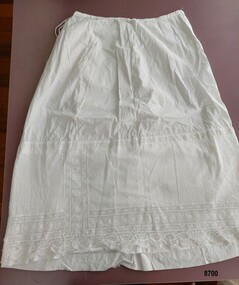
... Matthew Stephenson (1861 – 1943) who had grown up on the Bendigo goldfields and shifted to Melbourne in the early 1900’s was a train driver and later, a fireman with the railways. His wife Elizabeth...Matthew Stephenson (1861 – 1943) who had grown up on the Bendigo goldfields and shifted to Melbourne in the early 1900’s was a train driver and later, a fireman with the railways. His wife Elizabeth ...This item is one of a collection of clothing items that belonged to the Stephenson family who lived at 22 McCracken Street, Kensington, Melbourne. Matthew Stephenson (1861 – 1943) who had grown up on the Bendigo goldfields and shifted to Melbourne in the early 1900’s was a train driver and later, a fireman with the railways. His wife Elizabeth Jane (Betsy) Wigley (1865 – 1953) also grew up on the goldfields around Majorca and Bendigo. They married in 1885 in Bendigo. They had two daughters – Ethel Evelyn Stephenson (1886 – 1956) and Lillian or Lila (1891 – 1977) who were milliners and dressmakers and who continued to live in the family home after the death of their parents. The family are recorded as living at 22 McCracken Street, Kensington, as early as 1914. It is not known who made or owned the clothing that makes up this collection but as it appears to be from the late Victorian and early Edwardian era, the different pieces were probably made and worn by any of the three ladies of the house – Betsy, Ethel and/or Lila. During W.W.2, a local Warrnambool couple (Meryl and Tony Everard) boarded with them – Tony was in the airforce training paratroopers to jump into (and survive) enemy territory and his wife Meryl worked in the Methodist baby Home. The Everards developed a close friendship with the Stephensons and were responsible for clearing out the house (and finding this clothing collection) after Lila died in 1977. A petticoat is a lady's undergarment - worn under a skirt or dress. They provided warmth, modesty and shape to the dress. In the middle of the 19th century, petticoats were worn over hoops, bustles or in layers. Petticoats varied according to the style of the outside skirt or dress. Plain petticoats tended to be worn with everyday wear whilst better dresses (party dresses or silk gowns) were worn with petticoats that often had more trim and embellishments. Edwardian petticoats had less volume than Victorian era petticoats and they had a "dust ruffle" or lining under a lace flounce. The "dust ruffle" protected the lace flounce and gave the petticoat more flare at the bottom, greater freedom when walking as well as saving the flounce (which was often made of finer material) from everyday wear and tear. Tucks are another feature of Edwardian petticoats - when the lace at the bottom became worn, it could be cut off and the tucks released. This extended the life of the petticoat. This petticoat features an intricate trim of broderie anglaise. Although broderie anglaise was a lace that could be made by hand, it was very time consuming to make. St Gallen was a city in Switzerland that had become known for producing quality textiles. At the beginning of the 19th century, the first embroidery machines were developed in St Gallen. Factories used embroidery machines but people also had them in their homes. They were able to produce broderie anglaise for export. By the early 20th century, machine made lace, fabric, ribbons etc. were being sold in drapers shops all over England and Wales to women who were making clothes and furnishings for their families. It is highly likely that the lady who made this petticoat brought the lengths of broderie anglaise already made to embellish and personalise her petticoat.This item is an example of the needlework skills of women in the late 19th century - creating pintucks and adding lace to personalise and embellish a practical item of clothing. A lady's fine cotton and lace ankle length petticoat featuring a deep decorative hem made from sheer pinspot fabric and bands of eyelet lace. The top section of the petticoat is made from five sections of fine cotton sewn together with french seams and gathered with pleats and darts into the waistband. The waistband opening has two button holes and one button (the top button is missing) and a front section with a drawstring. The lace hem is lined with the same fine cotton as the top of the petticoat. There are three different lace bands - a narrow one featuring small flowers, a similar wider band with larger flowers and it is finished at the bottom with a broad band of lace with an intricate leaf design.flagstaff hill maritime museum and village, great ocean road, warrnambool, shipwreck coast, petticoat, lady's petticoat, broderie anglaise, decorative petticoat, draw string waist, machine sewn, dressmaker, stephenson family, pintucks, needlework -
 Flagstaff Hill Maritime Museum and Village
Textile - Overskirt, circa 1910
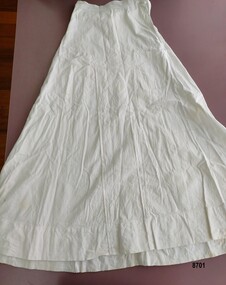
... Matthew Stephenson (1861 – 1943) who had grown up on the Bendigo goldfields and shifted to Melbourne in the early 1900’s was a train driver and later, a fireman with the railways. His wife Elizabeth...Matthew Stephenson (1861 – 1943) who had grown up on the Bendigo goldfields and shifted to Melbourne in the early 1900’s was a train driver and later, a fireman with the railways. His wife Elizabeth ...This item is one of a collection of clothing items that belonged to the Stephenson family who lived at 22 McCracken Street, Kensington, Melbourne. Matthew Stephenson (1861 – 1943) who had grown up on the Bendigo goldfields and shifted to Melbourne in the early 1900’s was a train driver and later, a fireman with the railways. His wife Elizabeth Jane (Betsy) Wigley (1865 – 1953) also grew up on the goldfields around Majorca and Bendigo. They married in 1885 in Bendigo. They had two daughters – Ethel Evelyn Stephenson (1886 – 1956) and Lillian or Lila (1891 – 1977) who were milliners and dressmakers and who continued to live in the family home after the death of their parents. The family are recorded as living at 22 McCracken Street, Kensington, as early as 1914. It is not known who made or owned the clothing that makes up this collection but as it appears to be from the late Victorian and early Edwardian era, the different pieces were probably made and worn by any of the three ladies of the house – Betsy, Ethel and/or Lila. During W.W.2, a local Warrnambool couple (Meryl and Tony Everard) boarded with them – Tony was in the airforce training paratroopers to jump into (and survive) enemy territory and his wife Meryl worked in the Methodist baby Home. The Everards developed a close friendship with the Stephensons and were responsible for clearing out the house (and finding this clothing collection) after Lila died in 1977. This overskirt is an outer protective garment made of durable cotton and was probably worn over a lady's skirt or dress to protect it whilst they were working. The pockets are large enough for the wearer to keep small items in and there is a loop at the back that would allow the wearer to hang it on a hook, when she finished her work. This item is an example of clothing worn by working women in the late 19th and early 20th centuryA heavy cotton ankle length overskirt made with two wide gored sections containing inset pockets joined to a middle T shaped front band. It has a waistband of grosgrain ribbon and a side opening with 3 pairs of metal snaps (one pair is missing) and a hook and eye at the top. The waistband also has a taped loop (for hanging) and an unusual double fabric overlay with unattached curved ends.flagstaff hill maritime museum and village, great ocean road, shipwreck coast, warrnambool, overskirt, needlework, sewing, protective garment, stephenson family -
 Flagstaff Hill Maritime Museum and Village
Textile - Petticoat, circa 1910
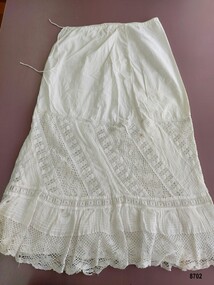
... Matthew Stephenson (1861 – 1943) who had grown up on the Bendigo goldfields and shifted to Melbourne in the early 1900’s was a train driver and later, a fireman with the railways. His wife Elizabeth...Matthew Stephenson (1861 – 1943) who had grown up on the Bendigo goldfields and shifted to Melbourne in the early 1900’s was a train driver and later, a fireman with the railways. His wife Elizabeth ...This item is one of a collection of clothing items that belonged to the Stephenson family who lived at 22 McCracken Street, Kensington, Melbourne. Matthew Stephenson (1861 – 1943) who had grown up on the Bendigo goldfields and shifted to Melbourne in the early 1900’s was a train driver and later, a fireman with the railways. His wife Elizabeth Jane (Betsy) Wigley (1865 – 1953) also grew up on the goldfields around Majorca and Bendigo. They married in 1885 in Bendigo. They had two daughters – Ethel Evelyn Stephenson (1886 – 1956) and Lillian or Lila (1891 – 1977) who were milliners and dressmakers and who continued to live in the family home after the death of their parents. The family are recorded as living at 22 McCracken Street, Kensington, as early as 1914. It is not known who made or owned the clothing that makes up this collection but as it appears to be from the late Victorian and early Edwardian era, the different pieces were probably made and worn by any of the three ladies of the house – Betsy, Ethel and/or Lila. During W.W.2, a local Warrnambool couple (Meryl and Tony Everard) boarded with them – Tony was in the airforce training paratroopers to jump into (and survive) enemy territory and his wife Meryl worked in the Methodist baby Home. The Everards developed a close friendship with the Stephensons and were responsible for clearing out the house (and finding this clothing collection) after Lila died in 1977. A petticoat is a lady's undergarment - worn under a skirt or dress. They provided warmth, modesty and shape to the dress. In the middle of the 19th century, petticoats were worn over hoops, bustles or in layers. Petticoats varied according to the style of the outside skirt or dress. Plain petticoats tended to be worn with everyday wear whilst better dresses (party dresses or silk gowns) were worn with petticoats that often had more trim and embellishments. Edwardian petticoats had less volume than Victorian era petticoats and they had a "dust ruffle" or lining under a lace flounce. The "dust ruffle" protected the lace flounce and gave the petticoat more flare at the bottom, greater freedom when walking as well as saving the flounce (which was often made of finer material) from everyday wear and tear. Tucks are another feature of Edwardian petticoats - when the lace at the bottom became worn, it could be cut off and the tucks released. This extended the life of the petticoat. This petticoat features an intricate trim of broderie anglaise. Although broderie anglaise was a lace that could be made by hand, it was very time consuming to make. St Gallen was a city in Switzerland that had become known for producing quality textiles. At the beginning of the 19th century, the first embroidery machines were developed in St Gallen. Factories used embroidery machines but people also had them in their homes. They were able to produce broderie anglaise for export. By the early 20th century, machine made lace, fabric, ribbons etc. were being sold in drapers shops all over England and Wales to women who were making clothes and furnishings for their families. It is highly likely that the lady who made this petticoat brought the lengths of broderie anglaise already made to embellish and personalise her petticoat.This item is an example of the needlework skills of women in the late 19th century - creating pintucks and adding lace to personalise and embellish a practical item of clothing.A lady's ankle length petticoat made in three sections. The top section is made from three rectangles of fine cotton (batiste) joined into a round with narrow french seams and inserted into a simple drawstring waistband with a small opening. The second section is made with rows of alternating strips of fine pin tucked lawn, white cotton cut work embroidery and a wider cotton lace design all joined in a diagonal pattern and lined with fine lawn. The bottom section of the petticoat has a horizontal strip of eyelet lace followed by a wider strip of fine pin tucked lawn and is finished with a deep hem of white cotton crocheted lace fabric and has the same lawn lining as the section above.flagstaff hill maritime museum and village, great ocean road, shipwreck coast, warrnambool, petticoat, lady's petticoat, needlework, sewing, broderie anglaise, stephenson family, drawstring waistband -
 Flagstaff Hill Maritime Museum and Village
Textile - Nightgown, Circa 1900
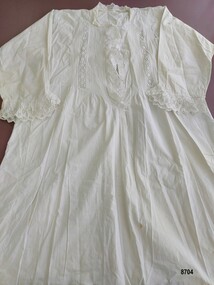
... Matthew Stephenson (1861 – 1943) who had grown up on the Bendigo goldfields and shifted to Melbourne in the early 1900’s was a train driver and later, a fireman with the railways. His wife Elizabeth...Matthew Stephenson (1861 – 1943) who had grown up on the Bendigo goldfields and shifted to Melbourne in the early 1900’s was a train driver and later, a fireman with the railways. His wife Elizabeth ...This item is one of a collection of clothing items that belonged to the Stephenson family who lived at 22 McCracken Street, Kensington, Melbourne. Matthew Stephenson (1861 – 1943) who had grown up on the Bendigo goldfields and shifted to Melbourne in the early 1900’s was a train driver and later, a fireman with the railways. His wife Elizabeth Jane (Betsy) Wigley (1865 – 1953) also grew up on the goldfields around Majorca and Bendigo. They married in 1885 in Bendigo. They had two daughters – Ethel Evelyn Stephenson (1886 – 1956) and Lillian or Lila (1891 – 1977) who were milliners and dressmakers and who continued to live in the family home after the death of their parents. The family are recorded as living at 22 McCracken Street, Kensington, as early as 1914. It is not known who made or owned the clothing that makes up this collection but as it appears to be from the late Victorian and early Edwardian era, the different pieces were probably made and worn by any of the three ladies of the house – Betsy, Ethel and/or Lila. During W.W.2, a local Warrnambool couple (Meryl and Tony Everard) boarded with them – Tony was in the airforce training paratroopers to jump into (and survive) enemy territory and his wife Meryl worked in the Methodist baby Home. The Everards developed a close friendship with the Stephensons and were responsible for clearing out the house (and finding this clothing collection) after Lila died in 1977. This nightgown is machine sewn and has an added detailed design of pintucks and broderie anglaise lace to the front yoke and cuffs as a decorative element. The 1800's bought a shift in attitude towards modesty as the Victorian era progressed and by the mid to late 1800's it had become more acceptable ladies to wear simple, modest nightgowns. They tended to have a very loose fit and were usually made of linen, cotton or flannel, which had the advantage of providing warmth and also being easy to wash - a necessity for a garment worn next to the skin. Although the basic design of the nightgown was fairly simple, the wearer was free to add various types of trim e.g. lace, crochet, pintucks, embroidery etc.This item is an example of the needlework skills of women in the late 19th and early 20th century - combining machine stitching with hand embroidery to personalise and embellish a practical item of clothing. A full length lady's cotton nightgown with long sleeves finished with a diagonal pointed cuff of broderie anglaise. The bodice features a front opening placket with 3 buttons and buttonholes and a broderie anglaise cover. On either side of the placket, the bodice has been decorated with rows of vertical pintucks and a broderie anglaise panel insert. There is also a frill of broderie anglaise lace around the neck. The back of the nightgown is gathered onto a yoke.flagstaff hill maritime museum and village, great ocean road, shipwreck coast, warrnambool, nightgown, lady's nightgown, needlework, sewing, broderie anglaise, pintucks, stephenson family -
 Flagstaff Hill Maritime Museum and Village
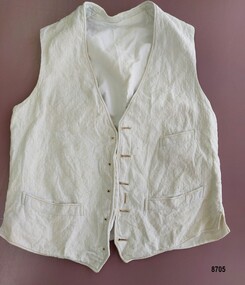
Textile - Waistcoat, circa 1910
... Matthew Stephenson (1861 – 1943) who had grown up on the Bendigo goldfields and shifted to Melbourne in the early 1900’s was a train driver and later, a fireman with the railways. His wife Elizabeth...Matthew Stephenson (1861 – 1943) who had grown up on the Bendigo goldfields and shifted to Melbourne in the early 1900’s was a train driver and later, a fireman with the railways. His wife Elizabeth ...This item is one of a collection of clothing items that belonged to the Stephenson family who lived at 22 McCracken Street, Kensington, Melbourne. Matthew Stephenson (1861 – 1943) who had grown up on the Bendigo goldfields and shifted to Melbourne in the early 1900’s was a train driver and later, a fireman with the railways. His wife Elizabeth Jane (Betsy) Wigley (1865 – 1953) also grew up on the goldfields around Majorca and Bendigo. They married in 1885 in Bendigo. They had two daughters – Ethel Evelyn Stephenson (1886 – 1956) and Lillian or Lila (1891 – 1977) who were milliners and dressmakers and who continued to live in the family home after the death of their parents. The family are recorded as living at 22 McCracken Street, Kensington, as early as 1914. It is not known who made or owned the clothing that makes up this collection but as it appears to be from the late Victorian and early Edwardian era however the vest was probably made by one of the three ladies of the house, for their husband and father, Matthew Stephenson. During W.W.2, a local Warrnambool couple (Meryl and Tony Everard) boarded with them – Tony was in the airforce training paratroopers to jump into (and survive) enemy territory and his wife Meryl worked in the Methodist baby Home. The Everards developed a close friendship with the Stephensons and were responsible for clearing out the house (and finding this clothing collection) after Lila died in 1977. Although by 1916, men's "ready to wear" clothing were widely available, this waistcoat was handmade (possibly by Matthew's wife or daughters). Men's suits in the early part of the twentieth century were predominantly three piece, consisting of a jacket, vest (or waistcoat) and trousers made from matching fabrics. Some men liked to wear a watch attached to their waistcoat with a fob chain. This item is an example of clothing worn by men on special occasions, in the late 19th and early 20th century.A man's waistcoat with cream cotton weave front pieces and cream cotton lining and back. The left front features five machine worked horizontal buttonholes and one vertical buttonhole (for a fob watch) and two inset pockets. The right hand side has five corresponding stud holes and one inset pocket. The studs or buttons are missing. The lining and back of the waistcoat are made from a plain cream cotton fabric. The back also features a cotton strap with a two pronged metal buckle.flagstaff hill maritime museum and village, great ocean road, shipwreck coast, warrnambool, vest, waistcoat, needlework, sewing, stephenson family, man's waistcoat -
 Flagstaff Hill Maritime Museum and Village
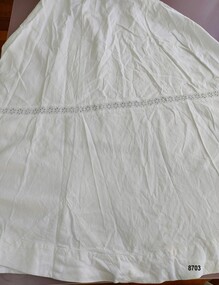
Textile - Skirt, circa 1910
... Matthew Stephenson (1861 – 1943) who had grown up on the Bendigo goldfields and shifted to Melbourne in the early 1900’s was a train driver and later, a fireman with the railways. His wife Elizabeth...Matthew Stephenson (1861 – 1943) who had grown up on the Bendigo goldfields and shifted to Melbourne in the early 1900’s was a train driver and later, a fireman with the railways. His wife Elizabeth ...This item is one of a collection of clothing items that belonged to the Stephenson family who lived at 22 McCracken Street, Kensington, Melbourne. Matthew Stephenson (1861 – 1943) who had grown up on the Bendigo goldfields and shifted to Melbourne in the early 1900’s was a train driver and later, a fireman with the railways. His wife Elizabeth Jane (Betsy) Wigley (1865 – 1953) also grew up on the goldfields around Majorca and Bendigo. They married in 1885 in Bendigo. They had two daughters – Ethel Evelyn Stephenson (1886 – 1956) and Lillian or Lila (1891 – 1977) who were milliners and dressmakers and who continued to live in the family home after the death of their parents. The family are recorded as living at 22 McCracken Street, Kensington, as early as 1914. It is not known who made or owned the clothing that makes up this collection but as it appears to be from the late Victorian and early Edwardian era, the different pieces were probably made and worn by any of the three ladies of the house – Betsy, Ethel and/or Lila. During W.W.2, a local Warrnambool couple (Meryl and Tony Everard) boarded with them – Tony was in the airforce training paratroopers to jump into (and survive) enemy territory and his wife Meryl worked in the Methodist baby Home. The Everards developed a close friendship with the Stephensons and were responsible for clearing out the house (and finding this clothing collection) after Lila died in 1977. This skirt features broderie anglaise trim. Although broderie anglaise was a lace that could be made by hand, it was very time consuming to make. St Gallen was a city in Switzerland that had become known for producing quality textiles. At the beginning of the 19th century, the first embroidery machines were developed in St Gallen. Factories used embroidery machines but people also had them in their homes. They were able to produce broderie anglaise for export. By the early 20th century, machine made lace, fabric, ribbons etc. were being sold in drapers shops all over England and Wales to women who were making clothes and furnishings for their families. It is highly likely that the lady who made this skirt brought the lengths of broderie anglaise already made to embellish and personalise her skirt.This item is an example of the needlework skills of women in the late 19th century - creating pintucks and adding lace to personalise and embellish a practical item of clothing. A full length lady's skirt of heavy textured ribbed twill cotton. The top of the skirt is made from five pieces of fabric, sewn together and inserted into a simple waistband. It has an opening with room for 6 hook and eyes (but only the middle three remain). The top section of the skirt is separated from the bottom section by a strip of eyelet embroidery that has been inserted in a horizontal line at the back but becomes slightly diagonal at the front causing the two ends to cross in a decorative X fashion. The bottom of the skirt is the same heavy cotton as the top and one seam features a V shaped insert or patch.flagstaff hill maritime museum and village, great ocean road, shipwreck coast, warrnambool, broderie anglaise, needlework, sewing, stephenson family, skirt, lady's skirt -
 Ringwood and District Historical Society
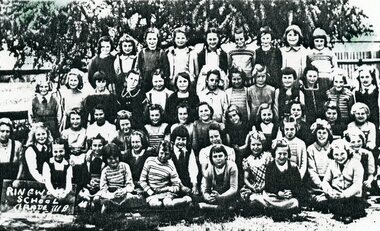
Photograph, Ringwood State School - Class photograph - Grade 3B, 1953
... "Attached to photograph" Back Row- L to R: Marian Stephenson, Pauline Valome, Elaine (?), Diane Galemts, Elizabeth Cole, Pam Goodall, Wendy Tregetzer, Dawn Marley, Mary Lloyd. 2nd Row - L to R: Paula Schro, Lee Tonkin, Ann Washington, Pat Saines, Sandra LeBusque, Janice (?)..."Attached to photograph" Back Row- L to R: Marian Stephenson, Pauline Valome, Elaine (?), Diane Galemts, Elizabeth Cole, Pam Goodall, Wendy Tregetzer, Dawn Marley, Mary Lloyd. 2nd Row - L to R: Paula Schro, Lee Tonkin, Ann Washington, Pat Saines, Sandra LeBusque, Janice (?) ...Black and white photograph - Grade 3B, 1953"Attached to photograph" Back Row- L to R: Marian Stephenson, Pauline Valome, Elaine (?), Diane Galemts, Elizabeth Cole, Pam Goodall, Wendy Tregetzer, Dawn Marley, Mary Lloyd. 2nd Row - L to R: Paula Schro, Lee Tonkin, Ann Washington, Pat Saines, Sandra LeBusque, Janice (?), Noeline King, Marian Hayward, Judy Callaby, Ailsa Ralston, Pam Cowan, Betty Reid, Margaret Stacken. 3rd Row - L to R: Jennifer Young, Carolyn Halls, Carolyn Roberts, Jennifer Lewis, Judy Van Praet, Meryl Hagan, Kay Mc Namara, Judy Bowen, Hazel Wittington, Faye Bryan, Marcia Kenyse, Rosemary, Langer, Sheryl Buchanan. 4th Row - L to R: Carolyn Hately, Diane Close, Carol Whitford, Ann Sterling, Dorothy Beverage, Wendy Hall, Jill Lorens, Norma Buchanan, Lauren Jones. Front Row- L to R: Sandra Marshall, Faye Lilywhite, Margaret Spence, Carol Hanysson, Joyce Warce. Teacher: -
 Glen Eira Historical Society
Document - Elizabeth Street, 39, Elsternwick
... Elizabeth Street... Elsternwick... Thomson Ellen... Stevenson William E... Stevenson Alice... Stephenson...Nyalong Elizabeth Street Elsternwick Thomson Ellen Stevenson William E Stevenson Alice Stephenson William E Stephenson Alice Marschner E Small F H Bullock Hilary Landells Rosalind Brighton Historical Society Flats Federation style Architectural styles Architectural features House names Document Elizabeth Street, 39, Elsternwick ...A one page typed research report, dated 15/01/1988, by the Brighton Historical Society, regarding the occupancy of house Nyalong at 39 Elizabeth Street, Elsternwick. The file also includes one page of handwritten working notes, undated and unattributed.nyalong, elizabeth street, elsternwick, thomson ellen, stevenson william e, stevenson alice, stephenson william e, stephenson alice, marschner e, small f h, bullock hilary, landells rosalind, brighton historical society, flats, federation style, architectural styles, architectural features, house names -
 Eltham District Historical Society Inc
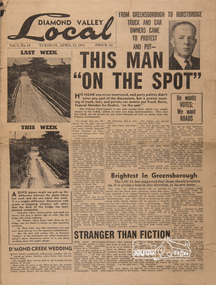
Newspaper, Diamond Valley Local, 13 Apr 1954, 13 April 1954
... Hutchinson (sand, screenings, soil, stone) Rattray Rd Montmorency 0. 7 L & W Stephenson (grocer) Were St Montmorency p.9 M Ricardo painter Elizabeth St (off Looker St) Montmorency back page. ...Hutchinson (sand, screenings, soil, stone) Rattray Rd Montmorency 0. 7 L & W Stephenson (grocer) Were St Montmorency p.9 M Ricardo painter Elizabeth St (off Looker St) Montmorency back page. ...Page 1 Protest Meeting re Lack of Funds from Federal Government means that the Country Roads Board (CRB) cannot help municipalities Reference to newly formed Diamond Valley Chamber of Commerce Bridgeworks on unidentified bridge Diamond Creek wedding- LOTT – STEIN LOCAL newspaper new home in Greensborough Page 2 Mudbricks Eltham Gymkhana (and add page 3) – in aid of war memorial trust Memorial window at St Helena Church Page 3 Annual report for South and North Ridings, incl photo of Dr. Corder Bus Route in Research Hurstbridge Hall Rolls Royse hits out Labor Member At the films – Greensborough, Eltham, Diamond Theatre and Montmorency Theatre, RSL Hall, Page 4 Bus journey between Eltham and Warrandyte (inc photos) Page 5 Article on campaign inviting better local shopping conditions for the DV Public Properties for sale, some with photos in Croydon, Greensborough, Montmorency, Warrandyte including a 5 acre flower farm in Briar Hill with house. Page 6 Article with photo on Eltham butcher Don Dureau (no personal history however) Panton Hill Cricket Club annual dinner Page 7 CWA Diamond Creek branch 5th birthday – Letter to editor referring Cr. Alice Peake and re-subdivision of the City of Heidelberg two yrs ago. Panton Hill Red Cross Page 8 Electric light for Research, Eltham North, Hurstbridge, St Andrews Page 9 Hurstbridge Methodist Community Phone box for Wattle Glen. Page 11 Report on Heidelberg Council Page 12 Pigeon racing DV Tennis association Adds for the following local businesses The Blue Gum (deli meats and cakes) Cnr Pryor and Main Rds Eltham p, 2 Eltham Hotel (inc photo) Main Rd Eltham - p. 2 Eltham Meat Supply – Main Road – p. 2 A & S Davis, (Paint store_ Main Road Eltham – p 4 and 10 Presswells Garage, Main Street, Eltham East – page 4 (and article on page 9 reference to “newly named” Eltham East – Post Office and News Agent J N Burgoyne & Sons (groceries) Main Rd, Eltham – page 6 John Mclean & Son Eltham (Chook Breeder) Eltham – page 7 Eltham Hardware & Timber Co, Main Road Eltham – page 8 I J Thompson Chemist, Eltham – page 8 E L Owen Carrier Dudley St Eltham page 8 Arnetts (bakers) Main St Eltham p. 9 Jean Kimber Florist Hillcrest Ave. Eltham p. 9 J C Rains haberdashery , drapery, school wear – Main road Eltham P. 10 Alistair Knox (joinery) York Street Eltham – p 11 T. R.. Walker Plumber Main rd Eltham – pa 11 John McLean & Sons (supplies for poultry farmers_ Main rd Eltham – p 11 Briar Hill Iceworks Beaconsfield Rd, Briar Hill p. 9 Briar Hill Timber & Trading – page 4 D & E Middleton (Steelworkers) Sherbourne Rd Briar Hill – page 9 and 10 R W Fell Delicatessen Supplies (with photo) Montmorency Eltham Taxi service, Rattray Road (Montmorency) – page 6 Tozer & Whiteway (Grover) Were St Montmorency = p 4 W. Hutchinson (sand, screenings, soil, stone) Rattray Rd Montmorency 0. 7 L & W Stephenson (grocer) Were St Montmorency p.9 M Ricardo painter Elizabeth St (off Looker St) Montmorency back page. Ken Smith Fire Wood Main Road Lower Plenty Hillcrest Dry Cleaners Main road Research p. 11 C Jessop and Co, Greensborough – p. 2 The “Rose Bower” Floral Salon, Main St, Greensborough – p 2. J. D. Baines (Upholsterer) 140 Grimshaw St, Greensborough p. 4 Greensborough and DV Real Estate, Cnr Grimshaw and Main St Greensborough p. 5 Greensborough Hardware p. 6 P. B. Stubley & Son (Chook Breeder and fencing ) Greensborough – page 6 and 11 Vaness Motors Grimshaw St Greensborough page 6 Fred Shaw Motors Main Street Greensborough p. 6 Dennis Hogg electrical contractor McDowell St Greensborough p. 7 D.R Ross (electrician) Main Street Greensborough p. 8 S Page Fencing William St Greensborough p. 11 Greensborough District Bakery – p. 11 Moir and Lott Pty Ltd (Chook Breeder) Hurstbridge – page 7 Hurstbridge Motors Main Street Hurstbridge – page 8 W & U Freeman (Clothing, Footwear , knitting wool and patterns) Main Street Hurstbridge p. 9 Avonlea Diary / Scales Dairy Hurstbridge page 9 A R Saunders car truck farm plant Hurstbridge – page 9 W Saville poultry seller Hurstbirdge – p 11 John R Horton Hurstbridge bakery Hurstbridge p 11 W. F. Burrell Motors 238 Plenty Road Preston (agent for Ferguson mechanised farming) -p 6. Macleod Hardware Between Provlan’s Garage and Macleod railway station p. 7 W S Heard Electrician Macleod -page 8 Sew – Ezt Sewing Machine service – 227 Upper Heidelberg Road, Ivanhoe – p 7 G. W. Middleton (dam and road construction) Diamond Creel -page 9 L R Bassett Pty Ltd (Hire of bulldozer) Diamond Creek p. 10 Warings General Store Diamond Creek p. 9 Davey Jones’ Locker Chinese and English cooking Panton Hill – page 9 The friendly pub – Panton Hill back page T H Fisher dairymen Yarra Glenn p. 10 Local newspaper (complete); 12 pagesnewspaper, local newspapers, diamond valley local -
 Vision Australia
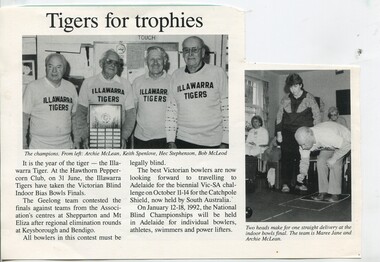
Article - Text, Tigers for Trophies, 1991
... Stephenson and Bob McLeod. The team will go on to represent Victoria in the biennial VA-SA Challenge for the Catchpole Shield. Association for the Blind Elizabeth ...The 1991 Victorian Blind Bowlers Final was won by the Illawarra Tigers team of Archie McLean, Keith Spenlove, Hec Stephenson and Bob McLeod. The team will go on to represent Victoria in the biennial VA-SA Challenge for the Catchpole Shield.1 cut out article from an AFB publicationnon-fictionassociation for the blind, elizabeth maxwell, neil maxwell, illawarra tigers, recreation
