
Showing 24 items matching "embroidery kit"
-
 Embroiderers Guild, Victoria
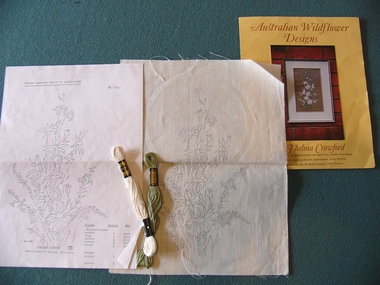
Textile - Thelma Crawford Kit, Thelma Crawford, Mid 20th C
... Embroidery kit...Embroidery Kit with pattern and threads. Design is of a bunch of flannel flowers and crowea....Embroidery kit Kit Pattern Stamped linen Photograph Threads Embroidery Kit with pattern and threads. ...Embroidery Kit with pattern and threads. Design is of a bunch of flannel flowers and crowea.embroidery kit, kit, pattern, stamped linen, photograph, threads -
 Embroiderers Guild, Victoria
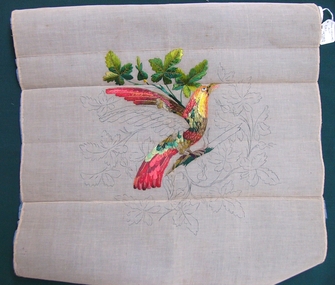
Textile - Silk Embroidery Kit, Bird in a Tree, 1900-20
... Silk Embroidery Kit...Bird in a Tree Textile Silk Embroidery Kit ...Design is on fine light brown canvas and depicts a bird sitting on a branch. Part of the bird and foliage is embroidered in brightly coloured silks. The bird has an unusual bead as an eye. (No threads with kit.) Probably meant for fire screen.embroidery, silk embroidery, kits -
 Embroiderers Guild, Victoria
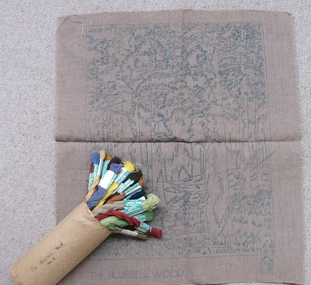
Textile - Wool Embroidery Kit, "The Bluebell Wood", 1920-40
... Wool Embroidery Kit..."The Bluebell Wood" Textile Wool Embroidery Kit ...Dark beige linen with stamped design, working instructions, photograph and bundle of wools.Label - Patons & Baldwins Needle Painting Series No. 6 "The Bluebell Wood"embroidery, wool embroidery, kits -
 Embroiderers Guild, Victoria
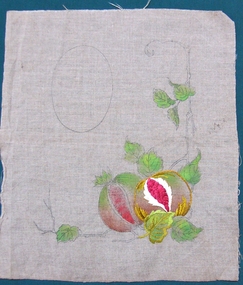
Textile - Silk Embroidery Kit, 1900-20
... Silk Embroidery Kit...Textile Silk Embroidery Kit ...Dark ecru linen with a design of pomegranates partly embroidered in the lower right corner. There is an oval marked in top left corner, which is meant to be cut out for a photograph to be inserted when the piece is mounted (no threads with kit).embroidery, silk embroidery, kits -
 Embroiderers Guild, Victoria
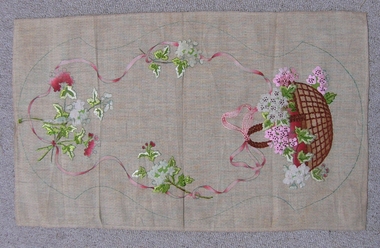
Textile - Silk Ribbon and Embroidery Kit, 1900-20
... Silk Ribbon and Embroidery Kit...Basket and leaves in silk embroidery and flowers in silk ribbon work. The mat's edge is marked in a scalloped shape. (no threads with kits)....Textile Silk Ribbon and Embroidery Kit ...Ecru textured cotton, design basket of flowers and sprays of flowers. Basket and leaves in silk embroidery and flowers in silk ribbon work. The mat's edge is marked in a scalloped shape. (no threads with kits).embroidery, silk embroidery, silk ribbon embroidery -
 Embroiderers Guild, Victoria
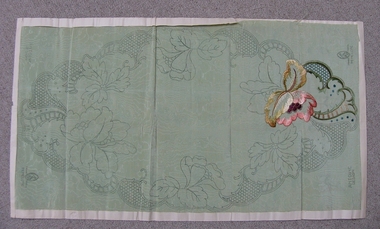
Textile - Moiré Silk Embroidery Table Centre Kit, 1900-20
... Moiré Silk Embroidery Table Centre Kit...Embroidery Silk Embroidery Kits Label: Antoine Design, Trade Mark PENELOPE Pale green moiré silk with a stamped design of stylized flowers. ...Pale green moiré silk with a stamped design of stylized flowers. One corner has been embroidered in silk in soft shades of pink and green with a touch of Jap gold (no threads with kit).Label: Antoine Design, Trade Mark PENELOPEembroidery, silk embroidery, kits -
 Embroiderers Guild, Victoria
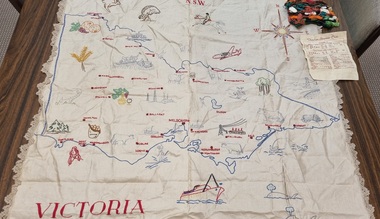
Textile - Semco Souvenir Tablecloth, Semco, Mid 20 th C
... Accompanied by bundle of embroidery cottons with Semco kit label....Accompanied by bundle of embroidery cottons with Semco kit label. Textile Semco Souvenir Tablecloth Veronica Constable Semco ...Embroidered by the donor's Grandmother Veronica Constable. Veronica was born in 1904 in Culgoa and died in 1976. Veronica lived on a soldier settlement property in the Wimmera at Wycheproof where the family farmed wheat and cattle. The table cloth was stored in a suitcase with other linen in her mothers wardrobe since 1970s or earlier. Donor doesn't remember her grandmother embroidering so probably dates pre 1950's. Cotton tablecloth, unfinished. Printed design of the state of Victoria, with Victorian towns and their local industries.. Crochet edging. Accompanied by bundle of embroidery cottons with Semco kit label.Victoria and names of major towns map, victoria, towns, industry -
 Flagstaff Hill Maritime Museum and Village
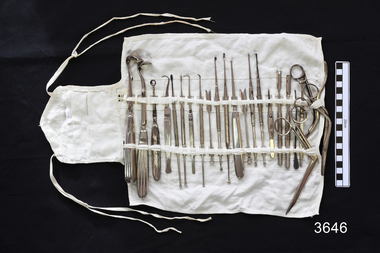
Surgical Kit, late 19th century
... Roll-up kit, right weight, flexible canvas, 21 loops for instruments, with fastening and tying tapes, plus 6 pockets for needles and sutures. Fabric is suitable for sterilising by boiling or autoclave treatment. Name tag, sewn on, with red embroidery...Roll-up kit, right weight, flexible canvas, 21 loops for instruments, with fastening and tying tapes, plus 6 pockets for needles and sutures. Fabric is suitable for sterilising by boiling or autoclave treatment. Name tag, sewn on, with red embroidery ...This surgical kit holder was used by Dr T.F. Ryan's to hold surgical instruments for Ear Nose and Throat surgery. I was useful for both holding these particular instruments and for keeping them together whilst they were sterilised. It was donated to Flagstaff Hill Maritime Village, including the instruments, by the family of Doctor William Roy Angus, Surgeon and Oculist. It is part of the “W.R. Angus Collection” that includes historical medical equipment, surgical instruments and material once belonging to Dr Edward Ryan and Dr Thomas Francis Ryan, (both of Nhill, Victoria) as well as Dr Angus’ own belongings. The Collection’s history spans the medical practices of the two Doctors Ryan, from 1885-1926 plus that of Dr Angus, up until 1969. ABOUT THE “W.R.ANGUS COLLECTION” Doctor William Roy Angus M.B., B.S., Adel., 1923, F.R.C.S. Edin.,1928 (also known as Dr Roy Angus) was born in Murrumbeena, Victoria in 1901 and lived until 1970. He qualified as a doctor in 1923 at University of Adelaide, was Resident Medical Officer at the Royal Adelaide Hospital in 1924 and for a period was house surgeon to Sir (then Mr.) Henry Simpson Newland. Dr Angus was briefly an Assistant to Dr Riddell of Kapunda, then commenced private practice at Curramulka, Yorke Peninsula, SA, where he was physician, surgeon and chemist. In 1926, he was appointed as new Medical Assistant to Dr Thomas Francis Ryan (T.F. Ryan, or Tom), in Nhill, Victoria, where his experiences included radiology and pharmacy. In 1927 he was Acting House Surgeon in Dr Tom Ryan’s absence. Dr Angus had become engaged to Gladys Forsyth and they decided he would take time to further his studies overseas in the UK in 1927. He studied at London University College Hospital and at Edinburgh Royal Infirmary and in 1928, was awarded FRCS (Fellow from the Royal College of Surgeons), Edinburgh. He worked his passage back to Australia as a Ship’s Surgeon on the on the Australian Commonwealth Line’s T.S.S. Largs Bay. Dr Angus married Gladys in 1929, in Ballarat. (They went on to have one son (Graham 1932, born in SA) and two daughters (Helen (died 12/07/1996) and Berenice (Berry), both born at Mira, Nhill ) Dr Angus was a ‘flying doctor’ for the A.I.M. (Australian Inland Ministry) Aerial Medical Service in 1928 . The organisation began in South Australia through the Presbyterian Church in that year, with its first station being in the remote town of Oodnadatta, where Dr Angus was stationed. He was locum tenens there on North-South Railway at 21 Mile Camp. He took up this ‘flying doctor’ position in response to a call from Dr John Flynn; the organisation was later known as the Flying Doctor Service, then the Royal Flying Doctor Service. A lot of his work during this time involved dental surgery also. Between 1928-1932 he was surgeon at the Curramulka Hospital, Yorke Peninsula, South Australia. In 1933 Dr Angus returned to Nhill where he’d previously worked as Medical Assistant and purchased a share of the Nelson Street practice and Mira hospital from Dr Les Middleton one of the Middleton Brothers, the current owners of what was once Dr Tom Ryan’s practice. Dr L Middleton was House Surgeon to the Nhill Hospital 1926-1933, when he resigned. [Dr Tom Ryan’s practice had originally belonged to his older brother Dr Edward Ryan, who came to Nhill in 1885. Dr Edward saw patients at his rooms, firstly in Victoria Street and in 1886 in Nelson Street, until 1901. The Nelson Street practice also had a 2 bed ward, called Mira Private Hospital ). Dr Edward Ryan was House Surgeon at the Nhill Hospital 1884-1902 . He also had occasions where he successfully performed veterinary surgery for the local farmers too. Dr Tom Ryan then purchased the practice from his brother in 1901. Both Dr Edward and Dr Tom Ryan work as surgeons included eye surgery. Dr Tom Ryan performed many of his operations in the Mira private hospital on his premises. He too was House Surgeon at the Nhill Hospital 1902-1926. Dr Tom Ryan had one of the only two pieces of radiology equipment in Victoria during his practicing years – The Royal Melbourne Hospital had the other one. Over the years Dr Tom Ryan gradually set up what was effectively a training school for country general-practitioner-surgeons. Each patient was carefully examined, including using the X-ray machine, and any surgery was discussed and planned with Dr Ryan’s assistants several days in advance. Dr Angus gained experience in using the X-ray machine there during his time as assistant to Dr Ryan. Dr Tom Ryan moved from Nhill in 1926. He became a Fellow of the Royal Australasian College of Surgeons in 1927, soon after its formation, a rare accolade for a doctor outside any of the major cities. He remained a bachelor and died suddenly on 7th Dec 1955, aged 91, at his home in Ararat. Scholarships and prizes are still awarded to medical students in the honour of Dr T.F. Ryan and his father, Dr Michael Ryan, and brother, John Patrick Ryan. ] When Dr Angus bought into the Nelson Street premises in Nhill he was also appointed as the Nhill Hospital’s Honorary House Surgeon 1933-1938. His practitioner’s plate from his Nhill surgery states “HOURS Daily, except Tuesdays, Fridays and Saturday afternoons, 9-10am, 2-4pm, 7-8pm. Sundays by appointment”. This plate is now mounted on the doorway to the Port Medical Office at Flagstaff Hill Maritime Village, Warrnambool. Dr Edward Ryan and Dr Tom Ryan had an extensive collection of historical medical equipment and materials spanning 1884-1926 and when Dr Angus took up practice in their old premises he obtained this collection, a large part of which is now on display at the Port Medical Office at Flagstaff Hill Maritime Village in Warrnambool. During his time in Nhill Dr Angus was involved in the merging of the Mira Hospital and Nhill Public Hospital into one public hospital and the property titles passed on to Nhill Hospital in 1939. In 1939 Dr Angus and his family moved to Warrnambool where he purchased “Birchwood,” the 1852 home and medical practice of Dr John Hunter Henderson, at 214 Koroit Street. (This property was sold in1965 to the State Government and is now the site of the Warrnambool Police Station. ). The Angus family was able to afford gardeners, cooks and maids; their home was a popular place for visiting dignitaries to stay whilst visiting Warrnambool. Dr Angus had his own silk worm farm at home in a Mulberry tree. His young daughter used his centrifuge for spinning the silk. Dr Angus was appointed on a part-time basis as Port Medical Officer (Health Officer) in Warrnambool and held this position until the 1940’s when the government no longer required the service of a Port Medical Officer in Warrnambool; he was thus Warrnambool’s last serving Port Medical Officer. (The duties of a Port Medical Officer were outlined by the Colonial Secretary on 21st June, 1839 under the terms of the Quarantine Act. Masters of immigrant ships arriving in port reported incidents of diseases, illness and death and the Port Medical Officer made a decision on whether the ship required Quarantine and for how long, in this way preventing contagious illness from spreading from new immigrants to the residents already in the colony.) Dr Angus was a member of the Australian Medical Association, for 35 years and surgeon at the Warrnambool Base Hospital 1939-1942, He served as a Surgeon Captain during WWII1942-45, in Ballarat, Victoria, and in Bonegilla, N.S.W., completing his service just before the end of the war due to suffering from a heart attack. During his convalescence he carved an intricate and ‘most artistic’ chess set from the material that dentures were made from. He then studied ophthalmology at the Royal Melbourne Eye and Ear Hospital and created cosmetically superior artificial eyes by pioneering using the intrascleral cartilage. Angus received accolades from the Ophthalmological Society of Australasia for this work. He returned to Warrnambool to commence practice as an ophthalmologist, pioneering in artificial eye improvements. He was Honorary Consultant Ophthalmologist to Warrnambool Base Hospital for 31 years. He made monthly visits to Portland as a visiting surgeon, to perform eye surgery. He represented the Victorian South-West subdivision of the Australian Medical Association as its secretary between 1949 and 1956 and as chairman from 1956 to 1958. In 1968 Dr Angus was elected member of Spain’s Barraquer Institute of Barcelona after his research work in Intrasclearal cartilage grafting, becoming one of the few Australian ophthalmologists to receive this honour, and in the following year presented his final paper on Living Intrasclearal Cartilage Implants at the Inaugural Meeting of the Australian College of Ophthalmologists in Melbourne In his personal life Dr Angus was a Presbyterian and treated Sunday as a Sabbath, a day of rest. He would visit 3 or 4 country patients on a Sunday, taking his children along ‘for the ride’ and to visit with him. Sunday evenings he would play the pianola and sing Scottish songs to his family. One of Dr Angus’ patients was Margaret MacKenzie, author of a book on local shipwrecks that she’d seen as an eye witness from the late 1880’s in Peterborough, Victoria. In the early 1950’s Dr Angus, painted a picture of a shipwreck for the cover jacket of Margaret’s book, Shipwrecks and More Shipwrecks. She was blind in later life and her daughter wrote the actual book for her. Dr Angus and his wife Gladys were very involved in Warrnambool’s society with a strong interest in civic affairs. Their interests included organisations such as Red Cross, Rostrum, Warrnambool and District Historical Society (founding members), Wine and Food Society, Steering Committee for Tertiary Education in Warrnambool, Local National Trust, Good Neighbour Council, Housing Commission Advisory Board, United Services Institute, Legion of Ex-Servicemen, Olympic Pool Committee, Food for Britain Organisation, Warrnambool Hospital, Anti-Cancer Council, Boys’ Club, Charitable Council, National Fitness Council and Air Raid Precautions Group. He was also a member of the Steam Preservation Society and derived much pleasure from a steam traction engine on his farm. He had an interest in people and the community He and his wife Gladys were both involved in the creation of Flagstaff Hill, including the layout of the gardens. After his death (28th March 1970) his family requested his practitioner’s plate, medical instruments and some personal belongings be displayed in the Port Medical Office surgery at Flagstaff Hill Maritime Village, and be called the “W. R. Angus Collection”. The W.R. Angus Collection is significant for still being located at the site it is connected with, Doctor Angus being the last Port Medical Officer in Warrnambool. The collection of medical instruments and other equipment is culturally significant, being an historical example of medicine from late 19th to mid-20th century. Dr Angus assisted Dr Tom Ryan, a pioneer in the use of X-rays and in ocular surgery. Surgical kit holder once belonging to Dr T.F. Ryan, part of the W.R. Angus Collection. Roll-up kit, right weight, flexible canvas, 21 loops for instruments, with fastening and tying tapes, plus 6 pockets for needles and sutures. Fabric is suitable for sterilising by boiling or autoclave treatment. Name tag, sewn on, with red embroidery, "DR T.F. RYAN" Used by Dr Ryan to store ENT surgical instruments (Ear Nose Throat).Name tag, sewn on, with red embroidery, "DR T.F. RYAN" flagstaff hill, warrnambool, shipwrecked coast, flagstaff hill maritime museum, maritime museum, shipwreck coast, flagstaff hill maritime village, great ocean road, dr w r angus, dr ryan, surgical instrument, ent ear nose throat surgery, warrnambool base hospital, nhill base hospital, mira hospital, flying doctor, medical treatment, surgical kit, fabric sutrical instrument holder, surgery -
 Orbost & District Historical Society
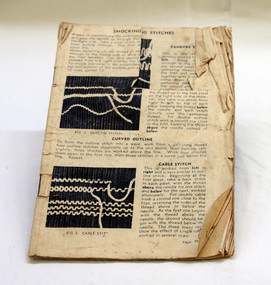
book, first half 20th century
... Embroidery has always had a great appeal to women, as it needs few tools. Historically the skills were taught within the family or in primary schools. Articles to make or embroider had been available in kits ...In the early 20th century, smocking appears in women’s magazines and sewing manuals on garments, domestic textiles and children’s wear. The 1930s and 1940s were the heyday of patterns and innovative stitch development. Embroidery has always had a great appeal to women, as it needs few tools. Historically the skills were taught within the family or in primary schools. Articles to make or embroider had been available in kits since the 1850s. Fancy work, the opposite of plain sewing, enjoyed great popularity in the 19th and 20th centuries. Companies which manufactured threads often produced instruction guides and patterns. This instruction book has been well-used. A small 30pp book with no cover. It contains instructions for embroidery stitches, including smocking.book-embroidery smocking handcraft needlework -
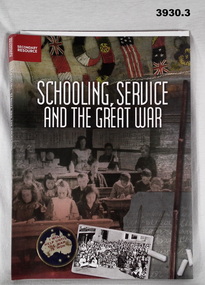 Bendigo Military Museum
Education kit - EDUCATION KIT WW1, Schooling service and the Great War, 2015
... Education kit schools WW1 Schooling, Service & The Great War. .1) Two x Soft cover books, cardboard with front fold out flap. White print on front / back covers. Illustrated in colour, background, group photo of children at school desks, 2 posters & embroidery. ...Schooling, Service & The Great War. Secondary Resource. See also Reg No 3929.8.Schooling, Service & The Great War. .1) Two x Soft cover books, cardboard with front fold out flap. White print on front / back covers. Illustrated in colour, background, group photo of children at school desks, 2 posters & embroidery. Inside of cover is colour photo of timber, leather satchel & papers. Spiral bound in black wire. 94 cut, plain, white pages. Illustrated black / white / sepia / colour photos. CD plastic pocket on front flap. .2) Paper poster, white print, college colour, black white photos, copy of book cover. .3) CD Rom, plastic. illustrated copy of book cover.education, kit, schools, ww1 -
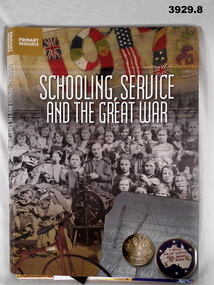 Bendigo Military Museum
Education kit - EDUCATION KIT WW1, Schooling, Service and the Great War, 2015
... Education Schools kit WW1 .1) Book, soft cover, cardboard with front fold out flap, white print on front & back covers. Illustrated with colour background, group photo of children, embroidery & badges. ...Schooling, Service and the Great War Primary Resource. See also Cat No 3930..1) Book, soft cover, cardboard with front fold out flap, white print on front & back covers. Illustrated with colour background, group photo of children, embroidery & badges. Inside of cover is a colour photo of timber, leather satchel & papers. 82 cut, plain, white pages. Illustrated black / white / colour photos. Spiral bound, black wire. .2) Poster, paper, Schooling, Service and the Great War. Collage copy of book cover, colour photos. .3) Paper, paper, Australian War Memorial Education Services 2015. Black print, collage colour photos. .4) Poster, paper, Discovering Anzacs. Black print, black / white / colour collage photos. .5) Poster, paper, Anzac Day Schools Award 2015. Black print, black / white photo. .6) Poster, paper, Leadership and Legacy. Yellow print, colour photos. .7) Bookmark, paper, Gallipoli, The First Day. Black print, colour photos. .8) Erratum. Paper, black print for page 30.education, schools, kit ww1 -
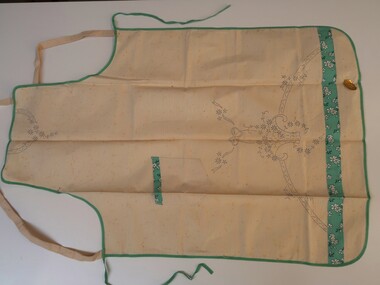 Embroiderers Guild, Victoria
Textile - Fautley's Stamped Design Apron, Fautleys and Sons, 1940's
... embroidery patterns from the late 1920's until 1950's. During World War 2 due to austerity measures, some Fautleys patterns were printed on coarser unbleached calico instead of finer fabrics (Australian War Memorial) Flowers Apron Label - Fautley's Apron kit with stamped floral pattern on unbleached calico. ...T.A. Fautleys & Sons (Brunswick, Victoria) manufactured and sold needlework supplies, particularly stamped embroidery patterns from the late 1920's until 1950's. During World War 2 due to austerity measures, some Fautleys patterns were printed on coarser unbleached calico instead of finer fabrics (Australian War Memorial)Apron kit with stamped floral pattern on unbleached calico.Label - Fautley'sflowers, apron -
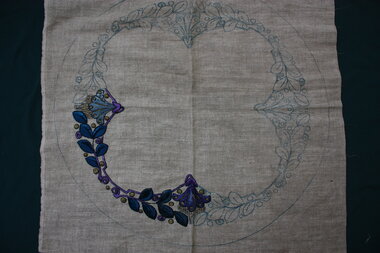 Embroiderers Guild, Victoria
Functional Object - Kit with Threads, Early 20th C
... Embroidery Silk Rayon Label - "Read's of Prahran" 14/11 sale price. Partially worked transfer design on dark ecru furnishing linen-like fabric. A circular design incorporating leaves, Prince of Wales feathers, stems and circles. A quarter of design is worked in purple and peacock worked in rayon threads, gold metal thread and beads. A little over 1/4 stitched. Includes a bag of threads Pearsall 'Fibrette' wood pulp yarn (rayon) and Perfecta Floss (rayon) and 1 reel metallic thread. Functional Object Kit ...Originally purchased at Read's of Prahran. 2 labels attached - Read's Prahran and Read's 14/11 sale price. Originally purchased by donor in an Op Shop.Partially worked transfer design on dark ecru furnishing linen-like fabric. A circular design incorporating leaves, Prince of Wales feathers, stems and circles. A quarter of design is worked in purple and peacock worked in rayon threads, gold metal thread and beads. A little over 1/4 stitched. Includes a bag of threads Pearsall 'Fibrette' wood pulp yarn (rayon) and Perfecta Floss (rayon) and 1 reel metallic thread.Label - "Read's of Prahran" 14/11 sale price.embroidery, silk, rayon -
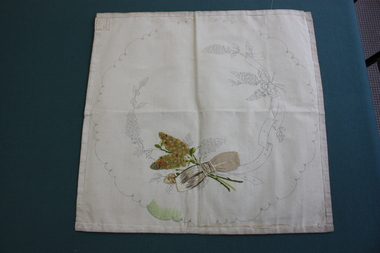 Embroiderers Guild, Victoria
Functional Object - Unfinished Ribbon Work Kit Cushion
... Embroidery Ribbon Floral design with bow. Ribbon work partly embroidered on a stamped design. Functional Object Unfinished Ribbon Work Kit Cushion ...This item has been removed from Folio 1 and placed in kKits - 7/LB12Floral design with bow. Ribbon work partly embroidered on a stamped design.embroidery, ribbon -
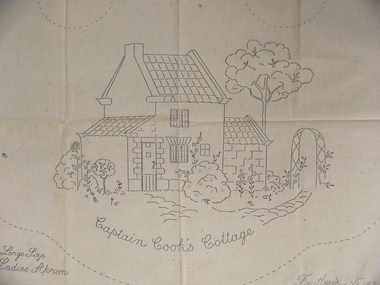 Embroiderers Guild, Victoria
Domestic Object - Semco Apron Captain Cook's Cottage, 1930's
... Donor, Mr Graham White, found it among his grandmother's things when she died in 1973, aged in the 90's. Embroidery 1920-40 Australia Kits Aprons Fautley's No. 1423 Large size ladies apron Stamped linen apron pattern, with design of Captain Cook's cottage - circa 1930. ...Donor, Mr Graham White, found it among his grandmother's things when she died in 1973, aged in the 90's.Stamped linen apron pattern, with design of Captain Cook's cottage - circa 1930. Labelled Large Size, ladies apron, Fautley's No. 1423. Not worked.Fautley's No. 1423 Large size ladies apronembroidery, 1920-40, australia, kits, aprons -
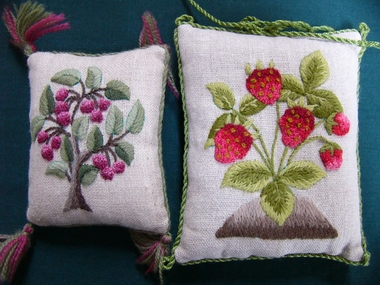 Embroiderers Guild, Victoria
Functional Object - Crewel Work Pincushions, Miss Kath Wilson, 1960's
... Donor made them from Erica Wilson kits. Embroidery Pincushions Crewel Embroidery Australia 1960-80 Both embroidered in wool on beige linen and trimmed with a green cord. a. ...Donor made them from Erica Wilson kits.Both embroidered in wool on beige linen and trimmed with a green cord. a. Stylised design of a spray of strawberries on a mount b. Small tree with deep pink berries.embroidery, pincushions, crewel embroidery, australia, 1960-80 -
 Embroiderers Guild, Victoria
Textile - Unfinished Ribbon Work Kit
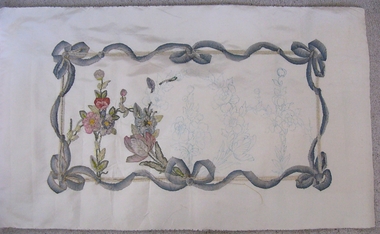
... Embroidery Ribbon work Silk Embroidery Kits Cream silk background with a stamped design of roses and tulips. ...Cream silk background with a stamped design of roses and tulips. Partially embroidered with a selection of softly coloured and shaded ribbons and a fine gold thread.embroidery, ribbon work, silk embroidery, kits -
 Lakes Entrance Historical Society
Equipment - Collection of Sewing/Knitting/Crochet Equipment, c1900 -1920
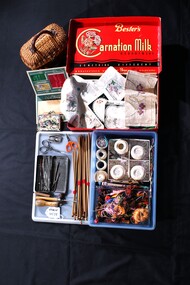
... kit. Small tin containing 14 crochet hooks with covers, 9 fine crochet hooks, one fine latch hook. Small plastic box containing 1 awl, 1 thimble, 1 large crochet hook, 3 embroidery scissors, 1 tiny screw driver, large sewing needles. ...kit. Small tin containing 14 crochet hooks with covers, 9 fine crochet hooks, one fine latch hook. Small plastic box containing 1 awl, 1 thimble, 1 large crochet hook, 3 embroidery scissors, 1 tiny screw driver, large sewing needles. ...This wonderful collection of craft equipment has been lovingly preserved by the donor, much of it is 100 years old.Twenty two bamboo knitting needles. Small sewing basket containing small embroidered sewing kit. Small tin containing 14 crochet hooks with covers, 9 fine crochet hooks, one fine latch hook. Small plastic box containing 1 awl, 1 thimble, 1 large crochet hook, 3 embroidery scissors, 1 tiny screw driver, large sewing needles. Large Plastic box containing 8 reels crochet cottons (Coats), 1 fine crochet hook, 1 small embroidery scissors, 1 crochet pattern, embroidery silks. Red Box containing crochet butterfly paper patterns, Embroidery pieces unfinished.craft supplies, equipment, collections -
 Embroiderers Guild, Victoria
Textile - Beaded Lambrequin, Late Victorian (1880-1900)
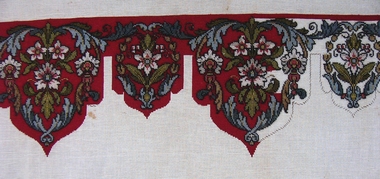
... Embroidery Furnishings Late 19th century Beadwork Partly finished lambrequin. Design in beads is complete but background of deep red half cross stitch in floss is not finished. Probably sold as a kit ...Partly finished lambrequin. Design in beads is complete but background of deep red half cross stitch in floss is not finished. Probably sold as a kit.embroidery, furnishings, late 19th century, beadwork -
 Embroiderers Guild, Victoria
Footwear - Slipper, 1900
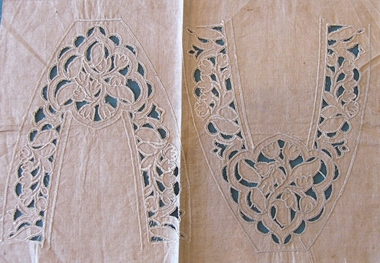
... 2 pairs of slippers in white and beige embroidery (most buttonhole) on natural linen, they were kits for slippers which were never made up. ...Embroidery Cutwork 1900-20 2 pairs of slippers in white and beige embroidery (most buttonhole) on natural linen, they were kits for slippers which were never made up. ...2 pairs of slippers in white and beige embroidery (most buttonhole) on natural linen, they were kits for slippers which were never made up. One is cut, the other partially cut.embroidery, cutwork, 1900-20 -
 Wodonga & District Historical Society Inc
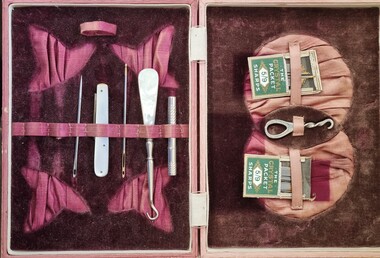
Functional object - Sewing Kit, c1900
... kit were manufactured by John James Redditch, Worcestershire, England. The business was formed in 1840 and first appeared in the region’s business directory in 1860. John James initially specialised in industrial needles and tools and in particular in sail making needles before branching out into embroidery and domestic use. ...kit were manufactured by John James Redditch, Worcestershire, England. The business was formed in 1840 and first appeared in the region’s business directory in 1860. John James initially specialised in industrial needles and tools and in particular in sail making needles before branching out into embroidery and domestic use. ...Sewing kit, often referred to as a sewing necessaire, contained items which were seen as necessary to complete basic needlework tasks. They were portable so could easily be carried by a lady when she was travelling away from home. Fitted in a velvet and silk lined box, it included a selection of needles ranging from darning needles to smaller sharps, as well as a button hook, a small pocket knife. The sewing needles in this kit were manufactured by John James Redditch, Worcestershire, England. The business was formed in 1840 and first appeared in the region’s business directory in 1860. John James initially specialised in industrial needles and tools and in particular in sail making needles before branching out into embroidery and domestic use. The brand continues to be manufactured in 2026 by the English Needle and Fishing Tackle Company – ENTACO. This item is significant because it is an example of domestic items used by women in the late 19th and early 20th century throughout the Wodonga district and beyond.A velvet lined wood box containing a range of basic sewing items.domestic items, sewin implements -
 Whitehorse Historical Society Inc.
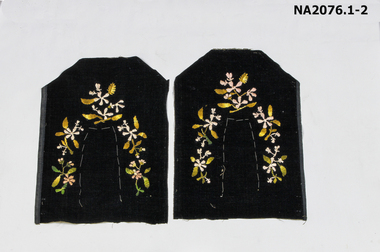
Textile - Embroidery
... These are the tops for men's slippers and were sold in kit form. handcrafts needlework Two pieces of black velvet embroidered in greens and pink. Textile Embroidery ...These are the tops for men's slippers and were sold in kit form.Two pieces of black velvet embroidered in greens and pink. handcrafts, needlework -
 Whitehorse Historical Society Inc.
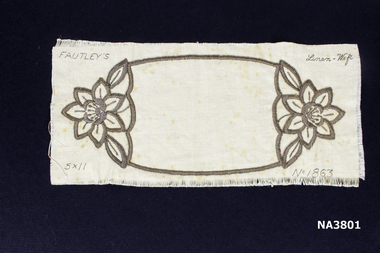
Textile - Embroidered doiley
... embroidery. The doiley was worked and when finished the pattern was cut out, leaving the centre uncut The doiley is a part of a handcraft kit sold by Fautleys fancy work shops, and Needlework shops. ...The doiley was worked by Betty Harrison, wife of Don Harrison. It is a sample of cutwork embroidery. The doiley was worked and when finished the pattern was cut out, leaving the centre uncutThe doiley is a part of a handcraft kit sold by Fautleys fancy work shops, and Needlework shops. Needle work such as embroidery was a very popular social activity during that era. T & A Fautley & Sons operated from Brunswick around 1920's - 1950's.Unfinished piece of cutwork in shape of oblong doiley. Brown cotton thread has been worked to shape star-shaped flowers at each end as well as the bordersFautley's Linen-Weft 5 x 11 No. 1863handcrafts, embroidery -
 Mont De Lancey
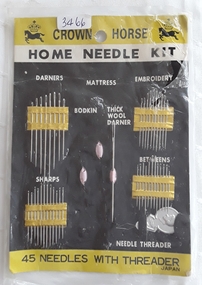
Functional object - Home Needle Kit, Crown Horse, Unknown
... Kit with 48 needles and a threader in a plastic bag. The needles are presented in gold strips attached to a black piece of cardboard.and are labelled as - Darners, Embroidery, Thick Wool Darner, Sharps, Betweens and a Threader. ...Kit with 48 needles and a threader in a plastic bag. The needles are presented in gold strips attached to a black piece of cardboard.and are labelled as - Darners, Embroidery, Thick Wool Darner, Sharps, Betweens and a Threader. ...A Crown Horse brand Home Needle Kit with 48 needles and a threader in a plastic bag. The needles are presented in gold strips attached to a black piece of cardboard.and are labelled as - Darners, Embroidery, Thick Wool Darner, Sharps, Betweens and a Threader. Two needles are missing, - a Bodkin and Mattress. The card has two black horses underneath a black crown at the top.'Crown Horse Home Needle Kit Japan' The types of needles are as listed above.sewing equipment, sewing, sewing needles
