
Showing 65 items matching "end of summer"
-
 Bayside Gallery - Bayside City Council Art & Heritage Collection
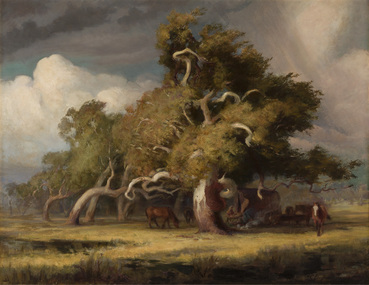
Painting - oil on canvas, Charles Douglas Richardson, End of summer, 1917
... End of summer...end of summer...end of summer landscape trees horses charles douglas richardson painting cloud farm summer grass oil on canvas End of summer Painting oil on canvas Charles Douglas Richardson ...oil on canvasend of summer, landscape, trees, horses, charles douglas richardson, painting, cloud, farm, summer, grass -
 Orbost & District Historical Society
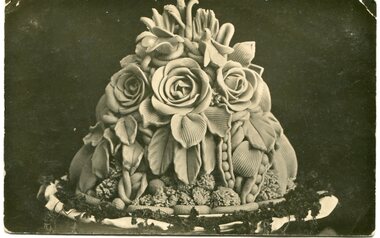
black and white photograph, Sherwood, Herbert, 1900
... The Harvest Festival display was always put together by the church ladies ( Orbost Presbyterian Church) and was a family friendly festival celebrating the end of summer. ...The Harvest Festival display was always put together by the church ladies ( Orbost Presbyterian Church) and was a family friendly festival celebrating the end of summer. The Harvest Festivals were regular community events in Orbost during the first half of the 20th century. ...This display of butter was created by Mrs Jessie Petterson for the Harvest Festival. Ten pounds of butter was used. The Harvest Festival display was always put together by the church ladies ( Orbost Presbyterian Church) and was a family friendly festival celebrating the end of summer. The Harvest Festivals were regular community events in Orbost during the first half of the 20th century. This photograph is associated with that time.A black / white photograph postcard of a butter sculpture, a flower arrangement carved out of butter.on back - "display of butter by Mrs Jessie Petterson, 1900"harvert-festival sculpture-butter petterson-jessie -
 Orbost & District Historical Society
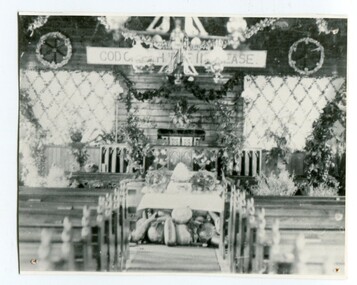
black and white photograph, C1900
... The Festival was a family friendly festival celebrating the end of summer....The Festival was a family friendly festival celebrating the end of summer. This item is reminiscent of the late 19th - mid 20th centuries when church-going was more common. church-presbyterian-orbost harvest-festival on front - stamp -" Herbert Sherwood" on back - "M. ...The first Orbost Presbyterian Church was opened on January 9 1898. It was built by Mr R. P. Cameron for three pounds. The Harvest Festival display was always put together by the church ladies. The Festival was a family friendly festival celebrating the end of summer.This item is reminiscent of the late 19th - mid 20th centuries when church-going was more common.A black / white photograph of inside the Orbost Presbyterian Church decorated with rural produce and flowers for the "Harvest Festival". It is on a white buff card with a blue photographer's stamp in the bottom left hand corner.on front - stamp -" Herbert Sherwood" on back - "M. Gilbert, Orbost" - "Mrs J. Sterling, 6 Marine Parade , Elwood"church-presbyterian-orbost harvest-festival -
 Eltham District Historical Society Inc
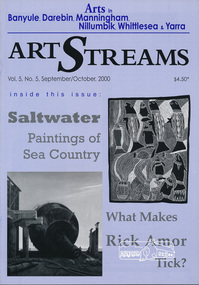
Journal, Peter Doughtery, ArtStreams: Arts in Banyule, Darebin, Manningham, Nillumbik, Whittlesea & Yarra; Vol. 5, No. 5 (sic - 4) Sep-Oct 2000, 2000
... ." - Eltham District Historical Society Newsletter No. 161, March 2005 art streams Rick Amor willy wonka's ice cream gourmet food bulleen art & garden centre sandy jeffs museum of modern art at heide sea country indigenous paintings roberta sykes Kinglake Gallery Sue Yardley Alan Marshall Short Story Award Plenty Ranges Arts & Convention Centre Eltham Little Theartre Warrandyte Theartre Company Eltham Wiregrass Gallery David Moore Montsalvat Art Now At Winter's End Festival Artstreams Publications amberley Anthology of Australian music on disc Plenty Views Golf Park Wayne Viney william Barak Short Story competition emily borg Rhiannon Foster Dynamic Vegies Maria Pellicano Steve Pellicano were street cafe Gemma Lynch-Memory Adriane Strampp Nina Christesen Stephanie Holt St andrews Market Thompsons Pharmacy Colour front and back cover with feature articles and literary pieces with photographs and advertisements printed in black and white. 36 pages, 30 cm. Vol. 1, no. 1 (Nov. 1996) - Vol. 10, no. 5 (summer ...Vol. 5, No. 5 (4), Sep-Oct 2000 CONTENTS From Beach to Battleground 3 Talking art with Rick Amor The Poetry of Catharsis 7 New Work by Sandy Jeffs Saltwater 8 Paintings of Sea Country Snake Circle 10 Reviewed by Anna Barden Short Story 12 The Rainbow Shell Theatre Reviews 16 By Kathy Oliver Interview 18 David Moore and why he paints Art Now 21 City of Darebin Biennial Exhibition Australian Classical Music 22 Betty Scarlett William Barak Writing Competition 24 Stories by Emily Borg & Rhiannon Foster New Arts Contributors 26 Were Street Cafe & Studio19 Artin About 27 Wining & Dining 30 Poetry 32 By Shelton Lea Artist's Services 32 "Peter Dougherty has been involved in the local art scene for many years. As publisher and editor of the arts magazine Artstreams, his comments on the various branches of the arts are widely respected. His "The Arts" column in the Diamond Valley Leader presents a brief summary for a much wider cross section of the local community. Peter also operates his own gallery and the Artstreams Cafe at the St Andrews market. Peter has a wealth of knowledge about present day and historical aspects of local art and artists." - Eltham District Historical Society Newsletter No. 161, March 2005Colour front and back cover with feature articles and literary pieces with photographs and advertisements printed in black and white. 36 pages, 30 cm. Vol. 1, no. 1 (Nov. 1996) - Vol. 10, no. 5 (summer ed. 2005/06) art streams, rick amor, willy wonka's ice cream gourmet food, bulleen art & garden centre, sandy jeffs, museum of modern art at heide, sea country, indigenous paintings, roberta sykes, kinglake gallery, sue yardley, alan marshall short story award, plenty ranges arts & convention centre, eltham little theartre, warrandyte theartre company, eltham wiregrass gallery, david moore, montsalvat, art now, at winter's end festival, artstreams publications, amberley, anthology of australian music on disc, plenty views golf park, wayne viney, william barak short story competition, emily borg, rhiannon foster, dynamic vegies, maria pellicano, steve pellicano, were street cafe, gemma lynch-memory, adriane strampp, nina christesen, stephanie holt, st andrews market, thompsons pharmacy -
 Eltham District Historical Society Inc
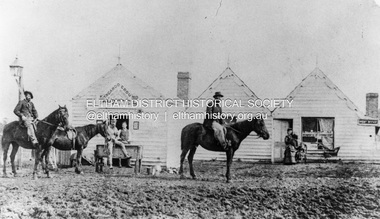
Photograph, William McLaughlin's Kangaroo Ground Hotel, General Store and Post Office, Eltham-Yarra Glen Road, Kangaroo Ground, c.1875
... summer again before the track was available to vehicular traffic. I believe one of the first to effect the whole passage in this way was Mr. Gillies, some time settled at Mortlake. He drove a buggy and called at the Ground on 9th September, stating his intention to drive through to the Point, and we were subsequently informed that he had accomplished the task. (End...summer again before the track was available to vehicular traffic. I believe one of the first to effect the whole passage in this way was Mr. Gillies, some time settled at Mortlake. He drove a buggy and called at the Ground on 9th September, stating his intention to drive through to the Point, and we were subsequently informed that he had accomplished the task. (End ...Initially known as the ‘Kangaroo Hotel,’ this photo shows the sign ‘Kangaroo Ground Hotel’ and William McLaughlin as the proprietor, which dates it between 1871 and 1882. The first hotel known as the Kangaroo Hotel was built at the top of the hill by Andrew Ross in 1864 commencing April; a license was obtained, and the bar opened by Edmund Pickett, the tenant, on 11th of July. The hotel was ready for public accommodation by September, 1864. On June 27, 1864, Edmund Pickett, residing at Kangaroo Ground, gave notice to the Bench of Magistrates at Eltham that it was his intention to apply on July 6th for a certificate authorising the issue of a Publican’s Licence for a house rented and occupied by himself, situated at Kangaroo Ground, containing two sitting rooms and five bedrooms exclusive of those required for the use of his family. On February 7, 1866, Edmund Pickett, publican, residing at Kangaroo Ground, applied at the Court of Petty Sessions held at Eltham for a Publican’s License for a house situated at the Kangaroo Ground, containing six bedrooms and two sitting rooms, rented and occupied by himself and licensed under the sign of the 'Kangaroo Hotel.' In 1866, with few boarders at the school and needing to reduce expenses, Ross had the bedroom house removed from the school and placed in contiguity to the hotel, the occupier to have the post office. The house was re-erected with a kitchen addition and was opened as the Post Office & General Store on April 1st. Throughout 1870 Andrew Ross found himself at odds with Pickett - he "felt much dissatisfaction at my having a hotel especially kept by a man of loose principals and low habits" and so served him notice to vacate by December 31st, occupying it himself on January 1, 1871, calling it Rossville House. William McLaughlin and his wife kept the store and post office. As a hotel was now wanted and McLaughlin was desirous to obtain a license, Ross set about making the Store building suitable which was achieved towards the end of 1871. Ross notes in his diary that the Store hotel was finished January 1, 1872. At the Court of Petty Sessions held at Eltham on 5 December 1871, William McLaughlin applied for a license for the Kangaroo Hotel, Kangaroo Ground. He had previously obtained a wine license, March 28. In June 1882, William McLaughlin of Madeline Street, Carlton, (late of Kangaroo Ground, hotelkeeper) was found insolvent due to losses in connection with the Kangaroo Ground Hotel. The license for the hotel was later transferred from Mr John Donaldson to Mrs Sophia Greenaway. It appears during McLaughlin’s tenure the hotel became known as the Kangaroo Ground Hotel. The hotel was replaced with a new wooden building in 1892, constructed by W.Holland and described as being "of a neat appearance, roomy, and fittled up with all modern requirements necessary in a business of this kind." This building was destroyed by fire in 1930. References: Ross, Andrew, 1814-1895 & Woiwod, Mick & Andrew Ross Museum. (2011). The diary of Andrew Ross 1828-1895 & the reminiscences of Andrew Ross 1851-1864 / edited, annotated and introduced by Mick Woiwod for the Andrew Ross Museum, Kangaroo Ground. Kangaroo Ground, [Vic.] : Tarcoola Press in association with the Andrew Ross Museum The Evelyn Observer, (1892, June 24). Evelyn Observer, and South and East Bourke Record (Vic. : 1882 - 1902), p. 2 (MORNING.). Retrieved May 13, 2025, from http://nla.gov.au/nla.news-article60667494 REMINISCENCES. (1893, April 21). Evelyn Observer, and South and East Bourke Record (Vic. : 1882 - 1902), p. 2 (MORNING.). Retrieved May 10, 2025, from http://nla.gov.au/nla.news-article60669116 REMINISCENCES COUNTY EVELYN. BY Andrew Ross. (No. 41) The summer of 1863-4 may be re membered by many colonists as one of the most enjoyable as regards wet weather, and it was one made remarkable by the enterprise and activity apparent throughout Evelyn County. This spirit was fostered and encouraged by the prospect presented from the opening up of the new route to the Jordan and Wood's Point, and the consequent occupation of lands and special localities along the main track. Accommodation for travellers were established at Yarra Flats, the future Healesville, Fernshaw, Marysville, while the beauties and difficulties of the Black Spur, together with the romantic region of the Stephenson Waterfalls mid the mountain forests attracted visitors other than the gold diggers. Before the end of this year 1863, the new route to Wood's Point by the Dividing Range had been so far improved that a track was laid off by the New Chum Creak, Paradise Plains, and the Springs to Emerald Hill, about half way between Jordan and Wood's Point, and the clearing of this track was looked forward to as enabling drays to be employed. The Government had so far yielded to the demands made upon it, that the work was proceeded with early in 1864. In March of that year the writer was favoured by a visit from Mr. Ligne, Surveyor-General, who was enroute to inspect the progress of the undertaking. He was accompanied by Mr. Collins Levey, his son-in-law, who had been a frequent visitor with his friend Mr. Franklin, of the Melbourne Herald newspaper, These parties, and not a few others, were glad to partake of the hospitality of residents on the Ground or, at Yarra Flats when as yet no public accommodation existed. Horsemen and pedestrians became numerous ere winter set in, and there was obviously the want of the hotel which was planned and commenced late in the autumn. The absence of any endeavour on that score by local proprietors induced the writer to undertake the erection of the Kangaroo Ground Hotel, which he did on his own responsibility. The spot best suited for the hotel being held by him on lease, he was permitted by the landlord to devote the required portion of land for the premises to be erected and occupied. Before this was accomplished the imported houses placed near the schoolhouse which had served for bedroom to boarded pupils were rebuilt near the hotel and served for a general store and post office also. Delay was experienced in procuring all the materials for the new building. After the break in the weather the roads on the Ground became very heavy and as timber had to come from town, it was under difficulties that the supply was procured. Bricks for chimneys were made in a small kiln, and hardwood for joists, &c., provided by sawyers employed for the purpose in the bush. The hotel, in consequence, was not ready for public accommodation until the spring, although a license was obtained, and the bar opened by Mr. Pickett, the tenant, on 11th of July. It may be remarked that the house was rather late in being established; a year earlier it would have secured the benefit of the rush to the new diggings, but in another sense it was rather premature for as yet no steps had been taken by the authorities to stop or even discourage the sale of liquor by unlicensed parties, and the holder of a license had to compete with the class in question. As the season (1864) advanced there were parties anxious to be the pioneers in traversing the whole of the route to Wood’s Point, but it was nigh to summer again before the track was available to vehicular traffic. I believe one of the first to effect the whole passage in this way was Mr. Gillies, some time settled at Mortlake. He drove a buggy and called at the Ground on 9th September, stating his intention to drive through to the Point, and we were subsequently informed that he had accomplished the task. (End of Reminiscences No 41)This photo forms part of a collection of photographs gathered by the Shire of Eltham for their centenary project book,"Pioneers and Painters: 100 years of the Shire of Eltham" by Alan Marshall (1971). The collection of over 500 images is held in partnership between Eltham District Historical Society and Yarra Plenty Regional Library (Eltham Library) and is now formally known as the 'The Shire of Eltham Pioneers Photograph Collection.' It is significant in being the first community sourced collection representing the places and people of the Shire's first one hundred years.Digital image (neg copy missing) Print 21 x 26.5 cmeltham-yarra glen road, kangaroo ground, kangaroo ground hotel, post office, shire of eltham pioneers photograph collection, gas lamp, hotels, kangaroo hotel, william mclaughlin, andrew ross, edmund pickett -
 Kiewa Valley Historical Society
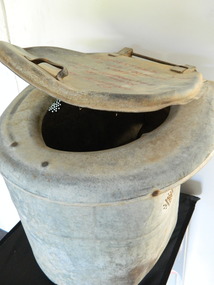
Toilet - Portable
... summer. They stayed in huts which had basic amenities such as a fireplace, tree stumps for seats and an area set aside for a bed. A separate area was used to stock firewood and the hut was located near a stream. Toilet amenities were most often in the bush. camping. camping equipment. portable toilet. cattlemen. bogong high plains. Top of lid: "Guaranteed not / to use too much / water / Lifetime guarantee / on all parts / Bush Plumbing Co. Dirty dented hollow tin cylinder with open ends ...This portable 'dunny' toilet may have been taken on camping trips possibly to the Bogong High Plains where this type of facility didn't exist.Cattlemen grazed their cattle on the Bogong High Plains during summer. They stayed in huts which had basic amenities such as a fireplace, tree stumps for seats and an area set aside for a bed. A separate area was used to stock firewood and the hut was located near a stream. Toilet amenities were most often in the bush.Dirty dented hollow tin cylinder with open ends top and bottom. It has a curved seat attached to the cylinder and a cover attached to the seat by a hinge at the back. It is hand made with basic fittings and is light to lift.Top of lid: "Guaranteed not / to use too much / water / Lifetime guarantee / on all parts / Bush Plumbing Co. camping. camping equipment. portable toilet. cattlemen. bogong high plains. -
 Kiewa Valley Historical Society
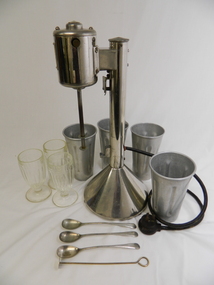
Milkshake Maker Set, 1940 - 1950's
... summer holidays. Milkshake maker machine; Vera Drummond; Tawonga Milk Bar; Tawonga Post Office On the cylinder with the motor - "Type D3; No. 1675; Volt 230; Watt 40; RPM A; ACDC; (the letter) R (with) G (in the top) (and) E (between the 'feet') Reg. Des.No. 24264/65 Spoons: 2 rows of embossed writing on handle end ...The milk shaker machine was used in milk bars during the 1940's and 1950's often using fresh milk from the local diaries. Modern machines are more compact with a variety of different settings and the ability to blend a variety of food including fruit and vegetables as well as liquids.Vera Drummond worked in the Tawonga Milk Bar where she used the Milk Shaker machine. The premises were leased out until it finally closed. The Milk Shaker machine was then lent to the Tawonga cafe which was situated opposite the Tawonga Hotel on the Kiewa Valley Highway near Mountain Creek Road. When the cafe owner bought their own milk shaker machine the original was returned to Vera who lived at the Tawonga Post Office. The milk shakes were made with fresh real milk direct from the diary and enjoyed by Vera's grandchildren and great grandchildren especially on summer holidays.This set consists of: 1 stainless steel milkshake blender with black electric cord attached; 3 moulded glasses with vertical grooves; 4 aluminium mixing beakers also with vertical grooves; 3 long handle stainless steel mixing spoons; 1 stainless steel swivel stick. The blender is heavy with an enclosed cylinder at the top containing the motor with a rotating mixer hanging below it. This is supported by a long vertical enclosed cylinder attached to a base where the electric cord is placed. This cylinder has parts attached to hold the beakers during mixing.On the cylinder with the motor - "Type D3; No. 1675; Volt 230; Watt 40; RPM A; ACDC; (the letter) R (with) G (in the top) (and) E (between the 'feet') Reg. Des.No. 24264/65 Spoons: 2 rows of embossed writing on handle end but illegiblemilkshake maker machine; vera drummond; tawonga milk bar; tawonga post office -
 Eltham District Historical Society Inc
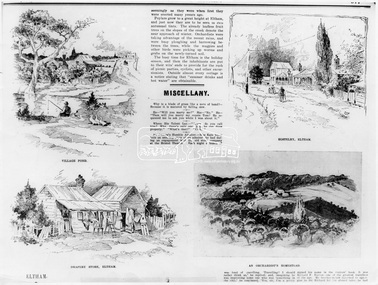
Photograph, The Australasian, Eltham - A series of four scenes of the local district, 2 May 1903
... The busy time for Eltham is the holiday season, and then the inhabitants are put to their wits' ends to provide for the rush of picnic parties, cyclists, and other excursionists. Outside almost every cottage is a notice stating that "summer drinks and hot water" are obtainable. ...The busy time for Eltham is the holiday season, and then the inhabitants are put to their wits' ends to provide for the rush of picnic parties, cyclists, and other excursionists. Outside almost every cottage is a notice stating that "summer drinks and hot water" are obtainable. ...Australasian (Melbourne, Vic. : 1864 - 1946), Saturday 2 May 1903, page 25 ________________________________________ ELTHAM A POPULAR HOLIDAY SPOT. By L.J.J. The village of Eltham, with its 377 in habitants, is prettily situated on Diamond Creek, a tributary of the Yarra, 16 miles from Melbourne. Yet, in spite of it being so easily accessible from town, few people are aware of the beauties of this early settlement. Prior to June last year one had to journey by coach from Heidelberg to Eltham, but now the railway conveys passengers through from Melbourne to Eltham, first-class return, for 1/9. The opening of this extension to Eltham was the last ceremony performed by Lord Hopetoun, on June 5, 1902, prior to his departure from Australia. Sauntering through the township one autumn morning recently I was constantly reminded of scenes characteristic of Surrey or Sussex villages. There is the village pond (so essentially English), reflecting in its clear water a quaint cottage, dwarfed by a huge gum tree, an old smithy, and a hostelry, built quite fifty years ago, the flooring-boards of which the landlord informed me with pride were of Singapore cedar, and quite fit for another fifty years' wear. Then there are the village school, the shoemaker's, the drapery store, and the butcher's shop, all seemingly as they were when first they were erected many years ago. Poplars grow to a great height at Eltham, and just now they are to be seen in rich autumnal tints. The already leafless fruit trees on the slopes of the creek denote the near approach of winter. Orchardists were taking advantage of the recent rains, and were busy ploughing and harrowing between the trees, while the magpies and other birds were picking up worms and grubs on the newly-turned soil. The busy time for Eltham is the holiday season, and then the inhabitants are put to their wits' ends to provide for the rush of picnic parties, cyclists, and other excursionists. Outside almost every cottage is a notice stating that "summer drinks and hot water" are obtainable. Sketches illustrating the article: VILLAGE POND. DRAPERY STORE, ELTHAM. ON DIAMOND CREEK. HOSTELRY, ELTHAM. AN ORCHADIST'S HOMESTEAD. ON THE HEIDELBERG-ROAD IN AND AROUND ELTHAM.This photo forms part of a collection of photographs gathered by the Shire of Eltham for their centenary project book,"Pioneers and Painters: 100 years of the Shire of Eltham" by Alan Marshall (1971). The collection of over 500 images is held in partnership between Eltham District Historical Society and Yarra Plenty Regional Library (Eltham Library) and is now formally known as the 'The Shire of Eltham Pioneers Photograph Collection.' It is significant in being the first community sourced collection representing the places and people of the Shire's first one hundred years.Digital image Print B&W 20 x 25 cmsepp, shire of eltham pioneers photograph collection, drapery store, hostelery, orchardist's homestead, village pond, eltham, dalton street, evelyn hotel, hostelry, jarrold cottage, john street, main road, maria street, white cloud cottage -
 Kiewa Valley Historical Society
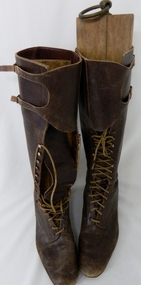
Boots Riding Women's, Circa 1950's
... summer muster seasons. It was unusual for women in the early to mid 1900's to go up on the High Plains to join the muster, which Clare Roper often did. These boots have high historical significance and good interpretive capacity. ladies riding boots. cattle mustering footwear. rural footwear. cattlemen. bogong high plains. roper family. horses. These brown "knee high" lady riding boots, are fastened by long "boot" laces which go from the base of the "fastening" position to a boot height of 22 cm. At the top end ...This pair of "adjustable" boots came from the 1950's era in which the majority of footwear was either locally manufactured or imported from England or Europe. Quality hard wearing leather was a rural necessity especially for the cattle mustering activity in the Kiewa Valley and the Bogong High Plains region. The late 1900's provided a cheaper made riding boot from Asia, however many rural based riders still prefer an Australian made boot. The better quality (stronger stitching) of Australian boots is the main considerations of "stock horse riders". In 1947 a scientific research project started to provide an impact analysis of any damage to alpine vegetation by cattle grazing in the Alpine regions incorporating the Bogong High Plains area. This monitoring is the longest running ecological study ever undertaken in Australia. From this study, compelling evidence was presented to the Victorian Government to cease cattle grazing in the Alpine regions including the Bogong High Plains. All grazing was banned by the Victorian Government in 2005. Recreational horse riding within the Bogong High Plains is still permitted.These pair of women's riding boots are very significant to the Kiewa Valley as the boots were worn by one of the descendants of a pioneer family living and operating a cattle station before the SEC Hydro Electricity Scheme opened up the semi remote rural location in the 1950's. These boots were worn during the annual six weeks (approx.) mustering of cattle in the Bogong High Plains location (Victorian Alps region). The owner of these boots was Clare Roper, part of the Roper Family who built a "lodging" hut on the "High Plains" for accommodating riders during the periods (up to six weeks) when controlling grazing cattle during the summer muster seasons. It was unusual for women in the early to mid 1900's to go up on the High Plains to join the muster, which Clare Roper often did. These boots have high historical significance and good interpretive capacity.These brown "knee high" lady riding boots, are fastened by long "boot" laces which go from the base of the "fastening" position to a boot height of 22 cm. At the top end of the boot is a leather flap which crosses the front section of the boot and is fastened to the outside leg region by two straps. These provide the wearer with an adjustable tie. The boot has a "tongue" of 22 mm long. The boot has six pairs of metal boot lace "hooks" and eight pairs of boot lace "eyelets".ladies riding boots. cattle mustering footwear. rural footwear. cattlemen. bogong high plains. roper family. horses. -
 Bendigo Military Museum
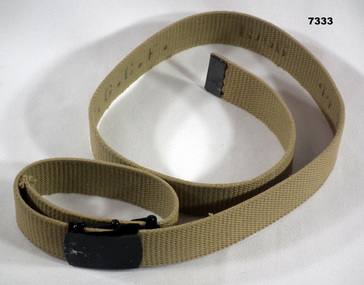
Uniform - BELT, POLYSTER - ARMY, Commonwealth Govt Clothing Factory, 1966
... The end of the belt has a blackened tip. It is used when wearing the polyester khaki uniform (Summer)....The end of the belt has a blackened tip. It is used when wearing the polyester khaki uniform (Summer). ...Item in the collection re Tom Glazebrook, refer Cat No 4330.2 for his service details.This is a Khaki coloured webbing belt. It has a blackened brass buckle. The end of the belt has a blackened tip. It is used when wearing the polyester khaki uniform (Summer).Stamped inside the belt are letters and numbers “C.G.C.F. (1966 44 4 0440 00 012 6305)”uniform, belt, army -
 Bendigo Historical Society Inc.
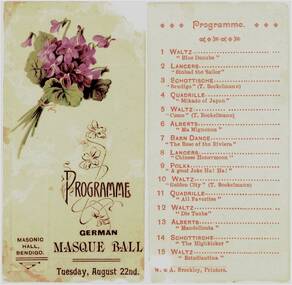
Programme - Programme for German Masque Ball, 1905
... Summer," rose, sailor girls, gondolier, Pierot, Charles II., Tipperary boy. Toreador, Romeo, Prince Le Var, huntsman, Indian prince, fireman, barristers. jockeys, cricketers, etc. Many of the Iadies were in evening dress, but wore the masque. The arrangements were admirably carried out by the secretarv. Mr. J. D. Khaland, while it would be difficult to find a better M.C. than Mr. J. Armstrong. The dancing was witnessed by a large number of the public, who were accommodated on a temporary gallery at one end...Summer," rose, sailor girls, gondolier, Pierot, Charles II., Tipperary boy. Toreador, Romeo, Prince Le Var, huntsman, Indian prince, fireman, barristers. jockeys, cricketers, etc. Many of the Iadies were in evening dress, but wore the masque. The arrangements were admirably carried out by the secretarv. Mr. J. D. Khaland, while it would be difficult to find a better M.C. than Mr. J. Armstrong. The dancing was witnessed by a large number of the public, who were accommodated on a temporary gallery at one end ...Two cardboard parts to a printed programme. On one is a posy of violets and the printing: "Programme German Masque Ball, Tuesday 22nd. The second lists 15 dances. Printed by A. Brookley, Printers. Also are the following two articles from Trove: From the Bendigo Advertiser and the Bendigo Independant, Wed 23 Aug 1905: GERMAN MASQUE BALL. The pleasant plan of fancy masque ball, which for nearly 20 years now has been an annual fixture at this season, is always looked forward to with delight. It is got up by the Bendigo Deutcher Verein, in aid of their free library. The function took place last night in the Masonic Hall and was most enjoyable, and all who took part in it were delighted. The hall was tastefully decorated with flags, flowers and ferns. Bockelmann's Band occupied the stage and discoured sweet music. Many of the items on a long programme were of Mr. Bockelmann's own composition, notably the schottische "Bendigo," the waltz 'Como, 'and the waltz "Golden City." By 9 o'clock there were about 80 couples on the floor. Amongst the merry troupe of dancers were youths and maidens in all sorts and descriptions of gay costumes, including flower girls, Japanese lady, German peasant, lily of the valley, Mercia, Geisha girl, French Vivandiere, red dominos, black dominos, "The Last Rose of Summer," rose, sailor girls, gondolier, Pierot, Charles II., Tipperary boy. Toreador, Romeo, Prince Le Var, huntsman, Indian prince, fireman, barristers. jockeys, cricketers, etc. Many of the Iadies were in evening dress, but wore the masque. The arrangements were admirably carried out by the secretarv. Mr. J. D. Khaland, while it would be difficult to find a better M.C. than Mr. J. Armstrong. The dancing was witnessed by a large number of the public, who were accommodated on a temporary gallery at one end of the hall. A small charge was made for their admission, which helped to swell thelibrary funds. An excellent supper, served in Mr. W. C. Dick's best style, was much enjoyed. Dancing was kept up till about three o'clock, everybody pronouncing the gathering a highly enjoyable one. bendigo history, sandhurst, lutheran german church, penny school -
 Monbulk RSL Sub Branch
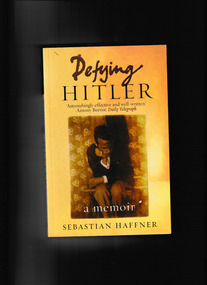
Book, Phoenix Paperback, Defying Hitler : a memoir, 2003
... This memoir (written in 1939 but only published now for the first time) begins in 1914 when the family summer holiday is cut short by the outbreak of war, and ends with Hitler's assumption of power in 1933. ...ebastian Haffner was a non-Jewish German who emigrated to England in 1938. This memoir (written in 1939 but only published now for the first time) begins in 1914 when the family summer holiday is cut short by the outbreak of war, and ends with Hitler's assumption of power in 1933. It is a portrait of himself and his own generation in Germany, those born between 1900 and 1910, and brilliantly explains through his own experiences and those of his friends how that generation came to be seduced by Hitler and Nazism.Index, ill, p.259.non-fictionebastian Haffner was a non-Jewish German who emigrated to England in 1938. This memoir (written in 1939 but only published now for the first time) begins in 1914 when the family summer holiday is cut short by the outbreak of war, and ends with Hitler's assumption of power in 1933. It is a portrait of himself and his own generation in Germany, those born between 1900 and 1910, and brilliantly explains through his own experiences and those of his friends how that generation came to be seduced by Hitler and Nazism. germany - history - 20th century, national socialism - germany -
 Monbulk RSL Sub Branch
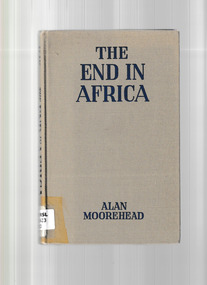
Book, George Jaboor, The end in Africa, 1944
... World war 1939 – 1945 – Campaigns – North Africa World war 1939 – 1945 – Personal narratives – Britain This is the story of the fall of Tunis and the third and final year of campaigning in Africa from the summer of 1942 to the summer of 1943. Maps, p.210. The end in Africa Book George Jaboor Alan Moorehead ...This is the story of the fall of Tunis and the third and final year of campaigning in Africa from the summer of 1942 to the summer of 1943.Maps, p.210.non-fictionThis is the story of the fall of Tunis and the third and final year of campaigning in Africa from the summer of 1942 to the summer of 1943.world war 1939 – 1945 – campaigns – north africa, world war 1939 – 1945 – personal narratives – britain -
 Tramway Heritage Centre
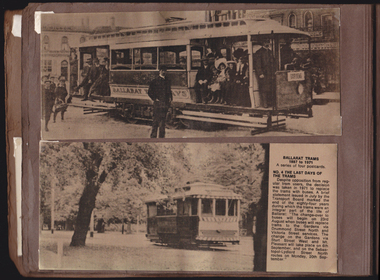
Photograph Album (part of), Ray Pearson's Photo Album - Trams of Victorian Railways, Ballarat, Bendigo, Geelong
... In 1906 / two open summer cars with / open cross seats (popularly / called toast racks) / were intro- / duced. These trams were packed at week-ends with / families en route to picnic by / the lake. ...In 1906 / two open summer cars with / open cross seats (popularly / called toast racks) / were intro- / duced. These trams were packed at week-ends with / families en route to picnic by / the lake. ...Page 4 of Ray Pearson's Photo Album. Brown card page with two metallic look postcards (landscape format) placed on page using clear plastic photo corners. Both postcard images depict trams in Ballarat. Both postcards have come loose of two of their photo corners (top and bottom on the left) and are not secure on the page.Printed text to back of postcard at top: BALLARAT TRAMS / 1887 to 1971 / A series of four postcards. / NO. 2 EARLY ELECTRIC TRAMS / Electric trams first ran in / Ballarat on 18th Aigust, 1905. / Twelve of the horse trams were / converted to electric cars by lengthening them at both ends. / Eight of the remaining horse / trams were used as trailers to / the motor cars. / The electric trams were / given a secret trial during the / previous night to the opening / date, but the drivers clanged / the gongs so much that it / brought people out of their / beds in night attire. They / formed an unofficial guard of / honour around Wendouree / Parade. / The trams were gaily decor- / ated for Opening Day. As the / line of cars came down Camp / Hill (Sturt Street) filled with / local dignitaries, the brakes on / the last car failed and it crashed / into the one in front. The win- / dows of both cars were / smashed, and the occupants / who had been sitting in state / made an undignified exit. / Seating accommodation was / from 32 to 36. Six small electric / trams were purchased from the / Sydney Tramways in 1905 and / were converted to a similar / pattern to the 12 re-built / Ballarat horse trams. In 1906 / two open summer cars with / open cross seats (popularly / called toast racks) / were intro- / duced. These trams were packed at week-ends with / families en route to picnic by / the lake. A fine printed vertical line runs down the centre of the blank writing space to the left of the body text. Above is written: POSTCARD Printed text to right of image on bottom postcard: BALLARAT TRAMS / 1887 to 1971 / A series of four postcards. / NO. 4 THE LAST DAYS OF THE TRAMS / Despite opposition from reg- / ular tram users, the decision / was taken in 1971 to replace / the trams with buses. A brief / statement issued in July by the / Transport Boar marked the / end of the eighty-four years / during which the trams were an / integral part of the life of / Ballarat: “The change-over to / buses will begin on 23rd / August when buses will replace / trams to the Gardens via / Drummond Street North and / Victoria Street services. The / change on the Gardens via / Sturt Street West and Mt. / Pleasant will take place on 6th / September, and on the Sebas- / topol-Lydiard Street North / routes on Monday, 20th Sep- / tember.” A fine printed vertical line runs down the centre of the blank writing space to the left of the body text. Above is written: POSTCARDpostcard, ballarat trams, ballarat tramways, vintage trams, tram postcard, electric trams -
 Ithacan Historical Society
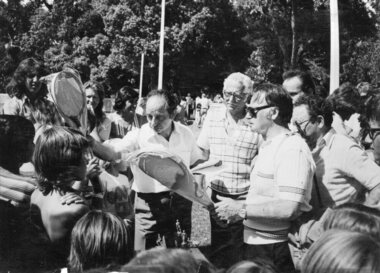
Photograph, Ithacan picnic, late 70s - early 80s
... The annual Ithacan picnic which is held towards the end of summer is a popular event allowing friends and families to mingle and relax. ...The photograph was taken at an Ithacan picnic during the running races. IPS committee members, L-R Stathi Raftopoulos, Michael Black and Nick Varigos are presenting prizes of tennis rackets to race winners.The annual Ithacan picnic which is held towards the end of summer is a popular event allowing friends and families to mingle and relax. The running races are a popular feature for the young.A black and white photograph of a crowd of people outdoors. Two men are holding wrapped tennis rackets while another man is talking to a child in the group. -
 National Vietnam Veterans Museum (NVVM)
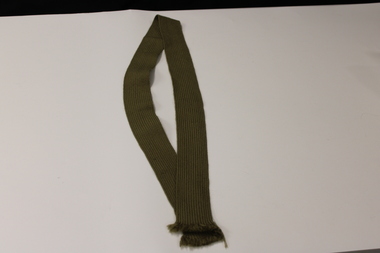
Uniform - Tie
... summer and winter versions) and General Duty dress. Veterans of the era often remember them as being too short. 7RAR Woods 2783285 Vietnam tie service dress service uniform A straight tie made from khaki knitted fabric with hemmed sides but square unhemmed ends. ...An army issue tie as part of non-combat uniform worn by national Serviceman Pte D G Woods, No: 2783285, who served in 7RAR in 1967. These ties were primarily worn with Service Dress (both summer and winter versions) and General Duty dress. Veterans of the era often remember them as being too short.A straight tie made from khaki knitted fabric with hemmed sides but square unhemmed ends.7rar, woods, 2783285, vietnam, tie, service dress, service uniform -
 Coal Creek Community Park & Museum
Music Sheets, Violin Music Sheets
... 6144.1 to 19 - A selection of 1st violin music sheets, all have been numbered by the previous owner; 19 sheets in total S1 - The Cute Little Things You Do S2 - In A Cafe On The Road To Calais S3 - Beautiful Love S4 - Toodle-oo So Long Goodbye S5 - Do You Believe in Love at Sight S6 - My World Begins and Ends With You S7 - Look Here Comes a Rainbow S8 - Lights Of Paris S9 - When You Hear This Song Remember Me S10 - All The World Will Smile Again After Tomorrow S11 - Underneath The Summer Moon S12 - Congorilla S13 - Rackety Ray S14 - Throw A Little Salt On The Blue Birds Tail S15 - Around You S16 - Gypsy Hearts S17 - Home Folks Violin___ 6G - I Don't Know Why 8G - When We Are Together...6144.1 to 19 - A selection of 1st violin music sheets, all have been numbered by the previous owner; 19 sheets in total S1 - The Cute Little Things You Do S2 - In A Cafe On The Road To Calais S3 - Beautiful Love S4 - Toodle-oo So Long Goodbye S5 - Do You Believe in Love at Sight S6 - My World Begins and Ends With You S7 - Look Here Comes a Rainbow S8 - Lights Of Paris S9 - When You Hear This Song Remember Me S10 - All The World Will Smile Again After Tomorrow S11 - Underneath The Summer Moon S12 - Congorilla S13 - Rackety Ray S14 - Throw A Little Salt On The Blue Birds Tail S15 - Around You S16 - Gypsy Hearts S17 - Home Folks Violin___ 6G - I Don't Know Why 8G - When We Are Together Violin Music Sheets Music Sheets ...6144.1 to 19 - A selection of 1st violin music sheets, all have been numbered by the previous owner; 19 sheets in total S1 - The Cute Little Things You Do S2 - In A Cafe On The Road To Calais S3 - Beautiful Love S4 - Toodle-oo So Long Goodbye S5 - Do You Believe in Love at Sight S6 - My World Begins and Ends With You S7 - Look Here Comes a Rainbow S8 - Lights Of Paris S9 - When You Hear This Song Remember Me S10 - All The World Will Smile Again After Tomorrow S11 - Underneath The Summer Moon S12 - Congorilla S13 - Rackety Ray S14 - Throw A Little Salt On The Blue Birds Tail S15 - Around You S16 - Gypsy Hearts S17 - Home Folks Violin___ 6G - I Don't Know Why 8G - When We Are Together -
 Ithacan Historical Society
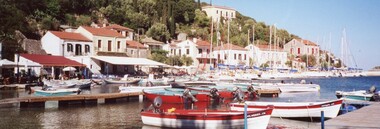
Photograph, Kioni harbour
... If one takes the road from Vathi, the main town on the island, and heads north, the road comes to an end at this picturesque village. Kioni is a very popular tourist destination and during the summer months many yachts sail into its harbour. ...If one takes the road from Vathi, the main town on the island, and heads north, the road comes to an end at this picturesque village. Kioni is a very popular tourist destination and during the summer months many yachts sail into its harbour. ...Kioni a seaside villages on the island of Ithaca. If one takes the road from Vathi, the main town on the island, and heads north, the road comes to an end at this picturesque village. Kioni is a very popular tourist destination and during the summer months many yachts sail into its harbour. Many Ithacans from the village of Kioni migrated to Melbourne. A coloured panoramic view of the harbour at Kioni showing some of the houses and small boats moored close to the water's edge. -
 Warrnambool and District Historical Society Inc.
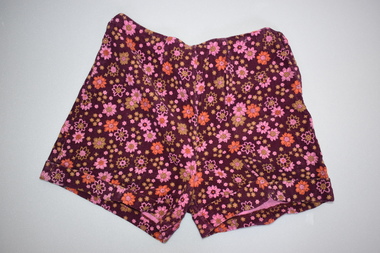
Clothing - Shorts, hot pants, Styro, 1965-1975
... summer fashion, perhaps in the 1970s. Similar- patterned garments may still be worn today but perhaps without the cuffs on the legs. This garment is retained as an example of women’s fashions in the mid to late 20th century and will be useful for display. ladies fashion hotpants ‘Styro SW All Cotton’ This is a pair of women’s shorts. They are made of cotton (velveteen) and are multi-patterned with a dark red background with pink, orange and yellow flowers. There are cuffs at the end ...This garment would have been worn by young girls as a summer fashion, perhaps in the 1970s. Similar- patterned garments may still be worn today but perhaps without the cuffs on the legs. This garment is retained as an example of women’s fashions in the mid to late 20th century and will be useful for display. This is a pair of women’s shorts. They are made of cotton (velveteen) and are multi-patterned with a dark red background with pink, orange and yellow flowers. There are cuffs at the end of the legs and a zip down the side. The waist is lined with white material and there are five buttons attached to the waist band. The maker’s label is also attached to the waist band.‘Styro SW All Cotton’ladies fashion, hotpants -
 Ballarat and District Irish Association
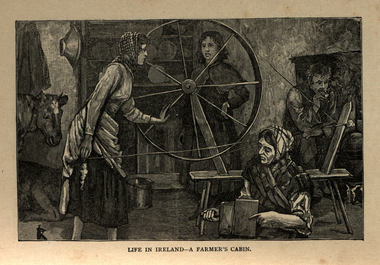
Image, Life in Ireland - A Farmer's Cabin, c1864
... Potatoes were the staple diet from September through to the end of Spring of the following year. But the summer months were months of hunger and hardship as they waited for the following harvest to come in Autumn. ...Potatoes were the staple diet from September through to the end of Spring of the following year. But the summer months were months of hunger and hardship as they waited for the following harvest to come in Autumn. ...The tenant lived at the mercy of the resident landlord. Home was a one-roomed house, a chimney of wicker work plastered over with mud or just a hole in the roof. The walls might consist of mud too, or sods of grass. Any windows, were rarely glazed and would be open to the elements all year round. The Pig, if any, was kept in the house, the most valuable possession. Sold for cash at local market. The main items in the house were a potato pot and water bucket. As well as mother, father and children, there could well be grandparents all living in the same cramped conditions. The family would sleep on rushes or straw lain on the floor. Most tenants were tenants 'at will ', which meant they could be evicted at the 'will' of the landlord. Some had a lease for the life of the father and the eldest son, and this meant they were relatively safe from eviction as long as they could pay their rent. There was a tradition of passing on a portion of your land from father to each of the sons, who would build a small dwelling, and in turn pass a portion onto their own sons. This cycle of subdivision meant that many families were surviving on a tiny plot of land from which to derive a crop of potatoes for the year. Women worked hard in this environment, rearing children, cooking, cleaning, tending to any animals such a pigs or chicken and when needed, helping in the potato field. Life was dictated by the annual rent due to the landlord. Other typical expenses could be the Hearth Tax (actually charged by the number of fire places in a house) Turf, Hay (for any farm animals) and tithes. A tax known as the tithes were calculated at one tenth the value of everything saleable. Tithes were a bitter issue. They were for the support of the Church of Ireland, Protestant Bishops and Ministers, and a cess tax for the construction and maintenance of Protestant Church buildings. The problem being that the vast majority of those paying the Tax were Catholic and paying to support something that was contrary to their beliefs. Potatoes were the staple diet from September through to the end of Spring of the following year. But the summer months were months of hunger and hardship as they waited for the following harvest to come in Autumn. During these months people had to resort to eating anything they could find; turnips, cabbage, even wild grass, nettles, wild berries and dandelions. Those who lived close to the sea would collect seaweed and use it spread on their land as a form of manure. The dependency of so much of the population on the Potato as their sole source of food was to prove disastrous during the Famine years. [http://www.youririshroots.com/irishhistory/tenant.php, accessed 14 December 2013]A woman spins wools, while another cards fleece in preparation for spinning. I man smokes a pipe by an open fireplace, while a cow takes shelter in the cabin for warmth. ballarat irish, cabin, spinning, wool, cow -
 Sunshine and District Historical Society Incorporated
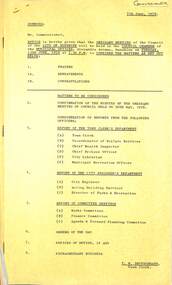
Administrative record - City of Sunshine - Commissioner Mr Alexander "Alex" George Gillon Collection 1976 - 1982 - Notice of Ordinary Meeting of the City of Sunshine on 13th June 1978, City of Sunshine, 7th June 1978
... Albans Road / Main Road East / East Esplanade Give Way to Right Signs Western Highway Fitzgerald Road / Boundary Road Funds Street Lighting Western Highway (Ballarat Road, Ashley Street and Mitchell Street Intersection Princess Highway West Old Geelong Road to McDonald Road Northern Service Road Replacement of Plant Nos 51 & 58 Chamberlin Front End Loaders Sunshine Swimming Pool Progress Report Relocation of Steel Framed Steel Clad Sheds to Errington Reserve and Robert Bruce Reserve Fairbairn Road Pre-School Centre Toilet Blocks Various Reserves Scovell Reserve Proposal by Maidstone Junior Sporting Club to Construct a Recreation Hall Report of the Acting Building surveyor Outbuilding 19 Charlotte Street Sunshine West Outbuilding 34 Bent Street St. Albans Outbuilding 2 Lynch Street Sunshine Outbuilding 18 Hertford Road Sunshine Outbuilding 16 Baynton Avenue Sunshine North Dangerous and Ruinous Building Van Ness Avenue (Former Rock Crushing Plant) Report of the Director Parks & Recreation Summer...Albans Road / Main Road East / East Esplanade Give Way to Right Signs Western Highway Fitzgerald Road / Boundary Road Funds Street Lighting Western Highway (Ballarat Road, Ashley Street and Mitchell Street Intersection Princess Highway West Old Geelong Road to McDonald Road Northern Service Road Replacement of Plant Nos 51 & 58 Chamberlin Front End Loaders Sunshine Swimming Pool Progress Report Relocation of Steel Framed Steel Clad Sheds to Errington Reserve and Robert Bruce Reserve Fairbairn Road Pre-School Centre Toilet Blocks Various Reserves Scovell Reserve Proposal by Maidstone Junior Sporting Club to Construct a Recreation Hall Report of the Acting Building surveyor Outbuilding 19 Charlotte Street Sunshine West Outbuilding 34 Bent Street St. Albans Outbuilding 2 Lynch Street Sunshine Outbuilding 18 Hertford Road Sunshine Outbuilding 16 Baynton Avenue Sunshine North Dangerous and Ruinous Building Van Ness Avenue (Former Rock Crushing Plant) Report of the Director Parks & Recreation Summer ...Notice of Ordinary Meeting of the City of Sunshine on 13th June 1978 Report of the Town Clerk's Department Report of the Town Clerk Increased Crime Request for Royal Commission Loan Programme Increased Borrowing Allocation for 1978/79 Pre-Natal Clinic Sunshine Infant Welfare Centre Land Transfer Discontinued Road Between Verdun Street and Mitchell Street Crown Lands Adjoining Kororoit Creek / Anderson Road / Graham Street Proposed Committee of Management Lease Italo-Australian Co-Operative Social Club Ltd Separate Rate Off Street Parking Scheme Melbourne Metropolitan Board of Works Representation Report of the Co-Ordinator of Welfare Services Family and Community Service Programme State Grants (Home Care) Act Welfare Officers Subsidies Proposal for Funding for Emergency Relief in the Western Region Caretaker / Cleaner Lions House of Sunshine Senior Citizens Club Howard Kingham Lodge Hostel for the Frail Aged Proposal for Upgrading Housing Commission Areas Report of the Acting Chief Health Inspector Prosecution Proceedings Sunshine Magistrates Court Quarterly Return of Food Samples Infant Welfare Immunisation St. Albans Deer Park Infant Welfare Centre Gas fired Toilet "Destroilet" Report of the By-Lawa Officer Court Proceedings Parking Infringements Report of the City Librarian Second Bookmobile School Holiday Programme 15th to 26th May Children's Literature Second National Seminar September 1st to 5th 1978 Report of the Municipal Recreation Officer Proposed Formation of Western Region Commission Municipal Recreation Officers' Sub Committee Ground Allocations Winter Seasons 1978 Report of the City Engineer Proposed Amendment No 81 to the Melbourne Metropolitan Planning Scheme Land Acquisition Maribyrnong Valley Land Use Permit Application Extensions to Marian College Secondary School Lots 590 & 591 Glengala Road Land Use Permit Application Flats Lot 31 Bardsley Street Land Use Permit Application Take Away Foods Lot 8 Market Place Land Use Permit Application Advertising Sign A.C. Sheeting Pty Ltd 1 Fourth Avenue Land Use Permit Application Drive In Bottle Shop and Extension to St. Albans Hotel McKechnie Street Plan of Subdivision Gladstone Street and Garfield Street Strata Subdivision 11 Yarmouth Avenue Consolidation of Title Somers Street and Henderson Street Plan of Subdivision Geelong Road and Francis Street Tenders for Surplus Equipment Mowers Contract Construction of Neale Road Somerville Road Outfall Drain Subsidy for Victoria S.E.S. Local Unit McIntyre Road / Sunshine Avenue Construction Construction of Wright Street Bridge Account for Reinstatement 11 Commercial Street Allocation of Funds Joint Works Main and Unclassified Roads Proposed Intersection Signals St. Albans Road / Main Road East / East Esplanade Give Way to Right Signs Western Highway Fitzgerald Road / Boundary Road Funds Street Lighting Western Highway (Ballarat Road, Ashley Street and Mitchell Street Intersection Princess Highway West Old Geelong Road to McDonald Road Northern Service Road Replacement of Plant Nos 51 & 58 Chamberlin Front End Loaders Sunshine Swimming Pool Progress Report Relocation of Steel Framed Steel Clad Sheds to Errington Reserve and Robert Bruce Reserve Fairbairn Road Pre-School Centre Toilet Blocks Various Reserves Scovell Reserve Proposal by Maidstone Junior Sporting Club to Construct a Recreation Hall Report of the Acting Building surveyor Outbuilding 19 Charlotte Street Sunshine West Outbuilding 34 Bent Street St. Albans Outbuilding 2 Lynch Street Sunshine Outbuilding 18 Hertford Road Sunshine Outbuilding 16 Baynton Avenue Sunshine North Dangerous and Ruinous Building Van Ness Avenue (Former Rock Crushing Plant) Report of the Director Parks & Recreation Summer School Park Management 1979 Children's Playgrounds Burnley Horticultural College Nursery Trends and Development Bon Thomas Reserve Development Main Pavilion House McKay Gardens Demolition Bon Thomas Reserve Development Tender Tree Surgery Maintenance Seminar Royal Australian Institute of Parks & Recreations Victoria Region city of sunshine, alexander "alex" george gillon, sunshine infant welfare centre, verdun street, mitchell street, maidstone, kororoit creek, anderson road, graham street, sunshine, italo-australian co-operative social club, furlong road, st. albans, lions house of sunshine senior citizens club, watt street, corio street, howard kingham lodge hostel, darnley street, braybrook, deer park infant welfare centre, maribyrnong valley, marian college, glengala road, bardsley street, sunshine west, market place, fourth avenue, st. albans hotel, mckechnie street, gladstone street, garfield street, yarmouth avenue, somers street, henderson street, sunshine north, geelong road, francis street, brooklyn, mcintyre road, sunshine avenue, wright street bridge, wright street, commercial street, st. albans road, main road east, east esplanade, western highway, fitzgerald road, boundary road, ballarat road, ashley street, princess highway, old geelong road, mcdonald road, sunshine swimming pool, kennedy street, errington reserve, robert bruce reserve, station road, deer park, scovell reserve, maidstone junior sporting club, charlotte street, bent street, lynch street, hertford road, baynton avenue, van ness avenue, maribyrnong, bon thomas reserve, quinn street -
 Ballarat Tramway Museum
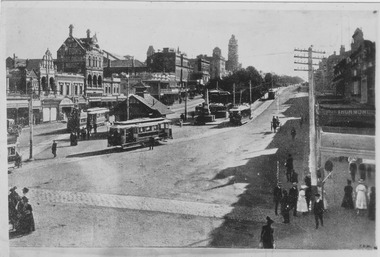
Photograph - Tram 20 -City Centre, c1910
... Photograph of Ballarat Summer car No.20 and 3 other tramcars (2 with former double deck horse tram trailers) at City Centre, Nth side of Sturt St at Grenville St Nth. Photo shows the large passenger shelter/ESCO office, several pedestrians, and the commercial buildings of the Eastern end of Sturt St. ...end of Sturt St. Ballarat Sturt St Tram 20 Horse tram trailer Has details of photograph and year on rear and number "T30". Also, "Ballarat Tramways", "Sturt Street in 1912", "Showing 3 old el types, 2 trailers and No.20 summer car(near band stand), "W.Jack Photo". ...Photograph of Ballarat Summer car No.20 and 3 other tramcars (2 with former double deck horse tram trailers) at City Centre, Nth side of Sturt St at Grenville St Nth. Photo shows the large passenger shelter/ESCO office, several pedestrians, and the commercial buildings of the Eastern end of Sturt St. Prominent in the background are the Mechanics Institute, and the Town Hall. See item 5134 for a digital image and a copy negative.Yields information about SEC tramway operations, and the buildings and layout of the East end of Sturt St.Black and white photograph on plain paperHas details of photograph and year on rear and number "T30". Also, "Ballarat Tramways", "Sturt Street in 1912", "Showing 3 old el types, 2 trailers and No.20 summer car(near band stand), "W.Jack Photo".ballarat, sturt st, tram 20, horse tram trailer -
 National Wool Museum
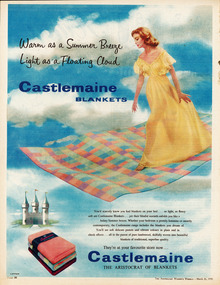
Archive - Advertisement, Castlemaine Woollen Mill, 1958
... end of the 1960s. The collection has blankets from each of these four decades representing the styles and fashions of their time and includes dated advertisements which help determine the eras the blankets are from." Wool Blanket Blanket fever Advertisement Castlemaine Australian Women's Weekly Warm as a Summer ...Note from collector- "For more than 100 years blankets were made all over Australia in over 100 woollen mills. My aim, is to preserve 100 examples of these wonderful pieces of history. Ten years ago I started collecting the iconic Onkaparinga travel rugs, so that on movie nights at home there would be plenty to go around. Everyone had their favourite; even the cat had his own – a small red tartan one. Keeping an eye out for those travel rugs at op-shops and markets, collectable stores and bazaars, led to noticing vintage blankets. I'd never really thought about them before or paid much attention though of course I had grown up with them at my grandmother's. When I discovered my first Laconia cream blanket with blue stripes, my eyes just went gaga. Well that was it, I was hooked and since then over 500 blankets have passed through my hands. These common, everyday items, found in all households for so many decades, were traditional engagement gifts. Pairs were prized wedding presents turning into family heirlooms. They were fashionable dressers of beds, givers of warmth, bestowers of security and reliability. The comfort found in these objects resonates with almost all of us; we grew up with them ourselves or fondly recall them in a grandparent’s home. There is no modern replacement with the integrity of these old blankets, many of them now older than most of us. They are romantic, sensible, special, familiar, nostalgic and nothing else feels so appropriate in so many situations. No offense to the great Aussie doona, but from hippie to hipster, at a music festival, picnic, campsite or couch, a vintage blanket is something coveted by all. This industry that employed tens of thousands and must have been such a huge contributor to the economy is almost completely lost now. Blanket Fever is an ode to everything that came before: the land, the sheep, the shearers, the hands, the mills, the weavers, the designers, the distributors, the department stores. To the grandparents that gave them, the people that received them, the families that kept them; thank you. I’m passionate about my collection of Australian blankets manufactured in mostly Victoria, South Australia and Tasmania from the 1930s to the end of the 1960s. The collection has blankets from each of these four decades representing the styles and fashions of their time and includes dated advertisements which help determine the eras the blankets are from." Advertisement Castlemaine blankets "Warm as a summer breeze"Warm as a Summer Breeze/Light as a Floating Cloud/Castlemaine Blankets/Castlemaine-the Aristocrat of Blanketswool, blanket, blanket fever, advertisement, castlemaine, australian women's weekly -
 Ballarat Tramway Museum
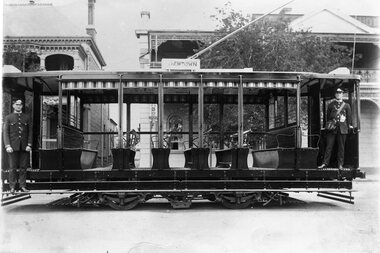
Photograph - Glass plate - Geelong No. 11, 1916
... end of the tram wearing their uniforms. Has the destination of "Newtown", 4345.1 - Black and White print contained within the Wal Jack Bendigo and Geelong Album, see Reg Item 5003 for more details. Added 7/8/2013. See Destination Eaglehawk for background details. Wal Jack has dated the photo as 1916. See item 4345 for a print. Yields information about Geelong tram No. 11 and tram crew uniforms. Trams tramways Geelong depot brougham st Cross bench tram tram 11 uniforms "Geelong No. 11 summer ...Photo of Geelong electric tram No. 11 - crossbench tram, taken in the same location as Reg Item 4316, following conversion from a trailer in Corio Terrace, now Brougham St. Has the driver and conductor standing at either end of the tram wearing their uniforms. Has the destination of "Newtown", 4345.1 - Black and White print contained within the Wal Jack Bendigo and Geelong Album, see Reg Item 5003 for more details. Added 7/8/2013. See Destination Eaglehawk for background details. Wal Jack has dated the photo as 1916. See item 4345 for a print.Yields information about Geelong tram No. 11 and tram crew uniforms.Glass plate negative, in white paper wrapping."Geelong No. 11 summer car" in pencil on wrappingtrams, tramways, geelong, depot, brougham st, cross bench tram, tram 11, uniforms -
 Ballarat Tramway Museum
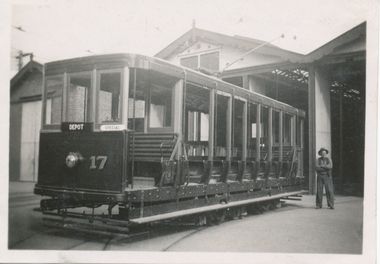
Photograph - SECV Bendigo No. 17 outside the depot, Wal Jack, Oct. 1939
... end see Reg Item 7802. Yields information about Bendigo 17, later converted into a scrubber car before being returned to a Cross bench car by the Bendigo Trust mid 1970s. trams tramways Bendigo ESCo Depot tram 17 On rear in ink "Bendigo No. 17 Summer car". ...No. 17 outside the Bendigo depot with a worker standing at the rear of the tram, October 1939. Tram has the "Depot" destination board on the front and a supplementary board "Special" on the camera side. lack and White print contained within the Wal Jack Bendigo and Geelong Album, see Reg Item 5003 for more details. i1 - scan of print in the album i2 - rear of image i3 - scan of negative at 3200dpi added 6/6/2020. For a similar image but with the worker at the other end see Reg Item 7802.Yields information about Bendigo 17, later converted into a scrubber car before being returned to a Cross bench car by the Bendigo Trust mid 1970s.Black and white print with photographer’s notes on the rear.On rear in ink "Bendigo No. 17 Summer car".trams, tramways, bendigo, esco, depot, tram 17 -
 Ballarat Tramway Museum
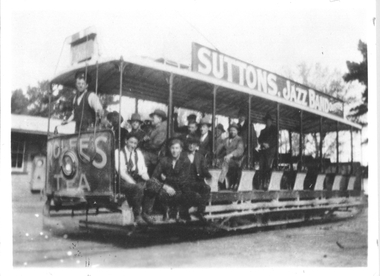
Photograph - ESCo No. 19 or 20, summer toastrack tramcar at depot, 1920's?
... Photograph of ESCo 19 or 20, summer toastrack tramcar, on the Wendouree Parade depot fan. Has a large number of people at one end of the tramcar. ...Photograph of ESCo 19 or 20, summer toastrack tramcar, on the Wendouree Parade depot fan. Has a large number of people at one end of the tramcar. ...Photograph of ESCo 19 or 20, summer toastrack tramcar, on the Wendouree Parade depot fan. Has a large number of people at one end of the tramcar. Depot "Bundy" clock visible in the background. Tram has a "Suttons Jazz Band" roof advertisement and an advertisement for "Rolfes" tea on the drivers dash panel. See also Re. Item 2507 for another print of this photograph. Yields information about one of the two ESCo summer cars.Black and white photograph with notes on the rear of one print.1427.2 - on rear of photo in ink - "Ballarat Tramways, No. 19 Summer car (only two in service 19 & 20) was scrapped 1930. At Depot 1928. (1906-1930). W. Jack Photo T27"trams, tramways, depot, wendouree parade, toastrack tram, suttons, esco, tram 19, tram 20 -
 Ballarat Tramway Museum
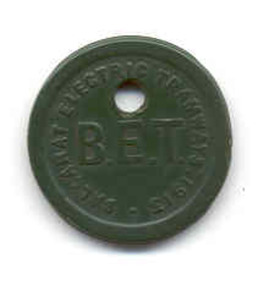
Functional object - Fare Token, Electric Supply Co. of Vic (ESCo), 1913
... On Sundays during busy periods this was reversed on the Gardens lines, but conductors were still required on this line to cope with the heavy summer holiday traffic. Trams 1 to 18 were altered by altering the end seating, placing gates on doorways and "pay as you enter" and "pay as you leave" signs. ...On Sundays during busy periods this was reversed on the Gardens lines, but conductors were still required on this line to cope with the heavy summer holiday traffic. Trams 1 to 18 were altered by altering the end seating, placing gates on doorways and "pay as you enter" and "pay as you leave" signs. ...Demonstrates aspects of the Ballarat Tramways fare system at the time of the one man trams, tokens which could be pre purchased by travellers and save time when boarding trams. See notes on file re these eg Reg Item 1801.Fare token- 2d - 21mm diameter - green celluloid - with "B.E.T." in large capitals on front centre of token and words "Ballarat Electric Tramways 1913" on circumference. On reverse in large font "2" and a small font "D" at top of the two - indicating token had a value of two pence. Extract from A. Bradley "The Golden City and its Tramways" about tokens and why. "The ESCo worked out its procedures from its own experience. A "pay as you enter" system was used on city-bound cars, and a "pay as you leave" system on outward-bound cars. On Sundays during busy periods this was reversed on the Gardens lines, but conductors were still required on this line to cope with the heavy summer holiday traffic. Trams 1 to 18 were altered by altering the end seating, placing gates on doorways and "pay as you enter" and "pay as you leave" signs. Once on board, passengers paid their coins into a farebox mounted behind the driver, which was fitted with glass windows and mirrors to enable the driver to see the coins slide into the box - a form of "moral check on passengers". Regular passengers could buy pink or green celluloid tokens at a discount price, to save the motorman having to issue tickets and give change." Stopped being in use in 1921, see Reg Item 1801.1 and 1802. Place of manufacture not known. For other 2d token see Reg. Item 1943 and 2488 page 31. See Reg. Item 2514 for H.P. James notes on the token system. 1794.1 - added 18/4/2009 - donation of Lyall Denning Related documents provides some information on the value of the items. eBay sale 15/10/2006 $20 - eBay slip with worksheet - see related items.trams, tramways, tickets, tokens, esco, one man trams -
 Ballarat Tramway Museum
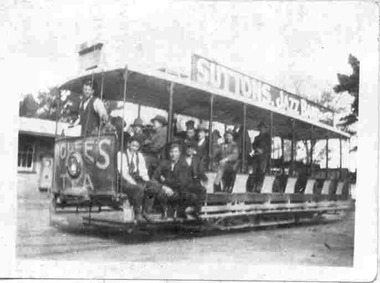
Photograph - ESCo No. 19 or 20, summer toastrack tramcar at depot, mid 1920's
... Photo of ESCo No. 19 or 20, summer toastrack or crossbench tramcar, on the Wendouree Parade depot fan. Has a large number of people at one end of the tramcar. ...Photo of ESCo No. 19 or 20, summer toastrack or crossbench tramcar, on the Wendouree Parade depot fan. Has a large number of people at one end of the tramcar. ...Photo of ESCo No. 19 or 20, summer toastrack or crossbench tramcar, on the Wendouree Parade depot fan. Has a large number of people at one end of the tramcar. Depot "Bundy" clock visible in the background. Tram has a "Suttons Jazz Band" roof advertisement and an advertisement for "Rolfes" tea on the drivers dash panel. See also Reg. Item 1427 for another print. Note Item Not formally Numbered. Image btm2507i2 shows position on page relative to items 2507 to 2512. High Res Images added 15/3/2011.Yields information about one of the ESCo cross bench or toastrack trams at the depot.Black and white photograph contained within Reg. Item 2488, page 55.Handwritten in Pencil under the photograph is "This tram and its twin - 19 & 20 - was very popular on the gardens run in midsummer as many as 129 fares have been taken on its 8 seats 1906 - 1931 - held 40 seated comfortably taken in Depot yard - note Bundy time registering clock on wall of messroom - see Ballarat Electric Tram ?"tramways, trams, depot, wendouree parade, toastrack tram, suttons, esco, tram 19, tram 20 -
 Ballarat Tramway Museum
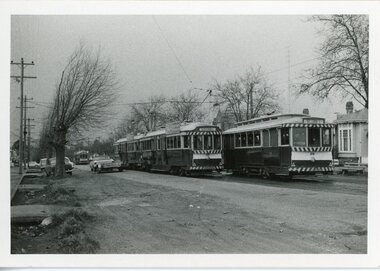
Photograph - Ballarat Trams 26 and 35, Ballarat Trams 26 and 35 in Drummond Street at Urquhart Street loop
... ends. The tram is still in the Ballarat Tramway fleet and runs during the Summer. ...ends. The tram is still in the Ballarat Tramway fleet and runs during the Summer. ...The photograph shows two trams in Drummond Street at the Urquhart Street Loop. Information on the back shows the photo was taken about 8.15 in the morning. The trams travel down Grey Street Sebastopol, up Victoria Street and then Lydiard Street North. Tram 26 was built in 1916 by Duncan and Fraser, Adelaide for Hawthorn Tramways Trust and was known as Tram No.6. It was renumbered by Melbourne and Metropolitan Tramway Board in 1920 . It became No.111. In 1930 it was sold to the Electric Supply Company of Victoria and numbered 26. In 1934 it passed to the SEC.It is a standard Californian combination - drop ends. The tram is still in the Ballarat Tramway fleet and runs during the Summer. Tram 35 was built in 1916 by Duncan and Fraser, Adelaide. It was part of the Hawthorn Tramways Trust until 1947 when it came to Ballarat. When the trams stopped running in Ballarat in 1971, it went to Ballarat College - known as Ballarat and Clarendon College from 1974. The College received the body only. The trucks were sent to Perth Museum. The body returned to the Ballarat Tramway Preservation Society in 1978 and dismantled due to the poor condition it was in. Black and white photograph of two tramsWritten on the back in pencil "1971, c.8.15 Urquhart Street loop. Down Grey Street Sebastopol, up Victoria St, Lydiard North."ballarat tram 26, ballarat tram 35, urquhart street loop, duncan and fraser adelaide, 1916, hawthorn tramway trust, melbourne and metropolitan tramway board, 1920, electrict supply co victoria, 1934, state electricity compamy, californian combination, runs in summer, 1947 to ballarat, ballarat college, tram body in 1971, returned in 1978, dismantled -
 Ballarat Tramway Museum
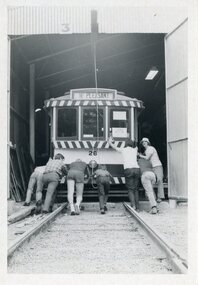
Photograph - Ballarat Tram 26, Tram 26 being pushed into shed
... ends. The tram is still in the Ballarat Tramway fleet and runs during the Summer. ...ends. The tram is still in the Ballarat Tramway fleet and runs during the Summer. ...Tram 26 was built in 1916 by Duncan and Fraser, Adelaide for Hawthorn Tramways Trust and was known as Tram No.6. It was renumbered by Melbourne and Metropolitan Tramway Board in 1920 . It became No.111. In 1930 it was sold to the Electric Supply Company of Victoria and numbered 26. In 1934 it passed to the SEC. It is a standard Californian combination - drop ends. The tram is still in the Ballarat Tramway fleet and runs during the Summer. Photograph shows seven people pushing the tram into the shed.Black and white photographtram 26, duncan and fraser, 1916, hawthorn tramway trust, tram 6, melbourne and metropolitan tramway board, 1920, tram 111, electric supply company, 1934, sec, californian combination, drop ends, ballarat tramway fleet, runs in summer, duncan campbell, photographer
