
Showing 68 items matching "engine components"
-
 Moorabbin Air Museum
Document (Item) - CAC - Monitoring Of TF 30 Engine Components At The USN Naval Air Rework Facility, Norfolk Virginia
... CAC - Monitoring Of TF 30 Engine Components At The USN Naval Air Rework Facility, Norfolk Virginia...CAC - Monitoring Of TF 30 Engine Components At The USN Naval Air Rework Facility, Norfolk Virginia...Report No.AA625 CAC - Monitoring Of TF 30 Engine Components At The USN Naval Air Rework Facility, Norfolk Virginia Document CAC - Monitoring Of TF 30 Engine Components At The USN Naval Air Rework Facility, Norfolk Virginia ... -
Moorabbin Air Museum
Document (item) - CAC Collection - ATAR Engine - An Investigation Of Available Alternatives For A Computer - Based Component Tracking System For Critical Engine Components
... CAC Collection - ATAR Engine - An Investigation Of Available Alternatives For A Computer - Based Component Tracking System For Critical Engine Components...CAC Collection - ATAR Engine - An Investigation Of Available Alternatives For A Computer - Based Component Tracking System For Critical Engine Components...CAC Collection - ATAR Engine - An Investigation Of Available Alternatives For A Computer - Based Component Tracking System For Critical Engine Components Document CAC Collection - ATAR Engine - An Investigation Of Available Alternatives For A Computer - Based Component Tracking System For Critical Engine Components ... -
Moorabbin Air Museum
Document (item) - Mirage 111O correspondence re processing details of engine components for the ATAR 9C engine, Mirage correspondence - ATAR Project - File 5
... Mirage 111O correspondence re processing details of engine components for the ATAR 9C engine ...Letter from SNECMA to CAC regarding processing details of engine components for the ATAR engine...Letter from SNECMA to CAC regarding processing details of engine components for the ATAR engine Mirage correspondence - ATAR Project - File 5 Document Mirage 111O correspondence re processing details of engine components for the ATAR 9C engine ...Letter from SNECMA to CAC regarding processing details of engine components for the ATAR engine -
Moorabbin Air Museum
Photograph - (SP) No Title collection of photographs, (SP) Building of CAC Lidcombe site 27/04/1940 ,,photos of construction ,workshops , facilities cac lidcombe was used to build 1200hp twin wasp engines , photos of engine components
... (SP) Building of CAC Lidcombe site 27/04/1940 ,,photos of construction ,workshops , facilities cac lidcombe was used to build 1200hp twin wasp engines , photos of engine components...(SP) Building of CAC Lidcombe site 27/04/1940 ,,photos of construction ,workshops , facilities cac lidcombe was used to build 1200hp twin wasp engines , photos of engine components Photograph (SP) No Title collection of photographs ... -
Moorabbin Air Museum
Manual (Item) - Commonwealth Aircraft Corporation F404 Engine Components - Spares, F404 Spares Manual
... Commonwealth Aircraft Corporation F404 Engine Components - Spares...Commonwealth Aircraft Corporation F404 Spares Manual Manual Commonwealth Aircraft Corporation F404 Engine Components - Spares ...Commonwealth Aircraft Corporation -
Moorabbin Air Museum
Document (item) - ATAR 1961 - CAC Correspondence Relating to ATAR Engines for the Mirage III - to S.N.E.C.M.A. Mission Australienne regarding engine components, manufacturing equipment and calibration testing tools from G.H. ('George') Foster, Turbine ATAR 9C-9K Specifications (French text)
... Mission Australienne regarding engine components, manufacturing equipment and calibration testing tools from G.H. ...Mission Australienne regarding engine components, manufacturing equipment and calibration testing tools from G.H. ...Cover contains a note: Not original label 10/96 -
Moorabbin Air Museum
Document (item) - ATAR 1961 - CAC Correspondence Relating to ATAR Engines for the Mirage III - to S.N.E.C.M.A. Mission Australienne regarding engine components, manufacturing equipment and calibration testing tools from G.H. ('George') Foster, Milling Machine A-80A Brochure
... Mission Australienne regarding engine components, manufacturing equipment and calibration testing tools from G.H. ...Mission Australienne regarding engine components, manufacturing equipment and calibration testing tools from G.H. ...Cover contains a note: Not original label 10/96 -
Moorabbin Air Museum
Document (item) - ATAR 1961 - CAC Correspondence Relating to ATAR Engines for the Mirage III - to S.N.E.C.M.A. Mission Australienne regarding engine components, manufacturing equipment and calibration testing tools from G.H. ('George') Foster, Ohmmetres Brouchure (French text)
... Mission Australienne regarding engine components, manufacturing equipment and calibration testing tools from G.H. ...Mission Australienne regarding engine components, manufacturing equipment and calibration testing tools from G.H. ...Cover contains a note: Not original label 10/96 -
Moorabbin Air Museum
Document (item) - ATAR 1961 - CAC Correspondence Relating to ATAR Engines for the Mirage III - to S.N.E.C.M.A. Mission Australienne regarding engine components, manufacturing equipment and calibration testing tools from G.H. ('George') Foster, Local Production Items - group 12 listing
... Mission Australienne regarding engine components, manufacturing equipment and calibration testing tools from G.H. ...Mission Australienne regarding engine components, manufacturing equipment and calibration testing tools from G.H. ...Cover contains a note: Not original label 10/96 -
Moorabbin Air Museum
Document (item) - ATAR 1961 - CAC Correspondence Relating to ATAR Engines for the Mirage III - to S.N.E.C.M.A. Mission Australienne regarding engine components, manufacturing equipment and calibration testing tools from G.H. ('George') Foster, Instructions Mecaniques De Precision - Attention Mr Thompson - welding equipment
... Mission Australienne regarding engine components, manufacturing equipment and calibration testing tools from G.H. ...Mission Australienne regarding engine components, manufacturing equipment and calibration testing tools from G.H. ...Cover contains a note: Not original label 10/96 -
Moorabbin Air Museum
Document (item) - ATAR 1961 - CAC Correspondence Relating to ATAR Engines for the Mirage III - to S.N.E.C.M.A. Mission Australienne regarding engine components, manufacturing equipment and calibration testing tools from G.H. ('George') Foster, 1961 Federal Elections - CAC staff in France
... Mission Australienne regarding engine components, manufacturing equipment and calibration testing tools from G.H. ...Mission Australienne regarding engine components, manufacturing equipment and calibration testing tools from G.H. ...Cover contains a note: Not original label 10/96 -
Moorabbin Air Museum
Document (item) - ATAR 1961 - CAC Correspondence Relating to ATAR Engines for the Mirage III - to S.N.E.C.M.A. Mission Australienne regarding engine components, manufacturing equipment and calibration testing tools from G.H. ('George') Foster, Receipt of plant and equipment - Herbert Knight
... Mission Australienne regarding engine components, manufacturing equipment and calibration testing tools from G.H. ...Mission Australienne regarding engine components, manufacturing equipment and calibration testing tools from G.H. ...Cover contains a note: Not original label 10/96 -
Moorabbin Air Museum
Document (item) - ATAR 1961 - CAC Correspondence Relating to ATAR Engines for the Mirage III - to S.N.E.C.M.A. Mission Australienne regarding engine components, manufacturing equipment and calibration testing tools from G.H. ('George') Foster, Production Data - Local production of engines 32 to 41
... Mission Australienne regarding engine components, manufacturing equipment and calibration testing tools from G.H. ...Mission Australienne regarding engine components, manufacturing equipment and calibration testing tools from G.H. ...Cover contains a note: Not original label 10/96 -
Moorabbin Air Museum
Document (item) - ATAR 1961 - CAC Correspondence Relating to ATAR Engines for the Mirage III - to S.N.E.C.M.A. Mission Australienne regarding engine components, manufacturing equipment and calibration testing tools from G.H. ('George') Foster, ATAR Progress - Drawings received and redone
... Mission Australienne regarding engine components, manufacturing equipment and calibration testing tools from G.H. ...Mission Australienne regarding engine components, manufacturing equipment and calibration testing tools from G.H. ...Cover contains a note: Not original label 10/96 -
Moorabbin Air Museum
Book - Aircraft engines, Aero Engines for ;Pilots and Ground Engineers
... ...Engine components...Aircraft engines The four stroke cycle Engine types & firing sequences Engine components Lubrication Carburetors Supercharging Magnetos & spark plugs Overview of the construction, operation & theory of the aeroplane engine, circa 1940 Aero Engines for ;Pilots and Ground Engineers Book Aircraft engines ...Overview of the construction, operation & theory of the aeroplane engine, circa 1940non-fictionOverview of the construction, operation & theory of the aeroplane engine, circa 1940the four stroke cycle, engine types & firing sequences, engine components, lubrication, carburetors, supercharging, magnetos & spark plugs -
Moorabbin Air Museum
Manual - RAAF flight mechanics, RAAF Fitters II.E Flight Mechanics Course notes - issue 3 - 1941 Engineering School
... ...Engine instruments & components...RAAF Flight Mechanics Engines Engine instruments & components Overhaul practices Full notes for RAAF fitters engineering course, circa 1943 Manual in book form RAAF Fitters II.E Flight Mechanics Course notes - issue 3 - 1941 Engineering School Manual RAAF flight mechanics ...Full notes for RAAF fitters engineering course, circa 1943Manual in book formFull notes for RAAF fitters engineering course, circa 1943engines, engine instruments & components, overhaul practices -
Moorabbin Air Museum
Document (item) - Mirage 111O correspondence re engine component handling fixtures for the ATAR 9C engine, Mirage correspondence - ATAR Project - File 6
... Mirage 111O correspondence re engine component handling fixtures for the ATAR 9C engine...Letters from SNECMA to CAC re engine component handling fixtures for the ATAR engine...Letters from SNECMA to CAC re engine component handling fixtures for the ATAR engine Mirage correspondence - ATAR Project - File 6 Document Mirage 111O correspondence re engine component handling fixtures for the ATAR 9C engine ...Letters from SNECMA to CAC re engine component handling fixtures for the ATAR engine -
 Bendigo Military Museum
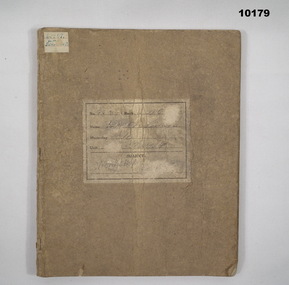
Book - MANUAL, AIR ENGINE REPAIR, c1939-45
... This book has personal training notes for working on; Merlin Engines, Bristol Hercules Engines, Workshop practices, Engine components. ...This book has personal training notes for working on; Merlin Engines, Bristol Hercules Engines, Workshop practices, Engine components. Book Training Notes Aircraft Maintenance On front cover is a label with the following; "994 PARK A.G." ...Collection re Frederick Simons. Refer to Cat No 10159. This book has personal training notes for working on; Merlin Engines, Bristol Hercules Engines, Workshop practices, Engine components. This is a plain exercise book, Govt issue, quarto size, khaki cover. Inside are ruled pages. On those pages of hand written notes, in pencil, on Aero engine repairs and operating principles. There are also pages devoted to workshop practices.On front cover is a label with the following; "994 PARK A.G." Name - "L.A.C. SIMONS MUSTERING C/O" Unit - illegible, "Subject - Workshop" On the LHS - stamp size label = "41707 LAC SIMONS F."book, training notes, aircraft maintenance -
 Port Melbourne Historical & Preservation Society
Photograph - Workers at Commonwealth Engine Works, 1952, 1952
... Later they built diesel engines with almost all components of the engines built on site. ...Later they built diesel engines with almost all components of the engines built on site. ...The Engine Works in Edwards Street (later Morley Street) were constructed in 1941-2 to build steam engines to propel ships. Later they built diesel engines with almost all components of the engines built on site. In this photo almost the entire staff are pictured with the completed four-cylinder engine that was built for the freighter, SS Boonaroo, which had been built at Mort's Dock in Sydney.B& W photograph of workers at Commonwealth Engine Works, Port Melbourne, with completed engine for the freighter, SS Boonaroo.commonwealth government engine works, industry - manufacturing, maritime, ss boonaroo -
 Flagstaff Hill Maritime Museum and Village
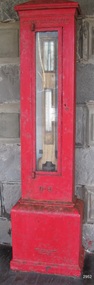
Instrument - Barometer, 1867
... The works employed as many as 350 workers manufacturing a wide range of marine, mining, civil engineering, railway and general manufacturing components including engines and boilers. The foundry prospered despite high wages and the lack of raw materials. ...The works employed as many as 350 workers manufacturing a wide range of marine, mining, civil engineering, railway and general manufacturing components including engines and boilers. The foundry prospered despite high wages and the lack of raw materials. ...Langlands Company History: Langlands foundry was Melbourne's first foundry and iron shipbuilder established in 1842, only 8 years after the founding of the Victorian colony by two Scottish immigrants, Robert Langlands and Thomas Fulton, who had formed a partnership before emigrating (1813–1859). The business was known as the 'Langlands Foundry Co'. Henry Langlands (1794-1863), left Scotland in 1846 with his wife Christian, née Thoms, and five surviving children to join his brother Robert. By the time he arrived in early January of 1847 the partnership of Robert Langlands and Fulton had dissolved as Fulton had gone off to establish his own works. It was at this time that the two brothers took over ownership of Langlands foundry. Several years later Robert retired and Henry became sole the proprietor. The foundry was originally located on Flinders Lane between King and Spencer streets. Their sole machine tool, when they commenced as a business, was a small slide rest lathe turned by foot. In about 1865 they moved to the south side of the Yarra River, to the Yarra bank near the Spencer Street Bridge and then in about 1886 they moved to Grant Street, South Melbourne. The works employed as many as 350 workers manufacturing a wide range of marine, mining, civil engineering, railway and general manufacturing components including engines and boilers. The foundry prospered despite high wages and the lack of raw materials. It became known for high-quality products that competed successfully with any imported articles. By the time Henry retired, the foundry was one of the largest employers in Victoria and was responsible for casting the first bell and lamp-posts in the colony. The business was carried on by his sons after Henry's death. The company was responsible for fabricating the boiler for the first railway locomotive to operate in Australia, built-in 1854 by Robertson, Martin & Smith for the Melbourne and Hobson's Bay Railway Company. Also in the 1860s, they commenced manufacture of cast iron pipes for the Board of Works, which was then laying the first reticulated water supply system in Melbourne. Langlands was well known for its gold mining equipment, being the first company in Victoria to take up the manufacture of mining machinery, and it played an important role in equipping Victoria's and Australia's first mineral boom in the 1850s and 1860s. Langlands Foundry was an incubator for several engineers including Herbert Austin (1866–1941) who worked as a fitter at Langlands and went on to work on the Wolesely Shearing machine. He also founded the Austin Motor Company in 1905. Around the 1890s Langlands Foundry Co. declined and was bought up by the Austral Otis Co. in about 1893. History for Grimoldi: John Baptist Grimoldi was born in London UK. His Father was Domeneck Grimoldi, who was born in Amsterdam with an Italian Father and Dutch mother. Domeneck was also a scientific instrument maker. John B Grimoldi had served his apprenticeship to his older brother Henry Grimoldi in Brooke Street, Holburn, London and had emigrated from England to Australia to start his own meteorological and scientific instrument makers business at 81 Queens St Melbourne. He operated his business in 1862 until 1883 when it was brought by William Samuel and Charles Frederick, also well known scientific instrument makers who had emigrated to Melbourne in 1875. John Grimoldi became successful and made a number of high quality measuring instruments for the Meteorological Observatory in Melbourne. The barometer was installed at Warrnambool's old jetty and then the Breakwater as part of the Victorian Government's insistence that barometers be placed at all major Victorian ports. This coastal barometer is representative of barometers that were installed through this government scheme that began in 1866. The collecting of meteorological data was an important aspect of the Melbourne Observatory's work from its inception. Just as astronomy had an important practical role to play in navigation, timekeeping and surveying, so the meteorological service provided up to date weather information and forecasts that were essential for shipping and agriculture. As a result, instruments made by the early instrument makers of Australia was of significant importance to the development and safe trading of companies operating during the Victorian colonies early days. The provenance of this artefact is well documented and demonstrates, in particular, the importance of the barometer to the local fishermen and mariners of Warrnambool. This barometer is historically significant for its association with Langlands’ Foundry which pioneered technology in the developing colony by establishing the first ironworks in Melbourne founded in 1842. Also, it is significant for its connection to John B Grimoldi who made the barometer and thermometer housed in the cast iron case. Grimoldi, a successful meteorological and scientific instrument maker, arrived in the colony from England and established his business in 1862 becoming an instrument maker to the Melbourne Observatory. Additional significance is its completeness and for its rarity, as it is believed to be one of only two extant barometers of this type and in 1986 it was moved to Flagstaff Hill Maritime Village as part of its museum collection. Coast Barometer No. 8 is a tall, red painted cast iron pillar containing a vertical combined barometer and thermometer. Half way down in the cast iron framed glass door is a keyhole. Inside is a wooden case containing a mercury barometer at the top with a thermometer attached underneath, each with a separate glass window and a silver coloured metal backing plate. Just below the barometer, on the right-hand side, is a brass disc with a hole for a gauge key in the centre. The barometer has a silvered tin backing plate with a scale, in inches, of "27 to 31" on the right side and includes a Vernier with finer markings, which is set by turning the gauge key. The thermometer has a silvered tin backing plate with a scale on the left side of "30 to 140". Each of the scales has markings showing the units between the numbers.Inscription at the top front of the pillar reads "COAST BAROMETER" Inscribed on the bottom of the pillar is "No 8". and "LANGLANDS BROS & CO ENGINEERS MELBOURNE " The barometer backing plate is inscribed "COAST BAROMETER NO. 8, VICTORIA" and printed on the left of the scale, has "J GRIMOLDI" on the top and left of the scale, inscribed "Maker, MELBOURNE". There is an inscription on the bottom right-hand side of the thermometer scale, just above the 30 mark "FREEZING" Etched into the timber inside the case are the Roman numerals "VIII" (the number 8)flagstaff hill, warrnambool, maritime village, maritime museum, flagstaff hill maritime museum & village, shipwreck coast, great ocean road, warrnambool breakwater, coast barometer, coastal barometer, barometer, weather warning, ports and harbours, fishery barometer, sea coast barometer, austral otis co, coast barometer no. 8, henry grimoldi, henry langlands, john baptist grimoldi, langlands foundry co, meteorological instrument maker, robert langlands, scientific instrument maker, thermometer, thomas fulton -
 Federation University Historical Collection
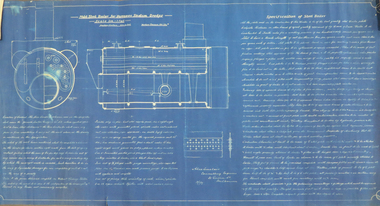
Plan, Mild Steel Boiler for Yarrawee Suction Dredge, 16 January 1907
... engine driver. C A Hauser died of malaria in Malaya shortly after arrival. Components for a further three of these dredges were in transit or on site when the first suction-cutter dredge was assembled and tested. ...engine driver. C A Hauser died of malaria in Malaya shortly after arrival. Components for a further three of these dredges were in transit or on site when the first suction-cutter dredge was assembled and tested. ...George Milford, a long term staff member of Thompsons Foundry Castlemaine, remembers discussing Alexander Sinclair with this son, Alex Sinclair Jnr. "When Alex Jnr was a boy, his father, a senior design engineer, was sent to Malaya to oversee the erection on site of a suction cutter dredge for Thompsons. This was an adaptation of the idea of a bucket-dredge, where gold is won from alluvial gravels. In the 1915-1920 era, the Thompsons Engineering Department designed a suction-cutter dredge, by which hydraulic suction with a revolving cutter at the end of a long proboscis would collect the alluvial soil and deliver it into the dredge for recovery of the precious metals. Export marketing was then ‘all the go’, and the tin dredges were ordered from Thompsons, using the new cutter design. The dredges were, of course, shipped to Malaya in pieces, ready to be assembled on site. A number of Thompsons employees were selected to travel to Malaya to assemble the dredges. There were fourteen men in the gang. These men sailed on 1st July 1925, their number including Delmenico, McKay and Charles Albert Hauser, an engine driver. C A Hauser died of malaria in Malaya shortly after arrival. Components for a further three of these dredges were in transit or on site when the first suction-cutter dredge was assembled and tested. The designers had failed to take into account the fact that, in the jungle floor in Malaya, many trees grow up, and fall down, in tropical conditions, and become submerged still waterlogged in the floor of the jungle, and in the tin-bearing gravels. The suction-cutter dredge was found to be inefficient in these circumstances, the price of tin had fallen and the Malayan client reneged on the contract. Faced with an outlay of over £4,000 on which no money would be received, the company went bankrupt on 25th August 1925. Alex Sinclair Snr was at that stage in Malaya, and received the news of the bankruptcy by telegram. Upon telegraphing his employers for funds to return home, he received the reply that there were no such funds available. Alex Sinclair Jnr told the story of how his father worked as a labourer in Malaya for two years, while his mother took in washing and ironing during the same period, until together they had assembled enough money to pay for his father’s return Anyone who talks about “the good old days” is talking nonsense!"Large blue printed paper plan outlining the conditions of contract for the making of a steel boiler. The Blueprint includes design drawings and written contract specifying materials, time frame and costs. Signed on front 'Alec Sinclair Consulting Engineer, 31 Queen Street, Melbourne'. Stamped on verso 'Printed by Paterson & Co, Colonial Mutual Chambers, Collins St, Melbourne'. blueprint, designs and plans, yarrawee suction dredge, conditions of contract, thompsons foundry castlemaine, george milford -
 The Beechworth Burke Museum
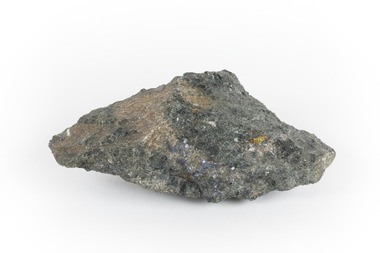
Geological specimen - Mangan Hedenbergite
... Manganese is a key component of certain widely used aluminium alloys and, in oxide form, dry cell batteries used in electric vehicles. These batteries are in high demand. Another potential use for manganese may as an additive to help coat and protect a car’s engine. ...This specimen was recovered from Broken Hill, NSW. It was given the name Mangan Hedenbergite in 1819 by Jöns Jakob Berzelius in honor of Mr. Anders Ludvig of Hedenberg who was the first to define hedenbergite as a mineral. Hedenbergite, belongs in the pyroxene group having a monoclinic crystal system. The mineral is extremely rarely found as a pure substance. Mangan Hedenbergite is a manganese bearing variety of Hedenbergite. Manganese is the world’s fourth most used mineral after iron, aluminium, and copper primarily because it has no satisfactory substitute in its major applications. Globally, the steel industry is the primary user of manganese metal, utilizing it as an alloy to enhance the strength and workability of steel and in the manufacture of tin cans. Manganese is a key component of certain widely used aluminium alloys and, in oxide form, dry cell batteries used in electric vehicles. These batteries are in high demand. Another potential use for manganese may as an additive to help coat and protect a car’s engine. Manganese is also used for non-metallurgical purposes such as plant fertilizers, animal feed, and colorants for bricks. This specimen is part of a larger collection of geological and mineral specimens collected from around Australia (and some parts of the world) and donated to the Burke Museum between 1868-1880. A large percentage of these specimens were collected in Victoria as part of the Geological Survey of Victoria that begun in 1852 (in response to the Gold Rush) to study and map the geology of Victoria. Collecting geological specimens was an important part of mapping and understanding the scientific makeup of the earth. Many of these specimens were sent to research and collecting organisations across Australia, including the Burke Museum, to educate and encourage further study.A hand-sized mineral specimen in shades of silver and blackmanganese, open cut mine, manganese ore processing, bell bay, tasmania, northern territory, steel industry, zinc-carbon batteries, alkaline batteries, tin cans -
 Flagstaff Hill Maritime Museum and Village
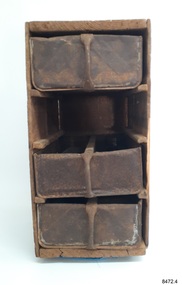
Domestic object - Chest of Drawers, British Imperial Oil Company Ltd, 1905-1927
... engine fuel. The last kerosene-fueled lighthouse lamp was transferred to solar power in 1985. The chest of drawers is one-of-a-kind. The original uses for the components ...This early 20th-century chest of drawers is unique. It was made from recycled timber kerosene boxes and metal tins. The case was made in South Australia between 1905 and 1927 by the British Imperial Oil Company Ltd, which was the first business to import bulk petroleum products into Australia. Before this, ships carried crates of kerosene as cargo. Items salvaged from the 1880 wreck of the vessel Eric the Red included kerosene boxes. Kerosene replaced plant and animal-based fuel, such as whale oil, for lighting in homes and for the lamps in lighthouses and on marine vessels. It was also used for cooking and heating and as engine fuel. The last kerosene-fueled lighthouse lamp was transferred to solar power in 1985. The chest of drawers is one-of-a-kind. The original uses for the components of the chest of drawers, the wooden box and metal tins were for containing and transporting kerosene. Kerosene was used from the late 19th century for fuel in lamps, heating, and cooling. Previously whale oil was used for the lamps in lighthouses. The company providing the kerosene was the first to import it into Australia in bulk quantities. The set of drawers is one of the many ways that inventive Australians were able to repurpose materials.Chest of drawers; wooden frame and rails, metal drawers with vertical metal handles. The frame has been constructed from the wooden panels of a vintage oil and kerosene box. The three drawers have been created from empty kerosene cans that were cut in half from top to bottom, some with the round opening closed over. Inscriptions from the original box and cams are stencilled on the top and base of the frame and impressed or painted on the metal cans. The frame has provision for a further drawer. The wooden case and metal tins were made in Australia.Top and base of frame; "THE BRITISH IMPERIAL OIL CO. LTD." "OIL ENGINE KEROSENE" "CASE ANDTINS AUSTRALIAN MADE" On tin; "POWIRIN" "BIOCO LTD" Logo [cross} with inscription on horizontal bar "CROSS" Impressed in timber drawer dividers (indecipherable text) Side of drawer, painted in orange on black; "TY -, REG U S - TIDE - "flagstaff hill, warrnambool, maritime village, maritime museum, shipwreck coast, great ocean road, antique, domestic equipment, chest of drawers, tool box, furniture, storage, recycled tin, recycled box, kerosene, fossil fuel, lighthouse lamp fuel, british imperial oil company ltd. -
 Flagstaff Hill Maritime Museum and Village
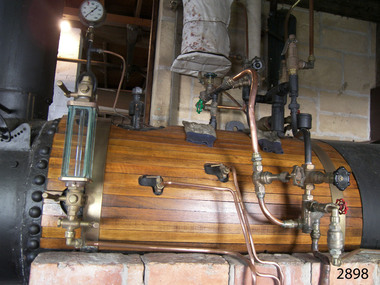
Equipment - Boiler, T & F Johnson, boilermakers, late 19th century
... engines, turbines, presses, wheels, and driving belts to operate looms and saws. The heat associated with the boiler can be used for preserving food, sterilising, factory manufacturing processes, and steaming wood for shipbuilding. Every boiler has several components...engines, turbines, presses, wheels, and driving belts to operate looms and saws. The heat associated with the boiler can be used for preserving food, sterilising, factory manufacturing processes, and steaming wood for shipbuilding. Every boiler has several components ...A steam boiler like this late 18th century boiler, is often called a colonial boiler. Steam boilers were used in factories throughout Australia, mounted over similar designs of brick furnaces. This heat from the fire travels through the tubes in this fire tube boiler and the water heats as it circulates around them. Another kind of boiler is a water tube boiler, in which the water is inside the tubes and the heat of the combustion surrounds the tubes. The boiler in our collection burned wood as fuel but others of this design could also burn coal, coke, gas and liquid fuels. The boiler was made by T & F Johnson, boilermakers. In 1922 their factory was located at Coventry Street, South Melbourne. They were still advertising their 'Colonial, multi, vertical boilers, all sizes' at the same address in 1934. The connected pressure gauge, made in London by Dewrance, measures 0 to 400 pounds per square inch. John Dewrance is renowned as a pioneer of the steam locomotive in the early 19th century. He founded John Dewrance & Co. in South London in 1844. His son Sir John Dewrance took over in 1879. In 1939 the company became a subsidiary of Babcock & Wilcox, and was eventually owned by Emerson. How the boiler works: - A boiler is about two-thirds filled with water and heat is applied, in this case in the form of burning wood. The heat is transferred through the metal of the boiler to the water. When the water boils the steam rises to the top, and as it escapes from the boiler the steam pressure builds up in the steam space to later be released to do work; drive machinery such as ship and train engines, turbines, presses, wheels, and driving belts to operate looms and saws. The heat associated with the boiler can be used for preserving food, sterilising, factory manufacturing processes, and steaming wood for shipbuilding. Every boiler has several components fitted for safe operation: - - Safety valves - Gauge glass - Pressure gauge - Main steam stop valve - Water check valve - Blowdown valve - Manhole doorThe boiler is a significant item that gives us a snapshot of early Melbourne's industrial history. It is an example of the technological advancement during the Industrial Revolution where steam-driven machinery and motors could perform tasks more efficiently than manual labour. The makers were one of many boilermaker businesses in Melbourne during the early late-19th andearly 20th centuries. The maritime trade and skills of boilermaking are still learned and applied today. The Dewrance steam pressure gauge connected to the boiler was made by the London firms foundered by John Dewrance. He was renowned for developing the steam locomotive in the early 19th century.Boiler; a horizontal cylindrical underfired steam boiler. It is a multi-tubular design and is timber plank-clad, with brass fittings and pressure gauges. The boiler has an iron door at one end with a metal chimney above it. It is installed over a brick-enclosed solid fuel furnace. Two large, wood-mounted pressure gauges are connected to the boiler and have inscriptions. An inscription is on a red, cast iron plaque above the boiler door. The boiler's maker is T & F Johnson, South Melbourne. One of the pressure gauges was made by Dewrance, London..Maker's plate: "T & F JOHNSON / BOILERMAKERS / SOUTH MELBOURNE" Pressure gauge: "POUNDS PRESSURE / PER [square] INCH / DEWRANCE LONDON"flagstaff hill, warrnambool, maritime museum, shipwreck coast, flagstaff hill maritime village, great ocean road, boiler, multi tube boiler, steam boiler, steam technology, underfired boiler, horizontal boiler, timber clad boiler, steam power, industrialisation, boilermakers, south melbourne, dewrance, john dewrance, pressure gauge, dewrance pressure gauge, t & f johnson, london, steam engine, steam locomotive, pounds per square inch, 19th century, steam machine, johnson tyne foundry, colonial boiler, fire tube boiler -
 Kiewa Valley Historical Society
Drawings of Pikrose Engine
... The Drawings were to be used for manufacture of all the components of the Pikrose engine.Some of the Pikrose Engine was manufactured by Austin Hopkinson and Co. ...The Drawings were to be used for manufacture of all the components of the Pikrose engine.Some of the Pikrose Engine was manufactured by Austin Hopkinson and Co. ...The Drawings were to be used for manufacture of all the components of the Pikrose engine.Some of the Pikrose Engine was manufactured by Austin Hopkinson and Co. Ltd. The drawings belonged to the SECV and were created in the 1950s. The engine was used in tunnel construction.These drawings were used in the workshop of the SECV during the construction of the Kiewa Hydro Electric Scheme. The engine was used in the tunnel and powered by compressed air.KVHS has the drawings only. Workshop drawings consisting of about 20 paper sheets. Size 2 Pikrose engines powered by compressed air and a winch used to operate a scraper. Used in tunnels of shaft.pikrose engine drawings, compressed air engine, austin hopkinson co. ltd., workshop drawings -
 Eltham District Historical Society Inc
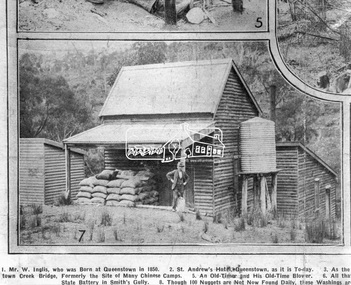
Photograph, Queenstown - St. Andrews District. "Quartz awaiting crushing at the State Battery in Smith's Gully.", c.1929
... component in the gold mining of this area from the 1920s. The battery crushed the gold bearing quartz extracted from the mines and was a sizeable weatherboard building enclosing the engine and stampers. ...component in the gold mining of this area from the 1920s. The battery crushed the gold bearing quartz extracted from the mines and was a sizeable weatherboard building enclosing the engine and stampers. ..."The State Battery was the central component in the gold mining of this area from the 1920s. The battery crushed the gold bearing quartz extracted from the mines and was a sizeable weatherboard building enclosing the engine and stampers. All that now remains are the bases for the machinery that comprised the battery, one timber and a couple of concrete bases and the nearby dam, which supplied water. However the historic significance of the site remains and is enhanced by the Queenstown Cemetery on the other side of Smiths Gully Road". - Bick Study 1922 This site is now the Peter Franke Reserve and is managed by Parks Victoria Photo Source: The Leader, Nov. 2nd, 1929This photo forms part of a collection of photographs gathered by the Shire of Eltham for their centenary project book,"Pioneers and Painters: 100 years of the Shire of Eltham" by Alan Marshall (1971). The collection of over 500 images is held in partnership between Eltham District Historical Society and Yarra Plenty Regional Library (Eltham Library) and is now formally known as the 'The Shire of Eltham Pioneers Photograph Collection.' It is significant in being the first community sourced collection representing the places and people of the Shire's first one hundred years.Digital imagesepp, shire of eltham pioneers photograph collection, queenstown, st andrews, gold mining, smiths gully -
B-24 Liberator Memorial Restoration Australia Inc
Pratt & Whitney R 1830 Radial Engine, TR 261
... components the B-24 Liberator restoration group had stored. It was the first exercise to allow the group to understand the configuration of these motors as well as get experience in general methods of repair. This motor was nicknamed 'The Bitza', referring to how it came to be. While it may not be of a high standard, it is capable of being run on the test rig for visitors. radial engine ...This motor was assembled over a twelve-month period (c.2007) from various components the B-24 Liberator restoration group had stored. It was the first exercise to allow the group to understand the configuration of these motors as well as get experience in general methods of repair. This motor was nicknamed 'The Bitza', referring to how it came to be. While it may not be of a high standard, it is capable of being run on the test rig for visitors. The Pratt & Whitney R 1830 is a double row 14 cylinder air cooled radial engine with a capacity of 1830 cubic inches, (30 litres), developing some 1200 horsepower at a maximum 2700 rpm.Engine Number TR 261radial engine, pratt & whitney -
Moorabbin Air Museum
Booklet - CAC Commonwealth Aircraft Corporation gas turbine division
... ...Component manufacturing...Engine...CAC Commonwealth Aircraft gas turbine division General outline Physical & surface treatment processing Vacuum brazing & heat treatment Component manufacturing Engine assembly/test/repair & overhaul Foundries Overview of CAC gas turbine division 2 copies CAC Commonwealth Aircraft Corporation Gas Turbine Division Booklet CAC Commonwealth Aircraft Corporation gas turbine division ...Overview of CAC gas turbine division2 copiesOverview of CAC gas turbine divisiongeneral outline, physical & surface treatment processing, vacuum brazing & heat treatment, component manufacturing, engine assembly/test/repair & overhaul, foundries -
 Monbulk RSL Sub Branch
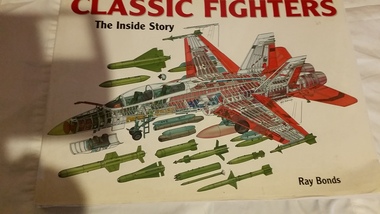
Book, Chartwell Books, Classic fighters : the inside story, 2005
... Each drawing examines what's 'under the skin', clearly showing 'the inside story' - airframe structure, cockpit components, engines, fuel tanks, avionics, machine guns and cannon, missiles and bombs - revealing how the fighters were built, and the weapons they have carried into combat. ...'Packed with fascinating facts, this volume contains incredibly detailed cutaway drawings of arguably the greatest fighter aircraft ever flown. Each drawing examines what's 'under the skin', clearly showing 'the inside story' - airframe structure, cockpit components, engines, fuel tanks, avionics, machine guns and cannon, missiles and bombs - revealing how the fighters were built, and the weapons they have carried into combat. Each significant component is given a number and is identified in an accompanying key. Moreover, together with stunning photographs, as well as detailed specifications, the absorbing in-depth development histories provide avid aviation enthusiasts all the information they could wish for about the most exciting warplanes spanning almost a hundred years. The aircraft themselves vary tremendously, from simple, wooden-framed, fabric-covered machines with open cockpits, often firing machine guns through whirring, propellers, to super-fast, highly maneuverable, sophisticated and stealthy fighters armed to the teeth with multi-barrel cannons and missiles that can destroy enemy aircraft from beyond visual range. In between are featured a host of combat-proven fighters, many of which have recorded a plethora of 'firsts' - first jet warplane, first supersonic fighter to enter service, first Mach 2 and even Mach 3 interceptors, first tail-less delta machine, first sweeping-wing machine, first missile-armed fighter, and many more. It is certainly an extraordinarily wide-ranging subject presented in such a fantastically individual manner that it is difficult to imagine a more striking volume in aviation publishing.Ill, p,253.non-fiction'Packed with fascinating facts, this volume contains incredibly detailed cutaway drawings of arguably the greatest fighter aircraft ever flown. Each drawing examines what's 'under the skin', clearly showing 'the inside story' - airframe structure, cockpit components, engines, fuel tanks, avionics, machine guns and cannon, missiles and bombs - revealing how the fighters were built, and the weapons they have carried into combat. Each significant component is given a number and is identified in an accompanying key. Moreover, together with stunning photographs, as well as detailed specifications, the absorbing in-depth development histories provide avid aviation enthusiasts all the information they could wish for about the most exciting warplanes spanning almost a hundred years. The aircraft themselves vary tremendously, from simple, wooden-framed, fabric-covered machines with open cockpits, often firing machine guns through whirring, propellers, to super-fast, highly maneuverable, sophisticated and stealthy fighters armed to the teeth with multi-barrel cannons and missiles that can destroy enemy aircraft from beyond visual range. In between are featured a host of combat-proven fighters, many of which have recorded a plethora of 'firsts' - first jet warplane, first supersonic fighter to enter service, first Mach 2 and even Mach 3 interceptors, first tail-less delta machine, first sweeping-wing machine, first missile-armed fighter, and many more. It is certainly an extraordinarily wide-ranging subject presented in such a fantastically individual manner that it is difficult to imagine a more striking volume in aviation publishing.fighter planes - history, fighter planes -
The Ed Muirhead Physics Museum
Engine, Grayson Diffracting Grating Ruling
... Grayson Diffraction Grating Ruling engine consisting of multiple complex chrome and brass components. Enclosed in specially made glass and wooden display box....Grayson Diffraction Grating Ruling engine consisting of multiple complex chrome and brass components. Enclosed in specially made glass and wooden display box. ...Made by Henry Grayson at home with the help of William Stone. Used to rule diffraction gratings, achieving excellent results of 2cm squared rulings on speculum metal. The instrument was transferred to Melbourne University, and used by Professor Lyle from 1917-30. Information attached to the front of object and statistical information on stand on top of object.Grayson Diffraction Grating Ruling engine consisting of multiple complex chrome and brass components. Enclosed in specially made glass and wooden display box.
