
Showing 111 items matching "engineer training"
-
 Moorabbin Air Museum
Manual (Item) - C-130E Pilot And Flight Engineer Technical Training Manual TP-7 Volume 8
... C-130E Pilot And Flight Engineer Technical Training Manual TP-7 Volume 8...C-130E Pilot And Flight Engineer Technical Training Manual TP-7 Volume 8...C-130E Pilot And Flight Engineer Technical Training Manual TP-7 Volume 8 Manual C-130E Pilot And Flight Engineer Technical Training Manual TP-7 Volume 8 ... -
 National Vietnam Veterans Museum (NVVM)
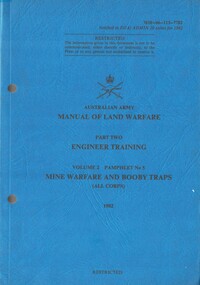
Manual, Australian Army, Australian Army: Manual Of Land Warfare, Part Two: Engineer Training. Volume 2 Pamphlet No. 5, Mine Warfare And Booby Traps (All Corps) 1982, 1982
... Australian Army: Manual Of Land Warfare, Part Two: Engineer Training. Volume 2 Pamphlet No. 5, Mine Warfare And Booby Traps (All Corps) 1982......Engineer Training...Australia - Armed Forces - Service manuals Land Warfare Engineer Training Mine Warfare Booby Traps A blue coloured cardboard cover with black information on the front cover. ...A blue coloured cardboard cover with black information on the front cover. Top right hand corner reads 7610-66-113-7782. Under the Australian Army insignia are the details of the manual. There are two punch holes down the left hand side and the manual is covered in a plastic cover.australia - armed forces - service manuals, land warfare, engineer training, mine warfare, booby traps -
4th/19th Prince of Wales's Light Horse Regiment Unit History Room
Booklet, Manual of Land Warfare Part 2 Engineer Training Vol 2 Pam 2 Obstacles and Field Defences (All Corps) 1982, 1982
... Manual of Land Warfare Part 2 Engineer Training Vol 2 Pam 2 Obstacles and Field Defences (All Corps) 1982...Manual of Land Warfare Part 2 Engineer Training Vol 2 Pam 2 Obstacles and Field Defences (All Corps) 1982 Booklet Booklet ...A soft covered booklet.7610-66-107-1255military engineering, obstacles, field defences -
4th/19th Prince of Wales's Light Horse Regiment Unit History Room
Booklet, Manual of Land Warfare Part 2 Engineer Training Vol 1 Pam 1 Employment of Engineers (All Corps) 1984, 1984
... Manual of Land Warfare Part 2 Engineer Training Vol 1 Pam 1 Employment of Engineers (All Corps) 1984...military engineering 7610-66-108-8445 A soft covered booklet providing guidance to all corps on the employment of engineers in operations. 2 copies Manual of Land Warfare Part 2 Engineer Training Vol 1 Pam 1 Employment of Engineers (All Corps) 1984 Booklet Booklet ...A soft covered booklet providing guidance to all corps on the employment of engineers in operations. 2 copies7610-66-108-8445military engineering -
4th/19th Prince of Wales's Light Horse Regiment Unit History Room
Booklet, Manual of Land Warfare Part 2 Engineer Training Vol 3 Pam 4 Demolitions (RAE and Assault Pioneers) 1982, 1982
... Manual of Land Warfare Part 2 Engineer Training Vol 3 Pam 4 Demolitions (RAE and Assault Pioneers) 1982...Manual of Land Warfare Part 2 Engineer Training Vol 3 Pam 4 Demolitions (RAE and Assault Pioneers) 1982 Booklet Booklet ...A soft covered booklet providing RAE and Assault Pioneers with guidance in military demolitions.7610-66-106-0085military engineering, demolitions -
 Monbulk RSL Sub Branch
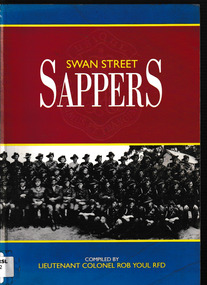
Book, Headquarters Logistic Support Force Engineers committee, The Swan Street Sappers 1860-1996 : a history of the Engineer Training Depot, Swan Street, Melbourne and of Sappers in Victoria, 1995
... The Swan Street Sappers 1860-1996 : a history of the Engineer Training Depot, Swan Street, Melbourne and of Sappers in Victoria...The Swan Street Sappers 1860-1996 : a history of the Engineer Training Depot, Swan Street, Melbourne and of Sappers in Victoria Book Headquarters Logistic Support Force Engineers committee Rob Youl ...This book marks the closing of the Engineer Training Depot at Swan Street, Melbourne in late 1991 by registering its great contribution to military and community life and by telling the story of Sappers in Victoria.Index, bib, ill, p.203.non-fictionThis book marks the closing of the Engineer Training Depot at Swan Street, Melbourne in late 1991 by registering its great contribution to military and community life and by telling the story of Sappers in Victoria.australian army - history, australian army - engineers -
 Lilydale RSL Sub Branch
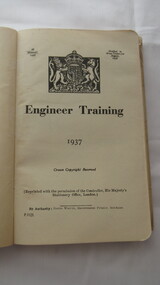
Book, His Majety's Stationary Office, Engineer Training 1937, 1937
... Engineer Training 1937...H G Bridge Book Engineer Training 1937 Book His Majety's Stationary Office David Whyte Government Printer ...Book -
Moorabbin Air Museum
Manual (item) - Hercules C130E RAAF Training manual, C-130E Pilot and Flight Engineer Technical Training Manual
... C-130E Pilot and Flight Engineer Technical Training Manual ...RAAF Technical Training C-130E Pilot and Flight Engineer Technical Training Manual Manual Hercules C130E RAAF Training manual ...RAAF Technical Training -
 Mission to Seafarers Victoria
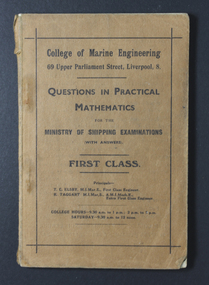
Education kit - Text Book, Questions in Practical Mathematics for Ministry of Shipping Examinations with Answers, early to mid 20th Century
... marine engineer training...The memorabilia relates to his career at sea and in particular the role of an engineer, including a handwritten manual of notes and references relating to the mechanical and engineering aspects and areas of responsibility for maintenance. marine engineer training engineers mathematics ministry of shipping liverpool exams, mariners george winfield duncan (1922-2017) ship engineer s.s. athenic See image attached Text book with dull grey brown cover with black printing and simple line border. ...As the previous owner, a marine engineer and donor of this textbook was based in Liverpool for some years it is possible that he may have studied for the Ministry of shipping exam at the former College of Marine Engineers, Liverpool in the early - mid 20th C. Mariner Duncan had a particular regard for the Mission to Seafarers. A plate for display on a commissioned new table at the MTSV chapel acknowledges his bequest and the material donated. Collectively the G W Duncan material includes: photographs, professional data memorabilia and written and commercially printed resources. The memorabilia relates to his career at sea and in particular the role of an engineer, including a handwritten manual of notes and references relating to the mechanical and engineering aspects and areas of responsibility for maintenance. Text book with dull grey brown cover with black printing and simple line border.See image attachedmarine engineer training, engineers, mathematics, ministry of shipping, liverpool, exams, mariners, george winfield duncan (1922-2017), ship engineer, s.s. athenic -
 Bendigo Military Museum
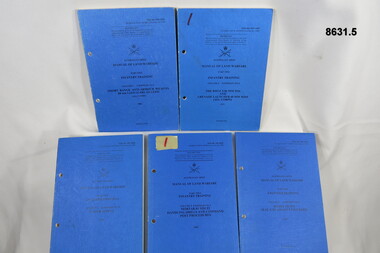
Manual - INFANTRY TRAINING, Australian Army, MANUAL OF LAND WARFARE, 1979, 1980, 1981, 1984
... Blue Manual Engineer Training Volume 3, Pamphlet No. 10, Water Supply. 4. ...Blue Manual Engineer Training Volume 3, Pamphlet No. 10, Water Supply. 4. ...1. Blue manual Infantry Training Volume 4, Pamphlet No. 4. The Rifle 5.56 and MM 16. 2. Blue Manual Infantry Training Volume 5, Pamphlet No. 1, Mortar 81, MM F2. 3. Blue Manual Engineer Training Volume 3, Pamphlet No. 10, Water Supply. 4. Blue Manual Engineer Training Volume 3, Pamphlet No. 8, Booby Traps. 5. Blue Manual Infantry training Volume 6, Pamphlet No. 2, Short Range Anti-Armour weapon.Manuals 1. and 2. have a texta marking 1.passchendaele barracks trust, pbt 36 37 39 40 41, manual, land warfare -
 Bendigo Military Museum
Letter - CALL UP NOTICE NATIONAL SERVICE, C.1966
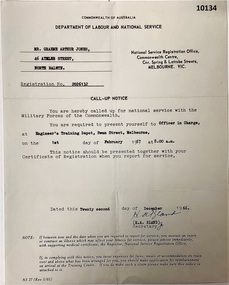
... The letter to Graeme Arthur Jones is to inform him that he has been Called up for National Service with the Military Forces of the Commonwealth requiring him to report to, "Officer in Charge at Engineers Training Depot, Swan Street Melbourne on the 1st day of February 1967 at 8.00am". ...The letter to Graeme Arthur Jones is to inform him that he has been Called up for National Service with the Military Forces of the Commonwealth requiring him to report to, "Officer in Charge at Engineers Training Depot, Swan Street Melbourne on the 1st day of February 1967 at 8.00am". ...The letter to Graeme Arthur Jones is to inform him that he has been Called up for National Service with the Military Forces of the Commonwealth requiring him to report to, "Officer in Charge at Engineers Training Depot, Swan Street Melbourne on the 1st day of February 1967 at 8.00am". Collection re G.A. Jones 3790932, refer Cat No 10053.2P for his service details.Letter of white colour, all print in black, typed entries are in black, dated and signed in blue pen, "Registration No 2026132", "22.12.1996""Department of Labour and National Service"letter, call up, national service -
 Bendigo Military Museum
Memorabilia - MONTAGE, FRAMED MEMORABILIA, Post 2000
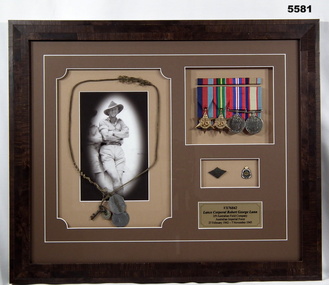
... Robert George Lunn VX76842 enlisted on 27.2.1942 age 35 years, 5.3 1942 transfer to Engineer Training Echuca, 12.4.1942 transfer to 2nd Field Sqd, 27.6.1942 transfer to No 4 Bomb Disposal Coy, 3.9.1942 transfer to No 2 Bomb Disposal Coy, 18.2.1943 transfer to Engineer Training Centre RAE, 18.8.1943 transfer to 5th Aust Advance Reinforcements Depot Townsville, 11.11.1943 embark for Pt Moresby, 19.11.1943 taken on strength 2/9th Field Coy, 4.6.1944 embark from Lae to Brisbane, 11.8.1944 hospital with Malaria28.8.1944 rejoin unit, 20.9.1944 hospital (unclear), 27.9.1944 rejoin unit, 23.5.1945 embark for Morotai, 7.8.1945 promoted to Cpl, 12.8.1945 fly from Balikpapan to Aust to attend a Junior leaders school Aust Army, 22.8.1945 arrive Vic and attend school, 29.8.1945 attend RAE Training Centre NSW, 31.10.1945 Move to Vic for discharge, 7.11.1945 discharged from the 2nd AIF....Robert George Lunn VX76842 enlisted on 27.2.1942 age 35 years, 5.3 1942 transfer to Engineer Training Echuca, 12.4.1942 transfer to 2nd Field Sqd, 27.6.1942 transfer to No 4 Bomb Disposal Coy, 3.9.1942 transfer to No 2 Bomb Disposal Coy, 18.2.1943 transfer to Engineer Training Centre RAE, 18.8.1943 transfer to 5th Aust Advance Reinforcements Depot Townsville, 11.11.1943 embark for Pt Moresby, 19.11.1943 taken on strength 2/9th Field Coy, 4.6.1944 embark from Lae to Brisbane, 11.8.1944 hospital with Malaria28.8.1944 rejoin unit, 20.9.1944 hospital (unclear), 27.9.1944 rejoin unit, 23.5.1945 embark for Morotai, 7.8.1945 promoted to Cpl, 12.8.1945 fly from Balikpapan to Aust to attend a Junior leaders school Aust Army, 22.8.1945 arrive Vic and attend school, 29.8.1945 attend RAE Training Centre NSW, 31.10.1945 Move to Vic for discharge, 7.11.1945 discharged from the 2nd AIF. ...Robert George Lunn VX76842 enlisted on 27.2.1942 age 35 years, 5.3 1942 transfer to Engineer Training Echuca, 12.4.1942 transfer to 2nd Field Sqd, 27.6.1942 transfer to No 4 Bomb Disposal Coy, 3.9.1942 transfer to No 2 Bomb Disposal Coy, 18.2.1943 transfer to Engineer Training Centre RAE, 18.8.1943 transfer to 5th Aust Advance Reinforcements Depot Townsville, 11.11.1943 embark for Pt Moresby, 19.11.1943 taken on strength 2/9th Field Coy, 4.6.1944 embark from Lae to Brisbane, 11.8.1944 hospital with Malaria28.8.1944 rejoin unit, 20.9.1944 hospital (unclear), 27.9.1944 rejoin unit, 23.5.1945 embark for Morotai, 7.8.1945 promoted to Cpl, 12.8.1945 fly from Balikpapan to Aust to attend a Junior leaders school Aust Army, 22.8.1945 arrive Vic and attend school, 29.8.1945 attend RAE Training Centre NSW, 31.10.1945 Move to Vic for discharge, 7.11.1945 discharged from the 2nd AIF.Wood framed item with photo, ID tags, medals x 4, RAS badge, RSL badge, all items are set in panels within the frame, panel with text at bottom. Medals. 1. 1939 - 45 Star. 2. Pacific Star. 3. British War medal 1939 - 45. 4. Australian Service Medal 1939 - 45."VX76842 Lance Corporal Robert George Lunn, 2/9 Australian Field Company Australian Imperial Force, 27 February 1942 - 7 November 1945"framed, memorabilia, ww2, medals, lunn -
 National Vietnam Veterans Museum (NVVM)
Document - Call-up Notice for Mr N.E. Swainston, NS27 (Rev 5/65)
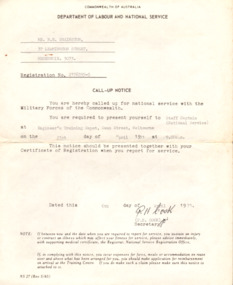
... Pro-forma call-up notice issued by Department of Labour and National Service to N E Swainston on 6th April 1971 advising that he has been called up for national service with the Military Forces of the Commonwealth and is to present himself at Engineer's Training Depot, Swan Street, Melbourne on 21st April 1971 at 9.00am. ...Call-up Conscription Swainston Collection Department of Labour and National Service Pte Neil Ernest Swainston 3801127 Australian National Serviceman Recruit and Corps Training Regimental Duties Rifleman Pro-forma call-up notice issued by Department of Labour and National Service to N E Swainston on 6th April 1971 advising that he has been called up for national service with the Military Forces of the Commonwealth and is to present himself at Engineer's Training Depot, Swan Street, Melbourne on 21st April 1971 at 9.00am. ...This item is part of a collection donated by Pte Neil Ernest Swainston (3801127) who was called up for National Service but was only in the Australian Army from 24 Apr 71 to 20 Oct 72 a total of 1 year and 183 days. Reason for Pte Swainston’s discharge: Having completed the prescribed period of service in the ARAS (NS). During service Pte Swainston did 5 months with Recruit and Corps Training and regimental and rifleman duties with Infantry until his discharge.Pro-forma call-up notice issued by Department of Labour and National Service to N E Swainston on 6th April 1971 advising that he has been called up for national service with the Military Forces of the Commonwealth and is to present himself at Engineer's Training Depot, Swan Street, Melbourne on 21st April 1971 at 9.00am. Details are typed in, National Service Registration Office address stamped on in purple. Signed by PH Cook- Secretary, the document advises recipient what to do if he should become ill or injured prior to the set date, and how to claim related expenses.call-up, conscription, swainston collection, department of labour and national service, pte neil ernest swainston, 3801127, australian national serviceman, recruit and corps training, regimental duties, rifleman -
Federation University Art Collection
Work on paper - No. 4 Battalion Kapooka, Sali Herman, c1944
... He later became a sergeant with the 3rd Royal Australian Engineers Training Battalion at Kapooka. He was appointed an official war artist in 1945 and worked in the Pacific for five months, recording scenes in Lae, Torokina, Bougainville and Rabaul....He later became a sergeant with the 3rd Royal Australian Engineers Training Battalion at Kapooka. He was appointed an official war artist in 1945 and worked in the Pacific for five months, recording scenes in Lae, Torokina, Bougainville and Rabaul. ...Sali HERMAN (12 February 1898-03 April 1993) Born Switzerland Arrived Australia 1937 After studying at the Zurich Technical School Sali Herman migrated to Australia where he continued his studies with the George Bell School, Melbourne. He moved to Sydney in 1938. Sali Herman enlisted in the Australian Army in 1941 and was assigned to the First Camouflage Section. He later became a sergeant with the 3rd Royal Australian Engineers Training Battalion at Kapooka. He was appointed an official war artist in 1945 and worked in the Pacific for five months, recording scenes in Lae, Torokina, Bougainville and Rabaul.A drawing in ink of an army encampment at Kapooka. sali herman, war artist, kapooka, army -
 Beechworth RSL Sub-Branch
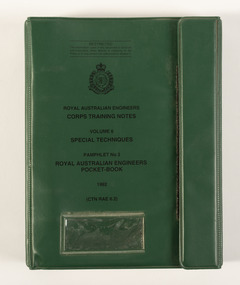
Pamphlet - Royal Australian Engineers Pocket Book - Special Techniques, 1992
... Front - ROYAL AUSTRALIAN ENGINEERS HANDBOOK / CORPS TRAINING NOTES / VOLUME 6 / SPECIAL TECHNIQUES / PAMPHLET NO 2 / ROYAL AUSTRALIAN ENGINEERS / POCKET BOOK / 1992 / (CTN RAE 6.2) Image - ...Front - ROYAL AUSTRALIAN ENGINEERS HANDBOOK / CORPS TRAINING NOTES / VOLUME 6 / SPECIAL TECHNIQUES / PAMPHLET NO 2 / ROYAL AUSTRALIAN ENGINEERS / POCKET BOOK / 1992 / (CTN RAE 6.2) Image - Green vinyl handbook with a velcro opening, featuring a four-part ring binder that holds a paper notebook of written and illustrated information regarding weapons and practices. ...Green vinyl handbook with a velcro opening, featuring a four-part ring binder that holds a paper notebook of written and illustrated information regarding weapons and practices. Front - ROYAL AUSTRALIAN ENGINEERS HANDBOOK / CORPS TRAINING NOTES / VOLUME 6 / SPECIAL TECHNIQUES / PAMPHLET NO 2 / ROYAL AUSTRALIAN ENGINEERS / POCKET BOOK / 1992 / (CTN RAE 6.2) Image - -
Surrey Hills Historical Society Collection
Photograph
... At the age of 22, he enlisted on the 15 July 1915 and was assigned to the 5th Field Company of Engineers, training as a sapper. William served for nearly 2 years and was killed in 1917, only months before the end of the war whilst putting up barbed wire at Oestoik. ...At the age of 22, he enlisted on the 15 July 1915 and was assigned to the 5th Field Company of Engineers, training as a sapper. William served for nearly 2 years and was killed in 1917, only months before the end of the war whilst putting up barbed wire at Oestoik. ...William Frederick Mawson was born in 1893 to Frederick William and Mary Mawson. Prior to the war, William was employed for 5 years as a carpenter with his older brother John who was a partner in Garrett & Mawson, architects and builders of Box Hill. At the age of 22, he enlisted on the 15 July 1915 and was assigned to the 5th Field Company of Engineers, training as a sapper. William served for nearly 2 years and was killed in 1917, only months before the end of the war whilst putting up barbed wire at Oestoik. His body was brought back the 4 miles from Oestoik to Lille Gate, Ypres in Belgium. William wrote a diary, the original of which was donated to Anzac House by his great-nephew John Howden. This diary was borrowed by the Surrey Hills Historical Society for the exhibition 'Gallipoli and beyond' mounted in Boroondara libraries and council spaces during 2015. The diary was then transcribed by Sandra Dexter and limited copies were printed by the Surrey Hills Historical Society. This framed photo authenticates the identification of this soldier whose photo was taken by the Darge company (Dasey1498) and uploaded to the Australian War Memorial online collection, but initially mis-idetified as Manson. His name appears on the panels of names on The Shrine in the Surrey Gardens and a profile of him is included in Sandra Dexter's book 'People of The Shrine' launched on Remembrance Day 2025. Framed photograph of soldier within fabric inset, embroidered with English and Australian flags, white ribbon at base of green wreath which surrounds photo. frederick william mawson, mary mawson, surrey hills, garrett & mawson, william frederick mawson, carpenter, 14 bona vista avenue, architects, world war 1, world war, 1914-1918, diaries, sandra dexter -
 Federation University Historical Collection
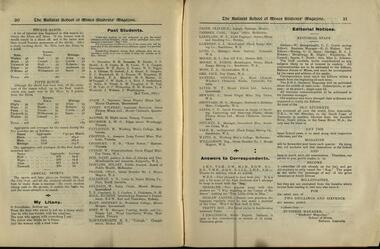
Magazine of 24 pages, Baxter & Stubbs, Print, Ballarat School of Mines, Student Magazine, Third Term, 1911, 1911
... Table of Contents: Editorial, Inventions and inventors, The hydroplane launch "Maple Leaf III", Hints on examination, First aid, Some geographical features at Ballarat, The volumetric determination of potassium, Milk, The cannon, A scientific apologue, New inventions by Tesla, Coronation fair, First aid, Cinematography, Electrical chatter, Education and training of engineers, Mining notes, Engineering students midwinter excursion, Hints to S.M. ...Table of Contents: Editorial, Inventions and inventors, The hydroplane launch "Maple Leaf III", Hints on examination, First aid, Some geographical features at Ballarat, The volumetric determination of potassium, Milk, The cannon, A scientific apologue, New inventions by Tesla, Coronation fair, First aid, Cinematography, Electrical chatter, Education and training of engineers, Mining notes, Engineering students midwinter excursion, Hints to S.M. ...Table of Contents: Editorial, Inventions and inventors, The hydroplane launch "Maple Leaf III", Hints on examination, First aid, Some geographical features at Ballarat, The volumetric determination of potassium, Milk, The cannon, A scientific apologue, New inventions by Tesla, Coronation fair, First aid, Cinematography, Electrical chatter, Education and training of engineers, Mining notes, Engineering students midwinter excursion, Hints to S.M. B. yachtsmen, News and notes, The long and short of it, Abbreviated account of the geology of the Forbes-Parkes gold field, Excursion to Pyke's Creek Reservoir, A practical joke, Sports, Past students, Answers to correspondents, Editorial notes.table of contents: editorial, inventions and inventors, the hydroplane launch "maple leaf iii", hints on examination, first aid, some geographical features at ballarat, the volumetric determination of potassium, milk, the cannon, a scientific apologue, new inventions by tesla, coronation fair, first aid, cinematography, electrical chatter, education and training of engineers, mining notes, engineering students midwinter excursion, hints to s.m. b. yachtsmen, news and notes, the long and short of it, abbreviated account of the geology of the forbes-parkes gold field, excursion to pyke's creek reservoir, a practical joke, sports, past students, answers to correspondents, editorial notes., alumni: w. k. clifford, j. adam, wilfred avery, h. baxter, l. w. g. buchner, h. caulfield, a. cropper, e. b. crossley, w. currie, dave don, hilary dowling, chas fraser, a. d. galloway, w. geldard,t. e. copeland, l, j. coulter, j. dickinson, g. h. hall, godfrey s.hart, w. b. hirt, h. e. hawkesworth, oliver e. jager, carl janssen, w. t. lakeland, l. j. lambert, c. lund, r. i. moore, byron k. moore, f. a. moss, jack orr, douglas runting, w. t. sayer, l. seward, h. s. sheppard, c. e. sands, n. stuckey, r. vale, r. watts, reg williamson, w. baragwanath, c. c. corrie, r. g. walker, g. g. sams, r. a. j. roberts, r. blight, h. cornell, v. booth, miss l johnson. -
 Rutherglen Historical Society
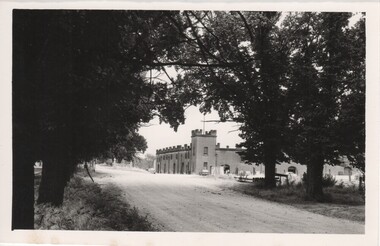
Photograph - Image, 1970s
... Choosing to settle in the Wahgunyah area, they used their training as engineers from the Edinburgh Railway Institute to build a bridge over the Edwards River at Deniliquin. ...Choosing to settle in the Wahgunyah area, they used their training as engineers from the Edinburgh Railway Institute to build a bridge over the Edwards River at Deniliquin. ...All Saints Estate is a family owned winery established in 1864 and located on the banks of the Murray River in Wahgunyah, North East Victoria. Original owners George Sutherland Smith, and John Banks, arrived from Caithness, Scotland in 1852. They were just 23 and 20 years of age. Choosing to settle in the Wahgunyah area, they used their training as engineers from the Edinburgh Railway Institute to build a bridge over the Edwards River at Deniliquin. They were also involved in the construction of several buildings in Beechworth including the Presbyterian Church, part of the Gaol and the original hospital of which the granite facade still remains today. Smith and Banks began growing vines at ‘Sunday Creek’ closer to Wahgunyah than the present All Saints Estate winery, before relocating to build the 'All Saints castle' just three miles north of Wahgunyah, in 1864. The partners took up 100 acres and proceeded with planting vines in earnest whilst also constructing pise cellars made from the estate soil. The All Saints Estate castle was based on the design of ‘The Castle of Mey’, including turrets and a tower. The castle was constructed mainly of handmade bricks that were fired in the All Saints Estate Brick Kiln (classified on the Victorian Heritage Register) on the property. However, only the battement parapets of the lower wall and a turrets were copied, not the main castle style. The Castle of Mey, most recently owned by the late Queen Mother, was where George Sutherland-Smiths’ father was a carpenter and joiner.Black and white photograph showing a view, up a road between the Elm Tree entry drive of All Saints Winery wineries, north east victoria, wine industry, all saints winery, rutherglen, wahgunyah, winemaking, castle, winery -
 Rutherglen Historical Society
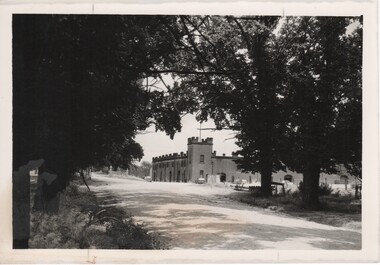
Image, 1970s
... Choosing to settle in the Wahgunyah area, they used their training as engineers from the Edinburgh Railway Institute to build a bridge over the Edwards River at Deniliquin. ...Choosing to settle in the Wahgunyah area, they used their training as engineers from the Edinburgh Railway Institute to build a bridge over the Edwards River at Deniliquin. ...All Saints Estate is a family owned winery established in 1864 and located on the banks of the Murray River in Wahgunyah, North East Victoria. Original owners George Sutherland Smith, and John Banks, arrived from Caithness, Scotland in 1852. They were just 23 and 20 years of age. Choosing to settle in the Wahgunyah area, they used their training as engineers from the Edinburgh Railway Institute to build a bridge over the Edwards River at Deniliquin. They were also involved in the construction of several buildings in Beechworth including the Presbyterian Church, part of the Gaol and the original hospital of which the granite facade still remains today. Smith and Banks began growing vines at ‘Sunday Creek’ closer to Wahgunyah than the present All Saints Estate winery, before relocating to build the 'All Saints castle' just three miles north of Wahgunyah, in 1864. The partners took up 100 acres and proceeded with planting vines in earnest whilst also constructing pise cellars made from the estate soil. The All Saints Estate castle was based on the design of ‘The Castle of Mey’, including turrets and a tower. The castle was constructed mainly of handmade bricks that were fired in the All Saints Estate Brick Kiln (classified on the Victorian Heritage Register) on the property. However, only the battement parapets of the lower wall and a turrets were copied, not the main castle style. The Castle of Mey, most recently owned by the late Queen Mother, was where George Sutherland-Smiths’ father was a carpenter and joiner.Black and white photograph showing a view, up a road between the Elm Tree entry drive of All Saints Winery On back of photo: "250% [upper case D in small circle] All Saints"wineries, north east victoria, wine industry, all saints winery, rutherglen, wahgunyah, winemaking, castle, winery -
 Federation University Historical Collection
Book, The Economics of Mining (Non-Ferrous Metals), 1938, 1938
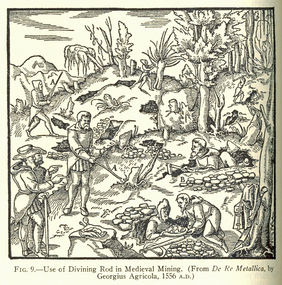
... engineer, managing director, director, and president of many mining companies in America, Europe, Asia, Africa, and Australia. He returned to Stanford in 1919 as Professor of Mining and Metallurgy and Executive Head of the Department of Mining and Metallurgy. His experience and ability in organization made him a natural leader. He was influential in the formation of the School of Engineering at Stanford. The School was formed in 1925 and he was made dean, a position he held until his retirement in 1936. As dean of engineering, he promoted a broad fundamental training...Contents include mine valuation (sampling, ore deposits, ore reserves, financial provisions, sale of mineral product, metal prices, reports) and Mining Organization (Co-operative effort, Mining Companies, Promoting Mining Enterprises, fluctuations of share prices, valuation of mining shares, fakes and fallacies, the mining Engineer and the law) and Mine Management (Organization of staff, mine manager, efficiency, industrial relations, training and discipline, safety). ...engineer, managing director, director, and president of many mining companies in America, Europe, Asia, Africa, and Australia. He returned to Stanford in 1919 as Professor of Mining and Metallurgy and Executive Head of the Department of Mining and Metallurgy. His experience and ability in organization made him a natural leader. He was influential in the formation of the School of Engineering at Stanford. The School was formed in 1925 and he was made dean, a position he held until his retirement in 1936. As dean of engineering, he promoted a broad fundamental training ...The book was used by Charles Bacon who studied at the University of Nevada in the late 1930s/early 1940s. Bacon worked at Bunker Hill Mines and Kellogg Idaho, before arriving in Australian in 1951. He worked for CN Myers, a company involved with paper converting. CN Myers was a family business (on Charles Bacon's maternal line). The Mackay School of Mines, Nevada was established in 1908. At the time of writing this mook T.J. Hoover was Professor of Mining and Metallurgy and Dean of the School of Engineering at Stanford University. Theodore Jesse Hoover, brother of the 31st President of the United States, was born in West Branch, Iowa, on January 28, 1871. He attended Stanford and received the Bachelor of Arts degree in Geology and Mining in 1901. Following graduation his professional career started with the position of assayer for the Keystone Consolidated Mining Company. After one year, he became assistant manager for the Standard Consolidated Mine, and a year later he was promoted to manager of the operation. In 1907 Hoover went to London as general manager of Minerals Separation, Ltd. This company was developing the froth flotation process for recovering minerals from ores. Hoover took an active part in the development of the flotation concentration process and authored one of the first books on the concentration of ores by flotation. After four years with Minerals Separation, Ltd., Hoover entered private practice as a consulting mining and metallurgical engineer with offices in London and in San Francisco. He was very successful and held positions of consulting engineer, managing director, director, and president of many mining companies in America, Europe, Asia, Africa, and Australia. He returned to Stanford in 1919 as Professor of Mining and Metallurgy and Executive Head of the Department of Mining and Metallurgy. His experience and ability in organization made him a natural leader. He was influential in the formation of the School of Engineering at Stanford. The School was formed in 1925 and he was made dean, a position he held until his retirement in 1936. As dean of engineering, he promoted a broad fundamental training program for undergraduate engineering students. Under his guidance, emphasis was placed upon graduate work and he was responsible for developing strong graduate engineering curricula at Stanford. While dean he continued teaching and his course, "The Economics of Mining," developed into a book which was published in 1933. He became interested in the functions of engineers and, with Professor Fish, wrote a book entitled "The Engineering Profession" which was published in 1940 and revised in 1950. In addition to his academic activities he was generous in his hospitality. Faculty and students alike enjoyed the annual field day and barbecue at his Rancho del Oso, near Santa Cruz. He was widely read and had a lively interest in all the things he encountered. He speculated on the antiquity of man and man's early production processes. To verify an idea regarding flint tools, he studied their shapes and became proficient in making arrow heads. He was also interested in wild life, and was one of the founding members of the Cooper Ornithological Society. (http://engineering.stanford.edu/about/bio-hoover) Blue hard covered book of 547 pages including an index. Contents include mine valuation (sampling, ore deposits, ore reserves, financial provisions, sale of mineral product, metal prices, reports) and Mining Organization (Co-operative effort, Mining Companies, Promoting Mining Enterprises, fluctuations of share prices, valuation of mining shares, fakes and fallacies, the mining Engineer and the law) and Mine Management (Organization of staff, mine manager, efficiency, industrial relations, training and discipline, safety). Inside front cover 'Charles Bacon Mackay School of Mines"charles bacon, mining engineering, metallurgy, university of nevada, mackay school of mines, stanford, bacon, mining, economics, divining, theodore hoover -
 Federation University Historical Collection
Document - Document - Correspondence, ZILLES COLLECTION: Letter paper and cards - Defence Forces, Portsea and Queenscliff
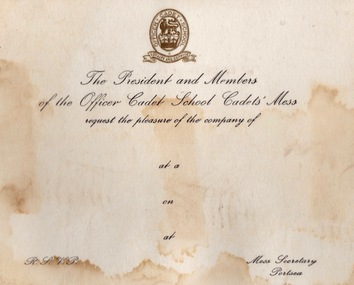
... Training for the Vietnam War was here, Now gone the remnants of the quarantine station and army activites can be seen. Under Point Nepean Community Trust. Fort Queenscliff dates from 1860 when it was an open battery known as Shortlands Bluff. The Garrison included volunteer artillery, engineers...Training for the Vietnam War was here, Now gone the remnants of the quarantine station and army activites can be seen. Under Point Nepean Community Trust. Fort Queenscliff dates from 1860 when it was an open battery known as Shortlands Bluff. The Garrison included volunteer artillery, engineers ...Zilles Printers was begun by Lewis Zilles in the early 1930s. It was in McKenzie Street Ballarat. His son Jeffrey also became a printer - letterpress, offset and screen printer. The business became Zilles Printers/Graphics and was in Armstrong Street and later Bell Street Ballarat. Items are work done for the Australian Defence Force bases at Portsea and Queenscliff. They were training bases - Officer Cadet School and Australian Staff College. Originally the base at Portsea was the Quarantine Station established in the late 1800s. International protocols required captains of arriving ships to provide a clean bill of health from the last port of call. If this was not possible all on board would be transferred to the Quarantine Station by boat for observations. This was to stop the spread of diseases such as cholera, small pox, typhoid fever, influenza and the plague. In 1952 it became a military training base - Officer Cadet School. The quarantine station still operated and the Army had to be prepared to evacuated in an emergency. This occurred in 1954 when 113 passengers on board the Strathaird were quarantined with smallpox. Cadets and staff came with their families and was a small township. Training for the Vietnam War was here, Now gone the remnants of the quarantine station and army activites can be seen. Under Point Nepean Community Trust. Fort Queenscliff dates from 1860 when it was an open battery known as Shortlands Bluff. The Garrison included volunteer artillery, engineers and infantry. It was a Coastal Defence Installation from 1883-1946. The base on Swan Island was part of this and soldiers from the Fort would go on detail to the Island each day. A permanent group with their families were housed there. The children would attend the local school in Queenscliff. It eventually became and still is a restricted area. In 1946 the Fort became home of the Army Command and Staff College. Officers came from overseas to train. Families would come with them and be accommodated in the main officers residence "Maytone" or private housing rented by the Army. Their children would attend local schools. Staff Colleges were all moved to Canberra. The Fort is now the Army Soldiers Career Management Agency and houses all historical documents related to the Army. .1 Off-white card with gold badge and black writing. .2 White card with separate page held together with blue and red ribbon. Badge in gold on front. Two Officer Cadet School flags - crossed and Christmas Greeting in blue inside card. .3 Off-white paper with Australian Staff College emblem. Blue print.2 Officer Cadet School emblem - lion and crown in centre. Flags - British and Australian .3 Emblem - crossed swords, owl and crownzilles printers, australian defence force, quarantine station portsea, officer cadet school, fort queenscliff, open battery, swan island, staff college, army command, zilles collection -
Federation University Historical Collection
Book - Book - Scrapbook, Ballarat Institute of Advanced Education: Scrapbook of newspaper cutting, Book 5, August 1971 to December 1971
... The cuttings cover the period from 19 August 1971 to 1 December 1971. ballarat institute of advanced education biae employment advertisements application for enrolment outline of courses smb finances concern mildura visitors testing new wind tunnel derek vine zig placina excellent year for association jack barker biae art show woman on a bike letters to the editor re art show 1500 trees planted biae students call strike new courses approved new physics equipment apartheid history explained derek viner talk student protest backed ballarat trades and labor council support prahran college of technology seeks supporters role of colleges threatened teacher training new regional office - education dept clay pit plans equipment for biae art display by smb students teachers to conduct assessment experiment undermining our sold foundation pioneer experiment at biae national diploma controls needed f r hornby colleges and students - 1972 helping hand for overseas students gordon smith teachers' colleges accommodation at technical schools victorian teachers' union concerns exceptions in an imperfect world student housing local degree courses on secondary studentships problem for school leavers $250000 for biae union building death of harry arblaster - former smb principal model of building project engineers' seminar at ballarat Book with orange cover, front. ...Newspaper cuttings relating to Ballarat Institute of Advanced Education. These are from various newspapers and include The Age, Ballarat Courier, The Australian, The Herald. The cuttings cover the period from 19 August 1971 to 1 December 1971. Book with orange cover, front. Spiral bound. Large tear back cover.ballarat institute of advanced education, biae, employment advertisements, application for enrolment, outline of courses, smb finances concern, mildura visitors, testing new wind tunnel, derek vine, zig placina, excellent year for association, jack barker, biae art show, woman on a bike, letters to the editor re art show, 1500 trees planted, biae students call strike, new courses approved, new physics equipment, apartheid history explained, derek viner talk, student protest backed, ballarat trades and labor council support, prahran college of technology seeks supporters, role of colleges threatened, teacher training, new regional office - education dept, clay pit plans, equipment for biae, art display by smb students, teachers to conduct assessment experiment, undermining our sold foundation, pioneer experiment at biae, national diploma controls needed, f r hornby, colleges and students - 1972, helping hand for overseas students, gordon smith, teachers' colleges, accommodation at technical schools, victorian teachers' union concerns, exceptions in an imperfect world, student housing, local degree courses on secondary studentships, problem for school leavers, $250000 for biae union building, death of harry arblaster - former smb principal, model of building project, engineers' seminar at ballarat -
Federation University Historical Collection
Book - Book - Scrapbook, Ballarat College of Advanced Education: Scrapbook of newspaper cutting, Book 15; January 1985 to August 1985
... The cuttings cover the period from 31 January 1985 to 22 August 1985. . employment advertisements application for enrolment outline of courses computing for engineers $24000for course new residential college for bcae sandy blythe's will to succeed aboriginal students at bcae beer of distinction geoffrey lowe wins award karen bibby jack barker new chair of australian council of directore and principals of cae peter pearson - teacher with class education method observations kenneth wullf european wasp menace fitness test for rowers "zigger zagger" production bcae to study ballarat volunteers ballarat photographic project world student games sharon stewart stephen moneghetti ian anderson r w richards obituary miles coverdale to head apprenticeship group dr murray gillan women as engineers ballarat asian links tertiary fees nursing's new era three course in nursing hospital-based training to end bill hitchins computer-swap to boost library jacki straude's exhibition louise tomlinson aids seminar at bcae statistic in map form accommodation to double bcae staff union branch death of allan sonsee naturalist brett robinson student union president inustry-bcae research bid engineering award winners mark davies grant mcghie pamela dethridge e j tippettretires tribute to antarctic explorer barry jones civil engineering award anthony sperber bush will be surveyed professor michael birt elizabeth miles national safety council trophy technology and old gold mines women in education still a 'privilege' ian moore - dean of education mining firm's prizes last intake of nursing students ballarat base hospital peter blizzard selkirk sculpture brick sculpture keating's budget Book with yellow cover, front. ...Newspaper cuttings relating to Ballarat College of Advanced Education. These are from various newspapers and include The Age, Ballarat Courier, The Australian, The Herald. The cuttings cover the period from 31 January 1985 to 22 August 1985. . Book with yellow cover, front. Spiral bound.employment advertisements, application for enrolment, outline of courses, computing for engineers, $24000for course, new residential college for bcae, sandy blythe's will to succeed, aboriginal students at bcae, beer of distinction, geoffrey lowe wins award, karen bibby, jack barker, new chair of australian council of directore and principals of cae, peter pearson - teacher with class, education method observations, kenneth wullf, european wasp menace, fitness test for rowers, "zigger zagger" production, bcae to study ballarat volunteers, ballarat photographic project, world student games, sharon stewart, stephen moneghetti, ian anderson, r w richards obituary, miles coverdale to head apprenticeship group, dr murray gillan, women as engineers, ballarat asian links, tertiary fees, nursing's new era, three course in nursing, hospital-based training to end, bill hitchins, computer-swap to boost library, jacki straude's exhibition, louise tomlinson, aids seminar at bcae, statistic in map form, accommodation to double, bcae staff union branch, death of allan sonsee, naturalist, brett robinson, student union president, inustry-bcae research bid, engineering award winners, mark davies, grant mcghie, pamela dethridge, e j tippettretires, tribute to antarctic explorer, barry jones, civil engineering award, anthony sperber, bush will be surveyed, professor michael birt, elizabeth miles, national safety council trophy, technology and old gold mines, women in education still a 'privilege', ian moore - dean of education, mining firm's prizes, last intake of nursing students, ballarat base hospital, peter blizzard, selkirk sculpture, brick sculpture, keating's budget -
Federation University Historical Collection
Book - Book - Scrapbook, Ballarat School of MInes: Scrapbook of Newspaper Cuttings, Book 18, June 1983 to October 1983
... training the best...tutors needed to help with literacy courses...bella guerin...gaol governor's daughter...bcae open day...philip tjerstra leaves for austria...skill olympics...relay raises funds for fitness...smb has trained 350+ in computer method...hints for buyers...rex hoolioake - shire engineer...The papers concerned are The Courier, Ballarat, The Australian, The Age over the period of 12 February 1983 to 4 June 1983. courses available teaching positions advertised tracie marks top secretarial student ray pond new cooking instructor bronze bust of mica smith royal melbourne institute of technology presentation of bust of dick richards greenhaigh sculptor ballarat craftsmen elite group smb win inter-school chess competition bcae host seminar gmh donates car for apprentices three faces of liz gurrie growing education industry new programs at smb training the best tutors needed to help with literacy courses bella guerin gaol governor's daughter bcae open day philip tjerstra leaves for austria skill olympics relay raises funds for fitness smb has trained 350+ in computer method hints for buyers rex hoolioake - shire engineer patrick mcardle of smb ensemble health and fitness week dick richards - antarctic hero smb design banner for air show in texas resi award winners smb farm courses Book with white cover, front, spiral bound. ...Collection of newspaper articles related to Ballarat School Of Mines.They cover activities and advertisements for staff. The papers concerned are The Courier, Ballarat, The Australian, The Age over the period of 12 February 1983 to 4 June 1983.Book with white cover, front, spiral bound. courses available, teaching positions advertised, tracie marks top secretarial student, ray pond new cooking instructor, bronze bust of mica smith, royal melbourne institute of technology, presentation of bust of dick richards, greenhaigh sculptor, ballarat craftsmen elite group, smb win inter-school chess competition, bcae host seminar, gmh donates car for apprentices, three faces of liz gurrie, growing education industry, new programs at smb, training the best, tutors needed to help with literacy courses, bella guerin, gaol governor's daughter, bcae open day, philip tjerstra leaves for austria, skill olympics, relay raises funds for fitness, smb has trained 350+ in computer method, hints for buyers, rex hoolioake - shire engineer, patrick mcardle of smb ensemble, health and fitness week, dick richards - antarctic hero, smb design banner for air show in texas, resi award winners, smb farm courses -
Federation University Historical Collection
Book - Book - Scrapbook, Ballarat School of MInes: Scrapbook of Newspaper Cuttings, Book 35, April 1988 to July 1988
... The papers concerned are The Courier, Ballarat, The Australian, The Age over the period of 22 July 1988 to 3 October 1987. teaching positions advertised pre-employment courses courses available enrolment for smb courses aboriginal flag for smb $600000 for science studies building arbor day at victoria park smb and local industry smb's marketing company inskill ltd open learning for maths students pilot business program industry oriented training scheme rob webber new enterprise incentives scheme gerardine christou myra morgan art and craft teacher 1950s new computer software for engineers more adults return to school cuts to special school funding transition program hospitality studies - certificate of catering anne-marie allison christine brady robert reilly sue collins sculptor peter blizzard student andrew burnham ricky hains wins tippett award kandra chapman award winner sheetmetal women's access group smb women's trade and technical program offended girl mechanic hit back mining course at smb kerrie cross council president adult literacy tutors june huggins josie micich hospitality traineeship system launched farm manager computer program course peter quinn peter davis federal grant to john valves special course on stoneware glazes ceramics instructor neville french players find home at smb michael staley winning apprentice ballarat small business centre quality control course at smb calligraphyteacher eddie goodson Book with green cover, front, spiral bound. ...Collection of newspaper articles related to Ballarat School Of Mines.They cover activities and advertisements for staff. The papers concerned are The Courier, Ballarat, The Australian, The Age over the period of 22 July 1988 to 3 October 1987.Book with green cover, front, spiral bound. teaching positions advertised, pre-employment courses, courses available, enrolment for smb courses, aboriginal flag for smb, $600000 for science studies building, arbor day at victoria park, smb and local industry, smb's marketing company inskill ltd, open learning for maths students, pilot business program, industry oriented training scheme, rob webber, new enterprise incentives scheme, gerardine christou, myra morgan art and craft teacher 1950s, new computer software for engineers, more adults return to school, cuts to special school funding, transition program, hospitality studies - certificate of catering, anne-marie allison, christine brady, robert reilly, sue collins, sculptor peter blizzard, student andrew burnham, ricky hains wins tippett award, kandra chapman award winner sheetmetal, women's access group, smb women's trade and technical program, offended girl mechanic hit back, mining course at smb, kerrie cross council president, adult literacy tutors, june huggins, josie micich, hospitality traineeship system launched, farm manager computer program course, peter quinn, peter davis, federal grant to john valves, special course on stoneware glazes, ceramics instructor neville french, players find home at smb, michael staley winning apprentice, ballarat small business centre, quality control course at smb, calligraphyteacher eddie goodson -
Federation University Historical Collection
Book - Book - Scrapbook, Ballarat School of MInes: Scrapbook of Newspaper Cuttings, Book 40, July 1989 to October 1989
... engineer...smb centenary medal...smb forced to turn away apprentices...anton parrot...top motor mechanic apprentice...university link turns full circle...bella guerin...agent nominated for top award...anthony wonish...help for small business...dame phyllis frost...victorian relief committee...ballarat regional board move to aid business...changes in job training...The papers concerned are The Courier, Ballarat, The Australian, The Age over the period of 5 July 1989 to 11 October 1989. teaching positions advertised pre-employment courses courses available enrolment for smb courses bcae to be uni college paul litchfield david gray carpentry awards charles copeman mining engineer smb centenary medal smb forced to turn away apprentices anton parrot top motor mechanic apprentice university link turns full circle bella guerin agent nominated for top award anthony wonish help for small business dame phyllis frost victorian relief committee ballarat regional board move to aid business changes in job training regional library stunning hats for racegoers secretarial student kerrie burzacott librarians look at information gathering canberra cae nancy lane bcae teaching resource centre barbara crump chief librarian bill hitchins diploma of tertiary studies 'hats off to spring' contest melissa young third place val d'angri teacher Book with yellow cover, front, spiral bound. ...Collection of newspaper articles related to Ballarat School Of Mines.They cover activities and advertisements for staff. The papers concerned are The Courier, Ballarat, The Australian, The Age over the period of 5 July 1989 to 11 October 1989.Book with yellow cover, front, spiral bound. teaching positions advertised, pre-employment courses, courses available, enrolment for smb courses, bcae to be uni college, paul litchfield, david gray, carpentry awards, charles copeman mining engineer, smb centenary medal, smb forced to turn away apprentices, anton parrot, top motor mechanic apprentice, university link turns full circle, bella guerin, agent nominated for top award, anthony wonish, help for small business, dame phyllis frost, victorian relief committee, ballarat regional board move to aid business, changes in job training, regional library, stunning hats for racegoers, secretarial student kerrie burzacott, librarians look at information gathering, canberra cae, nancy lane, bcae teaching resource centre, barbara crump, chief librarian, bill hitchins, diploma of tertiary studies, 'hats off to spring' contest, melissa young third place, val d'angri teacher -
 Lara RSL Sub Branch
Photograph, Set 4 photographs. and others for Torquay Light Horse camp, 1940
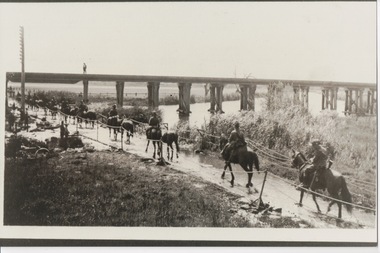
... Training Camp, WW2 Plaque at Pt. Danger Note----- (See images to view plaque) The plaque identifies a significant event in Torquay’s history and the sentiments of ‘change’ for the Light Horse Brigade – from horses to machines. In 1940 the four Light Horse Regiments (4th, 8th, 13th and 20th), some 5000 Light Horse and 2000 horses camped and trained at Torquay. Three other regiments, formerly mounted on horses, were also at Torquay ‘mounted’ on privately owned trucks and cars. Division troops included Artillery, Engineers...Training Camp, WW2 Plaque at Pt. Danger Note----- (See images to view plaque) The plaque identifies a significant event in Torquay’s history and the sentiments of ‘change’ for the Light Horse Brigade – from horses to machines. In 1940 the four Light Horse Regiments (4th, 8th, 13th and 20th), some 5000 Light Horse and 2000 horses camped and trained at Torquay. Three other regiments, formerly mounted on horses, were also at Torquay ‘mounted’ on privately owned trucks and cars. Division troops included Artillery, Engineers ...These images capture for all time Light Horsemen travelling through Geelong on their way to camp at Torquay for the last Group meeting in Australia . information following - details obtained from .........https://torquayhistory.com/light-horse-brigade/ On Australia Day, 1997, Sir John Young unveiled this plaque on Point Danger, Torquay. Torquay history, Light Horse Training Camp, WW2 Plaque at Pt. Danger Note----- (See images to view plaque) The plaque identifies a significant event in Torquay’s history and the sentiments of ‘change’ for the Light Horse Brigade – from horses to machines. In 1940 the four Light Horse Regiments (4th, 8th, 13th and 20th), some 5000 Light Horse and 2000 horses camped and trained at Torquay. Three other regiments, formerly mounted on horses, were also at Torquay ‘mounted’ on privately owned trucks and cars. Division troops included Artillery, Engineers, Signals, Field Ambulance and other branches of the Army necessary to enable a Division to function. It wasn’t just the sheer numbers of men coming to this little town that made the event significant, it was also the fact that the men of the Light Horse were dramatic, almost glamorous figures and it is easy to see their exploits as some splendid adventure. Horses have played a special role in the story of Australia. They were the only means of transport across this huge country, so it was necessary for everyone to have the ability to ride a horse. When war broke out in 1899 between Britain and the Boers of South Africa (“Boer” was Dutch for “farmer”) Australia sent troops to fight. At first Britain was wary of using untried, unprofessional colonial cavalrymen but soon saw that the slouch-hatted Australian “bushmen” were a match for the fast-moving and unconventional mounted commandos of the Boers. The Australians proved themselves to be expert rough-riding horsemen and good shots. Bush life had hardened them to go for long periods with little food and water. They also showed remarkable ability to find their way in a strange country and use its features for cover, in both attack and defence. By 1914, when Australia joined the war against Germany, there were 23 Light Horse regiments of militia volunteers. Many men from these units joined the Light Horse regiments of the Australian Imperial Force (AIF). Men were given remounts (if not using their own horses) – army horses bought by Commonwealth purchasing officers from graziers and breeders. These were called “walers” because they were a New South Wales stockhorse type – strong, great-hearted animals with the strains of the thoroughbred and semi-draught to give them speed, strength and stamina. On 1st November, 1914, Australia’s First Infantry Division and the first four Light Horse regiments sailed for England in a fleet of transport ships. The first of the Light Horse arrived at Gallipoli in May without their horses. Back with their horses after Gallipoli, they were formidable combatants across the Sinai and Palestine. Some British commanders observed that the light horseman moved with a “lazy, slouching gait, like that of a sleepy tiger” but described how the promise of battle “changes that careless gait, into a live athletic swing that takes him over the ground much quicker than other troops”. They had Light Horse, Torquay, training campdeveloped a reputation as formidable infantrymen. The Turks called them “the White Ghurkas” – a reference to their deadly skill with the bayonet. The Arabs called them “The Kings of the Feathers”. The plume had originally been a battle honour of the Queensland Mounted Infantry for their work in the shearer’s strike of 1891. During WW1 it was adopted by almost all the Light Horse Regiments. It was the proud badge of the light horseman. The most famous of their battles was the attack on Beersheba- the charge of the 4th Light Horse Brigade. Mounted infantrymen and their superb walers had carried out one of the most successful cavalry charges in history – against what seemed impossible odds. They surprised the Turks by charging cavalry-style, when they would normally have ridden close to an objective then dismounted to fight. The fall of Beersheba swung the battle tide against the Turks in Palestine; and changed the history of the Middle East. While 19 men from the Surf Coast Shire served with the 4th Light Horse over the course of WW1, only four were involved in the charge of Beersheba- John GAYLARD, Philip QUINN.(Winchelsea); Wallace FINDLAY (Anglesea); Harry TRIGG (Bambra). After the war, Light Horse units played a key role in the Australian Government’s compulsory military training programme. The Citizen Military Forces (C.M.F.) thrived on the glamour of the wartime Light Horse tradition, ignoring the possibility that motor vehicles would soon replace the horses. When training was no longer compulsory, the C.M.F. regiments declined and horses became more of a luxury during the 1930s depression years of poverty and unemployment. Some regiments were motorised. Then, in 1939, Australia joined Britain in another world war. Training was increased for the militia at both home bases and regional training camps. The camp at Torquay in 1940, commanded by Major General Rankin, was at Divisional strength. By the end of the camp some felt that the Division was ready for active service. Gradually, over the next four years, the Australian Light Horse units were mounted on wheels and tracks and the horses were retired. Six men enlisted at the Torquay camp and another 57 men and women enlisted at Torquay for service in WW2. Those who served in the Militia provided valuable Officers and NCOs and men for the armed services during the war. Each infantry division of the 2nd AIF had a Light Horse regiment attached to it. But the day of the Australian mounted soldier hadn’t quite passed. During World War II, Australia’s 6th Cavalry Regiment formed a mounted unit they called “The Kelly Gang” which did valuable scouting work. In New Guinea, a mounted Light Horse Troop did patrol duty and helped carry supplies. Some fully equipped walers were flown into Borneo for reconnaissance in rugged mountain country. But by the end of the war, in 1945, the horse had disappeared from the Australian Army. References: Australian Light Horse Association www.lighthorse.org.au National Australia Archives Australian War Memorial Surf Coast Shire WW1 memorials www.togethertheyserved.com The Light horse- a Cavalry under Canvas Light Horse, Training Camp, Torquay, WW2 Late in 1939 it was decided to set up a Lighthorse training camp in Torquay to train both men and horses for the battles of the Second World War. Horses, men and equipment came on special trains from all over Victoria and NSW, and as you would expect horseman came from areas such as Omeo and Sale, the Wimmera and the Western District. They arrived at the Geelong racecourse for watering in the Barwon River and then were ridden across the ford at the breakwater and began their 11 mile trek to Torquay. Light Horse, Training Camp, Torquay, WW2 Tent city By the end of January 1940 the camp at Torquay accommodated some 5000 men and 2500 horses of the Second Cavalry Division. The rows of horses, tents and huts near Blackgate Road were quite a sight. While the cavalrymen engaged in exercises on the land and on the beaches, many of the troops took over the Torquay School for special training of men and officers. Mr Bob Pettit local farmer and Councillor for the Barrabool Shire, wrote about the Light horse in the Surf Coast Community News in 1985 saying “They used to travel about the district riding four abreast in one long convoy. To my annoyance they went through my property and shut all the gates behind them. I had certain gates open to let stock in to the water holes and it would take me three -quarters of an hour to follow the horsemen up and put all the gates right again” he continued “the men from the Light Horse were here when the fire went through in March 1940. He recalled an incident when early one morning, as some one blew the bugle, a soldier putting a white sheet on the line frightened the horses. They panicked and ran off in all directions. Six went over the cliff near Bird Rock, five were never found, and the rest were gathered up after nearly a fortnight in the bush around Addiscott and Anglesea" Light Horse, Training Camp, Torquay, WW2, Geelong Parade Geelong parade The training camp culminated in a parade through the streets of Geelong on March 12th 1940. The salute was given at the Town Hall and the troops continued on a route to the You Yang’s for a training exercise. Note-----(see media section for photograph) The Camp was abandoned in mid 1940 as it was deemed unsuitable for training during winter and the cost of a permanent camp could not be justified if it could not be used all year. Historic.......Rare,,,Interpretive.Sepia photographs.set of four ....post card size ....Horses &LighthorsemenNo 1, Lighthorsemen Regiment Geelong 1940......No 2 Light Horse at Breakwater Geelong 1938 to 1940....No 3 Light Horse at Breakwater Geelong 1938 to 1940.....No 4 Light Horse crossing Breakwater camped at Geelong Showgrounds. These markings are on reverse of photographs.light horsemengeelong 1940., world war 2 -
 Federation University Historical Collection
Book - Ledger, Ballarat School of Mines Trade Meetings?
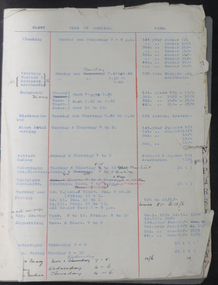
... ballarat school of mines trades h.h.smith sheet metalwork plumbing gasfitting carpentry joinery cabinet making manuel training photography architecture engineering drawing dressmaking assaying chemistry electricty and magnetism fitting and turning electrical calculations geology geometrical drawing hydraulics applied mechanics mining geology metallurgy mineralogy printing physics petrology surveying steam and gas engineers turning and fitting trigonometry telegraphy telephone fitters woolclassing .2) Timetable book of the Ballarat School of Mines, associated with H.H. ....2) Timetable book of the Ballarat School of Mines, associated with H.H. Smith, and student fees.ballarat school of mines, trades, h.h.smith, sheet metalwork, plumbing, gasfitting, carpentry, joinery, cabinet making, manuel training, photography, architecture, engineering drawing, dressmaking, assaying, chemistry, electricty and magnetism, fitting and turning, electrical calculations, geology, geometrical drawing, hydraulics, applied mechanics, mining geology, metallurgy, mineralogy, printing, physics, petrology, surveying, steam and gas engineers, turning and fitting, trigonometry, telegraphy, telephone fitters, woolclassing -
 Geelong RSL Sub Branch
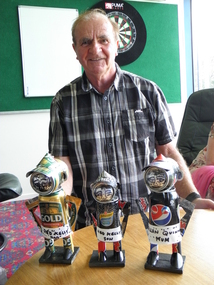
History of Colin Quin, Late 20th Century
... Engineers the unit went to Wewak, Borneo. After Military Service Colin worked as a refrigeration mechanic and has the interesting hobby of making model aeorplanes from beer cans. Colin Quin is also a distant relative to Ned Kelly. This is the original story of Colin Quin. A detailed A4 paper discription of Colin Quin a National Serviceman in 1958 and commenced training ...Colin Quin was a National Serviceman in the 1958 intake upon completion of National Service Colin Quin joined the Regular Army. Colin served with the 21st Construction Engineers the unit went to Wewak, Borneo. After Military Service Colin worked as a refrigeration mechanic and has the interesting hobby of making model aeorplanes from beer cans. Colin Quin is also a distant relative to Ned Kelly.This is the original story of Colin Quin.A detailed A4 paper discription of Colin Quin a National Serviceman in 1958 and commenced training in the 20 National Service Battalion. Colin Quinn and joined the Regular Army after completion of National Service. -
 Flagstaff Hill Maritime Museum and Village
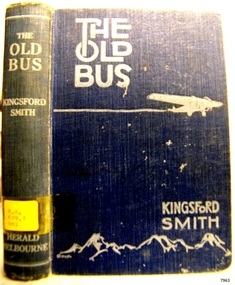
Book, The Old Bus
... engineer and later in Egypt and in France as a dispatch rider. In 1916 Kingsford Smith was transferred to the Australian Flying Corps as a sergeant. He was discharged after training...engineer and later in Egypt and in France as a dispatch rider. In 1916 Kingsford Smith was transferred to the Australian Flying Corps as a sergeant. He was discharged after training ...Sir Charles Edward Kingsford Smith is a famous Australian, well known in civil aviation history for his courageous endeavours in flight. He broken many flight records for long distance and time travelled and he was also a war hero in World War 1. He has been referred to as being “known to millions of Australians as “Smithy” … he was one of Australia’s true twentieth-century legends”. In honour of his place amongst the world’s famous pioneers his image is featured on Australia’s $20 note, Sydney airport is named after him, there is a memorial to Kingsford Smith, Taylor and Ulm at the Anderson Park, also in Sydney and his plane “Southern Cross” is on view at Brisbane Airport. Kingsford Smith wrote ‘The Old Bus’ (1932) and he and Ulm were co-authors of ‘Story of 'Southern Cross' Trans-Pacific Flight’ (1928). His also wrote a book about his own life ‘My Flying Life’ which was published after his death in 1937. and the story of his life was filmed in Australia in 1946. A BRIEF HISTORY OF SIR CHARLES EDWARD KINGSFORD SMITH (1897 – 1935) … Kingsford Smith was born 9th February 1897 in Brisbane, Queensland, Australia. His parents were William Charles Smith and Catherine Mary, nee Kingsford. His mother’s maiden name of “Kingsford” was added to the family name when they spent time in Canada from around 1903 to 1907, after which they returned to Sydney, Australia. In 1915 Kingsford Smith enlisted in Australian Imperial Force. He served in 4th Signal Troop, 2nd Division Signal Company at Gallipoli Peninsular as a ‘sapper’ or combat engineer and later in Egypt and in France as a dispatch rider. In 1916 Kingsford Smith was transferred to the Australian Flying Corps as a sergeant. He was discharged after training in England and commissioned as a second lieutenant in the Royal Flying Corps. He was appointed fling officer and soon joined the 23rd Squadron in France. He brought down four machines in his first month there and also did invaluable work attacking enemy targets. He was wounded and shot down and later awarded the Military Cross ‘for conspicuous gallantry and devotion to duty’. He was promoted to lieutenant in 1918 and served as a Flying Instructor with the R.F.C. Kingsford Smith was not allowed to participate in the 1919 England to Australia air race because of assumed lack of navigational experience. He and his pilot friend Cyril Maddocks formed a business and flew joy-flights in both England and America. In America he did some stunt flying with a Flying Circus. Kingsford Smith returned to Australia in 1921 and found employment as a pilot. He soon realised the value of air transport in such a vast country. He formed a partnership with pilot Keith Anderson in 1924 and they purchased two Bristol Tourer biplanes. Their business broadened to include Charles Ulm and became the Interstate Flying services in Sydney. Together they performed important ‘demonstration’ flights including a flight around Australia in 10 days and 5 hours using very limited navigational equipment. Kingsford Smith immediately started to search for support to do a trans-Pacific flight. This support came from the New South Wales government, Sidney Myer and G. Allan Hancock, an American oil magnate. On 31st May 1928 Kingsford Smith, Charles Ulm and two American crewmen, Harry Lyan and Jim Warner, took off from Oakland, California and flew to Brisbane via Hawaii and Suva. This historic flight took 83 hours and 38 minutes. Their Fokker plane had three engines and was named the “Southern Cross”. This amazing achievement resulted in huge financial subscriptions. Kingsford Smith was awarded the Air Force Cross and appointed as honorary squadron leader, Royal Australian Air Force. Kingsford Smith flew his Southern Cross plane from Point Cook in Victoria to Perth nonstop. Then in September – October 1928, with Charles Ulm and an Australian crew, he piloted the Southern Cross from Sidney to Christchurch New Zealand. This flight showed that was possible for regular passenger and mail services across the Tasman Sea. Kingsford Smith flew his plane to England to an order for four aircraft, planning to use them for an inter-capital air service in Australia. Sadly on 1st April 1929 he was forced to land, having lost radio contact with the ground and having run into bad weather over north – west Australia. Keith Anderson and Robert Hitchcock both perished before the search party reached them. Once official enquiries were completed the flight to England continued in June and was completed in record time of 12 days and 18 hours. In January 1930 Kingsford Smith piloted the “Southern Cloud”, one of the new Avro Ten planes, on the first flight of his airline, the Australian National Airways, from Sydney to Melbourne. The “Southern Cross” was overhauled in Holland by the Fokker Aircraft Co. and in June 1930 Kingsford Smith achieved an east-west crossing of the Atlantic from Ireland to Newfoundland in 31.5 hours. Kingsford Smith returned to England and took delivery of an Avro Avian biplane that he named the “Southern Cross Junior” and flew solo from England to Darwin, Australia. This record breaking flight took less than 10 days. He beat four other planes that had left England before him and he was 5.5 days faster than Hinkler. Sadly Kingsford Smith’s “Southern Cloud” was lost during a flight from Sydney to Melbourne in 1931 with no surviving crew or passengers; in 1958 the wreckage was discovered in the Snowy Mountains. Later that year Kingsford Smith flew his “Southern Cloud” from Australia to Timor, collecting mail from a damaged Imperial Airways plane in Timor. Other flights followed. Kingsford Smith was knighted in 1932 for his services in Aviation. He returned to selling joy flights then established the Kingsford Smith Air Service, a flying training school in Sydney. In 1933 Kingsford Smith flew the amazing record flight in “Miss Southern Cross” – a Percival Gull - from London to Wyndham in Western Australia in just over ten days. The Australian Commonwealth then gave Kingsford Smith a large grant and he was also appointed as aviation consultant to Vacuum Oil Co. Another flying record was made when Kingsford Smith and Sir P.G. Taylor flow “Lady Southern Cross” from Brisbane to San Francisco in order to sell her there; the west-east-trans-Pacific flight made aviation history. They returned to Australia to make an attempt at the trans-Tasman flight but their attempt failed due to engine failure; they managed to get back to Sydney safely, minus most of their cargo. Kingsford Smith had his unsold “Lady Southern Cross” shipped back to England, from where he and J. T. Pethybridge in the “Lady Southern Cross” attempted another record breaking flight from England The Old Bus Author: Charles Kingsford Smith Publisher: Distibuted by Herald Feature Service Date; 1932Label on spine cover with typed text RA 629.1309 KIN flagstaff hill, warrnambool, shipwrecked coast, flagstaff hill maritime museum, maritime museum, shipwreck coast, flagstaff hill maritime village, great ocean road, the old bus, charles kingsford smith
