
Showing 51 items matching "england - literature"
-
 Mrs Aeneas Gunn Memorial Library
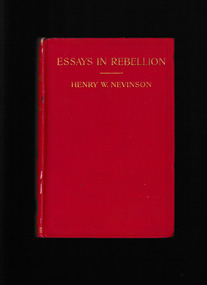
Book, Nisbet, Essays in rebellion, 1913
... England - Literature...England - Literature Socialism Henry Nevinson was a socialist. ...Henry Nevinson was a socialist. His views on injustice are detailed here in a series of essaysIndex, p.338.non-fictionHenry Nevinson was a socialist. His views on injustice are detailed here in a series of essaysengland - literature, socialism -
 Mrs Aeneas Gunn Memorial Library
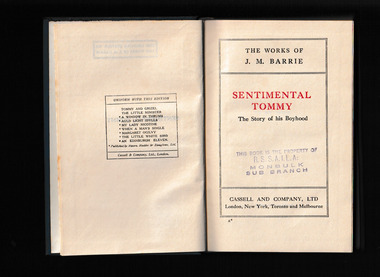
Book, JM Barrie, Sentimental Tommy : the story of his boyhood, 1896?
... England - Fiction...Children - Literature...England - Fiction Children - Literature The story of a child growing up in London p.452. ...The story of a child growing up in Londonp.452.fictionThe story of a child growing up in Londonengland - fiction, children - literature -
 Mrs Aeneas Gunn Memorial Library
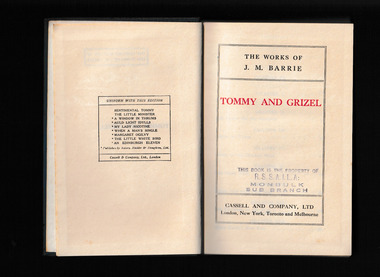
Book, JM Barrie, Tommy and Grizel, 192?
... England - Fiction...Children - Literature...England - Fiction Children - Literature The story of children growing up in London p.431. ...The story of children growing up in Londonp.431.fictionThe story of children growing up in Londonengland - fiction, children - literature -
![Book - Novel, Disraeli, Benjamin, Coningsby : or, the new generation, [n.d.] [First published 1844, date of this edition not known]](/media/collectors/641920217f0478323d8a47a8/items/65601983f86dc2f9cd2e07bc/item-media/65611b164271c4bd36b3de87/item-fit-380x285.jpg?cb=6) Linton Mechanics Institute and Free Library Collection
Linton Mechanics Institute and Free Library CollectionBook - Novel, Disraeli, Benjamin, Coningsby : or, the new generation, [n.d.] [First published 1844, date of this edition not known]
... England trilogy...English literature...Benjamin Disraeli Fiction James Dodds Original collection Young England trilogy English literature Novel set against the background of real political events of the 1830s. ...Novel set against the background of real political events of the 1830s. First of a trilogy of novels which also included the titles 'Sybil' and 'Tancred'. Dedicated to Henry Hope.346 p. : dark green cover, title and author's name spine embossed in gold on spine. Front cover embossed in black. Text on cover: 'The Works of B. Disraeli'.fictionNovel set against the background of real political events of the 1830s. First of a trilogy of novels which also included the titles 'Sybil' and 'Tancred'. Dedicated to Henry Hope.benjamin disraeli, fiction, james dodds, original collection, young england trilogy, english literature -
 Flagstaff Hill Maritime Museum and Village
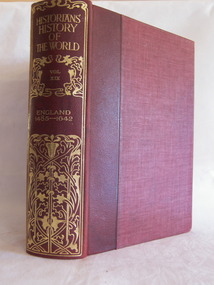
Book - Reference Book/History, Henry Smith Williams, The Historians History of the World Vol 19 set 1 - Edited by Henry Smith Williams L.L.D. Published by “The Times” 1908, 1908
... England. The Elizabethan era is well covered with a chapter on the "Golden Age," including the defeat of the Spanish Armada and the flourishing of English literature and exploration. ...England. The Elizabethan era is well covered with a chapter on the "Golden Age," including the defeat of the Spanish Armada and the flourishing of English literature and exploration. ...Henry Smith Williams’ “The Historians' History of the World” is a chronological and geographical "tapestry" of human events, these twenty five volumes occupy a very specific and prestigious place in historical research. Volume 19 is a pivotal component of the series, focusing specifically on a trans-formative era of British history from 1485 to 1642 covering the history of England from the rise of the Tudor Dynasty to the eve of the English Civil War.The Book is part of a 25 volume set with red cloth bindings and gold filigree design to rib.non-fictionHenry Smith Williams’ “The Historians' History of the World” is a chronological and geographical "tapestry" of human events, these twenty five volumes occupy a very specific and prestigious place in historical research. Volume 19 is a pivotal component of the series, focusing specifically on a trans-formative era of British history from 1485 to 1642 covering the history of England from the rise of the Tudor Dynasty to the eve of the English Civil War.flagstaff hill, warrnambool, shipwrecked-coast, flagstaff-hill-maritime-museum, maritime-museum, shipwreck-coast, flagstaff-hill-maritime-village, book, the historians history of the world vol 19 set 1, henry smith williams -
 Ballarat Clarendon College
Book
... Twenty-five books variously titled and sized including The History of England (8 vol) , Taine's History of English Literature (2 vols), and Hallam's History of England (3 vols)...Illustrated book plate inside cover of 'Longfellow's poetical works': Weatherly Library / Ballarat College / Miss E Tweedie / Mr F Tweedie 1947 Twenty-five books variously titled and sized including The History of England (8 vol) , Taine's History of English Literature (2 vols), and Hallam's History of England (3 vols) Book ...Twenty-five books donated by old collegian Francis Tweedie and possibly his sister Miss E M Tweedie. Francis Tweedie entered Ballarat College in 1889. He was the son of Mrs Tweedie 60 Doveton St, and attended with his brother Alec. The school holds no record of Miss E M Tweedie's attendance. Some of the books contain the signatures of Andrew Anderson and May Anderson. Their connection to the donors is unknown at this point. Example of ongoing old collegian support of school. The Weatherly Library was opened in 1936 and its collection significantly established by donation or bequest of old collegians.Twenty-five books variously titled and sized including The History of England (8 vol) , Taine's History of English Literature (2 vols), and Hallam's History of England (3 vols)Book plates inside front cover: Ballarat College Library / PRESENTED BY / Miss E M Tweedie and Mr F Tweedie / 1947.... Illustrated book plate inside cover of 'Longfellow's poetical works': Weatherly Library / Ballarat College / Miss E Tweedie / Mr F Tweedie 1947e-m-tweedie, francis-tweedie, weatherly-library, ballarat-college, andrew-anderson, may-anderson -
 Flagstaff Hill Maritime Museum and Village
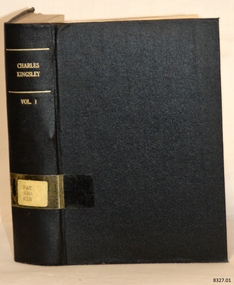
Book - Letters/Journals, Charles Kingsley, Charles Kingsley: His Letters and Memories of His Life Vol 1, 1879
... literature, religion and social reform. The very first edition of this work was published in two volumes in late 1876 (dated 1877) by Henry S. King & Co. The subject 1879 volume, published by C. Kegan Paul & Co., is a subsequent early sixth edition. It represents the first wave of popular printings issued after the copyright and printing plates were transferred to Kegan Paul. The publisher Charles Kegan Paul (1828–1902) was an author, intellectual and former Anglican clergyman. Having grown disillusioned with the Church of England...literature, religion and social reform. The very first edition of this work was published in two volumes in late 1876 (dated 1877) by Henry S. King & Co. The subject 1879 volume, published by C. Kegan Paul & Co., is a subsequent early sixth edition. It represents the first wave of popular printings issued after the copyright and printing plates were transferred to Kegan Paul. The publisher Charles Kegan Paul (1828–1902) was an author, intellectual and former Anglican clergyman. Having grown disillusioned with the Church of England ...The focus of this book is not a standard biography written by an outside observer; it is a life story told through letters and personal journals. The volume is seamlessly woven together with editorial commentary by Kingsley’s widow, Frances "Fanny" Grenfell. Because this is Volume 1, it covers the first half of Charles Kingsley's life. It documents his childhood, his time at Cambridge University, and his intense courtship of Fanny. His early career as an Anglican clergyman in the rural parish of Eversley is covered, alongside his rise to national prominence in the late 1840s and 1850s as a social reformer. The text highlights his role in the Christian Socialist movement and his writing under the pen name "Parson Lot" to advocate for the working class. It also explores the writing and reception of his famous early novels, such as Alton Locke and Yeast, which tackled themes of poverty and systemic inequality.Charles Kingsley: His Letters and Memories of His Life Vol 1 Author: Charles Kingsley Edited by his wife ( Frances "Fanny" Grenfell) Publisher: C Kegan Paul & Co Date: 1879 Further Information: Sixth Abridged Editionnon-fictionThe focus of this book is not a standard biography written by an outside observer; it is a life story told through letters and personal journals. The volume is seamlessly woven together with editorial commentary by Kingsley’s widow, Frances "Fanny" Grenfell. Because this is Volume 1, it covers the first half of Charles Kingsley's life. It documents his childhood, his time at Cambridge University, and his intense courtship of Fanny. His early career as an Anglican clergyman in the rural parish of Eversley is covered, alongside his rise to national prominence in the late 1840s and 1850s as a social reformer. The text highlights his role in the Christian Socialist movement and his writing under the pen name "Parson Lot" to advocate for the working class. It also explores the writing and reception of his famous early novels, such as Alton Locke and Yeast, which tackled themes of poverty and systemic inequality.flagstaff hill, warrnambool, shipwrecked coast, flagstaff hill maritime museum, maritime museum, shipwreck coast, flagstaff hill maritime village, great ocean road, book, pattison collection, warrnambool library, warrnambool mechanics’ institute, ralph eric pattison, corangamite regional library service, warrnambool city librarian, mechanics’ institute library, victorian library board, warrnambool books and records, warrnambool children’s library, charles kingsley: his letters and memories of his life vol 1, frances "fanny" grenfell, mrs kingsley -
 Flagstaff Hill Maritime Museum and Village
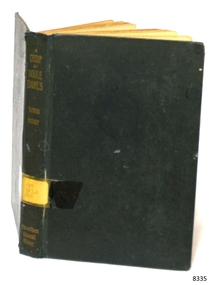
Book - Fictional Stories, Thomas Hardy, A Group of Noble Dames, 1894
... literature, famously straddling the worlds of both tragic prose and profound poetry. He was born in Higher Bockhampton, Dorset the heart of what would become his fictional "Wessex." Hardy, the son of a stonemason, initially trained and worked successfully as an ecclesiastical architect in London and Dorset before turning to writing full-time. Hardy set nearly all his major works in Wessex, a semi-fictionalized region of southwest England...literature, famously straddling the worlds of both tragic prose and profound poetry. He was born in Higher Bockhampton, Dorset the heart of what would become his fictional "Wessex." Hardy, the son of a stonemason, initially trained and worked successfully as an ecclesiastical architect in London and Dorset before turning to writing full-time. Hardy set nearly all his major works in Wessex, a semi-fictionalized region of southwest England ...The subject novel A Group of Noble Dames is a collection of ten historical short stories bound together by a classic frame narrative. The premise is that to escape the boredom of a rainy day, ten male members of the "Wessex Field and Antiquarian Club" gather together. To pass the time, each member including a local historian, an old surgeon, a rural dean, and a churchwarden takes a turn telling a scandalous, tragic, or ironic tale about a high-born lady from the local aristocracy of the 17th and 18th centuries. Unlike Hardy's deeply somber major novels, he categorized these stories as "Romances and Fantasies." However, they still contain classic Hardyan cynicism.A Group of Noble Dames Author: Thomas Hardy Publisher: Macmillan And Co Date: 1894 Further Information: Olive hardcover and spine with spine lettering in gold. The spine has a Library label with inscription.non-fictionThe subject novel A Group of Noble Dames is a collection of ten historical short stories bound together by a classic frame narrative. The premise is that to escape the boredom of a rainy day, ten male members of the "Wessex Field and Antiquarian Club" gather together. To pass the time, each member including a local historian, an old surgeon, a rural dean, and a churchwarden takes a turn telling a scandalous, tragic, or ironic tale about a high-born lady from the local aristocracy of the 17th and 18th centuries. Unlike Hardy's deeply somber major novels, he categorized these stories as "Romances and Fantasies." However, they still contain classic Hardyan cynicism.flagstaff hill, warrnambool, shipwrecked coast, flagstaff hill maritime museum, maritime museum, shipwreck coast, flagstaff hill maritime village, great ocean road, book, pattison collection, warrnambool library, warrnambool mechanics’ institute, ralph eric pattison, corangamite regional library service, warrnambool city librarian, mechanics’ institute library, victorian library board, warrnambool books and records, warrnambool children’s library, a group of noble dames, thomas hardy -
 Flagstaff Hill Maritime Museum and Village
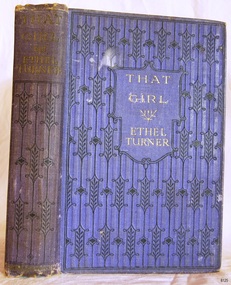
Book, That Girl
... Ethel Mary Turner Ethel Turner (25th January 1872 – 8th April 1958) was an English-born Australian novelist and children's literature writer. She was born Ethel Mary Burwell in Doncaster in England. Her father died when she was two, leaving her mother Sarah Jane Burwell with two daughters (Ethel and Lillian). ...Ethel Mary Turner Ethel Turner (25th January 1872 – 8th April 1958) was an English-born Australian novelist and children's literature writer. She was born Ethel Mary Burwell in Doncaster in England. Her father died when she was two, leaving her mother Sarah Jane Burwell with two daughters (Ethel and Lillian). ...This item is from the ‘Pattison Collection’, a collection of books and records that was originally owned by the Warrnambool Mechanics’ Institute, which was founded in Warrnambool in 1853. By 1886 the Warrnambool Mechanics’ Institute (WMI) had grown to have a Library, Museum and Fine Arts Gallery, with a collection of “… choice productions of art, and valuable specimens in almost every branch and many wonderful national curiosities are now to be seen there, including historic relics of the town and district.” It later included a School of Design. Although it was very well patronised, the lack of financial support led the WMI in 1911 to ask the City Council to take it over. In 1935 Ralph Pattison was appointed as City Librarian to establish and organise the Warrnambool Library as it was then called. When the WMI building was pulled down in 1963 a new civic building was erected on the site and the new Warrnambool Library, on behalf of the City Council, took over all the holdings of the WMI. At this time some of the items were separated and identified as the ‘Pattison Collection’, named after Ralph Pattison. Eventually the components of the WMI were distributed from the Warrnambool Library to various places, including the Art Gallery, Historical Society and Flagstaff Hill. Later some were even distributed to other regional branches of Corangamite Regional Library and passed to and fro. It is difficult now to trace just where all of the items have ended up. The books at Flagstaff Hill Maritime Village generally display stamps and markings from Pattison as well as a variety of other institutions including the Mechanics’ Institute itself. RALPH ERIC PATTISON Ralph Eric Pattison was born in Rockhampton, Queensland, in 1891. He married Maude Swan from Warrnambool in 1920 and they set up home in Warrnambool. In 1935 Pattison accepted a position as City Librarian for the Warrnambool City Council. His huge challenge was to make a functional library within two rooms of the Mechanics’ Institute. He tirelessly cleaned, cleared and sorted a disarrayed collection of old books, jars of preserved specimens and other items reserved for exhibition in the city’s museum. He developed and updated the library with a wide variety of books for all tastes, including reference books for students; a difficult task to fulfil during the years following the Depression. He converted all of the lower area of the building into a library, reference room and reading room for members and the public. The books were sorted and stored using a cataloguing and card index system that he had developed himself. He also prepared the upper floor of the building and established the Art Gallery and later the Museum, a place to exhibit the many old relics that had been stored for years for this purpose. One of the treasures he found was a beautiful ancient clock, which he repaired, restored and enjoyed using in his office during the years of his service there. Ralph Pattison was described as “a meticulous gentleman whose punctuality, floorless courtesy and distinctive neat dress were hallmarks of his character, and ‘his’ clock controlled his daily routine, and his opening and closing of the library’s large heavy doors to the minute.” Pattison took leave during 1942 to 1945 to serve in the Royal Australian Navy, Volunteer Reserve as Lieutenant. A few years later he converted one of the Museum’s rooms into a Children’s Library, stocking it with suitable books for the younger generation. This was an instant success. In the 1950’s he had the honour of being appointed to the Victorian Library Board and received more inspiration from the monthly conferences in Melbourne. He was sadly retired in 1959 after over 23 years of service, due to the fact that he had gone over the working age of council officers. However he continued to take a very keen interest in the continual development of the Library until his death in 1969. Ethel Mary Turner Ethel Turner (25th January 1872 – 8th April 1958) was an English-born Australian novelist and children's literature writer. She was born Ethel Mary Burwell in Doncaster in England. Her father died when she was two, leaving her mother Sarah Jane Burwell with two daughters (Ethel and Lillian). A year later, Ethel’s mother married Henry Turner, who was 20 years older and had six children of his own. Sarah Jane and Henry had a daughter, Rose. Henry Turner died suddenly, leaving Sarah Jane with nine children and little income. In 1879 Sarah Jane moved to Australia with Ethel, Lillian, and Rose; within the next two years she married Charles Cope and gave birth to his son Rex. Ethel Turner was educated at Paddington, New South Wales Public School and Sydney Girls High School she was one of the school's original thirty-seven pupils. Ethel started her writing career at eighteen, founding the Parthenon, a journal for young people, with her sister Lillian. Writing as “Dame Durden”, she wrote children's columns for the Illustrated Sydney News and later for the Australian Town and Country Journal. In 1891 the family moved to Woodlands, a large house in Lindfield, now Killara, which was then out in the country. Woodlands still stands today in Werona Avenue and is where she wrote “Seven Little Australians”. In 1896 Ethel married Herbert Curlewis, a lawyer. After living in Mosman, they built their own house overlooking Middle Harbour. The house, Avenel, is where Ethel Turner spent the rest of her years. She survived her daughter Jean Curlewis, who died of tuberculosis, by 28 years. Jean was also a writer of children's books, although not as popular as her mother. Jean's works include “The Ship That Never Set Sail”, “Drowning Maze”, and “Beach Beyond (1923)”. Her son Adrian, was a Barrister, Captain in WW2 and a Changi and Thai-Burma Railway POW and later a Judge. Ethel Turner died at Mosman on 8 April 1958 at 85. She is buried at Macquarie Park Her best-known work is her first novel, Seven Little Australians (1894), which is widely considered a classic of Australian children's literature and was an instant hit both in Australia and overseas. It is about a family of seven children growing up in Australia. The book, together with its sequels “The Family at Misrule” (1895) and “Little Mother Meg” (1902) that deal with the lives of the Wolcott family, particularly with its seven mischievous children in 1880s Australia. A companion to "Seven Little Australians", “Judy and Punch” was published in 1928. Like her stepfather, the character of Captain Woollcott was a widower with six children. The book was made into a feature film in Australia in 1939 and a UK television series in 1953. A 10-episode television series was made in 1973 by the Australian Broadcasting Corporation. Turner published a number of other books for children, short stories and poems. “Three Little Maids” (1900) is a strongly autobiographical novel about her family's migration from England to Sydney, Australia. Turner wrote more than forty novels. Some were about the mischievous Wolcott’s. Others were serialized, like her books on "the Cub", and some were stand-alone. The children she wrote about were all adventurous and independent. They frequently got themselves into sticky situations and got themselves out of them with very little to no adult help. Turner was awarded a number of prestigious literary awards and could be considered one of Australia's best-loved authors. She is listed on The Australian Women's Register. The Ethel Turner Prize for Young People's Literature is given annually under the auspices of the New South Wales Premier's Literary Awards. Ref Ethel Mary Turner, Biography: https://en.wikipedia.org/wiki/Ethel_Turner The Pattison Collection, along with other items at Flagstaff Hill Maritime Village, was originally part of the Warrnambool Mechanics' Institute’s collection. The Warrnambool Mechanics’ Institute Collection is primarily significant in its totality, rather than for the individual objects it contains. Its contents are highly representative of the development of Mechanics' Institute libraries across Australia, particularly Victoria. A diversity of publications and themes has been amassed, and these provide clues to our understanding of the nature of and changes in the reading habits of Victorians from the 1850s to the middle of the 20th century. The collection also highlights the Warrnambool community’s commitment to the Mechanics’ Institute, reading, literacy and learning in the regions, and proves that access to knowledge was not impeded by distance. These items help to provide a more complete picture of our community’s ideals and aspirations. The Warrnambool Mechanics Institute book collection has historical and social significance for its strong association with the Mechanics Institute movement and the important role it played in the intellectual, cultural and social development of people throughout the latter part of the nineteenth century and the early twentieth century. The collection of books is a rare example of an early lending library and its significance is enhanced by the survival of an original collection of many volumes. The Warrnambool Mechanics' Institute’s publication collection is of both local and state significance. That Girl Author: Ethel Turner Publisher: Ward, Lock & Co illustrations by Frances Ewan Date: 1920warrnambool, shipwrecked-coast, flagstaff-hill, flagstaff-hill-maritime-museum, maritime-museum, shipwreck-coast, flagstaff-hill-maritime-village, shipwrecked-artefact, book, pattison collection, warrnambool library, warrnambool mechanics’ institute, ralph eric pattison, corangamite regional library service, warrnambool city librarian, mechanics’ institute library, victorian library board, warrnambool books and records, warrnambool children’s library, great ocean road, that girl, ethel turner, frances ewan -
 Flagstaff Hill Maritime Museum and Village
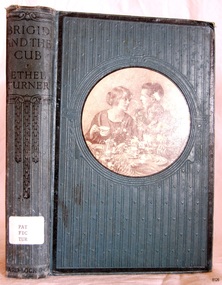
Book, Brigid and The Cub
... Ethel Mary Turner Ethel Turner (25th January 1872 – 8th April 1958) was an English-born Australian novelist and children's literature writer. She was born Ethel Mary Burwell in Doncaster in England. Her father died when she was two, leaving her mother Sarah Jane Burwell with two daughters (Ethel and Lillian). ...Ethel Mary Turner Ethel Turner (25th January 1872 – 8th April 1958) was an English-born Australian novelist and children's literature writer. She was born Ethel Mary Burwell in Doncaster in England. Her father died when she was two, leaving her mother Sarah Jane Burwell with two daughters (Ethel and Lillian). ...This item is from the ‘Pattison Collection’, a collection of books and records that was originally owned by the Warrnambool Mechanics’ Institute, which was founded in Warrnambool in 1853. By 1886 the Warrnambool Mechanics’ Institute (WMI) had grown to have a Library, Museum and Fine Arts Gallery, with a collection of “… choice productions of art, and valuable specimens in almost every branch and many wonderful national curiosities are now to be seen there, including historic relics of the town and district.” It later included a School of Design. Although it was very well patronised, the lack of financial support led the WMI in 1911 to ask the City Council to take it over. In 1935 Ralph Pattison was appointed as City Librarian to establish and organise the Warrnambool Library as it was then called. When the WMI building was pulled down in 1963 a new civic building was erected on the site and the new Warrnambool Library, on behalf of the City Council, took over all the holdings of the WMI. At this time some of the items were separated and identified as the ‘Pattison Collection’, named after Ralph Pattison. Eventually the components of the WMI were distributed from the Warrnambool Library to various places, including the Art Gallery, Historical Society and Flagstaff Hill. Later some were even distributed to other regional branches of Corangamite Regional Library and passed to and fro. It is difficult now to trace just where all of the items have ended up. The books at Flagstaff Hill Maritime Village generally display stamps and markings from Pattison as well as a variety of other institutions including the Mechanics’ Institute itself. RALPH ERIC PATTISON Ralph Eric Pattison was born in Rockhampton, Queensland, in 1891. He married Maude Swan from Warrnambool in 1920 and they set up home in Warrnambool. In 1935 Pattison accepted a position as City Librarian for the Warrnambool City Council. His huge challenge was to make a functional library within two rooms of the Mechanics’ Institute. He tirelessly cleaned, cleared and sorted a disarrayed collection of old books, jars of preserved specimens and other items reserved for exhibition in the city’s museum. He developed and updated the library with a wide variety of books for all tastes, including reference books for students; a difficult task to fulfil during the years following the Depression. He converted all of the lower area of the building into a library, reference room and reading room for members and the public. The books were sorted and stored using a cataloguing and card index system that he had developed himself. He also prepared the upper floor of the building and established the Art Gallery and later the Museum, a place to exhibit the many old relics that had been stored for years for this purpose. One of the treasures he found was a beautiful ancient clock, which he repaired, restored and enjoyed using in his office during the years of his service there. Ralph Pattison was described as “a meticulous gentleman whose punctuality, floorless courtesy and distinctive neat dress were hallmarks of his character, and ‘his’ clock controlled his daily routine, and his opening and closing of the library’s large heavy doors to the minute.” Pattison took leave during 1942 to 1945 to serve in the Royal Australian Navy, Volunteer Reserve as Lieutenant. A few years later he converted one of the Museum’s rooms into a Children’s Library, stocking it with suitable books for the younger generation. This was an instant success. In the 1950’s he had the honour of being appointed to the Victorian Library Board and received more inspiration from the monthly conferences in Melbourne. He was sadly retired in 1959 after over 23 years of service, due to the fact that he had gone over the working age of council officers. However he continued to take a very keen interest in the continual development of the Library until his death in 1969. WARRNAMBOOL'S MECHANICS' INSTITUTE Warrnambool's Mechanics' Institute (or Institution as it was sometimes called) was one of the earliest in Victoria. On 17th October 1853 a meeting was held where it was resolved to request the Lieutenant Governor of the Colony to grant land for the erection of a Mechanics' Institutes building. A committee was formed at the meeting and Richard Osburne chaired the first meeting of this committee. The land on the North West corner of Banyan and Merri Streets was granted but there were no funds to erect the building. The Formal Rights of the Warrnambool Mechanics' Institute's encompassed its aims and these were officially adopted in1859; "This Institution has for its object the diffusion of literary, scientific, and other useful knowledge amongst its members, excluding all controversial subjects, religious or political. These objects are sought to be obtained by means of a circulating library, a reading room, the establishment of classes, debates, and the occasional delivery of lectures on natural and experimental philosophy, mechanics, astronomy, chemistry, natural history, literature, and the useful and ornamental arts, particularly those which have a more immediate reference to the colony." The Warrnambool Mechanics' Institute opened its first reading room in November1884 in the National School building at the corner of Banyan and Timor Streets. The Institute was funded by member subscription, payable on a quarterly, half yearly or yearly basis. Samuel Hannaford, the Manager of the Warrnambool Bank of Australasia, was the first Honorary Secretary of the Mechanics' Institutes, and an early President and Vice-President. He also gave several of the early lectures in the Reading Room. Another early Secretary, Librarian and lecturer was Marmaduke Fisher, the teacher at the National School. Lecture topics included The Poets and Poetry of Ireland', 'The Birth and Development of the Earth', 'The Vertebrae - with Remarks on the pleasures resulting from the study of Natural History' and 'Architecture'. In 1856 the Reading Room was moved to James Hider's shop in Timor Street, and by 1864 it was located in the bookshop of Davies and Read. In the 1860's the Mechanics' Institute struggled as membership waned but in 1866, after a series of fund raising efforts, the committee was able to purchase land in Liebig Street, on a site then called Market Square, between the weighbridge and the fire station. A Mechanics' Institute building was opened at this site in August 1871. The following year four more rooms were added to the main Reading Room and in 1873 the Artisan School of Design was incorporated into the Institute. The same year Joseph Archibald established a Museum; however it deteriorated when he was transferred to Bendigo in 1877. In 1880, with Archibald's return to Warrnambool, the Museum was re-established, and in 1885 a new building was built at the back of the Institute to accommodate the re-created School of Design, the Art Gallery and the Museum. In 1887 the Museum section was moved to the former court house in Timor Street (for some time the walls of the building formed part of the TAFE cafeteria but all is now demolished)). In 1911 the Museum was transferred back to the original building and the management of the Mechanics' Institute was handed over to the Warrnambool City Council. The Museum and Art Gallery became one and housed many fine works of art, and the Library continued to grow. The building was well patronised, with records showing that at the beginning of the 20th century there were between 500 and 800 visitors. During World War One the monthly figures were in the thousands, with 3,400 people visiting in January 1915. The Museum was a much loved Institution in Warrnambool until the contents of the Museum and Art Gallery were removed to make room for the Warrnambool City Council Engineers' Department. The contents were stored but many of the items were scattered or lost. When the original building was demolished the site became occupied by the Civic Centre, which included the new City Library. (The library was temporarily located in the old Palais building in Koroit Street.) In the process of reorganisation the Collection was distributed amongst the community groups: -The new City Library took some of the historic books and some important documents, historic photographs and newspapers. -The Art Gallery kept the 19th Century art collection and some of the artefacts from the museum. -The Historic Society has some items -The State Museum has some items -Some items were destroyed -Flagstaff Hill Maritime Village has old newspapers, Government Gazettes, most of the Mechanics' Institute Library, ledgers and documents connected to the Mechanics' Institute Library, some framed and unframed art works and some photographs. The Warrnambool Mechanics' Institute Library book collection is deemed to be of great importance because it is one of the few collections in an almost intact state, and many of the books are now very rare and of great value. WARRNAMBOOL PUBLIC LIBRARY The Warrnambool Mechanics’ Institute (WMI) was formed by a voluntary community group in 1863, within six years of Warrnambool’s beginnings, and its Reading Room opened in 1854. The WMI operated until 1963, at which time it was one of the oldest Mechanics’ Institutes in Victoria. Mechanics’ Institutes offered important services to the public including libraries, reading rooms and places to display and store collections of all sorts such as curiosities and local historical relics. In 1886 a Museum and Fine Arts Gallery were added to the WMI and by the beginning of the 20th century there was also a billiards room and a School of Art. By this time all Mechanics’ Institutes in country Victoria had museums attached. Over the years the Warrnambool Mechanics’ Institute Library was also known as the Warrnambool Public Library the Warrnambool Library and the Free Library. Early funding from the government was for the “Free Library”. The inscription in a book “Science of Man” was for the “Warrnambool Public Library”, donated by Joseph Archibald in 1899. Another inscription in the book “Catalogue of Plants Under Cultivation in the Melbourne Botanic Gardens 1 & 2, 1883” was presented to the “Warrnambool Library” and signed by the author W.R. Guilfoyle. In 1903 the Warrnambool Public Library decided to add a Juvenile Department to library and stock it with hundreds of books suitable for youth. In 1905 the Public Library committee decided to update the collection of books and added 100 new novels plus arrangements for the latest novels to be included as soon as they were available in Victoria. In July 1911 the Warrnambool Council took over the management of the Public Library, Art Gallery, Museum and Mechanics’ Institute and planned to double the size of the then-current building. In 1953, when Mr. R. Pattison was Public Librarian, the Warrnambool Public Library’s senior section 10,000 of the 13,000 books were fiction. The children’s section offered an additional 3,400 books. The library had the equivalent of one book per head of population and served around 33 percent of the reading population. The collection of books was made up of around 60 percent reference and 40 percent fiction. The library was lending 400 books per day. In 1963 the Warrnambool City Council allocated the site of the Mechanics’ Institute building, which included the Public Library, Museum and Art Gallery, for the new Municipal Offices and the Collections were dispersed until 1971. The Warrnambool Library took over the Mechanics’ Institute Library’s holdings on behalf of the Warrnambool City Council. Since the closure of the Warrnambool Mechanics’ Institute the exact location and composition of the original WMI books and items has become unclear. Other materials have been added to the collection, including items from Terang MI, Warrnambool Court House and Customs House. Many of the books have been identified as the Pattison Collection, named after the Librarian who catalogued and numbered the books during his time as Warrnambool Public Librarian in the time before the Mechanics’ Institute closed. It seems that when Warrnambool became part of the Corangamite Regional Library some of the books and materials went to its head office in Colac and then back to Warrnambool where they were stored at the Art Gallery for quite some time. Some then went to the Warrnambool Historical Society, some stayed at the Art Gallery and some were moved to Flagstaff Hill Maritime Village. The various stamps and labels on the books held at Flagstaff Hill show the variety of the collection’s distribution and origin. The books in the collection at Flagstaff Hill Maritime Village date from the 1850’s to the late 1950’s and include rare and valuable volumes. Many of the books are part of the “Pattison Collection” after the Warrnambool’s Public Librarian, Mr. R. Pattison. Ethel Mary Turner Ethel Turner (25th January 1872 – 8th April 1958) was an English-born Australian novelist and children's literature writer. She was born Ethel Mary Burwell in Doncaster in England. Her father died when she was two, leaving her mother Sarah Jane Burwell with two daughters (Ethel and Lillian). A year later, Ethel’s mother married Henry Turner, who was 20 years older and had six children of his own. Sarah Jane and Henry had a daughter, Rose. Henry Turner died suddenly, leaving Sarah Jane with nine children and little income. In 1879 Sarah Jane moved to Australia with Ethel, Lillian, and Rose; within the next two years she married Charles Cope and gave birth to his son Rex. Ethel Turner was educated at Paddington, New South Wales Public School and Sydney Girls High School she was one of the school's original thirty-seven pupils. Ethel started her writing career at eighteen, founding the Parthenon, a journal for young people, with her sister Lillian. Writing as “Dame Durden”, she wrote children's columns for the Illustrated Sydney News and later for the Australian Town and Country Journal. In 1891 the family moved to Woodlands, a large house in Lindfield, now Killara, which was then out in the country. Woodlands still stands today in Werona Avenue and is where she wrote “Seven Little Australians”. In 1896 Ethel married Herbert Curlewis, a lawyer. After living in Mosman, they built their own house overlooking Middle Harbour. The house, Avenel, is where Ethel Turner spent the rest of her years. She survived her daughter Jean Curlewis, who died of tuberculosis, by 28 years. Jean was also a writer of children's books, although not as popular as her mother. Jean's works include “The Ship That Never Set Sail”, “Drowning Maze”, and “Beach Beyond (1923)”. Her son Adrian, was a Barrister, Captain in WW2 and a Changi and Thai-Burma Railway POW and later a Judge. Ethel Turner died at Mosman on 8 April 1958 at 85. She is buried at Macquarie Park Her best-known work is her first novel, Seven Little Australians (1894), which is widely considered a classic of Australian children's literature and was an instant hit both in Australia and overseas. It is about a family of seven children growing up in Australia. The book, together with its sequels “The Family at Misrule” (1895) and “Little Mother Meg” (1902) that deal with the lives of the Wolcott family, particularly with its seven mischievous children in 1880s Australia. A companion to "Seven Little Australians", “Judy and Punch” was published in 1928. Like her stepfather, the character of Captain Woollcott was a widower with six children. The book was made into a feature film in Australia in 1939 and a UK television series in 1953. A 10-episode television series was made in 1973 by the Australian Broadcasting Corporation. Turner published a number of other books for children, short stories and poems. “Three Little Maids” (1900) is a strongly autobiographical novel about her family's migration from England to Sydney, Australia. Turner wrote more than forty novels. Some were about the mischievous Wolcott’s. Others were serialized, like her books on "the Cub", and some were stand-alone. The children she wrote about were all adventurous and independent. They frequently got themselves into sticky situations and got themselves out of them with very little to no adult help. Turner was awarded a number of prestigious literary awards and could be considered one of Australia's best-loved authors. She is listed on The Australian Women's Register. The Ethel Turner Prize for Young People's Literature is given annually under the auspices of the New South Wales Premier's Literary Awards. Ref Ethel Mary Turner, Biography: https://en.wikipedia.org/wiki/Ethel_Turner The Pattison Collection, along with other items at Flagstaff Hill Maritime Village, was originally part of the Warrnambool Mechanics' Institute’s collection. The Warrnambool Mechanics’ Institute Collection is primarily significant in its totality, rather than for the individual objects it contains. Its contents are highly representative of the development of Mechanics' Institute libraries across Australia, particularly Victoria. A diversity of publications and themes has been amassed, and these provide clues to our understanding of the nature of and changes in the reading habits of Victorians from the 1850s to the middle of the 20th century. The collection also highlights the Warrnambool community’s commitment to the Mechanics’ Institute, reading, literacy and learning in the regions, and proves that access to knowledge was not impeded by distance. These items help to provide a more complete picture of our community’s ideals and aspirations. The Warrnambool Mechanics Institute book collection has historical and social significance for its strong association with the Mechanics Institute movement and the important role it played in the intellectual, cultural and social development of people throughout the latter part of the nineteenth century and the early twentieth century. The collection of books is a rare example of an early lending library and its significance is enhanced by the survival of an original collection of many volumes. The Warrnambool Mechanics' Institute’s publication collection is of both local and state significance. Brigid and The Cub Author: Ethel Turner Publisher: Ward, Lock & Co Date: 1919Label on spine cover with typed text PAT FIC TUR Pastedown front endpaper has sticker from Warrnambool Public Library covered by a sticker from Corangamite Regional Library Service Front loose endpaper has a stamp from Warrnambool Mechanics Institutewarrnambool, shipwrecked-coast, flagstaff-hill, flagstaff-hill-maritime-museum, maritime-museum, shipwreck-coast, flagstaff-hill-maritime-village, shipwrecked-artefact, book, pattison collection, warrnambool library, warrnambool mechanics’ institute, ralph eric pattison, corangamite regional library service, warrnambool city librarian, mechanics’ institute library, victorian library board, warrnambool books and records, warrnambool children’s library, great ocean road, brigid and the cub, ethel turner -
 Flagstaff Hill Maritime Museum and Village
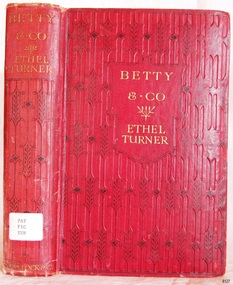
Book, Betty & Co
... Ethel Mary Turner Ethel Turner (25th January 1872 – 8th April 1958) was an English-born Australian novelist and children's literature writer. She was born Ethel Mary Burwell in Doncaster in England. Her father died when she was two, leaving her mother Sarah Jane Burwell with two daughters (Ethel and Lillian). ...Ethel Mary Turner Ethel Turner (25th January 1872 – 8th April 1958) was an English-born Australian novelist and children's literature writer. She was born Ethel Mary Burwell in Doncaster in England. Her father died when she was two, leaving her mother Sarah Jane Burwell with two daughters (Ethel and Lillian). ...This item is from the ‘Pattison Collection’, a collection of books and records that was originally owned by the Warrnambool Mechanics’ Institute, which was founded in Warrnambool in 1853. By 1886 the Warrnambool Mechanics’ Institute (WMI) had grown to have a Library, Museum and Fine Arts Gallery, with a collection of “… choice productions of art, and valuable specimens in almost every branch and many wonderful national curiosities are now to be seen there, including historic relics of the town and district.” It later included a School of Design. Although it was very well patronised, the lack of financial support led the WMI in 1911 to ask the City Council to take it over. In 1935 Ralph Pattison was appointed as City Librarian to establish and organise the Warrnambool Library as it was then called. When the WMI building was pulled down in 1963 a new civic building was erected on the site and the new Warrnambool Library, on behalf of the City Council, took over all the holdings of the WMI. At this time some of the items were separated and identified as the ‘Pattison Collection’, named after Ralph Pattison. Eventually the components of the WMI were distributed from the Warrnambool Library to various places, including the Art Gallery, Historical Society and Flagstaff Hill. Later some were even distributed to other regional branches of Corangamite Regional Library and passed to and fro. It is difficult now to trace just where all of the items have ended up. The books at Flagstaff Hill Maritime Village generally display stamps and markings from Pattison as well as a variety of other institutions including the Mechanics’ Institute itself. RALPH ERIC PATTISON Ralph Eric Pattison was born in Rockhampton, Queensland, in 1891. He married Maude Swan from Warrnambool in 1920 and they set up home in Warrnambool. In 1935 Pattison accepted a position as City Librarian for the Warrnambool City Council. His huge challenge was to make a functional library within two rooms of the Mechanics’ Institute. He tirelessly cleaned, cleared and sorted a disarrayed collection of old books, jars of preserved specimens and other items reserved for exhibition in the city’s museum. He developed and updated the library with a wide variety of books for all tastes, including reference books for students; a difficult task to fulfil during the years following the Depression. He converted all of the lower area of the building into a library, reference room and reading room for members and the public. The books were sorted and stored using a cataloguing and card index system that he had developed himself. He also prepared the upper floor of the building and established the Art Gallery and later the Museum, a place to exhibit the many old relics that had been stored for years for this purpose. One of the treasures he found was a beautiful ancient clock, which he repaired, restored and enjoyed using in his office during the years of his service there. Ralph Pattison was described as “a meticulous gentleman whose punctuality, floorless courtesy and distinctive neat dress were hallmarks of his character, and ‘his’ clock controlled his daily routine, and his opening and closing of the library’s large heavy doors to the minute.” Pattison took leave during 1942 to 1945 to serve in the Royal Australian Navy, Volunteer Reserve as Lieutenant. A few years later he converted one of the Museum’s rooms into a Children’s Library, stocking it with suitable books for the younger generation. This was an instant success. In the 1950’s he had the honour of being appointed to the Victorian Library Board and received more inspiration from the monthly conferences in Melbourne. He was sadly retired in 1959 after over 23 years of service, due to the fact that he had gone over the working age of council officers. However he continued to take a very keen interest in the continual development of the Library until his death in 1969. Ethel Mary Turner Ethel Turner (25th January 1872 – 8th April 1958) was an English-born Australian novelist and children's literature writer. She was born Ethel Mary Burwell in Doncaster in England. Her father died when she was two, leaving her mother Sarah Jane Burwell with two daughters (Ethel and Lillian). A year later, Ethel’s mother married Henry Turner, who was 20 years older and had six children of his own. Sarah Jane and Henry had a daughter, Rose. Henry Turner died suddenly, leaving Sarah Jane with nine children and little income. In 1879 Sarah Jane moved to Australia with Ethel, Lillian, and Rose; within the next two years she married Charles Cope and gave birth to his son Rex. Ethel Turner was educated at Paddington, New South Wales Public School and Sydney Girls High School she was one of the school's original thirty-seven pupils. Ethel started her writing career at eighteen, founding the Parthenon, a journal for young people, with her sister Lillian. Writing as “Dame Durden”, she wrote children's columns for the Illustrated Sydney News and later for the Australian Town and Country Journal. In 1891 the family moved to Woodlands, a large house in Lindfield, now Killara, which was then out in the country. Woodlands still stands today in Werona Avenue and is where she wrote “Seven Little Australians”. In 1896 Ethel married Herbert Curlewis, a lawyer. After living in Mosman, they built their own house overlooking Middle Harbour. The house, Avenel, is where Ethel Turner spent the rest of her years. She survived her daughter Jean Curlewis, who died of tuberculosis, by 28 years. Jean was also a writer of children's books, although not as popular as her mother. Jean's works include “The Ship That Never Set Sail”, “Drowning Maze”, and “Beach Beyond (1923)”. Her son Adrian, was a Barrister, Captain in WW2 and a Changi and Thai-Burma Railway POW and later a Judge. Ethel Turner died at Mosman on 8 April 1958 at 85. She is buried at Macquarie Park Her best-known work is her first novel, Seven Little Australians (1894), which is widely considered a classic of Australian children's literature and was an instant hit both in Australia and overseas. It is about a family of seven children growing up in Australia. The book, together with its sequels “The Family at Misrule” (1895) and “Little Mother Meg” (1902) that deal with the lives of the Wolcott family, particularly with its seven mischievous children in 1880s Australia. A companion to "Seven Little Australians", “Judy and Punch” was published in 1928. Like her stepfather, the character of Captain Woollcott was a widower with six children. The book was made into a feature film in Australia in 1939 and a UK television series in 1953. A 10-episode television series was made in 1973 by the Australian Broadcasting Corporation. Turner published a number of other books for children, short stories and poems. “Three Little Maids” (1900) is a strongly autobiographical novel about her family's migration from England to Sydney, Australia. Turner wrote more than forty novels. Some were about the mischievous Wolcott’s. Others were serialized, like her books on "the Cub", and some were stand-alone. The children she wrote about were all adventurous and independent. They frequently got themselves into sticky situations and got themselves out of them with very little to no adult help. Turner was awarded a number of prestigious literary awards and could be considered one of Australia's best-loved authors. She is listed on The Australian Women's Register. The Ethel Turner Prize for Young People's Literature is given annually under the auspices of the New South Wales Premier's Literary Awards. Ref Ethel Mary Turner, Biography: https://en.wikipedia.org/wiki/Ethel_Turner The Pattison Collection, along with other items at Flagstaff Hill Maritime Village, was originally part of the Warrnambool Mechanics' Institute’s collection. The Warrnambool Mechanics’ Institute Collection is primarily significant in its totality, rather than for the individual objects it contains. Its contents are highly representative of the development of Mechanics' Institute libraries across Australia, particularly Victoria. A diversity of publications and themes has been amassed, and these provide clues to our understanding of the nature of and changes in the reading habits of Victorians from the 1850s to the middle of the 20th century. The collection also highlights the Warrnambool community’s commitment to the Mechanics’ Institute, reading, literacy and learning in the regions, and proves that access to knowledge was not impeded by distance. These items help to provide a more complete picture of our community’s ideals and aspirations. The Warrnambool Mechanics Institute book collection has historical and social significance for its strong association with the Mechanics Institute movement and the important role it played in the intellectual, cultural and social development of people throughout the latter part of the nineteenth century and the early twentieth century. The collection of books is a rare example of an early lending library and its significance is enhanced by the survival of an original collection of many volumes. The Warrnambool Mechanics' Institute’s publication collection is of both local and state significance. Betty & Co Author: Ethel Turner Publisher: Ward, Lock & Co Date: 1903Label on spine cover with typed text PAT FIC TUR Pastedown front endpaper has sticker from Warrnambool Children’s Library covered by a sticker from Corangamite Regional Library Servicewarrnambool, shipwrecked-coast, flagstaff-hill, flagstaff-hill-maritime-museum, maritime-museum, shipwreck-coast, flagstaff-hill-maritime-village, shipwrecked-artefact, book, pattison collection, warrnambool library, warrnambool mechanics’ institute, ralph eric pattison, corangamite regional library service, warrnambool city librarian, mechanics’ institute library, victorian library board, warrnambool books and records, warrnambool children’s library, great ocean road, betty & co, ethel turner -
 Flagstaff Hill Maritime Museum and Village
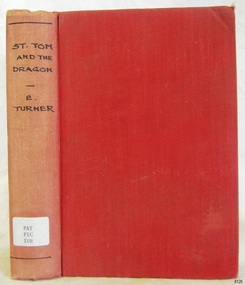
Book, St Tom and The Dragon
... Ethel Mary Turner Ethel Turner (25th January 1872 – 8th April 1958) was an English-born Australian novelist and children's literature writer. She was born Ethel Mary Burwell in Doncaster in England. Her father died when she was two, leaving her mother Sarah Jane Burwell with two daughters (Ethel and Lillian). ...Ethel Mary Turner Ethel Turner (25th January 1872 – 8th April 1958) was an English-born Australian novelist and children's literature writer. She was born Ethel Mary Burwell in Doncaster in England. Her father died when she was two, leaving her mother Sarah Jane Burwell with two daughters (Ethel and Lillian). ...This item is from the ‘Pattison Collection’, a collection of books and records that was originally owned by the Warrnambool Mechanics’ Institute, which was founded in Warrnambool in 1853. By 1886 the Warrnambool Mechanics’ Institute (WMI) had grown to have a Library, Museum and Fine Arts Gallery, with a collection of “… choice productions of art, and valuable specimens in almost every branch and many wonderful national curiosities are now to be seen there, including historic relics of the town and district.” It later included a School of Design. Although it was very well patronised, the lack of financial support led the WMI in 1911 to ask the City Council to take it over. In 1935 Ralph Pattison was appointed as City Librarian to establish and organise the Warrnambool Library as it was then called. When the WMI building was pulled down in 1963 a new civic building was erected on the site and the new Warrnambool Library, on behalf of the City Council, took over all the holdings of the WMI. At this time some of the items were separated and identified as the ‘Pattison Collection’, named after Ralph Pattison. Eventually the components of the WMI were distributed from the Warrnambool Library to various places, including the Art Gallery, Historical Society and Flagstaff Hill. Later some were even distributed to other regional branches of Corangamite Regional Library and passed to and fro. It is difficult now to trace just where all of the items have ended up. The books at Flagstaff Hill Maritime Village generally display stamps and markings from Pattison as well as a variety of other institutions including the Mechanics’ Institute itself. RALPH ERIC PATTISON Ralph Eric Pattison was born in Rockhampton, Queensland, in 1891. He married Maude Swan from Warrnambool in 1920 and they set up home in Warrnambool. In 1935 Pattison accepted a position as City Librarian for the Warrnambool City Council. His huge challenge was to make a functional library within two rooms of the Mechanics’ Institute. He tirelessly cleaned, cleared and sorted a disarrayed collection of old books, jars of preserved specimens and other items reserved for exhibition in the city’s museum. He developed and updated the library with a wide variety of books for all tastes, including reference books for students; a difficult task to fulfil during the years following the Depression. He converted all of the lower area of the building into a library, reference room and reading room for members and the public. The books were sorted and stored using a cataloguing and card index system that he had developed himself. He also prepared the upper floor of the building and established the Art Gallery and later the Museum, a place to exhibit the many old relics that had been stored for years for this purpose. One of the treasures he found was a beautiful ancient clock, which he repaired, restored and enjoyed using in his office during the years of his service there. Ralph Pattison was described as “a meticulous gentleman whose punctuality, floorless courtesy and distinctive neat dress were hallmarks of his character, and ‘his’ clock controlled his daily routine, and his opening and closing of the library’s large heavy doors to the minute.” Pattison took leave during 1942 to 1945 to serve in the Royal Australian Navy, Volunteer Reserve as Lieutenant. A few years later he converted one of the Museum’s rooms into a Children’s Library, stocking it with suitable books for the younger generation. This was an instant success. In the 1950’s he had the honour of being appointed to the Victorian Library Board and received more inspiration from the monthly conferences in Melbourne. He was sadly retired in 1959 after over 23 years of service, due to the fact that he had gone over the working age of council officers. However he continued to take a very keen interest in the continual development of the Library until his death in 1969. WARRNAMBOOL'S MECHANICS' INSTITUTE Warrnambool's Mechanics' Institute (or Institution as it was sometimes called) was one of the earliest in Victoria. On 17th October 1853 a meeting was held where it was resolved to request the Lieutenant Governor of the Colony to grant land for the erection of a Mechanics' Institutes building. A committee was formed at the meeting and Richard Osburne chaired the first meeting of this committee. The land on the North West corner of Banyan and Merri Streets was granted but there were no funds to erect the building. The Formal Rights of the Warrnambool Mechanics' Institute's encompassed its aims and these were officially adopted in1859; "This Institution has for its object the diffusion of literary, scientific, and other useful knowledge amongst its members, excluding all controversial subjects, religious or political. These objects are sought to be obtained by means of a circulating library, a reading room, the establishment of classes, debates, and the occasional delivery of lectures on natural and experimental philosophy, mechanics, astronomy, chemistry, natural history, literature, and the useful and ornamental arts, particularly those which have a more immediate reference to the colony." The Warrnambool Mechanics' Institute opened its first reading room in November1884 in the National School building at the corner of Banyan and Timor Streets. The Institute was funded by member subscription, payable on a quarterly, half yearly or yearly basis. Samuel Hannaford, the Manager of the Warrnambool Bank of Australasia, was the first Honorary Secretary of the Mechanics' Institutes, and an early President and Vice-President. He also gave several of the early lectures in the Reading Room. Another early Secretary, Librarian and lecturer was Marmaduke Fisher, the teacher at the National School. Lecture topics included The Poets and Poetry of Ireland', 'The Birth and Development of the Earth', 'The Vertebrae - with Remarks on the pleasures resulting from the study of Natural History' and 'Architecture'. In 1856 the Reading Room was moved to James Hider's shop in Timor Street, and by 1864 it was located in the bookshop of Davies and Read. In the 1860's the Mechanics' Institute struggled as membership waned but in 1866, after a series of fund raising efforts, the committee was able to purchase land in Liebig Street, on a site then called Market Square, between the weighbridge and the fire station. A Mechanics' Institute building was opened at this site in August 1871. The following year four more rooms were added to the main Reading Room and in 1873 the Artisan School of Design was incorporated into the Institute. The same year Joseph Archibald established a Museum; however it deteriorated when he was transferred to Bendigo in 1877. In 1880, with Archibald's return to Warrnambool, the Museum was re-established, and in 1885 a new building was built at the back of the Institute to accommodate the re-created School of Design, the Art Gallery and the Museum. In 1887 the Museum section was moved to the former court house in Timor Street (for some time the walls of the building formed part of the TAFE cafeteria but all is now demolished)). In 1911 the Museum was transferred back to the original building and the management of the Mechanics' Institute was handed over to the Warrnambool City Council. The Museum and Art Gallery became one and housed many fine works of art, and the Library continued to grow. The building was well patronised, with records showing that at the beginning of the 20th century there were between 500 and 800 visitors. During World War One the monthly figures were in the thousands, with 3,400 people visiting in January 1915. The Museum was a much loved Institution in Warrnambool until the contents of the Museum and Art Gallery were removed to make room for the Warrnambool City Council Engineers' Department. The contents were stored but many of the items were scattered or lost. When the original building was demolished the site became occupied by the Civic Centre, which included the new City Library. (The library was temporarily located in the old Palais building in Koroit Street.) In the process of reorganisation the Collection was distributed amongst the community groups: -The new City Library took some of the historic books and some important documents, historic photographs and newspapers. -The Art Gallery kept the 19th Century art collection and some of the artefacts from the museum. -The Historic Society has some items -The State Museum has some items -Some items were destroyed -Flagstaff Hill Maritime Village has old newspapers, Government Gazettes, most of the Mechanics' Institute Library, ledgers and documents connected to the Mechanics' Institute Library, some framed and unframed art works and some photographs. The Warrnambool Mechanics' Institute Library book collection is deemed to be of great importance because it is one of the few collections in an almost intact state, and many of the books are now very rare and of great value. Ethel Mary Turner Ethel Turner (25th January 1872 – 8th April 1958) was an English-born Australian novelist and children's literature writer. She was born Ethel Mary Burwell in Doncaster in England. Her father died when she was two, leaving her mother Sarah Jane Burwell with two daughters (Ethel and Lillian). A year later, Ethel’s mother married Henry Turner, who was 20 years older and had six children of his own. Sarah Jane and Henry had a daughter, Rose. Henry Turner died suddenly, leaving Sarah Jane with nine children and little income. In 1879 Sarah Jane moved to Australia with Ethel, Lillian, and Rose; within the next two years she married Charles Cope and gave birth to his son Rex. Ethel Turner was educated at Paddington, New South Wales Public School and Sydney Girls High School she was one of the school's original thirty-seven pupils. Ethel started her writing career at eighteen, founding the Parthenon, a journal for young people, with her sister Lillian. Writing as “Dame Durden”, she wrote children's columns for the Illustrated Sydney News and later for the Australian Town and Country Journal. In 1891 the family moved to Woodlands, a large house in Lindfield, now Killara, which was then out in the country. Woodlands still stands today in Werona Avenue and is where she wrote “Seven Little Australians”. In 1896 Ethel married Herbert Curlewis, a lawyer. After living in Mosman, they built their own house overlooking Middle Harbour. The house, Avenel, is where Ethel Turner spent the rest of her years. She survived her daughter Jean Curlewis, who died of tuberculosis, by 28 years. Jean was also a writer of children's books, although not as popular as her mother. Jean's works include “The Ship That Never Set Sail”, “Drowning Maze”, and “Beach Beyond (1923)”. Her son Adrian, was a Barrister, Captain in WW2 and a Changi and Thai-Burma Railway POW and later a Judge. Ethel Turner died at Mosman on 8 April 1958 at 85. She is buried at Macquarie Park Her best-known work is her first novel, Seven Little Australians (1894), which is widely considered a classic of Australian children's literature and was an instant hit both in Australia and overseas. It is about a family of seven children growing up in Australia. The book, together with its sequels “The Family at Misrule” (1895) and “Little Mother Meg” (1902) that deal with the lives of the Wolcott family, particularly with its seven mischievous children in 1880s Australia. A companion to "Seven Little Australians", “Judy and Punch” was published in 1928. Like her stepfather, the character of Captain Woollcott was a widower with six children. The book was made into a feature film in Australia in 1939 and a UK television series in 1953. A 10-episode television series was made in 1973 by the Australian Broadcasting Corporation. Turner published a number of other books for children, short stories and poems. “Three Little Maids” (1900) is a strongly autobiographical novel about her family's migration from England to Sydney, Australia. Turner wrote more than forty novels. Some were about the mischievous Wolcott’s. Others were serialized, like her books on "the Cub", and some were stand-alone. The children she wrote about were all adventurous and independent. They frequently got themselves into sticky situations and got themselves out of them with very little to no adult help. Turner was awarded a number of prestigious literary awards and could be considered one of Australia's best-loved authors. She is listed on The Australian Women's Register. The Ethel Turner Prize for Young People's Literature is given annually under the auspices of the New South Wales Premier's Literary Awards. Ref Ethel Mary Turner, Biography: https://en.wikipedia.org/wiki/Ethel_Turner The Pattison Collection, along with other items at Flagstaff Hill Maritime Village, was originally part of the Warrnambool Mechanics' Institute’s collection. The Warrnambool Mechanics’ Institute Collection is primarily significant in its totality, rather than for the individual objects it contains. Its contents are highly representative of the development of Mechanics' Institute libraries across Australia, particularly Victoria. A diversity of publications and themes has been amassed, and these provide clues to our understanding of the nature of and changes in the reading habits of Victorians from the 1850s to the middle of the 20th century. The collection also highlights the Warrnambool community’s commitment to the Mechanics’ Institute, reading, literacy and learning in the regions, and proves that access to knowledge was not impeded by distance. These items help to provide a more complete picture of our community’s ideals and aspirations. The Warrnambool Mechanics Institute book collection has historical and social significance for its strong association with the Mechanics Institute movement and the important role it played in the intellectual, cultural and social development of people throughout the latter part of the nineteenth century and the early twentieth century. The collection of books is a rare example of an early lending library and its significance is enhanced by the survival of an original collection of many volumes. The Warrnambool Mechanics' Institute’s publication collection is of both local and state significance. St Tom and The Dragon Author: Ethel Turner Publisher: Ward Lock & Co Date: 1918Label on spine cover with typed text PAT FIC TUR Pastedown front endpaper has sticker from Warrnambool Children’s Library covered by a sticker from Corangamite Regional Library Service Flyleaf has a stamp from Warrnambool Mechanics Institute warrnambool, shipwrecked-coast, flagstaff-hill, flagstaff-hill-maritime-museum, maritime-museum, shipwreck-coast, flagstaff-hill-maritime-village, shipwrecked-artefact, book, pattison collection, warrnambool library, warrnambool mechanics’ institute, ralph eric pattison, corangamite regional library service, warrnambool city librarian, mechanics’ institute library, victorian library board, warrnambool books and records, warrnambool children’s library, great ocean road, st tom and the dragon, ethel turner -
 Flagstaff Hill Maritime Museum and Village
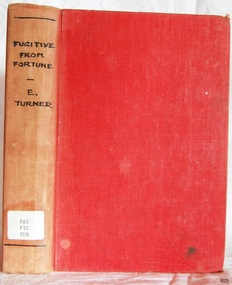
Book, Fugitives From Fortune
... Ethel Mary Turner Ethel Turner (25th January 1872 – 8th April 1958) was an English-born Australian novelist and children's literature writer. She was born Ethel Mary Burwell in Doncaster in England. Her father died when she was two, leaving her mother Sarah Jane Burwell with two daughters (Ethel and Lillian). ...Ethel Mary Turner Ethel Turner (25th January 1872 – 8th April 1958) was an English-born Australian novelist and children's literature writer. She was born Ethel Mary Burwell in Doncaster in England. Her father died when she was two, leaving her mother Sarah Jane Burwell with two daughters (Ethel and Lillian). ...This item is from the ‘Pattison Collection’, a collection of books and records that was originally owned by the Warrnambool Mechanics’ Institute, which was founded in Warrnambool in 1853. By 1886 the Warrnambool Mechanics’ Institute (WMI) had grown to have a Library, Museum and Fine Arts Gallery, with a collection of “… choice productions of art, and valuable specimens in almost every branch and many wonderful national curiosities are now to be seen there, including historic relics of the town and district.” It later included a School of Design. Although it was very well patronised, the lack of financial support led the WMI in 1911 to ask the City Council to take it over. In 1935 Ralph Pattison was appointed as City Librarian to establish and organise the Warrnambool Library as it was then called. When the WMI building was pulled down in 1963 a new civic building was erected on the site and the new Warrnambool Library, on behalf of the City Council, took over all the holdings of the WMI. At this time some of the items were separated and identified as the ‘Pattison Collection’, named after Ralph Pattison. Eventually the components of the WMI were distributed from the Warrnambool Library to various places, including the Art Gallery, Historical Society and Flagstaff Hill. Later some were even distributed to other regional branches of Corangamite Regional Library and passed to and fro. It is difficult now to trace just where all of the items have ended up. The books at Flagstaff Hill Maritime Village generally display stamps and markings from Pattison as well as a variety of other institutions including the Mechanics’ Institute itself. RALPH ERIC PATTISON Ralph Eric Pattison was born in Rockhampton, Queensland, in 1891. He married Maude Swan from Warrnambool in 1920 and they set up home in Warrnambool. In 1935 Pattison accepted a position as City Librarian for the Warrnambool City Council. His huge challenge was to make a functional library within two rooms of the Mechanics’ Institute. He tirelessly cleaned, cleared and sorted a disarrayed collection of old books, jars of preserved specimens and other items reserved for exhibition in the city’s museum. He developed and updated the library with a wide variety of books for all tastes, including reference books for students; a difficult task to fulfil during the years following the Depression. He converted all of the lower area of the building into a library, reference room and reading room for members and the public. The books were sorted and stored using a cataloguing and card index system that he had developed himself. He also prepared the upper floor of the building and established the Art Gallery and later the Museum, a place to exhibit the many old relics that had been stored for years for this purpose. One of the treasures he found was a beautiful ancient clock, which he repaired, restored and enjoyed using in his office during the years of his service there. Ralph Pattison was described as “a meticulous gentleman whose punctuality, floorless courtesy and distinctive neat dress were hallmarks of his character, and ‘his’ clock controlled his daily routine, and his opening and closing of the library’s large heavy doors to the minute.” Pattison took leave during 1942 to 1945 to serve in the Royal Australian Navy, Volunteer Reserve as Lieutenant. A few years later he converted one of the Museum’s rooms into a Children’s Library, stocking it with suitable books for the younger generation. This was an instant success. In the 1950’s he had the honour of being appointed to the Victorian Library Board and received more inspiration from the monthly conferences in Melbourne. He was sadly retired in 1959 after over 23 years of service, due to the fact that he had gone over the working age of council officers. However he continued to take a very keen interest in the continual development of the Library until his death in 1969. WARRNAMBOOL'S MECHANICS' INSTITUTE Warrnambool's Mechanics' Institute (or Institution as it was sometimes called) was one of the earliest in Victoria. On 17th October 1853 a meeting was held where it was resolved to request the Lieutenant Governor of the Colony to grant land for the erection of a Mechanics' Institutes building. A committee was formed at the meeting and Richard Osburne chaired the first meeting of this committee. The land on the North West corner of Banyan and Merri Streets was granted but there were no funds to erect the building. The Formal Rights of the Warrnambool Mechanics' Institute's encompassed its aims and these were officially adopted in1859; "This Institution has for its object the diffusion of literary, scientific, and other useful knowledge amongst its members, excluding all controversial subjects, religious or political. These objects are sought to be obtained by means of a circulating library, a reading room, the establishment of classes, debates, and the occasional delivery of lectures on natural and experimental philosophy, mechanics, astronomy, chemistry, natural history, literature, and the useful and ornamental arts, particularly those which have a more immediate reference to the colony." The Warrnambool Mechanics' Institute opened its first reading room in November1884 in the National School building at the corner of Banyan and Timor Streets. The Institute was funded by member subscription, payable on a quarterly, half yearly or yearly basis. Samuel Hannaford, the Manager of the Warrnambool Bank of Australasia, was the first Honorary Secretary of the Mechanics' Institutes, and an early President and Vice-President. He also gave several of the early lectures in the Reading Room. Another early Secretary, Librarian and lecturer was Marmaduke Fisher, the teacher at the National School. Lecture topics included The Poets and Poetry of Ireland', 'The Birth and Development of the Earth', 'The Vertebrae - with Remarks on the pleasures resulting from the study of Natural History' and 'Architecture'. In 1856 the Reading Room was moved to James Hider's shop in Timor Street, and by 1864 it was located in the bookshop of Davies and Read. In the 1860's the Mechanics' Institute struggled as membership waned but in 1866, after a series of fund raising efforts, the committee was able to purchase land in Liebig Street, on a site then called Market Square, between the weighbridge and the fire station. A Mechanics' Institute building was opened at this site in August 1871. The following year four more rooms were added to the main Reading Room and in 1873 the Artisan School of Design was incorporated into the Institute. The same year Joseph Archibald established a Museum; however it deteriorated when he was transferred to Bendigo in 1877. In 1880, with Archibald's return to Warrnambool, the Museum was re-established, and in 1885 a new building was built at the back of the Institute to accommodate the re-created School of Design, the Art Gallery and the Museum. In 1887 the Museum section was moved to the former court house in Timor Street (for some time the walls of the building formed part of the TAFE cafeteria but all is now demolished)). In 1911 the Museum was transferred back to the original building and the management of the Mechanics' Institute was handed over to the Warrnambool City Council. The Museum and Art Gallery became one and housed many fine works of art, and the Library continued to grow. The building was well patronised, with records showing that at the beginning of the 20th century there were between 500 and 800 visitors. During World War One the monthly figures were in the thousands, with 3,400 people visiting in January 1915. The Museum was a much loved Institution in Warrnambool until the contents of the Museum and Art Gallery were removed to make room for the Warrnambool City Council Engineers' Department. The contents were stored but many of the items were scattered or lost. When the original building was demolished the site became occupied by the Civic Centre, which included the new City Library. (The library was temporarily located in the old Palais building in Koroit Street.) In the process of reorganisation the Collection was distributed amongst the community groups: -The new City Library took some of the historic books and some important documents, historic photographs and newspapers. -The Art Gallery kept the 19th Century art collection and some of the artefacts from the museum. -The Historic Society has some items -The State Museum has some items -Some items were destroyed -Flagstaff Hill Maritime Village has old newspapers, Government Gazettes, most of the Mechanics' Institute Library, ledgers and documents connected to the Mechanics' Institute Library, some framed and unframed art works and some photographs. The Warrnambool Mechanics' Institute Library book collection is deemed to be of great importance because it is one of the few collections in an almost intact state, and many of the books are now very rare and of great value. Ethel Mary Turner Ethel Turner (25th January 1872 – 8th April 1958) was an English-born Australian novelist and children's literature writer. She was born Ethel Mary Burwell in Doncaster in England. Her father died when she was two, leaving her mother Sarah Jane Burwell with two daughters (Ethel and Lillian). A year later, Ethel’s mother married Henry Turner, who was 20 years older and had six children of his own. Sarah Jane and Henry had a daughter, Rose. Henry Turner died suddenly, leaving Sarah Jane with nine children and little income. In 1879 Sarah Jane moved to Australia with Ethel, Lillian, and Rose; within the next two years she married Charles Cope and gave birth to his son Rex. Ethel Turner was educated at Paddington, New South Wales Public School and Sydney Girls High School she was one of the school's original thirty-seven pupils. Ethel started her writing career at eighteen, founding the Parthenon, a journal for young people, with her sister Lillian. Writing as “Dame Durden”, she wrote children's columns for the Illustrated Sydney News and later for the Australian Town and Country Journal. In 1891 the family moved to Woodlands, a large house in Lindfield, now Killara, which was then out in the country. Woodlands still stands today in Werona Avenue and is where she wrote “Seven Little Australians”. In 1896 Ethel married Herbert Curlewis, a lawyer. After living in Mosman, they built their own house overlooking Middle Harbour. The house, Avenel, is where Ethel Turner spent the rest of her years. She survived her daughter Jean Curlewis, who died of tuberculosis, by 28 years. Jean was also a writer of children's books, although not as popular as her mother. Jean's works include “The Ship That Never Set Sail”, “Drowning Maze”, and “Beach Beyond (1923)”. Her son Adrian, was a Barrister, Captain in WW2 and a Changi and Thai-Burma Railway POW and later a Judge. Ethel Turner died at Mosman on 8 April 1958 at 85. She is buried at Macquarie Park Her best-known work is her first novel, Seven Little Australians (1894), which is widely considered a classic of Australian children's literature and was an instant hit both in Australia and overseas. It is about a family of seven children growing up in Australia. The book, together with its sequels “The Family at Misrule” (1895) and “Little Mother Meg” (1902) that deal with the lives of the Wolcott family, particularly with its seven mischievous children in 1880s Australia. A companion to "Seven Little Australians", “Judy and Punch” was published in 1928. Like her stepfather, the character of Captain Woollcott was a widower with six children. The book was made into a feature film in Australia in 1939 and a UK television series in 1953. A 10-episode television series was made in 1973 by the Australian Broadcasting Corporation. Turner published a number of other books for children, short stories and poems. “Three Little Maids” (1900) is a strongly autobiographical novel about her family's migration from England to Sydney, Australia. Turner wrote more than forty novels. Some were about the mischievous Wolcott’s. Others were serialized, like her books on "the Cub", and some were stand-alone. The children she wrote about were all adventurous and independent. They frequently got themselves into sticky situations and got themselves out of them with very little to no adult help. Turner was awarded a number of prestigious literary awards and could be considered one of Australia's best-loved authors. She is listed on The Australian Women's Register. The Ethel Turner Prize for Young People's Literature is given annually under the auspices of the New South Wales Premier's Literary Awards. Ref Ethel Mary Turner, Biography: https://en.wikipedia.org/wiki/Ethel_Turner The Pattison Collection, along with other items at Flagstaff Hill Maritime Village, was originally part of the Warrnambool Mechanics' Institute’s collection. The Warrnambool Mechanics’ Institute Collection is primarily significant in its totality, rather than for the individual objects it contains. Its contents are highly representative of the development of Mechanics' Institute libraries across Australia, particularly Victoria. A diversity of publications and themes has been amassed, and these provide clues to our understanding of the nature of and changes in the reading habits of Victorians from the 1850s to the middle of the 20th century. The collection also highlights the Warrnambool community’s commitment to the Mechanics’ Institute, reading, literacy and learning in the regions, and proves that access to knowledge was not impeded by distance. These items help to provide a more complete picture of our community’s ideals and aspirations. The Warrnambool Mechanics Institute book collection has historical and social significance for its strong association with the Mechanics Institute movement and the important role it played in the intellectual, cultural and social development of people throughout the latter part of the nineteenth century and the early twentieth century. The collection of books is a rare example of an early lending library and its significance is enhanced by the survival of an original collection of many volumes. The Warrnambool Mechanics' Institute’s publication collection is of both local and state significance. Fugitives From Fortune Author: Ethel Turner Publisher: Ward, Lock & Co Date: 1909Label on spine cover with typed text PAT FIC TUR Pastedown front endpaper has sticker from Warrnambool Children’s Library covered by a sticker from Corangamite Regional Library Service Flyleaf has a stamp from Warrnambool Mechanics Institute warrnambool, shipwrecked-coast, flagstaff-hill, flagstaff-hill-maritime-museum, maritime-museum, shipwreck-coast, flagstaff-hill-maritime-village, shipwrecked-artefact, book, pattison collection, warrnambool library, warrnambool mechanics’ institute, ralph eric pattison, corangamite regional library service, warrnambool city librarian, mechanics’ institute library, victorian library board, warrnambool books and records, warrnambool children’s library, great ocean road, fugitives from fortune, ethel turner -
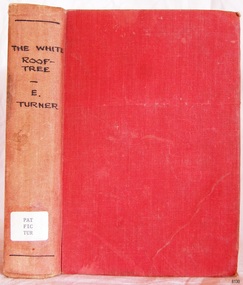 Flagstaff Hill Maritime Museum and Village
Book, A White Roof-Tree
... Ethel Mary Turner Ethel Turner (25th January 1872 – 8th April 1958) was an English-born Australian novelist and children's literature writer. She was born Ethel Mary Burwell in Doncaster in England. Her father died when she was two, leaving her mother Sarah Jane Burwell with two daughters (Ethel and Lillian). ...Ethel Mary Turner Ethel Turner (25th January 1872 – 8th April 1958) was an English-born Australian novelist and children's literature writer. She was born Ethel Mary Burwell in Doncaster in England. Her father died when she was two, leaving her mother Sarah Jane Burwell with two daughters (Ethel and Lillian). ...This item is from the ‘Pattison Collection’, a collection of books and records that was originally owned by the Warrnambool Mechanics’ Institute, which was founded in Warrnambool in 1853. By 1886 the Warrnambool Mechanics’ Institute (WMI) had grown to have a Library, Museum and Fine Arts Gallery, with a collection of “… choice productions of art, and valuable specimens in almost every branch and many wonderful national curiosities are now to be seen there, including historic relics of the town and district.” It later included a School of Design. Although it was very well patronised, the lack of financial support led the WMI in 1911 to ask the City Council to take it over. In 1935 Ralph Pattison was appointed as City Librarian to establish and organise the Warrnambool Library as it was then called. When the WMI building was pulled down in 1963 a new civic building was erected on the site and the new Warrnambool Library, on behalf of the City Council, took over all the holdings of the WMI. At this time some of the items were separated and identified as the ‘Pattison Collection’, named after Ralph Pattison. Eventually the components of the WMI were distributed from the Warrnambool Library to various places, including the Art Gallery, Historical Society and Flagstaff Hill. Later some were even distributed to other regional branches of Corangamite Regional Library and passed to and fro. It is difficult now to trace just where all of the items have ended up. The books at Flagstaff Hill Maritime Village generally display stamps and markings from Pattison as well as a variety of other institutions including the Mechanics’ Institute itself. RALPH ERIC PATTISON Ralph Eric Pattison was born in Rockhampton, Queensland, in 1891. He married Maude Swan from Warrnambool in 1920 and they set up home in Warrnambool. In 1935 Pattison accepted a position as City Librarian for the Warrnambool City Council. His huge challenge was to make a functional library within two rooms of the Mechanics’ Institute. He tirelessly cleaned, cleared and sorted a disarrayed collection of old books, jars of preserved specimens and other items reserved for exhibition in the city’s museum. He developed and updated the library with a wide variety of books for all tastes, including reference books for students; a difficult task to fulfil during the years following the Depression. He converted all of the lower area of the building into a library, reference room and reading room for members and the public. The books were sorted and stored using a cataloguing and card index system that he had developed himself. He also prepared the upper floor of the building and established the Art Gallery and later the Museum, a place to exhibit the many old relics that had been stored for years for this purpose. One of the treasures he found was a beautiful ancient clock, which he repaired, restored and enjoyed using in his office during the years of his service there. Ralph Pattison was described as “a meticulous gentleman whose punctuality, floorless courtesy and distinctive neat dress were hallmarks of his character, and ‘his’ clock controlled his daily routine, and his opening and closing of the library’s large heavy doors to the minute.” Pattison took leave during 1942 to 1945 to serve in the Royal Australian Navy, Volunteer Reserve as Lieutenant. A few years later he converted one of the Museum’s rooms into a Children’s Library, stocking it with suitable books for the younger generation. This was an instant success. In the 1950’s he had the honour of being appointed to the Victorian Library Board and received more inspiration from the monthly conferences in Melbourne. He was sadly retired in 1959 after over 23 years of service, due to the fact that he had gone over the working age of council officers. However he continued to take a very keen interest in the continual development of the Library until his death in 1969. Ethel Mary Turner Ethel Turner (25th January 1872 – 8th April 1958) was an English-born Australian novelist and children's literature writer. She was born Ethel Mary Burwell in Doncaster in England. Her father died when she was two, leaving her mother Sarah Jane Burwell with two daughters (Ethel and Lillian). A year later, Ethel’s mother married Henry Turner, who was 20 years older and had six children of his own. Sarah Jane and Henry had a daughter, Rose. Henry Turner died suddenly, leaving Sarah Jane with nine children and little income. In 1879 Sarah Jane moved to Australia with Ethel, Lillian, and Rose; within the next two years she married Charles Cope and gave birth to his son Rex. Ethel Turner was educated at Paddington, New South Wales Public School and Sydney Girls High School she was one of the school's original thirty-seven pupils. Ethel started her writing career at eighteen, founding the Parthenon, a journal for young people, with her sister Lillian. Writing as “Dame Durden”, she wrote children's columns for the Illustrated Sydney News and later for the Australian Town and Country Journal. In 1891 the family moved to Woodlands, a large house in Lindfield, now Killara, which was then out in the country. Woodlands still stands today in Werona Avenue and is where she wrote “Seven Little Australians”. In 1896 Ethel married Herbert Curlewis, a lawyer. After living in Mosman, they built their own house overlooking Middle Harbour. The house, Avenel, is where Ethel Turner spent the rest of her years. She survived her daughter Jean Curlewis, who died of tuberculosis, by 28 years. Jean was also a writer of children's books, although not as popular as her mother. Jean's works include “The Ship That Never Set Sail”, “Drowning Maze”, and “Beach Beyond (1923)”. Her son Adrian, was a Barrister, Captain in WW2 and a Changi and Thai-Burma Railway POW and later a Judge. Ethel Turner died at Mosman on 8 April 1958 at 85. She is buried at Macquarie Park Her best-known work is her first novel, Seven Little Australians (1894), which is widely considered a classic of Australian children's literature and was an instant hit both in Australia and overseas. It is about a family of seven children growing up in Australia. The book, together with its sequels “The Family at Misrule” (1895) and “Little Mother Meg” (1902) that deal with the lives of the Wolcott family, particularly with its seven mischievous children in 1880s Australia. A companion to "Seven Little Australians", “Judy and Punch” was published in 1928. Like her stepfather, the character of Captain Woollcott was a widower with six children. The book was made into a feature film in Australia in 1939 and a UK television series in 1953. A 10-episode television series was made in 1973 by the Australian Broadcasting Corporation. Turner published a number of other books for children, short stories and poems. “Three Little Maids” (1900) is a strongly autobiographical novel about her family's migration from England to Sydney, Australia. Turner wrote more than forty novels. Some were about the mischievous Wolcott’s. Others were serialized, like her books on "the Cub", and some were stand-alone. The children she wrote about were all adventurous and independent. They frequently got themselves into sticky situations and got themselves out of them with very little to no adult help. Turner was awarded a number of prestigious literary awards and could be considered one of Australia's best-loved authors. She is listed on The Australian Women's Register. The Ethel Turner Prize for Young People's Literature is given annually under the auspices of the New South Wales Premier's Literary Awards. Ref Ethel Mary Turner, Biography: https://en.wikipedia.org/wiki/Ethel_Turner The Pattison Collection, along with other items at Flagstaff Hill Maritime Village, was originally part of the Warrnambool Mechanics' Institute’s collection. The Warrnambool Mechanics’ Institute Collection is primarily significant in its totality, rather than for the individual objects it contains. Its contents are highly representative of the development of Mechanics' Institute libraries across Australia, particularly Victoria. A diversity of publications and themes has been amassed, and these provide clues to our understanding of the nature of and changes in the reading habits of Victorians from the 1850s to the middle of the 20th century. The collection also highlights the Warrnambool community’s commitment to the Mechanics’ Institute, reading, literacy and learning in the regions, and proves that access to knowledge was not impeded by distance. These items help to provide a more complete picture of our community’s ideals and aspirations. The Warrnambool Mechanics Institute book collection has historical and social significance for its strong association with the Mechanics Institute movement and the important role it played in the intellectual, cultural and social development of people throughout the latter part of the nineteenth century and the early twentieth century. The collection of books is a rare example of an early lending library and its significance is enhanced by the survival of an original collection of many volumes. The Warrnambool Mechanics' Institute’s publication collection is of both local and state significance. A White Roof-Tree Author: Ethel Turner Publisher: Ward, Lock & Co Date: 1905Label on spine cover with typed text PAT FIC TUR Pastedown front endpaper has sticker from Warrnambool Children’s Library covered by a sticker from Corangamite Regional Library Servicewarrnambool, shipwrecked-coast, flagstaff-hill, flagstaff-hill-maritime-museum, maritime-museum, shipwreck-coast, flagstaff-hill-maritime-village, shipwrecked-artefact, book, pattison collection, warrnambool library, warrnambool mechanics’ institute, ralph eric pattison, corangamite regional library service, warrnambool city librarian, mechanics’ institute library, victorian library board, warrnambool books and records, warrnambool children’s library, great ocean road, a white roof-tree, ethel turner -
 Flagstaff Hill Maritime Museum and Village
Book, Fair Ines
... Ethel Mary Turner Ethel Turner (25th January 1872 – 8th April 1958) was an English-born Australian novelist and children's literature writer. She was born Ethel Mary Burwell in Doncaster in England. Her father died when she was two, leaving her mother Sarah Jane Burwell with two daughters (Ethel and Lillian). ...Ethel Mary Turner Ethel Turner (25th January 1872 – 8th April 1958) was an English-born Australian novelist and children's literature writer. She was born Ethel Mary Burwell in Doncaster in England. Her father died when she was two, leaving her mother Sarah Jane Burwell with two daughters (Ethel and Lillian). ...This item is from the ‘Pattison Collection’, a collection of books and records that was originally owned by the Warrnambool Mechanics’ Institute, which was founded in Warrnambool in 1853. By 1886 the Warrnambool Mechanics’ Institute (WMI) had grown to have a Library, Museum and Fine Arts Gallery, with a collection of “… choice productions of art, and valuable specimens in almost every branch and many wonderful national curiosities are now to be seen there, including historic relics of the town and district.” It later included a School of Design. Although it was very well patronised, the lack of financial support led the WMI in 1911 to ask the City Council to take it over. In 1935 Ralph Pattison was appointed as City Librarian to establish and organise the Warrnambool Library as it was then called. When the WMI building was pulled down in 1963 a new civic building was erected on the site and the new Warrnambool Library, on behalf of the City Council, took over all the holdings of the WMI. At this time some of the items were separated and identified as the ‘Pattison Collection’, named after Ralph Pattison. Eventually the components of the WMI were distributed from the Warrnambool Library to various places, including the Art Gallery, Historical Society and Flagstaff Hill. Later some were even distributed to other regional branches of Corangamite Regional Library and passed to and fro. It is difficult now to trace just where all of the items have ended up. The books at Flagstaff Hill Maritime Village generally display stamps and markings from Pattison as well as a variety of other institutions including the Mechanics’ Institute itself. RALPH ERIC PATTISON Ralph Eric Pattison was born in Rockhampton, Queensland, in 1891. He married Maude Swan from Warrnambool in 1920 and they set up home in Warrnambool. In 1935 Pattison accepted a position as City Librarian for the Warrnambool City Council. His huge challenge was to make a functional library within two rooms of the Mechanics’ Institute. He tirelessly cleaned, cleared and sorted a disarrayed collection of old books, jars of preserved specimens and other items reserved for exhibition in the city’s museum. He developed and updated the library with a wide variety of books for all tastes, including reference books for students; a difficult task to fulfil during the years following the Depression. He converted all of the lower area of the building into a library, reference room and reading room for members and the public. The books were sorted and stored using a cataloguing and card index system that he had developed himself. He also prepared the upper floor of the building and established the Art Gallery and later the Museum, a place to exhibit the many old relics that had been stored for years for this purpose. One of the treasures he found was a beautiful ancient clock, which he repaired, restored and enjoyed using in his office during the years of his service there. Ralph Pattison was described as “a meticulous gentleman whose punctuality, floorless courtesy and distinctive neat dress were hallmarks of his character, and ‘his’ clock controlled his daily routine, and his opening and closing of the library’s large heavy doors to the minute.” Pattison took leave during 1942 to 1945 to serve in the Royal Australian Navy, Volunteer Reserve as Lieutenant. A few years later he converted one of the Museum’s rooms into a Children’s Library, stocking it with suitable books for the younger generation. This was an instant success. In the 1950’s he had the honour of being appointed to the Victorian Library Board and received more inspiration from the monthly conferences in Melbourne. He was sadly retired in 1959 after over 23 years of service, due to the fact that he had gone over the working age of council officers. However he continued to take a very keen interest in the continual development of the Library until his death in 1969. WARRNAMBOOL'S MECHANICS' INSTITUTE Warrnambool's Mechanics' Institute (or Institution as it was sometimes called) was one of the earliest in Victoria. On 17th October 1853 a meeting was held where it was resolved to request the Lieutenant Governor of the Colony to grant land for the erection of a Mechanics' Institutes building. A committee was formed at the meeting and Richard Osburne chaired the first meeting of this committee. The land on the North West corner of Banyan and Merri Streets was granted but there were no funds to erect the building. The Formal Rights of the Warrnambool Mechanics' Institute's encompassed its aims and these were officially adopted in1859; "This Institution has for its object the diffusion of literary, scientific, and other useful knowledge amongst its members, excluding all controversial subjects, religious or political. These objects are sought to be obtained by means of a circulating library, a reading room, the establishment of classes, debates, and the occasional delivery of lectures on natural and experimental philosophy, mechanics, astronomy, chemistry, natural history, literature, and the useful and ornamental arts, particularly those which have a more immediate reference to the colony." The Warrnambool Mechanics' Institute opened its first reading room in November1884 in the National School building at the corner of Banyan and Timor Streets. The Institute was funded by member subscription, payable on a quarterly, half yearly or yearly basis. Samuel Hannaford, the Manager of the Warrnambool Bank of Australasia, was the first Honorary Secretary of the Mechanics' Institutes, and an early President and Vice-President. He also gave several of the early lectures in the Reading Room. Another early Secretary, Librarian and lecturer was Marmaduke Fisher, the teacher at the National School. Lecture topics included The Poets and Poetry of Ireland', 'The Birth and Development of the Earth', 'The Vertebrae - with Remarks on the pleasures resulting from the study of Natural History' and 'Architecture'. In 1856 the Reading Room was moved to James Hider's shop in Timor Street, and by 1864 it was located in the bookshop of Davies and Read. In the 1860's the Mechanics' Institute struggled as membership waned but in 1866, after a series of fund raising efforts, the committee was able to purchase land in Liebig Street, on a site then called Market Square, between the weighbridge and the fire station. A Mechanics' Institute building was opened at this site in August 1871. The following year four more rooms were added to the main Reading Room and in 1873 the Artisan School of Design was incorporated into the Institute. The same year Joseph Archibald established a Museum; however it deteriorated when he was transferred to Bendigo in 1877. In 1880, with Archibald's return to Warrnambool, the Museum was re-established, and in 1885 a new building was built at the back of the Institute to accommodate the re-created School of Design, the Art Gallery and the Museum. In 1887 the Museum section was moved to the former court house in Timor Street (for some time the walls of the building formed part of the TAFE cafeteria but all is now demolished)). In 1911 the Museum was transferred back to the original building and the management of the Mechanics' Institute was handed over to the Warrnambool City Council. The Museum and Art Gallery became one and housed many fine works of art, and the Library continued to grow. The building was well patronised, with records showing that at the beginning of the 20th century there were between 500 and 800 visitors. During World War One the monthly figures were in the thousands, with 3,400 people visiting in January 1915. The Museum was a much loved Institution in Warrnambool until the contents of the Museum and Art Gallery were removed to make room for the Warrnambool City Council Engineers' Department. The contents were stored but many of the items were scattered or lost. When the original building was demolished the site became occupied by the Civic Centre, which included the new City Library. (The library was temporarily located in the old Palais building in Koroit Street.) In the process of reorganisation the Collection was distributed amongst the community groups: -The new City Library took some of the historic books and some important documents, historic photographs and newspapers. -The Art Gallery kept the 19th Century art collection and some of the artefacts from the museum. -The Historic Society has some items -The State Museum has some items -Some items were destroyed -Flagstaff Hill Maritime Village has old newspapers, Government Gazettes, most of the Mechanics' Institute Library, ledgers and documents connected to the Mechanics' Institute Library, some framed and unframed art works and some photographs. The Warrnambool Mechanics' Institute Library book collection is deemed to be of great importance because it is one of the few collections in an almost intact state, and many of the books are now very rare and of great value. Ethel Mary Turner Ethel Turner (25th January 1872 – 8th April 1958) was an English-born Australian novelist and children's literature writer. She was born Ethel Mary Burwell in Doncaster in England. Her father died when she was two, leaving her mother Sarah Jane Burwell with two daughters (Ethel and Lillian). A year later, Ethel’s mother married Henry Turner, who was 20 years older and had six children of his own. Sarah Jane and Henry had a daughter, Rose. Henry Turner died suddenly, leaving Sarah Jane with nine children and little income. In 1879 Sarah Jane moved to Australia with Ethel, Lillian, and Rose; within the next two years she married Charles Cope and gave birth to his son Rex. Ethel Turner was educated at Paddington, New South Wales Public School and Sydney Girls High School she was one of the school's original thirty-seven pupils. Ethel started her writing career at eighteen, founding the Parthenon, a journal for young people, with her sister Lillian. Writing as “Dame Durden”, she wrote children's columns for the Illustrated Sydney News and later for the Australian Town and Country Journal. In 1891 the family moved to Woodlands, a large house in Lindfield, now Killara, which was then out in the country. Woodlands still stands today in Werona Avenue and is where she wrote “Seven Little Australians”. In 1896 Ethel married Herbert Curlewis, a lawyer. After living in Mosman, they built their own house overlooking Middle Harbour. The house, Avenel, is where Ethel Turner spent the rest of her years. She survived her daughter Jean Curlewis, who died of tuberculosis, by 28 years. Jean was also a writer of children's books, although not as popular as her mother. Jean's works include “The Ship That Never Set Sail”, “Drowning Maze”, and “Beach Beyond (1923)”. Her son Adrian, was a Barrister, Captain in WW2 and a Changi and Thai-Burma Railway POW and later a Judge. Ethel Turner died at Mosman on 8 April 1958 at 85. She is buried at Macquarie Park Her best-known work is her first novel, Seven Little Australians (1894), which is widely considered a classic of Australian children's literature and was an instant hit both in Australia and overseas. It is about a family of seven children growing up in Australia. The book, together with its sequels “The Family at Misrule” (1895) and “Little Mother Meg” (1902) that deal with the lives of the Wolcott family, particularly with its seven mischievous children in 1880s Australia. A companion to "Seven Little Australians", “Judy and Punch” was published in 1928. Like her stepfather, the character of Captain Woollcott was a widower with six children. The book was made into a feature film in Australia in 1939 and a UK television series in 1953. A 10-episode television series was made in 1973 by the Australian Broadcasting Corporation. Turner published a number of other books for children, short stories and poems. “Three Little Maids” (1900) is a strongly autobiographical novel about her family's migration from England to Sydney, Australia. Turner wrote more than forty novels. Some were about the mischievous Wolcott’s. Others were serialized, like her books on "the Cub", and some were stand-alone. The children she wrote about were all adventurous and independent. They frequently got themselves into sticky situations and got themselves out of them with very little to no adult help. Turner was awarded a number of prestigious literary awards and could be considered one of Australia's best-loved authors. She is listed on The Australian Women's Register. The Ethel Turner Prize for Young People's Literature is given annually under the auspices of the New South Wales Premier's Literary Awards. Ref Ethel Mary Turner, Biography: https://en.wikipedia.org/wiki/Ethel_Turner The Pattison Collection, along with other items at Flagstaff Hill Maritime Village, was originally part of the Warrnambool Mechanics' Institute’s collection. The Warrnambool Mechanics’ Institute Collection is primarily significant in its totality, rather than for the individual objects it contains. Its contents are highly representative of the development of Mechanics' Institute libraries across Australia, particularly Victoria. A diversity of publications and themes has been amassed, and these provide clues to our understanding of the nature of and changes in the reading habits of Victorians from the 1850s to the middle of the 20th century. The collection also highlights the Warrnambool community’s commitment to the Mechanics’ Institute, reading, literacy and learning in the regions, and proves that access to knowledge was not impeded by distance. These items help to provide a more complete picture of our community’s ideals and aspirations. The Warrnambool Mechanics Institute book collection has historical and social significance for its strong association with the Mechanics Institute movement and the important role it played in the intellectual, cultural and social development of people throughout the latter part of the nineteenth century and the early twentieth century. The collection of books is a rare example of an early lending library and its significance is enhanced by the survival of an original collection of many volumes. The Warrnambool Mechanics' Institute’s publication collection is of both local and state significance. Fair Ines Author: Ethel Turner Publisher: Hodder & Stoughton Date: 1910Label on spine cover with typed text PAT FIC TUR Pastedown front endpaper has sticker from Warrnambool Children’s Library covered by a sticker from Corangamite Regional Library Service Flyleaf has a stamp from Warrnambool Mechanics Institute warrnambool, shipwrecked-coast, flagstaff-hill, flagstaff-hill-maritime-museum, maritime-museum, shipwreck-coast, flagstaff-hill-maritime-village, shipwrecked-artefact, book, pattison collection, warrnambool library, warrnambool mechanics’ institute, ralph eric pattison, corangamite regional library service, warrnambool city librarian, mechanics’ institute library, victorian library board, warrnambool books and records, warrnambool children’s library, great ocean road, ethel turner, fair ines -
 Flagstaff Hill Maritime Museum and Village
Book, King Anne
... Ethel Mary Turner Ethel Turner (25th January 1872 – 8th April 1958) was an English-born Australian novelist and children's literature writer. She was born Ethel Mary Burwell in Doncaster in England. Her father died when she was two, leaving her mother Sarah Jane Burwell with two daughters (Ethel and Lillian). ...Ethel Mary Turner Ethel Turner (25th January 1872 – 8th April 1958) was an English-born Australian novelist and children's literature writer. She was born Ethel Mary Burwell in Doncaster in England. Her father died when she was two, leaving her mother Sarah Jane Burwell with two daughters (Ethel and Lillian). ...This item is from the ‘Pattison Collection’, a collection of books and records that was originally owned by the Warrnambool Mechanics’ Institute, which was founded in Warrnambool in 1853. By 1886 the Warrnambool Mechanics’ Institute (WMI) had grown to have a Library, Museum and Fine Arts Gallery, with a collection of “… choice productions of art, and valuable specimens in almost every branch and many wonderful national curiosities are now to be seen there, including historic relics of the town and district.” It later included a School of Design. Although it was very well patronised, the lack of financial support led the WMI in 1911 to ask the City Council to take it over. In 1935 Ralph Pattison was appointed as City Librarian to establish and organise the Warrnambool Library as it was then called. When the WMI building was pulled down in 1963 a new civic building was erected on the site and the new Warrnambool Library, on behalf of the City Council, took over all the holdings of the WMI. At this time some of the items were separated and identified as the ‘Pattison Collection’, named after Ralph Pattison. Eventually the components of the WMI were distributed from the Warrnambool Library to various places, including the Art Gallery, Historical Society and Flagstaff Hill. Later some were even distributed to other regional branches of Corangamite Regional Library and passed to and fro. It is difficult now to trace just where all of the items have ended up. The books at Flagstaff Hill Maritime Village generally display stamps and markings from Pattison as well as a variety of other institutions including the Mechanics’ Institute itself. RALPH ERIC PATTISON Ralph Eric Pattison was born in Rockhampton, Queensland, in 1891. He married Maude Swan from Warrnambool in 1920 and they set up home in Warrnambool. In 1935 Pattison accepted a position as City Librarian for the Warrnambool City Council. His huge challenge was to make a functional library within two rooms of the Mechanics’ Institute. He tirelessly cleaned, cleared and sorted a disarrayed collection of old books, jars of preserved specimens and other items reserved for exhibition in the city’s museum. He developed and updated the library with a wide variety of books for all tastes, including reference books for students; a difficult task to fulfil during the years following the Depression. He converted all of the lower area of the building into a library, reference room and reading room for members and the public. The books were sorted and stored using a cataloguing and card index system that he had developed himself. He also prepared the upper floor of the building and established the Art Gallery and later the Museum, a place to exhibit the many old relics that had been stored for years for this purpose. One of the treasures he found was a beautiful ancient clock, which he repaired, restored and enjoyed using in his office during the years of his service there. Ralph Pattison was described as “a meticulous gentleman whose punctuality, floorless courtesy and distinctive neat dress were hallmarks of his character, and ‘his’ clock controlled his daily routine, and his opening and closing of the library’s large heavy doors to the minute.” Pattison took leave during 1942 to 1945 to serve in the Royal Australian Navy, Volunteer Reserve as Lieutenant. A few years later he converted one of the Museum’s rooms into a Children’s Library, stocking it with suitable books for the younger generation. This was an instant success. In the 1950’s he had the honour of being appointed to the Victorian Library Board and received more inspiration from the monthly conferences in Melbourne. He was sadly retired in 1959 after over 23 years of service, due to the fact that he had gone over the working age of council officers. However he continued to take a very keen interest in the continual development of the Library until his death in 1969. WARRNAMBOOL'S MECHANICS' INSTITUTE Warrnambool's Mechanics' Institute (or Institution as it was sometimes called) was one of the earliest in Victoria. On 17th October 1853 a meeting was held where it was resolved to request the Lieutenant Governor of the Colony to grant land for the erection of a Mechanics' Institutes building. A committee was formed at the meeting and Richard Osburne chaired the first meeting of this committee. The land on the North West corner of Banyan and Merri Streets was granted but there were no funds to erect the building. The Formal Rights of the Warrnambool Mechanics' Institute's encompassed its aims and these were officially adopted in1859; "This Institution has for its object the diffusion of literary, scientific, and other useful knowledge amongst its members, excluding all controversial subjects, religious or political. These objects are sought to be obtained by means of a circulating library, a reading room, the establishment of classes, debates, and the occasional delivery of lectures on natural and experimental philosophy, mechanics, astronomy, chemistry, natural history, literature, and the useful and ornamental arts, particularly those which have a more immediate reference to the colony." The Warrnambool Mechanics' Institute opened its first reading room in November1884 in the National School building at the corner of Banyan and Timor Streets. The Institute was funded by member subscription, payable on a quarterly, half yearly or yearly basis. Samuel Hannaford, the Manager of the Warrnambool Bank of Australasia, was the first Honorary Secretary of the Mechanics' Institutes, and an early President and Vice-President. He also gave several of the early lectures in the Reading Room. Another early Secretary, Librarian and lecturer was Marmaduke Fisher, the teacher at the National School. Lecture topics included The Poets and Poetry of Ireland', 'The Birth and Development of the Earth', 'The Vertebrae - with Remarks on the pleasures resulting from the study of Natural History' and 'Architecture'. In 1856 the Reading Room was moved to James Hider's shop in Timor Street, and by 1864 it was located in the bookshop of Davies and Read. In the 1860's the Mechanics' Institute struggled as membership waned but in 1866, after a series of fund raising efforts, the committee was able to purchase land in Liebig Street, on a site then called Market Square, between the weighbridge and the fire station. A Mechanics' Institute building was opened at this site in August 1871. The following year four more rooms were added to the main Reading Room and in 1873 the Artisan School of Design was incorporated into the Institute. The same year Joseph Archibald established a Museum; however it deteriorated when he was transferred to Bendigo in 1877. In 1880, with Archibald's return to Warrnambool, the Museum was re-established, and in 1885 a new building was built at the back of the Institute to accommodate the re-created School of Design, the Art Gallery and the Museum. In 1887 the Museum section was moved to the former court house in Timor Street (for some time the walls of the building formed part of the TAFE cafeteria but all is now demolished)). In 1911 the Museum was transferred back to the original building and the management of the Mechanics' Institute was handed over to the Warrnambool City Council. The Museum and Art Gallery became one and housed many fine works of art, and the Library continued to grow. The building was well patronised, with records showing that at the beginning of the 20th century there were between 500 and 800 visitors. During World War One the monthly figures were in the thousands, with 3,400 people visiting in January 1915. The Museum was a much loved Institution in Warrnambool until the contents of the Museum and Art Gallery were removed to make room for the Warrnambool City Council Engineers' Department. The contents were stored but many of the items were scattered or lost. When the original building was demolished the site became occupied by the Civic Centre, which included the new City Library. (The library was temporarily located in the old Palais building in Koroit Street.) In the process of reorganisation the Collection was distributed amongst the community groups: -The new City Library took some of the historic books and some important documents, historic photographs and newspapers. -The Art Gallery kept the 19th Century art collection and some of the artefacts from the museum. -The Historic Society has some items -The State Museum has some items -Some items were destroyed -Flagstaff Hill Maritime Village has old newspapers, Government Gazettes, most of the Mechanics' Institute Library, ledgers and documents connected to the Mechanics' Institute Library, some framed and unframed art works and some photographs. The Warrnambool Mechanics' Institute Library book collection is deemed to be of great importance because it is one of the few collections in an almost intact state, and many of the books are now very rare and of great value. Ethel Mary Turner Ethel Turner (25th January 1872 – 8th April 1958) was an English-born Australian novelist and children's literature writer. She was born Ethel Mary Burwell in Doncaster in England. Her father died when she was two, leaving her mother Sarah Jane Burwell with two daughters (Ethel and Lillian). A year later, Ethel’s mother married Henry Turner, who was 20 years older and had six children of his own. Sarah Jane and Henry had a daughter, Rose. Henry Turner died suddenly, leaving Sarah Jane with nine children and little income. In 1879 Sarah Jane moved to Australia with Ethel, Lillian, and Rose; within the next two years she married Charles Cope and gave birth to his son Rex. Ethel Turner was educated at Paddington, New South Wales Public School and Sydney Girls High School she was one of the school's original thirty-seven pupils. Ethel started her writing career at eighteen, founding the Parthenon, a journal for young people, with her sister Lillian. Writing as “Dame Durden”, she wrote children's columns for the Illustrated Sydney News and later for the Australian Town and Country Journal. In 1891 the family moved to Woodlands, a large house in Lindfield, now Killara, which was then out in the country. Woodlands still stands today in Werona Avenue and is where she wrote “Seven Little Australians”. In 1896 Ethel married Herbert Curlewis, a lawyer. After living in Mosman, they built their own house overlooking Middle Harbour. The house, Avenel, is where Ethel Turner spent the rest of her years. She survived her daughter Jean Curlewis, who died of tuberculosis, by 28 years. Jean was also a writer of children's books, although not as popular as her mother. Jean's works include “The Ship That Never Set Sail”, “Drowning Maze”, and “Beach Beyond (1923)”. Her son Adrian, was a Barrister, Captain in WW2 and a Changi and Thai-Burma Railway POW and later a Judge. Ethel Turner died at Mosman on 8 April 1958 at 85. She is buried at Macquarie Park Her best-known work is her first novel, Seven Little Australians (1894), which is widely considered a classic of Australian children's literature and was an instant hit both in Australia and overseas. It is about a family of seven children growing up in Australia. The book, together with its sequels “The Family at Misrule” (1895) and “Little Mother Meg” (1902) that deal with the lives of the Wolcott family, particularly with its seven mischievous children in 1880s Australia. A companion to "Seven Little Australians", “Judy and Punch” was published in 1928. Like her stepfather, the character of Captain Woollcott was a widower with six children. The book was made into a feature film in Australia in 1939 and a UK television series in 1953. A 10-episode television series was made in 1973 by the Australian Broadcasting Corporation. Turner published a number of other books for children, short stories and poems. “Three Little Maids” (1900) is a strongly autobiographical novel about her family's migration from England to Sydney, Australia. Turner wrote more than forty novels. Some were about the mischievous Wolcott’s. Others were serialized, like her books on "the Cub", and some were stand-alone. The children she wrote about were all adventurous and independent. They frequently got themselves into sticky situations and got themselves out of them with very little to no adult help. Turner was awarded a number of prestigious literary awards and could be considered one of Australia's best-loved authors. She is listed on The Australian Women's Register. The Ethel Turner Prize for Young People's Literature is given annually under the auspices of the New South Wales Premier's Literary Awards. Ref Ethel Mary Turner, Biography: https://en.wikipedia.org/wiki/Ethel_Turner The Pattison Collection, along with other items at Flagstaff Hill Maritime Village, was originally part of the Warrnambool Mechanics' Institute’s collection. The Warrnambool Mechanics’ Institute Collection is primarily significant in its totality, rather than for the individual objects it contains. Its contents are highly representative of the development of Mechanics' Institute libraries across Australia, particularly Victoria. A diversity of publications and themes has been amassed, and these provide clues to our understanding of the nature of and changes in the reading habits of Victorians from the 1850s to the middle of the 20th century. The collection also highlights the Warrnambool community’s commitment to the Mechanics’ Institute, reading, literacy and learning in the regions, and proves that access to knowledge was not impeded by distance. These items help to provide a more complete picture of our community’s ideals and aspirations. The Warrnambool Mechanics Institute book collection has historical and social significance for its strong association with the Mechanics Institute movement and the important role it played in the intellectual, cultural and social development of people throughout the latter part of the nineteenth century and the early twentieth century. The collection of books is a rare example of an early lending library and its significance is enhanced by the survival of an original collection of many volumes. The Warrnambool Mechanics' Institute’s publication collection is of both local and state significance. King Anne Author: Ethel Turner Publisher: Ward Lock & Co Date: 1921Label on spine cover with typed text PAT FIC TUR Pastedown front endpaper has sticker from Warrnambool Children’s Library covered by a sticker from Corangamite Regional Library Service Insider front loose endpaper has a stamp from Warrnambool Mechanics Institutewarrnambool, shipwrecked-coast, flagstaff-hill, flagstaff-hill-maritime-museum, maritime-museum, shipwreck-coast, flagstaff-hill-maritime-village, shipwrecked-artefact, book, pattison collection, warrnambool library, warrnambool mechanics’ institute, ralph eric pattison, corangamite regional library service, warrnambool city librarian, mechanics’ institute library, victorian library board, warrnambool books and records, warrnambool children’s library, great ocean road, king anne, ethel turner -
 Flagstaff Hill Maritime Museum and Village
Book, The Ungardeners
... Ethel Mary Turner Ethel Turner (25th January 1872 – 8th April 1958) was an English-born Australian novelist and children's literature writer. She was born Ethel Mary Burwell in Doncaster in England. Her father died when she was two, leaving her mother Sarah Jane Burwell with two daughters (Ethel and Lillian). ...Ethel Mary Turner Ethel Turner (25th January 1872 – 8th April 1958) was an English-born Australian novelist and children's literature writer. She was born Ethel Mary Burwell in Doncaster in England. Her father died when she was two, leaving her mother Sarah Jane Burwell with two daughters (Ethel and Lillian). ...This item is from the ‘Pattison Collection’, a collection of books and records that was originally owned by the Warrnambool Mechanics’ Institute, which was founded in Warrnambool in 1853. By 1886 the Warrnambool Mechanics’ Institute (WMI) had grown to have a Library, Museum and Fine Arts Gallery, with a collection of “… choice productions of art, and valuable specimens in almost every branch and many wonderful national curiosities are now to be seen there, including historic relics of the town and district.” It later included a School of Design. Although it was very well patronised, the lack of financial support led the WMI in 1911 to ask the City Council to take it over. In 1935 Ralph Pattison was appointed as City Librarian to establish and organise the Warrnambool Library as it was then called. When the WMI building was pulled down in 1963 a new civic building was erected on the site and the new Warrnambool Library, on behalf of the City Council, took over all the holdings of the WMI. At this time some of the items were separated and identified as the ‘Pattison Collection’, named after Ralph Pattison. Eventually the components of the WMI were distributed from the Warrnambool Library to various places, including the Art Gallery, Historical Society and Flagstaff Hill. Later some were even distributed to other regional branches of Corangamite Regional Library and passed to and fro. It is difficult now to trace just where all of the items have ended up. The books at Flagstaff Hill Maritime Village generally display stamps and markings from Pattison as well as a variety of other institutions including the Mechanics’ Institute itself. RALPH ERIC PATTISON Ralph Eric Pattison was born in Rockhampton, Queensland, in 1891. He married Maude Swan from Warrnambool in 1920 and they set up home in Warrnambool. In 1935 Pattison accepted a position as City Librarian for the Warrnambool City Council. His huge challenge was to make a functional library within two rooms of the Mechanics’ Institute. He tirelessly cleaned, cleared and sorted a disarrayed collection of old books, jars of preserved specimens and other items reserved for exhibition in the city’s museum. He developed and updated the library with a wide variety of books for all tastes, including reference books for students; a difficult task to fulfil during the years following the Depression. He converted all of the lower area of the building into a library, reference room and reading room for members and the public. The books were sorted and stored using a cataloguing and card index system that he had developed himself. He also prepared the upper floor of the building and established the Art Gallery and later the Museum, a place to exhibit the many old relics that had been stored for years for this purpose. One of the treasures he found was a beautiful ancient clock, which he repaired, restored and enjoyed using in his office during the years of his service there. Ralph Pattison was described as “a meticulous gentleman whose punctuality, floorless courtesy and distinctive neat dress were hallmarks of his character, and ‘his’ clock controlled his daily routine, and his opening and closing of the library’s large heavy doors to the minute.” Pattison took leave during 1942 to 1945 to serve in the Royal Australian Navy, Volunteer Reserve as Lieutenant. A few years later he converted one of the Museum’s rooms into a Children’s Library, stocking it with suitable books for the younger generation. This was an instant success. In the 1950’s he had the honour of being appointed to the Victorian Library Board and received more inspiration from the monthly conferences in Melbourne. He was sadly retired in 1959 after over 23 years of service, due to the fact that he had gone over the working age of council officers. However he continued to take a very keen interest in the continual development of the Library until his death in 1969. Ethel Mary Turner Ethel Turner (25th January 1872 – 8th April 1958) was an English-born Australian novelist and children's literature writer. She was born Ethel Mary Burwell in Doncaster in England. Her father died when she was two, leaving her mother Sarah Jane Burwell with two daughters (Ethel and Lillian). A year later, Ethel’s mother married Henry Turner, who was 20 years older and had six children of his own. Sarah Jane and Henry had a daughter, Rose. Henry Turner died suddenly, leaving Sarah Jane with nine children and little income. In 1879 Sarah Jane moved to Australia with Ethel, Lillian, and Rose; within the next two years she married Charles Cope and gave birth to his son Rex. Ethel Turner was educated at Paddington, New South Wales Public School and Sydney Girls High School she was one of the school's original thirty-seven pupils. Ethel started her writing career at eighteen, founding the Parthenon, a journal for young people, with her sister Lillian. Writing as “Dame Durden”, she wrote children's columns for the Illustrated Sydney News and later for the Australian Town and Country Journal. In 1891 the family moved to Woodlands, a large house in Lindfield, now Killara, which was then out in the country. Woodlands still stands today in Werona Avenue and is where she wrote “Seven Little Australians”. In 1896 Ethel married Herbert Curlewis, a lawyer. After living in Mosman, they built their own house overlooking Middle Harbour. The house, Avenel, is where Ethel Turner spent the rest of her years. She survived her daughter Jean Curlewis, who died of tuberculosis, by 28 years. Jean was also a writer of children's books, although not as popular as her mother. Jean's works include “The Ship That Never Set Sail”, “Drowning Maze”, and “Beach Beyond (1923)”. Her son Adrian, was a Barrister, Captain in WW2 and a Changi and Thai-Burma Railway POW and later a Judge. Ethel Turner died at Mosman on 8 April 1958 at 85. She is buried at Macquarie Park Her best-known work is her first novel, Seven Little Australians (1894), which is widely considered a classic of Australian children's literature and was an instant hit both in Australia and overseas. It is about a family of seven children growing up in Australia. The book, together with its sequels “The Family at Misrule” (1895) and “Little Mother Meg” (1902) that deal with the lives of the Wolcott family, particularly with its seven mischievous children in 1880s Australia. A companion to "Seven Little Australians", “Judy and Punch” was published in 1928. Like her stepfather, the character of Captain Woollcott was a widower with six children. The book was made into a feature film in Australia in 1939 and a UK television series in 1953. A 10-episode television series was made in 1973 by the Australian Broadcasting Corporation. Turner published a number of other books for children, short stories and poems. “Three Little Maids” (1900) is a strongly autobiographical novel about her family's migration from England to Sydney, Australia. Turner wrote more than forty novels. Some were about the mischievous Wolcott’s. Others were serialized, like her books on "the Cub", and some were stand-alone. The children she wrote about were all adventurous and independent. They frequently got themselves into sticky situations and got themselves out of them with very little to no adult help. Turner was awarded a number of prestigious literary awards and could be considered one of Australia's best-loved authors. She is listed on The Australian Women's Register. The Ethel Turner Prize for Young People's Literature is given annually under the auspices of the New South Wales Premier's Literary Awards. Ref Ethel Mary Turner, Biography: https://en.wikipedia.org/wiki/Ethel_Turner The Pattison Collection, along with other items at Flagstaff Hill Maritime Village, was originally part of the Warrnambool Mechanics' Institute’s collection. The Warrnambool Mechanics’ Institute Collection is primarily significant in its totality, rather than for the individual objects it contains. Its contents are highly representative of the development of Mechanics' Institute libraries across Australia, particularly Victoria. A diversity of publications and themes has been amassed, and these provide clues to our understanding of the nature of and changes in the reading habits of Victorians from the 1850s to the middle of the 20th century. The collection also highlights the Warrnambool community’s commitment to the Mechanics’ Institute, reading, literacy and learning in the regions, and proves that access to knowledge was not impeded by distance. These items help to provide a more complete picture of our community’s ideals and aspirations. The Warrnambool Mechanics Institute book collection has historical and social significance for its strong association with the Mechanics Institute movement and the important role it played in the intellectual, cultural and social development of people throughout the latter part of the nineteenth century and the early twentieth century. The collection of books is a rare example of an early lending library and its significance is enhanced by the survival of an original collection of many volumes. The Warrnambool Mechanics' Institute’s publication collection is of both local and state significance. The Ungardeners Author: Ethel Turner Publisher: Ward, Lock & Co Date: 1925Label on spine cover with typed text PAT FIC TUR Pastedown front endpaper has sticker from Corangamite Regional Library Service Flyleaf has a stamp from Warrnambool Public Librarywarrnambool, shipwrecked-coast, flagstaff-hill, flagstaff-hill-maritime-museum, maritime-museum, shipwreck-coast, flagstaff-hill-maritime-village, shipwrecked-artefact, book, pattison collection, warrnambool library, warrnambool mechanics’ institute, ralph eric pattison, corangamite regional library service, warrnambool city librarian, mechanics’ institute library, victorian library board, warrnambool books and records, warrnambool children’s library, great ocean road, ethel turner, the ungardeners -
 Flagstaff Hill Maritime Museum and Village
Book - Fictional Novel, Benjamin Disraeli, Contarini Fleming: A Psychological Romance, 1871
... literature and financial speculation before successfully entering politics. He served twice as Prime Minister (in 1868 and 1874–1880) and was a favourite of Queen Victoria, who created him the Earl of Beaconsfield. He wrote novels throughout his life, famously using them to promote his political philosophies such as his "Young England...literature and financial speculation before successfully entering politics. He served twice as Prime Minister (in 1868 and 1874–1880) and was a favourite of Queen Victoria, who created him the Earl of Beaconsfield. He wrote novels throughout his life, famously using them to promote his political philosophies such as his "Young England ...This specific book brings together two distinct works written early in the career of one of Victorian Britain's most fascinating political and literary figures. The subject 1871 volume is Volume VII of the first major "Collected Edition" of Disraeli's novels and tales issued by Longmans, Green & Co. The first novel, Contarini Fleming, published in 1832, is an intensely autobiographical, romantic and experimental work. It follows the development of a young man, Contarini Fleming, the son of a Scandinavian nobleman and an Italian mother. The story charts his emotional and artistic growth as he struggles with his identity, travels across Europe and the Levant, and attempts to become a poet. It explores the inner consciousness, imagination and the formation of a creative mind which is why Disraeli subtitled it a "Psychological Romance".Contarini Fleming: A Psychological Romance - and - The Rise of Iskander Author: Benjamin Disraeli (Right Honorable B. Disraeli) Publisher: Longmans Green & Co., London Date: 1871 (new edition) Black cloth hardcover book with embossed gold text on the spine. Inscriptions include stickers, stamps and handwriting. fictionThis specific book brings together two distinct works written early in the career of one of Victorian Britain's most fascinating political and literary figures. The subject 1871 volume is Volume VII of the first major "Collected Edition" of Disraeli's novels and tales issued by Longmans, Green & Co. The first novel, Contarini Fleming, published in 1832, is an intensely autobiographical, romantic and experimental work. It follows the development of a young man, Contarini Fleming, the son of a Scandinavian nobleman and an Italian mother. The story charts his emotional and artistic growth as he struggles with his identity, travels across Europe and the Levant, and attempts to become a poet. It explores the inner consciousness, imagination and the formation of a creative mind which is why Disraeli subtitled it a "Psychological Romance".flagstaff hill, flagstaff hill maritime museum and village, warrnambool, maritime museum, maritime village, great ocean road, shipwreck coast, pattison collection, ralph eric pattison, warrnambool mechanics’ institute, mechanics’ institute library, warrnambool library, free library, corangamite regional library service, longmans green and co. london, benjamin disraeli, queen victoria's friend, longmans green & co, earl of beaconsfield, british politician, british prime minister, contarini fleming, psychological romance, the rise of iskander, right honourable b. disraeli, 1871 -
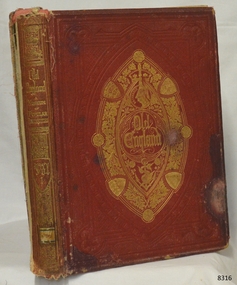 Flagstaff Hill Maritime Museum and Village
Book - Illustrated compendium of Lithographs/History, Charles Knight, Old England Vol 1, 1864
... He passionately believed that high-quality literature, history, and science should be affordable and accessible to the working and middle classes, not just the elite. Aside from Old England...He passionately believed that high-quality literature, history, and science should be affordable and accessible to the working and middle classes, not just the elite. Aside from Old England ...The full title of the work is ‘Old England: A Pictorial Museum of Regal, Ecclesiastical, Baronial, Municipal, and Popular Antiquities’. Edited by Charles Knight, this book serves as a massive, richly illustrated compendium of British social, architectural, and cultural history. It traces the development of England from prehistoric and Roman times, through the Middle Ages, and up to the 18th century.Old England Vol 1 Edited by Charles Knight Publisher: James Sangster & Co Date: 1864 Further Information: Red highly embossed hardcover with spine and lettering in gilt. Title to front cover in a egg shaped lozenge patterned in gilt. The spine has a Library label with an inscription.non-fictionThe full title of the work is ‘Old England: A Pictorial Museum of Regal, Ecclesiastical, Baronial, Municipal, and Popular Antiquities’. Edited by Charles Knight, this book serves as a massive, richly illustrated compendium of British social, architectural, and cultural history. It traces the development of England from prehistoric and Roman times, through the Middle Ages, and up to the 18th century.flagstaff hill, warrnambool, shipwrecked coast, flagstaff hill maritime museum, maritime museum, shipwreck coast, flagstaff hill maritime village, great ocean road, book, pattison collection, warrnambool library, warrnambool mechanics’ institute, ralph eric pattison, corangamite regional library service, warrnambool city librarian, mechanics’ institute library, victorian library board, warrnambool books and records, warrnambool children’s library, old england vol 1, chromolithographs -
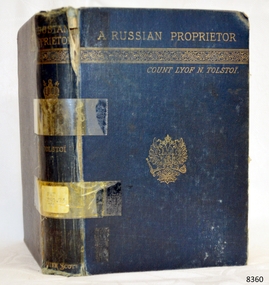 Flagstaff Hill Maritime Museum and Village
Book - Fictional Stories, Count Leo Tolstoy, A Russian Proprietor and other Stories, 1888
... England. However, Nathan Haskell Dole’s translation was actually first published a year earlier, in 1887, in New York by the publisher T.Y. Crowell. Therefore, the 1887 American edition holds the title of the true first appearance of this translation. Today, this volume is considered a respectable piece of 19th-century literature...England. However, Nathan Haskell Dole’s translation was actually first published a year earlier, in 1887, in New York by the publisher T.Y. Crowell. Therefore, the 1887 American edition holds the title of the true first appearance of this translation. Today, this volume is considered a respectable piece of 19th-century literature ...A Russian Proprietor and Other Stories is a collection of early short stories and semi-autobiographical fiction. The title story, A Russian Proprietor (originally published in Russian in 1856 as A Landlord's Morning), reflects the author's real-life experiences as a young nobleman trying to improve the lives of the serfs on his estate, only to be met with deep-seated mistrust and resistance.A Russian Proprietor and other Stories. Author: Count Lyof Tolstoy ( Leo Tolstoy) Publisher: Walter Scott Date: 1888 Translator: Nathan Haskell DolefictionA Russian Proprietor and Other Stories is a collection of early short stories and semi-autobiographical fiction. The title story, A Russian Proprietor (originally published in Russian in 1856 as A Landlord's Morning), reflects the author's real-life experiences as a young nobleman trying to improve the lives of the serfs on his estate, only to be met with deep-seated mistrust and resistance.flagstaff hil, warrnambool, flagstaff hill maritime museum, maritime museum, shipwreck coast, flagstaff hill maritime village, great ocean road, book, pattison collection, warrnambool library, warrnambool mechanics’ institute, ralph eric pattison, corangamite regional library service, warrnambool city librarian, mechanics’ institute library, victorian library board, warrnambool books and records, warrnambool children’s library, a russian proprietor and other stories, leo tolstoy -
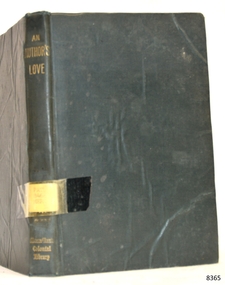 Flagstaff Hill Maritime Museum and Village
Book - A Fictional Love Story, Elizabeth Balch et al, An Authors Love, 1889
... England family based in Massachusetts and New Hampshire. As an author, she frequently wrote under the pseudonym "D.T.S." or published completely anonymously. She possessed a remarkably high-level understanding of elite European and British high society, which became the central focus of her writing. Her sudden death in 1890 at a relatively young age cut short what was shaping up to be a highly successful career in transatlantic literature...England family based in Massachusetts and New Hampshire. As an author, she frequently wrote under the pseudonym "D.T.S." or published completely anonymously. She possessed a remarkably high-level understanding of elite European and British high society, which became the central focus of her writing. Her sudden death in 1890 at a relatively young age cut short what was shaping up to be a highly successful career in transatlantic literature ...The book is an epistolary novel (a story told in letters) written by the American author Elizabeth Balch (though it was published anonymously at the time). It was written as a highly clever literary hoax and a sequel of sorts to a major 1873 French literary sensation, Lettres à une Inconnue (Letters to an Unknown) by the famous French dramatist and short-story writer Prosper Mérimée (best known as the author of the novella Carmen). Mérimée had spent over thirty years writing passionate, brilliant, and deeply personal letters to an anonymous woman (later revealed to be Jenny Dacquin). When these were published after his death, they became a massive hit, but the public only ever saw his side of the conversation. Elizabeth Balch decided to write the missing half of the romance.An Authors Love Author: Prosper Merimee's Publisher: Macmillan And Co Date: 1889 Further Information: Being the unpublished letters of Prosper Merimee's 'Inconnue'fictionThe book is an epistolary novel (a story told in letters) written by the American author Elizabeth Balch (though it was published anonymously at the time). It was written as a highly clever literary hoax and a sequel of sorts to a major 1873 French literary sensation, Lettres à une Inconnue (Letters to an Unknown) by the famous French dramatist and short-story writer Prosper Mérimée (best known as the author of the novella Carmen). Mérimée had spent over thirty years writing passionate, brilliant, and deeply personal letters to an anonymous woman (later revealed to be Jenny Dacquin). When these were published after his death, they became a massive hit, but the public only ever saw his side of the conversation. Elizabeth Balch decided to write the missing half of the romance.flagstaff hil, warrnambool, flagstaff hill maritime museum, maritime museum, shipwreck coast, flagstaff hill maritime village, great ocean road, book, pattison collection, warrnambool library, warrnambool mechanics’ institute, ralph eric pattison, corangamite regional library service, warrnambool city librarian, mechanics’ institute library, victorian library board, warrnambool books and records, warrnambool children’s library, an authors love, prosper merimees -
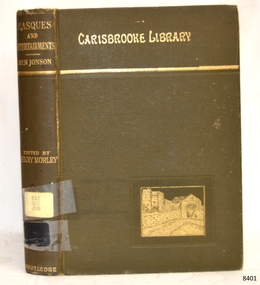 Flagstaff Hill Maritime Museum and Village
Book - Compilation of Dramatic Artistic Performances, George Routledge, Masques and Entertainments, 1890
... literature enthusiast, this volume provides an excellent window into early modern culture. It contains Morley’s historical introductions and footnotes that explain the context of King Henry VIII introducing masques to England, how Queen Anne of Denmark commissioned Jonson, and how these performances set the stage for the modern opera and ballet that we enjoy today. flagstaff hil Warrnambool flagstaff hill maritime museum maritime museum shipwreck coast flagstaff hill maritime village great ocean road book pattison collection warrnambool library warrnambool mechanics’ institute ralph eric pattison corangamite regional library service warrnambool city librarian mechanics’ institute library victorian library board warrnambool books and records warrnambool children’s library Masques and Entertainments Ben Jonson Masques and Entertainments by Ben Jonson (edited by Henry Morley and published by George Routledge & Sons in 1890) is a compilation of the dramatic courtly performances written by the legendary Renaissance playwright and poet Ben Jonson. ...Masques and Entertainments by Ben Jonson (edited by Henry Morley and published by George Routledge & Sons in 1890) is a compilation of the dramatic courtly performances written by the legendary Renaissance playwright and poet Ben Jonson. Issued as Volume IX of the popular "Carisbrooke Library" series, this specific late-Victorian edition gathered works that Jonson originally wrote in the early 17th century (between 1603 and 1630) for the courts of King James I and King Charles I.Masques and Entertainments Author: Ben Jonson Publisher: George Routledge & Sons Date: 1890fictionMasques and Entertainments by Ben Jonson (edited by Henry Morley and published by George Routledge & Sons in 1890) is a compilation of the dramatic courtly performances written by the legendary Renaissance playwright and poet Ben Jonson. Issued as Volume IX of the popular "Carisbrooke Library" series, this specific late-Victorian edition gathered works that Jonson originally wrote in the early 17th century (between 1603 and 1630) for the courts of King James I and King Charles I.flagstaff hil, warrnambool, flagstaff hill maritime museum, maritime museum, shipwreck coast, flagstaff hill maritime village, great ocean road, book, pattison collection, warrnambool library, warrnambool mechanics’ institute, ralph eric pattison, corangamite regional library service, warrnambool city librarian, mechanics’ institute library, victorian library board, warrnambool books and records, warrnambool children’s library, masques and entertainments, ben jonson -
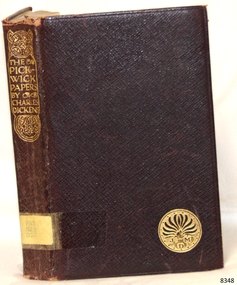 Flagstaff Hill Maritime Museum and Village
Book - A Fictional Story, Charles Dickens, The Posthumous Papers of The Pickwick Club (Pickwick Papers), 1910-1912
... England, including urbanisation, industrialisation, and a growing reading public. In literary history, it is often treated as a turning point because it helped turn Dickens into one of the central figures of Victorian literature. ...Charles Dickens (1812–1870) was one of the great English novelists of the Victorian era, famous for vivid characters, social criticism, and stories that were first published in serial form. He began as a journalist, rose to enormous popularity during his lifetime, and wrote major works such as Oliver Twist, David Copperfield, and Great Expectations. The “Pickwick Papers” is a comic novel about Samuel Pickwick and the members of his club as they travel around England, recording amusing adventures, misunderstandings, lawsuits, and mishaps.The theme gradually becomes a story about friendship, folly, and social life in early Victorian England. It is significant because it was Dickens’s first novel that helped establish his reputation, and is widely praised for its lively characters, satire, and its strong focus on the absurdities of the legal system.The Posthumous Papers of The Pickwick Club. Author: Charles Dickens. Publisher: J M Dent & Sons Ltd, London. Date: 1910-1912. (See note section this document for more information on Edition). Brown leather hardcover with title and a design on spine in gold lettering, Front has round publishers logo in gold embossing. The spine has a Library label and no Volume information.fictionCharles Dickens (1812–1870) was one of the great English novelists of the Victorian era, famous for vivid characters, social criticism, and stories that were first published in serial form. He began as a journalist, rose to enormous popularity during his lifetime, and wrote major works such as Oliver Twist, David Copperfield, and Great Expectations. The “Pickwick Papers” is a comic novel about Samuel Pickwick and the members of his club as they travel around England, recording amusing adventures, misunderstandings, lawsuits, and mishaps.The theme gradually becomes a story about friendship, folly, and social life in early Victorian England. It is significant because it was Dickens’s first novel that helped establish his reputation, and is widely praised for its lively characters, satire, and its strong focus on the absurdities of the legal system.book, the old curiosity shop, charles dickens, shipwrecked-coast, flagstaff-hill, flagstaff-hill-maritime-museum, warrnambool, maritime-museum, flagstaff-hill-maritime-village, pattison collection, warrnambool library, warrnambool mechanics’ institute, ralph eric pattison, corangamite regional library service, warrnambool city librarian, mechanics’ institute library, victorian library board, warrnambool books and records, warrnambool children’s library, great ocean road -
 City of Moorabbin Historical Society (Operating the Box Cottage Museum)
Book - Rites, Prayer Book, c1880
... Literature. Since its introduction in the sixteenth century, it has gone through many revisions, both in England and in the other countries of the Anglican Communion, but the original text is still comprehensible and relevant. ...Literature. Since its introduction in the sixteenth century, it has gone through many revisions, both in England and in the other countries of the Anglican Communion, but the original text is still comprehensible and relevant. churches anglican church prayer book brighton moorabbin pioneers early settlers rites erskine i h naughton robina THE BOOK OF / COMMON PRAYER/ and administration of the Sacrament and other / Rites and Ceremonies of The Church/ according to the use of / THE CHURCH OF ENGLAND / Together with / THE PSALTER OR PSALMS OF DAVID/ ‘I.H. ...THE BOOK OF COMMON PRAYER is one of the major works of English Literature. Since its introduction in the sixteenth century, it has gone through many revisions, both in England and in the other countries of the Anglican Communion, but the original text is still comprehensible and relevant. A small, prayer book c1880THE BOOK OF / COMMON PRAYER/ and administration of the Sacrament and other / Rites and Ceremonies of The Church/ according to the use of / THE CHURCH OF ENGLAND / Together with / THE PSALTER OR PSALMS OF DAVID/ ‘I.H. Erskine’ written churches, anglican church, prayer book, brighton, moorabbin, pioneers, early settlers, rites, erskine i h, naughton robina -
Phillip Island and District Historical Society Inc.
Book, MURDOCH, Sir Walter, Australian Citizen : an elementary account of civic rights and duties, 1912?
... Book from the Cleeland Bequest - a comprehensive collection of books relating to the History of England, Civil & Military, Religious, Intellectual & Social. league of nations civics australia juvenile literature law politics government Cleeland Bequest Labelled: Phillip Island Historical Society. ...Book from the Cleeland Bequest - a comprehensive collection of books relating to the History of England, Civil & Military, Religious, Intellectual & Social. Labelled: Phillip Island Historical Society. Cleeland Bequest. Inscribed: L. Danielson Sect C., Frank Danielson, 32 Chetwynd St., West Melbourne, Victoria.league of nations, civics, australia, juvenile literature, law, politics, government, cleeland bequest -
 Orbost & District Historical Society
book, Stanhope Sermons, 1878
... In Times Gone By - Deborah Hall) Richard Weston was the vicar at Burntwood in Staffordshire, England from 1886–1922. sermons Dicken-Frank Weston-Richard Burntwood religious-literature Inside- To Frank Dicken, in memory of Burntwood days from Vicar Richard Weston 1926 A book with a brown cloth cover. ...This book was owned by F.B. Dicken. Frank and May Dicken moved to Orbost in 1936 where Frank became manager of Pardew Brothers store in Nicholson Street. In 1945, Frank purchased the business and in 1947, formed a partnership with his son, Selwyn. The store was then called F.B. Dicken and Son. The premises are still retained by the Dicken family although the shop business was sold in 1981. (ref. In Times Gone By - Deborah Hall) Richard Weston was the vicar at Burntwood in Staffordshire, England from 1886–1922.A book with a brown cloth cover. Stanhope Sermons - second edition.Inside- To Frank Dicken, in memory of Burntwood days from Vicar Richard Weston 1926sermons dicken-frank weston-richard burntwood religious-literature -
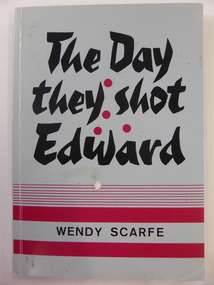 Warrnambool and District Historical Society Inc.
Book, The Day they shot Edward, 1991
... England and India. Her final teaching post was at Warrnambool High School. She has published many novels, biographies, volumes of poetry and other books dealing with social issues. This book is important because it was written by a local Warrnambool author, Wendy Scarfe. She has twice been awarded an Australian Council Literature ...This is a novella by Wendy Scarfe. She is a novelist and writer who lives in Warrnambool with her writer husband Alan Scarfe. She graduated from the University of Melbourne and Melbourne Secondary Teachers’ College and has taught in Australia, England and India. Her final teaching post was at Warrnambool High School. She has published many novels, biographies, volumes of poetry and other books dealing with social issues. This book is important because it was written by a local Warrnambool author, Wendy Scarfe. She has twice been awarded an Australian Council Literature Board Special Purpose Grant and has a fine reputation as a writer. This is a soft cover book of 120 pages. It has a light grey cover with black print and red lines on the front cover and critics’ comments in black print on the back cover. The book has a prologue and the rest of it is a novella set in World War One Australia. Signature inside first page: ‘E.Douglas 8 McKiernan Rd Warrnambool 1992’australian literature, wendy scarfe -
 Warrnambool and District Historical Society Inc.
Book, Allan Scarfe, The Dissident Guru, 2004
... He taught in India, England and Australia (including several years at Warrnambool High School) and was the joint author with his wife Wendy of 12 non-fiction books published in Australia, India, England and the U.S.A. He and Wendy were twice awarded Australia Council Literature Board grants. ...He taught in India, England and Australia (including several years at Warrnambool High School) and was the joint author with his wife Wendy of 12 non-fiction books published in Australia, India, England and the U.S.A. He and Wendy were twice awarded Australia Council Literature Board grants. ...An anti-globalisation thriller drawing on the author's experiences in India.This is a soft cover book of 328 pages. It was written by Allan Scarfe. The cover is black, grey and white and the lettering is white on the front cover and black on the spine. The front cover has an illustration of masked figures and a body and the back cover has excerpts from critics’ remarks about other Scarfe books. fictionAn anti-globalisation thriller drawing on the author's experiences in India.allan scarfe, warrnambool author -
 Warrnambool and District Historical Society Inc.
Book - Bible, Thomas Bankes, The Christian's New and Complete Family Bible, 1786
... England. The local owner of the Bible is unknown. This Bible is retained for its antiquarian interest. 18th Century literature family bible 1786 bible warrnambool bankes bible This is a family bible circa late 1700's The book has a plain brown leather cover, the front of which is scuffed, stained and completely detached from the spine. ...This is a family bible circa late 1700'sThe book has a plain brown leather cover, the front of which is scuffed, stained and completely detached from the spine. On the spine is printed Bankes's Bible, an alternative title. The pages contain text, black and white plates, images and engravings. Some of the pages are torn, others have been repaired with paste. The dedication by Thomas Bankes, a clergyman, is to his Bishop Lord James Beauclerc. All the 's' letters are written as ' f'.non-fictionThis is a family bible circa late 1700's18th century literature, family bible, 1786 bible, warrnambool, bankes bible -
 Ruyton Girls' School
Literary work - Ruyton Prize Book, Geoffrey Cumberlege Oxford University Press, The Complete Works of William Shakespeare, No date
... Often hailed as England's national poet, his surviving works comprise around 39 plays, 154 sonnets, three lengthy narrative poems, and a handful of other verses, some of which are of uncertain authorship. His plays have been translated into every major living language and are staged more frequently than those of any other playwright. Shakespeare remains arguably the most influential figure in English literature...Often hailed as England's national poet, his surviving works comprise around 39 plays, 154 sonnets, three lengthy narrative poems, and a handful of other verses, some of which are of uncertain authorship. His plays have been translated into every major living language and are staged more frequently than those of any other playwright. Shakespeare remains arguably the most influential figure in English literature ...This book contains a collection of literary works written by William Shakespeare. Shakespeare was an English playwright, poet, and actor, widely esteemed as the foremost writer in the English language and the world's premier dramatist. Often hailed as England's national poet, his surviving works comprise around 39 plays, 154 sonnets, three lengthy narrative poems, and a handful of other verses, some of which are of uncertain authorship. His plays have been translated into every major living language and are staged more frequently than those of any other playwright. Shakespeare remains arguably the most influential figure in English literature, with his works persistently reinterpreted and reimagined. Ruyton Girls' School has a long tradition of awarding prizes to students at annual "Speech Night" events. Speech Night at Ruyton is an extraordinary occasion. It is a time when we gather to celebrate both the year just lived and the contribution of our Year 12 girls to the life of our School. It is a night of stirring student speeches, acknowledgement of student endeavour and excellence and awe-inspiring performances by School choirs and ensembles. The record has strong historic significance as it was awarded to a former notable student, Helen Gordon (maiden name Cole). Helen started at Little Ruyton in Prep 1940 and finished Year 12 in 1952 as School Captain, Bromby Captain, Form Captain for Matric, Tennis Captain, Hockey Captain, Swimming Vice Captain, and an award for Best All-Round Girl. She also played baseball for Victoria. After finishing school, Helen went on to graduate from the University of Melbourne as a physiotherapist in 1956. Her first position at age 19 involved setting up clinics with the Victorian Health Department Poliomyelitis Rural division. Helen’s strong ties to Ruyton continued when she held the position of President of the Old Ruytonians’ Association from the start of 1966 to the end of 1967. In 2019, Helen received an Order of Australia Medal for service to community health as a physiotherapist. She was also the recipient of the 2022 Victorian Senior Achiever Award at Parliament House. This historic significance is further enhanced by Ruyton's bygone "Shakespeare Night" tradition. A celebration of ‘culture’, and a chance to enjoy some ‘fun and games, cakes and ale’, were the motivation behind Ruyton’s annual Shakespeare Night party, led by longstanding Principal Miss Hilda Daniell. In her book, "The History of Ruyton 1878-1956", she describes how the yearly tradition began in 1915, just two years after she took over the role of Principal. That first Shakespeare Night, the senior girls and other guests gathered in the School’s chrysanthemum-filled dining room for music, games and supper. Such fun was had that the festivities became an annual event and was one of the coveted privileges of being one of Ruyton’s older girls. The Night was always held as close and possible to April 23rd, which is the date of William Shakespeare’s death, and the approximate date of his birth. Senior girls and some staff and parents would be invited to a party in the School. There, Shakespearean songs were sung, his poetry recited, and scenes from his plays were acted. Sometimes a competition was held to see who could recognise the largest number of quotations. In other years all the attendees would dress as Shakespearean characters. In a nod to a minor character from ‘A Midsummer Night’s Dream’, Senior teacher Miss Dorothy Derham famously came disguised as a lion one time, and no one knew who it was until she dramatically removed her mask at the end of the evening. Whatever the programme, the Night always drew to a close with a delicious supper that included a spectacular birthday cake especially in honour of the Bard. (Accompanying it may have been the ‘ale’ of Miss Daniell’s description, though of course it was presumably of the ginger rather than the alcoholic variety.) The evening was complete when ‘God Save the King’ and ‘Auld Lang Syne’ were sung. Shakespeare Night was held almost without interruption from 1915 to at least the mid 1950s. Only in 1919, with the threat of Spanish Flu, did the Night get cancelled. Later, fear of Japanese invasion in the Second World War years, and the consequent black-out restrictions, turned the ‘Night’ into an afternoon event. Thankfully, Miss Daniell notes, "from 1944 the programmes could be given as usual", though as we now know, it was a School tradition that eventually faded away. The record's significance is also supported by its strong provenance, having been produced by Ruyton Girls' School and donated to the Archives by a familial connection.Navy leather hardcover bound book with gold detailing on front cover and spine. 1,164 pages.Front Cover: R / RECTE ET FIDE LITER / RUYTON / Spine: SHAKESPEARE'S / COMPLETE / WORKS / OXFORD / Inside Cover: R / RECTE ET FIDE LITER / RUYTON / PRIZE / AWARDED TO / Helen Cole / FOR / Latin / VB / H. Daniell. / 9th Dec. 1949 / Katie Alsop Memorial Prize /ruyton girls' school, school, students, prize, speech night, poetry, lord tennyson, queen victoria, senior school, high school, ruyton, old ruytonians' association
